Trintech is the best overall financial reconciliation software in 2026 for controls-heavy, multi-entity closes. BlackLine is best for large SAP-centric enterprises, and FloQast is best for mid-market teams standardizing Excel-based reconciliations. Choose by your reconciliation job first, then by company size, entity count, ERP setup and transaction volume.
Spreadsheet reconciliations break down as entities and transaction volumes grow, and sign-off evidence ends up scattered across inboxes. Buyers then risk two mistakes: buying an enterprise platform that is too much for them, or a lightweight tool they soon outgrow. Small businesses that only need bank and card reconciliation may not need a dedicated tool at all.
PlugRoute has no affiliate relationships with any company listed, and rankings are determined entirely by research data and objective evaluation criteria.
This guide ranks seven tools across four categories using a published 45-point scoring model. Every figure is labeled by source type and date. Banks and regulated institutions will find two operational matching engines, ranked separately from corporate close software.
What Are the 4 Categories of Financial Reconciliation Software?
Financial reconciliation software falls into four categories. They differ in how much matching they automate, how much close control they provide, and who buys them. Work out which category matches your reconciliation job before you compare vendors, because the categories are not interchangeable.
- Enterprise Close & Reconciliation Suite: Trintech and BlackLine combine balance-sheet reconciliation, high-volume matching, journal entry, intercompany and close controls in one record-to-report platform.
- Close Workflow Orchestrator: FloQast and Numeric structure, track and certify month-end reconciliations and checklists. FloQast sells matching as an add-on.
- Unified Finance Automation Suite: HighRadius Record to Report runs reconciliation and close on the same platform as order-to-cash, accounts payable and treasury automation.
- Operational Matching Engine: ReconArt and Duco are rules-driven platforms that match high transaction volumes across many data formats. Their main buyers are banks and regulated institutions.
Users on r/Accounting shared their experience:
“It’s fine, probably changed a lot since I used it. Definitely more of a middle market tool so if you have a simple business it probably will work well. I used it for recs and it was interesting that their mindset is to leave the rec where it is in excel and integrate to it, rather than Blackline which has the mindset of get the rec into the tool.” Posted by u/zeevenkman
Takeaway: FloQast and BlackLine take opposite approaches, with FloQast wrapping existing Excel reconciliations and BlackLine pulling the reconciliation itself into the platform.
For small businesses, the baseline is the native reconciliation in QuickBooks Online, Xero or NetSuite. Those products are ERPs or accounting platforms rather than dedicated reconciliation software, so this guide does not rank them.
Do You Need Bank Reconciliation or Full Balance-Sheet Reconciliation?
Most small businesses only need bank and card reconciliation, and the native tools in QuickBooks Online, Xero or NetSuite usually handle it. Growing companies need balance-sheet reconciliation tied to the month-end close, with reviewer sign-offs and audit evidence. Banks need operational, intraday reconciliation, which is a separate job done with separate tools.
These signs suggest a business has outgrown native reconciliation (CFO Shortlist, 2026):
- The business reconciles balance-sheet accounts other than bank accounts in spreadsheets.
- The business operates several entities or currencies.
- The business stores reviewer sign-off evidence in email.
- The business sees the same exceptions recur every month.
- The business’s auditors keep asking for the same supporting documents.
- The business’s close depends on one or two people who hold undocumented knowledge.
As one user on r/Accounting described:
“I’m now working for a company that has 3 sets of books and about 30-40 accounts each that need a viewable supporting schedule or reconciliation attached. Currently these are in 3 separate workbooks with a trial balance on the front page and a zillion tabs rolling out named the account name. It’s a challenge to even know where I am in the monthly recon process so I’m creating a checklist for myself to also keep up with.” Posted by u/malfunctiontion
Takeaway: Once a business runs several entities, spreadsheet reconciliation becomes file management, which is the point where dedicated reconciliation software starts to pay off.
The category is growing because these problems are common. The reconciliation software market was estimated at $2.53 billion in 2024 and is projected to reach $7.54 billion by 2033 (Grand View Research, 2024). APQC puts the median close at 6.4 calendar days across about 2,300 organizations (APQC, as cited by Safebooks, 2025).
Reconciling data across systems is the core pain. Leapfin’s survey of finance teams found the following (Leapfin, 2025):
- 28% of respondents named reconciling data across systems as the manual task they most want to eliminate.
- 73% of respondents said the business is growing faster than finance can keep up.
- 23% of respondents named data quality as the top barrier to automation.
“Blackline & Trintech are great, but mainly for large enterprise… unless you’ve got a ton of entities & over $100M revenue – it’s pretty hard to justify anything other than Floqast.” (u/thefamousmutt, Reddit r/Accounting, 2026)
Takeaway: Practitioners informally use entity count and revenue of roughly $100M to separate mid-market close tools from enterprise suites. Treat this as a rule of thumb, not a ranking factor.
Bank reconciliation and corporate close reconciliation are different jobs with different controls (Workisy, 2026):
- Corporate close: Corporate teams perform balance sheet substantiation and subledger-to-GL account reconciliation for month-end financial statements, with SOX 404 preparer/reviewer certification.
- Bank operations: Banks reconcile continuously or intraday across nostro accounts, securities, payments, cards and the core banking ledger, under strict break-aging and escalation rules.
How Do the Top Financial Reconciliation Software Tools Compare at a Glance?
For corporate close, Trintech (39.5/45), BlackLine (39.0) and FloQast (36.5) lead PlugRoute’s 2026 ranking. HighRadius and Numeric fit narrower cases: cash-heavy businesses and lean NetSuite teams. ReconArt and Duco serve banks and regulated institutions. The table summarizes each tool’s category, fit, strength and main limitation.
| Rank (Score /45) | Company | Category | Best For | One-Line Summary | Key Capabilities | Primary Strength | Key Limitation |
|---|---|---|---|---|---|---|---|
| 1 (39.5) | Trintech (Cadency + Adra) | Enterprise Close & Reconciliation Suite | Controls-heavy multi-entity closes; mid-market via Adra | Trintech is the best-evidenced reconciliation platform for controls-heavy, multi-entity closes in 2026. | 3- and 4-way matching, risk-based certification, intercompany (Cadency) | Named scale references (HPE, Boston Scientific, H&R Block) | Moving from Adra to Cadency can mean reimplementing |
| 2 (39.0) | BlackLine | Enterprise Close & Reconciliation Suite | Large SAP-centric, multi-entity enterprises | BlackLine offers the broadest close and reconciliation module set of the seven tools reviewed in 2026. | Many-to-many matching, journals, intercompany, Verity AI | Broadest module set; 1,070 G2 reviews | ~6-month implementation; ownership uncertainty |
| 3 (36.5) | FloQast | Close Workflow Orchestrator | Mid-market teams reconciling in Excel | FloQast is the most widely reviewed close management platform in 2026. | Excel-linked recs, sign-offs, flux, AutoRec add-on | Largest G2 review base (~1,417) | Organizes work more than it automates it |
| 4 (33.5) | HighRadius Record to Report | Unified Finance Automation Suite | High-volume cash and receivables businesses | HighRadius Record to Report links reconciliation to order-to-cash data on one platform. | Bank matching, 50+ ERP connectors, LiveCube | Vendor-reported ~99% matching at Konica Minolta | R2R line less mature than order-to-cash |
| 5 (33.0) | Numeric | Close Workflow Orchestrator | Lean NetSuite teams | Numeric is the best-value AI-native close platform for NetSuite teams in 2026. | Live NetSuite transaction sync, AI flux, Monitors | ~$15K/year Vendr median; under 1 month to implement | Deep sync and write-back on NetSuite only |
| 6 (27.0) | ReconArt | Operational Matching Engine | Mid-sized banks and credit unions | ReconArt is a configurable matching engine with optional on-premise deployment. | Fuzzy matching, BAI/SWIFT/ISO 20022, certification | Cloud or on-premise; banking formats | Lowest G2 rating (3.6/5 from 5 reviews) |
| 7 (25.0) | Duco | Operational Matching Engine | Tier-1 banks and capital markets | Duco is a no-code operational reconciliation platform built for very high data volumes. | Multi-pass matching, IDP, agentic rule building | Strongest vendor-documented bank outcomes | Not a close tool; only 3 G2 reviews |
Which Financial Reconciliation Software Should I Choose for My Situation?
Start from your top priority. Small businesses that only need bank and card reconciliation can usually stay with QuickBooks Online, Xero or NetSuite. Lean NetSuite teams should start with Numeric. Excel-heavy mid-market teams should start with FloQast or Trintech Adra, multi-entity enterprises with Trintech Cadency or BlackLine, and banks with ReconArt or Duco.
| Your #1 Priority | Recommended Tool | Why | Acceptable Alternative |
|---|---|---|---|
| Bank and card reconciliation only (small business) | Native QuickBooks Online, Xero or NetSuite | The seven ranked tools rarely justify their cost when the only need is bank and card reconciliation | Numeric or FloQast, once non-bank balance-sheet recs move into spreadsheets |
| Startup or lean NetSuite team | Numeric | Transaction-level NetSuite sync at a ~$15K/year Vendr median | FloQast |
| Mid-market, 1–10 entities, Excel-heavy | FloQast | Keeps existing workbooks; ~2-month implementation | Trintech Adra |
| High-volume matching across systems | Trintech or BlackLine (tied on matching depth, C2 = 5) | Both support many-to-many matching with tolerances; Trintech has named high-volume references (H&R Block peaks above 1M card transactions/month) | HighRadius (cash-heavy), Duco (bank operations) |
| Enterprise, many entities, mixed ERPs, heavy controls | Trintech Cadency | Risk-based certification and named scale references | BlackLine |
| Heavy receivables and cash volume | HighRadius Record to Report | Connects cash application to the close | Trintech |
| Mid-sized bank, credit union or on-premise need | ReconArt | Banking formats plus on-premise deployment | Duco |
| Tier-1 bank or capital markets | Duco, plus a close tool for certification | Volume-priced operational matching | ReconArt |
Entity count and ERP give a quick first filter:
- A single-entity NetSuite team should start with Numeric or FloQast.
- A team with 2–10 entities on NetSuite or Sage Intacct should start with FloQast or Trintech Adra.
- An organization with 10+ entities or a mix of SAP and Oracle ERPs should start with Trintech Cadency or BlackLine.
- A team on Dynamics or Oracle Fusion should confirm connector depth with every vendor. Coverage for those ERPs is uneven across the tools in this review (October 2026).
What Are the Best Financial Reconciliation Software Tools in 2026, Ranked?
Ranked by evidence, the best financial reconciliation software tools in 2026 are:
- Trintech
- BlackLine
- FloQast
- HighRadius Record to Report
- Numeric
- ReconArt
- Duco
Each entry uses the same structure. Every figure is labeled by source type: independent review platform, vendor-reported, procurement data, user-reported or competitor-authored. Full pricing evidence is in the cost section.
1. Trintech (Cadency and Adra): Best Overall for Complex, Controls-Heavy Close, with a Mid-Market On-Ramp (Adra)

Category: Enterprise Close & Reconciliation Suite. These are full record-to-report platforms combining balance-sheet reconciliation, high-volume matching, journals and close controls.
At a Glance
- Category: Enterprise Close & Reconciliation Suite
- Best For: Multi-entity, multi-ERP organizations with heavy SOX requirements (Cadency), and cost-conscious mid-market teams (Adra)
- Price Range: Adra ~$30K–$100K/year; Cadency ~$300K–$1M+/year plus implementation (third-party estimates, 2026)
- Primary Strength: Trintech has the strongest named, quantified enterprise scale references in this review, including 29,000+ accounts in Cadency at Boston Scientific.
- Biggest Limitation: Trintech’s Adra and Cadency are separate products, so moving up from Adra to Cadency can amount to a full reimplementation.
- One-Line Summary: Trintech is the best-evidenced reconciliation platform for controls-heavy, multi-entity closes in 2026, with Adra serving mid-market teams and Cadency serving global enterprises.
- Last Verified: October 2026
Overview
Trintech is a financial close and reconciliation vendor with two product lines: Trintech Cadency for global enterprises and Trintech Adra for mid-market teams. Both serve finance organizations that need high-volume matching, balance-sheet certification and risk-based close controls across many entities and ERPs.
Trintech was founded in 1987 and acquired Adra Software in 2017 (ERP Research, 2026). Buyers should treat Trintech Adra and Trintech Cadency as separate purchases, each with its own implementation, timeline and price.
Key Features
- Trintech Adra Matcher supports 3- and 4-way transaction matching across bank, card and point-of-sale data with configurable rules.
- Trintech Adra Balancer handles balance-sheet reconciliations with ERP connectivity, audit trails and support for spreadsheet-based workflows.
- Trintech Cadency adds intercompany, journal entry, risk and compliance modules, and an audit binder for enterprise record-to-report processes.
- Trintech’s risk-intelligent close scales review effort to each account’s risk rating, including auto-certification of low-risk accounts.
- Trintech Adra Analytics connects reconciliation data to Power BI, Tableau and OData, and Trintech added a Journal Entry module to Adra in April 2025.
Best For
Trintech Cadency fits global, multi-ERP companies with dozens of entities and strict compliance requirements. Trintech Adra fits mid-market teams that need matching and balance-sheet reconciliation without enterprise-scale spend.
Strengths
- Trintech Cadency runs 29,000+ accounts at Boston Scientific across 93 entities in 53 countries, with 4,400+ auto-reconciled (Trintech case study, captured October 2026).
- Trintech Cadency supports roughly 25,000 reconciliation accounts at HPE (CFO Shortlist, 2026). H&R Block reconciles more than 1 million credit-card transactions a month at peak season, against about 200,000 in a normal month (Trintech, 2026).
- Trintech holds a G2 rating of about 4.5/5 from roughly 555 reviews, mostly for Adra, and a Gartner Peer Insights rating of 4.4/5 from 116 reviews of unclear product scope (G2 and Gartner, captured October 2026).
- Trintech Adra implementations typically take about 1–3 months, against about 4–6 months for Trintech Cadency (Phacet Labs, 2026).
Limitations
Trintech’s two-product structure has a cost: there is no single upgrade path. Trintech Adra lacks a standalone intercompany module, so moving up to Trintech Cadency can amount to a full reimplementation rather than an upgrade (CFO Shortlist, 2026).
- Trintech reviewers cite a dated interface, rigid configuration and heavy implementation effort (G2, 2026).
- Trintech Adra stalled partway through one team’s rollout. Task Manager went live quickly, but Matcher still could not handle the team’s bank recs, and Adra does not push entries to Oracle (Reddit r/Accounting, user-reported, 2025).
- Trintech’s H&R Block volume is a peak-season figure, so it says less about sustained throughput than the headline number suggests (Trintech, 2026).
- Trintech’s claims of 70% less matching time and 60% shorter closes are vendor-reported and not tied to named customers. Trintech’s SOC attestations were not verified for this review.
Users on r/Accounting noted:
“We went with Adra, which as been……Fine. We got the task manager up and running quickly, which is to be expected, but everything else is dragging. We still can’t get matcher to handle our bank recs and until that’s done, we’re holding on getting balancer (reconciliations) going.” Posted by u/KidGorgeous19
Takeaway: Trintech Adra can stall after its easiest module goes live, so mid-market buyers should confirm that Matcher handles their own bank data before they sign.
Verdict
Trintech ranks first in PlugRoute’s 2026 ranking at 39.5/45. It pairs top-scoring matching and risk-based close controls with the strongest named, quantified scale evidence of any close vendor reviewed.
Trintech leads BlackLine by only 0.5 points, so a change in verified evidence could flip the top spot. Mid-market buyers should test Trintech Adra Matcher on their own bank data in a proof of concept. Enterprises should budget for a multi-month Trintech Cadency rollout. Oracle users should see journal write-back work in a live demo.
2. BlackLine: Best for Large Enterprises Needing the Broadest Close Suite (Especially SAP Environments)

Category: Enterprise Close & Reconciliation Suite. These are full record-to-report platforms combining balance-sheet reconciliation, high-volume matching, journals and close controls.
At a Glance
- Category: Enterprise Close & Reconciliation Suite
- Best For: Large enterprises with many entities, mixed ERPs (especially SAP) and complex journal and intercompany workflows
- Price Range: Quote-based; third-party estimates ~$17.5K–$340K/year (average ~$77K) plus implementation (2026)
- Primary Strength: BlackLine offers the broadest close and reconciliation module set in this review, backed by 1,070 G2 reviews.
- Biggest Limitation: BlackLine typically takes about six months to implement, and its ownership is uncertain after a reported June 2025 SAP approach and 2026 activist pressure.
- One-Line Summary: BlackLine offers the broadest close and reconciliation module set of the seven tools reviewed in 2026. It suits large multi-entity organizations that can absorb a six-month implementation and premium pricing.
- Last Verified: October 2026
Overview
BlackLine is an end-to-end financial close platform covering account reconciliation, high-volume transaction matching, journal entry, intercompany and close management. BlackLine is built for large enterprises with many entities and complex ERP environments that need strong preparer/reviewer controls.
BlackLine was founded in 2001 and went public in 2016 (NASDAQ: BL) (BlackLine 10-K, 2025). BlackLine is sold module by module, so total cost depends heavily on scope.
Key Features
- BlackLine Transaction Matching supports 1:1, 1:many and many:many matching with configurable tolerances for high-volume data.
- BlackLine Account Reconciliations centralizes balance-sheet substantiation with preparer/reviewer workflow and a full audit trail.
- BlackLine Journal Entry and Intercompany modules add intercompany netting and eliminations to the wider record-to-report process.
- BlackLine’s Verity AI layer targets agent-based automation of judgment-heavy accounting work. BlackLine extended it by acquiring WiseLayer on December 15, 2025, for about $23.7 million (BlackLine investor filing, 2025).
- BlackLine Task Management and variance analysis show controllers close status across entities.
Best For
BlackLine fits SAP-centric enterprises and other large organizations with many entities, mixed ERPs and complex journal and intercompany needs. Practitioners suggest BlackLine is easier to justify once revenue is well above roughly $100M (Reddit r/Accounting, 2026).
Strengths
- BlackLine holds a G2 rating of 4.5/5 from 1,070 reviews (G2, captured October 2026) and a vendor-cited TrustRadius score of 8.9/10 from 430+ reviews (BlackLine, 2026).
- BlackLine reports more than 4,300 customers, the largest installed base among the dedicated close vendors in this review (BlackLine, vendor-reported, 2026).
- BlackLine’s auto-match engine cleared 80% of one user’s Shopify payout lines before human review (Reddit r/Accounting, user-reported, 2025).
- BlackLine users describe the platform as well organized and “very easy to use” once implemented, and G2 reviewers praise its audit trail and ERP connectivity (Reddit r/Accounting, 2025; G2, 2026).
Limitations
BlackLine’s breadth comes at the cost of implementation speed. Typical BlackLine rollouts take about six months, against about two for FloQast, so buyers wait longer for value (Pilot Meridian, citing G2 data, 2026).
- BlackLine’s ownership is unsettled. SAP reportedly made a $66/share approach in June 2025, which BlackLine rejected, and Engaged Capital nominated directors for the 2026 annual meeting (CNBC, January 2026).
- BlackLine reviewers cite configuration complexity, a learning curve and cost. One practitioner calls BlackLine’s journals capability “far too complex for smaller companies” (Reddit r/Accounting, 2026).
- BlackLine returned no named, quantified customer outcomes in our research, and BlackLine’s SOC attestations were not verified for this review.
This aligns with community sentiment on r/Accounting:
“Recently switched from Blackline to FloQast and am pleased with the transition. Much cleaner UI, better integration with excel + sharepoint, and easier to manage. Blackline seems more geared to larger organizations and they didn’t bothered to improve their atrocious UI in the 5 years we were on it.” Posted by u/Razoc
Takeaway: BlackLine’s dated interface and enterprise orientation push some smaller teams to leave it for lighter close tools, even after years on the platform.
Verdict
BlackLine offers the broadest close and reconciliation module set of the seven tools PlugRoute reviewed in 2026. Its roughly six-month implementation and unresolved ownership leave it 0.5 points behind Trintech, at 39.0/45.
BlackLine would rank first, at 40.0, if verified named customer outcomes raised its outcomes score from 3.5 to 4.5. Large SAP-centric or multi-entity organizations should shortlist BlackLine, ask for references with a similar ERP and entity count, and negotiate change-of-control protections.
3. FloQast: Best for Mid-Market Teams Standardizing an Excel-Based Close
Category: Close Workflow Orchestrator. These platforms structure, track and certify month-end reconciliations and checklists. FloQast sells matching as an add-on.
At a Glance
- Category: Close Workflow Orchestrator
- Best For: Mid-market accounting teams on NetSuite or Sage Intacct who reconcile in Excel
- Price Range: Quote-based; Vendr median ~$24.5K/year (range ~$10K–$69K), add-ons extra (2026)
- Primary Strength: FloQast has the largest verified user review base in the category, with a G2 rating of 4.6/5 from roughly 1,417 reviews.
- Biggest Limitation: FloQast organizes reconciliation work more than it removes it, and FloQast’s matching is weaker than enterprise suites at very high volumes.
- One-Line Summary: FloQast is the most widely reviewed close management platform in 2026. It is best for mid-market teams that want to standardize Excel-based reconciliations with sign-offs and audit evidence rather than replace them.
- Last Verified: October 2026
Overview
FloQast is a close management platform that links a team’s existing Excel and Google Sheets reconciliation workbooks to general-ledger balances. FloQast is built for mid-market teams that want checklists, sign-offs, flux analysis and audit evidence in one place without abandoning spreadsheets.
FloQast sells AutoRec as an add-on for AI-assisted matching. Buyers who need high-volume matching should price and test FloQast AutoRec separately.
Key Features
- FloQast links reconciliation workbooks to GL balances and rolls folders and reconciliation files forward every month.
- FloQast AutoRec, an add-on module, provides AI-assisted 1:1, 1:many and many:many transaction matching.
- FloQast includes close checklists, in-app preparer/reviewer sign-offs and flux analysis.
- FloQast offers SOX compliance and AI Agent modules that extend the platform into controls documentation.
- FloQast integrates with NetSuite, Sage Intacct, QuickBooks, Microsoft Dynamics and SAP.
Best For
FloQast fits mid-market accounting teams that already reconcile in Excel, have a modest entity count, and value fast implementation over deep matching automation. One practitioner says FloQast suits companies of roughly 150+ people better than smaller ones (Reddit r/Accounting, 2026).
Strengths
- FloQast holds a G2 rating of 4.6/5 from roughly 1,417 reviews, the largest footprint in the category, plus a Capterra rating of 4.9/5 from 106 reviews (G2 and Capterra, captured October 2026).
- FloQast AutoRec cut a CHG Healthcare accounting manager’s monthly bank reconciliation time from 38 hours to 16 (FloQast case study, vendor-reported, captured October 2026).
- FloQast implementations take about two months, against about six for BlackLine (Pilot Meridian, citing G2 data, 2026).
- FloQast cut one customer’s close from 10 days to 8 (FloQast reviews page, vendor-curated, captured October 2026). A paying customer called FloQast “simple, easy to implement” (Reddit r/Accounting, 2024).
Limitations
FloQast gives up automation depth in exchange for spreadsheet familiarity. One Reddit user called FloQast “a workflow / glorified spreadsheet,” and that team chose BlackLine for more automation (Reddit r/Accounting, 2024).
- FloQast pulls balance-level data more readily than transaction-level detail, so users still drill into the ERP (CFO Shortlist, 2026).
- FloQast’s matching is weaker than BlackLine’s or Trintech’s at very high volumes, its flux commentary is still partly manual, and FloQast is not a consolidation tool (CFO Shortlist, 2026).
- FloQast reviewers report limited reporting and customization and slower refresh at peak times (G2, 2026).
- FloQast’s SOC attestations were not verified for this review. We excluded one pro-FloQast Reddit comment because the commenter was flagged as a likely employee.
Users on r/Accounting shared their experience:
“It seems fine for tracking tasks and manual reconciliations. My coworkers tried to utilize it for an automated bank rec on our main bank account and it would not work. Probably too much activity for it to handle. We used to use excel to track tasks so it’s a step up there but not sure the cost outweighs the benefits.” Posted by u/infiniti30
Takeaway: FloQast improves on Excel task tracking, but its automated matching can fail on high-activity bank accounts, which leaves its cost hard to justify for some teams.
Verdict
Among the leaders in PlugRoute’s 2026 ranking, FloQast is the most widely reviewed and fastest to implement, but it organizes reconciliation work more than it automates it.
FloQast scores 36.5/45. It leads every vendor on review evidence (5) but scores 3 on matching depth, which accounts for its gap to the top two. Excel-heavy mid-market teams should shortlist FloQast. Teams whose main problem is high-volume matching should test AutoRec on their own data.
4. HighRadius (Record to Report): Best for High-Volume Cash and Receivables Businesses Linking Order-to-Cash to the Close
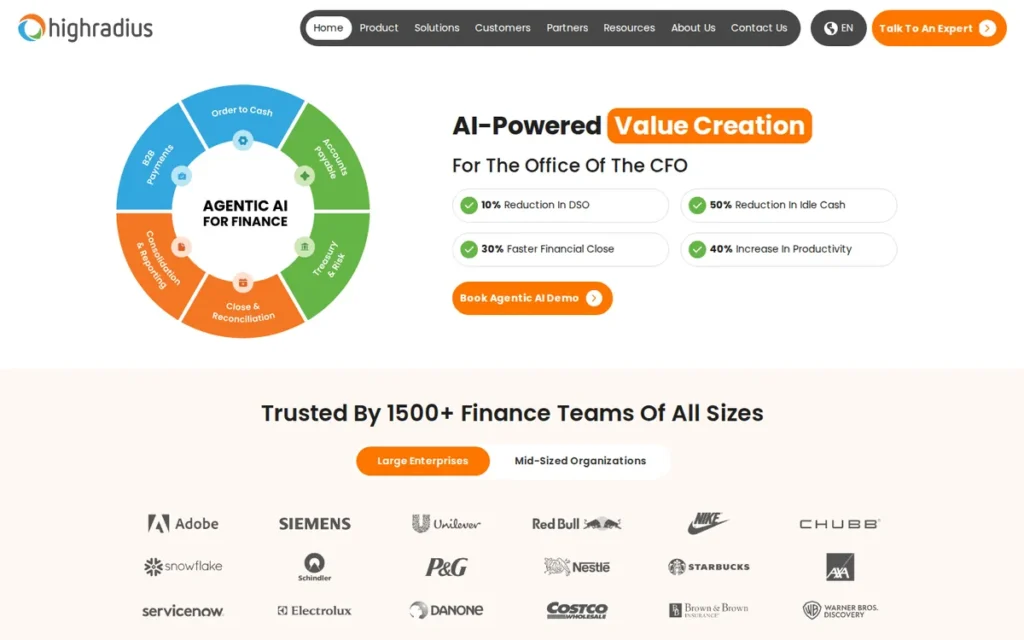
Category: Unified Finance Automation Suite. These platforms combine reconciliation and close with order-to-cash, AP and treasury automation on shared data.
At a Glance
- Category: Unified Finance Automation Suite
- Best For: Upper mid-market and enterprise businesses with heavy cash, receivables and bank transaction volume across multiple ERPs
- Price Range: Quote-based; typically six figures/year, seven figures for multi-module enterprise programs (2026)
- Primary Strength: HighRadius connects order-to-cash and cash-application data to reconciliation and close. HighRadius reports that Konica Minolta automated nearly 99% of its monthly line items (vendor-reported).
- Biggest Limitation: HighRadius’s Record to Report line is less proven than its order-to-cash products, and its R2R-specific review evidence is thin and partly unverified.
- One-Line Summary: HighRadius Record to Report is the best-fit 2026 option in this review for high-volume cash and receivables businesses that want reconciliation connected to order-to-cash. Buyers should validate its less mature close capabilities in a proof of concept.
- Last Verified: October 2026
Overview
HighRadius Record to Report is an AI-driven reconciliation and close suite covering account reconciliation, bank matching, journal entry, intercompany and anomaly management. HighRadius Record to Report is built for high-volume businesses that want their close connected to order-to-cash data.
HighRadius is headquartered in Houston and is best known for order-to-cash software. Buyers should evaluate the HighRadius Record to Report products on their own evidence, not on that reputation.
Key Features
- HighRadius Record to Report automates bank reconciliation and transaction matching with AI-based rules and automated journal generation.
- HighRadius states that it connects to 50+ ERPs, including SAP, Oracle, NetSuite, Dynamics, Workday, Sage Intacct and QuickBooks, and to 100+ banks.
- HighRadius LiveCube provides a no-code, Excel-like workspace for building reconciliation and analysis logic.
- HighRadius includes anomaly management, intercompany and close management modules alongside AI agents.
- HighRadius runs order-to-cash, AP, treasury and record-to-report on one platform, so cash-application data flows into the close.
Best For
HighRadius Record to Report fits businesses with high receivables and bank transaction volume that run several ERPs and want matching tied to cash application. Existing HighRadius order-to-cash customers gain the most from the shared platform.
Strengths
- HighRadius reports that Konica Minolta automated nearly 99% of more than 45,000 monthly line items (HighRadius/BusinessWire, vendor-reported, April 2025).
- HighRadius reports that a large hotel chain reached 97% automated bank reconciliation, and cites 95% auto-match as a general product benchmark (HighRadius, vendor-reported, 2026).
- HighRadius was named a Challenger in the 2025 Gartner Magic Quadrant for Financial Close and Consolidation Solutions (HighRadius/BusinessWire, April 2025).
- HighRadius claims the broadest stated connectivity in this review (HighRadius, 2026). HighRadius holds a TrustRadius rating of 4.4/5 from 73 reviews (TrustRadius, captured October 2026).
Limitations
HighRadius gives up close maturity in exchange for platform breadth. Third-party sources repeatedly describe the HighRadius Record to Report products as less mature than its order-to-cash line (bluecopa, competitor-authored, 2026).
- HighRadius’s R2R review evidence is thin. Its G2 rating of ~4.3/5 has an unverified review count, and we excluded the widely quoted 837-review Gartner rating because it likely covers HighRadius’s AR products.
- HighRadius’s 95% auto-match figure is a general product claim that is not tied to a named customer. We gave Trintech’s 70%/60% claims the same treatment.
- HighRadius users report data-upload delays and rigid sequencing (G2, 2026), and a reviewer cites implementation problems and poor support (Gartner Peer Insights, captured October 2026).
- HighRadius’s customer-count claims conflict. We excluded HighRadius-positive Reddit posts from a likely promotional account, and HighRadius’s SOC attestations were not verified.
Verdict
In PlugRoute’s 2026 ranking, HighRadius Record to Report is the best fit for high-volume cash and receivables businesses that want reconciliation tied to order-to-cash. Its close capabilities are less proven than the leaders’.
HighRadius scores 33.5/45. It edges Numeric by 0.5 points on matching breadth (4.5 vs 3.5) and ERP coverage (4.5 vs 2). Buyers should run a proof of concept on their own bank and receivables data and ask for R2R-specific reference customers.
5. Numeric: Best for Lean, Tech-Forward NetSuite Teams on a Budget

Category: Close Workflow Orchestrator. These platforms structure, track and certify month-end reconciliations and checklists. Numeric builds in AI-native flux analysis and cash matching.
At a Glance
- Category: Close Workflow Orchestrator
- Best For: Startups and lean, tech-forward mid-market finance teams running NetSuite
- Price Range: From ~$30/user/month entry tier (may be retired; verify live); Vendr median ~$15K/year; Growth/Enterprise custom (2026)
- Primary Strength: Numeric combines live transaction-level NetSuite sync with the lowest verified median cost and fastest implementation in this review.
- Biggest Limitation: Numeric supports deep transaction-level sync and journal write-back only for NetSuite, which limits it for SAP, Oracle Fusion or Dynamics users.
- One-Line Summary: Numeric is the best-value AI-native close platform for lean NetSuite teams in 2026, with a median cost near $15,000 a year and implementations under a month. Its ERP coverage beyond NetSuite is narrow.
- Last Verified: October 2026
Overview
Numeric is an AI-native month-end close platform covering checklists, reconciliations, cash matching, AI-generated flux explanations and continuous anomaly monitoring. Numeric is built for startups and lean NetSuite teams that want transaction-level visibility without exporting data from the ERP.
Numeric was founded in 2020 and has raised about $89 million, including a $51 million Series B led by IVP (Numeric/PR Newswire, November 19, 2025). Numeric’s 2020 founding makes it the youngest vendor in this ranking.
Key Features
- Numeric syncs transaction-level data from NetSuite in near real time, so reviewers can drill into individual transactions in the app.
- Numeric provides cash matching with an auto-match rate above 90% (Numeric, vendor-reported, 2026).
- Numeric generates AI-written flux explanations to reduce manual variance commentary.
- Numeric Monitors send continuous alerts on account anomalies between closes.
- Numeric writes journal entries back to NetSuite. Its connections to QuickBooks Online, Xero, Sage Intacct and Workday are more limited, often at trial-balance level.
Best For
Numeric fits startups and lean NetSuite-based finance teams that want fast implementation, AI-assisted close workflows and predictable cost. Numeric is a weaker fit for companies planning to move to SAP, Oracle Fusion or Dynamics.
Strengths
- Numeric reports that Brex raised its automated cash-matching rate from about 30% to more than 90%, removing several days of manual reconciliation work each month (PR Newswire, vendor-reported, November 2025).
- Numeric holds a G2 rating of about 4.8/5 from 65+ reviews, with sub-scores of 9.7/10 for Ease of Use and 9.9/10 for Quality of Support (G2, captured October 2026).
- Numeric’s Vendr median of ~$15,000/year is the lowest verified cost among the close platforms reviewed, and Numeric implementations take under a month (Vendr, 2026; Pilot Meridian, 2026).
- Numeric reports SOC 2 Type II certification and also claims SOC 1 Type II. These are the only vendor-stated SOC reports found in this research, though a trust-center review for this article confirmed neither (Numeric, 2026).
Limitations
Numeric gives up ERP breadth in exchange for NetSuite depth. Numeric’s transaction-level sync and journal write-back work with NetSuite only, and one user notes “they don’t support Dynamics” (Reddit r/Accounting, user-reported, 2025).
- Numeric’s G2 review base of about 65 is a small fraction of the leaders’, so Numeric’s high ratings rest on a small sample.
- Numeric reviewers report occasional peak-time slowdowns and friction with advanced workflows (G2, 2026).
- Numeric has the least enterprise track record here. Numeric’s $30 entry tier may be retired, which would weaken its public-price advantage.
- Numeric’s SOC 1 Type II report could not be independently confirmed. We excluded several Reddit comparisons with FloQast because the accounts may have competitor ties.
Verdict
In PlugRoute’s 2026 ranking, Numeric offers the best price-to-value for lean NetSuite teams. Its NetSuite-only depth and short track record keep it out of the top tier.
Numeric scores 33.0/45. It would still rank fifth, at 31.0, if its pricing score fell to 4 and its controls score to 3.5. NetSuite-based teams should demo Numeric alongside FloQast. Companies on other ERPs should confirm integration depth before shortlisting Numeric.
6. ReconArt: Best for Mid-Sized Banks and Credit Unions Needing Configurable Matching and On-Premise Deployment
Category: Operational Matching Engine. These rules-driven platforms match high transaction volumes across many data sources and formats. ReconArt adds close certification.
At a Glance
- Category: Operational Matching Engine
- Best For: Mid-sized banks, credit unions and organizations with varied data formats or on-premise/data-residency requirements
- Price Range: ~$300/user/month or ~$1,500–$3,000/month for Essentials/Plus editions; Enterprise custom (third-party, 2026)
- Primary Strength: ReconArt combines rules-based, fuzzy and similarity matching across banking formats (BAI, SWIFT MT, ISO 20022) with optional on-premise deployment, which is uncommon among the vendors reviewed.
- Biggest Limitation: ReconArt has the lowest G2 rating in this review: 3.6/5 from only five reviews.
- One-Line Summary: ReconArt is a configurable reconciliation engine for mid-sized banks and credit unions in 2026. It stands out for on-premise deployment and banking-format support but has very little independent review evidence.
- Last Verified: October 2026
Overview
ReconArt is a reconciliation platform that matches bank, card, payment, GL, intercompany and securities transactions in almost any data format. ReconArt is built for mid-sized banks, credit unions and finance teams that need configurable rules and a choice of cloud or on-premise deployment.
ReconArt has focused on reconciliation since 2011 (ERP Research, 2026). Corporate accountants rarely mention ReconArt on Reddit, and there is little independent evidence about ReconArt.
Key Features
- ReconArt supports rules-based 1:1, 1:many and many:many matching plus fuzzy and similarity matching.
- ReconArt ingests BAI, ACH, SWIFT MT and ISO 20022 camt.053 files alongside other data formats.
- ReconArt can be deployed in the cloud or on-premise to meet data-residency requirements.
- ReconArt adds balance-sheet certification, journal approvals and close task management to its matching engine.
- ReconArt IntelliDoc applies OCR to extract data from documents for reconciliation.
Best For
ReconArt fits mid-sized banks, credit unions and finance teams that have varied data formats, reconcile bank accounts daily across branches, or must keep reconciliation data on-premise.
Strengths
- ReconArt supports daily bank reconciliation across 27 branches at Progressive Credit Kenya (bluecopa, competitor-authored, 2026; confirm with ReconArt).
- ReconArt is one of the few vendors in this review offering both cloud and on-premise deployment (ERP Research and Capterra, 2026).
- ReconArt’s third-party price points of ~$1,500–$3,000/month are the most visible SMB and mid-market figures in this review (FeaturedCustomers, 2026).
- ReconArt lists securities, trades and positions among its supported reconciliation types. The corporate close tools in this review do not list these (ERP Research, 2026).
Limitations
ReconArt gives up usability and evidence in exchange for configurability. ReconArt has the lowest G2 rating in this review, and reviewers call its match rules “too complex,” its implementation support “insufficient,” and mistaken clearings hard to reverse (G2, captured October 2026).
- ReconArt’s aggregator-reported Capterra (4.9/106) and Gartner (4.7/114) figures nearly duplicate FloQast’s, so we excluded them as likely misattributed.
- ReconArt’s interface is described as dated and “potentially intimidating for beginners” (Nerdisa, 2026).
- ReconArt has no verified named, quantified customer outcomes, and its “millions of transactions per minute” claim is unverified.
- ReconArt’s headquarters, headcount and SOC attestations could not be confirmed for this review.
Verdict
ReconArt is a credible, configurable matching option for mid-sized banks and credit unions in 2026. It also has the lowest G2 rating and one of the thinnest evidence bases in PlugRoute’s ranking.
ReconArt scores 27.0/45. It outranks Duco because it adds balance-sheet certification and close tasks (controls 3.5 vs 1). Institutions that need on-premise deployment should shortlist ReconArt and insist on peer references and a proof of concept using their own files.
7. Duco: Best for Tier-1 Banks and Capital Markets Running Operational Data Reconciliation
Category: Operational Matching Engine. These rules-driven platforms match high transaction volumes across many data sources and formats. Duco serves bank and capital-markets operations rather than the month-end close.
At a Glance
- Category: Operational Matching Engine
- Best For: Tier-1 banks, asset managers, brokers and custodians reconciling high-volume operational data continuously or intraday
- Price Range: From $80,000/year (AWS Marketplace, 100K daily records); typical contracts ~$52K–$281K/year (third-party, 2026)
- Primary Strength: Duco has the strongest vendor-documented operational-reconciliation outcomes in this review, including a global bank cutting its reconciliation count from 1,100 to 500.
- Biggest Limitation: Duco is not a close-management tool and has only three G2 reviews (3.8/5), with no Capterra or Gartner Peer Insights rating found.
- One-Line Summary: Duco is a no-code operational reconciliation platform for banks and capital-markets firms in 2026, built for very high data volumes rather than corporate month-end close certification.
- Last Verified: October 2026
Overview
Duco is a cloud-only, no-code operational and data reconciliation platform for banks, asset managers, brokers and custodians. Duco matches very high volumes of structured and unstructured data, and it works outside the corporate month-end close.
Duco matches data using tolerances, fuzzy logic and multi-pass rules, and Duco claims capacity of up to one billion transactions per day. Duco lacks preparer/reviewer close workflows, so institutions typically pair Duco with a close tool (Bank Automation, 2026).
Key Features
- Duco matches any data format using tolerances, roll-ups, fuzzy logic and multiple passes.
- Duco’s Adaptive Intelligence workspace lets users describe a reconciliation in plain language while AI agents build rules and track match-rate drift.
- Duco Intelligent Document Processing extracts data from unstructured documents for reconciliation.
- Duco prices by daily record volume rather than per user.
- Duco ingests data through generic file and API connections rather than certified ERP connectors.
Best For
Duco fits regulated institutions in three situations:
- Duco fits tier-1 banks reconciling nostro and cash data intraday.
- Duco fits capital-markets firms reconciling securities and trade data.
- Duco fits operations teams that want business users to build reconciliations without code.
Strengths
- Duco helped a global tier-one bank cut its reconciliations from 1,100 to 500, automate 200 manual processes, and lower onboarding cost per reconciliation from over $50,000 to under $5,000 (CaseStudies.com, vendor case study, captured October 2026).
- Duco reports that Bank Van Breda could save 333 manual hours a month, with document extraction reaching 87% accuracy after 290 training documents (Duco customer story, vendor-reported, captured October 2026).
- Duco’s $80,000/year AWS Marketplace package is the clearest public enterprise price in this review (AWS Marketplace, captured October 2026).
- Duco reports that Willis Towers Watson’s match rates rose from 60–70% to 90–99% (IDP-Software, vendor-sourced, captured October 2026).
Limitations
Duco gives up close functionality in exchange for operational scale. Duco has no preparer/reviewer close calendar or balance-sheet certification, so corporate finance teams need a separate close tool alongside Duco.
- Duco has only three G2 reviews (3.8/5, captured October 2026), too few for G2 to show buying insights. Duco’s 11 FeaturedCustomers reviews are vendor-curated.
- Duco is cloud-only and relies on generic file and API ingestion rather than certified SAP, Oracle or NetSuite connectors (Bank Automation and ERP Research, 2026).
- Duco lacks independent proof of performance at the very highest volumes compared with SmartStream TLM, and is described as weaker than AutoRek on client-money requirements.
- Duco’s founders, funding and SOC/ISO status were not verified for this review.
Verdict
Duco has the strongest vendor-documented outcomes of any operational reconciliation platform in PlugRoute’s 2026 review, but it belongs to a different category from corporate close software.
Duco’s last place, at 25.0/45, reflects the corporate-close weighting, where controls count double, rather than weak operational performance. Duco ties the leaders on matching depth at 5. Regulated institutions should compare Duco with Gresham, AutoRek and SmartStream TLM, which are not ranked here.
How Much Does Financial Reconciliation Software Cost in 2026?
Financial reconciliation software costs roughly $20,000–$80,000 a year for light mid-market needs and $50,000–$300,000 for multi-entity mid-market companies. Enterprises typically pay $150,000–$800,000+ a year, and implementation fees come on top. Small businesses that only reconcile bank and card accounts can usually rely on their accounting software’s native tools (CFO Shortlist, 2026).
| Segment | Typical Annual Cost | Typical Implementation |
|---|---|---|
| Small business, single entity | Native QuickBooks Online, Xero or NetSuite reconciliation | None |
| Light mid-market | ~$20K–$80K/year | 2–8 weeks |
| Multi-entity mid-market | ~$50K–$300K/year; first-year implementation can add 1–1.5× the subscription | 1–4 months |
| Enterprise | ~$150K–$800K+/year | 3–9+ months |
For multi-entity mid-market buyers, first-year cost is typically two to two-and-a-half times the annual subscription once implementation is included. For example, a team quoted $60,000 a year should budget roughly $120,000–$150,000 for year one (CFO Shortlist, 2026).
Published and estimated prices for the ranked vendors vary widely in source quality:
- Trintech Adra is estimated at ~$30,000–$100,000/year. Trintech Cadency is estimated at ~$300,000–$1M+/year plus ~$100,000–$500,000+ for implementation (bluecopa, competitor-authored; CFO Shortlist, 2026).
- BlackLine is estimated at ~$17,500–$340,000/year, averaging ~$77,000, plus separate implementation fees (Numeric blog, competitor-authored, 2026).
- FloQast’s median annual contract is ~$24,481, with a range of ~$10,147–$68,727, and add-ons cost extra (Vendr, via a competitor-authored page, 2026).
- HighRadius contracts typically run six figures a year. Some HighRadius programs advertise “$0 implementation / $0 subscription until go-live,” and buyers should get those terms in writing (CFO Shortlist and HighRadius, 2026).
- Numeric is the only close platform in this review with a published per-user list price, a $30/user/month entry tier that may be retired. Numeric’s Vendr median is ~$15,000/year (Vendr, 2026).
- ReconArt is listed at ~$1,500/month (Essentials) to ~$3,000/month (Plus, 10 users), reportedly with no fees for major upgrades (FeaturedCustomers, 2026).
- Duco publishes a volume-based AWS Marketplace package: $80,000/year for 100K daily records, plus $40,000 for each additional 100K (AWS Marketplace, captured October 2026).
Buyers most often underestimate implementation time. Sourced estimates for the ranked vendors:
- Numeric implementations typically take under one month (Pilot Meridian, citing G2 data, 2026).
- FloQast implementations typically take about two months (Pilot Meridian, citing G2 data, 2026).
- Trintech Adra implementations typically take about 1–3 months, and Trintech Cadency about 4–6 months (Phacet Labs, 2026).
- HighRadius implementations are estimated at about 3–8 months (Pilot Meridian and Guideflow, 2026).
- BlackLine implementations typically take about six months (Pilot Meridian, 2026).
What Red Flags Should I Watch For When Evaluating Financial Reconciliation Software?
The biggest red flags fall into two groups: tools that organize work without automating it, and evidence that does not match the product being sold. Each of the six flags below hides cost or risk that usually shows up only after the contract is signed. Check every finalist against all six.
Red Flag #1: Organizes Instead of Automates
A reconciliation tool that only adds checklists and sign-offs around spreadsheets organizes work without removing it. A reconciliation tool that tracks sign-offs but doesn’t match transactions changes who does the work, not how much work there is. Reddit practitioners call such tools “a glorified spreadsheet” (Reddit r/Accounting, 2024–2026).
In manual environments, 30–45% of bank transactions can need investigation at 5–20 minutes each. That works out to roughly 250–1,500 staff hours a month per 10,000 transactions (2025 Gartner benchmark, as cited by Workisy, 2026). Ask every vendor what share of your own transactions it auto-matches with no human touch.
Red Flag #2: Modules That Never Go Live
Phased rollouts often stall once the easiest module goes live, which leaves the hardest reconciliation work manual. In one documented Trintech Adra rollout, Task Manager launched quickly while Matcher still couldn’t handle the team’s bank recs (Reddit r/Accounting, 2025). Ask references which modules are live today, not which ones they bought.
Red Flag #3: Trial-Balance-Only ERP Sync or No Journal Write-Back
A connector that syncs only trial balances leaves transaction-level investigation inside the ERP, so much of the work stays outside the reconciliation tool. Numeric’s write-back is NetSuite-only, and one user reports that Trintech Adra does not push entries to Oracle. Confirm transaction-level sync and journal write-back for your specific ERP.
Red Flag #4: Match Rates With No Named Customer or Data Conditions
In this category, auto-match figures of 90%, 95% or 99%+ are almost all vendor-reported. PlugRoute found no independent cross-vendor match-rate benchmark (research conducted October 2026). Ask which customer, which data sources and what transaction volume produced each figure, and treat unattributed rates as marketing.
Red Flag #5: Review Ratings From a Different Product Line
A review rating can describe a different product from the one being sold. HighRadius’s widely quoted 837-review Gartner rating most likely covers its accounts-receivable products, while its R2R product has a TrustRadius sample of 73. Ask each vendor which product a cited rating covers and how many reviews it includes.
Red Flag #6: Reimplementation Required to Move Up a Tier
Some vendors sell entry and enterprise tiers as separate products, so moving up becomes a new project rather than an upgrade. Moving from Trintech Adra to Trintech Cadency means going from about $30K–$100K a year to a first-year cost of about $400K–$1.2M (third-party estimates, 2026). Ask what an upgrade involves before signing.
What Questions Should I Ask Before Choosing Financial Reconciliation Software?
Before choosing financial reconciliation software, ask questions that make each vendor prove its claims on your own data and in your contract. The seven questions below turn a vendor demo into evidence you can defend. Each one describes what a strong answer and a red-flag answer sound like, so you can score finalists consistently.
Question #1: Can you run our own reconciliation and exception scenario live?
A live run on your own bank, card or intercompany data shows real match rates and how exceptions are handled. Give every finalist the same scenario so you can compare results directly instead of relying on each vendor’s curated demo dataset.
A strong answer is a live run on your file that shows the match rate and the exception queue. A red-flag answer is a canned demo dataset.
Question #2: Does your connector sync our ERP at transaction level, and can it write journals back?
The answer tells you how much reconciliation work will stay outside the system. Ask for the answer ERP by ERP, especially for Dynamics and Oracle Fusion, which are covered unevenly by the connectors documented in this review (October 2026).
A strong answer names the sync level for each ERP and shows journal write-back live. A red-flag answer is “we integrate with everything.”
Question #3: What is the full first-year cost, including implementation, add-ons and volume tiers?
For multi-entity mid-market buyers, first-year implementation can add 1–1.5× the subscription (CFO Shortlist, 2026). Get add-on modules, user counts and volume thresholds in writing so total cost of ownership is visible before procurement.
A strong answer is an itemized year-one quote. A red-flag answer is a subscription price with implementation “to be scoped.”
Question #4: Can you provide reference customers with our ERP and entity count?
Reference customers with a similar ERP, entity count and transaction volume are the closest thing to independent proof in this category. Ask references how long implementation actually took and which modules went live on schedule.
A strong answer is two or more comparable references. A red-flag answer offers only logos or references from a different product line.
Question #5: Which AI features are shipping today, and can you demo them live?
Claims about AI on the roadmap are common in reconciliation software. Ask the vendor to show its agentic or AI matching features live in your scenario, and treat anything that appears only on slides as unavailable for your buying decision.
A strong answer is a live demo on your data. A red-flag answer is a roadmap date.
Question #6: What change-of-control and price-protection terms will you put in the contract?
Change-of-control clauses and caps on renewal prices protect buyers from changes to the roadmap, pricing or support. These terms matter most where ownership is uncertain, as with BlackLine in 2025–2026 (CNBC, January 2026).
A strong answer is a written renewal cap and exit rights. A red-flag answer is “that’s standard, don’t worry.”
Question #7: Can we see your current SOC 1 and SOC 2 Type II reports?
SOC 1 and SOC 2 Type II reports show that a vendor’s controls have been independently tested over time. Our research found vendor-stated SOC reports only for Numeric, so request current reports and bridge letters from every vendor, including Numeric.
A strong answer is a current report shared under NDA. A red-flag answer is a badge on a website.
How Did We Rank These Financial Reconciliation Software Tools?
PlugRoute scored each vendor from 1 to 5 on six published criteria. The three primary criteria (review evidence, matching depth and close controls) count double. The three secondary criteria count once, for a maximum of 45 points. Every score is backed by a labeled, dated source.
Primary criteria (weighted ×2):
- C1 Reviews: This criterion weights G2, Capterra, Gartner Peer Insights and TrustRadius ratings by sample size and correct product scope, because review evidence is the most independent signal available.
- C2 Matching: This criterion measures match types and documented scale, because high-volume exceptions overwhelm manual processes.
- C3 Controls: This criterion measures preparer/reviewer workflow, certification, audit trails and SOC status, because manual sign-off tracking creates compliance risk.
Secondary criteria (weighted ×1):
- C4 ERP: This criterion measures connectors, transaction-level sync and write-back, because integration depth decides how much work stays outside the system.
- C5 Price & Implementation: This criterion rewards published prices, procurement data and fast rollouts, because hidden total cost is a central buyer risk.
- C6 Outcomes & Stability: This criterion measures named, quantified results and vendor stability, because buyers need decisions they can defend.
| Rank | Vendor | C1 Reviews (×2) | C2 Matching (×2) | C3 Controls (×2) | C4 ERP | C5 Price & Implementation | C6 Outcomes & Stability | Total /45 |
|---|---|---|---|---|---|---|---|---|
| 1 | Trintech | 4 | 5 | 5 | 4 | 3 | 4.5 | 39.5 |
| 2 | BlackLine | 4.5 | 5 | 5 | 4.5 | 2 | 3.5 | 39.0 |
| 3 | FloQast | 5 | 3 | 4.5 | 4 | 3.5 | 4 | 36.5 |
| 4 | HighRadius R2R | 3.5 | 4.5 | 3.5 | 4.5 | 2.5 | 3.5 | 33.5 |
| 5 | Numeric | 4 | 3.5 | 4 | 2 | 5 | 3 | 33.0 |
| 6 | ReconArt | 1.5 | 4 | 3.5 | 3 | 4 | 2 | 27.0 |
| 7 | Duco | 1.5 | 5 | 1 | 2.5 | 3.5 | 4 | 25.0 |
Trintech and BlackLine are tied on matching depth and close controls. Trintech’s 0.5-point lead comes from named scale evidence (C6 4.5 vs 3.5) and its Adra mid-market price tier (C5 3 vs 2), not from better features. BlackLine’s stronger review base (C1 4.5 vs 4) partly offsets that lead.
Trintech’s scale references count toward both C2 (demonstrated capacity) and C6 (documented outcomes). If BlackLine supplied verified, named outcomes that raised its C6 score to 4.5, it would total 40.0 and rank first. We recalculate when verified evidence changes, and for no other reason.
Evidence handling rules:
- PlugRoute labels every figure as independent review platform, vendor-reported, procurement data, user-reported or competitor-authored.
- PlugRoute uses competitor-written pages only as leads, never as the sole proof of a positive claim.
- PlugRoute excluded misattributed ratings, including HighRadius’s likely AR-scoped Gartner rating and ReconArt’s likely duplicated figures.
- PlugRoute did not count Reddit accounts flagged as possible promoters or vendor employees as independent sentiment.
- PlugRoute caps C1 at 4 for samples under 100 reviews and at 1.5 for samples under 10, which covers both ReconArt and Duco.
Which tools did we exclude, and why?
- QuickBooks Online, Xero and NetSuite were excluded because they are ERPs with native reconciliation, not dedicated tools.
- Reconciler was excluded because its domain was unclear and its review presence was thin.
- Netgain NetClose was excluded because, although practitioners mention it, it was not researched in depth.
- Gresham, AutoRek and SmartStream TLM are bank alternatives that were not ranked.
PlugRoute has no affiliate relationships with any company listed, and rankings are determined entirely by research data and objective evaluation criteria.
What Are the Most Common Questions About Financial Reconciliation Software?
Buyers most often ask which tools handle high-volume transaction matching, how to choose software for the month-end close, and how independent rankings are produced. The answers below address each directly, using PlugRoute’s six-criterion, 45-point scoring framework and the dated evidence collected for this 2026 guide.
What is the best software for high-volume transaction matching?
Trintech and BlackLine score highest for high-volume matching in PlugRoute’s 2026 ranking, both 5/5 on matching depth. Trintech has named references, including H&R Block reconciling more than 1 million card transactions a month at peak season. HighRadius Record to Report suits receivables-heavy volume, and Duco suits bank operations at very high data volumes.
How do I choose financial reconciliation software for the month-end close?
Choose by reconciliation job first, then by size, entity count and ERP. Excel-heavy mid-market teams should start with FloQast or Trintech Adra, lean NetSuite teams with Numeric, and multi-entity enterprises with Trintech Cadency or BlackLine. Then run the same proof-of-concept scenario with two or three finalists, using your own data.
How does PlugRoute determine its rankings?
PlugRoute scores every vendor from 1 to 5 on six published criteria. Review evidence, matching depth and close controls count double, for a maximum of 45 points. Each score cites a labeled, dated source. Misattributed ratings and suspected promotional posts are excluded, and rankings change only when verified evidence changes a score.
Which Financial Reconciliation Software Is Right for You?
Key Insights
- Finance teams should identify their reconciliation job (bank and card, balance-sheet close, high-volume matching or bank operations) before comparing any vendors.
- Trintech ranked first at 39.5/45 on named enterprise scale evidence, and BlackLine (39.0/45) would move ahead if it supplied verified customer outcomes.
- FloQast (36.5/45) has the largest verified review base in the category, but FloQast organizes reconciliation work more than it automates it.
- Numeric (33.0/45) is the value pick for lean NetSuite teams, while HighRadius Record to Report (33.5/45) suits businesses with heavy cash and receivables volume.
- ReconArt (27.0/45) and Duco (25.0/45) serve banks and regulated institutions rather than corporate month-end close teams.
- Small businesses reconciling only bank and card accounts usually do not need a dedicated reconciliation tool.
For a defensible decision, shortlist two or three finalists from this article’s Quick Decision Framework table, which is organized by company size, ERP and transaction volume. Run the same proof-of-concept scenario with each, using your own bank files, entities and exception cases.
Compare match results, ERP write-back and first-year cost side by side. Vendor ownership, AI features and pricing are changing quickly, so recheck ratings and quotes before you sign. For more independent research, read PlugRoute’s full scoring methodology and our reviews of close and consolidation software.
We update this guide quarterly. Last updated: October 2026.