Onfleet leads G2 rankings for courier, pharmacy, and grocery dispatch; OptimoRoute excels at planned multi-stop routing with the category’s only five-week planning horizon and transparent per-driver pricing; Shipday is the only platform with a functional free tier, built for restaurants with native POS integration. The right choice depends on fleet size, vertical, and billing model.
Manual dispatch creates routing inefficiencies, missed delivery windows, driver visibility gaps, and proof-of-delivery liability, the four pain points operations managers cite most in delivery software evaluations. This article covers seven independently validated platforms to address them, including three largely absent from AI-generated recommendations despite holding the category’s highest Capterra review volume (Route4Me, 850+ reviews), dual Gartner and IDC analyst citation (DispatchTrack), and G2’s #1 route optimizer designation (OptimoRoute). If you searched an AI assistant before arriving here, you likely received a shorter, less independently validated shortlist.
PlugRoute has no affiliate relationships with any company listed. Rankings are determined entirely by research data and objective evaluation criteria.
TL;DR: Top Picks at a Glance
- Onfleet is the top-rated platform for courier, pharmacy, and grocery delivery dispatch, holding the highest G2 rating in the on-demand delivery management category (4.6/5, approximately 140 verified reviews, June 2026).
- OptimoRoute offers the category’s most transparent per-driver pricing ($35.10/driver/month on annual billing) with the only five-week route planning horizon in this evaluation and vendor-reported outcomes including a 25% fuel cost reduction and 40% faster delivery times.
- Shipday is the only delivery management platform in this evaluation with a functional free tier (300 orders per month, 10 driver accounts) plus native integrations for Toast, Square, Lightspeed, and MICROS restaurant POS systems.
- DispatchTrack is cited by Gartner and IDC in analyst materials covering AI-powered last-mile delivery, processing 1,000,000+ deliveries per day across 2,500+ customers, with purpose-built features for furniture, appliance, and appointment-based delivery operations.
What Are the Main Categories of On-Demand Delivery Software?
On-demand delivery platforms divide into three categories based on fleet size and operational complexity. Enterprise Orchestrators (Bringg, DispatchTrack) manage multi-carrier retailer networks for large organizations. Mid-Market Route Optimizers (Onfleet, OptimoRoute, Route4Me) serve 5–50 driver fleets with ML routing and real-time tracking. SMB and Vertical Specialists (Shipday, Locate2u) target restaurants and small couriers starting at no cost.
Enterprise Orchestrators are purpose-built for retail and logistics organizations managing both owned driver fleets and third-party carrier relationships across multiple geographies, with multi-carrier connectivity, appointment scheduling, enterprise SLA management, and proof-of-delivery documentation as core capabilities. Bringg and DispatchTrack occupy this tier, with pricing structures that reflect enterprise procurement cycles rather than self-serve evaluation.
Mid-Market Route Optimizers are full-featured delivery management platforms for operations with 5–50 drivers needing ML-powered route optimization, automated dispatch, real-time GPS tracking, and proof of delivery without enterprise pricing complexity. Onfleet, OptimoRoute, and Route4Me operate in this tier with published pricing and self-serve free trials.
For most operations managers evaluating courier dispatch software in 2026, these three represent the most independently validated mid-market options, each with 140–850+ verified public reviews and documented platform tenure exceeding five years.
SMB and Vertical Specialists are entry-level to mid-range platforms designed for specific delivery verticals or fleet types. Shipday is purpose-built for restaurant and ghost kitchen delivery with native POS integrations for Toast, Square, Lightspeed, and MICROS. Locate2u differentiates through a GPS hardware bundle at $15/seat/month for non-smartphone fleets and a built-in invoicing engine for courier billing workflows.
How Do the Top On-Demand Delivery Software Platforms Compare at a Glance?
These seven on-demand delivery platforms divide into three tiers: enterprise orchestrators (Bringg, DispatchTrack) with opaque pricing and multi-carrier networks; mid-market route optimizers (Onfleet, OptimoRoute, Route4Me) with published pricing and full dispatch stacks; and SMB specialists (Shipday, Locate2u) with free tiers and vertical POS integrations. Pricing model, planning horizon, and proof-of-delivery depth are the three dimensions that most sharply differentiate them.
| Rank | Platform | Category | Best For | One-Line Summary | Key Capabilities | Primary Strength | Key Limitation |
|---|---|---|---|---|---|---|---|
| 1 | Onfleet | Last-Mile Orchestrator | Courier, pharmacy, grocery (5–50+ drivers) | Onfleet is the G2 top-rated last-mile delivery management platform, with a driver app rated 4.8+ stars across 4,500+ App Store reviews and an ML routing engine trained on 100M+ deliveries. | ML routing, auto-dispatch, real-time GPS, POD, customer notifications, analytics, multi-depot | Highest G2 rating in on-demand delivery management (4.6/5, ~140 reviews); reported 4.8+ driver app | $619/month entry floor; 118% price jump to Scale tier |
| 2 | OptimoRoute | Route Optimizer | Scheduled delivery, food distribution (3–50 drivers) | OptimoRoute is an AI route planning platform trusted by 4,000+ companies, offering the category’s only five-week planning horizon at $35.10/driver/month on annual billing. | 5-week planning, real-time GPS, POD, analytics, SAP/Oracle Fusion/Shopify integration | Only 5-week planning horizon in evaluation; most transparent per-driver pricing; G2 #1 route optimizer | Less suited to high-volatility same-day dispatch |
| 3 | Shipday | Restaurant Delivery Hub | Restaurants, ghost kitchens, local couriers | Shipday is the only delivery platform with a functional free tier covering 300 orders per month and native integrations for Toast, Square, Lightspeed, and MICROS restaurant POS systems. | Free tier (300 orders/month), POS integration, gig overflow (Uber Direct/DoorDash Drive), dispatch, POD | Free 300-order/10-driver tier; only native restaurant POS platform in evaluation | Route optimization gated to paid tiers; scalability ceiling ~15–20 drivers |
| 4 | DispatchTrack | Appointment Delivery Platform | Furniture, appliance, big-and-bulky retailers | DispatchTrack is cited by Gartner and IDC in analyst materials, processing 1M+ deliveries/day across 2,500+ customers with a vendor-reported 98% on-time delivery rate and Customer Pickup 2.0 self-scheduling. | AI-ETA routing, customer self-scheduling, multi-crew coordination, 3P carrier visibility, 15+ years operating history | Dual Gartner/IDC analyst citation; 1M+ deliveries/day; Walmart/Samsung/Coca-Cola deployments | No published pricing; full sales engagement required before cost evaluation |
| 5 | Route4Me | Territory Route Planner | Regional distributors, franchise networks, multi-depot fleets | Route4Me is the most Capterra-reviewed delivery management platform in this evaluation (850+ reviews, approximately 4.7/5) and the only platform with polygon-based territory management for geographic zone routing. | Polygon territory management (KML import), sub-60s optimization, dynamic reoptimization, Geotab integration, optimization profiles | 850+ Capterra reviews (~4.7/5); only polygon territory management in evaluation | Web platform pricing not published; POD less robust than top-ranked platforms |
| 6 | Bringg | Enterprise Orchestrator | Global retailers and logistics operators with multi-carrier complexity | Bringg is a platform estimated to have raised $191M in total funding with a unicorn valuation achieved in 2021, connecting 800+ enterprise customers to 250+ carriers across 70+ countries including Walmart, Best Buy, and Coca-Cola. | 250+ carrier integrations, Delivery Hub, ROAD AI routing, Zenkraft Salesforce-native module, ML dispatch | 250+ carrier network; Walmart/Best Buy/Coca-Cola enterprise deployments; modular Salesforce-native architecture | Estimated $10,000+ annual minimum; no published pricing; limited public G2/Capterra reviews |
| 7 | Locate2u | SMB Delivery Suite | Small fleets where not all drivers use company smartphones | Locate2u is the only delivery management platform in this evaluation that bundles GPS hardware tracking at $15/seat/month alongside a software routing suite, enabling fleet visibility without smartphone dependency. | GPS hardware bundle, AI route optimization, live re-optimization, POD, built-in billing, Shopify/WooCommerce | Only GPS hardware bundle at $15/seat/month; no-credit-card free trial with no cancellation fees | Only 3 verified public reviews identified across review platforms (June 2026); API gated to Enterprise tier |
Billing Model Quick Guide
| Billing Model | Platform | Favors |
|---|---|---|
| Per-task flat-rate (unlimited drivers) | Onfleet | High-driver-count operations at moderate per-driver delivery volume |
| Per-driver monthly | OptimoRoute | Smaller fleets needing total-cost predictability at each growth stage |
| Freemium + flat tiers | Shipday | Operations under 300 orders/month or restaurants using POS integration |
| Per-vehicle estimate (not published) | DispatchTrack | Enterprise buyers with dedicated procurement teams |
| Custom quote | Bringg | Fortune 500 multi-carrier complexity with a 12–18 month procurement cycle |
| Per-seat + GPS hardware option | Locate2u | Non-smartphone fleets requiring hardware-based fleet tracking |
Which On-Demand Delivery Software Should I Choose for My Use Case?
Use this table if you have a clear #1 priority. If you have two equally weighted priorities, see the individual entry Verdict sections for trade-off guidance.
| Your #1 Priority | Recommended Platform | Why | Acceptable Alternative |
|---|---|---|---|
| Restaurant POS integration (Toast, Square, MICROS) | Shipday | Only platform with native Toast, Square, Lightspeed, and MICROS integration | Onfleet (API-based custom integration possible) |
| Route planning 3–5 weeks ahead | OptimoRoute | Only platform in evaluation with 5-week planning horizon | Route4Me (same-day dynamic reoptimization) |
| 20+ drivers, flat-rate unlimited-driver pricing | Onfleet | Task-based pricing includes unlimited drivers at every tier | OptimoRoute (per-driver, predictable cost scaling) |
| Furniture/appliance appointment delivery | DispatchTrack | Dual Gartner/IDC citation; vendor-reported 98% OTD; Customer Pickup 2.0 self-scheduling | Onfleet (configurable delivery windows) |
| GPS hardware tracking (non-smartphone drivers) | Locate2u | Only platform with GPS hardware bundle at $15/seat/month | No direct equivalent in this evaluation; OptimoRoute supports mixed-vehicle fleet planning without hardware |
| Free tier with real dispatch functionality | Shipday | Free plan: 300 orders/month, 10 drivers, real-time tracking, POD at zero cost | Locate2u (no-credit-card free trial, no cancellation fees) |
| Territory-based geographic zone routing | Route4Me | Only polygon-based territory management in evaluation | OptimoRoute (optimization profiles by vehicle/scenario) |
| Enterprise multi-carrier orchestration (50+ carriers) | Bringg | 250+ carrier integrations across 70+ countries | DispatchTrack (third-party carrier network visibility) |
| Budget under $100/month with full dispatch | Shipday | Free–$99/month tiers; functional dispatch and POD at lowest entry cost | Locate2u ($15/seat GPS plan) |
| Mid-market fleet (15–50 drivers) scaling up | Onfleet or OptimoRoute | Onfleet for flat-rate unlimited-driver economics above ~19 drivers; OptimoRoute for per-driver transparency below that threshold | Avoid Shipday (~15–20 driver ceiling) and Bringg (estimated $10,000+ annual minimum) |
The Mid-Market Gap: Operations with 15–50 drivers often find themselves caught between Shipday’s scalability ceiling (~15–20 drivers) and Bringg’s estimated $10,000+ annual minimum. The clearest mid-market guidance from this evaluation: choose Onfleet’s Launch tier ($619/month, unlimited drivers) if dispatch automation and driver field adoption are the priority; choose OptimoRoute’s Pro tier (~$44–$49/driver/month) if per-driver cost predictability and multi-week planning depth matter more. At approximately 19 drivers, both platforms cost roughly the same, the decision turns on flat-rate simplicity (Onfleet) versus per-driver transparency (OptimoRoute).
1. Onfleet: Best Overall: Last-Mile Delivery Management for Courier, Pharmacy, Grocery, and Logistics Operations
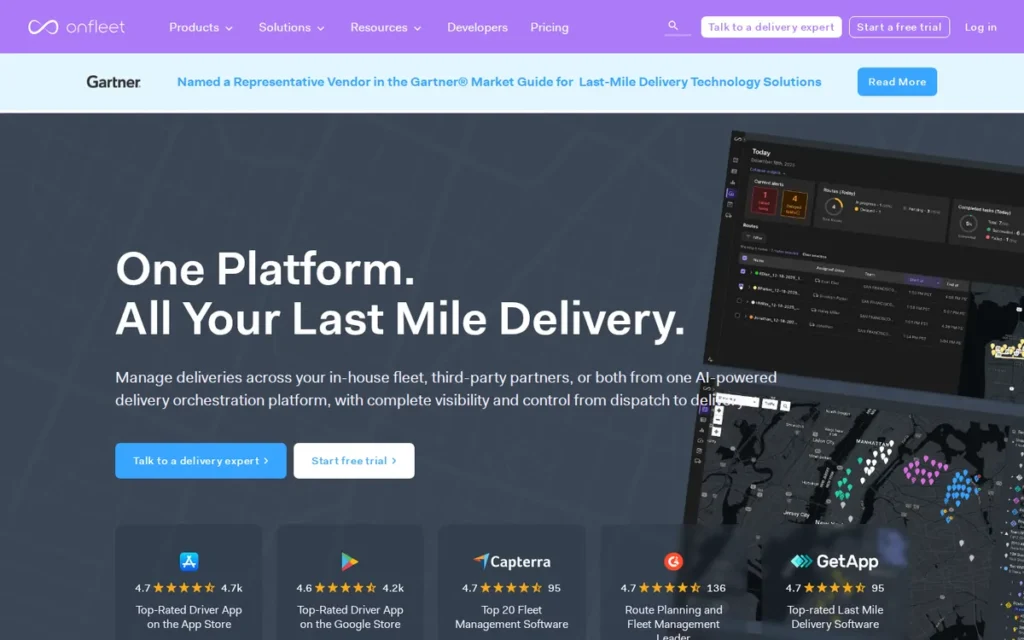
Category: Last-Mile Orchestrator, full-stack dispatch, ML route optimization, real-time GPS tracking, and proof-of-delivery platform.
At a Glance
- Category: Last-Mile Orchestrator
- Best For: Courier, pharmacy, grocery, cannabis, and logistics operations dispatching 100–2,500+ orders per month across 5–50+ drivers
- Price Range: $619–$3,099+/month flat-rate; unlimited drivers and dispatchers included at every tier; 14-day free trial (no credit card required)
- Primary Strength: Onfleet’s ML routing engine is trained on over 100 million deliveries, and its driver app holds a reported 4.8+ star rating across 4,500+ App Store reviews, the highest-volume field-adoption signal in this evaluation
- Biggest Limitation: Onfleet’s $619/month entry floor is cost-prohibitive for operations processing fewer than 500 deliveries per month, and the 118% price jump from Launch ($619) to Scale ($1,349) creates a sharp upgrade cliff as task volume grows
- One-Line Summary: Onfleet is the G2 top-rated last-mile delivery management platform, with a driver app rated 4.8+ stars across 4,500+ App Store reviews and an ML routing engine trained on over 100 million deliveries.
- Last Verified: June 2026
Overview
Onfleet is a last-mile delivery management platform built for courier, grocery, pharmacy, and logistics operations needing ML-powered route optimization, automated dispatch, real-time GPS tracking, and proof of delivery in a single dispatcher dashboard. Onfleet’s driver app is reported at 4.8+ stars across 4,500+ App Store reviews (Onfleet blog, 2026), the highest-volume driver-side quality signal in this evaluation.
Onfleet’s routing engine is trained on over 100 million historical deliveries and continuously adapts to real-time traffic, delivery window constraints, and stop density rather than relying on static algorithms. Onfleet’s task-based pricing model includes unlimited drivers and dispatchers at every tier, making it more economical than per-driver alternatives for high-driver-count operations.
Key Features
- ML Route Optimization Engine: Onfleet’s routing engine is trained on over 100 million deliveries and dynamically adapts routes based on real-time traffic, delivery time windows, and stop density (Onfleet route optimization page, 2026), reducing manual planning time and improving SLA compliance across the driver fleet.
- Automated Dispatch: Onfleet provides task auto-assignment with logic-based driver assignment rules, enabling dispatchers to define routing criteria rather than manually processing each order, a critical capability for operations dispatching hundreds of daily deliveries.
- Proof of Delivery: Onfleet captures delivery confirmation via driver-submitted photos, e-signatures, and notes, creating a timestamped, geocoded record for every completed stop accessible from the dispatcher dashboard for liability and dispute management.
- Real-Time GPS Fleet Visibility: Onfleet provides real-time tracking across the entire driver fleet from a centralized dispatcher view, with customer-facing tracking links and automated ETA notifications that reduce inbound delivery status inquiries.
- E-Commerce Integrations: Onfleet integrates with Shopify, Magento, and external order management systems via webhooks and a full REST API (Onfleet blog, 2026), enabling automated order ingestion from existing commerce stacks without manual re-entry.
Best For
Onfleet is best for courier companies, grocery operators, pharmacies, cannabis dispensaries, and meal kit businesses dispatching 100 to 2,500+ orders per month across 5 to 50+ drivers, specifically operations where driver field adoption and dispatcher real-time visibility are non-negotiable, and where flat-rate unlimited-driver pricing outperforms per-driver billing at fleet sizes above approximately 15 drivers.
Pricing
Onfleet publishes three flat-rate tiers (verified June 2026): Launch at $619/month (2,500 tasks included, unlimited drivers and dispatchers), Scale at $1,349/month (5,000 tasks), and Enterprise at $3,099+/month (10,000+ tasks) (Onfleet pricing page).
A 14-day free trial is available with unrestricted access and no credit card requirement. Note: AI-generated pricing references citing $599/month for Onfleet are outdated, verify current pricing directly at onfleet.com/pricing before any procurement decision.
Strengths
- Onfleet’s driver app holds a reported 4.8+ star rating across more than 4,500 App Store reviews (Onfleet blog, 2026, independently verify at the iOS App Store before procurement), making it the highest-volume driver-side quality signal in this evaluation; driver app quality is consistently cited among the most significant factors in delivery software rollout success in practitioner communities (r/logistics research, June 2026).
- Onfleet is positioned as the #1 rated platform in G2’s on-demand delivery management software category at 4.6/5 across approximately 140 verified reviews (G2, June 2026, G2 grid positions update quarterly), with consistent user praise for the dispatcher interface, real-time visibility tools, and analytics dashboard.
- Onfleet’s routing engine is trained on over 100 million historical deliveries (Onfleet route optimization page, 2026), enabling ML-based continuous adaptation to traffic patterns, delivery window constraints, and stop density, a machine learning foundation that static routing algorithms used by newer platforms cannot replicate.
- Onfleet includes unlimited drivers and dispatchers at every pricing tier (Onfleet pricing, 2026), removing per-seat cost escalation for high-driver-count operations, a structural pricing advantage for businesses with 15+ drivers at moderate per-driver delivery volume.
Limitations
- Price Floor vs. Value Delivered: Onfleet’s $619/month Launch tier is a meaningful commitment for operations processing fewer than 500 deliveries per month, where OptimoRoute’s per-driver pricing ($35.10–$44.10/driver/month annual) produces a lower total cost for small fleets at the same operational stage.
- Upgrade Cliff: Onfleet’s tier jump from Launch ($619) to Scale ($1,349) represents a 118% price increase for doubling task capacity, operations approaching the 2,500-task ceiling should budget for the Scale tier well in advance rather than discovering the constraint mid-operation.
- Case Study Specificity Gap: Onfleet’s publicly available case study materials do not consistently include independently verifiable before-and-after performance metrics with named client types and specific percentages, limiting direct evidence comparison despite Onfleet’s category leadership by review data, and contrasting with OptimoRoute’s more specifically documented vendor-reported outcomes.
- Deep ERP Integration Complexity: Onfleet’s API-first approach requires custom development for businesses needing native SAP or Oracle Fusion connectivity, relevant primarily for mid-to-large operations with established ERP workflows, as OptimoRoute provides pre-built connectors for those specific enterprise systems.
Verdict
Onfleet is the highest-rated on-demand delivery management platform in the G2 last-mile category, backed by a reported 4.8+ star driver app rating across 4,500+ App Store reviews and an ML routing engine trained on over 100 million deliveries, the strongest combination of independent review validation and field-adoption evidence in this evaluation. Onfleet is the most independently validated default choice for courier, grocery, pharmacy, and logistics operations dispatching 100 to 2,500+ monthly orders needing automated dispatch, real-time dispatcher visibility, and proof of delivery in a platform drivers will actively use. Operations processing fewer than 500 orders per month should evaluate Shipday (free tier) or OptimoRoute (per-driver pricing) as more cost-proportionate starting points before committing to Onfleet’s flat-rate model.
2. OptimoRoute: Best for Multi-Week Route Planning, Transparent Per-Driver Pricing, and Documented Operational ROI
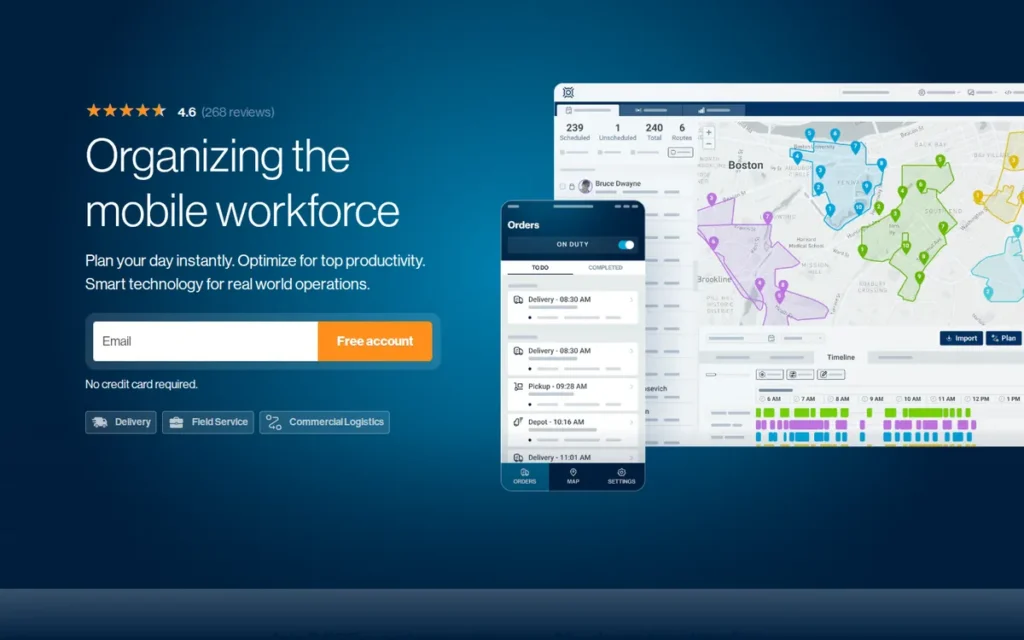
Category: Route Optimizer, AI route planning with five-week scheduling depth, real-time driver tracking, and proof-of-delivery capture for scheduled and on-demand delivery operations.
At a Glance
- Category: Route Optimizer
- Best For: Scheduled delivery, field service, and food distribution operations with 3–50 drivers needing multi-day route planning and predictable per-driver costs
- Price Range: $35.10–$44.10/driver/month (annual billing); $39–$49/driver/month (monthly billing); Custom enterprise tier on request
- Primary Strength: OptimoRoute is the only platform in this evaluation offering route planning up to five weeks ahead with driver availability, vehicle capacity, skill requirements, and service window constraints, a scheduling depth no competing platform provides
- Biggest Limitation: OptimoRoute is optimized for scheduled and multi-day delivery planning rather than high-volatility same-day on-demand dispatch; restaurants and couriers with heavily unpredictable intraday order flow will find Onfleet or Shipday better matched to reactive dispatch requirements
- One-Line Summary: OptimoRoute is an AI-powered route planning platform trusted by 4,000+ companies, offering the category’s only five-week planning horizon at $35.10/driver/month on annual billing.
- Last Verified: June 2026
Overview
OptimoRoute is an AI-powered route planning and delivery management platform trusted by more than 4,000 companies needing to optimize multi-stop routes and plan driver schedules up to five weeks in advance. OptimoRoute is the only platform in this evaluation offering a five-week planning horizon, making it particularly well-suited to scheduled delivery, field service, and recurring appointment-based operations.
OptimoRoute’s per-driver pricing starts at $35.10 per month on annual billing with no per-task overage charges, making total cost of ownership calculable at current and projected fleet size without a sales conversation. G2 reviewers describe OptimoRoute as having “completely eliminated the manual workload and guesswork involved in route planning” across food distribution, vending, HVAC maintenance, and medical transport industries (G2, June 2026).
Key Features
- Five-Week Route Planning Horizon: OptimoRoute’s AI planning engine supports scheduling up to five weeks in advance, the only platform in this evaluation with this depth (OptimoRoute help center, 2026), accommodating driver availability, vehicle capacity, skill requirements, service time windows, and workload balancing across multi-day route sets.
- Proof of Delivery Capture: OptimoRoute captures proof of delivery via driver-submitted photos, e-signatures, and notes through its mobile app (OptimoRoute help center, 2026), creating a timestamped audit trail for every completed stop reviewable from the dispatcher dashboard.
- Real-Time Tracking with Customer ETAs: OptimoRoute provides minute-by-minute customer ETA updates, breadcrumb-style route history for dispatcher auditing, and live route deviation alerts, enabling real-time fleet monitoring without manual driver check-ins.
- Enterprise System Integration: OptimoRoute integrates with SAP, Microsoft Dynamics, Oracle Fusion, and Shopify via its Web Service API (RoadWarrior, 2026), supporting automated order creation, route planning triggers, and delivery status retrieval for enterprise and e-commerce workflows.
- Route Analytics Dashboard: OptimoRoute’s analytics module delivers route performance reporting, driver efficiency metrics, on-time delivery rates, and delivery success rates, giving operations managers the data infrastructure to measure optimization ROI over time.
Best For
OptimoRoute is best for food distribution companies, vending operators, HVAC and maintenance services, medical transport, and courier businesses with 3–50 drivers that need to plan multi-stop routes days or weeks in advance, balance driver workloads across complex scheduling constraints, and document operational ROI at a predictable per-driver cost.
Pricing
OptimoRoute publishes transparent per-driver pricing (verified June 2026): Lite tier at approximately $39/driver/month (monthly) or $35.10/driver/month (annual); Pro tier at approximately $49/driver/month (monthly) or $44.10/driver/month (annual); Custom enterprise tier on request (SaaSworthy, 2026).
A 10-driver team on annual Pro billing costs approximately $5,292/year, competitive against Onfleet’s Launch tier at $7,428/year for the same driver count. Onfleet’s unlimited-driver flat-rate model becomes cost-equivalent at approximately 19 drivers; above that threshold, Onfleet’s pricing becomes more economical per driver.
Strengths
- OptimoRoute case study materials (OptimoRoute YouTube channel, 2026) report customer outcomes including a 25% reduction in fuel costs and 15% revenue increase for a vending business, a 40% improvement in delivery speed for a food distribution company, and a 50%+ reduction in inspection operation time, the most specific vendor-attributed outcome data of any platform in this evaluation (vendor-reported figures; independent third-party audits were not accessible at research time, June 2026).
- OptimoRoute holds a G2 rating of 4.6/5 across 153 verified reviews (G2, June 2026), with G2 positioning it as the “#1 route optimization and route planning platform” in its category (designation as of June 2026 (G2 grid positions update quarterly)) consistent satisfaction across a statistically meaningful dataset of over 150 verified business buyers.
- OptimoRoute’s five-week planning horizon (OptimoRoute help center, 2026) is unique in this evaluation, enabling pre-planned recurring delivery runs, balanced driver availability across multiple weeks, and optimized capacity utilization in advance, a scheduling depth unavailable in any other evaluated platform.
- OptimoRoute’s per-driver pricing model is the most transparent in this evaluation, scaling from $35.10 to $44.10/driver/month annually without per-task overage charges, making total cost of ownership calculable at current and projected fleet size without a sales engagement (SaaSworthy, 2026).
Limitations
- Planning Depth vs. Reactive Dispatch: OptimoRoute’s most consequential trade-off is planning depth versus real-time reactive dispatch, the platform excels at pre-planned, constraint-rich routing but is less optimized for high-volatility same-day environments where orders arrive unpredictably after routes are dispatched, making Onfleet or Shipday better matches for restaurants and couriers with heavily variable intraday order flow.
- Driver App Verification Gap: OptimoRoute’s driver app App Store rating and review volume were not independently documented in publicly accessible data during this research period (June 2026), preventing direct comparison against Onfleet’s reported 4.8+ star benchmark and introducing a field-adoption confidence gap for buyers evaluating driver-side usability.
- Own-Fleet Focus: OptimoRoute is purpose-built for own-fleet operations without a third-party carrier integration layer, businesses requiring multi-carrier orchestration across dynamic carrier networks will need Bringg’s 250+ carrier connections rather than OptimoRoute’s planning-depth architecture.
Verdict
OptimoRoute is the only on-demand delivery management platform in this evaluation enabling route planning up to five weeks in advance while delivering real-time driver tracking, proof of delivery, and per-driver pricing starting at $35.10 per month on annual billing, making it the strongest evidence-backed choice for scheduled delivery, food distribution, field service, and recurring appointment-based operations. OptimoRoute case study materials report the most specific vendor-attributed outcomes of any evaluated platform (25% fuel savings, 40% faster delivery times, 50%+ inspection time reduction), supporting ROI conversations with operations leadership. Businesses centered on reactive same-day on-demand dispatch should weight Onfleet’s driver app quality and dynamic ML routing more heavily than OptimoRoute’s planning depth in their evaluation.
3. Shipday: Best for Restaurants, Ghost Kitchens, and SMBs Starting with a Free Tier
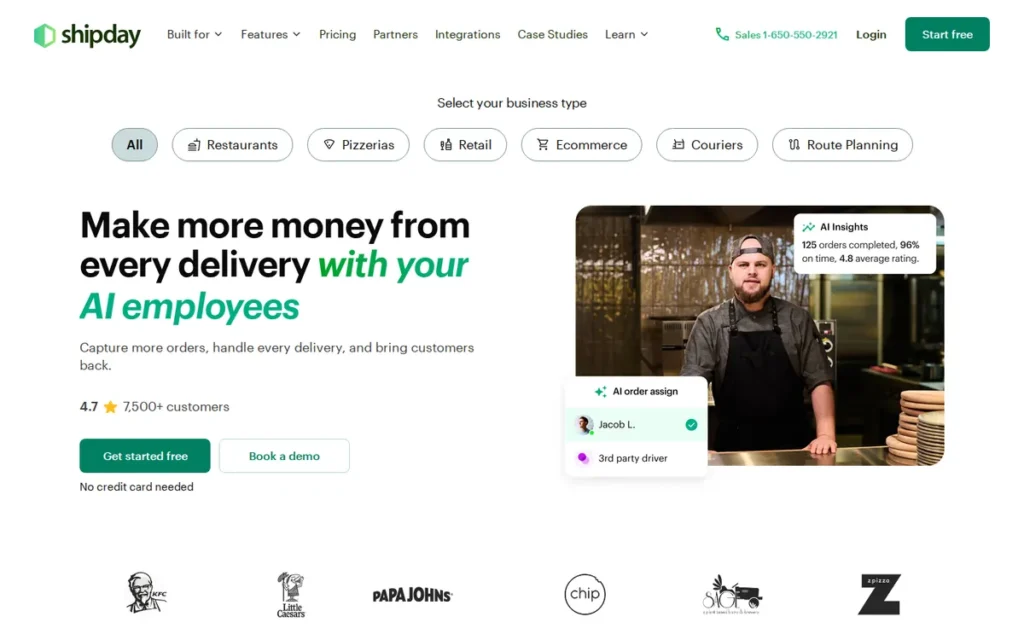
Category: Restaurant Delivery Hub, POS-native dispatch platform with free-tier access, real-time tracking, and gig-network overflow for demand spikes.
At a Glance
- Category: Restaurant Delivery Hub
- Best For: Restaurants, ghost kitchens, and local couriers needing free-tier dispatch, POS integration, or hybrid gig-network overflow for demand spikes
- Price Range: Free ($0/month, 300 orders, 10 drivers); $39/month Professional; $99/month Elite; $299/month Business Advanced, route optimization and SMS notifications gated to paid tiers
- Primary Strength: Shipday is the only on-demand delivery platform in this evaluation offering native integrations with Toast, Square, Lightspeed, and MICROS restaurant POS systems, plus automatic demand-spike overflow to Uber Direct and DoorDash Drive
- Biggest Limitation: Shipday’s route optimization and SMS customer notifications are gated to paid tiers, and its scalability ceiling creates operational friction for growing fleets beyond approximately 15–20 drivers or 1,000+ monthly deliveries
- One-Line Summary: Shipday is the only delivery management platform in this evaluation with a functional free tier covering 300 orders per month and 10 driver accounts, plus native integrations with Toast, Square, Lightspeed, and MICROS restaurant POS systems.
- Last Verified: June 2026
Overview
Shipday is a cloud-based delivery management platform purpose-built for restaurants, ghost kitchens, and small courier businesses needing automated dispatch, real-time driver tracking, and proof of delivery without an enterprise contract. Shipday is the only platform in this evaluation with a genuinely functional free tier covering 300 orders per month across 10 driver accounts at zero cost.
Shipday’s restaurant-first architecture includes native POS integrations with Toast, Square, Lightspeed, and MICROS that no competing evaluated platform provides, plus automatic delivery overflow to Uber Direct and DoorDash Drive when in-house driver capacity is exceeded during demand spikes. Shipday case study materials document a 200% business growth for A-Team Delivery and a 50% reduction in delivery support costs through dispatch automation (Shipday, 2026).
Key Features
- Functional Free Tier: Shipday’s free tier supports 300 deliveries per month across 10 driver accounts with real-time GPS tracking and proof-of-delivery capture at no cost (Shipday pricing page, 2026), the only evaluated platform offering functional delivery management without any financial commitment.
- Native Restaurant POS Integration: Shipday integrates natively with Toast, Square, Lightspeed, and MICROS restaurant POS systems (Lightspeed integration page, 2026), automatically importing orders into the dispatch queue without manual re-entry, a capability unique in this evaluation.
- Gig-Network Demand Overflow: Shipday’s hybrid fleet management feature automatically overflows delivery assignments to Uber Direct, DoorDash Drive, and Skip courier networks when in-house driver capacity is reached (Shipday restaurant delivery guide, 2026), preventing missed deliveries during demand spikes without a separate third-party integration.
- Customer Tracking and Notifications: Shipday sends automated customer tracking notifications with real-time driver location links and captures proof of delivery via photos and e-signatures on paid tiers, reducing inbound delivery status calls for restaurant operations staff.
- Broad Integration Ecosystem: Shipday integrates with Shopify, Odoo, GoTab, Otter, Wix, and additional platforms, and supports driver payment management within the platform, covering order ingestion, dispatch automation, and driver compensation from a single SMB-accessible system.
Best For
Shipday is best for restaurants, ghost kitchens, and local courier operations processing under 300 orders per month who need to start at zero cost and upgrade incrementally, and for any food service business using Toast, Square, Lightspeed, or MICROS POS systems that needs delivery management without manual order re-entry into a separate dispatch tool.
Pricing
Shipday publishes four pricing tiers (verified June 2026): Free at $0/month (300 orders, 10 drivers, real-time tracking, POD); Professional at $39/month; Elite at $99/month; Business Advanced at $299/month (Shipday pricing page).
Route optimization and SMS customer notifications are gated to paid tiers, the free plan provides tracking and POD but not route optimization, which buyers should factor in before choosing the free tier for route-intensive operations. At 300 orders per month on the Professional tier, cost equates to approximately $0.13/order, among the most cost-effective paid entry points in this evaluation.
Strengths
- A-Team Delivery documented 200% business growth in an official Shipday case study (Shipday, 2026), attributing the result to driver tracking automation, real-time communication tools, and integrated payment management, the most dramatic single-customer growth outcome documented in any named-client case study across all seven evaluated platforms (vendor-attributed figure from a named client).
- Shipday case study materials (Shipday, 2026) report a 50% reduction in delivery support costs through auto-dispatch and route optimization, and a 60–100 hour per month reduction in operational labor from dispatch automation, translating to an estimated $1,200–$2,000/month in potential labor savings at $20/hour against a $39/month software cost.
- Shipday holds a 4.6/5 rating on Capterra (June 2026) from an SMB and restaurant operator user base that rates delivery software more critically than enterprise buyers, making Shipday’s sustained 4.6 rating a meaningful quality signal relative to platforms with fewer but potentially less scrutinized public reviews.
- Shipday is the only platform in this evaluation with native POS integrations for Toast, Square, Lightspeed, and MICROS restaurant systems (Shipday restaurant delivery software ranking, 2026), eliminating manual order re-entry, a documented source of dispatcher error and delivery delay for food service operators managing simultaneous dine-in and delivery orders.
Limitations
- Scalability Ceiling: Shipday’s most consequential trade-off is free-tier accessibility versus operational depth, its architecture is optimized for SMB restaurant dispatch rather than complex multi-depot fleet coordination, creating operational friction for businesses growing beyond approximately 15–20 drivers or 1,000+ monthly deliveries, where a platform migration to Onfleet or OptimoRoute becomes the appropriate next step.
- Feature Gating on Free Plan: Shipday gates route optimization and SMS customer notifications to paid tiers, meaning the most cost-constrained users receive the least planning assistance, an intentional commercial structure that buyers should understand before choosing the free tier for route-intensive operations.
- Support Responsiveness on Lower Tiers: Shipday has documented support responsiveness issues on free and lower-tier plans (CheckThat.ai, 2026), a meaningful operational risk for restaurant operators managing time-sensitive delivery disputes without a dedicated customer success contact.
Verdict
Shipday is the only on-demand delivery management platform in this evaluation offering a fully functional free tier (300 orders per month, 10 driver accounts, real-time GPS tracking, and proof of delivery at zero cost) alongside native integrations with Toast, Square, Lightspeed, and MICROS restaurant POS systems that no other evaluated platform provides. For restaurants, ghost kitchens, and local delivery businesses with under 300 monthly orders or tight launch budgets, Shipday delivers genuine operational value before any financial commitment, making it the most cost-proportionate starting point for this segment. Operations approaching 15–20 drivers or requiring sophisticated multi-stop route optimization should plan a platform transition to Onfleet or OptimoRoute; at approximately 19 drivers, the cost crossover between Onfleet’s flat-rate model and OptimoRoute’s per-driver pricing means the decision turns on dispatch control depth versus planning horizon.
4. DispatchTrack: Best for Furniture, Appliance, and Appointment-Based Delivery Operations
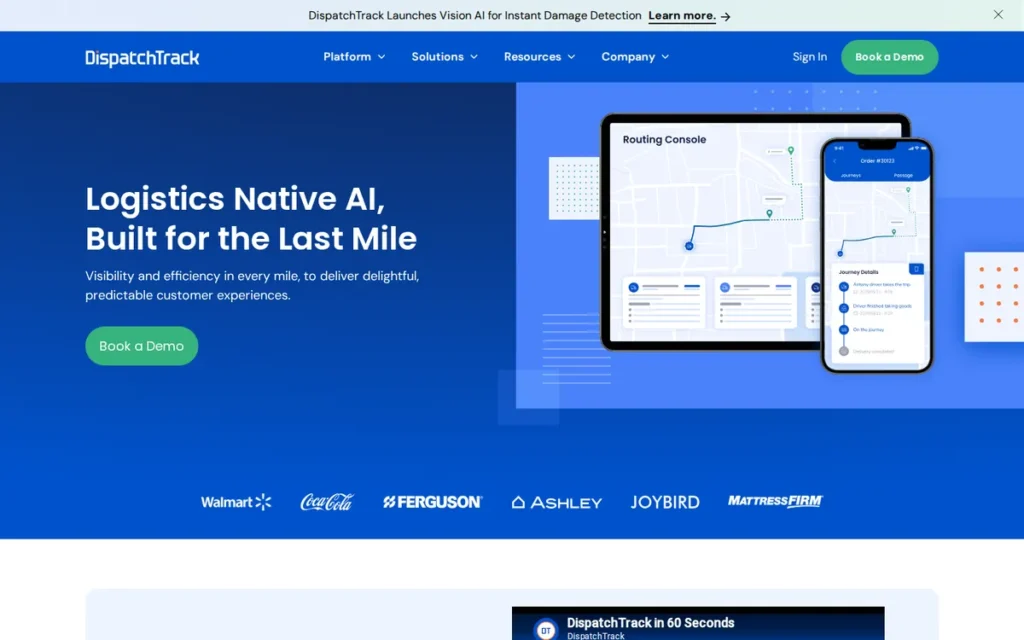
Category: Appointment Delivery Platform, AI-scheduled, big-and-bulky delivery management with customer self-scheduling, multi-crew coordination, and capacity-based booking.
At a Glance
- Category: Appointment Delivery Platform
- Best For: Furniture retailers, appliance dealers, and big-and-bulky logistics operators requiring appointment scheduling, multi-crew delivery coordination, and customer self-scheduling tied to real-time inventory availability
- Price Range: Not publicly published; third-party estimates $75–$150/vehicle/month plus setup fees (~$100/vehicle) and training fees (~$250) (source: Locus pricing analysis, 2026); enterprise custom pricing on request
- Primary Strength: DispatchTrack is cited by Gartner and IDC in analyst materials covering AI-powered last-mile delivery, operating at more than 1,000,000 deliveries per day across 2,500+ customers with a vendor-reported 98% on-time delivery rate and Customer Pickup 2.0 self-scheduling tied to real-time inventory availability
- Biggest Limitation: DispatchTrack does not publish pricing publicly, requiring a full sales engagement before cost evaluation, third-party estimates ($75–$150/vehicle/month plus setup and training fees) effectively exclude small fleet operations from practical consideration
- One-Line Summary: DispatchTrack is cited by Gartner and IDC in analyst materials covering AI-powered last-mile delivery, processing 1,000,000+ deliveries per day across 2,500+ customers with a vendor-reported 98% on-time delivery rate and purpose-built features for furniture, appliance, and appointment-based delivery.
- Last Verified: June 2026
Overview
DispatchTrack is an AI-powered last-mile delivery management platform cited by Gartner and IDC in analyst materials covering last-mile delivery software (specific report names and recognition type cited in DispatchTrack marketing materials, 2026, not independently confirmed at research time), serving 2,500+ delivery organizations processing over one million deliveries per day. DispatchTrack’s 15+ year operating history and purpose-built feature set address big-and-bulky retail, furniture, appliance, and appointment-based delivery requirements that general-purpose platforms do not serve natively.
DispatchTrack’s Customer Pickup 2.0 feature allows customers to self-schedule deliveries and pickups based on real-time inventory availability and location capacity constraints, a capability unavailable in any other evaluated platform. Enterprise customers including Walmart, Samsung, and Coca-Cola validate DispatchTrack’s capacity to handle extreme delivery volume and multi-location fleet coordination (DispatchTrack platform documentation, 2026).
Key Features
- AI-ETA Routing Engine: DispatchTrack’s routing engine reports a 98% on-time delivery rate and a 50–75%+ reduction in routing time for appointment-based operations (DispatchTrack blog, 2026 (vendor-stated figures; independent audit data not available at research time)) a performance target purpose-built for retailers where a missed appointment window triggers costly redelivery and customer service escalation.
- Customer Pickup 2.0 Self-Scheduling: DispatchTrack’s Customer Pickup 2.0 feature enables customers to self-schedule deliveries and store pickups based on real-time inventory availability and location-based capacity constraints, reducing inbound scheduling call volume and improving warehouse throughput without a separate scheduling system, a capability unique among the seven evaluated platforms.
- Multi-Crew Delivery Coordination: DispatchTrack supports multi-crew delivery team coordination, capacity-based booking rules, and dynamic scheduling constraints required by big-and-bulky operations involving furniture, appliances, and fitness equipment, where two-person delivery teams, elevator reservations, and assembly workflows are standard operational requirements.
- Third-Party Carrier Visibility: DispatchTrack provides real-time visibility across third-party carrier networks alongside internal fleet tracking, enabling retailers managing both owned delivery teams and outsourced last-mile providers to monitor all delivery activity from a unified dispatcher interface.
- Operating History Depth: DispatchTrack has been in continuous operation for over 15 years, accumulating delivery pattern data across pre-smartphone routing, the emergence of same-day consumer delivery expectations, and the COVID-era volume surge, an operational history and dataset depth that no newer platform in this evaluation has yet accumulated.
Best For
DispatchTrack is best for furniture retailers, appliance dealers, fitness equipment distributors, building materials suppliers, and enterprise logistics operators delivering large-format goods on appointment windows with multi-crew teams, where customer self-scheduling tied to real-time inventory availability, capacity-based booking rules, and enterprise-grade on-time delivery performance are baseline operational requirements rather than differentiators.
Pricing
DispatchTrack does not publish pricing publicly as of June 2026. Third-party procurement analysis estimates small fleet costs at approximately $75–$150 per vehicle per month, with additional setup fees of approximately $100 per vehicle and training fees of approximately $250 (Locus pricing analysis, 2026). Mid-market and enterprise pricing requires direct sales engagement.
A 10-vehicle fleet at the estimated midpoint ($112/vehicle/month) would cost approximately $1,120/month before setup costs, comparable to Onfleet’s Scale tier ($1,349/month) but structured per-vehicle rather than per-task. Buyers should budget for a full sales process before any cost evaluation, and should be aware that enterprise deployment typically involves onboarding investment beyond software licensing fees.
Strengths
- DispatchTrack is cited by Gartner and IDC in analyst materials covering AI-powered last-mile delivery (per DispatchTrack marketing materials, 2026, specific report names and recognition tier not independently confirmed at research time); the dual analyst citation distinguishes DispatchTrack from every other platform in this evaluation, none of which claim both Gartner and IDC recognition in the same research period.
- DispatchTrack operates at more than 1,000,000 deliveries per day across 2,500+ customer organizations, with Walmart, Samsung, and Coca-Cola as documented enterprise deployments (DispatchTrack platform documentation, 2026), validating the platform’s capacity to support extreme delivery volume, multi-location fleet coordination, and Fortune 500 compliance requirements.
- DispatchTrack’s 15+ year operating history means its AI-ETA optimization engine has been trained across multiple delivery paradigm shifts (pre-smartphone routing, the shift to same-day consumer expectations, and the COVID-era volume surge) an operational data depth that newer platforms in this evaluation have not yet accumulated.
- DispatchTrack’s Customer Pickup 2.0 self-scheduling feature enables Amazon-style delivery booking flexibility for local and regional retailers, with customers selecting windows based on real-time inventory and capacity availability, a capability unique in this evaluation that reduces scheduling labor and improves first-attempt delivery rates for appointment-based retailers.
Limitations
- Pricing Opacity: DispatchTrack’s most significant trade-off for self-serve buyers is the complete absence of published pricing, the platform requires a full sales engagement before any cost data is available, creating a dead-end for operations managers building internal budget proposals during self-serve market research. Third-party estimates of $75–$150/vehicle/month plus implementation fees put a 10-vehicle fleet at $750–$1,500/month before onboarding costs, exceeding the budget floor of most SMB and mid-market operations.
- Audience Mismatch for Small Fleets: DispatchTrack is not an appropriate evaluation target for businesses under 10 vehicles or under approximately $1,000/month software budget, those operations are better served by Onfleet, OptimoRoute, or Shipday, which offer published pricing, self-serve trials, and feature sets calibrated for smaller fleet operations.
- Community Scalability Signal: A Reddit thread in r/RunYourBusiness titled “Has anyone else found DispatchTrack limiting once you grow?” surfaced during community research (June 2026), the thread title alone signals that some buyers encounter operational friction at certain growth stages, though specific thresholds are not publicly documented and buyers should investigate this directly with DispatchTrack during evaluation.
Verdict
DispatchTrack is the only on-demand delivery platform in this evaluation cited by both Gartner and IDC in analyst materials, operating at more than one million deliveries per day across 2,500+ customers with a 15+ year operating history and a vendor-reported 98% on-time delivery rate for appointment-based shipments, making it the most credentialed and purpose-built choice for furniture, appliance, and big-and-bulky retailers requiring enterprise-grade appointment scheduling and multi-crew delivery coordination. DispatchTrack’s Customer Pickup 2.0 self-scheduling and capacity-based booking rules are category-defining capabilities with no direct equivalent among the other six evaluated platforms. Buyers outside the big-and-bulky or appointment delivery segment, or those operating below a 10-vehicle fleet, should evaluate Onfleet, OptimoRoute, or Shipday as more accessible alternatives, DispatchTrack’s pricing opacity and enterprise positioning create evaluation barriers appropriate for dedicated procurement teams, not self-serve research workflows.
5. Route4Me: Best for Territory-Based Geographic Route Management and High-Volume Review Validation
Category: Territory Route Planner, territory-based multi-stop route optimization with polygon zone management, dynamic reoptimization, and geographic order assignment for regionally organized fleets.
At a Glance
- Category: Territory Route Planner
- Best For: Regional distributors, franchise delivery networks, multi-depot courier operations, and field service businesses with defined geographic service zones
- Price Range: Web platform pricing not published (7-day free trial available); mobile app tiers $9.99–$19.99/month are individual driver navigation tools only and are NOT representative of the full business platform
- Primary Strength: Route4Me is the most Capterra-reviewed delivery management platform in this evaluation, more than 850 verified reviews at approximately 4.7/5, and the only platform offering polygon-based territory management for automatic geographic zone-based order assignment
- Biggest Limitation: Route4Me’s web platform pricing is not publicly published, requiring direct sales contact before cost evaluation, and its proof-of-delivery capabilities are less robust than the photo/signature/notes capture provided by Onfleet, OptimoRoute, and Shipday
- One-Line Summary: Route4Me is the most Capterra-reviewed delivery management platform in this evaluation, more than 850 verified reviews at approximately 4.7/5, and the only platform with polygon-based territory management for geographic zone routing and automatic order assignment.
- Last Verified: June 2026
Overview
Route4Me is a multi-stop route optimization and delivery management platform with more than 850 verified Capterra reviews at approximately 4.7/5 (the highest independent review volume of any platform in this evaluation) serving SMB through mid-market delivery and field service operations with territory-based routing, polygon zone management, and sub-60-second route generation. Verify current review count at capterra.com/routing-software/route4me/ before citing this figure in procurement documentation.
Route4Me’s territory management tools allow operations managers to draw custom geographic service zones, automatically assign incoming orders by territory, and generate individual driver routes per zone, a structural geographic fleet management capability unique among evaluated platforms. Route4Me’s dynamic mid-route reoptimization allows dispatchers to add urgent stops to already-active driver routes with automatic sequence regeneration, without requiring a complete route rebuild.
Key Features
- Sub-60-Second Route Optimization: Route4Me generates optimized multi-stop routes in under 60 seconds from an uploaded stop list, combining routing algorithms, machine learning, and real-time traffic adaptation to minimize total drive time and fuel consumption across the driver fleet.
- Polygon-Based Territory Management: Route4Me’s territory management system allows operations managers to draw custom delivery service zones using polygon shapes or KML file imports, assign color codes and names to each zone, and automatically route incoming orders to the correct territory driver, a geographic organization capability unique in this evaluation.
- Dynamic Mid-Route Reoptimization: Route4Me supports inserting new stop locations into already-active driver routes with automatic regeneration of the optimal stop sequence, directly addressing the on-demand delivery challenge of intraday order volume changes after initial routes are dispatched.
- Optimization Profile System: Route4Me’s optimization profile system allows operations to save routing configurations tailored to specific vehicle types, driver constraints, seasonal delivery patterns, or business service scenarios, enabling consistent, repeatable route logic without rebuilding parameters daily.
- Geotab Marketplace Integration: Route4Me is available through Geotab’s fleet telematics marketplace, providing a validated integration pathway for organizations already using Geotab hardware for GPS tracking, ELD compliance, and fuel monitoring, extending Route4Me’s reach into the fleet telematics ecosystem.
Best For
Route4Me is best for regional distributors, franchise delivery networks, multi-depot courier operations, and field service businesses whose delivery geography is organized into defined service territories, where automatically assigning orders by geographic zone and generating per-territory driver routes creates operational structure that simple stop-sequencing tools cannot provide.
Pricing
Route4Me does not publicly publish its web (Marketplace) platform pricing as of June 2026. A 7-day free trial is available without a credit card requirement.
Critical note: the mobile app tiers ($9.99/month Basic, $19.99/month Enhanced) are individual driver navigation tools and are NOT representative of full business platform pricing for fleet dispatch, territory management, and multi-driver operations. Business buyers must contact Route4Me directly for Marketplace subscription pricing. Without published web platform pricing, buyers can use OptimoRoute’s $35.10–$44.10/driver/month annual pricing as a mid-market benchmark for comparison purposes.
Strengths
- Route4Me holds more than 850 verified user reviews on Capterra at approximately 4.7/5 (Capterra, June 2026, verify current count at capterra.com/routing-software/route4me/), the highest independent review volume of any platform in this evaluation, reflecting sustained SMB and mid-market adoption across more than a decade. Route4Me’s 850+ Capterra review dataset is treated as a performance evidence proxy in the absence of specific documented outcome metrics, the volume of buyer-verified experience signals quality where case study data is not publicly accessible.
- Route4Me is the only platform in this evaluation offering polygon-based territory management (June 2026), enabling operations managers to draw, name, and save custom geographic service zones using freeform polygon shapes or KML file imports, then automatically assign incoming orders to the correct zone driver, a structural routing capability particularly valuable for regional distributors, franchise delivery models, and multi-depot operations organized geographically.
- Route4Me’s dynamic mid-route reoptimization allows dispatchers to insert urgent orders into already-active routes with automatic stop-sequence regeneration, directly addressing the operational challenge of intraday order volume changes in on-demand delivery without requiring a complete route rebuild from scratch.
- Route4Me’s Geotab Marketplace listing provides a validated integration pathway for organizations already using Geotab vehicle tracking and ELD hardware, enabling delivery route optimization to be layered into an existing fleet telematics investment without a parallel software evaluation process.
Limitations
- Pricing Opacity and TCO Complexity: Route4Me’s web platform pricing is not publicly disclosed as of June 2026, requiring direct sales engagement before total cost of ownership can be evaluated, a documented friction point in community research (r/b2b_sales, January 2025), where buyers specifically cite difficulty comparing Route4Me’s actual cost against competitors with published per-driver pricing. The marketplace add-on architecture, where capability modules are available at different subscription tiers and mobile app pricing is distinct from business platform pricing, adds additional TCO complexity at the trial-to-purchase decision point.
- Proof-of-Delivery Depth: Route4Me’s proof-of-delivery capabilities are described in available research as status tracking rather than the full photo, e-signature, and notes capture provided by Onfleet, OptimoRoute, and Shipday, a material limitation for delivery operations where liability documentation requires a timestamped visual record of every completed stop.
- Limited Documented Outcome Data: Route4Me does not have publicly accessible case study materials with specific before-and-after performance metrics comparable to OptimoRoute’s vendor-reported fuel and delivery speed outcomes, buyers evaluating based on documented ROI will find stronger evidence trails at OptimoRoute or Shipday.
Verdict
Route4Me is the most Capterra-reviewed delivery management platform in this evaluation, more than 850 verified user reviews at approximately 4.7/5, and the only platform offering polygon-based territory management for geographic zone routing, making it the strongest purpose-built choice for regional distributors, franchise delivery networks, and multi-depot operations whose fleet structure is organized geographically rather than by individual stop sequencing. The combination of the highest review volume in this evaluation, territory management uniqueness, and dynamic reoptimization capability gives Route4Me a legitimate claim as the preferred mid-market platform for geographically organized delivery operations. Pricing opacity, web platform pricing not publicly published as of June 2026, and less robust electronic proof-of-delivery relative to top-ranked platforms are friction points that buyers must investigate directly with Route4Me before finalizing a shortlist.
6. Bringg: Best for Enterprise Multi-Carrier Orchestration Across Global Retail and Logistics Networks
Category: Enterprise Orchestrator, multi-carrier last-mile orchestration for global retailers and logistics operators managing owned fleets, third-party couriers, and hybrid delivery networks across 70+ countries.
At a Glance
- Category: Enterprise Orchestrator
- Best For: Large retailers, global logistics operators, and enterprise organizations managing hybrid delivery networks combining owned driver fleets with third-party carrier relationships across multiple geographies, particularly Salesforce-native enterprises and businesses with multi-carrier peak-season scaling requirements
- Price Range: Not publicly published; third-party procurement estimates $10,000–$20,000+ annually minimum, with large enterprise deployments potentially exceeding $1,000,000 annually (source: CheckThat.ai procurement estimates, 2026)
- Primary Strength: Bringg connects an estimated 800+ enterprise customers to 250+ carrier integrations across 70+ countries (the largest multi-carrier delivery network of any platform in this evaluation) with Walmart, Best Buy, and Coca-Cola among documented enterprise deployments
- Biggest Limitation: Bringg’s estimated $10,000+ minimum annual contract and fully opaque pricing effectively exclude every SMB and the majority of mid-market businesses from practical consideration; individual review platform presence on G2 and Capterra is limited relative to other evaluated platforms
- One-Line Summary: Bringg is a platform estimated to have raised $191M in total funding with a unicorn valuation achieved in 2021, connecting 800+ enterprise customers to 250+ carriers across 70+ countries including Walmart, Best Buy, and Coca-Cola.
- Last Verified: June 2026
Overview
Bringg is an enterprise last-mile delivery orchestration platform coordinating delivery operations across 250+ carrier integrations in 70+ countries for 800+ global enterprise customers, built for retailers and logistics operators managing owned fleets, third-party couriers, and hybrid delivery networks from a single orchestration layer. Third-party procurement analysis estimates Bringg’s total funding at $191 million with a unicorn valuation achieved in 2021 (CheckThat.ai, June 2026, verify via Crunchbase or official investor relations for current accuracy).
Bringg’s modular architecture (Delivery Hub for multi-carrier parcel orchestration, ROAD for internal fleet management with AI routing and ML, and Zenkraft for Salesforce-native shipping) enables enterprises to deploy selectively into existing technology stacks rather than replacing foundational ERP, TMS, or OMS systems. Bringg’s enterprise customer base includes Walmart, Best Buy, and Coca-Cola as documented deployments (Bringg platform documentation, 2026).
Key Features
- 250+ Carrier Network via Delivery Hub: Bringg’s Delivery Hub connects enterprises to 250+ carrier integrations across 70+ countries, enabling dynamic switching between internal driver fleets and third-party couriers based on real-time capacity, cost, and SLA performance, the largest carrier network accessible through a single platform in this evaluation.
- ROAD AI Fleet Management: Bringg’s ROAD product provides AI-powered route optimization with ML-driven dispatch automation, BI analytics, and programmable logistics constraints at the Accelerate tier, alongside baseline workflow digitization, shipment tracking, feedback collection, and exception management at the Launch tier.
- Zenkraft Salesforce-Native Module: Bringg’s Zenkraft module provides Salesforce-native shipping management, enabling enterprises operating on Salesforce CRM and Service Cloud to manage carrier selection, shipment tracking, and delivery visibility directly within their existing Salesforce environment without a separate integration layer.
- Enterprise ERP and OMS Integration: Bringg integrates with Magento, Shopify, Salesforce, and major ERP, WMS, TMS, and OMS systems via REST API, functioning as a connective orchestration layer across existing enterprise technology stacks rather than as a standalone delivery tool requiring data re-entry.
- Modular Deployment Pathways: Bringg’s ROAD product launched in October 2023 with tiered modules (Launch and Accelerate) designed for companies at different stages of digital delivery maturity, enabling enterprises to begin with workflow digitization before investing in ML routing and advanced analytics.
Best For
Bringg is best for large retailers, global logistics operators, and enterprise organizations managing hybrid delivery networks combining owned driver fleets with third-party carrier relationships across multiple geographies, particularly businesses already operating on Salesforce, those requiring 250+ carrier connectivity for peak-season scaling, or organizations with dedicated procurement and implementation teams capable of managing a 12–18 month enterprise software deployment cycle.
Pricing
Bringg does not publish pricing publicly as of June 2026. Third-party procurement analysis (CheckThat.ai, June 2026) estimates minimum annual contracts at approximately $10,000, average enterprise contracts at approximately $20,000 annually, and large-scale deployments potentially exceeding $1,000,000 annually. These are third-party estimates, not published figures, actual pricing requires direct engagement with Bringg’s enterprise sales team.
The estimated $10,000 minimum effectively excludes every SMB and most mid-market operations from practical consideration. Businesses below a 50+ driver fleet or below approximately $1,000/month software budget should evaluate Onfleet, OptimoRoute, or Shipday first, those platforms provide published pricing and self-serve trials that do not require a sales commitment before cost evaluation.
Strengths
- Third-party procurement analysis estimates Bringg’s total funding at $191 million with a unicorn valuation achieved in 2021 (CheckThat.ai, June 2026 (verify via Crunchbase or official investor relations for current accuracy), making Bringg the most heavily capitalized company in this evaluation) a financial depth that sustains the 250+ carrier integration network and the extended enterprise sales cycles required to serve Walmart-tier accounts.
- Bringg serves Walmart, Best Buy, and Coca-Cola as documented enterprise customers (Bringg platform documentation, 2026), validating the platform’s capacity to handle extreme delivery volume, multi-geography carrier orchestration, and the compliance and reporting requirements of Fortune 500 organizations with the most demanding last-mile operations in the world.
- Bringg’s 250+ carrier integrations across 70+ countries constitute the largest multi-carrier delivery network in this evaluation by a significant margin, enabling enterprises to dynamically route shipments between internal drivers and third-party couriers based on real-time capacity, cost, and SLA performance, a capability critical for peak-season scaling and geographic market expansion without renegotiating individual carrier contracts.
- Bringg’s modular architecture (Delivery Hub, ROAD, Zenkraft) allows enterprise buyers to deploy into specific operational gaps rather than replacing entire fulfillment technology stacks, reducing implementation risk and enabling a phased adoption pathway within existing enterprise environments.
Limitations
- Pricing Accessibility: Bringg’s estimated $10,000–$20,000+ minimum annual contract and fully opaque pricing structure require a complete enterprise sales engagement before any cost data is available, a structural reality of enterprise SaaS sales cycles and not a deficiency unique to Bringg, but one that makes the platform a non-starter for the SMB and mid-market operations forming the majority of this article’s target audience.
- Limited Public Review Footprint: Bringg’s individual review platform presence on G2 and Capterra is limited relative to SMB-focused platforms in this evaluation, consistent with the enterprise buying dynamic where fewer, larger customers are less likely to post public reviews, but this pattern reduces the available independent third-party sentiment data for buyers evaluating Bringg from outside the enterprise procurement process.
- Audience Mismatch for Smaller Operations: Businesses under 50 drivers or under approximately $1,000/month software budget are structurally mismatched with Bringg’s offering regardless of feature appeal, the platform’s deployment complexity, minimum contract value, and multi-carrier orchestration architecture are purpose-built for global enterprise operations, not fleet dispatch at the SMB or emerging mid-market scale.
Verdict
Bringg is the only unicorn-valued delivery orchestration platform in this evaluation, connecting 800+ enterprise customers to 250+ carriers across 70+ countries, with Walmart, Best Buy, and Coca-Cola as documented deployments, making it the unambiguous choice for large retailers and global logistics operators managing hybrid owned-fleet and multi-carrier delivery networks at enterprise scale. For the enterprise buyer with a dedicated procurement team, a multi-year software budget, and a Salesforce-native or ERP-integrated technology stack, Bringg’s carrier breadth and modular orchestration architecture have no equivalent among the seven evaluated platforms. For the majority of this article’s audience, operations managers and business owners evaluating delivery software for fleets of 5 to 50 drivers, Bringg’s estimated $10,000+ minimum annual contract and fully opaque pricing model make it a non-starter; those buyers will find Onfleet, OptimoRoute, or Shipday significantly more accessible and cost-proportionate to their current scale.
7. Locate2u: Best for GPS Hardware Bundling and Small Fleets Without Full Smartphone Dependency
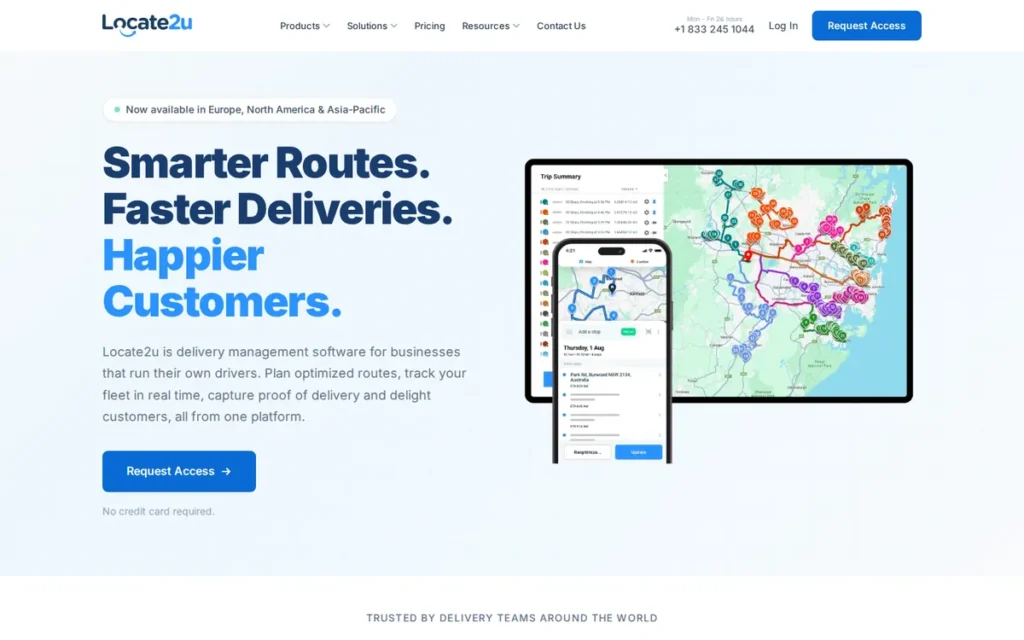
Category: SMB Delivery Suite, all-in-one delivery management with GPS hardware option, booking automation, AI route optimization, and built-in billing for small and mid-sized fleets.
At a Glance
- Category: SMB Delivery Suite
- Best For: Small and mid-sized delivery businesses with 1–50 drivers: particularly operations with older vehicle fleets or mixed workforces where not all drivers carry company smartphones, and courier businesses needing built-in invoicing alongside route optimization
- Price Range: $15/seat/month (GPS hardware plan); $260/month for 4 seats, $55/additional seat (Premium Plan); Enterprise custom pricing for 50+ users; free trial with no credit card and no cancellation fees
- Primary Strength: Locate2u is the only delivery management platform in this evaluation offering a GPS hardware-plus-software bundle at $15 per seat per month, enabling fleet tracking for operations where drivers do not use company smartphones
- Biggest Limitation: Only 3 verified public reviews were identified across G2, Capterra, and GetApp Australia as of June 2026 (additional reviews may exist on platforms not accessed during this research period) creating a critically limited independent evidence base relative to the six other evaluated platforms; API access and SLA guarantees are also gated to the Enterprise tier (50+ users)
- One-Line Summary: Locate2u is the only delivery management platform in this evaluation that bundles GPS hardware tracking at $15 per seat per month alongside a software routing suite, enabling fleet visibility for operations where not all drivers carry company smartphones.
- Last Verified: June 2026
Overview
Locate2u is an all-in-one delivery management and route optimization platform built for small and mid-sized delivery businesses needing dispatch automation, AI route optimization, real-time GPS tracking, and proof of delivery. Locate2u offers the lowest-friction free trial in this evaluation: no credit card required and no cancellation fees, accessible for SMB buyers wary of auto-renewal charges before validating a platform against real operational conditions.
Locate2u’s GPS hardware bundle at $15/seat/month is unique in this evaluation, addressing a genuine operational gap for businesses with older vehicle fleets or driver workforces where smartphone dependency creates fleet tracking blind spots that a software-only solution cannot address. Locate2u’s all-in-one feature set and built-in invoicing engine are operationally differentiated for SMB courier operations, though its review footprint (currently limited to 3 verified GetApp Australia reviews identified during this research period) means independent quality validation is not yet available at a statistically meaningful scale comparable to other evaluated platforms.
Key Features
- GPS Hardware Bundle: Locate2u offers a GPS hardware-plus-software bundle at $15 per seat per month (the only evaluated platform providing hardware-tracked fleet management) enabling delivery visibility for operations using older vehicles or employing drivers who do not carry company smartphones.
- Live Route Re-Optimization: Locate2u’s AI route optimization supports real-time re-optimization of active routes, allowing dispatchers to insert urgent orders into already-dispatched driver routes and have the system automatically regenerate stop sequences to accommodate same-day demand changes without a full route rebuild.
- Proof of Delivery Capture: Locate2u captures proof of delivery via driver-submitted photos, e-signatures, and notes, delivering timestamped documentation for every completed stop accessible from the dispatcher dashboard for dispute resolution, compliance reporting, and client billing purposes.
- Built-In Billing and Invoicing: Locate2u includes a built-in billing and invoicing engine for driver and client invoice management (an unusual feature at this price point) allowing courier businesses to manage both route optimization and payment workflows from a single platform without requiring a separate accounting integration.
- Shopify and WooCommerce Integration: Locate2u integrates with Shopify and WooCommerce for automatic order ingestion, and offers drivers the choice of Google Maps or Waze for in-app navigation, reducing field rollout resistance by accommodating the navigation tools drivers already know.
Best For
Locate2u is best for small and mid-sized delivery operations with 1–50 drivers needing an all-in-one dispatch, route optimization, proof-of-delivery, and invoicing platform, particularly businesses with mixed fleets where some drivers use GPS hardware devices rather than company smartphones, and courier businesses in Australian markets where Locate2u has its strongest established presence and support infrastructure.
Pricing
Locate2u publishes three pricing tiers (verified June 2026): GPS Plan at $15/seat/month for GPS hardware-tracked fleet management; Premium Plan at $260/month for 4 seats ($55/additional seat per month) for full software dispatch, routing, and POD; Enterprise custom pricing for 50+ users (Locate2u pricing page).
Annual billing discounts are available. The free trial requires no credit card and imposes no cancellation penalty. Critical note: API access, custom integrations, SLA guarantees, and priority support are gated to the Enterprise tier (50+ users minimum), Premium Plan customers do not have programmatic API access, a structural limitation for businesses with non-standard tech stacks. The $260/month Premium Plan for 4 seats equates to $65/driver/month, higher per-driver than OptimoRoute’s Pro tier ($44.10/driver/month annual) for an equivalent team size.
Strengths
- Locate2u offers a free trial requiring no credit card and imposing no cancellation fees (Locate2u pricing page, 2026), making it the lowest-friction evaluation pathway in this category, a meaningful differentiator for SMB buyers cautious about auto-renewal charges, misfit software costs, or procurement overhead before validating a platform against real operational conditions.
- Locate2u is the only delivery management platform in this evaluation offering a GPS hardware-plus-software bundle at $15 per seat per month (Locate2u pricing page, June 2026), addressing a genuine operational gap for businesses with older vehicle fleets or driver workforces where smartphone dependency creates fleet tracking blind spots that a software-only solution cannot address.
- Locate2u’s built-in billing and invoicing engine is an operationally differentiated feature at this price point (Locate2u product documentation, June 2026), courier businesses billing clients per delivery or per route can manage both route optimization and invoice generation from a single platform, eliminating the need for a separate accounting tool integration during early-stage operations.
- Locate2u supports live route re-optimization for active driver routes, enabling dispatchers to add urgent same-day orders to dispatched routes with automatic stop-sequence regeneration (Locate2u product documentation, June 2026), a real-time dispatch flexibility that addresses the on-demand delivery challenge of intraday order volume changes after routes are already in progress.
Limitations
- Critically Limited Review Footprint: Locate2u’s most consequential limitation is its evidence gap, only 3 publicly accessible verified reviews were identified across G2, Capterra, and GetApp Australia at research time (June 2026), with additional reviews possibly existing on platforms not accessed during this research period. This evidence gap does not reflect on Locate2u’s actual platform quality, but it represents a meaningful buyer risk: evaluating a platform with 3 identified reviews requires substantially greater due diligence, extended trial periods, direct customer reference calls, independent feature testing, than evaluating a platform with 140–850+ cross-verified reviews providing an established quality baseline.
- API and SLA Gating: Locate2u gates API access, custom integrations, SLA guarantees, and priority support to its Enterprise tier (50+ users minimum), meaning Premium Plan customers needing custom integrations or contractual reliability commitments must either accept Enterprise pricing or operate without programmatic API access, a structural limitation affecting scaling businesses with non-standard technology stacks.
- Geographic Concentration: Locate2u’s strongest market presence and support infrastructure is concentrated in Australia, which may result in limited North American support coverage depending on time zone alignment, a practical consideration for operations requiring responsive support during US business hours.
Verdict
Locate2u is the only delivery management platform in this evaluation that bundles GPS hardware tracking at $15 per seat per month alongside a software routing suite (enabling fleet visibility for operations where not all drivers carry company smartphones) and offers the most accessible free trial in this category with no credit card requirement and no cancellation fees. For SMB delivery businesses with mixed fleets including GPS hardware-tracked vehicles, Australian-market courier companies, or operations needing built-in invoicing alongside route optimization at a no-commitment entry point, Locate2u’s all-in-one feature set and low-risk trial make it a legitimate evaluation option. Buyers should enter the evaluation aware of Locate2u’s evidence gap: with only 3 verified public reviews identified across all platforms as of June 2026, Locate2u carries the highest information risk of any platform in this evaluation, and businesses making a significant operational commitment should conduct extended trials and request direct customer references before finalizing their decision.
What Red Flags Should I Watch For When Evaluating On-Demand Delivery Software?
Before signing a delivery software contract, evaluate these five warning signals that indicate higher buyer risk, each drawn from documented patterns across the platforms in this evaluation and the broader delivery software category.
Red Flag #1: Pricing Opacity Without a Sales Call
Three of the seven platforms in this evaluation (Bringg, DispatchTrack, and Route4Me (web platform)) do not publish pricing publicly. If a vendor requires a full sales engagement before revealing any cost data, budget planning during self-serve research becomes impossible.
Treat pricing opacity as a qualification signal: it is not necessarily a quality deficiency, but it does indicate the platform is designed for enterprise procurement cycles rather than self-serve evaluation. Buyers who need to build a budget proposal before initiating vendor conversations should prioritize Onfleet, OptimoRoute, or Shipday first.
Red Flag #2: Core Feature Gating Behind Higher-Tier Paywalls
Shipday gates route optimization and SMS customer notifications to paid tiers. Locate2u gates API access and SLA guarantees to its Enterprise tier (50+ users). When the features most relevant to your operation are unavailable at the entry or free tier, the advertised entry price may significantly underrepresent your actual operating cost.
Request a tier comparison matrix from every vendor showing exactly which features (route optimization, SMS notifications, API access, analytics depth, SLA guarantees) are available at which tier. Know your upgrade cost before committing to an entry tier.
Red Flag #3: Driver App Quality Not Publicly Documented
Onfleet reports a 4.8+ driver app rating across 4,500+ App Store reviews. For five of the seven evaluated platforms, driver-side mobile app quality cannot be confirmed from independent sources, including OptimoRoute, whose App Store rating was not publicly documented during this research period.
Driver app quality is consistently cited among the most significant factors in delivery software rollout success in practitioner communities (r/logistics research, June 2026). Ask vendors for their driver app App Store rating and review count, and request a driver app demonstration before involving field staff in any pilot evaluation.
Red Flag #4: Scalability Ceiling Below Your Target Fleet Size
Shipday’s architecture creates operational friction for businesses growing beyond approximately 15–20 drivers or 1,000+ monthly deliveries. Locate2u gates API access to the Enterprise tier (50+ users). A platform that fits today’s fleet may require a full migration within 12–18 months of growth.
Ask specifically: “What is the maximum fleet size you have successfully deployed at this tier, and what does the migration path look like when we outgrow it?” A vendor who provides a clear, honest answer is more trustworthy than one who insists every operation can scale indefinitely on the same plan.
Red Flag #5: Review Volume Too Low for Independent Quality Assessment
Locate2u has only 3 verified public reviews identified across all review platforms as of June 2026. Bringg has limited public review presence on G2 and Capterra. Review volume of fewer than 50 verified reviews is insufficient to establish a reliable independent quality signal.
Route4Me’s 850+ Capterra reviews and OptimoRoute’s 153 G2 reviews represent meaningfully different confidence levels than a handful of reviews on a single regional platform. Low review volume is not a disqualifier, but it should prompt additional due diligence (extended trial periods, direct customer references, and independent feature testing) before committing.
What Questions Should I Ask Before Choosing On-Demand Delivery Software?
Use these questions in vendor calls and during free trial evaluations to cut through marketing claims and surface the information that matters for your specific operation.
Question #1: What is the billing model and total monthly cost at my current and projected fleet size?
Ask vendors to calculate your total cost at both current driver count and your 12-month growth target. For per-driver models (OptimoRoute), confirm whether pricing scales linearly. For per-task models (Onfleet), confirm overage charges when you exceed included tasks. For per-vehicle estimates (DispatchTrack), confirm setup and training fees are included in the quoted figure.
Question #2: Which features are gated to higher tiers, and what does upgrading cost?
Request a tier comparison matrix showing exactly which features (route optimization, SMS notifications, API access, SLA guarantees, analytics depth) are available at which pricing tier. Shipday and Locate2u both gate critical operational features to paid tiers. Know your upgrade costs before committing to any entry or free tier.
Question #3: What is the driver app’s App Store rating and how many reviews does it have?
Onfleet reports a 4.8+ rating across 4,500+ App Store reviews, a documented field adoption signal. For platforms where this data is not public (including OptimoRoute during this research period), ask the vendor directly and request a driver app demonstration before involving field staff in any pilot.
Question #4: Are performance outcome claims documented with specific metrics, named client types, and source dates?
OptimoRoute case study materials report 25% fuel savings and 40% faster delivery times from named client categories. Shipday case study materials document 200% growth for named client A-Team Delivery. Ask vendors to share case study materials with equivalent specificity (client type, metric, percentage improvement, and date) rather than accepting generic testimonials.
Question #5: What is the vendor’s funding history and how long have they been in operation?
Delivery software is a long-term operational commitment. Onfleet was founded in 2012 with $19M+ in total funding. DispatchTrack has 15+ years of operating history. Bringg has an estimated $191M in total funding. Shipday launched approximately in 2019–2020. Vendor longevity and funding depth affect R&D sustainability, support quality, and platform continuity risk during your contract period.
Question #6: What integration method is used for my existing POS, e-commerce, or ERP system?
Shipday has native POS integrations for Toast, Square, Lightspeed, and MICROS. OptimoRoute has pre-built SAP, Oracle Fusion, and Shopify connectors. Onfleet uses an API-first approach requiring custom development for systems not in its pre-built catalog. Locate2u gates API access to the Enterprise tier. Confirm whether your existing systems connect natively, via API, or require a third-party middleware layer, and who is responsible for building and maintaining that connection.
Question #7: What is the migration path if I outgrow this platform?
Shipday is purpose-built for SMB restaurant dispatch with a scalability ceiling around 15–20 drivers. Locate2u gates Enterprise features to 50+ users. Ask every vendor: “What does your customer migration path look like when a business grows beyond this platform’s optimal range?” A vendor who provides a clear, honest answer about their ceiling is more trustworthy than one who insists every operation can scale indefinitely.
Question #8: Can you provide direct customer references from operations of similar fleet size and vertical?
For platforms with limited public review footprints (Locate2u, Bringg), direct customer references are essential verification tools. For platforms with high review volume (Route4Me, OptimoRoute), request references from businesses that have been on the platform for 2+ years, tenure-based references are more predictive of long-term satisfaction than recent adopters.
How Did We Rank These On-Demand Delivery Software Platforms?
Seven platforms were selected for this evaluation through systematic research across G2, Capterra, GetApp, and independent delivery software buyers’ guides to identify the most independently validated on-demand delivery management platforms available to North American and global buyers in 2026. Selection criteria required that each platform offer real-time GPS tracking, automated dispatch, and proof-of-delivery capability as core features, not paid add-ons.
Evaluation Process
Each platform was assessed against six weighted criteria using publicly available data sources verified in June 2026. Vendor pricing pages, G2 product review pages, Capterra profile pages, and independent pricing analyses were accessed directly. Vendor case study claims were evaluated for specificity (named client type, percentage metric, source date) and clearly labeled as vendor-reported or vendor-attributed where independently unverifiable.
Ranking Criteria and Why Each Matters
C1, Review Platform Validation (primary weight): Independent review volume and ratings on G2, Capterra, and analyst platforms (Gartner, IDC) represent third-party evidence of real-world customer satisfaction. Higher review volume is weighted more heavily than rating alone, since ratings without volume are statistically unreliable. Analyst citations (Gartner, IDC) are treated as equivalent to 100+ verified user reviews, this is why Route4Me (850+ Capterra reviews) places above Bringg (limited public reviews) despite Bringg’s higher enterprise market status.
C2, Feature Completeness for Core Delivery Operations (primary weight): The target audience is replacing manual or fragmented dispatch workflows. Platforms requiring multiple separate tools for route optimization, real-time GPS tracking, proof of delivery, automated dispatch, and customer notifications score lower than unified platforms providing all five natively.
C3, Documented Performance Outcomes (primary weight): Near-purchase buyers need evidence of measurable business improvement. Outcomes with named client type, metric percentage, and source date are weighted over generic marketing claims. All vendor-stated outcome figures (OptimoRoute, Shipday) are presented with explicit vendor-attribution labels and are not treated as independently audited results.
C4, Pricing Transparency and Total Cost of Ownership (secondary weight): Published pricing tiers, clear billing model explanations, and no-surprise fee structures reduce evaluation friction. Pricing opacity, requiring a sales call before cost data is available, is treated as a buyer friction signal that lowers score. All pricing was verified against vendor pages in June 2026.
C5, Integration Depth and Driver App Quality (secondary weight): Driver app quality, measured by App Store ratings and review volume, is consistently cited among the most significant factors in delivery software rollout success in practitioner communities (r/logistics research, June 2026). Integration depth with e-commerce, POS, and ERP systems is assessed against vendor documentation at the buyer’s target tier.
C6, Scalability Range and Market Accessibility (secondary weight): Growing delivery businesses need platforms that serve current fleet size without requiring enterprise pricing, while supporting growth without a forced migration. Platforms with SMB entry points and documented enterprise capability score higher than platforms at either pricing extreme.
Evidence Weighting Rationale
When independent review data, vendor case study claims, and analyst citations conflict, this evaluation applies the following hierarchy: (1) independent review platform data with named sources and dates outweighs vendor-produced marketing claims; (2) analyst citations are presented as cited in vendor materials with explicit acknowledgment that specific report names and recognition types were not independently confirmed; (3) vendor case study metrics are labeled “vendor-reported” or “vendor-attributed” throughout and are not presented as independently audited outcomes.
Data Validation Approach
All vendor pricing cited in this article was verified against vendor pricing pages in June 2026. Third-party pricing estimates (for Bringg and DispatchTrack) are sourced to named independent analyses (CheckThat.ai, Locus) with explicit labeling as estimates rather than published figures. App Store rating claims for Onfleet are sourced to Onfleet’s own blog (2026) and should be independently verified at the iOS App Store before procurement. Review counts flagged as approximate should be confirmed directly on the relevant review platform before citing in internal procurement documentation.
Update Cadence
This guide is updated quarterly. Pricing, review counts, and analyst citations are re-verified at each update cycle. Last updated: June 2026.
PlugRoute has no affiliate relationships with any company listed. Rankings are determined entirely by research data and objective evaluation criteria.
Frequently Asked Questions About On-Demand Delivery Software
What is the best on-demand delivery software for small businesses in 2026?
Shipday is the strongest starting point for small businesses in 2026, its free tier covers 300 orders per month and 10 driver accounts with real-time tracking and proof of delivery at no cost. Restaurants using Toast, Square, Lightspeed, or MICROS POS systems gain the additional advantage of native order integration, eliminating manual re-entry between the point of sale and the dispatch queue.
Is there a truly free on-demand delivery management platform with no trial limitations?
Shipday’s free plan is the only genuinely functional free tier in this evaluation, 300 orders per month, 10 driver accounts, real-time GPS tracking, and proof-of-delivery capture at zero cost with no time limit. Route optimization and SMS customer notifications are gated to paid tiers, so the free plan is best suited to dispatch and tracking needs rather than route-intensive operations requiring stop-sequence optimization.
How does PlugRoute determine its on-demand delivery software rankings?
PlugRoute rankings are determined by scoring platforms against six criteria (review platform validation, feature completeness, documented performance outcomes, pricing transparency, integration depth, and scalability range) using publicly available data from G2, Capterra, independent pricing analyses, and vendor documentation verified in June 2026. No affiliate relationships exist with any listed company. Full methodology is disclosed in the “How Did We Rank” section above.
Glossary: Key Terms Used in This Comparison
Last-Mile Delivery: The final stage of the delivery process, from a distribution hub, warehouse, or restaurant kitchen directly to the end customer’s address. Last-mile delivery software manages the dispatching, routing, driver tracking, and proof-of-delivery documentation for this final delivery leg, which accounts for a disproportionate share of total delivery cost and customer experience impact.
Proof of Delivery (POD): A timestamped, geocoded record confirming that a delivery was completed, typically captured via driver-submitted photos, electronic signatures, and notes at the delivery location. POD documentation protects businesses in liability disputes and is a regulatory requirement for many pharmaceutical, cannabis, and controlled-goods delivery operations.
Route Optimization: The algorithmic process of calculating the most efficient sequence of delivery stops across a driver’s route, minimizing total drive time, fuel consumption, and missed delivery windows given real-time traffic conditions, delivery time constraints, and stop density. ML-powered route optimization (as used by Onfleet) continuously adapts as the engine processes additional historical delivery data.
Delivery Cadence: A recurring, pre-planned sequence of delivery runs (often scheduled days or weeks in advance) common in food distribution, vending, medical transport, and HVAC field service operations. OptimoRoute’s five-week planning horizon is specifically designed for cadence-based delivery operations rather than reactive same-day dispatch.
Gig-Network Overflow: A hybrid delivery model in which a merchant’s in-house driver fleet handles primary delivery volume and automatically routes excess orders to third-party gig-economy delivery platforms (Uber Direct, DoorDash Drive) when in-house capacity is exceeded. Shipday’s gig-network overflow feature enables this hybrid model without a separate third-party integration, preventing missed deliveries during demand spikes.
Which On-Demand Delivery Software Is Right for You?
Key Insights
- Onfleet holds the highest G2 rating in the on-demand delivery management category (4.6/5, approximately 140 verified reviews, June 2026) and the highest-volume driver app quality signal in this evaluation (reported 4.8+ stars, 4,500+ App Store reviews), making it the most independently validated default choice for courier, grocery, pharmacy, and logistics operations at 5–50+ drivers.
- Three platforms with significant independent validation: Route4Me (850+ Capterra reviews), DispatchTrack (Gartner/IDC analyst citation, 1M+ deliveries/day), and OptimoRoute (G2 #1 route optimizer designation, 4,000+ customers), are largely absent from AI-generated delivery software recommendations as of June 2026, making independent reviews like this one a critical correction for buyers who searched AI assistants first.
- Only four of the seven evaluated platforms publish pricing publicly: Onfleet, OptimoRoute, Shipday, and Locate2u, making self-serve cost evaluation impossible for Bringg, DispatchTrack, and Route4Me (web platform) without a sales engagement that may be premature for early-stage market research.
- The mid-market gap (15–50 drivers, caught between Shipday’s ~15–20 driver scalability ceiling and Bringg’s estimated $10,000+ annual minimum) has no single purpose-built solution; Onfleet and OptimoRoute are the closest options, with cost parity at approximately 19 drivers.
- Driver app quality is consistently cited among the most significant factors in delivery software rollout success in practitioner communities, a platform with a high-volume, high-rated driver app (Onfleet, reported 4.8+ stars across 4,500+ reviews) provides the highest field-adoption confidence signal in this evaluation, and field adoption failure is the most avoidable cause of delivery software implementation failure.
For restaurant operators starting with a limited budget, Shipday’s free tier (300 orders/month, 10 drivers, zero cost) is the most cost-proportionate entry point, validate dispatch automation against your actual order flow, then plan a migration to OptimoRoute or Onfleet when volume exceeds 500 monthly orders or driver count approaches 15.
For mid-market courier and logistics fleet operators with 15–50 drivers, the decision narrows to Onfleet and OptimoRoute. Choose Onfleet if driver field adoption confidence and ML-powered dynamic routing are the priority; choose OptimoRoute if per-driver cost predictability and multi-week route planning depth matter more. Both have transparent published pricing and self-serve trials that allow full budget evaluation before any vendor conversation.
For enterprise retailers delivering furniture, appliances, or large-format goods on appointment windows, DispatchTrack is the category-specific choice, budget for a dedicated procurement process, expect a full sales engagement before any cost data is available, and verify the Gartner/IDC recognition specifics directly with DispatchTrack before citing them internally.
We update this guide quarterly. Last updated: June 2026. For additional independent delivery technology comparisons and SaaS buyer guides, visit PlugRoute.