ReferenceEdge is the best customer advocacy software for Salesforce-centric B2B reference programs. UserEvidence is best for getting verified customer proof to Sales, and Influitive is best for gamified advocate communities. No single platform covers references, proof, community, referrals, and reviews equally well, so the right choice depends on which advocacy job matters most.
“Customer advocacy” now covers at least five different jobs. Most rankings still list these tools side by side as if they did the same thing. This guide separates full-program platforms from point solutions and shows the dated evidence behind each rank.
PlugRoute has no affiliate relationships with any company listed. Rankings are determined entirely by research data and objective evaluation criteria.
“I’m guessing that the main hurdle with this is getting people to actually use it.” (u/olcap, r/AskMarketing (2019))
Takeaway: Advocacy programs most often stall on adoption, not on missing features. Weigh evidence of engagement and rep adoption alongside capability lists.
What Are the 5 Categories of Customer Advocacy Software?
Customer advocacy software falls into five categories. Full-program advocacy platforms try to run the whole program. Reference management, customer proof, referral, and review and reputation tools are point solutions that each do one job in depth. Pick the category that fits your main job first, then compare vendors inside that category.
- Full-Program Advocacy Platforms: Influitive and SlapFive run advocate recruitment, engagement, and several advocacy activities in one system.
- Reference Management: ReferenceEdge and Champion match customer references to sales opportunities and track the revenue those references influence.
- Customer Proof Platforms: UserEvidence gathers verified customer evidence through surveys and delivers it to sales teams.
- Referral Program Platforms: Referral Rock tracks, qualifies, and rewards customer and partner referrals.
- Review & Reputation Suites: Birdeye generates and manages online reviews, listings, and light referrals for local and multi-location businesses.
A referral tool, a reference tool, and a review tool can all be called “customer advocacy software,” yet none of them can do the others’ job.
Most B2B teams start with one job, such as a customer reference program or voice-of-customer (VoC) proof. They then expand toward customer-led growth goals like pipeline and net revenue retention.
What customer advocacy software is not:
- Customer advocacy software is not employee advocacy software, which helps staff share company content on social media. None of the seven tools ranked here is an employee advocacy tool.
- B2B customer advocacy software is not the same as local or consumer review generation. Small and local business owners should go straight to the Birdeye entry and the small-business FAQ below.
How Do the Top Customer Advocacy Platforms Compare at a Glance?
ReferenceEdge leads this ranking with a weighted score of 4.30/5. UserEvidence (3.88) and Influitive (3.70) follow. Each of the three serves a different advocacy job: Salesforce reference operations, verified proof for Sales, and gamified communities. Referral Rock, SlapFive, Birdeye, and Champion cover the referral, video-story, local-review, and AI-matching jobs.
| Rank | Company | Category | Best For | One-Line Summary | Key Capabilities | Primary Strength | Key Limitation |
|---|---|---|---|---|---|---|---|
| 1 | ReferenceEdge | Reference Management | Salesforce-centric B2B reference programs | ReferenceEdge is a 100% Salesforce-native reference platform that matches advocates to opportunities and reports reference-influenced revenue. | Opportunity-level matching, overuse tracking, approvals, content library | Native Salesforce workflow with published per-user pricing | G2 reviewers call the UI dated, and full value depends on Salesforce |
| 2 | UserEvidence | Customer Proof Platform | Getting verified proof to reps, including HubSpot and Pipedrive teams | UserEvidence is a survey-based customer proof platform that turns feedback into verified testimonials and statistics for sales teams. | Surveys, evidence library, CRM and enablement integrations, review prompts | Broadest integration set, plus a confirmed free plan | Lighter reference operations and no gamified community |
| 3 | Influitive | Full-Program Advocacy Platform | Staffed enterprise advocate communities | Influitive is a gamified advocate community platform with 396 G2 reviews averaging 4.4/5. | Challenges, points, rewards, review and referral campaigns, community tier | Largest B2B review base and the only gamification-first design in this ranking | Heavy admin load and reported post-acquisition concerns |
| 4 | Referral Rock | Referral Program Platform | B2B and service referral programs | Referral Rock is a referral platform that rewards closed referred deals, with published $250/month pricing. | Referral links, member portal, deal-triggered rewards, HubSpot and Salesforce sync | Most transparent pricing and a free trial | Covers referrals only |
| 5 | SlapFive | Full-Program Advocacy Platform | Enterprise video stories and reference deflection | SlapFive is a B2B customer-marketing system of record built around video stories and reference reels. | Video capture, reference reels, reference scheduling, revenue reporting | Video stories that cut down on live reference calls | Very thin review evidence and a reported 3-month Salesforce integration |
| 6 | Birdeye | Review & Reputation Suite | Multi-location and local businesses | Birdeye is an all-in-one review and reputation suite used by 150,000+ businesses that is not designed for B2B reference management. | Review requests, listings, messaging, referrals, AI agents | Largest review volume and customer base | Not built for B2B references, and Trustpilot ratings are polarized |
| 7 | Champion | Reference Management | Enterprise Salesforce revenue teams piloting AI reference matching | Champion is an early-stage AI advocacy platform that matches references to deals and tracks advocate job changes. | AI matching, capacity limits, job-change alerts, Gainsight ARR sync | Only documented job-change tracking in this ranking | No verified third-party reviews |
Which Customer Advocacy Software Should I Choose for My Use Case?
The right customer advocacy software depends on your main job. ReferenceEdge fits Salesforce reference programs, UserEvidence fits sales-facing proof and HubSpot teams, and Influitive fits staffed gamified communities. Referral Rock fits referral programs that publish their pricing. SlapFive fits video stories, Birdeye fits local reviews, and Champion fits AI reference-matching pilots.
| Your #1 Priority | Recommended Tool | Why | Acceptable Alternative |
|---|---|---|---|
| Salesforce reference requests and revenue attribution | ReferenceEdge | Matching, approvals, and reference-influenced revenue all live on the opportunity record | Champion (as a pilot) |
| Verified proof for reps, or HubSpot/Pipedrive support | UserEvidence | Pushes proof into Salesforce, HubSpot, Pipedrive, Slack, Seismic, Highspot, and Gong | SlapFive |
| Lowest-cost B2B starting point | UserEvidence | Confirmed free plan at $0 (2026) | Referral Rock (14-day trial) |
| Gamified advocate community with staff to run it | Influitive | Challenges, points, badges, and a rewards catalog | ReferenceEdge (gamification and rewards modules) |
| B2B or partner referrals with transparent pricing | Referral Rock | $250/month, month-to-month, with rewards triggered by closed deals | Influitive (referral challenges) |
| Video customer stories and reference deflection | SlapFive | Reference reels cut down on live reference calls | UserEvidence |
| More G2 and Capterra reviews for a B2B product | UserEvidence | Survey thank-you page prompts for third-party reviews | Influitive |
| Multi-location or local reviews and reputation | Birdeye | Review requests, listings, and messaging across locations | Referral Rock (for referrals only) |
| AI reference matching and job-change tracking | Champion | Deal-context matching and advocate job-change alerts | ReferenceEdge |
| Budget under $5K/yr | UserEvidence (free plan) | $0 entry tier (2026) | Referral Rock ($3,000/yr) |
| Budget of $5K–$25K/yr | ReferenceEdge | Published per-user tiers from $4/user/month | UserEvidence paid (~$12K/yr average, Vendr) |
| Budget of $25K+/yr with program staff | Influitive | Vendr estimates $25K–$150K+/yr | SlapFive (quote only) |
CRM approach and price anchors differ sharply across the seven platforms. Both should shape your shortlist.
| Tool | CRM Approach | Non-Salesforce CRM Support | Price Anchor (Nov 2026) | Pricing Transparency |
|---|---|---|---|---|
| ReferenceEdge | Salesforce-native | Non-Salesforce interface available | $4–$16/user/mo (tiers fall as company size rises) | Published per-user pricing |
| UserEvidence | Salesforce-connected | HubSpot, Pipedrive | Free; ~$12K/yr average (Vendr) | Free plan plus benchmarks |
| Influitive | Connected (sync depth unverified) | Not verified | Quote; $25K–$150K+/yr (Vendr) | Benchmarks only |
| Referral Rock | Salesforce-connected | HubSpot | $250/mo | Published monthly pricing |
| SlapFive | Salesforce-connected (custom integration reported) | Not verified | Quote only | Quote only |
| Birdeye | Triggers review requests from CRM data | CRM-agnostic review exports | ~$299–$349/location/mo (estimates) | Third-party estimates only |
| Champion | Salesforce- and Gainsight-connected | Not verified; enterprise Salesforce focus | Quote; third-party reports conflict | Conflicting third-party reports |
ReferenceEdge’s G2 tiers cost less per seat as the customer gets bigger. They run $16/user/month for small businesses, $9 for medium businesses, and $4 for large enterprises. That means a 20-seat team can pay more per seat than a 500-seat team (G2, 2026).
A 50-rep sales team on ReferenceEdge’s $9 medium-business tier would pay about $5,400 a year (G2, 2026). Referral Rock’s Operator plan costs $3,000 a year (Referral Rock, 2026). Vendr estimates Influitive at $25K–$50K a year for 500–1,000 active advocates (Vendr, 2026).
Common Tool Combinations
- Referral Rock plus UserEvidence covers programs that need both referrals and proof: Referral Rock handles rewards, and UserEvidence supplies verified testimonials.
- ReferenceEdge plus UserEvidence suits Salesforce teams that need both reference operations and survey-based proof.
- Birdeye plus Referral Rock usually duplicates referral features, because Birdeye already includes Birdeye Referrals.
What Are the 7 Best Customer Advocacy Software Platforms in 2026?
Ranked by PlugRoute’s weighted evidence score, the seven best customer advocacy platforms in 2026 are ReferenceEdge, UserEvidence, Influitive, Referral Rock, SlapFive, Birdeye, and Champion. Every entry follows the same structure, with dated ratings, strengths, and limitations, so you can compare them directly.
1. ReferenceEdge by Point of Reference: Best Overall for Salesforce Reference Programs
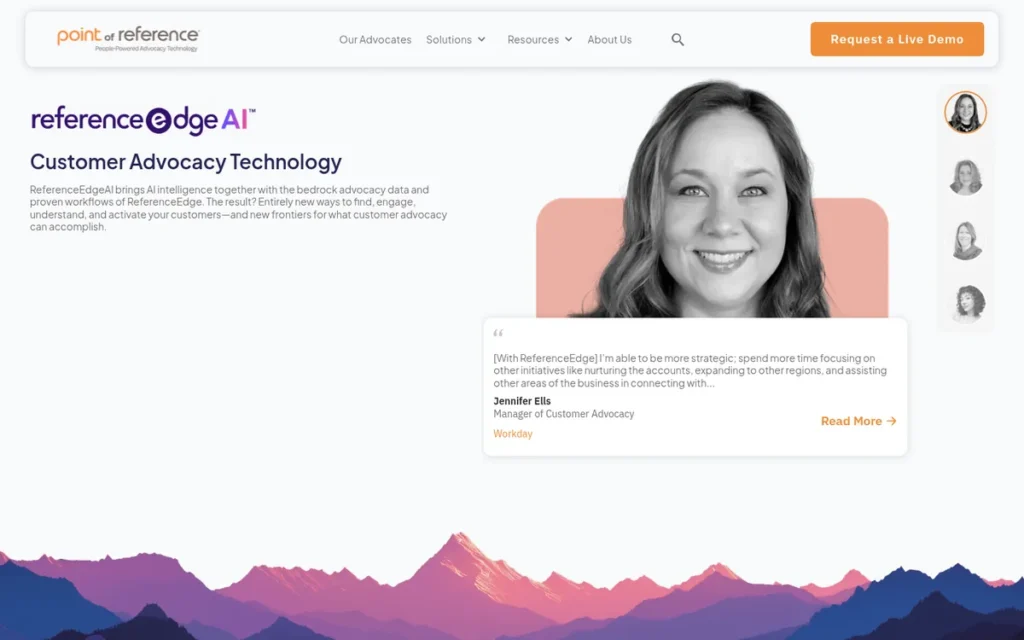
Category: Reference Management, matches customer references to sales opportunities and tracks the revenue they influence.
At a Glance
- Category: Reference Management
- Best For: Salesforce-centric mid-market and enterprise B2B teams running high-volume reference programs that must report reference-influenced revenue
- Price Range: $4/user/month (large enterprise), $9 (medium business), $16 (small business) (G2, 2026); some value-added features cost extra; no free trial
- Primary Strength: ReferenceEdge runs reference matching, approvals, overuse tracking, and reference-influenced revenue reporting natively inside Salesforce opportunity records.
- Biggest Limitation: G2 reviewers and competitor comparisons describe ReferenceEdge’s interface as dated, and its full value depends on Salesforce and on sales reps consistently using the workflow.
- One-Line Summary: ReferenceEdge by Point of Reference is a 100% Salesforce-native reference management platform that matches advocates to opportunities, tracks advocate overuse, and reports reference-influenced revenue, with published pricing from $4/user/month.
- Last Verified: November 2026
Why #1
- ReferenceEdge scores 4.30/5. It scored highest on CRM integration (C3: 5.0) and earned strong review evidence (C2: 4.5) and pricing transparency (C5: 4.5).
- ReferenceEdge lost points on program coverage (C1: 4.0) because community and gamification are secondary features.
Overview
ReferenceEdge by Point of Reference is a Salesforce-native customer reference and advocacy platform for B2B sales and customer marketing teams. ReferenceEdge helps those teams match reference customers to open opportunities, control advocate overuse, and report the revenue references influence.
ReferenceEdge is built by Point of Reference, which was founded in 2003. That makes it the longest-operating vendor in this ranking (Point of Reference, 2026). ReferenceEdge has grown beyond references into adjacent modules such as reviews and case studies, and it now offers a non-Salesforce interface.
Key Features
- ReferenceEdge lets sales reps search for and request matching reference customers directly from the Salesforce opportunity page.
- ReferenceEdge tracks each advocate’s participation history and flags overuse, so the same customers are not asked again and again.
- ReferenceEdge keeps approval workflows and account-owner nominations inside Salesforce, so permissions for references and stories stay on record.
- ReferenceEdge reports reference-influenced revenue by linking reference activity to Salesforce opportunities.
- ReferenceEdge keeps a content library of case studies, videos, logos, and testimonials, and adds a model-agnostic ReferenceEdgeAI.
Users on r/sales shared their experience:
“I work in a small SaaS startup and have a late stage deal that is asking for 2 customer references. It’s a small deal and my boss doesn’t want to “waste relationship capital” by giving her a reference.” Posted by u/Independent-Hat-8404
Takeaway: Sales teams treat every reference request as a draw on limited customer goodwill, which is why ReferenceEdge’s overuse tracking and approval governance matter for programs that handle a high volume of requests.
Best For
ReferenceEdge is best for B2B organizations that use Salesforce as their system of record. Their main advocacy problem is fulfilling, governing, and attributing sales reference requests at volume.
Strengths
- ReferenceEdge holds 4.6/5 on G2 from about 53 reviews, 4.96/5 on Salesforce AppExchange from 79 reviews, and 4.7/5 on Capterra from 20 reviews, where it has a 5.0/5 support sub-score (G2, AppExchange, and Capterra, 2026).
- One unnamed G2 reviewer credited ReferenceEdge with 300% reference database growth and doubled year-over-year reference revenue (G2, 2026).
- ReferenceEdge publishes per-user pricing from $4/user/month, the most transparent pricing among the B2B reference and advocacy platforms in this ranking (AppExchange and G2, 2026).
- ReferenceEdge comes from a vendor operating since 2003, with a named leadership team led by President and CEO David Sroka (Point of Reference, 2026).
Limitations
- ReferenceEdge gives up a modern standalone experience in exchange for deep Salesforce nativity. ReferenceEdge’s full value depends on the company running on Salesforce and on reps actually using the request workflow.
- G2 reviewers describe ReferenceEdge’s interface as “dated or intimidating” and implementation as time-consuming (G2, 2026). Competitor-authored comparisons by UserEvidence and Deeto make the same point (UserEvidence and Deeto, 2026).
- ReferenceEdge’s outcome evidence comes only from an unnamed G2 reviewer and an unnamed vendor example (120 to 700+ reference accounts), so no named-customer ROI was verified (G2 and Point of Reference, 2026).
- ReferenceEdge charges extra for some value-added features, such as automated reference check-ins, according to a TrustRadius pricing review (TrustRadius, 2026).
- ReferenceEdge’s community and gamification features are less central than those of a dedicated advocate-community platform such as Influitive.
Verdict
ReferenceEdge is the strongest customer advocacy platform in 2026 for Salesforce-centric B2B teams whose program depends on matching references to opportunities and proving reference-influenced revenue.
ReferenceEdge’s transparent per-user pricing and 20-plus-year track record lower buying risk. Teams on HubSpot, or teams that want a gamified community, should compare ReferenceEdge with UserEvidence and Influitive. Ask for a demo that uses your own opportunity data.
2. UserEvidence: Best for Getting Verified Customer Proof to Sales at Low Cost
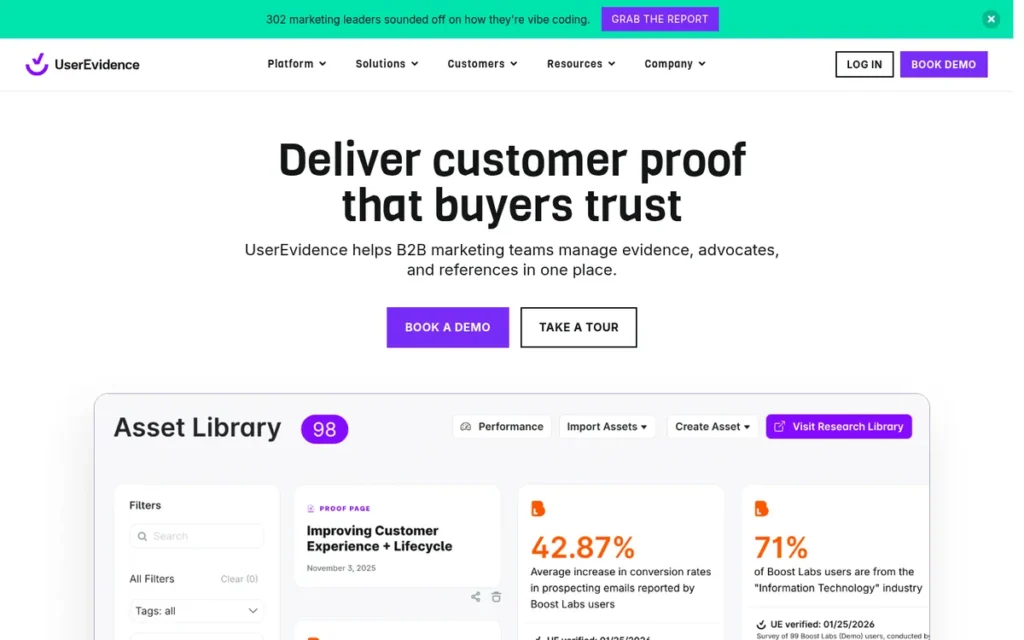
Category: Customer Proof Platform, collects verified customer evidence through surveys and delivers it to sales teams.
At a Glance
- Category: Customer Proof Platform
- Best For: B2B SaaS marketing and sales enablement teams whose reps can’t find relevant, verified customer proof, including teams on HubSpot or Pipedrive
- Price Range: Free plan ($0); Salesforce integration package $1,000/month (Freedom251, 2026); average contract about $12K/yr (Vendr, 2026); Pro is custom
- Primary Strength: UserEvidence turns customer survey responses into verified, searchable proof and delivers it through Salesforce, HubSpot, Slack, Seismic, Highspot, and Gong.
- Biggest Limitation: UserEvidence is a proof-focused point solution with lighter reference-operations depth than ReferenceEdge and no gamified advocate community like Influitive’s.
- One-Line Summary: UserEvidence is a survey-based customer proof platform that converts customer feedback into verified testimonials, statistics, and case studies and pushes them into CRM and sales-enablement tools, with a free plan for entry-level use.
- Last Verified: November 2026
Why #2
- UserEvidence scores 3.88/5. It ties for the top scores on CRM and enablement integration (C3: 5.0) and entry cost (C5: 5.0).
- UserEvidence ranks below ReferenceEdge because of lighter reference operations (C1: 3.5), review evidence from a single platform (C2: 3.5), and unverified attribution depth (C4: 3.0).
Overview
UserEvidence is a customer evidence platform for B2B SaaS marketing and sales enablement teams. UserEvidence runs short customer surveys, turns the answers into verified testimonials, statistics, and case studies, and delivers that proof to reps inside their CRM and enablement tools.
UserEvidence was founded in 2020. It has completed a Series A with investors including Crosslink Capital and Founder Collective (Vanta, 2026). UserEvidence focuses on proof assets rather than advocate communities or referral rewards.
Key Features
- UserEvidence sends short email and in-app surveys at key points in the customer journey and turns the responses into verified proof assets.
- UserEvidence keeps a searchable evidence library that can be filtered by industry, role, and use case.
- UserEvidence syncs content links, NPS scores, and reference activity to Salesforce and integrates with HubSpot, Pipedrive, Slack, Seismic, Highspot, and Gong.
- UserEvidence imports G2 and TrustRadius reviews and prompts satisfied customers to leave third-party reviews from the survey thank-you page.
- UserEvidence offers AI features including proof suggestions per deal, natural-language asset requests, and AI case-study generation on the Pro plan.
Best For
UserEvidence is best for B2B teams that need a steady supply of verified customer proof in front of reps. It suits HubSpot and Pipedrive teams in particular, and teams that want to start on a free plan before committing budget.
Strengths
- UserEvidence holds 4.8/5 on G2 from 63 reviews on its product page. It scores 9.8/10 for quality of support, against a 9.0 category average (G2, 2026).
- UserEvidence received the highest documented-capability score (95) in Proofmap’s 2026 customer advocacy report, which measures publicly documented capability against 30 requirements rather than usability (Proofmap, 2026).
- Unnamed UserEvidence customers reported a 120% increase in five-star reviews and a 27% completion rate for third-party review requests made from the survey thank-you page (G2 and UserEvidence, 2026).
- UserEvidence is the only B2B advocacy platform in this ranking with a confirmed, publicly documented free plan, which includes 500 evidence items and 3 team members (Freedom251, 2026).
Limitations
- UserEvidence gives up program breadth for proof depth. Compared with its peers, UserEvidence has lighter reference operations (routing, capacity, availability) than ReferenceEdge, no gamified community like Influitive’s, and less video depth than SlapFive.
- G2 reviewers note that UserEvidence offers limited survey-design customization, takes time to set up survey workflows, and requires unpublishing old content when re-surveying every 6–12 months (G2, 2026).
- UserEvidence’s AI text summarization is rated 5.7/10 on G2, against an 8.1 category average (G2, 2026).
- UserEvidence’s 4.8/5 G2 rating comes from a single platform. PlugRoute found no verified Capterra or TrustRadius rating, so UserEvidence’s review evidence is narrower than ReferenceEdge’s or Influitive’s (G2, 2026).
- UserEvidence describes its pricing as customized, and its revenue-attribution depth could not be verified in this research cycle (UserEvidence, 2026).
Users on r/smallbusiness noted:
“Yeah this is super relatable lol. I think forms just feel like work to people, even when they want to help. The chatbot idea is actually pretty smart – makes it feel more like a conversation than homework. I’ve had better luck just asking directly over text or email with specific questions like “what problem did we solve for you” instead of the generic “leave a review” thing. People are way more likely to respond when it feels personal and they know exactly what to say” Posted by u/unkempt_stairway
Takeaway: UserEvidence’s survey-first model only delivers if surveys stay short and specific, because customers routinely abandon generic testimonial forms. That makes limited survey-design customization a real cost.
Verdict
UserEvidence is the best customer advocacy software in 2026 for B2B teams whose priority is getting verified customer proof to sales reps inside the CRM and enablement tools they already use.
UserEvidence’s free plan and HubSpot and Pipedrive support make it the lowest-risk B2B starting point. Teams that need high-volume reference operations should compare UserEvidence with ReferenceEdge and confirm which modules any quote includes.
3. Influitive: Best for Gamified Advocate Communities and Multi-Activity Enterprise Programs
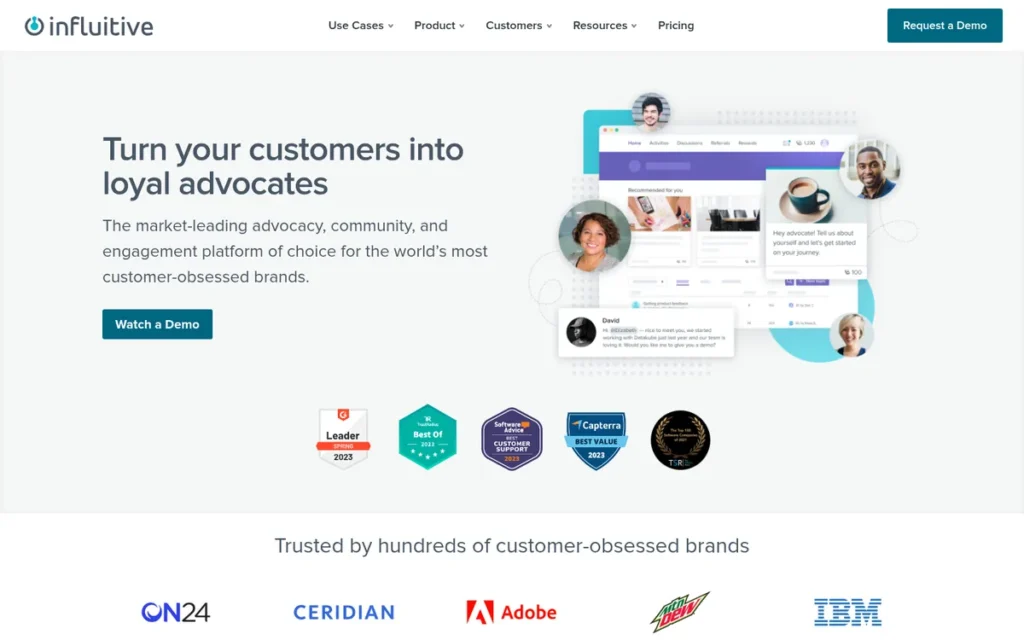
Category: Full-Program Advocacy Platform, runs advocate recruitment, engagement, and multiple advocacy activities in one system.
At a Glance
- Category: Full-Program Advocacy Platform
- Best For: Enterprise B2B teams with dedicated program staff who want a persistent, gamified advocate community that drives reviews, references, and referrals
- Price Range: Quote-based; historically from $1,999/month on Influitive’s own pricing page (Influitive, 2023) and $1,499/month Basic on G2 (G2, 2026); Vendr estimates $25K–$150K+/yr (Vendr, 2026)
- Primary Strength: Influitive uses challenges, points, badges, and rewards to keep advocates engaged across reviews, references, referrals, and case studies in one branded hub.
- Biggest Limitation: Influitive needs significant ongoing admin time and faces reported support and renewal-pricing concerns since its December 2023 change of ownership.
- One-Line Summary: Influitive is a gamified advocate community platform that motivates B2B customers to write reviews, take reference calls, give referrals, and join case studies, backed by 396 G2 reviews averaging 4.4/5.
- Last Verified: November 2026
Why #3
- Influitive scores 3.70/5. It has the top program coverage (C1: 5.0) and review evidence (C2: 5.0) in this ranking.
- Influitive’s ranking is pulled down by unverified Salesforce depth (C3: 3.0), quote-only pricing (C5: 2.0), and risk from its ownership change and admin burden (C6: 2.0).
Overview
Influitive is a gamified customer advocacy platform for enterprise B2B marketing teams that want a branded advocate community. Influitive customers earn points, badges, and rewards for writing reviews, taking reference calls, giving referrals, and joining case studies.
Influitive is one of the longer-running platforms in the advocate marketing category. Jigsaw Interactive, part of the ESW Capital portfolio, acquired Influitive in December 2023, and financial terms were not disclosed (Proofmap, 2026; Jigsaw Interactive, 2023).
Key Features
- Influitive’s AdvocateHub lets marketers create targeted challenges such as writing a review, taking a reference call, or sharing on social media.
- Influitive rewards participation with points, badges, levels, and a rewards catalog to keep advocates engaged over time.
- Influitive supports review campaigns for G2, TrustRadius, and Capterra alongside referral, reference, testimonial, and case-study recruitment.
- Influitive offers a Digital Community tier with discussions, moderation, a knowledge base, ideation, and Q&A.
- Influitive provides CRM and marketing-automation integrations, though the depth of its Salesforce sync could not be independently verified.
Best For
Influitive is best for enterprise B2B teams that can staff an ongoing community program. These teams want gamification and recognition to fight advocate burnout across many kinds of advocacy activity.
Strengths
- Influitive has the largest B2B advocacy review base in this ranking: 4.4/5 on G2 from 396 reviews and 4.7/5 on Capterra from 247 reviews (G2 and Capterra, 2026).
- Influitive reports 21 G2 awards across four categories and 23 consecutive quarters of G2 category leadership, according to vendor-published announcements (Influitive, 2026).
- One unnamed TrustRadius reviewer credited Influitive with generating hundreds of third-party reviews, dozens of case studies, hundreds of quotes, and thousands of survey responses (TrustRadius, 2020).
- Influitive is the only platform in this ranking built mainly around gamification. That design targets the participation risk practitioners describe as “getting people to actually use it” (Reddit r/AskMarketing, 2019).
Limitations
- Influitive gives up low operating overhead in exchange for engagement depth. G2 review summaries say Influitive “can require significant time to maintain effectively,” and its 8.4/10 ease-of-admin score is below the category average (G2, 2026).
- Influitive’s implementation takes about 2 months, according to competitor-authored comparisons that also report integration reliability issues (UserEvidence, 2026).
- Since the acquisition, competitor-authored sources report that Influitive moved to chatbot-first support. The same sources cite a TrustRadius review describing a roughly 25% renewal increase (UserEvidence, 2026). Verify current support terms and negotiate renewal caps in writing.
- Influitive scored 73 in Proofmap’s 2026 documented-capability report, below UserEvidence (95) and SlapFive (92). Influitive also has no verified named-client pipeline case study (Proofmap, 2026).
Verdict
Influitive is the gamified advocate community platform with the largest review base in this ranking (643 reviews across G2 and Capterra, 2026). Buyers should still verify its post-acquisition support and pricing before purchase.
Influitive fits programs where a persistent, staffed community is central. Budget for admin time, negotiate renewal terms, and ask Influitive for named customer references from after the 2023 ownership change.
4. Referral Rock: Best for B2B and Service Referral Programs with Transparent Pricing
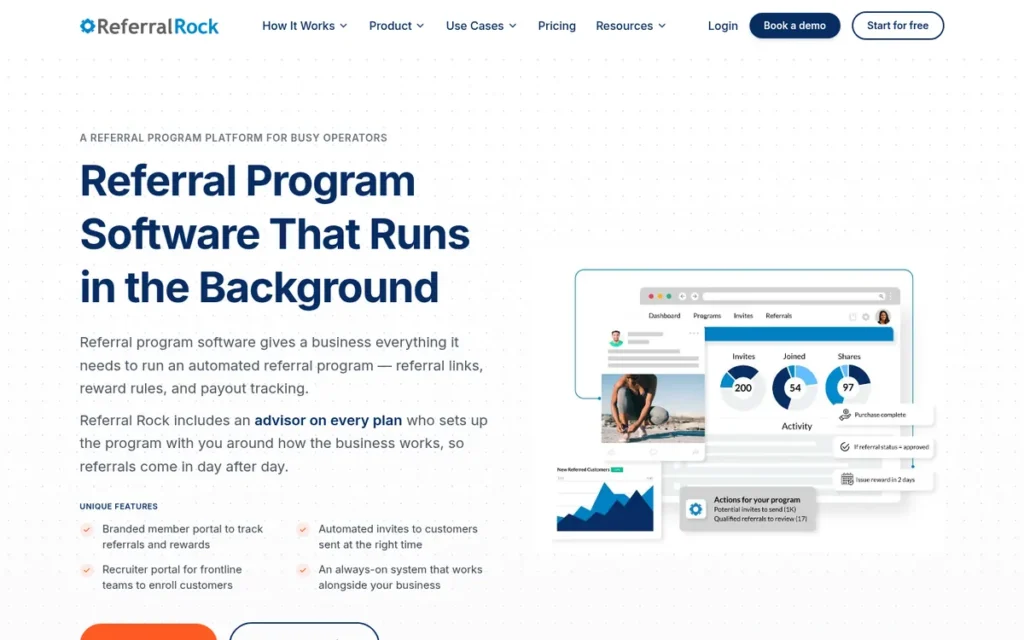
Category: Referral Program Platform, tracks, qualifies, and rewards customer and partner referrals.
At a Glance
- Category: Referral Program Platform
- Best For: B2B SaaS, professional services, and SMB teams that want a tracked, rewarded customer or partner referral program tied to HubSpot or Salesforce
- Price Range: $250/month Operator plan, month-to-month, no setup fee, 14-day free trial (Referral Rock, 2026); custom pricing on request
- Primary Strength: Referral Rock automates referral links, member portals, and reward payouts triggered by closed deals, with published month-to-month pricing.
- Biggest Limitation: Referral Rock covers referrals only and does not manage customer references, stories, reviews, or advocate communities.
- One-Line Summary: Referral Rock is a referral program platform for B2B, services, and SMB companies that automates referral tracking and rewards tied to closed deals, starting at a published $250/month with a 14-day free trial.
- Last Verified: November 2026
Why #4
- Referral Rock scores 3.63/5. It earned the top pricing transparency score (C5: 5.0) and strong outcome evidence from four named-client case studies (C4: 4.0).
- Referral Rock lost points on program coverage (C1: 2.5) because it handles referrals only.
Overview
Referral Rock is a referral program platform for B2B SaaS, professional services, and small-to-midsize businesses. Referral Rock tracks customer, partner, and affiliate referrals through a sales cycle and rewards advocates automatically when a referred deal closes.
Referral Rock was started in 2014 by founder Josh Ho, is independently owned, and is headquartered in Alexandria, Virginia (Referral Rock, 2026). Referral Rock reports more than 1,000 customers.
Key Features
- Referral Rock gives each advocate unique referral links, codes, and QR codes, plus a hosted member portal with password-free access.
- Referral Rock triggers rewards automatically when a referred deal closes or a job is completed, which suits referrals with a sales cycle.
- Referral Rock integrates with HubSpot and Salesforce and can assign recruiters from the CRM.
- Referral Rock sends automated invitations and reminders and offers personalized landing pages for referred prospects.
- Referral Rock includes analytics, exports, and audit logs, and assigns a program advisor on every plan.
Best For
Referral Rock is best for B2B and service businesses that want a structured, rewarded referral or partner program with predictable monthly pricing rather than a full advocacy suite.
Strengths
- Referral Rock holds 4.6/5 on Capterra from 101 reviews and 4.5/5 on G2 from 16 reviews. Reviewers say it “just works” and integrates with HubSpot (Capterra and G2, 2026).
- Referral Rock publishes named-client results. Catapult generated 4,500+ referrals in its first 6 months, and SIR Glass gained 30+ new sales per month after automating its partner program (Referral Rock, 2026).
- Referral Rock reports that its named client CoolBot turned 10% of its customers into ambassadors and achieved 10x ROI within months (Referral Rock, 2026).
- Referral Rock is the only product in this ranking with published month-to-month pricing and a self-serve trial. Its Operator plan includes unlimited referrals and 10,000 base members (Referral Rock, 2026).
Limitations
- Referral Rock gives up program breadth for referral specialization. Referral Rock does not manage references, video stories, review generation, or communities, so B2B teams with a broader mandate will need another platform.
- Reviewers describe Referral Rock’s design as dated (“antequated” [sic] on Capterra) and “clunky” on G2, and they mention limited custom fields and formatting glitches (Capterra and G2, 2026).
- Reviewers report integration friction between Referral Rock and webstores or sales software, plus a steep learning curve for advanced reward rules (G2 and Rankite, 2026).
- Referral Rock has no low-cost starter tier for very small businesses. One third-party analysis warns of possible add-on costs, which PlugRoute could not confirm (CostBench, 2026).
- Referral Rock, like most referral tools, amplifies existing customer enthusiasm rather than creating it. As one founder put it: “The referral program just amplifies what already exists” (Reddit r/startups, 2023).
This aligns with community sentiment on r/Entrepreneur:
“Having software doesn’t mean you’ll have a successful referral program. That’s the main problem with most SaaS vendors. It’s good tech, it’s just that most companies can’t afford to stop paying attention to their core competency to implement their tool. Which makes it hard to get a good return.” Posted by u/igleyal
Takeaway: Referral Rock buyers should budget internal time to run the program, because referral software on its own does not produce a return without sustained attention.
Verdict
Referral Rock is the most transparently priced referral program platform for B2B and service businesses in 2026, offering month-to-month plans from $250 and a 14-day free trial.
Referral Rock’s named-client case studies give buyers more checkable outcome evidence than most advocacy vendors publish. Choose Referral Rock when referrals are the main goal, pair it with a reference or proof tool, and test the CRM integration during the trial.
5. SlapFive: Best for Video Customer Stories and Reference Deflection in Enterprise Customer Marketing
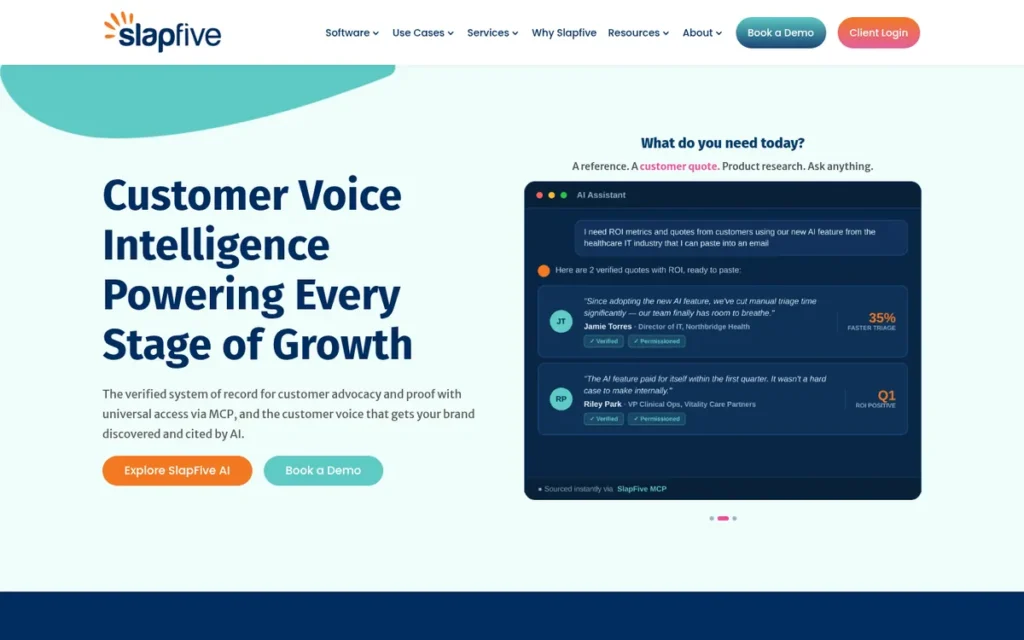
Category: Full-Program Advocacy Platform.
At a Glance
- Category: Full-Program Advocacy Platform
- Best For: Enterprise B2B customer marketing teams that want video customer stories, reference reels, and reference management in one system of record
- Price Range: Pricing on request; no free trial or free plan; no setup fee (TrustRadius, 2026)
- Primary Strength: SlapFive captures remote video customer stories and packages them as reference reels that reduce live reference calls while feeding revenue-influence reporting.
- Biggest Limitation: SlapFive has very little independent review evidence, and one reviewer reports a roughly 3-month custom Salesforce integration.
- One-Line Summary: SlapFive is a B2B customer-marketing system of record that combines advocate recruitment, video story capture, reference management, and revenue-influence reporting, scored 92 in Proofmap’s 2026 report.
- Last Verified: November 2026
Why #5
- SlapFive scores 3.10/5. It ties for the top program coverage score (C1: 5.0).
- SlapFive lost the most points on review evidence (C2: 1.5) and pricing transparency (C5: 1.5) because it has fewer than 10 independent reviews and no public pricing.
Overview
SlapFive is a customer marketing and advocacy platform for enterprise B2B teams. In one system of record, SlapFive helps teams recruit advocates, capture video customer stories, manage reference requests, and report how customer voice influences revenue.
SlapFive was founded in January 2015 by CEO Jeff Ernst and is based in the Boston area (SlapFive, 2026). SlapFive uses a “top-down” approach: it starts from go-to-market obstacles and works back to the customer stories that address them.
Key Features
- SlapFive captures remote video and audio customer stories and offers an event “Minute Booth” for in-person capture.
- SlapFive turns stories into “reference reels” that let prospects hear from customers without a live call, which reduces advocate fatigue.
- SlapFive manages reference requests and scheduling and keeps a central customer-content library.
- SlapFive reports revenue influence through Salesforce and Slack workflows.
- SlapFive uses AI to help identify advocates and generate content from captured stories.
Best For
SlapFive is best for enterprise B2B customer marketing teams that prioritize video customer stories and reference deflection. These teams also need the internal resources to support a custom Salesforce integration.
Strengths
- SlapFive scored 92 (“leader”) overall in Proofmap’s 2026 report, which scores publicly documented capability against 30 requirements using data as of October 2026. Proofmap highlighted SlapFive’s revenue-influence reporting and its Salesforce and Slack workflows (Proofmap, 2026).
- One unnamed G2 reviewer credited SlapFive with saving about 20 hours per week through automated reference scheduling (G2, 2026).
- Acumatica uses SlapFive’s reference reels across product proof, competitive intelligence, campaigns, webinars, and social content (TrustRadius, 2026).
- SlapFive holds 8.0/10 on TrustRadius from a small sample of 6 reviews. Reviewers praise its video capture and self-administration, and one calls the team “incredibly collaborative” (TrustRadius, 2026).
Limitations
- SlapFive gives up implementation speed in exchange for a broad, connected system. A RingCentral reviewer called the SlapFive Salesforce integration a “significant undertaking” that took about 3 months (G2, 2026).
- SlapFive has a very small independent review base: about 2 G2 reviews, 6 TrustRadius reviews, and no Capterra listing (G2 and TrustRadius, 2026).
- SlapFive publishes no figures for reference-deflection rates or pipeline impact, so its outcome claims are hard to verify.
- SlapFive has no public pricing and no third-party price benchmarks, so total cost cannot be estimated before a sales conversation (TrustRadius, 2026).
Verdict
SlapFive is the strongest choice in 2026 for enterprise B2B teams that want video customer stories and reference reels to reduce live reference calls inside one customer-marketing system.
SlapFive’s documented breadth scored 92 in Proofmap’s 2026 report, second only to UserEvidence’s 95. Thin review evidence and a reported 3-month Salesforce integration are the main risks, so ask SlapFive for named references and an itemized quote.
6. Birdeye: Best for Multi-Location Businesses Needing Reviews and Reputation
Category: Review & Reputation Suite, generates and manages customer reviews, listings, and light referrals for local and multi-location businesses.
At a Glance
- Category: Review & Reputation Suite
- Best For: Multi-location and local service businesses that need review generation, reputation management, listings, and simple referrals
- Price Range: Pricing on request; third-party estimates about $299–$349/location/month, Dominate tier custom (SaaSSwitcher, 2026); AI and premium support may cost extra
- Primary Strength: Birdeye automates review requests, monitoring, and responses across many locations, alongside listings, messaging, and referrals, in one suite.
- Biggest Limitation: Birdeye is not built for structured B2B reference programs, and its Trustpilot reviews are polarized by complaints about auto-renewal and cancellation.
- One-Line Summary: Birdeye is an all-in-one review and reputation platform for multi-location and local businesses, used by 150,000+ businesses and rated 4.7/5 from over 4,000 G2 reviews, but it is not designed for B2B reference management.
- Last Verified: November 2026
Why #6
- Birdeye scores 2.63/5 on B2B-weighted criteria. It earned strong review-evidence and vendor-stability scores (C2: 4.0, C6: 4.0) but lost points on B2B job fit (C1: 1.5).
- Birdeye would be the top pick in this set on criteria weighted for SMB and local businesses.
Overview
Birdeye is a customer experience and reputation management platform for multi-location and local service businesses. From one Birdeye dashboard, local businesses can generate and respond to online reviews, manage listings, message customers, and run simple referral programs.
Birdeye was founded in 2012 in Palo Alto and reportedly serves more than 150,000 businesses (Supergood, 2026). Birdeye is included because AI engines often recommend it for advocacy, but it fits the SMB and local audience rather than B2B reference programs.
Key Features
- Birdeye sends automated SMS and email review requests and centralizes review monitoring and responses across locations.
- Birdeye includes Birdeye Referrals, surveys, and testimonial collection alongside its reputation tools.
- Birdeye offers two-way messaging, webchat, listings management, social publishing, and payments in the same platform.
- Birdeye provides a multi-agent AI suite covering reviews, chat, listings, surveys, competitors, referrals, and reporting.
- Birdeye can trigger review requests from CRM data, which one agency buyer described as “daily review exports from any CRM” (Reddit r/agency, 2024).
Best For
Birdeye is best for multi-location and local service businesses whose main advocacy goal is more Google and third-party reviews and a stronger local reputation.
Strengths
- Birdeye holds 4.7/5 on G2 from roughly 4,300 reviews and 4.7/5 on Capterra from about 705 reviews, the largest review base in this ranking (G2 and Capterra, 2026).
- Birdeye reports more than 150,000 business customers, including H&R Block, Caesars Entertainment, Cracker Barrel, and Aspen Dental (Supergood and CaseStudies.com, 2026).
- A vendor-published case study credits Birdeye with helping its named client Alyce generate 50 net-new opportunities and 1,700% ROI in one quarter (CaseStudies.com, 2026).
- Birdeye has institutional backing from Trinity Ventures, World Innovation Lab, and Accel-KKR, including an $8M Series A in 2016 (Birdeye and Pabau, 2026).
Limitations
- Birdeye gives up B2B advocacy depth for local-business breadth. Independent analysis notes that Birdeye “is not naturally optimized for managing a structured customer-reference program” (Beltstack and Vendasta, 2026).
- Birdeye’s reputation is polarized: about 3.1/5 on Trustpilot from 684 reviews, with roughly 71% five-star and 23% one-star ratings (Trustpilot, 2026).
- Birdeye’s one-star reviews cite complicated cancellation and renewal price increases. BBB complaints about Birdeye describe 90-day written-notice auto-renewal terms and “innovation” fees (Trustpilot and BBB, 2026).
- An agency buyer called Birdeye “super expensive and bloated with features most clients never touch,” and another reported a minimum of about $850/month for 10 locations (Reddit r/agency, 2024).
Users on r/restaurantowners shared their experience:
“They’re relentless in terms of trying to sign us and we do need some kind of review aggregator to work with – but they seem pretty pricey relative to some others. That said they do seem to be the best at this from what I can tell at a surface level.” Posted by u/Oxynod
Takeaway: Local businesses see Birdeye as a category leader in review aggregation but weigh that reputation against aggressive sales outreach and pricing above that of lighter alternatives.
Verdict
Birdeye is the best-evidenced review and reputation platform for multi-location and local businesses in 2026, but it is not a substitute for B2B reference or advocacy software.
Birdeye gives small and local businesses a mature, widely used suite. Check Birdeye’s location minimums and auto-renewal terms before signing. B2B teams should look at ReferenceEdge, UserEvidence, or Influitive instead.
7. Champion: Best for AI Reference Matching and Advocate Job-Change Tracking (Early-Stage Option)
Category: Reference Management.
At a Glance
- Category: Reference Management
- Best For: Enterprise B2B revenue teams on Salesforce, optionally with Gainsight, that want AI reference matching and advocate job-change tracking and can accept early-stage vendor risk
- Price Range: Quote-based with no free plan (Freedom251, 2026); one third-party profile reports a free tier for the first 20 champions and a ~$6,000/yr Salesforce package, which PlugRoute could not confirm (CheckThat, 2026)
- Primary Strength: Champion uses AI to match references to deal context, cap advocate requests, and flag when advocates change jobs, which can create new pipeline opportunities.
- Biggest Limitation: Champion has no verified reviews on any major review platform, so its outcome and pricing claims can’t yet be independently checked.
- One-Line Summary: Champion is an early-stage AI customer advocacy platform, launched in 2023, that matches references to deals, limits advocate fatigue, and tracks advocate job changes, but it has no verified third-party reviews as of November 2026.
- Last Verified: November 2026
Why #7
- Champion scores 2.38/5. It scored well on CRM and revenue-workflow integration (C3: 4.0).
- Champion lost the most points on review evidence (C2: 0.5) because no verified third-party reviews exist, and on pricing transparency (C5: 2.0) because its pricing sources conflict.
Overview
Champion is an AI-driven customer advocacy platform for revenue-focused B2B teams. Champion discovers advocates across the tech stack, matches references to deal context, caps how often each customer is asked, and sends alerts when an advocate changes jobs.
Champion launched in 2023 and raised a $3.3M seed led by Flyover Capital. A $5M Series A led by Armory Square Ventures followed in September 2026, bringing total funding to $10.3M (Champion and CX Network, 2026).
Champion has shifted its focus to enterprise Salesforce customers, according to investor Armory Square Ventures (Armory Square Ventures, 2026).
Key Features
- Champion uses AI to discover and score potential advocates from data across the customer’s tech stack.
- Champion matches references to deals by industry, use case, and relationship strength.
- Champion sets monthly capacity limits per customer to prevent reference fatigue.
- Champion monitors advocate job changes and triggers outreach when a champion joins a new company.
- Champion syncs advocate status, reference readiness, and advocate-attributed ARR to Gainsight and offers Slack alerts, webhooks, and an MCP server.
Best For
Champion is best for enterprise B2B revenue teams with clean Salesforce data that want automated reference matching and job-change pipeline signals and are willing to pilot an early-stage vendor.
Strengths
- Champion has raised $10.3M in total funding, including a September 2026 Series A led by Armory Square Ventures with Bread and Butter Ventures participating (Star Tribune and CX Network, 2026).
- A third-party profile reports that Champion cut Gainsight’s reference-matching time from 8 days to 1.7 days and influenced $383K in ARR within 90 days. The method and baseline were not disclosed (CheckThat, 2026).
- The same third-party profile reports that Champion delivered 5x reference-related conversion and a 10% lift in monthly sales-qualified opportunities for Zylo. These figures are unverified at the primary source (CheckThat, 2026).
- Champion is the only platform in this ranking that documents advocate job-change tracking, which turns departing champions into potential new-account pipeline (CheckThat and Proofmap, 2026).
Limitations
- Champion gives up a proven track record for newer AI-driven automation. Champion has zero verified reviews on G2, Capterra, GetApp, or Gartner Peer Insights, making it the hardest vendor in this ranking to verify (Freedom251, 2026).
- Champion’s outcome figures come from one third-party profile, and its pricing sources contradict each other (CheckThat and Freedom251, 2026).
- Champion does not publicly explain its AI methods and depends on clean CRM data. Its tracking of advocates’ job changes also raises privacy and consent questions.
- Champion has no native community or content library, so its scope is narrower than full-program suites.
- Champion’s shift to enterprise Salesforce accounts means smaller or Gainsight-only teams should confirm fit before piloting (Armory Square Ventures, 2026).
Verdict
Champion is the only reference matching option in this ranking that documents advocate job-change tracking. With no verified third-party reviews, it is best treated as a pilot for revenue teams willing to take on early-stage risk.
Champion’s job-change tracking and capacity limits address real gaps. Require named customer references, test Champion’s matching against your own CRM data, and review job-change monitoring with your privacy team.
What Other Customer Advocacy Tools Were Considered?
PlugRoute considered several other customer advocacy tools but did not fully rank them. Some had too little verifiable data in this research cycle. Others serve adjacent jobs such as e-commerce reviews, affiliate marketing, or social media, based on evidence available as of November 2026.
Being left out of the ranking does not mean these tools are worse.
- Deeto, Upland RO Innovation, TechValidate, Gainsight Customer Communities, and Peerbound were left out because too little data was available in this research cycle.
- Base AI was left out for limited depth of research, even though Proofmap scored it 92 and it holds 4.4/5 from 56 reviews on G2 (Proofmap and G2, 2026).
- Ambassador was left out because of weaker review data: 4.1/5 from 26 reviews on Capterra (Capterra, 2026).
- Higher Logic, Extole, Advocately, Yotpo, NiceJob, impact.com, and Sprout Social were named by AI engines but fall outside B2B customer advocacy or were not researched in depth.
What Red Flags Should I Watch For When Evaluating Customer Advocacy Software?
The most important red flags in customer advocacy software are thin third-party review evidence, hidden module and renewal costs, and outcome claims you cannot check. Each of the seven red flags below appeared in at least one platform evaluated in this ranking, and each names the specific evidence behind it.
Red Flag #1: No Verifiable Third-Party Reviews
A vendor with zero or single-digit reviews on G2, Capterra, or TrustRadius cannot be independently checked before purchase. In this ranking, Champion has no verified reviews and SlapFive has fewer than 10, so buyers should require named references (Freedom251 and TrustRadius, 2026).
Red Flag #2: Core Features Sold as Separate Modules
Add-on pricing can turn a low headline price into a much larger contract. A TrustRadius review criticizes ReferenceEdge’s extra charges for automated reference check-ins, and third-party estimates note that Birdeye’s AI and premium support may cost extra (TrustRadius and SaaSSwitcher, 2026).
Red Flag #3: Auto-Renewal With Long Written-Notice Periods
Long notice windows can lock buyers into another contract year. BBB complaints about Birdeye describe 90-day written-notice auto-renewal terms, and Trustpilot reviewers cite complicated cancellation (BBB and Trustpilot, 2026). Get cancellation terms in writing before signing.
Red Flag #4: Custom CRM Integration With No Scoped Timeline
Custom CRM integrations can take months and delay program launch. One SlapFive reviewer reported about 3 months for a custom Salesforce integration, and competitor-authored comparisons cite about 2 months for Influitive (G2 and UserEvidence, 2026). Ask for a written, scoped plan.
Red Flag #5: Outcome Claims Without Named Customers or Baselines
ROI figures without a named customer or baseline can’t be checked. In this ranking, ReferenceEdge’s 300% database growth and SlapFive’s 20 hours per week come from unnamed G2 reviewers. Champion’s 8-to-1.7-day figure comes from a third-party profile with an undisclosed method (G2 and CheckThat, 2026).
Red Flag #6: Recent Ownership Change Without Clear Support Commitments
Acquisitions can change support models and renewal pricing. Influitive changed ownership in December 2023, and competitor-authored sources report chatbot-first support and a roughly 25% renewal increase since then (UserEvidence and Proofmap, 2026). Confirm support terms and renewal caps in the contract.
Red Flag #7: Comparisons Written by Competing Vendors
Many “alternatives” and “versus” articles in this category are published by competing vendors, including UserEvidence, Deeto, and Point of Reference. Their criticisms may be accurate, but read them as competitor-authored and check them against independent review platforms.
What Questions Should I Ask Before Choosing Customer Advocacy Software?
The best questions to ask before choosing customer advocacy software force vendors to prove their claims rather than describe features. Each of the seven questions below targets a claim vendors commonly make and points to evidence from the platforms ranked in this guide.
Question #1: Which advocacy jobs does this platform actually cover, and which need another tool?
Most customer advocacy platforms cover one or two advocacy jobs well, not all five. Referral Rock covers referrals and UserEvidence covers customer proof, so both may need a second tool for full-program coverage. Ask each vendor to demonstrate every job you need in a live demo rather than relying on feature lists.
Question #2: Does it work natively with our CRM (Salesforce, HubSpot, Pipedrive), and what syncs in each direction?
CRM architecture determines whether reps actually use an advocacy platform. ReferenceEdge is Salesforce-native, UserEvidence and Referral Rock also support HubSpot, and UserEvidence supports Pipedrive. Ask which objects sync, in which direction, and whether reference requests start from the opportunity record.
Question #3: How does it measure reference-influenced revenue or advocate-attributed ARR?
Only three platforms in this ranking document revenue or ARR-influence reporting: ReferenceEdge, SlapFive, and Champion. Attribution reporting keeps advocacy programs funded. Ask each vendor for a sample report built on opportunity data and an explanation of how influence is defined and counted.
Question #4: How does it prevent advocate fatigue and track customer permissions and approvals?
The platforms in this ranking document three different ways to prevent advocate fatigue, and the right one depends on where your burnout comes from. Also ask where consent records are stored, whether approvals create an audit trail, and whether consent is tracked per asset when quotes are reused in AI-generated content.
- ReferenceEdge flags advocate overuse and records approvals inside Salesforce.
- Champion caps reference requests per customer each month.
- SlapFive substitutes recorded reference reels for live reference calls.
Question #5: What is the realistic implementation timeline and ongoing admin headcount?
Implementation burden often decides whether an advocacy program succeeds. Reported timelines include about 2 months for Influitive, per competitor-authored comparisons, and about 3 months for a custom SlapFive Salesforce integration (UserEvidence and G2, 2026). Ask for median implementation time at your company size.
Question #6: What exactly is included in the quote, and what are the renewal terms?
Quote-based pricing often hides module and renewal costs, so ask every vendor for an itemized quote. Request renewal caps and notice periods in writing, especially from vendors with reported renewal increases or auto-renewal complaints, such as Influitive and Birdeye.
- The itemized quote should show which modules are included and which are sold separately.
- The itemized quote should list CRM and sales-enablement integration costs.
- The itemized quote should break out implementation and services fees.
- The itemized quote should state the support tier and the renewal cap.
Question #7: Can you provide named references from companies like ours?
Named references are the most direct way to check vendor claims before buying. Ask for at least two current customers in your industry with a similar CRM setup. Named references matter most for vendors with thin review evidence, such as Champion and SlapFive.
As one user on r/sales described:
“The prospect is taking a risk on your no name startup. They can’t even do an industry reference because nobody knows about your startup. The startup you work for can literally close up tomorrow and who will support the customer.” Posted by u/ElTioBorracho
Takeaway: Named customer references are buyers’ main protection against early-stage vendor risk, so they should be non-negotiable when evaluating thinly reviewed platforms like Champion and SlapFive.
How Did We Rank These Customer Advocacy Platforms?
PlugRoute scored each platform from 0 to 5, in half-point steps, on six weighted criteria. The primary criteria are B2B job fit (25%), review evidence (20%), and CRM integration (20%). The secondary criteria are outcome evidence (15%), pricing transparency (10%), and implementation burden (10%).
The weights reflect the pain points B2B advocacy buyers report most often.
Ranking criteria and why each matters:
- C1: B2B Job Fit and Program Coverage (25%): This criterion measures how many advocacy jobs a platform covers and how deeply, because the category’s biggest problem is point solutions being ranked next to full-program platforms.
- C2: Multi-Platform Review Evidence (20%): This criterion weights ratings by sample size across G2, Capterra, TrustRadius, AppExchange, and Trustpilot. Independent peer reviews are one of the few checks buyers can run before talking to a vendor.
- C3: CRM and Sales-Enablement Integration (20%): This criterion measures how well proof and references reach reps. A Gartner survey of 646 B2B buyers found that 67% prefer a buying experience without a sales rep (Gartner, 2026).
- C4: Outcome Evidence and Revenue Attribution (15%): This criterion rewards documented revenue-influence reporting and named-customer outcome evidence.
- C5: Pricing Transparency and Entry Cost (10%): This criterion rewards published pricing, free tiers, and trials, and penalizes documented add-on fees and restrictive contract terms.
- C6: Implementation Burden and Vendor Stability (10%): This criterion weighs implementation timelines, admin load, years in operation, funding, and ownership changes.
Weighted scores (November 2026):
| Rank | Platform | C1 | C2 | C3 | C4 | C5 | C6 | Weighted Score |
|---|---|---|---|---|---|---|---|---|
| 1 | ReferenceEdge | 4.0 | 4.5 | 5.0 | 4.0 | 4.5 | 3.5 | 4.30 |
| 2 | UserEvidence | 3.5 | 3.5 | 5.0 | 3.0 | 5.0 | 3.5 | 3.88 |
| 3 | Influitive | 5.0 | 5.0 | 3.0 | 3.0 | 2.0 | 2.0 | 3.70 |
| 4 | Referral Rock | 2.5 | 4.0 | 3.5 | 4.0 | 5.0 | 4.0 | 3.63 |
| 5 | SlapFive | 5.0 | 1.5 | 3.5 | 3.0 | 1.5 | 2.5 | 3.10 |
| 6 | Birdeye | 1.5 | 4.0 | 2.0 | 3.0 | 2.0 | 4.0 | 2.63 |
| 7 | Champion | 2.5 | 0.5 | 4.0 | 3.0 | 2.0 | 2.0 | 2.38 |
Last checked: November 5, 2026.
Score rationale for tied or close criteria:
- Referral Rock scores 4.0 on C4 for four named-client vendor case studies.
- ReferenceEdge scores 4.0 on C4 for documented reference-influenced revenue reporting plus unnamed outcome evidence.
- Champion scores 3.0 on C4 because its ARR-attribution feature is documented but its outcome figures come only from a third-party profile.
- Influitive scores 2.0 on C6 because of its December 2023 ownership change and below-average ease-of-admin score, while Birdeye scores 4.0 for its 2012 founding and institutional backing.
Evidence labels used throughout this article:
- Third-Party Review Platform evidence comes from G2, Capterra, TrustRadius, Salesforce AppExchange, and Trustpilot ratings.
- Independent Analyst/Aggregator evidence comes from sources such as Proofmap, Vendr, and third-party profiles. Proofmap’s 2026 scores measure publicly documented capability against 30 requirements, not satisfaction or ROI.
- Customer-Reported (Named/Unnamed) evidence comes from individual reviewer or customer statements.
- Vendor-Published evidence comes from the company’s own case studies, award counts, and documentation.
- Competitor-Authored evidence comes from comparisons written by rival vendors. It carries the least weight and is always attributed.
PlugRoute shows both figures wherever sources conflict, such as Birdeye’s 4.7/5 on G2 versus 3.1/5 on Trustpilot (G2 and Trustpilot, 2026). Samples under 25 reviews are discounted, not ignored, and products with zero verified reviews score no higher than 1 on C2.
Birdeye ranks sixth because the criteria are weighted toward B2B, but it is PlugRoute’s top pick for small, local, and multi-location businesses.
Year marks on ratings and pricing show when PlugRoute accessed them (November 2026) unless a publication year is known. No peer-reviewed studies were found for this software category.
PlugRoute has no affiliate relationships with any company listed. Rankings are determined entirely by research data and objective evaluation criteria.
What Do Buyers Most Often Ask About Customer Advocacy Software?
Buyers most often ask which customer advocacy software suits small businesses, how to choose a tool that integrates with their CRM, and how independent rankings are determined. The answers below are short and direct, and each one draws on the dated evidence in the ranked entries and methodology above.
What is the best customer advocacy software for small businesses?
Birdeye is the best-evidenced option for local and multi-location small businesses that mainly need reviews and reputation management, with 4.7/5 from roughly 4,300 G2 reviews (G2, 2026). Small B2B and service businesses focused on referrals should consider Referral Rock, which costs $250/month month-to-month with a 14-day free trial (Referral Rock, 2026).
How do I choose customer advocacy software that integrates with my CRM?
Choose customer advocacy software whose CRM architecture matches yours. ReferenceEdge is Salesforce-native. UserEvidence and Referral Rock also document HubSpot integrations, and UserEvidence supports Pipedrive (UserEvidence and Referral Rock, 2026). Before buying, ask each vendor which records sync, in which direction, and how long the integration took for similar customers.
How does PlugRoute determine its customer advocacy software rankings?
PlugRoute ranks customer advocacy software on six weighted criteria, led by B2B job fit (25%), review evidence (20%), and CRM integration (20%). Each score cites dated evidence labeled by source type. Competitor-authored claims carry the least weight, small review samples are discounted, and every weighted score is published in the methodology section.
What Do Key Customer Advocacy Software Terms Mean?
Reference Management: Software that matches customer references to open sales opportunities and tracks the revenue those references influence. It matters if your main advocacy job is handling a high volume of reference requests from sales reps.
Customer Proof Platform: A tool that collects verified customer evidence, such as testimonials, statistics and case studies, through short surveys and delivers it to sales teams. It fits teams whose reps can’t find relevant proof, but it usually offers lighter reference operations than a reference management tool.
Full-Program Advocacy Platform: A system that runs advocate recruitment, engagement and several advocacy activities (reviews, references, referrals, case studies) in one place. It offers more coverage than a point solution, but it usually takes more admin time and staff to run.
Reference-Influenced Revenue: The revenue from sales opportunities where a customer reference or story played a part, measured by linking reference activity to CRM opportunity records. Attribution reporting keeps advocacy programs funded, so ask vendors how they define and count influence.
Advocate-Attributed ARR: Annual recurring revenue credited to advocate activity, synced into tools such as a CRM or customer success platform. Like reference-influenced revenue, it helps prove the program’s value, so ask for a sample report built on real opportunity data.
Salesforce-Native: Built to run entirely inside Salesforce, so reps can request references and approvals straight from the opportunity record. It supports rep adoption on Salesforce, but full value depends on running on Salesforce, and teams on HubSpot or Pipedrive should check what non-Salesforce support exists.
Advocate Fatigue (Overuse): The burnout that sets in when the same customers are asked for references or stories again and again, which uses up limited customer goodwill. Platforms handle it in different ways: overuse flags, monthly capacity limits per customer, or recorded stories that replace live calls.
Reference Deflection: Cutting down on live reference calls by giving prospects recorded customer videos (sometimes called reference reels) instead. It protects advocates’ time, but check whether a vendor publishes deflection figures before relying on the claim.
Gamification: Using challenges, points, badges, levels and a rewards catalog to keep advocates taking part over time. It targets the most common reason programs stall (low participation), but it needs ongoing staff time to run well.
Job-Change Tracking: Watching for when an advocate moves to a new company and triggering outreach, which can turn a departing champion into a new-account opportunity. It depends on clean CRM data and raises privacy and consent questions, so review it with your privacy team.
Quote-Based Pricing: Pricing given only after a sales conversation, as opposed to published per-user, per-location or monthly rates. It can hide module, integration, implementation and renewal costs, so ask for an itemized quote and renewal caps in writing.
Auto-Renewal Notice Period: The window in which you must cancel in writing before a contract renews automatically for another term. Long notice periods, such as 90 days, can lock buyers into another contract year, so confirm cancellation terms before signing.
Which Customer Advocacy Software Is Right for You?
Key Insights
- The right customer advocacy software depends on your main advocacy job, because no platform in this ranking covers references, proof, community, referrals, and reviews equally well.
- ReferenceEdge earned the highest weighted score (4.30/5) because it handles reference matching, approvals, overuse tracking, and revenue attribution natively in Salesforce, with published pricing from $4/user/month (G2, 2026).
- UserEvidence is the lowest-cost B2B starting point in this ranking. It offers a confirmed free plan and the broadest CRM and sales-enablement integration set, including HubSpot and Pipedrive (Freedom251, 2026).
- Influitive has the largest B2B review base in this ranking (643 reviews across G2 and Capterra), but buyers should verify its post-2023 support and renewal terms.
- Referral Rock and Birdeye are point solutions for referrals and local reviews, and neither replaces B2B reference or proof software.
- SlapFive and Champion document strong capabilities but have thin or no verified review evidence, so named references matter most when evaluating them.
Where to start based on your situation:
- A Salesforce team whose bottleneck is references should start with ReferenceEdge.
- A team whose reps can’t find proof, or that runs HubSpot, should test UserEvidence’s free plan first.
- A team just starting a program can begin with UserEvidence’s free plan or Referral Rock’s 14-day trial.
- A team scaling a program with dedicated staff should compare ReferenceEdge, Influitive, and SlapFive on admin staffing and integration scope.
In customer advocacy software, the vendors with the strongest feature claims often have the fewest independent reviews to back them up. Verification is part of the buying process, not an optional extra.
Read PlugRoute’s full methodology above and browse our other independent SaaS reviews to build your shortlist. We update this guide quarterly. Last updated: November 5, 2026.