HubSpot Marketing Hub is the best overall conversational marketing software in 2026 for teams already on HubSpot CRM, Qualified is best for Salesforce-led B2B pipeline generation, and Intercom is best for product-led SaaS. No single tool wins every scenario, so the right pick depends on your CRM, sales motion, main channel and cost at real conversation volume.
Conversational marketing is hard to compare because one label covers five different kinds of software:
- Live chat software lets human agents talk to website visitors in real time.
- AI chatbots and AI agents answer questions and resolve conversations without a human.
- AI SDRs qualify B2B visitors and book sales meetings.
- Support inboxes combine chat, email and messaging for service teams.
- WhatsApp and SMS platforms run sales conversations inside messaging apps.
Low entry prices also hide what a platform costs once conversation volume, AI usage and add-on meters grow. For small businesses, Tidio and LiveChat are the lowest-cost starting points.
PlugRoute has no affiliate relationships with any company listed. Rankings are determined entirely by research data and objective evaluation criteria.
What Are the 5 Categories of Conversational Marketing Tools?
Conversational marketing tools fall into five categories, and each one solves a different problem, from chat built into a CRM to WhatsApp sales. If you identify your category first, you avoid paying for a broad suite when you only need website chat, or buying a chat widget when you need pipeline. The five categories are:
- CRM Suite: HubSpot Marketing Hub builds chat, bots and an AI agent into its own CRM.
- Pipeline Engine: Qualified identifies and qualifies high-intent B2B website visitors, then books meetings with them.
- Support-Led Messenger: Intercom combines AI support, in-app messaging and inbound sales conversations.
- Website Chat Tool: LiveChat and Tidio focus on real-time website chat, with bots and AI available on top.
- Messaging-App Inbox: respond.io is built around WhatsApp, social messaging apps and SMS.
WhatsApp Business is a channel that these platforms connect to, not a platform in its own right, so PlugRoute does not rank it.
The wider market is growing. Grand View Research estimates the conversational AI market at $17.7B in 2026 and, in its latest edition, forecasts $78.9B by 2033 (Grand View Research, 2026). No analyst tracks conversational marketing software as a separate category, so this forecast is only a broad proxy.
How Do the Top Conversational Marketing Tools Compare at a Glance?
HubSpot Marketing Hub has the highest weighted score in PlugRoute’s ranking. Qualified leads on B2B lead qualification and Intercom leads on channel coverage. Lower-ranked tools still win specific scenarios: LiveChat for human-led chat, Tidio for small online stores and respond.io for WhatsApp-led sales. The table lists each tool’s weighted score, category, best fit, strength and limitation.
Ratings captured November 2026. The Rank column shows each tool’s weighted score out of 5 in parentheses.
| Rank | Company | Category | Best For | One-Line Summary | Key Capabilities | Primary Strength | Key Limitation |
|---|---|---|---|---|---|---|---|
| 1 (3.95) | HubSpot Marketing Hub | CRM Suite | Teams already on HubSpot CRM | HubSpot Marketing Hub is the best overall conversational marketing software in 2026 for HubSpot CRM teams. | Chatflows, live chat, shared inbox, Breeze Customer Agent | Conversations write natively to CRM records | Steep jump from Starter ($20/seat) to Professional ($890+/mo) |
| 2 (3.45) | Qualified | Pipeline Engine | Salesforce-based B2B teams | Qualified is the strongest platform in 2026 for turning B2B website traffic into Salesforce pipeline. | Piper AI SDR via chat, voice and video; meeting booking; Salesforce write-back | Highest score for qualification and routing; G2 4.9/5 (Nov 2026) | Quote-only pricing (Vendr median $62,000–$70,000/yr); Salesforce-owned since April 2026 |
| 3 (3.40) | Intercom | Support-Led Messenger | Product-led SaaS | Intercom is the strongest choice in 2026 for combining AI support, in-app messaging and inbound sales in one messenger. | Fin AI Agent across 8 channels, product tours, surveys | Broadest channel coverage in this ranking | Seats + $0.99 per Fin outcome + add-ons stack |
| 4 (3.30) | LiveChat | Website Chat Tool | Human-led website chat | LiveChat is the longest-established human-led website chat specialist in 2026. | Proactive greetings, transfers, chat-sales tracking, 200+ integrations | Capterra 4.6/5 from 1,723 reviews (Nov 2026); 24-year track record | ChatBot billed separately; per-agent pricing |
| 5 (2.80) | Tidio | Website Chat Tool | Shopify stores and small businesses | Tidio is the most accessible conversational marketing tool in 2026 for small online stores. | Live chat, Flows, Lyro AI, Shopify integration | Free plan; Shopify App Store 4.8/5 (Nov 2026) | Three separate usage meters; shallow B2B qualification |
| 6 (2.45) | respond.io | Messaging-App Inbox | WhatsApp-led consumer businesses | respond.io is the most channel-complete platform in 2026 for selling over WhatsApp and messaging apps. | WhatsApp Business Platform (API), TikTok, Telegram, LINE, Viber, SMS, lead stages, AI Agents | Widest messaging-app coverage | Contact overage and Meta WhatsApp fees on top of plan price |
Which Conversational Marketing Tool Should I Choose for My Use Case?
Choose by CRM and main channel first. HubSpot teams should start with HubSpot Marketing Hub, Salesforce B2B teams with Qualified, and product-led SaaS teams with Intercom. Human-led chat teams should consider LiveChat, small Shopify stores Tidio, and WhatsApp-led businesses respond.io. Current Drift customers should plan a migration before January 31, 2027.
| Your #1 Priority | Recommended Tool | Why | Acceptable Alternative |
|---|---|---|---|
| You run on HubSpot CRM | HubSpot Marketing Hub | Chat and AI agent data land natively on CRM records | LiveChat (integration-based) |
| Salesforce + B2B pipeline focus | Qualified | End-to-end AI SDR with Salesforce write-back | Intercom (for inbound plus support) |
| Product-led SaaS with in-app support | Intercom | In-app messages, product tours and Fin across channels | HubSpot Marketing Hub |
| Human-led website chat | LiveChat | Mature agent tooling and 200+ integrations | Tidio |
| Shopify store or small budget | Tidio | Free plan and Shopify App Store 4.8/5 (Nov 2026) | LiveChat Starter |
| WhatsApp/messaging-led sales | respond.io | Native WhatsApp Business Platform (API) plus TikTok, Telegram, LINE and Viber | Intercom (native WhatsApp) or HubSpot (connected accounts) |
| Mixed HubSpot + Salesforce stack | The tool matching the CRM that owns lead routing | Native fit with the system that drives attribution | Test bidirectional sync in a sandbox before signing |
| Current Drift customer | Qualified (Salesforce) or HubSpot Marketing Hub (HubSpot CRM) | Salesloft retires Drift on January 31, 2027; 2025 security incident | See the vendor status section below |
What Vendor Status Changes Should Buyers Know About in November 2026?
Two vendor-status changes affect this category in November 2026. Salesloft has confirmed that Drift will be retired on January 31, 2027, and Salesforce completed its acquisition of Qualified on April 1, 2026. Drift was also the entry point for the August 2025 Salesforce data theft. Buyers should factor both changes into contracts and migration plans.
Drift (Salesloft Drift): Not Ranked
- Salesloft’s official Drift Sunset FAQ says Drift will be retired on January 31, 2027, or when a customer’s current contract ends, whichever comes first (Salesloft, 2026). After retirement, the Drift chat widget and integrations stop working.
- Drift customers should export their data before access ends. Third-party migration guides say unexported data is scheduled for deletion on May 1, 2027, a date PlugRoute has not confirmed with Salesloft (third-party migration guides, 2026).
- From roughly August 8 to 18, 2025, attackers tracked as UNC6395 used stolen tokens from the Drift–Salesforce connection to export data from customers’ Salesforce accounts (Google Threat Intelligence, 2025).
- The Drift incident exposed contacts, account records and case data, and in some cases AWS keys, passwords and Snowflake tokens. SecurityWeek reported hundreds of affected organizations (SecurityWeek, 2025).
- Salesloft and Salesforce revoked all active Drift access and refresh tokens on August 20, 2025, and Salesforce removed the Drift app from AppExchange (Google Threat Intelligence, 2025).
- Drift customers who did not use the Salesforce connection were not affected by the 2025 incident (Google Threat Intelligence, 2025).
- PlugRoute does not recommend Drift for new purchases because its retirement is scheduled.
- Current Drift customers should export data, revoke tokens, and evaluate Qualified (the closest Salesforce-native substitute) or HubSpot Marketing Hub (for teams on HubSpot CRM).
- The 2025 Drift incident showed that a chat widget’s CRM connection is part of a buyer’s security perimeter, not a marketing add-on.
Qualified: Now Owned by Salesforce
- Salesforce completed its acquisition of Qualified on April 1, 2026, after announcing a definitive agreement in December 2025 (Qualified; Salesforce, 2026).
- Salesforce’s ownership of Qualified could change Qualified’s roadmap, pricing and support for non-Salesforce customers, because Piper is being integrated into Salesforce Agentforce.
All Vendors: CRM Connection Security
- Every chat vendor’s CRM connection should be reviewed for token scope, monitoring and revocation procedures.
Which Are the Best Conversational Marketing Software Platforms in 2026?
PlugRoute ranks six conversational marketing platforms for 2026 by weighted score across six published criteria. HubSpot Marketing Hub (3.95) and Qualified (3.45) lead. Each entry below follows the same structure and uses dated evidence, so you can compare the tools directly instead of relying on vendor claims.
1. HubSpot Marketing Hub: Best Overall / Best for Teams Already on HubSpot CRM
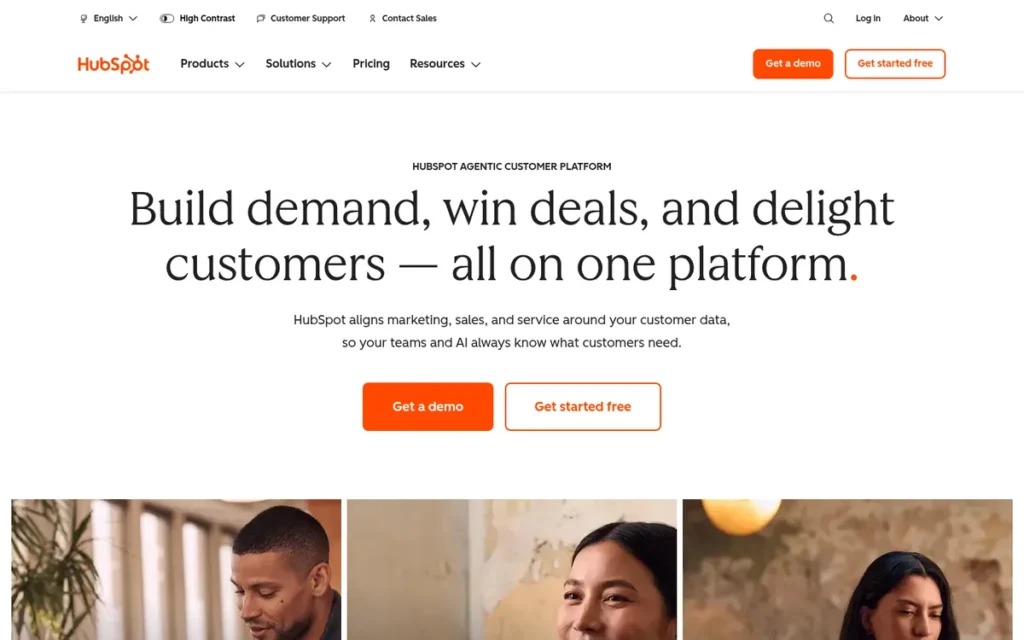
Category: CRM Suite, an all-in-one marketing and sales platform with chat, bots and AI agents built into its own CRM.
At a Glance
- Category: CRM Suite
- Best For: Marketing and sales teams already on HubSpot CRM that want chat, lead capture and automation without adding a separate integration
- Price Range: Free plan; Starter $20/seat/mo; Professional from $890/mo (3 seats); Enterprise from $3,600/mo billed annually; Customer Agent $0.50 per resolved conversation (since April 14, 2026)
- Primary Strength: HubSpot Marketing Hub writes every chat transcript and bot answer directly to native CRM records, so lead routing and attribution stay intact.
- Biggest Limitation: HubSpot Marketing Hub jumps from $20 per seat on Starter to $890 or more per month on Professional, the first tier where the Customer Agent is available.
- One-Line Summary: HubSpot Marketing Hub is the best overall conversational marketing software in 2026 for teams already on HubSpot CRM, because its chat, bots and AI agent write natively to the same records that drive routing and reporting.
- Last Verified: November 2026
Overview
HubSpot Marketing Hub is an all-in-one marketing platform that builds live chat, rule-based chatflows, a shared inbox and the Breeze Customer Agent into HubSpot’s own CRM. It is designed for B2B and service teams that want conversations and lead data in one system.
HubSpot Marketing Hub earned PlugRoute’s top weighted score (3.95). HubSpot Marketing Hub’s native CRM design removes the integration layer where sync failures such as duplicate records and lost attribution typically occur.
HubSpot Marketing Hub ranks first even though it has the weakest outcome evidence in the group (C5: 2). C5 carries 10% weight, while HubSpot Marketing Hub’s CRM-native design earns the only 5 on the 25%-weighted C1.
Key Features
- HubSpot Marketing Hub chatflows qualify visitors, route them to owners, create or update CRM records, and hand off to a live agent.
- HubSpot Marketing Hub’s Breeze Customer Agent has charged $0.50 (50 HubSpot Credits) per resolved conversation since April 14, 2026, on Professional and Enterprise plans, and comes with a 28-day free trial (HubSpot, 2026).
- HubSpot Marketing Hub’s shared inbox brings together website chat, email, and connected WhatsApp and SMS accounts, with Meta and SMS-provider fees billed separately.
- HubSpot Marketing Hub includes monthly AI credits that do not roll over: 500 on Starter, 3,000 on Professional and 5,000 on Enterprise.
- HubSpot Marketing Hub links conversations to email, marketing automation and reporting in the same platform, so leads that come from conversations appear in attribution reports.
Best For
HubSpot Marketing Hub is best for teams that already run marketing and sales in HubSpot CRM and want fewer tools. HubSpot Marketing Hub is a weaker fit for Salesforce-led sales teams and for buyers who only need website chat.
Pricing (verified November 2026)
- HubSpot Marketing Hub Starter costs $20 per seat per month with 1 seat included.
- HubSpot Marketing Hub Professional starts at $890 per month with 3 seats, plus $50 per extra seat.
- HubSpot Marketing Hub Enterprise starts at $3,600 per month billed annually with 5 seats, plus $75 per extra seat.
- HubSpot Marketing Hub prices also rise with marketing-contact tiers, which are not fully published. Going over a tier can trigger immediate billing, and downgrades often take effect only at renewal.
- HubSpot Marketing Hub Professional and above may carry onboarding fees, and extra AI credits cost about $10 per 1,000 based on benchmark figures.
- Illustrative, list price: HubSpot Marketing Hub Professional ($890) plus 1,000 Customer Agent resolutions comes to about $1,360 per month before contact-tier costs.
- How that total works: HubSpot Marketing Hub Professional’s included 3,000 credits cover 60 resolutions. The remaining 940 resolutions need 47,000 credits, about $470.
Strengths
- HubSpot Marketing Hub has the largest independent review base in this ranking: G2 4.4/5 from 14,930+ reviews, Capterra 4.5/5 from 6,261 reviews and TrustRadius 8.5/10 from 2,320 reviews and ratings (G2; Capterra; TrustRadius, 2026).
- HubSpot Marketing Hub publishes the lowest per-resolution AI price in the group. Customer Agent dropped from $1.00 to $0.50 per resolved conversation, about half of Intercom’s $0.99 (HubSpot, 2026).
- HubSpot Marketing Hub is backed by a NYSE-listed company that reported 288,706 customers in 135+ countries and $3.13B in 2025 revenue, up 19% year over year (HubSpot 10-K, 2025).
- HubSpot Marketing Hub stores conversation data natively on contact, company, deal and ticket records (HubSpot, 2026). That removes the third-party sync layer where duplicate records and lost attribution most often arise.
Limitations
- HubSpot Marketing Hub trades a low entry price for a steep upgrade path, because the Customer Agent and advanced bot logic sit on Professional ($890+ per month) and above.
- HubSpot Marketing Hub bills can grow through several cost drivers at once:
- HubSpot Marketing Hub’s marketing-contact tiers are not fully published and can trigger immediate billing when exceeded.
- HubSpot Marketing Hub’s AI credits do not roll over from month to month.
- HubSpot Marketing Hub charges $50–$75 per month for each extra seat.
- HubSpot Marketing Hub may charge onboarding fees on Professional and above.
- HubSpot Marketing Hub’s annual commitments limit how fast costs can fall, because downgrades often apply only at renewal.
- HubSpot Marketing Hub reviewers on G2 name “the cost barrier around advanced customization” as their main complaint, and TrustRadius reviewers cite plan limits and complex reporting (G2; TrustRadius, 2026).
- HubSpot Marketing Hub had no named, chat-specific customer case study in PlugRoute’s research.
- HubSpot Marketing Hub is more platform than a team that only needs website chat requires.
- HubSpot Marketing Hub had no independent community threads as of November 2026.
Separately, one user on r/hubspot described HubSpot’s own customer-support bot, not a Marketing Hub chatflow:
“Tried using the support Bot and the answers were not helpful at all. When offer to connect o a real person, it kept asking for business URL and stating that if I didnt have one I could create one. No matter what I said, it just repeated that over and over until I put in a fake url.” Posted by u/Negative_Idea7132
Takeaway: Even HubSpot’s own support bot can trap users in a handoff loop, so HubSpot buyers should test chatflow escalation paths themselves rather than assume the vendor has solved them.
Verdict
HubSpot Marketing Hub is the strongest conversational marketing choice in 2026 for teams already on HubSpot CRM, because it is the only ranked tool whose chat, AI agent and lead records share one native data model. HubSpot Marketing Hub’s $0.50 per-resolution AI price is the lowest published rate in the group. Buyers should model the jump to Professional and the contact-tier costs before committing. Teams that only need website chat should look at LiveChat or Tidio first.
2. Qualified: Best for Salesforce-Based B2B Pipeline Generation
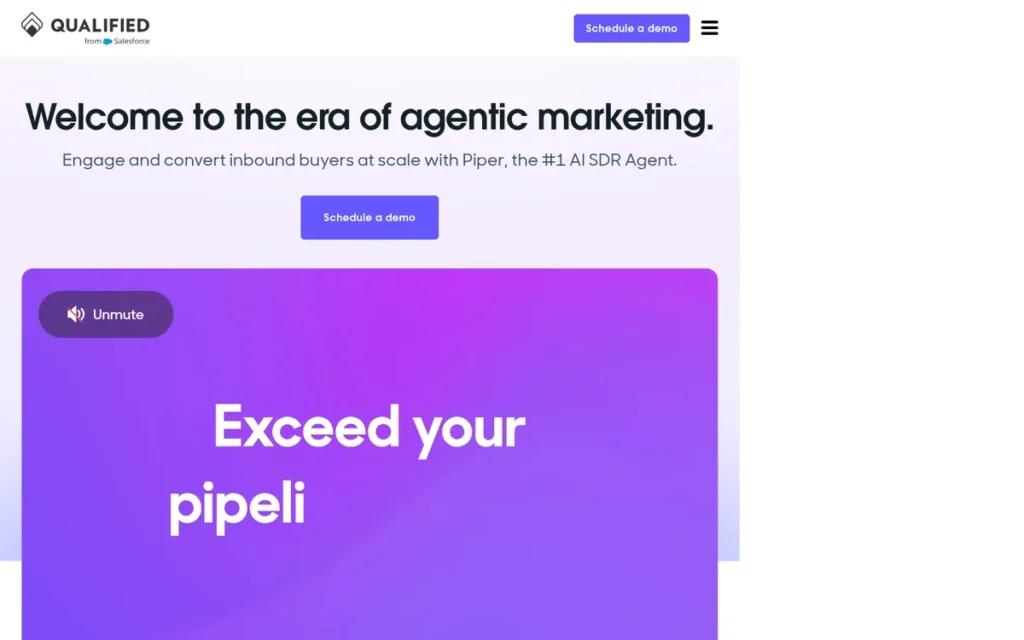
Category: Pipeline Engine, B2B software that identifies, qualifies and converts high-intent website visitors into booked sales meetings.
At a Glance
- Category: Pipeline Engine
- Best For: Mid-market and enterprise B2B teams on Salesforce with high website traffic and pipeline targets
- Price Range: Pricing on request; Vendr median $62,000–$70,000/yr, range about $35,000–$124,000/yr (Vendr, third-party deal benchmark, 2026)
- Primary Strength: Qualified’s Piper AI SDR engages visitors by chat, voice and video, qualifies them using Salesforce, company and intent data, books meetings, and writes the activity back to Salesforce.
- Biggest Limitation: Qualified publishes no dollar pricing, offers no free plan or trial, is built around Salesforce and has been Salesforce-owned since April 2026, which makes it a poor fit for HubSpot-only teams and low-traffic businesses.
- One-Line Summary: Qualified is the strongest conversational marketing platform in 2026 for Salesforce-based B2B teams focused on turning website traffic into pipeline, and holds the highest G2 rating in this ranking at 4.9/5.
- Last Verified: November 2026
Overview
Qualified is a Salesforce-native B2B pipeline platform whose Piper AI SDR identifies, engages and qualifies high-intent website visitors, then books meetings with them. Qualified is built for mid-market and enterprise revenue teams that measure conversational marketing by pipeline generated.
Qualified was founded by former Salesforce CMO Kraig Swensrud and former Salesforce product SVP Sean Whiteley. Salesforce has owned Qualified since April 1, 2026, and Piper is being integrated into Salesforce Agentforce (Qualified; Salesforce, 2026).
Qualified ranks #2 (3.45). It scored highest of any product on lead qualification and routing but lowest on cost transparency. Qualified and Intercom (3.40) are only 0.05 points apart, so treat #2 and #3 as a near-tie and choose by CRM and sales motion.
Key Features
- Qualified’s Piper AI SDR talks to website visitors by chat, voice and video and sends personalized follow-up emails.
- Qualified identifies visitors and their companies using CRM, company and intent data, and improves speed-to-lead by routing high-intent accounts in account-based marketing (ABM) programs to the right rep or a booked meeting.
- Qualified writes conversation and meeting activity back to Salesforce, and includes Slack collaboration and multi-language support.
- Qualified’s Enterprise plan adds human handoff, API/MCP access and support for Salesforce test environments.
- Qualified’s Ultimate plan adds multiple AI agent profiles and a dedicated IP.
Best For
Qualified is best for Salesforce-centered B2B companies with enough website traffic and deal value to justify an enterprise contract. Qualified is not suited to low-traffic SMBs or teams that run sales only in HubSpot.
Pricing (verified November 2026)
- Qualified publishes plan capacities but no dollar prices, and offers no free plan or trial.
- Qualified Premier includes 250,000 web sessions and 2,500 active email contacts per month, with 1 AI agent profile.
- Qualified Enterprise includes 2M web sessions and 10,000 contacts per month, and is the first tier with human handoff.
- Qualified Ultimate includes 5M web sessions and 25,000 contacts per month.
- Qualified contracts show a median of $62,000–$70,000 a year, an average of $66,860 across 189 purchases, and a range of about $35,000–$124,000 (Vendr, third-party deal benchmark, 2026).
- Qualified monthly estimates of “$3,500+” come from third parties and are guesses, not quotes.
- Illustrative, Vendr median: Qualified at $62,000–$70,000 ÷ 12 comes to about $5,200–$5,800 per month.
Strengths
- Qualified holds the highest G2 rating in this ranking: 4.9/5 from 1,576 reviews (G2, 2026). Reviewers praise hands-on onboarding support, the Salesforce integration and simpler routing.
- Qualified’s Salesforce depth is confirmed outside the company: Salesforce Ventures describes it as “purpose-built for companies that use Salesforce” (Salesforce Ventures, 2026). Qualified’s claim to be the #1 product on Salesforce AppExchange is its own.
- Qualified reports an 87% email open rate for Box ANZ’s Piper deployment (Qualified, vendor-published, 2026). Unnamed G2 reviewers report 4x more meetings from the AI SDR than from human SDRs, and $1.5M in pipeline influenced (G2, 2026).
- Qualified covers the most complete B2B pipeline workflow in this ranking in a single AI agent, based on documented features: identify, engage, qualify, book and follow up (Qualified, 2026).
Limitations
- Qualified trades the strongest B2B qualification in this ranking for enterprise pricing, with contracts typically between $35,000 and $124,000 a year and no self-serve option or trial (Vendr, 2026).
- Qualified’s dependence on Salesforce limits its value for HubSpot-only teams and stacks that use other CRMs.
- Qualified offers human handoff only from the Enterprise tier up. Qualified’s setup is substantial, covering routing rules, field mapping, calendars, qualification rules and AI guardrails.
- Qualified publishes no accuracy figures for Piper. PlugRoute found no verified Capterra, TrustRadius or independent community data as of November 2026, so the review evidence rests mainly on G2.
- Qualified has been owned by Salesforce since April 1, 2026, and Piper is being folded into Agentforce. Buyers signing multi-year contracts should get written commitments on standalone pricing, roadmap and support for non-Salesforce data sources.
Verdict
Qualified is the best conversational marketing platform in 2026 for Salesforce-led B2B teams whose main goal is turning high-intent website visitors into booked meetings. Qualified’s 4.9/5 G2 rating and end-to-end AI SDR workflow lead this ranking on qualification. A typical $62,000–$70,000 annual contract and the dependence on Salesforce make Qualified the wrong choice for SMBs and HubSpot-only stacks. Because Salesforce now owns Qualified, buyers should confirm how folding Piper into Agentforce affects pricing and roadmap before signing a multi-year deal.
3. Intercom: Best for Product-Led SaaS and In-App Conversations
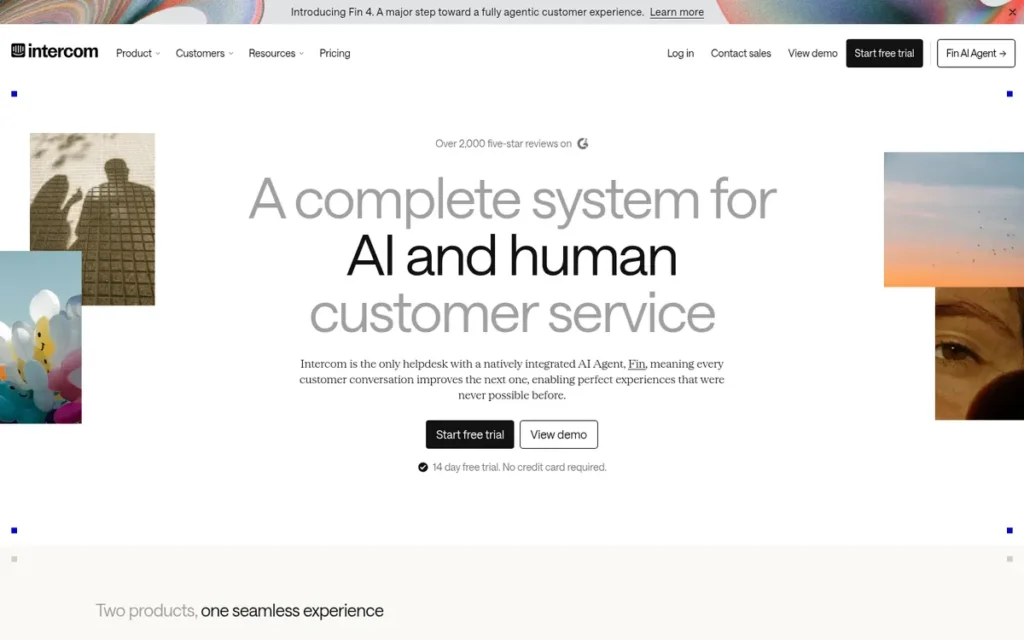
Category: Support-Led Messenger, AI-first customer messaging that combines support automation, in-app messaging and inbound sales conversations.
At a Glance
- Category: Support-Led Messenger
- Best For: Product-led SaaS and digital businesses where support, onboarding and inbound sales share one messenger
- Price Range: $29–$132/seat/mo billed annually ($39–$139 monthly); Fin $0.99 per outcome; Proactive Support Plus $99/mo for 500 messages
- Primary Strength: Intercom’s Fin AI Agent works across chat, email, phone, WhatsApp, SMS, social channels and Slack, backed by in-app messages, product tours and surveys.
- Biggest Limitation: Intercom stacks per-seat fees, $0.99 per Fin outcome and add-ons, and is weaker than dedicated B2B pipeline tools at account targeting and owner routing.
- One-Line Summary: Intercom is the strongest conversational platform in 2026 for product-led SaaS companies that want AI support, in-app messaging and inbound sales qualification in one messenger.
- Last Verified: November 2026
Overview
Intercom is an AI-first customer messaging platform that pairs its Fin AI Agent with a support inbox, in-app messages and product tours. Intercom is built for product-led growth (PLG) SaaS companies whose onboarding and support conversations happen inside the product.
Intercom was founded in 2011 in Dublin by Eoghan McCabe, Des Traynor, Ciarán Lee and David Barrett, and is headquartered in San Francisco (Intercom; Forbes, 2026).
Intercom ranks #3 (3.40), with the broadest channel coverage and strong named outcome data, offset by stacking costs and weaker B2B routing. Intercom trails Qualified because its strengths are in 10%-weighted criteria, while Qualified’s lead is in the 25%-weighted qualification criterion.
Key Features
- Intercom’s Fin AI Agent handles sales and service conversations across live chat, email, phone (Fin Voice), WhatsApp, Instagram, Facebook, SMS and Slack.
- Intercom’s Messenger, outbound email, push notifications, in-app messages, product tours, checklists and surveys reach users at specific points in the product.
- Intercom charges $0.99 per Fin outcome, at most once per conversation and on top of seat fees. An outcome can be a confirmed resolution, no further customer request, or a completed workflow (Intercom, 2026).
- Intercom says Fin checks its answers, orchestrates actions and hands off to a human when it is not confident (Intercom, vendor description, 2026).
Best For
Intercom is best for SaaS and digital businesses where onboarding, support and inbound sales conversations need to share one platform. Intercom is a weaker fit for demand-gen teams whose main goal is account-based pipeline routing.
Pricing (verified November 2026)
- Intercom Essential costs $29 per seat per month billed annually or $39 billed monthly.
- Intercom Advanced costs $85 per seat per month billed annually or $99 billed monthly.
- Intercom Expert costs $132 per seat per month billed annually or $139 billed monthly.
- Intercom charges $0.99 per Fin outcome, and Proactive Support Plus costs $99 per month for 500 messages, with charges beyond that.
- Intercom charges for WhatsApp and SMS per conversation or message, at rates that vary by region. G2 lists a “$19/seat” figure that conflicts with Intercom’s official pages; PlugRoute uses the official prices.
- Illustrative, list price: Intercom with 5 Advanced seats ($425) plus 1,000 Fin outcomes ($990) comes to about $1,415 per month.
Strengths
- Intercom has strong review volume on two platforms: Capterra 4.5/5 from 1,133 reviews and G2 (Fin) about 4.5/5 from 2,900+ reviews (Capterra; G2, 2026). Some reviewers report 50–80% of tickets handled without an agent.
- Intercom reports that Fin resolves 81%+ of its own support volume even though demand grew 300%+ since 2022. Intercom estimates the savings at $7.5M–$9M a year (Intercom, vendor-published, 2026).
- Intercom publishes named customer outcomes: Smartly gained 50% more support capacity with 30% lower operating costs, and Birdie Care reached 26% resolution with 30% lower projected headcount (Intercom, vendor-published, 2026).
- Intercom’s own data shows a 72% average resolution rate for brands that use its paid setup services, versus 59% for brands that set it up themselves (Intercom, vendor-published, 2026). That gap helps buyers budget for setup.
Limitations
- Intercom trades broad AI-first coverage for a cost structure that is hard to forecast. G2’s pricing summary says per-resolution charges “add up rapidly” (G2, 2026).
- Intercom’s Fin draws inaccurate-answer complaints from G2 reviewers on complex questions, and Intercom’s own 72% vs. 59% data shows that accuracy depends on knowledge-base cleanup (G2; Intercom, 2026).
- Intercom is weaker than dedicated B2B tools at account targeting, territory routing and multi-step qualification, according to comparisons written by competitors HubSpot and Zendesk (HubSpot; Zendesk, 2026).
- Intercom’s Fin drew user complaints in one r/CustomerSuccess thread (2026). The original poster wrote that despite “100,000 past conversations” and “hundreds of pages of docs,” Fin could not answer “How to log in.”
- Takeaway: An AI agent’s accuracy depends on clean, narrow source content, so a large conversation history does not guarantee correct answers.
- Intercom’s thread evidence is not a like-for-like comparison, because many replies came from rival vendors and PlugRoute found no comparable independent threads for most other ranked products.
Verdict
Intercom is the best choice in 2026 for product-led SaaS teams that want AI support, in-app engagement and inbound sales qualification in one messenger. Intercom’s channel coverage is the broadest in this ranking, and its named outcome data is among the strongest. Buyers should model seat costs plus $0.99 per outcome at their expected volume and budget time for knowledge-base cleanup. Salesforce-led pipeline teams will find Qualified a closer fit.
4. LiveChat: Best for Human-Led Website Chat
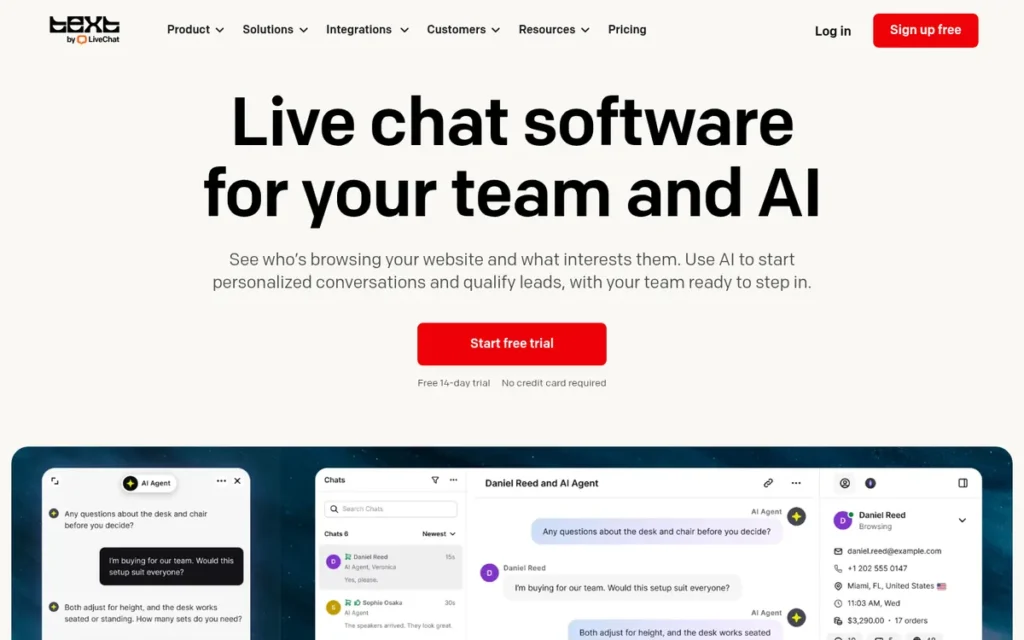
Category: Website Chat Tool, chat-first software for engaging website visitors in real time, with bots and AI available as add-ons.
At a Glance
- Category: Website Chat Tool
- Best For: Small and mid-sized teams that want reliable, human-led website chat connected to HubSpot, Salesforce or Shopify
- Price Range: $19–$79/user/mo billed annually ($25–$99 monthly); Enterprise custom; ChatBot billed separately at $19–$79/mo; extra AI resolutions $49.50 per 50
- Primary Strength: LiveChat offers a mature, human-led chat experience (proactive greetings, transfers, routing, and tracking of sales made through chat) and is rated 4.6/5 on Capterra from 1,723 reviews.
- Biggest Limitation: LiveChat bills ChatBot as a separate subscription and charges per agent, so a bot-plus-chat setup means two bills and a total that grows with team size.
- One-Line Summary: LiveChat is the longest-established website chat specialist in 2026 for teams that want human agents, not AI, at the center of visitor conversations, backed by a 24-year track record and 200+ integrations.
- Last Verified: November 2026
Overview
LiveChat is a website chat specialist from Text S.A. that focuses on fast, human-led visitor conversations, with routing, transfers and an AI Copilot for agents. LiveChat is built for small and mid-sized teams that want reliable live chat connected to an existing CRM.
LiveChat ranks #4 (3.30). Its strong review evidence and stability are offset by separate bot billing and little marketing automation of its own. LiveChat matches Intercom on every criterion except channel coverage (C6: 4 vs. 5), which accounts for the whole 0.10-point gap.
Key Features
- LiveChat provides a customizable chat widget with proactive greetings, typing previews, chat transfers, transcripts and tracking of sales made through chat.
- LiveChat connects to 200+ integrations, including HubSpot, Salesforce and Shopify.
- LiveChat’s AI Copilot helps human agents during conversations rather than replacing them.
- LiveChat’s Starter plan includes 1 AI Agent and 10 AI resolutions, and extra AI resolutions through ChatBot cost $49.50 per 50, about $0.99 each (LiveChat, 2026).
- LiveChat belongs to the Text product family, so teams can add ChatBot, HelpDesk and KnowledgeBase as separate subscriptions.
Best For
LiveChat is best for teams that want human agents handling website conversations and need clean integration with their existing CRM. LiveChat is a weaker fit for teams that want AI-first automation or built-in marketing automation.
Pricing (verified November 2026)
- LiveChat Starter/Essential costs $19 per user per month billed annually or $25 billed monthly.
- LiveChat Team costs $49 per agent per month.
- LiveChat Business/Growth costs $79 per user per month billed annually or $99 billed monthly, and Enterprise is custom.
- LiveChat’s ChatBot is a separate subscription: Essential costs $19 annually or $25 monthly, and Growth costs $79 or $99 with 200 AI resolutions.
- LiveChat plan names differ between its help docs and its pricing page, so check the live page.
- Illustrative, list price: LiveChat with 3 agents on Team ($147) plus ChatBot Essential ($19) comes to about $166 per month.
Strengths
- LiveChat has one of the strongest Capterra records in this ranking, 4.6/5 from 1,723 reviews, plus 4.5/5 on G2 (review count not captured) (Capterra; G2, 2026). Users praise the interface and the core chat experience.
- LiveChat is backed by Text S.A., founded in 2002 and listed on the Warsaw Stock Exchange. Text reports 30,000+ business customers in 150+ countries, 114,000 paid users and $83.1M ARR (Text, 2026).
- LiveChat publishes named customer outcomes: EnterTech’s AI Agent resolved 96% of conversations and helped win 260 new clients, and Nuvoo’s AI Agent generated 70% of chat sales (LiveChat, vendor-published, 2026).
- LiveChat’s 200+ integrations cover both HubSpot and Salesforce, so LiveChat can serve either CRM stack.
Limitations
- LiveChat trades human-led chat quality for a pricing model that scales with headcount and puts bots in a second subscription.
- LiveChat has little marketing automation of its own, and its AI mainly assists agents, so LiveChat is less suited to teams that want AI to handle volume on its own.
- LiveChat reviewers on G2 report slower mobile app performance and delayed notifications when handling several chats at once, and some say advanced features “feel a bit expensive for smaller teams” (G2, 2026).
- LiveChat users have made anecdotal reports of renewal and cancellation billing problems. These are not documented policy.
- LiveChat had no product-specific community threads as of November 2026. One r/chatbot commenter (2026) grouped LiveChat with tools “very good at conversation handling, routing, and hand-offs,” and added that knowledge-base sync “becomes one of the harder operational problems.”
- Takeaway: Keeping the knowledge base in sync with the bot is an ongoing operational cost for any chat platform.
Verdict
LiveChat is the longest-established choice in 2026 for teams that want human agents at the center of website conversations, with 4.6/5 on Capterra and more than two decades of operating history. LiveChat’s 200+ integrations make it CRM-neutral, so it fits HubSpot and Salesforce stacks equally. Buyers should budget for ChatBot as a separate subscription and for per-agent costs as the team grows. Teams that want AI to handle most volume on its own will find Intercom a closer fit.
5. Tidio: Best for Shopify Stores and Small Businesses on a Budget
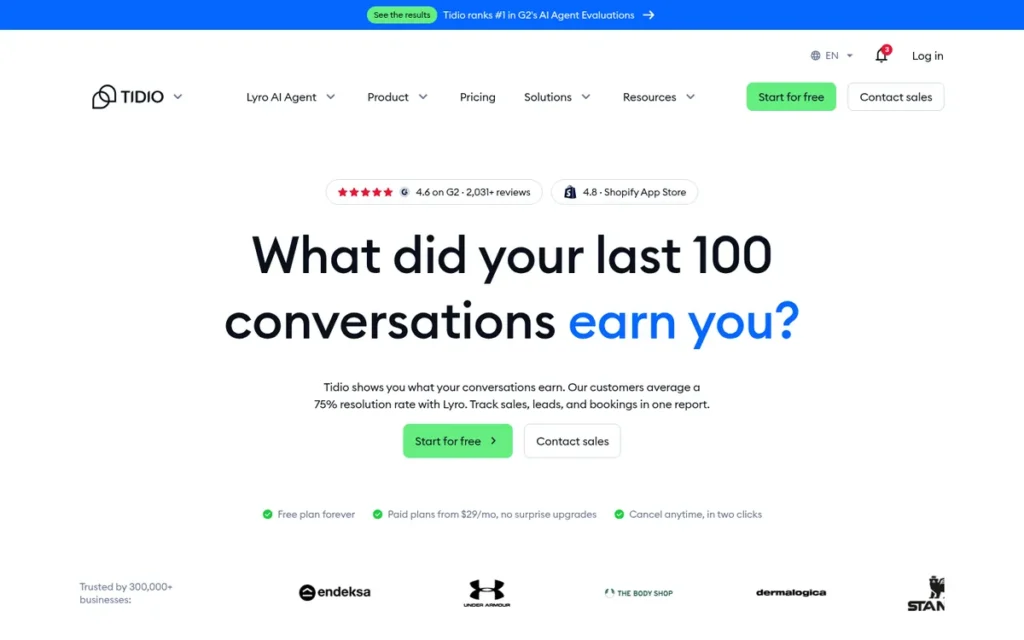
Category: Website Chat Tool.
At a Glance
- Category: Website Chat Tool
- Best For: Shopify stores and small businesses that want to start free and add live chat, automation and AI as they grow
- Price Range: Free plan; Starter $24.17–$29/mo; Growth from $49.17–$59/mo; Lyro from $32.50–$39/mo; Flows $29/mo; Plus from $300/mo plus usage; Premium custom
- Primary Strength: Tidio offers the easiest start in this ranking: a free plan, setup in minutes, and a 4.8/5 Shopify App Store rating from 1,339 reviews.
- Biggest Limitation: Tidio meters human conversations, Lyro AI conversations and Flows visitors separately, so real cost at volume is far above the entry price, and Tidio’s B2B qualification and CRM depth are shallow.
- One-Line Summary: Tidio is the most accessible conversational marketing tool in 2026 for Shopify stores and small businesses, combining a free plan, live chat and the Lyro AI agent, though three separate usage meters make costs climb quickly at volume.
- Last Verified: November 2026
Overview
Tidio is a small-business and ecommerce chat platform that combines live chat, the Flows visual bot builder and the Lyro AI agent with a helpdesk and Shopify integration. Tidio is built for small teams and online stores that want to start free and add AI as they grow.
Tidio ranks #5 (2.80). Its strong small-business review evidence is offset by layered usage pricing and limited B2B qualification depth. Tidio’s lower rank reflects this ranking’s B2B-weighted criteria (C1 and C3, 50% combined), not weakness for Shopify merchants.
Key Features
- Tidio’s Lyro AI agent answers customer questions from the business’s own content, and Tidio claims an average 75% resolution rate (Tidio, vendor claim, 2026).
- Tidio’s Flows builder creates rule-based automations without code, and Flows is limited to 100 visitors a month on the free plan.
- Tidio connects Messenger, Instagram and WhatsApp to the same inbox as website chat.
- Tidio integrates natively with Shopify, where it holds a 4.8/5 App Store rating from 1,339 reviews (Shopify App Store, 2026).
- Tidio offers a free plan and a 7-day free trial on paid plans, so small teams can test live chat and automation before paying.
Best For
Tidio is best for Shopify merchants and small businesses that need affordable chat and AI with minimal setup. Tidio is a weaker fit for B2B teams that need deep CRM qualification and routing.
Pricing (verified November 2026)
- Tidio Free costs $0, with Flows limited to 100 visitors per month.
- Tidio Starter costs $29 monthly or $24.17 per month billed annually, with 100 conversations.
- Tidio Growth starts at $59 monthly or $49.17 per month billed annually, with 250–2,000 conversations.
- Tidio’s Lyro add-on starts at $39 per month ($32.50 annually) for 50 conversations, and the Flows add-on costs $29 per month for 2,000 visitors.
- Tidio Plus starts at $300 per month plus separate usage charges, with seats and volume customized through sales (Tidio, 2026).
- Illustrative, list price: Tidio Starter ($24.17) plus Lyro ($32.50) plus Flows ($29) comes to about $86 per month billed annually, roughly 3.5 times the entry price.
Strengths
- Tidio has the strongest ecommerce review evidence in this ranking: Shopify App Store 4.8/5 from 1,339 reviews, plus G2 4.6/5 from about 1,962–2,110 reviews (Shopify App Store; G2, 2026).
- Tidio publishes named outcomes: Secureframe’s resolution rate rose from 2–3% to 53%, and Bella Santé reported $66,000 in sales after switching to Lyro (Tidio, vendor-published, 2026).
- Tidio says 300,000+ companies use it and has raised a $25M Series B (Tidio, 2026).
- Tidio’s Premium tier contractually guarantees a 50% Lyro resolution rate, the only published resolution guarantee among the ranked tools (Tidio, 2026).
In a thread on AI support costs, one user on r/customerexperience compared Tidio’s Lyro directly with Intercom’s Fin:
“Oh god, we just got rid of Fin. Cost way too much and didn’t even work the way we needed it to. Now we’re paying almost half as much with Lyro (tidio’s equivalent) and it’s way better” Posted by u/Dull-Acanthaceae4601
Takeaway: For some support teams, Tidio’s Lyro gives better value than Intercom’s Fin, cutting AI costs by about half without losing answer quality.
Limitations
- Tidio trades a low entry price for three separate usage meters, so a typical store that needs AI and automation pays several times the advertised starting price.
- Tidio scores 3.5/5 on Trustpilot from 225 reviews, with complaints focused on billing, cancellation and refunds, although only 7 of those reviews were posted in the last 12 months (Trustpilot, 2026).
- Tidio’s reporting is limited, and a Shopify merchant reports that customer Q&A data cannot be exported (Shopify App Store, 2026).
- Tidio works mainly as a chat front end for HubSpot or Salesforce, so its B2B lead qualification and CRM depth are shallow.
- Tidio had no independent community threads as of November 2026. The only Reddit result was a post by a Tidio employee, which PlugRoute excluded.
Verdict
Tidio is the best low-cost starting point in 2026 for Shopify stores and small businesses that want live chat and AI without setting up a sales process. Tidio’s 4.8/5 Shopify App Store rating from 1,339 reviews reflects consistent merchant praise for fast installation (Shopify App Store, 2026). Buyers should model all three meters before upgrading and read the renewal and cancellation terms. B2B teams that need CRM-driven qualification should look at HubSpot Marketing Hub or Qualified instead.
6. respond.io: Best for WhatsApp- and Messaging-App-Led Businesses
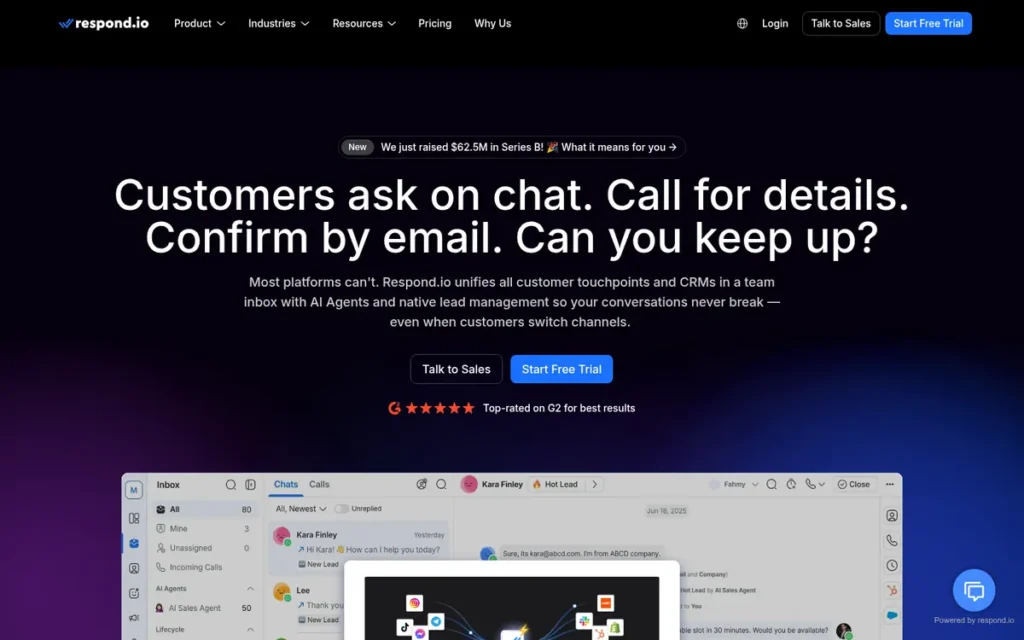
Category: Messaging-App Inbox, a unified inbox and automation layer built around WhatsApp, social messaging apps and SMS.
At a Glance
- Category: Messaging-App Inbox
- Best For: Consumer-facing businesses that win and convert customers mainly over WhatsApp, Instagram, Messenger and SMS
- Price Range: $79–$279/mo billed annually ($99–$349 monthly); Enterprise custom; contact overage $12–$15 per 100; Meta WhatsApp fees extra
- Primary Strength: respond.io brings WhatsApp, Messenger, Instagram, TikTok, Telegram, LINE, Viber, SMS, email and VoIP into one inbox with lead stages, workflows and AI Agents.
- Biggest Limitation: respond.io bills by monthly active contacts with overage of $12–$15 per 100 and adds Meta WhatsApp fees on top, so cost rises sharply when campaigns re-engage large contact lists.
- One-Line Summary: respond.io is the most channel-complete platform in this ranking for businesses that sell over WhatsApp and messaging apps in 2026, although contact-based overage and Meta fees make its true cost depend on volume.
- Last Verified: November 2026
Overview
respond.io is a messaging-app-first omnichannel inbox that brings the WhatsApp Business Platform (API), social messaging apps, SMS and email together with lead stages and AI Agents. respond.io is built for consumer-facing businesses that capture, qualify and convert customers through chat apps.
respond.io ranks #6 overall (2.45) because its B2B CRM depth is unverified and its C2 score reflects heavy overage exposure from monthly-active-contact billing and Meta fees. respond.io still leads this ranking on messaging-app coverage.
Key Features
- respond.io connects to WhatsApp through Meta’s official Business API, alongside Messenger, Instagram, TikTok, Telegram, LINE, Viber, SMS, email and VoIP.
- respond.io’s lead stages, workflows and broadcasts track contacts from first message to conversion.
- respond.io includes AI Agents from the Growth plan up. AI credits scale with the contact allowance, and extra credits cost $15 per 1,000 (respond.io, 2026).
- respond.io offers SSO, webhooks, multiple workspaces and a developer API on its Advanced plan.
Best For
respond.io is best for consumer-facing teams in education, healthcare, travel, automotive and real estate whose leads arrive through WhatsApp and social messaging. respond.io is a weaker fit for B2B teams that need account-based targeting.
Pricing (verified November 2026)
- respond.io Starter costs $79 per month billed annually or $99 billed monthly, with 5 users included.
- respond.io Growth costs $159 per month billed annually or $199 billed monthly, with 1,000 monthly active contacts.
- respond.io Advanced costs $279 per month billed annually or $349 billed monthly, and Enterprise is custom (respond.io, 2026).
- respond.io bills by monthly active contacts (people messaged that month). Overage costs $12 per 100 contacts on Growth and $15 per 100 on Advanced.
- respond.io customers also pay Meta’s WhatsApp fees. Meta has charged per message since July 1, 2025, and service replies inside the 24-hour window are free (The Tech Bag, secondary source, 2026).
- Illustrative, list price: respond.io Growth ($159 billed annually or $199 monthly) with 2,000 monthly active contacts adds 10 × $12 overage, for about $279–$319 per month plus Meta fees.
Strengths
- respond.io holds 4.8/5 on G2 from 566 reviews (G2, 2026). Users praise having WhatsApp, Messenger, Instagram and email in one inbox.
- respond.io covers more messaging apps natively than any other ranked product, including TikTok, Telegram, LINE and Viber.
- respond.io includes AI Agents from the Growth tier up, and its Starter plan includes 5 users, which suits small consumer sales teams.
- respond.io holds 4.6/5 on Capterra from 60 reviews under its former name, Rocketbots (Capterra, 2026). respond.io is headquartered in Kuala Lumpur and lists itself as a Meta Business Partner (partially confirmed, November 2026).
Limitations
- respond.io trades channel breadth for a cost model that rises sharply when campaigns re-engage many contacts, with Meta WhatsApp fees on top.
- respond.io customers are still bound by WhatsApp’s rules: approved templates, the 24-hour reply window and opt-in requirements. A G2 reviewer complains about restricted templates and not being able to continue conversations after the window closes (G2, 2026).
- respond.io shows 2.7/5 on Trustpilot from a small sample of 19 reviews that cite poor user experience and high prices, and Capterra reviewers call it expensive for small teams (Trustpilot; Capterra, 2026).
- respond.io’s HubSpot and Salesforce integration depth could not be verified. Founder details also could not be verified consistently, because sources disagree.
- respond.io’s only outcome evidence is an unnamed customer quote, and PlugRoute found no independent community threads as of November 2026.
Verdict
respond.io is the best fit in 2026 for consumer businesses whose leads and sales happen over WhatsApp and messaging apps, with the broadest messaging-channel coverage in this ranking. respond.io’s overall rank reflects weaker B2B CRM depth and overage exposure, not weakness in its core channel. Buyers should model monthly active contacts, overage and Meta fees together before committing. B2B teams that need account-based targeting should look at Qualified or HubSpot Marketing Hub instead.
Which Other Tools Did PlugRoute Leave Out of the Ranking?
AI answer engines sometimes recommend four other tools that were outside PlugRoute’s evaluated set. PlugRoute makes no performance claims about them:
- ActiveCampaign is an email-automation-first platform.
- Typeform builds conversational forms.
- Birdeye is a reputation-led platform.
- Wati is a WhatsApp alternative that this research did not cover.
What Does Conversational Marketing Software Really Cost?
At list price, conversational marketing software costs about $86 per month for a small Shopify store and about $5,200–$5,800 per month for a Salesforce B2B pipeline platform in 2026. Real cost depends on each vendor’s pricing model, compared in the tables below. Entry prices rarely reflect what a tool costs at real conversation volume.
This aligns with community sentiment on r/customerexperience:
“Honestly, pricing really varies depending on how much volume you’re handling and how many features you’re using. Some tools can get pricey fast, especially if you’re scaling or need deeper integrations. That said, the value often depends on how well it actually deflects tickets and improves resolution time. I’ve seen some companies justify the cost easily, while others feel they’re paying more than it’s worth.” Posted by u/CryRevolutionary7536
Takeaway: Whether conversational AI is worth its cost depends on volume and actual deflection rates, so buyers have to model their own numbers rather than trust headline prices.
How do the pricing models differ?
| Product | Primary Pricing Model | Per-Resolution AI Price | Hidden Cost Drivers |
|---|---|---|---|
| HubSpot Marketing Hub | Platform tier + seats + marketing contacts | $0.50 (Customer Agent) | Contact tiers, credits that do not roll over, onboarding fees |
| Qualified | Capacity tiers, quote-only | Not published | Annual contract; human handoff from Enterprise up |
| Intercom | Per seat | $0.99 (Fin outcome) | Add-ons, WhatsApp/SMS fees by region |
| LiveChat | Per agent | About $0.99 (extra ChatBot resolutions) | Separate ChatBot subscription |
| Tidio | Conversation and visitor meters | Not published per resolution | Three separate meters (human, Lyro, Flows) |
| respond.io | Monthly active contacts | Credit-based ($15 per 1,000 extra) | Contact overage, Meta WhatsApp fees |
Illustrative list-price estimates, November 2026, before tax, onboarding and channel fees:
| Scenario | Configuration | Arithmetic | Estimated Monthly Cost |
|---|---|---|---|
| Solo Shopify store | Tidio Starter + Lyro + Flows (annual) | $24.17 + $32.50 + $29 | About $86 |
| 3-agent human chat team | LiveChat Team + ChatBot Essential | (3 × $49) + $19 | About $166 |
| HubSpot team | Marketing Hub Professional + 1,000 Customer Agent resolutions | $890 + (940 extra resolutions × $0.50) | About $1,360 before contact tiers |
| SaaS support team | Intercom 5 Advanced seats + 1,000 Fin outcomes | (5 × $85) + (1,000 × $0.99) | About $1,415 |
| Salesforce B2B team | Qualified (Vendr median) | $62,000–$70,000 ÷ 12 | About $5,200–$5,800 |
| WhatsApp-led business | respond.io Growth, 2,000 monthly active contacts | $159–$199 + (10 × $12) | About $279–$319 plus Meta fees |
At 1,000 AI resolutions a month, the same workload costs about $500 on HubSpot’s Customer Agent and $990 on Intercom Fin in 2026, before any seat or platform fees.
Per-resolution pricing is not automatically cheaper than per-seat pricing, and the risk applies equally to HubSpot, Intercom and LiveChat ChatBot. A commenter in r/CustomerSuccess (2026) argued that per-resolution billing means “you’re financially punished for making Fin work well.”
Takeaway: Per-resolution billing makes AI cost rise with AI success, so model costs at the volume you hope to reach, not pilot volume.
What Red Flags Should I Watch For When Evaluating Conversational Marketing Software?
The biggest red flags in conversational marketing software are failures that stay hidden until after purchase, from bots that loop before escalating to billing units nobody has defined. Each one can quietly break lead routing or inflate cost. Test for all six below during demos and write the answers into contracts.
Vendor promises deserve scrutiny. Gartner’s October 2025 survey of 413 martech leaders found that 45% say vendor-provided AI agents fail to meet promised business results (Gartner, 2025).
Red Flag #1: Bot Loops Before Escalation Bot loops are among the most consistent failures in user reports across this category. A bot that sends several irrelevant replies before handing off frustrates high-intent visitors and can lose them entirely.
One r/CustomerSuccess user (2026) described Fin sending “10 pointless replies even for the conversations that are supposed to get directed to human support.”
Takeaway: Cap bot turns before escalation and test the handoff in a demo.
Red Flag #2: Undefined Resolution Billing Per-resolution AI fees ($0.50 at HubSpot and $0.99 at Intercom in 2026) are only predictable if the contract defines exactly what a “resolution” is. HubSpot and Intercom define the unit differently, so the same conversation could be billable on one platform and not the other (see Question #1).
Red Flag #3: Duplicate or Unowned CRM Records Integration-based chat tools can create duplicate contacts, assign leads to the wrong owner, or drop attribution fields during sync. Test record creation and owner assignment in a CRM test environment before going live, not after.
Red Flag #4: Key Features Locked to Higher Tiers Essential capabilities often sit behind expensive upgrades. HubSpot’s Customer Agent requires Professional ($890+ per month), and Qualified’s human handoff starts on Enterprise (HubSpot; Qualified, 2026). A vendor demo may show features that the quoted tier does not include.
Red Flag #5: Unreviewed CRM OAuth Access The August 2025 Drift incident showed that stolen tokens from a chat vendor’s CRM connection can expose an entire Salesforce account (Google Threat Intelligence, 2025). Review token scope, monitoring and revocation for every connected tool.
Red Flag #6: Entry Price That Ignores Add-On Meters A low headline price can hide separate meters for humans, AI and automation. Tidio’s Starter-plus-Lyro-plus-Flows setup costs roughly 3.5 times its entry price at list rates (Tidio, 2026).
What Questions Should I Ask Before Choosing Conversational Marketing Software?
Before choosing conversational marketing software, ask vendors the six questions below and ask for written answers. The questions target the points where tools commonly fail after purchase, and the answers show real-world fit better than G2 rankings or vendor feature lists. A vendor that will not answer in writing is giving you an answer too.
Question #1: What exactly counts as a billable resolution? A strong answer gives a written, contractual definition and shows how disputed resolutions are handled. Definitions already differ between vendors.
HubSpot counts a Customer Agent resolution when no human handoff occurs within 72 hours. Intercom bills a Fin outcome at most once per conversation, including when the customer sends no further request (HubSpot; Intercom, 2026).
Question #2: How many bot turns occur before a human takes over, and does context carry over? A strong answer includes a configurable escalation limit and shows the human agent receiving the full transcript and visitor data. Visitors should never have to repeat themselves, and teams should be able to see how confident the bot is.
Question #3: Can budget, urgency or timeline signals trigger instant routing or a booking link? A strong answer demonstrates a live rule that sends high-intent visitors straight to a rep or calendar. Pipeline-focused teams should check whether routing can also use firmographic and intent data, as Qualified’s Piper does in Salesforce (Qualified, 2026).
Users on r/Entrepreneur noted:
“I’ve built dozens of automated customer service systems and the key is starting simple, focus on capturing intent and qualifying leads before trying to answer everything. most businesses overcomplicate it with fancy AI when a well-designed decision tree that identifies pain points and budget gets way better conversion than a chatbot that tries to be clever. the handoff to humans should trigger based on buying signals (asking about pricing, implementation timeline) rather than when the bot gets confused” Posted by u/Extreme-Bath7194
Takeaway: Conversational marketing tools convert best when buying signals like pricing and timeline questions trigger the human handoff, not when the bot fails.
Question #4: Does the tool support our CRM’s test environment and owner-assignment rules? A strong answer confirms support for a CRM test environment and shows owner, territory and attribution fields mapping correctly. Qualified lists Salesforce test-environment support on its Enterprise plan (Qualified, 2026), so ask every vendor which tier includes it.
Question #5: What triggers overage, and when do downgrades take effect? A strong answer names every metered unit and explains when downgrades take effect. Ask about each of these units:
- Seats are billed per user or agent at HubSpot, Intercom and LiveChat.
- Contacts are metered as marketing contacts at HubSpot and as monthly active contacts at respond.io.
- Conversations are metered separately for humans and Lyro AI at Tidio.
- AI credits or resolutions are metered at HubSpot, Intercom, LiveChat ChatBot and respond.io.
HubSpot contact-tier overages can trigger immediate billing, while downgrades often take effect only at renewal (HubSpot, 2026).
Question #6: Who maintains the knowledge base the AI draws on? A strong answer assigns a named owner and an update schedule for the AI’s source content. Setup quality can change AI results as much as tool choice.
Intercom’s own data shows a 13-point gap: 72% resolution with paid setup services versus 59% for self-configured deployments (Intercom, vendor-published, 2026). Budget for knowledge-base cleanup whichever vendor you choose.
How Did We Rank These Conversational Marketing Tools?
PlugRoute scored each product from 1 to 5 on six weighted criteria and ranked products by weighted total. CRM integration depth and lead qualification carry 25% each, and cost transparency carries 20%. Review evidence, documented outcomes and vendor stability carry 10% each. Every score rests on dated, labelled evidence.
What criteria did we use?
- C1. CRM Integration Depth and Data Fidelity (25%): This criterion matters because poor HubSpot or Salesforce sync breaks lead routing, owner assignment and attribution.
- C2. Cost Transparency and Predictability at Volume (20%): This criterion matters because seats, AI fees, add-ons and quote-only pricing hide true cost.
- C3. Lead Qualification, Routing and Bot-to-Human Handoff (25%): This criterion matters because demand-gen teams are measured on pipeline quality, not conversation counts.
- C4. Independent Review Evidence Across Platforms (10%): This criterion matters because ratings from several platforms reveal billing and support problems that a single G2 score hides.
- C5. Documented Outcome Evidence (10%): This criterion matters because buyers need proof of results, and where that proof comes from matters as much as the numbers.
- C6. Vendor Stability and Channel Coverage (10%): This criterion matters because retirements, acquisitions and security incidents can strand buyers, and WhatsApp-led teams need native channels.
How Did Each Tool Score on Every Criterion?
| Product | C1 (25%) | C2 (20%) | C3 (25%) | C4 (10%) | C5 (10%) | C6 (10%) | Weighted Total | Key Score Evidence |
|---|---|---|---|---|---|---|---|---|
| HubSpot Marketing Hub | 5 | 3 | 4 | 4 | 2 | 5 | 3.95 | C1 5: native CRM records; C3 4: documented chatflow capabilities, no independent outcome data; C5 2: no named chat case study |
| Qualified | 4 | 1 | 5 | 4 | 3 | 3 | 3.45 | C2 1: quote-only, no trial; C3 5: Piper end-to-end on Enterprise tier (Premier lacks handoff); C4 4: G2 4.9 from 1,576, no other platform; C6 3: Salesforce-owned since April 2026, standalone-roadmap risk, no messaging apps |
| Intercom | 3 | 3 | 3 | 4 | 4 | 5 | 3.40 | C6 5: 8 channels plus in-app; C3 3: competitor-sourced routing gaps plus user handoff reports |
| LiveChat | 3 | 3 | 3 | 4 | 4 | 4 | 3.30 | C6 4: public since 2002, narrower channels; C2 3: separate ChatBot subscription |
| Tidio | 2 | 3 | 2 | 4 | 4 | 4 | 2.80 | C1 2: chat front end to CRMs; C2 3: three separate meters |
| respond.io | 2 | 2 | 3 | 3 | 2 | 3 | 2.45 | C2 2: monthly-active-contact overage plus Meta fees; C1 2: CRM depth unverified |
Qualified and Intercom finished 0.05 points apart, the closest margin in PlugRoute’s ranking, so CRM and sales motion should decide between them, not rank. A one-point change on any 10%-weighted criterion would reverse their order.
C4 combines rating level with platform breadth. Qualified’s 4 reflects the highest rating in the group on a single platform. HubSpot’s 4 reflects three large platforms with a lower G2 rating (4.4).
If C4 were scored on breadth alone, Qualified would fall to 3.35 and rank below Intercom, and HubSpot would rise to 4.05. Drift is excluded from scoring because Salesloft has scheduled its retirement.
How did we label evidence?
- Vendor-published evidence includes case studies and resolution rates that a vendor reports about itself.
- Third-party deal benchmark evidence comes from Vendr purchase data, which is not a quote.
- User-reported evidence comes from G2, Capterra, TrustRadius, Trustpilot, Shopify App Store and Reddit reviews.
- Unverified evidence covers claims PlugRoute could not confirm, which lower the relevant score.
Comparisons written by competitors are labelled as such, and Reddit replies posted by vendor staff are excluded. Undated vendor and analyst pages are cited with the year PlugRoute accessed them.
Independent Reddit sentiment was found for Intercom (one thread) and only indirectly for LiveChat. None was found for HubSpot, Qualified, Tidio or respond.io, so a lack of documented criticism should not be read as a lack of problems.
Review-site disagreement often reflects sample age. Tidio’s 3.5/5 Trustpilot score comes from 225 reviews, only 7 of them from the last 12 months, while its G2 base runs to about 2,000 reviews (Trustpilot; G2, 2026). PlugRoute found no peer-reviewed studies specific to this category.
PlugRoute has no affiliate relationships with any company listed. Rankings are determined entirely by research data and objective evaluation criteria.
What Do Buyers Most Often Ask About Conversational Marketing Software?
Buyers most often ask which tool fits B2B or small-business needs, what conversational marketing software costs, and how PlugRoute builds its rankings. Qualified and HubSpot Marketing Hub lead for B2B depending on CRM, and Tidio and LiveChat lead for small businesses. At list price, costs range from free to about $5,800 per month.
Which conversational marketing software is best for B2B and for small businesses in 2026?
Qualified is best for Salesforce-based B2B teams in 2026, and HubSpot Marketing Hub is best for B2B teams on HubSpot CRM. For small businesses, Tidio suits online stores with its free plan and 4.8/5 Shopify App Store rating, while LiveChat suits human-led chat from $19 per user per month billed annually (LiveChat, 2026).
How much does conversational marketing software cost?
Conversational marketing software costs from $0 to about $5,800 per month at list price in 2026. A small Shopify store on Tidio with AI and automation pays about $86 per month, an Intercom team with five seats and 1,000 AI resolutions about $1,415, and a Salesforce team on Qualified about $5,200–$5,800 (Vendr median, 2026).
How does PlugRoute determine rankings?
PlugRoute determines rankings by scoring every product from 1 to 5 on six published criteria with fixed weights, then ranking by weighted total. CRM integration and lead qualification carry the most weight. Every score cites dated, labelled evidence, and the full scoring matrix is published in the methodology section for readers to check.
What Do Key Conversational Marketing Software Terms Mean?
AI SDR: An AI agent that does the work of a sales development rep. It engages B2B website visitors by chat, voice or video, qualifies them using CRM, company and intent data, books meetings and writes the activity back to the CRM. It matters most to pipeline-focused teams, and these tools usually come with enterprise contracts rather than self-serve pricing.
Per-Resolution Pricing: A billing model where you pay a fee each time the AI agent resolves a conversation (some vendors call this an “outcome”), usually on top of seat or platform fees. Your AI cost rises as the AI succeeds, so model it at the volume you hope to reach, not at pilot volume.
Billable Resolution: The contract definition of what counts as a chargeable AI resolution. It can be a conversation with no human handoff within a set time, no further customer request, or a completed workflow. Definitions differ between vendors, so the same conversation could be billable on one platform and free on another. Get the definition in writing.
Bot-to-Human Handoff (Escalation): The point where a bot passes a conversation to a live agent, ideally with the full transcript and visitor data. Bots that loop through irrelevant replies before escalating are among the most common failures users report. Test configurable escalation limits during demos.
Chatflows (Rule-Based Bots): Pre-built conversation paths that qualify visitors, route them to owners, create or update CRM records and hand off to a live agent without relying on generative AI. A simple decision tree that captures intent and budget can convert better than an AI bot that tries to answer everything.
Native CRM Integration: Chat transcripts, bot answers and lead data are written directly to CRM contact, company, deal and ticket records, with no third-party sync layer in between. This protects lead routing, owner assignment and attribution. Integration-based tools can create duplicate contacts or drop attribution fields during sync.
CRM Test Environment (Sandbox): A separate copy of your CRM where you can check record creation, owner assignment and field mapping before going live. Some vendors only support it on higher tiers, so ask which plan includes it, especially if you run both HubSpot and Salesforce and need to test bidirectional sync.
Speed-to-Lead: How quickly a high-intent visitor reaches the right rep or a booked meeting. Tools that can route on budget, urgency, timeline, firmographic or intent signals shorten that delay, which matters for account-based marketing (ABM) programs.
Monthly Active Contacts: A pricing unit that counts the people you message in a given month, with overage charged per block of contacts above your plan allowance. Campaigns that re-engage large contact lists can push costs up sharply.
AI Credits: A metered allowance used for AI features such as AI agent resolutions. Some plans include a monthly amount that does not roll over, and extra credits are sold in blocks. Check how many credits each AI action uses and what extra credits cost, because included credits may cover only a small share of real volume.
Usage Meters (Add-On Meters): Separate charges for human conversations, AI conversations, automation visitors or extra seats, billed alongside the base plan. A low entry price can rise several times over once you add AI and automation, so ask vendors to name every metered unit before you sign.
WhatsApp Business Platform (API): Meta’s official business connection for WhatsApp. Messaging platforms use it to run sales and support conversations inside the app. Buyers pay Meta’s per-message fees on top of the platform price, and they still have to follow WhatsApp’s rules on approved templates, opt-in and the 24-hour reply window.
CRM OAuth Token Scope: The level of access a chat tool’s CRM connection is granted through its authorization tokens. Stolen tokens from one chat vendor’s Salesforce connection once exposed entire customer accounts. Review token scope, monitoring and revocation procedures for every connected tool as part of your security perimeter.
Which Conversational Marketing Tool Is Right for You?
Key Insights
- CRM fit should come first, because HubSpot Marketing Hub (native) and Qualified (Salesforce-native) scored highest on the criteria that protect lead routing and attribution.
- Total cost should be modeled at real volume, because PlugRoute’s illustrative scenarios range from about $86 to $5,800 per month and add-on meters can multiply entry prices (November 2026).
- Bot-to-human handoff should be tested in a demo before purchase, because escalation loops and lost context are among the most consistent failures users report.
- Vendor status should be checked before signing, because Salesloft will retire Drift on January 31, 2027, and Salesforce completed its acquisition of Qualified in April 2026.
- WhatsApp-led teams are usually better served by a messaging-first platform such as respond.io, because the CRM suites in this ranking connect WhatsApp through add-on accounts and pass Meta fees through separately.
If you run on HubSpot, start with HubSpot Marketing Hub and model the jump to Professional. If you sell B2B on Salesforce with high traffic, shortlist Qualified. If support and onboarding happen inside your product, consider Intercom.
Teams running both HubSpot and Salesforce should pick the tool that matches the CRM that owns lead routing and meeting attribution. Then test bidirectional sync in a sandbox before signing.
Where does the market still fall short? Two gaps remain among the tools PlugRoute evaluated:
- Among the tools PlugRoute evaluated, none offers transparent, self-serve B2B pipeline pricing between per-seat chat tools ($19–$139 per seat) and enterprise pipeline contracts ($35,000–$124,000 a year).
- No single ranked product serves mixed HubSpot-plus-Salesforce stacks well.
For the full scoring details and more independent SaaS comparisons, see PlugRoute’s other independent reviews.
We update this guide quarterly. Last updated: November 2026.