PostGrid narrowly leads PlugRoute’s 2026 ranking of direct mail automation software for compliant, API-driven mail. Postalytics is best for HubSpot- and Salesforce-triggered campaigns, and Handwrytten is best for real-ink handwritten notes. The right pick depends on whether marketers or engineers run the tool and how you prefer to pay per piece.
Picking a platform is hard because “direct mail automation” covers five different jobs. Vendors also price in ways that are hard to compare side by side, and many put key integrations behind higher plans.
This guide sorts the tools by job and puts costs on the same basis where the data allows. It also labels every claim by how confident we are in it.
PlugRoute has no affiliate relationships with any company listed. Rankings are determined entirely by research data and objective evaluation criteria.
What Are the 5 Categories of Direct Mail Automation Tools?
Direct mail automation tools fall into five categories:
- Mail APIs (PostGrid, Lob)
- CRM-triggered campaign platforms (Postalytics)
- Handwritten note services (Handwrytten)
- Self-serve personalized senders (Thanks.io)
- Gifting and ABM platforms (Reachdesk, Sendoso)
Each category does a different job, so identify your category before you compare vendors.
- Mail API (Developer & Transactional): A mail API gives engineers print-and-mail infrastructure they call from apps or backends to send letters, postcards and checks, often for transactional or regulated mail. PostGrid and Lob are mail APIs.
- CRM-Triggered Campaign Platform: A CRM-triggered platform is a no-code tool that sends mail automatically from CRM and marketing automation workflows, with built-in tracking and attribution. Postalytics is a CRM-triggered platform.
- Handwritten Note Service: A handwritten note service uses robots that write cards with real pens and mails them when a send is triggered. Handwrytten is a handwritten note service.
- Self-Serve Personalized Sender: A self-serve sender is a dashboard-first tool for low-cost personalized sends, often with printed handwriting fonts and simple automations. Thanks.io is a self-serve sender.
- Gifting & ABM Platform: A gifting and ABM platform is an enterprise tool that combines gifts, swag, eGifts and mail with warehousing and pipeline attribution. Reachdesk and Sendoso are gifting platforms.
How Do the Top Direct Mail Automation Tools Compare at a Glance?
PostGrid (36/45) narrowly leads PlugRoute’s 2026 ranking, one point ahead of Postalytics (35). Ranks 3–7 fall within 4 points of each other, so for most of the field, use-case fit matters more than exact rank. Each row below gives a tool’s category, best-fit buyer, main strength and main limitation.
| Rank | Company | Category | Best For | One-Line Summary | Key Capabilities | Primary Strength | Key Limitation |
|---|---|---|---|---|---|---|---|
| 1 | PostGrid | Mail API | Transactional, regulated and international mail | PostGrid is the highest-rated print-and-mail API in PlugRoute’s 2026 evaluation, best for compliant automated mail across the US, Canada, UK and Australia. | API, batch API, webhooks, CASS (US) and SERP (Canada) address verification, USPS Intelligent Mail barcode (IMb) tracking, QR codes and personalized URLs (PURLs) | G2 4.9/5 (232 reviews), HIPAA-ready printing in four countries | Harder setup for non-technical marketers; steep jump from the free 500-mailer plan to ~$1,000/month Growth |
| 2 | Postalytics | CRM-Triggered | HubSpot and Salesforce marketers without engineers | Postalytics is the strongest platform in PlugRoute’s 2026 evaluation for triggering and tracking mail from HubSpot or Salesforce workflows. | HubSpot workflow triggers, 35 personalization fields, CASS and National Change of Address (NCOA) hygiene, QR/PURL attribution | Most deeply documented native HubSpot integration | 13 G2 reviews; no certification found; mainly US-only |
| 3 | Handwrytten | Handwritten | High-value real-ink notes | Handwrytten is the highest-reviewed real-ink handwritten note service in PlugRoute’s 2026 evaluation. | Pen-holding robots, reported CRM, Shopify and Blackbaud integrations, API | G2 4.7/5 from 887 reviews; full price table published | Premium per-card cost plus postage; no documented hygiene or tracking |
| 4 | Lob | Mail API | High-volume, engineering-led programs | Lob is the most transparently priced developer mail API in PlugRoute’s 2026 evaluation, best for high-volume programmatic print-and-mail. | API, webhooks, Print Delivery Network, USPS event tracking, CASS Cycle O verification | Most complete published plan and per-piece pricing | No confirmed native CRM integrations; G2 dashboard complaints |
| 5 | Reachdesk | Gifting | EMEA-focused B2B ABM gifting | Reachdesk is the strongest international gifting-led platform in PlugRoute’s 2026 evaluation, best for EMEA-focused B2B teams. | Gifts, eGifts, swag, address confirmation, Salesforce, Outreach and Salesloft | Published $20,000/year floor plus five-region fulfillment | High entry commitment; thin APAC catalog reported |
| 6 | Thanks.io | Self-Serve | Small businesses and real estate agents | Thanks.io is the most transparently priced tool in PlugRoute’s 2026 evaluation, best for handwriting-style mail with no minimums. | Postage-included pricing, REST API, Zapier, Make and n8n, QR tracking, Neighbor Blast | Postage-included pricing with no minimums or contracts | Only 4 G2 reviews; 1–10 person team; no certification found |
| 7 | Sendoso | Gifting | Enterprise global gifting programs | Sendoso is the most widely reviewed gifting-led direct mail platform in PlugRoute’s 2026 evaluation. | Gifting marketplace, direct mail, eGifts, swag, owned fulfillment | G2 4.6/5 from 2,038 reviews | No published pricing; layered fees and refund risk reported |
Which Direct Mail Automation Tool Should I Choose for My Use Case?
Choose the tool that matches your top priority. Postalytics fits HubSpot or Salesforce teams without engineers, PostGrid fits regulated or international transactional mail, and Lob fits high-volume engineering teams. Your monthly volume matters too, because free tiers have caps and the paid tiers above them change the math.
| Your #1 Priority | Recommended Tool | Why | Acceptable Alternative |
|---|---|---|---|
| Trigger mail from HubSpot or Salesforce with no engineers | Postalytics | The HubSpot Marketplace listing documents workflow, list and object-level triggers | Thanks.io (connector-based, Business plan) |
| Regulated or international transactional mail | PostGrid | SOC 2 Type 2 and HIPAA with BAAs (vendor-reported) plus printing in the US, CA, UK and AU | Lob (US-focused, HIPAA-ready) |
| High-volume, engineering-led mail programs | Lob | Published per-piece rates by format plus routing across multiple print facilities | PostGrid |
| Authentic real-ink handwritten notes | Handwrytten | Robots write with real pens; 887 G2 reviews | Thanks.io (printed font, lower cost) |
| Small budget with no minimums | Thanks.io | Postage-included pricing; no contracts | PostGrid Starter or Postalytics Free |
| ABM gifting with EMEA recipients | Reachdesk | Warehouses in five regions; published starting price | Sendoso |
| Global enterprise gifting with the broadest catalog | Sendoso | Largest review base; owned fulfillment in 165+ countries | Reachdesk |
| Volume under 500 pieces/month | PostGrid Starter or Postalytics Free | $0/month plans with per-piece pricing | Thanks.io Business ($49/month) |
| Volume of 500–6,000 pieces/month | Lob Startup or Postalytics Marketer | Lob Startup covers 75,000 mailings/year; Postalytics Marketer is $199/month | Thanks.io Professional ($199/month) |
| Volume above 12,500 pieces/month | Lob Enterprise or PostGrid Enterprise | Above 150,000/year exceeds Lob’s Growth cap | Postalytics Pro (~$0.808 per 6×9 at 10,000+) |
The best pick for a small business depends on which trade-off matters most:
- Thanks.io is the small-business pick when no minimums and postage-included pricing matter most.
- Postalytics Free is the small-business pick when native CRM workflows matter most.
- PostGrid Starter is the small-business pick when a free API start matters most.
As one user on r/realtors described:
“I do a lot of EDDM for my farm and haven’t found a better quality/lower cost option than a local printer. I also shop around every year or so and nobody has been able to beat them. Plus, it’s nice to support a local business, especially when they’re the best option.” Posted by u/zooch76
Takeaway: For simple, recurring neighborhood postcard drops with no CRM triggers, a local printer can still beat automation software on cost, so small senders should benchmark against one before subscribing.
What Are the Best Direct Mail Automation Software Tools in 2026?
The best direct mail automation software in 2026 is PostGrid for compliant API mail and Postalytics for HubSpot- and Salesforce-triggered campaigns. Handwrytten or Lob come next, depending on whether you need real-ink notes or high-volume developer mail. Reachdesk, Thanks.io and Sendoso round out the seven, and each leads a specific use case.
The seven tools in rank order are:
- PostGrid (36/45)
- Postalytics (35/45)
- Handwrytten (34/45)
- Lob (33.5/45)
- Reachdesk (31.5/45)
- Thanks.io (30.5/45)
- Sendoso (30/45)
Every entry below follows the same structure. Every rating shows its review count, and every vendor-published result is labeled “vendor-reported.”
1. PostGrid: Best Overall for Transactional, Compliance-Sensitive and API-Driven Mail
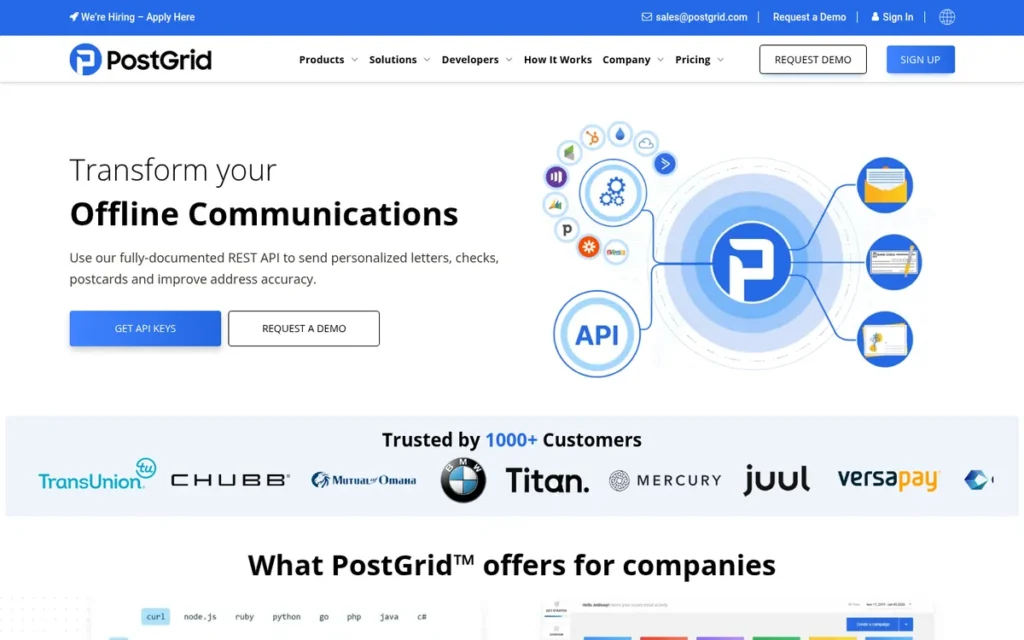
Category: Mail API (Developer & Transactional). A mail API is print-and-mail infrastructure that sends letters, postcards and checks programmatically from your app or systems.
At a Glance
- Category: Mail API (Developer & Transactional)
- Best For: Product, operations and compliance teams sending transactional, regulated or high-volume mail in the US, Canada, UK or Australia
- Price Range: Free Starter ($0/month, up to 500 mailers); pay-per-piece from $0.862 per 4×6 postcard and $1.019 per letter; Growth listed at ~$1,000/month; Enterprise on request (PostGrid and HubSpot, November 2026)
- Primary Strength: PostGrid holds the highest G2 rating among the seven tools evaluated (4.9/5, 232 reviews, November 2026) and runs HIPAA-ready print-and-mail infrastructure in four countries.
- Biggest Limitation: PostGrid is harder for non-technical marketers to set up, according to G2 reviewers (2026), and moving from its free 500-mailer plan to its ~$1,000/month Growth tier is a steep jump.
- One-Line Summary: PostGrid is the highest-rated print-and-mail API in PlugRoute’s 2026 evaluation, best suited to teams that need compliant, automated transactional or marketing mail across the US, Canada, UK and Australia.
- Last Verified: November 2026
Overview
PostGrid is a print-and-mail API and no-code dashboard that sends letters, postcards, self-mailers and checks with certified address verification. PostGrid is built for product, operations and compliance teams that need automated transactional or marketing mail in the US, Canada, the UK and Australia.
PostGrid lists a HubSpot Marketplace app and reported Zapier connections, so PostGrid can trigger mail from CRM events. Even so, PostGrid is built mainly around its API and batch processing.
Key Features
- PostGrid’s API sends letters, postcards (6×4, 9×6, 11×6), 8.5×11 bifold self-mailers, checks and handwriting-style mail, with variable data printing for each recipient.
- PostGrid verifies addresses before printing, using CASS certification for the US and SERP certification for Canada.
- PostGrid tracks pieces with USPS Intelligent Mail barcodes and supports QR codes and personalized URLs (PURLs) to capture responses.
- PostGrid prints locally through partner networks in four countries and states a 2-business-day SLA from print to postal handoff (PostGrid, 2026; vendor-reported).
- PostGrid offers a no-code dashboard alongside its batch API and webhooks.
Best For
PostGrid is best for healthcare, financial, logistics and SaaS teams sending statements, disclosures, checks or triggered marketing mail that need HIPAA-ready handling or coverage outside the US. PostGrid is not the strongest fit for marketers who want a visual, multi-touch campaign builder without engineering help.
Pricing
- PostGrid’s Starter plan costs $0/month for up to 500 mailers (PostGrid, November 2026).
- PostGrid’s pricing page lists pay-per-piece First-Class rates of $0.862 (4×6 postcard), $0.983 (6×9), $1.249 (6×11), $1.019 (black-and-white letter) and $1.179 (color letter) (PostGrid, November 2026). An older PostGrid page cites $0.74 per postcard and $0.85 per letter. Confidence: Conflicting sources.
- PostGrid’s HubSpot Marketplace listing shows a Growth plan at $1,000/month with 10 users and 50 templates (HubSpot, November 2026; display pricing, subject to confirmation). PostGrid Enterprise is quote-only.
Strengths
- PostGrid holds a 4.9/5 G2 rating from 232 Print & Mail reviews and a 4.9/5 Capterra rating from 53 reviews (G2 and Capterra, November 2026). PostGrid’s G2 rating is the highest among the seven tools evaluated.
- PostGrid states SOC 2 Type 2, HIPAA with BAAs, PIPEDA and HITECH compliance (PostGrid, 2026; vendor-reported). One G2 reviewer said the “HIPAA BAA process was smoother than expected” (G2, 2026).
- PostGrid documents local printing in the US, Canada, the UK and Australia and Canadian SERP-certified address verification (PostGrid, 2026). Lob’s documented printing in this research is US-focused.
- PostGrid’s batch API earns specific praise. One G2 reviewer wrote that the “batch API was exactly what we needed” (G2, 2026).
Limitations
PostGrid’s most consequential trade-off is a cost cliff. The free Starter plan caps at 500 mailers, and the next listed tier (Growth) is about $1,000/month (HubSpot, November 2026). A team sending 600 postcards a month would face a large jump in fixed cost.
- PostGrid’s G2 category summary cites setup difficulty for non-technical users, limited template variety, slow loading and trouble with large uploads (G2, 2026).
- PostGrid offers limited multi-touch orchestration and only basic attribution, according to a third-party buyer’s guide (SecuritySenses, 2026).
- PostGrid’s case-study results, such as +30% response for an HVAC platform after connecting HubSpot, use anonymized clients (PostGrid, 2026; vendor-reported).
Users on r/RealEstateTechnology noted:
“Actually, it didn’t work for us and we swore off it especially with the service. But to each their own.” Posted by u/Ancient-Pumpkin-8098
Takeaway: PostGrid’s high review scores do not hold up for every buyer, and at least some real-estate users dropped it over service problems.
Verdict
PostGrid is the best overall direct mail automation software in PlugRoute’s 2026 evaluation. It earns the top score on the strength of its 4.9/5 G2 rating, free Starter plan and HIPAA-ready print infrastructure in four countries.
PostGrid ranks #1 with 36/45, narrowly ahead of Postalytics (35). Its review confidence (C2 = 5) and compliance and coverage (C5 = 5) outweigh its ease-of-use score (C6 = 3) and partly published pricing (C3 = 3). Marketers without engineers should compare it against Postalytics, and every buyer should get Growth-tier pricing in writing.
2. Postalytics: Best for CRM-Triggered Campaigns Without Engineers
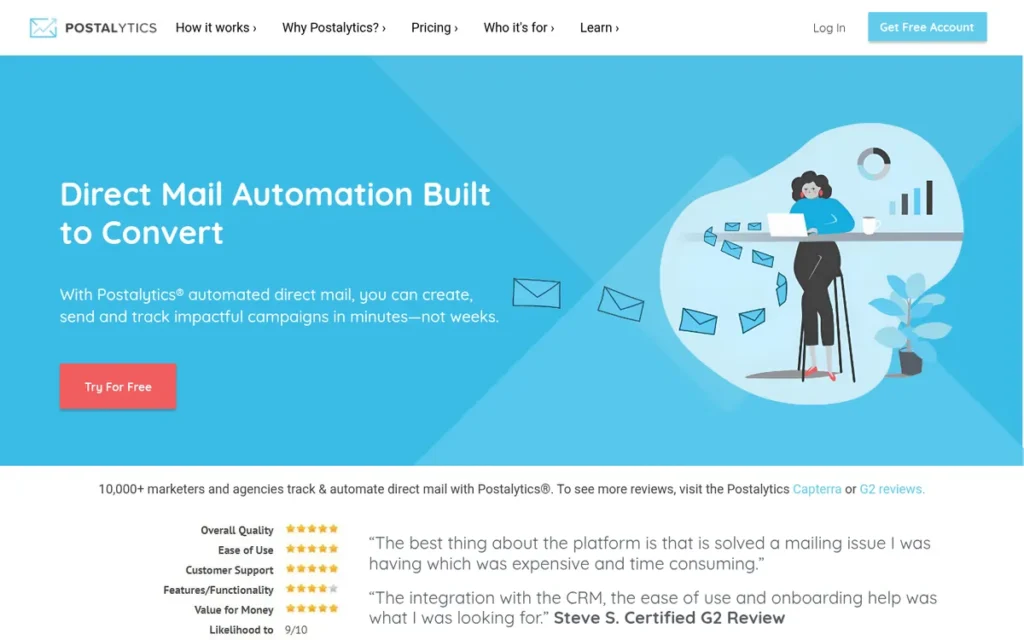
Category: CRM-Triggered Campaign Platform. A CRM-triggered platform sends postcards and letters automatically from CRM and marketing automation workflows, with built-in tracking.
At a Glance
- Category: CRM-Triggered Campaign Platform
- Best For: Marketing and demand-gen teams on HubSpot or Salesforce who want automated, trackable mail without engineering help
- Price Range: Free plan ($0/month) plus per-piece fees; Marketer $199/month; Pro/Agency $399/month; 6×9 postcards from $0.838 Standard Mail on Pro (Postalytics, November 2026)
- Primary Strength: Postalytics offers the most deeply documented native HubSpot integration in this evaluation, with object-level workflow triggers and up to 35 personalization fields.
- Biggest Limitation: Postalytics has a small independent review base (13 G2 reviews), no compliance certification was found, and its coverage is mainly US-only.
- One-Line Summary: Postalytics is the strongest direct mail automation platform in PlugRoute’s 2026 evaluation for marketers who want to trigger and track postcards and letters directly from HubSpot or Salesforce workflows.
- Last Verified: November 2026
Overview
Postalytics is a direct mail automation platform that lets marketers trigger personalized postcards and letters from HubSpot, Salesforce and other marketing tools. Postalytics is built for marketing teams without dedicated engineers.
Postalytics includes built-in address hygiene, QR and PURL tracking, and response attribution. Postalytics’ free plan includes a basic HubSpot integration, while the enhanced HubSpot features require a paid Postalytics plan (Postalytics, 2026).
Key Features
- Postalytics’ HubSpot Marketplace app triggers mail from HubSpot Workflows and Lists and supports Contacts, Companies, Custom Objects and Timeline events.
- Postalytics personalizes each piece with up to 35 HubSpot fields, and Postalytics’ Salesforce, ActiveCampaign, Klaviyo and Zapier integrations are reported but not confirmed.
- Postalytics cleans mailing lists with CASS standardization and NCOA processing to catch recipients who have moved.
- Postalytics includes free QR codes, PURLs, delivery tracking and response attribution dashboards.
- Postalytics offers a visual editor for marketers and a print-and-mail API for technical teams.
Best For
Postalytics is best for small-to-mid-sized B2B and B2C marketing teams on HubSpot or Salesforce that want mail to send automatically on lifecycle, abandonment or sales-stage triggers. Postalytics is less suited to regulated senders who need documented certifications or to teams mailing outside the US.
Pricing
- Postalytics lists a Free/Pay-As-You-Go plan ($0/month), Marketer ($199/month) and Pro/Agency ($399/month), with print and postage charged per piece (Postalytics, November 2026).
- Postalytics’ official pricing page lists 6×9 postcards at $0.928 (Marketer) and $0.838 (Pro) for Standard Mail, or $0.981 and $0.891 for First-Class. Pro drops to about $0.808 at 10,000+ pieces (Postalytics, November 2026). Confidence: Confirmed on official page.
- Postalytics’ Free-plan rate of $1.048 per 6×9 postcard is third-party reported (RFP.wiki, 2026), and full automation needs a paid plan.
Strengths
- Postalytics’ HubSpot App Marketplace listing (HubSpot, November 2026) documents object-level workflow triggers and up to 35 personalization fields, the most deeply documented CRM integration in this evaluation.
- Postalytics bundles three measurement layers: address hygiene, delivery tracking and QR/PURL attribution. Postalytics’ built-in QR tracking fills a common gap, since only 22% of organizations track QR codes (Lob, 2026; vendor-sponsored survey).
- Postalytics earns 4.3/5 on Capterra from 33 reviews (Capterra, November 2026), where reviewers praise HubSpot workflow-triggered postcards and easy setup.
- Postalytics’ $0/month plan lets teams test a real workflow before subscribing, and Postalytics lists IQ Fiber as a customer (RFP.wiki, 2026; vendor-reported).
Limitations
Postalytics’ most consequential trade-off is limited proof. Postalytics has 13 G2 reviews (4.4/5) and 33 Capterra reviews (4.3/5) (G2 and Capterra, November 2026), which gives its ratings only low-to-moderate confidence.
- Postalytics draws G2 criticism for a “clunky” interface, a learning curve and occasional bugs (G2, 2026).
- Postalytics has no SOC 2 or HIPAA certification found, and its strongest workflows rely on USPS infrastructure, so it is effectively US-only.
- Postalytics’ ROI claims have no independently audited payback models (RFP.wiki, 2026), and the $199–$399 subscription may not pay off for occasional senders.
Users on r/Entrepreneur noted:
“Postalytics – Best if you are looking for marketing use cases but per piece pricing is very expensive” Posted by u/AdUpset3546
Takeaway: Postalytics is seen as the marketing-focused choice, but its per-piece pricing is a known drawback for cost-conscious senders.
Verdict
Postalytics is the best direct mail automation software for marketers who want to trigger postcards and letters from HubSpot or Salesforce without engineers, based on PlugRoute’s 2026 evaluation of documented integration depth.
Postalytics ranks #2 with 35/45. It earned the only perfect scores for integration depth (C1 = 5) and tracking and attribution (C4 = 5), but trails PostGrid on review confidence (C2 3 vs 5) and compliance and coverage (C5 2 vs 5). Start on the Free plan, and confirm which integration features your plan includes.
3. Handwrytten: Best for Real-Ink Handwritten Notes at Scale
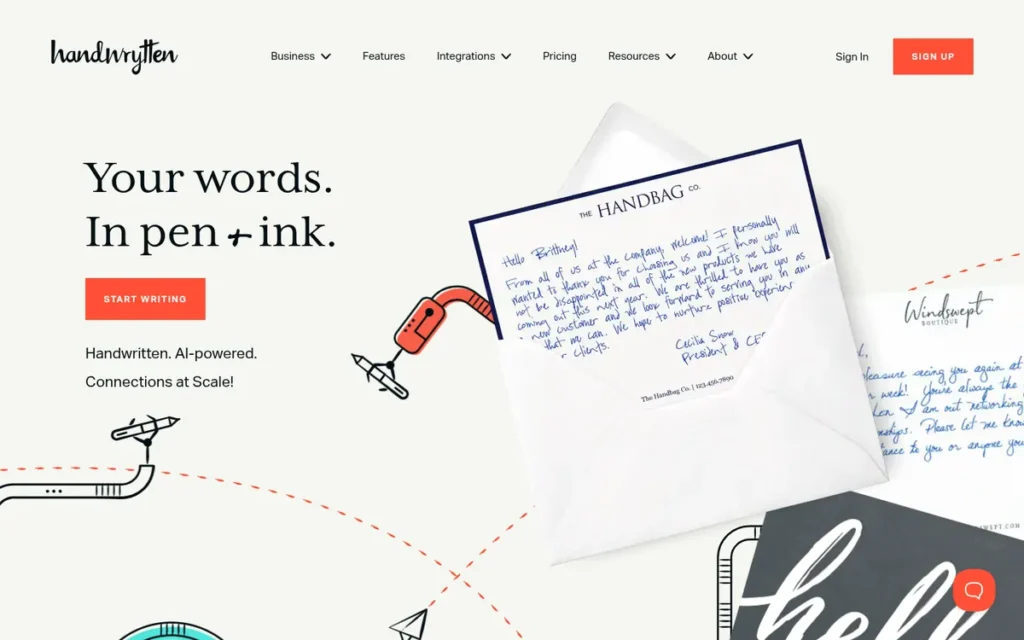
Category: Handwritten Note Service. A handwritten note service uses robots that write cards with real pens and mails them when your CRM or store triggers a send.
At a Glance
- Category: Handwritten Note Service
- Best For: Relationship-driven B2B sales, customer success, e-commerce and nonprofit teams sending high-value thank-you, win-back or donor notes
- Price Range: Pay-as-you-go $3.75/card plus postage; subscriptions $449–$2,499/month ($374–$2,082 billed annually) at $1.19–$1.99/card (Handwrytten, November 2026)
- Primary Strength: Handwrytten produces real-ink, robot-written notes and has the second-largest review base in the category (G2 4.7/5, 887 reviews, November 2026).
- Biggest Limitation: Handwrytten costs several times more per piece than printed alternatives once postage is added, and it offers no documented address hygiene or response tracking.
- One-Line Summary: Handwrytten is the highest-reviewed real-ink handwritten note service in PlugRoute’s 2026 evaluation, best suited to teams for whom authentic pen-written personalization justifies a premium per-card price.
- Last Verified: November 2026
Overview
Handwrytten is a handwritten note service whose pen-holding robots write, address, stamp and mail real-ink cards triggered from Salesforce, HubSpot, Shopify or Zapier. Handwrytten is built for sales, customer success, e-commerce and nonprofit teams that want authentic personal notes at scale.
Handwrytten writes with real pens, while some competitors print handwriting fonts. Robot handwriting is not unique to Handwrytten, though: Simply Noted and Scribeless use similar robots.
Key Features
- Handwrytten’s robots write each note with a real ballpoint pen on card stock, then address, stamp and mail the envelope.
- Handwrytten reports integrations with Salesforce, HubSpot, Shopify, Zapier, Make, Integrately and Blackbaud, plus an API (Handwrytten, 2026; reported, confirm on official docs).
- Handwrytten offers a card catalog and templates for thank-you, prospecting, post-purchase and fundraising notes.
- Handwrytten reports capacity of 200+ robots producing 30,000+ cards per day (Handwrytten, 2026; vendor-reported).
- Handwrytten offers pay-as-you-go pricing and tiered subscriptions that lower the per-card price.
Best For
Handwrytten is best for lower-volume, high-value notes, such as enterprise prospecting, retention and donor stewardship, where obviously mass-produced mail would undermine the message. Handwrytten is a poor fit for high-volume prospect postcards or budget-sensitive small businesses.
Pricing
| Plan | Monthly fee | Billed annually (per month) | Per card |
|---|---|---|---|
| Pay-as-you-go | None | None | $3.75 + postage |
| Pro | $449 | $374 | $1.99 |
| Enterprise | $649 | $540 | $1.49 |
| Elite | $849 | $707 | $1.29 |
| Agency | $2,499 | $2,082 | $1.19 |
Confidence: Confirmed on official page (Handwrytten, November 2026). An older Handwrytten resource page cites about $6.99 per card.
Handwrytten’s $449 Pro plan beats $3.75 pay-as-you-go above about 255 cards a month, because the $1.76 per-card saving covers the subscription at that volume. Postage is extra, adding roughly $0.82 per card at First-Class rates after July 12, 2026.
Strengths
- Handwrytten holds a 4.7/5 G2 rating from 887 reviews (G2, November 2026), with consistent praise for card quality, turnaround and support.
- Handwrytten publishes its full plan table, including annual-billing prices, on its official pricing page (Handwrytten, November 2026).
- Handwrytten reported $6.3M in 2021 revenue and about 175 robots (Phoenix Business Journal, September 2022), the most recent independent operating data found.
- Handwrytten’s reported Salesforce, HubSpot, Shopify and Blackbaud integrations suit CRM-triggered thank-you and donor workflows.
Limitations
Handwrytten’s most consequential trade-off is cost. Reported per-card prices of $1.19–$3.75 plus about $0.82 postage run several times higher than Thanks.io’s printed notecards, which start at $1.49 with postage included (Thanks.io, November 2026).
- Handwrytten’s G2 reviewers report manual address entry and list management (G2, 2026).
- Handwrytten has no documented address hygiene, delivery tracking or response attribution in this research.
- Handwrytten claims SOC 2 Type II, but PlugRoute could not locate a trust center or report to verify it (November 2026).
- Handwrytten’s robot handwriting can still look patterned, and the widely repeated claim that handwritten mail gets 4–10% response could not be verified.
Verdict
Handwrytten is the best direct mail automation software for real-ink handwritten notes in PlugRoute’s 2026 evaluation, backed by 887 G2 reviews averaging 4.7/5.
Handwrytten ranks #3 with 34/45, half a point ahead of Lob. Its top review score (C2 = 5) and published price table (C3 = 4) offset its missing hygiene and tracking (C4 = 2). It trails Postalytics on integration depth and tracking. Plan your own response tracking.
4. Lob: Best for High-Volume, Developer-Led Mail Programs
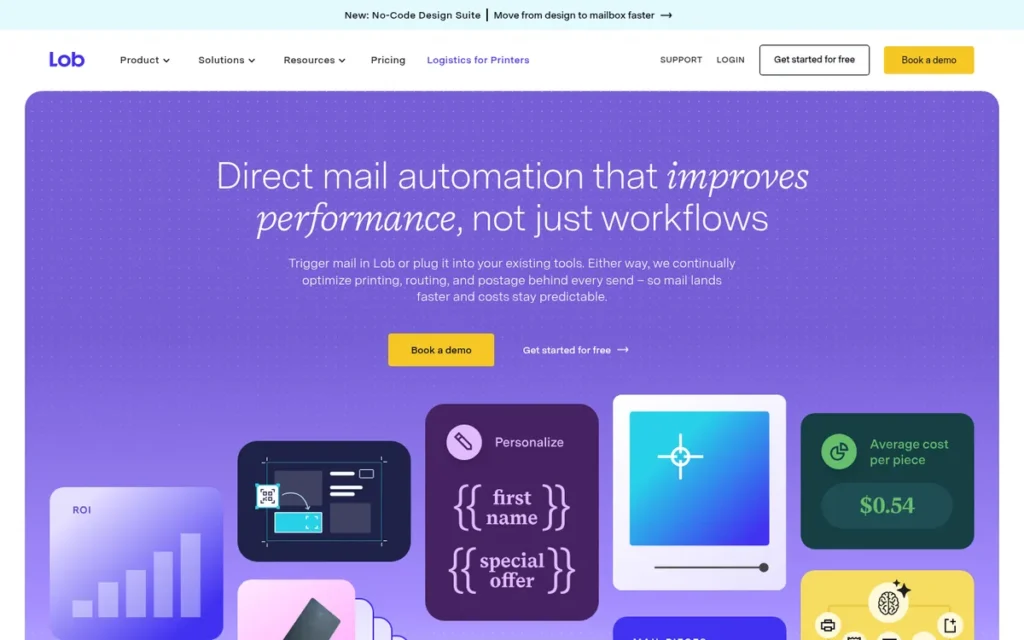
Category: Mail API (Developer & Transactional).
At a Glance
- Category: Mail API (Developer & Transactional)
- Best For: Engineering-led teams building high-volume, programmatic mail into their product or operations
- Price Range: Developer $0/month; Startup $260/month ($225 billed annually, up to 75,000 mailings/year); Growth $550/month ($480 billed annually, up to 150,000 mailings/year); Enterprise custom; per-piece print and postage extra
- Primary Strength: Lob publishes the most complete plan and per-piece pricing in the category and pairs it with print routing across multiple facilities and USPS event tracking.
- Biggest Limitation: Lob is built for engineers, and this research found no officially confirmed native CRM integrations for Lob.
- One-Line Summary: Lob is the most transparently priced developer mail API in PlugRoute’s 2026 evaluation, best suited to engineering teams running high-volume programmatic print-and-mail at scale.
- Last Verified: November 2026
Overview
Lob is an API-first print-and-mail platform that lets engineering teams send postcards, letters, self-mailers and checks programmatically. Lob is built for companies running high-volume or transactional mail from their own applications.
Lob includes address verification, webhooks and USPS event tracking. Lob also offers a campaigns interface, and Lob’s annual mailing caps of 75,000 and 150,000 show it is aimed at high-volume senders.
Key Features
- Lob’s API and webhooks send postcards (4×6, 5×7, 6×9, 6×11), letters, self-mailers and checks, with print, postage and fulfillment in one per-piece price.
- Lob’s Print Delivery Network and Postal IQ route each job to a print facility and choose where it enters USPS.
- Lob tracks each piece through production and USPS processing events, which show movement through the mail but not receipt.
- Lob’s address verification API is CASS Cycle O certified and covers 156M+ US addresses (Lob, 2026; vendor-reported).
- Lob’s campaigns interface supports dashboard-based sending alongside the API.
Best For
Lob is best for product and engineering teams mailing tens of thousands of pieces a month that want detailed USPS tracking and predictable, published unit costs. Lob is not the simplest choice for a small business or a marketer who wants native HubSpot workflows.
Pricing
- Lob’s Startup plan covers up to 75,000 mailings per year (about 6,250 a month) and 3 users, and Growth covers 150,000 per year (about 12,500 a month) and 5 users (Lob, November 2026).
- Lob’s 4×6 First-Class postcard costs $0.909 on Developer, $0.649 on Startup and $0.619 on Growth. A 6×9 costs $1.030, $0.710 and $0.660 on the same plans (Lob, November 2026).
- Lob’s letters start at $0.838 First-Class (black and white) or $0.568 Standard (Lob, November 2026).
- Lob’s FAQ quotes older blended rates ($0.77 postcard, $0.89 letter). Confidence: Conflicting sources; Help Center rates used.
Strengths
- Lob publishes plan fees, annual mailing caps and per-piece rates by format and postage class (Lob, November 2026).
- Lob holds a 4.4/5 G2 rating from 289 reviews (G2, November 2026), where reviewers praise hands-off automation, delivery visibility and responsive API support.
- Lob reports annual SOC 2 Type II audits and offers BAAs for HIPAA workflows (Lob, 2026; vendor-reported). Lob was named 2026 Overall Marketing Automation Platform of the Year by MarTech Breakthrough (GlobeNewswire, August 2026).
- Lob’s routing across multiple facilities and its per-piece USPS events let operations teams follow pieces through the mail.
This aligns with community sentiment on r/RealEstateTechnology:
“I’ve tried sending direct mail both by ordering directly from the vender and integrating into my CRM. I’m currently operating off the latter and have Lob integrated directly into my system. It’s pretty awesome because it allows me to send one-off letters or postcards, or mass mailings. Since most direct mail houses require minimum orders numbers, having the ability to send individual mailers has been amazing.” Posted by u/ArtisticAd4357
Takeaway: Once engineers wire Lob into a CRM, it removes print-shop minimums and handles both one-off and mass mailings, though that integration has to be built rather than switched on.
Limitations
Lob’s most consequential trade-off is accessibility. This research found no officially confirmed native CRM integrations for Lob, and Lob’s paid plans start at $260/month before print and postage, which is hard to justify for low-volume senders.
- Lob’s G2 reviewers describe a slow admin dashboard with unreliable search and a learning curve for advanced features (G2, 2026).
- Lob’s G2 reviewers report cryptic error messages and SDK bugs (G2, 2026).
- Lob’s G2 reviewers say costs climb at high volume and international support is limited (G2, 2026).
- Lob’s own pages show conflicting per-piece prices.
Verdict
Lob is the best direct mail automation software for engineering-led, high-volume programs in PlugRoute’s 2026 evaluation, thanks to the category’s most complete published pricing and print routing across multiple facilities.
Lob ranks #4 with 33.5/45. It leads subscription vendors on pricing transparency (C3 = 4.5) but trails Handwrytten on review confidence and integration depth, and scores lowest on ease of use (C6 = 2.5). Start on the free Developer plan, and compare it with PostGrid if you need printing outside the US.
5. Reachdesk: Best for International (EMEA-Strong) Gifting and ABM Programs
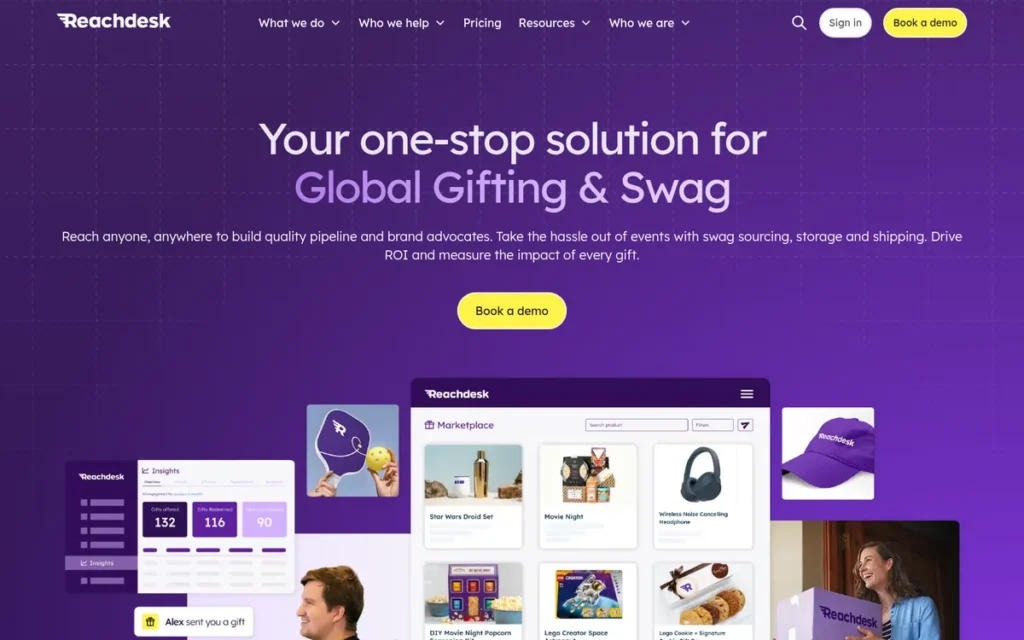
Category: Gifting & ABM Platform. A gifting platform sends physical gifts, eGifts, swag and direct mail to prospects and customers, with pipeline attribution.
At a Glance
- Category: Gifting & ABM Platform
- Best For: B2B sales and marketing teams running account-based gifting programs across EMEA and North America
- Price Range: From $20,000/year (custom quote); swag-sourcing orders carry a $2,500 minimum; gifts billed separately (Reachdesk, November 2026)
- Primary Strength: Reachdesk pairs a published enterprise starting price with international warehouses delivering to 180+ countries and confirmed Salesforce, Outreach and Salesloft integrations.
- Biggest Limitation: Reachdesk requires a $20,000+ annual commitment, and reviewers report a thin APAC catalog and unexpected customs and tax charges.
- One-Line Summary: Reachdesk is the strongest international gifting-led direct mail platform in PlugRoute’s 2026 evaluation, best suited to EMEA-focused B2B teams that can commit to a five-figure annual contract.
- Last Verified: November 2026
Overview
Reachdesk is an enterprise corporate gifting and account-based direct mail platform that sends physical gifts, eGifts, branded swag and mail. Reachdesk is built for B2B teams running account-based programs, especially across Europe and North America.
Reachdesk confirms recipient addresses and bills physical gifts only when they are claimed. Reachdesk is privately held and has raised about $49M, including a $43M Series B led by Highland Europe (TechCrunch, September 2021). No acquisition was found.
Key Features
- Reachdesk sends physical gifts, eGifts, branded merchandise and direct mail, and bills physical gifts only when claimed.
- Reachdesk confirms recipient addresses before shipping, which reduces wasted sends.
- Reachdesk integrates with Salesforce, Outreach, Salesloft and Slack (confirmed), while Reachdesk’s HubSpot and Marketo integrations are reported but not confirmed.
- Reachdesk reports warehouses in the US, UK, EU, Canada and Australia delivering to 180+ countries from 8,500+ gift options (G2, 2026).
- Reachdesk MCP connects gifting workflows to AI assistants such as ChatGPT and Claude.
Best For
Reachdesk is best for mid-market and enterprise B2B revenue teams running ABM, event follow-up or deal-acceleration gifting with significant European recipient volume. Reachdesk is not suited to small businesses or teams that only need printed postcards and letters.
Pricing
- Reachdesk’s official pricing page lists plans from $20,000/year across Core, Plus and Premium tiers, with a $2,500 minimum per swag-sourcing order (Reachdesk, November 2026). Confidence: Confirmed on official page.
- Reachdesk Core covers 5 users, 1 fulfillment center, 1 eGift region and about 50 gifts a month, with gifts and swag billed on top (Reachdesk, 2026).
- Reachdesk contract figures of $20K–$52.4K come from a Sendoso-published comparison, so treat them with caution. Capterra’s “$9/user/month” listing appears outdated.
Strengths
- Reachdesk holds a 4.5/5 G2 rating from 1,277 reviews (G2, November 2026), where reviewers praise ease of use, catalog variety, Salesforce and Slack integration and responsive customer success managers.
- Reachdesk publishes its starting price (Reachdesk, November 2026), which is more transparent than quote-only gifting competitors.
- Reachdesk reports warehouses in five regions delivering to 180+ countries, the broadest international footprint stated in this evaluation (G2, 2026).
- Reachdesk’s address confirmation and claim-based billing reduce wasted spend on undeliverable gifts.
Limitations
Reachdesk’s most consequential trade-off is accessibility. Reachdesk’s $20,000/year floor rules out small businesses, and gifts are billed on top of the platform fee (Reachdesk, November 2026).
- Reachdesk’s G2 reviewers report a limited APAC catalog, inventory inaccuracies, little visibility into delivery times and clunky wallet and permission admin (G2, 2026).
- Reachdesk’s G2 reviewers also report unexpected taxes or customs charges, and Reachdesk’s inventory services may cost extra (G2, 2026).
- Reachdesk has no compliance certification found, and Reachdesk’s ROI results, such as Verkada’s 40% higher ROI, are vendor-reported (Reachdesk, 2026).
Verdict
Reachdesk is the best gifting-led direct mail platform for EMEA-focused B2B teams in PlugRoute’s 2026 evaluation, combining a published $20,000/year starting price with fulfillment in five regions.
Reachdesk ranks #5 with 31.5/45. It ranks above Sendoso because it publishes a starting price (C3 2 vs 1), and below the printed-mail tools because its $20,000/year floor limits who can buy it. Get customs and inventory fees in writing.
6. Thanks.io: Best for Budget-Conscious Small Businesses and Real Estate (No Minimums)
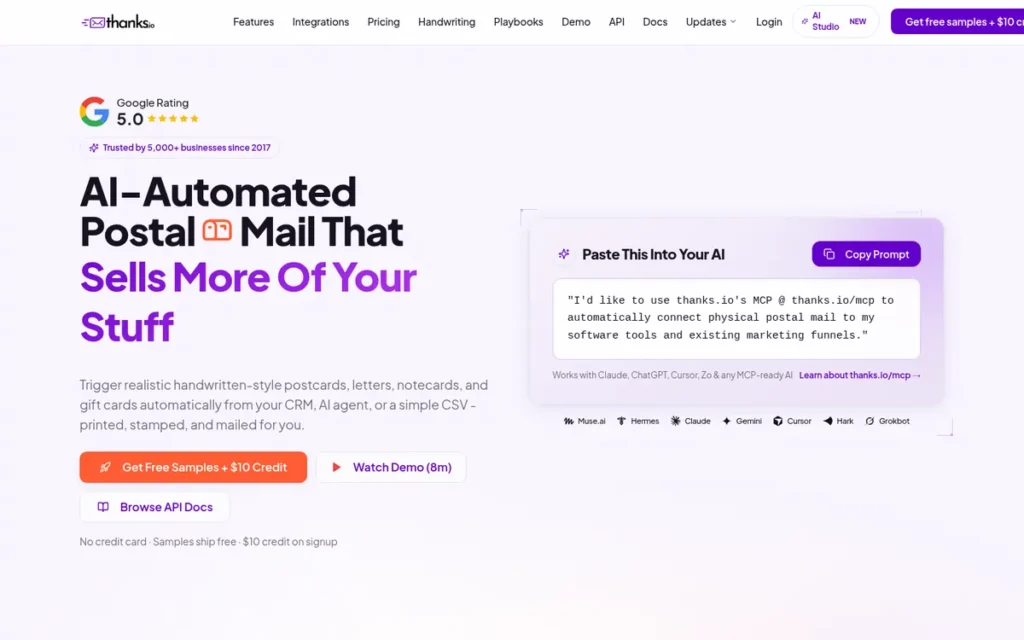
Category: Self-Serve Personalized Sender. A self-serve sender is a dashboard-first tool for sending low-cost, personalized postcards, letters and notecards with simple automation.
At a Glance
- Category: Self-Serve Personalized Sender
- Best For: Small businesses, solo marketers and real estate agents who want low-cost, personalized sends with no minimums
- Price Range: Business $49/month ($0.77 per postcard, postage included); Professional $199/month ($0.64); pay-as-you-go reported from $1.18 (unverified) (Thanks.io, November 2026)
- Primary Strength: Thanks.io publishes the most transparent postage-included pricing in this evaluation, with no minimums or contracts.
- Biggest Limitation: Thanks.io has only 4 G2 reviews, a 1–10 person team, no compliance certification found, and limited design customization.
- One-Line Summary: Thanks.io is the most transparently priced direct mail automation tool in PlugRoute’s 2026 evaluation, best suited to small businesses and real estate agents who want handwriting-style mail with no minimums.
- Last Verified: November 2026
Overview
Thanks.io is a self-serve direct mail platform that sends handwriting-style postcards, letters, notecards and gift cards with postage included and no minimums. Thanks.io is built for small businesses, solo marketers and real estate agents on tight budgets.
Thanks.io connects to HubSpot, Shopify, Salesforce and Zapier. Thanks.io prints its handwriting from fonts rather than writing with pens, and key Thanks.io automations require the Business plan or above.
Key Features
- Thanks.io sends handwriting-style postcards, letters, notecards, gift cards and magnet cards (MagnaCards) using printed fonts.
- Thanks.io connects to HubSpot, Shopify, Salesforce and Canva, and to 500+ apps via Zapier, Make and n8n, with Zapier, Make and webhooks requiring the Business plan (Thanks.io, 2026).
- Thanks.io offers a REST API with webhooks and a test mode.
- Thanks.io includes dynamic QR tracking and AI-written messages for each recipient.
- Thanks.io provides real estate tools, including Neighbor Blast radius mailing and Street View images.
Best For
Thanks.io is best for small businesses, real estate agents and solo marketers who send occasionally or in modest volumes and value predictable all-in pricing over enterprise controls. Thanks.io is not suited to regulated senders or teams that need real-ink handwriting.
Pricing
- Thanks.io charges $0.77 per 4×6 postcard (postage included) on its $49/month Business plan and $0.64 on its $199/month Professional plan (Thanks.io, November 2026). Confidence: Confirmed on official page.
- Thanks.io lists letters from $0.79 and notecards from $1.49 with postage included, with the lowest rates on higher plans (Thanks.io, November 2026).
- Thanks.io’s $1.18 pay-as-you-go postcard rate is reported but not verified, and older figures ($0.45, $0.99) conflict with it.
Strengths
- Thanks.io publishes postage-included prices with no minimums or contracts (Thanks.io, November 2026), the most transparent all-in pricing in this evaluation.
- Thanks.io holds a 4.4/5 TrustScore from 198 Trustpilot reviews (Trustpilot, November 2026), with praise for realistic handwriting, CRM integrations and easy setup.
- Thanks.io covers both no-code and developer workflows through Zapier, Make, n8n and a REST API with webhooks (Thanks.io, 2026).
- Thanks.io’s real estate tools, such as Neighbor Blast radius mailing and just-sold cards, serve a niche the other six evaluated tools do not document.
Limitations
Thanks.io’s most consequential trade-off is confidence. Thanks.io’s 4.8/5 G2 rating rests on only 4 reviews (G2, November 2026), and PlugRoute’s review score counts G2 and Capterra only.
- Thanks.io drew G2 criticism for offering only four design types, with customization limited to small areas (G2, 2026).
- Thanks.io has no SOC 2 or HIPAA certification found, lists 1–10 employees, focuses on the US and documents no CASS or NCOA address hygiene.
- Thanks.io’s $0.64 postcards require the $199/month Professional plan, and Business ($49/month) pays $0.77, so free to send is not free to automate.
Verdict
Thanks.io is the best direct mail automation software for budget-conscious small businesses and real estate agents in PlugRoute’s 2026 evaluation, offering the category’s most transparent postage-included pricing with no minimums.
Thanks.io ranks #6 with 30.5/45. It earned a perfect pricing score (C3 = 5) but trails Reachdesk on review confidence (C2 2 vs 4.5) and on compliance and coverage (C5 1.5 vs 3.5). The low review score reflects a 4-review sample, not dissatisfaction.
7. Sendoso: Best for Enterprise Gifting with the Broadest Catalog and Global Fulfillment
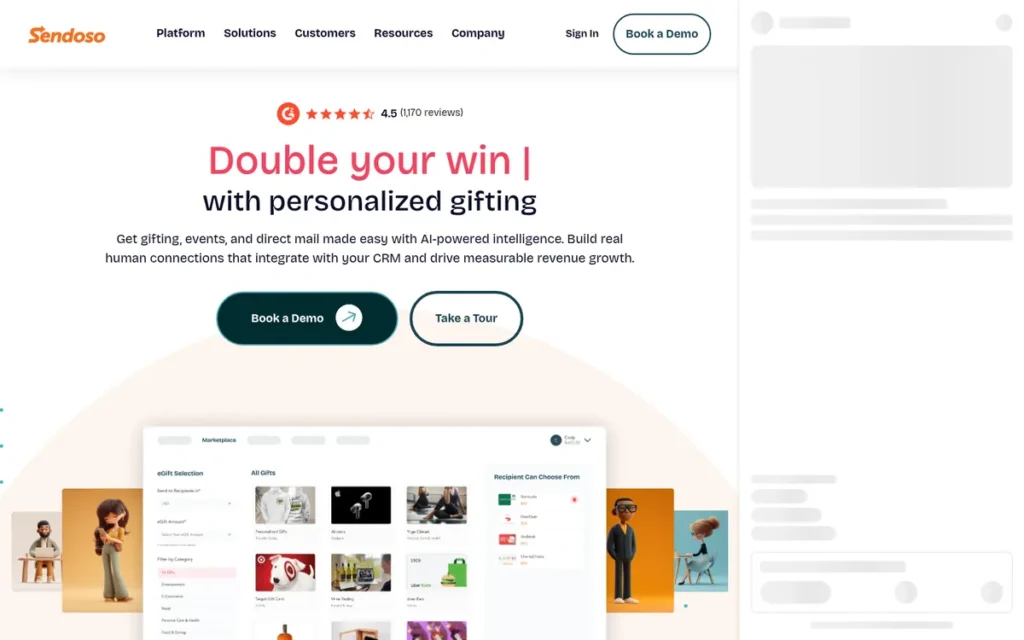
Category: Gifting & ABM Platform.
At a Glance
- Category: Gifting & ABM Platform
- Best For: Enterprise sales, marketing and customer success teams running large, multi-region gifting and swag programs
- Price Range: Pricing on request (custom enterprise contracts; layered platform, seat, balance and fulfillment fees)
- Primary Strength: Sendoso combines the largest review base in the category (G2 4.6/5, 2,038 reviews) with a broad gifting catalog and its own global fulfillment centers.
- Biggest Limitation: Sendoso publishes no pricing, and reviewers report layered fees and prefunded balances that may be non-refundable after cancellation.
- One-Line Summary: Sendoso is the most widely reviewed gifting-led direct mail platform in PlugRoute’s 2026 evaluation, best suited to enterprise teams that need a broad global catalog and can absorb opaque, layered pricing.
- Last Verified: November 2026
Overview
Sendoso is an enterprise sending platform that combines corporate gifting, direct mail, eGifts, a swag store and global warehousing in one system. Sendoso is built for B2B sales, marketing and customer success teams running prospecting, ABM, event and retention programs across many regions.
Sendoso acquired Alyce in February 2024 and announced its acquisition of Postal on May 1, 2025 (Docket.io, 2026). Folding both into Sendoso’s SmartSuite could change products and roadmaps.
Key Features
- Sendoso combines corporate gifting, direct mail, eGifts, branded swag and a vendor marketplace in one platform.
- Sendoso runs its own fulfillment centers and reports an average ship time of 1.6 days to 165+ countries (Sendoso, 2026; vendor-reported).
- Sendoso is adding recipient-choice gifting from Alyce and swag-store logistics from Postal into SmartSuite.
- Sendoso began as “Coffee Sender,” a Salesforce app for sending gift cards (Sendoso, 2021).
- Sendoso offers warehousing and kitting for stored swag and inventory.
Best For
Sendoso is best for large B2B organizations with high-volume, multi-region gifting needs, where catalog breadth matters more than predictable pricing. Sendoso is not suited to small businesses or teams that only need printed postcards and letters.
Pricing
- Sendoso publishes no price list and uses custom enterprise contracts (G2, November 2026). Confidence: Quote-only.
- Sendoso’s G2 reviewers report eight fee layers: platform or license fees, per-seat charges, prefunded gift balances, marketplace markups, storage, pick-and-pack, packaging and shipping (G2, 2026).
- Sendoso’s prefunded balances may be non-refundable after cancellation. One Reddit post cited a “$12k annual platform fee” (Reddit r/RecruitmentAgencies, May 2026), but that figure is anecdotal and the post may be promotional.
Strengths
- Sendoso holds a 4.6/5 G2 rating from 2,038 reviews (G2, November 2026), the largest and highest-confidence base in the category.
- Sendoso cited 30,000 gift options and warehouses in North America, Europe and Asia serving 165+ countries at its $100M Series C in 2021 (PR Newswire, 2021).
- Sendoso reported 15M+ sends and 800+ customers, including Comcast, Thomson Reuters, Nasdaq and eBay, as of 2021 (Sendoso, 2021).
- Sendoso’s acquisitions give buyers recipient-choice gifting and swag-store capabilities from one vendor.
Limitations
Sendoso’s most consequential trade-off is price transparency. Sendoso combines no published pricing, stacked fee layers and possibly non-refundable balances (G2, 2026).
- Sendoso drew a Capterra review calling its cost “outrageous for the very low utility of the product” (Capterra, 2026), along with complaints about setup and accounting problems.
- Sendoso’s G2 complaints include portal bugs, unclear shipping status and inventory errors (G2, 2026).
- Sendoso has gone through at least four layoff rounds since 2022, including a reported 14% cut in June 2024. Estimates of Sendoso’s 2026 headcount range from 279 to 409 (Docket.io, 2026).
Verdict
Sendoso is the most widely reviewed gifting-led direct mail platform in PlugRoute’s 2026 evaluation, with 2,038 G2 reviews averaging 4.6/5, but its opaque, layered pricing placed it last in our weighted ranking.
Sendoso ranks #7 with 30/45, half a point behind Thanks.io (30.5), because it scored lowest on pricing transparency (C3 = 1). Get every fee layer and the refund terms in writing, and compare it with Reachdesk’s published price floor.
How Much Does Direct Mail Automation Software Really Cost in 2026?
Sending 2,000 printed postcards a month with direct mail automation software costs roughly $1,480 to $2,360 in 2026 at published or reported rates, depending on plan fees and postage class. Real-ink handwritten notes cost over $4,000 including postage, and gifting platforms start at about $20,000 per year.
Direct mail automation software uses four pricing models:
- Subscription plus per-piece fees: Lob, Postalytics and Handwrytten charge a monthly plan fee plus a rate for each piece.
- Postage-included pricing: Thanks.io quotes one price per piece that already includes postage.
- Capped free tiers: PostGrid Starter, Lob Developer and Postalytics Free cost $0/month but cap volume or charge higher per-piece rates.
- Quote-only enterprise contracts: Sendoso prices through custom contracts, and Reachdesk publishes only a starting price.
In direct mail automation, free to send is not free to automate: Postalytics and Thanks.io both put key integrations behind paid plans.
Users on r/AskMarketing noted:
“The challenge with direct mail is cost for bulk printing vs. cost for ad hoc printing. If i have 100k customers and want my mail shop to print 100k individual pieces based on that customers browse and purchase behavior, that’s possible. But the costs go way up for printing.” Posted by u/Rhinoridiana
Takeaway: Personalized, behavior-triggered direct mail costs much more per piece than bulk runs, which is why buyers should model all-in cost at their real volume before picking a platform.
Postage class also changes the comparison. Marketing Mail (Standard) is cheaper but slower than First-Class, and vendors quote different classes.
USPS price change (July 12, 2026): The First-Class 1-oz letter rose from $0.78 to $0.82, and the postcard from $0.61 to $0.65. Metered letters rose from $0.74 to $0.78. The change adds about $400 per 10,000 pieces (USPS, July 2026).
USPS figures show why prices keep rising:
- USPS Marketing Mail volume was 56.8B pieces in FY2025, down 1.3% (Market Intelligence Tools, 2026).
- USPS Marketing Mail revenue rose 2.3% to $15.7B in FY2025 (Market Intelligence Tools, 2026).
- USPS prices are rising even as Marketing Mail volume declines.
What Does Printed Mail Cost at Different Volumes?
PlugRoute calculated the monthly totals below from published or reported rates (November 2026). They exclude taxes, add-ons and separately priced address verification.
| Product | Format, postage class and rate basis | 200 pieces/month | 2,000 pieces/month | 20,000 pieces/month | Confidence |
|---|---|---|---|---|---|
| PostGrid | 4×6 postcard, First-Class, pay-per-piece $0.862 | $172.40 (Starter) | Exceeds the 500-mailer Starter cap; Growth listed at ~$1,000/month plus per-piece (rate not published) | Enterprise quote required | Conflicting sources |
| Lob | 4×6 postcard, First-Class | $181.80 (Developer) | $1,558 (Startup: $260 + $0.649) | Exceeds Growth’s 150,000/year cap; Enterprise quote required | Confirmed (Help Center); conflicts with FAQ |
| Postalytics | 6×9 postcard, Standard (First-Class in brackets) | $209.60 (Free, $1.048) | $2,055 (Marketer: $199 + $0.928) [$2,161 First-Class] | $16,559 (Pro: $399 + $0.808) | Confirmed on official page (Free rate third-party reported) |
| Thanks.io | 4×6 postcard, First-Class, postage included | $203 (Business: $49 + $0.77) | $1,589 (Business); $1,479 (Professional: $199 + $0.64) | $12,999 (Professional) | Confirmed on official page; $1.18 pay-as-you-go unverified |
| Handwrytten | Real-ink notecard plus ~$0.82 First-Class postage | $914 ($750 pay-as-you-go + $164 postage) | $5,069 (Elite: $849 + $1.29, + $1,640 postage) | $42,699 (Agency: $2,499 + $1.19, + $16,400 postage) | Confirmed on official page |
Real ink costs about 70% more than printed handwriting at 2,000 cards a month. Handwrytten Elite totals about $5,069 with postage, compared with about $2,980 for Thanks.io notecards at $1.49 postage-included.
Free tiers have cost cliffs, so model 12 months of volume before choosing one:
- PostGrid Starter caps at 500 mailers, and the next listed tier is about $1,000/month (HubSpot, November 2026).
- Lob’s Startup plan covers 75,000 mailings per year, or about 6,250 a month (Lob, November 2026).
- Postalytics Pro drops to about $0.808 per 6×9 Standard postcard above 10,000 pieces (Postalytics, November 2026).
What Do Gifting Platforms Cost?
Gifting platform costs can’t be compared per piece with printed mail. The total depends on gift value, storage and shipping, not print and postage.
| Platform | Published starting point | Minimums | Fee layers | Confidence |
|---|---|---|---|---|
| Reachdesk | From $20,000/year | $2,500 minimum per swag-sourcing order | Platform fee plus gifts and swag; inventory services may cost extra | Confirmed on official page (November 2026) |
| Sendoso | None published | Not published | Platform, seats, prefunded balances, markups, storage, pick-and-pack, packaging, shipping | Quote-only; $12k fee anecdotal |
Which Price Conflicts Should Buyers Know About?
Three vendors show conflicting or unverified prices across sources (all checked November 2026):
- PostGrid’s pricing page lists $0.862 per postcard and $1.019 per letter, while an older PostGrid page cites $0.74 and $0.85.
- Lob’s Help Center rates conflict with the older blended rates in Lob’s FAQ ($0.77 postcard, $0.89 letter).
- Thanks.io’s $1.18 pay-as-you-go postcard rate is reported but does not appear on its official pricing page.
Which Direct Mail Software Integrates With HubSpot, Salesforce, Klaviyo and Zapier?
Postalytics has the most deeply documented native HubSpot integration in this evaluation, and Reachdesk has confirmed native Salesforce, Outreach and Salesloft integrations. PostGrid lists a HubSpot Marketplace app, Thanks.io gates Zapier and webhooks to its Business plan, and Lob relies mainly on its API.
Most other integrations are reported but not confirmed. Integration depth also varies:
- One-way triggers send mail when a CRM event fires.
- Two-way sync writes delivery and response events back to the CRM record.
- Connector-based integrations (Zapier, Make, n8n) add a middle layer and may need a paid plan.
| Product | HubSpot | Salesforce | Klaviyo | Shopify | Zapier/Make/n8n | Sales engagement (Outreach/Salesloft) | API + Webhooks | Plan gating notes |
|---|---|---|---|---|---|---|---|---|
| PostGrid | Native – listed on HubSpot Marketplace (scope not verified) | Not found | Not found | Not found | Via connector – reported (Zapier) | Not found | API + webhooks | Growth tier ~$1,000/month |
| Postalytics | Native – confirmed (HubSpot Marketplace) | Native – reported | Native – reported | Not found | Via connector – reported (Zapier) | Not found | API (webhooks not found) | Enhanced HubSpot features on paid plans |
| Handwrytten | Native – reported | Native – reported | Not found | Native – reported | Via connector – reported (Zapier, Make) | Not found | API (webhooks not found) | Not documented |
| Lob | Not found | Not found | Not found | Not found | Not found | Not found | API + webhooks | Developer plan has higher per-piece rates |
| Reachdesk | Native – reported (unconfirmed) | Native – confirmed | Not found | Not found | Not found | Native – confirmed (plus Slack) | Not found | Core tier: 5 users, 1 fulfillment center |
| Thanks.io | Native – reported | Native – reported | Not found | Native – reported | Via connector (Zapier, Make, n8n) | Not found | API + webhooks, test mode | Zapier/Make and webhooks need Business plan+ |
| Sendoso | Not found | Native – reported (Salesforce origin) | Not found | Not found | Not found | Not found | Not found | Not documented |
“Not found” means this research did not find the integration (research captured November 2026). It does not prove the integration is missing, so confirm on vendor documentation before buying.
The three kinds of tracking measure different things:
- USPS Intelligent Mail barcode tracking shows that a piece is moving through the mail, not that anyone read it.
- QR codes and PURLs measure whether a recipient responded.
- CRM writeback ties that response to pipeline and revenue.
What Red Flags Should I Watch For When Evaluating Direct Mail Automation Software?
The biggest red flags are pricing and evidence problems that raise your real cost or make ROI impossible to prove. The six to watch for are prefunded quote-only contracts, plan-gated integrations, ratings based on very few reviews, ROI claims with no stated method, missing address hygiene, and prices set before the July 2026 USPS increase.
Red Flag #1: Quote-Only Pricing With Prefunded Balances Quote-only pricing with prefunded balances can lock up budget you may not get back. G2 reviewers report that Sendoso’s unused balances may be non-refundable after cancellation (G2, 2026).
Red Flag #2: Integrations Gated Behind Higher Plans An integration on the feature list may not be included in the plan you buy. Postalytics reserves enhanced HubSpot features for paid plans, and Thanks.io requires its Business plan for Zapier, Make and webhooks (Postalytics and Thanks.io, 2026).
Red Flag #3: Ratings Built on Single-Digit Review Counts A high star rating from very few reviews is weak evidence. Thanks.io’s 4.8/5 G2 rating comes from 4 reviews, while its Trustpilot TrustScore is 4.4/5 from 198 reviews (G2 and Trustpilot, November 2026).
Red Flag #4: ROI Claims With No Methodology Vendor ROI claims without a stated method or control group can’t be checked. PlugRoute found no independently audited case studies for any of the seven vendors (PlugRoute research, November 2026).
Red Flag #5: No Documented Address Hygiene (CASS/NCOA) Without CASS standardization and NCOA processing, bad addresses waste postage. PostGrid, Lob and Postalytics document address verification, while Handwrytten and Thanks.io do not in this research.
Red Flag #6: Stale Pricing That Predates the July 2026 USPS Increase Prices published before July 12, 2026 may understate postage by about $0.04 per piece. Ask vendors whether their quoted rates include the new USPS rates (USPS, July 2026).
What Questions Should I Ask Before Choosing Direct Mail Automation Software?
Before choosing direct mail automation software, ask about integration scope, all-in cost at your real volume, address hygiene results, refund terms, documented certifications, and whether you can run a pilot. These six questions expose the hidden costs and gaps that vendor feature lists and starting prices leave out.
Question #1: Is the integration I need native, and is it included on the plan I’d buy? Ask for official documentation, such as a HubSpot Marketplace listing, rather than a logo on a page. Confirm whether the integration only triggers sends or also writes results back to your CRM.
Question #2: What is my all-in cost per piece at my real monthly volume? Ask for a written quote at your volume that includes the platform fee, print, postage class and address verification. Compare that total, not the “from” price.
Question #3: What is your undeliverable rate and NCOA match rate, and how do you handle apartment and suite numbers? PlugRoute found no verified industry-wide undeliverable rate, so ask each vendor for its own numbers. Vague answers suggest weak address hygiene.
Question #4: Are prefunded balances refundable, and what are the contract minimums? Get refund terms and minimums in writing before signing. Reachdesk publishes a $2,500 minimum per swag-sourcing order, while Sendoso does not publish its terms (Reachdesk and G2, November 2026).
Question #5: Which compliance certifications can you document, and will you sign a BAA? Regulated senders should ask for the SOC 2 Type II report and a signed BAA, not just a claim on a webpage. PostGrid and Lob both say they offer HIPAA-ready workflows with BAAs (PostGrid and Lob, 2026; vendor-reported).
Question #6: Can I run a pilot with my own CRM, one format and realistic volume? Pilot one trigger, one format and 200–500 pieces. Measure delivery days, undeliverable rate and QR/PURL response before signing an annual plan. Free tiers from PostGrid, Lob and Postalytics keep pilots cheap.
How Did We Rank These Direct Mail Automation Tools?
PlugRoute scored seven direct mail automation tools from 1 to 5 on six criteria. Integration depth, confidence-weighted reviews and pricing transparency count double. Address hygiene and attribution, compliance and coverage, and ease of use count once, for a maximum of 45 points.
Primary criteria (counted twice):
- C1 Workflow Automation and Integration Depth: This criterion matters because buyers worry about tools that need custom development or put integrations behind higher plans.
- C2 Review Ratings Weighted by Sample Confidence: This criterion matters because a 4.8 rating from 4 reviews is weaker evidence than a 4.6 rating from 2,038 reviews. C2 uses G2 and Capterra for every vendor. Trustpilot is shown for context but not scored.
- C3 Pricing Transparency and All-In Cost: This criterion matters because hidden fees, minimums and mixed pricing models distort comparisons.
Secondary criteria (counted once):
- C4 Address Hygiene, Tracking and Attribution: This criterion matters because bad addresses waste postage and ROI can’t be proven without tracking.
- C5 Compliance, Security and Coverage: This criterion matters because regulated and international senders must rule out vendors without certifications or local printing.
- C6 Ease of Use and Operator Flexibility: This criterion matters because a tool that only marketers or only engineers can run limits who can use it.
| Rank | Company | C1 | C2 | C3 | C4 | C5 | C6 | Total |
|---|---|---|---|---|---|---|---|---|
| 1 | PostGrid | 4 | 5 | 3 | 4 | 5 | 3 | 36 |
| 2 | Postalytics | 5 | 3 | 4 | 5 | 2 | 4 | 35 |
| 3 | Handwrytten | 4 | 5 | 4 | 2 | 2.5 | 3.5 | 34 |
| 4 | Lob | 3 | 4 | 4.5 | 4 | 4 | 2.5 | 33.5 |
| 5 | Reachdesk | 4 | 4.5 | 2 | 3.5 | 3.5 | 3.5 | 31.5 |
| 6 | Thanks.io | 4 | 2 | 5 | 3 | 1.5 | 4 | 30.5 |
| 7 | Sendoso | 4 | 5 | 1 | 3 | 4 | 3 | 30 |
Formula: Total = 2×(C1 + C2 + C3) + C4 + C5 + C6. November 2026 re-checks changed three scores:
- PostGrid’s C3 fell to 3 because its pricing page conflicts with its advertised rates.
- Handwrytten’s C3 rose to 4 because its pricing is now confirmed on its official page.
- Handwrytten’s C5 fell to 2.5 because its SOC 2 claim could not be verified.
Confidence labels used throughout:
- Confirmed on official page: The figure appears on the vendor’s own pricing page, help center or marketplace listing.
- Third-party reported: The figure comes from an aggregator and was not confirmed on an official page.
- Vendor-reported: The vendor published the claim, and it was not independently verified.
- Conflicting sources: The figure differs across sources, including the vendor’s own pages.
- Small sample: The rating rests on fewer than 30 reviews.
Disclosures:
- G2 review bases range from 2,038 reviews (Sendoso) to 4 (Thanks.io).
- Reddit discussion was sparse, and none of the seven products had a usable product-specific thread.
- Nearly all ROI claims in this category are vendor-published.
- Competitors wrote some comparison content: PostGrid publishes much of the Lob comparison content, and Sendoso published a Reachdesk pricing comparison.
- Click2Mail, DirectMail.io, Inkit, PFL, Poplar and Stannp were excluded for lack of comparable review-volume data. Alyce and Postal are now part of Sendoso.
- All prices and ratings were captured in November 2026.
PlugRoute has no affiliate relationships with any company listed. Rankings are determined entirely by research data and objective evaluation criteria.
What Do Buyers Most Often Ask About Direct Mail Automation Software?
What’s the best direct mail automation software for small businesses?
Thanks.io is the best direct mail automation software for most small businesses in PlugRoute’s 2026 evaluation. Thanks.io charges postage-included prices with no minimums, from $0.77 per postcard on its $49/month Business plan (Thanks.io, November 2026). Postalytics Free suits small HubSpot teams, and PostGrid Starter suits teams that want a free API start.
Do I need developers to use direct mail automation software?
Most teams can run CRM-triggered or self-serve platforms like Postalytics and Thanks.io without developers, though field mapping and plan-gated connectors may need some technical help. Lob and PostGrid are API-first tools that work best with engineering support, although both offer dashboards or campaign interfaces for simpler sends.
How does PlugRoute determine rankings?
PlugRoute ranks tools with a published, weighted scoring model of six criteria and a 45-point maximum. Integration depth, review ratings weighted by sample size and pricing transparency count double.
Every rating shows its review count, every price is dated, and every claim carries a confidence label, from confirmed on an official page to vendor-reported.
What Do Key Direct Mail Automation Software Terms Mean?
Mail API: Print-and-mail infrastructure that engineers call from an app or backend to send letters, postcards and checks automatically, often for transactional or regulated mail. Mail APIs give you a lot of control, but they’re harder for marketers to set up without engineering help.
CRM-Triggered Mail: Mail that sends automatically when an event fires in a CRM or marketing automation workflow, such as a lifecycle stage change or an abandoned cart. Check whether the integration only triggers sends (one-way) or also writes delivery and response events back to the CRM record (two-way sync).
Per-Piece Pricing: A charge for each mailer sent, usually covering print and sometimes postage, often added on top of a monthly plan fee. Rates change with format, postage class and plan tier, so compare the all-in cost at your real monthly volume and not the “from” price.
Postage-Included Pricing: A single per-piece price that already includes postage, so you don’t pay postage separately. It makes budgeting more predictable, but it can only be compared fairly with other tools after you add postage to their quoted rates.
First-Class vs. Marketing Mail (Standard): These are two USPS postage classes. Marketing Mail is cheaper but slower than First-Class. Vendors quote different classes, so make sure two price quotes use the same class before you compare them.
CASS Certification: A USPS address standardization certification (SERP is the Canadian equivalent) that checks and corrects addresses before printing. Without it, bad addresses waste postage, so documented CASS verification is a sign of solid address hygiene.
NCOA (National Change of Address): A list-cleaning process that catches recipients who have moved, so mail goes to their current address. Ask vendors for their NCOA match rate and undeliverable rate, because vague answers suggest weak address hygiene.
Intelligent Mail Barcode (IMb): A USPS barcode that tracks a piece as it moves through the mail system. It shows that a piece is in transit, not that anyone received or read it, so you still need separate response tracking.
PURL (Personalized URL): A unique web address printed on a mailer, often alongside a QR code, that tells you when a specific recipient responds. PURLs and QR codes are how you measure response, which you need in order to prove ROI.
Plan Gating: When a vendor puts certain integrations or features, such as Zapier connectors, webhooks or enhanced HubSpot features, behind higher-priced plans. An integration on the feature list may not come with the plan you buy, so confirm what your tier includes.
Free Tier Cost Cliff: A sharp jump in fixed cost when your volume goes over a free plan’s cap and you have to move to the next paid tier. Model 12 months of expected volume before you commit to a free plan, so a predictable price jump doesn’t surprise you later.
BAA (Business Associate Agreement): A contract required for HIPAA workflows in which a vendor agrees to protect regulated health information. Regulated senders should ask for a signed BAA and a SOC 2 Type II report, not just a compliance claim on a webpage.
Prefunded Balance: Money paid upfront into a gifting platform account to cover future gifts and sends. These balances may not be refundable after you cancel, so get the refund terms and contract minimums in writing before you sign.
Which Direct Mail Automation Tool Is Right for You?
Key Insights
- No single direct mail automation platform wins every use case, because the category covers five distinct jobs.
- PostGrid scored highest overall (36/45), narrowly ahead of Postalytics (35), on the strength of its 4.9/5 G2 rating from 232 reviews and HIPAA-ready printing in four countries.
- Postalytics leads CRM-triggered marketing with the most deeply documented native HubSpot integration in this evaluation.
- Direct mail pricing models can’t be compared directly, so buyers should model all-in cost at their real 12-month volume.
- The July 12, 2026 USPS increase adds about $400 per 10,000 pieces (USPS, July 2026).
- Vendor ROI claims in this category are not independently audited, so buyers should measure response in their own pilot.
Set realistic expectations before you buy. ANA/DMA benchmarks put house-list response around 5–9% and prospect lists around 4–5% (ANA/DMA, 2018 and later editions, via Market Intelligence Tools, 2026).
Practitioners report about 1% response on cold real-estate postcards (Reddit r/WholesalingHouses, 2021).
Match the tool to your situation:
- If you run HubSpot without engineers, start with Postalytics Free.
- If you send regulated or international mail, shortlist PostGrid and Lob.
- If authentic handwriting matters, compare Handwrytten against Thanks.io on all-in cost.
- If you run enterprise gifting, get every fee layer from Reachdesk and Sendoso in writing.
Whichever tool you pick, run a pilot with your own CRM, one format and realistic volume before signing a contract. Read PlugRoute’s full scoring methodology, or browse more independent SaaS reviews on PlugRoute.
We update this guide quarterly. Last updated: November 2026.
Update log:
- November 2026: Initial publication. All ratings, review counts and prices were captured in November 2026. Scores were re-checked against official pricing pages, and PostGrid’s and Handwrytten’s scores were adjusted.