Brevo Marketing Platform is the best overall Mailchimp alternative for small businesses with large lists they mail infrequently. Campaign Monitor suits frequent senders who want unlimited sends, and Constant Contact fits teams that need live phone and chat support. Which option is cheapest depends on your list size and how often you send.
Mailchimp’s free plan now allows 250 contacts and 500 sends a month, with a 250-send daily cap (Mailchimp Help, November 2026). Paid tiers rise as your contact count grows, and “Expensive” is Mailchimp’s most-tagged G2 con, with 45 mentions (G2, November 2026).
PlugRoute has no affiliate relationships with any company listed, and rankings are determined entirely by research data and objective evaluation criteria.
“Some users note that pricing can escalate quickly as contact lists grow, which may be a concern for small businesses.”, G2 reviewer summary for Mailchimp (G2, November 2026)
Takeaway: Mailchimp’s per-contact pricing is the main reason small businesses start comparing alternatives.
What Are the 5 Categories of Mailchimp Alternatives?
Mailchimp alternatives fall into five categories, defined by how each one charges and what job it does. The right category depends on how often you send, whether you need human support, and whether you send transactional email. Each ranked tool belongs to exactly one category.
- All-in-One Multichannel Platform: All-in-one multichannel platforms combine email, SMS, CRM and transactional messaging in one account and charge mainly by send volume. Brevo Marketing Platform is the evaluated example.
- Unlimited-Send Campaign Platform: Unlimited-send campaign platforms charge per contact but don’t cap campaign sends on most tiers, which suits frequent senders. Campaign Monitor and Robly are the evaluated examples.
- Support-First Small-Business Suite: Support-first small-business suites charge per contact and bundle email with events, surveys, social tools and live human support. Constant Contact is the evaluated example.
- Developer Email Platform: Developer email platforms are API-first services for teams that send marketing plus transactional email, or transactional email only. Twilio SendGrid Email Marketing Campaigns and Mailgun are the evaluated examples.
- Multi-Location Brand Governance Platform: Brand governance platforms give a central team control over branding across sub-accounts, locations and departments. Emma is the evaluated example.
How Do the Top Mailchimp Alternatives Compare at a Glance?
Brevo Marketing Platform ranks first overall with a weighted score of 4.60 out of 5. Campaign Monitor (3.55) is second, and Constant Contact (3.20) is third, just ahead of Robly (3.18). Mailchimp appears as an unranked baseline. Prices are G2 list prices from November 2026 and may change.
| Rank | Company | Category | Best For | One-Line Summary | Key Capabilities | Primary Strength | Key Limitation |
|---|---|---|---|---|---|---|---|
| Unranked (baseline) | Mailchimp | Baseline | Current Mailchimp users comparing options | Mailchimp is the per-contact baseline: 4.3/5 on G2 from 13,000 reviews, with a free plan capped at 250 contacts and 500 sends a month. | Templates, automation, segmentation, separate Transactional (Mandrill) product | Ease of use (142 G2 mentions) | Costs rise as contacts grow; “Expensive” is the top G2 con |
| 1 | Brevo Marketing Platform | All-in-One | Large lists mailed infrequently | Brevo Marketing Platform pairs a 4.5/5 G2 rating from 2,779 reviews with a free 300-emails-per-day plan and send-based pricing. | Email, SMS, WhatsApp, CRM, transactional API/SMTP | Charges mainly for sends, not stored contacts | Users complain about suspensions, support access and shared-IP deliverability |
| 2 | Campaign Monitor | Unlimited-Send | Frequent full-list senders and agencies | Campaign Monitor includes unlimited campaign sends on Essentials ($19 G2 list; $31 at 500 contacts on its billing page), which keeps bills predictable for frequent senders. | Templates, AI Brand Hub, journeys, transactional email, agency accounts | Unlimited campaign sends on Essentials and Premier | No free plan; Lite caps sends at 5× contacts; phone support only on Premier |
| 3 | Constant Contact | Support-First | Small businesses and nonprofits that need human help | Constant Contact pairs live phone and chat support with the largest G2 review base here (7,636 reviews at 4.1/5). | Email, SMS add-on, events, surveys, social posting | Live phone and chat support | Per-contact pricing scales much like Mailchimp’s |
| 4 | Robly | Unlimited-Send | Simple small businesses that send often | Robly includes every feature on every plan and unlimited sends for lists up to 50,000 contacts, plus automatic resends to non-openers. | OpenGen resends, AI send timing, automation, landing pages | 4.5/5 G2 rating, with 96.3% of reviews at 4–5 stars | Thinnest independent evidence in this list |
| 5 | Twilio SendGrid Email Marketing Campaigns | Developer | Product teams sending marketing plus transactional email | Twilio SendGrid Email Marketing Campaigns runs marketing and transactional email on one infrastructure. | Design and code editors, A/B testing, automation, Email API | Low published per-contact pricing at scale | Reports of suspensions and shared-IP blocks; Basic sends capped at 3× contacts |
| 6 | Mailgun | Developer | Teams replacing Mailchimp Transactional (Mandrill) | Mailgun replaces Mandrill with a free 100-emails-per-day tier and flat $15–$35 entry plans. | Email API, SMTP relay, webhooks, Validate, Optimize, Inspect | Reliability and deliverability praised on G2 | Not a newsletter tool |
| 7 | Emma | Governance | Franchises, universities and multi-location brands | Emma gives a central team control over branding across sub-accounts, with unlimited sends on all plans. | Sub-accounts, locked sections, approvals, SSO | Documented locked sections, approvals and SSO across sub-accounts | Highest entry price ($99+ G2 list); annual contract reported |
Which Mailchimp Alternative Should I Choose for My Use Case?
Start with your top priority. Brevo Marketing Platform fits tight budgets with large, rarely mailed lists, and Campaign Monitor fits frequent full-list senders. Constant Contact fits teams that need human support, Mailgun fits teams leaving Mandrill, and Emma fits multi-location brands. Ecommerce-first and creator-newsletter needs fall outside this evaluation.
| Your #1 Priority | Recommended Tool | Why | Acceptable Alternative |
|---|---|---|---|
| Tight budget with a large, rarely mailed list | Brevo Marketing Platform | Charges mainly for sends; free plan allows 300 emails/day | Twilio SendGrid Email Marketing Campaigns (low published per-contact tiers; shared-IP and suspension risk documented) |
| List mailed fewer than 4 times a month | Brevo Marketing Platform | Send-volume pricing charges for emails sent, not contacts stored | Mailgun (transactional email only) |
| Full list mailed more than 12 times a month | Campaign Monitor (Essentials or Premier) | No cap on campaign, journey or RSS sends | Robly (up to 50,000 contacts) or Emma |
| Frequent sending with predictable bills and strong design | Campaign Monitor | Unlimited campaign sends on Essentials and Premier | Robly |
| Live human support, events or nonprofit tools | Constant Contact | Live phone and chat support, plus events and surveys | Emma (multi-location organizations only; $99+ G2 list price) |
| Simple setup with automatic resends to non-openers | Robly | OpenGen resends and all features on every plan | Campaign Monitor |
| Marketing plus transactional email for a product team | Twilio SendGrid Email Marketing Campaigns | Shares infrastructure with the SendGrid Email API | Brevo Marketing Platform |
| Leaving Mailchimp Transactional (Mandrill) | Mailgun | Free tier plus flat $15–$35 entry plans | Twilio SendGrid Email API |
| Franchise, university or multi-location brand | Emma | Sub-accounts, locked sections and approvals | Campaign Monitor (agency client accounts) |
| Ecommerce-first automation or creator newsletters | Not covered by this evaluation | No ranked tool is built ecommerce-first or creator-first | See the scope note in our methodology |
Why Are People Leaving Mailchimp in 2026?
Most people leave Mailchimp because of cost. Mailchimp’s free plan now allows 250 contacts and 500 sends a month, paid prices rise with every contact tier, and unsubscribed contacts count toward the bill. “Expensive” is Mailchimp’s top G2 con with 45 mentions, ahead of Limited Features (32) and Learning Curve (31) (G2, November 2026).
Mailchimp documents these current limits itself:
- Mailchimp’s Free plan allows 250 contacts and 500 sends per month, with a 250-send daily cap, and going over the contact cap can stop live and test sends (Mailchimp Help, November 2026).
- Mailchimp Essentials starts at $13/month and Standard at $20/month, both at 500 contacts, while Premium starts at $350/month at 10,000 contacts (Mailchimp pricing page, November 2026).
- Mailchimp caps monthly sends at 10×, 12× and 15× the contact tier on Essentials, Standard and Premium (Mailchimp pricing page, November 2026).
- Mailchimp bills for subscribed, unsubscribed and non-subscribed contacts, while archived, cleaned and deleted contacts don’t count (Mailchimp Help, November 2026).
Every unsubscribed contact in a Mailchimp audience still counts toward the bill until it is archived or deleted. That makes list cleanup the fastest way to cut costs without migrating (Mailchimp Help, November 2026).
As one user on r/MailChimp described:
“We’re currently paying over $400 a month on Mailchimp and we’re starting to feel like the value is wavering, especially at the pricing we’re looking at. Any tips on how to get the monthly pricing down? We’re a seasonal business so our campaigns only go out a few times a year, but it’s a robust list.” Posted by u/ElvishSight
Takeaway: Mailchimp’s contact-based billing hits seasonal senders hardest, because they pay all year to store a large list they mail only a few times.
Mailchimp G2 reviewers most often ask for these improvements (G2, November 2026):
- Mailchimp reviewers want more design control over layouts, typography and branding.
- Mailchimp reviewers want simpler audience management across tags, groups and segments.
- Mailchimp reviewers want more adaptable automation for complex journeys.
- Mailchimp reviewers want deeper reporting on subscriber behavior.
- Mailchimp reviewers want better signup-form customization.
ActiveCampaign, a competitor, reports that Mailchimp’s free plan shrank from 2,000 contacts to 500 and then to today’s 250 (ActiveCampaign blog, 2026).
ActiveCampaign also reports a change on February 17, 2026, and 11–13% increases on some legacy plans from April 13, 2026. Mailchimp hasn’t confirmed these dates.
How Do Mailchimp Alternatives Charge?
Mailchimp alternatives use four pricing models, and the cheapest one depends on your list size compared with how often you send. Large lists mailed rarely usually favor send-volume pricing. Frequent full-list sending usually favors unlimited-send plans, though Mailchimp’s own send caps already cover most weekly schedules.
- Per contact with send caps: Mailchimp, Constant Contact, Twilio SendGrid Email Marketing Campaigns and Campaign Monitor Lite charge by contact tier and limit monthly sends.
- Per contact with unlimited sends: Campaign Monitor Essentials and Premier, Robly (up to 50,000 contacts) and Emma charge by contact tier or plan and don’t cap campaign sends.
- Send volume: Brevo Marketing Platform charges mainly by monthly emails sent rather than contacts stored.
- Flat-rate API packages with overage: Mailgun and the Twilio SendGrid Email API sell monthly email bundles and charge per 1,000 emails above the bundle.
Worked example: one 20,000-contact list, two schedules
- A 20,000-contact list mailed once a month sends 20,000 emails.
- The same 20,000-contact list mailed four times a month sends 80,000 emails.
- Send-volume pricing makes the weekly schedule cost more than the monthly one.
- Unlimited-send pricing makes both schedules cost the same.
Mailchimp Essentials already allows 10 full-list sends a month. Unlimited-send plans therefore save money mainly for senders who mail their entire list more than 10 to 15 times a month.
A plan’s send-to-contact ratio shows how many emails you can send per stored contact each month:
- Mailchimp allows 10×, 12× and 15× contacts on Essentials, Standard and Premium (Mailchimp pricing page, November 2026).
- Constant Contact allows 10×, 12× and 24× contacts on Lite, Standard and Premium (PCMag, accessed November 2026).
- Campaign Monitor Lite allows 5× contacts, which is tighter than Mailchimp Essentials (Campaign Monitor Help, November 2026).
- Twilio SendGrid Email Marketing Campaigns Basic allows 3× contacts (SendGrid plan PDF, March 2025).
- Robly allows unlimited sends up to 50,000 contacts and 10× contacts above that (Robly pricing page, November 2026).
For example, a 5,000-contact list on Mailchimp Standard can receive 60,000 sends a month, which is 12 full-list campaigns. A weekly newsletter uses about 20,000 of those sends.
“Brevo is best for large lists with infrequent sending habits… If you send frequently, you may find their pricing structure a bit annoying.” (u/moremosby (Reddit r/Emailmarketing, accessed November 2026))
Takeaway: Send-volume pricing rewards large lists mailed rarely and penalizes weekly or daily senders.
How Does Each Alternative Compare With Mailchimp on Price, Limits and Support?
Compared with Mailchimp, Brevo Marketing Platform and Mailgun are the only alternatives with free-forever plans. Constant Contact is the only one built around live phone and chat support. Campaign Monitor, Robly and Emma remove most send caps. Mailchimp keeps a free plan and the largest G2 review base in this comparison (G2, November 2026).
| Platform | Pricing Model | Free Plan | Entry Price | Send Limits | Phone/Chat Support | Transactional Email | G2 Rating (reviews) |
|---|---|---|---|---|---|---|---|
| Mailchimp (baseline) | Per contact, with send caps | Free: 250 contacts, 500/month, 250/day | $13 Essentials (G2 list) | 10×–15× contact tier | Not verified in this research | Mandrill; requires a paid plan | 4.3 (13,000) |
| Brevo Marketing Platform | Send volume | Free: up to 100,000 contacts, 300/day | $9 Starter (G2 list) | Paid entry from 5,000 emails/month | Not verified; complaints about support access | Yes (API/SMTP) | 4.5 (2,779) |
| Campaign Monitor | Per contact | 30-day trial only | $11 Lite (G2 list); $13 on Campaign Monitor’s site at 500 contacts | Lite 5× contacts; Essentials and Premier unlimited campaign sends | Phone on Premier only | Yes | 4.1 (736) |
| Constant Contact | Per contact, with send caps | None; 30-day trial, 100 total sends (Constant Contact KB) | $12 Lite (G2 list) | 10×/12×/24× contact tier | Live phone and chat | Not documented | 4.1 (7,636) |
| Robly | Per contact | None (trial) | $19 up to 500 contacts (G2 list) | Unlimited up to 50,000 contacts; 10× contacts above (Robly pricing page) | Not verified | Not documented | 4.5 (918) |
| Twilio SendGrid Email Marketing Campaigns | Per contact, with send caps | 60-day trial (100/day) | $15 Basic (G2 list) | Basic 3× contacts (e.g., 15,000 sends at 5,000 contacts) | Not verified; reports of slow support | Yes, via Email API | 4.0 (324) |
| Mailgun | Send volume (flat rate plus overage) | Free: 100/day | $15 Basic (G2 list) | 10,000/month on Basic | Not verified | Core product | 4.2 (332) |
| Emma | Per plan tier (users and sub-accounts); contact allowance unverified | None | $99 Lite (G2 list); $105 on Emma’s site | Unlimited on all plans | Priority support on Corporate | Not documented | 4.0 (563) |
What Is the Difference Between Stored Contacts and Sending Allowances?
A stored-contact limit is how many addresses you can keep, while a sending allowance is how many emails you can actually send per day or month. Vendors advertise the two separately. Brevo Marketing Platform’s free plan, for example, stores up to 100,000 contacts but sends only 300 emails a day (Brevo Help Center, November 2026).
| Platform | Free Option | Stored Contacts | Sending Allowance | Recent Change |
|---|---|---|---|---|
| Mailchimp | Free forever | 250 | 500/month; 250/day | Changes reported by ActiveCampaign (2026); not confirmed by Mailchimp |
| Brevo Marketing Platform | Free forever | Up to 100,000 (Brevo Help Center, November 2026) | 300/day; unused sends don’t roll over | Reddit users fear further cuts (accessed November 2026) |
| Mailgun | Free | Not applicable (API) | 100/day | Free tier currently listed (Mailgun pricing page, November 2026) |
| Twilio SendGrid Email Marketing Campaigns | 60-day trial | 100 | 100/day | Free plan replaced March 25, 2025; existing free plans retired (announced May 2025) |
| Constant Contact | 30-day trial | Not published | 100 total sends over 30 days (Constant Contact KB, November 2026) | Free plan ended June 2025 |
| Campaign Monitor | 30-day trial | Up to 500 | Not published | None found |
| Robly | Trial only | Not published | Not published | None found |
| Emma | None | Not applicable | Not applicable | None found |
1. Brevo Marketing Platform: Best Overall for Cost-Conscious Small Businesses With Large Lists
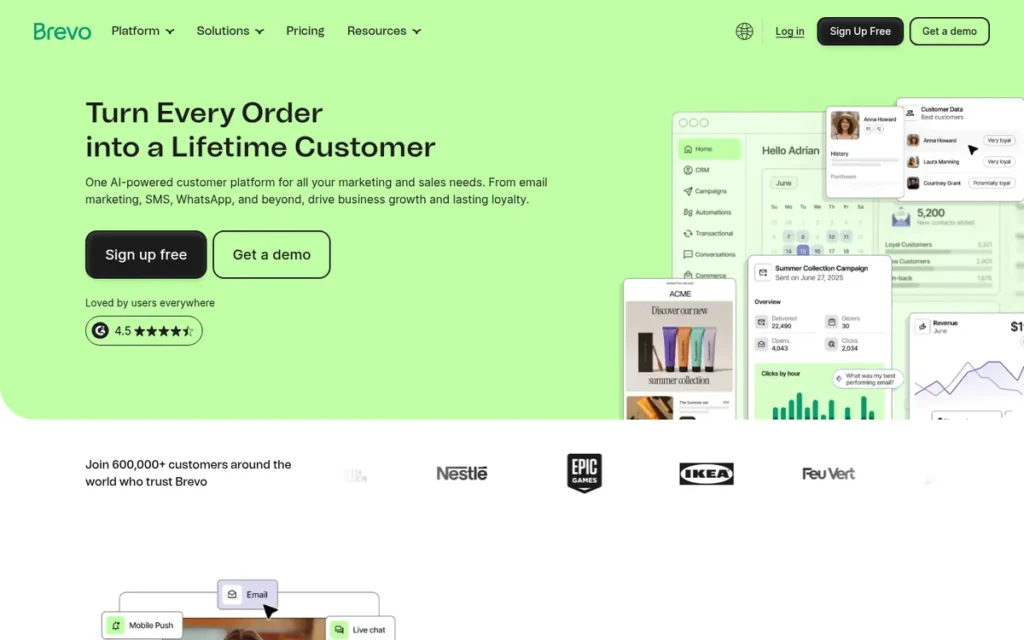
Category: All-in-One Multichannel Platform, combines email, SMS, CRM and transactional messaging in one account, priced mainly on send volume.
At a Glance
- Category: All-in-One Multichannel Platform
- Best For: Small and mid-sized businesses with large lists they mail infrequently
- Price Range: Free (up to 100,000 contacts, 300 emails/day) + paid from $9/month; Standard $18; Professional $449 (G2 list prices, November 2026; may change). Brevo’s own material lists Professional at $499
- Primary Strength: Brevo Marketing Platform charges mainly for emails sent rather than contacts stored, which keeps costs low for large, rarely mailed lists.
- Biggest Limitation: Brevo Marketing Platform draws recurring complaints about account suspensions, hard-to-reach support and shared-IP deliverability, and its pricing becomes less favorable for frequent senders.
- One-Line Summary: Brevo Marketing Platform has the strongest review evidence of any Mailchimp alternative for budget-conscious small businesses in 2026, pairing a 4.5/5 G2 rating from 2,779 reviews with a free 300-emails-per-day plan and send-based pricing.
- Last Verified: November 2026
Overview
Brevo Marketing Platform is a Paris-based all-in-one platform that bundles email campaigns, SMS, WhatsApp, a built-in CRM and transactional email for small and mid-sized teams with large lists they mail infrequently. Brevo Marketing Platform charges mainly by monthly send volume rather than contact count.
Brevo Marketing Platform was founded in 2012 as Sendinblue. Brevo Marketing Platform says it serves 600,000+ business customers, which is a vendor claim (Brevo Press page, November 2026).
Key Features
- Brevo Marketing Platform runs email, SMS, WhatsApp, push notifications and live chat from a single account.
- Brevo Marketing Platform includes a built-in CRM that stores contacts, deals and customer data alongside campaign activity.
- Brevo Marketing Platform sends transactional email over API or SMTP from the same account as marketing campaigns.
- Brevo Marketing Platform offers a free-forever plan that stores up to 100,000 contacts and sends 300 emails per day.
- Brevo Marketing Platform hosts data in France and Germany and holds ISO 27001:2022 certification (Brevo Facts page, November 2026).
Best For
Brevo Marketing Platform is best for small businesses with large lists that send a few campaigns a month, and for teams that want marketing, SMS and transactional email on one bill. Brevo Marketing Platform is a weaker fit for frequent senders and stores needing deep ecommerce behavior tracking.
Pricing
- Brevo Marketing Platform lists Starter at $9/month and Standard at $18/month, both usage-based, and Professional at $449/month (G2, November 2026; may change).
- Brevo Marketing Platform’s own pricing material lists Professional at $499/month from 150,000 emails/month, which conflicts with the G2 figure (Brevo pricing page, November 2026).
- Brevo Marketing Platform’s paid tiers start at 5,000 emails/month, annual billing is about 10% off, and Enterprise pricing is custom (Brevo Help Center, November 2026).
- Brevo Marketing Platform’s free plan stores up to 100,000 contacts but sends a maximum of 300 emails per day, and unused sends don’t roll over (Brevo Help Center, November 2026).
- Brevo Marketing Platform’s Help Center notes that some paid tiers cap stored contacts, so check the cap at your list size.
Strengths
- Brevo Marketing Platform holds a 4.5/5 G2 rating from 2,779 reviews, with 95.0% at 4–5 stars, which matches Robly’s rating with about three times the review volume (G2, November 2026).
- Brevo Marketing Platform’s top G2 pro is Ease of Use (314 mentions), and reviewers most often report going live in under a day (G2, November 2026).
- Brevo Marketing Platform reviewers praise its volume-based model “that avoids penalties for large contact lists” (G2, November 2026), and one Reddit user reports paying only per send while keeping 10,000+ contacts (Reddit r/Emailmarketing, accessed November 2026).
- Brevo Marketing Platform reports that France Télévisions reached 8,000+ employees at 99.7% deliverability, which is a vendor case study (Brevo customer stories, November 2026).
Limitations
Brevo Marketing Platform trades feature depth and account security for low cost. Its top G2 cons are Missing Features (107) and Limited Features (80), and reviewers say analytics and customization feel limited as needs grow (G2, November 2026).
- Brevo Marketing Platform faces recurring complaints about suspensions, slow support and shared-IP deliverability (Trustpilot, accessed November 2026), and Brevo documents that it may suspend accounts with high bounce or spam-complaint rates to protect shared sender reputation.
- Brevo Marketing Platform becomes less economical for frequent senders because costs rise with every send (Reddit r/Emailmarketing, accessed November 2026).
- Brevo Marketing Platform restricts logo removal to higher tiers, and add-ons can push the real cost above the headline price (Brevo Help Center, November 2026).
- Brevo Marketing Platform is weaker for ecommerce behavior tracking, and one store owner reported moving to Omnisend for smoother WooCommerce automation (Reddit r/webmarketing, accessed November 2026).
- Brevo Marketing Platform users on Reddit worry that the free tier will keep shrinking (Reddit r/Emailmarketing, accessed November 2026).
Users on r/emaildeliverability noted, in a thread about two Brevo dedicated IPs that showed poor Microsoft reputation from the start:
“I would not warm those IPs with a real list. That risks burning good recipients while you test inventory Brevo supplied. Send Brevo dated SNDS screenshots for both IPs and ask for an IP with verifiable clean history, or move to another ESP if they cannot provide one.” Posted by u/DamienBreneliere
Takeaway: Brevo Marketing Platform customers who upgrade to a dedicated IP should check its reputation history first, because a poorly allocated IP can hurt deliverability before the first real campaign goes out.
How It Compares With Mailchimp
Brevo Marketing Platform costs less than Mailchimp for large lists mailed rarely, and it includes CRM and transactional email. Brevo Marketing Platform’s free plan (300 emails/day) is more usable than Mailchimp’s (250/day, 500/month).
Mailchimp earns more G2 mentions for templates (55), and Brevo Marketing Platform carries more complaints about suspensions and support.
Verdict
Brevo Marketing Platform is the best overall Mailchimp alternative in 2026 for small businesses with large, infrequently mailed lists, because its send-based pricing and free 300-emails-per-day plan address the way Mailchimp’s costs grow with contacts.
Brevo Marketing Platform’s 4.5/5 G2 rating from 2,779 reviews is the strongest review evidence in this list (G2, November 2026). Weekly senders, ecommerce stores and teams that depend on human support should test those areas before migrating.
2. Campaign Monitor: Best for Frequent Senders Who Want Predictable Bills
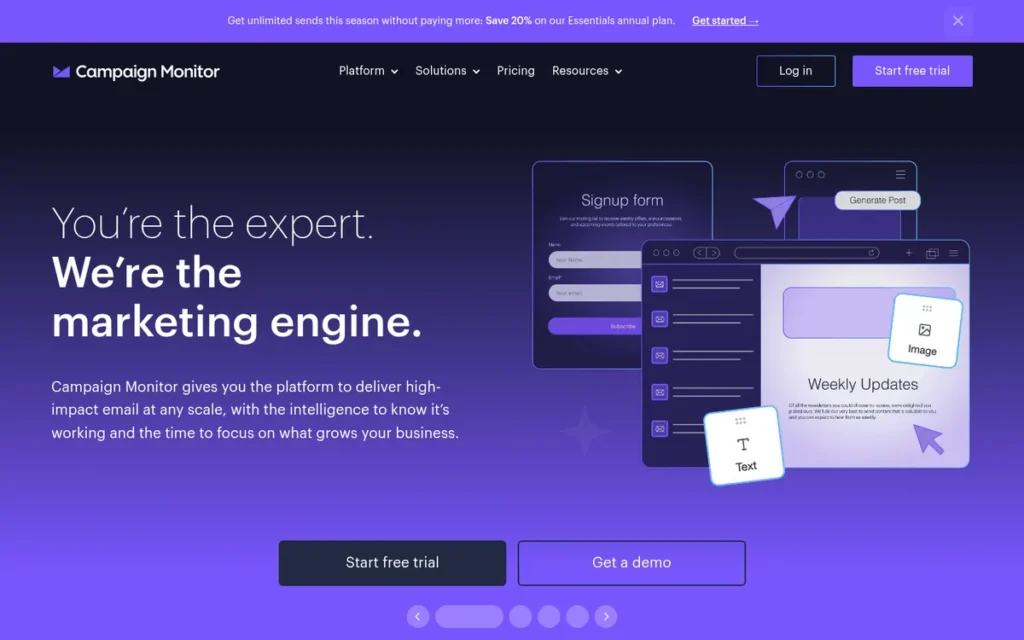
Category: Unlimited-Send Campaign Platform, per-contact pricing with uncapped campaign sending on mid and upper tiers, built for frequent senders.
At a Glance
- Category: Unlimited-Send Campaign Platform
- Best For: Frequent full-list senders, design-focused teams and agencies managing client accounts
- Price Range: Paid from $11/month (Lite); Essentials $19; Premier $149 (G2 list prices, November 2026; may change). Campaign Monitor’s billing page shows $13 / $31 / $171 at 500 contacts (November 2026). 30-day trial, no free plan
- Primary Strength: Campaign Monitor includes unlimited campaign, journey and RSS sends on Essentials and Premier, so frequent senders pay for contacts rather than per email.
- Biggest Limitation: Campaign Monitor has no free plan, caps Lite sends at 5× contacts, offers phone support only on Premier and relies on a limited set of automation triggers.
- One-Line Summary: Campaign Monitor is the Mailchimp alternative with the most predictable costs for frequent full-list senders in 2026, with uncapped campaign sends on Essentials ($19 G2 list price; $31 at 500 contacts on its billing page) and design tools that apply brand assets automatically.
- Last Verified: November 2026
Overview
Campaign Monitor is a design-led email marketing platform owned by Marigold that offers responsive templates, automated journeys and unlimited campaign sends on Essentials and Premier, for teams and agencies that email often and want predictable monthly costs.
Campaign Monitor was founded in 2004 in Sydney (LinkedIn, November 2026); G2 lists 2017, the Marigold/CM Group entity date. Campaign Monitor now operates under Marigold, which is headquartered in Nashville.
Key Features
- Campaign Monitor provides a drag-and-drop builder, responsive templates and custom HTML import.
- Campaign Monitor’s AI Marketing Studio includes Email Workspace, Creative Lab, Brand Hub, one-click Translation and Social Suite.
- Campaign Monitor’s Brand Hub pulls a logo, colors and tone from your website and applies them to campaigns.
- Campaign Monitor supports automated journeys, segmentation, RSS-to-email and transactional email.
- Campaign Monitor lets agencies manage client accounts with client-level permissions, separate billing or markup, and white-labeling.
Best For
Campaign Monitor is best for businesses that mail their full list more than 10 to 15 times a month, and for agencies that need branded client accounts. Campaign Monitor is a weaker fit for teams needing complex behavior-triggered automation.
Pricing
- Campaign Monitor lists Lite at $11, Essentials at $19 and Premier at $149 per month (G2, November 2026; may change).
- Campaign Monitor’s own billing page shows $13, $31 and $171 per month at 500 contacts, which puts vendor-listed Essentials above Mailchimp Standard’s $20 (Campaign Monitor Help, November 2026).
- Campaign Monitor Lite allows sends of 5× the contact count, while Essentials and Premier include unlimited campaign, journey and RSS sends (Campaign Monitor Help, November 2026).
- Campaign Monitor offers a 30-day trial for up to 500 contacts and no permanent free plan (Campaign Monitor pricing page, November 2026).
Strengths
- Campaign Monitor’s billing documentation confirms unlimited campaign, journey and RSS sends on Essentials and Premier, the clearest protection in this list against send-driven cost growth (Campaign Monitor Help, November 2026).
- Campaign Monitor holds a 4.1/5 G2 rating from 736 reviews, with 87.0% at 4–5 stars and Ease of Use (21) as the top pro (G2, November 2026).
- Campaign Monitor is the only evaluated alternative that documents client-level billing with markup and white-labeled client accounts (Campaign Monitor pricing page, November 2026; Stack99, October 2026).
- Campaign Monitor reports a 75% conversion increase for the Australian Red Cross from a segmented campaign, which is a vendor case study (Campaign Monitor blog, November 2026).
Limitations
Campaign Monitor trades a free entry point and advanced automation for predictable sending costs. Campaign Monitor has no permanent free plan, so users move to a paid plan after the 30-day trial (Campaign Monitor pricing page, November 2026).
- Campaign Monitor Lite caps sends at 5× contacts, half of Mailchimp Essentials’ 10× allowance, so the unlimited-send advantage starts at Essentials ($31 at 500 contacts on Campaign Monitor’s billing page).
- Campaign Monitor’s custom journeys rely on a limited set of native event triggers (PCMag, accessed November 2026), and G2 reviewers say triggers don’t support some advanced workflows.
- Campaign Monitor offers phone support only on Premier and supports only English (G2, November 2026).
- Campaign Monitor plans are described as “annual by default” in a 2026 review (Stack99, October 2026).
- Campaign Monitor’s Reddit discussion is thin and partly promotional in tone, which limits independent community evidence (Reddit, accessed November 2026).
How It Compares With Mailchimp
Campaign Monitor beats Mailchimp for senders who mail their full list more than 10 to 15 times a month, because Essentials and Premier don’t cap campaign sends.
Mailchimp still offers a free plan, 48 G2-listed integrations and a cheaper vendor-listed mid tier. Mailchimp is also widely praised for ease of use (142 G2 mentions).
Verdict
Campaign Monitor is the best Mailchimp alternative in 2026 for frequent full-list senders who want predictable bills, because its Essentials and Premier plans remove caps on campaign, journey and RSS sends.
Campaign Monitor’s Brand Hub and agency client accounts are the most documented agency features among the seven alternatives evaluated. Buyers who need a free plan, low-tier phone support or complex trigger-based automation should look elsewhere.
3. Constant Contact: Best for Small Businesses and Nonprofits Needing Live Support
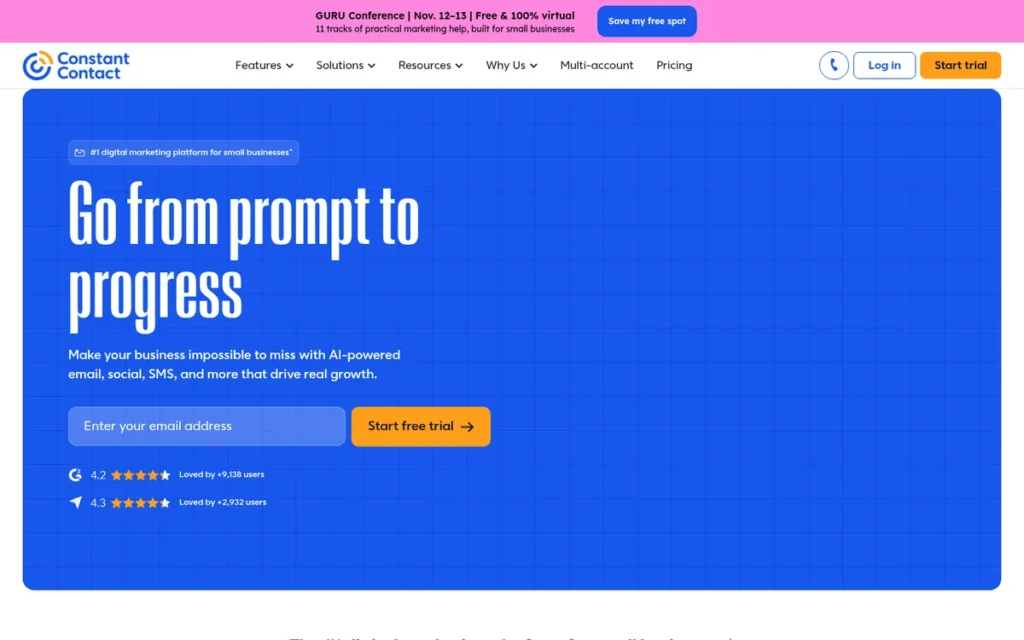
Category: Support-First Small-Business Suite, contact-based email marketing bundled with events, surveys, social tools and live human support.
At a Glance
- Category: Support-First Small-Business Suite
- Best For: Small businesses, nonprofits and event organizers who value phone and chat support over the lowest price
- Price Range: Paid from $12/month (Lite); Standard $35; Premium $80 at up to 500 contacts (G2 list prices, November 2026; may change). 30-day trial with 100 total sends, no free plan
- Primary Strength: Constant Contact pairs email marketing with live phone and chat support plus events, surveys and social tools.
- Biggest Limitation: Constant Contact uses per-contact pricing that scales much like Mailchimp’s, and users report that useful automation requires higher tiers.
- One-Line Summary: Constant Contact is the best Mailchimp alternative in 2026 for small businesses and nonprofits that need live human support, backed by 7,636 G2 reviews at 4.1/5, but it does not solve Mailchimp’s price-scaling problem.
- Last Verified: November 2026
Overview
Constant Contact is a small-business email marketing suite founded in 1995 that bundles email, SMS, events, surveys, social posting and AI content tools with live phone and chat support, for organizations that want human help more than the lowest price.
Constant Contact is headquartered in Waltham, Massachusetts (G2, November 2026). Constant Contact ended its free plan in June 2025 (Constant Contact knowledge base, November 2026).
Key Features
- Constant Contact provides live phone and chat support, plus nonprofit-specific tools and help.
- Constant Contact includes event management, surveys and social media posting alongside email campaigns.
- Constant Contact offers SMS as an add-on from $10/month for 500 messages, and Premium includes 500 messages.
- Constant Contact’s AI “prompt to progress” builder generates marketing assets from a description.
- Constant Contact supports multi-location management and lists 47 integrations on G2 (G2, November 2026).
Best For
Constant Contact is best for small businesses, nonprofits and event-driven organizations that want reachable human support. Constant Contact buyers who need list-based automation should budget for the Standard tier or higher.
Pricing
- Constant Contact lists Lite at $12, Standard at $35 and Premium at $80 per month at up to 500 contacts, with prices rising as contacts grow (G2, November 2026; may change).
- Constant Contact allows monthly sends of 10× (Lite), 12× (Standard) and 24× (Premium) the contact tier, with overage reported at $2 per 1,000 sends (PCMag, accessed November 2026).
- Constant Contact’s annual-billing equivalents are reported as about $10.20, $29.75 and $68 per month (Mailercloud, accessed November 2026).
- Constant Contact ended its free plan in June 2025 and now offers a 30-day trial limited to 100 total sends (Constant Contact knowledge base, November 2026).
Strengths
- Constant Contact holds a 4.1/5 G2 rating from 7,636 reviews, the largest review base of any alternative here (G2, November 2026).
- Constant Contact ranked #5 in Best Marketing & Digital Advertising Products in G2’s 2026 Best Software Awards, one of four category placements (Constant Contact press release, 2026).
- Constant Contact’s accessible support is a recurring reason users switch to it from Mailchimp, Flodesk, SendGrid and Higher Logic (G2, November 2026).
- Constant Contact supports 10 languages, the most of any mass-market option here (G2, November 2026).
“Constant Contact had a leg up because of their customer support… If you need tools other than just email I would recommend them.” (u/michelleyness (Reddit r/Emailmarketing, accessed November 2026))
Takeaway: Reachable human support is Constant Contact’s clearest advantage over lower-cost alternatives.
Limitations
Constant Contact trades cost efficiency for support and breadth. Constant Contact’s per-contact pricing scales much like Mailchimp’s, and Lite ($12) costs almost the same as Mailchimp Essentials ($13) (G2, November 2026).
- Constant Contact gates some automation by tier, and a nonprofit on Reddit said list-driven automation would require an upgrade that doubles its annual cost (Reddit r/Emailmarketing, accessed November 2026).
- Constant Contact has BBB complaints about billing discrepancies, refunds, price jumps between contact tiers and difficulty canceling (BBB, accessed November 2026).
- Constant Contact users on Reddit report having to phone to cancel, a new per-transaction event fee and unreliable segmentation beyond two variables (Reddit r/Emailmarketing, accessed November 2026).
- Constant Contact’s G2 profile shows no tagged pros or cons, which limits detailed sentiment analysis (G2, November 2026).
A staff member at a small arts nonprofit on r/Emailmarketing shared their experience:
“They recently updated about 5 months ago and we were overloaded with tons of new features that were included in our pricing and that I was using. Now, they’ve taken a lot of that functionality away (about a week ago) and when I try to look for it or contact them – they say it’s not included in our current plan / pricing and we need to pay more.” Posted by u/Slay_Crochet_Day
Takeaway: Constant Contact can move features customers already use into higher tiers, so nonprofits on tight budgets should get written confirmation of what their plan includes.
How It Compares With Mailchimp
Constant Contact beats Mailchimp on live human support, events and nonprofit tools. Mailchimp still offers a free plan, a similar entry price and higher G2 satisfaction (4.3 vs. 4.1). Neither platform escapes per-contact price scaling.
Verdict
Constant Contact is the best Mailchimp alternative in 2026 for small businesses and nonprofits that value live phone and chat support, backed by the largest G2 review base in this list (7,636 reviews at 4.1/5).
Constant Contact’s event, survey and social tools add value for community-facing organizations. Buyers switching mainly to cut costs should know that its per-contact pricing and tier-gated automation mirror Mailchimp’s problems.
4. Robly: Best for Simple Small Businesses Wanting Automatic Resends
Category: Unlimited-Send Campaign Platform, per-contact pricing with uncapped campaign sending up to 50,000 contacts, built for frequent senders.
At a Glance
- Category: Unlimited-Send Campaign Platform
- Best For: Simple small businesses that send regular newsletters and want automated follow-ups to non-openers
- Price Range: $19/month (up to 500 contacts), $35 (501–2.5k), $58 (2.5k–5k) (G2 list prices, November 2026; may change); $92 up to 10k and $270 up to 50k on Robly’s site; discounted billing $15 / $29 / $49. No free plan
- Primary Strength: Robly includes every feature on every plan and unlimited sends for lists up to 50,000 contacts, including automatic resends to subscribers who didn’t open.
- Biggest Limitation: Robly has the thinnest independent evidence in this list, with a tiny G2 tagged-review sample and no Reddit discussion found.
- One-Line Summary: Robly is a simple, all-features-included Mailchimp alternative in 2026 with a 4.5/5 G2 rating and automatic resends to non-openers, best for small businesses that send often and can accept a smaller integration ecosystem.
- Last Verified: November 2026
Overview
Robly is a New York-based email marketing platform founded in 2011 that includes every feature on every plan, plus AI send-time optimization and automatic resends to non-openers, for simple small businesses that want regular newsletters without managing feature tiers.
Robly includes unlimited sends for lists up to 50,000 contacts, and larger lists are capped at 10× contacts (Robly pricing page, November 2026). Robly markets itself directly as a Mailchimp alternative, which is vendor positioning.
Key Features
- Robly’s OpenGen automatically resends a campaign to non-openers with a new subject line after a 1–10 day delay.
- Robly AI times each send to the individual subscriber.
- Robly provides welcome, drip, re-engagement and post-purchase automation sequences.
- Robly includes landing pages and popups with exit-intent triggers.
- Robly Engage identifies and cleans up disengaged contacts to protect list health.
Best For
Robly is best for simple small businesses that send frequent newsletters and want automated resends and send-time optimization included at every price. Robly is a weaker fit for teams relying on many integrations or deep reporting.
Pricing
- Robly lists $19/month up to 500 contacts, $35 for 501–2,500 and $58 for 2,500–5,000 (G2, November 2026; may change).
- Robly’s own pages list $92/month up to 10,000 contacts and $270/month up to 50,000 (Robly pricing page, November 2026).
- Robly’s discounted billing option lists $15, $29 and $49 for the first three tiers (Robly pricing page, November 2026).
- Robly offers no free plan, only a trial, and caps sends at 10× contacts above 50,000 contacts (Robly pricing page, November 2026).
Strengths
- Robly holds a 4.5/5 G2 rating from 918 reviews, with 96.3% at 4–5 stars, the highest share of top ratings in this list (G2, November 2026).
- Robly reviewers consistently praise the resend and send-timing features across four review sites (G2, Capterra, GetApp and Software Advice, accessed November 2026).
- Robly’s unlimited sends for lists up to 50,000 contacts remove the 10–15× send caps that Mailchimp applies (Robly pricing page, November 2026).
- Robly claims OpenGen recovers 10–30% additional opens, which is a vendor claim that hasn’t been independently verified (Robly, November 2026).
Limitations
Robly trades evidence depth and ecosystem breadth for simplicity. Robly’s G2 tagged pros and cons have only one or two mentions each, and PlugRoute found no Reddit discussion, so buyers have little peer evidence (G2, November 2026).
- Robly’s unlimited sending applies only up to 50,000 contacts, and larger lists are capped at 10× contacts (Robly pricing page, November 2026).
- Robly’s integration count is reported at 60+ (Capterra, November 2026) or 74 (GetApp, November 2026), against a vendor claim of 100+.
- Robly reviewers ask for more design flexibility, deeper reporting and exports, better mobile use and broader CRM integrations (G2, November 2026).
- Robly’s per-contact pricing ($92 at 10,000 contacts) doesn’t escape Mailchimp-style scaling, and some reviewers call it expensive for small businesses (G2, November 2026).
How It Compares With Mailchimp
Robly beats Mailchimp on simplicity, uncapped sending up to 50,000 contacts and built-in resends. Mailchimp has a free plan, 48 G2-listed integrations and far more independent review evidence. Both platforms charge per contact.
Verdict
Robly is a strong Mailchimp alternative in 2026 for simple small businesses that send often and want automatic resends to non-openers at every price, with 96.3% of its G2 reviews at 4–5 stars.
Robly’s all-features model with unlimited sends up to 50,000 contacts removes the tier trade-offs Mailchimp users face. Buyers should weigh the thin independent evidence and smaller integration ecosystem before migrating.
5. Twilio SendGrid Email Marketing Campaigns: Best for Marketing Plus Transactional Email
Category: Developer Email Platform, API-first email infrastructure with marketing or transactional sending, built for technical teams.
At a Glance
- Category: Developer Email Platform
- Best For: Product teams that need marketing campaigns and app or transactional email on one infrastructure
- Price Range: Basic from $15/month; Advanced from $60/month (G2 list prices, November 2026; usage-based; may change). 60-day trial, no free-forever plan
- Primary Strength: Twilio SendGrid Email Marketing Campaigns shares infrastructure with the SendGrid Email API, so one vendor handles marketing and transactional email.
- Biggest Limitation: Twilio SendGrid Email Marketing Campaigns draws recurring user reports of account suspensions, slow support and shared-IP deliverability problems.
- One-Line Summary: Twilio SendGrid Email Marketing Campaigns is a 2026 Mailchimp alternative for product teams that need marketing and transactional email together, with low published tier pricing at scale but documented account-review and shared-IP risk.
- Last Verified: November 2026
Overview
Twilio SendGrid Email Marketing Campaigns is Twilio’s marketing email product, with design and code editors, segmentation, A/B testing and automation, built for product teams that send both marketing and transactional email from one vendor.
Twilio SendGrid Email Marketing Campaigns runs on the same infrastructure as the SendGrid Email API. Twilio SendGrid Email Marketing Campaigns is less suited to non-technical marketers, according to G2 reviewers who describe a steep learning curve (G2, November 2026).
Key Features
- Twilio SendGrid Email Marketing Campaigns provides both a visual design editor and a code editor.
- Twilio SendGrid Email Marketing Campaigns includes segmentation, A/B testing, signup forms, automation and scheduling.
- Twilio SendGrid Email Marketing Campaigns shares a platform with the SendGrid Email API for transactional sending over API or SMTP.
- Twilio SendGrid Email Marketing Campaigns includes a dedicated IP on Advanced plans, and extra IPs cost $30/month each.
- Twilio SendGrid Email Marketing Campaigns publishes tiers from 5,000 contacts/15,000 sends up to 200,000 contacts/1M sends (SendGrid plan PDF, March 2025).
Best For
Twilio SendGrid Email Marketing Campaigns is best for product and developer-led teams that want marketing campaigns and app or transactional email from one vendor. Twilio SendGrid Email Marketing Campaigns is a weaker fit for non-technical small businesses and very small senders.
Pricing
- Twilio SendGrid Email Marketing Campaigns lists Basic at $15/month and Advanced at $60/month (G2, November 2026; usage-based; may change).
- Twilio SendGrid Email Marketing Campaigns’ Basic tier costs $15 at 5,000 contacts, $25 at 10,000, $120 at 50,000 and $200 at 100,000, with sends capped at 3× contacts (SendGrid plan PDF, March 2025; may be outdated).
- Twilio SendGrid Email Marketing Campaigns’ Advanced tier costs $60 at 10,000 contacts, $450 at 100,000 and $900 at 200,000, and contact-storage overages apply (SendGrid plan PDF, March 2025).
- Twilio SendGrid Email Marketing Campaigns has given new accounts a 60-day trial (100 emails/day, 100 contacts) since March 25, 2025, and Twilio announced in May 2025 that existing free plans would be retired (Twilio changelog, May 2025).
- The Twilio SendGrid Email API, a separate product, lists Essentials at $14.95–$29.95/month and Pro at $89.95–$949.95/month (G2, November 2026).
Strengths
- Twilio SendGrid Email Marketing Campaigns holds a 4.0/5 G2 rating from 324 reviews (84.9% at 4–5 stars), and reviewers praise its deliverability and API integration (G2, November 2026).
- Twilio SendGrid Email Marketing Campaigns’ published Basic price of $120 at 50,000 contacts is lower than Robly’s published $270 at the same size, though Basic caps sends at 150,000 a month (SendGrid plan PDF, March 2025).
- Twilio SendGrid Email Marketing Campaigns lets one vendor cover marketing and transactional email without the separate Mandrill product that Mailchimp uses.
- Twilio SendGrid Email Marketing Campaigns runs on infrastructure whose benchmark report analyzed 5 trillion+ emails, which is vendor research (Twilio SendGrid Benchmark Report, 2023).
Limitations
Twilio SendGrid Email Marketing Campaigns trades accessibility and account predictability for infrastructure strength. Users report sudden suspensions, automated “not a good fit” sign-up rejections and slow support (Trustpilot and Reddit, accessed November 2026).
- Twilio confirms it may suspend SendGrid accounts during compliance or fraud review (Twilio Help Center, November 2026).
- Twilio SendGrid Email Marketing Campaigns users on shared IPs report Microsoft blocking Hotmail and Outlook delivery, and avoiding this requires paying for a dedicated IP (Reddit r/webdev, accessed November 2026).
- Twilio SendGrid Email Marketing Campaigns’ Basic plan allows sends of only 3× contacts, the tightest send-to-contact ratio among the per-contact plans evaluated (SendGrid plan PDF, March 2025).
- Twilio SendGrid Email Marketing Campaigns has a steep learning curve for beginners and supports only English (G2, November 2026).
- Twilio SendGrid Email Marketing Campaigns’ published tier table dates from March 2025, so current pricing needs live verification.
This aligns with community sentiment on r/webdev:
“I confirm this is a common issue. The only solution I found is to pay SendGrid for my own unique and clean IP. Still the emails being sent to hotmail.fr addresses are often put into the spam box.” Posted by u/ApprehensiveDog
Takeaway: Twilio SendGrid users on shared IPs report Microsoft blocks that only a paid dedicated IP fixes, and even then Hotmail inbox placement isn’t guaranteed.
How It Compares With Mailchimp
Twilio SendGrid Email Marketing Campaigns beats Mailchimp for hybrid marketing-plus-transactional sending and lists lower published prices at large list sizes.
Mailchimp is friendlier for non-technical marketers, allows 10–15× sends per contact, offers a free plan and has a higher G2 rating (4.3 vs. 4.0).
Verdict
Twilio SendGrid Email Marketing Campaigns is the best Mailchimp alternative in 2026 for product teams that want marketing and transactional email on a single infrastructure, with low published per-contact pricing at large list sizes.
Twilio SendGrid Email Marketing Campaigns’ G2 reviews praise deliverability and API quality but warn of a steep learning curve. Small, non-technical senders should weigh the documented suspension, shared-IP and support concerns.
6. Mailgun: Best for Replacing Mailchimp Transactional (Mandrill)
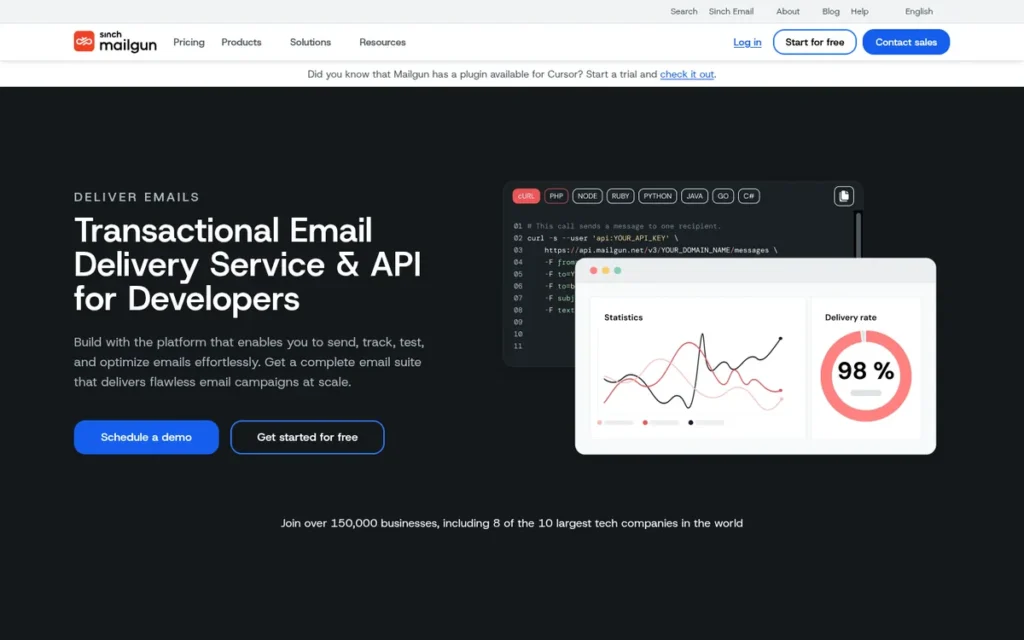
Category: Developer Email Platform, API-first email infrastructure with marketing or transactional sending, built for technical teams.
At a Glance
- Category: Developer Email Platform
- Best For: Developers and product teams leaving Mailchimp Transactional (Mandrill) or sending transactional email only
- Price Range: Free (100 emails/day) + Basic $15/month; Foundation $35/month (G2 list prices, November 2026; flat rate; may change). One-month free trial on Foundation
- Primary Strength: Mailgun provides reliable API and SMTP transactional sending with a free tier and flat entry pricing, and unlike Mandrill it doesn’t require a paid marketing plan.
- Biggest Limitation: Mailgun lacks a full marketer campaign suite, so it can’t replace Mailchimp’s drag-and-drop newsletter product.
- One-Line Summary: Mailgun is the best replacement for Mailchimp Transactional (Mandrill) in 2026, with a free 100-emails-per-day tier and flat $15–$35 entry plans, but it doesn’t replace Mailchimp’s newsletter tools.
- Last Verified: November 2026
Overview
Mailgun is an email infrastructure platform owned by Sinch that provides an email API, SMTP relay, webhooks and deliverability add-ons, for developers replacing Mailchimp Transactional (Mandrill) rather than Mailchimp’s newsletter builder.
Mailgun was founded in 2010 (Wikipedia, accessed November 2026; G2 lists 2008, likely an entity date) and acquired by Sinch in September 2021. Mailgun ranks sixth because it covers one narrow job well, not because it is a weak product.
Key Features
- Mailgun sends email over API and SMTP relay, with webhooks and inbound email routing.
- Mailgun Validate checks list and real-time email addresses before sending.
- Mailgun Optimize provides inbox-placement tests, blocklist monitoring, and Google Postmaster and Microsoft SNDS integration.
- Mailgun Inspect runs pre-send rendering QA, powered by Email on Acid.
- Mailgun includes a dedicated IP at the Foundation 100K tier, and extra IPs cost $59/month.
Best For
Mailgun is best for developers moving transactional email, such as order confirmations and password resets, away from Mandrill. Mailgun doesn’t fit marketers who need a drag-and-drop newsletter builder.
Pricing
- Mailgun lists Free at $0, Basic at $15 and Foundation at $35 per month (G2, November 2026; flat rate; may change).
- Mailgun Basic includes 10,000 emails/month, with overage from $1.80 per 1,000 and 1-day log retention (Mailgun pricing page, November 2026).
- Mailgun Foundation includes 50,000 emails/month at $35 (overage from $1.30 per 1,000) or 100,000 at $75, plus a one-month free trial (Mailgun pricing page, November 2026).
- Mailgun Scale starts at $90 for 100,000 emails with 30-day logs, and sources conflict on its overage rate (Mailgun pricing page, November 2026).
- Mailchimp’s Mandrill requires a paid Mailchimp plan, and PlugRoute found no official current Mandrill block price.
Strengths
- Mailgun holds a 4.2/5 G2 rating from 332 reviews (88.0% at 4–5 stars), with Reliability (18) and Deliverability (15) among its top pros (G2, November 2026).
- Mailgun users most often report going live in under a day and name SendGrid, Amazon SES and Mandrill as previous tools (G2, November 2026).
- Mailgun publishes an annual deliverability report, and the 2025 edition surveyed 1,100 senders (Mailgun State of Email Deliverability, 2025).
- Mailgun says it serves 150,000+ companies and lists SOC 2, HIPAA, GDPR and ISO 27001 alignment, which are vendor claims (Mailgun, November 2026).
Limitations
Mailgun trades marketer usability for developer infrastructure. Mailgun has a template builder from Foundation up but no full campaign suite, so newsletter senders would need a second tool (Mailgun features page, November 2026).
- Mailgun’s top G2 con is Expensive (11), and reviewers say “pricing can escalate quickly as usage increases” (G2, November 2026).
- Mailgun users cite a learning curve, DNS setup friction, short log retention on lower tiers and poor support (5 mentions) (G2, November 2026).
- Mailgun supports only English (G2, November 2026).
- Mailgun’s 4.3 Capterra and Trustpilot scores are reported by Mailgun itself (Mailgun reviews page, November 2026).
Users on r/Ghost noted:
“Upon registration I could only choose “Basic 10K” plan that costs $15/month. On billing dashboard there are still [Downgrade] and [Unsubsribe], both of which redirect me to a page where I can only choose plans that are more expensive than $15/month. After contacting support I got a response “We apologize, but the Flex PAYG plan is no longer available. If you’d prefer we can go ahead and schedule a downgrade to the free plan.”” Posted by u/tsykinsasha
Takeaway: Mailgun’s free tier exists but can be hard to reach, with some new users placed on the $15 Basic plan until they ask support to downgrade them.
How It Compares With Mailchimp
Mailgun beats Mailchimp’s Mandrill on entry access, with a free tier and flat $15–$35 plans, while Mandrill requires a paid Mailchimp plan.
Mailchimp says Mandrill offers a 99% average delivery rate and 99.99% uptime (vendor claim, G2, November 2026). Mailchimp also keeps transactional and marketing email in one account and is far stronger for newsletters.
Verdict
Mailgun is the best Mailchimp Transactional (Mandrill) replacement in 2026, offering a free 100-emails-per-day tier and flat $15–$35 entry plans without requiring a paid marketing plan.
Mailgun’s G2 reviews highlight reliability (18 mentions) and deliverability (15 mentions). Readers who need newsletters should treat Mailgun as a complement to a marketing platform, not a replacement for Mailchimp.
7. Emma: Best for Multi-Location Brands, Franchises and Universities
Category: Multi-Location Brand Governance Platform, email marketing with central brand control across sub-accounts, locations and departments.
At a Glance
- Category: Multi-Location Brand Governance Platform
- Best For: Franchises, universities, nonprofits and multi-location brands that need central brand control
- Price Range: From $99/month (Emma Lite); Essentials $159; Emma for Teams $249 (G2 list prices, November 2026; may change). Emma’s site shows Lite $105 and Teams $205. No free tier; annual contract reported
- Primary Strength: Emma lets central teams control branded templates, locked sections, permissions and approvals across sub-accounts, with unlimited sends on all plans.
- Biggest Limitation: Emma has the highest entry price in this list and a reported annual contract, which makes it overkill for a single small business.
- One-Line Summary: Emma is the strongest Mailchimp alternative in 2026 for franchises, universities and multi-location brands that need central brand governance, but its $99+ entry price (G2 list) makes it overkill for a single small business.
- Last Verified: November 2026
Overview
Emma is a Nashville-based email marketing platform, part of Marigold, that gives central teams control over branded templates, sub-accounts, permissions and approvals, for franchises, universities, nonprofits and multi-location brands.
Emma includes unlimited sends on every plan (Emma pricing page, November 2026). Emma was founded in 2003 and acquired by CM Group in May 2022 (theatdb, November 2026). Emma ranks seventh because it serves a narrow segment, not because it is a weak product.
Key Features
- Emma for Teams uses a parent account with sub-accounts, so central teams can share branded templates and assets.
- Emma lets administrators lock email sections, set custom permissions and require approvals before sending.
- Emma includes SSO and trend reporting across sub-accounts on team plans.
- Emma provides segmentation, dynamic content, core automation and API access from the Lite plan.
- Emma includes unlimited sends on all plans and lists 56 integrations on G2 (G2, November 2026).
Best For
Emma is best for organizations with many locations, departments or franchisees that need consistent branding and approval control. Emma will usually charge a single small business for capability it doesn’t use.
Pricing
- Emma lists Emma Lite at $99, Essentials at $159 and Emma for Teams at $249 per month (G2, November 2026; may change).
- Emma’s own pricing page shows Lite at $105/month and Teams at $205/month, with Corporate priced on request (Emma pricing page, November 2026).
- Emma Lite includes 1 user, Teams includes 25 users and 5+ sub-accounts, and Corporate includes unlimited users and 10+ sub-accounts (Emma pricing page, November 2026).
- Emma has no free tier, and TechRadar reports an annual contract requirement, but Emma’s pricing page doesn’t state the billing term, so confirm before signing (TechRadar, accessed November 2026).
Strengths
- Emma holds a 4.7 rating from 77 ratings on Gartner Peer Insights (Gartner, November 2026) and 4.2/5 on Capterra from 156–158 reviews (Capterra, November 2026).
- Emma’s G2 rating is 4.0/5 from 563 reviews, and users name better support and multi-team accounts as reasons for switching (G2, November 2026).
- Emma is the only evaluated alternative that documents locked email sections, approval workflows and SSO across parent and sub-accounts (Emma pricing page, November 2026).
- Emma includes unlimited sends on every plan, and one Reddit user reports paying about $250/month to email 40,000 contacts about five times a month (Reddit r/Emailmarketing, accessed November 2026; anecdotal).
Limitations
Emma trades affordability for governance. Emma’s $99+ entry price (G2 list) is far above Mailchimp’s $13–$20 entry tiers, and G2 reviews note pricing concerns for smaller businesses (G2, November 2026).
- Emma has no free tier, and TechRadar reports an annual contract requirement (TechRadar, accessed November 2026).
- Emma’s G2 cons include Missing Features, Limited Features and Template Limitations, and an agency user describes the block editor as basic (Reddit r/Emailmarketing, accessed November 2026).
- Emma reviewers report an unexpected overage bill after sub-account contacts were added (Software Advice, accessed November 2026) and a billing dispute (G2, November 2026).
- Emma supports only English (G2, November 2026).
How It Compares With Mailchimp
Emma beats Mailchimp on multi-team governance, approvals and uncapped sending. Mailchimp is far cheaper to start, offers a free plan and has a higher G2 rating (4.3 vs. 4.0).
Verdict
Emma is the best Mailchimp alternative in 2026 for franchises, universities and multi-location brands that need central control over branding and approvals, with a 4.7 Gartner Peer Insights rating and unlimited sends on every plan.
Emma’s pricing can compare well for high-volume senders with large lists. For a single small business, Emma’s $99+ entry price and reported annual contract make it the wrong fit.
How Much Do Mailchimp Alternatives Cost as Your List Grows?
At 10,000 contacts, the lowest published prices among evaluated alternatives are Twilio SendGrid Email Marketing Campaigns Basic at $25/month (March 2025 document) and Robly at $92/month (November 2026). This research didn’t capture Mailchimp’s Essentials and Standard prices at 10,000 contacts. Mailchimp’s top Premium tier starts at $350, so check Mailchimp’s live calculator.
| Platform | 500 Contacts | 5,000 Contacts | 10,000 Contacts | 50,000 Contacts |
|---|---|---|---|---|
| Mailchimp (baseline) | $13 Essentials / $20 Standard | Not captured; verify live | $350 (Premium, top tier); Essentials/Standard at 10,000 not captured; verify live | Not captured; verify live |
| Robly | $19 | $58 | $92 | $270 (unlimited sends end above 50,000) |
| Twilio SendGrid Email Marketing Campaigns (Basic, March 2025) | Not published (entry tier is 5,000) | $15 (15,000 sends) | $25 (30,000 sends) | $120 (150,000 sends) |
| Campaign Monitor | $11 / $19 / $149 (G2 list); $13 / $31 / $171 (Campaign Monitor billing page) | Not published; verify live | Not published; verify live | Not published; verify live |
| Constant Contact (G2) | $12 / $35 / $80 | Not published; verify live | Not published; verify live | Not published; verify live |
| Emma (contact tier unverified) | $99 / $159 / $249 (G2 list); $105 Lite / $205 Teams (Emma site) | Not published; verify live | Not published; verify live | Not published; verify live |
Priced by send volume, not contacts:
- Brevo Marketing Platform starts at $9/month for 5,000 emails/month whatever your list size (G2, November 2026), but Brevo’s Help Center notes some paid tiers cap stored contacts, so check the cap at your list size.
- Mailgun charges $15 for 10,000 emails, $35 for 50,000 and $75 for 100,000 emails per month (Mailgun pricing page, November 2026).
What Red Flags Should I Watch For When Evaluating Mailchimp Alternatives?
The most costly red flags when leaving Mailchimp are hidden sending caps, automation locked behind expensive tiers, and billing for unsubscribed contacts. Shrinking free plans, phone-only cancellation, shared-IP risk, suspensions and annual contracts also recur. PlugRoute found these patterns across several vendors in this list, Mailchimp included, and applied the same standard to each.
Red Flag #1: Contact Storage Presented as Sending Allowance A large stored-contact limit doesn’t mean you can email those contacts often. Brevo Marketing Platform’s free plan stores up to 100,000 contacts but sends only 300 emails a day (Brevo Help Center, November 2026), and Mailchimp’s free plan sends 250 a day. Always compare the daily or monthly sending cap, not the contact limit.
Red Flag #2: Automation Locked Behind a Tier That Doubles the Cost A low entry price can hide the features you actually need. A Constant Contact nonprofit user reported that list-driven automation required an upgrade that would double its annual cost (Reddit r/Emailmarketing, accessed November 2026). Before signing up, confirm that every automation you run today is included on the tier you plan to buy.
Red Flag #3: Per-Contact Pricing That Counts Unsubscribed Contacts Some platforms bill for contacts you can no longer email. Mailchimp counts subscribed, unsubscribed and non-subscribed contacts toward the bill, while archived, cleaned and deleted contacts don’t count (Mailchimp Help, November 2026). Ask each alternative which contact statuses are billable, because the answer changes your real per-contact price.
Red Flag #4: A Free Plan With a History of Cuts Three vendors in this evaluation cut or ended free plans between March 2025 and February 2026. Mailchimp’s free plan reportedly changed in February 2026 (ActiveCampaign blog, 2026), SendGrid moved new accounts to a 60-day trial in March 2025, and Constant Contact ended its free plan in June 2025. Treat any free tier as temporary.
Red Flag #5: Cancellation Friction and Annual Lock-In Cancellation and contract terms decide how cheaply you can leave a platform that doesn’t fit. Reddit users report Constant Contact requiring a phone call to cancel (Reddit r/Emailmarketing, accessed November 2026). TechRadar reports an annual contract for Emma, and a 2026 review calls Campaign Monitor plans “annual by default” (Stack99, October 2026).
Red Flag #6: Shared-IP Sending and Account Suspensions A shared IP ties your deliverability to other senders’ behavior, and low-cost plans can suspend accounts with little warning. SendGrid users report Microsoft blocking shared IPs (Reddit r/webdev, accessed November 2026). Brevo Marketing Platform also faces recurring complaints about suspensions and shared-IP deliverability (Trustpilot, accessed November 2026).
Ask each vendor what triggers a suspension, how appeals work and what a dedicated IP costs. Extra dedicated IPs cost $30/month at SendGrid and $59/month at Mailgun.
What Questions Should I Ask Before Choosing a Mailchimp Alternative?
Two questions decide most switches: how your list size compares with how often you send, and what your total first-year cost will be once add-ons are included. The seven questions below narrow a long list of Mailchimp alternatives to a short one, and each one cites vendor examples documented in this evaluation.
Question #1: How many contacts do I have, and how often do I send each month? Your list size and send frequency decide which pricing model is cheapest. Large lists mailed fewer than four times a month usually favor send-volume pricing such as Brevo Marketing Platform. Lists mailed in full more than 10 to 15 times a month usually favor unlimited-send plans such as Campaign Monitor Essentials or Robly.
Question #2: Which automations would I have to rebuild? Most automations have to be rebuilt by hand on the new platform, because none of the evaluated vendors documents automated workflow import. List your welcome series, triggers and segments, then confirm each one is supported on your planned tier. Constant Contact gates automation by tier, and Campaign Monitor uses a limited trigger set.
Question #3: Do I use Mailchimp Transactional (Mandrill)? Mailchimp Transactional (Mandrill) is a separate migration from your newsletters. If you send order confirmations or password resets through Mandrill, you’ll likely need a developer platform such as Mailgun or an all-in-one platform with transactional email such as Brevo Marketing Platform. Plan DNS changes for each sending domain.
Question #4: Which tier unlocks phone or chat support? Human support is often limited to higher tiers or missing on low-cost plans. Campaign Monitor offers phone support only on Premier ($149 G2 list price), while Constant Contact is built around live phone and chat. Ask each vendor in writing which support channels your specific plan includes before you migrate.
Question #5: What is my total first-year cost, including add-ons, overages and dedicated IPs? The headline price rarely covers everything you’ll pay in the first year. Build a like-for-like total for each vendor before comparing, because add-ons and overages can push the real cost well above the advertised entry tier. Add these documented extra costs to each quote:
- Constant Contact charges for SMS as an add-on from $10/month for 500 messages.
- Brevo Marketing Platform restricts logo removal to higher tiers.
- Mailgun charges send overages from $1.80 per 1,000 emails on Basic.
- Twilio SendGrid and Mailgun charge $30 and $59 a month for extra dedicated IPs.
Question #6: Has this vendor’s free plan been cut before? A free plan that has been cut before can be cut again. Mailchimp’s free plan reportedly changed again in February 2026, SendGrid replaced its free plan with a 60-day trial in March 2025, and Constant Contact ended its free plan in June 2025. Plan for any free tier to shrink, and check each vendor’s change history.
Question #7: Can I cancel online, and is billing monthly or annual? Cancellation and billing terms decide how easily you can leave if the platform doesn’t work out. Reddit users report Constant Contact requiring a phone call to cancel, TechRadar reports an annual contract for Emma, and Campaign Monitor plans are described as annual by default. Monthly billing with online cancellation keeps your exit cheap.
When Does Staying With Mailchimp Make Sense?
Staying with Mailchimp makes sense if you value its ease of use and templates, depend on its integrations, have a small list, or would lose working automations by migrating. Cleaning your list may also cut costs without a migration. Switching only pays off when an alternative fixes a specific problem you have.
- Mailchimp remains a strong fit if ease of use matters most, since Ease of Use (142) and Templates (55) are among its top G2 pros (G2, November 2026).
- Mailchimp remains a strong fit if you rely on its integrations, with 48 listed on G2 (G2, November 2026).
- Mailchimp remains price-competitive for small lists, where Essentials ($13) and Standard ($20) sit close to Constant Contact Lite ($12) and below Campaign Monitor Essentials ($31 on Campaign Monitor’s billing page; $19 G2 list).
- Mailchimp remains a sensible choice if migrating would break working automations, because Constant Contact’s lower tiers and Campaign Monitor’s limited trigger set aren’t clearly stronger.
- Mailchimp users can archive unsubscribed and non-subscribed contacts to remove them from the billable count, which may drop the account a pricing tier (Mailchimp Help, November 2026).
What Should I Check Before Switching From Mailchimp?
Before switching from Mailchimp, authenticate your sending domain and plan any Mandrill migration separately, because both affect deliverability from day one. None of the vendors evaluated publishes verifiable free migration help, so ask each one directly what assistance it offers. The full checklist follows.
- Check whether you use Mailchimp Transactional (Mandrill), because Mandrill needs its own migration.
- Authenticate your domain on the new platform. Since February 2024, Google and Yahoo have required senders of 5,000+ messages a day to authenticate with SPF, DKIM and DMARC, offer one-click unsubscribe and keep spam complaints below 0.3% (Google Email Sender Guidelines; Yahoo Sender Hub, 2024).
- Export all contacts, including unsubscribes, so the new platform never emails anyone who opted out.
- List every automation and integration you will need to rebuild.
- Plan an IP warm-up period before full-volume sends if you move to a dedicated IP.
- Confirm in writing which support tier you need and what that tier costs.
- Review each vendor’s free-plan history before relying on a free tier.
- Expect go-live in under a day on Brevo Marketing Platform and Mailgun, and in under a month on Campaign Monitor, Constant Contact, Robly and Emma, based on the most common G2 reports (G2, November 2026).
How Did We Rank These Mailchimp Alternatives?
PlugRoute scored seven Mailchimp alternatives from 1 to 5 on six weighted criteria and ranked them by weighted total. Pricing model and cost at scale carries the most weight (25%). Review sentiment and feature fit follow at 20% each, then support and risk (15%), free-plan access (10%) and evidence quality (10%).
PlugRoute has no affiliate relationships with any company listed, and rankings are determined entirely by research data and objective evaluation criteria.
How scores work: A 5 marks the strongest documented evidence in the set for that criterion. A 3 marks parity with Mailchimp. A 1 marks a material barrier for a typical small business.
Ranking criteria:
- Pricing Model and Cost at Scale (25%): This criterion matters because cost is the main reason people leave Mailchimp. PlugRoute measured billing model, tier jumps, overages and contract terms.
- Review Platform Sentiment and Volume (20%): Peer ratings with real volume are the most reliable independent satisfaction signal. PlugRoute used G2 ratings, review counts and tagged pros and cons, and discounted small tagged samples.
- Feature Fit for Mailchimp Use Cases (20%): This criterion measures coverage of core Mailchimp jobs, from newsletters and automation to transactional email.
- Support Access and Post-Switch Risk Signals (15%): This criterion measures support channels by tier, along with recurring complaints about suspensions, billing and cancellation.
- Free Plan and Entry Accessibility (10%): This criterion measures free-forever plans versus trials, with sending allowances kept separate from contact storage.
- Evidence Quality and Transparency (10%): This criterion measures the volume and independence of evidence, and conflicting published prices lower the score.
| Rank | Company | C1 | C2 | C3 | C4 | C5 | C6 | Weighted Total |
|---|---|---|---|---|---|---|---|---|
| 1 | Brevo Marketing Platform | 5 | 5 | 5 | 3 | 5 | 4 | 4.60 |
| 2 | Campaign Monitor | 4 | 3.5 | 4 | 3 | 3 | 3 | 3.55 |
| 3 | Constant Contact | 2.5 | 3.5 | 3.5 | 3.5 | 2.5 | 4 | 3.20 |
| 4 | Robly | 3.5 | 4 | 3 | 3 | 2.5 | 2 | 3.18 |
| 5 | Twilio SendGrid Email Marketing Campaigns | 3.5 | 3 | 3.5 | 2 | 2 | 3 | 2.98 |
| 6 | Mailgun | 3.5 | 3.5 | 1.5 | 2.5 | 4 | 3 | 2.95 |
| 7 | Emma | 2 | 3 | 3 | 3.5 | 1 | 3 | 2.63 |
How to read these scores:
- Brevo Marketing Platform scores 5 on Feature Fit because it is the only entry covering all seven core Mailchimp jobs, from campaigns to CRM. Its Missing Features con reflects depth, which this criterion doesn’t measure.
- Brevo Marketing Platform keeps a 4 on Evidence Quality because its price conflict ($449 G2 vs. $499 vendor) affects only the Professional tier, while Campaign Monitor’s and Emma’s conflicts affect entry tiers.
- Robly scores 4 on Review Sentiment, not 5 like Brevo at the same 4.5 rating, because its tagged sample of one or two mentions per tag is discounted.
- Constant Contact (3.20) and Robly (3.175) are separated by 0.025 points, and evidence quality (4 vs. 2) is the deciding factor.
- Twilio SendGrid Email Marketing Campaigns (2.975) and Mailgun (2.95) are also separated by 0.025 points, so a half-point change on any 10% criterion could swap either pair.
- Campaign Monitor would score about 3.43 if its pricing score dropped to 3.5 to reflect vendor-listed prices, which keeps its #2 rank.
- Twilio SendGrid Email Marketing Campaigns’ support score of 2 is the lowest in the set, driven by documented suspensions, sign-up rejections and shared-IP blocks.
- Mailgun’s Feature Fit score of 1.5 reflects that it replaces only transactional email, and Emma’s free-plan score of 1 drives most of its gap, though Emma ties for the highest support score (3.5).
Scope and limits of this evaluation:
- PlugRoute evaluated seven products from a verified G2 candidate set.
- PlugRoute excluded Agentforce Marketing (an enterprise product priced from $1,250/month), GMass (a Gmail mail-merge tool) and the duplicate SendGrid Email API listing.
- MailerLite, Klaviyo, Kit and Omnisend weren’t evaluated to the same standard and aren’t ranked.
- PlugRoute treated G2 list prices as primary and shows conflicting vendor or third-party figures alongside them.
- PlugRoute labeled vendor case studies as vendor claims and presents complaints as recurring themes, not frequency rates.
- PlugRoute didn’t test editors or support response times hands-on, and screened Reddit quotes for self-promotion.
What Do Buyers Most Often Ask About Mailchimp Alternatives?
Buyers most often ask which Mailchimp alternative has the most generous free plan, which one fits an ecommerce store, and how PlugRoute determines its rankings. The short answers below draw on the same dated G2 data, vendor documentation and community evidence used throughout the rankings.
Which Mailchimp alternative has the most generous free plan?
Brevo Marketing Platform has the most generous free plan among the marketing suites PlugRoute evaluated: up to 100,000 stored contacts and 300 emails per day (Brevo Help Center, November 2026), compared with Mailchimp’s 250 contacts and 500 sends per month. Unused Brevo sends don’t roll over. Mailgun’s free tier allows 100 emails per day, for transactional email only.
What is the best Mailchimp alternative for an ecommerce store?
None of the seven ranked tools is built ecommerce-first, so PlugRoute can’t name an evaluated leader for abandoned-cart or behavioral triggers. Anecdotally, one store moved from Brevo to Omnisend for smoother WooCommerce automation, and one user reports Campaign Monitor integrating with WooCommerce (Reddit, accessed November 2026). Klaviyo and Omnisend weren’t evaluated.
How does PlugRoute determine rankings?
PlugRoute ranks products by a weighted score across six published criteria, with pricing model and cost at scale carrying the most weight (25%). Every product is scored against the same evidence standard, using dated G2 data, review platforms, vendor documentation and community discussion. Conflicting prices and vendor-only claims are labeled openly, and the full score table is published.
What Do Key Email Marketing Platform Terms Mean?
Email marketing vendors use pricing and deliverability terms that make like-for-like comparison harder. The definitions below explain the pricing, sending and deliverability terms used throughout this guide, and why each one matters to a buyer comparing Mailchimp alternatives.
Per-contact pricing: Per-contact pricing charges by the number of contacts stored in your account. Costs rise as your list grows, even if you don’t send more email.
Send-volume pricing: Send-volume pricing charges mainly by how many emails you send per month. Send-volume pricing favors large lists mailed rarely and penalizes frequent sending.
Stored-contact limit: A stored-contact limit is the maximum number of contacts you can keep in an account. A stored-contact limit is separate from how many emails you can send.
Daily sending cap: A daily sending cap is the maximum number of emails a plan lets you send in one day. Free plans often use daily caps to limit real usage.
Send-to-contact ratio: A send-to-contact ratio is the number of monthly sends a plan allows per stored contact, such as 10× or 3×. A higher ratio lets you mail your full list more often before hitting a cap.
Unlimited sends: Unlimited sends means the plan doesn’t cap how many campaigns you send to your contacts. Unlimited sends make costs predictable for frequent senders.
Overage fee: An overage fee is a charge for sending or storing more than your plan includes, often priced per 1,000 emails. Overage fees can push your real cost well above the headline price.
Transactional email: Transactional email covers automated one-to-one messages such as receipts and password resets, usually sent through an API. Transactional email often requires a separate product or plan.
Shared IP: A shared IP is a sending address used by many customers at once. Other senders’ behavior on a shared IP can affect whether your email reaches the inbox.
Dedicated IP: A dedicated IP is a sending address used only by your account. A dedicated IP gives you control over your sender reputation but usually costs extra and needs a warm-up period.
SPF, DKIM and DMARC: SPF, DKIM and DMARC are domain authentication records that prove your email is legitimate. Major mailbox providers require these records for bulk senders, so they’re part of every migration.
Sub-account: A sub-account is a child account under a parent account, used for locations, departments or clients. A sub-account lets a central team control branding while local teams send.
Which Mailchimp Alternative Is Right for You?
Key Insights
- Brevo Marketing Platform ranks first with a 4.60 weighted score, backed by a 4.5/5 G2 rating from 2,779 reviews (G2, November 2026) and a free 300-emails-per-day plan (Brevo Help Center, November 2026).
- Campaign Monitor includes unlimited campaign sends on Essentials and Premier, while Mailchimp caps monthly sends at 10–15× contacts (Mailchimp pricing page, November 2026). Campaign Monitor’s own billing page lists Essentials at $31 at 500 contacts.
- Constant Contact has the largest G2 review base here (7,636 reviews at 4.1/5) and live phone support, but its per-contact pricing mirrors Mailchimp’s (G2, November 2026).
- Twilio SendGrid Email Marketing Campaigns replaced its free plan with a 60-day trial on March 25, 2025, one of three free-plan cuts in this category since then (SendGrid support documentation, November 2026).
- Mailgun is the clearest replacement for Mailchimp Transactional (Mandrill), with a free 100-emails-per-day tier and flat $15–$35 plans (G2, November 2026).
Match your situation to a tool:
- If you mail a large list fewer than four times a month, consider Brevo Marketing Platform.
- If you mail your full list more than 10 to 15 times a month, look at Campaign Monitor or Robly.
- If you need live human support, consider Constant Contact.
- If you run multiple locations, consider Emma.
- If you’re only leaving Mandrill, look at Mailgun.
- If your list is small and your automations work, staying with Mailchimp remains reasonable.
Free plans and published prices in this category change often, so check live pricing at your own list size before migrating. Read our full ranking methodology, see our independent free email plan comparison, or follow our guide to switching email platforms safely on PlugRoute.
We update this guide quarterly. Last updated: November 2026.