The best account data management software in 2026 is Apollo.io for small and mid-market B2B sales teams, ZoomInfo for enterprise data coverage and CRM hygiene, and Cognism for compliance-first EMEA phone data. “Account data management” covers four different tool types. The right pick depends on the job you need done, your target region and your budget.
This guide covers account data management: keeping company and contact records complete and clean across four tool types, from enrichment to CRM hygiene. For finding and qualifying new leads, see Best Lead Intelligence Software; for building prospect lists cheaply, see Best Lead Mining Software; for all-in-one prospecting platforms, see Best Sales Intelligence Software.
Most revenue teams have plenty of data but little they can trust. Account records end up scattered, duplicated and stale across the CRM and other tools. Credit limits, seat minimums and quote-only contracts make the real cost of fixing this hard to see.
PlugRoute has no affiliate relationships with any company listed. Rankings are determined entirely by research data and objective evaluation criteria.
“ZoomInfo = best data, worst price. Apollo = best price, most cleanup needed. Cognism sits awkwardly in the middle depending on region.” (u/HamudyBlueSky, r/CRM (Reddit, 2026))
Takeaway: This is one practitioner’s shorthand, and PlugRoute’s evidence partly supports it: no single vendor in this list leads on data quality, price and regional coverage at once.
What Are the 4 Categories of Account Data Management Tools?
Account data management tools fall into four categories:
- Contact databases supply and enrich records.
- Enterprise data platforms add intent signals and CRM data operations.
- Enrichment orchestrators chain many data providers together.
- ABM and intent platforms rank which accounts are in market.
Each category solves a different problem, so start your shortlist from the problem you have.
The seven ranked products fit into the four categories like this:
- Contact Database & Enrichment (“Database” in the tables below) is a group of B2B data providers, sometimes called sales intelligence tools. They supply contact and company records and write them into your CRM. Apollo.io, Cognism and Lusha are in this category.
- Enterprise Data Platform (“Platform”) tools combine contact data, intent signals and CRM data operations such as deduplication in one contract. ZoomInfo is the only product in this category.
- Enrichment Orchestration (“Orchestration”) tools chain many third-party data providers into custom enrichment and scoring workflows. Clay is the only product in this category.
- ABM & Intent Platform (“ABM”) tools identify which accounts are in market and when, using firmographics, technographics and intent data. Demandbase One and 6sense are in this category.
What’s not ranked here: CRM data hygiene and master data management (MDM) is a separate category. Our discovery process ranked products by review volume, and that process surfaced no dedicated hygiene tools.
If your main problem is duplicated or stale CRM records, also look at these hygiene-focused options:
- Openprise is a dedicated CRM data-operations tool that is not ranked in this article.
- HubSpot Breeze Intelligence replaced Clearbit and adds enrichment inside HubSpot. It is not ranked in this article.
- ZoomInfo OperationsOS is a deduplication and normalization module of the #2-ranked ZoomInfo platform.
As one user on r/b2b_sales described:
“Manual updates definitely get skipped when reps are busy, but a lot of the problem actually starts before the salesperson even touches the record. If inaccurate or incomplete contact data is entering the CRM from forms, imports or other sources, reps are already starting with bad data.” Posted by u/Glass_Honeydew4280
Takeaway: CRM data quality problems often start at the point of entry, so account data tools have to validate records before they reach the CRM, not just clean them up afterward.
Some AI answer engines recommend the tools below. We excluded them because they don’t source or enrich account data:
- Airtable is a general-purpose database.
- Clari is a forecasting tool.
- Pipedrive is a basic CRM.
How Do the Top Account Data Management Tools Compare at a Glance?
Apollo.io ranks first (40.5/50) as the best fit for small and mid-market teams. ZoomInfo is second (37.0/50) for enterprise coverage and CRM hygiene, and Cognism is third (35.0/50) for compliance-first EMEA data. Lusha, Clay, Demandbase One and 6sense are within 2.5 points of each other, so fit matters more than rank in that range.
| Rank | Company | Category | Best For | One-Line Summary | Key Capabilities | Primary Strength | Key Limitation |
|---|---|---|---|---|---|---|---|
| 1 | Apollo.io | Database | Small and mid-market, US-focused, email-led sales teams | Apollo.io has the largest G2 review base in this 2026 evaluation. It is best for small and mid-market teams that will add a verification step in exchange for low cost. | Database, waterfall enrichment, signals, sequencing, CRM sync | Apollo.io combines a large B2B database, CRM enrichment and outbound sequencing in one self-serve product with a free tier. | Apollo.io’s real-world email accuracy varies widely. One practitioner reports 20–30% bounce rates without a separate verifier. |
| 2 | ZoomInfo | Platform | Enterprise RevOps teams that need direct dials plus CRM deduplication | ZoomInfo is the only enterprise data platform in this 2026 evaluation that combines direct-dial coverage with a dedicated CRM-hygiene module in one contract, at a Vendr median of about $33,500 per year. | Database, intent, OperationsOS dedupe and normalization, MarketingOS, Copilot AI | ZoomInfo is the only product in this evaluation with a dedicated CRM data-operations module for deduplication and normalization. | ZoomInfo’s quote-only pricing, seat costs and contract terms put it out of reach for most small teams. |
| 3 | Cognism | Database | Phone-led SDR teams with heavy EMEA revenue | Cognism has the strongest compliance posture among contact data providers in this 2026 evaluation. It is best for EMEA-focused, phone-led teams, though its US coverage trails ZoomInfo and Apollo.io. | Phone-verified mobiles, DNC/TPS registry screening, Bombora intent, CRM enrichment | Cognism offers the most compliance-first data model in this evaluation, with phone-verified mobiles and screening against DNC/TPS registries. | Cognism’s US coverage is reported as thin. One practitioner test returned emails for only about 60% of 1,000 US accounts. |
| 4 | Lusha | Database | Small teams and founders on a minimal budget | Lusha has the lowest published paid entry price in this 2026 evaluation and is best for small North American teams. EU-targeting buyers should weigh its July 2026 Italian regulatory fine. | Chrome/LinkedIn extension, bulk and CRM enrichment, signals, API on every plan | Lusha has the lowest published paid entry price and the simplest self-serve workflow in this evaluation. | Italy’s data protection authority fined Lusha €2 million in July 2026, and reviewers report weaker accuracy outside North America. |
| 5 | Clay | Orchestration | Ops-savvy teams with a GTM engineer | Clay is the only enrichment orchestration platform in this 2026 evaluation. It is best for teams with GTM-engineering skills and works as a workflow layer, not a plug-and-play contact database. | Waterfall across 100+ providers, Claygent AI, signals, AI scoring, CRM sync on Growth | Clay can raise coverage by cascading lookups across 100+ data providers in one workflow. | Clay has a steep learning curve, and its two usage meters make monthly cost hard to forecast. |
| 6 | Demandbase One | ABM | Enterprise ABM teams with ad budgets | Demandbase One combines more ABX capabilities in one suite than any other product in this 2026 evaluation, including the only native B2B advertising DSP. Contact data is not its strength. | Account ID, intent, native B2B DSP, technographics, orchestration, AI agents | Demandbase One is the broadest account-centric ABX suite in this evaluation and includes a native B2B advertising DSP. | Demandbase One has the highest Vendr median in this research (about $68,591 per year), and reviewers describe its contact data as stale. |
| 7 | 6sense | ABM | Mature ABM programs with dedicated RevOps staff | 6sense offers the most intent sources in this 2026 evaluation. It is best for mature ABM teams that pair it with a separate contact data source and dedicated operations staff. | Predictive buying stages, account-level visitor ID, multi-source intent, ads, AI agents | 6sense offers the most intent sources in this evaluation and is the only product here that assigns accounts to customer-specific predictive buying stages. | 6sense uses quote-only pricing with a Vendr median of about $62,440 per year, and it does not replace a contact database. |
Which Account Data Management Tool Should I Choose for My Use Case?
Choose account data management software by the problem you need solved:
- Apollo.io or Lusha fits small US teams on tight budgets.
- ZoomInfo fits enterprise CRM hygiene.
- Cognism fits phone-led EMEA selling.
- Clay fits teams with a GTM engineer.
- Demandbase One or 6sense fits mature ABM programs.
If clean CRM records are your only goal, also evaluate dedicated hygiene tools that aren’t ranked here.
| Your #1 Priority | Recommended Tool | Why | Acceptable Alternative |
|---|---|---|---|
| Small US team on a tight budget | Apollo.io | Apollo.io publishes its pricing, has a free tier and bundles data with outbound sequencing. | Lusha, which has the lowest published paid entry price |
| Duplicate and stale CRM records at enterprise scale | ZoomInfo (OperationsOS) | ZoomInfo OperationsOS is the only dedicated dedupe and normalization module in this list. | Openprise or HubSpot Breeze Intelligence (not ranked) |
| Selling into EMEA by phone | Cognism | Cognism offers phone-verified mobiles and screens against do-not-call and TPS registries. | ZoomInfo, if US coverage also matters |
| Multi-source coverage with a GTM engineer on staff | Clay | Clay cascades lookups across 100+ providers to fill gaps a single database leaves. | Apollo.io with waterfall enrichment |
| Timing outreach to buying stages in a mature ABM program | 6sense | 6sense assigns accounts to predictive buying stages using customer-specific models. | Demandbase One |
| Enterprise ABM with paid advertising | Demandbase One | Demandbase One is the only platform here with a native B2B advertising DSP. | 6sense, which also includes account-based advertising |
| Lowest bounce rates on a budget | Apollo.io plus an email verifier | One practitioner reports Apollo.io bounces dropping from 20–30% to 5–8% after verification (Reddit r/CRM, 2026). | Clay as a signals layer on top of Apollo.io |
What Are the 7 Best Account Data Management Tools in 2026?
The seven best account data management tools in 2026, in order, are Apollo.io, ZoomInfo, Cognism, Lusha, Clay, Demandbase One and 6sense. Each was ranked by weighted score across six criteria, out of 50 points. Every entry uses the same structure and evidence labels, so you can compare them directly.
Ranks 4 through 7 are separated by 2.5 points or less, so “best for” fit should count for more than rank order in that range:
- Lusha scores 33.5/50.
- Clay scores 33.0/50.
- Demandbase One scores 31.0/50 and ranks ahead of 6sense on the published tie-break.
- 6sense scores 31.0/50.
Every vendor gets the same evidence labels:
- “Vendor-reported, unaudited” marks claims a company publishes about itself.
- “Third-party estimate” marks pricing or analysis from outside sources such as Vendr.
- “User-reported” marks practitioner statements from Reddit, with the year.
1. Apollo.io: Best Overall for Small and Mid-Market B2B Sales Teams
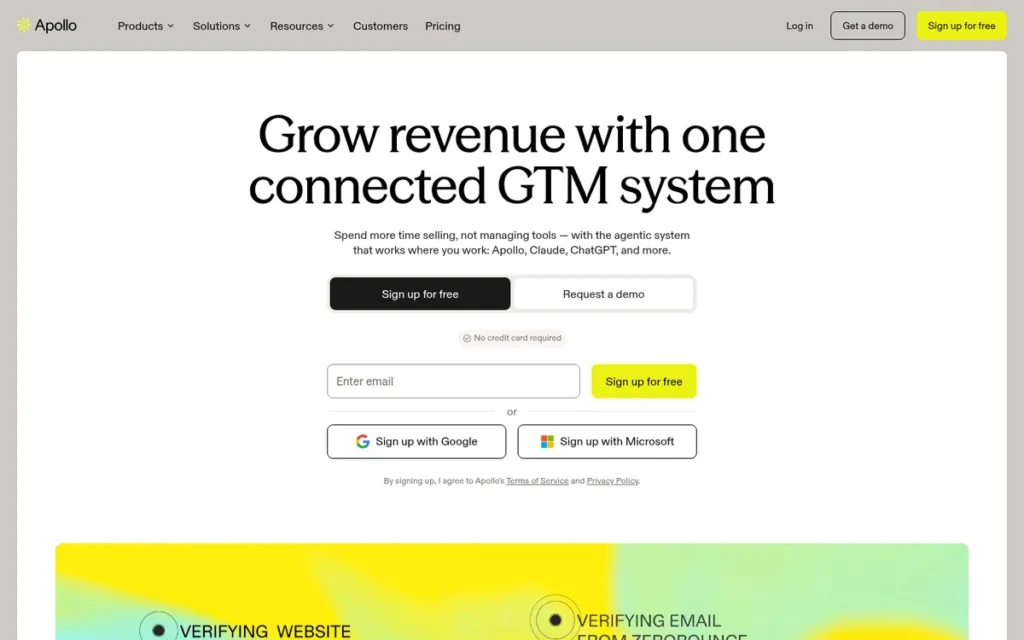
Category: Contact Database & Enrichment. These tools supply B2B contact and company records and write them into your CRM.
At a Glance
- Category: Contact Database & Enrichment
- Best For: Small and mid-market, US-focused, email-led sales teams that want prospecting data and outbound in one tool
- Price Range: Free; $49–$119 per user per month billed annually ($65–$99 monthly for Basic and Professional), plus usage credits (2026)
- Primary Strength: Apollo.io combines a large B2B database, CRM enrichment and outbound sequencing in one self-serve product with a free tier.
- Biggest Limitation: Apollo.io’s real-world email accuracy varies widely. One practitioner reports 20–30% bounce rates without a separate verifier.
- One-Line Summary: Apollo.io has the largest G2 review base in this 2026 evaluation. It is best for small and mid-market teams that will add a verification step in exchange for low cost.
- Last Verified: November 2026
Overview
Apollo.io is an all-in-one B2B contact and company database with built-in enrichment, buying signals, email sequencing and CRM sync. It is built for small and mid-market sales teams that want prospecting data and outbound execution in one self-serve tool.
Apollo.io’s data comes from a contributory network of more than 2 million users who connect their inboxes and CRMs (Apollo, 2026). Practitioners increasingly use Apollo.io as a data source rather than a sending platform (Reddit r/gtmengineering, 2026).
Key Features
- Apollo.io provides a searchable B2B contact and company database, and reviewers consistently praise its filters for list building.
- Apollo.io enriches CRM records manually, on a schedule or in real time, and offers waterfall enrichment for broader coverage.
- Apollo.io surfaces job-change, intent and website-visitor signals, so teams can prioritize accounts without an enterprise intent contract.
- Apollo.io includes email sequencing, dialing and a Chrome extension, so reps can act on data without switching tools.
- Apollo.io syncs with Salesforce, HubSpot and Pipedrive, though reviewers report duplicate records and overwritten fields with two-way sync (Capterra, 2026).
Best For
Apollo.io is best for small and mid-market sales teams selling mainly into the US that need affordable prospecting data plus CRM enrichment. Apollo.io fits teams willing to run exports through an email verifier before the data reaches the CRM.
Strengths
- Apollo.io holds a 4.7/5 G2 rating from about 9,800 reviews, the largest review base in this evaluation (G2, 2026). It also holds 4.5/5 on Capterra from 397 reviews (Capterra, 2026).
- Apollo.io reported $150M ARR, about 1 million users and 40,000 paying customers as of May 2025 (Apollo, 2025; vendor-reported, unaudited).
- Apollo.io publishes its pricing and offers a free plan, so small teams can test data quality on their own accounts before committing budget (Apollo, 2026).
- Apollo.io states SOC 2 Type II, ISO 27001 and GDPR compliance, which helps it pass procurement security screening (Apollo, 2026).
Limitations
Apollo.io trades consistent accuracy for low price and breadth.
- Apollo.io claims 98% email accuracy, but that figure is self-reported. One mid-market practitioner reports 20–30% bounce rates on “verified” emails (Reddit r/CRM, 2026).
- Apollo.io matched about 41% of mobile numbers, compared with about 67% for ZoomInfo, in one third-party comparison whose method has not been independently established (idealonlinebusiness.com, 2026).
- Apollo.io users on Capterra report credits running out quickly, frustration with credit-system changes, expensive API usage and charges for duplicate data (Capterra, 2026).
- Apollo.io’s sending infrastructure is described as lagging dedicated outreach tools (Reddit r/gtmengineering, 2026), so many teams pay for a separate verifier and a separate sending tool as well.
Users on r/gtmengineering shared their experience:
“My connect rates have dropped from like 15% to maybe 8% over the last 6 months. Half the emails bounce now. My SDR team is getting frustrated. We’re burning through credits faster than ever just to find working contacts.” Posted by u/truecakesnake
Takeaway: Long-term Apollo.io users report that falling data accuracy makes them burn more credits for fewer usable contacts, which cuts into its low-price advantage.
Verdict
Apollo.io is the best overall account data management software for small and mid-market B2B sales teams in 2026, with the largest G2 review base in this evaluation (about 9,800 reviews, 2026).
Apollo.io’s lead comes from review volume (C2) and self-serve time to value (C6). It scores mid-range on accuracy (C1). Plan an external verification step and model how many credits mobile reveals will use. Apollo.io packs more capabilities into its published tiers than any other self-serve product in this evaluation.
2. ZoomInfo: Best for Enterprise Data Coverage and CRM Data Hygiene
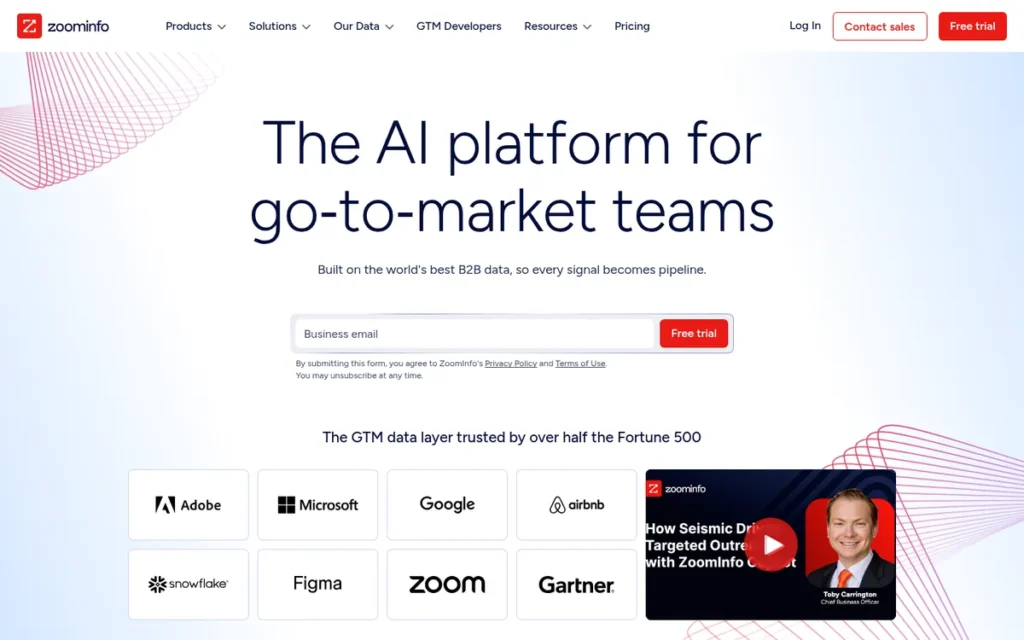
Category: Enterprise Data Platform. These platforms combine contact data, intent signals and CRM data operations in one contract.
At a Glance
- Category: Enterprise Data Platform
- Best For: Enterprise and upper mid-market RevOps teams that need direct dials plus CRM deduplication and normalization
- Price Range: Pricing on request; third-party estimates of about $15K–$36K+ per year; Vendr median about $33,500 (2026)
- Primary Strength: ZoomInfo is the only product in this evaluation with a dedicated CRM data-operations module for deduplication and normalization.
- Biggest Limitation: ZoomInfo’s quote-only pricing, seat costs and contract terms put it out of reach for most small teams.
- One-Line Summary: ZoomInfo is the only enterprise data platform in this 2026 evaluation that combines direct-dial coverage with a dedicated CRM-hygiene module in one contract, at a Vendr median of about $33,500 per year.
- Last Verified: November 2026
Overview
ZoomInfo is an enterprise go-to-market data platform. It combines a large B2B contact and company database, intent data and the OperationsOS module for CRM enrichment, normalization and deduplication. It is built for enterprise RevOps teams that need direct dials and cleaner CRM records at scale.
ZoomInfo is sold as separate modules, so total cost depends on which modules a buyer bundles. ZoomInfo is publicly traded under the ticker GTM (ZoomInfo IR, 2025).
Key Features
- ZoomInfo OperationsOS is built on the acquired RingLead and enriches, normalizes, routes and deduplicates CRM records.
- ZoomInfo SalesOS provides contact data, org charts and alerts, and reviewers credit it for direct-dial coverage.
- ZoomInfo MarketingOS adds website visitor identification, ABM audiences and ad targeting.
- ZoomInfo provides first-party intent data and Copilot AI recommendations for account prioritization.
- ZoomInfo integrates with Salesforce, HubSpot, Microsoft Dynamics, Marketo, Outreach and Salesloft.
Best For
ZoomInfo is best for enterprise and upper mid-market RevOps teams selling into the US whose main problems are duplicate CRM records and weak phone coverage. ZoomInfo suits teams whose budget can absorb five-figure annual contracts.
Strengths
- ZoomInfo holds about 4.5/5 on G2 from about 9,170 reviews (G2, 2026). It also holds 4.7/5 on Gartner Peer Insights from 439 validated reviews in an ABM context (as cited by ZoomInfo, 2025).
- ZoomInfo matched about 67% of mobile numbers, compared with 41% for Apollo.io, in one third-party comparison (idealonlinebusiness.com, 2026; method not established). One practitioner calls its mobiles “the best by far” (Reddit r/CRM, 2026).
- ZoomInfo is the only product in this list with a dedicated deduplication and normalization module, OperationsOS, which came from the RingLead acquisition (ZoomInfo, 2025).
- ZoomInfo is publicly traded, with trailing-twelve-month revenue of about $1.25B (ZoomInfo IR, 2025). That gives buyers audited financial disclosure, though not audited data quality.
Limitations
ZoomInfo trades affordability and contract flexibility for coverage.
- ZoomInfo’s estimated pricing starts near $15,000 per year, with extra seats at $1,500–$2,500 (third-party estimate, Vendr and digijaws.com, 2026). One practitioner says the pricing shuts out “anyone who isn’t enterprise” (Reddit r/CRM, 2026).
- ZoomInfo’s standard terms renew automatically unless you give notice at least 60 days before the term ends (ZoomInfo License Terms, 2026). That can lock in renewals that buyers miss.
- ZoomInfo’s standard terms require destroying copies of licensed materials at termination unless the signed agreement says otherwise (ZoomInfo License Terms, 2026). Check your order form for continued-use exceptions.
- ZoomInfo reviewers on Gartner Peer Insights flag data freshness for mid-market contacts (as cited by ZoomInfo, 2025). One dated thread says the data “falls apart for startups” (Reddit r/AskMarketing, 2023).
Users on r/gtmengineering noted:
“I was a big fan of ZI btw but we simply couldn’t afford/justify it in our org. I used their entire product suite for years and it wasn’t bad by any means just not worth the cost when so much more competition has popped up. Loved ringlead especially and still miss it even after building my own clone.” Posted by u/Ownfir
Takeaway: Even long-time ZoomInfo fans who value its suite and its RingLead-based hygiene tooling report that the price gets harder to justify as cheaper competitors catch up.
Verdict
ZoomInfo is the best account data management software for enterprise teams that need both direct-dial coverage and CRM deduplication, because OperationsOS is the only dedicated hygiene module in this evaluation.
ZoomInfo trails Apollo.io by 3.5 points, almost entirely on pricing transparency (C3) and implementation effort (C6). Buyers should negotiate near quarter-end and review the renewal and data-destruction clauses before signing.
3. Cognism: Best for Compliance-First EMEA Phone Data
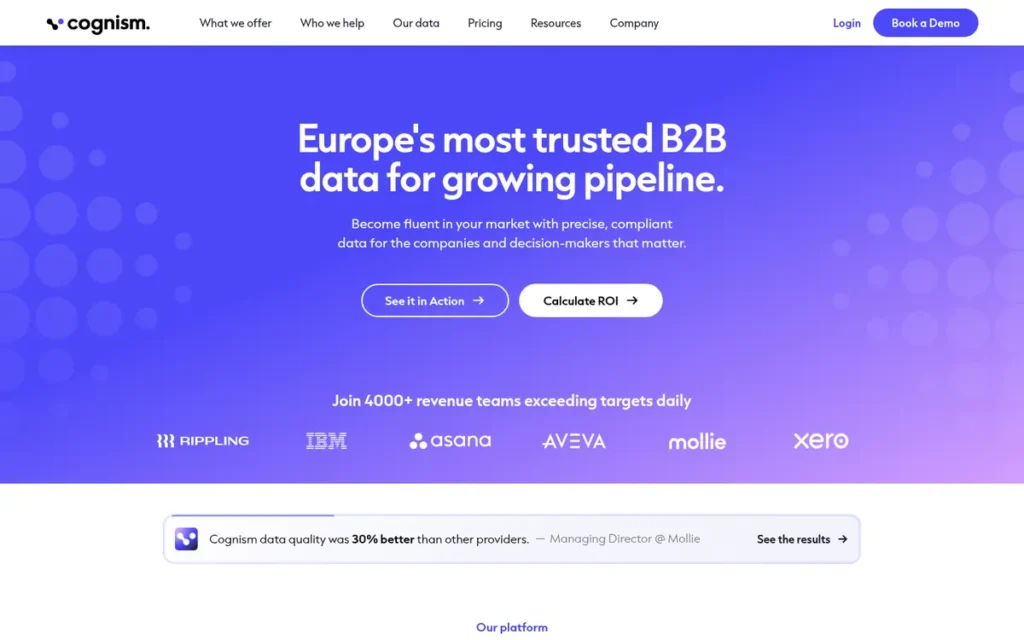
Category: Contact Database & Enrichment.
At a Glance
- Category: Contact Database & Enrichment
- Best For: Phone-led SDR teams where a large share of revenue comes from Europe, the Middle East and Africa (EMEA)
- Price Range: Pricing on request; Vendr median about $32,750 per year, range about $16.6K–$88.4K (2026)
- Primary Strength: Cognism offers the most compliance-first data model in this evaluation, with phone-verified mobiles and screening against what Cognism says are 15 DNC/TPS registries.
- Biggest Limitation: Cognism’s US coverage is reported as thin. One practitioner test returned emails for only about 60% of 1,000 US accounts.
- One-Line Summary: Cognism has the strongest compliance posture among contact data providers in this 2026 evaluation. It is best for EMEA-focused, phone-led teams, though its US coverage trails ZoomInfo and Apollo.io.
- Last Verified: November 2026
Overview
Cognism is a compliance-first B2B contact data provider known for phone-verified “Diamond Data” mobile numbers, do-not-call registry screening, and Salesforce and HubSpot enrichment. It is built for phone-led SDR teams that sell heavily into EMEA.
Cognism also includes intent data powered by Bombora. Cognism’s pricing is quote-based, with annual contracts (Cognism, 2026).
Key Features
- Cognism provides Diamond Data mobile numbers that people verify by phone rather than matching only by algorithm.
- Cognism says it screens contacts against 15 do-not-call and TPS registries (Cognism, 2026). Third-party sources list registries in at least 12 countries, including the UK, US, Germany and France.
- Cognism includes Bombora-powered intent signals for account prioritization.
- Cognism enriches Salesforce and HubSpot records and offers a Chrome extension for lookups inside the rep’s workflow.
- Cognism says it notifies contacts that they are in its database within GDPR timeframes (Cognism, 2026).
Best For
Cognism is best for SDR teams calling into EMEA markets, where compliance documentation and phone accuracy matter more than US email coverage.
Strengths
- Cognism holds a 4.7/5 Capterra rating from 263 reviews, the highest Capterra score in this list among products with meaningful review volume, with ease of use at about 4.8 (Capterra, 2026).
- Cognism’s Diamond Data mobiles were 87% accurate in a customer evaluation that Cognism quotes (Cognism, 2026; vendor-reported, verified subset only).
- Cognism holds ISO 27001 and SOC 2 Type II certifications (Cognism, 2026) and documents its registry screening and contact-notification practices.
- Cognism reports 4,000+ customers and more than $80M ARR (founder claim, unaudited), following an $87.5M Series C (Cognism newsroom, 2022).
Limitations
Cognism trades US coverage for EMEA depth and compliance.
- Cognism returned emails for only about 60% of roughly 1,000 US accounts in one practitioner’s test (Reddit r/CRM, 2026). Another practitioner advised skipping Cognism “unless half your revenue is europe.”
- Cognism’s quote-only pricing, reported five-seat minimum and annual contracts make it a mid-market commitment rather than a self-serve trial (Supered, 2026).
- Cognism’s “unlimited” views are subject to fair-use and export rules, so heavy users should confirm their actual limits in writing (Supered, 2026).
- Cognism reviewers flag cost, contract expectations and regional gaps (Capterra, 2026). One practitioner describes Cognism as “a bit more ‘manual'” than ZoomInfo (Reddit r/CRM, 2026).
This aligns with community sentiment on r/CRM:
“zoominfo’s data is legitimately good but at that price per seat for 40 reps you’re looking at a massive annual commitment. cognism makes sense if europe is a real part of your ICA but yeah US coverage has gaps. the bounce rate issue you’re seeing with the cheaper tools is pretty common once you scale past a handful of reps.” Posted by u/Inevitable-Maize6944
Takeaway: Practitioners see Cognism as a solid choice when Europe is a real part of the target market, but its US coverage gaps make it a poor primary source for US-centric teams.
Verdict
Cognism is the best account data management software for EMEA-focused, phone-led sales teams that need documented compliance, thanks to phone-verified mobiles and do-not-call registry screening.
Cognism ranks #3 because its US email coverage and quote-only pricing limit its fit for US-centric or small teams. If compliance (C5) were weighted more heavily, Cognism would rank above ZoomInfo. Test Cognism on a sample from the exact countries and roles you sell to.
4. Lusha: Best Budget Option for Lightweight Contact Enrichment
Category: Contact Database & Enrichment.
At a Glance
- Category: Contact Database & Enrichment
- Best For: Small teams and founders who need quick contact lookups and light CRM enrichment on a minimal budget
- Price Range: Free; $29–$51 per user per month billed annually; Scale on request (2026)
- Primary Strength: Lusha has the lowest published paid entry price and the simplest self-serve workflow in this evaluation.
- Biggest Limitation: Italy’s data protection authority fined Lusha €2 million in July 2026, and reviewers report weaker accuracy outside North America.
- One-Line Summary: Lusha has the lowest published paid entry price in this 2026 evaluation and is best for small North American teams. EU-targeting buyers should weigh its July 2026 Italian regulatory fine.
- Last Verified: November 2026
Overview
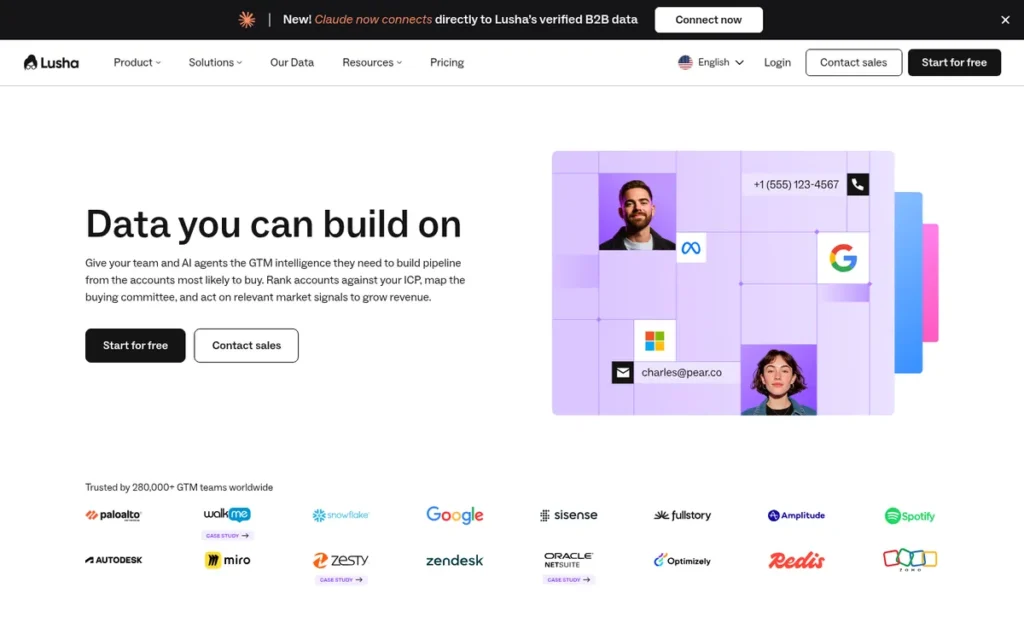
Lusha is a lightweight, self-serve B2B contact enrichment tool. It includes a Chrome and LinkedIn extension, bulk and CRM enrichment, and API access on every plan. It is built for small teams that need quick contact lookups at the lowest published entry price.
Lusha describes its data as community-based, but its sourcing actually combines several channels (Supered, 2026):
- Lusha collects community contributions and data from connected Google and Microsoft accounts.
- Lusha licenses directories and draws on public sources and scraping.
- Lusha also buys data from third parties.
Key Features
- Lusha reveals emails and phone numbers in one click through its Chrome and LinkedIn extension.
- Lusha enriches records in bulk and inside Salesforce, HubSpot and Pipedrive.
- Lusha surfaces job-change, hiring and funding signals for low-cost account prioritization.
- Lusha includes API access on every plan, including the lower tiers.
- Lusha adds AI prospecting and basic sequences for light outreach.
Best For
Lusha is best for founders and small sales teams prospecting mainly in North America who want fast lookups without a contract or a dedicated operations owner.
Strengths
- Lusha’s Starter plan costs $29 per user per month billed annually, the lowest published paid entry price among the seven products evaluated (Lusha, 2026).
- Lusha scores 4.6/5 for ease of use on Capterra from 398 reviews (Capterra, 2026).
- Lusha holds a 4.3/5 G2 rating from about 1,670 reviews, and reviewers praise its LinkedIn extension (G2, 2026).
- Lusha claims SOC 2 Type II, five ISO certifications, and GDPR and CCPA compliance (Supered, citing Lusha’s trust center, 2026).
Limitations
Lusha trades data depth and regulatory standing for low cost and simplicity.
- Italy’s Garante fined Lusha Systems €2 million in a decision adopted July 14, 2026, citing GDPR violations including lawfulness, transparency and data minimization (Garante, 2026). The decision banned further processing of the Italian data and ordered it deleted.
- Lusha reviewers report stale titles, dead numbers and switchboards labeled as direct lines. Phone accuracy reportedly drops outside North America and for mid-level roles (G2, 2026).
- Lusha’s customer service scores 3.9/5 on Capterra (Capterra, 2026). Its Trustpilot score is 1.2/5, mostly from people objecting to being listed, which signals privacy-reputation risk (gtmbud.com, 2026).
- For Lusha, we found no dedicated Reddit discussion or verified named-client outcomes. That is an evidence gap, not a negative finding.
Verdict
Lusha is the best budget account data tool for small North American teams that need fast contact lookups, with the lowest published paid price in this evaluation.
Lusha leads on pricing transparency (C3) and time to value (C6). Its July 2026 Garante fine holds down its compliance score (C5). Its 0.5-point lead over Clay is a small difference. Buyers targeting EU contacts should complete a compliance review before adopting Lusha.
5. Clay: Best for Multi-Provider Enrichment Orchestration
Category: Enrichment Orchestration. These tools chain many third-party data providers into custom enrichment and scoring workflows.
At a Glance
- Category: Enrichment Orchestration
- Best For: Ops-savvy teams with a GTM engineer who want custom, multi-source enrichment layered on an existing data source
- Price Range: Free; $167–$446 per month billed annually ($185–$495 monthly); CRM sync on Growth; Enterprise on request (2026)
- Primary Strength: Clay can raise coverage by cascading lookups across 100+ data providers in one workflow.
- Biggest Limitation: Clay has a steep learning curve, and its two usage meters make monthly cost hard to forecast.
- One-Line Summary: Clay is the only enrichment orchestration platform in this 2026 evaluation. It is best for teams with GTM-engineering skills and works as a workflow layer, not a plug-and-play contact database.
- Last Verified: November 2026
Overview
Clay is a spreadsheet-style enrichment orchestration workspace. It runs waterfall lookups across 100+ third-party data providers, adds AI web research and buying signals, and syncs results to Salesforce or HubSpot. It is built for ops-savvy teams with a GTM engineer.
Clay does not own a native database. Clay’s data quality depends on which providers each customer connects and how the workflow is designed.
Key Features
- Clay runs waterfall enrichment, querying providers in sequence until a field is filled.
- Clay’s Claygent AI agent researches accounts on the open web and writes structured results into the table.
- Clay tracks job-change, hiring, news and web-intent signals for account prioritization.
- Clay supports AI formulas, custom scoring and bring-your-own API keys.
- Clay includes CRM sync, HTTP API integrations and webhooks on the Growth plan, not on Launch (Clay, 2026).
Best For
Clay is best for RevOps or growth teams with a GTM engineer who want custom enrichment and scoring on top of an existing database and can monitor usage actively.
Strengths
- Clay reports more than 17,000 customers, including Anthropic, OpenAI, Stripe and Siemens (Clay, 2026; vendor-reported, unaudited). Sacra estimates Clay’s 2025 revenue at about $102M (Sacra, 2025).
- Clay holds a 4.6–4.7/5 G2 rating from about 188–229 reviews, with praise for its flexibility and waterfall coverage (G2, 2026).
- Clay publishes its tier pricing, including a free plan, unlike the four quote-only vendors in this list (Clay, 2026).
- Clay offers Clay University, a community and a network of certified agencies and experts for implementation help (Clay, 2026).
Limitations
Clay trades simplicity and cost predictability for flexibility.
- Clay takes roughly 2–6 weeks to reach basic proficiency (databar.ai, 2026). One reviewer says it “can feel intimidating” (Capterra, 2026).
- Clay works as a layer added to a stack, not a database replacement (Reddit r/CRM, 2026). Writing data back into Salesforce requires Growth, at about $5,350 per year billed annually (Clay, 2026).
- Clay’s two-meter model makes monthly cost harder to forecast (G2, 2026). Clay’s compliance depends on the providers each customer connects, and its review base is about a tenth of Apollo.io’s (G2, 2026).
- For Clay, we found no dedicated Reddit discussion or verified named-client outcomes. That is an evidence gap, not a negative finding.
Verdict
Clay is the best account data management tool for ops-led teams that want custom multi-provider enrichment, because its waterfall model can fill gaps that any single database leaves.
Clay ranks #5 because it needs GTM-engineering skills (C6) and its two-meter pricing makes cost hard to forecast (C3). Teams without a dedicated operations owner should start with a single-source database instead.
6. Demandbase One: Best for Account-Centric ABX with Native Advertising
Category: ABM & Intent Platform. These platforms identify which accounts are in market and when, for account-based programs.
At a Glance
- Category: ABM & Intent Platform
- Best For: Enterprise ABM teams with dedicated advertising budgets and marketing-operations staff
- Price Range: Pricing on request; third-party estimate from about $45K and Vendr median about $68,591 per year (2026)
- Primary Strength: Demandbase One is the broadest account-centric ABX suite in this evaluation and includes a native B2B advertising DSP.
- Biggest Limitation: Demandbase One has the highest Vendr median in this research, and reviewers describe its contact data as stale.
- One-Line Summary: Demandbase One combines more ABX capabilities in one suite than any other product in this 2026 evaluation, including the only native B2B advertising DSP. Contact data is not its strength.
- Last Verified: November 2026
Overview
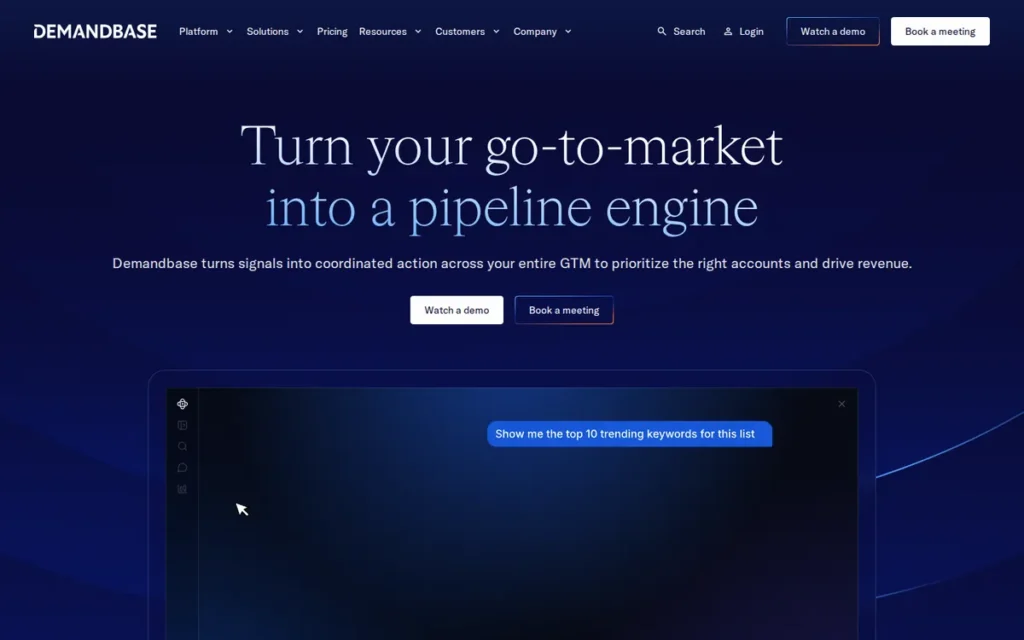
Demandbase One is an account-centric ABX platform. It combines account identification, account- and person-level intent, a native B2B advertising DSP, technographic data and CRM sync. It is built for enterprise ABM teams with advertising budgets and marketing-operations staff.
Demandbase One grew through the acquisitions of Engagio (2020) and InsideView and DemandMatrix (2021). Demandbase was founded in 2006 and reports more than 1,000 customers (Demandbase, 2026).
Key Features
- Demandbase One identifies anonymous accounts and tracks account- and person-level intent.
- Demandbase One includes a native B2B advertising DSP for running account-targeted campaigns.
- Demandbase One provides firmographic and technographic data through a Data Cloud built on InsideView and DemandMatrix.
- Demandbase One orchestrates account journeys and syncs with CRM and marketing automation platforms.
- Demandbase One adds Agentbase AI agents for account research and actions.
Best For
Demandbase One is best for enterprise marketing teams running account-based programs with paid advertising that want intent, account data and ad activation on one platform.
Strengths
- Demandbase One was one of two vendors named a Gartner Peer Insights Customers’ Choice for ABM Platforms in 2024 (as reported by Demandbase, 2024). It holds about 4.4/5 on G2 from about 1,990 reviews (G2, 2026).
- Demandbase One scores 9.0/10 for Account-level Insights on G2, based on 302 reviewers (G2, 2026).
- Demandbase One is the only platform in this evaluation with a native B2B advertising DSP.
- Demandbase One customer Actian reported a 468% rise in opportunities after ad impressions and a 32% rise in win rate (Demandbase GTM Impact Awards, 2026; vendor-reported, unaudited).
Limitations
Demandbase One trades cost and contact accuracy for account-level breadth.
- Demandbase One’s Vendr median of $68,591 per year across 187 purchases is the highest in this research, and a third-party estimate puts entry around $45,000 (SalesHive; Vendr, 2026).
- Demandbase One technical implementation typically takes about 4–10 weeks, and Demandbase says it is often under 60 days. Measurable ROI commonly takes 6–12 months, a timeline similar to 6sense’s (third-party comparisons, 2026).
- Demandbase One reviewers report a steep learning curve and a dense interface (TrustRadius, 7.8/10 from 397 reviews, 2026). They also report stale contacts and intent signals that look stronger than actual buying activity (marketintelligencetools.com, 2026).
- Demandbase One users typically need a separate contact data source. We found no dedicated Reddit discussion, which is an evidence gap, not a negative finding.
Verdict
Demandbase One is the best account data management platform for enterprise ABM teams that want intent, account data and native ad activation in one suite.
Demandbase One ties 6sense at 31.0/50. It ranks #6 on the published tie-break because its verified review score (C2) is higher. Its high cost (C3) and weaker contact data keep it low. Demandbase One suits teams with ad budgets, not teams mainly cleaning CRM records.
7. 6sense: Best for Predictive Intent and Buying-Stage Prioritization
Category: ABM & Intent Platform.
At a Glance
- Category: ABM & Intent Platform
- Best For: Mature ABM programs with dedicated RevOps or marketing-ops staff that need to time outreach to buying stages
- Price Range: Free tier; paid plans on request; Vendr median about $62,440 per year (2026)
- Primary Strength: 6sense offers the most intent sources in this evaluation and is the only product here that assigns accounts to customer-specific predictive buying stages.
- Biggest Limitation: 6sense uses quote-only pricing with a Vendr median of about $62,440 per year, and it does not replace a contact database.
- One-Line Summary: 6sense offers the most intent sources in this 2026 evaluation. It is best for mature ABM teams that pair it with a separate contact data source and dedicated operations staff.
- Last Verified: November 2026
Overview
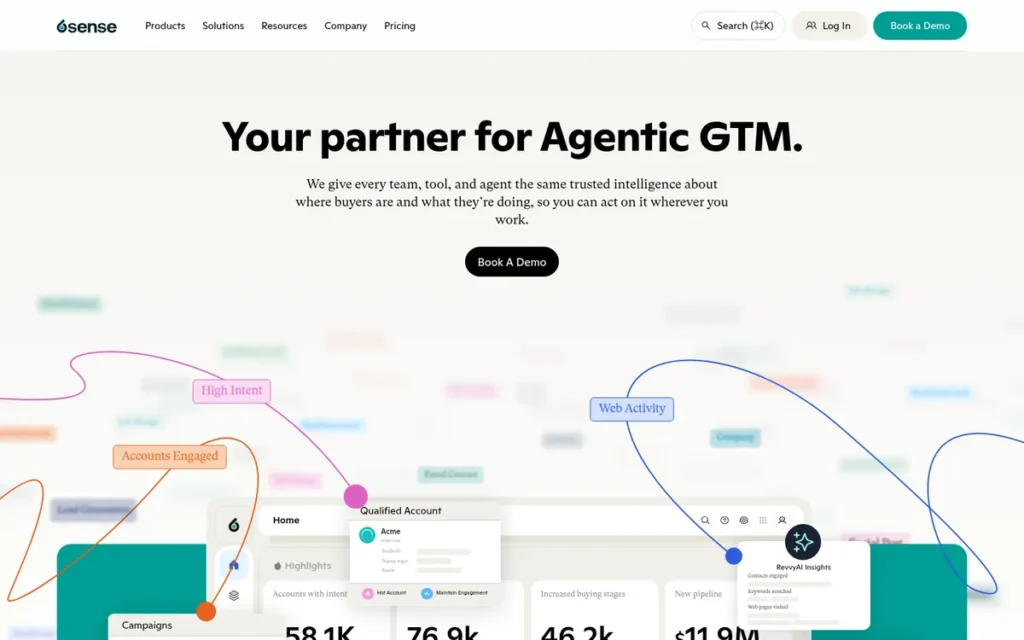
6sense is a predictive account-based marketing and intent platform. It uses customer-specific AI models to assign accounts to buying stages, identifies anonymous website visitors at the account level and adds account-based advertising. It is built for mature ABM programs with dedicated operations staff.
6sense also sells Sales Intelligence credits for contact data. Reviewers rate 6sense Sales Intelligence below dedicated contact databases (G2, 2026).
Key Features
- 6sense assigns accounts to five predictive buying stages: Target, Awareness, Consideration, Decision and Purchase.
- 6sense identifies anonymous website visitors at the account level.
- 6sense combines keyword intent from its own publisher network with partner intent from Bombora, G2, TrustRadius, Gartner Digital Markets and PeerSpot.
- 6sense includes account-based advertising plus conversational and email AI agents.
- 6sense integrates with Salesforce, HubSpot and Marketo and offers an MCP server.
Best For
6sense is best for enterprise marketing and RevOps teams running established ABM programs that need to rank target accounts by buying stage and already have a contact data source.
Strengths
- 6sense holds a 4.4/5 Gartner Peer Insights rating from 296 reviews (Gartner, 2026) and 8.4/10 on TrustRadius from 551 reviews (TrustRadius, 2026).
- 6sense combines its own publisher-network intent with five partner intent sources, the most intent sources of any product in this evaluation (6sense, 2026).
- 6sense offers a free tier, so teams can test its intent data before committing to a five-figure contract (6sense, 2026).
- 6sense charges no setup fee, according to TrustRadius (TrustRadius, 2026). Technical implementation reportedly takes about 6–14 weeks (third-party comparisons, 2026).
Limitations
6sense trades cost and ease of adoption for predictive depth.
- 6sense uses quote-only pricing. Its Vendr median of $62,440 per year across 385 purchases is the second-highest in this research, with a wide range of $11,376–$176,809 (Vendr, 2026).
- 6sense Revenue Marketing draws complaints about a steep learning curve and difficulty proving pipeline impact (review summaries by ZoomInfo and UserGems, competitor sources, 2026). Reliable ROI evidence typically takes 6–12 months.
- 6sense Sales Intelligence scores 4.0/5 on G2 from 1,106 reviews, with complaints about inaccurate data, bounced emails and intent false positives (G2, 2026).
- 6sense users typically still need a separate contact database. We found no dedicated Reddit discussion or verified named-client outcomes, which is an evidence gap, not a negative finding.
Verdict
6sense is the best account data management platform for mature ABM teams that need to time outreach to predicted buying stages, and it draws on more intent sources than any other product in this evaluation.
6sense ties Demandbase One at 31.0/50. It ranks #7 on the published tie-break because of its lower verified review score (C2). Pair 6sense with a dedicated contact source, and confirm you have the operations staff to act on its signals.
How Much Does Account Data Management Software Cost by Team Profile?
Account data management software costs from $0 to more than $175,000 per year:
- Small teams can stay under about $1,000 with Apollo.io or Lusha.
- Mid-market teams on ZoomInfo or Cognism typically spend $15,000–$88,000.
- Mature ABM programs on Demandbase One or 6sense often pay $45,000 to more than $175,000.
The table below shows PlugRoute estimates built from published and third-party pricing (2026). Treat them as planning ranges, not quotes.
| Buyer Profile | Likely Fit | Estimated Annual Cost | Conditions |
|---|---|---|---|
| Solo founders and small teams | Apollo.io Free/Basic or Lusha Free/Starter, plus an email verifier | Under about $1K | Model phone-credit use: about 8× the cost of an email reveal on Apollo.io and 5× on Lusha |
| Ops-led teams adding orchestration | Clay Launch or Growth on top of an existing data source | About $2K (Launch, no CRM sync) to about $5.4K (Growth, with CRM sync) | Requires GTM-engineering skills and active monitoring of Actions usage |
| Mid-market, EMEA-focused | Cognism | About $16K–$88K | Reported five-seat minimum and annual contract |
| Mid-market, US-focused | ZoomInfo Professional or Advanced | About $15K–$30K plus seats | Extra seats cost about $1,500–$2,500 each; negotiate near quarter-end |
| Enterprise hygiene plus prospecting | ZoomInfo with OperationsOS | Quote-based | Best fit for Salesforce or HubSpot shops with RevOps staff |
| Mature ABM with intent and ads | Demandbase One (Vendr median $68,591) or 6sense (Vendr median $62,440), plus a contact source | About $45K–$175K+ | Both go live in about 1.5–3.5 months, but ROI evidence takes 6–12 months; needs dedicated RevOps or marketing-ops headcount |
The vendor-level pricing below is the evidence behind the estimates above. Every vendor is shown in the same format.
| Vendor | 2026 Pricing | Usage and Credit Mechanics | Contract Notes |
|---|---|---|---|
| Apollo.io | Free $0. Basic $49/user/month billed annually ($65 monthly). Professional $79 annually ($99 monthly). Organization $119 annually with a 3-user minimum (Apollo, 2026). | Credits are pooled and reset each cycle with no rollover. Basic includes about 30,000 credits per year, Professional about 48,000 (Apollo, 2026). A mobile reveal costs about 8 credits (cufinder.io, 2026). | All seats on an account must be on the same plan. Practitioners budget for NeverBounce or ZeroBounce (Reddit r/CRM, 2026). |
| ZoomInfo | Quote-only. Third-party estimates: Professional about $14,995, Advanced about $24,995–$29,995, Elite about $35,995+ (Vendr; digijaws.com; superframeworks.com, 2026). | Extra seats cost about $1,500–$2,500 per user per year. Vendr median is $33,500 across 1,579 purchases, with a 22% average saving (Vendr, 2026). | 60-day non-renewal notice and a destruction clause for licensed materials (ZoomInfo License Terms, 2026). |
| Cognism | Quote-only. Capterra lists pricing “starting at $1,000 per feature per month” (Capterra, 2026). | Vendr median is $32,750 across 94 purchases, range $16,585–$88,449, with a 26% average saving (Vendr, 2026). Other third-party figures are $33K–$36K. | Platform fee plus seats, reported five-seat minimum and annual contracts (Supered, 2026). “Unlimited” views are fair-use limited. |
| Lusha | Free (40 credits per month). Starter $29/user/month and Pro $51/user/month billed annually. Scale is custom (Lusha, 2026). | Each email reveal costs 1 credit, each phone reveal 5 and each company reveal 1 (Lusha, 2026). | Monthly-billing prices were not available when we verified pricing. |
| Clay | Free. Launch $167/month billed annually ($185 monthly). Growth $446/month billed annually ($495 monthly). Enterprise is custom (Clay, 2026). | Launch includes 15,000 Actions and 2,500 Data Credits, and Growth includes 40,000 Actions and 6,000 Data Credits. Data Credits start at about $0.05 each, and Actions cost under $0.01 (Clay, 2026). | CRM sync, HTTP API and webhooks are Growth features (Clay, 2026). |
| Demandbase One | Custom, with no public price sheet. Third-party estimate from about $45,000 per year (SalesHive, 2026). | Vendr median is $68,591 across 187 purchases (Vendr, 2026). | Implementation fees and minimum spend could not be verified, so request a written first-year total. |
| 6sense | Free, Team, Growth and Enterprise tiers are listed without dollar amounts (6sense, 2026). | Priced by seats, credits, records or conversations. Vendr median is $62,440 across 385 purchases, range $11,376–$176,809 (Vendr, 2026). | No setup fee, according to TrustRadius (TrustRadius, 2026). |
How Do I Test Vendor Data Accuracy Against My Own Accounts?
Test vendor data accuracy by running finalists side by side on a few hundred of your own ICP-matched accounts. Then run a 2–3 week live outbound pilot and track bounce rate, connect rate and meetings booked. Vendor accuracy claims are unaudited, so your own pilot is the most reliable evidence you can get.
The gap between marketing and reality is large. Vendors advertise 90–95%+ accuracy, while semi-independent comparisons put the market average closer to about 50% (databar.ai, 2026).
Practitioners recommend this five-step procedure (Reddit r/CRM, 2026):
- Pull a few hundred accounts that match your ICP, then compare emails, mobiles, titles and company data side by side across finalists.
- Run a 2–3 week live outbound pilot using real SDR workflows rather than a vendor demo.
- Track bounce rate, connect rate and meetings booked for each vendor’s records.
- Run every export through an email verifier before it reaches the CRM.
- Test CRM sync, field mapping and overwrite rules in a sandbox before connecting production records.
Use these benchmarks to judge pilot results:
- Hard bounces under 1% are excellent, and hard bounces over 5% signal a serious data problem (databar.ai, 2026).
- The average cold-email bounce rate in 2025 was 3.6%, across 31 million emails sent through Hunter (Hunter, 2025, via scalelist.com).
- B2B contact data is commonly estimated to decay about 2.1% per month, or roughly 22.5% per year (MarketingSherpa research, cited by Apollo and Clay, 2026).
- Email data alone decays about 3.6% per month (Apollo and Clay guides, 2026).
- Gartner estimated that poor data quality costs organizations an average of $12.9M per year (Gartner, 2020, via Docsumo).
At a 2.1% monthly decay rate, a CRM with 10,000 accurate contacts will hold roughly 2,250 outdated records within a year unless the data is re-enriched.
“Take a few hundred accounts that actually match your ICP and compare emails, mobiles, titles, and company data side by side.” (u/Distinct_Highway873, r/CRM (Reddit, 2026))
Takeaway: A side-by-side test on a few hundred of your own ICP accounts tells you more about vendor fit than any review rating or demo.
What Red Flags Should I Watch For When Evaluating Account Data Management Software?
These are the biggest red flags in account data management software:
- Unaudited accuracy claims
- Credits that don’t roll over
- Expensive phone reveals
- Auto-renewal and data-deletion clauses
- Fair-use caps on “unlimited” plans
- Undocumented CRM overwrite rules
- Recent regulatory enforcement
Each one can push true cost or compliance risk well beyond the quoted price.
Red Flag #1: Unaudited Accuracy Claims No vendor in this evaluation publishes independently audited accuracy figures. For example, Apollo.io claims 98% email accuracy, while one practitioner reports 20–30% bounce rates on “verified” emails (Reddit r/CRM, 2026). Always validate accuracy claims on your own target accounts before signing.
Users on r/CRM noted:
“The other half is whether you’re running a verification pass before emails hit your sequences. Even ZoomInfo data degrades fast, and most teams eating 20-30% bounces are sending straight from export. Running contacts through a real-time verifier before they enter the queue usually cuts that number significantly regardless of which platform you’re on.” Posted by u/No-Subject-1428
Takeaway: No account data vendor’s “verified” label replaces your own verification step, because even premium data decays fast enough to produce high bounce rates when sent straight from export.
Red Flag #2: Credits That Don’t Roll Over Credits that reset each billing cycle without rollover penalize teams whose usage is uneven or seasonal. Apollo.io credits reset every cycle with no rollover (Apollo, 2026). Teams that prospect seasonally may pay for credits they never use.
Red Flag #3: Phone Reveals Priced at 5–8 Times Email Phone reveals cost several times more than email reveals on Apollo.io and Lusha, so phone-led teams use up credits much faster. Lusha charges 5 credits per phone reveal versus 1 per email (Lusha, 2026). Apollo.io reportedly charges about 8 credits per mobile reveal (cufinder.io, 2026).
At that ratio, Apollo.io Basic’s roughly 30,000 annual credits buy about 30,000 email reveals or only about 3,750 mobile reveals (Apollo, 2026). Quote-only vendors set credit costs per contract, so ask for them in writing.
Red Flag #4: Auto-Renewal Notice Windows Long auto-renewal notice windows can lock buyers into another contract year if they miss the cancellation deadline. ZoomInfo’s standard terms require non-renewal notice at least 60 days before the term ends (ZoomInfo License Terms, 2026). Put that date on the calendar the day you sign.
Red Flag #5: Data-Deletion Clauses at Contract End Data-deletion clauses can require you to purge exported records when a contract ends, which creates lock-in. ZoomInfo’s standard terms require destroying licensed materials at termination unless the agreement says otherwise (ZoomInfo License Terms, 2026). Confirm any vendor’s terms before importing its data into your CRM.
Red Flag #6: Fair-Use Limits on Unlimited Plans Plans marketed as “unlimited” usually come with fair-use or export caps that limit what you can actually use. Cognism’s unlimited views are subject to fair-use and export rules (Supered, 2026). Ask any vendor selling “unlimited” access to put the exact limits in writing.
Red Flag #7: Undocumented CRM Overwrite Rules None of the sources we reviewed included field-level CRM overwrite documentation from any vendor. Apollo.io reviewers report duplicate records and overwritten fields from two-way sync (Capterra, 2026). Test sync frequency and overwrite protection in a sandbox before going live.
Red Flag #8: Recent Regulatory Enforcement Regulatory enforcement against a data vendor creates downstream risk for buyers who target the affected region. Italy’s Garante fined Lusha Systems €2 million in July 2026 and ordered unlawfully collected Italian data deleted (Garante, 2026). EU-focused buyers should review every vendor’s enforcement history and data provenance.
What Questions Should I Ask Before Choosing Account Data Management Software?
Before choosing account data management software, ask each vendor to enrich a sample of your own accounts and report bounce rates. Also ask for credit and rollover rules, a written first-year cost, CRM overwrite controls, data-sourcing practices, post-contract data terms and coverage in your regions. Vague answers are a warning sign.
Question #1: What is your bounce rate on a sample of my own target accounts? Ask each vendor to enrich a few hundred of your ICP accounts before you sign. Under 1% hard bounces is excellent and over 5% is a serious problem (databar.ai, 2026). The 2025 cold-email average was 3.6% (Hunter, 2025).
Question #2: How many credits does each action cost, and do unused credits roll over? Credit costs per email, phone and company reveal determine your real monthly spend. On Apollo.io, a mobile reveal reportedly costs about 8 credits versus 1 for an email (cufinder.io, 2026). Ask about credit pooling, rollover and overage pricing.
Question #3: What is the total first-year cost, including seats, minimums and implementation? Quote-only vendors often leave seat minimums and implementation fees out of initial pricing. Cognism reportedly has a five-seat minimum (Supered, 2026), and Demandbase One implementation fees could not be verified. Request a written all-in figure from every finalist.
Question #4: Which fields does CRM sync overwrite, and can I lock them? CRM sync behavior determines whether enrichment cleans your records or corrupts them. Ask which fields each sync mode overwrites, whether you can lock fields, how often sync runs and how duplicates are detected in Salesforce or HubSpot.
Question #5: How is your data sourced, and how do you handle suppression and data-subject requests? Data sourcing and suppression practices determine your exposure under GDPR, CPRA and US state privacy laws. Ask for documentation of each of the following:
- The vendor’s data-sourcing methods and data provenance
- Its do-not-call and TPS registry screening
- Its contact-notification practices
- Its process for handling data-subject requests
Question #6: What happens to exported data when the contract ends? Exported-data terms decide whether you keep the records you paid for. For example, ZoomInfo’s standard terms require destroying licensed materials at termination unless the agreement provides otherwise (ZoomInfo License Terms, 2026). Get each vendor’s answer in the contract, not in a sales email.
Question #7: How strong is your coverage in my specific regions and buyer roles? Coverage varies sharply by region and seniority. Practitioners report thin US coverage for Cognism (Reddit r/CRM, 2026), and reviewers report weaker Lusha phone accuracy outside North America (G2, 2026). Ask for coverage data broken down by your markets and roles.
How Did We Rank These Account Data Management Tools?
PlugRoute scored all seven tools from 1 to 5 on six criteria. Four primary criteria count double: accuracy, review ratings, pricing transparency and capability breadth. Two secondary criteria count once: compliance and implementation effort. That gives a maximum of 50 points, and every score is tied to dated evidence.
The six ranking criteria and their weights:
- C1: Real-World Data Accuracy and Coverage Evidence (primary, ×2). C1 matters because contact data decays about 2.1% per month (MarketingSherpa research, cited by Apollo and Clay, 2026), and practitioner bounce rates often contradict vendor claims.
- C2: Verified Review Ratings and Review Volume (primary, ×2). C2 matters because large verified review bases signal satisfaction better than small samples. We discount ratings based on fewer than about 300 reviews.
- C3: Pricing Transparency and Total Cost Predictability (primary, ×2). C3 matters because credit mechanics, seat minimums, contract terms and add-on verifiers determine true cost.
- C4: Breadth of Account Data Capabilities and CRM Integration (primary, ×2). C4 matters because teams need to centralize, enrich and prioritize data inside Salesforce or HubSpot, and tools cover different parts of that job.
- C5: Compliance Posture and Data Sourcing Transparency (secondary, ×1). C5 matters because privacy laws require buyers to document data provenance, and the 2026 Garante fine against Lusha shows the risk is real.
- C6: Implementation Effort and Time to Value (secondary, ×1). C6 matters because long rollouts and specialist staffing needs raise cost and risk for smaller teams.
PlugRoute weights evidence in three tiers:
- Independent or practitioner evidence, such as Reddit tests, third-party comparisons and regulatory records, carries the most weight.
- Third-party estimates, such as Vendr contract medians and review-site analyses, carry moderate weight.
- Vendor-published claims carry the least weight, and we always label them unaudited.
Most practitioner accuracy evidence for Apollo.io, ZoomInfo and Cognism comes from a single 2026 r/CRM thread comparing the three. We treat it as directional, not representative.
We read ratings from G2, Capterra, Gartner Peer Insights and TrustRadius side by side with their review counts. We report Trustpilot separately because, for data vendors, it mostly reflects people objecting to being listed.
Missing evidence, such as the absence of Reddit threads for Lusha, Clay, Demandbase One or 6sense, did not move any score up or down. We found no peer-reviewed studies of vendor data accuracy. Research date: November 2026.
PlugRoute has no affiliate relationships with any company listed. Rankings are determined entirely by research data and objective evaluation criteria.
| Company | C1 | C2 | C3 | C4 | C5 | C6 | Weighted Total (/50) |
|---|---|---|---|---|---|---|---|
| Apollo.io | 3 | 5 | 4 | 4 | 3.5 | 5 | 40.5 |
| ZoomInfo | 4 | 4.5 | 2 | 5 | 3 | 3 | 37.0 |
| Cognism | 3.5 | 4.5 | 2 | 3 | 5 | 4 | 35.0 |
| Lusha | 2.5 | 3.5 | 4.5 | 3 | 1.5 | 5 | 33.5 |
| Clay | 3 | 4 | 3 | 4 | 3 | 2 | 33.0 |
| Demandbase One | 3 | 4 | 1.5 | 4.5 | 3 | 2 | 31.0 |
| 6sense | 3 | 3.5 | 2 | 4.5 | 3 | 2 | 31.0 |
We updated the scores in November 2026 after checking primary sources:
- Demandbase One C6 (changed): We raised Demandbase One’s C6 score from 1.5 to 2. The earlier score relied on a “6–12 month rollout” claim, but technical go-live is about 4–10 weeks, comparable to 6sense.
- Tie-break rule: Ties are broken by C1 first and then C2. Demandbase One and 6sense tie on C1, and Demandbase One leads on C2.
- Clay C3 (unchanged): Clay’s C3 score stays at 3. Its pricing is now confirmed first-party, but its two meters and Growth-only CRM sync still limit cost predictability. A score of 3.5 would have placed Clay at 34.0, above Lusha.
The ranking is sensitive to weighting:
- Weighting C4 more heavily, or C3 less heavily, would lift Demandbase One and 6sense.
- Weighting C5 more heavily would lift Cognism above ZoomInfo.
Frequently Asked Questions
These answers cover what RevOps and sales ops buyers most often ask about account data management software in 2026.
What’s the best account data management software for small businesses in 2026?
Apollo.io is the best account data management software for most small businesses in 2026. It has a free plan, and paid tiers start at $49 per user per month billed annually (Apollo, 2026). Lusha is the lowest-cost paid alternative at $29 per user per month billed annually (Lusha, 2026). Budget for an email verifier either way.
Which account data management software has the best CRM enrichment for Salesforce and HubSpot?
ZoomInfo offers the broadest CRM data-operations capabilities in this evaluation, because OperationsOS deduplicates and normalizes records as well as enriching them. Apollo.io offers manual, scheduled and real-time enrichment at a much lower price. No vendor we reviewed publishes field-level overwrite documentation, so test sync behavior in a sandbox first.
How does PlugRoute determine rankings?
PlugRoute ranks tools with a weighted 50-point score across six criteria: accuracy, review ratings, pricing transparency, capability breadth, compliance and implementation effort. Every score is tied to dated evidence and labeled by strength. Practitioner evidence comes first, then third-party estimates, then vendor claims marked unaudited. Missing evidence never raises or lowers a score.
What Do Key Account Data Management Software Terms Mean?
Credits: Credits are the usage units that many account data tools charge each time you reveal an email, phone number or company record, on top of the per-seat price. On some plans unused credits reset each billing cycle and do not roll over, so check credit rules before you sign. Teams with uneven or seasonal prospecting can end up paying for credits they never use.
Phone Reveal (Mobile Reveal): A phone reveal shows a contact’s phone or mobile number, and it usually costs several credits for every one credit an email reveal costs. In this evaluation the ratio is about 5 to 8 times. Phone-led teams should work out how many reveals their credit allowance really covers.
Waterfall Enrichment: Waterfall enrichment queries several data providers one after another until a missing field is filled. It can raise coverage beyond what a single database provides, but it adds workflow complexity and uses up credits.
Enrichment Orchestration: Enrichment orchestration tools chain many third-party data providers into custom enrichment and scoring workflows instead of supplying their own database. Data quality depends on which providers you connect and how you design the workflow. These tools usually need GTM-engineering skills to run well.
Intent Data: Intent data is a set of signals, such as research activity or website visits, suggesting that an account is actively looking into a purchase. Buyers use it to decide which accounts to contact first. It can also produce false positives that look stronger than real buying activity.
Predictive Buying Stages: Predictive buying stages are model-assigned labels (for example Awareness, Consideration or Decision) that estimate where an account is in its purchase journey. They help mature ABM programs time outreach, but they don’t replace a contact database.
CRM Data Hygiene (Deduplication and Normalization): CRM data hygiene means finding and merging duplicate records and standardizing fields so the CRM stays reliable. It’s a separate job from supplying new contact data, so teams whose main problem is stale or duplicate records should check whether a tool really includes it.
CRM Overwrite Rules: Overwrite rules control which CRM fields an enrichment sync is allowed to replace and whether you can lock fields. Poorly controlled two-way sync can create duplicates or overwrite good data, so test this in a sandbox before connecting production records.
Bounce Rate: Bounce rate is the share of sent emails that can’t be delivered, and it’s the most practical way to check a vendor’s email accuracy. Hard bounces under 1% are excellent and over 5% signal a serious data problem. Running exports through an email verifier can cut bounce rates significantly.
Data Decay: Data decay is how quickly contact records go out of date as people change jobs, titles or numbers. It is commonly estimated at about 2.1% per month for B2B contact data. A CRM therefore needs regular re-enrichment to stay accurate.
DNC/TPS Registry Screening: DNC/TPS registry screening checks phone numbers against do-not-call and Telephone Preference Service lists before reps dial. It matters most for phone-led teams selling into regulated regions such as EMEA, where documented compliance reduces legal risk.
Fair-Use Limits: Fair-use limits are caps on views or exports that apply even when a plan is marketed as “unlimited.” Ask vendors to put the exact limits in writing so heavy users aren’t surprised.
Auto-Renewal and Data-Destruction Clauses: These contract terms can renew your agreement automatically unless you give notice by a deadline (for example 60 days before the term ends). They can also require you to delete licensed records when the contract ends. Both can create lock-in, so review them before you sign and before you import data into your CRM.
Which Account Data Management Tool Is Right for You?
Key Insights
The key insight from this evaluation is that account data tools do different jobs, so no single ranking fits every team. Vendor accuracy claims are unaudited, and real cost depends on credits and contract terms. Most teams get the best results by pairing a contact source with an email verifier and, for ABM, an intent layer.
- Account data management software should be compared by job, because contact databases, enterprise platforms, orchestrators and ABM platforms solve different problems.
- No single tool in this evaluation covers contact data, CRM hygiene and buying-stage intent well at the same time.
- Vendor accuracy claims are unaudited, so every finalist should be tested on a few hundred of your own ICP accounts in a 2–3 week live pilot.
- Email verification is a near-mandatory add-on. One practitioner reports bounce rates falling from 20–30% to 5–8% after adding a verifier (Reddit r/CRM, 2026).
- Phone reveals cost about 5–8 times as much as emails on Apollo.io and Lusha, so credit mechanics shape true cost as much as list price.
- Demandbase One and 6sense work best when paired with a separate contact data source and dedicated operations staff.
- Contract terms, including 60-day renewal notices and data-destruction clauses, should be reviewed before signing rather than at renewal.
Situational guidance for common starting points:
- Founders and small US teams should start with Apollo.io Free or Lusha Free and add an email verifier.
- Teams whose main pain is duplicate CRM records should evaluate ZoomInfo OperationsOS alongside dedicated hygiene tools such as Openprise or HubSpot Breeze Intelligence.
- Teams with a GTM engineer can layer Clay Growth on top of their primary database for waterfall coverage and CRM sync.
- Teams that want intent signals without an enterprise budget can use job-change signals from Apollo.io or Lusha, Bombora intent through Cognism, or the 6sense free tier.
The sales intelligence market is projected to grow from $4.4B in 2026 to $8.7B by 2033 (Grand View Research, 2026). Buyers should expect three shifts:
- Data platforms will build in more AI agents.
- Waterfall enrichment across multiple providers will become more common.
- Regulators will look more closely at data sourcing, as the 2026 Garante decision against Lusha shows.
We update this guide quarterly. Last updated: November 2026.
To see how we score every product, read PlugRoute’s full methodology and browse our other independent reviews of RevOps software.