Qwilr is the best AI proposal generator for sales teams that can afford its 10-seat Scale plan. It finishes narrowly ahead of PandaDoc, the best all-in-one proposal-to-payment platform. Proposify is best for brand-controlled teams. Pick the category first (sales proposal or RFP response), then check which plan includes the AI you need.
Writing proposals by hand takes time away from selling and slows deals down. Many “AI-powered” labels sit on what is really a document editor. Seat minimums and higher-tier gating can also keep small teams from reaching the AI they are paying for.
PlugRoute has no affiliate relationships with any company listed, and rankings are determined entirely by research data and objective evaluation criteria.
“Used to rely on our proposal team…switched to Loopio + ChatGPT and cut our turnaround time by about 50%. Still review manually, but it helps for first drafts. Wouldn’t go back.” (u/kylekeyboardpusher, r/sales)
Takeaway: AI cut one government-sector seller’s proposal turnaround by about half, but even satisfied users still review every AI draft by hand.
What Are the 4 Categories of AI Proposal Generator Tools?
AI proposal software falls into four categories. They differ by who starts the document and by how much the tool costs. Choosing the wrong category is one of the costliest mistakes buyers make, because RFP platforms can cost ten times more than sales proposal tools. The four categories are:
- Sales Proposal Platform: A sales proposal platform creates, sends, signs and tracks branded client proposals, quotes and contracts, often with CPQ (configure-price-quote) tools. PandaDoc, Proposify and Better Proposals fall into this category.
- Interactive Web Proposal Builder: An interactive web proposal builder publishes each proposal as a mobile-responsive webpage with embedded pricing, e-signature and payments. Some also connect to AI assistants through an MCP (Model Context Protocol) connector. Qwilr is the ranked tool in this category.
- Freelancer Business Suite: A freelancer business suite bundles proposals with contracts, invoicing, payments and project tools for solo operators. Bonsai is the ranked tool in this category.
- RFP Response Platform: An RFP response platform answers buyer-issued questionnaires from a governed content library and routes questions to SMEs (subject-matter experts). These include RFPs (requests for proposal), RFIs (requests for information), DDQs (due diligence questionnaires) and security questionnaires. Loopio and Responsive (formerly RFPIO) fall into this category.
Grant-writing specialists and government-contracting tools serve different workflows, so PlugRoute left them out of this ranking.
Signs you picked the wrong category:
- Your buyers send you questionnaires with hundreds of fixed questions, which means you need an RFP response platform rather than a sales proposal tool.
- You need deposits collected at signing, which means you need a sales proposal platform or interactive web proposal builder rather than an RFP platform.
- Nobody on your team can own a content library, which means an RFP response platform will likely underperform.
AI use is growing fastest on the RFP side. In the Loopio and APMP survey, 68% of proposal teams used generative AI in RFP responses, and 70% of those teams used it at least weekly (Loopio/APMP, 2025). Loopio is a vendor, and its respondents lean toward teams that already run active RFP programs.
How RFP platform economics work:
- Proposal teams spend about 33 hours per RFP and win about 39% of bids (Loopio, 2025).
- 83% of proposal teams now use a go/no-go process before bidding (Loopio, 2025).
- A team that answers four RFPs a month spends roughly 1,580 hours a year on responses.
- An RFP platform that costs about $24,000 a year and saves half that time works out to about $30 per hour saved (PlugRoute calculation using Vendr, November 2026).
If your buyer sends you a questionnaire, you need an RFP response platform. If you send your buyer a pitch, you need a sales proposal tool.
How Do the Top AI Proposal Generator Tools Compare at a Glance?
Qwilr and PandaDoc are nearly tied at the top of the 2026 ranking. Qwilr leads on documented AI depth, and PandaDoc leads on reviews and workflow coverage. Proposify leads on governance. Loopio and Responsive lead the RFP category, and Better Proposals and Bonsai are the lowest-cost options for agencies and freelancers.
PlugRoute checked the ratings and published prices below against G2, Capterra and vendor pricing pages in November 2026. Quote-only and transaction-based figures are labeled as estimates.
| Rank | Company | Category | Best For | One-Line Summary | Key Capabilities | Primary Strength | Key Limitation |
|---|---|---|---|---|---|---|---|
| 1 | Qwilr | Interactive Web Proposal Builder | B2B sales teams and agencies wanting interactive, AI-assembled proposals | Qwilr is the best-documented AI proposal generator for sales teams in 2026, but its most advanced automation requires a 10-seat Scale plan. | URL-to-template AI, Smart Proposal Engine, AI Prefill, MCP connector, QwilrPay | Most specific documented AI among sales proposal tools | Advanced AI is Scale-only (10 seats, about $9,000/year) |
| 2 | PandaDoc | Sales Proposal Platform | SMB sales teams needing CPQ, e-signature and payments in the CRM | PandaDoc has the highest G2 rating (4.7/5) and the broadest proposal-to-payment workflow in this 2026 evaluation, and trails Qwilr by 0.07 points. | CPQ, e-signature, payments, two-way HubSpot sync, ChatGPT app | Largest G2 review base and broadest integrations | In-product AI Assistant does not write content; Cobl.ai scored AI generation 3.8/5 |
| 3 | Proposify | Sales Proposal Platform | Teams that must keep every proposal on-brand and on-price | Proposify is the highest-scoring governance-first proposal platform in PlugRoute’s 2026 evaluation, with AI writing included from its $39 Build plan. | Locked sections, approvals, AI writing, MCP server | Most mature brand and pricing controls; SOC 2 Type II | SSO and premium integrations require the $12,800/year, 10-user Scale plan |
| 4 | Loopio | RFP Response Platform | Mid-market and enterprise teams answering formal RFPs at volume | Loopio is the highest-scoring library-grounded RFP response platform in PlugRoute’s 2026 evaluation, built for teams that answer formal questionnaires at volume. | Content library, Magic auto-fill, Verbatim Mode | Verbatim Mode protects approved answers | Quote-only pricing and a 10-seat entry plan |
| 5 | Responsive | RFP Response Platform | Large enterprises running multi-team response programs | Responsive documents the most process-complete AI response workflow among the tools PlugRoute evaluated in 2026, but it is more than routine sales proposals need. | AI agents, ASK AI, TRACE Score, Agent Studio | Traceable, quality-checked AI answers | Steep learning curve; licenses and add-ons cost extra on top of the $10,000/year platform fee |
| 6 | Better Proposals | Sales Proposal Platform | Budget-conscious agencies and freelancers | Better Proposals is the most affordable dedicated proposal tool in PlugRoute’s 2026 evaluation, but buyers should not choose it mainly for AI. | 250+ templates, Stripe/PayPal/GoCardless, in-proposal chat | Lowest entry price ($13/user/month annually); 4.8/5 on Capterra | No built-in AI generator listed; Starter covers 1 user |
| 7 | Bonsai | Freelancer Business Suite | Solo freelancers wanting one connected tool | Bonsai is the only freelancer business suite in this 2026 ranking, covering proposals, contracts, invoicing and payments in one subscription. | Proposals, contracts, invoicing, CRM, time tracking | Replaces several freelancer subscriptions | AI unverified; 1% platform fee and reported payment holds |
Which AI Proposal Generator Should I Choose for My Use Case?
Choose by your top priority, not by overall rank. Solo freelancers fit Bonsai or Better Proposals. Small teams that want AI writing without a seat minimum fit Proposify Build, and SMB sales teams that need CPQ fit PandaDoc. Teams of ten or more that want AI assembly fit Qwilr Scale. Formal RFP programs fit Loopio or Responsive.
| Your #1 Priority | Recommended Tool | Why | Acceptable Alternative |
|---|---|---|---|
| Proposals, contracts and invoicing in one tool (solo) | Bonsai | Essentials ($19/month annual) includes proposals, contracts, invoices and payments | Better Proposals |
| A dedicated proposal tool on a tight budget | Better Proposals | Lowest entry price ($13/user/month annually) with three payment processors | Bonsai |
| AI drafting from call notes on a 1–5 seat budget | Proposify Build | AI writing included from $39/user/month annually, with no seat minimum | PandaDoc (ChatGPT app) |
| Interactive web proposals for a 2–5 seat agency | Qwilr Starter | $35/user/month annual, no send cap, built-in QwilrPay | Better Proposals |
| CRM, CPQ and payments in one platform | PandaDoc | Native CPQ, two-way HubSpot sync, broadest integrations | Qwilr |
| Brand and pricing control across 10+ reps | Proposify | Locked sections, role permissions, 8.6/10 G2 approval-workflow score, SOC 2 Type II | PandaDoc |
| AI assembly from deal data and transcripts (10+ seats) | Qwilr Scale | Smart Proposal Engine and AI Prefill | Proposify |
| High-volume formal RFPs with a library owner | Loopio | Verbatim Mode and named customer case studies | Responsive |
| Multi-team response program needing traceable AI | Responsive | AI agents, SME routing and TRACE Score | Loopio |
What Are the 7 Best AI Proposal Generator Tools in 2026?
PlugRoute ranked seven AI proposal tools for 2026 by weighted score, from Qwilr at 4.30/5 down to Bonsai at 2.80/5. Each tool was scored on six weighted criteria using dated third-party ratings, vendor pricing and security pages, and documented feature pages. Every entry uses the same structure, so you can compare them side by side.
1. Qwilr: Best Overall AI Proposal Generator for Interactive Web Proposals
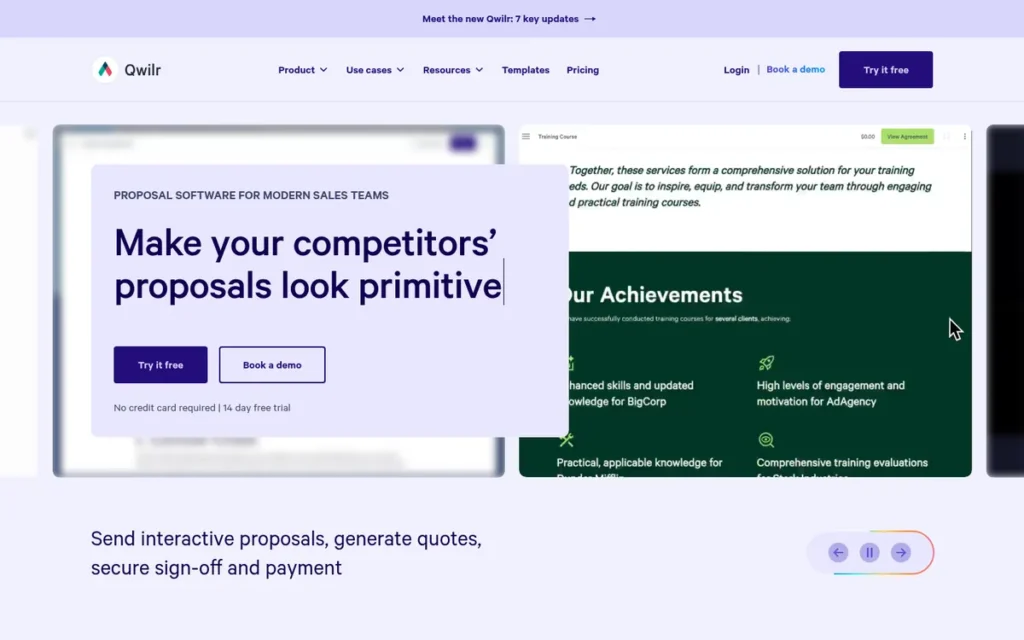
Category: Interactive Web Proposal Builder, publishes proposals as interactive web pages with embedded pricing, e-signature and payments.
At a Glance
- Category: Qwilr is an Interactive Web Proposal Builder.
- Best For: Qwilr is best for B2B sales teams and agencies that want AI-assembled, interactive web proposals tied to CRM deal data.
- Price Range: Qwilr costs $35–$75/user/month billed annually, and its Smart Proposal Engine requires the 10-seat Scale plan at about $9,000/year (Qwilr pricing page, November 2026).
- Primary Strength: Qwilr has the most specific documented AI feature set among the sales proposal tools evaluated. It includes URL-to-template generation, AI Prefill, call-transcript personalization and a rules-based Smart Proposal Engine.
- Biggest Limitation: Qwilr limits its Smart Proposal Engine, AI Prefill and Salesforce integration to the Scale plan, which requires 10 seats on annual billing.
- One-Line Summary: Qwilr is the best-documented AI proposal generator for sales teams in 2026, but its most advanced automation requires a 10-seat Scale plan costing about $9,000 per year.
- Last Verified: PlugRoute last verified Qwilr’s ratings, pricing and features in November 2026.
Overview
Qwilr is an interactive web proposal builder for B2B sales teams and agencies. It turns website URLs, CRM deal data and call transcripts into branded proposal pages with embedded e-signature and payments. Qwilr was founded in Sydney in 2014 and raised a $7.25M Series A in 2020 (Crunchbase News, 2020).
Qwilr ranked #1 with a weighted score of 4.30/5, just 0.07 points ahead of PandaDoc. That is the narrowest margin in this ranking. Qwilr’s lead comes from AI generation depth, so buyers who care more about CRM, CPQ and price should favor PandaDoc.
Key Features
- Qwilr’s AI Proposal Creator builds an editable proposal template from a company’s website URL and business details.
- Qwilr’s Smart Proposal Engine sets up content and pricing from sales rules and deal context, and Qwilr’s AI Prefill fills proposals from connected data sources.
- Qwilr’s AI can personalize proposal drafts from call transcripts, and Qwilr connects to ChatGPT and Claude through an MCP connector.
- Qwilr embeds e-signature, configurable pricing, calculators, video and QwilrPay (Stripe) deposits inside each web proposal.
- Qwilr integrates with HubSpot (creating proposals from Deal, Company or Contact records), Salesforce, Zoho, Pipedrive, Microsoft Dynamics, Zapier and QuickBooks.
Best For
Qwilr is best for sales teams of 10 or more on HubSpot or Salesforce that want AI to assemble personalized proposals from deal context. Qwilr Starter also suits smaller agencies that mainly want trackable web proposals with built-in payments.
Pricing
- Qwilr Starter costs $35/user/month billed annually, or $49 month-to-month (Qwilr pricing page, November 2026).
- Qwilr Growth costs $55/user/month, billed annually only, with a 5-seat minimum of about $3,300/year (Qwilr pricing page, November 2026).
- Qwilr Scale costs $75/user/month, billed annually only, with a 10-seat minimum of about $9,000/year (Qwilr pricing page, November 2026).
- Qwilr limits the Smart Proposal Engine, AI Prefill, conditional content and Salesforce integration to Scale. On Starter, Qwilr’s AI is available only through the MCP connector.
Strengths
- Qwilr held 4.6/5 on G2 across about 936 reviews and 4.6/5 on Capterra across 385 reviews (G2; Capterra, November 2026). Reviewers specifically praise Qwilr’s HubSpot integration and section-level engagement analytics.
- Qwilr published a named case study in which TravelBank cut document-generation time by 30% using Qwilr with Salesforce (Qwilr case study, November 2026). This is a single customer’s account.
- Qwilr documents SOC 2 Type II, GDPR alignment, PCI-DSS-related controls and a certified acceptance audit trail (Qwilr, November 2026).
- Qwilr closes the gap between proposal and payment by embedding e-signature and QwilrPay deposits inside each proposal. Qwilr also does not cap proposal sends on any plan (Qwilr pricing page, November 2026).
Limitations
- Qwilr’s biggest trade-off is that the Smart Proposal Engine and AI Prefill require the 10-seat, annual-only Scale plan. A 3-person agency would pay for 10 seats, about $9,000/year, to get them (Qwilr pricing page, November 2026).
- Qwilr’s web-first format adds friction in formal procurement, because G2 reviewers report that Qwilr’s PDF exports are not pixel-perfect (G2, November 2026).
- G2 reviewers report limited formatting control in Qwilr, missing advanced design modules, and API-created Qwilr pages that need manual formatting fixes (G2, November 2026).
- PlugRoute could not verify Qwilr’s current headcount or which Qwilr plan includes the AI Proposal Creator.
A creative agency owner on r/b2bmarketing shared their experience:
“We’ve got a big library of modular sections for web/SEO/hosting/social, our intake to scope to pricing is pretty dialed in, and we’ve tested the usual proposal platforms like Qwilr, PandaDoc, Proposify, even Notion-to-Slides. They’re fine for quotes and contracts, but the minute you’re working on a design-heavy deck, the editing just falls apart” Posted by u/shaddy-haggag
Takeaway: Even agencies with mature proposal libraries find that Qwilr, like PandaDoc and Proposify, handles quotes and contracts well but breaks down on design-heavy proposal editing.
Verdict
Qwilr is the best AI proposal generator in 2026 for sales teams that can justify its Scale plan, because Qwilr documents more specific proposal-generation AI than any other sales proposal tool PlugRoute evaluated.
Smaller teams should treat Qwilr Starter as an interactive proposal builder with limited native AI, not a full AI generator. Buyers who need pixel-perfect PDFs should test Qwilr’s exports during a trial before committing to annual billing.
2. PandaDoc: Best All-in-One Proposal-to-Payment Platform for SMB Sales Teams
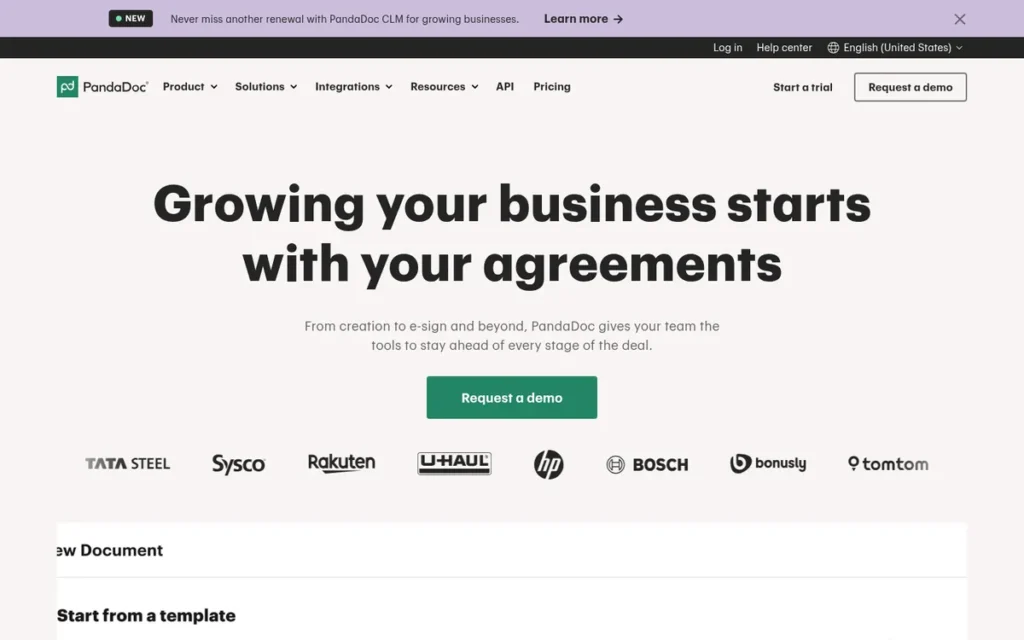
Category: Sales Proposal Platform, creates, sends, signs and tracks branded client proposals, quotes and contracts.
At a Glance
- Category: PandaDoc is a Sales Proposal Platform.
- Best For: PandaDoc is best for small-to-mid-sized sales teams that need proposals, quotes, CPQ, e-signature and payments inside their CRM.
- Price Range: PandaDoc offers a Free eSign plan (5 sent documents/month), paid plans at $19–$49/user/month billed annually, and custom Enterprise pricing (PandaDoc support, November 2026).
- Primary Strength: PandaDoc has the broadest proposal-to-payment workflow in this evaluation. It combines CPQ, e-signature, payments and two-way HubSpot sync with the largest G2 review base in the category.
- Biggest Limitation: PandaDoc’s strongest AI generation runs through its ChatGPT app rather than its own editor, and one third-party comparison scored PandaDoc’s AI generation 3.8/5 (Cobl.ai, November 2026).
- One-Line Summary: PandaDoc has the highest G2 rating (4.7/5) and the broadest proposal-to-payment workflow in this 2026 evaluation, though its in-product AI is an assistant rather than a full proposal generator.
- Last Verified: PlugRoute last verified PandaDoc’s ratings, pricing and features in November 2026.
Overview
PandaDoc is an all-in-one document platform for small-to-mid-sized sales teams that manage proposals and quotes inside their CRM. It combines AI-assisted proposal creation, templates, CPQ, legally binding e-signatures and in-document payments. PandaDoc reports serving 60,000+ organizations, including Autodesk, Rakuten and Sysco (PandaDoc, 2026).
PandaDoc ranked #2 with a weighted score of 4.23/5. PandaDoc led every evaluated tool on review volume and workflow coverage. It trails Qwilr by 0.07 points, mainly because Qwilr documents deeper AI generation.
Key Features
- PandaDoc includes CPQ with guided selling, catalog-based quoting, approval rules and signing-order rules that run inside CRM workflows.
- PandaDoc’s HubSpot integration supports two-way sync, so reps can create, send, sign and collect payment without leaving HubSpot.
- PandaDoc integrates with Salesforce, HubSpot, Pipedrive, Stripe, PayPal, QuickBooks Payments, Xero and Zapier, the broadest integration set among the sales proposal tools evaluated.
- PandaDoc provides legally binding e-signatures, in-document payments, deal rooms and workflow automation in a single platform.
- PandaDoc’s ChatGPT app creates proposals from natural-language prompts, fills templates, adds recipients and signature fields, and sends documents for e-signature without leaving ChatGPT. PandaDoc also supports MCP-based AI agents (PandaDoc, November 2026).
Best For
PandaDoc is best for SMB sales teams that want one platform for drafting, quoting, signing and collecting payment. PandaDoc especially fits HubSpot or Salesforce users who value CPQ and approval rules more than AI-first generation.
Pricing
- PandaDoc’s Free eSign plan allows 5 sent documents per month, 2 recipients per document and 5 templates. Older annual free accounts may keep a 60-document annual allowance (PandaDoc support, November 2026).
- PandaDoc Starter costs $19/user/month billed annually, or $35 monthly (PandaDoc support, November 2026).
- PandaDoc Business costs $49/user/month billed annually, or $65 monthly, and PandaDoc Enterprise is custom-priced (PandaDoc support, November 2026).
- PandaDoc offers a 14-day trial. G2 reviewers report that CRM integrations, custom workflows and bulk send require higher PandaDoc plans (G2, November 2026).
Strengths
- PandaDoc held 4.7/5 on G2 across about 3,861 reviews (G2, November 2026). PandaDoc also reports earning the highest Likelihood to Recommend score (93%) in G2’s Spring 2026 Proposals category (PandaDoc, 2026; vendor-reported G2 result).
- PandaDoc held 4.5/5 on Capterra across about 1,260 reviews (Capterra, November 2026), which gives PandaDoc the largest combined third-party review base in this evaluation.
- PandaDoc states that it holds SOC 2 Type II and provides its SSAE 18 SOC 2 Type II report on request. PandaDoc also markets HIPAA, GDPR and UETA compliance (PandaDoc Security page, November 2026).
- PandaDoc reports that customers close deals 30% faster and see an 18% close-rate lift (PandaDoc, 2026). These are vendor-reported correlations, not controlled studies.
In a thread comparing proposal tools, a self-identified former PandaDoc employee on r/sales noted:
“Go with PandaDoc. I used to work there 4 years ago and back than it was already miles ahead than proposify and other alternatives. Not as big as DocuSign in regards to market share but product is arguably better. They’re also cheaper than proposify and have free plan as well. NOT a sponsored comment haha, I truly believe the product is the best.” Posted by u/z_alex
Takeaway: A former PandaDoc employee rates PandaDoc ahead of Proposify on both product quality and price, though the endorsement comes from an insider rather than a current customer.
Limitations
- PandaDoc’s biggest trade-off is that its strongest AI generation runs through the ChatGPT app. PandaDoc’s in-product AI Assistant finds and summarizes agreements but does not write document content (PandaDoc help center, November 2026).
- Cobl.ai scored PandaDoc 3.8/5 for AI generation versus 4.8/5 for collaboration, and G2 reviewers ask PandaDoc for “more useful AI features” (Cobl.ai; G2, November 2026).
- PandaDoc’s Starter plan allows only 5 templates, and G2 reviewers describe PandaDoc’s editor as slow or clunky for detailed formatting, including unwanted rows in tables (PandaDoc support; G2, November 2026).
- PandaDoc’s Trustpilot rating of about 3.3/5 contrasts sharply with its G2 score. Complaints center on billing-plan changes, unexpected charges and hard-to-reach support (Trustpilot, November 2026).
- PlugRoute could not verify PandaDoc’s Trustpilot review count, because sources conflict (97 vs. about 660 reviews).
Verdict
PandaDoc is the best all-in-one proposal-to-payment platform in 2026 for small-to-mid-sized sales teams that value CRM, CPQ and e-signature integration over AI-first proposal generation.
PandaDoc trails Qwilr by only 0.07 weighted points, and the whole gap comes from AI depth. Buyers should confirm which PandaDoc plan includes the CRM features they need and read the billing terms before committing to annual billing.
3. Proposify: Best for Brand-Controlled Sales Teams That Need Proposal Governance
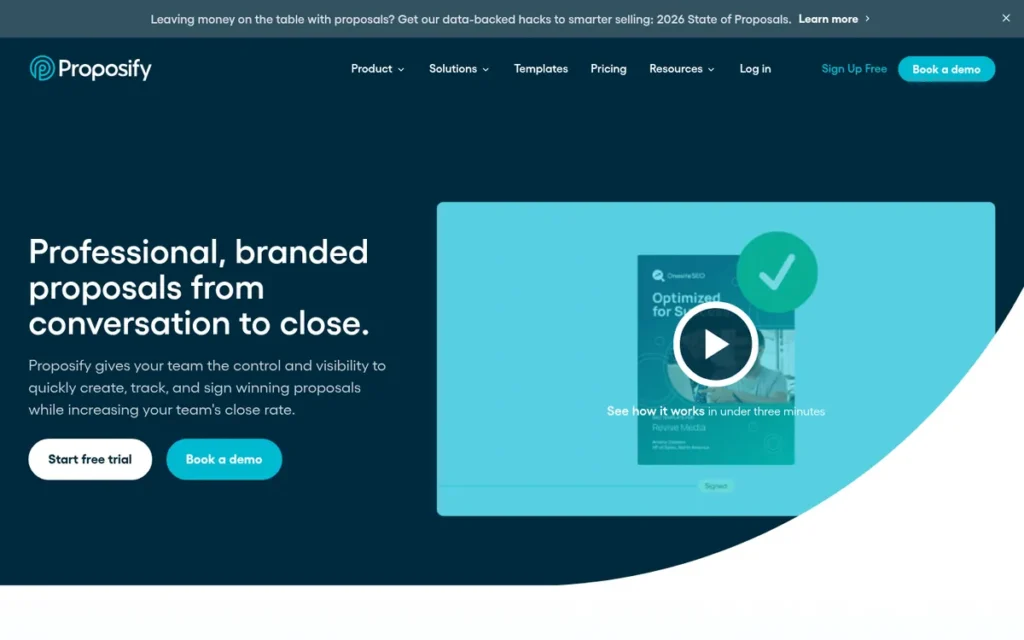
Category: Sales Proposal Platform.
At a Glance
- Category: Proposify is a Sales Proposal Platform.
- Best For: Proposify is best for sales teams and agencies that need every rep’s proposal to stay on-brand and on-price.
- Price Range: Proposify ranges from $39/user/month on the Build plan (billed annually) to $12,800/year for 10 users on the Scale plan (Proposify pricing page, November 2026).
- Primary Strength: Proposify’s locked sections, role permissions and approval workflows give managers the most mature brand and pricing controls among the sales proposal tools evaluated.
- Biggest Limitation: Proposify reserves SSO and premium integrations for its $12,800/year, 10-user Scale plan and does not document in-proposal payments.
- One-Line Summary: Proposify is the highest-scoring governance-first proposal platform in PlugRoute’s 2026 evaluation, pairing AI writing from its entry Build plan with locked pricing and messaging.
- Last Verified: PlugRoute last verified Proposify’s ratings, pricing and features in November 2026.
Overview
Proposify is a sales proposal platform built around content governance, for sales teams and agencies that need every rep’s proposal to stay on-brand. It combines AI-assisted section drafting, branded templates, locked pricing sections, approval workflows and e-signatures. Proposify, founded in Halifax in 2013, reports 10,000+ customers in about 40 countries (Proposify About page, 2026).
Proposify ranked #3 with a weighted score of 3.80/5. Proposify scored well on governance, SOC 2 Type II documentation and AI writing on its entry plan. It trails PandaDoc on review volume and workflow breadth, and PlugRoute found no documentation of in-proposal payments.
Key Features
- Proposify’s AI writing tool drafts and revises proposal sections such as executive summaries, scopes of work and project approaches from call notes, transcripts or requirements (Proposify AI Proposal Generator page, November 2026).
- Proposify includes AI writing and an “AI + MCP server” capability on its entry Build plan, which connects proposal work to external AI assistants (Proposify pricing page, November 2026).
- Proposify lets admins lock sections, set role permissions and require approval workflows, so reps can personalize proposals without changing approved pricing or messaging.
- Proposify includes interactive pricing tables, e-signatures and section-level analytics.
- Proposify integrates with CRMs including Salesforce and offers a content library for reusing approved content.
Best For
Proposify is best for sales teams and agencies whose managers must enforce approved pricing, legal language and branding across many reps. Proposify also fits small teams that want AI drafting from call notes without a seat minimum.
Pricing
- Proposify Build costs $39/user/month billed annually, or $49 monthly, and includes AI writing and the MCP server (Proposify pricing page, November 2026).
- Proposify Grow costs $65/user/month billed annually (Proposify pricing page, November 2026).
- Proposify Scale, previously named Business, costs $12,800/year for 10 users plus $780/year per additional user. Scale adds SSO, multiple workspaces and premium integrations (Proposify pricing page, November 2026).
- Proposify states that every paid plan includes unlimited documents and signatures (Proposify pricing page, November 2026).
Strengths
- Proposify held 4.6/5 on G2 across about 1,146 reviews and 4.4/5 on Capterra across 299 reviews (G2; Capterra, November 2026). Reviewers praise Proposify’s design editor, approvals, interactive pricing and continued AI development.
- Proposify scored 8.6/10 for assembly and approval workflows in G2’s Proposal category (G2, November 2026), which supports Proposify’s governance positioning.
- Proposify states it is SOC 2 Type II certified and GDPR compliant. The SOC 2 audit was performed by 360 Advanced for Security, Availability and Confidentiality, and the report is available on request (Proposify Security page, November 2026).
- Proposify’s State of Proposals research analyzed 1M+ proposals and found that proposals with an e-signature option close about 30% faster (Proposify, 2026). This is category-level research, not proof of Proposify’s own impact.
Limitations
- Proposify’s biggest trade-off is that its governance-heavy design has a steeper learning curve. G2 reviewers describe Proposify’s editor as less flexible than PandaDoc’s, and its ease-of-use score of 8.5/10 is slightly below the category average (G2, November 2026).
- Proposify reserves SSO, multiple workspaces, custom reporting and premium integrations for its Scale plan. Scale costs $12,800/year for 10 users plus $780/year per additional user (Proposify pricing page, November 2026).
- Proposify’s Grow plan costs $65/user/month billed annually, which is $16 more per user than PandaDoc Business at $49 (vendor pricing pages, November 2026).
- Proposify’s in-proposal payment collection was not documented in PlugRoute’s research, which matters for teams that want deposits at signing.
- PlugRoute could not verify whether Proposify has a monthly send allowance. A competitor’s claim (Qwilr, 2026) conflicts with Proposify’s “unlimited documents” statement.
A Proposify trainer and admin on r/sales shared their experience:
“We use. Half the sales team loves it. Others hate it. It’s clunky but works best if you stay away from customization. We have all our product collateral, case studies, and team bios + product fees/descriptions loaded in there. I’m a trainer and admin on it. Can bang out a proposal in 15-20 minutes. We also use for SOWs and project sign offs. Proposify CX team and support are pretty helpful too. Lots of room for improvement but I like it.” Posted by u/sannicanbro
Takeaway: Proposify splits sales teams between fans and detractors, producing fast proposals once content is loaded but feeling clunky as soon as reps go beyond standard templates.
Verdict
Proposify is the best AI-assisted proposal platform in 2026 for brand-controlled sales teams that need approved pricing and messaging locked across every rep’s proposals.
Proposify includes AI writing from the $39 Build plan, so small teams can reach it without a seat minimum. Teams that need SSO should budget for the 10-user Scale plan. Teams that collect deposits at signing should confirm Proposify’s payment options during the trial.
4. Loopio: Best RFP Response Platform for Library-Grounded, Verifiable AI Answers
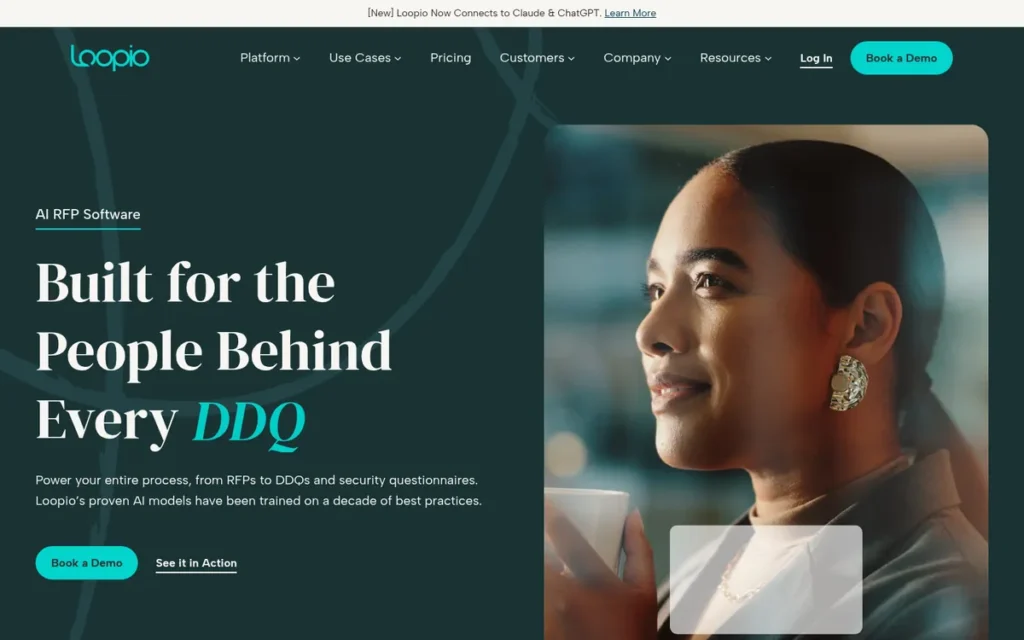
Category: RFP Response Platform, answers buyer-issued RFPs, RFIs, DDQs and security questionnaires from an approved content library.
At a Glance
- Category: Loopio is an RFP Response Platform.
- Best For: Loopio is best for mid-market and enterprise teams that answer recurring RFPs, DDQs and security questionnaires and can assign a dedicated library owner.
- Price Range: Loopio is quote-only. Vendr transaction estimates put contracts at about $10K–$100K+/year (median about $24,318/year), and Loopio’s entry plan includes 10 seats (Vendr; Loopio pricing page, November 2026).
- Primary Strength: Loopio’s Verbatim Mode inserts approved library answers word for word, which gives RFP teams the clearest documented safeguard against AI misstating commitments.
- Biggest Limitation: Loopio’s quote-only pricing and 10-seat entry plan put it out of reach for freelancers and small teams, and Loopio’s AI quality depends on ongoing library maintenance.
- One-Line Summary: Loopio is the highest-scoring library-grounded RFP response platform in PlugRoute’s 2026 evaluation, best for teams that answer formal questionnaires at volume rather than write persuasive sales proposals.
- Last Verified: PlugRoute last verified Loopio’s ratings, pricing and features in November 2026.
Overview
Loopio is an RFP response platform for mid-market and enterprise teams that handle recurring formal bids. It answers RFPs, RFIs, DDQs and security questionnaires using a governed content library, Magic auto-fill and library-grounded generative AI. Loopio, founded in Toronto in 2014, reports serving 1,700+ companies (G2 seller page, 2026).
Loopio ranked #4 with a weighted score of 3.60/5. Loopio led the RFP tools on named customer evidence and accuracy safeguards. Its cost and lack of e-signature or payments make Loopio a poor fit for most sales-proposal buyers.
Key Features
- Loopio maintains a governed content library with unlimited entries, so teams can reuse approved answers across RFPs, RFIs, DDQs and security questionnaires.
- Loopio’s Magic feature auto-fills questionnaire responses from the library, and Loopio’s generative AI drafts answers grounded in the library and connected sources.
- Loopio’s Verbatim Mode inserts approved library answers word for word with no AI rewriting, for answers where exact wording matters.
- Loopio includes project collaboration tools for assigning questions to SMEs and managing review across a response team.
- Loopio is commonly cited as integrating with Salesforce, Slack and Microsoft Teams.
Best For
Loopio is best for mid-market and enterprise teams, including government-sector sellers, that answer several formal RFPs or security questionnaires each week and can assign someone to maintain the Loopio content library.
Pricing
- Loopio did not publish prices as of November 2026, and Loopio’s entry Foundations plan includes 10 seats (Loopio pricing page, November 2026).
- Vendr transaction estimates put Loopio Essentials at about $10K–$18K/year, Plus at about $25K–$50K/year and Advanced at about $40K–$100K/year (Vendr, November 2026).
- Loopio’s median contract value is about $24,318/year across 269 purchases, within a range of $11,770–$59,147 (Vendr, November 2026). These figures are estimates, not list prices.
- Loopio buyers should request a quote that itemizes AI features and seat counts.
Strengths
- Loopio published a named case study in which WellRight automated 53% of its RFP responses using Loopio’s Library and Magic features (Loopio case study, November 2026).
- Loopio’s DocuSign case study reports that DocuSign grew from 25 to 132 global Loopio users in one year and saved hours per response with Magic (Loopio case study, November 2026).
- Loopio held 4.6/5 on G2 across 813 reviews and 4.6/5 on Capterra across 74 reviews (G2; Capterra, November 2026).
- Loopio states that it completes annual third-party SOC 2 Type II audits and holds ISO 27001 certification (Loopio, November 2026).
Limitations
- Loopio’s biggest trade-off is that Loopio’s AI is only as accurate as the content library behind it. The library needs ongoing taxonomy, ownership and review work, and search gets worse without it (G2 reviewers; Arphie and Inventive AI competitor blogs, 2026).
- Loopio’s quote-only pricing and 10-seat entry plan rule out freelancers and small businesses. Vendr estimates typical Loopio contracts at roughly $15K–$60K per year (Vendr, November 2026).
- Loopio’s own benchmark puts the average RFP at about 33 hours of work, so Loopio’s value depends on bid volume. A team answering one RFP per month may not recoup a median contract of about $24,000 (Loopio, 2025; Vendr, November 2026).
- Loopio is not built for designed, persuasive sales proposals, e-signature or payment collection.
- PlugRoute could not verify the exact scope of Loopio’s Salesforce, Slack and Microsoft Teams integrations.
An enterprise account executive on r/procurement noted:
“enterprise here. AE but I work on rfx process too
- migrated from loopio. was expensive. good project features though.” Posted by u/likablestoppage27
Takeaway: Enterprise users rate Loopio’s project features well, but for some teams the price alone is enough reason to switch to another platform.
Verdict
Loopio is the best choice in 2026 for mid-market and enterprise teams that answer high volumes of formal RFPs and security questionnaires and can dedicate staff to maintaining a content library.
Loopio’s Verbatim Mode and named case studies make its accuracy and efficiency claims easier to check than most competitors’ claims. Sales teams sending routine client proposals should choose a sales proposal platform instead of Loopio.
5. Responsive (formerly RFPIO): Best for Enterprise Response Programs Needing Traceable AI
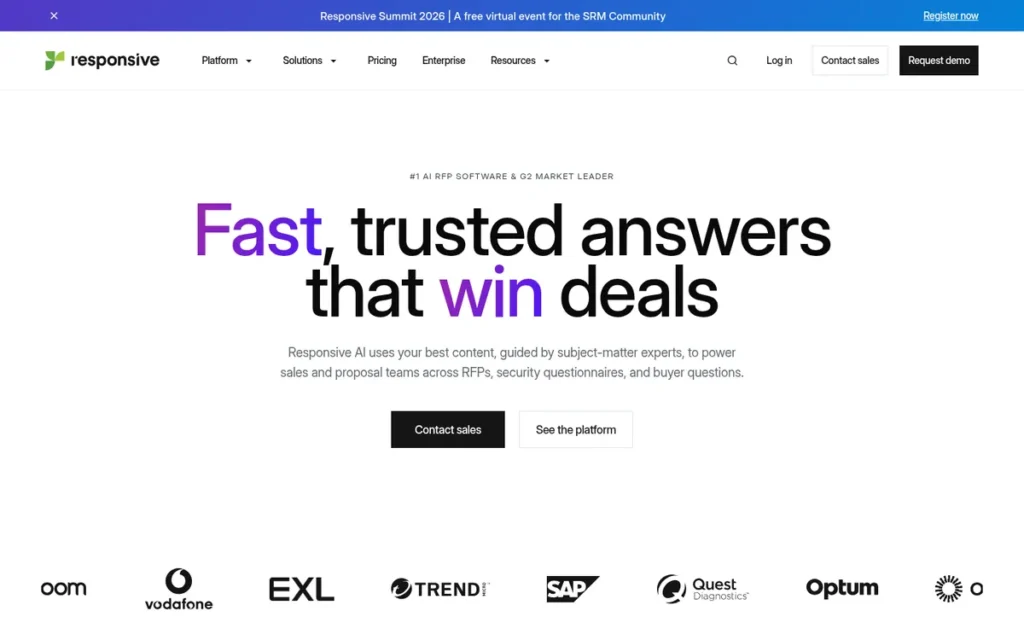
Category: RFP Response Platform.
At a Glance
- Category: Responsive is an RFP Response Platform.
- Best For: Responsive is best for large enterprises running multi-team RFP, DDQ and security-questionnaire programs that need traceable AI answers.
- Price Range: Responsive’s Emerging Edition starts at a $10,000/year platform fee. Growth and Enterprise are quote-only, and user licenses and add-ons cost extra (Responsive pricing page, November 2026).
- Primary Strength: Responsive documents the most process-complete AI workflow among the tools PlugRoute evaluated in 2026. Its agents split requests, draft from approved content, route questions to SMEs and score answers with TRACE.
- Biggest Limitation: Responsive’s steep learning curve, dense admin settings and separately priced licenses and add-ons raise both implementation effort and true cost.
- One-Line Summary: Responsive documents the most process-complete AI response workflow among the tools PlugRoute evaluated in 2026, but its complexity and add-on pricing make it more than routine sales proposals need.
- Last Verified: PlugRoute last verified Responsive’s ratings, pricing and features in November 2026.
Overview
Responsive (formerly RFPIO) is an enterprise Strategic Response Management platform for large, multi-team programs. It drafts, routes and quality-checks answers to RFPs, DDQs and security questionnaires using AI agents, ASK AI and TRACE Score accuracy checks. Responsive reports serving 2,000+ organizations, from SMBs to Fortune 500 companies (Responsive, 2026).
Responsive ranked #5 with a weighted score of 3.50/5. Responsive matches Loopio on AI depth and security score and has a larger G2 review base. It trails Loopio by 0.10 points because its results evidence is mostly vendor-claimed rather than named.
Key Features
- Responsive’s AI agents split incoming requests into questions, draft answers from approved content, route questions to SMEs and run quality checks.
- Responsive’s ASK AI assistant generates answers from the organization’s approved content.
- Responsive’s TRACE Score and Quality Check rate answers for accuracy and traceability, so reviewers can see where each answer came from.
- Responsive’s Agent Studio lets teams build custom AI agents for their own response workflows.
- Responsive integrates with Salesforce and Slack, and lists SAML/SSO, translation, sandbox environments, custom roles and eSignature as advanced features or add-ons.
Best For
Responsive is best for large enterprises with dedicated proposal operations teams. These teams handle RFPs, DDQs, security questionnaires and risk assessments across several departments and need traceable Responsive answers for compliance-heavy bids.
Pricing
- Responsive’s Emerging Edition starts at $10,000/year as a platform fee, and Responsive’s Growth and Enterprise editions are quote-only (Responsive pricing page, November 2026).
- Responsive prices user licenses, eSignature, premium connectors, custom AI, migration and premium support separately (Responsive pricing page, November 2026).
- Responsive’s $19/user/month figure on Capterra is probably a marketplace entry price and is not typical of enterprise contracts (Capterra, November 2026).
- PlugRoute found no Vendr contract data for Responsive as of November 2026, so buyers should request an itemized Responsive quote.
Strengths
- Responsive held 4.5/5 on G2 across 1,314 reviews and 4.5/5 on Capterra across 190 reviews with 96% positive sentiment (G2; Capterra, November 2026).
- Responsive publicly lists SOC 2 Type II, ISO 27001, ISO 27701 and ISO 42001 certifications (Responsive Security page, November 2026).
- Responsive’s TRACE Score, cited answers and Quality Check directly address the worry that AI will misstate scope or commitments, a safeguard most sales proposal tools do not document.
- Responsive’s Summer 2024 report, a vendor-published summary of G2 data, found that 97% of users rated it 4–5 stars and 91% would recommend it (Responsive, 2024). Responsive also claims an average efficiency gain of about 40% (Responsive, November 2026; vendor claim).
Limitations
- Responsive’s biggest trade-off is complexity, and G2 reviewers describe a steep Responsive learning curve (G2, November 2026).
- Software Advice reviewers say Responsive’s admin settings are dense and confusing and that Responsive’s search gets cluttered without active library management (Software Advice, November 2026).
- G2 reviewers say Responsive’s setup is time-consuming, imports from oddly formatted documents can be messy, and AI autofill is sometimes inaccurate, with too little control over AI tone (G2, November 2026).
- Responsive’s $10,000/year Emerging price covers the platform fee only, so licenses and add-ons must be quoted separately (Responsive pricing page, November 2026).
- PlugRoute could not verify which Responsive AI features cost extra or the size of typical Responsive contracts.
Verdict
Responsive is the strongest choice in 2026 for enterprises running large, multi-team response programs that need agent-based AI with traceable, quality-checked answers.
Responsive’s TRACE Score and agent routing go further than any sales proposal tool in this list. Buyers should budget for implementation effort, confirm which Responsive features are add-ons, and pilot answer quality against Loopio.
6. Better Proposals: Best Budget Dedicated Proposal Tool for Agencies and Freelancers
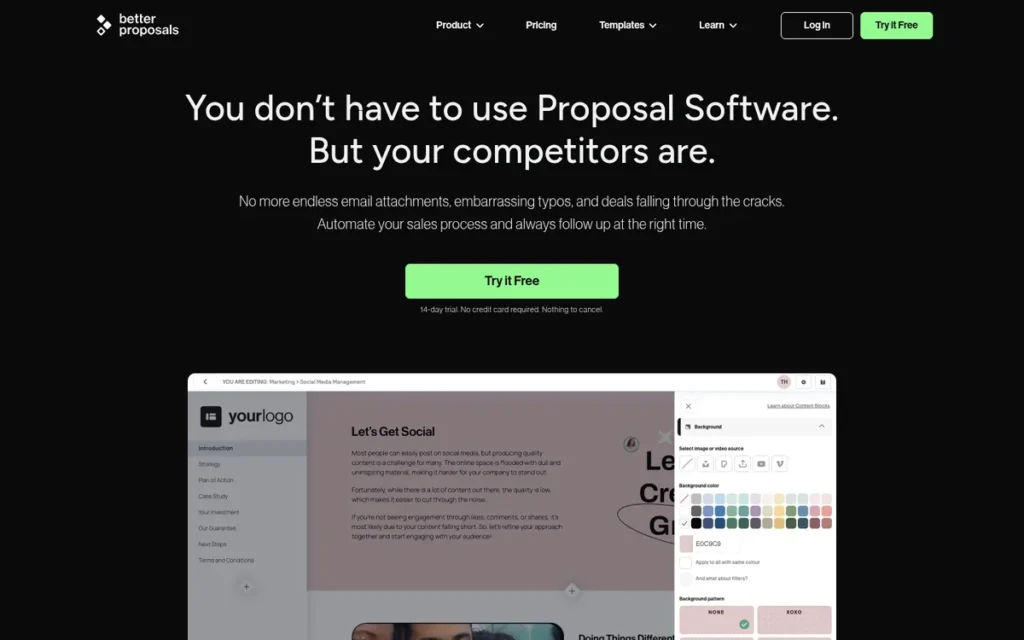
Category: Sales Proposal Platform.
At a Glance
- Category: Better Proposals is a Sales Proposal Platform.
- Best For: Better Proposals is best for agencies, freelancers and small businesses that want affordable branded proposals with e-signature and payments.
- Price Range: Better Proposals costs $13–$42/user/month billed annually, and its Starter plan covers 1 user and 10 sent documents per month (Better Proposals pricing page, November 2026).
- Primary Strength: Better Proposals delivers e-signature, three payment processors and section-level tracking at the lowest entry price among the dedicated proposal tools evaluated.
- Biggest Limitation: Better Proposals lists AI-related integrations rather than a built-in AI generator, which gives it the least documented native AI generation among the sales proposal tools evaluated.
- One-Line Summary: Better Proposals is the most affordable dedicated proposal tool in PlugRoute’s 2026 evaluation for agencies and freelancers, but buyers should not choose it mainly for AI generation.
- Last Verified: PlugRoute last verified Better Proposals’ ratings, pricing and features in November 2026.
Overview
Better Proposals is a web-based sales proposal tool for agencies, freelancers and small businesses, with one of the lowest entry prices in the category. It offers 250+ templates, e-signatures, Stripe, PayPal and GoCardless payments, and section-level tracking. Better Proposals reports 10,000+ brand, small-business and freelancer users (Better Proposals customers page, 2026).
Better Proposals ranked #6 with a weighted score of 3.30/5. Better Proposals led on value and Capterra satisfaction but scored lowest among the sales proposal tools on documented AI. Its Enterprise plan does add content locking and approvals.
Key Features
- Better Proposals provides 250+ templates for mobile-friendly web proposals with built-in e-signatures and payments through Stripe, PayPal and GoCardless.
- Better Proposals tracks opens, forwards and downloads, shows section-level analytics and offers live chat inside proposals.
- Better Proposals offers 50+ integrations including HubSpot, Salesforce and Pipedrive, but it pulls CRM data into proposals rather than creating proposals from CRM records.
- Better Proposals’ Enterprise plan adds content locking, manager approvals, simultaneous editing and advanced permissions (Better Proposals pricing page, November 2026).
- Better Proposals says its AI helps users write, send and close proposals faster in a human tone. Its pricing page lists AI-related integrations on Premium and above and no built-in AI generator on any plan (Better Proposals pricing page, November 2026).
Best For
Better Proposals is best for agencies, consultants and freelancers who send frequent client proposals, want e-signature and payment collection on a tight budget, and see AI as a secondary need.
Pricing
- Better Proposals Starter costs $13/user/month billed annually, or $19 monthly, for 1 user and 10 sent documents per month (Better Proposals pricing page, November 2026).
- Better Proposals Premium costs $21/user/month billed annually, or $29 monthly, with unlimited users, 50 documents per month and AI-related integrations (Better Proposals pricing page, November 2026).
- Better Proposals Enterprise costs $42/user/month billed annually, or $49 monthly, with unlimited documents, content locking and manager approvals (Better Proposals pricing page, November 2026).
- Better Proposals limits Zapier to higher plans, which Capterra reviewers call “somewhat restrictive” (Capterra, November 2026).
Strengths
- Better Proposals held 4.8/5 on Capterra across 167 reviews, with sub-scores of 4.8 for value, 4.8 for support and 4.7 for ease of use (Capterra, November 2026). That is the highest Capterra rating in this evaluation.
- Better Proposals published a named case study in which Zinc Digital, a 25-person agency and customer since 2017, found that well-designed proposals converted 82% better (Better Proposals case study, November 2026).
- Better Proposals has the lowest entry price among the dedicated sales proposal tools evaluated, at $13/user/month billed annually (Better Proposals pricing page, November 2026).
- Better Proposals reports 88% higher conversion than PDFs and 50% faster document creation (Better Proposals customers page, 2026). These are vendor-reported aggregate statistics.
Limitations
- Better Proposals’ biggest trade-off is strong workflow value but uncertain AI. Better Proposals markets AI-assisted writing, while a PandaDoc-authored comparison says it has no native AI generator (PandaDoc blog, 2026), and PlugRoute discounted that competitor source as it does for every vendor.
- Better Proposals’ Starter plan covers 1 user and 10 sent documents per month. Teams need Premium ($21/user/month annually, 50 documents/month) to add users (Better Proposals pricing page, November 2026).
- Capterra reviewers describe Better Proposals’ editor as “outdated” and “clunky” for layout changes, and they report fiddly payment tables and PDF rendering problems (Capterra, November 2026).
- Better Proposals has a thin G2 base of 4.3/5 from 51 reviews (G2, November 2026), the lowest G2 volume among the sales proposal tools.
- PlugRoute could not verify how deep Better Proposals’ AI goes or whether Better Proposals holds a SOC 2 report.
Verdict
Better Proposals is the best-value dedicated proposal tool in 2026 for agencies and freelancers who need e-signature and payment collection without enterprise pricing.
Better Proposals earns its score on price and Capterra satisfaction, not on AI. Buyers who mainly want AI to turn call notes into proposals should test Better Proposals’ AI integrations during a trial or consider Proposify Build or Qwilr.
7. Bonsai: Best All-in-One Business Suite for Solo Freelancers
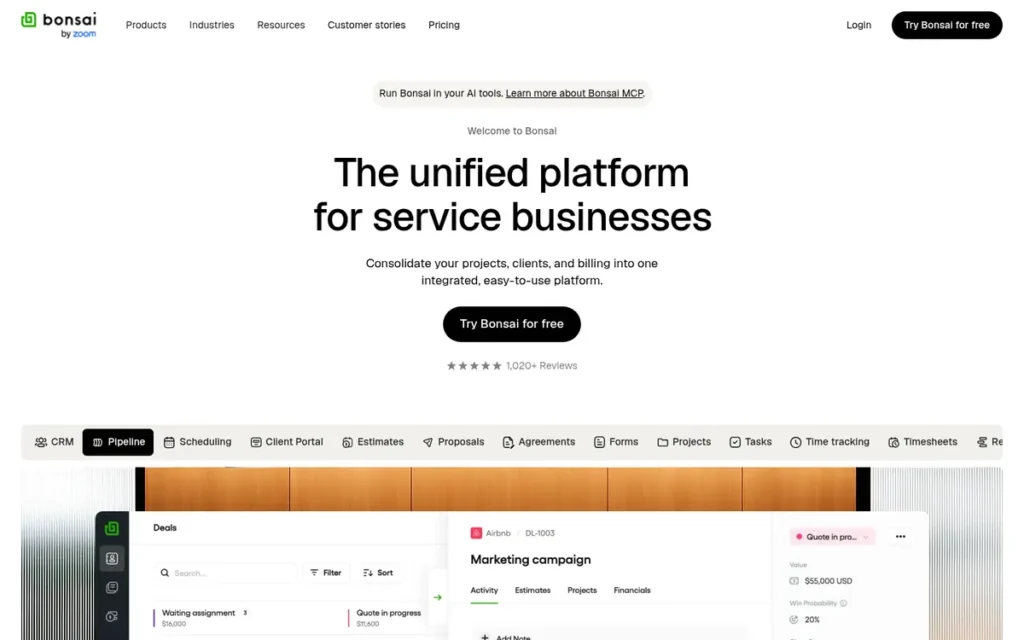
Category: Freelancer Business Suite, bundles proposals with contracts, invoicing, payments and project tools for solo operators.
At a Glance
- Category: Bonsai is a Freelancer Business Suite.
- Best For: Bonsai is best for solo freelancers and very small agencies that want proposals, contracts and invoicing in one tool.
- Price Range: Bonsai costs $19–$49/user/month billed annually for plans that include proposals, and Basic at $9 excludes them. Card payments carry Stripe processing of 2.9% + $0.30 plus a 1% Bonsai platform fee (Bonsai pricing page and help center, November 2026).
- Primary Strength: Bonsai replaces several freelancer subscriptions by connecting proposals, contracts, invoicing, payments and time tracking in its $19/month Essentials plan.
- Biggest Limitation: PlugRoute could not verify Bonsai’s AI proposal capabilities, and reviewers report restrictive Bonsai proposal customization and payment holds.
- One-Line Summary: Bonsai is the only freelancer business suite in this 2026 ranking and covers proposals, contracts, invoicing, payments and time tracking in one subscription, but it is not a dedicated AI proposal generator.
- Last Verified: PlugRoute last verified Bonsai’s ratings, pricing and features in November 2026.
Overview
Bonsai is an all-in-one business suite for freelancers and small agencies. One subscription bundles proposals, contracts, e-signatures, invoicing, payments, time tracking, a CRM and project management. Bonsai is a Y Combinator W16 company backed by Matrix Partners (TechCrunch, 2016).
Bonsai ranked #7 with a weighted score of 2.80/5. Bonsai scores well on value and Trustpilot sentiment. PlugRoute could not verify Bonsai’s AI proposal features or security documentation, and Bonsai’s only performance data dates from 2016.
Key Features
- Bonsai’s Essentials plan includes proposals, contracts, e-signatures, invoices and payments in a single workspace.
- Bonsai connects accepted proposals to contracts and invoices, so freelancers can go from pitch to payment without switching tools.
- Bonsai includes a CRM, time and expense tracking, scheduling, forms, a client portal and project management with Gantt and workload views.
- Bonsai’s Premium plan adds QuickBooks, Xero and Zapier integrations, a sales pipeline and removal of Bonsai branding.
- Bonsai markets AI-assisted features, and third-party reviews describe Bonsai’s proposal AI as assisted auto-fill from client details and saved pricing (SmartToolsPick, 2026). PlugRoute found no Bonsai feature page documenting its scope.
Best For
Bonsai is best for solo freelancers and very small agencies who would rather pay for one connected tool than buy a proposal platform plus separate billing software.
Pricing
- Bonsai Basic costs $9/user/month billed annually ($15 monthly) and excludes proposals, contracts and invoicing (Bonsai pricing page, November 2026).
- Bonsai Essentials costs $19/user/month billed annually ($25 monthly) and is the cheapest Bonsai plan that includes proposals (Bonsai pricing page, November 2026).
- Bonsai Premium costs $29/user/month billed annually ($39 monthly). Bonsai Elite costs $49/user/month billed annually ($59 monthly) with a 3-user minimum (Bonsai pricing page, November 2026).
- Bonsai payments via Stripe cost 2.9% + $0.30 per card transaction plus a 1% Bonsai platform fee, or about $39.30 on a $1,000 card payment (Bonsai help center, November 2026).
Strengths
- Bonsai held about 4.2–4.3/5 on Trustpilot across about 617–632 reviews and 4.6/5 on Capterra across 95 reviews (Trustpilot; Capterra, November 2026). Reviewers cite fast support and smooth onboarding.
- Bonsai held 4.3/5 on G2 across about 101 reviews (G2, November 2026), so Bonsai is rated above 4/5 on all three review platforms PlugRoute checked.
- Bonsai Essentials at $19/month billed annually is one of the lowest-cost ways to get proposals, contracts, invoicing and payments in a single tool (Bonsai pricing page, November 2026).
- Bonsai covers the whole freelancer client workflow. One Capterra reviewer said Bonsai supplied the essential combination of “invoicing, accounting, time tracking, contracts and proposals” (Capterra, November 2026).
Limitations
- Bonsai’s biggest trade-off is breadth over proposal depth, and reviewers describe Bonsai’s proposal customization as restrictive (Capterra; G2, November 2026).
- Bonsai’s payment model adds cost and risk. The 1% platform fee (1.35% on American Express) sits on top of Stripe processing, and reviewers report funds held for weeks (Bonsai help center; G2; Capterra, November 2026).
- Bonsai’s Basic plan excludes proposals entirely, so $19/month is the practical minimum, and Software Finder reports Bonsai price increases of over 150% across several years (Software Finder, 2026).
- Bonsai’s only performance figures (paid about two weeks faster, 3× fewer late payments) date from 2016 (TechCrunch, 2016).
- PlugRoute could not verify the scope of Bonsai’s AI, Bonsai’s security certifications, or Bonsai’s current headcount and headquarters.
Verdict
Bonsai is the best all-in-one option in 2026 for solo freelancers who want proposals, contracts, invoicing and time tracking in a single low-cost subscription.
Bonsai ranks last because it is a client-workflow suite with unverified proposal AI, not a dedicated AI proposal generator. Freelancers should weigh Bonsai’s 1% platform fee and reported payment holds against pairing a dedicated proposal tool with their existing invoicing software.
Which Tools Actually Generate Proposals With AI?
Qwilr, Loopio and Responsive document the deepest AI generation among the seven tools in 2026. PandaDoc and Proposify both generate proposal content from prompts or notes and connect to external AI assistants, and Proposify includes AI writing on its $39 Build plan. Better Proposals lists AI integrations only, and Bonsai’s AI is unverified.
PlugRoute scored each tool on a five-level capability ladder:
- Level 1 (drafting assist): The proposal tool’s AI helps users draft and edit text but does not generate whole sections from inputs.
- Level 2 (input-based generation): The proposal tool’s AI generates proposal content from inputs such as a website URL, call transcripts, notes or prompts.
- Level 3 (rule-based assembly): The proposal tool’s AI assembles proposals from sales rules and deal context, such as conditional content and prefill.
- Level 4 (library-grounded answers): The proposal tool’s AI grounds answers in an approved content library, or AI agents route work to SMEs.
- Level 5 (assistant connectors): The proposal tool connects to external AI assistants such as ChatGPT or Claude through MCP or app connectors.
| Tool | Documented Levels | Key AI Features | Evidence Grade | Cheapest Plan With Main AI |
|---|---|---|---|---|
| Qwilr | 2 (input-based generation), 3 (rule-based assembly), 5 (assistant connector) | AI Proposal Creator, Smart Proposal Engine, AI Prefill, transcripts, MCP | Documented | Scale (10 seats) for Engine and Prefill; Starter for MCP connector |
| PandaDoc | 1 (drafting assist), 2 (input-based generation), 5 (assistant connector) | ChatGPT app prompt-to-proposal, MCP agent support, in-product AI Assistant for summaries | Documented; Cobl.ai rated AI generation 3.8/5 | Plan availability not confirmed |
| Proposify | 2 (input-based generation), 5 (assistant connector) | AI writing from notes and transcripts; AI + MCP server | Documented | Build ($39/user/month annually) |
| Loopio | 4 (library-grounded answers) | Magic auto-fill, library-grounded AI, Verbatim Mode | Documented | Quote-only |
| Responsive | 4 (library-grounded answers and agent routing) | Agents, ASK AI, TRACE Score, Agent Studio | Documented | Emerging ($10,000/year platform fee); custom AI priced separately |
| Better Proposals | 1 (drafting assist, claimed) | AI-assisted writing claimed; AI-related integrations | Disputed | Premium ($21/user/month annually) for AI integrations |
| Bonsai | None confirmed | Marketed AI-assisted features; third-party reports of auto-fill | Unverified | Unknown |
In 2026, the difference between AI proposal tools is less about whether they have AI and more about which plan the AI is on.
What Does AI Proposal Software Really Cost for My Team Size?
AI proposal software costs about $156 per year for a solo freelancer and $24,000 or more per year for an enterprise RFP platform (PlugRoute, November 2026). Seat minimums are the biggest hidden cost. Qwilr Scale needs 10 seats for its Smart Proposal Engine, and Loopio’s entry plan includes 10 seats.
Proposify, by contrast, includes AI writing on its single-seat Build plan. The table below shows PlugRoute’s first-year arithmetic from vendor-published or reported prices as of November 2026. Quote-only and transaction-based figures are estimates.
| Tool | Plan Modeled | Solo (1st Year) | 3 Seats (1st Year) | 10 Seats (1st Year) | Hidden Cost Notes |
|---|---|---|---|---|---|
| Qwilr | Starter / Scale | $420 (Starter) | $1,260 (Starter); $9,000 to reach Scale AI | $9,000 (Scale) | Scale is annual-only with a 10-seat minimum |
| PandaDoc | Starter / Business | $228–$588 | $684–$1,764 | $2,280–$5,880 | Vendor-confirmed; CRM integrations and bulk send on higher plans |
| Proposify | Build / Scale | $468 (Build) | $1,404 (Build) | $4,680 (Build) or $12,800 (Scale, with SSO) | Scale adds $780/year per additional user |
| Loopio | Foundations (estimate) | Not available | Not available | About $24,318 median (Vendr estimate) | Quote-only; 10-seat entry |
| Responsive | Emerging | Not practical ($10,000+ platform fee) | Not available | $10,000+ platform fee plus licenses | Licenses, eSignature and custom AI priced separately |
| Better Proposals | Starter / Premium | $156 (Starter) | $756 (Premium) | $2,520 (Premium) | Starter is limited to 1 user and 10 documents/month |
| Bonsai | Essentials | $228 | $684 | $2,280 | 2.9% + $0.30 plus a 1% Bonsai fee per card payment |
Consider a 3-person agency that wants AI drafting from call notes. It would pay about $1,404 a year for Proposify Build, $1,764 for PandaDoc Business, or $9,000 for Qwilr Scale (vendor pricing pages, November 2026). Same headcount, but a 6× price difference, driven entirely by where each vendor puts its AI.
The real price of AI proposal software is the cheapest plan that includes the AI you need, multiplied by that plan’s seat minimum, not the per-seat list price.
Can I Trust AI on Scope, Pricing and Security?
AI proposal tools still need human review before sending, but several tools document safeguards that limit errors. Loopio’s Verbatim Mode, Responsive’s TRACE Score and Proposify’s locked sections constrain AI output. As of November 2026, five of the seven tools publish SOC 2 Type II: Qwilr, PandaDoc, Proposify, Loopio and Responsive.
Better Proposals and Bonsai did not publicly document SOC 2. PlugRoute found no evidence that any of the seven tools reliably produces send-ready proposals without human review, because AI hallucination can still misstate prices or scope.
| Tool | Accuracy and Governance Mechanisms | Publicly Documented Security |
|---|---|---|
| Qwilr | Certified acceptance audit trail; identity verification on higher tiers | SOC 2 Type II, GDPR alignment, PCI-DSS-related controls |
| PandaDoc | Approval rules and signing-order rules | SOC 2 Type II (vendor-stated, report on request), HIPAA, GDPR, UETA |
| Proposify | Locked sections, role permissions, approval workflows | SOC 2 Type II (audited by 360 Advanced), GDPR |
| Loopio | Verbatim Mode; library-grounded AI | SOC 2 Type II, ISO 27001 |
| Responsive | TRACE Score, Quality Check, cited answers | SOC 2 Type II, ISO 27001, ISO 27701, ISO 42001 |
| Better Proposals | Content locking, manager approvals, advanced permissions (Enterprise plan) | GDPR indicated; SOC 2 not publicly documented |
| Bonsai | Not documented in research | Not publicly documented |
“We are piloting with Inventive AI, Responsible [sic], Loopio, Tribble, AutoRFP, Arphie… Response quality is our most important metric.” (u/Mobile-Middle2613, r/sales)
Takeaway: Experienced RFP buyers judge AI tools on answer quality in a pilot, not on feature lists.
PlugRoute records “not publicly documented” as a neutral finding, not an accusation. Before entering sensitive pricing or client data, ask each vendor for its SOC 2 report, audit period and data-retention terms.
How Do These Tools Fit My CRM, E-Signature and Payment Workflow?
PandaDoc and Qwilr cover the most of the quote-to-cash workflow, combining CRM integration, e-signature and in-proposal payments. Proposify includes e-signature but does not document payments. Better Proposals and Bonsai bundle payments at lower prices with shallower CRM integration. Loopio and Responsive focus on SME collaboration.
| Tool | Named CRMs | CRM Depth | E-Signature | Payments | Plan-Gated Integrations |
|---|---|---|---|---|---|
| Qwilr | HubSpot, Salesforce, Zoho, Pipedrive, Dynamics | Creates proposals from HubSpot Deal, Company or Contact records | Yes | QwilrPay (Stripe) | Salesforce on Scale only |
| PandaDoc | Salesforce, HubSpot, Pipedrive | Two-way HubSpot sync; CPQ | Yes | Stripe, PayPal, QuickBooks Payments | CRM integrations, custom workflows and bulk send on higher plans |
| Proposify | Salesforce and others | Depth not confirmed | Yes | Not documented | Premium integrations and SSO on Scale |
| Better Proposals | HubSpot, Salesforce, Pipedrive | Pulls CRM data into proposals | Yes | Stripe, PayPal, GoCardless | Zapier on higher plans |
| Bonsai | Built-in CRM | Built-in CRM and deals pipeline (Premium) | Yes | Stripe-based, plus 1% Bonsai fee | QuickBooks, Xero, Zapier on Premium |
| Loopio | Salesforce, Slack, Teams (scope unconfirmed) | SME collaboration | No | No | Quote-only |
| Responsive | Salesforce, Slack | SME routing | Add-on | No | SSO, eSignature and premium connectors as add-ons |
Which Other AI Proposal Tools Did We Consider?
PlugRoute also reviewed seven tools that lacked enough review-platform data as of November 2026 to rank fairly. Practitioners often compare the AI-native RFP challengers among them with Loopio and Responsive, so buyers can reasonably shortlist them alongside the ranked tools.
- Inventive AI is an AI-native RFP challenger that r/sales practitioners pilot against Loopio and Responsive, but Inventive AI had limited review-platform data in 2026.
- AutoRFP is an AI-native RFP tool priced from about $899/month billed annually (third-party data, 2026), but AutoRFP had limited review-platform data.
- Arphie is an AI-native RFP challenger promoted on Reddit, though one Arphie pilot user reported “poor response quality” (Reddit r/sales, November 2026).
- Tribble is an AI-native RFP tool named in practitioner pilots, but Tribble had limited review-platform data in 2026.
- Prospero, Bookipi and Storydoc are budget and design-led proposal tools that each had limited review-platform data in 2026.
Some r/sales practitioners describe both Loopio and Responsive as “legacy” players next to these challengers. PlugRoute treated those comments cautiously because promotional posting was visible in the threads.
Some practitioners build custom GPTs or use free Google Docs templates instead of paid software. These DIY setups have clear gaps:
- A custom GPT or free template does not provide legally binding e-signature.
- A DIY setup does not provide section-level engagement analytics.
- A DIY setup does not provide locked sections or approval governance.
- A DIY setup does not collect payments inside the proposal.
- A DIY setup does not create audit trails for proposal acceptance.
What Red Flags Should I Watch For When Evaluating AI Proposal Generator Software?
PlugRoute found six red flags that point to hidden cost, AI claims you can’t verify, or a category mismatch. Each one showed up in at least one of the seven tools PlugRoute evaluated in 2026. Each is listed below with the evidence that triggered it.
Red Flag #1: AI Locked Behind Seat Minimums AI locked behind seat minimums means a small team pays for seats it doesn’t use just to reach the AI. Qwilr’s Smart Proposal Engine needs a 10-seat Scale plan at about $9,000/year, and Loopio’s entry plan starts at 10 seats (vendor pricing pages, November 2026).
Red Flag #2: AI Claims With No Documented Feature Page An “AI-powered” claim with no feature or help page may mean editing help, not proposal generation. PlugRoute could not verify Bonsai’s AI. Better Proposals lists AI-related integrations rather than a built-in generator, and vendor and competitor sources disagree about its AI (Better Proposals pricing page, November 2026; PandaDoc blog, 2026).
Red Flag #3: Quote-Only Pricing With AI or SSO Add-Ons Quote-only pricing with add-ons hides the true first-year cost until late in the sales process. Responsive’s Emerging Edition starts at $10,000/year as a platform fee, with licenses, eSignature, premium connectors and custom AI priced separately. Loopio publishes no prices at all (vendor pricing pages, November 2026).
Red Flag #4: No Publicly Documented Security Certifications Missing public security documentation doesn’t prove a tool is insecure, but it does mean you have to request evidence before sharing deal data. Better Proposals and Bonsai did not publish SOC 2 reports as of November 2026, while the other five tools evaluated document SOC 2 Type II.
Red Flag #5: Large Gaps Between G2 and Trustpilot Ratings A large gap between rating platforms often points to billing or support problems that hit smaller buyers hardest. PandaDoc held 4.7/5 on G2 but about 3.3/5 on Trustpilot, where reviewers complain about unexpected charges and billing-plan changes (G2; Trustpilot, November 2026).
Red Flag #6: An RFP Platform Sold for Routine Sales Proposals (or Vice Versa) Buying from the wrong category wastes budget and still leaves gaps in your workflow. RFP platforms such as Loopio and Responsive lack built-in payments, and Responsive sells e-signature only as an add-on. Sales proposal tools, in turn, typically lack governed questionnaire libraries and SME routing.
What Questions Should I Ask Before Choosing AI Proposal Generator Software?
Ask every vendor the six questions below before you buy, and get each answer in writing. Then pilot every finalist with a real but non-sensitive brief. Written answers expose hidden costs and AI gaps, and a pilot shows you the actual output quality.
Question #1: Which plan is the cheapest one that includes the AI I need? Ask each vendor to name the cheapest plan that includes the AI features you need and to confirm usage limits. AI placement varies widely. Qwilr offers its Smart Proposal Engine only on its 10-seat Scale plan, while Proposify includes AI writing on its $39 Build plan (vendor pricing pages, November 2026).
Question #2: What will the first year cost for my exact team size? Ask for a written first-year total for your exact headcount that includes seat minimums, annual-only billing, add-ons and payment-processing fees. Per-seat list prices understate costs on plans with 5-seat or 10-seat minimums. Bonsai, for example, adds a 1% platform fee to every Stripe card payment (Bonsai help center, November 2026).
Question #3: Does CRM sync go both ways, and can proposals be created from CRM records? Ask whether CRM data syncs both ways and whether reps can create proposals directly from deal records. PandaDoc documents two-way HubSpot sync, and Qwilr creates proposals from HubSpot Deal, Company or Contact records. Better Proposals pulls CRM data into proposals built inside its own editor (vendor documentation, November 2026).
Question #4: What stops the AI from misstating pricing, scope or commitments? Ask the vendor to name the specific mechanism that keeps AI from changing approved pricing, scope or commitments. Documented examples include Loopio’s Verbatim Mode, Responsive’s TRACE Score, and locked sections with approval workflows in Proposify and Better Proposals Enterprise. Vague promises about “accurate AI” are not safeguards.
Question #5: Can you send your SOC 2 report or security documentation? Ask for the actual SOC 2 Type II report, including its audit period and scope, not a marketing badge. Five of the seven tools publish SOC 2 Type II: Qwilr, PandaDoc, Proposify, Loopio and Responsive (vendor security pages, November 2026). Also ask where proposal data goes when it passes to third-party AI models.
Question #6: How does the PDF export look for formal procurement? Export a finished proposal to PDF during the trial and review it as a procurement officer would. Web-first tools build proposals as webpages, and reviewers report PDF fidelity problems with Qwilr and Better Proposals (G2; Capterra, November 2026). This matters most for formal bids that need offline review.
How to pilot in two weeks:
- Pick one recent won deal and its call notes as the test brief.
- Generate the proposal in each finalist on the plan you would actually buy.
- Check every price, scope line and commitment in each AI draft against the original deal.
- Export each proposal to PDF and send a test to a colleague to check tracking and e-signature.
As one proposal consultant on r/Entrepreneurs described:
“AI has made producing a first draft much faster, but it has also made it easier to produce something polished that nobody has actually thought through. That is the real problem I see. The proposal can look finished while the scope is still vague, the pricing reflects a different approach than the technical section, and important assumptions are buried as if they were facts.” Posted by u/Exact-Collar7439
Takeaway: AI proposal tools speed up first drafts but can hide vague scope and mismatched pricing behind confident writing, so a person still has to check every line.
How Did We Rank These AI Proposal Generator Tools?
PlugRoute scored each tool from 1 to 5 on six weighted criteria and ranked the tools by weighted total. AI generation depth carries the most weight at 25%. Third-party ratings and workflow coverage get 20% each, true cost gets 15%, and safeguards and results evidence get 10% each.
PlugRoute has no affiliate relationships with any company listed, and rankings are determined entirely by research data and objective evaluation criteria.
Ranking criteria:
- C1 Documented AI Proposal Generation Depth (25%): This criterion matters because many tools label editing help as AI generation. PlugRoute scored only features documented on vendor product, help or pricing pages, using the five-level ladder.
- C2 Third-Party Review Ratings and Volume (20%): This criterion matters because large-sample independent ratings are the most objective satisfaction signal. PlugRoute weighted G2 and Capterra by review count and used Trustpilot as a check on billing and support sentiment.
- C3 Proposal-to-Close Workflow Coverage (20%): This criterion matters because CRM, e-signature and payments are often split across separate tools. PlugRoute scored e-signature, payments, CRM depth, CPQ and engagement analytics.
- C4 True Cost and Small-Team Accessibility (15%): This criterion matters because seat minimums and add-ons hide the real cost. PlugRoute modeled solo, 3-seat and 10-seat first-year costs.
- C5 Accuracy Safeguards, Governance and Security (10%): This criterion matters because buyers worry about AI misstatements and data exposure. PlugRoute scored named safeguards and publicly documented certifications.
- C6 Quality of Results Evidence (10%): This criterion matters because buyers want proof rather than feature lists. PlugRoute ranked named case studies above vendor aggregates and marked down data older than five years.
| Rank | Tool | C1 | C2 | C3 | C4 | C5 | C6 | Weighted Total |
|---|---|---|---|---|---|---|---|---|
| 1 | Qwilr | 5.0 | 4.5 | 4.5 | 3.0 | 4.5 | 3.5 | 4.30 |
| 2 | PandaDoc | 3.5 | 5.0 | 5.0 | 4.0 | 4.5 | 3.0 | 4.23 |
| 3 | Proposify | 3.5 | 4.0 | 4.0 | 3.5 | 4.5 | 3.5 | 3.80 |
| 4 | Loopio | 4.5 | 4.0 | 3.0 | 1.5 | 4.5 | 4.0 | 3.60 |
| 5 | Responsive | 4.5 | 4.0 | 3.0 | 1.5 | 4.5 | 3.0 | 3.50 |
| 6 | Better Proposals | 2.0 | 3.5 | 4.0 | 5.0 | 2.5 | 3.0 | 3.30 |
| 7 | Bonsai | 1.5 | 3.5 | 3.5 | 4.5 | 1.5 | 2.0 | 2.80 |
How to read these scores:
- Margin note: Qwilr leads PandaDoc by 0.07 weighted points, the narrowest margin in this ranking, and Qwilr’s #1 position depends on AI generation depth. If PandaDoc’s ChatGPT-app generation were scored 4.0 instead of 3.5, PandaDoc would rank first.
- Sensitivity note: If C1 drops to 15% and C4 rises to 25%, PandaDoc (4.28) overtakes Qwilr (4.10). Better Proposals (3.60) would then move above Loopio (3.30) and Responsive (3.20).
- Evidence grading: PlugRoute labeled each claim as Documented, Vendor-claimed, Disputed or Unverified, and discounted vendor statistics and competitor-written comparisons equally for every vendor.
- Attribution format: PlugRoute uses “(Source, Month Year)” for the date it checked ratings, prices and vendor pages, and “(Source, Year)” for dated studies and articles.
- Score update (November 2026): PlugRoute raised security scores for PandaDoc, Proposify, Loopio and Responsive after confirming their published SOC 2 Type II documentation. PlugRoute also corrected Proposify’s AI plan placement. The ranking order did not change.
- Testing limits: PlugRoute did not run hands-on tests of output quality, so the scores reflect documented evidence only.
What Do Buyers Ask About AI Proposal Software?
These answers cover three questions buyers ask when comparing AI proposal software: which tool fits small businesses and freelancers, how proposal generators differ from RFP software, and how PlugRoute sets its rankings. Each answer is a short, standalone summary from PlugRoute’s November 2026 evaluation.
What is the best AI proposal generator for small businesses and freelancers in 2026?
Better Proposals is the best-value dedicated proposal tool for small businesses and freelancers in 2026, starting at $13 per user per month billed annually. Bonsai fits solo freelancers who also want contracts and invoicing for $19 per month billed annually. Small teams wanting AI writing without a seat minimum should consider Proposify Build at $39 per user per month.
What is the difference between an AI proposal generator and RFP response software?
An AI proposal generator creates persuasive, branded client proposals with e-signature and often payments; Qwilr, PandaDoc and Proposify are examples. RFP response software, such as Loopio and Responsive, answers buyer-issued questionnaires from an approved content library. RFP platforms typically cost five figures per year and need someone to own the content library.
How does PlugRoute determine rankings?
PlugRoute ranks tools by scoring each one from 1 to 5 on six weighted criteria, using dated third-party ratings, vendor pricing and security pages, documented feature pages and named case studies. Every claim gets an evidence grade, and vendor and competitor claims are discounted equally. PlugRoute publishes the full score table and did not perform hands-on output testing.
What Do Key AI Proposal Generator Software Terms Mean?
RFP (Request for Proposal): A formal questionnaire a buyer sends to vendors, often with hundreds of fixed questions. If your buyers send you RFPs, you need an RFP response platform rather than a sales proposal tool, and the two categories differ a lot in price.
DDQ (Due Diligence Questionnaire): A buyer-issued questionnaire, similar to an RFI or security questionnaire, that checks a vendor’s business, risk and compliance details. RFP response platforms are built to answer these from approved content, and sales proposal tools generally are not.
CPQ (Configure-Price-Quote): Tools that guide reps through product selection, catalog-based quoting and pricing approval rules inside the proposal workflow. CPQ matters most for sales teams that quote varied products or prices and want those quotes to run inside their CRM.
Content Library: A governed store of approved answers, case studies, bios and pricing that the AI and the team reuse across proposals or questionnaires. In RFP platforms, AI answers are only as accurate as this library, so someone has to own and maintain it.
SME (Subject-Matter Expert): A colleague with specialist knowledge, such as legal, security or technical staff, who answers questions the library cannot. RFP platforms route questions to SMEs, which matters for teams answering complex, multi-department bids.
MCP (Model Context Protocol) Connector: A link that lets a proposal tool work with external AI assistants such as ChatGPT or Claude. Some vendors offer AI on lower plans only through this kind of connector, so check whether you are getting built-in generation or just a link to an outside assistant.
Seat Minimum: The smallest number of user licenses a plan requires, such as 5 or 10 seats on annual billing. Seat minimums are the biggest hidden cost in this category, because a small team may have to pay for unused seats just to reach the AI features.
Platform Fee: A base annual charge for the software, with user licenses and add-ons such as e-signature or custom AI billed separately. When you see a platform fee, ask for an itemized quote, because the listed price does not show the true first-year cost.
SOC 2 Type II: An independent audit report that shows how a vendor’s security controls performed over a set period. Ask for the actual report, including its audit period and scope, before you enter sensitive pricing or client data. A marketing badge is not enough.
Two-Way CRM Sync: An integration that moves data both into and out of your CRM, so reps can create, send, sign and track proposals from deal records. It matters because some tools only pull CRM data into their own editor and don’t write anything back.
AI Hallucination: When AI produces confident but wrong content, such as incorrect prices, scope or commitments. It is the main reason every AI draft still needs a person to review it, and why safeguards like locked sections and word-for-word library answers matter.
Locked Sections: Proposal sections that admins protect so reps can personalize a proposal without changing approved pricing, legal language or messaging. Teams with many reps who must stay on-brand and on-price rely on this kind of governance control.
Which AI Proposal Generator Tool Is Right for You?
Key Insights
The right AI proposal tool depends on your category first, your team size second and your workflow third. Qwilr and PandaDoc are nearly tied at the top. Proposify offers AI writing from a single seat, and RFP platforms only pay off at high bid volume.
- Buyers should choose a category before a product, because RFP response platforms and sales proposal tools solve different problems at very different prices.
- Qwilr documents the deepest sales-proposal AI in 2026, but Qwilr’s Smart Proposal Engine and AI Prefill require a 10-seat plan costing about $9,000 per year.
- PandaDoc trails Qwilr by only 0.07 points and leads the category on G2 reviews (4.7/5 across about 3,861) and workflow breadth.
- Proposify includes AI writing on its $39 Build plan, making Proposify the lowest-cost route to documented AI drafting for small teams.
- Loopio and Responsive cost five figures per year, so RFP platforms only make sense with high bid volume and someone to maintain the content library.
- PlugRoute found no evidence that any evaluated tool reliably produces send-ready proposals, so every AI draft still needs human review of scope, pricing and commitments.
If you have 10+ seats and need AI assembly from deal data, consider Qwilr Scale. If you need CPQ and payments inside HubSpot, consider PandaDoc. If you’re a solo freelancer, consider Bonsai or Better Proposals.
AI in this category is shifting from paragraph copilots to agents and MCP connectors, so expect plan structures to change. For the full scores, see “How Did We Rank These AI Proposal Generator Tools?” above, and pilot every finalist with a real but non-sensitive brief before your next trial. We update this guide quarterly. Last updated: November 2026.