Unified.to ranks #1 for compliance-minimal architecture and AI agent workflows, Nango ranks #2 for engineering teams needing full schema control, and Kombo ranks #3 as the definitive European HR specialist. Merge (the most recognized brand in this category) ranks #4, because architecture and pricing model determine long-term cost and compliance exposure as much as market share does.
Replacing dozens of point-to-point connectors with a unified API layer is the right architectural move, but the wrong vendor creates a different category of technical debt. Sync-and-store platforms store customer data in vendor infrastructure, expanding GDPR and SOC 2 compliance scope. Per-account pricing compounds as your customer base grows. Fixed Common Data Models create a customization ceiling the moment an enterprise customer needs a field the schema doesn’t cover.
PlugRoute has no affiliate relationships with any company listed in this article. Rankings are determined entirely by research data and objective evaluation criteria.
“Merge is best when covering many different systems from a cursory perspective. So if you want to support the basics in Salesforce, HubSpot, etc., Merge makes it easy to pull that data. For ‘deep’ integrations, you’ll need something that handles custom objects, does mapping, and has some kind of ETL built into the product.” Posted by u/Platodog, r/b2b_sales, 2024
Takeaway: Merge’s value proposition is breadth over depth, a practitioner signal that teams needing deep CRM custom-object coverage or niche HRIS functionality should evaluate specialized alternatives rather than forcing Merge into use cases outside its HRIS/ATS core.
TL;DR: Top Picks at a Glance
- Unified.to ranks #1 in this evaluation as the only zero-storage, real-time pass-through unified API with confirmed MCP protocol support for compliance-sensitive B2B SaaS teams and AI agent builders.
- Nango ranks #2 as the open-source, TypeScript-first platform for engineering teams that need full schema control, self-hosting, and AI coding agent compatibility.
- Kombo ranks #3 as the definitive European HR/HRIS/ATS/payroll specialist with the strongest four-certification compliance stack of any evaluated vendor.
- Merge ranks #4 for multi-category B2B SaaS teams prioritizing the broadest proven enterprise track record across seven integration categories.
What Is Unified API Software: And What Isn’t It?
A unified API is an integration middleware layer that normalizes data from multiple third-party SaaS providers (HRIS, CRM, ATS, payroll, accounting) into a single standardized API schema, eliminating the need to build and maintain individual point-to-point connectors. Unified APIs are not API gateways (Kong, Apigee), which manage traffic to your own APIs. They are also not iPaaS platforms (MuleSoft, Zapier), which orchestrate workflows with low-code visual builders.
The core engineering value proposition is leverage: instead of building 40 separate HRIS connectors, a B2B SaaS product builds against one normalized schema and relies on the unified API vendor to maintain the underlying per-provider integrations.
The practical trade-off is abstraction depth. Unified API Common Data Models cover the most common fields and objects, but vendor-specific behaviors, custom objects, and non-standard field mappings often fall outside the pre-built schema. This “wide but shallow” pattern is the most consistent community complaint across all evaluated platforms.
A practitioner on r/ExperiencedDevs summarized the category-level risk:
“These services are great until they’re not. Where I see them having most value is for SaaS software providers that want to offer a bunch of different integrations as a premium feature on their product. I.e. let’s offer file sync to Drive, Dropbox, Azure, and more. But if your solution only needs a few integrations, where they tend to fall down in my experience is: they end up missing features from the target APIs, most often because they have a ton of API specs to keep up with and that takes time, the pricing is often variable and hard to justify versus the relatively modest lift to replace their integration. TL;DR – if they slingshot your product development ahead, go for it. But likely your solution will either outgrow them and go custom OR graduate to a more powerful but more complex integration solution.” Posted by u/FormerKarmaKing, r/ExperiencedDevs, 2024
Takeaway: Unified APIs deliver time-to-market value when their schema matches your use case, but teams that outgrow the pre-built data model face a migration that is most expensive and disruptive precisely when the product is under the most growth pressure, validating this evaluation’s emphasis on field-level coverage verification before commitment.
These four integration middleware patterns determine how a unified API layer handles authentication, data normalization, webhook delivery, and (most consequentially) whether the vendor becomes a data processor in your GDPR Data Processing Agreements and SOC 2 vendor audit scope.
What Are the Four Types of Unified API Architecture?
Four unified API architecture types define the 2026 vendor landscape: sync-and-store (Merge, Finch, Codat), real-time pass-through (Unified.to, Apideck), code-first configurable (Nango), and vertical specialist (Kombo). Architecture type is the most consequential purchase decision in unified API evaluation, it determines whether the vendor enters your GDPR, HIPAA, and SOC 2 compliance scope as a data processor.
- Sync-and-store (Merge, Finch, Codat): customer data cached at rest in vendor infrastructure; periodic sync; vendor becomes a GDPR/HIPAA data processor.
- Real-time pass-through (Unified.to, Apideck): every request routes live to source API; no data stored at rest; vendor excluded from compliance data processor scope.
- Code-first configurable (Nango): TypeScript integration scripts on managed runtime; optional self-hosting; no fixed Common Data Model ceiling.
- Vertical specialist (Kombo): pre-built deep HR domain coverage; near-real-time webhooks; 120+ HRIS/ATS/payroll providers.
Sync-and-store platforms periodically authenticate, sync, and cache customer data from connected systems into the vendor’s infrastructure. This enables faster reads and higher availability. The trade-off: the unified API vendor becomes a data processor in GDPR Data Processing Agreements, HIPAA Business Associate Agreements, and SOC 2 audit scope. Practically, if Merge or Finch experiences a security incident, your legal team may be required to notify affected customers under GDPR or HIPAA (even if the breach occurred entirely on the vendor’s infrastructure) because the vendor is a registered data processor in your compliance chain.
Real-time pass-through platforms route every API request live to the source system with no customer data stored at rest. Compliance scope is minimized because the vendor never holds a copy of customer data. The trade-off is real-time dependency on third-party API availability and latency.
Code-first configurable platforms (Nango) provide integration runtime infrastructure (OAuth, webhooks, proxy, observability) while allowing engineers to write custom TypeScript schemas and business logic. This eliminates the abstraction ceiling of any pre-built schema at the cost of engineering investment.
Vertical specialist platforms (Kombo) combine pre-built schemas with domain depth, covering more providers within a single vertical at a higher field-coverage level than horizontal platforms can achieve across seven categories simultaneously.
The architecture decision is also a compliance decision: choosing sync-and-store means adding the unified API vendor to your GDPR Data Processing Agreements, HIPAA Business Associate Agreements, and SOC 2 vendor audit scope, downstream obligations that are very difficult to remove once created in production.
How Do the Top Unified API Platforms Compare at a Glance?
The seven leading unified API platforms in 2026 serve distinct buyer profiles (European HR tech teams, US benefits administrators, fintech lenders, and multi-category SaaS builders) across four architecture types. No single platform is optimal for all use cases; selection depends on compliance posture, pricing model at scale, and connector depth for your specific providers.
Before reading seven vendor entries, apply these three rapid elimination filters:
- European HR or payroll integrations required → eliminate Finch and Merge as primary candidates for European system coverage.
- Financial data (accounting, banking, commerce) required → Codat is the only evaluated option purpose-built for this use case.
- Customer data cannot be stored at a third party → eliminate Merge, Finch, and Codat; all three use sync-and-store architecture.
Apply the comparison table and Quick Decision Framework below to the remaining platforms.
| Rank | Company | Category | Best For | One-Line Summary | Key Capabilities | Primary Strength | Key Limitation |
|---|---|---|---|---|---|---|---|
| 1 | Unified.to | Real-Time Pass-Through + MCP | Compliance-sensitive SaaS; AI agent builders | Zero-storage, real-time pass-through unified API + MCP; 459 sources, 27 categories | MCP-native, unlimited connections, API-call pricing | Zero data at rest + confirmed MCP support | Smaller production track record; ~26 G2 reviews |
| 2 | Nango | Code-First Configurable | Engineering teams needing custom schemas, self-hosting | Open-source, TypeScript-native; 800+ APIs, 30 categories, self-hostable | Custom TypeScript scripts, self-hosting, AI coding agent compatible | Open-source with full self-hosting and schema control | Requires engineering investment; base tier pricing not public |
| 3 | Kombo | Vertical Specialist; HR/Payroll | European HR tech; US HR SaaS with EU customers | Vertical HR unified API; 120+ providers, deepest European system coverage | European HRIS depth, 20s webhooks, 4 compliance certs | Four-cert compliance stack + European HRIS depth | HR-vertical only; no CRM/accounting; no MCP support |
| 4 | Merge | Multi-Category Sync-and-Store | Multi-category B2B SaaS; enterprise track record | Market-leading multi-category unified API; 2,500+ customers as of 2022, 7 categories | 7 categories, Merge Link, enterprise observability | Largest verified production footprint; 7-category breadth | Stores data at rest; per-account pricing expensive at scale |
| 5 | Apideck | Pass-Through + Embedded Marketplace | Teams building white-labeled integration marketplaces | Belgium-based pass-through unified API with embedded marketplace (Vault) | Vault hosted/headless, 9 categories, GDPR-native | EU-native pass-through + Vault embedded/headless UI | 9-category limit; 24-hour polling on some connectors |
| 6 | Codat | Financial Data Unified API | Fintech, lenders, AP automation, embedded banking | Only purpose-built financial data unified API; $160M+ raised | 15+ financial dataset types, SMB accounting/banking/commerce | $160M+ raised; JPMorgan/PayPal/Plaid investor validation | Financial-only vertical; no HRIS/CRM; no public pricing |
| 7 | Finch | Employment Data Unified API; US | US benefits platforms, 401(k) providers, TPAs | US employment data unified API; 200+ providers, Deductions API write-back | Deductions API, Assisted Connect, US payroll depth | Deductions API write-back; deepest US payroll coverage | US-only geographic scope; vendor-specific employment IDs |
Which Unified API Platform Should I Choose for My Use Case?
The seven vendor routes in this evaluation map cleanly to use case: European HR tech teams should start with Kombo, US benefits platforms with Finch, fintech and lending teams with Codat, compliance-minimal or AI agent builders with Unified.to, full schema control with Nango, multi-category breadth with Merge, and embedded marketplace builders with Apideck.
| Your #1 Priority | Recommended Tool | Why | Acceptable Alternative |
|---|---|---|---|
| EU HR tech / HRIS with European providers | Kombo | Kombo is the only evaluated platform covering Personio, Factorial, HiBob, PayFit, AFAS, and Cegid at field depth, alongside a four-certification compliance stack. | Merge (wider breadth, shallower European depth) |
| US benefits administration / payroll write-back | Finch | Finch’s Deductions API enables programmatic 401(k), insurance, and HSA write-back across 200+ US providers; a depth not matched by Merge or Kombo. | Merge (HRIS/ATS breadth, limited Deductions depth) |
| Fintech / lending / accounting data | Codat | Codat is the only purpose-built financial data unified API evaluated; $160M+ institutional fintech investor validation from JPMorgan, PayPal, and Plaid. | No direct alternative in this evaluation; consider Plaid or Yodlee for specific financial data use cases outside Codat’s enterprise pricing range. |
| Compliance-minimal / no data at rest / AI agents | Unified.to | Unified.to provides zero storage + confirmed MCP-native architecture + 459 sources across 27 categories. | Apideck (9 categories, also zero-storage, no confirmed MCP) |
| Full schema control / custom data models / self-hosting | Nango | Nango is open-source, code-first TypeScript, and the only evaluated platform with genuine self-hosting for data sovereignty. | Unified.to (managed pass-through, less customizable) |
| Multi-category breadth / enterprise track record | Merge | Merge covers 7 categories with 2,500+ customers as of 2022; the most battle-tested production infrastructure in this evaluation. | Nango (more customizable but smaller footprint) |
| Embedded integration marketplace / EU pass-through | Apideck | Apideck’s Vault (embedded/headless UI) and Belgium-based GDPR-native pass-through architecture are its primary differentiators. | Unified.to (broader categories, less marketplace-focused) |
Use the Quick Decision Framework above to navigate directly to your most relevant entry below.
1. Unified.to: Best for Compliance-Minimal Architecture and AI Agent Workflows
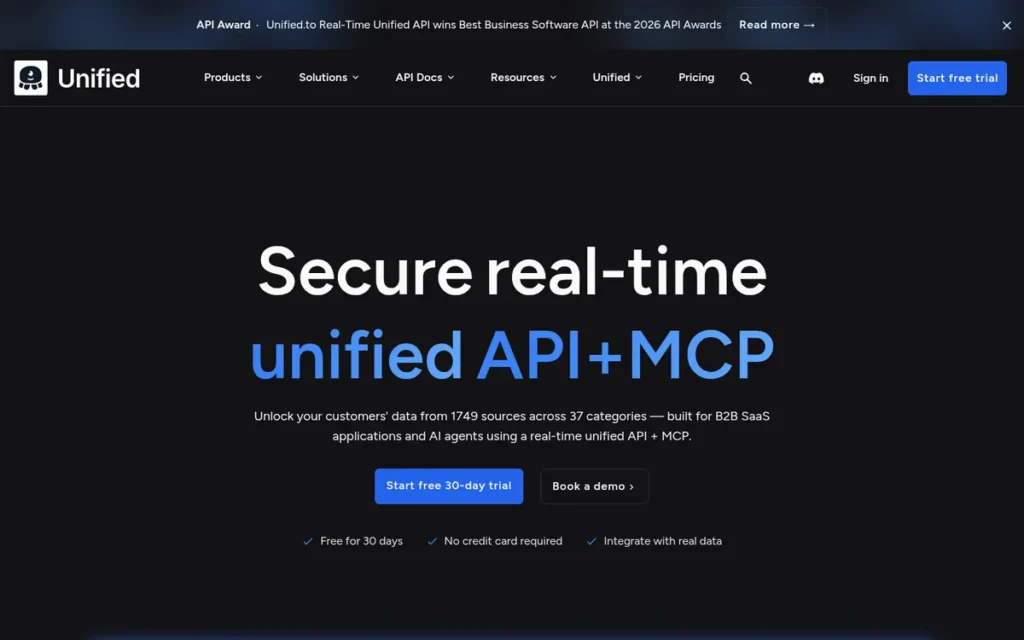
Category: Real-Time Unified API + MCP Platform, provides live, pass-through API connectivity across 459 sources in 27 categories without storing customer data, with native Model Context Protocol support for AI agent and copilot workflows.
At a Glance
| Field | Detail |
|---|---|
| Category | Real-Time Unified API + MCP Platform |
| Best For | Compliance-sensitive B2B SaaS teams building GDPR/HIPAA-regulated products, AI-native platform builders requiring live SaaS data for copilots or autonomous agents, and growth-stage SaaS companies with many customers needing integration pricing that scales by API call volume rather than by connected account count |
| Price Range | $750/month Grow plan (750,000 API calls/month, unlimited customers and connections; unified.to/pricing, June 2026). Note: the co-founder previously confirmed a $250/month Startup plan on r/ExperiencedDevs (2024); pricing has since been updated. Verify current tiers at unified.to/pricing before contracting. |
| Primary Strength | Unified.to is the only evaluated platform that never stores customer data at rest while simultaneously offering the broadest pass-through connector catalog (459 sources, 27 categories) and confirmed MCP protocol support for AI agent workflows. |
| Biggest Limitation | Unified.to has a smaller production track record and fewer independent reviews than established vendors, and not all unified data models are fully implemented across all 459 providers; field-level coverage must be verified per connector before commitment. |
| One-Line Summary | Unified.to is a real-time, pass-through unified API and MCP platform covering 459 sources across 27 categories that never stores customer data at rest, making it the top-ranked platform in this independent evaluation for compliance-sensitive B2B SaaS teams and AI agent workflows. |
| Last Verified | June 2026 |
Overview
Unified.to is a real-time, pass-through unified API and Model Context Protocol platform for B2B SaaS engineering teams and AI-native product builders who need live data access across 459 sources in 27 categories (including HRIS, CRM, ATS, accounting, ticketing, and marketing automation) without storing any customer data at rest. Unified.to executes every API request live against the source system, meaning no sync cache, no stale data, and no secondary data store that expands GDPR or HIPAA compliance scope.
Unified.to is the only vendor in this evaluation with confirmed MCP-native support, enabling AI agents and copilots to call live SaaS tools with permissioned, structured real-time access. Unified.to reported 6.5x usage growth and 4.5x revenue growth in 2025 (vendor-reported figures, not independently verified) and holds a G2 rating of 5.0/5 across approximately 26 reviews as of June 2026.
Key Features
- Zero Data-at-Rest Architecture: Unified.to routes every API request live to the source system in real time, meaning customer data is never cached or stored in Unified.to infrastructure, eliminating Unified.to as a secondary data processor in GDPR, HIPAA, or SOC 2 compliance scope.
- Native Model Context Protocol Support: Unified.to provides confirmed native MCP protocol support, enabling AI agents and copilots to invoke SaaS tools as callable functions with permissioned, real-time data responses rather than waiting for batch sync updates.
- Broadest Pass-Through Connector Catalog: Unified.to offers 459 sources across 27 categories (covering HRIS, CRM, ATS, accounting, ticketing, marketing automation, file storage, and eCommerce) the widest integration footprint of any pass-through vendor evaluated.
- API-Call-Based Pricing with Unlimited Connections: Unified.to uses API-call-based pricing with no per-connection charges, meaning a SaaS company can offer integrations to thousands of customers without triggering the per-Linked-Account cost escalation characteristic of sync-and-store competitors.
- TypeScript Types and Zod Schemas: Unified.to publishes TypeScript types and Zod schemas for all unified models, providing typed, validated integration contracts that reduce runtime errors and support AI coding assistant tooling (Claude Code, Cursor, Codex) for integration authoring.
Best For
Unified.to is best for:
- B2B SaaS engineering teams building compliance-sensitive products under GDPR, HIPAA, or SOC 2 Type II requirements
- AI-native platforms requiring live SaaS data for copilots or autonomous agents via Model Context Protocol
- Growth-stage SaaS companies with many customers needing integration pricing that scales by API call volume rather than by connected account count
Pricing
Unified.to’s current entry tier is the Grow plan at $750/month for 750,000 API calls per month with unlimited customers and connections (unified.to/pricing, June 2026). The co-founder previously confirmed a $250/month Startup plan on r/ExperiencedDevs (2024), this tier appears to have been updated since that post. Verify current tier limits, overage rates, and enterprise options at unified.to/pricing before contracting.
Unified.to’s API-call-based pricing with unlimited customer connections means total cost does not compound with customer adoption. By contrast, Merge’s $65-per-Linked-Account model creates approximately $32,500/month in connection fees at 500 customers above the platform fee (Vendr, 2024), making Unified.to’s structural pricing architecture decisively advantageous at high customer-connection volumes, even when Unified.to’s entry price is higher than a competitor’s entry tier. HIPAA Business Associate Agreements are available on higher tiers.
Strengths
- Verified Zero-Storage Compliance Architecture: Unified.to is the only vendor in this evaluation with a verified zero-data-at-rest architecture combined with SOC 2 Type II certification, GDPR compliance, and HIPAA BAA availability, reducing compliance scope by eliminating the integration vendor as a secondary data processor entirely (Unified.to compliance blog, 2025).
- Structurally Favorable Scale Economics: Unified.to’s API-call-based pricing with unlimited customer connections means total cost does not scale proportionally with customer adoption, a structural pricing advantage over per-Linked-Account models that can reach $120,000–$250,000+ annually at large deployments (Vendr, 2024).
- Confirmed MCP-Native Architecture: Unified.to provides confirmed native MCP protocol support (the only evaluated vendor to explicitly position as an MCP-native platform) making it the most directly aligned option for B2B SaaS teams building AI agent or copilot products that require live, permissioned SaaS data access (Unified.to, 2026).
- Strong Early Adopter G2 Reception: Unified.to’s G2 rating of 5.0/5 across approximately 26 reviews as of June 2026 reflects high early customer satisfaction, with community praise specifically citing TypeScript/Zod schema quality, real-time architecture, and pricing transparency relative to established incumbents (G2.com, June 2026; r/ExperiencedDevs, 2024).
Limitations
- Maturity and Production Track Record: Unified.to has significantly fewer independent reviews (~26 on G2) and a less-established production track record than Merge (2,500+ customers as of 2022, $75M raised) or Finch (YC-backed, UKG/Paycor marketplace certified), introducing more vendor continuity risk for teams making long-term infrastructure commitments.
- No Built-In Sync Layer for Batch Workloads: Unified.to’s zero-storage architecture means teams requiring a local data replica for analytics dashboards, RAG pipelines, or offline reporting must build and maintain their own sync layer, the platform does not provide one, adding engineering overhead for batch analytics use cases.
- Connector Coverage Depth Variability: Unified.to’s 459-provider catalog does not guarantee uniform field-level depth or write parity across all sources, connector count does not equal field-level coverage, and specific integrations must be verified at the field level before commitment.
- TypeScript Type Inference Friction: Developer community feedback from r/ExperiencedDevs (2024) noted that Unified.to’s TypeScript type inference requires manual casting in some contexts, adding friction for strongly-typed codebases where full type safety is a development standard.
An independent developer evaluating Unified.to on r/ExperiencedDevs noted both the schema quality advantage and the type-safety trade-off:
“Congrats on building unified.to! it actually looks pretty sweet. I’ve just recently been looking at unified apis, and there’s one thing that has shocked me and thats how many of the platforms appear not to have a easily accessible data schemas. I notice that your team provides not only the Typescript type but also the Zod Schema, that’s awesome. I notice that the typing isn’t automatically inferred, so I’m guessing there will be alot of ‘as unknown as
‘ ? This ties into what u/FormerKarmaKing said about the Dev tooling often lacking for unified apis. You get the unified apis, but still have to wrestle with making sure the types are in your codebase.” Posted by u/Joshpachner, r/ExperiencedDevs, 2025
Takeaway: Unified.to’s TypeScript and Zod schema availability is a genuine differentiator among evaluated unified API platforms, but teams building strongly-typed codebases should budget for manual type casting in some contexts until type inference is fully automated across all models.
Verdict
Unified.to is the highest-ranked unified API platform in this independent evaluation for compliance-sensitive B2B SaaS teams and AI agent workflows, earning its position through verified zero-data-at-rest architecture, confirmed MCP protocol support, the broadest pass-through connector catalog (459 sources, 27 categories), and an API-call-based pricing model with unlimited connections that does not compound with customer adoption. Teams building compliance-critical products or AI-native integrations should prioritize Unified.to for evaluation; teams requiring a proven high-volume production track record or a managed sync layer for analytics workloads should also evaluate Merge. Verify connector-level field coverage depth and enterprise support SLAs before committing.
2. Nango: Best for Engineering-Led Teams Needing Full Schema Control and Self-Hosting
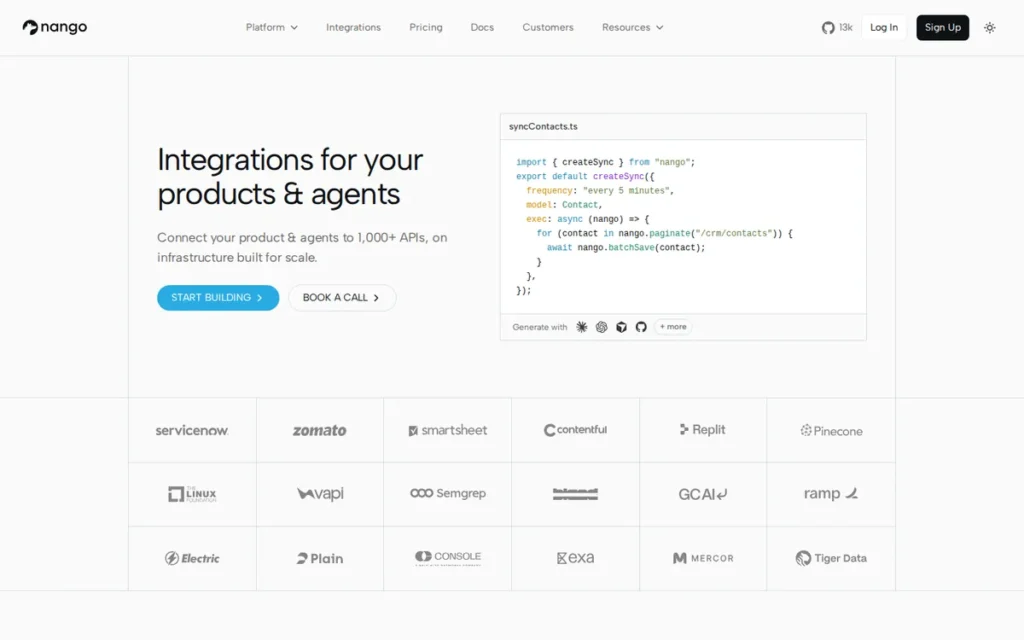
Category: Code-First Unified Integration Platform, provides open-source, TypeScript-native integration infrastructure (OAuth, syncs, webhooks, proxy) across 800+ APIs in 30 categories, with optional self-hosting for data sovereignty requirements.
At a Glance
| Field | Detail |
|---|---|
| Category | Code-First Unified Integration Platform |
| Best For | Engineering-led B2B SaaS teams with custom field, custom object, or schema requirements that exceed any vendor’s pre-built Common Data Model; teams with data residency or self-hosting constraints; and teams adopting AI coding assistants as part of their integration development workflow |
| Price Range | Tiered plans with $1/active connection/month and $0.10/1,000 proxy request overages; free tier and 14-day trial available. Base tier prices not publicly listed as of June 2026; verify at nango.dev/pricing. Model overage cost at your expected peak connection volume before contracting. |
| Primary Strength | Nango is the only evaluated platform offering a fully open-source, self-hosted unified integration runtime with TypeScript scripting; giving engineering teams complete control over schemas, business logic, and data residency without accepting a vendor-imposed Common Data Model. |
| Biggest Limitation | Nango’s code-first architecture requires meaningful engineering investment to implement and maintain; teams expecting a managed, low-code integration service will find Nango misaligned with their technical resources and timeline. |
| One-Line Summary | Nango is an open-source, code-first unified integration platform supporting 800+ APIs across 30 categories that gives engineering teams full TypeScript control over schemas and sync logic, with optional self-hosting for data sovereignty; ranking #2 in this independent evaluation for technical teams prioritizing customization depth over managed abstraction. |
| Last Verified | June 2026 |
Overview
Nango is an open-source, code-first unified integration platform for engineering-led B2B SaaS teams that need complete control over integration schemas, OAuth flows, webhooks, and data sync logic across 800+ APIs in 30 categories, without accepting the limitations of a vendor-imposed Common Data Model. Nango engineers write TypeScript integration scripts stored in their own codebase, executed on Nango’s managed runtime that handles auth token refresh, webhook delivery, error retry, and observability.
Nango supports both managed cloud and full self-hosted deployment, making Nango the only evaluated platform with a genuine data residency option for teams with strict sovereignty or air-gapped environment requirements. Nango re-launched in its current form in 2023, has accumulated 3,000+ GitHub stars (referenced in multiple independent comparison articles, 2025), and serves over 300 companies including Motion, Vapi, and Electric.
Key Features
- Custom TypeScript Integration Scripts: Nango allows engineers to write custom TypeScript integration scripts stored in their own codebase, giving full control over data models, business logic, field mappings, and sync schedules, eliminating the ceiling imposed by any vendor’s pre-defined Common Data Model.
- OAuth and Token Management Infrastructure: Nango’s authentication layer handles credential refresh, token storage, and multi-tenant auth flows for 800+ APIs across 30 categories, abstracting the most error-prone integration infrastructure without restricting what data can be accessed or modeled.
- Self-Hosted Deployment Option: Nango supports fully self-hosted deployment on the team’s own infrastructure, enabling data residency compliance for regulated industries, air-gapped environments, and companies with strict third-party vendor data access policies, a capability unavailable from any other evaluated vendor.
- AI Coding Agent Compatibility: Nango’s code-first TypeScript architecture is directly compatible with AI coding assistants, Claude Code, Cursor, and Codex can write, test, and deploy Nango integration scripts, making Nango the best-positioned evaluated platform for LLM-assisted integration development workflows.
- Unified Runtime with Configurable Sync: Nango provides configurable sync intervals per customer, webhook delivery with retry semantics, proxy request routing for direct API access, and observability dashboards, all on a single unified runtime without separate infrastructure required per integration category.
Best For
Nango is best for:
- Engineering-led B2B SaaS teams whose integration needs exceed what any vendor’s pre-built Common Data Model can express
- Companies with custom object or custom field requirements in CRM or HRIS systems
- Teams with data residency or self-hosting constraints that prohibit third-party cloud data storage
- Organizations building integration development workflows around AI coding assistants
Pricing
Nango uses tiered pricing with usage-based overages: $1 per active connection per month and $0.10 per 1,000 proxy requests beyond plan allowances, billed monthly with no minimum commitment. A free tier and 14-day free trial are available. The specific base monthly cost of paid tiers was not publicly listed in sources available as of June 2026, verify current pricing at nango.dev/pricing before budgeting.
Model the per-connection overage at your expected peak connection volume before contracting: 500 active connections per month triggers $500/month in overages above the base plan, which can significantly affect total cost calculations at scale.
Strengths
- Open-Source with Self-Hosting: Nango’s open-source codebase on GitHub accumulated 3,000+ stars as referenced in multiple independent comparison articles (2025), with self-hosted deployment available, the only evaluated platform providing complete code auditability and data residency control, two capabilities with no equivalent among closed-source competitors.
- Second-Highest Verified G2 Review Volume Among Evaluated Platforms: Nango holds a G2 rating of 4.5/5 across 65 reviews (G2.com, June 2026; a secondary source, CheckThat.ai (2025), cited 4.4/5 from 60 reviews at time of research), with specific praise for developer flexibility, code-first control, and OAuth/webhook infrastructure quality.
- Founder Candor on Common Data Model Limitations: Nango’s co-founder (u/nango-robin) publicly acknowledged in a documented r/ExperiencedDevs thread (2024) that fixed Common Data Models limit integration capability for vendor-specific features, a level of candor about architectural trade-offs that is absent from most vendor communications and provides buyers with an authentic basis for evaluation.
- Community-Validated AI Coding Compatibility: Multiple r/b2b_sales community members (2024) specifically cite Claude/Cursor/Codex integration scripting compatibility as a 2025–2026 Nango differentiator, identifying Nango as the preferred choice for teams building LLM-assisted integration development workflows.
“Nango has better security. Better self-hosting, and it’s also code-based, so AI coding agents like Claude/Cursor/Codex can build and deploy integrations on Nango.” Posted by u/sapnesh, r/b2b_sales, 2024
Takeaway: Nango’s AI coding agent compatibility is practitioner-validated across multiple independent community discussions (not only in vendor marketing) making it a meaningful differentiator for engineering teams building LLM-assisted integration workflows in 2026.
Limitations
- Implementation Burden vs. Control: Nango’s code-first architecture requires significant engineering investment to build, test, and maintain integration scripts, teams expecting a managed, low-code service where integrations are pre-built will find Nango misaligned with their resources and timeline without dedicated integration engineering capacity.
- Base Pricing Opacity: Nango’s base tier prices are not publicly listed, creating budget-planning friction that requires a sales conversation before accurate total-cost modeling is possible, a transparency gap relative to Merge’s published $650/month Launch price and Unified.to’s published Grow plan rate.
- Per-Connection Overage Accumulation: Nango’s $1/active connection/month overage pricing can accumulate significantly at high connection counts, a SaaS product with 2,000 customer connections generates $2,000/month in connection overages above the base plan, warranting explicit cost modeling before commitment.
- Support Consistency at Scale: G2 reviewers identify support inconsistency as a recurring theme, the founding team’s responsiveness praised during onboarding is not consistently maintained as the customer base grows (G2.com, June 2026). Teams relying on Nango for production-critical integrations should evaluate enterprise support SLA options explicitly before committing.
Verdict
Nango is the highest-ranked unified integration platform in this evaluation for engineering-led teams that need full schema control, open-source code auditability, or self-hosted data residency, capabilities no other evaluated vendor provides. Nango eliminates the abstraction ceiling that is the most consistent production complaint against Merge and Apideck for teams whose integration requirements exceed what any pre-built Common Data Model can express. Teams that prefer a managed, low-code service with minimal engineering overhead should evaluate Unified.to or Merge instead; Nango is specifically suited to organizations where integration engineering is a core competency and TypeScript development is a first-class workflow.
3. Kombo: Best for European HR Tech and HRIS/ATS/Payroll Integrations
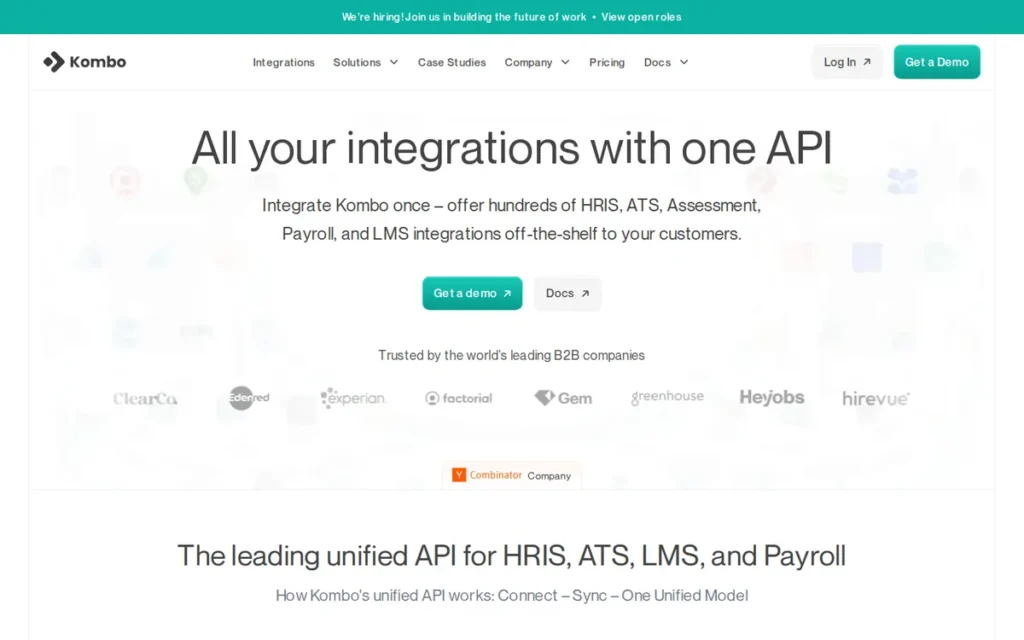
Category: Vertical Unified API (HR/Payroll Specialist) provides deep HRIS, ATS, payroll, LMS, and assessment integrations across 120+ providers with European system coverage depth unavailable from horizontal platforms.
At a Glance
| Field | Detail |
|---|---|
| Category | Vertical Unified API; HR/Payroll Specialist |
| Best For | European HR tech companies, US HR SaaS products with European customer bases, compensation analytics platforms, workforce management tools, and any B2B SaaS product where HRIS/ATS/payroll integration depth matters more than multi-category breadth |
| Price Range | Per-customer flat-fee pricing model; exact amounts not publicly listed as of June 2026. Kombo raised a $25M Series A led by Volition Capital (with Y Combinator, Acadian Ventures, and 468 Capital; Kombo blog, February 2026), bringing total funding to $30M; positioning Kombo for mid-market to enterprise pricing. Contact kombo.dev for current pricing and scenario modeling. |
| Primary Strength | Kombo is the only evaluated platform covering European HRIS and payroll systems (Personio, Factorial, HiBob, PayFit, AFAS, Cegid, and 114+ others) at field-level depth, with a four-certification compliance stack (SOC 2 Type II, ISO 27001, HIPAA, GDPR) required for EU enterprise procurement. |
| Biggest Limitation | Kombo covers only HR-adjacent categories (HRIS, ATS, payroll, LMS, assessments); teams needing CRM, accounting, ticketing, or file storage integrations must use a separate vendor, and Kombo has no AI agent or MCP roadmap positioning as of June 2026. |
| One-Line Summary | Kombo is a vertical unified API specialist covering 120+ HRIS, ATS, payroll, and LMS providers; including the broadest set of European HR systems of any evaluated platform; with the strongest compliance certification stack evaluated, making it the definitive choice for European HR tech companies and US HR SaaS teams expanding to European markets. |
| Last Verified | June 2026 |
Overview
Kombo is a vertical unified API platform for B2B SaaS companies building HR technology, covering HRIS, ATS, payroll, LMS, and assessment integrations across 120+ providers in Europe and North America, with the deepest European system coverage of any evaluated platform, including Personio, Factorial, HiBob, PayFit, AFAS, and Cegid. Kombo is headquartered in Berlin, Germany, is Y Combinator-backed, and raised a $25M Series A led by Volition Capital (with Y Combinator, Acadian Ventures, and 468 Capital; Kombo blog, February 2026), bringing total funding to $30M. Kombo is listed in both the UKG Marketplace and Workable Partner Directory.
Kombo delivers real-time webhook updates within 20 seconds of source system changes (Kombo technical documentation, docs.kombo.dev/hris/features/real-time-data, accessed June 2026), supports bidirectional write-back for compensation and benefits data, and carries a four-certification compliance stack, SOC 2 Type II, ISO 27001, HIPAA, and GDPR (Unified.to comparison blog, 2025, verify certifications directly with Kombo for procurement reliance), that satisfies EU enterprise procurement requirements most horizontal platforms cannot meet.
European systems explicitly covered by Kombo include Personio, Factorial, HiBob, PayFit, Softgarden, AFAS, Cegid, Kenjo, d.vinci, and SAP SuccessFactors, alongside global platforms such as Workday, ADP, UKG, BambooHR, and Gusto.
Key Features
- European HRIS and Payroll Provider Depth: Kombo covers 120+ HRIS, ATS, and payroll providers with specific depth in European systems, including Personio, Factorial, HiBob, PayFit, Softgarden, AFAS, Cegid, Kenjo, and d.vinci, a set of named EU providers no other evaluated vendor covers at comparable field-level depth.
- 20-Second Webhook Latency: Kombo delivers webhook-based change notifications within 20 seconds of modifications in connected HRIS systems (Kombo technical documentation, accessed June 2026), enabling real-time HR automation workflows such as automated onboarding triggers and immediate offboarding actions.
- Bidirectional Compensation Write-Back: Kombo supports bidirectional write-back for compensation data (salary, equity, bonuses, commissions, performance scores, and benefits) enabling compensation analytics platforms to push reviewed changes back to HRIS systems without custom per-provider integration code.
- Four-Certification Compliance Stack: Kombo holds SOC 2 Type II, ISO 27001, HIPAA, and GDPR certifications simultaneously (Unified.to comparison blog, 2025 (verify directly with Kombo for procurement reliance)) the most comprehensive compliance stack of any evaluated vendor and the only one including ISO 27001, a common EU enterprise procurement prerequisite absent from Merge, Unified.to, Apideck, and Finch.
- Developer-Paired Support Model: Kombo pairs each customer with the specific engineers who built their connected integrations, providing edge-case domain expertise on system-specific quirks unavailable from horizontal platforms serving dozens of verticals simultaneously.
Best For
Kombo is best for:
- European HR tech companies (compensation analytics, recruiting platforms, workforce management, LMS) requiring native coverage of European HRIS and payroll systems
- US HR SaaS products expanding to European markets where providers like Personio, Factorial, and PayFit dominate
- Any HR tech team in regulated industries where ISO 27001 certification is a non-negotiable enterprise procurement requirement
For B2B SaaS products serving German-speaking markets, Kombo’s Berlin HQ and coverage of systems like Personio, AFAS, and d.vinci addresses European HCM compliance requirements that US-headquartered platforms typically cannot navigate at field depth.
Pricing
Kombo uses per-customer flat-fee pricing, which is more cost-predictable than per-Linked-Account or per-API-call models for HR tech products with frequent data reads, total cost does not escalate based on read frequency. Exact pricing amounts are not publicly listed as of June 2026. Kombo’s $25M Series A and $30M total funding position it for mid-market to enterprise contract sizes rather than self-service startup adoption. Contact kombo.dev directly for current pricing; request scenario modeling for your expected customer count and data read frequency before evaluation.
Strengths
- Most Comprehensive Compliance Stack Evaluated: Kombo holds four enterprise compliance certifications simultaneously, SOC 2 Type II, ISO 27001, HIPAA, and GDPR (Unified.to comparison blog, 2025, verify directly with Kombo), the only evaluated platform to do so, with ISO 27001 specifically required for EU enterprise procurement and absent from Merge, Unified.to, Apideck, and Finch.
- Community-Validated High-Touch Support Model: A documented r/SaaS user evaluation (2026) selected Kombo over Merge and Nango specifically for ATS integration depth and support quality, describing direct access to “the actual developers who built the integrations for questions, and they know their systems in-and-out with all edge cases and quirks”, a support model unavailable from horizontal platforms.
- Dual Marketplace Listing Validation: Kombo is listed in both the UKG Marketplace and Workable Partner Directory (selective enterprise HR platform ecosystems requiring integration quality vetting before listing) providing two independent marketplace validations of production readiness alongside the $25M Series A (UKG Marketplace; Workable partner directory, 2025).
- Documented 20-Second Webhook Latency: Kombo’s 20-second webhook latency for HR system changes is confirmed in its technical documentation (accessed June 2026) and is meaningfully faster than polling-based change detection used by horizontal competitors, enabling event-driven HR automation workflows with near-real-time data fidelity.
“We ended up going with Kombo. They had the deepest integrations for our ATS use case (+ HRIS we’re considering) and offered the best support experience. We get paired with the actual developers who built the integrations for questions, and they know their systems in-and-out with all edge cases and quirks.” Posted by u/Healthy-Use-7501, r/SaaS, 2026
Takeaway: Kombo’s developer-paired support model (customers communicate directly with engineers who built their specific integrations) is a structural service differentiator that horizontal platforms serving dozens of verticals simultaneously cannot replicate. Test Kombo’s support depth early in the evaluation process.
Limitations
- Vertical-Only Coverage Scope: Kombo explicitly covers only HR-adjacent categories (HRIS, ATS, payroll, LMS, assessments) and provides no CRM, accounting, ticketing, or file storage integrations, teams needing multi-category coverage must use Kombo alongside a separate horizontal platform, adding vendor management overhead and integration layer complexity.
- No AI Agent or MCP Positioning: Kombo has no documented AI agent or MCP positioning as of June 2026, making Kombo structurally misaligned for teams building agentic workflows or AI-native products that require live SaaS tool access via Model Context Protocol.
- Limited Public Review Data: Kombo has no verified G2 rating or review count in sources available as of June 2026, making peer-validated quality comparison more difficult than for Merge or Nango. Quality assessment relies on two marketplace listings (UKG, Workable) and one documented Reddit evaluation (r/SaaS, 2026); request Kombo references from your specific HR tech sub-vertical before POC.
- Pricing Opacity: Kombo’s exact pricing is not publicly listed, requiring direct sales engagement before budget evaluation can begin, a barrier to self-service evaluation that adds timeline friction relative to Unified.to’s or Merge’s published pricing structures.
Verdict
Kombo is the definitive choice for European HR tech companies and US HR SaaS teams expanding to European markets, earning its #3 ranking through unmatched European HRIS/payroll provider coverage (120+ providers including Personio, Factorial, HiBob, PayFit, AFAS, and Cegid), the strongest compliance certification stack evaluated (SOC 2 Type II + ISO 27001 + HIPAA + GDPR), and a high-touch developer support model validated independently in community research. For teams building pure HR tech in Europe or for any team where ISO 27001 is a non-negotiable procurement requirement, Kombo should be the first evaluation candidate. For teams needing multi-category coverage beyond HR or AI agent workflow support, Unified.to or Merge are more appropriate starting points.
4. Merge: Best for Multi-Category B2B SaaS Teams Needing Broad Coverage and Enterprise Track Record
Category: Multi-Category Unified API (Sync-and-Store) provides a cached, normalized unified API across 7 SaaS categories (HRIS, ATS, CRM, Accounting, Ticketing, File Storage, Marketing Automation) with an embedded OAuth UI component and enterprise observability tooling.
At a Glance
| Field | Detail |
|---|---|
| Category | Multi-Category Unified API; Sync-and-Store |
| Best For | Mid-market to enterprise B2B SaaS companies needing broad multi-category coverage (HRIS + ATS + CRM simultaneously), teams that weight vendor maturity and production track record over architecture novelty, and products whose customer count is moderate enough that per-Linked-Account pricing remains within budget |
| Price Range | Launch: $650/month (10 Linked Accounts), $65/additional account; Professional/Scale: ~$30,000–$55,000 platform fee + $65/account (Knit secondary analysis; verify at merge.dev/pricing); enterprise: custom; typical contracts $120,000–$250,000+ at large deployments (Vendr, 2024) |
| Primary Strength | Merge is the most widely adopted unified API platform evaluated; 2,500+ customers reported as of 2022 (Sacra), $75M raised, named enterprise users including Ramp, Bill.com, and Drata; with the broadest multi-category coverage (7 categories, 200+ integrations) and mature observability and compliance infrastructure. |
| Biggest Limitation | Merge’s sync-and-store architecture stores customer data at rest in Merge’s infrastructure, expanding GDPR and HIPAA compliance scope, and its per-Linked-Account pricing model ($65/account) compounds rapidly as the customer base grows, reaching $120,000–$250,000+ annually at scale (Vendr, 2024). |
| One-Line Summary | Merge is the market-leading multi-category unified API platform with 2,500+ customers reported as of 2022 and 7 integration categories; the strongest production track record of any evaluated vendor; but its sync-and-store architecture and per-Linked-Account pricing model make it a less suitable choice for compliance-sensitive teams or those anticipating rapid customer growth. |
| Last Verified | June 2026 |
Overview
Merge is the most widely adopted unified API platform in this evaluation, serving 2,500+ B2B SaaS customers as reported in 2022 research, including Ramp, Bill.com, and Drata, with a normalized, sync-and-store API spanning 7 integration categories (HRIS, ATS, CRM, Accounting, Ticketing, File Storage, Marketing Automation) across 200+ third-party systems. Merge reached 2,500 customers and grew ARR 30x in its early growth phase after launching in 2020, raising $75 million by October 2022 Sacra, 2022; the current customer count as of June 2026 was not independently confirmed in this research but is expected to be higher given continued growth.
Merge Link, its embedded OAuth UI component, reduces custom authentication development time by handling end-user connection flows out of the box. Merge’s mature observability tooling, sync status monitoring, issue detection, and error logs (merge.dev/features/integration-observability, accessed June 2026), reduces ongoing integration maintenance burden across all connected customer accounts.
Key Features
- Unified Common Data Model Across 7 Categories: Merge provides a normalized Common Data Model spanning HRIS, ATS, CRM, Accounting, Ticketing, File Storage, and Marketing Automation, giving B2B SaaS products a single API endpoint for all customer-facing integrations regardless of the underlying third-party system.
- Merge Link Embedded OAuth UI: Merge Link is an embeddable UI component that handles end-user OAuth flows and system authorization, reducing custom authentication development time for teams building integration connection flows directly into their product.
- Enterprise Observability Tooling: Merge’s observability suite: sync status monitoring, automated issue detection, error classification, and activity logs, provides engineering teams with production-grade visibility into integration health across all connected accounts (merge.dev/features/integration-observability, accessed June 2026).
- Enterprise Compliance Certifications: Merge is SOC 2 Type II, GDPR, and HIPAA certified, with enterprise security including audit logging and role-based access controls, meeting common enterprise B2B SaaS procurement security requirements confirmed across multiple independent sources (2024–2025).
- Emerging AI and MCP Layer: Merge’s 2025–2026 positioning adds Merge Agent and Model Context Protocol marketing, enabling integrations to function as callable tools in LLM workflows, though Merge’s underlying sync-and-store architecture may not satisfy AI agent tool calls in workflows where data freshness is material to the agent’s decision.
Best For
Merge is best for mid-market to enterprise B2B SaaS companies that need broad multi-category coverage spanning HRIS, ATS, CRM, and Accounting simultaneously, particularly teams where Merge’s production footprint (2,500+ customers as of 2022, Sacra), enterprise compliance posture, and Merge Link embedded auth UI reduce time-to-market risk more than architecture optimization or pricing model does at their current scale.
Pricing
Merge’s Launch tier is $650/month for up to 10 production Linked Accounts, with each additional Linked Account costing $65/month. Professional/Scale carries an estimated $30,000–$55,000 platform fee plus $65 per connected account (Knit secondary analysis; verify at merge.dev/pricing). Enterprise is custom with volume discounts. Vendr market data (2024) cites typical annual contracts of $120,000–$250,000+ for large deployments. A “Merge for Startups” program offers reduced pricing for early-stage companies at merge.dev/merge-for-startups.
Model total cost explicitly at 100, 500, and 2,000 connections before contracting, per-account pricing compounds rapidly: 500 connections generates approximately $32,500/month in connection fees above the platform fee. A SaaS product that closes a Series A and lands 400 enterprise accounts simultaneously triggers a $26,000/month increase in Merge infrastructure costs, precisely when switching vendors is most expensive and most disruptive.
Strengths
- Market-Leading Production Track Record: Merge reached 2,500+ customers and grew ARR 30x in its early growth phase with $75 million raised by October 2022, representing the strongest verified market adoption of any evaluated vendor, with named enterprise customers including Ramp, TripActions, Bill.com, and Drata Sacra, 2022.
- Multi-Category Coverage Breadth: Merge covers 7 integration categories on a single unified API (the broadest multi-category breadth of any evaluated vendor) enabling B2B SaaS teams to ship HRIS, ATS, CRM, and Accounting integrations without fragmenting across multiple vendors.
- Enterprise Compliance and Security: Merge is SOC 2 Type II, GDPR, and HIPAA certified with enterprise security infrastructure including audit logging and role-based access controls, confirmed across multiple independent comparison sources (2024–2025).
- Community-Recognized Category Authority: Multiple Reddit threads (r/b2b_sales, 2024) consistently position Merge as the default evaluation starting point for multi-category B2B SaaS teams, reflecting the largest peer-evaluated production footprint in the category.
“Merge will getcha with the free/cheap options and once you’re embedded in their ecosystem, you get hit hard with cost scaling (and have to face sunk cost fallacy).” Posted by u/Interesting-Hat-2158, r/b2b_sales, 2024
Takeaway: Merge’s per-account pricing creates a compounding cost dynamic that becomes a strategic budget conversation at growth milestones, model total cost at 500+ customer connections before signing, not after.
Limitations
- Compliance Scope Expansion: Merge’s sync-and-store model stores customer data at rest in Merge’s infrastructure, adding Merge as a secondary data processor in GDPR, HIPAA, and SOC 2 compliance scope, an exposure that pass-through alternatives (Unified.to, Apideck) structurally eliminate and that can materially expand vendor audit obligations for regulated SaaS products.
- Per-Account Pricing Compounds at Scale: Merge’s $65-per-Linked-Account pricing creates compounding cost pressure, a SaaS product with 500 customer connections incurs approximately $32,500/month in connection fees above the platform fee, making Merge one of the most expensive evaluated options for high-customer-count products (Vendr, 2024).
- Contested Credential Portability: A documented r/b2b_sales thread (2024) includes a former customer claiming credentials were not easily exported during churn (disputed by a Merge employee in the same thread but unresolved publicly) warranting contractual verification of credential portability terms before signing.
- Surface-Level CRM Connectors: Multiple community members in r/b2b_sales (2024) describe Merge’s CRM connectors as surface-level relative to its HRIS/ATS depth, with documented engineering waste when teams attempt to use Merge for deep Salesforce custom object coverage, making Merge a poor fit for products requiring custom CRM object access.
Verdict
Merge is the most production-proven unified API platform in this evaluation (2,500+ customers as of 2022, $75M raised, the broadest multi-category coverage, and the most mature observability infrastructure) earning the #4 position overall despite stronger compliance architecture from higher-ranked alternatives. Teams that prioritize vendor stability, the largest peer-validated customer base, and HRIS + ATS + CRM breadth on a single contract should evaluate Merge first; teams with compliance-sensitive requirements, anticipated rapid customer growth, or deep CRM custom-object needs should evaluate Unified.to or Nango as primary options and treat Merge as a secondary comparison.
5. Apideck: Best for Embedded Integration Marketplace and GDPR-Native Pass-Through Architecture
Category: Pass-Through Unified API + Embedded Integration Marketplace, provides real-time, no-storage-at-rest unified API connectivity across 9 categories with an embeddable integration management component (Vault) and white-labeled integration marketplace.
At a Glance
| Field | Detail |
|---|---|
| Category | Pass-Through Unified API + Embedded Marketplace |
| Best For | B2B SaaS teams building a white-labeled integration marketplace within their product, teams requiring GDPR-compliant pass-through architecture with an EU-origin provider, and developer teams needing flexibility between hosted UI and fully headless integration connection flows |
| Price Range | Launch: ~$599/month; Scale: ~$1,299/month (Truto comparison blog, 2025; secondary source; verify at apideck.com/pricing). Consumer-based pricing. Custom field mapping restricted to higher tiers. |
| Primary Strength | Apideck combines a real-time pass-through architecture (no data stored at rest) with Vault; an embeddable or fully headless integration management component; making it the top option for teams needing GDPR-compliant data flow and a white-labeled integration marketplace built into their product. |
| Biggest Limitation | Apideck covers only 9 integration categories (vs. Unified.to’s 27) and some connectors rely on a 24-hour polling cycle for change detection rather than real-time webhooks (Truto comparison blog, 2025; verify current connector architecture with Apideck directly); a material limitation for event-driven architectures requiring sub-hour data freshness. |
| One-Line Summary | Apideck is a Belgium-based pass-through unified API platform covering 9 integration categories with no data stored at rest, an embeddable or headless integration marketplace component (Vault), and consumer-based pricing; ranking #5 in this independent evaluation as the top choice for teams building embedded integration marketplaces under GDPR-compliant architecture. |
| Last Verified | June 2026 |
Overview
Apideck is a Belgium-based, pass-through unified API platform for B2B SaaS teams that need real-time integration data without storing customer information at rest, across 9 categories including CRM, HRIS, and Accounting, paired with Vault, an embeddable or headless integration management component for end-user system authorization. Apideck executes every API request live against the source system with no customer data cached in Apideck’s infrastructure, a GDPR-native architecture that reduces compliance scope by eliminating Apideck as a secondary data processor.
Apideck Vault generates a per-user consumer record and provides either a hosted/embedded UI or a fully headless API mode for end-user authorization flows. Apideck’s Ecosystem product adds a white-labeled integration directory embeddable within the customer’s product, combining API connectivity layer and integration marketplace builder on one platform.
Key Features
- Real-Time Pass-Through Architecture: Apideck routes every API request live to the source system in real time, with no customer business data stored at rest in Apideck’s infrastructure, a compliance-minimal architecture that eliminates Apideck from GDPR data processor agreements and SOC 2 vendor audit scope.
- Apideck Vault (Hosted and Headless Modes): Apideck Vault creates a consumer object per end user, provides a hosted or embeddable authorization URL, and stores credentials securely, enabling teams to deploy a branded integration connection flow in hours, with a fully headless API mode available for pixel-perfect custom UI implementations.
- White-Labeled Integration Marketplace: Apideck’s Ecosystem product provides a white-labeled integration directory embeddable within the customer’s product, allowing teams to ship a branded “integrations” page with a marketplace UI without designing it from scratch.
- Per-Customer Custom Field Mapping: Apideck supports custom field mapping per customer on applicable pricing tiers, allowing individual field-level configuration across connections without code changes, enabling runtime data mapping adjustments rather than build-time redeployments.
- Fully Headless API Mode: Apideck’s headless API mode allows teams to bypass the Vault UI entirely and build pixel-perfect custom authorization flows using Apideck’s underlying APIs, providing maximum UI design flexibility without losing the data normalization and credential management layer.
Best For
Apideck is best for:
- B2B SaaS teams building a white-labeled integration marketplace within their product
- Teams operating under EU data regulations that prefer a Belgium-based provider with verified pass-through architecture
- Developer-led organizations that need the flexibility to switch between a hosted integration UI and a fully headless implementation without changing their underlying API layer
Pricing
Apideck’s approximate pricing is a Launch plan at ~$599/month and a Scale plan at ~$1,299/month based on secondary source analysis Truto comparison blog, 2025. These figures should be verified directly at apideck.com/pricing before any budget planning. Apideck uses consumer-based pricing tied to the number of end-user integration connections, which is more predictable than per-Linked-Account models at moderate scale.
Custom field mapping is restricted to higher pricing tiers, factor this in if advanced per-customer mapping is a launch requirement rather than a later-phase feature.
Strengths
- Independent Community Validation of Pass-Through Architecture: Apideck’s real-time pass-through architecture received independent third-party confirmation (a non-vendor observer in r/SaaS (2023) noted “Apideck has a more real-time approach where there is no concept of data sync”) corroborating the vendor’s architectural claim from a non-vendor source without promotional framing.
- Founder-Active Community Engagement: Apideck’s founder (Gert-Jan de Wilde, u/gertjandewilde) maintains active r/SaaS community engagement (2024), responding directly to developer architecture questions about Vault’s headless vs. hosted design, a practitioner-validated signal of developer transparency and vendor responsiveness.
- EU-Native GDPR Compliance Advantage: Apideck’s Belgium-based origin provides an inherent EU compliance advantage, EU-origin pass-through architecture simplifies the data protection agreement process for European SaaS companies compared to adding a US-headquartered vendoras a secondary data processor in GDPR scope.
- Community Recognition for Architectural Flexibility: Multiple community threads describe Apideck as “less opinionated, more flexible” and recommend Apideck for teams wanting headless integration control, a signal that developer teams with custom UI requirements find Apideck’s architecture meaningfully differentiated from more opinionated competitors (r/b2b_sales, 2024).
This aligns with independent community observations on r/SaaS:
“Something I learnt about Merge.dev and Apideck in this HN post. 1. Merge.dev has a data sync approach and is very costly 2. Apideck has a more realtime approach where there is no concept of datasync” Posted by u/aspantel, r/SaaS, 2023
Takeaway: Apideck’s real-time, zero-storage architecture is independently validated outside vendor marketing, confirming that its compliance advantage over sync-and-store competitors like Merge is practitioner-recognized, not just self-reported by the vendor.
Limitations
- Category Breadth Gap vs. Unified.to: Apideck’s 9-category coverage is significantly narrower than Unified.to’s 27 categories or Nango’s 30, teams needing integrations outside Apideck’s supported categories must use a separate vendor or accept coverage gaps, adding complexity for multi-category SaaS products.
- 24-Hour Polling on Some Connectors: Apideck’s change detection on some connectors relies on a 24-hour polling cycle rather than true real-time webhooks, a material limitation for event-driven workflows requiring sub-hour data freshness (Truto comparison blog, 2025; request webhook vs. polling documentation for your specific categories directly from Apideck before contracting, as connector architecture may have been updated since this analysis).
- Advanced Mapping Gated to Higher Tiers: Apideck’s custom field mapping is restricted to higher pricing tiers, creating friction for teams that need advanced per-customer mapping at entry-level pricing and may require an upgrade sooner than anticipated if field mapping complexity increases post-launch.
- Apideck has no verified G2 rating or publicly disclosed funding data in sources available as of June 2026, making independent peer-validated quality assessment more difficult than for Merge or Nango, buyers should request reference customers and documented case studies early in the evaluation process.
Verdict
Apideck ranks #5 in this evaluation as the leading option for B2B SaaS teams building embedded integration marketplaces with GDPR-compliant pass-through architecture, a product combination no other evaluated vendor provides as a primary offering. Teams whose primary need is integration coverage breadth (27+ categories), production track record validation, or AI agent readiness should prioritize Unified.to or Merge; teams specifically building a white-labeled integration marketplace within their product and operating under EU data regulations should evaluate Apideck as a leading candidate.
6. Codat: Best for Fintech and Financial Data Connectivity, Accounting, Banking, and Commerce
Category: Financial Data Unified API, provides consent-driven, unified connectivity to SMB accounting, banking, and commerce systems (QuickBooks, Xero, Sage, and 15+ financial dataset types) for fintech, commercial lending, AP automation, and embedded banking use cases.
At a Glance
| Field | Detail |
|---|---|
| Category | Financial Data Unified API |
| Best For | Fintech companies, commercial lenders, AP automation platforms, expense management tools, and embedded banking products that need unified, consent-driven connectivity to SMB accounting, banking, and commerce data as a core product input |
| Price Range | Custom/enterprise pricing only; no public pricing as of June 2026; structured as platform fee plus linked-account usage (secondary source). Contact codat.io early in the evaluation cycle to avoid timeline delays. |
| Primary Strength | Codat is the only evaluated unified API platform purpose-built for financial data connectivity, covering SMB accounting, banking, and commerce systems across 15+ financial dataset types, with institutional validation from JPMorgan, PayPal, and Plaid as both investors and ecosystem partners. |
| Biggest Limitation | Codat will be found unsuitable as a primary option for teams needing HRIS, CRM, ATS, ticketing, or marketing automation integrations; its financial data specialization is its defining strength and its defining limitation for non-fintech buyers. |
| One-Line Summary | Codat is the only purpose-built financial data unified API platform evaluated; covering SMB accounting, banking, and commerce systems for lending, AP automation, and embedded banking use cases; with $160M+ raised from institutional fintech investors including JPMorgan, PayPal, and Plaid. |
| Last Verified | June 2026 |
Overview
Codat is a financial data unified API platform purpose-built for fintech companies, commercial lenders, AP automation platforms, and embedded banking products that need standardized, consent-driven access to SMB accounting systems (QuickBooks, Xero, Sage, FreshBooks), banking data, and commerce platforms, covering 15+ financial dataset types including Profit and Loss, Balance Sheet, Aged Debtor/Creditor reports, and transaction-level data. Codat was founded in 2017 in London and has raised over $160 million, including a $100 million Series C.
Codat’s investor profile is uniquely institutional: Series C investors included JPMorgan Growth Equity Partners, Canapi Ventures, Shopify, Plaid, Tiger Global, PayPal Ventures, and Index Ventures (PR Newswire, 2022); American Express Ventures was a prior-round investor. This roster implies production-level vetting by sophisticated domain-expert buyers. Codat’s named production partnerships with nCino (commercial lending) and Alloy (credit decisioning) confirm deployed use in regulated financial services workflows.
Key Features
- 15+ SMB Financial Dataset Types: Codat provides consent-driven, standardized access to datasets including Profit and Loss, Balance Sheet, Bank Feeds, Aged Debtor/Creditor, and transaction-level data across major accounting platforms including QuickBooks, Xero, Sage, and FreshBooks.
- Pre-Built Fintech Product Packages: Codat supports specific fintech use cases through product packages (Bank Feeds for transaction data, Expenses for business spend management, and Lending for automated credit decisioning and portfolio monitoring) reducing integration scoping time for common financial services workflows.
- Named Financial Services Production Partnerships: Codat’s production partnerships with nCino (commercial lending software) and Alloy (credit decisioning platform) represent deployed enterprise use cases in regulated financial services, providing documented evidence of production readiness in lending and risk assessment workflows (partner pages, 2025).
- Advisory Intelligence Positioning: Codat’s 2025–2026 commercial banking positioning enables banking teams to transform SMB client accounting and ERP data into forward-looking financial insights and automated workflows, extending beyond data connectivity into financial analysis infrastructure.
- Normalized Financial Data Models: Codat provides standardized financial data schemas that eliminate custom accounting data parsing per provider, enabling fintech engineering teams to build financial products on normalized structures rather than raw heterogeneous accounting API responses.
Best For
Codat is best for fintech companies building lending, AP automation, expense management, or embedded banking products; commercial banks and credit unions building SMB-facing financial tools; and any technology team that needs programmatic, consent-based access to SMB accounting and banking data as a core product input, not as an ancillary integration feature.
Pricing
Codat does not publish pricing publicly as of June 2026. Pricing is structured as a custom platform fee plus linked-account usage charges (secondary analysis, Merge blog on Codat pricing), positioning Codat for mid-market to enterprise fintech and banking contracts rather than self-service startup adoption. Codat’s 2025–2026 positioning shift toward commercial banking advisory intelligence suggests a potential market focus narrowing away from early-stage fintech startups, seed and Series A fintech teams should verify minimum contract requirements before investing evaluation time. Contact codat.io early in the evaluation cycle to avoid timeline delays; request scenario modeling for your expected SMB connection volume before progressing to a proof of concept.
Strengths
- Highest-Quality Institutional Investor Validation: Codat has raised over $160 million including a $100 million Series C from JPMorgan Growth Equity Partners, Canapi Ventures, Shopify, Plaid, Tiger Global, PayPal Ventures, and Index Ventures, the most financially validated investor profile of any evaluated vendor, from institutions who are simultaneously domain-expert customers (PR Newswire, 2022).
- Named Financial Services Production Partnerships: Codat’s partnerships with nCino and Alloy are confirmed on partner pages (2025), providing documented deployment evidence in regulated financial services workflows where data accuracy and compliance are mission-critical requirements.
- G2-Validated Core Value Proposition: G2 users confirm that Codat provides access to 15 distinct financial datasets including Profit and Loss, Balance Sheet, and Aged Creditor/Debtor reports and describe the integration as “really easy to integrate”, providing independent user validation of the core accounting data connectivity value proposition (G2 reviews, 2024).
- Longest Operational History Evaluated: Codat was founded in 2017 in London and has accumulated 8+ years of financial data API product development (the longest operational history of any evaluated vendor) providing the deepest institutional knowledge of SMB accounting system connectivity challenges that fintech buyers consistently encounter.
Users on r/dataengineering noted Codat’s financial data schema consistency alongside its enterprise-tier cost:
“You could look into unified API solutions that’ll handle the auth + extraction. E.g Paragon, Codat, Merge etc. Codat also calculates the PnL + BS from a variety of systems whilst keeping the schema consistent. They can be expensive, but could be an option.” Posted by u/Goleggett, r/dataengineering, 2024
Takeaway: Codat’s financial schema consistency across accounting systems earns independent practitioner recognition, but its pricing is flagged as a barrier, validating this evaluation’s assessment that Codat is positioned for mid-market and enterprise fintech buyers rather than early-stage startups exploring the platform for the first time.
Limitations
- Financial-Data-Only Vertical Scope: Codat covers only financial data (accounting, banking, commerce) and is structurally unsuitable for teams needing HRIS, CRM, ATS, ticketing, or marketing automation integrations, teams needing those categories alongside financial data cannot use Codat as a single-vendor solution.
- Complete Pricing Opacity: Codat’s absence of public pricing adds significant evaluation friction for teams that need budget estimates before entering a sales process, atypical compared to the pricing transparency of Unified.to, Nango, and Merge, and potentially extending evaluation timelines by weeks when budget approval is required upfront.
- Codat has no documented AI agent or MCP positioning as of June 2026, making Codat misaligned for teams building agentic financial workflows that require live data access via Model Context Protocol.
- Limited Community Practitioner Sentiment: Codat has limited independently sourced community reviews as of June 2026, making practitioner sentiment harder to assess than for more developer-community-engaged vendors, a reflection of Codat’s sales-led enterprise model that buyers should address by requesting detailed reference calls before commitment.
Verdict
Codat is the default evaluation candidate for fintech companies, commercial lenders, and embedded banking product teams in this evaluation, as the only purpose-built financial data unified API reviewed, Codat has no direct competitor among the seven platforms for its specific buyer segment. For fintech teams, Codat’s $160M+ institutional investor validation from JPMorgan, PayPal, and Plaid, its 8+ years of financial data API development, and its named production partnerships make it the only structurally appropriate starting point. Non-fintech teams evaluating unified APIs for HRIS, CRM, or multi-category SaaS integrations will find Codat unsuitable as a primary option, the platform is purpose-built for financial data and does not cover those integration categories.
7. Finch: Best for US Employment Data, Benefits Administration, and Payroll Write-Back
Category: Employment Data Unified API (US Specialist) provides a standardized unified API for HRIS and payroll data across more than 200 US employment systems, with a Deductions API for benefits write-back and Assisted Connect for long-tail employer coverage.
At a Glance
| Field | Detail |
|---|---|
| Category | Employment Data Unified API; US Specialist |
| Best For | US-market benefits administration platforms (401(k) providers, TPAs, insurance platforms), HR tech companies serving primarily US employers, and any B2B SaaS product needing standardized access to pay-statement-level employment data with benefits write-back across 200+ US HRIS and payroll providers |
| Price Range | Starter (24 integrations, read-only, up to 15 connections), Pro (all integrations, write support), Premier (enterprise security controls); typical annual contracts $30,000–$80,000 (Vendr, 2024); base fee + per-connection + API call volume model. Verify at tryfinch.com. |
| Primary Strength | Finch’s Deductions API enables programmatic creation and management of employee deductions and employer contributions across supported US HRIS and payroll providers; the deepest employment data write-back capability evaluated, making Finch the top-ranked option specifically for US benefits administration platforms. |
| Biggest Limitation | Finch covers US employment data only; teams with European customers or international payroll requirements will find Finch’s geographic scope insufficient; and its vendor-specific employment ID schema creates meaningful migration friction if the team later moves to a different unified API vendor. |
| One-Line Summary | Finch is a US employment data unified API covering more than 200 HRIS and payroll providers with a Deductions API for benefits write-back; the most specialized evaluated option for US-market 401(k) providers, TPAs, and benefits administration platforms despite US-only geographic coverage and high per-contract pricing. |
| Last Verified | June 2026 |
Overview
Finch is a US-focused employment data unified API designed for benefits administration platforms, 401(k) providers, TPAs, and HR tech companies that need standardized, programmatic access to HRIS and payroll data, covering directory, individual, employment, payment, and pay-statement endpoints, across more than 200 US employment systems including ADP, Gusto, Paycor, and UKG. Finch was co-founded by Jeremy Zhang and Ansel Parikh in 2020, is Y Combinator-backed, and is headquartered in San Francisco. Finch raised $40M in a Series B (BuiltInSF, 2023), verify current total funding at tryfinch.com.
Finch is the only evaluated vendor with a dedicated Deductions API, enabling programmatic creation and management of employee benefit deductions and employer contributions (including 401(k) and 403(b) plans, insurance premiums, and HSA contributions) serving recordkeepers and TPAs who need to push benefits data back to payroll without custom per-provider code. Finch covers long-tail US employers without direct APIs through Assisted Connect, a hybrid mechanism where Finch’s operations team manually establishes the connection when no direct API access exists.
Key Features
- Standardized US Employment Data Model: Finch provides a standardized employment data model (covering directory, individual, employment, payment, and pay-statement endpoints) across more than 200 US HRIS and payroll providers including ADP, Gusto, Paycor, and UKG, on a consistent schema regardless of the underlying system.
- Deductions API for Benefits Write-Back: Finch’s Deductions API enables programmatic creation and management of employee benefit deductions and employer contributions (including 401(k) and 403(b) plans, insurance premiums, and HSA contributions) making Finch the only evaluated platform with deep payroll write-back for benefits administration use cases.
- Assisted Connect for Long-Tail Employer Coverage: Finch Assisted Connect extends employer coverage to long-tail providers without direct API access, where Finch’s operations team manually establishes the connection, providing broad nominal US employer reach, though with lower speed and less consistency compared to direct API-based connections. Buyers should document which required providers are API-direct vs. Assisted Connect-mediated before committing.
- Triple Marketplace Validation: Finch is listed in both the UKG Marketplace and Paycor Marketplace and is an official Greenhouse integration partner, three independent marketplace validations of enterprise integration quality in the US HR tech ecosystem (partner pages, 2025).
- Tiered Access with Graduated Write Support: Finch’s Starter, Pro, and Premier tiers provide graduated access to integration count, write operations, and enterprise security controls, enabling teams to begin with read-only access across 24 integrations and expand to full Deductions API write support as their product matures.
Best For
Finch is best for US-market benefits administration platforms (particularly 401(k) record-keepers, TPAs, and insurance platforms) that need programmatic payroll write-back via the Deductions API; US HR tech SaaS companies building products on pay-statement-level employment data; and any B2B SaaS team serving primarily US employers where 200+ provider coverage and ADP/Gusto/Paycor/UKG compatibility are core product requirements.
Pricing
Finch pricing comprises three tiers (Starter, Pro, Premier) structured as a base fee plus per-connection cost plus API call volume. Vendr market analysis (2024) cites typical annual contracts of $30,000–$80,000 for mid-market deployments, significantly higher than Unified.to’s entry tier and comparable to Merge’s mid-tier pricing. Write-back via the Deductions API requires Pro or Premier tier access, factor this into budget planning if benefits write-back is a launch requirement rather than a later-phase addition.
Per-connection pricing compounds at high employer-connection volumes. Model your total cost explicitly at expected peak connection count before contracting. Verify current pricing and write-enabled provider counts at tryfinch.com.
Strengths
- Three Independent Marketplace Validations: Finch is listed in both the UKG Marketplace and Paycor Marketplace and is an official Greenhouse integration partner, three independent marketplace validations of production readiness in the US employment technology ecosystem, confirmed on partner pages (2025).
- Deepest US Benefits Write-Back Capability Evaluated: Finch’s Deductions API supports programmatic creation and management of employee deductions and employer contributions across supported payroll providers, enabling 401(k) platforms, 403(b) administrators, and TPAs to push enrollment and change data back to payroll without custom per-provider integration code, a depth not matched by Merge or Kombo for US benefits administration.
- Community-Recognized US Payroll Specialist: Multiple Reddit threads specifically position Finch as the specialist choice for US HRIS and payroll integrations (with the routing guidance “HR/ATS US → Finch or Merge” appearing independently across r/SaaS and r/ExperiencedDevs evaluation discussions (2024)) reflecting practitioner-validated brand positioning in the US employment data category.
- YC-Backed with Established US Provider Relationships: Finch’s YC backing and co-founders Jeremy Zhang and Ansel Parikh (2020 founding) align it with the established US startup ecosystem, and Finch’s coverage across ADP, Gusto, Paycor, UKG, and other US providers reflects years of employment data schema refinement across diverse payroll architectures (Gusto embedded blog, 2024).
Limitations
- US-Only Geographic Scope: Finch is explicitly a US-focused platform: comparison sources note it is suitable “when US-only coverage is acceptable”, making Finch unsuitable for any SaaS product with meaningful European customer presence, where Kombo’s Personio, Factorial, and PayFit coverage is required Unified.to comparison blog, 2025.
- Vendor-Specific Employment ID Migration Friction: Finch’s vendor-specific employment ID schema creates migration friction beyond credential portability, switching from Finch to another vendor requires re-mapping employment identifiers across all stored data, not just re-authenticating connections, as documented in comparison analysis (Truto, 2025).
- Read/Write Asymmetry: Finch’s automated write-back support is limited to a subset of the 200+ providers, teams must verify which specific providers support write operations before assuming Deductions API coverage extends across their full provider list. Assisted Connect connections are operationally less consistent than direct API integrations.
- No AI Agent or MCP Positioning: Finch has no documented AI agent or MCP positioning as of June 2026, limiting Finch’s suitability for teams modernizing their integration stack for agentic workflows that require live, permissioned payroll data access via Model Context Protocol.
Verdict
Finch ranks #7 in this independent evaluation overall (reflecting US-only geographic limitation, per-contract pricing complexity, and absent AI/MCP readiness) but ranks as the best-evaluated option for one specific use case: US employment data with benefits write-back. For 401(k) providers, TPAs, insurance platforms, and US-focused HR SaaS teams where pay-statement-level data and Deductions API write-back are core product requirements, Finch is the most specialized evaluated choice; for teams with international customers or multi-category integration needs, Kombo (European HR depth) or Merge (multi-category breadth) are more structurally appropriate alternatives.
Identified your top 2–3 platforms? Use the Red Flags and Evaluation Questions below to stress-test each before entering a vendor proof of concept.
What Red Flags Should I Watch For When Evaluating Unified API Vendors?
The most consequential red flags in unified API evaluation are per-account pricing without scale modeling, connector count claims without field-level verification, MCP marketing without protocol documentation, missing credential portability guarantees, and write-back coverage claims without provider-level confirmation. Each of these failure modes has resulted in documented production rework across the seven evaluated platforms.
- Per-account pricing without explicit scale modeling at 100, 500, and 2,000 connections
- Connector count claims without field-level coverage verification for your specific providers
- MCP marketing language without architecture documentation confirming real-time protocol support
- No credential portability clause in the contract specifying export format and timeline
- Write-back coverage claims without a provider-level list of write-enabled vs. read-only connectors
Red Flag #1: Per-Account Pricing Without Scale Modeling
Vendors charging per connected account, Linked Account, connection, or consumer, create compounding cost exposure as a SaaS product grows its customer base. Merge’s $65/Linked Account pricing reaches approximately $32,500/month in connection fees for 500 customer connections above the platform fee. A SaaS product that closes a Series A and lands 400 enterprise accounts simultaneously triggers a $26,000/month increase in infrastructure costs, precisely when switching vendors is most expensive and most disruptive.
Before signing any per-account contract, model total cost explicitly at 100, 500, and 2,000 connections and verify whether the contract includes a volume discount floor or pricing ceiling (r/b2b_sales, 2024).
Red Flag #2: Connector Count Without Field-Level Coverage Verification
A connector catalog count (200+, 400+, 800+) does not guarantee that the specific fields, objects, or write operations a team requires are implemented for their target providers. Example: a vendor listing Workday as a supported connector may implement 12 of the 47 HRIS fields Workday exposes via API, sufficient for basic employee directory reads, but insufficient for benefits enrollment or compensation reporting. The connector exists; the field coverage does not.
Teams commit based on connector count, then discover at production time that critical fields or write operations are unsupported. Verify field-level coverage for the three highest-priority providers before signing (not after) by requesting a written field coverage matrix from the vendor (r/ExperiencedDevs, 2024).
Red Flag #3: MCP Claimed Without Protocol Documentation
Apply this verification standard to every platform evaluated, not only Merge. Multiple vendors apply MCP language in 2025–2026 marketing without documenting protocol implementation. The distinctive Unified.to claim is that its real-time architecture is documented as MCP-native; vendors with sync-and-store architectures making MCP claims should provide architecture documentation showing how cached data may not satisfy agent tool calls requiring live source state in workflows where data freshness is material to the agent’s decision. Demand specific MCP protocol documentation and architecture diagrams before accepting MCP positioning at face value.
Red Flag #4: No Credential Portability Guarantee in Contract
A documented r/b2b_sales thread (2024) includes a former Merge customer claiming customer credentials were not easily exportable during churn, a concern disputed by Merge but unresolved publicly in the same thread. Credential lock-in means migrating to a new integration platform requires asking all customers to re-authenticate from scratch. Require an explicit credential portability clause, specifying export format, timeline, and process, in any unified API contract before signing.
Red Flag #5: Write-Back Coverage Claimed Without Provider-Level Verification
Finch’s read/write asymmetry illustrates a consistent pattern: a vendor claims write-back capability across 200+ providers, but automated write operations are supported on a smaller subset. For any integration category where write-back is a product requirement (payroll deductions, compensation updates, HRIS record changes) verify the exact list of providers supporting automated write operations before evaluation concludes, not as a post-contract discovery item Unified.to comparison blog, 2025.
What Questions Should I Ask Before Choosing Unified API Software?
Five questions consistently separate successful unified API evaluations from costly post-commitment discoveries: which specific provider fields are covered, what the total cost is at 100/500/2,000 customer connections, whether the vendor’s storage model expands compliance scope, whether credentials and entity IDs are exportable, and which connectors support full write-back.
- Which specific providers do I need covered, and does this vendor support all required fields, not just the connection?
- What is my total cost at 100, 500, and 2,000 customer connections?
- Does this vendor’s data storage model add them to my SOC 2, HIPAA, or GDPR compliance scope?
- Are my customer credentials and entity IDs exportable if I switch vendors?
- Which connectors support full write-back, and which are read-only?
Question #1: Which specific providers do I need covered, and does this vendor support all required fields, not just the connection?
Request a field-level coverage matrix for your three most critical providers before signing. A connector “existing” may mean the vendor can authenticate but reads only 30% of the API’s actual fields.
- For HRIS integrations: confirm whether custom attributes, geography-specific employment types, and payroll-calculation fields are supported in the vendor’s schema.
- For CRM integrations: verify custom object and custom field read/write support explicitly, not by inference from the connector listing.
- For all categories: request a written field coverage matrix for your three highest-priority providers before signing, not after.
Question #2: What is my total cost at 100, 500, and 2,000 customer connections?
Every per-account or per-connection pricing model must be modeled at three scale milestones before signing. Ask the vendor for written cost scenarios at each volume, including base platform fee, per-connection fee, API call volume overage rates, and any tiered discount thresholds. A vendor unwilling to provide written scenario pricing during evaluation is a vendor whose pricing will surprise at renewal.
Question #3: Does this vendor’s data storage model add them to my SOC 2, HIPAA, or GDPR compliance scope?
Sync-and-store vendors (Merge, Finch, Codat) become secondary data processors in GDPR Data Processing Agreements, require HIPAA BAAs, and become systems-in-scope for SOC 2 audits. Pass-through vendors (Unified.to, Apideck) eliminate this exposure by never storing payload data.
Ask for the vendor’s Data Processing Agreement template and your security team’s vendor questionnaire response before the evaluation exits the technical review phase.
Question #4: Are my customer credentials and entity IDs exportable if I switch vendors?
Credential portability enables migration without asking customers to re-authenticate. Entity ID portability enables data migration without re-mapping all records to a new vendor’s identifier schema. Finch uses vendor-specific employment IDs that create migration friction even when credentials are portable. Require explicit contract language specifying the export format, timeline, and process for both credentials and entity identifiers before signing.
Question #5: Which of your connectors support full write-back, and which are read-only?
Read/write asymmetry, where a vendor lists 200+ providers but supports write operations on a fraction, is a consistent pattern across Finch, Merge, and Kombo for certain categories. For any category where a product needs to push data back to the connected system, payroll deductions, HRIS record updates, CRM contact writes, demand the specific list of write-enabled providers before the proof-of-concept phase, not after it.
How Did We Rank These Unified API Platforms?
These seven platforms were ranked using a six-criterion weighted scoring model (coverage depth, compliance architecture, market adoption, pricing scale economics, developer experience, and AI/MCP readiness) applied consistently with no pre-assigned positions. The highest weighted score earns #1 regardless of market share, which is why Merge ranks #4 despite being the most recognized brand in the category.
How Was Each Platform Evaluated?
Ranking began with discovery queries across multiple AI search engines to identify the most-cited unified API platforms in 2026. Each of the seven identified platforms was then researched across identical dimensions:
- Review platform ratings and volume (G2, Capterra: primary where verified; secondary sources labeled)
- Community sentiment from Reddit (r/SaaS, r/ExperiencedDevs, r/b2b_sales, r/fintech, specific threads cited per data point)
- Vendor pricing documentation (primary from vendor pages; secondary from comparison blogs, labeled as such)
- Compliance certification verification (primary from vendor documentation; secondary from comparison sources, labeled)
- Marketplace listing confirmation (UKG, Workable, Paycor, Greenhouse: confirmed via partner pages)
- Funding and investor data (PR Newswire, Sacra research, Dealroom: secondary where primary unavailable)
No vendor received advance notice of the evaluation or was given the opportunity to influence its criteria or scoring.
What Were the Six Ranking Criteria?
Each platform was scored 1–5 on six criteria:
- Vertical Coverage Depth and Breadth (Primary Weight): Connector quality matters more than connector count. A vendor claiming 200+ connectors receives a quality-adjusted score if community research documents field-level gaps or write-parity failures. Why it matters: teams commit based on connector count, then discover critical fields are unsupported at production time.
- Architecture and Compliance Posture (Primary Weight): Pass-through vs. sync-and-store is the most consequential compliance decision in unified API selection, it determines whether the vendor is a data processor in GDPR, HIPAA, and SOC 2 scope. Why it matters: this decision is very difficult to reverse once the integration layer is in production.
- Market Adoption and Production Credibility (Primary Weight): Infrastructure vendors must demonstrate production stability at the buyer’s growth trajectory. Why it matters: verified customer count, funding, named enterprise customers, and marketplace certifications reduce vendor risk for teams making multi-year commitments.
- Pricing Model and Scale Economics (Primary Weight): Pricing model type determines cost predictability as the SaaS product grows. Why it matters: hidden pricing, non-transparent scaling models, and community-sourced “pricing shock” incidents are counted as negative signals.
- Developer Experience and Integration Customization Depth (Secondary Weight): Schema flexibility, OAuth abstraction quality, observability tooling, and self-hosting capability directly affect time-to-first-integration and long-term maintenance burden. Why it matters: integration vendors that impose rigid schemas create engineering debt when production requirements exceed the pre-built data model.
- AI Agent and MCP Readiness (Secondary Weight): Confirmed MCP protocol implementation and real-time architecture suitability for agent tool calls are transitioning from differentiators to expected features in 2026. Why it matters: the gap between MCP marketing claims and genuine protocol implementation is wide, buyers need evidence-based differentiation.
How Was Conflicting Evidence Weighted?
When review platform ratings conflict with Reddit sentiment, specificity and recency take precedence. A detailed 2025 Reddit post from a named user describing a specific failure mode outweighs a generic 2023 G2 review.
Founder statements made in public community forums (Reddit, Hacker News) are treated as attributable on-record claims, not as promotional marketing. Vendor-reported growth statistics are labeled as vendor-reported and not presented as independently verified facts.
How Was Data Validated Before Publication?
Only claims corroborated by at least one independent source are stated as fact without qualification. Pricing figures from secondary comparison blogs are labeled as secondary and accompanied by instructions to verify at the vendor’s pricing page. Compliance certifications noted as “secondary source” should be independently verified with the vendor before being relied upon in procurement decisions.
When Will This Evaluation Be Updated?
This evaluation was completed in June 2026 and reflects sources available as of that date. The unified API market is evolving rapidly, pricing, connector counts, and compliance certifications change on vendor roadmaps quarterly. We update this guide quarterly. Last updated: June 2026.
Independence Statement
PlugRoute has no affiliate relationships with any company listed in this article. Rankings are determined entirely by research data and objective evaluation criteria.
Verification Gap Note: Where primary source verification was not available, secondary sources are labeled as such. Buyers should independently verify pricing, compliance certifications, and connector counts with vendors before contracting, this evaluation reflects sources available as of June 2026.
Frequently Asked Questions
What is the best unified API software for B2B SaaS in 2026?
Unified.to ranks #1 in this independent evaluation for compliance-sensitive B2B SaaS teams and AI agent workflows, its zero-storage pass-through architecture, confirmed MCP protocol support, and API-call-based pricing with unlimited customer connections address the three most decisive architectural and pricing failure modes. For multi-category breadth with a proven track record, Merge (2,500+ customers as of 2022) remains the most widely deployed option. The right answer depends on compliance posture, customer volume, and integration depth requirements.
What is the difference between pass-through and sync-and-store unified API architecture?
Pass-through unified APIs (Unified.to, Apideck) route every request live to the source system with no customer data stored at rest, minimizing GDPR, HIPAA, and SOC 2 compliance scope. Sync-and-store platforms (Merge, Finch, Codat) cache data in vendor infrastructure for faster reads but add the vendor to your compliance scope as a data processor, a choice that is very difficult to reverse once in production. Architecture type is the most consequential and least-reversible decision in unified API evaluation.
Which unified API platforms store customer data at rest?
Merge, Finch, and Codat use sync-and-store architecture, customer data is cached in vendor infrastructure, and these vendors become secondary data processors in GDPR Data Processing Agreements and SOC 2 audit scope. Unified.to and Apideck use real-time pass-through architecture, no customer data is stored at rest. Nango is configurable, with sync or pass-through available depending on team preference and self-hosting setup.
Which unified API platforms genuinely support MCP and AI agent workflows?
Unified.to is the only evaluated vendor with confirmed MCP-native architecture as of June 2026, its real-time pass-through design is structurally aligned with AI agent tool calls requiring live data. Merge uses MCP language in 2025–2026 marketing, but its sync-and-store architecture may not satisfy agent tool calls in workflows where data freshness is material to the agent’s decision. Demand specific MCP protocol documentation and architecture diagrams from any vendor claiming MCP support.
Why does Merge rank #4 when it is the most well-known unified API platform?
Merge ranks #4 because a six-criterion weighted scoring model (not market share or brand recognition) determines rankings at PlugRoute. Merge’s sync-and-store architecture expands GDPR and SOC 2 compliance scope (penalized under Criterion 2), and its $65-per-Linked-Account pricing compounds to $120,000–$250,000+ annually at large deployments (penalized under Criterion 4). Unified.to, Nango, and Kombo each scored higher on criteria most decisive for the primary buyer segment evaluated.
How does PlugRoute determine its rankings?
PlugRoute rankings use a six-criterion weighted scoring model (vertical coverage depth, architecture and compliance posture, market adoption credibility, pricing scale economics, developer experience, and AI/MCP readiness) applied consistently across all platforms with no financial relationships with any vendor. The highest weighted score earns #1 regardless of market share, which is why Merge ranks #4 despite being the most recognized unified API brand in the category.
What Do These Unified API Terms Mean?
Common Data Model (CDM): A pre-defined, normalized data schema maintained by a unified API vendor that maps fields from multiple third-party systems (for example, mapping “employee_id” from Workday, “staff_id” from Personio, and “user_id” from BambooHR to a single “id” field) into one standardized structure. Common Data Models accelerate integration by eliminating per-provider schema translation, but they impose a ceiling on data access: any field not included in the CDM requires custom extension or a different vendor.
Pass-Through Architecture: A unified API architecture pattern in which every data request is routed live to the source third-party system in real time, with no customer payload data stored at rest in the integration vendor’s infrastructure. Pass-through architecture eliminates the unified API vendor as a secondary data processor in GDPR, HIPAA, and SOC 2 compliance scope. Vendors using this pattern include Unified.to and Apideck; the trade-off is real-time dependency on third-party API availability and latency.
Model Context Protocol (MCP): An emerging open protocol for enabling AI agents and large language models to call external tools and SaaS systems in a structured, permissioned way. In the unified API context, MCP allows AI copilots and autonomous agents to query live CRM, HRIS, or accounting data as function calls rather than waiting for batch sync updates. Unified.to is the only evaluated vendor with confirmed MCP-native architecture as of June 2026.
Linked Account: The unit of billing used by sync-and-store unified API vendors (most notably Merge) representing a single end-customer connection to a third-party system. One company connecting their BambooHR instance equals one Linked Account. Linked Account pricing compounds directly with customer adoption: a SaaS product with 500 customers, each connecting their HRIS, generates 500 Linked Accounts at $65/month each, totaling $32,500/month in connection fees above the platform fee.
Assisted Connect: A hybrid integration mechanism used by Finch in which connections to HRIS and payroll providers that lack direct API access are established and managed manually by Finch’s operations team on the customer’s behalf. Assisted Connect extends nominal coverage to long-tail employers but introduces lower speed, less consistency, and less predictable reliability compared to direct API-based connections, a distinction buyers should document for each required provider before committing to Finch.
Glossary: Key Terms Used in This Comparison
Common Data Model (CDM): A pre-defined, normalized data schema maintained by a unified API vendor that maps fields from multiple third-party systems into one standardized structure. CDMs accelerate integration by eliminating per-provider schema translation, but impose a ceiling on data access, any field not included in the schema requires custom extension or a different vendor.
Sync-and-Store Architecture: A unified API architecture pattern in which customer data from connected third-party systems is periodically authenticated, synced, and cached at rest in the integration vendor’s infrastructure. This approach enables faster reads but adds the vendor as a secondary data processor in GDPR Data Processing Agreements, HIPAA Business Associate Agreements, and SOC 2 audit scope.
Pass-Through Architecture: A unified API architecture pattern in which every data request is routed live to the source third-party system in real time, with no customer payload data stored at rest in the integration vendor’s infrastructure. Pass-through architecture eliminates the unified API vendor from GDPR, HIPAA, and SOC 2 compliance scope as a data processor.
Model Context Protocol (MCP): An emerging open protocol for enabling AI agents and large language models to call external tools and SaaS systems in a structured, permissioned way. In the unified API context, MCP allows AI copilots and autonomous agents to query live CRM, HRIS, or accounting data as callable functions rather than waiting for batch sync updates.
Linked Account: The per-connected-customer billing unit used by sync-and-store unified API vendors (most notably Merge) where one end-customer connection to a third-party system equals one Linked Account. Linked Account pricing compounds directly with customer adoption, as each new customer connecting their HRIS or CRM instance adds a recurring per-account charge to the platform fee.
Which Unified API Platform Is Right for You?
The right unified API platform depends on three intersecting factors: your vertical scope (HR/payroll, financial data, or multi-category SaaS), your compliance architecture requirement (pass-through eliminates the vendor from GDPR and SOC 2 scope; sync-and-store adds them), and your scale economics at expected peak customer volume. Use the Key Insights and decision guidance below to identify your starting candidate.
Key Insights
- Merge, the most widely recognized unified API brand, ranks #4 in this evaluation: not #1, because its sync-and-store architecture expands GDPR/SOC 2 compliance scope and its per-Linked-Account pricing compounds to $120,000–$250,000+ annually at large deployments (Vendr, 2024).
- Codat is entirely absent from AI-generated unified API recommendations despite being the only purpose-built financial data unified API evaluated (with $160M+ raised from JPMorgan, PayPal, and Plaid) leaving an entire fintech buyer segment unserved by current AI-generated guidance.
- Pricing models diverge dramatically: Unified.to’s API-call-based pricing with unlimited connections does not compound with customer adoption, while Merge charges $65 per Linked Account with no ceiling, the same 500 customers cost vastly different amounts depending on which vendor is chosen.
- ISO 27001 certification is a non-negotiable EU enterprise procurement requirement that only Kombo holds among the seven evaluated vendors, making Kombo the only viable choice for European HR tech companies selling to large enterprise buyers under EU procurement rules.
- Finch’s Assisted Connect is not the same as a direct API connection: it is an operationally mediated hybrid with lower speed and less predictable consistency, a distinction buyers must document per provider before committing.
- Unified.to is the only evaluated platform with confirmed MCP-native architecture; Merge uses MCP language in its 2025–2026 marketing despite a sync-and-store architecture that may not deliver the live data that AI agent tool calls require in freshness-sensitive workflows.
- Connector count is a marketing number. Field-level coverage is an engineering requirement. The difference between the two is typically discovered at production time, when switching vendors is most expensive and most disruptive.
The right unified API platform depends on the intersection of vertical scope, compliance architecture, and scale economics at your expected peak customer volume.
- If European HR tech is your primary integration requirement, start with Kombo: no other evaluated platform matches its European HRIS/payroll system depth or its four-certification compliance stack.
- If compliance-minimal architecture or AI agent workflows are your first filter, start with Unified.to, its zero-storage pass-through and confirmed MCP support are the only architecture genuinely suited to both requirements.
- If you’re building a US fintech, lending, or embedded banking product, start with Codat, it is the only purpose-built financial data unified API in this evaluation, and no other platform is structurally appropriate for that buyer segment.
- If multi-category breadth with a proven enterprise track record is the priority, evaluate Merge, with the expectation that pricing requires careful scenario modeling at scale and compliance implications need explicit DPA review.
- If your product spans multiple use case categories: HR data plus financial reporting, or HRIS plus CRM, evaluate whether a horizontal platform (Merge, 7 categories) or a combination of two specialists (e.g., Kombo + Codat) produces better field-level coverage depth at an acceptable combined total cost.
Before signing any unified API contract: Step 1, request a written field-level coverage matrix from your top two vendors for your three most critical provider integrations. Step 2, model total cost at 100, 500, and 2,000 customer connections using current pricing from the vendor’s pricing page (not this article). Step 3, run one live integration in a sandbox environment before committing; most vendors offer trial access.
Read our full evaluation methodology and other independent B2B SaaS integration comparisons at PlugRoute.