For SaaS engineering teams in 2026, Knock leads notification infrastructure on workflow orchestration depth and verified enterprise production evidence; SuprSend is the strongest choice for B2B2C multi-tenancy and native WhatsApp support; Novu is the only free MIT-licensed self-hostable option with approximately 39,000 GitHub stars. Knock carries a significant per-notification pricing premium at scale; Novu’s production self-hosting documentation has persistent gaps documented from 2022 through 2025.
Building notification infrastructure in-house (queuing, fallback routing, delivery observability, template management, and preference systems) consumes engineering capacity better directed at core product features. Most teams reach the “buy” tipping point when orchestration complexity outgrows a single delivery API. Comparing platforms is deliberately difficult: most gate full pricing behind sales conversations, and pricing models (per-notification, per-subscriber, per-seat) are incompatible across vendors.
PlugRoute has no affiliate relationships with any company listed; rankings are determined entirely by research data and objective evaluation criteria.
TL;DR: Top Picks at a Glance
- Knock is the strongest choice for engineering teams that need declarative workflow orchestration (batching, digests, routing) at enterprise scale, trusted in production by Vercel and Gorgias.
- SuprSend delivers native B2B2C multi-tenancy and WhatsApp channel support at more transparent pricing than Knock, making it the go-to for B2B SaaS companies with per-tenant customization needs.
- Novu is the only MIT-licensed open-source platform in this evaluation: free to self-host at any scale, with approximately 39,000 GitHub stars and 400+ contributors as of June 2026.
- Courier is the only platform with AI workflow nodes invoking GPT-4o and Claude at execution time, backed by $47.5M in funding from GV, Bessemer, Twilio Ventures, and Slack Fund.
What Are the Main Categories of Notification Infrastructure Platforms?
Notification infrastructure platforms fall into two categories: managed multi-channel orchestrators (Knock, SuprSend, Courier, Fyno, Pingram) that handle all delivery logic in a hosted environment; and open-source self-hosted platforms (Novu) offering zero licensing cost and full data control.
Category 1: Managed Multi-Channel Orchestrators
Managed orchestrators handle multi-channel delivery (email, SMS, push, in-app, chat) through a single hosted API and visual workflow builder. Teams pay a subscription fee to eliminate infrastructure management. Knock, SuprSend, Courier, Fyno, and Pingram fall into this category.
Within managed orchestrators, three sub-specializations exist:
- Workflow-first platforms (Knock, SuprSend, Courier): Center value on declarative workflow engines with batching, digests, delays, and fallback routing as core capabilities.
- Regulated-industry platforms (Fyno): Add voice channel delivery, IVR-capable workflows, and compliance management (consent tracking, audit logs, RBAC) that standard platforms omit.
- Rapid-deployment platforms (Pingram): Optimize for fastest time-to-production over maximum orchestration complexity.
Category 2: Open-Source Self-Hosted Platforms
Open-source platforms provide multi-channel orchestration logic under a permissive license, allowing teams to self-host at zero licensing cost. Novu is the primary platform in this category, with approximately 39,000 GitHub stars (github.com/novuhq/novu, June 2026). Teams trade subscription fees for infrastructure maintenance responsibility.
When Should You NOT Use Notification Infrastructure Software?
Do not use any notification infrastructure platform in this evaluation if your only requirement is simple push notification delivery without batching, digests, multi-channel routing, or workflow orchestration. AWS SNS, FCM, or OneSignal serve this need at up to 10,000x lower cost per message, a gap confirmed directly by a Knock cofounder on Reddit in November 2024.
To calibrate: AWS SNS costs approximately $0.50 per million messages for simple push delivery. The most prominent notification infrastructure platform in this category charges approximately $5 per 1,000 messages above the free tier. That is a 10,000x price difference. These platforms exist to eliminate orchestration complexity, batching activity digests, routing across multiple providers, managing user preferences, and enforcing delivery logic centrally. If your team does not need orchestration, raw delivery primitives will serve you better at a fraction of the cost.
How Do These 6 Platforms Compare at a Glance?
All capabilities, pricing, and channel support data verified June 2026. Verify current pricing at each vendor’s pricing page before budget planning.
| Rank | Company | Category | Best For | One-Line Summary | Key Capabilities | Primary Strength | Key Limitation |
|---|---|---|---|---|---|---|---|
| 1 | Knock | Multi-Channel Workflow Orchestrator | Engineering teams needing declarative workflow orchestration at enterprise scale | Workflow-first notification infrastructure trusted by Vercel and Gorgias | Batching, digests, delays, conditional branching, fallback routing, 25+ integrations, React in-app components | Most fully documented workflow engine in the evaluated set; Gorgias reports 27% response time improvement after adoption | Per-notification pricing significantly higher than raw delivery primitives above free tier; no self-hosted option |
| 2 | SuprSend | Multi-Tenant Notification Orchestrator | B2B SaaS teams needing per-tenant customization and native WhatsApp | B2B2C-first orchestration with native multi-tenancy and WhatsApp in a single workflow API | Drag-and-drop builder, automatic provider failover, WhatsApp, multi-tenancy, Smart Routing | Native B2B2C multi-tenancy architecture and WhatsApp; no other top-four platform offers both natively | Multi-tenancy feature-gated behind Business tier ($275/month annually); self-hosted option requires Enterprise tier |
| 3 | Novu | Open-Source Notification Platform | Teams prioritizing data sovereignty, zero licensing cost, and open-source community | MIT-licensed notification infrastructure with 39,000+ GitHub stars and free self-hosted option | Multi-channel API (email, SMS, push, in-app, chat), embeddable React Inbox, custom provider support | Only MIT-licensed open-source platform in this evaluation, with approximately 39,000 GitHub stars (June 2026) | Production self-hosting documentation gaps documented by community members from 2022 through 2025 |
| 4 | Courier | Visual Notification Orchestrator | Teams needing AI-augmented content generation and cross-platform mobile SDKs | Best-funded notification platform with AI workflow nodes and visual workflow builder for cross-functional teams | Visual Journeys builder, AI nodes (GPT-4o, Claude), React/iOS/Android/Flutter SDKs, AWS Marketplace | Only platform with AI workflow nodes (GPT-4o, Claude); $47.5M funding from GV, Bessemer, Twilio Ventures (TechCrunch, June 2022) | Full tier pricing not publicly listed; no self-hosted option; limited organic community forum presence |
| 5 | Fyno | Provider-Agnostic Notification Router | Regulated industry teams requiring voice channel delivery and IVR-capable workflows | Enterprise notification orchestrator with the widest channel set including voice and IVR-capable workflow architecture | Voice channel delivery, IVR-capable workflows, email, SMS, push, WhatsApp, no-code builder, cost-aware Smart Routing | Only platform in this evaluation with confirmed voice channel support and documented IVR-capable workflow use cases | No public pricing page; G2 reviewers cite interface design maturity issues; limited developer community presence |
| 6 | Pingram (formerly NotificationAPI) | Rapid-Deployment Notification Platform | Small-to-mid SaaS teams prioritizing fastest time-to-production and cross-functional content management | Fastest setup in the category with 4.7/5 G2 rating for rapid cross-functional notification deployment | In-app, email, push, SMS delivery; visual design-send-monitor workflow; cross-functional content management | 4.7/5 G2 rating (June 2026); cross-functional architecture separating developer delivery from non-engineer content control | Lower orchestration ceiling than top-four platforms; rebrand from NotificationAPI creates review search fragmentation |
Quick Decision Framework
Use this table to identify your starting point before evaluating individual entries.
| Your #1 Priority | Recommended Platform | Why It Fits | Acceptable Alternative |
|---|---|---|---|
| Advanced workflow orchestration at enterprise scale | Knock (knock.app) | Most fully documented workflow engine in the evaluated set; verified enterprise production evidence (Vercel, Gorgias reporting 27% response time improvement) | SuprSend for comparable features at more transparent pricing |
| B2B2C multi-tenancy and per-tenant notification customization | SuprSend (suprsend.com) | Native multi-tenancy architecture with per-tenant branding, preferences, and provider configs configured at trigger time | No close alternative in this evaluation; multi-tenancy is SuprSend’s structural differentiator |
| Native WhatsApp channel support | SuprSend (suprsend.com) | WhatsApp confirmed as a native channel alongside email, SMS, push, and in-app | Fyno also confirms WhatsApp support |
| Open-source self-hosting at zero licensing cost | Novu (novu.co) | Only MIT-licensed open-source platform in this evaluation; approximately 39,000 GitHub stars (June 2026) | SuprSend (self-hosted option requires Enterprise tier) |
| AI-augmented notification content generation | Courier (courier.com) | Only platform with AI workflow nodes invoking GPT-4o and Claude at execution time (Journeys documentation, courier.com, 2025–2026) | No functional equivalent in this evaluated set |
| Voice channel delivery for regulated industry compliance | Fyno (fyno.io) | Only platform in this evaluation with confirmed voice channel support and IVR-capable workflow use cases | No alternative within this evaluated set |
| Fastest time-to-production with non-engineer content management | Pingram (pingram.io) | Days-not-months setup; 4.7/5 G2 (June 2026); cross-functional architecture separating developer delivery from non-engineer content | Novu Cloud ($30/month) for balance of speed and orchestration depth |
| Simple push notifications only; no multi-channel orchestration needed | AWS SNS, FCM, or OneSignal (not platforms in this article) | Notification infrastructure platforms cost up to 10,000x more per message than raw delivery primitives; the Knock cofounder confirmed this directly (Reddit, r/node, November 2024) | Any of the three: choose based on mobile platform (iOS vs. Android vs. cross-platform) |
1. Knock: Best Overall for Workflow-Driven, Multi-Channel Notification Infrastructure
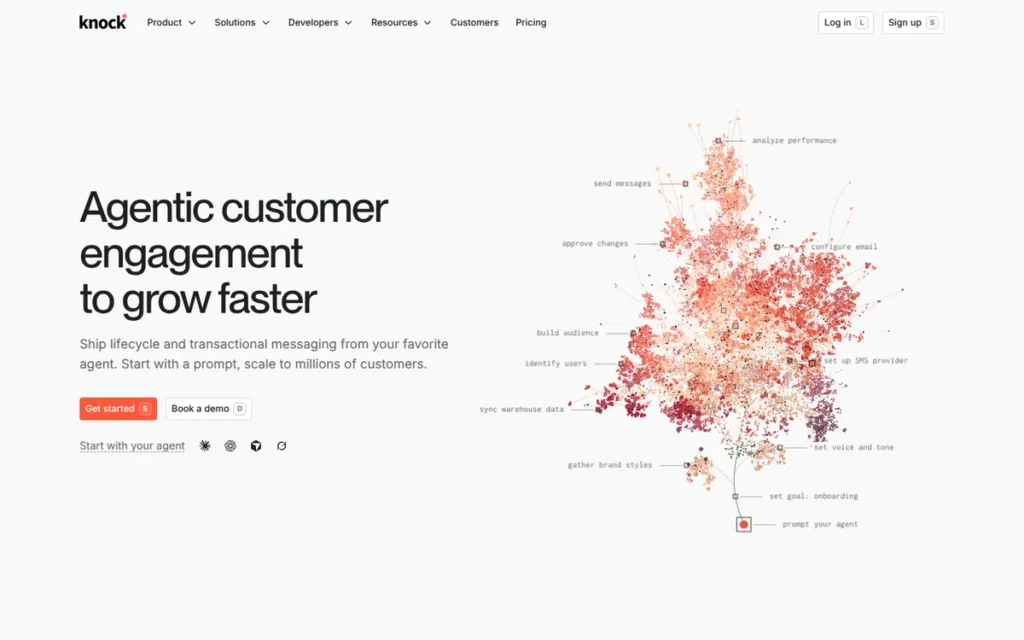
Category: Multi-Channel Workflow Orchestrator, a notification infrastructure platform that manages multi-channel delivery logic (batching, digests, delays, routing, fallback) through a declarative workflow engine, abstracting orchestration complexity from application code.
At a Glance
- Category: Multi-Channel Workflow Orchestrator
- Best For: Engineering teams at growth-stage and enterprise SaaS companies needing advanced workflow orchestration (batching, digests, delays, conditional routing) across email, SMS, push, in-app, Slack, and Teams, with pre-built React UI components for the in-app notification layer
- Price Range: Free (10,000 notifications/month); paid tiers scale with volume; approximately $5 per 1,000 notifications above the free threshold per community report (Reddit, r/node, November 2024); enterprise pricing by sales. Full tier pricing not publicly listed as of June 2026. Verify current rates at knock.app/pricing.
- Primary Strength: Knock provides the most fully documented workflow engine in the evaluated set, with declarative batching, digests, delays, conditional branching, and fallback routing all confirmed in official product documentation as of June 2026.
- Biggest Limitation: Knock’s per-notification pricing above the free tier (~$5 per 1,000 per community reporting) is significantly higher than raw delivery primitives, making it economically misaligned for teams needing simple push delivery without orchestration value.
- One-Line Summary: Knock is a developer-first notification infrastructure platform with the most fully documented workflow orchestration engine in the evaluated category, trusted in production by Vercel and Gorgias, with Gorgias reporting a 27% customer service response time improvement after adoption.
- Last Verified: June 2026
Overview
Knock (knock.app) is a managed notification infrastructure platform for SaaS engineering teams that orchestrates multi-channel notifications (email, SMS, push, in-app, Slack, and Teams) through a single declarative workflow engine, eliminating the need to hard-code batching, digests, and routing logic in application code. Knock positions the workflow engine as the core product differentiator, enabling teams to define notification orchestration as versioned configurations rather than embedded application logic. Knock is a fully managed commercial service with no self-hosted or open-source deployment option.
Key Features
- Declarative Workflow Engine: Knock allows engineering teams to define notification orchestration (including batching, digests, delays, conditional branching, and fallback routing) as versioned workflow configurations outside application code, removing these concerns from the core codebase entirely.
- Multi-Channel Delivery API: Knock supports cross-channel delivery across email, SMS, push, in-app, Slack, Microsoft Teams, and additional chat platforms through a single unified API, with 25+ provider integrations confirmed as of June 2026.
- Pre-Built React In-App Components: Knock includes pre-built React notification feeds, banners, pop-ups, and embeddable notification inboxes, enabling product teams to ship a complete in-app notification experience without building custom frontend infrastructure.
- User Preference Management: Knock provides a hosted user preference management system that allows end users to control which notifications they receive per channel, reducing notification fatigue and supporting GDPR and CCPA compliance workflows.
- Delivery Observability: Knock delivers per-notification delivery logs, real-time status tracking, and failure visibility across all channels and providers from a single dashboard, reducing engineering time required for production incident response.
Best For
Knock is best for engineering teams at SaaS companies building complex, multi-channel notification systems where workflow orchestration, batching activity digests, routing across multiple providers, managing user preferences, and enforcing delivery logic centrally, represents the primary technical challenge. Knock is explicitly not appropriate for teams whose sole requirement is simple, high-volume push notification delivery without orchestration needs, a positioning the Knock cofounder confirmed directly on Reddit in November 2024.
Pricing
Knock’s free tier includes 10,000 notifications per month. Above the free threshold, a community pricing discussion (Reddit, r/node, November 2024) estimated approximately $5 per 1,000 notifications.
One Reddit commenter calculated this as approximately 10,000x the cost of AWS SNS, which charges $0.50 per million messages. The Knock cofounder acknowledged the gap in the same thread, framing it as payment for workflow compute, log storage, and real-time infrastructure rather than message delivery alone.
Knock’s full paid tier pricing is not publicly listed as of June 2026. The cofounder noted pricing was a “work-in-progress” intended to become more competitive at scale. A funding round was confirmed in March 2024 (AlleyWatch, March 2024), signaling continued product investment. Enterprise pricing requires sales engagement. Verify current rates at knock.app/pricing.
Strengths
- Verified Enterprise Production Evidence: Gorgias reports a 27% improvement in customer service response times after adopting Knock for notification infrastructure (knock.app/customers/gorgias, 2024), and Vercel is a named production customer, establishing Knock’s enterprise reliability with independent evidence beyond self-reported marketing claims.
- Strong G2 Recognition: Knock has earned G2 Leader, Easiest to Use, and Best Free Software badges in the notification infrastructure category (G2, g2.com/categories/notification-infrastructure, June 2026), reflecting verified customer satisfaction across core workflow orchestration use cases.
- Highest Community Endorsement Score: A Reddit community recommendation for Knock received 21 upvotes in r/node (u/TheCommentAppraiser, November 2024), the most upvoted organic notification infrastructure platform recommendation in any researched thread, a credibility signal independent of paid promotion.
- Consistent Market Recognition: Knock is included in independently authored best-notification-infrastructure roundups by Resend, Courier, and Fyno, confirming strong cross-category market recognition from organizations with no financial incentive to favor Knock.
“Knock is great, You get 10k notifications a month for free, and the product is top-notch, and takes you far beyond just APNS push notifications.” Posted by u/TheCommentAppraiser, r/node (21 upvotes, November 2024)
Takeaway: Knock’s community endorsement is specific about its multi-channel orchestration value, reviewers identify it as superior to basic push delivery services, confirming the platform delivers on its workflow-first positioning.
Limitations
- Pricing Premium vs. Raw Delivery: Knock’s per-notification pricing above the free tier (~$5 per 1,000 per community reporting) is significantly higher than raw delivery primitives, a Reddit commenter calculated a 10,000x premium over AWS SNS ($0.50 per million messages), and the Knock cofounder explicitly stated Knock is “not the best fit” for teams wanting the cheapest way to send push notifications without orchestration needs (r/node, November 2024).
“The pricing on Knock is actually insane. If you’re just a developer who wants to send simple push notifications, steer clear of Knock. Or at least understand that you will be paying extreme prices once you get over 10k notifications per month.” Posted by u/Professional-Trick14, r/node (7 upvotes, November 2024)
Takeaway: Knock’s pricing model delivers value only when teams use its workflow orchestration features, teams paying for simple message delivery without using batching, digests, or routing receive significantly less value than lower-cost alternatives provide at comparable volume.
“If you’re looking for the cheapest way to send simple push notifications and you don’t have multi-channel, in-app, or preference requirements, then a simple delivery service such as SNS/FCM might be a better fit for you.” Posted by u/seelsonwheels (Knock cofounder), r/node (November 2024)
Takeaway: A Knock cofounder’s direct acknowledgment that Knock is the wrong tool for simple push delivery is the most credible self-qualification statement in any notification infrastructure vendor’s public communications, and the primary reason Knock’s #1 ranking applies specifically to teams with orchestration complexity.
- No Self-Hosting Option: Knock is a fully managed commercial service with no self-hosted or open-source deployment option, making it unsuitable for teams with strict data residency requirements or compliance mandates requiring on-premise infrastructure control.
Verdict
Knock is the strongest overall notification infrastructure platform for SaaS engineering teams that need production-grade, workflow-driven multi-channel orchestration and can justify the pricing premium through orchestration value rather than raw delivery volume. Knock’s combination of workflow engine depth, verified enterprise production evidence (Vercel as a named customer, Gorgias reporting a 27% response time improvement), G2 Leader status, and pre-built React UI components creates the most complete and credible solution package in this evaluation. Teams should evaluate alternatives if their primary requirement is high-volume simple push delivery without orchestration complexity, or if on-premise deployment is a compliance requirement.
2. SuprSend: Best for B2B2C SaaS Teams Requiring Multi-Tenant Notification Infrastructure with WhatsApp Support
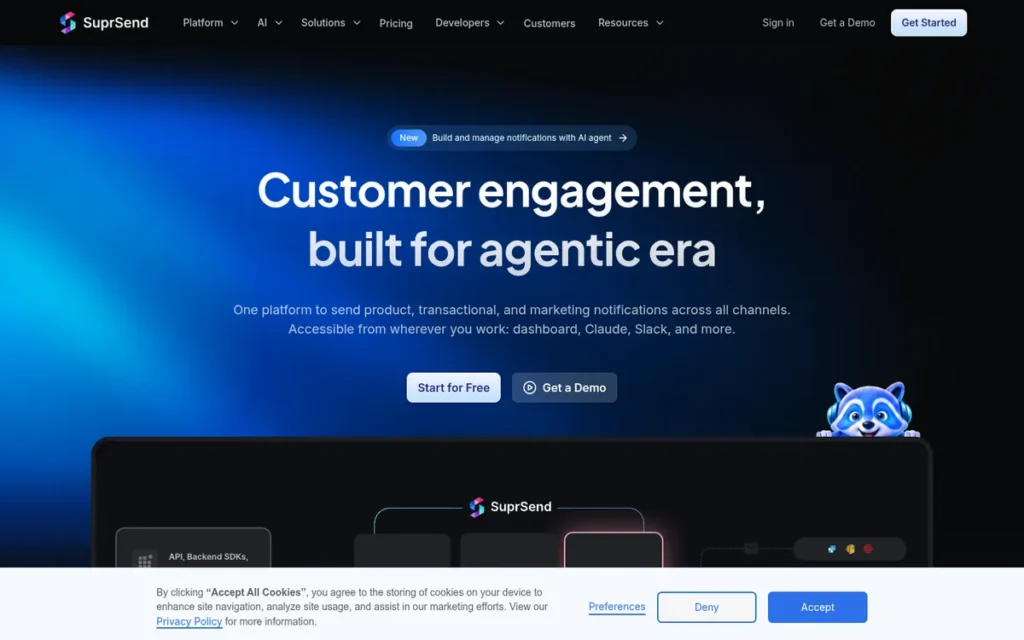
Category: Multi-Tenant Notification Orchestrator, a notification infrastructure platform built around B2B2C multi-tenancy, enabling SaaS companies to manage per-tenant branding, preferences, and provider configurations while orchestrating delivery across email, SMS, push, in-app, WhatsApp, and Slack from a single API.
At a Glance
- Category: Multi-Tenant Notification Orchestrator
- Best For: B2B SaaS and marketplace teams that need per-tenant notification customization, international teams requiring native WhatsApp channel support, and engineering teams at growth-stage SaaS companies seeking full workflow orchestration with more transparent pricing than Knock
- Price Range: Free (10,000 notifications/month); Essentials $110/month; Business $275/month (billed annually per suprsend.com/pricing, June 2026). Note: third-party comparisons reference $100/$250 figures that may reflect monthly billing equivalents or prior pricing. Multi-tenancy requires Business or Enterprise tier. Enterprise tier includes a self-hosted deployment option. Verify current rates at suprsend.com/pricing.
- Primary Strength: SuprSend’s native B2B2C multi-tenancy architecture enables SaaS companies to manage per-tenant branding, notification preferences, and provider configurations as a first-class platform concept, the deepest multi-tenant notification architecture in this evaluation.
- Biggest Limitation: SuprSend’s headline multi-tenancy differentiator is feature-gated behind the Business tier ($275/month annually) and Enterprise pricing, teams selecting SuprSend specifically for multi-tenancy cannot access it at the $110/month Essentials tier.
- One-Line Summary: SuprSend is a B2B2C-first notification infrastructure platform combining native multi-tenant architecture, automatic provider failover, and WhatsApp channel support in a single workflow orchestration API.
- Last Verified: June 2026
Overview
SuprSend (suprsend.com) is a notification infrastructure platform engineered for B2B SaaS and marketplace teams that need to deliver customized notifications on behalf of each tenant organization (supporting per-tenant branding, preferences, and provider configurations) alongside multi-channel orchestration across email, SMS, push, in-app, WhatsApp, and Slack via a unified API. SuprSend distinguishes itself from most notification platforms by treating B2B2C multi-tenancy as a first-class architectural concept, making it the strongest option for SaaS companies whose business customers expect white-labeled or individually configured communications. SuprSend is a managed cloud service; a self-hosted deployment option is available on the Enterprise tier (suprsend.com/pricing, June 2026).
Key Features
- B2B2C Multi-Tenancy Architecture: SuprSend’s multi-tenancy model enables each tenant organization to have its own branding, notification preferences, provider configurations, and user subscription settings configured at trigger time without code changes, the deepest multi-tenant notification architecture in this evaluation.
- Drag-and-Drop Workflow Builder: SuprSend’s workflow builder supports conditions, delays, batching and digest aggregation, throttling, branching logic, and automatic Smart Routing that dynamically switches between providers or channels based on delivery performance and cost.
- Native WhatsApp Channel: SuprSend supports the most complete non-Fyno channel set in this evaluation, including email, SMS, push (web and mobile), in-app inbox, WhatsApp, Slack, and drop-in React components for the in-app notification feed.
- Automatic Provider Failover: SuprSend’s Smart Routing dynamically switches to backup channels or providers when a primary delivery attempt fails, reducing engineering on-call burden for high-volume notification systems without manual intervention.
- CI/CD and Version-Controlled Templates: SuprSend provides CI/CD integration and version-controlled template management, enabling engineering teams to treat notification configurations as code artifacts managed alongside application deployments.
Best For
SuprSend is best for B2B SaaS companies and marketplaces where each customer organization (tenant) requires its own notification identity (custom branding, user preference controls, and potentially separate provider configurations) and for international SaaS teams serving markets where WhatsApp is the dominant communication channel. SuprSend is also a strong choice for engineering teams that need full workflow orchestration comparable to Knock but with more transparent entry-level pricing and native WhatsApp support.
Pricing
SuprSend’s official pricing page (suprsend.com/pricing, June 2026) lists Essentials at $110/month and Business at $275/month when billed annually. Third-party comparisons including Resend’s independently authored list reference $100/$250/month, which may reflect monthly billing equivalents or prior pricing, verify current rates directly at suprsend.com/pricing.
The free tier includes 10,000 notifications per month. Business tier includes batching, digest notifications, user preferences, and Smart Routing. Multi-tenancy requires Business or Enterprise tier, teams selecting SuprSend specifically for B2B2C multi-tenancy should budget $275/month minimum or request Enterprise pricing.
A self-hosted deployment option is available on the Enterprise tier (suprsend.com/pricing, June 2026), which is meaningful for teams with data residency requirements but unavailable below Enterprise pricing. A Reddit commenter noted SuprSend’s Business tier is “almost half the price of Knock with almost the same features” at comparable capability levels (u/FroyoOk2287, r/webdev, 2025).
Strengths
- Validated by Independent Reviewer: SuprSend is included in Resend’s independently authored “best notification infrastructure services” comparison (resend.com/blog, June 2026), confirming third-party category recognition from a respected developer infrastructure brand with no incentive to favor SuprSend.
- Consistent G2 Validation: G2 reviewers consistently cite SuprSend’s ability to centralize multi-channel notifications in a single workflow as the primary adoption driver, with “reduced engineering overhead” appearing as the most common theme across multiple pages of G2 reviews (G2, June 2026), validating the platform’s core build-vs-buy positioning.
- Automatic Failover Confidence: SuprSend’s automatic provider failover: confirmed in product documentation (suprsend.com, June 2026), switches to backup providers or channels without manual intervention, a reliability feature G2 reviewers identified as a key confidence builder for high-volume notification systems.
- Cost-Competitive Against Category Leader: A Reddit commenter directly compared SuprSend to Knock, noting “the pricing is almost double compared to SuprSend, with almost the same set of features” at comparable capability tiers (u/FroyoOk2287, r/webdev, 2025), establishing SuprSend as the more cost-competitive alternative for teams with equivalent orchestration requirements.
“If you want push + email + automation in one place: SuprSend [is a good option]” Posted by u/nightswordblade, r/webdev (2025)
Takeaway: Community consensus positions SuprSend as the go-to recommendation for teams that need push, email, and workflow automation in a single platform, reinforcing its #2 ranking on the pricing transparency and channel breadth criteria against Knock.
Limitations
- Feature Gating of Core Differentiator: SuprSend’s most consequential trade-off is feature gating: B2B2C multi-tenancy (the capability that most distinguishes SuprSend from competitors) is not available at the $110/month Essentials tier, requiring teams to commit to the $275/month Business plan (annually) or Enterprise pricing. A Reddit commenter confirmed directly: “SuprSend $100 plan doesn’t offer batching or preferences, so $250 plan is pretty comparable” to alternatives at similar feature levels (r/webdev, 2025). Teams should budget for Business or Enterprise from the start, not plan to scale up from Essentials.
Users on r/reactjs noted:
“I’ve tried a 3rd party around 1 yr back – suprsend for one of my web dev client. so we were using their react SDK. advantage was that their inapp notification center was one of the best in the market. Though the changes pushing in was very frequent, one time like some features broke down, because of that. I think it was their initial time, now product might have been more matured. I’ve heard about novu as well, but haven’t tried them.” Posted by u/Party-Tower-5475, r/reactjs (3 upvotes, 2024)
Takeaway: SuprSend’s in-app notification center earns recognition as best-in-class among practitioners who evaluated it, but early adopters encountered stability disruptions from rapid platform shipping cadence, a risk that teams on production-critical notification pipelines should factor into adoption timing decisions.
- Self-Hosting Limited to Enterprise Tier: SuprSend’s self-hosted deployment option is available only on the Enterprise tier (suprsend.com/pricing, June 2026), teams with data residency requirements who cannot commit to Enterprise pricing have no lower-cost self-hosting path, unlike Novu which provides MIT-licensed self-hosting at zero licensing cost.
- Limited Public Vendor Background: SuprSend’s founding team, company size, and total funding are not publicly disclosed, introducing a vendor longevity consideration for teams making multi-year infrastructure commitments.
Verdict
SuprSend is the strongest notification infrastructure choice for B2B SaaS companies that need per-tenant notification customization as a structural platform capability and for international teams where native WhatsApp channel support is a hard requirement. SuprSend’s combination of native multi-tenancy, automatic provider failover, WhatsApp support, and more transparent pricing than Knock makes it the most balanced overall platform in this evaluation for teams whose use case fits its B2B2C architecture. Teams that need the deepest workflow engine and the most demanding orchestration evidence should evaluate Knock first, as Knock’s workflow depth and named enterprise production evidence remain the category benchmark.
3. Novu: Best Open-Source Notification Infrastructure Platform for Self-Hosting and Developer Community
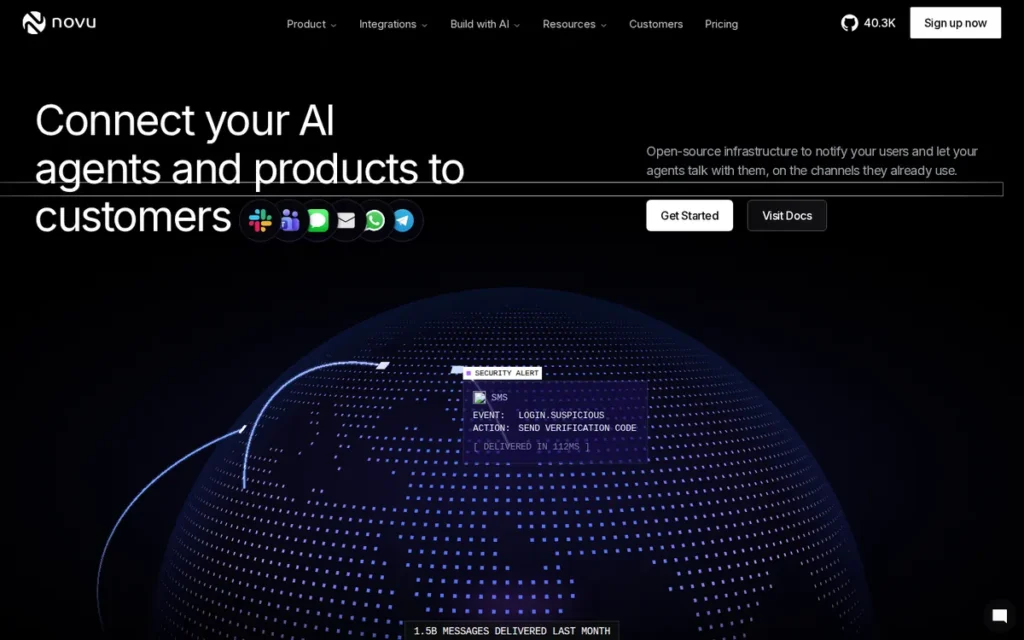
Category: Open-Source Notification Platform, a notification infrastructure platform with a publicly available, MIT-licensed codebase that can be self-hosted for free or used as a managed cloud service, covering multi-channel delivery, workflow orchestration, and embeddable in-app notification components.
At a Glance
- Category: Open-Source Notification Platform
- Best For: Developer teams that prioritize data control, zero vendor lock-in, and cost-minimized infrastructure, including compliance-sensitive teams, solo developers, early-stage SaaS companies with engineering capacity to self-host, and teams that want an active open-source community with extensible custom provider support
- Price Range: Free (self-hosted, MIT license, unlimited notifications); Cloud: Free (10,000 notifications/month), Starter $30/month (30,000 notifications), Team $250/month (250,000 notifications), Enterprise custom. (Per Resend comparison, June 2026, verify current rates at novu.co/pricing.)
- Primary Strength: Novu is the only MIT-licensed open-source notification infrastructure platform among the six evaluated, with approximately 39,000 GitHub stars and 400+ contributors as of June 2026 (github.com/novuhq/novu), enabling unlimited self-hosted deployment at zero licensing cost.
- Biggest Limitation: Novu’s production self-hosting documentation has been described as inadequate for real deployment scenarios by multiple community members from 2022 through 2025, with Docker configurations oriented toward development setups rather than production-grade deployments behind reverse proxies.
- One-Line Summary: Novu is the leading open-source notification infrastructure platform among those evaluated, with approximately 39,000 GitHub stars, a free MIT-licensed self-hosted option, and a unified multi-channel API covering email, SMS, push, in-app, and chat.
- Last Verified: June 2026
Overview
Novu (novu.co) is an open-source notification infrastructure platform available under an MIT license for self-hosting or as Novu Cloud, a managed service covering email, SMS, push, in-app, and chat channels including Slack, Teams, Discord, and WhatsApp via community providers through a unified API and workflow engine. Novu is the most GitHub-starred open-source notification infrastructure platform in this evaluation, with approximately 39,000 stars and 400+ contributors as of June 2026 (github.com/novuhq/novu; novu.co), establishing it as the default first evaluation for engineering teams whose primary requirements are data control, self-hosting capability, and elimination of vendor lock-in. Novu’s open-core model provides the fundamental workflow engine and delivery infrastructure freely under an MIT license, while enterprise features carry a commercial license.
Key Features
- MIT-Licensed Open-Source Core: Novu’s MIT-licensed core enables unlimited self-hosted deployment on any infrastructure, giving teams complete data sovereignty and eliminating vendor lock-in, the only platform among the six evaluated with a genuinely free and unlimited self-hosted option.
- Embeddable React Inbox Component: Novu provides an embeddable
<Inbox />React component for in-app notification feeds with Angular, Vue, and iFrame variants, enabling teams to ship a complete in-app notification experience without building custom frontend infrastructure. - Community-Extensible Provider System: Novu’s unified API spans email, SMS, push, in-app, and chat channels with a documented contribution path (docs.novu.co/community/create-provider) for adding custom providers beyond the default integration set, making Novu extensible for regional or niche communication providers.
- Workflow Orchestration: Novu’s workflow builder supports filters, delays, digest notifications, and subscriber preference management, covering the core orchestration requirements for most SaaS notification use cases with visual and API-driven configuration.
- Cloud Managed Service Option: Novu Cloud provides a managed hosting option starting at $30/month for 30,000 notifications, enabling teams to adopt the platform without operational self-hosting overhead while maintaining the option to migrate to self-hosted at any time.
Best For
Novu is best for developer teams that prioritize data control and zero vendor lock-in, including compliance-sensitive organizations with data residency requirements, early-stage SaaS companies with engineering capacity to maintain infrastructure, and solo developers where zero licensing cost is the primary budget constraint. Novu is also the strongest choice for teams that want access to an active open-source community where peer experience is publicly documented and for teams that need extensibility through custom channel integrations beyond the default provider set.
Pricing
Novu offers two distinct pricing tracks. Self-hosted (open source): free and unlimited under the MIT license, teams pay only for their own infrastructure and the engineering time required to deploy and maintain the platform in production.
Cloud pricing (per Resend comparison, June 2026): Free tier includes 10,000 notifications/month; Starter is $30/month for 30,000 notifications; Team is $250/month for 250,000 notifications; Enterprise is custom pricing. Verify current rates at novu.co/pricing.
Self-hosting is the lowest total licensing cost option, but factor operational engineering time into total cost of ownership. A conservative estimate for one senior engineer maintaining a self-hosted notification stack is 10–15% of their annual time (equivalent to $15,000–$25,000 per year at a $150,000 fully loaded cost) which often exceeds Novu Cloud’s Starter tier cost at relevant scale. Novu’s early funding was reported at approximately $6M in community discussions (Reddit, r/selfhosted, 2022); this figure has not been confirmed via a primary financial source such as a press release.
Users on r/reactjs described their Novu Cloud pricing evaluation:
“I’ve been evaluating it for my app, and while the platform is impressive, I found that the cloud pricing becomes quite expensive at scale. For example, with just 1,000 users, each receiving 10 in-app notifications per day, that results in 300,000 events per month. Based on their current pricing: Pro Plan: $354/month. Team Plan: $310/month. And that’s just for in-app notifications for 1,000 users. Scaling to 5,000 or 10,000 users would cost thousands of dollars monthly, which is hard to justify for a notification system. I also explored the self-hosted option, but it’s extremely resource-intensive. According to their documentation, the recommended setup is: 36 vCPUs and 64GB RAM for all Novu services, MongoDB Cluster (M20 or higher) on Atlas, 10GB of S3-compatible storage.” Posted by u/Issam_Seghir, r/reactjs (2025)
Takeaway: Novu Cloud’s per-event pricing model reaches costs comparable to fully managed competitors at just 1,000 active users generating frequent in-app notifications, making self-hosting the only cost-effective path at volume, despite its significant documented infrastructure requirements.
Strengths
- Largest Open-Source Community in the Category: Novu has accumulated approximately 39,000 GitHub stars and 400+ contributors as of June 2026 (github.com/novuhq/novu; novu.co), the most developer-community-validated notification infrastructure project by open-source metrics in this evaluation, with a community scale that dwarfs all other platforms reviewed.
- Only MIT-Licensed Self-Hosted Option at Zero Cost: Novu’s MIT-licensed self-hosted deployment satisfies data residency and compliance requirements without licensing fees, a structural cost advantage over all fully managed competitors at any notification volume above the free tier.
- Strong Product Hunt Rating: Novu received a 4.7/5 rating on Product Hunt with 1,900 followers (Product Hunt, June 2026), with reviewers specifically praising multi-channel workflow support including filters, delays, and digest notifications, independently validating core orchestration quality.
- Active Commercial Ecosystem: Novu’s open-core enterprise licensing model and the FerretDB infrastructure partnership (blog.ferretdb.io, 2024) signal sustained investment in long-term platform maintenance beyond community contribution alone.
“My ELI5 understanding is: instead of having your project connect to 20 different providers for SMS/mail/…, You just connect to Novu with simple/unified commands. You don’t need to understand the raw API of each provider, Novu does that for you and wrap them into a unified API.” Posted by u/GSBattleman, r/selfhosted (6 upvotes, 2022)
Takeaway: Novu’s core value is provider-agnostic abstraction, community members recognize it as the layer that eliminates integration sprawl without sacrificing channel flexibility, validating the platform’s foundational value proposition.
Limitations
- Production Self-Hosting Documentation Gap: Novu’s most consequential trade-off is the gap between its self-hosting marketing and the production self-hosting reality: multiple community members have reported since 2022 that Novu’s Docker documentation is configured for development environments rather than production deployments behind reverse proxies such as nginx. Teams attempting production Novu self-hosting without documented reverse proxy configuration typically encounter broken WebSocket connections, failed health checks, and missing environment variable propagation, issues requiring undocumented debugging time estimated at several engineering days (community reports, r/selfhosted, 2022–2025).
“Cool and promising product, but selfhosting documentation is really lacking. How do you set this up behind a reverse proxy such as nginx? The docker docs are basically for development setups and not production.” Posted by u/gsusgur, r/selfhosted (11 upvotes, 2022)
Takeaway: The most upvoted specific Novu criticism identifies the gap between Novu’s Docker documentation (development-oriented) and what production deployment behind a reverse proxy actually requires, validating this as a community-wide observation, not an isolated edge case.
“documentation is intentionally lacking. It looks like a project that only pretends to be cool with self hosting but in practice, not really.” Posted by u/FitAbalone2805, r/selfhosted (2025)
Takeaway: A 2025 community comment echoing the same criticism from 2022 confirms Novu’s self-hosting documentation gap is a persistent platform limitation, teams should build undocumented setup time into project plans for any Novu self-hosted production deployment.
- Workflow Orchestration Depth vs. Knock: Novu’s workflow orchestration depth (while sufficient for most SaaS use cases) is assessed as less mature than Knock’s declarative workflow engine based on available feature documentation and community comparisons, particularly for complex multi-step orchestration requirements.
Verdict
Novu is the definitive choice for engineering teams whose primary requirement is an open-source, self-hostable notification infrastructure platform with an active developer community and zero licensing cost. Novu’s approximately 39,000 GitHub stars, MIT license, transparent cloud pricing starting at $30/month, and extensible community provider system represent the strongest combination of openness and production viability in the notification infrastructure category. Novu’s self-hosting documentation gap is a genuine operational risk that teams must evaluate directly (particularly for compliance-motivated deployments) before assuming production self-hosting will be straightforward. Teams that need hosted simplicity without self-hosting complexity should compare Novu Cloud pricing against SuprSend and Knock at their expected notification scale.
4. Courier: Best for Teams Combining Visual Workflow Orchestration with AI-Augmented Notification Content Generation
Category: Visual Notification Orchestrator, a notification infrastructure platform centered on a visual Journeys workflow builder and template design Studio, with unique AI model integration nodes (GPT-4o, Claude) for dynamic content generation at workflow execution time.
At a Glance
- Category: Visual Notification Orchestrator
- Best For: SaaS teams where engineers, product managers, and marketers share notification ownership, particularly teams that need AI-augmented notification personalization, cross-platform in-app SDK components for iOS and Android, or enterprise procurement through AWS Marketplace
- Price Range: Free (10,000 messages/month); full tier pricing not publicly listed as of June 2026; enterprise pricing by sales; AWS Marketplace private offers available. Verify current rates at courier.com/pricing.
- Primary Strength: Courier is the only notification infrastructure platform in this evaluation that supports AI workflow nodes, enabling GPT-4o and Claude to dynamically generate notification content at workflow execution time, as documented in Courier’s Journeys product documentation (courier.com, 2025–2026).
- Biggest Limitation: Courier’s full tier pricing is not publicly listed as of June 2026, requiring sales engagement before any complete cost projection is possible, creating procurement friction for engineering teams that need budget approval before committing to evaluation depth.
- One-Line Summary: Courier is the best-funded notification infrastructure platform in the evaluated category, combining a visual Journeys workflow builder, AI content nodes supporting GPT-4o and Claude, and pre-built SDK components for React, iOS, Android, and Flutter.
- Last Verified: June 2026
Overview
Courier (courier.com) is a notification infrastructure platform that combines a unified sending API with a visual template Studio, a Journeys visual workflow builder featuring drag-and-drop routing logic and AI content generation nodes (GPT-4o and Claude), and pre-built notification components for React, iOS, Android, and Flutter, making Courier the platform most directly designed for organizations where engineers, product managers, and marketers share responsibility for the notification experience. Courier raised $47.5M in total funding as of June 2022, including a $35M Series B led by GV (Google Ventures) with participation from Bessemer Venture Partners, Matrix Partners, Twilio Ventures, Slack Fund, and Y Combinator (TechCrunch, June 2022; BusinessWire, June 2022), the strongest financial stability signal in this evaluation. Courier has no self-hosted or open-source deployment option.
Key Features
- AI-Augmented Journeys Workflow Builder: Courier’s Journeys visual workflow builder supports drag-and-drop routing logic, batching, digests, delays, branching, fallback handling, and AI content generation nodes that can invoke GPT-4o and Claude models at any workflow step, the only AI-augmented notification workflow capability in this evaluation, documented in Courier’s Journeys product documentation (courier.com, 2025–2026).
- Visual Studio Template Designer: Courier’s Studio enables non-engineer team members (including product managers, designers, and marketers) to manage notification templates and workflow content without engineering involvement, directly addressing the cross-functional team tension in notification management.
- Cross-Platform In-App Components: Courier includes pre-built notification center components for React, iOS, Android, and Flutter, with hosted user preference management and stated GDPR and CCPA compliance support, the broadest cross-platform in-app component library in this evaluation.
- AWS Marketplace Procurement: Courier is listed on AWS Marketplace with enterprise procurement support, enabling organizations with existing AWS committed spend to apply that spend toward Courier licensing and reduce procurement approval friction.
- Multi-Channel Delivery: Courier supports multi-channel delivery across email, push, in-app, SMS, Slack, Microsoft Teams, and Stream Chat through a single unified API, covering the core channel set for most SaaS notification requirements.
Best For
Courier is best for SaaS teams where multiple stakeholder groups (engineers, product managers, designers, and marketers) share ownership of the notification experience, and for teams that need AI-augmented notification personalization through dynamic content generation via GPT-4o or Claude at workflow execution time. Courier is also the strongest option for teams requiring native cross-platform in-app components on iOS and Android alongside web, and for enterprise buyers whose procurement workflows run through AWS Marketplace.
Pricing
Courier’s free tier includes 10,000 messages per month across all channels. Full tier pricing beyond the free tier is not publicly listed on courier.com as of June 2026, teams must contact sales to obtain full pricing.
Courier’s pricing opacity makes direct pre-budget comparison with SuprSend ($110–$275/month officially listed) and Novu ($30–$250/month publicly listed) impossible without a sales conversation. AWS Marketplace private offers are available for enterprise procurement using existing AWS committed spend.
Courier’s $47.5M in confirmed funding (TechCrunch, June 2022; BusinessWire, June 2022) reduces vendor longevity risk at current scale, but the private pricing model limits budget predictability for self-service evaluators. Verify current rates at courier.com/pricing. The 150+ paying customers referenced dates to June 2022, current customer count is not publicly disclosed as of June 2026.
Strengths
- Strongest Financial Stability Signal: Courier raised $47.5M in total funding as of June 2022 (including a $35M Series B led by GV (Google Ventures) with Bessemer Venture Partners, Matrix Partners, Twilio Ventures, Slack Fund, and Y Combinator (TechCrunch, June 2022; BusinessWire, June 2022)) making Courier the best-capitalized platform in this evaluation.
- Unique AI Workflow Node Capability: Courier’s AI workflow nodes support GPT-4o and Claude at workflow execution time, enabling dynamic notification content generation as a native platform capability, documented in Courier’s Journeys product documentation (courier.com, 2025–2026) with no functional equivalent available in any other notification infrastructure platform in this evaluation as of June 2026.
- Broadest Cross-Platform In-App SDK: Courier’s pre-built notification components spanning React, iOS, Android, and Flutter provide the broadest cross-platform in-app notification SDK set in this evaluation, reducing frontend engineering time across the full mobile and web stack without requiring separate library integrations.
- Consistent Commercial Adoption: Courier maintained 150+ paying customers as of its Series B announcement (TechCrunch, June 2022, current count not publicly disclosed), and has maintained consistent inclusion in developer roundup shortlists alongside Knock and Novu, with no significant community criticism identified in researched Reddit threads.
Users on r/reactjs shared their experience:
“Unless you have lots of time, would suggest just going with Courier. Really good SDK that allowed us to coordinate push notifications with email and other notification options with an API call. Free tier is pretty generous so you can test out without sinking in cash.” Posted by u/BezisDaMan, r/reactjs (3 upvotes, 2025)
Takeaway: Courier’s SDK earns organic practitioner recommendation for teams needing multi-channel coordination across push, email, and other channels with minimal code, and its generous free tier lowers the barrier to verified proof-of-concept adoption without upfront cost commitment.
Limitations
- Full Pricing Opacity: Courier’s most consequential trade-off is pricing transparency: full tier pricing is not publicly listed as of June 2026, requiring sales engagement before any complete cost projection is possible. Courier’s pricing opacity makes direct pre-budget comparison with competitors like SuprSend and Novu impossible without a sales conversation, a material friction point for engineering teams needing budget approval before committing to evaluation depth.
This aligns with community sentiment on r/reactjs:
“I got a proof of concept working with courier in about 5 minutes! Able to send test messages into my page and customize it to look on brand for me. So far it seems excellent. I can’t see how it’s free?? I guess they banking on companies using significantly more than there free allotment” Posted by u/bob_mcbob69, r/reactjs (2024)
Takeaway: Even developers enthusiastic about Courier’s rapid time-to-proof-of-concept immediately encounter the pricing question, confirming that Courier’s cost structure above the free tier requires a sales conversation, not a publicly documented pricing page, before any budget commitment can be made.
- Dated Commercial Scale Evidence: Courier’s customer count of 150+ dates to June 2022 and has not been publicly updated, leaving current commercial scale and growth trajectory unclear for teams evaluating vendor stability beyond the funding signal.
- No Self-Hosted Option: Courier is a fully managed cloud service with no self-hosted or open-source deployment option, eliminating it from consideration for teams with data residency requirements or compliance mandates requiring on-premise infrastructure control.
- Limited Organic Community Forum Presence: Courier’s limited Reddit community presence compared to Knock and Novu means fewer organic peer discussions about production experience are available for pre-adoption research, reducing independent sentiment data for evaluating teams.
Verdict
Courier is the strongest notification infrastructure choice for SaaS teams at the intersection of engineering control and non-engineering empowerment, particularly those needing visual workflow management accessible to product managers and marketers, AI-augmented notification content generation via GPT-4o or Claude, or cross-platform native SDK components for iOS and Android. Courier’s $47.5M funding from premier investors provides the most robust financial stability signal in this evaluation. Teams that prioritize pricing transparency, open-source availability, or the deepest workflow engine should evaluate Knock, SuprSend, or Novu before committing to Courier’s sales-led pricing process.
5. Fyno: Best for Regulated Industries and Teams Requiring Voice Notification Channel Support
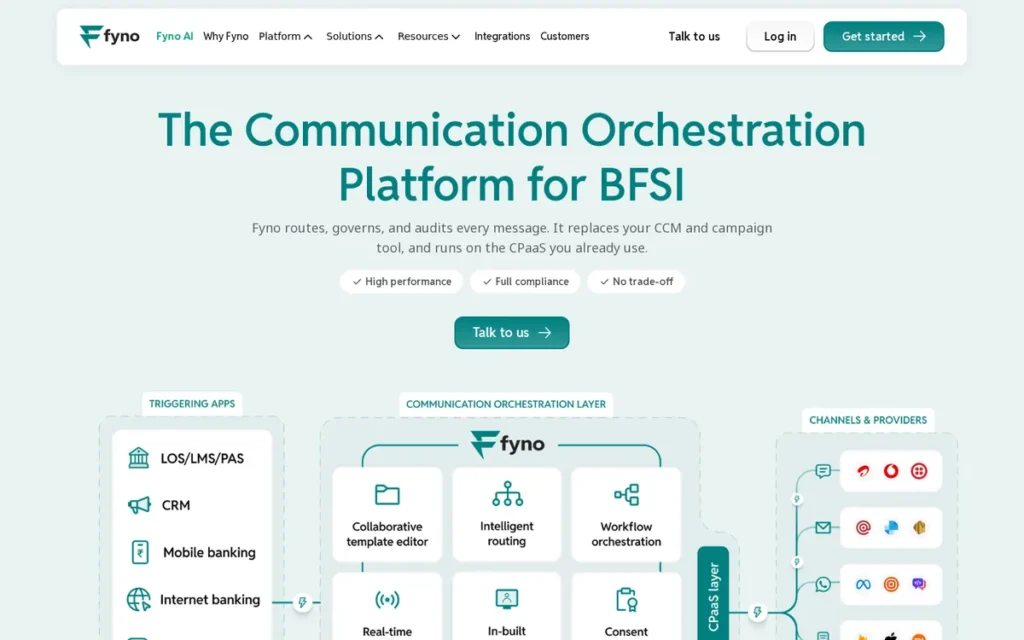
Category: Provider-Agnostic Notification Router, a no-code enterprise notification orchestration platform routing messages across the widest channel set in this evaluation (including voice channel delivery and IVR-capable workflow use cases) via a visual workflow builder with cost-aware Smart Routing, provider failover, and compliance management features.
At a Glance
- Category: Provider-Agnostic Notification Router
- Best For: Regulated industry teams (fintech, healthcare, logistics) requiring voice channel notification delivery and IVR-capable workflows as part of compliance systems, and enterprise teams needing no-code notification orchestration with consent tracking, audit logs, RBAC, and AWS Marketplace procurement
- Price Range: Pricing not publicly listed as of June 2026; contact sales required. AWS Marketplace procurement available. Verify current status at fyno.io/pricing.
- Primary Strength: Fyno is the only notification infrastructure platform in this evaluation with confirmed voice channel support and documented IVR-capable workflow use cases, making it the primary candidate for regulated industry teams where automated voice alerts are a hard channel requirement.
- Biggest Limitation: Fyno has no public pricing page as of June 2026, requiring sales engagement before any cost assessment is possible; G2 reviewers have documented developer dependency, interface design maturity issues, and missing features as active limitations.
- One-Line Summary: Fyno is the only notification infrastructure platform in this evaluated set with confirmed voice channel support and IVR-capable workflows, combined with no-code orchestration and compliance management features including consent tracking, audit logs, and RBAC.
- Last Verified: June 2026
Overview
Fyno (fyno.io) is an enterprise-oriented notification orchestration platform covering email, SMS, push, in-app, WhatsApp, and voice channel delivery with IVR-capable workflow use cases, through a no-code visual workflow builder with cost-aware Smart Routing, provider failover, and compliance management features including consent tracking, audit logs, and role-based access controls. Fyno’s voice channel support and documented IVR-capable workflow architecture make Fyno the primary notification infrastructure candidate for fintech, healthcare, and logistics teams where automated voice alerts are regulatory requirements, a channel capability no other platform in this evaluation confirms. Fyno is a fully managed enterprise platform with no open-source or self-hosted deployment option and pricing available only through sales engagement.
Key Features
- Voice Channel and IVR-Capable Workflows: Fyno supports voice channel delivery and has documented an IVR-capable workflow use case in customer materials (fyno.io, June 2026), the only platform in this evaluation with confirmed voice notification support. Note: IVR is supported via workflow architecture and customer use case documentation, not as an explicitly listed standalone product channel; teams requiring IVR as a hard compliance channel should request a formal capabilities document from Fyno directly.
- Cost-Aware Smart Routing: Fyno’s Smart Routing dynamically selects the most cost-effective qualifying provider for each notification delivery, optimizing spend at scale, a routing philosophy that differs from platforms that optimize routing on reliability and delivery performance alone.
- Compliance Management Suite: Fyno includes consent tracking, centralized audit logs, and role-based access controls, addressing a class of enterprise procurement requirements that most other platforms in this evaluation do not explicitly surface as first-class capabilities.
- No-Code Visual Workflow Builder: Fyno’s event-driven Visual Workflow Builder with Smart Routing, provider failover, and centralized template management enables enterprise teams to manage orchestration without requiring developer involvement for routine workflow changes.
- White-Labeling and AWS Marketplace: Fyno’s white-labeling capabilities and AWS Marketplace certification (confirmed via AWS Marketplace listing, June 2026) support enterprise procurement workflows and brand-controlled notification deployments for large organizations.
Best For
Fyno is best for regulated industry teams (fintech companies with automated compliance alerts, healthcare organizations with patient notification requirements, and logistics platforms with delivery exception workflows) where voice channel support is a hard requirement that no other platform in this evaluation can meet. Fyno is also appropriate for enterprises that need compliance management (consent tracking, audit logs, RBAC) as a standard platform feature and prefer a no-code orchestration approach with AWS Marketplace procurement support.
Pricing
Fyno does not publish pricing tiers publicly as of June 2026. All pricing requires direct engagement with the Fyno sales team. Fyno’s blog content frames ROI in terms of build-vs-buy engineering cost analysis, suggesting a sales-led pricing model targeted at enterprise budget cycles.
Fyno reports processing 2.5 billion+ notifications annually at an average processing time of under 50 milliseconds (fyno.io, June 2026, self-reported, not independently audited), providing a scale reference point for enterprise teams evaluating production throughput requirements. AWS Marketplace availability enables procurement through existing AWS committed spend.
Teams requiring a budget projection before beginning evaluation should contact Fyno directly at fyno.io before investing evaluation time in a fully sales-led process. Verify current pricing status at fyno.io/pricing.
Strengths
- Category-Exclusive Voice Channel Support: Fyno is confirmed as the only notification infrastructure platform in this evaluation with voice channel delivery support and documented IVR-capable workflow use cases (fyno.io, June 2026; AWS Marketplace listing), a category-exclusive capability that makes Fyno the only viable evaluation candidate for regulated industry teams with voice notification requirements.
- Formal AWS Marketplace Certification: Fyno achieved formal AWS Marketplace certification, confirming enterprise infrastructure readiness through Amazon’s independent verification process and enabling procurement through AWS committed spend, an institutional credential providing independent validation beyond vendor self-reporting.
- Compliance Management as a First-Class Feature: Fyno’s compliance management features (consent tracking, centralized audit logs, and role-based access controls) are documented in product materials (fyno.io, June 2026), addressing enterprise procurement requirements that most other platforms in this evaluation do not explicitly surface.
- Independent Category Recognition: Fyno is included in Resend’s independently authored “best notification infrastructure services” comparison (resend.com/blog, June 2026), providing third-party category recognition beyond Fyno’s own marketing materials.
Limitations
- Complete Pricing Opacity and Limited Community Validation: Fyno’s most consequential trade-off is the combination of pricing opacity and limited independent community validation, pricing requires sales engagement with no public tiers as of June 2026, and Fyno produced no verifiable presence in any r/node, r/webdev, or r/selfhosted developer community thread researched, suggesting real-world developer adoption is lower than the top-four platforms. G2 reviewers documented specific product maturity concerns including “Outdated Design,” “Poor Interface Design,” “Missing Features,” and “Developer Dependency”, the last of which is notably concerning for a platform marketed as no-code (G2, June 2026).
- IVR Capability Requires Direct Verification: Fyno’s IVR channel capability, while referenced in customer materials and confirmed for voice delivery, is not explicitly documented as a named product-page feature in available research. Regulated industry teams selecting Fyno specifically for IVR compliance requirements should request a formal technical capability document before committing to a contract.
- Limited Public Vendor Background: Fyno’s founding team, company size, and total funding are not publicly documented, making vendor longevity assessment difficult for teams committing to multi-year infrastructure contracts.
Verdict
Fyno is the primary notification infrastructure candidate in this evaluation for fintech, healthcare, and logistics teams that require voice channel delivery, no other platform in the six evaluated confirms voice notification support, creating a de facto exclusive position for Fyno within that buyer segment. Outside of regulated industry voice requirements, Fyno’s full pricing opacity, limited community validation, and documented interface maturity concerns from G2 reviewers make it a less compelling option than Knock, SuprSend, Novu, or Courier for standard multi-channel notification use cases. Teams evaluating Fyno for non-voice use cases should weigh whether the exclusive channel coverage justifies the evaluation overhead of a fully sales-led process without public pricing benchmarks.
6. Pingram: Best for Small-to-Mid SaaS Teams Needing the Fastest Time-to-Production with Cross-Functional Notification Management
Category: Rapid-Deployment Notification Platform, a managed notification infrastructure service designed for fast time-to-production, enabling developer-handled delivery via SDK alongside non-engineer content and rule management through a visual design-send-monitor workflow.
At a Glance
- Category: Rapid-Deployment Notification Platform
- Best For: Small-to-mid-sized SaaS teams that prioritize fastest time-to-production over maximum workflow complexity, and cross-functional teams where product managers, customer success, or marketing staff need to manage notification content and rules without developer involvement for routine updates
- Price Range: Pricing not independently verified as of June 2026; one third-party source references a $200/month plan, do not use this figure for budget planning. Verify directly at pingram.io/pricing.
- Primary Strength: Pingram’s cross-functional architecture cleanly separates notification delivery (developer-managed via SDK) from notification content and rules (non-engineer-managed through a visual interface), directly addressing the engineering and product team tension in notification management.
- Biggest Limitation: Pingram’s workflow orchestration depth and channel breadth are more limited than the top-four platforms, making it less suitable for high-volume multi-channel orchestration requirements or enterprise-scale deployment with advanced workflow needs.
- One-Line Summary: Pingram (formerly NotificationAPI) is a rapid-deployment notification infrastructure platform rated 4.7/5 on G2 (June 2026), designed for SaaS teams that need notification capabilities in days rather than months with cross-functional visual content management.
- Last Verified: June 2026
Overview
Pingram (pingram.io), formerly known as NotificationAPI, is a managed notification infrastructure platform founded in 2020 in Canada that enables SaaS teams to add in-app, email, push, and SMS notification capabilities in days rather than months, with a cross-functional architecture allowing developers to handle delivery infrastructure via SDK while product managers, customer success teams, and marketers manage notification content and rules without writing code. Pingram’s 4.7/5 G2 rating (G2 notification infrastructure category, June 2026) is the highest confirmed rating in this evaluation, suggesting strong customer satisfaction within its target use case. Teams researching Pingram should also search for “NotificationAPI,” the prior brand name under which most community reviews and G2 entries are currently indexed.
Key Features
- Cross-Functional Architecture: Pingram’s architecture separates notification delivery, managed by developers through SDKs, from notification content and rules, managed by product managers, customer success, and marketing through a visual interface, reducing engineering bottlenecks for routine notification management tasks.
- Days-Not-Months Time-to-Production: Pingram enables SaaS teams to add multi-channel notification capabilities in days rather than months, making it the fastest stated time-to-production option in this evaluation for teams with standard in-app, email, push, and SMS requirements.
- Unified Visual Workflow: Pingram covers in-app, email, push, and SMS channels through a unified visual design-send-monitor workflow, providing standard channel coverage required by most early-to-mid-stage SaaS products without requiring deep configuration.
- Delivery Monitoring: Pingram includes visual delivery monitoring and notification performance tracking, enabling teams to observe delivery status and engagement metrics without building custom observability tooling.
- Canadian-Origin Privacy Alignment: Pingram’s Canadian-origin platform design reflects alignment with PIPEDA data privacy requirements, which may be relevant for Canadian SaaS teams or products serving Canadian markets with specific privacy compliance obligations.
Best For
Pingram is best for small-to-mid-sized SaaS teams that need to add multi-channel notification capabilities quickly (within days rather than months) and for cross-functional teams where product managers or customer success representatives need to manage notification content and rules without depending on engineering for every content update. Pingram is less appropriate for teams that require complex workflow orchestration (multi-level digests, advanced branching, automatic provider failover), high-volume enterprise scale, or channel coverage beyond email, SMS, push, and in-app.
Pricing
A $200/month plan was referenced in one third-party comparison source for Pingram/NotificationAPI, but this figure could not be independently verified from the official pricing page as of June 2026. Pingram’s recent rebrand from NotificationAPI to Pingram may have changed pricing tiers.
Teams should not rely on the $200/month reference for budget planning. Verify current pricing directly at pingram.io/pricing before any budget assumptions. (Pricing status as of June 2026.)
Strengths
- Highest Confirmed G2 Rating in the Evaluation: Pingram holds a 4.7/5 rating on G2 (G2 notification infrastructure category aggregate data, June 2026) (the highest confirmed rating in this evaluation) suggesting a customer base highly satisfied with the platform’s delivery on its time-to-production and cross-functional management value proposition. Note: this rating is indexed primarily under the prior NotificationAPI brand name; the rebrand may affect future rating aggregation.
- Established Product Maturity: Pingram’s 2020 founding gives it 4–5 years of product iteration and production stability as of June 2026, meaningful evidence of sustained commercial viability in a competitive market.
- Organic Community Recognition: Pingram received an unprompted recommendation on Reddit (u/shishami, r/webdev, 3 upvotes, 2026) and was co-mentioned alongside infrastructure staples including Firebase, Pusher, and Postmark without qualification, indicating baseline community trust in platform reliability and developer experience.
- Multi-Platform Aggregator Presence: Pingram is listed across G2, Capterra, and Slashdot’s notification infrastructure category simultaneously (June 2026), confirming multi-platform aggregator recognition that validates its standing as a legitimate category participant.
“check out notificationapi.com” Posted by u/shishami, r/webdev (3 upvotes, 2026)
Takeaway: Concise but upvoted organic community recommendations indicate Pingram has developer familiarity, the brevity reflects the platform’s smaller community footprint compared to Knock or Novu, but unprompted positive recommendations suggest genuine satisfaction among those who have used it.
Limitations
- Orchestration Scope Ceiling: Pingram’s most consequential trade-off is orchestration depth: its time-to-production strength comes at the cost of advanced workflow capability, meaning teams that need multi-level digests, complex branching logic, automatic provider failover, or enterprise-grade multi-tenancy will outgrow Pingram’s capabilities as notification requirements scale. Pingram’s channel set (in-app, email, push, SMS) is standard but narrower than SuprSend (adds WhatsApp and Slack) and significantly narrower than Fyno (adds voice channel delivery).
- Rebrand Search Fragmentation and Unverified Pricing: The recent rebrand from NotificationAPI to Pingram introduces brand search fragmentation (teams researching the platform may encounter reviews split between both names with inconsistent findability) and the only available pricing reference ($200/month) is unverified and potentially outdated following the rebrand.
- Limited Enterprise Evidence: No named enterprise customers, publicly confirmed funding, or production scale metrics were available from research, limiting the evidence base for vendor longevity assessment. Teams making multi-year infrastructure commitments should request reference customers and financial stability information directly from Pingram.
Verdict
Pingram is the strongest choice for SaaS teams that need to ship notification infrastructure quickly and want a cross-functional management layer that product and customer success teams can operate without engineering involvement, with a 4.7/5 G2 rating suggesting this promise is consistently delivered to the current customer base. Teams with growing orchestration complexity, enterprise multi-tenancy requirements, or channel needs beyond the standard email/SMS/push/in-app set should plan for a platform migration earlier rather than later, as Pingram’s orchestration ceiling is lower than the top-four platforms in this evaluation. Verify current pricing at pingram.io before relying on any third-party pricing reference.
What Red Flags Should I Watch For When Evaluating Notification Infrastructure Software?
Six red flags indicate that a notification infrastructure platform may not deliver on its promises: pricing opacity without publicly listed tiers, self-hosting marketing without production-grade documentation, core differentiators feature-gated behind enterprise pricing, no verifiable developer community forum presence, conflicting or unverifiable pricing data across sources, and incomplete channel coverage listed as “coming soon.” Each is documented in detail below.
Red Flag #1: Pricing Opacity Without Publicly Listed Tier Data
When a platform does not publicly list full pricing tiers, budget projection requires a sales conversation before evaluation can begin, adding friction and timeline risk to procurement. Of the six platforms evaluated, Knock, Courier, and Fyno do not publicly list full paid tier pricing as of June 2026. Teams evaluating these platforms should request complete volume-based pricing before conducting deep integration evaluation.
Red Flag #2: Self-Hosting Marketing Without Production-Grade Documentation
Platforms that market self-hosting as a feature while providing only development-oriented deployment documentation create false expectations for compliance-motivated teams. Novu is the clearest example in this evaluation, community members from 2022 through 2025 consistently document the gap between Novu’s self-hosting marketing and the actual production deployment experience behind reverse proxies. Teams evaluating any platform for self-hosting should search “[platform name] + self hosting + nginx” or “[platform name] + self hosting + production” in developer forums before committing.
Red Flag #3: Core Differentiators Feature-Gated Behind Enterprise Tiers
When a platform’s headline differentiator is not available at the entry-level paid tier, teams that selected it for that feature must commit to enterprise pricing to access it. SuprSend’s B2B2C multi-tenancy is the clearest example in this evaluation, teams selecting SuprSend for multi-tenancy must budget for Business ($275/month annually) or Enterprise pricing, not the $110/month Essentials tier that the free-to-paid upgrade path suggests as the natural first step. Verify which features are available at which tiers before any commitment.
Red Flag #4: No Verifiable Developer Community Forum Presence
Platforms with no organic presence in developer forums, Reddit, GitHub discussions, Stack Overflow, provide limited peer experience data for pre-adoption research. Fyno produced no verifiable presence in any r/node, r/webdev, or r/selfhosted thread researched. Platforms with active Reddit communities, even those with mixed sentiment, provide more independent validation signal than platforms with no discussion presence at all.
Red Flag #5: Conflicting or Unverifiable Pricing Data Across Sources
When third-party sources, aggregators, and official pricing pages show materially different figures, budget planning becomes unreliable. SuprSend shows $100/$250 (third-party comparisons) vs. $110/$275 annually (official pricing page). Always verify pricing at the vendor’s official pricing page, note the date of verification, and treat any third-party pricing figure as unconfirmed until cross-checked.
Red Flag #6: Incomplete Channel Coverage Listed as “Coming Soon”
When a platform lists key channels (SMS, WhatsApp, voice) as “coming soon” rather than confirmed and available, teams cannot rely on those channels for production workflows. Teams with multi-channel requirements should confirm current channel availability directly with vendors before beginning integration work, “coming soon” status can reflect days or years depending on the platform’s roadmap.
What Questions Should I Ask Before Choosing a Notification Infrastructure Platform?
Six questions filter the field from six candidates to one or two platforms for most engineering teams. The questions below surface the constraints that most frequently create mismatches between platform selection and actual requirements, answering them before a demo request saves weeks of evaluation time.
Question #1: What Channels Do You Need Today and in 12 to 18 Months?
Identify required channels now and likely-required channels within 18 months. Teams that need only email and push today but expect to add WhatsApp in 12 months should select a platform with native WhatsApp support now (SuprSend, Fyno) rather than planning a platform migration later. Teams with voice/IVR requirements have exactly one option in this evaluation: Fyno. Teams that need only SMS and push have more flexibility.
Question #2: Does Your Use Case Require Per-Tenant Notification Customization for Business Customers?
If your SaaS product is sold to business customers who expect their own branding, notification preferences, or provider configurations, B2B2C multi-tenancy is a structural requirement, not a feature. SuprSend is the only platform in this evaluation with native per-tenant architecture as a first-class architectural concept. Budget for the Business tier ($275/month annually) minimum or Enterprise pricing for multi-tenancy access, it is not available at the $110/month Essentials tier.
Question #3: What Is Your Monthly Notification Volume Today and Projected at 12 Months, and What Is the Cost at Each Scale Point?
Calculate projected costs at current volume and 12-month projected volume for each candidate platform. For Knock, estimate at approximately $5 per 1,000 notifications above the free tier (community reporting, June 2026). For Novu Cloud, estimate at $30/month for 30,000 or $250/month for 250,000. For SuprSend, estimate at $275/month for 50,000 (Business, annually). For platforms without public pricing, request volume-based pricing before comparing, do not commit to integration work before you have at least a rough cost figure at your expected scale.
Question #4: Do Any Compliance or Data Residency Requirements Mandate Self-Hosting or On-Premise Deployment?
If compliance requirements mandate data residency or on-premise control, identify this before evaluating managed-only platforms. Novu is the only platform in this evaluation with a confirmed MIT-licensed self-hosted option at zero licensing cost. SuprSend offers Enterprise-tier self-hosting. All other platforms are managed-only cloud services, establishing this requirement early eliminates four platforms from your evaluation before investing time in their feature assessment.
Question #5: Who (Beyond Engineering) Will Need to Manage Notification Content and Workflow Rules Without Code Changes?
If product managers, marketers, or customer success teams need to update notification content or workflow logic without engineering involvement, the platform must provide a non-engineer-accessible interface. Courier’s Studio and Journeys, Pingram’s visual content management, and SuprSend’s drag-and-drop builder all explicitly serve this need. Knock and Novu are more developer-centric platforms. Mismatching cross-functional needs with a developer-only platform creates ongoing engineering bottlenecks for routine content updates.
Question #6: How Difficult Would It Be to Migrate Off This Platform in 18 Months If Requirements Change?
Platforms with open-source cores (Novu) or documented data export APIs reduce migration risk and long-term switching costs. Fully managed platforms without publicly documented data portability create higher lock-in. Ask every vendor: what does a complete data export and migration-off process look like? Vendor responses to this question reveal how much the platform relies on lock-in versus sustained platform quality to retain customers, and will tell you more about long-term suitability than any feature comparison.
How Did We Rank These Notification Infrastructure Platforms?
Rankings are determined by scoring each platform against six criteria: workflow orchestration depth, observability and delivery reliability, review platform ratings and community endorsement, pricing transparency and value at scale, channel breadth and specialization, and developer tooling and deployment model. The first four criteria are weighted as primary; channel breadth and developer tooling are weighted as secondary. All evidence is dated and cited. Platforms ranked #5 and #6 receive the same methodological scrutiny as platforms ranked #1 and #2.
Criterion 1: Workflow Orchestration Depth (Primary Weight)
The central value proposition of every notification infrastructure platform is abstracting orchestration complexity, batching, digests, delays, branching, fallback routing, and smart provider switching. Why it matters: teams choosing a notification infrastructure platform are paying for orchestration depth above all else; teams that need only simple delivery should use AWS SNS or FCM. Measurement: assessed by documented feature presence including digest and batch aggregation, delay and schedule support, conditional branching, automatic failover, multi-provider orchestration, and workflow builder quality. Evidence drawn from official product documentation, G2 feature descriptions, and developer community assessments verified June 2026.
Criterion 2: Observability and Delivery Reliability (Primary Weight)
The inability to diagnose delivery failures, inspect queue depth, and understand silent notification failures makes production incident response slow and unpredictable. Why it matters: platforms with robust delivery logs, real-time status tracking, and failure drill-down reduce engineering on-call burden, the top developer pain point identified across researched community forums. Measurement: delivery log availability, real-time status visibility, failure reason exposure, provider-level retry visibility, and whether observability is a marketed first-class feature.
Criterion 3: Review Platform Ratings and Community Endorsement (Primary Weight)
Independent developer community sentiment (upvoted Reddit discussions, verified G2/Capterra reviews, Product Hunt ratings) provides a credibility signal that feature lists cannot communicate. Why it matters: high organic community endorsement indicates production reliability, documentation quality, and support responsiveness. Measurement: confirmed G2 rating and review volume, Product Hunt ratings, upvoted Reddit recommendations with attributed usernames and upvote counts, organic shortlist inclusions in community forum threads, and GitHub star count for open-source platforms. Community evidence was weighted as independent primary evidence rather than treated as anecdote.
Criterion 4: Pricing Transparency and Value at Scale (Primary Weight)
Pricing opacity and sticker shock after free tier exhaustion are documented high-frustration pain points in this category. Why it matters: engineering leads need to project infrastructure costs at multiple scale points before a platform commitment. Platforms with transparent, publicly documented tier pricing score higher because they reduce procurement friction and budget uncertainty. Measurement: whether full tier pricing is publicly listed, whether the pricing model is clearly explained, verified tier pricing with dated sources, and community-reported pricing experiences.
Total Cost of Ownership Consideration
When evaluating pricing, total cost of ownership matters more than list price alone. Self-hosted options like Novu carry zero licensing cost but require engineering time for deployment, updates, and incident response. A conservative estimate for one senior engineer maintaining a self-hosted notification stack is 10–15% of their annual time (equivalent to $15,000–$25,000 per year at a $150,000 fully loaded cost) which often exceeds the cost of a managed platform’s Business tier at relevant scale.
Criterion 5: Channel Breadth and Specialization (Secondary Weight)
Multi-channel orchestration is the core use case for this category. Why it matters: channel coverage determines whether a platform can serve as a complete notification layer or requires supplemental tools. Specific channels (WhatsApp, IVR/voice) function as binary selection filters for defined buyer segments. Measurement: confirmed channel support across email, SMS, in-app, web push, mobile push, Slack/Teams, WhatsApp, and voice/IVR, distinguishing “native support” from “community integration” from “coming soon.”
Criterion 6: Developer Tooling, SDK Quality, and Deployment Model (Secondary Weight)
SDK completeness, documentation quality, self-hosting availability, and community support directly determine total adoption cost and long-term maintenance burden. Why it matters: the target audience is developers who will integrate and maintain this platform over multi-year product cycles. Measurement: SDK language coverage, documentation quality including production self-hosting documentation, GitHub activity for open-source platforms, community forum presence, and deployment model classification (managed-only, open-source self-hosted, or hybrid).
PlugRoute has no affiliate relationships with any company listed; rankings are determined entirely by research data and objective evaluation criteria.
Frequently Asked Questions
What is the best notification infrastructure software for open-source self-hosting in 2026?
Novu (novu.co) is the strongest open-source notification infrastructure option in 2026. Novu’s core is MIT-licensed and can be self-hosted at zero licensing cost with no notification volume cap, backed by approximately 39,000 GitHub stars and 400+ contributors (github.com/novuhq/novu, June 2026). Note: production self-hosting documentation has been reported as inadequate by community members from 2022 through 2025, factor undocumented setup engineering time into any self-hosted deployment plan.
How much does notification infrastructure software cost in 2026?
Notification infrastructure software costs range from $0 (Novu self-hosted, MIT license) to $275/month at the Business tier (SuprSend, billed annually). Novu Cloud starts at $30/month for 30,000 notifications. Knock’s paid tier is not publicly listed; community reports estimate approximately $5 per 1,000 notifications above the free tier. Courier and Fyno require sales contact for pricing. All platforms offer a free tier of approximately 10,000 notifications per month.
How does PlugRoute determine its notification infrastructure platform rankings?
PlugRoute ranks platforms against six scored criteria: workflow orchestration depth, observability and delivery reliability, community endorsement, pricing transparency, channel breadth, and developer tooling. The first four criteria carry primary weight. All evidence is dated, cited, and independently sourced from G2, Reddit developer communities, TechCrunch, and direct platform documentation. No platform pays for placement or ranking position in this evaluation.
Glossary: Key Terms Used in This Comparison
Workflow Orchestration: In notification infrastructure, workflow orchestration refers to the platform’s ability to manage the logic governing when, to whom, and how notifications are sent, including batching multiple events into a single digest, delaying sends by time intervals, applying conditional branching based on user behavior or attributes, and automatically routing or failing over between delivery providers. Platforms with deep workflow orchestration allow teams to define this logic declaratively outside application code as versioned configurations.
Multi-Tenancy (B2B2C): In the context of notification infrastructure, multi-tenancy means the platform natively supports separate notification configurations (branding, user preferences, provider keys, and template sets) for each of a SaaS company’s business customers (tenants), managed at trigger time without code changes. Multi-tenancy is distinct from standard user-level preference management and is specifically required by SaaS companies building products sold to other businesses who expect white-labeled or customized communications.
Delivery Observability: Delivery observability refers to a notification platform’s ability to expose detailed, real-time information about the delivery status of each notification, including whether it was delivered, opened, failed, retried, or bounced, and the specific reason for any failure. Strong delivery observability reduces engineering time required for production incident response and is the most commonly cited pain point in developer community discussions about notification infrastructure.
Open-Core: Open-core is a commercial licensing model where a software product’s core functionality is available under an open-source license (such as MIT), while advanced or enterprise features are available only under a commercial license. Novu uses an open-core model, the community edition is MIT-licensed and freely self-hostable, while enterprise features require a paid commercial agreement. Open-core differs from fully open-source (all features free) and fully proprietary (no source code publicly available).
Which Notification Infrastructure Platform Is Right for You?
Most engineering teams at SaaS companies should start evaluation with Knock (deepest workflow orchestration, verified enterprise scale), Novu (only free self-hosted option with 39,000+ GitHub stars), or SuprSend (B2B2C multi-tenancy, WhatsApp). Courier is the strongest choice for AI-augmented workflows and cross-platform mobile SDKs. Fyno is the only option if voice and IVR are hard channel requirements.
Key Insights
- Knock leads notification infrastructure on workflow orchestration depth and enterprise production evidence, Gorgias reports a 27% response time improvement after adoption (knock.app/customers/gorgias, 2024), but carries a significant per-notification pricing premium above the free tier that makes it economically misaligned for simple push delivery use cases without orchestration complexity.
- SuprSend is the strongest choice for B2B SaaS companies that need per-tenant notification customization and for international teams where native WhatsApp support is a hard requirement, but multi-tenancy is feature-gated behind the $275/month Business tier (billed annually), not the $110/month Essentials entry point.
- Novu is the only MIT-licensed open-source platform in this evaluation, with approximately 39,000 GitHub stars and 400+ contributors as of June 2026 (github.com/novuhq/novu), offering unlimited self-hosted deployment at zero licensing cost, but production self-hosting documentation has persistent gaps documented by community members from 2022 through 2025 that require factoring undocumented engineering time into any self-hosted deployment plan.
- Courier holds the strongest financial backing in the category at $47.5M from GV, Bessemer, Twilio Ventures, Slack Fund, and Y Combinator (TechCrunch, June 2022) and is the only platform with AI workflow nodes invoking GPT-4o and Claude, but full tier pricing is not publicly listed, requiring a sales conversation before budget planning is possible.
- Fyno is the only platform in this evaluation with confirmed voice channel support and documented IVR-capable workflow use cases, making it the exclusive candidate for regulated industry teams with voice notification requirements, but full pricing opacity, limited community validation, and G2-documented interface maturity concerns require careful due diligence before commitment.
- Pingram is the strongest option for SaaS teams that need notification capabilities in days rather than months, with a 4.7/5 G2 rating as of June 2026 confirming consistent delivery on its time-to-production promise, but orchestration complexity and channel breadth are limited relative to the top-four platforms, and the recent rebrand from NotificationAPI creates review search fragmentation.
- For teams whose only requirement is simple push notification delivery without orchestration complexity, notification infrastructure platforms are the wrong category, AWS SNS, FCM, or OneSignal serve this need at up to 10,000x lower cost per message, a pricing gap confirmed directly by a Knock cofounder on Reddit (r/node, November 2024).
Most teams benefit from a parallel evaluation of two platforms, their primary candidate and their most differentiated alternative. Start with the Quick Decision Framework table above to narrow from six candidates to two, then request volume-based pricing from both vendors before committing to integration work. For teams with regulatory voice requirements, Fyno is the only platform to evaluate within this set, verify IVR capability scope directly with the Fyno team before procurement.
We update this guide quarterly. Last updated: June 2026. For related independent SaaS infrastructure evaluations, visit PlugRoute.