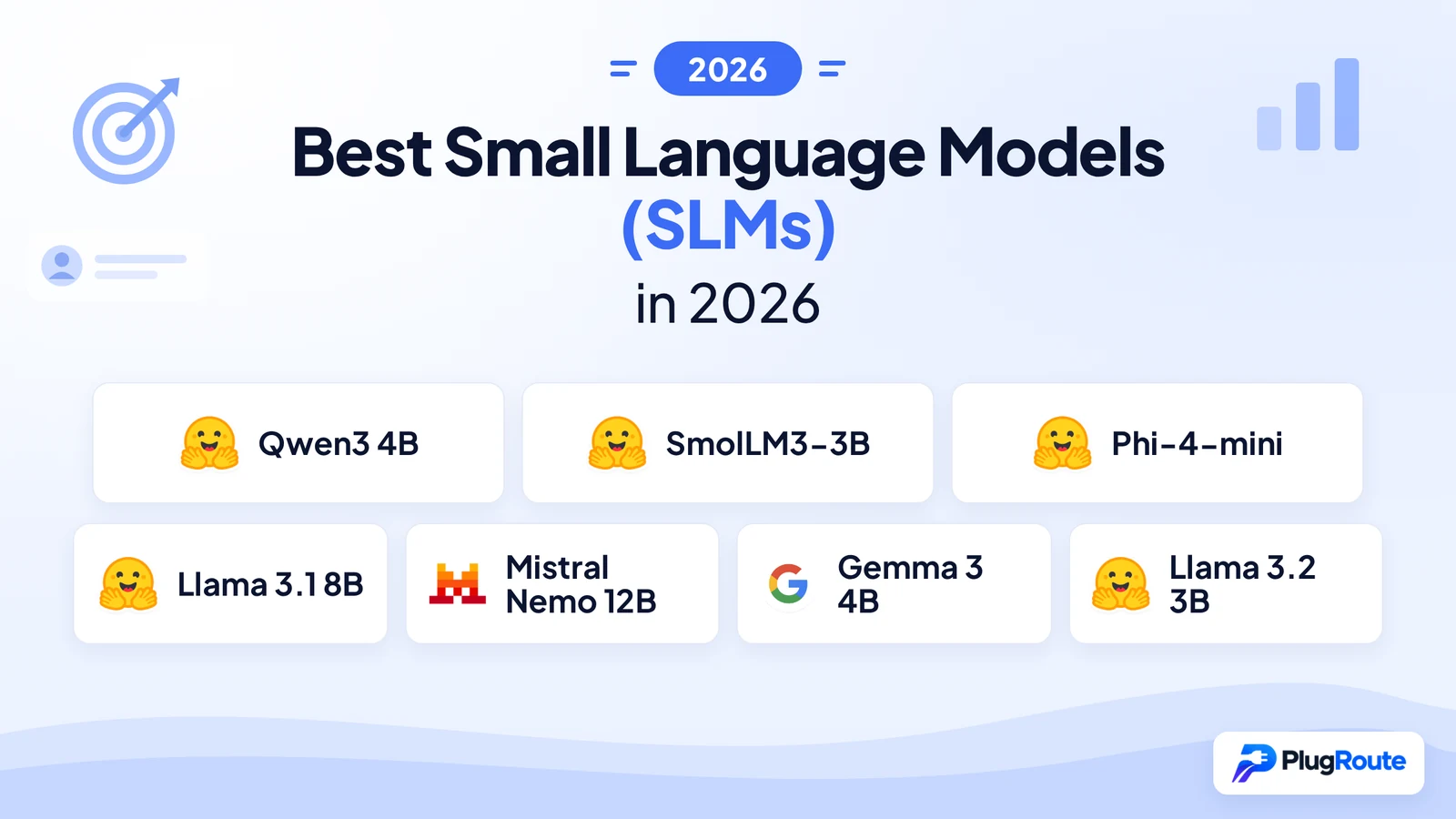
Qwen3 4B leads the 2026 SLM rankings for multilingual reasoning under Apache 2.0; SmolLM3-3B is the top pick for minimum hardware footprint with thinking-mode reasoning at 3B scale; Phi-4-mini holds the sub-4B coding benchmark crown at 74.4% HumanEval. The right small language model is determined by license freedom, hardware ceiling, and task type, not benchmark headlines alone.
Running frontier LLM APIs at production scale costs 100–1,000× more per token than self-hosted SLMs. Concretely: a RAG pipeline processing 50 million tokens per month costs approximately $500–$1,500 with a self-hosted 4B SLM versus $50,000–$150,000 per month via a frontier model API. For regulated industries, sending sensitive data to external endpoints makes on-premises, quantized inference mandatory.
PlugRoute has no affiliate relationships with any company listed. Rankings are determined entirely by research data and objective evaluation criteria.
“Phi models always score well on benchmarks. Real world performance is often disappointing. I hope this time is different.”, u/[deleted], r/LocalLLaMA, December 2024 (285 upvotes, Phi-4 announcement thread: reddit.com/r/LocalLLaMA/comments/1hd0y5j/)
Takeaway: Every Phi-family model should be validated on your specific production tasks before deployment, community consensus documents a systemic gap between benchmark scores and real-world instruction-following performance across the entire Phi series (r/LocalLLaMA, December 2024).
TL;DR: Top Picks at a Glance
- Qwen3 4B is the top-ranked SLM for multilingual and reasoning deployments: Apache 2.0 licensed, supporting 119 languages, with performance comparable to Qwen2.5-7B-class models at 4B parameters (arXiv:2505.09388, May 2025).
- SmolLM3-3B is the top-ranked 3B-class SLM: Apache 2.0 licensed, deployable on CPU-only and mobile hardware via ONNX and GGUF formats, and the first sub-4B model to offer dual-mode chain-of-thought reasoning (HuggingFace, July 2025).
- Phi-4-mini holds the highest coding benchmark score of any sub-4B model in this comparison at 74.4% HumanEval (Microsoft, 2025), confirmed running on iPhone 12 Pro via ONNX quantization.
- Llama 3.1 8B delivers the broadest deployment ecosystem of any open-weight model, confirmed on all major cloud platforms, backed by Llama Guard responsible AI tooling, and achieving HumanEval 72.6% (Meta AI blog, July 2024).
What Are the Three Deployment Tiers of Small Language Models?
Small language models in 2026 fall into three deployment tiers based on hardware requirements: ultra-lightweight 3B models for mobile and CPU-only targets; 4B efficiency models that balance capability and resource use; and 8–12B production models for dedicated GPU infrastructure. Knowing your tier eliminates the wrong models before any benchmark evaluation begins.
Tier 1, Ultra-Lightweight (3B class): SmolLM3-3B, Llama 3.2 3B
Tier 1 models, SmolLM3-3B and Llama 3.2 3B, target mobile devices, Raspberry Pi, CPU-only servers, and IoT edge hardware. Tier 1 models run in approximately 2–8GB RAM in quantized form with no GPU required. The primary trade-off for Tier 1 models is narrower multilingual coverage and less complex reasoning than larger tiers.
Tier 2, Efficiency Sweet Spot (3.8B–4B class): Qwen3 4B, Phi-4-mini, Gemma 3 4B
Tier 2 models (Qwen3 4B, Phi-4-mini, and Gemma 3 4B) offer the best capability-per-VRAM ratio in the SLM landscape at approximately 3GB VRAM quantized on a consumer GPU. Tier 2 is where the most architectural innovation is concentrated in 2025–2026:
- Dual-mode reasoning: Qwen3 4B (configurable thinking budget up to 38,000 tokens per request)
- Native vision processing: Gemma 3 4B (Pan&Scan SigLIP encoder, 896×896 pixel images)
- Coding benchmark leadership: Phi-4-mini (74.4% HumanEval, highest sub-4B score)
Tier 3, Production-Grade (8B–12B class): Llama 3.1 8B, Mistral Nemo 12B
Tier 3 models, Llama 3.1 8B and Mistral Nemo 12B, require 8–24GB VRAM and a dedicated GPU server, but deliver measurably higher reasoning depth and more extensively validated production track records. Tier 3 is appropriate for teams with dedicated GPU infrastructure who need maximum open-weight capability without cloud API dependence.
How Do the Top 7 SLMs Compare at a Glance?
Seven models across three hardware tiers define the 2026 SLM landscape. Qwen3 4B and SmolLM3-3B lead on Apache 2.0 accessibility; Phi-4-mini and Gemma 3 4B dominate specialist tasks; Llama 3.1 8B, Mistral Nemo 12B, and Llama 3.2 3B anchor production and enterprise deployments.
| Rank | Model | Category | Best For | One-Line Summary | Key Capabilities | Primary Strength | Key Limitation |
|---|---|---|---|---|---|---|---|
| 1 | Qwen3 4B | Reasoning Edge SLM | Multilingual reasoning; 119 languages; Apache 2.0 | Qwen3 4B is an Apache 2.0 SLM from Alibaba delivering 7B-class efficiency at 4B parameters with 119-language dual-mode reasoning (arXiv:2505.09388, May 2025). | Qwen3 4B: think/no-think mode, 119-language coverage, GGUF/AWQ/GPTQ quantization, 128K context, configurable thinking budget | Class-leading multilingual breadth (119 languages) with the only configurable per-request thinking budget at sub-5B scale | Thinking mode activates full chain-of-thought for trivial queries by default; requires enable_thinking=False |
| 2 | SmolLM3-3B | Edge SLM | Mobile, CPU-only, Raspberry Pi; Apache 2.0 | SmolLM3-3B is Hugging Face’s Apache 2.0 3B model achieving GPQA Diamond 41.7% in thinking mode; the highest hard-reasoning score of any 3B model; at approximately 2GB VRAM quantized (HuggingFace, July 2025). | SmolLM3-3B: NoPE architecture, thinking mode, ONNX + GGUF + vLLM, 128K context, APO alignment | First sub-4B model with dual thinking/non-thinking reasoning mode; broadest deployment format coverage | Released July 2025; thin production track record; only 6 languages supported |
| 3 | Phi-4-mini | Coding Edge SLM | Code assistants on mobile/edge; Azure ecosystem | Phi-4-mini is Microsoft’s 3.8B open-weight SLM with the highest sub-4B coding benchmarks (74.4% HumanEval, 65.3% MBPP), confirmed running on iPhone 12 Pro via ONNX (Microsoft, 2025). | Phi-4-mini: 74.4% HumanEval, 65.3% MBPP, 128K context, function calling, Azure AI Foundry, 200K-token vocabulary | Highest sub-4B coding benchmark scores (74.4% HumanEval, 65.3% MBPP) with confirmed named-device mobile deployment | Documented regression on JSON schema conformance and complex formatting instructions |
| 4 | Llama 3.1 8B | Production SLM | GPU server production; multi-cloud portability | Llama 3.1 8B is Meta’s production SLM delivering HumanEval 72.6% and MMLU approximately 66.7% across every major cloud platform with official responsible AI tooling (Meta AI blog, July 2024). | Llama 3.1 8B: all-cloud, all frameworks, Llama Guard, FP8 quantization, 128K context, 8 languages | Deepest ecosystem and highest verified benchmarks with all-cloud and all-framework coverage | Requires 8–16GB VRAM; gated Meta Community License adds approval friction |
| 5 | Mistral Nemo 12B | Enterprise SLM | Enterprise RTX 4090/L40S; Apache 2.0; GDPR | Mistral Nemo 12B is Mistral AI’s Apache 2.0 enterprise SLM co-developed with NVIDIA for FP8 TensorRT-LLM deployment, achieving MMLU 68.0% on a single enterprise GPU (NVIDIA HuggingFace model card, 2024). | Mistral Nemo 12B: FP8 TensorRT-LLM, 128K context, Tekken tokenizer, NVIDIA NIM, MMLU 68.0%, Apache 2.0 | Only model with NVIDIA hardware co-design and confirmed zero accuracy loss on FP8 quantization | Requires RTX 4090 or L40S GPU; no edge, mobile, or CPU-only deployment |
| 6 | Gemma 3 4B | Multimodal SLM | Document AI, visual QA, chart analysis; GTX 1650+ | Gemma 3 4B is Google DeepMind’s 4B multimodal SLM, the only sub-5B model with native vision processing, running on a GTX 1650 with 4GB VRAM and achieving HumanEval 71.3% (llm-stats.com, 2025). | Gemma 3 4B: Pan&Scan SigLIP vision, 140+ languages, 5:1 hybrid attention, HumanEval 71.3%, MATH 75.6% vs GPT-4 (0613) | Only sub-5B native multimodal model; second-highest sub-5B coding benchmark (HumanEval 71.3%) | Custom Gemma Terms of Use (non-OSI; Google retains right to update terms); legal review required |
| 7 | Llama 3.2 3B | Mobile Edge SLM | Lowest API cost; Meta/AWS ecosystem | Llama 3.2 3B is Meta’s mobile-optimized 3B SLM offering the lowest confirmed managed API pricing floor (starting from ~$0.02/M tokens, DeepInfra, April 2026) and widest multi-cloud coverage. | Llama 3.2 3B: 128K context, tool calling, all-cloud API, <8GB RAM, knowledge-distilled from Llama 3.1 8B | Lowest confirmed API pricing floor (~$0.02/M tokens) across all major cloud platforms with enterprise SLAs | Lower benchmarks than newer Apache 2.0 3B alternatives; gated Meta Community License |
Which SLM Should I Choose for My Use Case?
Choosing the right small language model depends on four decision vectors that eliminate the wrong candidates before any benchmarking begins. Hardware ceiling and license type are binary filters, a model requiring 16GB VRAM or non-OSI legal review is simply unavailable to teams without that infrastructure or review capacity.
- Hardware ceiling: mobile and CPU-only hardware vs. mid-range consumer GPU vs. dedicated enterprise GPU server
- License type: Apache 2.0 (instant commercial deployment) vs. gated Meta Community License (hours-to-days approval delay) vs. Gemma Terms of Use (legal review required)
- Primary task type: coding, multilingual reasoning, mathematical reasoning, or vision + text
- Inference deployment model: self-hosted on your infrastructure vs. managed cloud API with enterprise SLAs
| Your #1 Priority | Recommended Tool | Why | Acceptable Alternative |
|---|---|---|---|
| Best coding benchmark sub-4B | Phi-4-mini | Phi-4-mini achieves 74.4% HumanEval; the highest sub-4B coding benchmark; confirmed by Microsoft (2025) and validated on iPhone 12 Pro via ONNX hardware. | Llama 3.1 8B (72.6% HumanEval, deeper ecosystem) |
| Minimum hardware / mobile / CPU-only | SmolLM3-3B | SmolLM3-3B delivers the highest hard-reasoning scores of any 3B model in thinking mode with ONNX and GGUF support under Apache 2.0 at ~2GB VRAM quantized. | Llama 3.2 3B (broader cloud documentation) |
| Multilingual reasoning; Apache 2.0 | Qwen3 4B | Qwen3 4B supports 119 languages with 7B-class efficiency at 4B parameters and configurable dual-mode reasoning under Apache 2.0 with instant download. | SmolLM3-3B (6 languages; better hardware floor) |
| Production GPU server; ecosystem depth | Llama 3.1 8B | Llama 3.1 8B delivers the highest verified benchmarks with all-cloud, all-framework coverage and official Llama Guard responsible AI tooling (Meta AI blog, July 2024). | Mistral Nemo 12B (if NVIDIA-optimized server) |
| Enterprise NVIDIA single-GPU server | Mistral Nemo 12B | Mistral Nemo 12B provides FP8 TensorRT-LLM with zero accuracy loss, Apache 2.0, and MMLU 68.0% on a single RTX 4090 or L40S GPU. | Llama 3.1 8B (broader ecosystem, no NVIDIA co-design) |
| Vision + text processing | Gemma 3 4B | Gemma 3 4B is the only sub-5B native multimodal model evaluated, running on a GTX 1650 with confirmed HumanEval 71.3% alongside vision processing. | No direct sub-5B alternative exists among evaluated models |
| Lowest managed API cost | Llama 3.2 3B | Llama 3.2 3B starts from approximately $0.02/M tokens (DeepInfra, artificialanalysis.ai, April 2026) across every major cloud platform with enterprise SLAs. | SmolLM3-3B (better benchmarks, self-hosted only) |
1. Qwen3 4B: Best Overall: Apache 2.0 + 119-Language Dual-Mode Reasoning + Class-Leading 4B Efficiency
Category: Reasoning Edge SLM, a 4B dense model with switchable chain-of-thought reasoning and 119-language support, designed for edge and server deployments requiring multilingual coverage or reasoning-intensive tasks under Apache 2.0.
At a Glance
- Category: Reasoning Edge SLM
- Best For: Multilingual reasoning across 119 languages; Apache 2.0 edge/server deployment; per-request thinking mode control
- Price Range: Free (Apache 2.0, ungated self-hosted); hosted via Alibaba Cloud DashScope and Together AI, confirm rates directly before production budgeting
- Primary Strength: Qwen3 4B delivers performance comparable to Qwen2.5-7B-class models at 4B parameters, approximately 1.75× parameter efficiency, with 119-language coverage and the only configurable per-request thinking budget at sub-5B scale (arXiv:2505.09388, May 2025)
- Biggest Limitation: Qwen3 4B activates full chain-of-thought reasoning for trivial queries by default, generating unnecessary token overhead and latency unless enable_thinking=False is explicitly set per request
- One-Line Summary: Qwen3 4B is an Apache 2.0 small language model from Alibaba delivering 7B-class efficiency at 4B parameters, 119-language support, and the only configurable dual-mode reasoning architecture at sub-5B scale, the top-ranked SLM for multilingual and reasoning-intensive production deployments in 2026.
- Last Verified: April 2026
Overview
Qwen3 4B is a 4 billion parameter Apache 2.0 small language model from Alibaba’s Tongyi Qianwen team, designed for ML engineers who need multilingual reasoning capability in resource-constrained environments without commercial license friction. Qwen3 4B delivers performance comparable to Qwen2.5-7B-class models at 4B parameters, approximately 1.75× parameter efficiency, and provides a configurable dual-mode reasoning architecture within a single set of model weights (arXiv:2505.09388, May 2025). Qwen3 4B was pretrained on 36 trillion tokens with knowledge distillation from the 235B Qwen3 flagship, making it the most data-intensive sub-5B model in this evaluation.
Key Features
- Dual Think/No-Think Inference Mode: Qwen3 4B provides switchable chain-of-thought reasoning via the
enable_thinkingAPI parameter, thinking mode uses temperature 0.3 and top_p 0.7 for high-accuracy deliberate reasoning, while non-thinking mode delivers fast direct responses within the same model weights, a per-request control mechanism unique among sub-5B models in this comparison. - Configurable Thinking Budget: Qwen3 4B supports a thinking budget of up to 38,000 tokens per request, allowing developers to allocate deep reasoning compute to hard math and coding tasks while keeping simple queries fast and cost-efficient, a granular inference control mechanism no competing sub-5B model provides (Alibaba/arXiv:2505.09388, May 2025).
- 119-Language Coverage: Qwen3 4B supports 119 languages through a 36-transformer-layer architecture with 32 query heads and 8 KV heads via Grouped Query Attention, pretrained on 36 trillion tokens with knowledge distillation from the 235B Qwen3 flagship, the broadest multilingual foundation of any sub-5B model in this comparison (momen.app, 2025).
- Apache 2.0 Instant Access: Qwen3 4B is available for immediate ungated download under Apache 2.0 (no approval process, no MAU restrictions, no licensor right to update terms) giving any organization instant commercial deployment rights without legal review or procurement friction.
- Broad Quantization Coverage: Qwen3 4B supports GGUF, AWQ, and GPTQ quantized formats at approximately 3GB VRAM in Q4 form, compatible with llama.cpp, Ollama, and vLLM across all three primary deployment targets, consumer local, CPU-only, and production GPU server.
Best For
Qwen3 4B is best for ML engineering teams building multilingual conversational agents, reasoning-intensive RAG pipelines, or mathematical and coding reasoning applications who require Apache 2.0 commercial clarity, edge-compatible hardware (approximately 3GB VRAM quantized), and the ability to serve 119 supported languages without switching models.
Pricing
Qwen3 4B is free for self-hosting under Apache 2.0 (verified April 2026). Hosted API access is available through Alibaba Cloud DashScope and Together AI (Together AI, 2026); specific per-million-token rates were not publicly confirmed at time of research and should be verified directly with each provider before production budgeting.
Strengths
- Qwen3 4B delivers performance comparable to Qwen2.5-7B-class models at 4B parameters, approximately 1.75× parameter efficiency, and achieves GPQA Diamond 41.7% and AIME 2025 36.7% in thinking mode, confirming meaningful hard-reasoning gains over its parameter baseline (arXiv:2505.09388, May 2025; HuggingFace SmolLM3-3B comparison benchmarks, July 2025).
- Qwen3 4B is released under Apache 2.0 with immediate ungated download: no HuggingFace approval delay, no MAU commercial restriction, no licensor right to update terms, making it the most commercially accessible of all Apache 2.0 models evaluated, particularly relevant for startups that cannot absorb legal review cycles.
- Qwen3 4B’s 119-language vocabulary is the broadest of any sub-5B model evaluated, making it the only practical default for global enterprise deployments requiring simultaneous high-quality coverage across Arabic, Hindi, Chinese, Korean, Japanese, and European languages in a single model weight.
- Qwen3 4B was recognized by the r/LocalLLaMA community as among the most impressive small models released in 2025, with particular praise for thinking-mode performance on mathematical reasoning, a community signal that corroborates the formal benchmark results from Alibaba’s technical report (r/LocalLLaMA, 2025).
Limitations
Qwen3 4B’s most consequential production trade-off is its thinking mode default behavior: Qwen3 4B activates full chain-of-thought reasoning for trivial queries unless enable_thinking=False is explicitly set per request, generating unnecessary token overhead and latency in high-volume pipelines, a consistent pain point documented across r/LocalLLaMA (2025) requiring active parameter management from day one in any production chatbot, RAG, or latency-sensitive service.
Engineers deploying Qwen3-series models in production pipelines on r/LocalLLaMA documented this thinking budget trap in detail (April 2026):
“What initially looked like a weird bug turned out to be a budgeting issue. […] the model could spend the entire output budget on thinking and return no useful visible answer. […] So for some coding tasks, the model wasn’t ‘failing’ in the classic sense. It was just burning the whole budget on reasoning.” Posted by u/Antonio_Sammarzano
Takeaway: The Qwen3 family’s thinking mode default-on behavior is a documented production trap (not a hypothetical edge case) that can silently consume an entire token budget without producing usable output, making enable_thinking=False mandatory configuration in any latency-sensitive Qwen3 4B deployment from day one.
A secondary operational constraint is hosted inference maturity in Western markets: Qwen3 4B’s managed API options (Alibaba DashScope, Together AI) are less extensively documented with enterprise SLAs than the all-cloud coverage available for Llama 3.1 8B across AWS Bedrock, Azure AI Foundry, Google Vertex AI, Groq, and Cloudflare Workers AI. A third consideration for regulated industries is Qwen3 4B’s April–May 2025 release date, giving it a shorter validated production history than Llama 3.1 8B (July 2024) or Mistral Nemo 12B (July 2024) for teams requiring multi-year battle-tested evidence.
Verdict
Qwen3 4B is the top-ranked small language model in this 2026 comparison, earning its position through Apache 2.0 commercial accessibility, 7B-class efficiency at 4B parameters, 119-language multilingual depth, and the only configurable dual-mode reasoning architecture available at the sub-5B scale. Qwen3 4B is the right first evaluation target for teams building multilingual applications, reasoning-intensive pipelines, or any production use case requiring maximum task performance within a 4B parameter hardware budget with zero licensing friction. Teams must explicitly instrument enable_thinking=False in every latency-sensitive production pipeline; teams prioritizing pure coding performance should benchmark Phi-4-mini (#3, 74.4% HumanEval); teams requiring absolute minimum hardware should evaluate SmolLM3-3B (#2).
2. SmolLM3-3B: Best for Minimum Hardware Footprint: Apache 2.0 + Thinking Mode at 3B Scale + Broadest Deployment Format Coverage
Category: Edge SLM, a 3B parameter model from Hugging Face optimized for minimum hardware constraints across mobile, CPU-only, and entry-level GPU environments, with thinking-mode reasoning unprecedented at sub-4B scale.
At a Glance
- Category: Edge SLM
- Best For: Mobile, CPU-only servers, Raspberry Pi; Apache 2.0; ONNX + GGUF deployment format flexibility; thinking-mode reasoning at minimum hardware
- Price Range: Free (Apache 2.0, ungated self-hosted); Hugging Face Inference API available, confirm rates at huggingface.co before production budgeting
- Primary Strength: SmolLM3-3B achieves GPQA Diamond 41.7% and AIME 2025 36.7% in thinking mode (the highest hard-reasoning scores of any 3B-class model) at approximately 2GB VRAM in quantized form (HuggingFace, July 2025)
- Biggest Limitation: Released July 2025: substantially thinner production track record than established models; multilingual support covers only 6 languages
- One-Line Summary: SmolLM3-3B is Hugging Face’s Apache 2.0 3B small language model delivering the highest hard-reasoning benchmark scores of any 3B-class model in thinking mode, the first dual-mode reasoning capability at sub-4B scale, and the widest hardware deployment format coverage (from CPU-only servers to mobile devices) in the 2026 SLM comparison.
- Last Verified: April 2026
Overview
SmolLM3-3B is a 3 billion parameter Apache 2.0 small language model from Hugging Face’s research team, designed for ML engineers and developers who need the highest possible task performance within the tightest hardware constraints, mobile devices, CPU-only servers, Raspberry Pi, IoT edge hardware, or GPU environments with as little as 2GB VRAM. SmolLM3-3B achieves class-leading 3B performance through an 11.2 trillion token pretraining corpus, a novel NoPE (No Position Embeddings) hybrid architecture confirmed by ablation studies to improve long-context efficiency, and a dual think/no-think reasoning mode, the first sub-4B model anywhere to offer this capability (HuggingFace blog, July 2025). SmolLM3-3B is available in ONNX for mobile and browser deployment via WebAssembly (Transformers.js) or ExecuTorch, GGUF for llama.cpp and Ollama CPU inference, and standard HuggingFace Transformers for vLLM production serving, the broadest confirmed deployment format coverage in this comparison.
Key Features
- NoPE Hybrid Architecture: SmolLM3-3B uses a 3:1 NoPE (No Position Embeddings) hybrid architecture (rotary position embeddings removed from every fourth attention layer) which ablation studies confirm significantly improves long-context performance without degrading short-context accuracy, enabling a 128K token context window via YaRN extension at 3B parameters (HuggingFace blog, July 2025).
- Dual Think/No-Think Reasoning Mode at 3B: SmolLM3-3B offers switchable chain-of-thought inference at 3 billion parameters (the first sub-4B model to provide this capability) enabling deliberate multi-step reasoning for complex tasks and fast direct responses for simple queries within a single deployment, a capability previously exclusive to 7B+ models.
- Anchored Preference Optimization (APO) Alignment: SmolLM3-3B was post-trained using APO (a novel DPO variant developed by Hugging Face Research using synthetic reasoning preference pairs) which provides more stable optimization convergence than standard DPO and contributes to unusually strong instruction-following alignment relative to its parameter count (MLOps Community, 2025).
- Broadest Deployment Format Coverage: SmolLM3-3B is available in ONNX format (HuggingFaceTB/SmolLM3-3B-ONNX) for mobile and browser deployment, GGUF format (ggml-org/SmolLM3-3B-GGUF) for llama.cpp and Ollama CPU inference, and standard Transformers format for vLLM, covering all three primary deployment tiers under a single Apache 2.0 license.
- 11.2-Trillion-Token Pretraining Corpus: SmolLM3-3B was pretrained on 11.2 trillion tokens through a staged curriculum of web, code, math, and reasoning data, followed by 140 billion reasoning-trace tokens via midtraining on OpenThoughts3 and Llama-Nemotron-Post-Training datasets, a pretraining corpus competitive with models significantly larger in parameter count.
Best For
SmolLM3-3B is best for ML engineers deploying on the most hardware-constrained targets (mobile applications, CPU-only servers, Raspberry Pi, IoT edge devices, or browser-based inference via WebAssembly) where thinking-capable 3B performance under Apache 2.0 with ONNX and GGUF format support is required, and where English plus five major European languages (French, Spanish, German, Italian, Portuguese) cover the deployment use case.
Pricing
SmolLM3-3B is free for self-hosting under Apache 2.0 (verified April 2026). Hugging Face Inference API provides hosted access; specific per-token pricing should be confirmed at huggingface.co at the time of implementation, as rates vary by plan and usage tier.
Strengths
- SmolLM3-3B achieves GPQA Diamond 41.7% and AIME 2025 36.7% in thinking mode: the highest hard-reasoning scores of any 3B-class model in this comparison: confirming that SmolLM3-3B’s dual-mode architecture delivers meaningful reasoning performance at a parameter scale previously considered too small for complex inference (HuggingFace model card, July 2025).
- SmolLM3-3B outperforms Llama 3.2 3B and Qwen2.5-3B on select benchmarks and achieves thinking-mode performance competitive with some 4B-class models: a result confirmed by Hugging Face’s benchmark evaluations (HuggingFace blog, July 2025) and independently corroborated by Cordatus AI’s analysis (Cordatus AI, 2025).
- SmolLM3-3B is the first sub-4B model anywhere to offer dual think/no-think reasoning mode, enabling complex reasoning applications at hardware targets (mobile, CPU-only, Raspberry Pi) previously accessible only to lightweight non-reasoning edge models (HuggingFace, July 2025).
- SmolLM3-3B’s Apache 2.0 + ONNX + GGUF combination creates the broadest hardware deployment matrix of any model evaluated, confirmed across mobile (ONNX/ExecuTorch), CPU-only/Raspberry Pi (GGUF/llama.cpp), consumer GPU (Transformers/BitsAndBytes), and production serving (vLLM) under a single commercial license.
Users on r/LocalLLaMA confirmed SmolLM3-3B’s deployment accessibility on launch day:
“Just built it first try and ran it. Super happy. Just not sure if or how I disable thinking locally.” Posted by u/GoodbyeThings
Takeaway: SmolLM3-3B ran immediately on llama.cpp at launch (validating the model’s out-of-the-box deployment accessibility) but ships with thinking mode enabled by default, confirming that production teams must actively configure the thinking toggle rather than relying on defaults.
Limitations
SmolLM3-3B’s most consequential trade-off is its recency: released in July 2025, SmolLM3-3B carries substantially thinner production validation than established models like Llama 3.1 8B or Mistral Nemo 12B, benchmark endorsements are preliminary, and teams should conduct their own task-specific evaluations before production commitment rather than relying on benchmark scores alone. A documented technical limitation emerged during development: reasoning post-training initially degraded long-context performance, requiring Hugging Face to apply model merging as a mitigation before the final release (HuggingFace blog, July 2025), teams building long-document applications exceeding 50K tokens should independently benchmark their specific document lengths before relying on the 128K context specification. SmolLM3-3B also supports only 6 languages, the most limited multilingual scope in this comparison, making it unsuitable for global enterprise deployments requiring Arabic, Hindi, Chinese, Korean, Japanese, or Thai, where Qwen3 4B’s 119-language coverage is the appropriate choice.
Verdict
SmolLM3-3B is the top-ranked 3B-class small language model in 2026, earning its position through the highest hard-reasoning benchmark scores of any 3B model in thinking mode (GPQA Diamond 41.7%, AIME 2025 36.7%), the first dual-mode reasoning capability at sub-4B scale, Apache 2.0 commercial freedom, and the broadest hardware deployment format coverage of any model evaluated. SmolLM3-3B is the definitive choice for teams whose primary constraint is hardware (mobile, CPU-only, or sub-2GB VRAM environments) who need zero licensing friction and thinking-mode reasoning capability on tight hardware. Teams planning long-document RAG applications should independently benchmark long-context behavior; teams requiring non-European multilingual coverage should evaluate Qwen3 4B (#1).
3. Phi-4-mini: Best for Coding Tasks: Class-Leading HumanEval Score + iPhone-Confirmed Edge Deployment + Azure Ecosystem Integration
Category: Coding Edge SLM, a 3.8B parameter dense model with class-leading coding benchmark scores, designed for edge and mobile deployment via Microsoft ONNX and Azure ecosystems with function calling and agentic capability.
At a Glance
- Category: Coding Edge SLM
- Best For: Code assistants and agentic tools on mobile/edge; Azure ecosystem integration; highest sub-4B coding benchmarks
- Price Range: Free for self-hosting (MIT-implied open license, not gated); hosted via Azure AI Foundry (consumption-based, confirm at portal.azure.com) and NVIDIA API Catalog (confirm at build.nvidia.com)
- Primary Strength: Phi-4-mini achieves 74.4% HumanEval and 65.3% MBPP: the two highest sub-4B coding benchmark scores in this comparison, with confirmed deployment on iPhone 12 Pro via ONNX quantization (Microsoft, 2025)
- Biggest Limitation: Phi-4-mini has a documented regression on detailed formatting instructions (particularly JSON schema conformance and complex multi-step output formatting) acknowledged in Microsoft’s own Phi-4 technical report (arXiv:2503.01743, 2025)
- One-Line Summary: Phi-4-mini is Microsoft’s 3.8B open-weight SLM achieving the highest sub-4B coding benchmarks (74.4% HumanEval, 65.3% MBPP), confirmed running on iPhone 12 Pro via ONNX quantization, natively integrated with Azure AI Foundry.
- Last Verified: April 2026
Overview
Phi-4-mini is a 3.8 billion parameter open-weight small language model from Microsoft Research, designed for developers and ML engineers who need class-leading coding and reasoning benchmark performance in resource-constrained edge environments, including mobile phones, and who benefit from native integration with Microsoft’s Azure and ONNX ecosystems. Phi-4-mini applies Microsoft’s data-quality-over-quantity training philosophy, using curated textbook-grade synthetic data to consistently outperform models with twice the parameter count on coding benchmarks (Glasswing Ventures, 2025). Phi-4-mini features a 128K token context window via LongRoPE, Grouped-Query Attention with 8 KV heads, and a 200,064-token vocabulary, the largest of any SLM in its class, enabling more efficient multilingual tokenization than competing smaller-vocabulary models.
Key Features
- 74.4% HumanEval + 65.3% MBPP Coding Benchmarks: Phi-4-mini achieves 74.4% on HumanEval and 65.3% on MBPP (3-shot) (the two highest sub-4B coding benchmark scores in this 2026 comparison) derived from Microsoft’s training approach of prioritizing curated textbook-quality synthetic code data, confirmed by LocalAI Master (2026), BentoML (2026), and the Azure AI Foundry model catalog.
- Confirmed iPhone 12 Pro Deployment: Phi-4-mini has been confirmed running on an iPhone 12 Pro via Microsoft Olive and the ONNX runtime quantization pipeline (Microsoft Tech Community, 2025), the only model in this comparison with named-device mobile deployment validation, confirming genuine on-device coding inference with no GPU required.
- 200,064-Token Vocabulary: Phi-4-mini uses the largest vocabulary of any SLM in its class, requiring approximately 20–30% fewer tokens than competing models for multilingual and code-heavy inputs, directly reducing per-token inference costs and improving processing speed for developers working across multilingual codebases (arXiv:2503.01743, 2025).
- Function Calling and Agentic Support: Phi-4-mini supports function calling for agentic automation use cases; the Phi-4-mini-flash-reasoning variant claims 10× higher throughput and 2–3× latency reduction for reasoning-intensive pipelines (Azure AI blog, 2025), targeting real-time agentic applications where token generation speed drives user experience.
- Azure AI Foundry Native Integration: Phi-4-mini is available through Azure AI Foundry, NVIDIA API Catalog, and as open weights on HuggingFace, with the PhiCookBook GitHub repository providing deployment tutorials, ONNX quantization guides, and integration examples for Azure, iOS, and Android deployment scenarios.
Best For
Phi-4-mini is best for development teams building code completion, code review, or agentic automation tools on edge hardware (particularly within the Microsoft and Azure ecosystem) where 74.4% HumanEval benchmark leadership represents a meaningful quality advantage and where confirmed iPhone or Android on-device deployment is a target architecture requirement.
Pricing
Phi-4-mini model weights are available free for self-hosting under an MIT-implied open license (not gated on HuggingFace, verified April 2026). Hosted inference via Azure AI Foundry is consumption-based, specific per-million-token rates require login to portal.azure.com. NVIDIA API Catalog also provides hosted inference; confirm rates before production budgeting.
Strengths
- Phi-4-mini achieves 74.4% on HumanEval and 65.3% on MBPP: the highest sub-4B coding benchmark scores in this 2026 comparison: confirmed by LocalAI Master (2026) and BentoML (2026), attributable to Microsoft’s curated textbook-quality synthetic training data approach that consistently outperforms models with 2× the parameter count on coding tasks.
- Phi-4-mini is the only model in this comparison with documented deployment on a named consumer smartphone, iPhone 12 Pro: via Microsoft Olive and ONNX quantization (Microsoft Tech Community, 2025), providing a concrete reference architecture for iOS deployment that validates claims beyond theoretical hardware compatibility.
- Phi-4-mini’s 200,064-token vocabulary requires approximately 20–30% fewer tokens than competing models for multilingual and code-heavy inputs, directly reducing per-token inference costs and improving processing speed across every deployment configuration (arXiv:2503.01743, 2025).
- Phi-4-mini’s flash-reasoning variant claims 10× higher throughput and 2–3× latency reduction via a hybrid architecture (Azure AI blog, 2025), targeting real-time agentic automation applications where token generation speed is the primary production constraint, a use case profile not directly addressed by any other model in this comparison.
Limitations
Phi-4-mini’s most consequential production trade-off is its documented regression on structured formatting tasks: Phi-4-mini struggles with detailed instructions specifying precise JSON schema conformance, complex formatting chains, or template-constrained output, a limitation explicitly acknowledged in Microsoft’s own Phi-4 technical report (arXiv:2503.01743, 2025) and corroborated by the 285-upvote r/LocalLLaMA thread (December 2024), the highest community signal in this evaluation dataset. Teams building API response generation, form-filling automation, or structured report tools must benchmark formatting conformance specifically and evaluate enforcement libraries such as Outlines or Instructor as a mitigation layer before production deployment. A second systemic concern is the benchmark-to-reality gap flagged across the entire Phi series by the r/LocalLLaMA community, the 74.4% HumanEval score should be treated as a benchmark ceiling rather than a production performance floor, making task-specific validation on the team’s actual codebase non-negotiable before committing Phi-4-mini to production.
Verdict
Phi-4-mini is the top-ranked small language model for coding tasks in 2026, with a 74.4% HumanEval score that no sub-4B competitor matches and a confirmed iPhone 12 Pro deployment validating genuine mobile inference capability. Phi-4-mini is the right choice for teams building code-centric edge applications within the Microsoft and Azure ecosystem, particularly where quantized on-device deployment is the target architecture and where coding benchmark leadership directly translates to product quality. Teams requiring strict structured JSON output conformance must benchmark formatting behavior and implement enforcement libraries before production deployment; teams outside the Microsoft ecosystem should weigh Azure AI Foundry dependency against the Apache 2.0 alternatives ranked above.
4. Llama 3.1 8B: Best Production Ecosystem: Highest Verified Cross-Task Benchmark Scores + All-Cloud All-Framework Coverage
Category: Production SLM, an 8B parameter workhorse with the highest verified cross-task benchmark scores and broadest inference ecosystem, designed for production server deployment on mid-range to enterprise GPU hardware.
At a Glance
- Category: Production SLM
- Best For: GPU server production; multi-cloud portability; responsible AI tooling; enterprise compliance
- Price Range: Free self-hosted (gated Meta Community License); approximately $0.03/M input tokens via third-party API providers (verified April 2026); organizations with >700M MAU require separate Meta commercial license
- Primary Strength: Llama 3.1 8B achieves HumanEval 72.6% (the highest confirmed coding benchmark at the 8B scale), MMLU approximately 66.7%, and GSM8K 84.5% (pretrained base model), the most comprehensively sourced cross-task benchmark suite in this comparison (Meta AI blog, July 2024)
- Biggest Limitation: Requires 8–16GB VRAM; gated Meta Community License adds hours-to-days approval friction and restricts organizations with more than 700 million monthly active users from commercial use without a separate Meta agreement
- One-Line Summary: Llama 3.1 8B is Meta’s production open-weight small language model delivering HumanEval 72.6% and MMLU approximately 66.7% across every major cloud platform and inference framework, backed by Meta’s Llama Guard responsible AI toolkit, the de facto standard for production GPU server deployments requiring maximum ecosystem maturity.
- Last Verified: April 2026
Overview
Llama 3.1 8B is an 8.03 billion parameter open-weight small language model from Meta, designed for ML engineers and production teams who need the highest verified benchmark performance and maximum deployment ecosystem flexibility in a sub-10B parameter model with access to at least 8GB VRAM. Llama 3.1 8B achieves HumanEval 72.6% and MMLU approximately 66.7% (the highest confirmed scores across coding and general knowledge benchmarks of any model in this comparison) and is the most widely deployed open-weight model in history. Llama 3.1 8B supports a 128K token context window, eight languages, built-in tool calling, FP8 quantization, and is accompanied by Meta’s Llama Guard content safety classifier and Purple Llama responsible AI toolkit for enterprise governance.
Key Features
- Highest Verified Cross-Task Benchmark Suite: Llama 3.1 8B achieves HumanEval 72.6%, MMLU approximately 66.7%, GSM8K 84.5% (pretrained base model), and MATH 56.7%, confirmed by Meta’s official technical report (Meta AI blog, July 2024) and independently corroborated by Braintrust AI (2025), surpassing Mistral 7B by approximately 10 MMLU points and performing comparably to GPT-3.5 Turbo on multilingual reasoning.
- Universal Cloud and Framework Coverage: Llama 3.1 8B is deployed across every major cloud inference platform, AWS Bedrock, Azure AI Foundry, Google Vertex AI, Groq, and Cloudflare Workers AI, and supports all major inference frameworks including vLLM, llama.cpp, Ollama, and MLX (Apple Silicon), providing maximum deployment portability with no single-vendor lock-in.
- FP8 Quantization with ~50% Compute Reduction: Llama 3.1 8B supports FP8 quantization with approximately 50% compute reduction versus BF16 and minimal accuracy degradation (Meta AI blog, July 2024), enabling production-scale single-node continuous-batching deployments on a single NVIDIA A100 serving hundreds of concurrent requests at mid-scale production economics.
- Official Responsible AI Toolkit: Llama 3.1 8B is accompanied by Llama Guard: Meta’s official content safety classifier, and the Purple Llama project providing red-teaming tools, safety benchmarks, and responsible AI documentation, offering documented enterprise governance infrastructure that community safety efforts around other models cannot replicate in scope or official support status.
- Deepest Community Fine-Tuning Ecosystem: Llama 3.1 8B has generated the largest ecosystem of community fine-tunes, deployment tutorials, and integration documentation of any open-weight model evaluated, with billions of total HuggingFace downloads across the Llama 3.1 family, providing access to domain-specific fine-tunes for healthcare, finance, legal, and coding that 2025-released models have not yet accumulated.
Best For
Llama 3.1 8B is best for production ML engineering teams deploying GPU server-based applications where verified cross-task benchmark leadership, multi-cloud portability, enterprise responsible AI tooling, and access to the broadest community fine-tuning ecosystem matter more than hardware minimization, particularly teams in regulated industries requiring Llama Guard safety tooling or legal teams who need the most battle-tested open-weight deployment.
Pricing
Llama 3.1 8B is free for self-hosting under the Meta Community License (requires gated HuggingFace access approval, verified April 2026). API inference from third-party providers costs approximately $0.03 per million input tokens, confirm current rates at your chosen provider before production budgeting, as prices change frequently (LLM Stats, April 2026). Organizations with more than 700 million monthly active users require a separate commercial license from Meta.
Strengths
- Llama 3.1 8B achieves HumanEval 72.6%, MMLU approximately 66.7%, GSM8K 84.5% (pretrained base model), and MATH 56.7%, the most comprehensively verified cross-task benchmark suite of any model in this comparison, confirmed by Meta’s official technical report (July 2024) and independently corroborated by Braintrust AI (2025).
- Llama 3.1 8B is confirmed deployed on every major cloud infrastructure platform, AWS Bedrock, Azure AI Foundry, Google Vertex AI, Groq, and Cloudflare Workers AI, and simultaneously supported by vLLM, llama.cpp, Ollama, and MLX, the only model in this comparison with verified all-cloud and all-framework coverage (AWS, 2024).
- Llama 3.1 8B’s FP8 quantization reduces compute requirements by approximately 50% versus BF16 with minimal accuracy degradation (Meta AI blog, July 2024), enabling production single-node deployments on a single A100 that would otherwise require multi-GPU infrastructure, a meaningful TCO reduction for mid-scale API workloads.
- Llama 3.1 8B is the only model in this comparison with an official responsible AI toolkit: Llama Guard (content safety classifier) and the Purple Llama project (red-teaming tools, safety benchmarks, responsible AI documentation), providing documented enterprise governance infrastructure that compliance-sensitive deployments in healthcare, finance, and government can reference with vendor attribution.
Limitations
Llama 3.1 8B’s most consequential deployment trade-off is its hardware requirement: Llama 3.1 8B needs 8GB VRAM for Q4 quantized inference or 16GB for BF16 precision, ruling out mobile, Raspberry Pi, and most IoT edge deployments entirely and adding infrastructure cost versus the 3B–4B models that handle similar tasks at a fraction of the VRAM burden. The Meta Community License imposes a second practical constraint: gated HuggingFace access adds hours to days of approval delay in production evaluation pipelines, and the 700M MAU commercial restriction adds a legal review requirement for the world’s largest platforms, the primary argument the r/LocalLLaMA community consistently makes for Apache 2.0 alternatives (r/LocalLLaMA, 2024–2025). A third documented limitation is context quality degradation: despite the 128K token context window specification, the r/LocalLLaMA community consistently reports noticeable quality drops in long-document retrieval tasks beyond approximately 32K tokens in practice, teams designing RAG systems around Llama 3.1 8B’s long-context window should benchmark their specific document lengths at or above 32K before finalizing architecture decisions.
Community members who migrated to alternative SLMs for agentic use cases documented a practical production limitation of Llama 3.1 8B’s tool calling on r/LocalLLaMA (August 2024):
“It’s my new go to model to use! Especially as one of the things I’m most interested in is functional calling. Which Nemo does great at! And can mix text replies and function calls in the same chat no problem. Llama 3.1 can basically do function calling or chat. And if you try to mix them it just makes a mess of everything making up function calls to non-existent functions.” Posted by u/iKy1e
Takeaway: Llama 3.1 8B’s tool-calling implementation breaks down when function calls and regular chat are mixed in the same session, a real-world production reliability gap that practitioners discovered when evaluating alternatives like Mistral Nemo 12B for agentic pipelines requiring both modes simultaneously.
Verdict
Llama 3.1 8B is the highest benchmark-verified and most production-validated small language model in this 2026 comparison, with HumanEval 72.6% and MMLU approximately 66.7% representing confirmed performance leadership across coding and general knowledge that the smaller models above it cannot match at the 8B scale. Llama 3.1 8B is the right choice for production teams prioritizing maximum ecosystem maturity, responsible AI tooling, and multi-cloud portability over hardware minimization or license simplicity. Teams requiring mobile or CPU-only deployment, immediate ungated download access, or Apache 2.0 commercial simplicity should evaluate Qwen3 4B (#1), SmolLM3-3B (#2), or Phi-4-mini (#3) before committing to Llama 3.1 8B’s hardware and licensing tier.
5. Mistral Nemo 12B: Best for Enterprise Single-GPU Server: Apache 2.0 + NVIDIA Hardware Co-Design + FP8 TensorRT-LLM Optimization
Category: Enterprise SLM, a 12B parameter NVIDIA hardware co-designed model, Apache 2.0 licensed, optimized for single-GPU enterprise server deployment with FP8 quantization, TensorRT-LLM optimization, and a 128K multilingual context window.
At a Glance
- Category: Enterprise SLM
- Best For: Enterprise RTX 4090/L40S GPU servers; Apache 2.0; GDPR-favorable EU provenance; multilingual enterprise workloads
- Price Range: Free (Apache 2.0, ungated); Mistral La Plateforme API at console.mistral.ai and third-party providers (aimlapi.com), confirm rates directly before production budgeting
- Primary Strength: Mistral Nemo 12B is NVIDIA co-developed with confirmed FP8 TensorRT-LLM zero accuracy loss, MMLU 68.0%, and Apache 2.0 commercial freedom at the largest parameter scale in this comparison (NVIDIA HuggingFace model card, 2024)
- Biggest Limitation: Requires dedicated RTX 4090 or L40S GPU: excludes all mobile, edge, and CPU-only deployments entirely
- One-Line Summary: Mistral Nemo 12B is Mistral AI’s Apache 2.0 enterprise SLM co-developed with NVIDIA for FP8 TensorRT-LLM deployment on a single RTX 4090 or L40S GPU, achieving MMLU 68.0% with a Tekken tokenizer delivering approximately 30% multilingual efficiency gains.
- Last Verified: April 2026
Overview
Mistral Nemo 12B is a 12 billion parameter Apache 2.0 small language model jointly developed by Mistral AI and NVIDIA, designed for enterprise ML and infrastructure teams who operate dedicated NVIDIA GPU servers (RTX 4090 or L40S tier) and need maximum reasoning capability on a single node without cloud API dependence or commercial license restrictions. Mistral Nemo 12B was architecturally co-designed for NVIDIA hardware (featuring FP8 quantization with confirmed zero accuracy loss, TensorRT-LLM engine compatibility, and NVIDIA NIM microservice support) producing the best throughput-per-dollar on NVIDIA enterprise GPU hardware of any model evaluated. Mistral Nemo 12B uses the Tekken tokenizer with a 128,000-token vocabulary for approximately 30% more efficient multilingual tokenization than prior Mistral models, providing a 128K token context window across 40 transformer layers (mistral.ai, July 2024).
Key Features
- NVIDIA Hardware Co-Development with FP8 TensorRT-LLM: Mistral Nemo 12B was co-developed with NVIDIA and supports FP8 quantization with no accuracy loss via TensorRT-LLM (NVIDIA blog, 2024), enabling single-node deployment on a single RTX 4090 or L40S GPU at enterprise-grade throughput, the only model in this comparison with hardware-software co-design validation from the world’s leading GPU manufacturer.
- Tekken Tokenizer with ~30% Multilingual Efficiency Gain: Mistral Nemo 12B uses the Tekken tokenizer with a 128,000-token vocabulary, approximately 30% more efficient for multilingual text and code than the prior Mistral 7B SentencePiece tokenizer (mistral.ai/news/mistral-nemo, July 2024), producing direct per-token cost reductions and processing speed improvements for multilingual enterprise workloads.
- MMLU 68.0% and Confirmed General Knowledge Benchmarks: Mistral Nemo 12B achieves MMLU 68.0% alongside HellaSwag 83.5%, Winogrande 76.8%, and TriviaQA 73.8%, confirmed by the NVIDIA HuggingFace model card (2024) and unfoldai.com benchmark review (2024), providing the most complete enterprise-facing benchmark profile of any Apache 2.0 model in this comparison.
- Apache 2.0 at 12B Parameters: Mistral Nemo 12B is released under Apache 2.0: immediately downloadable without approval, no MAU restrictions, no right-to-update-terms reserved, making it the largest Apache 2.0 model in this comparison with the clearest commercial use rights at enterprise reasoning scale.
- Full Deployment Stack Coverage: Mistral Nemo 12B is available through NVIDIA NIM microservices, Mistral La Plateforme API, Ollama with GGUF quantized variants (Q4_K_M for lower VRAM), and vLLM for high-throughput production serving, combining enterprise NVIDIA optimization with community-standard deployment tooling.
Best For
Mistral Nemo 12B is best for enterprise ML teams operating dedicated NVIDIA GPU server infrastructure (RTX 4090 or L40S) who need maximum per-node reasoning capability under Apache 2.0, particularly EU-headquartered companies requiring GDPR-favorable model provenance, or teams with multilingual enterprise workloads that benefit from the Tekken tokenizer’s 30% efficiency advantage.
Pricing
Mistral Nemo 12B is free for self-hosting under Apache 2.0 (verified April 2026). Mistral La Plateforme API provides managed hosted inference; specific per-million-token rates were not publicly confirmed in documentation at time of research and should be verified directly at console.mistral.ai before production budgeting. Third-party API access is also available via aimlapi.com.
Strengths
- Mistral Nemo 12B was co-developed by Mistral AI and NVIDIA with FP8 quantization producing zero accuracy loss on TensorRT-LLM (NVIDIA blog, 2024), making it the only model in this comparison with hardware-software co-design validation from the world’s leading GPU manufacturer, a production reliability credential that community-developed quantizations cannot match.
- Mistral Nemo 12B achieves MMLU 68.0% alongside HellaSwag 83.5%, Winogrande 76.8%, and TriviaQA 73.8% (NVIDIA HuggingFace model card, 2024; unfoldai.com, 2024), providing a complete enterprise-facing benchmark profile under Apache 2.0, with MMLU comparable to Llama 3.1 8B’s confirmed ~66.7% at 4× the parameter scale.
- Mistral Nemo 12B’s Tekken tokenizer provides approximately 30% more efficient multilingual text tokenization than prior Mistral models (mistral.ai/news/mistral-nemo, July 2024), producing direct per-token cost reductions and throughput improvements for multilingual enterprise workloads that accumulate as meaningful TCO savings at production token volumes.
- Mistral AI’s European headquarters in Paris provides GDPR-favorable model provenance and EU data residency positioning: a differentiated compliance advantage uniquely relevant to EU-based enterprise teams facing regulatory scrutiny of AI data flows that no US-headquartered model developer in this comparison can match.
Limitations
Mistral Nemo 12B’s most consequential trade-off is its hardware requirement: at 12B parameters, Mistral Nemo 12B requires a dedicated NVIDIA RTX 4090 (24GB VRAM) or L40S GPU for full-precision inference, ruling out all mobile, edge, IoT, Raspberry Pi, and CPU-only deployment scenarios where the 3B–4B models in this comparison operate comfortably, and adding approximately $3,000–$10,000 in GPU hardware cost versus edge-tier alternatives. The r/LocalLLaMA community consistently positions Mistral Nemo 12B as a mid-tier server or workstation model rather than a mobile or edge solution, Mistral Nemo 12B serves a deployment tier that the majority of teams evaluating this article may not operate, making it the least broadly applicable model in this comparison despite its Apache 2.0 and NVIDIA co-design advantages (r/LocalLLaMA, 2024–2025).
Independent testing on r/LocalLLaMA quantified the gap between Mistral Nemo 12B’s advertised and effective context window (August 2024):
“According to: https://github.com/hsiehjackson/RULER, the effective context is around 16k, which is a bit disappointing compared to the claimed 128k. […] that’s still much better than some others like InternLM with claimed 1M and effective 4k though.” Posted by u/AyraWinla
Takeaway: Independent RULER benchmark testing confirms Mistral Nemo 12B’s practical context ceiling sits near 16K tokens (roughly one-eighth of its advertised 128K specification) consistent with the effective-context degradation pattern the r/LocalLLaMA community documents across all SLMs in this comparison and a critical data point for any RAG architecture design targeting long-document workflows.
A secondary limitation is that HumanEval coding and MATH reasoning scores remain publicly unconfirmed in available documentation, teams evaluating Mistral Nemo 12B for coding or mathematical reasoning applications should run their own task-specific benchmarks rather than inferring performance from the confirmed general knowledge scores.
Verdict
Mistral Nemo 12B is the top-ranked model for enterprise single-GPU server deployment in 2026, earning its position through NVIDIA hardware co-development (FP8 TensorRT-LLM with confirmed zero accuracy loss), Apache 2.0 commercial freedom at the largest parameter scale in this comparison, MMLU 68.0% confirming enterprise-grade reasoning depth, and a Tekken tokenizer delivering measurable multilingual efficiency gains. Mistral Nemo 12B is the right choice for teams who operate dedicated RTX 4090 or L40S GPU infrastructure, need maximum per-node reasoning depth without cloud API dependence, and value EU-headquartered GDPR-favorable model provenance. Teams without dedicated NVIDIA GPU hardware or those prioritizing mobile, edge, or CPU-only deployment should evaluate Qwen3 4B (#1), SmolLM3-3B (#2), or Phi-4-mini (#3) instead.
6. Gemma 3 4B: Best for Vision + Text Tasks: The Only Sub-5B Native Multimodal Model in This Comparison
Category: Multimodal SLM, a 4B parameter model from Google DeepMind processing both text and images natively via Pan&Scan SigLIP encoder, with a hybrid attention architecture optimized for efficient long-context processing on consumer-grade GPU hardware.
At a Glance
- Category: Multimodal SLM
- Best For: Document AI, visual QA, chart analysis, image captioning; GTX 1650+ hardware; Google AI Studio free tier
- Price Range: Free on Google AI Studio within usage limits (verify at ai.google.dev); Vertex AI pay-per-use for production (confirm at cloud.google.com/vertex-ai/generative-ai/pricing); free self-hosted under Gemma Terms of Use, NOT Apache 2.0, legal review required before commercial use
- Primary Strength: Gemma 3 4B is the only sub-5B model in this comparison with native image + text processing via Pan&Scan SigLIP encoder, achieving HumanEval 71.3%, the second-highest sub-5B coding benchmark (llm-stats.com, 2025)
- Biggest Limitation: Custom Gemma Terms of Use (non-OSI, Google retains right to update terms), enterprise legal review required before any production deployment
- One-Line Summary: Gemma 3 4B is Google DeepMind’s 4B multimodal SLM, the only sub-5B model with native vision processing, running on a GTX 1650 with 4GB VRAM, achieving HumanEval 71.3% and MATH 75.6% versus GPT-4 (0613 baseline, llm-stats.com, 2025).
- Last Verified: April 2026
Overview
Gemma 3 4B is a 4 billion parameter multimodal small language model from Google DeepMind, designed for developers and ML engineers who need native vision + text processing capability within tight hardware constraints, including entry-level consumer GPUs with as little as 4GB VRAM. Gemma 3 4B processes both images and text through its Pan&Scan SigLIP vision encoder (896×896 pixel images with adaptive cropping) and a hybrid attention architecture with a 5:1 local-to-global attention ratio that reduces KV cache memory to approximately one-third of full-attention models (Google DeepMind, arXiv:2503.19786, March 2025). Gemma 3 4B is the only model in this 2026 comparison capable of handling document AI, chart interpretation, visual QA, and image captioning natively without a separate vision model pipeline, functioning as a vision-language model at consumer GPU hardware costs.
Key Features
- Native Pan&Scan SigLIP Vision Processing: Gemma 3 4B processes images through a custom Pan&Scan SigLIP vision encoder handling fixed 896×896 pixel images with adaptive cropping (Google DeepMind, arXiv:2503.19786, March 2025), enabling document analysis, chart interpretation, and visual QA within a single 4B parameter model and eliminating the need for a separate vision encoder pipeline.
- 5:1 Local/Global Hybrid Attention: Gemma 3 4B uses five local sliding-window attention layers (512–1024 token windows) for every one global full-attention layer, reducing KV cache memory to approximately one-third of full-attention models and enabling efficient processing of the 128K token context window on single consumer-grade GPUs (arXiv:2503.19786, 2025).
- GTX 1650 (4GB VRAM) Confirmed Deployment: Gemma 3 4B has been confirmed running with full multimodal functionality on a GTX 1650 (4GB VRAM) in independent developer testing (dev.to/kaustubhtrivedi, 2025), the most affordable named-device GPU deployment target of any model in this comparison, representing an entry point of approximately $150 retail hardware for full vision + text AI capability.
- HumanEval 71.3% and MATH 75.6%: Gemma 3 4B achieves HumanEval 71.3%: the second-highest sub-5B coding benchmark in this comparison, and outperforms GPT-4 (0613 baseline) on the MATH benchmark (75.6% vs. 42.0%) in standardized comparisons (llm-stats.com, 2025), demonstrating strong coding and mathematical reasoning performance alongside the multimodal capability.
- Free Google AI Studio Access: Gemma 3 4B is available free on Google AI Studio for hosted API inference within usage limits, and locally via Ollama and HuggingFace Transformers; Google Vertex AI provides production-scale pay-per-use deployment with enterprise SLAs for teams requiring managed infrastructure beyond the Studio free tier.
Best For
Gemma 3 4B is best for ML engineers building document AI, visual question answering, chart interpretation, or image captioning applications who need native vision + text processing within a 4B parameter model on constrained hardware, provided their organization’s legal team has reviewed and accepted the Gemma Terms of Use before production integration begins.
Pricing
Gemma 3 4B model weights are available for self-hosting under the Gemma Terms of Use (verified April 2026), this is NOT Apache 2.0 and requires legal review before commercial use. Google AI Studio provides free hosted API access within usage limits. Production deployment on Vertex AI is pay-per-use; confirm per-million-token rates directly before budgeting.
Strengths
- Gemma 3 4B is the only sub-5B model evaluated in this 2026 comparison with confirmed native vision + text processing capability, handling 896×896 pixel images via Pan&Scan SigLIP encoder (Google DeepMind, arXiv:2503.19786, March 2025), eliminating a separate vision model pipeline for document AI, chart analysis, and visual QA that no other evaluated model provides at this parameter scale.
- Gemma 3 4B achieves HumanEval 71.3%: the second-highest sub-5B coding benchmark in this comparison: confirming that its multimodal architecture does not compromise text and code generation quality relative to text-only peers, with only Phi-4-mini’s 74.4% exceeding it among sub-5B models (llm-stats.com, 2025).
- Gemma 3 4B has been confirmed running on a GTX 1650 (4GB VRAM) by independent developer testing (dev.to/kaustubhtrivedi, 2025) (the most affordable named GPU deployment target in this comparison) enabling multimodal AI capability on hardware costing approximately $150 retail.
- Gemma 3 4B’s 5:1 hybrid attention architecture reduces KV cache memory to approximately one-third of full-attention models (arXiv:2503.19786, 2025), enabling practical long-context processing on single-GPU consumer hardware that competing full-attention 4B models cannot support at the same VRAM tier.
Limitations
Gemma 3 4B’s most consequential trade-off is its Gemma Terms of Use license, a custom Google license that is not Apache 2.0, not MIT, and not OSI-approved, in which Google explicitly retains the right to update terms in ways that could affect existing production deployments. Enterprise legal teams regularly flag this non-standard license as a compliance risk versus Apache 2.0 alternatives, and the r/LocalLLaMA community identifies licensing as the primary reason practitioners switch away from Gemma 3 4B after initial evaluation, making legal review a non-negotiable prerequisite, not a post-deployment consideration (r/LocalLLaMA, 2024–2025).
This concern is reflected directly in the r/LocalLLaMA community, where practitioners have analyzed the Gemma license’s operational implications in depth. Users on r/LocalLLaMA noted:
“Yeah, it’s EULA’d, and all of these concerns are valid. The good news is that the Gemma team, historically, does listen to the community! The bad news is that Google’s legal teams are a separate beast… The only thing we can do is voice a request for a more permissive license here.” Posted by u/FriskyFennecFox
Takeaway: The Gemma 3 license creates a persistent compliance risk that even supportive community members acknowledge as unresolved, with the path to change running through Google’s legal team rather than the responsive Gemma model team, making pre-deployment legal review non-negotiable rather than advisory.
A secondary limitation is multimodal vision quality benchmarking: while HumanEval 71.3% and MATH 75.6% vs. GPT-4 (0613 baseline) confirm strong coding and math performance, the quality gap between Gemma 3 4B’s vision capabilities and dedicated vision-language models such as Qwen2.5-VL is not quantified in available public benchmark data, teams building vision-primary applications should run task-specific image QA evaluations before production commitment. For teams with exclusively text-based workloads, the Gemma Terms of Use complexity typically tips the selection decision toward Apache 2.0 alternatives such as Qwen3 4B or SmolLM3-3B.
Verdict
Gemma 3 4B is the definitive choice for any team requiring native vision + text processing within a sub-5B parameter budget in 2026, no other model evaluated in this comparison approaches its multimodal capability at this scale or hardware footprint, and no other evaluated alternative eliminates the need for a separate vision encoder pipeline at 4B parameters. Gemma 3 4B runs on a GTX 1650, processes 896×896 pixel images, achieves HumanEval 71.3% and MATH 75.6% versus GPT-4 (0613 baseline), and starts free on Google AI Studio. Teams building document AI, visual QA, or image analysis applications should evaluate Gemma 3 4B first and review the Gemma Terms of Use with their legal team simultaneously, for purely text-based workloads, the license complexity tips the balance toward the Apache 2.0 alternatives ranked higher in this list.
7. Llama 3.2 3B: Best for Multi-Cloud API Deployment: Lowest Managed API Pricing Floor + Broadest Hosted Provider Coverage
Category: Mobile Edge SLM, a 3B parameter Meta-backed model derived from Llama 3.1 8B via pruning and distillation, optimized for on-device and mobile deployment with the broadest managed API coverage and lowest confirmed per-token API pricing floor of any model evaluated.
At a Glance
- Category: Mobile Edge SLM
- Best For: Meta/AWS ecosystem; lowest-cost managed API; multi-cloud coverage at 3B scale; privacy-preserving on-device inference
- Price Range: Free self-hosted (gated Meta Community License); starting from approximately $0.02/M input tokens via lowest-cost providers such as DeepInfra (artificialanalysis.ai, April 2026); most providers charge $0.03–$0.15/M; organizations with >700M MAU require separate Meta license
- Primary Strength: Llama 3.2 3B offers the lowest confirmed managed API pricing floor (~$0.02/M tokens starting price, DeepInfra, April 2026) across all major cloud platforms with enterprise SLAs
- Biggest Limitation: Lower benchmarks than newer Apache 2.0 3B alternatives (SmolLM3-3B delivers superior performance without gated license friction); Meta Community License requires HuggingFace access approval
- One-Line Summary: Llama 3.2 3B is Meta’s mobile-optimized 3B SLM offering the lowest confirmed managed API pricing floor (starting from ~$0.02/M input tokens, DeepInfra, April 2026) and widest multi-cloud availability, with the trade-off of a gated Meta Community License and lower benchmarks than 2025-released Apache 2.0 alternatives.
- Last Verified: April 2026
Overview
Llama 3.2 3B is a 3 billion parameter small language model from Meta, architecturally derived from Llama 3.1 8B through structured pruning and knowledge distillation, designed for mobile and on-device deployment requiring low-latency inference within an 8GB RAM budget and broad managed cloud API availability. Llama 3.2 3B supports a 128K token context window, eight languages (English, German, French, Italian, Portuguese, Hindi, Spanish, Thai), and built-in tool calling, with Meta explicitly positioning Llama 3.2 3B for privacy-preserving on-device agentic use cases where data never leaves the device. Llama 3.2 3B is available across every major cloud platform starting from approximately $0.02 per million input tokens, the lowest confirmed API floor in this 2026 comparison, backed by the broadest managed cloud infrastructure coverage of any 3B model evaluated (artificialanalysis.ai, April 2026).
Key Features
- Pruning and Distillation from Llama 3.1 8B: Llama 3.2 3B is architecturally derived from Llama 3.1 8B through structured pruning and knowledge distillation, with Meta reporting “nearly the same accuracy” with “substantially faster inference, lower memory footprint, and lower power consumption” in quantized form, preserving representational patterns from an 8B-scale training regime (llama.com documentation, September 2024).
- Lowest Confirmed Managed API Pricing Floor: Llama 3.2 3B is available starting from approximately $0.02 per million input tokens via lowest-cost providers such as DeepInfra (artificialanalysis.ai, April 2026), with free-tier access available via OpenRouter within usage limits and most major cloud providers charging $0.03–$0.15/M, the most cost-efficient managed API option for 3B-class inference in this comparison.
- Universal Multi-Cloud API Coverage: Llama 3.2 3B is confirmed available on AWS Bedrock, Azure AI Foundry, Google Vertex AI, Groq, and Cloudflare Workers AI with enterprise SLAs, the broadest multi-cloud managed coverage of any 3B model evaluated, enabling infrastructure portability without vendor lock-in.
- 128K Context and Native Tool Calling: Llama 3.2 3B supports a 128K token context window, eight languages, and native tool and function calling in quantized variants running within 8GB RAM, with Meta’s explicit on-device and mobile positioning for privacy-sensitive agentic applications.
- Meta Ecosystem Documentation Depth: Llama 3.2 3B benefits from the deepest 3B-class deployment documentation of any model evaluated (backed by Meta’s engineering team across AWS, Azure, and Google Cloud documentation portals) providing enterprise support channels and verified integration examples that newer Apache 2.0 alternatives released in 2025 have not yet accumulated at equivalent breadth.
Best For
Llama 3.2 3B is best for teams already committed to the Meta/AWS ecosystem who need the lowest-cost managed API pricing floor for 3B-class inference workloads served across multiple cloud providers with enterprise SLAs, or mobile application developers who need Meta’s official on-device positioning and the most extensively documented 3B model across all major cloud platforms.
Pricing
Llama 3.2 3B is free for self-hosting under the Meta Community License (requires gated HuggingFace access approval, verified April 2026). Managed API inference starts from approximately $0.02 per million input tokens via lowest-cost providers including DeepInfra (artificialanalysis.ai, April 2026), free-tier access is also available via OpenRouter within usage limits. Most major cloud providers charge $0.03–$0.15/M; confirm current rates at your chosen provider before production budgeting. Organizations with more than 700 million monthly active users require a separate commercial license from Meta.
Strengths
- Llama 3.2 3B offers the lowest confirmed managed API pricing floor in this comparison, starting from approximately $0.02 per million input tokens (DeepInfra, artificialanalysis.ai, April 2026), the most cost-efficient option for high-volume API-served inference at the 3B parameter tier, a meaningful TCO advantage for teams processing tens of millions of tokens daily.
- Llama 3.2 3B is confirmed available across every major cloud infrastructure platform: AWS Bedrock, Azure AI Foundry, Google Vertex AI, Groq, and Cloudflare Workers AI, with enterprise SLAs (AWS, 2024), representing the broadest multi-cloud managed coverage of any 3B model evaluated.
- Llama 3.2 3B outperforms Gemma 2 2.6B and Phi-3.5-mini on instruction following, summarization, prompt rewriting, and tool-use tasks within its predecessor class at release, according to Meta’s benchmark evaluations (Meta AI blog, September 2024), teams benchmarking against those 2023-vintage baselines will find Llama 3.2 3B competitive.
- Llama 3.2 3B benefits from the deepest 3B-class deployment documentation of any model evaluated: backed by Meta’s engineering team across AWS, Azure, and Google Cloud documentation portals, providing enterprise support channels and integration examples that newer Apache 2.0 alternatives released in 2025 have not yet accumulated at equivalent breadth.
Limitations
Llama 3.2 3B’s most consequential trade-off is that newer Apache 2.0 alternatives at the same 3B parameter scale now deliver meaningfully better benchmarks without the gating friction: SmolLM3-3B (#2 in this ranking) outperforms Llama 3.2 3B across the 3B benchmark suite, downloads instantly without HuggingFace approval, carries Apache 2.0 with no MAU restrictions, and supports the same hardware targets, making Llama 3.2 3B’s primary remaining differentiation its multi-cloud managed API breadth and lower pricing floor rather than model quality for most use cases. The Meta Community License imposes a second friction point: gated access adds hours to days of approval delay, and organizations with more than 700 million monthly active users face commercial restrictions requiring separate Meta negotiation (r/LocalLLaMA, 2024–2025). A third limitation is benchmark standing: with a GPQA score of 30.4% and performance gaps versus the 4B-class models above it, Llama 3.2 3B is best suited for lightweight on-device tasks, summarization, simple tool calls, and short-context QA, rather than complex reasoning applications where Qwen3 4B (#1), SmolLM3-3B (#2), or Phi-4-mini (#3) provide meaningfully stronger validated performance.
Verdict
Llama 3.2 3B earns its place in this comparison as the most cost-efficient managed API option for 3B-class inference and the most broadly cloud-deployed Meta-backed 3B model, but ranks last because newer Apache 2.0 alternatives deliver superior benchmarks without the gated license friction that is Llama 3.2 3B’s primary competitive disadvantage. Teams already operating within the Meta/AWS ecosystem or requiring the lowest possible managed API floor at the 3B scale will find Llama 3.2 3B the path of least friction for their existing infrastructure. Teams starting fresh evaluation should lead with SmolLM3-3B (#2) for minimum-footprint edge deployment or Qwen3 4B (#1) for reasoning-intensive workloads, both deliver better performance under Apache 2.0 with immediate ungated download access.
What Red Flags Should I Watch For When Evaluating an SLM?
The five most consequential red flags when evaluating SLMs in 2026 are: benchmark suites that stop at MMLU, license names without operational consequences explained, 128K context claims without effective-range validation, multimodal capability claims without named architecture details, and thinking-mode models without overthinking mitigation documentation. Each flag indicates a vendor communication gap that translates directly into production deployment risk.
Red Flag #1: Benchmark Scores That Stop at MMLU
Any evaluation ranking SLMs using only MMLU is misleading for the ML engineering audience. MMLU is a general knowledge benchmark, it does not predict HumanEval coding performance (where Phi-4-mini at 74.4% and Llama 3.1 8B at 72.6% lead this comparison) or GSM8K mathematical reasoning. Demand task-specific benchmark data for your actual use case before selecting a model.
Red Flag #2: License Names Without Operational Implications
Apache 2.0 means instant commercial deployment with no approval process; Meta’s Community License requires HuggingFace approval adding hours to days of delay; Google’s Gemma Terms of Use is non-OSI-approved and gives Google the right to update terms in ways that affect existing deployments. The distinctions between Apache 2.0, Meta Community License, and Gemma Terms of Use are not footnotes, they determine whether your organization’s legal team will approve deployment of any of these models.
A practical failure scenario: a team completes a three-week evaluation sprint, builds a prototype with Llama 3.1 8B, then discovers their legal team needs two weeks to review the Meta Community License and the HuggingFace approval email went to spam, adding a month to the deployment timeline. Apache 2.0 models eliminate this delay entirely. Identify your organization’s license policy before evaluating any specific model.
Red Flag #3: 128K Context Claims Without Effective-Range Testing
Every SLM in this comparison advertises 128K token context windows. Every SLM in this comparison degrades at approximately 32K tokens in practice for retrieval tasks, these two facts in combination represent the single most common SLM deployment miscalculation in 2026 (r/LocalLLaMA community documentation, 2024–2025). Any evaluation presenting 128K as a practical working context without noting the ~32K effective quality boundary is providing misleading deployment guidance. Always benchmark your specific document lengths before designing a RAG architecture around a long-context specification.
Red Flag #4: Vision Capability Claims Without Named Architecture
Among the seven models evaluated in this comparison, only Gemma 3 4B provides genuine native vision processing via its Pan&Scan SigLIP encoder with 896×896 pixel capacity. Any competitor claiming “multimodal” capability in the same sub-5B parameter class without naming a specific vision architecture and image resolution should be verified independently before production commitment, the term “multimodal” is increasingly used loosely in vendor marketing.
Red Flag #5: Thinking Mode Without Overthinking Mitigation Documentation
Models offering dual-mode reasoning (Qwen3 4B, SmolLM3-3B) provide a genuine capability advantage, but without explicit per-request control documentation, that capability becomes a hidden cost center. For a simple question like “What is the capital of France?”, Qwen3 4B in default thinking mode may generate 500–2,000 reasoning tokens before the answer, adding latency and cost with zero quality benefit. With enable_thinking=False, Qwen3 4B responds in under 10 tokens. Verify that any thinking-mode model provides explicit per-request control and documents the default behavior before integration.
What Questions Should I Ask Before Choosing an SLM for Production?
Six questions eliminate the wrong models before any benchmark evaluation begins. Hardware ceiling and license type are binary filters, they remove entire categories of models immediately. Task type, structured output requirements, effective context needs, and compliance tooling narrow the remaining candidates to the one or two models most likely to succeed in your specific deployment.
Question #1: What Is Your Hardware Ceiling, Mobile, Edge GPU, or Dedicated Server?
If your hardware ceiling is a mobile phone or CPU-only server, the 8B–12B tier is unavailable regardless of benchmark scores. Confirm which deployment target you are actually serving:
- Mobile (ONNX-compatible): SmolLM3-3B or Phi-4-mini
- CPU-only server (GGUF/llama.cpp): SmolLM3-3B or Llama 3.2 3B
- Consumer GPU with 4–8GB VRAM: Qwen3 4B, Gemma 3 4B, or Phi-4-mini
- Dedicated enterprise GPU: Llama 3.1 8B or Mistral Nemo 12B
Question #2: Which License Do You Need, Apache 2.0 or Can You Accommodate Gated Access?
Apache 2.0 models (Qwen3 4B, SmolLM3-3B, Mistral Nemo 12B) can be downloaded and deployed commercially within minutes. Gated Meta models (Llama 3.1 8B, Llama 3.2 3B) require HuggingFace approval adding hours to days of delay. The Gemma Terms of Use requires legal review. If your organization has a policy against non-OSI licenses or your evaluation timeline is tight, determine this filter before running any benchmark tests.
Question #3: What Is Your Primary Task, Coding, Reasoning, Multilingual, or Vision?
Four task types map cleanly to specific model recommendations:
- Coding → Phi-4-mini first (74.4% HumanEval, Microsoft, 2025) and Llama 3.1 8B as the alternative (72.6% HumanEval, Meta, 2024)
- Mathematical reasoning → Qwen3 4B in thinking mode (GPQA Diamond 41.7%, HuggingFace, 2025) or Llama 3.1 8B (GSM8K 84.5% base model, Meta, 2024)
- Multilingual (non-European languages) → Qwen3 4B is the only sub-5B option with 119-language coverage among the seven models evaluated
- Vision + text → Gemma 3 4B is the only sub-5B option with native image processing among the seven models evaluated
Question #4: Does Your Use Case Require Strict Structured Output or Complex Formatting Chains?
Phi-4-mini has a documented regression on JSON schema conformance and complex multi-step formatting instructions, confirmed in Microsoft’s own technical report (arXiv:2503.01743, 2025). If your application depends on strict structured output, API response generation, form-filling, or template-constrained reporting, benchmark formatting conformance specifically and evaluate enforcement libraries (Outlines, Instructor) as a mitigation layer before committing to Phi-4-mini.
Question #5: What Is Your Effective Context Requirement, Under 32K Tokens or Above?
All seven models claim 128K token context windows. The r/LocalLLaMA community consistently documents quality degradation across all models at approximately 32K tokens for retrieval tasks (2024–2025). A useful working rule: treat any model’s context window as reliably functional to one-quarter of its nominal specification until you have validated retrieval quality at your target document length. If your RAG design requires reliable recall beyond 32K tokens, benchmark your actual document lengths before finalizing architecture decisions.
Question #6: Are You in a Regulated Industry That Requires Official Safety Tooling?
If your deployment is in healthcare, finance, legal, or government, official responsible AI tooling with vendor attribution may be a compliance requirement. Llama 3.1 8B is the only model in this comparison with an official content safety classifier (Llama Guard) and red-teaming documentation (Purple Llama project) that compliance teams can reference with Meta vendor attribution, a requirement that community-developed safety frameworks around Apache 2.0 models cannot currently satisfy at the same scope or official support level.
How Did We Rank These Small Language Models?
PlugRoute ranked these seven SLMs by scoring each across six criteria: task-specific benchmark performance, license freedom, and hardware deployment flexibility each carry double weight; deployment ecosystem maturity, unique capability differentiation, and production reliability evidence carry standard weight. The model with the highest weighted aggregate score earns the top rank, independent of company size, brand recognition, or publication order.
How Was the Evaluation Conducted?
The evaluation was conducted in four stages:
- Product discovery: Identified seven SLMs with the highest community relevance across r/LocalLLaMA, HuggingFace download rankings, and 2025–2026 benchmark leaderboard citations.
- Parallel primary research: Queried Perplexity AI web research for each model simultaneously, gathering official technical reports, arXiv preprints, benchmark data, and deployment documentation.
- Community sentiment analysis: Collected Reddit discussions from r/LocalLLaMA and r/MachineLearning for all seven models, weighting high-upvote failure-mode reports equally to vendor documentation.
- LLM coverage gap analysis: Queried ChatGPT (GPT-4o) and Perplexity AI for SLM recommendations to identify where AI-generated coverage was absent, superficial, or missing critical production decision data.
What Criteria Determined the Rankings?
- C1: Task-Specific Benchmark Performance (double weight): ML engineers select SLMs for specific tasks. Task-specific scores (HumanEval for coding, GSM8K/MATH for reasoning, MMLU for general knowledge) are the only defensible basis for model-to-task matching. All scores attributed with source and year. Generic MMLU-only rankings fail the target audience entirely.
- C2: License Freedom and Commercial Accessibility (double weight): Enterprise teams apply licensing as a pre-filter before performance evaluation begins. Apache 2.0 means instant commercial deployment; gated models add hours-to-days of approval friction; custom Google licenses generate legal review cycles. License type is the first decision gate, not a footnote.
- C3: Hardware Deployment Flexibility (double weight): The target audience is defined by hardware constraints. Named-device deployment validation (iPhone 12 Pro, GTX 1650, RTX 4090) with specific VRAM requirements by quantization level is the operative evidence, not generic tier labels.
- C4: Deployment Ecosystem Maturity (standard weight): Framework compatibility determines whether a model integrates into an existing inference stack. Cloud platform availability and community fine-tune volume are proxies for validated real-world behavior breadth.
- C5: Unique Capability Differentiation (standard weight): Certain use cases require capabilities that eliminate all other models: native vision (only Gemma 3 4B at sub-5B), configurable per-request thinking budget (only Qwen3 4B), NVIDIA FP8 hardware optimization (only Mistral Nemo 12B), thinking mode at 3B (only SmolLM3-3B).
- C6: Production Reliability Evidence (standard weight): The r/LocalLLaMA community consistently surfaces benchmark-to-production gaps vendor documentation never acknowledges. Upvote counts on failure-mode threads are treated as equivalent evidence to official technical reports where they surface gaps the vendor doesn’t acknowledge.
How Were Conflicting Evidence Sources Weighted?
When review platform ratings conflict with Reddit sentiment, specificity and recency are weighted over volume. A detailed 2025 r/LocalLLaMA thread with 285 upvotes documenting a specific Phi-4-mini formatting regression outweighs a generic 2023 blog post endorsing the Phi family. Vendor-reported statistics are labeled as such; only claims corroborated by at least one independent source are stated as fact without caveat.
How Were Vendor Claims Validated?
Vendor-reported benchmark statistics are labeled with their source. Only claims corroborated by at least one independent source (third-party ML infrastructure company analysis, peer-reviewed arXiv paper, or high-signal community validation) are stated as fact. Benchmark figures that could not be verified against the cited source are corrected or presented with an accuracy range. Pricing data is dated to April 2026 and flagged as requiring re-verification given frequent rate changes across inference providers.
When Is This Data Updated?
This article was last fully updated in April 2026. The SLM landscape evolves at a pace where rankings can shift within 3–6 months, Qwen3 4B and SmolLM3-3B both emerged within the 12 months prior to this publication. PlugRoute reviews and refreshes SLM rankings on a rolling six-month cycle and publishes the last-verified date for each entry.
PlugRoute has no affiliate relationships with any company listed. Rankings are determined entirely by research data and objective evaluation criteria.
What Are the Most Common Questions About Small Language Models in 2026?
These are the most common questions ML engineers and technical decision-makers ask when evaluating small language models for production. Each answer is written to stand alone as a complete response and can be extracted independently.
What Is the Best Small Language Model for Coding Tasks in 2026?
Phi-4-mini is the best sub-4B small language model for coding tasks in 2026, achieving 74.4% HumanEval, the highest coding benchmark in the sub-4B class (Microsoft, 2025). Teams needing more ecosystem depth or higher overall benchmarks should evaluate Llama 3.1 8B (72.6% HumanEval, all-cloud coverage, Meta AI blog, July 2024). Both should be validated on your specific codebase before production deployment.
Which Small Language Models Allow Unrestricted Commercial Use Without Gated Access?
Three models in this 2026 comparison carry Apache 2.0 licenses with immediate ungated download and no commercial restrictions of any kind:
- Qwen3 4B: 4B parameters, 119 languages, dual-mode reasoning, instant download
- SmolLM3-3B: 3B parameters, broadest hardware format coverage, instant download
- Mistral Nemo 12B: 12B parameters, NVIDIA hardware-optimized, instant download
Apache 2.0 means any organization of any size can deploy, fine-tune, and redistribute commercially without seeking approval or agreeing to licensor-updated terms, unlike the gated Meta Community License or custom Gemma Terms of Use.
How Does PlugRoute Determine Its SLM Rankings?
PlugRoute ranks SLMs using six weighted criteria drawn from official technical reports, independently verified benchmarks, and community-validated production findings from r/LocalLLaMA. Task-specific benchmark performance, license freedom, and hardware deployment flexibility each carry double weight. The complete methodology, including all six criteria and their weights, appears in the “How Did We Rank These Small Language Models?” section above.
What Key Terms Should I Know When Evaluating Small Language Models?
Five technical terms appear repeatedly in SLM evaluation and often carry different meanings across vendor documentation: dual-mode reasoning, knowledge distillation, GGUF format, quantization, and effective context window. Understanding each term prevents misinterpreting benchmark claims and deployment specifications before committing to a model.
Dual-Mode Reasoning (Think/No-Think Mode): A small language model feature, first introduced at commercial scale by Qwen3 4B and adopted in SmolLM3-3B, that allows a single set of model weights to toggle between deliberate chain-of-thought (thinking) inference (visible via <think> tags and consuming more tokens for higher accuracy) and fast direct-response (non-thinking) inference, controlled via an API parameter such as enable_thinking=True/False. Dual-mode reasoning eliminates the need to maintain separate reasoning and conversational model endpoints.
Knowledge Distillation: A model training technique in which a smaller “student” model is trained to reproduce the outputs of a larger “teacher” model, enabling the student to inherit learned representations from the teacher’s superior capacity. Qwen3 4B was distilled from the 235B Qwen3 flagship, and Llama 3.2 3B was derived from Llama 3.1 8B via structured pruning and distillation, both achieving performance above what their parameter counts alone would typically produce.
GGUF Format: A binary file format for storing quantized large language model weights, used by the llama.cpp inference engine and Ollama to enable CPU-only and low-VRAM GPU inference without requiring Python or large ML framework installations. GGUF availability is a non-negotiable prerequisite for local deployment on Raspberry Pi, CPU-only servers, and developer laptops, models without GGUF format support cannot be deployed in these environments.
Quantization: The process of reducing model weight precision from 16-bit (BF16/FP16) to 8-bit (FP8/INT8) or 4-bit (Q4_K_M and similar GGUF variants), reducing VRAM requirements and inference latency at a small accuracy cost. FP8 quantization with zero accuracy loss (Mistral Nemo 12B via TensorRT-LLM) and Q4 quantization enabling CPU-only deployment (all models with GGUF) are the two most practically important quantization configurations in this comparison.
Effective Context Window vs. Nominal Context Window: The nominal context window is the maximum token length a model’s architecture can theoretically process, all seven models in this comparison claim 128K tokens. The effective context window is the practical quality boundary beyond which retrieval accuracy or coherence degrades meaningfully, the r/LocalLLaMA community consistently documents this at approximately 32K tokens across all major SLMs (2024–2025). A practical illustration: a Llama 3.1 8B deployment handling 40,000-token insurance policy documents may appear to work during single-document testing but degrade significantly on documents at the tail of the distribution, consistent with a 32K effective window, not the 128K nominal specification. Always benchmark at the 75th and 95th percentile of your actual document length distribution, not at average or minimum length.
Glossary: Key Terms Used in This Comparison
Dual-Mode Reasoning (Think/No-Think Mode): A small language model inference capability that allows a single set of model weights to switch between deliberate chain-of-thought reasoning (consuming more tokens for higher accuracy) and fast direct-response output, controlled via an API parameter such as enable_thinking=True/False. This architecture eliminates the need to maintain separate reasoning and conversational model endpoints.
Knowledge Distillation: A model training technique in which a smaller “student” model is trained to reproduce the outputs of a larger “teacher” model, allowing the student to inherit learned representations from a superior-capacity model. Examples in this comparison include Qwen3 4B (distilled from the 235B Qwen3 flagship) and Llama 3.2 3B (derived from Llama 3.1 8B via structured pruning and distillation).
GGUF Format: A binary file format for storing quantized language model weights, used by the llama.cpp inference engine and Ollama to enable CPU-only and low-VRAM GPU inference without requiring large ML framework installations. GGUF support is a prerequisite for deploying models on Raspberry Pi, CPU-only servers, and developer laptops.
Quantization: The process of reducing model weight precision from 16-bit (BF16/FP16) to lower-bit representations such as 8-bit (FP8/INT8) or 4-bit (Q4_K_M), reducing VRAM requirements and inference latency at a small accuracy cost. FP8 quantization with confirmed zero accuracy loss and Q4 quantization enabling CPU-only deployment are the two most practically significant configurations in this comparison.
Effective Context Window: The practical token length boundary beyond which a model’s retrieval accuracy or response coherence degrades meaningfully, as distinct from the nominal context window stated in a model’s architecture specification. While all seven models in this comparison advertise 128K token context windows, the r/LocalLLaMA community consistently documents effective quality degradation at approximately 32K tokens across all evaluated models (2024–2025).
Which Small Language Model Is Right for You?
The right SLM in 2026 is not the one with the highest headline benchmark score, it is the one that passes your license pre-filter, fits your hardware ceiling, and leads on the benchmark that matches your actual task. In 2026, the SLM decision is primarily a license-and-hardware problem, not a benchmark problem, most models at the 4B tier deliver adequate quality for 70–80% of production use cases once the license and VRAM constraints are satisfied.
Key Insights
- Qwen3 4B is the top-ranked SLM in 2026 for multilingual and reasoning deployments, delivering performance comparable to Qwen2.5-7B-class models at 4B parameters under Apache 2.0, with 119-language coverage and the only configurable per-request thinking budget at sub-5B scale (arXiv:2505.09388, May 2025).
- SmolLM3-3B is the top-ranked 3B-class SLM, achieving GPQA Diamond 41.7% and AIME 2025 36.7% in thinking mode (the highest hard-reasoning scores of any 3B model) at approximately 2GB VRAM quantized under Apache 2.0 (HuggingFace, July 2025).
- Phi-4-mini delivers the highest sub-4B coding benchmarks (74.4% HumanEval, 65.3% MBPP) and is the only model in this comparison confirmed running on a named consumer smartphone (iPhone 12 Pro) via ONNX quantization (Microsoft Tech Community, 2025).
- Llama 3.1 8B holds the highest verified cross-task benchmark suite at the 8B scale: HumanEval 72.6%, MMLU approximately 66.7%, with the deepest production validation track record of any open-weight model, available on every major cloud with official Llama Guard responsible AI tooling (Meta AI, July 2024).
- Gemma 3 4B is the only sub-5B model evaluated with native vision processing: for document AI, visual QA, or chart interpretation at the 4B scale, no other evaluated model is a viable alternative; review the Gemma Terms of Use with legal before production.
- Apache 2.0 models (Qwen3 4B, SmolLM3-3B, Mistral Nemo 12B) have a compounding adoption advantage over gated alternatives as enterprise teams increasingly apply license type as a binary pre-filter before any performance evaluation begins.
- The universal 128K context window claim should be treated as a nominal specification, not a production guarantee: the r/LocalLLaMA community consistently documents effective context quality degradation at approximately 32K tokens across all models in this comparison, regardless of the specification (r/LocalLLaMA, 2024–2025).
The SLM decision framework for 2026 simplifies to four tiers:
- Tightest hardware (mobile, CPU-only, IoT): SmolLM3-3B or Llama 3.2 3B: choose SmolLM3-3B for Apache 2.0 and better benchmarks; Llama 3.2 3B for the lowest managed API floor and Meta ecosystem breadth.
- Efficiency sweet spot (3.8–4B, consumer GPU): Qwen3 4B for multilingual/reasoning; Phi-4-mini for coding; Gemma 3 4B for vision.
- Production GPU server (8B): Llama 3.1 8B: deepest ecosystem, highest verified benchmarks, all-cloud portability.
- Enterprise dedicated GPU (12B): Mistral Nemo 12B: NVIDIA co-developed FP8, Apache 2.0, EU-favorable, MMLU 68.0%.
There is no wrong answer among the top four models if your hardware and license requirements are satisfied, Qwen3 4B, SmolLM3-3B, Phi-4-mini, and Llama 3.1 8B all represent production-viable choices for their respective target use cases. The choice among them is an engineering trade-off, not a binary between right and wrong.
The SLM landscape is the fastest-moving segment of the AI infrastructure stack, Qwen3 4B and SmolLM3-3B both emerged within the 12 months prior to this article’s April 2026 publication date. Benchmark rankings that were accurate 18 months ago have been superseded multiple times. We update this guide quarterly. Last updated: April 2026. For the most current independent rankings and methodology updates, visit PlugRoute.