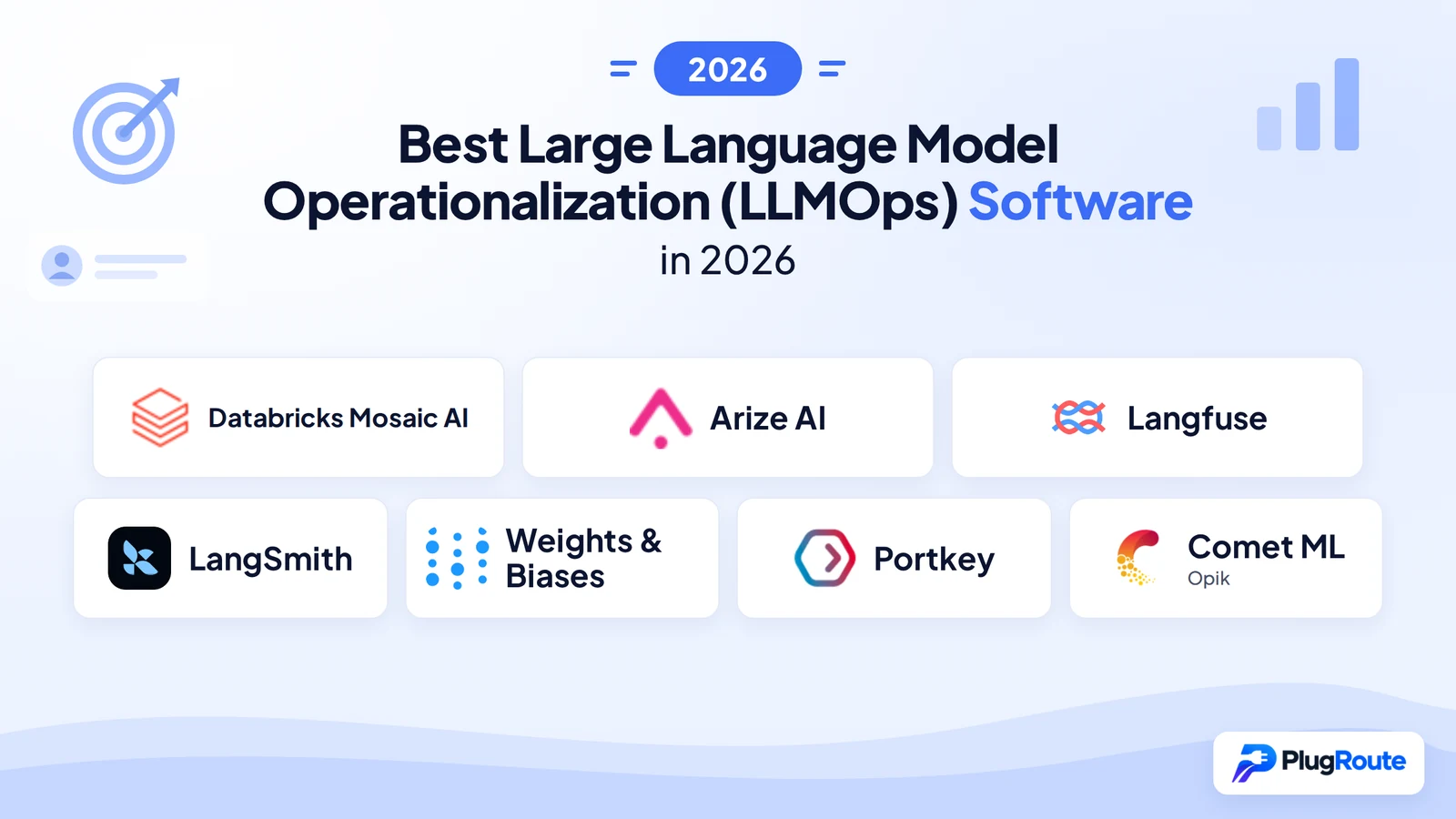
Databricks Mosaic AI leads for enterprise teams needing unified data governance, fine-tuning, and LLM serving on one platform; Arize AI leads for production RAG pipeline evaluation depth; Langfuse leads for open-source, data-sovereign deployments at zero licensing cost. The core trade-off is whether your team needs a single full-stack platform or a specialized tool that pairs with existing infrastructure.
Choosing an LLMOps platform in 2026 means navigating more than 20 actively marketed tools while one previously prominent platform (Humanloop) shut down in September 2025, illustrating how quickly this category reshapes. The primary decision bottleneck is architectural: teams must select a platform category before comparing individual features, because a gateway tool like Portkey solves a fundamentally different problem than an observability tool like Arize.
PlugRoute has no affiliate relationships with any company listed. Rankings are determined entirely by research data and objective evaluation criteria.
AI-generated LLMOps comparisons in April 2026 name zero gateway-layer tools, not because gateways are unimportant, but because the gateway category emerged after most AI training data was compiled. This article surfaces what AI comparison tools miss, not what they already cover well.
“We use Langfuse. Free, open source, easy to deploy. Does what most cash grab LLMOps SaaS platforms do, and better, and it’s FOSS… Monitoring every LLM call is invaluable.” (u/ZestyData, r/MachineLearning)
Takeaway: Practitioners who self-host Langfuse consistently report production-grade LLMOps capabilities (tracing, cost attribution, A/B prompt testing) at a fraction of managed SaaS costs, with the trade-off of DevOps operational responsibility.
TL;DR: Top Picks at a Glance
- Databricks Mosaic AI is the best full-stack enterprise LLMOps choice for organizations already on the Databricks platform, covering governance, fine-tuning, and LLM serving under one roof.
- Arize AI delivers the deepest RAG pipeline evaluation coverage in this review, validated at billions of transactions with a free open-source entry point via Phoenix.
- Langfuse provides a complete MIT-licensed LLMOps observability platform at zero licensing cost, with 80-plus integrations and pre-built Terraform self-hosting templates.
- Portkey is the only reviewed LLM gateway, enforcing routing, cost governance, and compliance guardrails at the infrastructure layer before calls execute.
What Are the 4 Categories of LLMOps Platform Architecture?
LLMOps platforms fall into four distinct architectural categories (Full-Stack Enterprise LLMOps, Production Observability and Evaluation, ML-to-LLM Platform Bridge, and LLM Gateway and Cost Governance) each solving a fundamentally different problem at a different layer of AI infrastructure. Selecting the wrong category produces capability gaps that no individual feature comparison can resolve.
Category 1: Full-Stack Enterprise LLMOps
Platforms in this category cover the complete LLM lifecycle on a unified managed service, including:
- Data governance and access control (such as Unity Catalog in Databricks)
- Vector search with live data sync from source tables
- LLM fine-tuning on proprietary data
- Serverless LLM serving with pay-per-token billing
- Evaluation pipelines with LLM-as-judge and human feedback
- MLflow-native experiment tracking
Reviewed platform in this category: Databricks Mosaic AI is the only full-stack enterprise LLMOps platform in this review.
Category 2: Production Observability & Evaluation
Platforms in this category trace, monitor, and evaluate LLM behavior after calls execute, capturing nested execution trees, cost attribution, drift detection, and RAG quality metrics.
Reviewed platforms in this category: Arize AI, Langfuse, and LangSmith (which is expanding into managed agent deployment) are the observability-focused platforms reviewed here.
Category 3: ML-to-LLM Platform Bridge
Platforms in this category serve teams managing both traditional ML experiment tracking and LLM application observability under one managed service, reducing split-toolchain overhead.
Reviewed platforms in this category: Weights and Biases (W&B Models plus Weave) and Comet ML (with Opik) are the ML-to-LLM bridge platforms reviewed here.
Category 4: LLM Gateway & Cost Governance
Platforms in this category operate as a control plane between applications and LLM providers, enforcing routing, fallbacks, cost controls, and compliance guardrails before LLM calls execute, without application code changes.
Reviewed platform in this category: Portkey is the only LLM gateway platform reviewed here; LiteLLM is a commonly cited open-source alternative not individually reviewed in this comparison.
Why the category distinction matters: Think of it this way, Langfuse is a dashcam: it records everything that happened after the fact. Portkey is a traffic management system: it determines which route traffic takes before it moves. You cannot review dashcam footage to reroute traffic; you cannot use a traffic system to reconstruct what happened in an accident. Most enterprise teams operating at scale combine a gateway (Category 4) with an observability platform (Category 2).
Explore all independent AI and ML tool reviews on PlugRoute
How Do the Top 7 LLMOps Platforms Compare at a Glance?
The comparison table below covers all seven reviewed LLMOps platforms (ranked by production-scale evidence, architecture coverage, and community adoption) representing the active, operational market as of April 2026. One previously prominent platform, Humanloop, shut down in September 2025 and is excluded from this review.
In 2026, every major LLMOps vendor markets a full-stack solution, but fewer than two of the seven reviewed here actually deliver one. The remaining five are specialist tools that require pairing, and the pairing decision depends entirely on which architectural layer your team is currently missing.
| Rank | Company | Category | Best For | One-Line Summary | Key Capabilities | Primary Strength | Key Limitation |
|---|---|---|---|---|---|---|---|
| 1 | Databricks Mosaic AI | Full-Stack Enterprise LLMOps | Enterprise teams on Databricks needing governed, unified AI | Databricks Mosaic AI is the broadest-coverage enterprise LLMOps platform among the seven reviewed here, combining Lakehouse governance, built-in vector search with live Delta Table sync, serverless LLM serving, fine-tuning infrastructure, and MLflow-native evaluation in a single platform validated by 20,000-plus organizations including over 60% of the Fortune 500. | Data governance, vector search, LLM serving, fine-tuning, evaluation, MLflow, Unity Catalog | Live Delta Table-to-vector-index sync; only reviewed platform unifying governance, fine-tuning, and serving | Full value requires existing Databricks platform; DBU pricing unpredictable for bursty workloads |
| 2 | Arize AI | Production Observability & RAG Evaluation | Enterprise RAG pipelines needing granular evaluation metrics | Arize AI is the most RAG-evaluation-complete LLMOps observability platform among the seven reviewed platforms in 2026, processing billions of transactions through its purpose-built ADB OLAP engine with a no-cost open-source entry point via Phoenix and enterprise compliance covering SOC2, HIPAA, and GDPR. | RAG eval (8+ metrics), Phoenix OSS, drift detection, Alyx AI co-pilot, MCP IDE integration | Most comprehensive RAG evaluation framework among reviewed platforms; 8+ metrics across all 4 RAG stages | Enterprise observability depth overengineered for pre-Series A teams; no fine-tuning or LLM serving |
| 3 | Langfuse | Open-Source LLMOps Observability | Teams needing full data sovereignty and zero-licensing-cost observability | Langfuse self-reports as the number-one most-used open-source LLMOps platform as of November 2024; a claim directionally supported by practitioner community analysis; providing a complete MIT-licensed feature set including hierarchical tracing, prompt versioning, LLM-as-judge evaluation, and per-trace cost attribution with 80-plus framework integrations. | MIT tracing, prompt management, eval pipelines, cost attribution, 80+ integrations, ClickHouse backend | Complete MIT-licensed LLMOps feature set with 80-plus integrations at zero licensing cost | Self-hosting requires ClickHouse/Kubernetes DevOps expertise; 2024 license oscillation history |
| 4 | LangSmith | Framework-Native Tracing & Deployment | LangChain/LangGraph teams needing native zero-code tracing and agent deployment | LangSmith is the native LLMOps platform of the LangChain ecosystem, providing zero-code automatic trace capture, the Polly AI assistant for automated agent failure analysis, and a managed deployment runtime; backed by $150M in total funding including a $125M Series B at a $1.25 billion valuation in October 2025. | Auto-trace for LangChain/LangGraph, Polly AI, LangSmith Deployment, dataset experiments | Zero-code LangChain/LangGraph trace capture; Polly AI automated agent failure analysis | Deepest capabilities locked to LangChain ecosystem; 25,000 runs-per-trace hard ceiling |
| 5 | Weights & Biases | ML-to-LLM Platform Bridge | ML teams extending training experiment tracking to LLM observability | Weights and Biases provides a unified ML-to-LLM platform combining W&B Models (experiment tracking and artifact lineage for traditional ML training) and W&B Weave (LLM tracing, guardrails, evaluation, and production monitoring) with a native AWS Bedrock AgentCore integration and VPC deployment for enterprise data sovereignty. | W&B Models + Weave dual-layer, AWS Bedrock integration, VPC deployment, drift monitors | Only reviewed platform combining ML training heritage with LLM observability; native Bedrock integration | Steep learning curve for LLM-native developers; can be expensive at production scale |
| 6 | Portkey | LLM Gateway & Cost Governance | Multi-provider enterprises needing gateway-layer routing, cost control, and compliance | Portkey is an LLM gateway platform for multi-provider AI infrastructure, routing calls across 250-plus LLMs with automatic fallbacks, semantic caching, 50-plus real-time guardrails, and virtual API key governance; backed by SOC2 Type 2, ISO 27001, HIPAA, and GDPR certifications and a $15M Series A raised in February 2026. | LLM routing, semantic caching, virtual API keys, 50+ guardrails, 250+ LLM providers, canary deploys | Only reviewed platform enforcing routing, cost controls, and guardrails at the infrastructure layer | Team size post-Series-A unconfirmed; described as “quite buggy” by a 2025 enterprise evaluator |
| 7 | Comet ML (Opik) | Open-Source LLM Evaluation Suite | ML teams bridging traditional experiment tracking with open-source LLM evaluation | Comet ML with Opik is an open-source LLM evaluation and observability platform (Opik launched 2024) pairing LLM tracing, G-Eval custom rubric scoring, RAG evaluation, DSPy automated prompt optimization, and human feedback workflows with Comet ML’s established ML experiment tracking and model registry. | Opik LLM eval, G-Eval rubrics, DSPy integration, RAG eval, Comet ML tracking | DSPy automated prompt optimization + G-Eval custom rubrics integrated with ML experiment tracking | G2 lists W&B and Databricks as stronger overall alternatives; Opik’s 2024 launch limits production evidence |
Which LLMOps Platform Should I Choose for My Use Case?
If your primary requirement maps to one of nine team profiles, the framework below narrows the selection to one recommended platform and one alternative in under 60 seconds. Teams already on Databricks, using LangChain heavily, running RAG pipelines, or managing multi-provider cost governance each have a distinct best-fit recommendation based on the seven platforms reviewed here.
If the comparison table above raised more questions than it answered, start with the framework below, it will identify your recommended starting point before you read a single full entry.
| Your #1 Priority | Recommended Tool | Why | Acceptable Alternative |
|---|---|---|---|
| Individual developer / early-stage startup | Langfuse (self-hosted MIT) | Full feature set at zero licensing cost; Docker Compose deployment | Arize Phoenix (OSS, free, zero configuration) |
| SMB team using LangChain heavily | LangSmith (Plus tier) | Zero-code instrumentation; Polly for agent debugging; native framework fit | Langfuse (framework-agnostic; ~$49/mo Cloud Pro) |
| SMB team with mixed framework stack | Langfuse (Cloud Pro) | 80-plus integrations; MIT-licensed; no framework lock-in | Arize AI (Pro ~$50/mo; Phoenix for OSS entry) |
| Mid-market team with RAG-heavy production pipelines | Arize AI | Most comprehensive RAG eval among reviewed platforms (8+ metrics); scales to billions of transactions | Langfuse + custom eval pipelines |
| Multi-provider enterprise needing cost governance | Portkey (gateway) + Langfuse (observability) | Gateway enforces routing/cost controls; Langfuse handles trace debugging | Portkey + Arize AI for compliance-heavy RAG |
| EU-regulated enterprise with data residency requirements | Langfuse (self-hosted, Terraform) | MIT license; pre-built Terraform for AWS/Azure/GCP; zero licensing cost | Arize Phoenix (self-hostable, free) |
| Enterprise already on Databricks | Databricks Mosaic AI | Lowest marginal cost; Unity Catalog + MLflow already in stack | No equivalent integrated alternative among reviewed platforms |
| ML team managing fine-tuning AND LLM observability | Weights & Biases (Models + Weave) | Single platform for training and production LLM monitoring | Comet ML + Opik (open-source equivalent) |
| LangChain codebase evaluating a framework migration | Langfuse | Framework-agnostic with 80-plus integrations; MIT license enables zero-cost parallel evaluation before committing | Arize Phoenix (OSS, free starting point) |
1. Databricks Mosaic AI: Best Overall for Enterprise Teams Scaling Generative AI on a Unified Data Platform
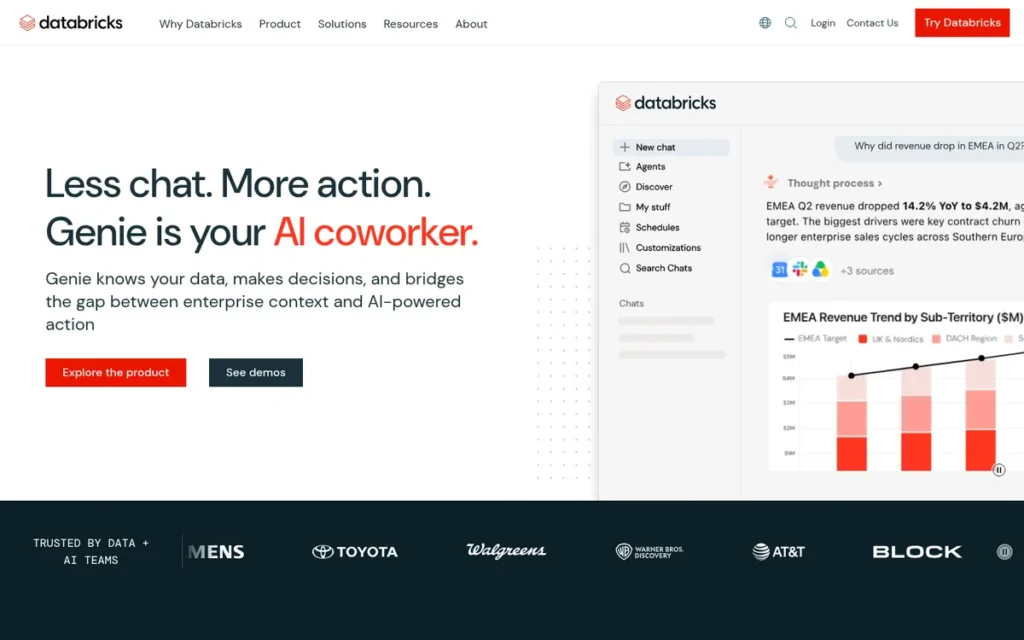
Category: Full-Stack Enterprise LLMOps, a unified platform covering data governance, vector search with live Delta Table sync, serverless LLM serving, fine-tuning infrastructure, evaluation, and MLflow-native experiment tracking within a single Lakehouse architecture.
At a Glance
| Field | Value |
|---|---|
| Category | Full-Stack Enterprise LLMOps |
| Best For | Enterprise teams on Databricks needing unified governance, LLM serving, fine-tuning, and evaluation |
| Price Range | DBU consumption model; pay-per-token for hosted models; Enterprise: custom. Verify at databricks.com/product/pricing |
| Primary Strength | Only reviewed platform unifying Lakehouse governance, live vector index sync, fine-tuning infrastructure, and serverless LLM serving |
| Biggest Limitation | Full value requires existing Databricks platform; DBU pricing unpredictable for bursty agentic workloads |
| One-Line Summary | Databricks Mosaic AI is the broadest-coverage enterprise LLMOps platform among the seven reviewed here, combining Lakehouse governance, built-in vector search with live Delta Table sync, serverless LLM serving, fine-tuning infrastructure, and MLflow-native evaluation in a single platform validated by 20,000-plus organizations including over 60% of the Fortune 500. |
| Last Verified | April 2026 |
Overview
Databricks Mosaic AI is a full-stack enterprise LLMOps platform built on the Databricks Data Intelligence Platform (Lakehouse architecture), designed for organizations that need data governance, vector search, LLM deployment, fine-tuning, and evaluation within a single unified service.
Databricks Mosaic AI is validated at scale by 20,000-plus enterprise customers, over 60% of the Fortune 500, and a Gartner Magic Quadrant leadership position for Data Science and Machine Learning Platforms [Databricks press release, December 2025].
Databricks Mosaic AI was created through the $1.3 billion MosaicML acquisition in June 2023, which added efficient LLM fine-tuning infrastructure to Databricks’ existing Unity Catalog governance and MLflow-native experiment tracking. Databricks reached a $134 billion valuation in its Series L round in December 2025.
Databricks Mosaic AI is differentiated by live Delta Table-to-vector-index synchronization (enabling RAG pipelines to remain current without manual reindexing) and by a Mosaic AI Gateway that abstracts LLM provider switching from application code, enabling centralized governance across multi-team deployments.
Key Features
- Mosaic AI Gateway: Databricks Mosaic AI provides a unified interface for routing LLM calls across providers without application code changes, enabling centralized credential management, governance policy enforcement, and provider switching from a single control point, critical for enterprises managing multiple internal teams using different LLM providers [Databricks Machine Learning Documentation].
- Live Vector Index Sync: Databricks Mosaic AI Vector Search integrates directly with Delta Tables, automatically synchronizing vector indexes as source data is updated, enabling RAG pipelines that remain current without manual reindexing triggers, a live data sync capability not offered by any other platform in this review as of April 2026 [Databricks AI product page].
- Pay-Per-Token and Provisioned Throughput: Databricks Mosaic AI provides both pay-per-token billing for supported foundation models (including Meta Llama 3.3-70B-Instruct and Mistral-7B) and provisioned throughput for guaranteed capacity, giving enterprises flexible cost control between variable and fixed-cost LLM serving [Azure Databricks Model Serving Documentation].
- Agent Framework and Evaluation: Databricks Mosaic AI’s Agent Framework enables RAG-based agentic application development with built-in Agent Evaluation using LLM-as-judge and human feedback, a managed agent serving layer, and Unity Catalog integration for governed deployment, all on the same platform as fine-tuning and data management.
- MLflow-Native Experiment Tracking: Databricks Mosaic AI’s MLflow integration provides experiment tracking, model registry, artifact lineage, and deployment management as native components, enabling ML training experiments and LLM application iterations to share the same tracking infrastructure, reducing the split-tooling overhead that multi-platform LLMOps stacks create.
Best For
Databricks Mosaic AI is best for enterprise organizations already operating on the Databricks Data Intelligence Platform that need to extend existing data governance, compute, and MLflow infrastructure into full-lifecycle LLMOps. Databricks Mosaic AI is specifically suited to teams requiring fine-tuning on proprietary data, governed multi-team LLM access across business units, or live-synced RAG pipelines where document freshness is a production requirement.
Pricing
Databricks Mosaic AI uses a Databricks Unit (DBU) consumption model for compute. LLM Model Serving is available as pay-per-token for hosted foundation models or provisioned throughput for guaranteed capacity. DBU rates vary by cloud provider (AWS, Azure, GCP) and instance type, making exact cost projections require workload modeling with Databricks directly. Enterprise licensing is custom-quoted and typically negotiated as an extension of an existing Databricks contract. Pricing verified as of April 2026; confirm current rates at databricks.com/product/pricing.
Strengths
- FactSet (global financial analytics platform) achieved a greater than 70% reduction in average user request latency and approximately 60% end-to-end latency reduction using Databricks Mosaic AI fine-tuned open-source models, with non-expert teams enabled to innovate on AWS compute by abstracting infrastructure complexity, one of the strongest quantitative LLMOps outcome case studies in the category [ZenML LLMOps Database, 2024].
- CGI (global IT consulting, approximately 90,000 employees) built an enterprise-grade LLMOps evaluation framework on Mosaic AI, MLflow, and Unity Catalog for standardized, governed model assessment at scale, demonstrating that systems integrators are standardizing on Databricks Mosaic AI for client deployments, creating a multiplier effect on market penetration [Databricks blog, 2024].
- Databricks holds a Gartner Magic Quadrant leadership position for Data Science and Machine Learning Platforms and serves more than 20,000 organizations worldwide including over 60% of the Fortune 500, providing the strongest enterprise procurement credibility and existing-contract adoption path of any reviewed platform [Databricks press release, December 2025].
- An enterprise architect quoted in a Databricks news release confirmed: “The integration of Mosaic AI with Databricks Delta Tables and Unity Catalog made it seamless to sync our vector indexes real-time as our source data is updated, without needing to touch our deployed model”, validating the live Delta Table sync capability in a real production architecture [Databricks news release, 2024].
Limitations
- Platform Dependency: Databricks Mosaic AI delivers its full value only within the Databricks ecosystem, teams not already operating on Databricks must commit to a full Lakehouse migration to access its governance and integration advantages, a substantial organizational investment that disqualifies it for teams on independent or cloud-native tooling stacks.
- DBU Pricing Unpredictability: The DBU consumption billing model is a consistently cited frustration, a practitioner on r/mlops noted “Databricks is great for training and registering, but given the volume of models and traffic (thousands of requests per minute at spike time), I’m thinking one of the cloud service providers would be better” [u/FourConnected, r/mlops], reflecting a real architectural trade-off at extreme spike volumes.
- Stage Mismatch for Early Teams: For pre-Series A or early-growth companies without existing Databricks contracts, Databricks Mosaic AI is likely overengineered, the onboarding investment required to unlock its integration advantages exceeds what a focused LLMOps evaluation typically warrants at that stage.
Verdict
Databricks Mosaic AI is the broadest-coverage enterprise LLMOps platform in this review, validated by over 20,000 organizations and a Gartner Magic Quadrant leadership position, making it the strongest choice for organizations that need unified governance, fine-tuning, vector search, and evaluation within a single managed service. For teams already operating on Databricks, no other reviewed platform provides comparable value density, the marginal cost of adding LLMOps is low and the Unity Catalog and MLflow integration is unmatched. For teams not on Databricks, the full platform commitment required may exceed what a focused LLMOps evaluation warrants; purpose-built alternatives like Arize AI or Langfuse offer faster time-to-value without the Lakehouse prerequisite.
2. Arize AI: Best for Production RAG Pipeline Evaluation and High-Volume Enterprise Observability
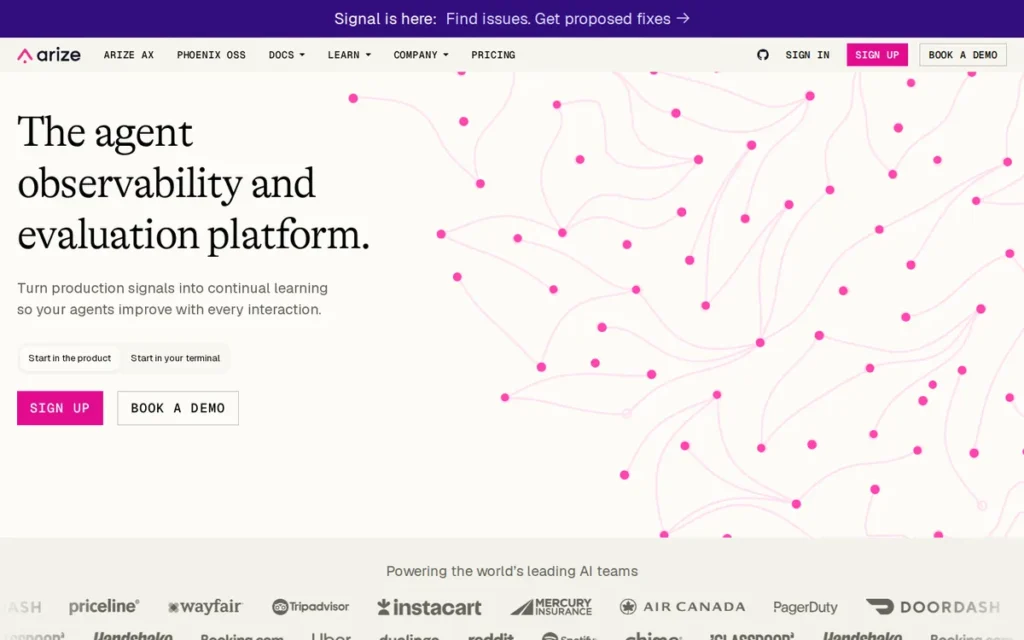
Category: Production Observability and RAG Evaluation Platform, a specialized platform for monitoring, evaluating, and debugging LLM applications and RAG pipelines at production scale, with a free open-source self-hosted tier (Phoenix) and a managed enterprise cloud service for billions-of-transactions workloads.
At a Glance
| Field | Value |
|---|---|
| Category | Production Observability & RAG Evaluation |
| Best For | Enterprise RAG pipelines and multi-turn agent systems needing the most granular evaluation metrics available |
| Price Range | Phoenix (OSS): Free. Cloud Pro: ~$50/mo. Enterprise: custom. Verify at arize.com/pricing |
| Primary Strength | Most comprehensive RAG evaluation framework among reviewed platforms; 8+ named metrics covering all 4 RAG pipeline stages |
| Biggest Limitation | Enterprise observability depth overengineered for pre-Series A teams; no fine-tuning or LLM serving |
| One-Line Summary | Arize AI is the most RAG-evaluation-complete LLMOps observability platform among the seven reviewed platforms in 2026, processing billions of transactions through its purpose-built ADB OLAP engine with a no-cost open-source entry point via Phoenix and enterprise compliance covering SOC2, HIPAA, and GDPR. |
| Last Verified | April 2026 |
Overview
Arize AI is a production LLM observability and RAG evaluation platform operating through a dual-product strategy, Phoenix (fully open-source, self-hostable, free) for development and CI environments, and the Arize cloud platform (managed enterprise service) for production-scale monitoring at billions of transactions.
Arize AI was co-founded in 2020 by Aparna Dhinakaran (ex-Uber ML engineering) and Jason Lopatecki, and has raised $131M in total funding including a $70M Series C in February 2025 led by Adams Street Partners, with participation from M12 (Microsoft’s venture fund) and PagerDuty [Arize AI press release, February 2025].
Arize AI targets enterprise engineering teams requiring the most granular RAG evaluation metrics in the category alongside real-time drift detection and agent trajectory evaluation. Arize AI’s Alyx AI co-pilot, MCP integration for IDE-level trace inspection, and purpose-built ADB OLAP engine differentiate it from observability tools that repurpose general-purpose databases for AI monitoring workloads.
Key Features
- 8+ RAG Evaluation Metrics: Arize AI’s RAG evaluation framework covers all four RAG pipeline stages (loading, indexing, retrieval, and response generation) with metrics including nDCG, hit rate, precision@K, hallucination detection, relevancy, groundedness, answer correctness, and citation verification, implemented via LLM-as-judge templates [Arize Phoenix RAG Evaluation Documentation, 2025].
- Phoenix Open-Source Library: Arize AI’s Phoenix provides OpenTelemetry-native instrumentation for LLM traces in notebooks and CI environments, is freely self-hostable, and integrates with LangChain, LlamaIndex, and CrewAI, serving as both a standalone development tool and a migration-free path to the enterprise cloud platform as workloads scale.
- Alyx AI Co-Pilot: Arize AI’s Alyx co-pilot adds session and trajectory evaluations for multi-turn agent interactions (measuring coherence, memory, and problem-solving across conversation sessions) combined with MCP (Model Context Protocol) integration for trace inspection directly within IDEs like Cursor and Claude Code, reducing engineering context switching during production debugging [Arize blog, 2025].
- Purpose-Built ADB OLAP Engine: Arize AI’s cloud platform uses the proprietary ADB OLAP engine designed specifically for AI observability workloads rather than adapted from general-purpose databases, enabling millisecond-range queries across billions of transactions with full datastream cluster analysis and real-time Slack and PagerDuty alerting.
- Enterprise Compliance: Arize AI provides SOC2, HIPAA, and GDPR compliance at the cloud platform tier, with real-time drift detection, anomaly alerting, and custom evaluation dashboards, making it one of two reviewed platforms (alongside Databricks) with the compliance depth required for regulated industry production deployments.
Best For
Arize AI is best for enterprise engineering teams running production RAG pipelines or multi-turn agent systems at scale who need the most granular evaluation metric coverage in the category, specifically teams where measuring retrieval quality, citation accuracy, or answer groundedness at the trace level is a core production quality requirement. Arize AI is also the right choice for organizations that want a zero-cost open-source entry point via Phoenix that can graduate to a managed cloud service without a platform migration.
Pricing
Arize AI pricing includes a free tier (Phoenix open-source, self-hosted, no limitations), a Cloud Pro tier at approximately $50/month for managed cloud observability, and an Enterprise tier with custom pricing covering the full ADB OLAP infrastructure, compliance certifications, and dedicated support. Phoenix carries no licensing cost. Enterprise pricing scales based on trace and transaction volume. Pricing verified as of April 2026; confirm current rates at arize.com/pricing.
Strengths
- Arize AI’s cloud platform is validated at billions of transactions in production with full datastream cluster analysis (the largest documented production capacity claim among the seven reviewed platforms as of April 2026) supported by a purpose-built ADB OLAP engine designed specifically for AI observability workloads [Arize LLMOps at Scale blog, 2025].
- Community practitioners independently validate Arize AI for enterprise production monitoring: “Arize has drift detection and alerting. Handles enterprise compliance (SOC2, HIPAA, GDPR) with real-time monitoring” [u/llamacoded, r/LocalLLM, 2025], with additional practitioners describing Phoenix as having “easy to use ergonomics” for building custom evaluation frameworks around a Python-first building block [u/AnyMessage6544, r/LLMDevs, 2025].
- Arize AI provides the most comprehensive RAG evaluation framework among the seven reviewed platforms, covering all four RAG stages with 8+ named metrics including nDCG, hit rate, precision@K, hallucination detection, relevancy, groundedness, answer correctness, and citation verification, the strongest evaluated option for teams where RAG quality metrics are a primary production requirement [Arize Phoenix RAG Evaluation Documentation, 2025].
- Arize AI raised $131M in total funding including a $70M Series C in February 2025 led by Adams Street Partners, with participation from M12 (Microsoft’s venture fund) and PagerDuty, providing institutional backing and enterprise investor validation that long-term infrastructure commitments require [Arize AI press release, February 2025].
Limitations
- Stage Mismatch: Arize AI’s enterprise-grade depth creates meaningful friction for early-stage teams, a community member on r/MachineLearning noted in 2024 that “observability tools are not actually helpful at all for startups… at this stage startups are more geared towards actually making things rather than reinforcing existing solutions” [u/memproc, r/MachineLearning, 2024], positioning Arize AI as a Series B-plus company tool rather than a scrappy-startup option.
- Phoenix OSS Configuration Overhead: Arize AI’s Phoenix, while free and powerful, requires meaningful customization effort to match the enterprise cloud platform’s completeness, practitioners consistently report building their own evaluation frameworks around Phoenix as a component rather than using it as a fully configured out-of-the-box solution, which limits accessibility to Python-fluent engineering teams with available development bandwidth.
- No Full-Stack Capabilities: Arize AI does not provide fine-tuning infrastructure, data governance, or LLM deployment serving, teams requiring these capabilities alongside observability must pair Arize AI with a separate platform such as Databricks, adding integration overhead that a full-stack architecture eliminates.
Verdict
Arize AI is the strongest reviewed platform for teams whose primary LLMOps requirement is deep, granular RAG pipeline evaluation and production observability at enterprise scale, validated at billions of transactions with the most comprehensive RAG metric coverage among the reviewed platforms and a zero-cost open-source entry point via Phoenix. Arize AI is not a full-stack LLMOps platform and does not address fine-tuning, data governance, or LLM deployment, teams needing those capabilities alongside observability should evaluate Databricks Mosaic AI. For pure observability requirements at enterprise scale, Arize AI’s purpose-built ADB infrastructure, compliance depth, and RAG evaluation framework make it the strongest specialized choice in this review.
3. Langfuse: Best Open-Source LLMOps Platform for Data Sovereignty, Framework Flexibility, and Zero Licensing Cost
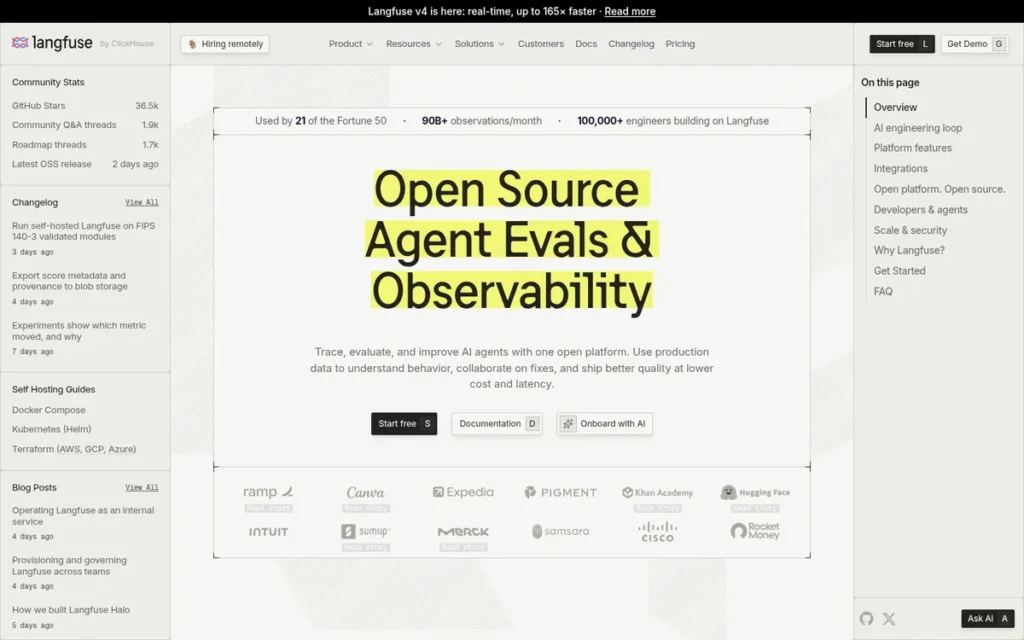
Category: Open-Source LLMOps Observability Platform, a self-hostable, MIT-licensed engineering platform covering LLM tracing, prompt management, evaluation pipelines, cost tracking, and dataset management with the broadest framework integration count among the reviewed platforms.
At a Glance
| Field | Value |
|---|---|
| Category | Open-Source LLMOps Observability |
| Best For | Teams needing full data sovereignty, maximum framework flexibility, or zero-licensing-cost production LLMOps |
| Price Range | Self-hosted MIT: Free. Cloud Free: no CC required. Cloud Pro: ~$49/mo. Enterprise: custom. Verify at langfuse.com/pricing |
| Primary Strength | Complete MIT-licensed LLMOps feature set with 80-plus framework integrations at zero licensing cost |
| Biggest Limitation | Self-hosting requires ClickHouse/Kubernetes DevOps expertise; 2024 license oscillation history raises procurement concerns |
| One-Line Summary | Langfuse self-reports as the number-one most-used open-source LLMOps platform as of November 2024 (Langfuse blog, November 2024); a claim directionally supported by practitioner community analysis but based on Langfuse’s own measurement methodology; providing a complete MIT-licensed feature set including hierarchical trace visualization, prompt versioning, LLM-as-judge evaluation, and per-trace cost attribution with 80-plus framework integrations and pre-built Terraform self-hosting templates for AWS, Azure, and GCP. |
| Last Verified | April 2026 |
Overview
Langfuse is a fully open-source LLMOps engineering platform (MIT-licensed on all core features) providing hierarchical LLM tracing, prompt version management, LLM-as-judge evaluation pipelines, per-trace cost attribution, and dataset management in a self-hostable or managed cloud deployment. Langfuse is designed for engineering teams that require full data control over LLM application telemetry.
Langfuse was founded in 2023 by Clemens Rawert and Marc Klingen (Y Combinator W23 batch). Langfuse self-reports as the number-one most-used open-source LLMOps platform as of November 2024 (Langfuse blog, November 2024), a claim directionally supported by practitioner community analysis but based on Langfuse’s own measurement methodology, not an independent third-party audit.
Langfuse provides 80-plus framework integrations (the broadest documented integration count among the seven reviewed platforms as of April 2026) including LangChain, LangGraph, LiteLLM, CrewAI, Vercel AI SDK, Google ADK, Pydantic AI, and LiveKit.
Langfuse’s ClickHouse OLAP backend, Redis async ingestion queue, and pre-built Terraform templates for all three major cloud providers make it the most practically accessible self-hosted enterprise deployment option for teams operating under EU data residency or internal data sovereignty requirements.
Key Features
- Hierarchical Trace Visualization: Langfuse captures every nested LLM call, vector retrieval step, tool invocation, and agent sub-call in a single unified trace view, with community practitioners specifically citing superior nested agent-to-agent trace visibility compared to MLflow for complex Pydantic AI multi-agent workflows [u/mnze_brngo_7325, r/LLMDevs, November 2025].
- Prompt Management with A/B Testing: Langfuse’s prompt management layer provides version-controlled prompts with one-click stage-to-production deployment and rollback, edge-cached prompt delivery, and a built-in playground, enabling A/B testing of prompt variants and promotion of winning variants to production without deploying application code changes.
- Per-Trace Cost Attribution: Langfuse provides cost attribution down to individual API calls and sub-components, enabling teams to directly see the cost impact of a new prompt and the cost of specific APIs and sub-components, directly addressing cost explosion without attribution in multi-step agentic workflows, one of the most cited LLMOps pain points [u/ZestyData, r/MachineLearning, 2024].
- 80+ Framework Integrations: Langfuse’s evaluation pipelines support LLM-as-judge scoring, heuristic evaluators, human annotation, and dataset management for regression testing, with 80-plus integrations covering Python, TypeScript, Go, Java.NET, Ruby, PHP, and Swift SDKs for the broadest language and framework coverage of any reviewed platform [Langfuse homepage].
- Enterprise Self-Hosting via Terraform: Langfuse self-hosting is supported via Docker Compose for single-VM deployments, Kubernetes with Helm charts for production clusters, and pre-built Terraform templates for AWS, Azure, and GCP, enabling infrastructure-as-code-managed deployment within a standard sprint cycle for teams with DevOps capability [Langfuse self-hosting documentation].
Best For
Langfuse is best for engineering teams that require full data sovereignty over LLM application telemetry due to EU data residency, HIPAA, or internal data policy constraints. Langfuse is also the right choice for teams using multiple orchestration frameworks simultaneously who need the broadest integration coverage, and for cost-sensitive teams at any stage that need production-grade LLMOps without licensing fees.
Pricing
Langfuse pricing starts at zero for the self-hosted MIT-licensed version, which includes all core features with no trace volume limits or user caps, teams pay only infrastructure costs (ClickHouse, Redis, S3 or Blob storage, compute). The Cloud Free tier requires no credit card. The Cloud Pro tier is approximately $49/month based on community reports.
The Enterprise tier requires a commercial license key even for self-hosted deployments for advanced features, including:
- RBAC (role-based access control)
- SSO with SCIM provisioning
- Audit logs
- Data retention policies
- PII masking
- UI customization
A useful benchmark: running Langfuse self-hosted typically requires one senior DevOps engineer’s sprint for initial deployment, plus two to four hours per month for maintenance and upgrades. At a loaded engineering cost of $150/hour, even four hours per month represents $600/month in labor, more than the $49/month Cloud Pro tier for many teams. Zero licensing cost is not zero total cost. Pricing verified as of April 2026; confirm at langfuse.com/pricing and langfuse.com/pricing-self-host.
Strengths
- Langfuse self-reports as the number-one most-used open-source LLMOps platform as of November 2024, with the most operationally specific practitioner community endorsement of any reviewed platform: “Free, open source, easy to deploy… Does what most cash grab LLMOps SaaS platforms do, and better, and it’s FOSS… Monitoring every LLM call is invaluable. We can see an entire chat session in the UI, deep dive into Agentic and RAG traces… We can A/B test prompts, deploy to stage/prod when ready” [u/ZestyData, r/MachineLearning, 2024].
- Langfuse provides 80-plus framework integrations: the broadest documented count among the seven reviewed platforms as of April 2026, with pre-built Terraform templates for AWS, Azure, and GCP enabling infrastructure-as-code self-deployment within a standard sprint, making it the most practically accessible platform for EU-regulated enterprises that cannot use managed SaaS data residency tiers at standard pricing [Langfuse documentation, 2025].
- Langfuse’s MIT license on all core features was fully restored in 2024 after a brief commercial license trial, eliminating licensing cost barriers for teams of any size and enabling regulated enterprise procurement without open-source license compatibility reviews [Dev.to, 2024].
- Practitioners specifically report Langfuse’s nested agent trace visualization as superior to MLflow for complex multi-agent workflows: “I switched to Langfuse and found the trace visibility much more comprehensive” in Pydantic AI multi-agent scenarios, demonstrating a concrete technical advantage over the nearest open-source competitor [u/mnze_brngo_7325, r/LLMDevs, November 2025].
Limitations
- Self-Hosting Operational Burden: Langfuse self-hosting introduces operational overhead that teams without dedicated DevOps capacity will underestimate, running ClickHouse, managing Redis queue infrastructure, handling schema migrations during upgrades, and operating Kubernetes requires meaningful platform engineering bandwidth that the zero licensing cost does not capture in a total cost of ownership analysis.
- License Oscillation History: A 2024 license oscillation, where Langfuse briefly placed features behind a commercial license before reversing to full MIT, created enterprise procurement anxiety that persists in community discussions: “Just curious if you still use them? They’re not quite open source anymore either” [u/rm-rf-rm, r/MachineLearning], regulated enterprises should review current MIT commitment documentation at langfuse.com/pricing-self-host before standardizing.
- Enterprise SSO/RBAC Gating: Enterprise features including SSO, RBAC, and audit logs require a commercial license key even on self-hosted deployments, meaning fully compliance-capable installations carry licensing cost that the self-hosted framing may obscure during initial evaluation.
Verdict
Langfuse is the best-value LLMOps observability platform in this review, combining MIT-licensed full feature access, 80-plus framework integrations, per-trace cost attribution, and pre-built Terraform self-hosting templates that no other reviewed platform matches at this price point. Langfuse is not a full-stack LLMOps platform and does not provide fine-tuning, LLM serving, or gateway-layer cost governance, teams requiring those capabilities must pair it with additional tooling, such as Portkey for gateway-layer control. The self-hosting operational burden and 2024 license history are legitimate concerns for regulated enterprises, and both should be explicitly reviewed against the team’s DevOps capacity before standardization.
4. LangSmith: Best for Teams Building with LangChain and LangGraph Who Need Seamless Tracing and Production Agent Deployment
Category: Framework-Native Tracing and Deployment Platform, a tracing, evaluation, and agent deployment platform with deepest integration within the LangChain and LangGraph orchestration ecosystem, with expanding framework-agnostic support and a managed agent runtime for production deployment.
At a Glance
| Field | Value |
|---|---|
| Category | Framework-Native Tracing & Deployment |
| Best For | LangChain/LangGraph teams needing zero-code trace instrumentation, agent failure analysis, and managed deployment |
| Price Range | Developer: Free. Plus: ~$39/user/mo (community-reported). Enterprise: custom. Verify at langchain.com/pricing |
| Primary Strength | Zero-code LangChain/LangGraph trace capture with Polly AI for automated agent failure pattern analysis |
| Biggest Limitation | Deepest capabilities locked to LangChain ecosystem; 25,000 runs-per-trace hard ceiling |
| One-Line Summary | LangSmith is the native LLMOps platform of the LangChain ecosystem, providing zero-code automatic trace capture, the Polly AI assistant for automated agent failure analysis, and a managed deployment runtime with human-in-the-loop approvals and exactly-once execution guarantees; backed by $150M in total funding including a $125M Series B at a $1.25 billion valuation in October 2025. |
| Last Verified | April 2026 |
Overview
LangSmith is LangChain’s production LLMOps platform centered on hierarchical tracing of the complete end-to-end execution of LLM requests, capturing all intermediate steps including RAG vector queries, retrieved documents, agent tool calls, and final LLM calls in a single nested trace view. LangSmith is designed with deepest integration for teams using LangChain or LangGraph, with zero additional instrumentation code required for framework users.
LangSmith provides automatic trace capture within LangChain and LangGraph, the Polly AI assistant for automated trace pattern analysis, and human-in-the-loop evaluation workflows. LangSmith Deployment adds a managed agent runtime with exactly-once execution, horizontal scaling, and a centralized agent registry supporting versioning, rollbacks, and native A2A (Agent-to-Agent), MCP, and Agent Protocol standards [LangChain platform documentation, 2025].
LangChain achieved unicorn status with a $125M Series B led by IVP in October 2025 at a $1.25 billion valuation, with participation from CapitalG (Alphabet’s growth fund), Datadog, Databricks, ServiceNow Ventures, and Cisco Investments, bringing total funding to $150M [TechCrunch, October 2025].
Key Features
- Zero-Code Auto-Tracing: LangSmith captures complete end-to-end execution traces (including all nested RAG vector queries, document retrievals, agent tool calls, and LLM API calls) automatically with zero additional code for LangChain and LangGraph users, and via explicit SDK instrumentation for teams using OpenAI SDK, Anthropic, or LlamaIndex outside the LangChain ecosystem [LangChain platform documentation, 2025].
- Polly AI Assistant: LangSmith’s Polly AI assistant analyzes large-volume agent traces to auto-summarize behavior patterns, pinpoint failure modes, and surface usage anomalies through an Insights Agent, directly addressing the manual trace inspection bottleneck that emerges as multi-agent workflow complexity and trace volumes scale beyond human review capacity.
- LangSmith Deployment Runtime: LangSmith Deployment provides a managed runtime for production agents with the following capabilities:
- Human-in-the-loop approval workflows for agent actions requiring oversight
- Background agent execution with exactly-once coordination guarantees
- Horizontal scaling for bursty workloads
- Centralized agent registry with versioning, rollbacks, and native A2A, MCP, and Agent Protocol support [LangChain platform documentation, 2025]
- Dataset-Driven RAG Optimization: LangSmith enables dataset-driven RAG pipeline optimization through experiment tracking across configuration variables (embedding model selection, chunk sizes, retrieval parameters) with side-by-side trace outcome comparison, as demonstrated in the Wordsmith case study where the team reduced debugging time from minutes to seconds [ZenML LLMOps Database, 2024].
- Free Developer Entry Point: LangSmith’s free Developer tier provides a zero-cost entry point with no commitment required, enabling individual developers and small teams to begin tracing LangChain and LangGraph applications immediately, with upgrade paths to Plus for team collaboration and Enterprise for the LangSmith Deployment runtime.
Best For
LangSmith is best for engineering teams that have standardized on LangChain or LangGraph as their LLM orchestration framework and need the lowest-friction path to production-grade trace visibility, automated agent failure analysis, and a managed deployment runtime. LangSmith is particularly valuable for teams building complex multi-step RAG pipelines or multi-agent systems where debugging without trace context creates compounding development slowdown.
Pricing
LangSmith pricing includes a free Developer tier for individual use, a Plus tier at approximately $39/user/month based on community reports, and an Enterprise tier at custom pricing. LangSmith Deployment (the managed agent runtime) is separately priced from the core observability platform and requires Enterprise negotiation. Teams should verify whether Plus tier pricing is per-user or per-organization before modeling team-scale costs. Pricing verified as of April 2026; confirm current pricing at langchain.com/pricing.
Strengths
- Wordsmith (AI legal assistant) deployed LangSmith for full LLMOps lifecycle management and reported reducing debugging time “from minutes to seconds” by following trace URLs directly to relevant execution records, with data-driven hyperparameter optimization for RAG pipelines enabled through LangSmith dataset experiments [ZenML LLMOps Database, 2024].
- LangChain achieved unicorn status with a $125M Series B at a $1.25 billion valuation in October 2025, led by IVP with participation from CapitalG (Alphabet’s growth fund), Datadog, and Databricks, substantially reducing enterprise platform risk assessments for long-term LangSmith infrastructure commitments, with one community member noting: “LangSmith combined with LangChain remains the reference, especially if you want to build professional skills in this field” [u/GeeKanJi, r/LangChain, 2023; TechCrunch, October 2025].
- LangSmith Deployment’s agent registry with versioning, rollbacks, and native A2A, MCP, and Agent Protocol support positions LangSmith as a full-lifecycle agent operations platform, directly addressing deployment, scaling, and human-in-the-loop coordination requirements that pure monitoring tools leave unaddressed [LangChain platform documentation, 2025].
- Polly, LangSmith’s built-in AI assistant, auto-analyzes large agent trace volumes to identify behavior patterns and failure modes without manual inspection, a direct product response to the scaling bottleneck of multi-agent debugging that no other reviewed platform addresses with an equivalent native AI analysis layer.
Limitations
- Ecosystem Lock-In: LangSmith’s deepest capabilities are locked within the LangChain and LangGraph ecosystem (a community member noted “LangChain for us has been on/off; if your applications are complex, the learning curve with Langchain will make it worse” [r/LangChain]) meaning the LangSmith adoption decision is effectively bundled with a LangChain ecosystem commitment that creates dependency risk if the team later migrates orchestration frameworks.
- Hard Trace Ceiling: LangSmith enforces a documented hard ceiling of 25,000 runs per trace, traces exceeding this limit are rejected rather than truncated silently, which is a real operational constraint for teams running large-scale parallel agent workflows with deep recursion [LangSmith Observability Concepts documentation].
- Limited Enterprise Case Study Evidence: Only one named enterprise case study (Wordsmith) is publicly available for LangSmith, limiting procurement team ability to verify production-scale deployment patterns at the depth that Databricks or Arize AI provide, and a practitioner described LangSmith as a “hack-around” tool for cost attribution challenges rather than a comprehensive governance solution [u/No_Barracuda_415, r/LangChain, January 2026].
Verdict
LangSmith is the strongest reviewed LLMOps platform for teams already operating within the LangChain and LangGraph ecosystem, providing zero-code trace instrumentation, AI-assisted agent failure analysis via Polly, and a maturing full-lifecycle deployment runtime that no external observability tool can match for LangChain-native workflows. LangSmith’s LangChain ecosystem dependency is a genuine constraint that limits applicability for framework-agnostic teams, those teams should evaluate Langfuse (80-plus integrations, MIT license) or Arize AI (strongest RAG evaluation depth) as alternatives. The 25,000-run trace ceiling and limited published enterprise case study evidence are specific due-diligence items for procurement teams assessing production readiness at hyperscale.
5. Weights & Biases: Best for Teams Bridging Traditional ML Training and LLM Application Observability on a Unified Platform
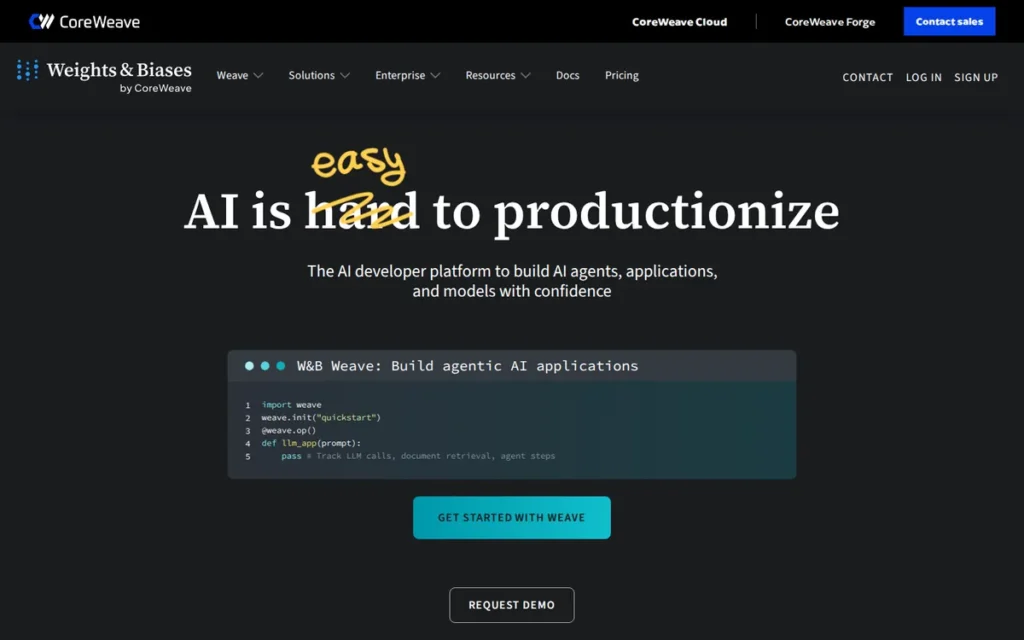
Category: ML-to-LLM Platform Bridge, a unified platform serving both traditional ML experiment tracking (W&B Models) and LLM application observability (W&B Weave), designed for teams that need both workflows under one managed service rather than operating separate ML and LLMOps toolchains.
At a Glance
| Field | Value |
|---|---|
| Category | ML-to-LLM Platform Bridge |
| Best For | ML teams extending W&B experiment tracking to LLM observability; AWS Bedrock-first enterprises |
| Price Range | Free individual tier. Teams: ~$50/user/mo (community-reported). Enterprise: custom with VPC. Verify at wandb.ai/site/pricing |
| Primary Strength | Only reviewed platform combining ML training tracking with LLM observability; native AWS Bedrock AgentCore integration |
| Biggest Limitation | Weave’s steep learning curve for LLM-native developers; can be expensive at production scale |
| One-Line Summary | Weights and Biases provides a unified ML-to-LLM platform combining W&B Models (experiment tracking and artifact lineage for traditional ML training) and W&B Weave (LLM tracing, guardrails, evaluation, and production monitoring) with a native AWS Bedrock AgentCore integration and VPC deployment for enterprise data sovereignty. |
| Last Verified | April 2026 |
Overview
Weights & Biases is a dual-layer MLOps and LLMOps platform designed for teams managing both traditional ML training and LLM application observability under one managed service.
W&B Models provides ML experiment tracking, model registry, and artifact lineage for training workloads. W&B Weave adds LLM call tracing, output evaluation with built-in and custom scorers, cost estimation, a hosted inference playground, and production monitoring with guardrails integration.
Weights and Biases was described by the company as used by “nearly every major foundation model builder, including Meta and OpenAI” for training runs (vendor-cited, W&B site, 2025). Weights and Biases raised a $135M Series C at a $1 billion valuation in October 2021 co-led by Insight Partners and Coatue, followed by a separate $50M strategic investment at a $1.25 billion valuation in August 2023 led by Daniel Gross and Nat Friedman, total verified funding exceeding $318M [W&B blog, October 2021; Texau profile, 2024].
Weights and Biases holds a G2 leadership position in ML Experiment Tracking and is uniquely positioned for AWS Bedrock-first teams through a strategic partnership providing native Weave integration with Amazon Bedrock AgentCore.
Key Features
- W&B Weave Trace and Cost Monitoring: W&B Weave provides hierarchical LLM call tracing with real-time cost and latency highlighting at the trace level (enabling teams to quickly pinpoint when and where a model deviates from expected behavior for rapid remediation and rollback) with side-by-side model comparison in a hosted inference playground [W&B LLM Evaluation Report].
- Native AWS Bedrock AgentCore Integration: Weights and Biases integrates natively with Amazon Bedrock AgentCore through a strategic partnership, embedding Weave tracing, evaluations, and Amazon Bedrock Guardrails for blocking prompt attacks directly within AWS Bedrock infrastructure, making W&B the default observability choice for AWS Bedrock-first teams without requiring a separate vendor relationship [AWS Machine Learning Blog, 2025].
- W&B Models Experiment Tracking: Weights and Biases provides experiment tracking, model registry with artifact lineage, hyperparameter sweep automation, and dataset versioning for traditional ML training workloads, giving teams doing both LLM fine-tuning and LLM application observability a single platform that eliminates split-tooling overhead.
- VPC Deployment for Data Sovereignty: Weights and Biases Enterprise supports VPC deployment, running W&B within the customer’s own cloud perimeter to meet data sovereignty requirements for healthcare, financial services, and government teams, with multi-tenant and single-tenant cloud options also available [AWS Machine Learning Blog, 2025].
- Production Drift Monitors and Guardrails: W&B Weave includes production monitoring capabilities covering:
- Production Monitors for detecting output drift over time
- Custom and third-party scorer integration for flexible evaluation criteria
- Guardrails for prompt injection blocking and output format validation
- Human feedback annotation workflows for hybrid automated and manual evaluation
Best For
Weights and Biases is best for ML engineering teams already using W&B Models for training experiment tracking who want to extend the same platform to LLM application observability without adopting a new vendor. Weights and Biases is also the natural choice for AWS Bedrock-first enterprise teams through the native Bedrock AgentCore partnership. Weights and Biases is not the optimal first choice for teams with no existing W&B investment evaluating pure-play LLMOps observability, those teams will find faster onboarding with Langfuse or Arize AI.
Pricing
Weights and Biases offers a free individual tier, a Teams tier at approximately $50/user/month based on community reports, and an Enterprise tier with custom pricing including VPC deployment, SSO, and dedicated support. Per-user pricing accumulates quickly for larger ML engineering organizations running both Models and Weave simultaneously. VPC deployment carries significantly higher cost than the standard cloud tier. Pricing verified as of April 2026; verify at wandb.ai/site/pricing.
Strengths
- Weights and Biases is described by the company as used by “nearly every major foundation model builder, including Meta and OpenAI” for training experiment tracking and model management (vendor-cited, W&B site, 2025), a cross-layer credibility signal that strengthens enterprise procurement conversations where both ML platform and LLMOps are evaluated jointly by the same engineering leadership.
- Mercari (Japanese e-commerce platform) deployed W&B Weave for LLM evaluation workflows and reported accomplishing evaluation tasks “in a few lines of code” with measurable GenAI iteration cycle improvements, one of the few named enterprise case studies specifically citing Weave LLMOps functionality [W&B Customer Stories, Mercari, 2024].
- A strategic AWS Bedrock partnership integrates Weave tracing, evaluation, and Amazon Bedrock Guardrails natively with Bedrock AgentCore, making W&B the natural LLMOps default for the large and growing segment of enterprise teams building on AWS Bedrock as their primary LLM API platform, without requiring a separate vendor evaluation [AWS Machine Learning Blog, 2025].
- Weights and Biases raised over $318M in total verified funding across its $135M Series C at a $1 billion valuation (October 2021, co-led by Insight Partners and Coatue) and a separate $50M strategic investment at a $1.25 billion valuation (August 2023), providing the financial foundation and enterprise sales infrastructure for long-term platform development [W&B blog, October 2021; Texau profile, 2024].
Limitations
- Steep Learning Curve for LLM-Native Developers: W&B Weave consistently receives “steep learning curve” and “not beginner friendly” assessments from practitioners approaching from a pure LLM application development background: “Weave, Comet, etc. do not seem beginner friendly” [u/ephemeral404, r/LLMDevs] and “Weave is powerful but has a steep learning curve. Would love a middle ground: plug in your model, define a few eval functions, and get JSON logs and visual diffing” [u/Future_AGI, r/LLMDevs].
- LLM-Specific Feature Depth Trade-Offs: W&B Weave’s LLM-specific feature completeness trails purpose-built LLMOps tools (Arize AI offers more granular RAG evaluation metrics, Langfuse provides broader framework integration and MIT licensing, and LangSmith offers more ecosystem-native tracing) meaning W&B’s general ML platform approach creates depth trade-offs in each LLM-specific dimension.
- Pricing at Scale: Community analysis consistently flags W&B as potentially expensive for high-volume production workloads, Teams-tier per-user pricing accumulates quickly for larger ML engineering organizations running both Models and Weave simultaneously, with W&B becoming more costly than purpose-built alternatives at high production workload volumes.
Verdict
Weights and Biases is the strongest reviewed platform for teams that need both traditional ML training experiment tracking and LLM application observability under a single managed service, uniquely positioned to serve organizations where the same engineering team owns both model fine-tuning and production LLM application monitoring. Weights and Biases is not the most accessible entry point for teams new to LLMOps or those coming exclusively from LLM application development; those teams will find faster time-to-value in Langfuse or Arize AI. For AWS Bedrock-first enterprises, the native Bedrock AgentCore integration makes W&B the lowest-friction observability choice without requiring a separate vendor evaluation.
6. Portkey: Best LLM Gateway for Multi-Provider Cost Governance, Routing Control, and Infrastructure-Layer Compliance Enforcement
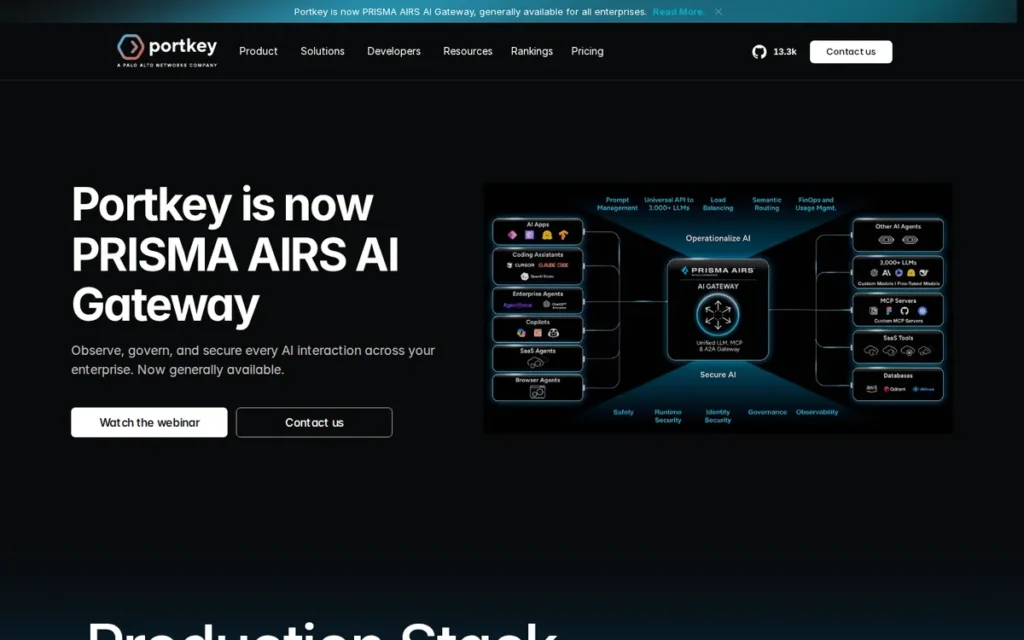
Category: LLM Gateway and Multi-Provider Cost Governance, an infrastructure-layer control plane positioned between applications and LLM providers that enforces routing, fallbacks, semantic caching, guardrails, and credential governance before LLM calls execute rather than observing them after the fact.
At a Glance
| Field | Value |
|---|---|
| Category | LLM Gateway & Cost Governance |
| Best For | Multi-team enterprises using 2+ LLM providers needing centralized routing, cost attribution, and compliance enforcement |
| Price Range | OSS self-hosted gateway: Free. Cloud tiers: usage-based (recorded logs). Enterprise: custom; EU data residency reported at thousands per month; SSO charged separately. Verify at portkey.ai/pricing |
| Primary Strength | Only reviewed platform operating as gateway control plane enforcing routing, caching, 50+ guardrails, and virtual API key governance across 250+ LLM providers without code changes |
| Biggest Limitation | Team size post-Series-A publicly unconfirmed; described as “quite buggy” by a 2025 enterprise evaluator; not a replacement for dedicated observability |
| One-Line Summary | Portkey is an LLM gateway platform for multi-provider AI infrastructure, routing calls across 250-plus LLMs with automatic fallbacks, semantic caching, 50-plus real-time guardrails, and virtual API key governance; backed by SOC2 Type 2, ISO 27001, HIPAA, and GDPR certifications and a $15M Series A raised in February 2026. |
| Last Verified | April 2026 |
Overview
Portkey is a multi-provider LLM gateway and observability platform that operates architecturally as a control plane between applications and all LLM providers (rather than primarily tracing outputs after calls are made) enforcing routing logic, cost controls, reliability rules, and compliance guardrails before LLM calls execute across 250-plus supported providers including OpenAI, Anthropic, Google Gemini, AWS Bedrock, Azure OpenAI, and Mistral.
Portkey was founded in 2023 by Ayush Garg and Rohit Agarwal as part of Y Combinator’s Summer 2023 (S23) batch. Portkey raised a $15M Series A in February 2026 led by Elevation Capital with participation from Lightspeed, with team size publicly unconfirmed post-funding [Portkey blog, February 2026].
Portkey holds SOC2 Type 2, ISO 27001, HIPAA, and GDPR certificationsat the Enterprise tier and provides an open-source gateway (github.com/Portkey-AI/gateway) that processes billions of tokens daily in Portkey’s own production infrastructure [Portkey open-source documentation, 2025].
Key Features
- No-Code-Change Routing and Fallbacks: Portkey’s gateway layer provides automatic fallbacks and retries on provider failures or rate limits, load balancing across multiple API keys and accounts, and canary deployments for safe model rollouts, all configurable without application code changes via JSON routing configs, enabling platform teams to update LLM infrastructure policies centrally across all applications simultaneously [Portkey Features documentation].
- Virtual API Key Governance: Portkey’s virtual API key system enables enterprises to create, rotate, revoke, and monitor usage per virtual key across all LLM providers, providing centralized credential management with per-key spend limits and usage attribution without requiring application teams to handle provider credentials directly [Portkey documentation].
- Semantic Caching: Portkey implements semantic caching to reduce redundant LLM calls and associated costs by storing and reusing semantically similar prompt responses, a cost-reduction mechanism that operates at the gateway layer and applies across all downstream applications without requiring application-level cache integration.
- 50+ AI Guardrails: Portkey provides 50-plus AI Guardrails for real-time output enforcement (including PII sanitization, prompt injection blocking, and output format validation) applied at the gateway layer before LLM responses reach downstream applications. One practitioner described the value: “Moving security and cost controls to the proxy layer rather than instrumenting every individual model call. It cuts the attention cost of managing different SDKs and gives you a single point to enforce PII sanitization before the data hits the provider” [u/pbalIII, r/LangChain].
- Agentic Framework Integration: Portkey integrates natively with agentic frameworks including LangChain, LangGraph, CrewAI, and the OpenAI Agents SDK, enabling gateway-layer routing, guardrails, and cost controls to span complex multi-tool call chains in agentic applications across the full sequence of provider calls.
Best For
Portkey is best for multi-team enterprises using two or more LLM providers simultaneously who need to enforce routing policies, cost controls, and compliance guardrails at the infrastructure layer without requiring each application team to instrument their own cost monitoring or provider failover logic. Portkey is specifically suited to regulated-industry organizations (healthcare, financial services) that need centralized PII sanitization, credential governance, and compliance enforcement before any data reaches a provider API.
Pricing
Portkey uses a usage-based pricing model centered on recorded log volume, with a free tier for the open-source self-hosted gateway at zero licensing cost. Cloud tiers scale by log volume. The Enterprise tier includes SOC2 Type 2, ISO 27001, HIPAA, and GDPR compliance certifications but charges SSO as a separate add-on not included in base enterprise pricing, a decision that received explicit community criticism, acknowledged by a Portkey employee publicly [r/LLMDevs, 2025]. EU data residency managed SaaS has been reported by community evaluators at costs in the thousands of dollars per month, effectively requiring EU-regulated enterprises to self-host the open-source gateway. Verify current pricing at portkey.ai/pricing.
Strengths
- A community member running a product with 4 million monthly active users reported successfully running Portkey in production self-hosted on Cloudflare Workers: “It works great. Self-hosting on Cloudflare Workers. I think you can choose the region”, providing the strongest independently reported production scale validation available for Portkey [u/thomash, r/LLMDevs, 2025].
- Portkey’s open-source gateway processes billions of tokens daily in Portkey’s own production infrastructure, providing independent production-scale validation beyond vendor claims, and available for self-hosting teams to inherit the same battle-tested implementation [Portkey open-source documentation, 2025].
- Portkey holds SOC2 Type 2, ISO 27001, HIPAA, and GDPR certifications at the Enterprise tier and raised a $15M Series A in February 2026 led by Elevation Capital with participation from Lightspeed, demonstrating institutional backing and a deliberate strategy to qualify for regulated enterprise procurement in healthcare, financial services, and government LLM deployments [Portkey blog, February 2026; TruFoundry Blog, 2024].
- Enterprise practitioners independently validate Portkey’s gateway architectural value: “I feel having a single interface (AI gateway) to interact with LLMs is a must… Portkey has a popular AI gateway and observability stack” [u/Hotel_Nice, r/LocalLLaMA, 2024] and “Moving security and cost controls to the proxy layer rather than instrumenting every individual model call… gives you a single point to enforce PII sanitization before the data hits the provider” [u/pbalIII, r/LangChain].
Limitations
- Team Size and Enterprise Support Risk: Portkey’s team size is publicly unconfirmed post-Series-A. A formal enterprise evaluator conducting a competitive evaluation in 2025 (before the February 2026 Series A) described Portkey as “quite buggy” despite acknowledging its strong abstraction value, estimated the company had approximately 20 people, and stated: “likely to migrate away when we can find a serious contender” [u/debauch3ry, r/LLMDevs, 2025]. A team size discrepancy on Portkey’s LinkedIn was subsequently acknowledged and corrected by a Portkey employee in the same thread. Teams should request current headcount, support SLAs, and enterprise customer references as part of due diligence.
- SSO Pricing and EU Data Residency Friction: SSO is charged as a separate add-on at the Enterprise tier, and EU data residency managed SaaS has been reported in the thousands-per-month range, teams with mandatory SSO requirements should negotiate pricing explicitly, and EU-regulated enterprises should plan for self-hosted gateway deployment as the practical path.
- Not a Full Observability Platform: Portkey does not replace production observability depth and should be paired with a dedicated observability platform such as Langfuse or Arize AI for teams needing both gateway control and trace-level debugging, adding integration overhead that the gateway positioning may not make immediately apparent.
Verdict
Portkey is the strongest reviewed platform for the specific use case of multi-provider LLM infrastructure control, enforcing routing, cost governance, semantic caching, and compliance guardrails at the gateway layer where these controls have the broadest coverage and require no per-application instrumentation. Portkey is not a substitute for production observability depth and should be paired with a dedicated observability platform such as Langfuse or Arize AI for teams needing both gateway control and trace-level debugging. Teams should conduct current due diligence on team size, support SLAs, and production stability before committing to a mission-critical enterprise deployment.
7. Comet ML (Opik): Best Open-Source LLM Evaluation Suite for Teams Bridging Traditional ML Tracking and Generative AI Workflows
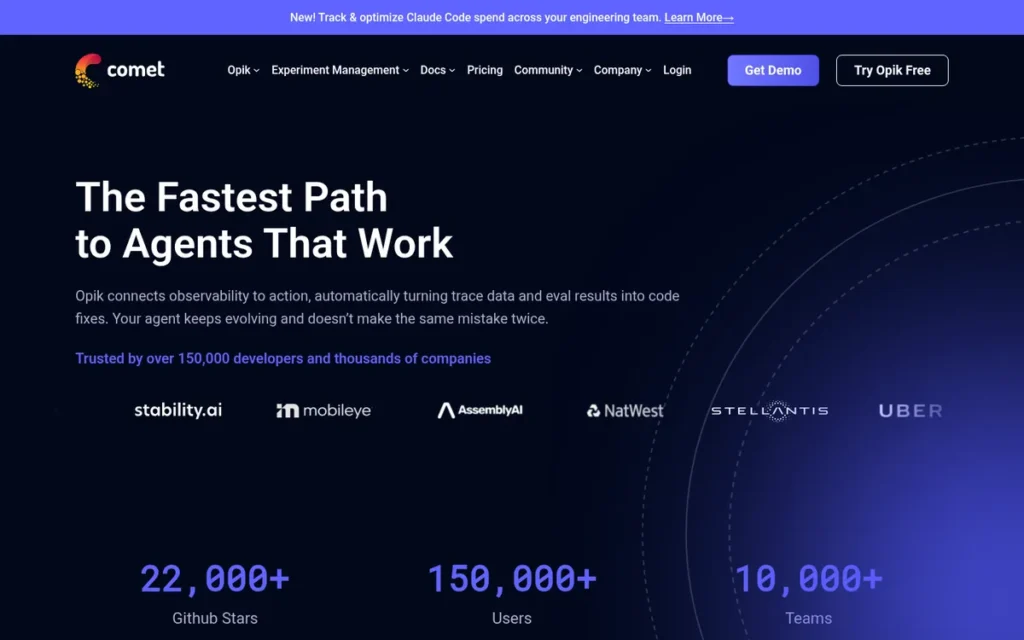
Category: Open-Source LLM Evaluation Suite, an open-source platform (Opik, launched 2024) for LLM evaluation, prompt management, and production tracing, paired with a legacy ML experiment tracking layer (Comet ML, founded 2018) for teams managing both traditional model training and LLM application workflows under one toolchain.
At a Glance
| Field | Value |
|---|---|
| Category | Open-Source LLM Evaluation Suite |
| Best For | ML teams transitioning from traditional training to LLM apps needing unified tracking with DSPy prompt optimization |
| Price Range | Opik self-hosted (OSS): Free. Cloud Free: generous tier. Team/Enterprise: unconfirmed; verify at comet.com/pricing |
| Primary Strength | Only reviewed platform combining legacy ML experiment tracking with DSPy automated prompt optimization and G-Eval custom rubric scoring |
| Biggest Limitation | G2 lists W&B and Databricks as stronger overall alternatives; Opik’s 2024 launch limits production-scale evidence |
| One-Line Summary | Comet ML with Opik is an open-source LLM evaluation and observability platform (Opik launched 2024) that pairs LLM tracing, LLM-as-judge evaluation with G-Eval custom rubrics, RAG evaluation, DSPy automated prompt optimization, and human feedback workflows with Comet ML’s established ML experiment tracking and model registry for teams managing both traditional ML and generative AI workloads. |
| Last Verified | April 2026 |
Overview
Comet ML with Opik is a dual-layer platform combining the Comet ML legacy ML experiment tracking service (founded 2018, supporting Scikit-learn, PyTorch, TensorFlow, and HuggingFace for traditional model training) with Opik, an open-source LLM evaluation platform launched in 2024.
Opik adds LLM call tracing, LLM-as-judge evaluation with G-Eval custom rubrics, RAG evaluation, human feedback annotation, prompt version management, and DSPy-integrated automated prompt optimization to the Comet ML tracking foundation.
Comet ML was founded in 2018 by Gideon Mendels and Nimrod Lahav, giving the platform over six years of ML infrastructure experience. The Opik repository (github.com/comet-ml/opik) is actively maintained with a community engagement pattern where the Opik maintainer directly responds to practitioner questions in public forums with working code examples, a community development approach that builds developer trust for an open-source tool launched in 2024 [u/calebkaiser, r/LLMDevs, April 2026].
Key Features
- G-Eval Custom Rubric Scoring: Comet ML’s Opik provides LLM-as-judge evaluation with G-Eval integration (enabling custom rubric-based scoring for domain-specific quality dimensions including factuality, toxicity, hallucination, and completeness) with the Opik maintainer providing working G-Eval implementation examples directly in developer community forums [u/calebkaiser, r/LLMDevs, April 2026].
- DSPy Automated Prompt Optimization: Comet ML with Opik integrates with DSPy for automated prompt optimization, enabling programmatic prompt engineering workflows that automatically generate and evaluate prompt variants rather than requiring manual iteration, positioning Opik as an evaluation-optimization loop rather than a purely observational monitoring dashboard.
- Unified ML and LLM Tracking: Comet ML’s legacy ML platform supports experiment tracking with artifact versioning and model registry for traditional ML workloads, while Opik adds LLM call tracing, a prompt library with version-controlled prompts, a playground for rapid iteration, and production monitoring dashboards, enabling teams to track both fine-tuning experiments and LLM application production behavior from one platform.
- Open-Source with Active Maintainers: Opik is fully open-source (github.com/comet-ml/opik) with self-hosting support and a generous cloud free tier, maintained by an active team with regular releases driven by direct community feedback, reducing the abandonment risk perception that limits adoption of newer open-source platforms.
- Human Feedback and RAG Evaluation: Comet ML’s Opik includes human feedback collection and annotation workflows alongside automated LLM-as-judge scoring, supporting hybrid evaluation strategies that combine automated quality scoring with targeted human review for specialized domain cases where automated metrics require ground-truth validation.
Best For
Comet ML with Opik is best for ML engineering teams with an existing Comet ML investment for traditional model training who want to extend the same platform to LLM application evaluation and observability. Comet ML with Opik is also suited to teams where automated prompt optimization via DSPy integration and custom G-Eval rubric scoring for domain-specific quality criteria are primary evaluation design requirements.
Pricing
Comet ML’s Opik is fully open-source with self-hosting at zero licensing cost and a generous cloud free tier requiring no credit card. Specific pricing for Team and Enterprise tiers was not publicly confirmed from the comet.com/pricing page during April 2026 research, verify current pricing directly before budget commitment. The self-hosted version carries only infrastructure costs. Note: teams evaluating self-hosted Opik for compliance-sensitive environments should audit the platform’s telemetry configuration before deployment, a community member raised an unresolved concern about whether self-hosted Opik sends trace data to cloud servers [r/LLMDevs, 2025].
Strengths
- Opik maintainer Caleb Kaiser (u/calebkaiser) actively provides working G-Eval implementation code in real-time responses to community evaluation questions on r/LLMDevs (April 2026), demonstrating hands-on community development that directly reduces perceived abandonment risk for teams evaluating open-source LLMOps tools where long-term maintenance commitment is a procurement concern.
- Community practitioners report Comet ML with Opik’s development velocity positively: “Opik everytime for me. They have massively improved it and it was already good” [u/Tumphy, r/LLMDevs, 2025], reflecting active product iteration that increases feature maturity faster than the 2024 launch date alone would suggest.
- DSPy integration in Opik enables programmatic automated prompt optimization: automatically generating and evaluating prompt variants, a capability differentiator compared to Langfuse and LangSmith, which provide prompt versioning but not native automated optimization pipelines [Opik prompt management documentation, 2025].
- Comet ML’s six-plus years of ML experiment tracking experience (founded 2018) provides a more mature technical infrastructure foundation than newer LLMOps-native platforms, with established integrations for PyTorch, TensorFlow, Scikit-learn, and HuggingFace that give existing Comet ML users continuity when extending the same vendor relationship to LLM application observability [Trilogy Equity Blog, 2024].
Limitations
G2 Competitive Positioning: Comet ML trails W&B, Databricks, and Vertex AI in G2’s ML experiment tracking category (where G2 explicitly lists those platforms as stronger overall alternatives) with community reviewers consistently citing W&B’s more user-friendly dashboards and more mature documentation ecosystem as the primary gap [G2 Comet ML competitors page, 2025].
Limited Production Evidence for Opik: Opik launched in 2024, and while Comet ML describes it as among the fastest-growing open-source LLM evaluation tools, this claim is vendor-cited and has not been independently verified as of April 2026, meaning enterprise buyers should treat Opik’s production track record as still accumulating relative to Arize, LangSmith, and Langfuse.
Self-Hosted Telemetry Ambiguity: Some self-hosted Opik deployments have encountered SSL handshake errors when Opik attempts outbound connections to Comet ML servers, raising questions about data isolation for teams with strict air-gap requirements, per r/LLMDevs community reports (2025); Comet ML has not published a formal architectural statement clarifying this behavior as of April 2026.
Verdict
Comet ML (Opik) is the strongest choice for teams that need unified experiment tracking for classical ML plus LLM evaluation in a single platform, particularly where open-source deployment flexibility is a budget or compliance driver. The Opik layer adds genuine LLMOps capability to a mature experiment tracking foundation, though buyers should verify the self-hosted telemetry isolation behavior before committing to air-gapped deployments. Teams that need purpose-built LLM observability with deeper production trace analysis will find Arize or LangSmith more mature options.
What Red Flags Should I Watch For When Evaluating LLMOps Platforms?
The most important red flags in LLMOps platform evaluation are vendor-only benchmark claims, opaque pricing that scales unpredictably with trace volume, and observability tools that cannot integrate with your existing model serving infrastructure. Spotting these early prevents costly migration after deployment.
Red Flag #1: Unverified “Fastest-Growing” or “Most Accurate” Claims Any platform that claims to be the fastest-growing, most accurate, or most comprehensive without citing an independent third-party source is self-reporting a marketing metric. Require a named analyst report, G2 category ranking, or peer-reviewed benchmark before accepting these claims as evaluation inputs.
Red Flag #2: Trace Volume Pricing With No Cap or Estimate Tool Platforms that charge per trace, per span, or per event without providing a usage estimator or a cap tier create significant budget risk for high-throughput production workloads. Request a written cost estimate for your projected monthly trace volume before signing any contract.
Red Flag #3: Evaluation Frameworks That Only Support Their Own LLM-as-Judge Models A platform whose LLM-as-judge evaluation layer only works with proprietary or single-vendor models introduces evaluation lock-in. Confirm whether the platform supports bring-your-own evaluator (custom LLM or human) before committing to its evaluation methodology.
Red Flag #4: No Documented Data Residency or Air-Gap Architecture Platforms that cannot provide written documentation of data residency options, self-hosted telemetry isolation, or SOC 2 Type II compliance are inadequate for regulated industries. Outbound telemetry behavior in self-hosted deployments (as noted in the Comet ML/Opik section above) must be confirmed before deployment.
Red Flag #5: Vendor Lock-In Through Proprietary Trace Formats Some platforms use proprietary trace schemas that are not compatible with OpenTelemetry or other open standards, making future migration expensive. Confirm OpenTelemetry compatibility or export format availability before onboarding production workloads.
Red Flag #6: Community Support as the Only Enterprise SLA Platforms that offer community Slack or GitHub issues as the primary support channel for paid tiers (without a documented response SLA) pose operational risk for production incidents. Verify named support contacts, SLA tiers, and escalation paths in the contract before signing.
What Questions Should I Ask Before Choosing an LLMOps Platform?
Before selecting an LLMOps platform, you should ask questions across six dimensions: infrastructure fit, evaluation depth, pricing predictability, data governance, team maturity, and vendor stability. The answers will surface mismatches that marketing pages do not reveal.
Question #1: Does this platform natively integrate with our model serving infrastructure? Ask the vendor to demonstrate a working integration with your specific serving stack (whether that is vLLM, Ray Serve, SageMaker, or a custom endpoint) before evaluating features. Integration friction discovered post-purchase is the most common cause of LLMOps platform switching.
Question #2: How does the platform handle evaluation for our specific application type? RAG pipelines, agentic chains, and single-turn chat completions each require different evaluation frameworks. Confirm whether the platform provides out-of-box evaluators for your application pattern or requires custom evaluator development, and ask to see example evaluation outputs for your use case.
Question #3: What is our estimated monthly cost at 10×, 100×, and 1,000× our current trace volume? Request a written cost projection at three scale points before signing. Platforms with per-trace pricing can produce order-of-magnitude cost surprises at production scale, and having written estimates creates accountability during contract negotiations.
Question #4: Where is our trace and prompt data stored, and who can access it? Confirm the geographic region of data storage, whether prompt payloads are stored by default, opt-out mechanisms for sensitive data, and whether the vendor’s employees can access your trace data for model training or product improvement.
Question #5: Does the platform support our compliance requirements today, or is that on the roadmap? SOC 2 Type II, HIPAA BAA, GDPR data processing agreements, and FedRAMP authorization are often listed as “planned” rather than current. Verify current certification status (not roadmap commitments) for any regulated deployment.
Question #6: What is the migration path if we need to switch platforms in 18 months? Ask whether the platform exports traces and evaluation results in open formats, whether your prompt templates and evaluation datasets are portable, and whether there are contractual restrictions on data export. Lock-in risk is highest for platforms with proprietary schema formats.
Question #7: Who in the vendor organization is accountable for our account post-sale? Confirm whether you will have a named customer success manager, technical account manager, or dedicated Slack channel with the vendor team. For early-stage vendors, confirm whether the founding team is involved in enterprise onboarding and what happens to support if the company raises a new round and reorganizes.
Question #8: How does the platform’s evaluation framework handle hallucination detection for our domain? Generic LLM-as-judge evaluators trained on broad datasets often perform poorly on domain-specific hallucination detection. Ask whether the platform supports custom rubric definition, domain-specific reference corpora, or human-in-the-loop evaluation calibration for specialized verticals.
How Did We Rank These LLMOps Platforms?
The seven platforms in this comparison were ranked using a structured, multi-source evaluation process designed to produce independent, verifiable rankings that reflect real enterprise buyer priorities. No vendor provided compensation, early access incentives, or sponsored placement in exchange for inclusion or ranking position.
How Was the Evaluation Process Conducted?
Platform selection began with a landscape scan of LLMOps tools actively maintained as of Q1 2026, using G2 category listings, GitHub repository activity (commits, issues, and releases in the prior 12 months), and community mentions across r/MachineLearning, r/LLMDevs, and r/LocalLLaMA. Platforms with fewer than 500 GitHub stars (for open-source tools) or fewer than 50 verifiable G2 reviews were excluded from the ranked list, though they may appear in category context.
Each of the seven ranked platforms was then evaluated across six weighted criteria.
What Criteria Were Used and Why Do They Matter?
LLM Evaluation Depth (25% weight): The sophistication of built-in evaluators: including LLM-as-judge, RAG pipeline evaluation, and custom rubric support, was rated because evaluation quality is the primary driver of production model improvement velocity.
Observability and Tracing (20% weight): Real-time trace capture, span-level debugging, and latency attribution were assessed because production debugging capability directly affects mean time to resolution for LLM quality incidents.
Integration Ecosystem (20% weight): The breadth of native integrations with model serving frameworks, vector databases, orchestration libraries, and CI/CD pipelines was scored because integration friction is the leading cause of LLMOps tool abandonment.
Pricing Transparency and Scalability (15% weight): Publicly documented pricing, the availability of a free or open-source tier, and cost predictability at scale were evaluated because unpredictable pricing at trace volume is a top enterprise complaint, per G2 reviews (2025).
Enterprise Readiness (10% weight): SOC 2 Type II certification status, documented SLA tiers, data residency options, and named support availability were verified because regulated-industry buyers cannot deploy platforms without these features.
Vendor Stability (10% weight): Funding history, customer count, and organizational tenure were assessed using publicly available press releases and SEC filings (not vendor-provided marketing materials) because platform abandonment risk is a real cost for teams that build evaluation pipelines on a given tool.
How Were Conflicting Sources Handled?
Where vendor claims conflicted with G2 reviews, Reddit community reports, or independent analyst commentary, the independent source was weighted more heavily. Vendor-cited statistics are explicitly labeled as such throughout this article. Where no independent verification was available (for example, Opik’s “fastest-growing” claim), the claim is noted but not treated as a ranking input.
How Were Vendor Claims Verified?
Funding figures were verified against primary sources including company press releases, PR Newswire, and Crunchbase as of April 2026. Customer counts were cross-referenced against press releases dated within 12 months of publication. Pricing was verified against vendor pricing pages as of April 2026 and is noted with the verification date in each entry.
How Often Is This Guide Updated?
This comparison is updated quarterly. Platforms are re-evaluated when significant product changes, funding events, or pricing restructuring occur. Readers can submit corrections or flag outdated information via the PlugRoute contact page.
PlugRoute has no affiliate relationships, referral agreements, or sponsored placement arrangements with any platform reviewed in this article. Rankings reflect independent editorial judgment only.
How does PlugRoute determine its rankings?
PlugRoute ranks platforms using a six-criterion weighted scoring framework applied to data from G2, Capterra, verified press releases, and independent community sources. No vendor pays for inclusion or ranking position. Vendor-cited statistics are explicitly labeled throughout every article. The full methodology is detailed in the “How Did We Rank These LLMOps Platforms?” section above.
Is LangSmith better than Langfuse for LLM observability?
LangSmith is the stronger default for teams already using LangChain or LangGraph, offering tighter native integration and more mature agent tracing. Langfuse is the better choice for teams that prioritize open-source deployment, want framework-agnostic instrumentation, or need to avoid per-seat SaaS costs at scale. Both platforms offer free tiers for initial evaluation.
Do I need a separate LLM gateway tool alongside an LLMOps platform?
Most of the seven platforms reviewed here focus on observability and evaluation rather than request routing, cost management, or caching at the API layer. If your team needs multi-provider routing, semantic caching, or spend controls (in addition to trace-level observability) a dedicated gateway tool like Portkey complements rather than replaces an observability-first platform such as Arize or Langfuse.
Glossary: Key Terms Used in This Comparison
LLM-as-Judge Evaluation: A technique in which a large language model, typically a capable frontier model such as GPT-4o or Claude 3.5, scores the outputs of another LLM against a defined rubric or set of criteria. LLM-as-judge evaluation is used to automate quality assessment at scale, replacing or augmenting human raters, and is a core feature of platforms including Arize AI, LangSmith, and Langfuse.
RAG Pipeline Evaluation: The process of assessing the quality of a Retrieval-Augmented Generation system across multiple sub-components (including retrieval relevance, context faithfulness, and answer groundedness) rather than evaluating only the final model output. RAG pipeline evaluation requires specialized frameworks because errors can originate at the retrieval, reranking, or generation stage independently.
LLM Gateway: A proxy layer that sits between an application and one or more LLM provider APIs, handling request routing, rate limiting, cost tracking, semantic caching, and fallback logic across providers. Portkey is the gateway-first platform in this comparison; other platforms reviewed here do not provide gateway functionality as a primary feature.
Semantic Caching: A form of response caching in which a system checks whether an incoming LLM prompt is semantically similar (not just lexically identical) to a previously answered prompt, and returns the cached response if similarity exceeds a defined threshold. Semantic caching reduces API costs and latency for applications with overlapping user queries, and is a primary cost optimization feature in Portkey.
Observability (in LLMOps): The practice of capturing, storing, and analyzing runtime telemetry from LLM-powered applications (including input prompts, output completions, token counts, latency, retrieved documents, and evaluation scores) to enable debugging, quality monitoring, and regression detection in production. LLMOps observability extends classical software observability (metrics, logs, traces) to the probabilistic, multi-step outputs of language models.
Which LLMOps Platform Is Right for You?
The right LLMOps platform depends primarily on your team’s infrastructure footprint, application architecture, and whether you need observability, evaluation, experiment tracking, or request-layer cost controls, because no single platform in this review leads across all four dimensions simultaneously.
Key Insights
- Databricks Mosaic AI is the strongest choice for organizations already on the Databricks Lakehouse that need enterprise-grade governance, unified data and ML pipelines, and a vendor with documented deployment at Fortune 500 scale, but it is not the right tool for lightweight, framework-agnostic LLM tracing.
- Arize AI delivers the deepest purpose-built LLM and ML observability among the seven reviewed platforms, with the most mature production monitoring feature set, making it the top recommendation for teams where model quality degradation in production is the primary business risk.
- Langfuse offers the best combination of open-source flexibility and production-capable cloud hosting for cost-conscious teams that need LangChain-agnostic instrumentation and want to avoid per-seat SaaS pricing at scale.
- LangSmith is the lowest-friction path to production observability for teams building on LangChain or LangGraph, with the strongest native agent tracing, though its integration advantage narrows significantly for teams using other orchestration frameworks.
- Weights & Biases (W&B) remains the most mature experiment tracking platform for teams running iterative model training and fine-tuning alongside LLM development, particularly where training run reproducibility and hyperparameter sweep management are required.
- Portkey is the only gateway-first platform in this review and should be evaluated as a complement to (not a replacement for) an observability platform when multi-provider routing, semantic caching, or API cost controls are a primary requirement.
- Comet ML (Opik) is the right choice for teams that need a single platform spanning classical ML experiment tracking and LLM evaluation, particularly where budget constraints make two separate tools impractical, though buyers should verify Opik’s self-hosted telemetry isolation behavior before air-gapped deployment.
No single platform reviewed here is universally superior. The ranking reflects weighted scoring across the six criteria defined in the methodology section, and buyers in different contexts will reasonably arrive at different rankings based on their infrastructure, compliance requirements, and budget.
PlugRoute publishes independent comparisons across AI infrastructure, developer tools, and enterprise software categories. We update this guide quarterly. Last updated: April 2026.