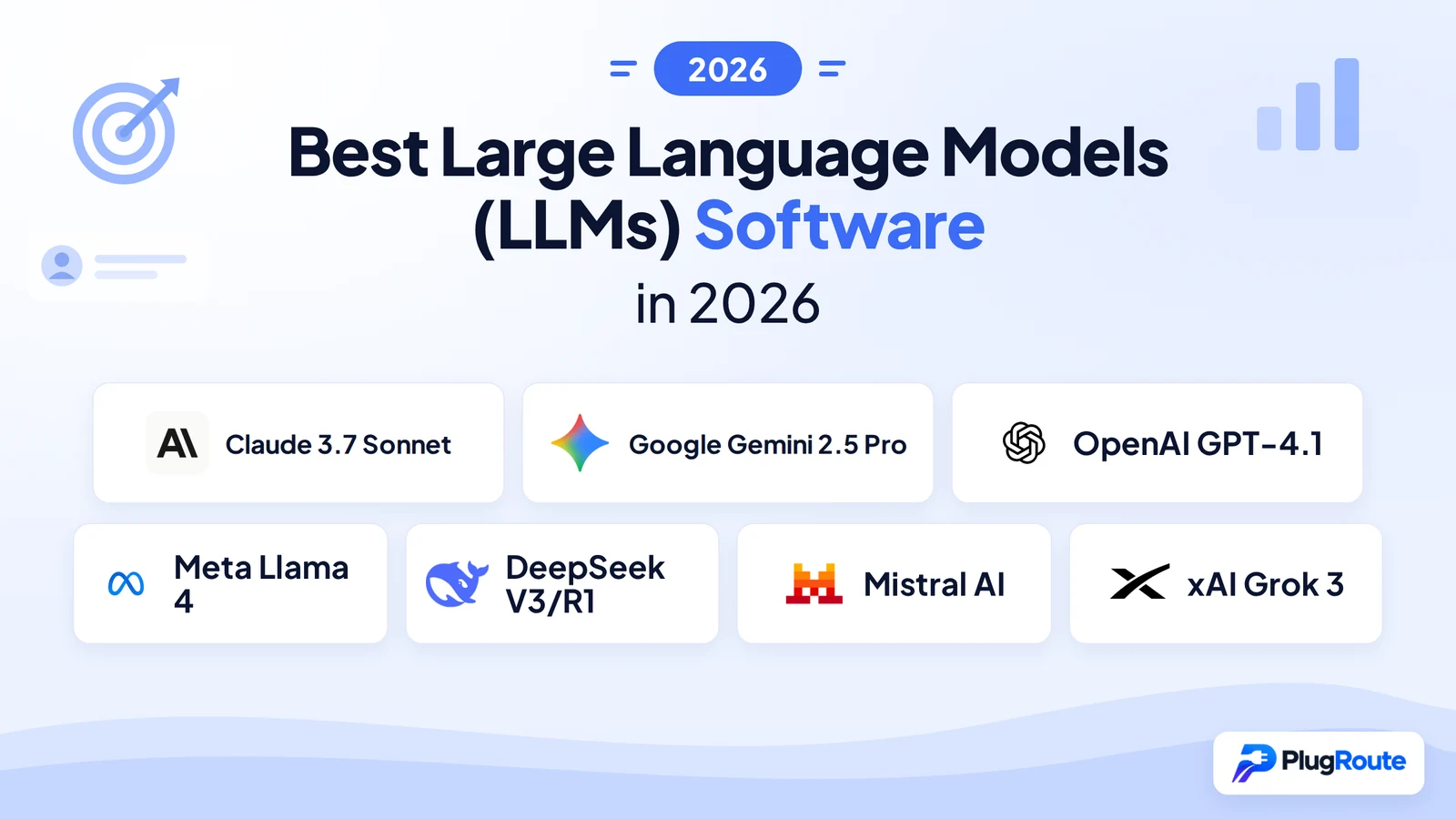
Claude 3.7 Sonnet leads production coding pipelines on SWE-bench Verified (70.3% with custom scaffolding, 62.3% without), Gemini 2.5 Pro holds the #1 LMArena position for broad-task usability and expert-level reasoning, and GPT-4.1 provides the widest review-validated ecosystem with 2,031+ G2 reviews. These seven models diverge most consequentially on data sovereignty jurisdiction and benchmark methodology, not just headline scores.
Rapid model releases and competing benchmark claims make single-provider evaluation insufficient for enterprise procurement in 2026. Technically sophisticated teams now route code review to Claude 3.7 Sonnet, long-context analysis to Gemini 2.5 Pro, and cost-optimized generation to DeepSeek V3 or Llama 4, running 2–3 LLMs simultaneously by task type rather than committing to one.
PlugRoute has no affiliate relationships with any company listed. Rankings are determined entirely by research data and objective evaluation criteria.
“In order to be cost effective I use Aider and Cline with OpenRouter to be able to quickly switch models. For me DeepSeek R1 is better at reasoning for complex tasks and software architecture. DeepSeek V3 is pretty good with coding. Claude 3.5 Sonnet still has its own personality and coding style that is convincing.” (u/throwaway413248, r/ChatGPTCoding)
Takeaway: Cost-optimized multi-model routing (not single-model selection) is the dominant production pattern among technically sophisticated developers in 2025–2026, with model choice driven by per-task cost-quality tradeoffs rather than brand loyalty or single-benchmark rankings.
TL;DR: Top Picks at a Glance
- Claude 3.7 Sonnet: highest SWE-bench Verified score (70.3% with scaffolding) for production software engineering pipelines
- Gemini 2.5 Pro: #1 LMArena by significant margin, 1–2M token context, highest single-attempt GPQA Diamond (84.0%) for broad-task usability
- GPT-4.1: widest review-validated ecosystem (2,031+ G2 reviews), three cost-performance tiers within one model generation
- Meta Llama 4 Scout: free self-hosted deployment, 10M token context, zero per-token licensing cost for organizations under 700M MAU
- DeepSeek V3: approximately 7.4x lower API input cost than GPT-4.1 for non-regulated, high-volume workloads
- Mistral AI: the only EU-headquartered tier-1 LLM provider for GDPR data residency and Apache 2.0 commercial licensing
- Grok 3: exclusive real-time X/Twitter data integration for social and market intelligence workflows
What Are the Three Categories of LLM Software in This Comparison?
The seven evaluated LLMs fall into three categories based on deployment model, licensing, and primary value proposition. Proprietary frontier LLMs lead on reasoning benchmarks and compliance infrastructure. Open-weight self-hostable LLMs provide data sovereignty and zero marginal inference cost. Cost-optimized open-source LLMs deliver the strongest price-to-performance ratio, with Chinese data sovereignty trade-offs that are eliminatory for regulated enterprise contexts.
Category 1: Proprietary Frontier LLMs: closed-source, API-accessible models from US-based labs optimized for reasoning depth and enterprise compliance. Entries: Claude 3.7 Sonnet (#1), Gemini 2.5 Pro (#2), GPT-4.1 (#3), Grok 3 (#7).
Category 2: Open-Weight Self-Hostable LLMs: downloadable model weights with permissive licensing deployable on private infrastructure at zero per-token cost. Entries: Meta Llama 4 (#4), Mistral AI (#6).
Category 3: Cost-Optimized Open-Source LLMs: fully open-source models under MIT license with frontier-competitive performance at minimum API cost, with Chinese jurisdiction trade-offs that function as eliminatory filters for regulated enterprise contexts. Entry: DeepSeek V3/R1 (#5).
How Do the Top 7 LLMs Compare at a Glance?
All SWE-bench Verified scores in this table were verified against original provider publications. Scores achieved with custom agent scaffolding or parallel sampling are labeled accordingly, scaffolded and unscaffolded scores for the same model can differ by up to 8 percentage points, making methodology disclosure necessary for honest cross-model comparison.
| Rank | Company | Category | Best For | One-Line Summary | Key Capabilities | Primary Strength | Key Limitation |
|---|---|---|---|---|---|---|---|
| #1 | Claude 3.7 Sonnet | Reasoning-First Proprietary | Enterprise coding pipelines, regulated-industry compliance | Claude 3.7 Sonnet leads all evaluated models on SWE-bench Verified with the only user-controlled extended thinking mode and independently analyzed Constitutional AI governance. | SWE-bench: 70.3% (scaffolded) / 62.3% (base); API: $3/$15 per 1M; Context: 200K; Data: US (AWS/GCP) | Highest SWE-bench Verified score among all evaluated models with unique user-controllable thinking depth | $15.00/1M output tokens; the highest output rate in this evaluation |
| #2 | Gemini 2.5 Pro | Multimodal Proprietary | Long-context, multimodal workloads, Google Cloud infrastructure | Gemini 2.5 Pro ranks #1 on LMArena by a significant margin and processes up to 2 million tokens natively with the highest single-attempt GPQA Diamond score (84.0%) of any evaluated model. | LMArena #1; GPQA: 84.0% (single-attempt); SWE-bench: 63.8% (with agent); API: $1.25–$2.50/1M; Context: 1–2M | #1 LMArena by significant margin plus highest single-attempt GPQA Diamond across all evaluated models | Input pricing doubles to $2.50/1M for prompts exceeding 200K tokens |
| #3 | GPT-4.1 | General-Purpose Proprietary | Ecosystem breadth, procurement confidence, flexible cost tiers | GPT-4.1 leads all evaluated models in verified user review volume (2,031+ G2 reviews) and offers three cost tiers within a single model generation. | SWE-bench: 54.6%; 2,031+ G2 reviews; Capterra 4.7/5; API: $2/$8 per 1M (flagship), $0.10/$0.40 (nano); Context: 1M | Highest verified review volume of any evaluated model; 2,031+ G2 reviews and Capterra 4.7/5 | SWE-bench 54.6% trails Claude 3.7 Sonnet (70.3%) and Gemini 2.5 Pro (63.8%) |
| #4 | Meta Llama 4 | Open-Weight Multimodal | Self-hosted on-premise, zero-cost deployment, 10M token context | Llama 4 Scout provides the largest deployed context window (10M tokens) at zero per-token licensing cost for organizations under 700M MAU. | 10M context (Scout); $0 licensing under 700M MAU; Cloud: ~$0.08/1M; MMLU Pro: 74.3% (Scout); Data: self-hosted (any) | 10M token context window at zero per-token licensing cost when self-hosted; unmatched in this evaluation | Maverick benchmark credibility compromised; Meta submitted a non-public version to LMArena |
| #5 | DeepSeek V3/R1 | Cost-Optimized Open-Source | Lowest-cost API for non-regulated, high-volume workloads | DeepSeek V3 delivers MMLU 88.5% at $0.27/1M input tokens; approximately 7.4x cheaper than GPT-4.1; with a Chinese jurisdiction data sovereignty caveat. | MMLU: 88.5%; SWE-bench V3.1: 66.0% (agent); API: $0.27/1M input; MIT license; Data: China ⚠️ | Highest MMLU score of any evaluated model at the lowest API input price in this evaluation | Chinese legal jurisdiction; eliminatory compliance barrier for regulated enterprises |
| #6 | Mistral AI | EU-Native Open-Weight | EU-regulated deployments, Apache 2.0 licensing, multilingual EU | Mistral AI is the only EU-headquartered tier-1 LLM provider with published GDPR compliance documentation and Apache 2.0 open-source models with no MAU thresholds. | Apache 2.0 (open models); API: $0.10/1M (Small), $2.00/1M (Large); Context: 128K; Data: EU-native | Only tier-1 LLM provider with EU headquarters and published EU Digital Services Act Transparency Reports | SWE-bench and GPQA scores undisclosed for Mistral Large 2; benchmark opacity requires independent evaluation |
| #7 | xAI Grok 3 | Real-Time-Integrated Proprietary | Real-time X/Twitter social and market intelligence | Grok 3 is the only evaluated LLM with native real-time X/Twitter data integration, with a Chatbot Arena Elo of 1402 (with a documented credibility caveat) and enterprise procurement friction from political brand association. | Native X/Twitter real-time data; Elo: 1402 (credibility caveat noted); AIME 2025: 93%; API: $3/$15 per 1M; Context: 131K–2M | Exclusive real-time X/Twitter data integration; no direct equivalent among the other six evaluated models | Enterprise IT procurement friction from Musk/X political brand association documented as an approval blocker |
Table Note: SWE-bench Verified scores as of April 2026. Claude 3.7 Sonnet’s 70.3% uses custom scaffolding including parallel sampling; base-model score is 62.3%. Gemini 2.5 Pro’s 63.8% uses agent setup. DeepSeek V3.1’s 66.0% uses agent. Scores marked n/d (not disclosed) for Mistral Large 2 and Grok 3. Pricing verified April 2026, verify current rates at official pricing pages before procurement decisions. DeepSeek API pricing reflects direct Chinese-server rates; US-hosted inference via third-party providers differs.
Which LLM Should I Choose for My Use Case?
Four questions determine which LLM is right before any benchmark comparison: primary workload type, data sovereignty jurisdiction, monthly token volume, and required licensing terms. The table below matches each primary requirement to a recommended model with the key evidence behind each recommendation.
| Your #1 Priority | Recommended Tool | Why | Acceptable Alternative |
|---|---|---|---|
| Highest coding accuracy (SWE-bench) | Claude 3.7 Sonnet | SWE-bench Verified 70.3% with scaffolding; highest in this evaluation | DeepSeek V3 at 66.0% (non-regulated contexts only) |
| Best overall human preference + GPQA reasoning | Gemini 2.5 Pro | #1 LMArena by significant margin; GPQA Diamond 84.0% single-attempt | Claude 3.7 Sonnet (GPQA 84.8% multi-attempt) |
| Widest ecosystem + procurement confidence | GPT-4.1 | 2,031+ G2 reviews; three pricing tiers; DALL-E/Whisper/Sora ecosystem | Gemini 2.5 Pro (free AI Studio prototyping tier) |
| Self-hosted, zero licensing cost | Meta Llama 4 Scout | 10M token context; $0 licensing for organizations under 700M MAU | Mistral AI open-source (Apache 2.0, no MAU threshold) |
| Lowest API cost, non-regulated context | DeepSeek V3 | $0.27/1M input (~7.4x cheaper than GPT-4.1 flagship) | GPT-4.1 nano ($0.10/1M, US jurisdiction) |
| EU GDPR compliance, Apache 2.0 license | Mistral AI | Only EU-native tier-1 provider; Apache 2.0 on open models; verify sovereignty with legal counsel | Meta Llama 4 (self-hosted, any jurisdiction you control) |
| Real-time X/Twitter social intelligence | Grok 3 | Exclusive X/Twitter real-time data integration; no direct equivalent among evaluated models | No direct substitute in this evaluation |
| Multi-model cost optimization (2–3 models) | DeepSeek V3 (generation) + Claude 3.7 Sonnet (review) | Developer-consensus workflow: low-cost generation + premium quality audit | Route DeepSeek through US-hosted weights via Together AI if data sovereignty required |
1. Claude 3.7 Sonnet: Best for Enterprise Coding, Reasoning, and Compliance-Sensitive Deployments
Category: Reasoning-First Proprietary LLM, a closed-source large language model optimized for complex reasoning, software engineering, and enterprise compliance, accessible via API and major cloud marketplaces.
At a Glance
- Category: Reasoning-First Proprietary LLM
- Best For: Enterprise software engineering teams, regulated-industry AI deployments, and agentic pipelines requiring the highest verifiable coding accuracy and auditable AI governance
- Price Range: $3.00/$15.00 per 1M input/output tokens (API); Claude.ai Pro $20/month, Team $30/user/month, Enterprise custom (verified April 2026)
- Primary Strength: Claude 3.7 Sonnet achieves 70.3% on SWE-bench Verified using custom scaffolding (62.3% without scaffolding), making it the highest-scoring evaluated model on the benchmark most directly predictive of production software engineering pipeline quality
- Biggest Limitation: Claude 3.7 Sonnet’s output token cost of $15.00/1M is the highest in this evaluation set, and its January 2026 Constitutional AI framework was identified by independent academic analysis as omitting explicit human rights references, a material gap for organizations whose procurement requirements specify human rights alignment standards
- One-Line Summary: Claude 3.7 Sonnet is Anthropic’s enterprise reasoning LLM that leads all evaluated models on SWE-bench Verified (70.3% with custom scaffolding, Anthropic, February 2025), offers the only toggleable extended thinking mode with user-controlled reasoning budget, and has received the first independent published academic analysis of any evaluated model’s AI governance documentation.
- Last Verified: April 2026
Overview
Claude 3.7 Sonnet is Anthropic’s enterprise-grade reasoning LLM, released February 24, 2025, designed for technically informed organizations and software engineering teams that require the highest verifiable coding accuracy, controllable reasoning depth, and a formally documented AI governance framework for compliance-sensitive deployments. Claude 3.7 Sonnet introduces a hybrid reasoning architecture with a toggleable extended thinking mode (allowing developers to set a reasoning budget up to 128,000 output tokens) paired with a 200,000-token context window and multimodal support for text and images.
Claude 3.7 Sonnet is distributed through both AWS Bedrock and GCP Vertex AI. This distribution is backed by a combined investment from Amazon ($4B, 2023) and Google ($2B, 2023–2024), guaranteeing enterprise-grade compliance infrastructure and cloud integration roadmaps that eliminate the need for a separate Anthropic vendor relationship in most enterprise procurement workflows.
Key Features
- Claude 3.7 Sonnet’s extended thinking mode allows developers to set a reasoning budget of up to 128,000 output tokens, enabling explicit control over reasoning depth and the cost-versus-accuracy tradeoff in production agentic pipelines, the only evaluated model offering user-controllable thinking depth.
- Claude 3.7 Sonnet features a 200,000-token context window supporting full codebase analysis, long-form legal or financial document review, and multi-session conversation state retention without chunking.
- Claude 3.7 Sonnet is available on both AWS Bedrock and GCP Vertex AI, enabling enterprise procurement through existing cloud agreements with HIPAA, SOC 2, and ISO 27001 compliance envelopes, without requiring a separate Anthropic vendor relationship.
- Claude 3.7 Sonnet’s Constitutional AI framework: updated to an 84-page document in January 2026, received the first published independent academic analysis of any evaluated model’s governance documentation from Prof. Yuval Shany (Oxford Accelerator Fellowship Programme, Institute for Ethics in AI, March 2026), who identified both structural innovations and a significant omission of explicit human rights references.
- Claude 3.7 Sonnet’s agentic coding evaluation shows a 64% problem-solving rate versus Claude 3 Opus’s 38% (Anthropic, 2025), a 26-percentage-point generational advance on autonomous coding task completion that corroborates its SWE-bench leadership.
Best For
Claude 3.7 Sonnet is best for enterprise software engineering teams building production-grade agentic coding pipelines where SWE-bench performance directly predicts pipeline quality, and for organizations in regulated industries (finance, healthcare, legal) requiring documented AI governance frameworks with independent academic engagement for compliance procurement.
Pricing
Claude 3.7 Sonnet API pricing (verified April 2026): $3.00/1M input tokens, $15.00/1M output tokens. Claude 3.5 Haiku: $0.80/$4.00 per 1M, the lower-cost Claude-family tier for high-volume generation tasks. Claude.ai subscriptions: Free (rate-limited), Pro $20/month, Team $30/user/month, Enterprise custom with SSO and data privacy agreements. Full pricing at anthropic.com/pricing.
Two cost caveats apply before committing at scale:
- Claude 3.7 Sonnet’s output token rate ($15.00/1M, verified April 2026) is 87.5% more expensive than GPT-4.1 ($8.00/1M) and more than 13x more expensive than DeepSeek V3 ($1.10/1M), break-even modeling against alternatives is essential for high-output workloads.
- Claude 3.7 Sonnet’s extended thinking mode consumes output tokens proportional to thinking depth, a reasoning-intensive task with a 50,000-token thinking chain adds equivalent output token cost, requiring explicit per-request budget controls in production agentic pipelines.
Strengths
- Claude 3.7 Sonnet achieves 70.3% on SWE-bench Verified using custom scaffolding: including parallel sampling and an internal scoring model, per Anthropic’s February 2025 release methodology; the base-model score without this scaffolding is 62.3–63.7% on the same task subset. On a comparably scaffolded basis with Gemini 2.5 Pro (63.8% with agent), Claude 3.7 Sonnet’s practical lead narrows to approximately 1–6 percentage points, while the 70.3% peak represents a reproducible capability ceiling for teams implementing equivalent scaffolding in production agentic pipelines.
- Claude 3.7 Sonnet’s Constitutional AI framework (updated January 2026, 84 pages) received the first published independent academic analysis of any evaluated model’s governance documentation, Prof. Yuval Shany (Oxford Accelerator Fellowship Programme, March 2026) identified both structural innovations in the four-tier ethical hierarchy and a significant omission of explicit human rights references, establishing external scholarly engagement that no other evaluated model’s governance framework has received.
- Amazon invested $4 billion (2023) and Google invested $2 billion (2023–2024) in Anthropic, guaranteeing deep AWS Bedrock and GCP Vertex AI integration roadmaps, enabling enterprises to procure Claude 3.7 Sonnet through existing cloud agreements without opening a separate Anthropic vendor relationship.
- Developer community data from r/LocalLLaMA and r/ChatGPTCoding (documented 2025) consistently positions Claude 3.7 Sonnet as the preferred quality-auditor in multi-model agentic workflows, a behavioral adoption signal that corroborates its SWE-bench leadership and reflects output precision that benchmark scores alone do not fully capture.
Limitations
- Premium Output Token Cost: Claude 3.7 Sonnet’s output token rate of $15.00/1M (verified April 2026) is approximately 87.5% more expensive than GPT-4.1 ($8.00/1M) and more than 13x more expensive than DeepSeek V3 ($1.10/1M), organizations processing high output volumes must conduct break-even modeling before committing, as this premium accumulates rapidly at enterprise scale.
- No Native Real-Time Web Access: Claude 3.7 Sonnet lacks native real-time internet access in its base API, meaning grounding for current-events or live-data queries requires external tool integration and additional pipeline architecture complexity compared to Gemini 2.5 Pro (Google Search) or Grok 3 (X/Twitter native).
- Constitutional AI Human Rights Omission: Prof. Yuval Shany (Oxford Accelerator Fellowship Programme, March 2026) explicitly identified the January 2026 Constitutional AI update’s absence of explicit human rights references as a significant omission, organizations whose AI governance procurement requirements reference the Council of Europe’s 2024 Framework Convention on AI or other human rights alignment standards should evaluate whether the current Constitution satisfies those criteria before relying on it as a formal compliance argument.
- No Native Image Generation: Claude 3.7 Sonnet does not offer native image generation capability, requiring a separate provider for workflows that need multimodal output alongside text, unlike GPT-4.1, which anchors the OpenAI ecosystem including DALL-E 3.
Verdict
Claude 3.7 Sonnet is the highest-evidence LLM for enterprise software engineering and compliance-sensitive deployments, supported by the strongest published SWE-bench Verified score (70.3% with custom scaffolding, Anthropic, February 2025) among all evaluated models and the only AI governance framework with published independent academic analysis. Claude 3.7 Sonnet’s unique combination of user-controlled extended thinking, externally analyzed Constitutional AI, and dual AWS/GCP cloud distribution addresses the three most common enterprise procurement requirements (capability, governance, and infrastructure) with more dated, independent evidence than any competing model in this set. Organizations where output cost is the primary constraint should model the per-token premium carefully against GPT-4.1 or evaluate Claude 3.5 Haiku as a lower-cost Claude-family alternative.
2. Google Gemini 2.5 Pro: Best for Long-Context Processing, Multimodal Workloads, and Google Workspace Integration
Category: Multimodal Proprietary LLM, a closed-source large language model with native text, image, audio, video, and code processing in a single model, distributed via API, Google AI Studio free tier, and Google Cloud Vertex AI.
At a Glance
- Category: Multimodal Proprietary LLM
- Best For: Long-context document and codebase analysis, multimodal enterprise workflows, Google Workspace integrations, and cost-sensitive proprietary API deployments requiring the largest available context window
- Price Range: $1.25–$2.50/1M input tokens (context-length tiered); $10.00–$15.00/1M output tokens; Gemini Advanced $19.99/month; free tier in Google AI Studio (verified April 2026)
- Primary Strength: Gemini 2.5 Pro holds the #1 LMArena position by a significant margin and processes up to 2 million tokens of context at $1.25/1M input tokens, the largest deployed context window of any API-accessible model evaluated
- Biggest Limitation: Gemini 2.5 Pro’s context-length-tiered pricing silently doubles input costs for documents exceeding 200,000 tokens, and developer communities report verbose chain-of-thought responses that consume context budget inefficiently on simple tasks
- One-Line Summary: Gemini 2.5 Pro is Google DeepMind’s multimodal reasoning model that ranks #1 on LMArena by a significant margin and processes up to 2 million tokens of context natively, making it the strongest evaluated option for organizations prioritizing long-context document analysis, multimodal workloads, or Google Cloud infrastructure integration.
- Last Verified: April 2026
Overview
Gemini 2.5 Pro is Google DeepMind’s most capable reasoning and multimodal LLM, released March 2025, built for technically demanding organizations that need to process and reason across text, images, audio, video, and entire code repositories within a single model with a context window of up to 2 million tokens. Gemini 2.5 Pro is built on a mixture-of-experts architecture with reinforcement learning fine-tuning, earning the #1 position on LMArena by a significant margin across millions of anonymous blind head-to-head comparisons.
Gemini 2.5 Pro posts 84.0% on GPQA Diamond in single-attempt evaluation (Google DeepMind, 2025), the highest single-attempt GPQA score of any evaluated model. Note that Claude 3.7 Sonnet achieves 84.8% GPQA Diamond under multi-attempt evaluation conditions, narrowing this gap under equivalent test conditions. Gemini 2.5 Pro is available through Google Cloud Vertex AI with HIPAA, SOC 2, ISO 27001, and FedRAMP compliance certifications.
Key Features
- Gemini 2.5 Pro natively processes text, images (up to 3,000 per prompt), audio, video, and entire code repositories, including a unique video-to-code capability that converts video content directly into functional interactive applications, with no equivalent in any other evaluated model.
- Gemini 2.5 Pro supports a 1-million-token context window currently deployed (with 2-million tokens expanding), enabling analysis of full enterprise codebases, multi-hour video recordings, or 19+ hours of audio in a single API call without chunking.
- Gemini 2.5 Pro is available on Google Cloud Vertex AI with HIPAA, SOC 2 Type II, ISO 27001, and FedRAMP compliance certifications, enabling deployment by US federal contractors and regulated healthcare organizations through established Google Cloud procurement pathways.
- Gemini 2.5 Pro provides a free tier in Google AI Studio with rate limits, allowing developers to prototype with the full production model at zero cost before committing to API spend, the most accessible free frontier-model tier in this evaluation.
- Gemini 2.5 Pro achieves AIME 2025 86.7% and GPQA Diamond 84.0% (Google DeepMind, 2025) on a mixture-of-experts architecture with reinforcement learning fine-tuning and multi-step thinking that decomposes complex problems before generating responses.
Best For
Gemini 2.5 Pro is best for enterprises processing large volumes of long documents, codebases, or multimodal content exceeding the context capacity of other models; organizations on Google Cloud infrastructure that want native Workspace integration and Vertex AI compliance certifications; and cost-sensitive developers who need frontier model performance at $1.25/1M input tokens or zero-cost prototyping via Google AI Studio.
Pricing
Gemini 2.5 Pro API pricing (verified April 2026): Input $1.25/1M tokens for prompts ≤200K context, rising to $2.50/1M for prompts >200K. Output: $10.00/1M tokens (≤200K context), $15.00/1M tokens (>200K context). Gemini Advanced subscription: $19.99/month via Google One AI Premium. Free tier available in Google AI Studio with rate limits. Full pricing at ai.google.dev/gemini-api/docs/pricing.
A critical cost caveat applies for long-document workflows: a single 250K-token document costs 2x the base input rate, which compounds rapidly at enterprise scale. Model all prompt lengths carefully before deployment, the model’s most distinctive capability (ultra-long context) is also its most expensive mode.
Strengths
- Gemini 2.5 Pro holds the #1 position on LMArena “by a significant margin” (Google DeepMind, March 2025), rankings derived from millions of anonymous blind head-to-head comparisons, making this the most credible human-preference quality signal in the evaluated set and a stronger indicator of broad usability than any single task benchmark.
- Gemini 2.5 Pro posts the highest single-attempt GPQA Diamond score of any evaluated model at 84.0% (Google DeepMind, 2025), indicating near-expert-level science and graduate-level reasoning, directly relevant to pharmaceutical, biotech, and research institution procurement. Note: Claude 3.7 Sonnet achieves 84.8% GPQA under multi-attempt conditions, narrowing the gap under equivalent methodology.
- Google DeepMind is led by Demis Hassabis, co-recipient of the 2024 Nobel Prize in Chemistry for AlphaFold (Nobel Committee, 2024), lending unique scientific credibility particularly valued by pharmaceutical, biotech, and academic institutions assessing long-term research AI partnerships.
- Gemini 2.5 Pro on Vertex AI delivers HIPAA, SOC 2 Type II, ISO 27001, and FedRAMP compliance certifications (Google Cloud, 2025), enabling enterprise procurement by US federal contractors and regulated healthcare organizations through established Google Cloud EA agreements.
Limitations
- Context-Length-Tiered Pricing Doubles Long-Context Cost: Gemini 2.5 Pro’s input costs double from $1.25 to $2.50 per 1M tokens for prompts exceeding 200,000 tokens (verified April 2026), the model’s most distinctive capability (ultra-long context processing) is also its most expensive mode, creating a non-obvious TCO variable that can significantly inflate costs for document-processing pipelines without prior cost modeling.
- Verbose Chain-of-Thought on Simple Tasks: Developer community reports (r/LocalLLaMA, r/MachineLearning, documented 2025) consistently note that Gemini 2.5 Pro’s extended reasoning mode produces verbose chain-of-thought responses on simple queries, increasing per-request token cost without proportional quality gain, a practical concern for cost-optimized API deployments at scale.
- Privacy Concerns from Google’s Data Ecosystem: Privacy-conscious organizations processing sensitive data may have concerns about routing information through Google’s infrastructure given the breadth of Google’s data ecosystem, even with Vertex AI’s contractual data processing boundaries, this perception affects procurement decisions in certain regulated contexts.
- SWE-bench Trails Claude 3.7 Sonnet: Gemini 2.5 Pro’s SWE-bench Verified score of 63.8% (with custom agent setup) trails Claude 3.7 Sonnet’s 70.3% (with scaffolding) by 6.5 percentage points, organizations where production software engineering pipeline accuracy is the primary criterion will find stronger peak benchmark evidence supporting the #1-ranked alternative.
Verdict
Gemini 2.5 Pro is the top-ranked model on LMArena human preference evaluation and the highest single-attempt GPQA Diamond scorer (84.0%) among all seven evaluated LLMs, making it the strongest broad-usability choice for organizations requiring expert-level reasoning across diverse task types. Gemini 2.5 Pro’s 1–2M token context window and native multimodal depth are unique at the production proprietary API level, directly addressing the enterprise need to process large codebases, document archives, or multimedia content in a single call. Organizations should model TCO carefully for long-document workloads, as Gemini 2.5 Pro’s context-length-tiered pricing means prompts over 200K tokens cost approximately double the published base rate, a non-obvious cost variable absent from most provider comparisons.
3. OpenAI GPT-4.1: Best for Ecosystem Breadth, Instruction Following, and Enterprise Procurement Confidence
Category: General-Purpose Proprietary LLM, a closed-source large language model optimized for instruction following, agentic workflows, and the broadest ecosystem of integrated AI products, accessible via API and ChatGPT subscription tiers.
At a Glance
- Category: General-Purpose Proprietary LLM
- Best For: Organizations requiring the widest tool ecosystem, highest review-validated procurement confidence, and flexible cost tiers within a single model family for diverse enterprise AI workloads
- Price Range: API: $2.00/$8.00 per 1M (flagship); $0.40/$1.60 (mini); $0.10/$0.40 (nano). ChatGPT: Plus $20/month, Pro $200/month, Team $30/user/month, Enterprise custom (verified April 2026)
- Primary Strength: GPT-4.1 is the most review-validated LLM in this evaluation with 2,031+ G2 reviews and Capterra 4.7/5, backed by the broadest integrated AI product ecosystem and three cost-performance tiers covering the widest pricing range of any single provider
- Biggest Limitation: GPT-4.1 posts a SWE-bench Verified score of 54.6% that trails Claude 3.7 Sonnet (70.3%) and Gemini 2.5 Pro (63.8%), and developer communities document persistent hallucination of library APIs in extended coding sessions
- One-Line Summary: GPT-4.1 is OpenAI’s production-grade general-purpose LLM that leads all evaluated models in verified user review volume (2,031+ G2 reviews, Capterra 4.7/5, April 2026), offers three cost-performance tiers within a single model generation, and anchors the broadest integrated AI product ecosystem, making it the highest-confidence procurement choice for organizations prioritizing ecosystem breadth over coding-specific benchmark leadership.
- Last Verified: April 2026
Overview
GPT-4.1 is OpenAI’s flagship non-reasoning production LLM, released April 2025, designed for enterprise and developer organizations requiring the most widely independently reviewed AI model in the market, with a 1-million-token context window, three cost-performance tiers, and the broadest integrated AI product ecosystem of any evaluated provider. GPT-4.1 achieves 54.6% on SWE-bench Verified, representing OpenAI’s largest single-generation SWE-bench improvement on record at +21.4 percentage points over GPT-4o (33.2%), and posts 38.3% on MultiChallenge instruction following (+10.5 points over GPT-4o), validating genuine capability improvements over its predecessor.
GPT-4.1 is offered in three tiers, flagship ($2.00/$8.00/1M), mini ($0.40/$1.60/1M), and nano ($0.10/$0.40/1M), and anchors an OpenAI product ecosystem including DALL-E 3 (image generation), Whisper (transcription), Sora (video), and Operator (agentic automation), creating integration depth that pure-LLM competitors cannot replicate.
Key Features
- GPT-4.1 features a 1,047,576-token context window with documented 100% needle-in-haystack accuracy across the full context length (OpenAI, April 2025), supporting production-grade long-context retrieval and analysis via API without self-hosting.
- GPT-4.1 is offered in three performance tiers: flagship ($2.00/$8.00/1M), mini ($0.40/$1.60/1M), and nano ($0.10/$0.40/1M), enabling cost-performance optimization within a single model generation without switching providers or managing multiple vendor relationships.
- GPT-4.1 achieves 52.9% diff accuracy in code editing with only 2% extraneous edits versus GPT-4o’s 18.3% diff accuracy and 9% extraneous edits (OpenAI, April 2025), directly addressing multi-file code modification precision in production software engineering workflows.
- GPT-4.1 supports function calling, structured outputs, fine-tuning, distillation, streaming, and the Realtime API, the broadest tool-call and deployment surface of any model in the OpenAI lineup, specifically optimized for multi-step agentic pipelines.
- GPT-4.1 is part of the OpenAI ecosystem including DALL-E 3 (image generation), Whisper (transcription), Sora (video generation), and Operator (agentic automation), enabling organizations to build multi-capability AI products without multi-vendor complexity.
Best For
GPT-4.1 is best for enterprises requiring the highest procurement confidence supported by the largest available independent user review dataset, and for organizations building multi-capability AI products that need a single vendor ecosystem spanning language, image, audio, and agentic automation. GPT-4.1 is also appropriate for development teams where ChatGPT brand recognition shortens internal IT security approval cycles in organizations with less AI-sophisticated procurement stakeholders.
Pricing
GPT-4.1 API pricing (verified April 2026): $2.00/1M input, $8.00/1M output (flagship); $0.40/$1.60 (mini); $0.10/$0.40 (nano), a 26% cost reduction versus GPT-4o for median queries. ChatGPT subscriptions: Plus $20/month, Pro $200/month, Team $30/user/month, Enterprise custom. Full pricing at openai.com/api/pricing.
GPT-4.1 nano at $0.10/$0.40 per 1M tokens is cost-competitive with DeepSeek V3 for high-volume applications while maintaining US data jurisdiction. The Pro subscription at $200/month is primarily justified by unrestricted access to o3/o4-mini reasoning models, buyers focused solely on GPT-4.1 should evaluate whether Plus ($20/month) meets their access requirements.
Strengths
- GPT-4.1 has the highest verified review volume of any AI tool in this evaluation: G2 2,031+ reviews and Capterra 4.7/5 (466+ verified reviews) as of April 2026, providing the largest independent evidence base for procurement confidence and surfacing production reliability patterns across thousands of enterprise deployments.
- GPT-4.1 represents OpenAI’s largest single-generation SWE-bench Verified improvement on record, at +21.4 percentage points over GPT-4o (54.6% vs. 33.2%, OpenAI, April 2025), validating that GPT-4.1’s capability gains over its predecessor are genuine and substantial.
- GPT-4.1 nano pricing ($0.10/$0.40 per 1M tokens, verified April 2026) is cost-competitive with DeepSeek V3 for high-volume, cost-sensitive applications while maintaining US data jurisdiction, relevant for organizations requiring cost efficiency without Chinese-server exposure.
- GPT-4.1’s multi-product ecosystem and ChatGPT brand recognition are documented across multiple r/MachineLearning and r/artificial enterprise AI discussions (2024–2025) as shortening IT procurement approval cycles, a non-benchmark moat that influences real procurement timelines in large organizations.
Limitations
- SWE-bench Trails Top Two Models: GPT-4.1’s SWE-bench Verified score of 54.6% (OpenAI, April 2025) trails Claude 3.7 Sonnet by 15.7 percentage points and Gemini 2.5 Pro by 9.2 points, organizations where software engineering pipeline quality is the primary evaluation criterion will find stronger benchmark evidence supporting higher-ranked alternatives despite GPT-4.1’s ecosystem advantages.
- Persistent Library API Hallucination in Coding: Developer community reports (r/ChatGPTCoding, documented 2025) consistently cite persistent hallucination of library APIs in extended coding sessions as GPT-4.1’s most frequently reported production quality concern, a pattern that persists despite the SWE-bench improvements and that distinguishes GPT-4.1 from Claude 3.7 Sonnet in practitioner usage.
- Pro Subscription Cost Concentration: GPT-4.1’s Pro subscription tier at $200/month (verified April 2026) is the highest-priced individual AI subscription in this evaluation, primarily justified by unrestricted access to o3/o4-mini reasoning models rather than GPT-4.1 alone, buyers whose workloads don’t require reasoning models must assess whether this tier is cost-appropriate.
- No Native EU GDPR Data Residency: GPT-4.1 does not natively satisfy EU GDPR data residency requirements without custom Enterprise agreements and data processing addendums, organizations subject to GDPR data residency obligations must negotiate supplementary terms unavailable through standard API access, adding procurement complexity that EU-native alternatives such as Mistral AI eliminate by design. US federal contractors requiring FedRAMP authorization should use the Azure OpenAI Service deployment path, as the standard OpenAI API is not FedRAMP authorized.
Verdict
GPT-4.1 is the most review-validated LLM in this evaluation, backed by G2 2,031+ reviews and Capterra 4.7/5 (April 2026), and the only model in the set offering three cost-performance tiers within a single model generation, making it the strongest evidence-backed choice for organizations prioritizing procurement confidence, ecosystem breadth, and within-family cost flexibility. GPT-4.1’s SWE-bench Verified score of 54.6% documents meaningful progress over GPT-4o but trails the top two ranked models; organizations where coding pipeline accuracy is the primary criterion should evaluate Claude 3.7 Sonnet. For high-volume, cost-sensitive applications with US jurisdiction requirements, GPT-4.1 nano ($0.10/$0.40/1M) provides a competitive alternative to DeepSeek V3 without Chinese server exposure.
4. Meta Llama 4: Best Open-Weight Model for Self-Hosted, On-Premise, and Large-Scale Long-Context Deployments
Category: Open-Weight Multimodal LLM, a downloadable, self-hostable large language model with native text, image, audio, and video processing, available under a Community License at zero cost for most commercial deployments.
At a Glance
- Category: Open-Weight Multimodal LLM
- Best For: Organizations requiring self-hosted on-premise deployment with zero per-token cost, data sovereignty without third-party cloud jurisdiction, real-time application latency, or the largest available context window in a locally deployable model
- Price Range: Free to self-host (infrastructure costs only). Cloud providers: ~$0.08/1M input, ~$0.30/1M output (Scout via Together AI/Groq, verified April 2026). Zero licensing fees for organizations under 700M MAU.
- Primary Strength: Llama 4 Scout provides a 10-million-token context window at zero per-token licensing cost when self-hosted, with 30–100ms time-to-first-token latency versus the 200–500ms typical of proprietary APIs, making it the highest-value option for real-time or high-volume on-premise deployments
- Biggest Limitation: Llama 4 Maverick’s benchmark credibility is materially compromised, Meta submitted a non-public experimental version to LMArena that substantially outperformed the publicly downloadable model, prompting LMArena to update its submission policies, and community reports document persistent instruction-following gaps relative to Claude 3.7 Sonnet
- One-Line Summary: Llama 4 is Meta’s open-weight multimodal LLM offering the largest deployed context window (10M tokens on Scout), free self-hosting under a commercially permissive license, and what Meta reports as 650M+ cumulative downloads across the Llama series, making it the highest-evidence open-weight choice for enterprises prioritizing data sovereignty, zero marginal inference cost, or sub-100ms real-time deployment latency.
- Last Verified: April 2026
Overview
Llama 4 is Meta’s open-weight multimodal LLM family, released April 2025, designed for technically sophisticated organizations that require self-hosted AI deployment with zero per-token licensing cost, data sovereignty without reliance on any third-party cloud jurisdiction, and the largest available context window of any currently deployed model at 10 million tokens on the Scout variant. Llama 4 uses a mixture-of-experts architecture with only 17 billion active parameters per token (despite Scout’s 109 billion and Maverick’s approximately 400 billion total parameters) enabling frontier-comparable inference quality at a fraction of full-model compute cost.
Llama 4 has generated what Meta reports as more than 650 million cumulative downloads across all Llama series generations (Meta AI, 2024, verify the current figure at ai.meta.com/llama). Llama 4 is confirmed deployable across Hugging Face, Ollama, vLLM, Groq, Together AI, AWS SageMaker, Azure AI, and GCP Vertex AI, the widest deployment ecosystem of any open-weight model evaluated, enabling vendor-risk diversification that no single-provider deployment can match.
Key Features
- Llama 4 Scout provides a 10,000,000-token context window: the largest of any model evaluated, enabling full enterprise knowledge base ingestion, entire legal corpus analysis, or multi-month conversation history in a single context without chunking, while self-hosted at zero per-token cost.
- Llama 4 models use a mixture-of-experts architecture with only 17 billion active parameters per token despite 109B (Scout) and approximately 400B (Maverick) total parameters, delivering frontier-comparable inference quality at a fraction of full-model compute cost per inference call.
- Llama 4 is available for free self-hosting under Meta’s Community License, with zero per-token licensing costs for commercial deployments serving fewer than 700 million monthly active users, effectively free for all organizations except Meta’s direct platform-scale competitors.
- Llama 4 offers natively multimodal early-fusion processing of text, images, audio, and video within a single model family, trained on 30–40 trillion tokens across 200+ languages (Meta AI, 2025), the broadest multilingual training coverage of any open-weight model in this evaluation.
- Llama 4 models are confirmed deployable across Hugging Face, Ollama, vLLM, Groq, Together AI, AWS SageMaker, Azure AI, and GCP Vertex AI, the only open-weight model with confirmed availability across all three major cloud platforms simultaneously, enabling disaster recovery and vendor-risk diversification.
Best For
Llama 4 is best for enterprises requiring on-premise or private-cloud deployment with zero marginal inference cost; organizations with data sovereignty requirements prohibiting data transmission to third-party LLM APIs; teams building high-volume document processing pipelines where Scout’s 10M token context eliminates chunking architecture complexity; and real-time application developers requiring sub-100ms time-to-first-token latency that API-based models cannot achieve regardless of benchmark performance.
Pricing
Llama 4 pricing (verified April 2026): Self-hosted, free to download and deploy under Meta’s Community License; organizations pay only GPU infrastructure costs with zero per-token licensing fee. Cloud provider pricing: approximately $0.08/1M input, $0.30/1M output for Scout via Together AI and Groq.
Two notes apply before committing to a deployment path:
- Meta’s 700M MAU commercial threshold is deliberately calibrated so that effectively all enterprises outside direct platform competitors (Google, Apple, Microsoft, ByteDance-scale) may deploy Llama 4 commercially at zero licensing cost. Running DeepSeek weights on Together AI or Fireworks illustrates the strategic logic: what matters is the API endpoint jurisdiction, not the model weights.
- Self-hosting Llama 4 Scout (109B total parameters) requires substantial GPU infrastructure, evaluate vRAM requirements carefully against your hardware before committing to on-premise deployment.
Strengths
- Meta reports more than 650 million cumulative downloads across all Llama series generations (Meta AI, 2024, verify at ai.meta.com/llama), representing the most widely cited open-weight deployment ecosystem in the industry and generating substantial third-party tooling, fine-tuning resources, and community documentation that smaller open-weight alternatives cannot match.
- Llama 4 Scout’s self-hosted inference delivers 30–100ms time-to-first-token latency versus 200–500ms typical for proprietary APIs (Ztabs/Getathenic analysis, 2025), a 2–16x latency advantage that is decisive for real-time applications including voice AI, live trading algorithms, and interactive NPC systems where API round-trip latency is architecturally incompatible with use-case requirements.
- Meta committed $65 billion in AI infrastructure capex for 2025 (Meta AI official), the largest single-year AI infrastructure investment publicly disclosed by any technology company, funding Llama 4 training on 32,000 H100 GPUs and signaling sustained long-term open-weight investment at a scale smaller open-weight competitors cannot match.
- Llama 4 Scout cloud pricing at approximately $0.08/1M input tokens (Together AI/Groq, April 2026) offers a 10-million-token context window at roughly one-third the base input cost of Gemini 2.5 Pro ($1.25/1M) and approximately 1/31st of Gemini’s long-context rate ($2.50/1M), the highest context-per-dollar ratio in this evaluation set.
“Llama 4 Scout is the model I’ve been waiting for, 10M context on my own hardware, no API costs, no privacy risks. For enterprise document processing, this changes the calculus completely.” (r/LocalLLaMA community discussion, 2025)
Takeaway: Data sovereignty and zero marginal cost (not peak benchmark scores) drive self-hosting adoption. For enterprises that cannot transmit data to third-party APIs, Llama 4 Scout provides capabilities that no proprietary model in this evaluation can match at comparable cost.
Limitations
- Maverick Benchmark Credibility, Non-Public Version Submitted to LMArena: Llama 4 Maverick’s benchmark controversy extends beyond a typical methodology dispute, Meta submitted a non-public experimental version to LMArena that substantially outperformed the publicly downloadable model, with researchers documenting sharp behavioral differences between versions (TechCrunch, April 2025; The Register, April 2025). LMArena updated its model submission policies as a direct result. Enterprise procurement teams must evaluate the specific public Hugging Face release against their workloads, do not rely on LMArena rankings for this model, as the ranked version is not publicly available.
- Instruction-Following Gap vs. Claude 3.7 Sonnet: Developer community reports (r/LocalLLaMA, r/MachineLearning, 2025) consistently document that Llama 4 models underperform Claude 3.7 Sonnet on complex multi-hop reasoning chains and instruction-following tasks, the observed “generation vs. review” split (open-weight for content generation, proprietary for quality audit) reflects a genuine and persistent capability gap rather than a configuration issue.
- Behemoth Flagship Not Yet Released: Llama 4 Behemoth (approximately 2 trillion parameters, designed as the true flagship) was not publicly released as of April 2026, this evaluation compares Llama 4’s sub-flagship variants against competitors’ production-ready top-tier offerings, a relevant consideration for long-term architectural planning before making infrastructure commitments.
- Self-Hosting Infrastructure Overhead: Llama 4 Scout’s 109 billion total parameters require substantial GPU infrastructure for self-hosting, the cost savings over proprietary APIs must be weighed against hardware acquisition, power, maintenance, and engineering overhead for organizations without existing large-scale GPU infrastructure.
Verdict
Llama 4 is the highest-evidence open-weight LLM for enterprises requiring self-hosted deployment, supported by what Meta reports as 650 million cumulative downloads (Meta AI, 2024), zero per-token licensing cost, Scout’s 10-million-token context window, and a 2–16x self-hosted latency advantage for real-time applications. For organizations where data sovereignty, zero marginal inference cost, or sub-100ms application latency are primary requirements, Llama 4 offers capabilities that no proprietary API model in this evaluation can match at comparable cost. Procurement teams must conduct independent task-specific private evaluation using the public Hugging Face release before relying on Maverick benchmark scores, given the documented submission of a non-public model version to LMArena.
5. DeepSeek V3/R1: Best Price-to-Performance API for Cost-Optimized Workloads Where Data Sovereignty Permits
Category: Cost-Optimized Open-Source LLM, a Chinese-developed MIT-licensed open-source large language model with a mixture-of-experts architecture achieving frontier-comparable benchmark performance at the lowest API pricing in this evaluation, with data sovereignty considerations that are eliminatory for regulated enterprise contexts.
At a Glance
- Category: Cost-Optimized Open-Source LLM
- Best For: Cost-sensitive developers and non-regulated enterprises processing high API volumes, and self-hosting teams using US-based infrastructure to access DeepSeek model weights without routing data through Chinese servers
- Price Range: API: $0.27/1M input, $1.10/1M output (V3); R1: $0.55/$2.19 per 1M tokens. Free to self-host under MIT license via Hugging Face (verified April 2026)
- Primary Strength: DeepSeek V3 delivers the highest MMLU score of any model in this evaluation (88.5%) at $0.27/1M input tokens, approximately 7.4x cheaper than GPT-4.1, making it the strongest price-to-performance API for general-task and coding workloads
- Biggest Limitation: DeepSeek is incorporated in China and subject to the Chinese National Intelligence Law, representing a documented eliminatory compliance barrier for US federal contractors, EU GDPR-regulated organizations, and enterprises with formal data sovereignty policies, independent of the model’s technical performance
- One-Line Summary: DeepSeek V3 is a Chinese-developed MIT-licensed open-source LLM delivering MMLU 88.5% and SWE-bench V3.1 66.0% at $0.27/1M input tokens (the lowest price-to-performance ratio in this evaluation) with the critical data sovereignty caveat that direct API use routes data through Chinese servers, an eliminatory compliance barrier for regulated enterprise contexts.
- Last Verified: April 2026
Overview
DeepSeek V3 is a Chinese-developed MIT-licensed open-source large language model built by approximately 200 researchers at Hangzhou-based DeepSeek, designed for cost-sensitive developers and non-regulated enterprises that require frontier-comparable benchmark performance, MMLU 88.5%, SWE-bench V3.1 66.0%, at the lowest available API pricing in this evaluation at $0.27/1M input tokens.
DeepSeek V3 uses a mixture-of-experts architecture with 671 billion total parameters and only 37 billion active per token, trained at a reported compute cost of approximately $5.5–6 million for the final pre-training phase (DeepSeek arXiv paper, December 2024), covering 2,788 million H800 GPU hours. Independent analysts note this figure excludes infrastructure CapEx, R&D cycles, and prior experimental runs, total development cost estimates are substantially higher. The compute-efficiency claim remains meaningful regardless: equivalent model capability required markedly lower pre-training compute than comparable US frontier models.
Key Features
- DeepSeek V3 uses a mixture-of-experts architecture with 671 billion total parameters but only 37 billion active per token, achieving MMLU 88.5% benchmark performance comparable to GPT-4o at approximately 7.4x lower API input cost through architectural efficiency rather than reduced capability.
- DeepSeek R1 provides a dedicated chain-of-thought reasoning model rivaling OpenAI o1 series performance at $0.55/1M input tokens, enabling cost-effective deployment of deliberate multi-step reasoning for architecture analysis, mathematical problem solving, and complex inference tasks.
- DeepSeek V3 and R1 are published under MIT license on Hugging Face, enabling fully unrestricted self-hosting on any infrastructure (including US-based cloud providers like AWS, Azure, and GCP) as the practitioner workaround for accessing DeepSeek capability without routing data through Chinese servers.
- DeepSeek V3.2 adds DeepSeek Sparse Attention (DSA) for long-context efficiency and a scaled reinforcement learning pipeline trained across 85,000+ agent tasks in 1,800+ environments, indicating deliberate investment in production agentic workflow quality at a technical depth rarely disclosed by other providers.
- DeepSeek V3.2-Speciale achieved gold-level performance scores on benchmark simulations of 2025 IMO problems (35/42 points), 2025 IOI problems (492/600, gold-equivalent rank), CMO, and ICPC problem sets ([Introl/Beebom analysis, December 2025]), AI systems did not formally enter these events; these results reflect scoring on official competition problems used as benchmarks.
Best For
DeepSeek V3/R1 is best for individual developers and non-regulated enterprises seeking to reduce API costs by up to 7.4x versus GPT-4.1 for general coding and generation tasks where data sovereignty is not a procurement requirement, and for self-hosting teams deploying DeepSeek weights on US or EU cloud infrastructure to separate the model’s capability from Chinese server jurisdiction. DeepSeek is also appropriate for multi-model workflow architects using DeepSeek for high-volume generation while routing quality review to Claude 3.7 Sonnet or GPT-4.1.
Pricing
DeepSeek API pricing (verified April 2026): V3: $0.27/1M input, $1.10/1M output (cache hit: $0.07/1M). R1: $0.55/1M input, $2.19/1M output. Verify current rates at platform.deepseek.com/api-pricing, DeepSeek announced 50%+ price cuts with V3.2-Exp launch.
Running DeepSeek weights on Together AI or Fireworks AI (US-hosted) means your data never touches a Chinese server while your pipeline still benefits from DeepSeek’s architecture, the model is MIT-licensed and what you’re avoiding is the API endpoint, not the intelligence. At scale, this separation can preserve DeepSeek’s cost advantage while satisfying US or EU data residency requirements, though third-party US hosting rates are higher than DeepSeek’s direct API rates and must be modeled separately.
Strengths
- DeepSeek V3.2-Speciale achieved gold-level performance scores on benchmark simulations of 2025 IMO problems (35/42 points), IOI 2025 (492/600, gold-equivalent rank), CMO, and ICPC problem sets ([Introl/Beebom analysis, December 2025]), the first AI model documented to achieve gold-level results simultaneously across multiple elite academic competition problem sets, representing creative problem-solving rather than pattern matching. Note: AI systems did not formally compete in these events.
- DeepSeek V3 achieves the highest MMLU score of any model in this evaluation at 88.5% (DeepSeek arXiv paper, December 2024), with a reported pre-training compute cost of approximately $5.5–6 million for the final phase, validating that the architectural efficiency approach is genuine, even accounting for higher total development cost estimates cited by independent analysts.
- DeepSeek V3.1 posts SWE-bench agent score 66.0% (Runpod analysis, 2025): above GPT-4.1 (54.6%) and approaching Gemini 2.5 Pro (63.8%), making DeepSeek V3 the only model in this evaluation leading on both general knowledge (MMLU 88.5%) and approaching coding benchmark leadership simultaneously at its price point.
- Developer community reports (r/ChatGPTCoding, April 2025) document that DeepSeek V3 reduces API costs by up to 80% versus GPT-4 series for comparable output quality on the majority of typical developer use cases, consistent with the documented 7.4x input token price differential and providing practitioner validation of the benchmark efficiency claims.
Limitations
- Chinese Legal Jurisdiction: Eliminatory for Regulated Contexts: DeepSeek is incorporated in Hangzhou, China and subject to China’s National Intelligence Law, which can compel organizations to provide data to government authorities without public disclosure, a documented eliminatory compliance barrier, not a theoretical risk, for US federal contractors, EU GDPR-regulated organizations, HIPAA-covered entities, and any enterprise with formal data sovereignty policies in Five Eyes countries.
- Confirmed Politically Sensitive Content Filtering: Independent testing has confirmed that DeepSeek models filter politically sensitive content (including Tiananmen Square references, Taiwan independence, and Tibetan independence queries) without disclosure in the model card, a material concern for enterprises deploying AI in news analysis, research, or public policy contexts where output neutrality is required.
- No Third-Party Data Practice Audit Published: No third-party audit of DeepSeek’s data handling practices has been published as of April 2026, meaning enterprise buyers cannot independently verify data retention and government access claims, a due-diligence gap not present with any evaluated US or EU provider.
- US-Hosting Workaround Adds Cost and Overhead: The US-hosted self-hosting workaround (running DeepSeek weights on AWS/Azure/GCP via Together AI or Fireworks AI) resolves the Chinese server jurisdiction concern but adds infrastructure management overhead and inference cost versus the direct API, the cost advantage narrows materially when third-party US hosting rates are factored into TCO.
Verdict
DeepSeek V3 delivers the highest verified price-to-performance ratio in this evaluation at $0.27/1M input tokens with MMLU 88.5% (DeepSeek, December 2024) and SWE-bench V3.1 66.0%, making it the strongest cost-optimization choice for non-regulated developers processing high API volumes. For enterprises subject to US federal contracting requirements, EU GDPR data residency obligations, or formal data sovereignty policies, DeepSeek’s Chinese legal jurisdiction is an eliminatory compliance barrier that must be resolved before deployment, either through the documented US-infrastructure self-hosting workaround or by selecting a US or EU-domiciled alternative. Organizations requiring both cost efficiency and confirmed US data jurisdiction should evaluate GPT-4.1 nano ($0.10/$0.40/1M) or Mistral Small ($0.10/$0.30/1M) as compliant alternatives.
6. Mistral AI: Best for EU-Regulated Deployments, Apache 2.0 Commercial Licensing, and Multilingual European Enterprise
Category: EU-Native Open-Weight LLM, a European-headquartered LLM provider offering both Apache 2.0 open-source models and proprietary commercial APIs from EU infrastructure, with native GDPR compliance and EU AI Act alignment as its primary differentiating qualifications.
At a Glance
- Category: EU-Native Open-Weight LLM
- Best For: EU-regulated enterprises requiring GDPR data residency, organizations requiring Apache 2.0 commercial licensing without monthly active user restrictions, and multilingual European deployments requiring high-quality French, German, Spanish, and Italian outputs
- Price Range: API: Mistral Small $0.10/$0.30 per 1M tokens; Mistral Large $2.00/$6.00 per 1M tokens. Open-source models (Mistral 7B, Mixtral series): free to self-host under Apache 2.0 (verified April 2026)
- Primary Strength: Mistral AI is the only tier-1 LLM provider headquartered in the EU with published GDPR compliance documentation and EU Digital Services Act Transparency Reports, the only evaluated option satisfying EU data residency requirements natively
- Biggest Limitation: Mistral AI’s peak reasoning benchmarks trail Claude 3.7 Sonnet, Gemini 2.5 Pro, and GPT-4.1, and SWE-bench and GPQA scores for Mistral Large 2 are undisclosed as of April 2026, the only provider in this evaluation with genuinely opaque performance on primary ranking benchmarks
- One-Line Summary: Mistral AI is the only EU-headquartered tier-1 LLM provider in this evaluation, offering Apache 2.0-licensed open-source models and GDPR-compliant commercial APIs from $0.10/1M input tokens, making it the uniquely appropriate choice for European regulated enterprises and organizations requiring the most commercially permissive open-source licensing with no monthly active user thresholds.
- Last Verified: April 2026
Overview
Mistral AI is a Paris-based LLM company founded in April 2023, offering both Apache 2.0 open-source models and proprietary commercial APIs designed specifically for European enterprises, regulated industries, and organizations requiring GDPR-compliant data residency, EU AI Act alignment, and the most commercially permissive open-source licensing in the evaluated market. Mistral AI’s model portfolio spans Mistral 7B, Mixtral 8x7B/8x22B, Mistral Large 2 (123B parameters, 128K context, 80+ coding languages), Codestral (code completion specialist), Pixtral (multimodal), and the Ministral edge series (3B/8B/14B with image understanding).
Mistral AI reached a $6 billion Series B valuation in 2024 with confirmed distribution partnerships on Microsoft Azure, AWS, GCP, and Snowflake. Mistral AI was founded by Arthur Mensch (CEO, co-author of the Chinchilla scaling laws paper at Google DeepMind), Guillaume Lample (co-creator of the original LLaMA model series at Meta FAIR), and Timothée Lacroix, all of whom held positions at Google DeepMind or Meta FAIR before founding Mistral.
Key Features
- Mistral AI publishes annual Transparency Reports under the EU Digital Services Act, maintains designated regulatory contact points, and provides EU AI Act compliance alignment documentation, the only evaluated provider with this formal EU regulatory compliance infrastructure, directly relevant to European public sector and regulated-industry procurement.
- Mistral AI’s open-source models (Mistral 7B, Mixtral 8x7B, Mixtral 8x22B, Ministral 3B/8B/14B) are released under Apache 2.0 license with no monthly active user thresholds, no commercial deployment restrictions, and no royalty requirements, strictly more permissive commercial rights than Meta Llama 4’s Community License.
- Mistral Large 2 supports 80+ coding languages with a 128,000-token context window and demonstrates multilingual benchmark leadership in French, German, Spanish, and Italian (Mistral AI, 2024), outperforming Llama 2 70B and prior-generation GPT-4 models on European-language MMLU benchmarks.
- Mistral AI’s Ministral 3B/8B/14B series with image understanding is designed for edge deployment on mobile and IoT devices, enabling on-device AI for applications where cloud connectivity is unavailable or where data must never leave the device for compliance reasons.
- Mistral AI is available on Microsoft Azure, AWS, GCP, and Snowflake marketplaces in addition to its own La Plateforme API, enabling European enterprise procurement through existing cloud agreements across all three major cloud providers without a direct Mistral vendor relationship.
Best For
Mistral AI is best for EU-regulated enterprises (healthcare, finance, public institutions) where GDPR data residency is an eliminatory procurement prerequisite; organizations building commercial AI products that require Apache 2.0 licensing without the Llama 4 Community License’s 700M MAU restriction; multilingual European deployments requiring high-quality French, German, Spanish, and Italian outputs; and edge AI deployments on mobile or IoT devices using the Ministral series.
Pricing
Mistral AI pricing (verified April 2026): La Plateforme API, Mistral Small: $0.10/1M input, $0.30/1M output (lowest EU-compliant commercial API in this evaluation); Mistral Large: $2.00/1M input, $6.00/1M output. Open-source models are free to self-host under Apache 2.0. Full pricing at mistral.ai/technology/#pricing.
Mistral Small at $0.10/$0.30 is cost-competitive with GPT-4.1 nano ($0.10/$0.40) while providing EU data residency that OpenAI cannot match natively. Mistral Large at $6.00/1M output is priced 60% below Claude 3.7 Sonnet ($15.00/1M), the output cost discount should be explicitly weighed against the capability gap for reasoning-intensive workloads before committing.
“I just switched from OpenAI to Mistral. It feels bad to lose the conversation mode but it’s worth it to me. Now I don’t feel bad every time I use AI.” (u/Gdiworog, r/BuyFromEU, 2025)
Takeaway: Values-driven adoption (European data sovereignty and independence from US providers) is a genuine purchase driver for Mistral that no benchmark score captures. Even Mistral’s most enthusiastic community advocates acknowledge capability tradeoffs, confirming that Mistral’s value proposition is sovereignty plus cost efficiency, not raw capability leadership.
Strengths
- Mistral AI is the only tier-1 LLM provider headquartered in the EU (Paris, France) with published EU Digital Services Act Transparency Reports, designated regulatory contact points, and documented EU AI Act compliance alignment (Mistral AI, 2025), a singular qualification that no other evaluated provider can claim without complex contractual arrangement.
- Mistral AI’s Apache 2.0 open-source license on Mistral 7B, Mixtral 8x7B, 8x22B, and Ministral series (Mistral AI, 2024) carries no MAU thresholds, no commercial deployment restrictions, and no royalty requirements, representing strictly more permissive commercial rights than Meta Llama 4’s Community License, making Mistral the most commercially accessible open-source option in this evaluation.
- Mistral AI reached a $6 billion Series B valuation in 2024 with confirmed distribution on Microsoft Azure, AWS, GCP, and Snowflake, providing EU-based enterprises with established contract pathways through all three major cloud platforms without requiring direct Mistral API contracting.
- Mistral Large 2 demonstrates multilingual benchmark leadership in French, German, Spanish, and Italian (Mistral AI, 2024), outperforming Llama 2 70B and prior-generation GPT-4 models on European-language MMLU benchmarks, addressing the systematic underperformance of US and Chinese providers on non-English European language tasks relevant to the world’s largest trading bloc.
Limitations
- Benchmark Opacity on Key Metrics: Mistral AI has not publicly disclosed SWE-bench Verified or GPQA Diamond scores for Mistral Large 2 as of April 2026, making it the only provider in this evaluation with genuinely undisclosed performance on the primary benchmarks used for ranking, a transparency gap that requires independent private evaluation before procurement decisions are finalized.
- Reasoning Benchmarks Trail Top Three Models: Third-party benchmark aggregators position Mistral Large below GPT-4.1 on aggregate reasoning where data is available, and Mistral AI’s SWE-bench and GPQA scores remain undisclosed, organizations where coding accuracy or expert-level reasoning are primary selection criteria will find stronger benchmark evidence supporting higher-ranked alternatives.
- EU Sovereignty Claims Require Independent Legal Scrutiny: Mistral AI’s EU sovereignty positioning has been challenged by independent analysis (Xprivo, 2025), which documents that Mistral’s compute infrastructure has not fully decoupled from non-EU providers, partially undermining absolute data sovereignty claims and requiring independent legal review before using Mistral’s EU positioning as a formal regulatory compliance argument in procurement documentation.
- Smaller Global Developer Ecosystem: Mistral AI’s brand recognition is concentrated primarily in EU and European developer communities, resulting in a smaller global ecosystem of third-party integrations, fine-tuning resources, and developer tooling compared to OpenAI, Anthropic, or Meta, a meaningful consideration for enterprise teams relying on community support for deployment and fine-tuning.
Verdict
Mistral AI is the uniquely appropriate LLM choice for European regulated enterprises and public institutions, as the only tier-1 provider with EU headquarters, published GDPR compliance infrastructure, EU Digital Services Act Transparency Reports, and EU AI Act alignment, qualifications that no other evaluated model provides without contractual complexity. Mistral AI’s Apache 2.0 licensing on its open-source models is the most commercially permissive in the evaluation set, directly benefiting SaaS builders and enterprises that cannot accept Llama 4’s 700M MAU threshold. Organizations should independently verify Mistral AI’s EU sovereignty claims with legal counsel before using them as formal regulatory compliance arguments, given documented analysis questioning the completeness of its infrastructure decoupling from non-EU compute.
7. xAI Grok 3: Best for Real-Time Social and Market Intelligence via Native X/Twitter Data Access
Category: Real-Time-Integrated Proprietary LLM, a closed-source large language model with unique native integration to the X/Twitter real-time data stream, enabling social sentiment analysis and market intelligence capabilities unavailable in any other evaluated model.
At a Glance
- Category: Real-Time-Integrated Proprietary LLM
- Best For: Financial analysts, market researchers, brand intelligence professionals, and social media teams requiring real-time X/Twitter sentiment analysis as a core workflow requirement
- Price Range: API: $3.00/$15.00 per 1M tokens (Grok 3); Grok 3 Mini $0.30/$0.50 per 1M. Consumer: X Premium $8/month, SuperGrok $30/month (verified April 2026)
- Primary Strength: Grok 3 is the only evaluated LLM with native integration to the X/Twitter real-time data stream, providing near-instant social sentiment analysis and market intelligence, a capability with no direct equivalent among the other six evaluated models as of April 2026
- Biggest Limitation: Grok 3’s association with Elon Musk and the X platform creates documented enterprise IT security approval friction that practitioners describe as an operational procurement blocker in organizational settings during periods of political controversy surrounding the brand
- One-Line Summary: Grok 3 is xAI’s proprietary LLM with the only native real-time X/Twitter data integration among evaluated models, a Chatbot Arena Elo of 1402 (with a documented participation credibility caveat), and a 2-million-token context window in its Grok 4.20 variant, making it the specialist choice for social intelligence and market sentiment workloads, with enterprise procurement friction from political brand association requiring independent evaluation by each organization.
- Last Verified: April 2026
Overview
Grok 3 is xAI’s proprietary large language model, built by xAI, a company founded by Elon Musk in March 2023, designed for professionals requiring real-time social and market intelligence through exclusive native integration with the X/Twitter data stream. Grok 3 features a 131,072-token context window (expanding to 2 million tokens in Grok 4.20), a Chatbot Arena Elo of 1402, and is available on Microsoft Azure AI Foundry, enabling enterprise procurement through existing Azure agreements without contracting directly with xAI.
Grok 3 was trained on xAI’s Colossus supercluster (100,000 NVIDIA H100 GPUs, Memphis, Tennessee) built in 122 days from groundbreaking. Enterprise procurement teams must independently assess the implications of Grok 3’s association with Musk and the X platform, community data documents this as a recurring and consequential IT security approval barrier in organizational settings that is unrelated to the model’s technical performance.
Key Features
- Grok 3 provides native API integration with the X/Twitter real-time data stream, enabling near-instant analysis of posts, engagement metrics, trending conversations, brand mentions, and social sentiment patterns (xAI documentation, 2025), a capability exclusively available through Grok among all seven evaluated models.
- Grok 3 Mini offers an adjustable reasoning effort parameter (low/high) at $0.30/1M input, $0.50/1M output, allowing developers to tune compute usage for speed-versus-accuracy tradeoffs without switching model families and at pricing below DeepSeek R1’s output cost.
- Grok 3 is available on Microsoft Azure AI Foundry, enabling procurement through existing Azure Enterprise Agreement contracts and providing an enterprise pathway for organizations that prefer not to contract directly with xAI.
- Grok 4.20 expands the context window to 2,000,000 tokens with industry-leading agentic tool calling, matching Gemini 2.5 Pro’s planned context capacity from a provider that had not yet been founded four years earlier, a significant technical milestone relative to organizational age.
- Grok 3 was trained on xAI’s Colossus supercluster (100,000 NVIDIA H100 GPUs, Memphis, Tennessee) using 10x the compute of prior state-of-the-art training runs, with the infrastructure built in 122 days from groundbreaking, the fastest documented construction of a large-scale AI training facility.
Best For
Grok 3 is best for financial analysts, market intelligence professionals, brand reputation teams, and social media researchers who require real-time X/Twitter sentiment analysis as a core workflow need, the single use case where Grok 3’s X integration provides a definitive capability advantage over all six other evaluated alternatives. Grok 3 is also accessible to individual researchers and developers at the lowest entry price point in this evaluation via X Premium ($8/month).
Pricing
xAI API pricing (verified April 2026): Grok 3: $3.00/1M input tokens, $15.00/1M output tokens, identical in rate to Claude 3.7 Sonnet, but without Claude’s documented SWE-bench coding leadership. Grok 3 Mini: $0.30/1M input, $0.50/1M output. Consumer: X Premium $8/month (Grok access included), SuperGrok $30/month. Full API pricing at x.ai/api.
Buyers comparing Grok 3 API pricing to Claude 3.7 Sonnet at the same per-token rate should assess whether their workload is primarily real-time social intelligence (Grok 3 advantage) or coding and enterprise reasoning (Claude 3.7 Sonnet advantage) before selecting at this price point. Grok 3 Mini at $0.30/$0.50 is meaningfully cost-competitive for reasoning-capable tasks.
Strengths
- Grok 3 is the only evaluated model with native integration to the X/Twitter real-time data API, enabling social sentiment analysis, brand mention tracking, trending topic monitoring, and financial market signal extraction from the world’s fastest-moving public discourse platform (xAI documentation, 2025), a capability with no direct equivalent among the other six evaluated models as of April 2026.
- Grok 3 achieved 93% on AIME 2025 competitive mathematics (xAI, 2025): the only independently verifiable mathematical reasoning benchmark for this entry, placing Grok 3 competitively on math benchmarks and providing a concrete performance data point where no SWE-bench Verified score has been published.
- xAI’s Colossus supercluster was operational in 122 days from groundbreaking with 100,000 NVIDIA H100 GPUs (xAI, 2024), the fastest documented construction of a large-scale AI training facility, providing evidence of exceptional infrastructure delivery capability relevant to enterprise assessments of xAI’s long-term model development reliability.
- Grok 3 Mini pricing ($0.30/1M input, $0.50/1M output, verified April 2026) is among the most cost-competitive reasoning-capable model tiers in this evaluation for adjustable-effort tasks, providing a meaningful cost option for workloads specifically requiring real-time X data capabilities without the full Grok 3 rate.
Limitations
- Enterprise IT Procurement Friction from Political Brand Association: Grok 3’s most consequential enterprise limitation is political brand association, documented practitioner discussions (r/MachineLearning, r/technology, 2025) report that Grok 3’s association with Elon Musk and the X platform makes IT security approval “basically impossible” in organizational procurement contexts during periods of political controversy, a structural brand-risk barrier that no benchmark improvement can resolve and that each organization’s procurement team must independently assess.
- Chatbot Arena Elo Credibility Caveat: Grok 3’s Chatbot Arena Elo of 1402 carries a documented credibility concern, xAI controls the X platform, which hosted significant Grok promotional activity during the Arena evaluation period, raising the question of whether Grok 3’s battle participation rate was organically inflated. Independent task-specific evaluation is recommended before relying on this Elo as a primary quality signal.
- Knowledge Cutoff Gap Despite Real-Time X Access: Grok 3’s knowledge cutoff of November 2024 means that, despite native real-time X data integration for social content, its underlying model knowledge for enterprise domains (regulatory changes, API documentation updates, scientific literature) is frozen at a fixed date, creating a gap between real-time social awareness and static domain knowledge that affects use cases requiring current factual depth alongside live data access.
- Limited General-Purpose Coding Evidence: Community reports (r/artificial, r/MachineLearning, 2025) consistently position Grok 3 as weaker than GPT-4.1 and Claude 3.7 Sonnet for general coding assistance and document analysis, and Grok 3 does not have a disclosed SWE-bench Verified score, making direct coding benchmark comparison impossible and raising the evidentiary bar for coding-primary enterprise procurement decisions.
Verdict
Grok 3 is the only evaluated LLM with native real-time X/Twitter data integration, making it the uniquely appropriate specialist choice for social intelligence, market sentiment analysis, and brand monitoring workflows requiring near-instant X data access, a capability no other provider in this evaluation can replicate. For general-purpose enterprise LLM use cases including software engineering, complex reasoning, and document analysis, the available evidence supports higher-ranked alternatives with stronger verified benchmark data and lower enterprise procurement friction. Each organization evaluating Grok 3 must independently assess the political brand association risk within their specific IT procurement environment, as community data indicates this is a real and recurring approval barrier rather than a theoretical concern.
What Red Flags Should I Watch For When Evaluating LLM Software?
Before finalizing any selection from the seven entries above, five recurring procurement failure patterns are worth verifying against your specific vendor shortlist. Each represents a risk that standard vendor comparison sheets systematically fail to surface.
Red Flag #1: Benchmark Score Without Methodology Disclosure
The most procurement-distorting benchmark practice is reporting scores from non-public or heavily scaffolded model variants that differ materially from the API model actually delivered to customers. Llama 4 Maverick exemplifies this: Meta submitted a non-public optimized version to LMArena that substantially outperformed the publicly downloadable model, prompting LMArena to update its submission policies (TechCrunch, April 2025).
Verify the following before citing any benchmark in a procurement document:
- Was the score achieved with the same model version available in the API today?
- Was agent scaffolding, parallel sampling, or an internal scoring model used to select the best output?
- Is the benchmark being compared across providers using a consistent measurement methodology?
Red Flag #2: Data Sovereignty Claims Without Legal Verification
Data sovereignty jurisdiction claims require independent legal scrutiny before use in formal procurement documentation, neither vendor assurances nor published blog posts constitute legal compliance verification.
Three jurisdiction patterns require independent verification:
- DeepSeek’s Chinese legal jurisdiction (National Intelligence Law) is a documented eliminatory compliance barrier for US federal contractors, HIPAA-covered entities, EU GDPR-regulated organizations, and enterprises with Five Eyes data residency policies, regardless of technical performance.
- Mistral AI’s EU sovereignty claim is partially undermined by documented dependency on non-EU compute infrastructure (Xprivo, 2025), EU residency positioning requires independent legal verification before formal compliance arguments.
- Neither claim should be accepted at face value without independent legal review against your organization’s specific regulatory requirements.
Red Flag #3: API Pricing That Omits Context-Length Tiers
Providers whose published base pricing doubles silently at certain context lengths represent a significant hidden cost risk for document-processing workloads. Gemini 2.5 Pro doubles input cost from $1.25 to $2.50/1M tokens for prompts exceeding 200,000 tokens, a non-obvious variable absent from most vendor comparison matrices that can substantially increase TCO for long-context enterprise deployments.
Red Flag #4: Model Version Churn Without Deprecation Policy
Rapid model version releases without documented deprecation timelines create enterprise integration risk. Multiple providers in this evaluation released new major versions within months of prior releases. Before committing API integrations to a specific model version, verify the provider’s deprecation policy, specifically how many months prior versions remain supported after a new release, and whether notification periods exist before forced migration.
Red Flag #5: Benchmark Opacity on Standard Evaluation Metrics
Mistral AI is the only provider in this evaluation that has not publicly disclosed SWE-bench Verified or GPQA Diamond scores for its flagship commercial model (Mistral Large 2) as of April 2026. Any provider benchmarking against less demanding tasks while omitting performance on the standard evaluation suite used by competitors should be required to supply independent task-specific evaluation results before procurement commitments are made.
What Questions Should I Ask Before Choosing an LLM?
Ask these four core questions before comparing any benchmarks: What is your primary workload, coding, reasoning, long-context, real-time data, or multilingual? What data sovereignty jurisdiction is legally required? What is your projected monthly token volume and self-hosting break-even point? Does your commercial product require Apache 2.0, MIT, or open licensing with no MAU restrictions?
Question #1: What is your primary workload type, coding and agentic pipelines, expert-level reasoning, long-context document analysis, real-time social data, or multilingual content?
Workload type is the single most decisive selection factor. SWE-bench Verified (Claude 3.7 Sonnet 70.3% with scaffolding, Gemini 2.5 Pro 63.8%, GPT-4.1 54.6%) predicts coding pipeline quality. GPQA Diamond (Gemini 2.5 Pro 84.0% single-attempt) predicts expert-level scientific reasoning. A 10M token context window (Llama 4 Scout) only matters if your workload actually requires it. Match the benchmark to your task before comparing scores across providers.
Question #2: Does your organization have data sovereignty requirements restricting data processing to US or EU jurisdiction?
Data sovereignty jurisdiction is an eliminatory filter, not a preference. Different regulated contexts require different solutions:
- US federal contractors: use GPT-4.1 (standard API), Gemini 2.5 Pro (Vertex AI with FedRAMP), or Claude 3.7 Sonnet (Bedrock/Vertex AI).
- EU GDPR-regulated organizations: Mistral AI is the only natively compliant option, verify sovereignty claims with legal counsel per Xprivo 2025 analysis.
- Any jurisdiction you control: Meta Llama 4 or Mistral open-source models deployed on your own infrastructure.
Question #3: What is your projected monthly token volume, and have you calculated the total cost of ownership difference between API and self-hosted deployment at that volume?
API pricing at low volume bears no relationship to TCO at enterprise scale. At 10 billion monthly output tokens, DeepSeek V3 costs approximately $110,000 versus Claude 3.7 Sonnet’s approximately $150,000, a material budget decision. Self-hosted Llama 4 may cost less than either at sufficient scale, but requires GPU infrastructure investment and engineering overhead that must be amortized. Calculate break-even before committing to a deployment architecture.
Question #4: Do you require an open-source license, and if so, is Apache 2.0, MIT, or Meta’s Community License acceptable for your commercial use case?
Licensing determines what you can legally do with a model in a commercial product. Three license types appear in this evaluation:
- Apache 2.0 (Mistral’s open models): full commercial use, modification, redistribution, no restrictions of any kind.
- MIT (DeepSeek): equivalent in permissiveness to Apache 2.0.
- Meta Community License (Llama 4): commercially permissive for organizations under 700M MAU, but not an OSI-approved open-source license, organizations requiring OSI certification for procurement policy compliance must use Apache 2.0 or MIT alternatives.
Question #5: What compliance certifications does your enterprise procurement require, HIPAA, SOC 2, ISO 27001, or FedRAMP?
Compliance certifications are available through specific deployment paths, not universally across all models. Gemini 2.5 Pro on Vertex AI provides HIPAA, SOC 2 Type II, ISO 27001, and FedRAMP certifications. Claude 3.7 Sonnet on AWS Bedrock or GCP Vertex AI provides HIPAA, SOC 2, and ISO 27001. Standard OpenAI API is not FedRAMP authorized, use Azure OpenAI Service for that requirement. Verify certification status at the specific cloud deployment path, not just the provider’s general compliance page.
Question #6: Have you modeled the total cost of ownership for your specific deployment architecture, including non-obvious pricing variables?
Per-token rates are the starting point, not the endpoint, of cost analysis. Model these variables before finalizing procurement:
- Gemini 2.5 Pro’s input cost doubles for prompts above 200K tokens.
- Claude 3.7 Sonnet’s extended thinking mode consumes output tokens proportional to reasoning depth.
- DeepSeek’s direct API price differs substantially from US-hosted inference rates through Together AI or Fireworks AI.
- Self-hosted Llama 4 requires GPU CapEx, power, and engineering overhead that must be amortized against saved per-token costs.
How Did We Rank These 7 LLMs?
These seven LLMs were ranked by scoring each model against six objective criteria derived from documented enterprise procurement priorities. No ranking criterion was applied selectively, every model was evaluated against every criterion with equal rigor. The company with the strongest overall weighted evidence earns rank #1 regardless of brand recognition or market share.
What Does the Evaluation Process Look Like?
The evaluation process followed four steps applied identically to all seven providers:
- Step 1: AI Engine Landscape Queries: Multiple AI answer engines (Perplexity) were queried to identify LLMs currently recommended in AI-generated responses, surfacing both commonly cited providers and coverage gaps.
- Step 2: Primary Source Research: Official model documentation, release announcements, and pricing pages from all seven providers were retrieved and cross-referenced against independent sources.
- Step 3: Independent Benchmark and Community Verification: Benchmark scores were cross-checked against original papers and third-party analyses (arXiv, Runpod, Google DeepMind reports). Reddit community sentiment (r/LocalLLaMA, r/ChatGPTCoding, r/MachineLearning) was analyzed for recurring production concerns not captured in benchmarks.
- Step 4: Evidence Conflict Resolution: Where vendor-reported scores conflicted with independent analyses (Llama 4 Maverick non-public LMArena submission, Grok Arena participation question, Claude SWE-bench scaffolding methodology), both the vendor claim and the credibility caveat are disclosed rather than silently suppressing either.
What Are the Six Ranking Criteria?
- C1: Benchmark Performance (Primary Weight): SWE-bench Verified, GPQA Diamond, MMLU-Pro, and LMArena Elo scores, cited with source and year. These are the metrics practitioners cite most frequently in procurement discussions and directly predict production quality for the target audience’s primary workloads.
- C2: Enterprise Readiness and Compliance (Primary Weight): Data sovereignty jurisdiction, compliance certifications (HIPAA, SOC 2, ISO 27001, FedRAMP), cloud marketplace availability, and government data access obligations, these are eliminatory filters in regulated enterprise procurement before performance is evaluated.
- C3: Review Platform Ratings and Community Trust (Primary Weight): G2 and Capterra aggregate ratings and review volume; Reddit community sentiment patterns from named threads; LMArena Elo as a human-preference proxy where review platform data is absent.
- C4: Pricing Transparency and Total Cost of Ownership (Secondary Weight): Per-token API rates plus non-obvious cost variables (context-length-tiered pricing, reasoning-mode token surcharges, self-hosting infrastructure overhead, and the API-versus-self-hosting break-even analysis at enterprise volume).
- C5: Deployment Flexibility and Licensing (Secondary Weight): License type classification (Apache 2.0, MIT, Meta Community License, proprietary API ToS), specific commercial restriction clauses, and self-hosting availability confirmed from official deployment documentation.
- C6: Use-Case Differentiation and Unique Capabilities (Secondary Weight): Capabilities confirmed in official documentation and corroborated by independent community usage patterns that have no direct equivalent among the other six evaluated providers.
How Should I Interpret Each Benchmark Score?
Not all benchmarks predict performance equally across all workload types. Match the benchmark to your use case before using any score as a procurement signal.
SWE-bench Verified measures the percentage of real GitHub repository issues a model can autonomously resolve. SWE-bench Verified directly predicts production software engineering pipeline quality. Claude 3.7 Sonnet: 70.3% with scaffolding / 62.3% without; Gemini 2.5 Pro: 63.8% with agent; GPT-4.1: 54.6%. Caveat: Scores vary materially with agent scaffolding, parallel sampling, and scoring model configuration, always verify whether the reported score used agent assistance or base model completion, and whether the scored model version matches the API version you will deploy.
GPQA Diamond tests graduate-level science and reasoning questions requiring expert knowledge. GPQA Diamond best predicts performance on research-grade domain-specific reasoning tasks. Gemini 2.5 Pro: 84.0% single-attempt (highest in evaluation); Claude 3.7 Sonnet: 84.8% multi-attempt (narrowing the gap under equivalent methodology). Best predictor for pharmaceutical, biotech, and academic institution deployments.
MMLU-Pro tests professional-level exam knowledge across 57 subjects. MMLU-Pro best predicts broad factual reliability and knowledge breadth for RAG deployments. DeepSeek V3: 88.5% (highest evaluated). Best predictor for knowledge-retrieval and information-synthesis workflows.
LMArena Elo reflects a human preference score from millions of anonymous blind head-to-head comparisons across diverse tasks. LMArena Elo best predicts broad user satisfaction across mixed workloads. Gemini 2.5 Pro holds #1 by significant margin. Caveat: Grok’s Chatbot Arena Elo (1402) carries a documented participation question given xAI’s control of the X platform used for promotional activity during evaluation. Llama 4 Maverick’s LMArena ranking reflects a non-public experimental version, not the publicly downloadable model.
AIME and Competition Benchmark Simulations test mathematical reasoning and competitive programming at elite competition level. DeepSeek V3.2-Speciale achieved gold-level performance on 2025 IMO and IOI benchmark simulations (AI systems did not formally compete). Grok 3: 93% on AIME 2025. Best predictor for mathematics-heavy and competitive programming deployments.
How Are Conflicting Sources Weighted?
Three principles guide conflict resolution across sources:
- Specificity and recency are weighted over age and vagueness: a documented 2025 Reddit thread with specific user attribution outweighs a generic 2023 G2 review for current production quality signals.
- Where vendor benchmark claims conflict with independent analysis (e.g., Llama 4 Maverick non-public submission, Claude SWE-bench scaffolding methodology), both the vendor claim and the credibility caveat are disclosed in the entry, neither is suppressed.
- Vendor-reported statistics are labeled with the vendor as source; only claims corroborated by at least one independent source are stated as confirmed fact; claims appearing only in vendor documentation are softened to “reported” or “according to.”
How Are Data Claims Validated?
Vendor-reported statistics are labeled with the vendor name as source. Claims corroborated by at least one independent source (arXiv paper, third-party analyst, independent benchmark replication) are stated as verified fact with both sources cited. Pricing figures are verified at official pricing pages, with the month and year of verification noted in every entry. Claims that appeared in vendor documentation but could not be independently corroborated are softened to “reported” or “according to” rather than stated as established fact.
When Was This Article Last Updated?
We update this guide quarterly. This article was last updated April 2026. The LLM landscape evolves rapidly, new model versions, pricing changes, and benchmark results may post-date this evaluation. Readers should verify current pricing at official provider pages before any procurement decision.
PlugRoute has no affiliate relationships with any company listed. Rankings are determined entirely by research data and objective evaluation criteria.
Frequently Asked Questions
What Is the Best LLM for Coding and Software Engineering in 2026?
Claude 3.7 Sonnet is the highest-evidence choice for production coding pipelines, achieving 70.3% on SWE-bench Verified with custom scaffolding (Anthropic, February 2025), the highest score among all seven evaluated models on the benchmark most directly predictive of real GitHub issue resolution quality. DeepSeek V3.1 achieves 66.0% at substantially lower cost for non-regulated contexts. GPT-4.1 trails both at 54.6% but offers the widest review-validated ecosystem for procurement confidence.
Which Large Language Model Is Best for Enterprise Use with GDPR Compliance?
Mistral AI is the only tier-1 LLM provider with EU headquarters, published GDPR compliance documentation, and EU Digital Services Act Transparency Reports, making it the uniquely appropriate choice for European regulated enterprises where EU data residency is an eliminatory procurement requirement. For US-regulated enterprise deployments, Claude 3.7 Sonnet on AWS Bedrock or GCP Vertex AI and Gemini 2.5 Pro on Vertex AI (adding FedRAMP) are the strongest compliance-certified options. Verify current certification status at each provider’s cloud documentation before finalizing procurement.
How Does PlugRoute Determine Its LLM Rankings?
PlugRoute ranks LLMs by scoring each model against six objective criteria: benchmark performance (SWE-bench, GPQA, MMLU-Pro, LMArena Elo), enterprise compliance, community trust (G2, Capterra, Reddit), pricing transparency and TCO, deployment flexibility and licensing, and use-case differentiation. Every provider receives equal editorial depth; every benchmark score is cited with source and year; every limitation is substantive rather than token. Rankings reflect evidence, not brand recognition or market share.
Glossary: Key Terms Used in This Comparison
SWE-bench Verified is a benchmark that measures the percentage of real GitHub repository issues that a large language model can autonomously resolve using the actual codebase, widely regarded as the most direct available proxy for production software engineering quality, because it tests real-world debugging and code editing rather than synthetic coding challenges.
Mixture-of-Experts (MoE) Architecture is a neural network design in which only a subset of the model’s total parameters (the “active parameters”) are used for any given input token, while the rest remain inactive, enabling models with very large total parameter counts (e.g., DeepSeek V3’s 671B total / 37B active, Llama 4’s 109B total / 17B active) to deliver quality approaching full-model performance at substantially reduced inference compute cost.
Context Window is the maximum amount of text (measured in tokens) that a large language model can process in a single API call, including both the input prompt and the model’s output. Larger context windows enable analysis of entire codebases, legal documents, or long conversation histories without splitting them into multiple calls. As of April 2026, context windows evaluated here range from 128K tokens (DeepSeek V3) to 10M tokens (Llama 4 Scout self-hosted).
Constitutional AI (CAI) is Anthropic’s training methodology in which a model is guided by a documented set of principles (a “constitution”) to evaluate and revise its own outputs for harmlessness and helpfulness, reducing reliance on human labeling for every harmful scenario. Claude 3.7 Sonnet’s 84-page January 2026 constitution received the first independent published academic analysis of any evaluated model’s governance documentation from Prof. Yuval Shany (Oxford Institute for Ethics in AI, March 2026), who identified structural innovations in the four-tier ethical hierarchy alongside a significant omission of explicit human rights references.
Agentic Workflow is a deployment pattern in which a large language model autonomously executes multi-step tasks by calling external tools (APIs, databases, code executors, web search) in a loop, rather than producing a single text response. Agentic benchmarks such as SWE-bench Verified and LiveCodeBench measure LLM performance in this mode, which is increasingly the dominant enterprise AI deployment pattern for software engineering, research automation, and data processing pipelines.
Which LLM Is Right for You?
Key Insights
- Claude 3.7 Sonnet leads all evaluated models on SWE-bench Verified at 70.3% with custom scaffolding (Anthropic, February 2025), a 15.7-point lead over GPT-4.1 on peak performance that narrows to approximately 1–6 points when compared to Gemini 2.5 Pro on a comparably scaffolded basis, making it the strongest evidence-backed choice for coding pipelines while warranting methodology awareness in procurement documents.
- Technically sophisticated practitioners now run 2–3 LLMs simultaneously, routing high-volume generation to DeepSeek V3 or Llama 4, code review to Claude 3.7 Sonnet, long-context analysis to Gemini 2.5 Pro, and real-time social intelligence to Grok 3, single-model evaluation frameworks no longer reflect actual production deployment patterns in 2026.
- DeepSeek V3’s $0.27/1M input pricing is the strongest cost optimization available, but its Chinese legal jurisdiction is a documented eliminatory barrier for regulated enterprises, organizations that can accept the jurisdiction risk or self-host weights on US infrastructure via Together AI or Fireworks AI gain approximately a 7.4x cost advantage over GPT-4.1.
- Mistral AI is the only qualifying option for EU GDPR data residency among tier-1 LLM providers, and its Apache 2.0 open-source licensing is strictly more permissive than Llama 4’s Community License for commercial products, making it the only evaluated provider satisfying both requirements simultaneously. Verify sovereignty claims with legal counsel before formal procurement documentation.
- Benchmark scores must be verified against your specific task distribution before procurement, GPQA Diamond (Gemini 2.5 Pro 84.0% single-attempt) does not predict coding pipeline quality; SWE-bench Verified (Claude 3.7 Sonnet 70.3% with scaffolding) does not predict broad conversational usability; and LMArena Elo (Gemini 2.5 Pro #1) aggregates across both. Match the metric to the workload, not the headline ranking.
If you are building in the EU regulated sector (healthcare, finance, or public institutions) Mistral AI is the only evaluated provider that satisfies native GDPR data residency without contractual complexity. Verify sovereignty claims independently before formal procurement documentation, as independent analysis (Xprivo, 2025) identifies incomplete infrastructure decoupling from non-EU compute.
If cost per token is the primary constraint and data sovereignty permits, DeepSeek V3 reduces API costs by approximately 7.4x versus GPT-4.1 with MMLU 88.5% general performance. Route data through US-hosted weights via Together AI or Fireworks AI if your organization operates under any formal data sovereignty policy, this resolves the Chinese server jurisdiction concern while preserving DeepSeek’s architectural efficiency advantage.
The best model for your organization is the one whose capability profile, compliance envelope, cost structure, and licensing terms align with your specific workload requirements, not the one with the highest single benchmark score. As of April 2026, no single LLM leads on all six evaluation criteria simultaneously: the procurement decision is a routing architecture decision, not a single-winner selection.
Browse our other independent SaaS comparisons at PlugRoute for equally rigorous, affiliate-free evaluations across the enterprise AI stack. We update this guide quarterly. Last updated: April 2026.