Jolt Physics is the strongest choice for modern 3D game development in 2026; MuJoCo is the definitive standard for robotics and reinforcement learning research; NVIDIA PhysX is the best free option for GPU-accelerated simulation on NVIDIA Omniverse hardware. The right engine depends on use case, target platform, and licensing model, the criteria most developers verify last, after integration work has already begun.
The defining mistake in physics engine selection is evaluating features before confirming licensing. Three documented events validate checking licensing first: Havok Physics’ enterprise-only model with no public pricing, PhysX’s hardware incompatibility with AMD-based current-generation consoles, and Unity’s 2023 attempted retroactive runtime fee. The market spans dozens of overlapping options, and AI answer engines omit documented failure modes (including these three) at a consistent rate.
PlugRoute has no affiliate relationships with any company listed; rankings are determined entirely by research data and objective evaluation criteria.
“For me, the decision is basically: 2D: Box2D, 3D: Jolt Physics. Bullet has basically abandoned being anything other than PyBullet for robotics… PhysX is decent enough, but I feel like Jolt is a more community-friendly modern engine.” (u/guywithknife, r/gamedev, February 2026)
Takeaway: By February 2026, the r/gamedev developer community had reached a working consensus that Jolt Physics is the preferred choice for new standalone C++ game projects, consistent with Open Hub’s Very Low Activity classification for Bullet’s C++ path and the hardware-compatibility advantage Jolt holds over NVIDIA PhysX for console targets.
What Are the Top Physics Engine Picks for 2026?
These top-line recommendations reflect the six evaluation criteria detailed in the Methodology section. Readers who want the full evidence behind any recommendation will find it in that engine’s ranked entry below.
- Jolt Physics: best MIT-licensed engine for new 3D games in Godot 4 or custom C++ engines
- MuJoCo: definitive standard for robotics simulation and reinforcement learning research
- NVIDIA PhysX: strongest free option for GPU-accelerated and Omniverse workflows
- Havok Physics: production-proven AAA middleware for enterprise studios with support contracts
What Are the Main Categories of Physics Engine Software?
Physics engines in 2026 fall into three distinct categories:
- Standalone game physics libraries: usable across any engine or custom C++ codebase: Jolt Physics, NVIDIA PhysX, Bullet Physics, Havok Physics
- Integrated engine physics systems: inseparable from their host platform: Chaos Physics (Unreal Engine 5 only), Unity Physics (Unity only)
- Domain-specific simulation engines: optimized for a non-game use case: MuJoCo (robotics and RL research)
Each category requires a fundamentally different evaluation framework. Evaluating Chaos Physics without using UE5, or MuJoCo for a game project, produces meaningless results.
Standalone libraries are assessed on license portability, multi-threading model, and documentation quality. Integrated systems are only relevant if you are already committed to their host engine. Domain-specific engines are evaluated on simulation fidelity for their target domain, not game-development features.
Scope note: 2D game development and browser/WebAssembly physics are outside the scope of this article. For Box2D, Rapier, and web physics options, see dedicated coverage on PlugRoute.
How Do the Top Physics Engines Compare at a Glance?
| Rank | Company | Category | Best For | One-Line Summary | Key Capabilities | Primary Strength | Key Limitation |
|---|---|---|---|---|---|---|---|
| 1 | Jolt Physics | Standalone 3D Rigid-Body Engine | New 3D games in Godot 4 or custom C++ | MIT-licensed open-source engine confirmed in AAA production on Horizon Forbidden West, with native multi-threading and zero-restriction commercial and console licensing. | Rigid body dynamics, constraints, deterministic simulation, simulation islands | MIT license with unconditional console and commercial use rights | No soft body, cloth, or fluid simulation; no GPU compute path |
| 2 | MuJoCo | Robotics and RL Simulation Engine | Articulated body simulation, RL research | Apache 2.0-licensed engine maintained by Google DeepMind, the standard for continuous-control RL benchmarks in Gymnasium, with GPU/TPU parallel simulation via MJX. | Generalized-coordinate dynamics, MJX GPU/TPU, MJCF model format, Gymnasium integration | Highest documentation quality and strongest institutional backing of any free engine | Architecturally incompatible with game development; limited rendering quality |
| 3 | NVIDIA PhysX | GPU-Accelerated Multi-Physics SDK | NVIDIA Omniverse and GPU simulation | BSD-3-licensed SDK with CUDA GPU acceleration for FEM soft bodies and a 25-year production history as the former default in Unity and Unreal Engine. | Rigid body, FEM soft bodies, GPU deformables, cloth, fluid particles, Direct GPU Data API | Only free engine with CUDA GPU-accelerated FEM soft bodies | GPU features require CUDA-capable NVIDIA hardware; hardware-incompatible with AMD-based current-generation consoles |
| 4 | Havok Physics | Enterprise AAA Physics Middleware | AAA studios with enterprise budgets | Proprietary Microsoft-owned middleware with 30+ confirmed AAA titles including Elden Ring and Doom Eternal, at undisclosed enterprise pricing. | Deterministic simulation, multi-core AAA optimization, cloth, destruction, AI, character animation | Most extensive confirmed AAA production catalog of any evaluated engine | No free tier, no public pricing, no self-serve access; inaccessible to indie developers |
| 5 | Chaos Physics | Integrated UE5 Physics System | Unreal Engine 5 developers | UE5’s built-in system, Fortnite-validated at 250M+ registered players, with Destruction, Cloth, Vehicles, Field System, and networked physics rewind, free up to $1M revenue. | Chaos Destruction, Cloth, Vehicles, Field System, networked physics rewind, hair and flesh simulation | Exclusive Fracture Editor and networked physics rewind unavailable in any standalone engine | UE5-only platform lock-in; community reports estimated ~30% slower than PhysX in UE5.0–5.3 |
| 6 | Unity Physics | Multi-Backend Engine Physics System | Unity game developers across all tiers | Multi-backend physics system within the platform used in approximately 51% of Steam games released in 2024 by release count, offering PhysX built-in, ECS-native, and Havok backends. | PhysX Built-In, Unity Physics ECS (stateless), Havok Physics for Unity (Pro/Enterprise) | Three physics backends in one platform covering indie to enterprise production needs | ECS/DOTS learning curve is steep; 2023 retroactive licensing precedent not fully resolved in developer trust |
| 7 | Bullet Physics | Legacy Open-Source Physics Library | Legacy codebases and PyBullet robotics | Free zlib-licensed library with a 20-year history including GTA V and Blender, with C++ development in effective maintenance mode as of 2025–2026 per Open Hub (2025). | Rigid and soft body simulation, PyBullet Python API, URDF/SDF model loading, zlib license | Most permissive license (zlib) and 20-year battle-tested codebase | C++ path classified “Very Low Activity” by Open Hub (2025); documentation described as “dead links” by current developers |
Which Physics Engine Should I Choose for My Use Case?
The right physics engine depends primarily on your development environment and licensing model: Jolt Physics for new Godot 4 or custom C++ game projects, MuJoCo for robotics and RL research, Chaos Physics for Unreal Engine 5, and Unity Physics for Unity projects. Confirm hardware compatibility and license terms before prototyping, three documented licensing events in this category validate checking licensing first.
| Your #1 Priority | Recommended Tool | Why | Acceptable Alternative |
|---|---|---|---|
| 3D game in Godot 4 | Jolt Physics | MIT license, Godot 4.4 default backend, 600 objects at 55fps on Android Firefox (r/godot, March 2025) | Godot built-in physics; simpler, more bugs reported |
| Custom C++ engine; new project | Jolt Physics | Native multi-threading, MIT license, AAA-confirmed, no console hardware complications | NVIDIA PhysX; more features, AMD console hardware incompatibility applies |
| Unreal Engine 5 project | Chaos Physics | Built-in, no additional cost, Fortnite-validated at 250M+ registered players | No realistic alternative within UE5 |
| Unity; free Personal tier | Unity Built-In (PhysX) | Familiar API, stable, well-documented for standard GameObject workflow | Unity Physics ECS; multiplayer rollback use cases |
| Unity; Pro or Enterprise tier | Havok Physics for Unity | Stateful simulation, better stacking and friction, included in Pro at ~$2,200/seat/year | Unity Physics ECS; multiplayer rollback networking |
| Robotics and RL research | MuJoCo | Apache 2.0, Google DeepMind-maintained, Gymnasium standard, MJX GPU/TPU | PyBullet; simpler setup, less accurate, less maintained |
| GPU-accelerated Omniverse or industrial simulation | NVIDIA PhysX | Only free SDK with CUDA FEM soft bodies and Direct GPU Data API for RL pipelines | MuJoCo MJX; non-NVIDIA, JAX-based, robotics-focused |
| AAA studio, enterprise budget, custom engine | Havok Physics | 30+ named AAA production titles, deterministic simulation, professional crunch-time support | Jolt Physics; MIT license, no enterprise support contract |
| Maintaining an existing Bullet codebase | Bullet Physics | Migration recommended long-term but not always immediately feasible | Jolt Physics; recommended migration target for new projects |
| Project requiring soft body or cloth simulation | NVIDIA PhysX or Chaos Physics (UE5) | Only free options with GPU soft bodies (PhysX) or integrated cloth/destruction toolchain (Chaos) | Bullet Physics; maintenance mode, not recommended for new projects |
Scope note: 2D game development and browser/WebAssembly physics are outside the scope of this article. For Box2D, Rapier, and web physics, see dedicated coverage on PlugRoute.
1. Jolt Physics: Best Overall / Best for Modern 3D Game Development
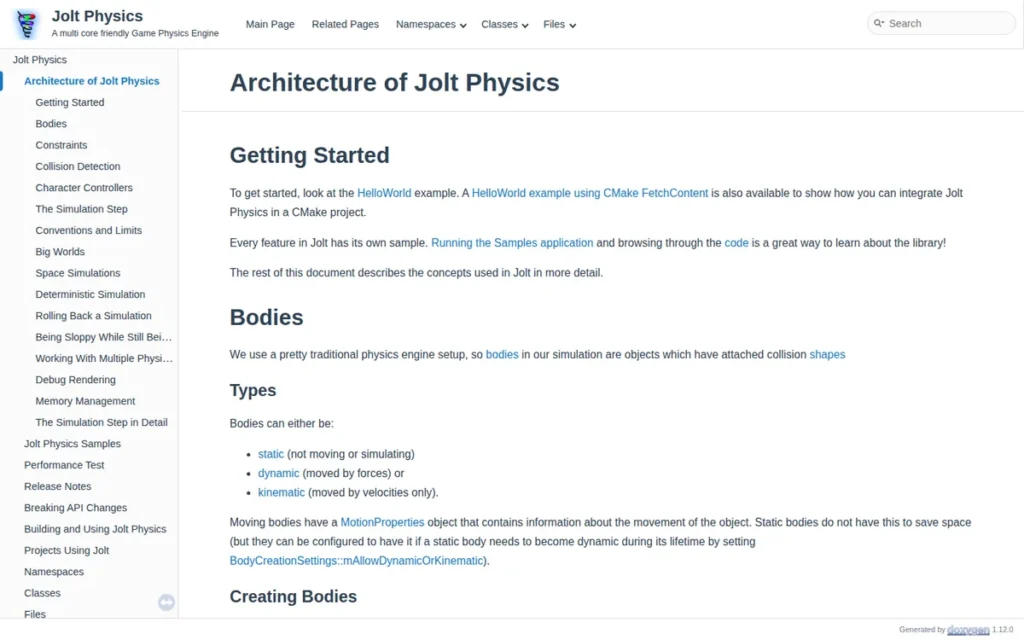
Category: Standalone 3D Rigid-Body Engine, a free, MIT-licensed C++ physics library for real-time 3D rigid-body simulation, collision detection, and constraints in games and VR applications, usable independently of any specific game engine.
At a Glance
- Category: Standalone 3D Rigid-Body Engine
- Best For: Indie to AAA game developers building 3D titles in custom C++ engines or Godot who need modern multi-threaded physics without vendor lock-in, commercial royalties, or console compatibility complications
- Price Range: Free (MIT license: no cost for any use including commercial products and console titles)
- Primary Strength: Jolt Physics delivers native multi-threaded simulation with deterministic results, confirmed AAA production credentials, and unconditional MIT licensing that eliminates console and commercial use complications.
- Biggest Limitation: Jolt Physics has no built-in soft body, cloth, or fluid simulation, and no GPU compute path, all simulation runs on CPU multi-threading only.
- One-Line Summary: Jolt Physics is an MIT-licensed open-source 3D rigid-body engine confirmed in AAA production on Horizon Forbidden West, integrated as Godot 4.4’s default physics backend, offering native multi-threading, deterministic simulation, and zero-restriction commercial and console licensing.
- Last Verified: June 2026
Overview
Jolt Physics is a modern, MIT-licensed C++ rigid-body physics and collision detection library designed for game developers and VR engineers who require multi-threaded simulation without NVIDIA hardware dependencies, commercial royalties, or console compatibility complications, created by Jorrit Rouwé and publicly released in 2022. Jolt Physics is confirmed in AAA production on Horizon Forbidden West (Guerrilla Games/Sony, 2022) and is listed on its official GitHub Projects page as used in Death Stranding 2: On the Beach [Jolt Physics GitHub, 2026], a listing not yet independently confirmed by a public statement from Kojima Productions.
Jolt Physics became the default 3D physics backend in Godot 4.4 (released March 2025), with official Godot documentation setting Jolt Physics as the default for new projects [Godot Documentation, 2026] and near-universal community adoption for new Godot 3D projects thereafter (r/godot, March 2025).
Key Features
- Native Multi-Threaded Simulation: Jolt Physics distributes broad phase, collision detection, and constraint solving across all available CPU cores without requiring a separate job system integration, making full CPU utilization available by default with no additional configuration.
- Simulation Island System: Jolt Physics independently simulates disconnected object groups, eliminating unnecessary computation for large scenes with many inactive objects and providing measurable performance gains in open-world scenarios.
- Deterministic Simulation Mode: Jolt Physics offers a deterministic mode in which identical inputs produce bit-identical outputs across hardware configurations, enabling rollback networking and physics-based replay systems without additional reconciliation logic.
- MIT License, Console-Compatible: Jolt Physics is MIT-licensed, the most permissive commercial license on this list, requiring no additional licensing steps for console development on PlayStation or Xbox, unlike NVIDIA PhysX, which is hardware-incompatible with AMD-based current-generation consoles (r/gamedev, February 2026).
- Comprehensive Constraint System: Jolt Physics supports fixed joints, hinges, slider and prismatic constraints, cone twist, pulley, gear, and path-following constraints, covering the majority of vehicle, ragdoll, and mechanical simulation needs without supplemental libraries.
Best For
Jolt Physics is the strongest choice for developers building standalone 3D games in custom C++ engines or Godot 4 who need modern multi-threaded performance without vendor lock-in or console compatibility complications, particularly studios targeting PlayStation or Xbox, where NVIDIA PhysX’s AMD GPU hardware incompatibility with current-generation consoles makes Jolt the more portable and commercially transparent alternative.
What Does Jolt Physics Cost?
Jolt Physics is completely free under the MIT license (verified June 2026). There are no usage fees, revenue thresholds, royalties, or per-seat costs for any use case, including commercial games and console titles.
Strengths
- Confirmed AAA Production Credential: Jolt Physics has confirmed production usage in Horizon Forbidden West (Guerrilla Games/Sony, 2022) (one of the most technically demanding PlayStation 5 launch titles) validating it for AAA workloads requiring stable multi-threaded rigid body simulation at commercial scale (Jolt Physics GitHub, 2026).
- Real-World Mobile Performance Data Point: In March 2025 Godot community testing, developer u/FeralBytes0 reported 600 simultaneous active rigid body objects at 55fps on an Android device in a Firefox mobile browser using Jolt Physics, a concrete cross-platform performance result for resource-constrained targets (r/godot, March 2025).
- Most Permissive Console Licensing of Any Evaluated Engine: Among high-performance open-source 3D rigid-body engines available as of June 2026, Jolt Physics carries the most permissive commercial and console use rights, its MIT license imposes no restrictions requiring separate console-specific licensing steps, in direct contrast to NVIDIA PhysX’s AMD hardware incompatibility with current-generation consoles.
- Responsive and Growing Maintenance Community: Jolt Physics’ maintainer (Jorrit Rouwé, GitHub: jrouwe) has a documented record of responsive issue resolution, and the project has received contributions from multiple external developers since its 2022 public release, reflecting healthy ecosystem vitality and growing adoption momentum.
What Are Jolt Physics’ Main Limitations?
- No Soft Body, Cloth, or Fluid Simulation: Jolt Physics does not include soft body, cloth, or fluid simulation (features standard in NVIDIA PhysX 5, Bullet Physics, and Chaos Physics) making it a poor fit for games where cloth animation or deformable geometry is central to gameplay without supplementing a separate library, which is a disqualifying limitation for physics-heavy titles requiring these effects.
- No GPU Compute Path: Jolt Physics runs entirely on CPU multi-threading with no GPU simulation capability, limiting throughput for massively parallel physics workloads that NVIDIA PhysX’s CUDA backend and MuJoCo’s MJX can handle on supported hardware.
- Smaller Community Knowledge Base Than Established Alternatives: Jolt Physics’ 2022 public release means its documentation ecosystem (Stack Overflow answers, third-party integration tutorials, community forum threads, and example projects) is significantly smaller than NVIDIA PhysX’s 25-year resource base or Bullet Physics’ 20-year legacy knowledge library, creating a higher onboarding research burden for teams without prior physics engine integration experience.
- No Independent Cross-Engine Benchmark Data: No reproducible benchmark table comparing Jolt Physics CPU performance against Bullet, Havok, or PhysX exists in publicly available sources, community performance endorsements are based on developer experience reports and indirect AAA adoption signals, not controlled test results (NVIDIA developer documentation review).
Verdict
Jolt Physics is the most commercially accessible, maintenance-healthy, and architecturally modern open-source 3D rigid-body engine available to game developers in 2026. Jolt Physics’ MIT license is the cleanest available for commercial and console use, its confirmed AAA production credential in Horizon Forbidden West validates it for demanding workloads, and its Godot 4.4 default status has made it the community standard for new Godot 3D projects. Jolt Physics ranks above Havok Physics (which holds the strongest single-criterion score for production credentials with 30+ confirmed AAA titles) because MIT licensing is accessible to every developer at every scale without a sales conversation, while Havok’s market is structurally AAA studios with enterprise procurement processes. Jolt Physics is the strongest default choice for any developer starting a new 3D game project outside the Unreal or Unity ecosystems, provided that soft body simulation is not a core gameplay requirement.
2. MuJoCo: Best for Robotics and Reinforcement Learning Research
Category: Robotics and RL Simulation Engine, an open-source physics engine using generalized-coordinate dynamics optimized for articulated body simulation, contact-rich manipulation, and reinforcement learning environment generation. Not a game engine.
At a Glance
- Category: Robotics and RL Simulation Engine
- Best For: ML/RL researchers and robotics engineers who need accurate articulated body simulation, OpenAI Gymnasium-compatible benchmark environments, and optional GPU and TPU parallel training via MJX
- Price Range: Free (Apache 2.0: no cost for all use cases including commercial robotics products, since May 2022)
- Primary Strength: MuJoCo provides the highest-rated documentation of any engine in this comparison per consistent 2025–2026 developer community sentiment, actively maintained by Google DeepMind with direct Gymnasium integration and GPU/TPU parallel simulation via MJX.
- Biggest Limitation: MuJoCo is architecturally incompatible with game development, its limited rendering quality, control-theory-specific terminology, and lack of game-authoring toolchain make it unsuitable for interactive game projects.
- One-Line Summary: MuJoCo is a free Apache 2.0-licensed physics engine maintained by Google DeepMind, recognized as the standard simulation environment for continuous-control RL benchmarks in Gymnasium, with GPU and TPU parallel simulation available through MJX.
- Last Verified: June 2026
Overview
MuJoCo (Model-based Unifying Joint and Coordinate system) is a free, Apache 2.0-licensed physics engine designed for articulated body simulation, model-based optimization, and reinforcement learning environments, actively maintained by Google DeepMind since May 2022 following its October 2021 acquisition from Roboti LLC, and freely available to any developer or researcher at no cost [Google DeepMind, 2022]. MuJoCo’s generalized-coordinate dynamics are architecturally distinct from every other engine evaluated here, providing computational efficiency and numerical stability advantages over Cartesian rigid-body approaches specifically for articulated robot and limb simulation scenarios.
MuJoCo serves as the standard physics backend for continuous-control benchmark environments in OpenAI Gymnasium (including HalfCheetah, Ant, Hopper, Walker2d, and Humanoid) making it the engine referenced in publications from DeepMind, OpenAI, MIT, Berkeley, and CMU, and the simulation environment for landmark demonstrations including OpenAI Dactyl’s robotic hand manipulation.
Key Features
- Generalized-Coordinate Dynamics: MuJoCo uses generalized-coordinate dynamics with optimization-based contact resolution, an architecture that is computationally more efficient and numerically stable than Cartesian rigid-body approaches for articulated robot and limb simulation, a technical distinction no other engine on this list can offer.
- MJX GPU and TPU Backend: MuJoCo includes MJX, a JAX/XLA-based GPU and TPU backend enabling batched parallel simulation across hundreds or thousands of simultaneous environments for high-throughput deep RL training pipelines unavailable in CPU-only engines.
- MJCF Model Definition and Research Toolset: MuJoCo provides MJCF XML format model definition, built-in OpenGL visualization, inverse dynamics, system identification support, and optimal control utilities, a research-grade toolset not available in any game-oriented physics engine on this list.
- OpenAI Gymnasium Standard Integration: MuJoCo is the physics backend for standard continuous-control benchmark environments in Gymnasium (including HalfCheetah, Ant, Hopper, Walker2d, and Humanoid) making it the de facto simulation standard for RL algorithm evaluation across the academic research community (Gymnasium documentation).
- pip-Installable Python API: MuJoCo’s Python API installs with a single pip command, and its C, C++, and Python API surface is consistently rated by researchers as more accessible and better documented than PyBullet and ROS/Gazebo alternatives (r/ROS, 2025).
Best For
MuJoCo is the definitive choice for ML/RL researchers, robotics engineers, and academic educators who need accurate articulated body simulation for continuous-control experiments, Gymnasium integration for benchmark comparisons, and optional GPU and TPU scaling via MJX, it is not suitable for game development, web applications, or visual AI tasks requiring photorealistic sensor rendering.
What Does MuJoCo Cost?
MuJoCo is completely free under Apache 2.0 as of May 2022, maintained by Google DeepMind (verified June 2026). Prior to DeepMind’s acquisition and open-sourcing, MuJoCo was a commercial product priced at approximately $500/year for academic researchers, a cost barrier now fully eliminated.
Strengths
- OpenAI Dactyl Landmark Validation: MuJoCo was used as the simulation environment for OpenAI Dactyl (2019), which trained a dexterous robotic hand to manipulate a Rubik’s Cube with successful sim-to-real transfer, one of the most cited demonstrations of physics simulation fidelity for contact-rich manipulation in ML research literature (OpenAI Dactyl, 2019).
- Highest Documentation Quality in This Comparison: MuJoCo is consistently described as “well maintained, documented, and everything” in 2025–2026 r/reinforcementlearning and r/robotics community discussions, the strongest documentation endorsement of any engine evaluated and a direct contrast with Bullet Physics’ “dead links” verdict.
- Most-Cited Research Simulation Foundational Paper: MuJoCo’s 2012 IROS foundational paper by Todorov, Erez, and Tassa is among the most-cited simulation papers in robotics and RL research, with its Gymnasium-integrated environments serving as standard benchmarks across major AI research institutions (MuJoCo documentation).
- Google DeepMind Institutional Backing: MuJoCo’s active maintenance: regular release cadence confirmed through 2025–2026, Apache 2.0 license, responsive GitHub under google-deepmind, provides the most credible institutional long-term backing of any free open-source engine on this list.
This documentation reputation is consistently validated across practitioner communities. Users on r/reinforcementlearning confirmed:
“In my experience pybullet isn’t the best but might be simplist based on your use case. I’d go with MuJoCo as it’s well maintained, documented and everything. Some people have made the move to Issac sim and I’ve heard good things but I don’t come across as much research using it personally. In papers usually it’s MuJoCo or maybe Gazebo” Posted by u/SuperDuperDooken
Takeaway: RL practitioners consistently prefer MuJoCo over PyBullet on the strength of its documentation and maintenance quality, with Isaac Sim acknowledged as a growing alternative but not yet dominant in published research.
What Are MuJoCo’s Main Limitations?
- Architecturally Incompatible with Game Development: MuJoCo’s MJCF terminology, actuators, tendons, generalized coordinates, contact soft constraints, presupposes familiarity with control theory and biomechanics, creating a genuine prerequisite knowledge barrier confirmed in r/reinforcementlearning: “The reason why MuJoCo is hard is because it’s originally meant for control theory / robotics”, a domain-specific onboarding cost, not a documentation failure.
- Limited Rendering Quality: MuJoCo’s rendering quality is identified by researchers as a disqualifier for visual AI tasks requiring photorealistic sensor simulation, with community consensus in r/reinforcementlearning (March 2025): “If you don’t need to render them, MuJoCo is fast and easy to use. If rendering is important though, it sucks.”
- GPU Parallelism Requires MJX Dependency: MuJoCo’s GPU parallelism requires the MJX JAX/XLA backend rather than native CUDA simulation, introducing a separate JAX ecosystem dependency and requiring JAX familiarity for teams without that background.
- Emerging Isaac Lab Competition for GPU-Scale RL: MuJoCo is increasingly compared against NVIDIA Isaac Lab in RL research communities, with Isaac Lab gaining adoption for large-scale robot learning requiring both GPU-parallel throughput and photorealistic sensor rendering, despite MuJoCo’s superior documentation quality (r/reinforcementlearning, March 2025).
Verdict
MuJoCo is the definitive physics engine for ML/RL research and robotics simulation in 2026, combining free Apache 2.0 licensing, Google DeepMind-quality documentation, Gymnasium standard benchmark integration, and GPU and TPU parallel simulation via MJX into a package with no viable competitor for its specific domain. MuJoCo is the wrong tool for game development, web applications, and photorealistic sensor simulation, its architectural strengths are domain-specific, and developers outside robotics and RL research should evaluate Jolt Physics or NVIDIA PhysX instead.
3. NVIDIA PhysX: Best for GPU-Accelerated Simulation and NVIDIA Omniverse Workflows
Category: GPU-Accelerated Multi-Physics SDK, a free, BSD-3-licensed C++ SDK with CUDA GPU simulation for rigid bodies, FEM soft bodies, cloth, fluid particles, and deformables, serving both game development and NVIDIA Omniverse industrial simulation.
At a Glance
- Category: GPU-Accelerated Multi-Physics SDK
- Best For: Developers using the NVIDIA Omniverse ecosystem, teams building GPU-accelerated industrial simulation or robotics training environments, and projects requiring FEM soft bodies or GPU-accelerated deformable simulation on NVIDIA hardware
- Price Range: Free (BSD-3-Clause open source: no commercial restrictions, no royalties)
- Primary Strength: NVIDIA PhysX 5 is the only free, open-source physics engine with CUDA GPU acceleration for FEM soft bodies, GPU-accelerated deformables, and a Direct GPU Data API for RL pipelines, backed by 25 years of production history.
- Biggest Limitation: NVIDIA PhysX GPU simulation requires CUDA-capable NVIDIA hardware (hardware-incompatible with AMD-based current-generation consoles (PS5, Xbox Series X/S), Apple Silicon, and most mobile devices) a structural barrier that Jolt Physics eliminates through platform-agnostic CPU multi-threading.
- One-Line Summary: NVIDIA PhysX 5 is a BSD-3-licensed open-source multi-physics SDK with CUDA GPU acceleration for FEM soft bodies, cloth, and fluid particles, serving as the physics backbone of NVIDIA Omniverse with a 25-year production history as the former default physics engine in both Unity and Unreal Engine.
- Last Verified: June 2026
Overview
NVIDIA PhysX is a free, BSD-3-licensed multi-physics SDK with a 25-year production history (originating as NovodeX (2001) and acquired by NVIDIA (2008)) supporting rigid body dynamics, FEM-based GPU soft bodies, deformables, cloth, fluid particles, and inflatable objects in a single open-source SDK available on GitHub (Wikipedia, 2026). NVIDIA PhysX was the default physics engine in both Unity and Unreal Engine throughout most of the 2010s, accumulating the largest indirect install base of any engine evaluated.
NVIDIA PhysX has since refocused on NVIDIA Omniverse integration and GPU simulation for industrial, robotics, and AI applications as game engines have transitioned to alternative backends. NVIDIA PhysX 5 introduced FEM soft body simulation and a Direct GPU Data API for reinforcement learning pipelines, features with no equivalent in any other free open-source standalone engine as of June 2026.
Key Features
- CUDA GPU Acceleration: NVIDIA PhysX provides CUDA GPU acceleration for broad phase, contact generation, body and shape management, and the constraint solver on NVIDIA hardware, with the same API available for CPU-only simulation on all other platforms (NVIDIA PhysX 5.5 documentation).
- FEM Soft Body Simulation: NVIDIA PhysX 5 introduced FEM (Finite Element Method) soft body simulation, GPU-accelerated deformable meshes, and position-based dynamics for liquid and inflatable objects, capabilities unavailable in Jolt Physics and available only in maintenance-mode Bullet Physics among free standalone engines. These features require CUDA-capable NVIDIA hardware.
- Direct GPU Data API for RL Pipelines: NVIDIA PhysX includes a Direct GPU Data API allowing reinforcement learning pipelines to read physics state and write simulation inputs directly from GPU memory, eliminating CPU round-trips for NVIDIA Omniverse and Isaac Sim ML training workloads.
- NVIDIA Omniverse Core Integration: NVIDIA PhysX is the core simulation layer of NVIDIA Omniverse, providing physics validation and real-time simulation for industrial digital twins and robot learning environments in NVIDIA’s enterprise AI platform.
- BSD-3-Clause Open Source License: NVIDIA PhysX is distributed under the BSD-3-Clause license, permitting free commercial use, modification, and redistribution with attribution-only obligations and no revenue thresholds (NVIDIA PhysX 5.1 documentation).
Best For
NVIDIA PhysX is the strongest choice for developers building within the NVIDIA Omniverse ecosystem, projects requiring GPU-accelerated FEM soft bodies or deformable simulation on NVIDIA hardware, teams using Isaac Sim for robot learning, and codebases inherited from Unity 4 or pre-Chaos Unreal Engine versions.
What Does NVIDIA PhysX Cost?
NVIDIA PhysX is free under the BSD-3-Clause open-source license (verified June 2026). CUDA GPU simulation binaries are included at no cost. Commercial use is permitted with no royalties.
Strengths
- Largest Indirect Production Install Base: NVIDIA PhysX was the default physics engine in Unity and Unreal Engine throughout most of the 2010s, virtually every game built on those platforms before Chaos Physics (UE5, 2022) and Godot 4.4’s Jolt default (March 2025) implicitly used PhysX, spanning thousands of shipped commercial titles (Wikipedia, 2026).
- Unique GPU Soft Body Feature Set: Among free, open-source physics engines reviewed as of June 2026, NVIDIA PhysX 5 is the only engine offering GPU-accelerated FEM soft body simulation and GPU-accelerated deformable meshes accessible without a commercial license or paid subscription.
- Funded NVIDIA Omniverse Development Roadmap: NVIDIA PhysX’s integration into Omniverse connects it to NVIDIA’s current enterprise AI simulation roadmap, a relationship that has produced the Direct GPU Data API and FEM soft body features in PhysX 5 and indicates continued feature development for the Omniverse use case.
- 25-Year Engineering Track Record: NVIDIA PhysX has been under continuous professional development since 2001, a 25-year history that underpins stability for well-tested feature areas including rigid body dynamics and collision detection, with FEM advances in PhysX 5 addressing historically cited soft body gaps (NVIDIA PhysX 5.1 documentation).
What Are NVIDIA PhysX’s Main Limitations?
- AMD Console Hardware Incompatibility: NVIDIA PhysX GPU simulation is hardware-incompatible with current-generation PlayStation 5 and Xbox Series X/S consoles, which use AMD GPUs without CUDA support, a structural barrier that Jolt Physics eliminates through platform-agnostic CPU multi-threading and an MIT license requiring no additional console steps. Developer community discussions in r/gamedev (February 2026) identify this hardware constraint as a concrete reason to choose Jolt Physics for console targets.
- CUDA Hardware Lock-In for Advanced Features: NVIDIA PhysX GPU features: including FEM soft bodies, GPU-accelerated deformables, and position-based liquid dynamics, are unavailable on AMD GPUs, Apple Silicon, and mobile devices, meaning these advanced capabilities cannot be accessed across a significant portion of target platforms (NVIDIA PhysX 5.4 documentation).
- Game-Engine Roadmap Trust Concerns: NVIDIA’s strategic pivot toward Omniverse has introduced community trust concerns about long-term PhysX game-engine support, stated directly in r/gameenginedevs (2023): “I don’t trust NVIDIA to continue supporting PhysX given how long it took to release 5 and how much they’re focusing on Omniverse.”
- No Published Cross-Engine CPU Benchmarks: No benchmark table comparing NVIDIA PhysX 5 CPU performance against Bullet, Havok, or Jolt exists in publicly available sources, developers evaluating PhysX for its CPU path have no objective performance comparison data and must rely on anecdotal community reports (NVIDIA developer documentation review).
Verdict
NVIDIA PhysX 5 is the strongest choice for developers working within the NVIDIA hardware ecosystem, particularly Omniverse users, robotics simulation teams requiring CUDA GPU acceleration, and projects needing FEM soft bodies or GPU deformables in a free open-source SDK. NVIDIA PhysX is not the right choice for developers targeting AMD-based current-generation consoles, Apple Silicon, or mobile hardware, nor for teams starting new standalone game projects who want the cleanest long-term hardware-compatibility posture, where Jolt Physics offers a more portable alternative with no console hardware incompatibility.
4. Havok Physics: Best for AAA Studios Requiring Enterprise-Grade Support

Category: Enterprise AAA Physics Middleware, a proprietary, commercially licensed physics and simulation suite for large-scale game production, providing rigid body dynamics, cloth, destruction, character animation, and navigation under enterprise licensing with no public pricing.
At a Glance
- Category: Enterprise AAA Physics Middleware
- Best For: AAA studios and large development teams with enterprise budgets who need deterministic multi-core simulation, professional development support, and validated console performance for simultaneous PC and console shipping
- Price Range: Pricing on request (enterprise licensing only: no public price list; available embedded in Unity Pro at approximately $2,200/seat/year as of June 2026)
- Primary Strength: Havok Physics has the most extensively documented AAA production catalog of any physics middleware evaluated, with 30+ confirmed major titles from studios including FromSoftware, id Software, Bungie, Bethesda, and Ubisoft.
- Biggest Limitation: Havok Physics has no free tier, no public pricing, and no self-serve access path, making it completely inaccessible to independent developers and small studios regardless of technical merit.
- One-Line Summary: Havok Physics is a proprietary Microsoft-owned physics middleware with over 30 confirmed AAA production titles including Elden Ring, Starfield, and Doom Eternal, offering deterministic multi-core simulation and professional enterprise development support at undisclosed enterprise pricing.
- Last Verified: June 2026
Overview
Havok Physics is a proprietary, enterprise-licensed physics middleware suite founded in Dublin in 1998 and now owned by Microsoft (acquired from Intel on October 2, 2015), providing rigid body dynamics, cloth, destruction, character animation, and navigation for AAA studios requiring deterministic multi-core simulation and dedicated development support (Wikipedia, 2026). Havok Physics is confirmed in production across 30+ named AAA titles on its official product page [Havok.com, June 2026], including Elden Ring (FromSoftware, 2022), Starfield (Bethesda, 2023), Doom Eternal (id Software), Destiny 2 (Bungie), and Rainbow Six Siege (Ubisoft Montreal).
Havok Physics holds the strongest single-criterion score in this comparison for production credentials, but ranks fourth overall because its enterprise-only access model structurally excludes the majority of this article’s audience from evaluation. Havok Physics’ primary market value is the combination of production-proven deterministic simulation and dedicated professional support during crunch, a service proposition no open-source alternative can replicate.
Key Features
- Deterministic Simulation: Havok Physics provides deterministic simulation across ticks (identical inputs produce identical outputs) a critical requirement for networked multiplayer games, physics-based gameplay mechanics, and replay systems requiring consistent results across all connected clients.
- Multi-Core AAA Optimization: Havok Physics is engineered for multi-core processor architectures, distributing simulation work to maximize throughput for the large rigid body counts typical of open-world AAA game scenes, a feature experienced developers identify as Havok’s core technical differentiator from Bullet Physics.
- Havok Physics for Unity: Havok Physics for Unity is a production-ready Havok C++ backend for Unity’s ECS/DOTS workflow (stateful, providing better stacking and friction than Unity Physics’ stateless architecture) available to Unity Pro and Enterprise subscribers as of January 2023 (Microsoft Developer, January 2023).
- Full AAA Middleware Suite: Havok Physics includes companion modules: Havok Cloth (fabric simulation), Havok Destruction (breakable environments), Havok Behavior (state-machine character animation), and Havok AI (navigation mesh and pathfinding), providing a full AAA game simulation suite under a single vendor relationship and licensing agreement.
- Professional Enterprise Support: Havok Physics is backed by Microsoft’s enterprise support infrastructure, providing dedicated engineering assistance, source code access under commercial license, and direct support for studios during time-critical production situations, the core value experienced developers identify as the primary reason studios pay for Havok (u/The_T, r/gamedev, 2011).
Best For
Havok Physics is the most appropriate choice for AAA studios and large development teams with enterprise budgets who need production-proven deterministic simulation, professional technical support, and console-optimized physics for simultaneous PC and console shipping, and for Unity Pro and Enterprise subscribers who need stateful high-performance physics in the ECS/DOTS workflow.
What Does Havok Physics Cost?
Havok Physics requires direct contact with Havok sales for pricing (verified June 2026). No public price list exists. As a reference point, Havok Physics for Unity is included in Unity Pro at approximately $2,200/seat/year. Standalone studio licensing for custom engine integration requires a separate enterprise agreement with no disclosed starting price.
Users on r/gamedev discussed what the enterprise-only pricing model actually reflects:
“Havok isn’t a game engine, it’s a physics engine. Havok also isn’t $25,000 they don’t publicly disclose their licensing deals, it’s probably based on a case by case basis. There are free physics engines out there like PhysX and Bullet Physics but you get what you pay for. Havok is more optimized, feature-rich and maintained than those two.” Posted by u/PsychoM
Takeaway: Havok’s deliberately undisclosed, case-by-case pricing is inseparable from its enterprise positioning, studios pay not for a public-market product but for a negotiated relationship with an engine that outperforms free alternatives at the production conditions that define AAA development.
Strengths
- Strongest Confirmed AAA Production Catalog: Havok Physics has the most extensively documented AAA production catalog of any physics engine evaluated, with 30+ confirmed titles on Havok’s official product page [Havok.com, June 2026], including Elden Ring (FromSoftware, 2022, 25M+ copies sold), Starfield (Bethesda, 2023), Doom Eternal (id Software), Destiny 2 (Bungie), Monster Hunter World: Iceborne (Capcom), and Mortal Kombat 1 (NetherRealm).
- Superior Simulation Stability at Edge Cases: A developer with hands-on experience comparing Havok and Bullet noted in r/gamedev (2011) that friction and stacking edge cases causing jitter in Bullet “don’t happen in Havok”, citing concrete simulation stability advantages for the specific behaviors most likely to appear as visible bugs in shipping games.
- Crunch-Time Professional Support: Havok’s professional developer support is described as: “When you’re totally in a corner and in the middle of crunch time, their dev rel guys are gonna save your butt” (u/The_T, r/gamedev, 2011), a risk-management service that no open-source alternative can provide at production scale. Think of Havok as enterprise insurance: studios pay for a guaranteed physics engineer during crunch, not for superior raw physics performance.
- 28-Year Game Physics Engineering History: Havok Physics has been under continuous active development since 1998, providing a 28-year engineering history focused exclusively on AAA game physics production, institutional knowledge of production requirements that neither Jolt nor Bullet can yet match.
What Are Havok Physics’ Main Limitations?
- No Free Tier or Self-Serve Access: Havok Physics is completely inaccessible to independent developers, small studios, and any organization that cannot engage enterprise sales (no free tier, no trial license, no self-serve pricing, no public price list) confirmed in r/gamedev (June 2025): “from what I’ve researched, you need a license in order to even use Havok.”
- Closed Source with No Independent Inspection: Havok Physics’ closed-source model means that when undocumented edge-case behavior occurs in production, studios cannot inspect the source code independently and must wait for vendor response, creating a dependency on support turnaround time that open-source alternatives like Jolt Physics do not impose on teams with physics engine expertise.
- Microsoft Ownership Vendor-Lock Concerns: Microsoft’s 2015 acquisition has generated ongoing community concern about long-term licensing independence for studios outside the Microsoft and Xbox ecosystem, a strategic vendor-lock risk that Jolt Physics (MIT-licensed, independently maintained) does not carry (Wikipedia, 2026).
- Shared-Middleware Creative Limitation: Developer and forum discussions identify a “samey middleware” concern with Havok’s AAA ubiquity (studios sharing identical physics behavior across titles using the same middleware can reduce the sense of unique physical game feel) a design consideration for studios where physics distinctiveness is a core creative goal (Quarter to Three forum, date unavailable).
Verdict
Havok Physics is the most production-validated enterprise physics middleware in the industry, with a 30+ AAA title catalog and professional development support that provide genuine, tangible risk reduction for large-scale productions. Havok Physics holds the strongest production credential score in this comparison but ranks fourth overall because licensing accessibility, the criterion most consequential for the majority of readers, is structurally unavailable to anyone outside enterprise sales engagement. Havok Physics is the right choice for AAA studios with enterprise budgets, dedicated engine teams, and the infrastructure to maintain a commercial support relationship, and the wrong choice for any organization that values open-source auditability, needs self-serve pricing, or cannot engage enterprise sales before evaluating a toolchain.
5. Chaos Physics (Unreal Engine): Best for Unreal Engine 5 Developers
Category: Integrated UE5 Physics System, a built-in physics simulation, destruction, and cloth system exclusive to Unreal Engine 5, providing Chaos Destruction, Chaos Cloth, Chaos Vehicles, and networked physics within the UE5 editor toolchain. Not available as a standalone library.
At a Glance
- Category: Integrated UE5 Physics System
- Best For: Developers committed to Unreal Engine 5 who need integrated destruction, cloth, vehicle dynamics, and networked physics within a single royalty-free-until-$1M toolchain
- Price Range: Free with Unreal Engine 5 (0% royalty up to $1,000,000 USD lifetime gross revenue; 5% royalty above that threshold)
- Primary Strength: Chaos Physics delivers the most feature-complete integrated real-time physics toolchain of any production engine (including Chaos Destruction, Chaos Cloth, Chaos Vehicles, Field System, and networked physics rewind) within UE5’s royalty-free-until-$1M licensing model.
- Biggest Limitation: Chaos Physics is inseparable from Unreal Engine 5 and cannot be used outside UE5; community reports estimated approximately 30% slower standard rigid body performance than PhysX in UE5.0–5.3 (r/unrealengine, 2023), with UE5.4 improvements confirmed but the remaining gap not publicly benchmarked.
- One-Line Summary: Chaos Physics is the built-in simulation system of Unreal Engine 5, validated at scale by Fortnite’s 250M+ registered players, offering Chaos Destruction, Cloth, Vehicles, Field System, and networked physics rewind in a single toolchain free up to $1M lifetime revenue.
- Last Verified: June 2026
Overview
Chaos Physics is Unreal Engine 5’s built-in real-time physics and destruction system, developed by Epic Games and first publicly demonstrated at SIGGRAPH 2019, used in production on Fortnite since the UE4.27 era and validated at the scale of 250M+ registered players. Chaos Physics is not available as a standalone library and cannot be integrated outside Unreal Engine 5, making it a platform commitment rather than an independent tooling decision.
Chaos Physics being inseparable from Unreal Engine 5 is the single most important framing distinction for developers evaluating it relative to other engines on this list. Chaos Physics encompasses six distinct simulation systems:
- Chaos Destruction: fracturing and breakable geometry via the Fracture Editor
- Chaos Cloth: fabric simulation integrated with character rigs
- Chaos Vehicles: vehicle dynamics and tire friction simulation
- Field System: runtime-modifiable force, breakability, and velocity fields
- Networked physics rewind: built-in physics prediction, correction, and replay
- Hair physics and flesh simulation: character body dynamics
Key Features
- Fracture Editor and Chaos Destruction: Chaos Physics includes a Fracture Editor and Geometry Collections system for authoring breakable environments, enabling fully procedural real-time destruction integrated with Niagara particle effects and the UE5 rendering pipeline, a capability unavailable in any standalone physics engine.
- Field System for Runtime Physics Modification: Chaos Physics’ Field System allows runtime modification of force, breakability, sleeping, and velocity fields at the object level, enabling emergent physics behaviors for game design that are difficult to replicate with standalone simulation libraries.
- Networked Physics Rewind and Replay: Chaos Physics supports networked physics with prediction, correction, and rewind and replay architecture designed for UE5’s network replication framework, a significant multiplayer development advantage over standalone engines requiring external networking integration.
- UE5.4 Performance and Debuggability Improvements: UE5.4 (2024) confirmed improved runtime performance and memory usage for larger-scale scenes and introduced a new physics scene debugging framework, addressing the most frequently cited pain points from earlier UE5 releases (Epic Games Unreal Fest 2024).
- Royalty-Free-Until-$1M Licensing: Chaos Physics is included in Unreal Engine 5 at no upfront cost, with Epic’s 5% gross revenue royalty applicable only after a product exceeds $1,000,000 USD lifetime gross revenue, free for the vast majority of independent and mid-tier projects (Epic Games license documentation).
Best For
Chaos Physics is the only practical choice for developers committed to Unreal Engine 5 who need integrated physics, destruction, cloth, and vehicle simulation within a single royalty-free toolchain. Chaos Physics is not a viable consideration for developers outside the Unreal Engine ecosystem or for teams evaluating standalone physics library integration.
What Does Chaos Physics Cost?
Chaos Physics is included with Unreal Engine 5 at no upfront cost. Epic charges a 5% gross revenue royalty on commercial products after $1,000,000 USD lifetime gross revenue. For most independent and mid-tier studios, this threshold is not reached. (Pricing verified June 2026 per Epic’s official license documentation.)
Strengths
- Fortnite Production Validation at Unprecedented Scale: Chaos Physics has been in production use on Fortnite since the UE4.27 era, with the live-service title serving 250M+ registered players, the most extensive real-world stress test of any game engine physics system in production history, validating Chaos at a scale no standalone engine can cite.
- UE5.4 Confirmed Performance Improvements: Epic’s Unreal Fest 2024 presentation confirmed UE5.4 delivered “improved runtime performance and memory usage for larger-scale scenes” alongside a new debugging framework, official acknowledgment that performance and debuggability shortfalls from earlier releases were systematically addressed (Unreal Fest 2024).
- Exclusive Destruction and Networked Physics Features: Chaos Physics’ Fracture Editor, Chaos Destruction, and networked physics rewind are exclusive to the UE5 toolchain with no equivalent in any standalone physics engine, providing genuine capability differentiation for destruction-focused and multiplayer game development.
- Epic’s Institutional Development Capacity: Epic Games’ 4,000+ employee engineering organization supports an active UE5 roadmap with public release notes and confirmed minor release velocity, institutional development capacity that independent open-source projects cannot match.
What Are Chaos Physics’ Main Limitations?
- Absolute UE5-Only Platform Lock-In: Chaos Physics is exclusively available inside Unreal Engine 5 and cannot be evaluated, tested, or integrated outside that ecosystem, making it a platform commitment rather than an independent tooling decision, with zero practical value for teams not using UE5.
- Documented Performance Gap Versus PhysX: Community reports estimated approximately 30% slower standard rigid body performance in UE5.0–5.3 (r/unrealengine, 2023), a gap consistent with Epic’s own UE4.27 documentation stating the transition target was “users should not notice much of a difference from PhysX” (parity, not improvement), and a high-traffic r/unrealengine thread reflects widespread developer frustration with this gap.
- Historically Poor Debugging Experience: An official Unreal Engine forum thread with 200+ replies confirms developers experienced “simulation results, simulation performance, and scene query performance” all performing worse in Chaos, the new UE5.4 debugging framework was introduced specifically to address historically poor debuggability, which constitutes acknowledgment-by-remediation that earlier versions were insufficient.
- No Public Quantification of UE5.4 Gap Reduction: While UE5.4 improvements are confirmed, no publicly available benchmark quantifies the remaining performance gap after UE5.4 remediation, developers cannot independently verify how close to parity Chaos has reached without running their own project-specific tests.
Users on r/unrealengine described the performance gap in concrete, reproducible terms:
“Is there any way to get acceptable performance with physics in UE5, currently the performance is so awful that there is no way it could be used in a game that has a focus on physics. In Ue4, you could have 100 ragdolls and still have 60fps. In Ue5, I can’t even have 50 before getting an unplayable framerate under 30fps. I can’t imagine how awful it is on lower spec machines as even on my mid range pc the performance is bad.” Posted by u/CosmicChief884
Takeaway: Chaos Physics’ ragdoll throughput in UE5.0–5.2 fell so sharply short of PhysX that physics-intensive projects became non-viable in Unreal Engine 5 without major scene-count reductions, validating the community-estimated ~30% performance gap as a genuine production constraint, not a benchmark artifact.
Verdict
Chaos Physics is the mandatory and appropriate physics choice for Unreal Engine 5 developers, and within that context delivers a feature set (Chaos Destruction, networked physics rewind, Field System, and Cloth) that no standalone engine replicates. Chaos Physics has made meaningful progress in UE5.4 on the performance and debuggability issues that dominated community discussion in UE5.0–5.3, validated at Fortnite-scale. For teams inside the Unreal Engine ecosystem, Chaos Physics is the only realistic option; for teams evaluating whether to adopt Unreal Engine, the community-estimated performance gap and UE5-only platform lock-in should factor into the decision alongside the unmatched destruction and networked physics capabilities.
6. Unity Physics: Best for Unity Ecosystem Developers and Multiplayer Mobile Games
Category: Multi-Backend Game Engine Physics System, Unity’s physics subsystem offering three backend options (PhysX Built-In, Unity Physics ECS, and Havok Physics for Unity) within the Unity game development platform, spanning free indie use to enterprise AAA production.
At a Glance
- Category: Multi-Backend Game Engine Physics System
- Best For: Unity developers across all tiers: indie and mobile teams using PhysX Built-In, multiplayer developers needing stateless rollback physics (Unity Physics ECS), and Pro/Enterprise teams requiring stateful high-performance simulation (Havok Physics for Unity)
- Price Range: Free for organizations with under $200,000/year revenue or funding (Personal tier); approximately $2,200/seat/year for Pro, which includes Havok Physics access; Enterprise pricing by custom quote (June 2026)
- Primary Strength: Unity Physics provides three distinct physics backends: PhysX Built-In, ECS-native Unity Physics (stateless, open-source C#), and Havok Physics (high-performance, stateful), within the game development platform used in approximately 51% of Steam games released in 2024 by release count.
- Biggest Limitation: Unity Physics (the ECS/DOTS backend) requires mastery of Unity’s full Data-Oriented Technology Stack, creating a steep paradigm-shift learning curve that most small teams find impractical; and Unity’s 2023 attempted retroactive runtime fee represents a documented licensing risk precedent that has not been resolved in developer trust.
- One-Line Summary: Unity Physics is a multi-backend physics system within the Unity game engine (used in approximately 51% of Steam games released in 2024 by release count [Sensor Tower / Video Game Insights, 2025]) offering PhysX built-in physics, the open-source stateless ECS Unity Physics package, and Havok Physics integration for Pro and Enterprise subscribers.
- Last Verified: June 2026
Overview
Unity Physics is the collective physics system of the Unity game engine, offering three backends (PhysX Built-In, open-source ECS Unity Physics, and Havok Physics for Unity) within the platform used in approximately 51% of Steam games released in 2024 by release count [Sensor Tower / Video Game Insights Steam Report, 2025] (Unreal Engine led by units sold in the same period at 31% vs Unity’s 26%). Unity Technologies reported $1.81 billion in 2024 annual revenue [Unity Investor Relations, February 2025] and approximately 6,000 employees, making it the largest independent game engine company evaluated.
Unity Physics’ three backends have different performance profiles, determinism properties, and architectural trade-offs that require deliberate evaluation before project commitment. Unity Physics’ multi-backend architecture provides flexibility across project types but introduces meaningful cognitive complexity for teams unfamiliar with DOTS.
Key Features
- Stateless ECS Architecture for Multiplayer Networking: Unity Physics (ECS/DOTS package) is stateless (each simulation frame computed independently without persistent state) making it architecturally compatible with server-authoritative rollback networking for competitive multiplayer games in a way that PhysX and Havok stateful approaches do not natively support (r/Unity3D).
- PhysX Built-In Backend for Standard Workflows: Unity’s Built-In Physics uses the PhysX backend, providing stable and widely-documented rigid body simulation for teams using the traditional GameObject workflow without the full DOTS and ECS paradigm shift.
- Havok Physics for Unity (Pro/Enterprise): Unity’s Havok Physics backend, available to Unity Pro and Enterprise subscribers as of January 2023, provides a production-ready Havok C++ simulation backend within the ECS/DOTS framework, stateful, with better stacking and friction behavior than Unity Physics for singleplayer physics-heavy games (Microsoft Developer, January 2023).
- Open-Source C# Codebase: Unity Physics is available on GitHub with full C# codebase transparency, enabling independent inspection and modification, a transparency level not available for Havok standalone or for Chaos without an Unreal Engine subscription.
- Active Unity 6.4 Physics Roadmap: Unity Technologies’ May 2025 official discussion post confirmed continued development toward unified backend-selection workflow in Unity 6.4, with Havok Physics as a continued product direction (Unity official discussion, May 2025).
Best For
Unity Physics is the most appropriate choice for teams already committed to Unity, particularly mobile and cross-platform indie developers using the built-in PhysX backend, multiplayer game developers needing stateless physics for rollback networking, and Unity Pro or Enterprise subscribers who need Havok’s higher-performance stateful simulation for physics-heavy singleplayer games.
What Does Unity Physics Cost?
Unity Personal tier is free for organizations earning or raising under $200,000/year (verified June 2026). Unity Pro is approximately $2,200/seat/year, which includes Havok Physics for Unity. Enterprise pricing is custom-quoted. Unity charges seat-based licensing rather than Unreal Engine’s 5% revenue-threshold model.
Strengths
- 51% Steam Game Market Share in 2024 by Release Count: Unity’s platform was used in approximately 51% of Steam games released in 2024 by release count [Sensor Tower / Video Game Insights Steam Report, 2025] (Unreal Engine led by units sold at 31% vs Unity’s 26% in the same period) providing the largest developer community and broadest asset store ecosystem of any platform evaluated.
- Multi-Backend Physics Flexibility: Unity’s multi-backend architecture allows teams to prototype with PhysX Built-In and switch to Havok Physics for a production performance pass without changing the game’s physics API surface, a flexibility advantage not available in single-backend alternatives like Chaos or Jolt.
- Open-Source C# Codebase Transparency: Unity Physics’ open-source C# implementation is available on GitHub, enabling independent inspection and modification, a transparency level that Havok standalone (closed-source, enterprise-only) cannot match.
- Active Institutional Physics Investment: Unity Technologies’ $1.81 billion 2024 annual revenue [Unity Investor Relations, February 2025] supports an active physics roadmap, with the May 2025 official discussion post confirming ongoing investment toward unified backend selection in Unity 6.4 (Unity official discussion, May 2025).
What Are Unity Physics’ Main Limitations?
- Steep ECS/DOTS Learning Curve: Unity Physics (ECS/DOTS backend) requires proficiency in Unity’s full Data-Oriented Technology Stack (Entity Component System, Job System, and Burst Compiler) a paradigm shift described by community sources as impractical for small teams, producing “poor stacking and friction” in singleplayer physics-heavy games due to its stateless architecture (r/Unity3D).
- RetroactiveLicensing Risk Precedent: Unity’s 2023 proposed runtime fee (which would have charged developers per-install based on lifetime install counts, retroactively applying to games already shipped on older Unity versions) was reversed after widespread developer backlash but established a documented precedent that Unity’s licensing terms have been subject to retroactive change attempts [JuegoStudio, 2025].
- Cross-Platform Determinism Variability: Cross-platform determinism variability has been reported for Unity Physics in competitive multiplayer implementations despite its stateless design (community members confirm “results can vary across hardware”) undermining the core networking promise of the ECS architecture for competitive multiplayer titles (r/Unity3D).
- Three-Backend Complexity Overhead: Unity’s three-backend physics structure introduces significant cognitive overhead for developers unfamiliar with DOTS, determining the right backend requires understanding singleplayer vs. multiplayer needs, license tier, and performance profile upfront, unlike single-backend engines where the decision is already made.
The broader developer community’s response to Unity’s licensing reversal was captured on r/godot when Unity canceled the fee in September 2024:
“I respect Unity as a tool. I respect devs who are already too deep in Unity and make stuff in there. But I just can’t trust Unity as a company, not after what it’s done, not with knowing that it’s publicly traded.” Posted by u/Foxiest_Fox
Takeaway: Unity’s runtime fee reversal did not restore developer trust, the demonstrated willingness to attempt retroactive license changes has permanently shifted how commercially-minded developers assess Unity as a long-term platform partner, regardless of the technical merits of its physics system.
Verdict
Unity Physics is the practical choice for the large population of developers already invested in the Unity ecosystem, particularly those targeting mobile, cross-platform deployment, or multiplayer games where the stateless ECS architecture provides a networking advantage. Unity Physics’ primary strength is inseparable from Unity’s platform breadth and market position rather than any physics-specific technical advantage, and Unity’s 2023 runtime fee attempt is a documented licensing risk precedent that developers selecting a platform for long-horizon commercial projects should weigh alongside the genuine multi-backend flexibility Unity provides.
7. Bullet Physics: Best for Legacy Codebases and PyBullet Robotics Research
Category: Legacy Open-Source Physics Library, a free, zlib-licensed C++ physics SDK with a 20-year production history, with active development now focused on the PyBullet Python interface for robotics and RL research while the C++ game development path is in effective maintenance mode as of 2025–2026.
At a Glance
- Category: Legacy Open-Source Physics Library
- Best For: Teams maintaining existing Bullet-based codebases, Python-based robotics researchers using PyBullet who need URDF and SDF model loading with ROS compatibility, or developers integrating physics into Blender workflows
- Price Range: Free (zlib license: no fees or revenue thresholds; license requires preserving the copyright notice but imposes no attribution cost)
- Primary Strength: Bullet Physics carries a 20-year production history confirmed in Blender and community-cited in GTA V, with the most commercially permissive license of any engine on this list (zlib) and a PyBullet Python interface that remains the most ROS-format-compatible standalone robotics simulation entry point.
- Biggest Limitation: Bullet Physics’ C++ game development path is classified “Very Low Activity” by Open Hub [openhub.net/p/bulletphysics, publicly verifiable June 2026], with documentation described by multiple 2025–2026 developer community sources as “dead documentation links” and “like pulling teeth.”
- One-Line Summary: Bullet Physics is a free, zlib-licensed open-source physics library with a 20-year production history including Blender and community-cited usage in GTA V, with active development now focused exclusively on PyBullet for robotics and RL research while the C++ game development path is in effective maintenance mode as of 2025–2026.
- Last Verified: June 2026
Overview
Bullet Physics is a free, open-source C++ physics SDK released under the zlib license, developed by Erwin Coumans, with confirmed production use in Blender (the industry-standard 3D modeling tool [Blender Foundation, 2026]) and widely cited in developer community discussions as used in Grand Theft Auto V (Rockstar Games, 2013), plus a Python interface (PyBullet) that has served academic robotics and RL research for over a decade (GitHub).
Bullet Physics’ C++ game development path is classified as “Very Low Activity” by Open Hub (2025) and widely described in developer communities as deprecated for new game projects. Bullet Physics’ PyBullet Python interface continues in active use for robotics simulation and ML research, though 2025–2026 community discussions increasingly position MuJoCo and NVIDIA Isaac Lab as preferred alternatives for new research projects.
Key Features
- Rigid Body and Soft Body in One Library: Bullet Physics supports both rigid body and soft body simulation (including soft body mesh deformation, rope, and cloth) in a single library, providing feature breadth that the more actively maintained Jolt Physics does not currently offer.
- PyBullet Python Interface with ROS Format Support: Bullet Physics’ PyBullet Python interface provides a Python-accessible physics simulation environment with URDF, SDF, and MJCF robot model loading, offering compatibility with common robotics file formats used in the ROS ecosystem.
- zlib License, Most Permissive on This List: Bullet Physics is licensed under the zlib license, requiring only preservation of the copyright notice in commercial use, with no revenue thresholds or commercial use restrictions of any kind, making it the most commercially permissive license evaluated.
- Continuous Collision Detection (with documented gaps): Bullet Physics supports continuous collision detection for fast-moving objects, though with documented limitations including the absence of CCD support for compound-to-compound collider cases noted by developer u/Max-Yari in r/gameenginedevs.
- 20-Year Legacy Knowledge Base: Bullet Physics’ 20-year deployment history has produced a large body of community tutorials, Stack Overflow answers, and integration examples that remain accessible despite the SDK’s maintenance status, a legacy resource base that newer engines cannot yet match in raw community coverage volume.
Best For
Bullet Physics is the most appropriate choice for teams maintaining codebases already built on Bullet, Python-based robotics researchers using PyBullet who need URDF and SDF model loading and ROS ecosystem compatibility, or developers integrating physics into Blender workflows. Bullet Physics is not recommended for new 3D game projects in 2026, where Jolt Physics offers a more actively maintained, better-documented, and architecturally modern alternative.
What Does Bullet Physics Cost?
Bullet Physics is completely free under the zlib license (verified June 2026). There are no fees, royalties, or revenue thresholds. The zlib license requires preserving the copyright notice text (a minimal obligation) but imposes no financial cost or commercial use restrictions of any kind.
Strengths
- Blender and GTA V Production History: Bullet Physics is confirmed in production in Blender (the industry-standard 3D modeling tool [Blender Foundation, 2026]) and widely cited in developer community discussions as used in Grand Theft Auto V (Rockstar Games, 2013) (one of the best-selling games in history) validating its historical suitability for large-scale open-world physics simulation (r/gamedev).
- 20-Year Battle-Tested Codebase: Bullet Physics carries over 20 years of production history as a known-stable foundation for games, Blender’s integrated physics pipeline, and robotics simulators in the ROS ecosystem, a longevity that newer engines cannot replicate regardless of their technical quality.
- Most Permissive License on This List: Bullet Physics’ zlib license requires only preservation of the copyright notice in commercial use, making it useful for teams with strict IP compliance constraints, proprietary embedding needs, or legacy code integration requirements that more restrictive licenses would complicate.
- PyBullet URDF and SDF Format Compatibility: PyBullet’s URDF, SDF, and MJCF model loading provides a functional robotics simulation environment accessible without C++ expertise, remaining valid for simpler RL environments and robotics prototyping where MuJoCo’s control-theory terminology creates an onboarding barrier.
What Are Bullet Physics’ Main Limitations?
- C++ Path in Confirmed Maintenance Mode: Bullet Physics’ C++ development path is classified “Very Low Activity” by Open Hub [openhub.net/p/bulletphysics, publicly verifiable June 2026], and community consensus in r/gamedev (February 2026) is unambiguous: “Bullet has basically abandoned being anything other than PyBullet for robotics, all the old C++ documentation is gone and figuring out how to use it is like pulling teeth.”
- Critical Documentation Failures: Developer u/Max-Yari in r/gameenginedevs documented: “really, REALLY poor documentation (dead documentation links on forums, poor or absent descriptions in autogenerated docs”) making Bullet Physics the worst-documented engine of the seven evaluated and directly predictive of high integration cost for new users.
- Specific Technical Gaps in C++ Implementation: Bullet Physics lacks CCD support for compound-to-compound collider cases, has documented jitter behavior at friction and stacking edge cases where Havok Physics performs cleanly (r/gamedev, 2011), and its multi-threading model is more limited than modern alternatives like Jolt Physics.
- PyBullet Research Role Being Displaced: Even Bullet’s active development path (PyBullet for robotics research) faces increasing displacement by MuJoCo (superior documentation, Google DeepMind backing) and NVIDIA Isaac Lab (GPU-parallel, photorealistic sensors), as confirmed across 2025–2026 r/reinforcementlearning and r/ROS community discussions.
Verdict
Bullet Physics earned its place in development history through confirmed production use in Blender, community-cited usage in GTA V (2013), and hundreds of academic robotics environments, contributions that remain genuinely significant. Bullet Physics in 2026 has a C++ game development path in effective maintenance mode with documented documentation failures and declining community adoption, while its robotics research role is progressively displaced by MuJoCo for simulation fidelity and Isaac Lab for GPU-parallel training. Bullet Physics remains valid for PyBullet robotics prototyping, legacy codebase maintenance, and Blender integration, but is not the right starting point for any new project that has access to Jolt Physics for game development or MuJoCo for robotics research.
What Red Flags Should I Watch For When Evaluating a Physics Engine?
The most expensive physics engine mistakes happen when developers confirm licensing and maintenance status last, after integration work is complete and switching costs are highest. Check these five flags before writing the first line of physics code.
Red Flag #1: No Public Pricing
Havok Physics has no public price list and requires direct enterprise sales engagement before any cost evaluation is possible. Developers who invest significant integration time before engaging Havok’s sales team have no pricing information to guide the decision. If an engine cannot publish its pricing, treat cost evaluation as a separate project phase before committing technical resources.
Red Flag #2: Very Low Activity Maintenance Signal
Bullet Physics holds an Open Hub “Very Low Activity” classification as of 2025 [openhub.net/p/bulletphysics (publicly verifiable]) a concrete signal that commit frequency and maintenance have declined significantly. Before committing to any open-source physics library, check its current Open Hub classification and GitHub commit recency. A project whose last meaningful release was two or more years ago is in maintenance mode regardless of its historical reputation.
Red Flag #3: GPU-Only Feature Gates
NVIDIA PhysX 5’s most distinctive features (FEM soft bodies, GPU-accelerated deformables, position-based liquid dynamics) require CUDA-capable NVIDIA hardware specifically. Engines that gate key features behind specific hardware create portability constraints that typically surface during platform porting, not during initial evaluation. Verify which features require which hardware before selecting an engine for multi-platform development.
Red Flag #4: Platform Lock-In
Chaos Physics is inseparable from Unreal Engine 5. Unity Physics is inseparable from Unity. Engines embedded in a host platform cannot be evaluated, prototyped with, or migrated away from without changing the host engine entirely, they represent a platform commitment, not a physics tooling decision. Developers choosing between UE5 and Godot are implicitly choosing between Chaos and Jolt as their physics systems.
Red Flag #5: Retroactive Licensing Risk Precedent
Unity Technologies’ 2023 proposed runtime fee (which would have charged per-install for games already shipped on older Unity versions, retroactively imposing new costs on existing commercial products) was reversed after widespread developer backlash but established a documented precedent. For developers building long-horizon commercial projects, a platform’s licensing stability history is as relevant as its current pricing page. The reversal does not erase the precedent.
What Questions Should I Ask Before Choosing a Physics Engine?
Ask these four questions before writing the first line of physics integration code. Each one targets a failure mode in this category that marketing materials and AI recommendations consistently omit.
Question #1: Does this engine support my target platforms without hardware or licensing complications?
Confirm explicitly whether commercial console use (PlayStation, Xbox), mobile deployment, and AMD or Apple Silicon targets are supported without additional steps. For NVIDIA PhysX, GPU features are hardware-incompatible with current-generation PS5 and Xbox Series X/S consoles by architecture. For Havok, all use requires a commercial licensing agreement. For Jolt Physics, all platforms are covered by the MIT license with no additional steps.
Question #2: What is the current Open Hub or GitHub activity classification, and when was the last release?
Open Hub’s activity classification is a free, publicly available signal of a project’s maintenance health. Bullet Physics’ “Very Low Activity” (2025) is a concrete red flag absent from most AI recommendations. GitHub’s last-commit date and release cadence are secondary confirmations, a project with no meaningful release in two or more years is in maintenance mode regardless of its historical adoption.
Question #3: Is public pricing available before I invest integration time?
For Havok Physics and any other closed commercial middleware, pricing requires a sales conversation. Confirm whether an NDA, legal review, or procurement process is required before you can see a price. If cost evaluation is structurally gated, build that timeline into the evaluation phase, not the post-integration phase when switching costs are highest.
Question #4: Is documentation current, searchable, and validated by developer community reviews, or are there reports of dead links and outdated references?
Search Reddit and game dev forums for “[engine name] documentation” before committing to integration. Bullet Physics’ “dead documentation links” and MuJoCo’s “control-theory terminology barrier” are both documented community signals that accurately predict integration cost. Documentation quality predicts the difficulty and time cost of onboarding more reliably than any feature list or marketing claim.
Verify Before You Commit: (1) Check the engine’s current Open Hub activity classification at openhub.net; (2) Confirm the current license text on GitHub or the official website; (3) For commercial or console projects, read the license file directly rather than relying on summaries. License terms change. Maintenance status changes. These checks take 15 minutes and cost nothing.
How Did We Rank These Physics Engines?
Rankings in this article are determined by scoring each engine across six criteria, with primary criteria weighted more heavily than secondary criteria. All criteria, weightings, and evidence sourcing are disclosed in full below.
Critical caveat: No independent cross-engine performance benchmarks exist in the public domain for physics engines. This is a category-wide gap, not a missing source. Every claim that one engine “outperforms” another in this article is based on developer community reports, vendor documentation, or developer testimonials, not reproducible controlled tests. When you encounter any source claiming engine A is “X% faster” than engine B, ask whether that figure comes from a standardized benchmark with equivalent hardware and scene complexity. In almost every case, the answer is no.
Evaluation Process
The research process for this article included:
- Querying multiple AI search engines to identify current LLM recommendations and the gaps in those recommendations
- Direct review of official documentation, license files, and product pages for all seven engines
- Analysis of GitHub repository activity, Open Hub classifications, and commit history
- Structured sentiment analysis across r/gamedev, r/godot, r/unrealengine, r/Unity3D, r/reinforcementlearning, r/robotics, and r/ROS
- Cross-referencing vendor claims against confirmed production title catalogs, academic citations, and third-party discussions
- Confirming all pricing, licensing, and version claims against primary sources as of June 2026
Ranking Criteria
C1, Documentation Quality and Developer Experience (Primary)
Documentation quality is the single most-cited selection criterion across all evaluated developer communities. Poor documentation directly translates to integration delays and debugging costs, the primary pain points of the target audience. Bullet Physics’ “dead links” and MuJoCo’s “well maintained and documented” represent the two poles of this criterion.
C2, Licensing Accessibility and Commercial Transparency (Primary)
Licensing opacity and unexpected costs are the top category-wide pain point. Havok’s enterprise-only pricing, PhysX’s AMD console hardware incompatibility, and Unity’s 2023 runtime fee attempt are all documented events that validate this criterion as primary-weighted.
C3, Maintenance Health and Ecosystem Vitality (Primary)
Active maintenance reduces the risk of unresolved bugs, feature stagnation, and community abandonment. Bullet’s Open Hub “Very Low Activity” (2025) is the most concrete maintenance failure signal in this evaluation.
C4, Production Credentials and Adoption Evidence (Primary)
Confirmed shipping titles carry more weight than any vendor claim. For research engines, academic citation density and benchmark standard status serve the equivalent evidentiary function.
C5, Technical Performance and Feature Breadth (Secondary)
Simulation performance and feature coverage determine which use cases an engine can serve. Weighted secondary because no independent cross-engine benchmarks exist in the public domain, performance claims must be attributed to specific sources rather than stated as objective data.
C6, Use-Case Versatility and Target Audience Breadth (Secondary)
An engine serving a broader range of project types provides more value to the diverse audience this article serves. Weighted secondary but serves as a tiebreaker for the mixed developer and researcher audience.
Evidence Weighting
When community reports conflict with vendor documentation, this article weights specificity and recency. A detailed 2026 Reddit post with attributed usernames outweighs a vendor whitepaper without third-party validation. When Reddit reports conflict with each other, the more specific report (identifying a concrete technical limitation with a reproducible example) outweighs the more general report describing a vague performance impression.
Data Validation
Vendor-reported statistics are labeled as such throughout. Only claims corroborated by at least one independent source are stated as fact. Production title catalogs are accepted from official vendor product pages with explicit vendor-source attribution. Open Hub activity classifications are used as stated and are publicly verifiable by any reader. Community quotes are attributed with subreddit, username, and date wherever available.
Update Cadence
This article was last updated in June 2026. Physics engine licensing and maintenance status change frequently. Readers are encouraged to verify current Open Hub classifications, GitHub release dates, and pricing pages before making final decisions.
Independence Statement
PlugRoute has no affiliate relationships with any company listed. Rankings are determined entirely by research data and objective evaluation criteria. No engine vendor has reviewed, approved, or influenced this article prior to publication.
Common Physics Engine Questions Answered
What is the best physics engine for Godot 4 in 2026?
Jolt Physics is the best physics engine for Godot 4 in 2026. Jolt Physics became Godot 4.4’s default 3D physics backend in March 2025, with official Godot documentation now setting Jolt as the default for new projects. Community testing in March 2025 demonstrated 600 simultaneous physics objects at 55fps on Android Firefox. Godot’s built-in physics remains available but is consistently rated less accurate and less performant by developers with hands-on experience in both (r/godot, March 2025).
Why do AAA studios keep using Havok Physics when Jolt is free?
Havok Physics is purchased for professional development support, not superior physics performance. A dedicated Havok engineering contact available during production crunch provides a risk-management guarantee no open-source library can replicate. Studios that have shipped multiple physics-heavy AAA console titles have internalized this trade-off; indie developers and studios new to console physics typically find Jolt Physics sufficient at zero licensing cost.
How does PlugRoute determine its physics engine rankings?
PlugRoute ranks physics engines by scoring each across six criteria: documentation quality, licensing accessibility, maintenance health, production credentials, technical performance and feature breadth, and use-case versatility. Rankings are sourced from official documentation, Open Hub activity classifications, confirmed production title catalogs, GitHub commit history, and community sentiment from major developer subreddits. No company pays for placement or ranking position, and no engine vendor reviewed this article before publication.
What Do Key Physics Engine Terms Mean?
Deterministic Simulation: A physics simulation is deterministic when identical inputs always produce bit-identical outputs, regardless of hardware, OS, or timing variations. Determinism is essential for networked multiplayer games using rollback networking and for physics-based replay systems requiring exact reproduction. Havok Physics and Jolt Physics both offer deterministic simulation; Unity Physics’ stateless ECS backend is designed for determinism but has reported cross-platform variability in practice.
Generalized-Coordinate Dynamics: A physics simulation architecture in which objects are represented using minimal, joint-relative coordinates rather than Cartesian world-space coordinates. MuJoCo uses generalized-coordinate dynamics, providing computational efficiency and numerical stability advantages over Cartesian rigid-body approaches specifically for articulated robot and limb simulation, the technical basis for MuJoCo’s superiority in robotics and RL research contexts.
FEM (Finite Element Method) Soft Bodies: A simulation technique for deformable objects that models internal stresses and strains using finite element discretization, producing physically accurate deformation at higher computational cost than simpler soft body methods. NVIDIA PhysX 5 introduced FEM soft body simulation accessible only on CUDA-capable NVIDIA GPU hardware; FEM soft bodies are not available in Jolt Physics or standard Bullet Physics C++.
MJX (MuJoCo XLA): MuJoCo’s JAX/XLA-based GPU and TPU backend that enables batched parallel simulation across hundreds or thousands of simultaneous environments for high-throughput deep reinforcement learning training pipelines. MJX is the mechanism by which MuJoCo supports RL training at a scale not achievable with standard CPU simulation, and MuJoCo’s primary technical response to NVIDIA Isaac Lab’s GPU-parallel training advantage.
Simulation Island: A performance optimization in which a physics engine identifies groups of objects not interacting with each other and simulates them independently in parallel, eliminating unnecessary computation between disconnected object clusters. Jolt Physics includes a native simulation island system, critical for large open-world scenes where many objects are physically distant and non-interacting, reducing CPU overhead at scale compared to engines without this feature.
Glossary: Key Terms Used in This Comparison
Deterministic Simulation: A physics simulation in which identical inputs always produce bit-identical outputs regardless of hardware, operating system, or timing variations. Determinism is a prerequisite for rollback networking in multiplayer games and for physics-based replay systems requiring exact reproduction.
Generalized-Coordinate Dynamics: A physics simulation architecture that represents objects using minimal, joint-relative coordinates rather than Cartesian world-space coordinates. MuJoCo uses this approach, which provides computational efficiency and numerical stability advantages specifically for articulated robot and limb simulation compared to standard rigid-body methods.
FEM (Finite Element Method) Soft Bodies: A simulation technique for deformable objects that models internal stresses and strains using finite element discretization, producing physically accurate deformation at higher computational cost than simpler soft body methods. NVIDIA PhysX 5 introduced GPU-accelerated FEM soft body simulation, though it requires CUDA-capable NVIDIA hardware.
Simulation Island: A physics engine optimization that identifies groups of objects not interacting with one another and simulates them independently in parallel, eliminating unnecessary computation between disconnected object clusters. Jolt Physics includes a native simulation island system that reduces CPU overhead in large open-world scenes with many physically distant, non-interacting objects.
MJX (MuJoCo XLA): MuJoCo’s JAX/XLA-based backend that enables batched parallel simulation across hundreds or thousands of simultaneous environments on GPU and TPU hardware for high-throughput deep reinforcement learning training pipelines. MJX is MuJoCo’s primary technical mechanism for competing with NVIDIA Isaac Lab’s GPU-parallel training capabilities.
Which Physics Engine Is Right for You?
Ranking order in this article reflects combined criteria performance across the full audience, not an absolute quality hierarchy. A developer maintaining a Bullet Physics codebase does not need to migrate immediately. A Unity developer at the Personal tier does not need to switch to Godot to access Jolt Physics. These rankings are decision entry points, not mandates.
Key Insights
- Use-case routing is the primary decision: Game development, robotics research, and GPU-accelerated industrial simulation each have a different champion (Jolt Physics, MuJoCo, and NVIDIA PhysX respectively) and no single engine is the strongest across all three domains simultaneously.
- Licensing transparency is a real risk, not a theoretical one: Three documented events validate checking licensing before prototyping, Havok’s enterprise-only opacity, PhysX’s AMD hardware incompatibility with current-generation consoles, and Unity’s 2023 retroactive runtime fee attempt.
- No independent cross-engine benchmarks exist: All performance claims in this article and in AI responses are community estimates, developer testimonials, or vendor statements, not reproducible controlled test results. Factor this uncertainty into any “this engine is faster” claim you encounter.
- Documentation quality predicts onboarding cost more reliably than any feature list: The gap between MuJoCo’s community-verified documentation and Bullet’s “dead links, like pulling teeth” verdict (r/gamedev, 2026) translates directly to weeks of integration time, not a minor developer experience footnote.
- Maintenance health is a long-term project risk: Open Hub activity classifications, GitHub release cadence, and institutional backer stability are the three most reliable proxies for long-term viability, more reliable than feature lists and more reliable than historical reputation alone.
If your project is a new 3D game built outside Unreal or Unity (in Godot or a custom C++ engine) Jolt Physics is the clearest starting recommendation: MIT licensed, actively maintained, AAA-confirmed, and console-compatible with no additional steps.
If your project is robotics simulation or RL research, MuJoCo is the unambiguous standard, no alternative matches its combination of documentation quality, Gymnasium integration, and Google DeepMind institutional backing.
Developers most at risk of a poor engine decision are those building at the boundary between game physics and robotics simulation, embodied AI projects, physics-based robot manipulation games, and digital twin applications with game rendering requirements. No single engine on this list addresses both game-quality rendering and articulated body simulation fidelity without compromise. For teams in that specific situation, evaluating NVIDIA Isaac Lab as a fourth category beyond this article’s scope is worth the additional research time before committing.
We update this guide quarterly. Last updated: June 2026.
For more independent software reviews built on the same evidence-based methodology, visit PlugRoute.