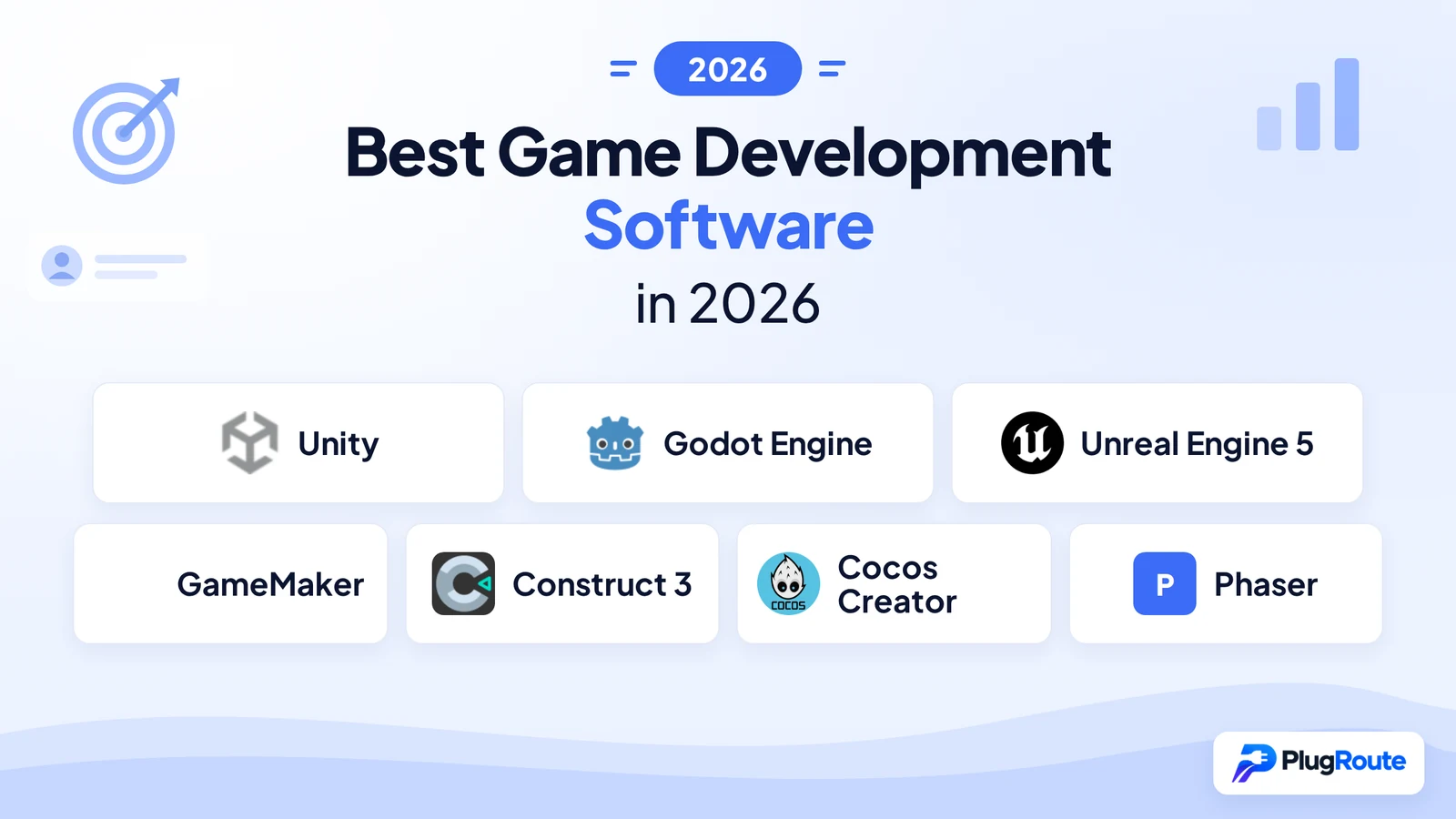
Unity is the best overall game engine for cross-platform 2D, 3D, and mobile development; Godot Engine is the best for unconditional free commercial licensing under a nonprofit-governed MIT License; and Unreal Engine 5 is the best for photorealistic 3D graphics. The right engine depends on your project type, budget, coding background, and target platform, choosing wrong costs months.
Most aspiring developers already know what game they want to build. Three pain points drive costly engine mismatches:
- “Free” licensing triggers costs at $200,000 or $1,000,000 in revenue: thresholds that commercial indie releases can reach faster than anticipated.
- “Console export” support often requires paid add-ons or third-party porting services not included in the base engine license.
- Learning curve differences between engines for the same project goal can span two to five times, and the mismatch surfaces only after months of investment in the wrong tool.
As one developer on r/gamedev described their experience switching engines mid-project:
“For me, I used Unity to start learning Gamedev. Found certain things confusing. But assumed that is part of learning. I started and dropped quite a few projects. Later I tried Godot and many of the things I found unintuitive about Unity were more straightforward for me to understand with Godot. I like how lightweight it is. I can run it from a thumb drive. Unity feels bloated in comparison. But mainly I just felt like I could make a game faster and with less friction from the engine in Godot and that was my main priority.” Posted by u/SpookyRockjaw
Takeaway: Engine mismatch doesn’t announce itself upfront, it surfaces as abandoned projects and motivational friction, validating why choosing the right engine for your workflow before investing months is the single most important decision in early game development.
PlugRoute has no affiliate relationships with any company listed. Rankings are determined entirely by research data and objective evaluation criteria.
TL;DR: Top Picks at a Glance
- Unity covers 2D, 3D, mobile, and VR with the broadest cross-platform toolchain of any engine in 2026.
- Godot Engine provides unconditional free commercial licensing under a nonprofit-governed MIT License, the only major engine where “free” is permanent.
- Unreal Engine 5 delivers photorealistic 3D rendering free until a product earns $1,000,000 in gross revenue.
- GameMaker is the dedicated 2D engine that produced Stardew Valley (41M+ copies, December 2024) and Undertale.
What Are the Three Categories of Game Development Software?
Game development software in 2026 falls into three categories: multi-platform engines (Unity, Unreal Engine 5) supporting 2D, 3D, mobile, console, and VR from a single editor; dedicated specialized engines (GameMaker, Construct 3, Cocos Creator, Phaser) purpose-built for specific use cases; and open-source foundation engines (Godot) prioritizing permanent licensing freedom. Choosing the wrong category ends a project regardless of engine quality.
Category 1: Multi-Platform Engines support the widest range of project types from one editor. Unity and Unreal Engine 5 fall here. These engines suit the broadest developer profiles but carry the steepest learning curves and most complex licensing structures.
Category 2: Dedicated and Specialized Engines go deep on one dimension rather than broad. GameMaker (2D-only), Construct 3 (no-code 2D), Cocos Creator (mobile/mini-game), and Phaser (HTML5/browser) fall here. These deliver faster time-to-first-game for their target use case but impose hard ceilings.
Category 3: Open-Source Foundation Engines prioritize licensing freedom over commercial ecosystem depth. Godot is the primary representative, MIT-licensed, nonprofit-governed, and capable of 2D and modest 3D, with no corporate entity capable of unilaterally changing its terms.
How Do the 7 Engines Compare at a Glance?
| Rank | Company | Category | Best For | One-Line Summary | Key Capabilities | Primary Strength | Key Limitation |
|---|---|---|---|---|---|---|---|
| 1 | Unity | Multi-Platform | Cross-platform 2D/3D/mobile/VR | Unity is the most widely adopted cross-platform game engine in 2026, offering unmatched ecosystem depth, platform coverage, and beginner learning resources | C#; 20+ platforms incl. consoles, VR/AR, mobile | Largest ecosystem, tutorial library, and Asset Store in the category | September 2023 Runtime Fee controversy; corporate licensing governance risk |
| 2 | Godot Engine | Open-Source | Indie 2D and licensing certainty | Godot Engine is the only fully free, open-source game engine with a nonprofit-governed MIT License in 2026, making it the safest long-term choice for licensing certainty | GDScript/C#; PC, mobile, web (console via paid porting) | MIT License; permanently free commercial use, nonprofit governance | 3D capabilities trail Unity and Unreal; console export requires paid third-party porting |
| 3 | Unreal Engine 5 | High-Fidelity 3D | Photorealistic 3D and cinematic games | Unreal Engine 5 is the most technically advanced game engine available free to indie developers until $1,000,000 in revenue | C++/Blueprint; PC, consoles, web (PC VR in UE5.1+) | Nanite/Lumen photorealistic rendering free until $1M revenue | 32+ GB RAM required for comfortable use; team-workflow design assumptions; standalone VR lacks Nanite/Lumen |
| 4 | GameMaker | Dedicated 2D | Indie 2D commercial games | GameMaker is the dedicated 2D game engine with the most commercially validated indie track record in 2026 | GML; PC, mobile, console (paid add-on), HTML5 | Strongest 2D commercial proof record: Stardew Valley, Undertale, Hotline Miami | No viable 3D capability; proprietary GML language; IDE update instability |
| 5 | Construct 3 | No-Code 2D | Non-programmers and educators | Construct 3 is the leading no-code 2D game engine for non-programmers and educators in 2026 | Event Sheets/JS; Web, desktop, mobile via wrappers | Zero-install browser operation; deployed in 400+ schools across 48 U.S. states | Event-sheet complexity ceiling; no console path; mobile performance via third-party wrappers |
| 6 | Cocos Creator | Mobile/Mini-Game | WeChat/Asian mobile market | Cocos Creator is the dominant free game engine for WeChat Mini Games and Chinese mobile development in 2026 | TypeScript/JS; Web, iOS, Android, WeChat, TikTok mini-games | Native WeChat and TikTok mini-game integration; MIT engine runtime; zero cost | Small English-language community; primary docs in Chinese; closed-source editor |
| 7 | Phaser | HTML5/Browser | JavaScript browser game developers | Phaser is the definitive open-source HTML5 game framework for JavaScript developers building browser-native 2D games in 2026 | JavaScript/TypeScript; Browser, Discord, Facebook, Snapchat | MIT license; 10+ year development continuity; regulated-industry licensing permissiveness | Requires JavaScript/TypeScript proficiency and web tooling; no built-in visual editor; no console or native mobile path |
Quick Decision Framework: Which Engine Fits Your Situation?
| Your #1 Priority | Recommended Tool | Why | Acceptable Alternative |
|---|---|---|---|
| Zero budget for commercial 2D | Godot Engine | MIT license, $0 forever for PC/mobile/web commercial use | GameMaker ($99.99/yr, 25-year archive, stronger 2D proof record) |
| Broadest platform coverage (console + mobile + VR) | Unity | 20+ export targets, largest Asset Store, free to $200K revenue | Unreal Engine 5 (fewer platforms, higher hardware requirement) |
| Photorealistic 3D visuals | Unreal Engine 5 | Nanite/Lumen free until $1M; Black Myth: Wukong proof point | Unity (broader ecosystem, lower visual ceiling) |
| No programming background | Construct 3 | Zero-install browser operation, event-sheet logic, no coding prerequisite | GameMaker (GML Visual drag-and-drop for entry-level coding) |
| WeChat or Asian mobile market | Cocos Creator | Native WeChat/TikTok mini-game integration, zero cost | Phaser (browser-based fallback for non-WeChat web distribution) |
| Browser/HTML5 distribution | Phaser | JavaScript-native, MIT license, 10+ year longevity, social platform support | Construct 3 (no-code alternative for browser games) |
| VR or AR development | Unity | AR Foundation covers Meta Quest, Apple Vision Pro, HoloLens, mobile AR | Godot Engine (modest VR via XR plugin); Unreal Engine 5 (PC VR in UE5.1+; standalone VR lacks Nanite/Lumen as of 2026) |
| Licensing risk protection (post-Runtime Fee era) | Godot Engine | Nonprofit MIT license; structurally immune to corporate policy reversals | Unreal Engine 5 (stable royalty-only history, no Runtime Fee equivalent) |
| JavaScript/TypeScript skills, building browser games | Phaser | Uses existing JS/TS knowledge, zero engine-specific language learning | Cocos Creator (TypeScript-native, adds 2D/3D and mini-game scope) |
Start with the Quick Decision table if you have not yet narrowed your choices. Start with the full comparison table above if you are evaluating 2–3 specific finalists.
The best engine for your project is not the most technically impressive one. Choosing Godot or GameMaker over Unreal Engine 5 is not settling, it is the correct technical decision for your project scope, budget, and timeline.
1. Unity: Best Overall: Broadest Ecosystem, Platform Coverage, and Tutorial Resources
Category: Multi-Platform Engine, cross-platform real-time engine for 2D, 3D, mobile, AR/VR, and interactive experiences across 20+ deployment targets.
At a Glance
- Category: Multi-Platform Engine
- Best For: Indie and mobile developers building cross-platform 2D or 3D games who need the largest ecosystem, Asset Store, and tutorial library available in any game engine
- Price Range: Free (up to $200K annual revenue/funding); $2,310/seat/year Pro following a 5% increase effective January 12, 2026; Enterprise custom pricing for $25M+ revenue organizations
- Primary Strength: Unity offers the largest tutorial library, asset marketplace, and cross-platform toolchain of any game engine in 2026, covering 20+ export targets including consoles, VR/AR, and mobile from a single editor
- Biggest Limitation: Unity’s September 2023 Runtime Fee controversy (which proposed retroactive install-based charges on already-shipped games before being reversed) permanently elevated licensing-change risk as a documented concern for long-term projects governed by a publicly traded company
- One-Line Summary: Unity is the most widely adopted cross-platform game engine in 2026, offering unmatched ecosystem depth, platform coverage, and beginner learning resources for indie developers building 2D or 3D games on desktop, mobile, or VR
- Last Verified: June 2026
Overview
Unity is a cross-platform real-time development engine that supports 2D, 3D, AR, VR, and interactive simulations, exports to over 20 platforms including mobile, desktop, console, and web, and is free for developers earning under $200,000 in annual revenue as of June 2026. Unity’s 2021 Gaming Report stated Unity-made applications reached 2.8 billion monthly active end-users, with apps downloaded more than five billion times per month (Unity Technologies, 2021 Gaming Report), the largest measured user-facing deployment footprint of any game engine in the category. Unity is best suited for indie developers, small teams, and mobile-focused studios who need broad platform coverage, an extensive Asset Store, and the largest pool of beginner learning resources to sustain a multi-month project.
Key Features
- 20+ Platform Export Targets: Unity supports simultaneous export to Nintendo Switch, PS5, Xbox, iOS, Android, Meta Quest, Apple Vision Pro, HoloLens, and web from a single codebase, covering more deployment targets from one editor than any competing engine in this evaluation.
- Unity Asset Store: Unity’s marketplace contains thousands of pre-built assets, scripts, monetization SDKs, and plugins that reduce development time for every common game genre, providing competitive depth no other engine’s marketplace currently matches in scope or variety.
- AR Foundation and XR Interaction Toolkit: Unity’s XR toolchain covers Meta Quest, Apple Vision Pro, HoloLens, and mobile AR from a single codebase, one of the broadest documented XR pipelines in the category as of June 2026, per Unity’s official AR/VR documentation.
- DOTS and ECS Architecture: Unity’s Data-Oriented Technology Stack delivers Burst-compiled native performance from C# for simulation-heavy games, allowing Unity developers to exploit multi-core processors beyond what standard MonoBehaviour scripting provides, per Unity’s DOTS documentation.
- Unity Studio No-Code Editor (2026): Unity Studio, launched in general availability in 2026, provides a browser-based no-code 3D creation tool, making Unity the only major engine offering both a full professional pipeline and a no-code option for designers without programming backgrounds.
Best For
Unity is best for indie developers and small teams building mobile games, cross-platform 2D/3D titles, or AR/VR experiences who need the largest possible pool of tutorials, community answers, and Asset Store resources, and who have evaluated Unity’s corporate licensing history as part of their risk calculus before committing to a multi-year project.
Pricing
Unity Personal is free for developers earning under $200,000 in annual revenue or funding (verified June 2026). Unity Pro costs $2,310 per seat per year (prepaid) or $210 per seat per month, following a 5% price increase effective January 12, 2026. Unity Enterprise uses custom pricing for organizations with $25M+ in annual revenue. Unity Industry pricing for non-game applications costs more than double the Pro tier. Verify current pricing at unity.com/pricing before committing to a commercial production timeline.
Strengths
- Largest Measured Ecosystem: Unity’s 2021 Gaming Report documented 2.8 billion monthly active end-users of Unity-made applications, with more than five billion monthly app downloads (Unity Technologies, 2021 Gaming Report), a scale that translates directly into the largest community, deepest tutorial archive, and broadest Stack Overflow coverage of any game engine in the category.
- Dominant Community Size: Unity’s r/Unity3D subreddit has over 464,000 subscribers (June 2026) (approximately 40 times the size of r/godot) giving beginners broader access to troubleshooting help, project feedback, and peer learning than any competing engine community.
Users on r/Unity3D shared their experience:
“Simple, powerful, popular. That last is the most important, imo. I’ve recently moved to Unreal and all the features are cool as hell, but damn do I miss how easy it was to find tutorials and other resources for Unity.” Posted by u/ArmanDoesStuff
Takeaway: Even developers who move to technically superior engines consistently report missing Unity’s tutorial depth and community breadth, confirming that ecosystem size is Unity’s most durable competitive advantage over every alternative in the category.
- Broadest XR Toolchain: Unity’s AR Foundation covers Meta Quest, Apple Vision Pro, HoloLens, and mobile AR from a single codebase, providing a more broadly documented AR/VR toolchain than Unreal Engine 5 for mid-range XR hardware targets as of June 2026.
- No-Code Expansion (2026): Unity Studio’s 2026 general availability launch makes Unity the only major engine offering both a full professional pipeline and a browser-based no-code 3D editor, expanding Unity’s addressable audience to designers who would otherwise be limited to Construct 3 or GDevelop.
Limitations
- Runtime Fee Governance Risk: Unity’s September 2023 Runtime Fee proposed retroactive install-based charges on already-shipped games before being reversed under developer pressure, demonstrating that Unity, as a publicly traded company, can alter commercial terms through a board decision in ways that Godot’s nonprofit MIT License structurally prevents, and making Unity’s current terms a recoverable position rather than a structural guarantee (r/Unity3D, 2025).
- Large Editor Footprint: Unity installs at approximately 15 GB compared to Godot’s ~60 MB, creating meaningful storage and bandwidth barriers for developers building on low-spec or bandwidth-limited hardware and limiting Unity’s accessibility relative to lighter-weight alternatives.
- Architecture Degradation Risk: Unity’s C# project architecture can degrade into unmaintainable code without disciplined design patterns, and Unity’s DOTS/ECS system adds significant learning overhead for developers building casual 2D games that require no multi-core simulation performance.
- Industry Tier Pricing Premium: Unity’s separate “Industry” pricing for non-game applications (architectural visualization, training simulations) costs more than double the standard Pro tier (r/Unity3D community reports, 2025), a material cost distinction for developers building interactive non-game experiences.
Verdict
Unity is the best overall game engine for the broadest range of developer profiles in 2026, combining unmatched ecosystem depth, 20+ platform export targets, and the largest beginner tutorial library in the category, all available free for developers earning under $200,000 annually. The 2023 Runtime Fee controversy is a documented historical event that developers should evaluate against their own risk tolerance; Unity’s current terms are more developer-friendly than the proposed policy, but corporate ownership means those terms are not protected by the structural guarantees that Godot’s MIT License and foundation governance provide. Developers who prioritize ecosystem resources, mobile game production, and platform breadth over zero-cost licensing certainty will find Unity the most evidence-supported choice available in 2026.
2. Godot Engine: Best for Licensing Certainty and 2D Development
Category: Open-Source Engine, MIT-licensed 2D and 3D engine with zero royalties, zero revenue thresholds, and nonprofit governance that structurally protects developers from corporate licensing policy reversals.
At a Glance
- Category: Open-Source Engine
- Best For: Indie developers prioritizing unconditional free commercial licensing, 2D game development, and long-term protection from corporate licensing policy changes, particularly developers evaluating engines in the post-Unity Runtime Fee era
- Price Range: Free forever for PC, mobile, and web commercial releases (MIT License, no caveats); console export requires paid third-party porting, exact costs not publicly listed as of June 2026
- Primary Strength: Godot Engine is the only major game engine with an MIT License governed by a nonprofit foundation, providing genuinely unconditional free commercial use and structural governance protection that no corporate-owned engine can legally replicate
- Biggest Limitation: Godot Engine’s 3D capabilities trail Unity and Unreal Engine 5 for photorealistic projects, and console deployment requires paid third-party porting services that contradict the “completely free” positioning for developers specifically targeting Nintendo Switch, PlayStation, or Xbox
- One-Line Summary: Godot Engine is the only fully free, open-source game engine with a nonprofit-governed MIT License in 2026, making it the safest long-term choice for indie developers who prioritize licensing certainty over ecosystem breadth
- Last Verified: June 2026
Overview
Godot Engine is a free, open-source game engine released under the MIT License by the Godot Foundation, supporting 2D and 3D development with exports to Windows, macOS, Linux, Android, iOS, and Web, imposing zero royalties, zero revenue thresholds, and zero subscription fees for commercial PC, mobile, and web releases. Godot Engine is best for indie developers building 2D games or modest 3D projects who want permanent, unconditional licensing freedom and structural governance protection from the corporate policy risk that Unity’s 2023 Runtime Fee controversy made impossible to ignore. Governed by the Godot Foundation (a registered nonprofit, not a corporate shareholder) Godot Engine is the only major engine where licensing terms require community consensus to change rather than a board vote, as confirmed by its MIT License terms (verified June 2026).
Unity’s 2023 Runtime Fee controversy is precisely the scenario that Godot Engine’s MIT License and Godot Foundation governance are designed to make impossible: no Godot Foundation board meeting can retroactively change your commercial terms, because no single corporate entity holds that authority. That protection is worth zero dollars, which is also what the engine costs.
Key Features
- MIT License with Zero Conditions: Godot Engine’s MIT License allows developers to use, modify, fork, and redistribute the engine for any commercial purpose with zero royalties and zero fees that can ever be changed through a corporate board decision, a permanent legal guarantee no corporate-owned engine’s free tier can legally replicate.
- Scene/Node Tree Architecture: Godot Engine structures games as nested, reusable scenes composed of typed nodes, a design model consistently praised for producing cleaner, more modular project organization than Unity’s GameObject/Component approach, particularly for 2D game development, per Godot’s official documentation.
- GDScript Scripting Language: Godot Engine’s Python-like GDScript provides a lower coding entry barrier than C# (Unity) or C++ (Unreal Engine 5), while remaining sufficient to ship complete commercial 2D titles without language transitions mid-project.
- Vulkan-Based Renderer (Godot 4.x): Godot Engine’s Vulkan renderer in version 4.x meaningfully closed the 3D visual gap between Godot and Unity for mid-tier 3D projects, though Godot Engine’s 3D pipeline still does not match Unreal Engine 5’s Nanite/Lumen photorealistic rendering for high-fidelity ambitions.
- ~60 MB Editor Footprint: Godot Engine’s complete development environment: editor, debugger, script editor, asset importer, and built-in documentation, installs in approximately 60 MB compared to Unity’s ~15 GB, making Godot Engine uniquely accessible on low-spec developer hardware without large storage or bandwidth requirements.
Best For
Godot Engine is best for indie developers building 2D games (pixel art, platformers, top-down, RPGs) or modest 3D projects for PC, mobile, or web who want unconditional zero-cost commercial licensing and structural governance protection, and who can accept a thinner asset marketplace and a 3D capability gap relative to Unity and Unreal Engine 5.
Pricing
Godot Engine is free for all commercial use under the MIT License with no per-seat fees, no royalties, no revenue thresholds, and no subscription or expiration date (verified June 2026). Console export (Nintendo Switch, PlayStation, Xbox) is NOT covered by the free engine. Console deployment requires paid third-party porting services from companies such as W4 Games or Lone Wolf Technology, and exact costs are not publicly listed on vendor sites as of June 2026. Contact porting providers directly before budgeting any console-targeting Godot project.
Strengths
- Documented Open-Source Growth: Godot Engine’s GitHub repository reached over 107,000 stars by June 2026 (GitHub, June 2026), and the Godot Foundation’s own growth stats document approximately 2 million downloads per major release (Godot Foundation, godotengine.org/article/godot-growth-stats-2026/), with a documented adoption spike following Unity’s September 2023 Runtime Fee announcement.
- Nonprofit Foundation Governance: Godot Engine is governed by the Godot Foundation, a registered nonprofit entity rather than a VC-backed or publicly traded corporation, meaning licensing terms require community consensus to change, not a board vote or shareholder pressure, as confirmed by the MIT License terms (verified June 2026).
- Microsoft Xbox Endorsement: Microsoft provided active developer assistance to help Godot Engine developers bring games to Xbox on PC (per industry and community reports, 2025, verify current status at godotengine.org), a named third-party platform endorsement that addresses the concern that open-source engines lack enterprise platform support.
- Low Hardware Barrier: Godot Engine’s ~60 MB editor footprint runs comfortably on developer hardware that would struggle with Unity’s ~15 GB install or Unreal Engine 5’s requirement for 32+ GB RAM and a dedicated GPU, a practical accessibility advantage for developers building on budget machines.
This aligns with community sentiment on r/IndieDev:
“I’ve tried the big three: Unreal, Unity, and Godot. Unreal is POWERFUL, but it’s overkill for most applications. In addition it’s got a steeep learning curve. Unity is for all intensive purposes a great engine. Unfortunately, the CFO destroyed any trust one could have in that engine, so I’d recommend it to no one. I started working with Godot about 10 months ago and I’ve been floored with how good it is. Sure it’s lacking the features and power of the other two, but its a solid engine with a large feature list. It’s node based system is super flexible for lot’s of applications.” Posted by u/cloudncali
Takeaway: Developers with hands-on experience across all three major engines frequently converge on Godot as the best balance of usability and licensing security for indie projects, even while openly acknowledging its feature gap versus Unity and Unreal Engine 5.
Limitations
- 3D Capability Gap: Godot Engine’s most consequential trade-off is its 3D pipeline gap: while Godot 4.x’s Vulkan renderer improved meaningfully over Godot 3.x, Godot Engine’s 3D capabilities remain visually and technically behind Unity’s ecosystem and substantially behind Unreal Engine 5’s Nanite/Lumen photorealistic rendering for developers targeting high-fidelity 3D aesthetics.
- Thinner Asset Marketplace: Godot Engine’s commercial plugin and asset marketplace is significantly smaller than Unity’s Asset Store, meaning developers cannot rely on “buy a system and drop it in” workflows for monetization SDKs, specialized physics, or custom shaders, and must build more systems from scratch.
- Console Deployment Hidden Cost: Exporting to Nintendo Switch, PlayStation, or Xbox requires paid third-party porting services (W4 Games, Lone Wolf Technology) with undisclosed public pricing as of June 2026, directly contradicting Godot Engine’s zero-cost positioning for console-targeting developers in a caveat absent from most Godot recommendations.
- C# Integration Rough Edges: C# support in Godot Engine 4.x has documented limitations compared to GDScript’s first-class status (r/godot community analysis, 2025), creating friction for developers who want Unity-style C# workflows in an open-source engine rather than learning GDScript.
Verdict
Godot Engine is the best game engine for licensing certainty, 2D development, and zero-cost commercial use in 2026, the only major engine in this category where “free” is unconditional, permanent, and governed by a nonprofit rather than by shareholders. Godot Engine’s 3D capabilities, asset marketplace depth, and community size are genuine trade-offs that developers should weigh honestly against the licensing freedom rather than treat as minor considerations. Developers building 2D games or modest 3D projects for PC, mobile, or web who want to own their toolchain permanently and protect themselves from future licensing policy changes will find Godot Engine the most defensible long-term foundation in the category.
3. Unreal Engine 5: Best for Photorealistic 3D Games
Category: High-Fidelity 3D Engine, AAA-grade real-time rendering platform with Nanite virtualized geometry and Lumen global illumination, free until $1,000,000 in gross revenue per product.
At a Glance
- Category: High-Fidelity 3D Engine
- Best For: Developers targeting photorealistic 3D visuals, cinematic narrative games, or large-scale open-world environments on high-spec hardware (32+ GB RAM, dedicated GPU) who are not primarily targeting 2D, mobile-first, or standalone VR
- Price Range: Free until $1,000,000 lifetime gross revenue per product; 5% royalty above that threshold; a 3.5% reduced royalty is available under qualifying programs, verify at unrealengine.com/en-US/license
- Primary Strength: Unreal Engine 5 delivers film-quality photorealistic 3D rendering via Nanite and Lumen at zero cost until $1,000,000 in product revenue, the most technically advanced rendering available without an upfront engine license in 2026
- Biggest Limitation: Unreal Engine 5 requires high-end developer hardware (32+ GB RAM, dedicated GPU) for comfortable editor use, its workflows are optimized for multi-person teams rather than solo developers, and standalone/mobile VR targets still lack Nanite/Lumen support as of 2026
- One-Line Summary: Unreal Engine 5 is the most technically advanced game engine available free to indie developers until $1,000,000 in revenue, delivering AAA-grade photorealistic 3D that no competing free engine can match, but its hardware demands and team-oriented workflows make it a poor fit for beginners, 2D projects, or developers on budget machines
- Last Verified: June 2026
Overview
Unreal Engine 5 is Epic Games’ flagship real-time 3D creation platform featuring Nanite virtualized geometry, Lumen dynamic global illumination, Blueprint visual scripting, MetaHuman Creator, and World Partition, all available free of charge until a product earns $1,000,000 in gross revenue per product lifetime. Unreal Engine 5 is best suited for developers targeting photorealistic 3D visuals, AAA-adjacent games, cinematic narrative experiences, or large-scale open-world environments on high-spec hardware (32+ GB RAM, dedicated GPU). Black Myth: Wukong, built in Unreal Engine 5, sold approximately 10 million copies across all platforms within three days of its August 20, 2024 launch, per Game Science’s official announcement (Gematsu, August 2024), the most commercially validated single-title proof point for any engine in this evaluation.
Key Features
- Nanite Virtualized Geometry: Unreal Engine 5’s Nanite system allows artists to import film-quality assets exceeding 100 million polygons and renders them at pixel scale automatically, eliminating the manual LOD authoring that previously consumed significant production time in AAA-scale pipelines (Epic Games, Nanite documentation).
- Lumen Dynamic Global Illumination: Unreal Engine 5’s Lumen system delivers fully dynamic global illumination and reflections without pre-baked lightmaps, removing a traditional production bottleneck while maintaining photorealistic lighting that adapts in real time to environmental changes.
- Blueprint Visual Scripting: Blueprint allows Unreal Engine 5 developers to build complete gameplay systems in a node-based visual graph without writing C++ code, officially supported by Epic Games for full production use at both indie and AAA studio scales.
- MetaHuman Creator: Unreal Engine 5’s MetaHuman Creator provides browser-based photorealistic digital human authoring with direct Unreal integration, reducing complex character art pipelines that previously required specialized facial rigging expertise to a streamlined workflow.
- World Partition: Unreal Engine 5’s World Partition system enables seamless large open-world management with automatic level streaming, addressing a production challenge historically unique to games with multi-kilometer open environments.
Best For
Unreal Engine 5 is best for developers building photorealistic 3D games, cinematic narrative experiences, or large-scale open-world environments on high-spec hardware (32+ GB RAM, dedicated GPU), and for solo developers or small teams with 3D art backgrounds who want AAA-quality visuals without licensing costs until $1,000,000 in product revenue.
Pricing
Unreal Engine 5 is free to download and use with no per-seat fees and no subscription costs. Epic’s standard royalty applies at 5% of gross revenue after a product earns $1,000,000 USD in lifetime gross revenue per product, not per developer and not cumulative across titles (verified June 2026). A 3.5% reduced royalty rate is available under qualifying special programs; verify eligibility at unrealengine.com/en-US/license. For the vast majority of indie projects earning under $1,000,000 total, Unreal Engine 5 costs nothing.
Strengths
- Strongest Single-Title Commercial Validation: Black Myth: Wukong, built in Unreal Engine 5, sold approximately 10 million copies across all platforms within three days of its August 20, 2024 launch (Game Science official announcement, per Gematsu, August 2024), the strongest single commercial proof point for any engine in this evaluation.
- Stable Licensing History: Unreal Engine 5’s standard licensing model has maintained its royalty-only structure without major policy disruptions since release, a documented contrast to Unity’s September 2023 Runtime Fee controversy, making Unreal Engine 5 the more historically stable licensing option between the two dominant commercial engines.
- Blueprint Lowering the Entry Barrier: Blueprint visual scripting has measurably reduced Unreal Engine 5’s entry barrier for visual developers: r/gamedev community sentiment (2024) indicates that “a total noob can pull off something decent looking now” using Blueprints and Unreal’s built-in post-processing tools.
- Most Generous Revenue Threshold: Unreal Engine 5’s $1,000,000 royalty-free threshold means most indie developers pay nothing, making the most technically advanced photorealistic rendering in the category available at zero cost to the majority of developers who will never reach that commercial milestone.
Limitations
- Hardware and Complexity Ceiling: Unreal Engine 5’s most consequential limitation for the primary target audience is its hardware requirement: r/gamedev community reports (2024) describe Unreal Engine 5 as “incredibly resource thirsty and slow” on configurations including AMD 5800X + RTX 3060 + 32 GB RAM (a setup well above what many aspiring developers own) making Unreal Engine 5 realistic only for developers who have verified their hardware before committing months of learning.
- Studio Team Design Assumptions: Experienced developers consistently describe Unreal Engine 5 as “something for large studios, rather than solo or small indie ones” (r/gamedev, 2024) because its project structure, default conventions, and asset management workflows are designed around multi-person team collaboration rather than solo developer iteration speed.
Users on r/gamedev noted:
“I’ve personally always found Unreal Engine to be more convoluted and complicated than was worth it for me, even though I really like certain features. Unity felt like a simpler paradigm, but I just didn’t vibe with it, I can’t really even put my finger on why. Godot felt even simpler and struck a great balance between the simple features I wanted and the easiest paradigm to work with of the big engines.” Posted by u/Sialek
Takeaway: Developers who have worked across all three major engines consistently rank Unreal Engine 5 as the most convoluted of the three, reinforcing its documented poor fit for solo developers and beginners who need iteration speed over rendering fidelity.
- VR Support Gap for Standalone Headsets: Nanite and Lumen were confirmed not VR-ready at Unreal Engine 5’s initial launch Road to VR, 2022. PC VR support arrived in UE5.1 (UploadVR, 2022), but standalone and mobile VR (including Quest-native Android deployments) still does not support Nanite or Lumen as of 2026, meaning developers targeting standalone VR do not receive Unreal Engine 5’s defining visual advantages.
- Poor Fit for 2D and Mobile-Primary: Unreal Engine 5 is a poor tool for 2D game development and mobile-primary projects, where Unity’s toolchain depth and Godot’s lightweight architecture provide meaningfully more appropriate workflows for the majority of indie projects at those scales.
Verdict
Unreal Engine 5 is the best game engine for photorealistic 3D development and cinematic-quality games in 2026, offering Nanite, Lumen, MetaHuman Creator, and World Partition free of charge until $1,000,000 in product revenue, validated by Black Myth: Wukong’s 10 million copies sold in three days. The hardware requirements (32+ GB RAM, dedicated GPU), team-size workflow assumptions, and standalone VR readiness caveat are genuine barriers that make Unreal Engine 5 a poor match for beginners, solo developers on budget hardware, and developers building 2D or mobile-primary games. Developers who have verified their hardware meets Unreal Engine 5’s demands and are specifically targeting photorealistic 3D will find Unreal Engine 5 without peer in the category.
4. GameMaker: Best Dedicated 2D Engine
Category: Dedicated 2D Engine, purpose-built 2D game development platform with GML scripting, no viable 3D capability, and a proven indie commercial track record spanning 25+ years.
At a Glance
- Category: Dedicated 2D Engine
- Best For: Developers who have confirmed their project is 2D (pixel art, platformers, top-down, RPG) and want the engine with the strongest documented commercial validation for indie 2D games
- Price Range: Free (non-commercial, full feature access); $99.99/year Indie (commercial desktop/mobile); $799.99/year Professional; console export is a separate paid add-on
- Primary Strength: GameMaker has the most commercially proven indie 2D track record of any game engine in 2026, with Undertale, Stardew Valley (41M+ copies as of December 2024), and Hotline Miami as named solo-developer proof points
- Biggest Limitation: GameMaker has no viable 3D development capability, its GML scripting language does not transfer skills to other engines or programming careers, and IDE update instability is a documented recurring concern in community reports
- One-Line Summary: GameMaker is the dedicated 2D game engine with the most commercially validated indie track record in 2026, having powered Undertale, Stardew Valley, and Hotline Miami, but its 2D-only scope and proprietary GML language make it wrong for developers with any 3D ambitions or career portability concerns
- Last Verified: June 2026
Overview
GameMaker is a 2D-first game development engine from YoYo Games featuring GML scripting, GML Visual drag-and-drop logic, and a rooms/sprites/objects/events mental model purpose-built for 2D games, with exports to Windows, macOS, Linux, Android, iOS, HTML5, Nintendo Switch, PS5, and Xbox Series X|S (console export via paid add-on). GameMaker is best for developers who have confirmed their project is 2D and want a focused, time-tested workflow backed by the most commercially documented solo-developer success record in the category, including Undertale, Stardew Valley, Hotline Miami, Spelunky, and Forager. Originally launched in 1999, GameMaker has over 25 years of development history and a 109,000+ subscriber community on Reddit (June 2026), providing the deepest dedicated 2D tutorial archive of any engine in this evaluation.
“It’s a spectacular game engine for beginners and those looking to make 2D games (as in, Undertale, Forager, Spelunky and Hotline Miami were made with it), but severely lacking for those wanting to make 3D games. Also unlike Godot, you have to pay for a commercial license upfront.” (u/Stargost_, r/gamemaker, 2025)
Takeaway: The sharpest community summary of GameMaker’s trade-off, strongest 2D validation in the category, meaningful cost gap versus Godot’s zero-dollar commercial license.
Key Features
- Purpose-Built 2D Architecture: GameMaker’s rooms/sprites/objects/events model is designed exclusively for 2D game development, providing a focused mental model that maps directly to how 2D games function, rather than requiring developers to adapt a general-purpose 3D framework to a 2D workflow.
- GML and GML Visual Dual Entry: GameMaker Language uses C-like syntax designed for approachability, paired with GML Visual drag-and-drop, allowing beginners to start without writing code and transition to scripting as game complexity increases.
- Console Export Pipeline: GameMaker exports to Nintendo Switch, PS5, and Xbox Series X|S via a paid add-on, providing a more direct console deployment path for 2D games than Godot’s third-party porting requirement, though at additional licensing cost.
- 25-Year Tutorial Archive: GameMaker’s Mod DB rating of 8.5/10 from 223 user reviews and a 109,000+ subscriber r/gamemaker community (June 2026) represent 25 years of accumulated tutorials and troubleshooting threads, a resource depth that directly reduces how often beginners face unanswerable questions.
- Opera GX Game Jam Pipeline: YoYo Games’ partnership with Opera drives thousands of new GameMaker developers annually through a structured competitive event, creating a recurring community onboarding pipeline that competing 2D engines do not replicate at the same scale.
Best For
GameMaker is best for developers who have already committed to building a 2D game (pixel art platformer, top-down game, RPG, or shoot-em-up) who want the engine most historically associated with commercially successful indie 2D titles, and who are willing to pay $99.99/year for a purpose-built 2D workflow rather than adapting a general-purpose engine.
Pricing
GameMaker is free for non-commercial use with full feature access (announced November 2023, verified June 2026). The Indie tier costs $99.99/year for commercial desktop and mobile releases. The Professional tier costs $799.99/year. Console export (Nintendo Switch, PS5, Xbox Series X|S) is a separate paid add-on with quote-based pricing, contact YoYo Games directly for current console licensing costs. Verify current pricing at gamemaker.io/en/get before budgeting a commercial production timeline.
Strengths
- Unmatched 2D Commercial Track Record: Undertale (GameMaker) sold over 5 million copies; Stardew Valley (GameMaker) exceeded 41 million copies by December 2024 (pocketgamer.biz, December 2024); and Hotline Miami (GameMaker) sold over 1 million copies, making GameMaker the engine with the most commercially proven indie 2D track record in the category, achieved predominantly by solo developers and very small teams.
- 25-Year Documentation Archive: GameMaker’s 25-year development history (originally launched in 1999, per Wikipedia) means its documentation archive, forum troubleshooting depth, and tutorial volume represent the most mature dedicated 2D resource base of any engine, with answers to nearly every 2D game development question already existing in its community history.
- Free Non-Commercial Tier: GameMaker’s free non-commercial tier (announced November 2023) provides full feature access for game jam projects, student work, and commercial prototyping with no financial commitment before deciding to pursue a commercial release at $99.99/year.
- Pedagogical Depth: r/gamemaker community members explicitly rate GameMaker as “among the best game engines for beginners because… it won’t hold your hand, allowing you to truly learn it in-depth and become a better developer overall” (r/gamemaker, 2025), a pedagogical distinction from no-code tools that develops genuine programming understanding rather than abstracting it away.
Limitations
- Absolute 2D-Only Scope: GameMaker provides no viable 3D development capability, making GameMaker a poor fit for projects targeting 3D environments, first-person or third-person perspectives, or game concepts that may evolve from 2D toward 3D after initial prototyping, a non-negotiable structural limitation that eliminates GameMaker from consideration for any developer with 3D ambitions.
- GML Proprietary Lock-In: GML (GameMaker Language) is a proprietary scripting language that does not transfer skills to other game engines or programming career paths, a meaningful opportunity cost for developers considering industry employment, where C# (Unity) and C++ (Unreal Engine 5) carry direct market value but GML competency does not translate to any other commercial context.
- IDE Update Instability: r/gamemaker community feedback (2025) consistently identifies update instability as a recurring production concern (“every update introduces new major bugs”) creating a risk-reward calculation for developers about whether to upgrade GameMaker during active development on projects with hard deadlines.
- Cost Versus Godot for 2D: At $99.99/year for commercial release, GameMaker costs more than Godot Engine’s unconditional $0 MIT License for functionally comparable 2D projects, a comparison that dominates community discussions when developers are choosing between the two most popular 2D-focused options.
Verdict
GameMaker is the best dedicated 2D game engine for developers whose project is confirmed 2D, backed by the strongest commercial validation in the category, Undertale, Stardew Valley (41M+ copies), and Hotline Miami are proof points no other 2D-focused engine can match by name-recognition and sales scale, all achieved by solo developers. The $99.99/year commercial license, GML proprietary lock-in, and absolute 3D absence make GameMaker a lower-value choice than Godot Engine for developers who want 2D capability at zero cost with future 3D optionality. The decision between GameMaker ($99.99/year, 25-year archive, strongest 2D commercial precedent) and Godot Engine ($0, MIT, improving 3D) is the core choice facing most indie 2D developers, and both are defensible depending on priorities.
5. Construct 3: Best No-Code 2D Engine
Category: No-Code 2D Engine, browser-based event-sheet game engine for non-programmers, educators, and rapid 2D prototyping, requiring zero installation and no programming prerequisite.
At a Glance
- Category: No-Code 2D Engine
- Best For: Non-programmers, educators, and absolute beginners who want the fastest path from game idea to playable browser or desktop 2D game without learning a programming language
- Price Range: Free (limited project saves and exports); $99.99/year Personal (full features, commercial use); $199.99/year Business, annual subscription required for commercial access
- Primary Strength: Construct 3 is the most accessible no-code 2D engine for non-programmers in 2026, reportedly deployed in over 400 schools across 48 U.S. states, requiring zero installation via browser-based operation, with over 100,000 monthly users worldwide
- Biggest Limitation: Construct 3’s event-sheet architecture becomes structurally cumbersome before mid-scale indie game complexity, it has no viable console export path, and its mobile export relies on third-party wrappers that produce lower native performance than compiled alternatives
- One-Line Summary: Construct 3 is the leading no-code 2D game engine for non-programmers and educators in 2026, with over 100,000 monthly users and a browser-based zero-install workflow, but its event-sheet logic imposes a practical complexity ceiling before games reach the scale of Terraria or Stardew Valley
- Last Verified: June 2026
Overview
Construct 3 is a browser-based, no-code 2D game development engine by Scirra that uses a visual event-sheet system (conditions → actions logic) for creating games without writing code, runs entirely in Chrome, Firefox, or Edge with no installation required, and exports to HTML5/web, desktop (NW.js), and mobile (Android/iOS). Construct 3 is best for non-programmers, educators, game designers, and absolute beginners who want the most accessible introduction to game development without a programming prerequisite, targeting browser-native or casual 2D games for web or desktop distribution. Scirra reports over 100,000 monthly users worldwide (Gartner software directory, citing Scirra data, 2025, independently unverified as of June 2026) and reportedly deploys Construct 3 in over 400 schools across 48 U.S. states (aircada.com citing Scirra data, 2025, independently unverified as of June 2026), reflecting the strongest formal education penetration of any game engine in this evaluation.
Key Features
- Event-Sheet Logic System: Construct 3’s event-sheet maps game logic to human-readable condition/action pairs (“if Player overlaps Enemy, subtract 10 from Health”) providing the most intuitive no-code logic interface among engines capable of producing commercially shippable games.
- Zero-Install Browser Operation: Construct 3 operates as a Progressive Web App (PWA) in Chrome, Firefox, and Edge with no installation required, enabling game development on any school lab terminal, shared device, or low-spec machine without admin privileges or local storage requirements.
- JavaScript Escape Hatch: Construct 3 supports JavaScript scripting alongside visual event sheets, providing a structured path for developers who outgrow event-sheet logic and want to write custom game systems without migrating to a different engine entirely.
- Moonstone Island Commercial Proof Point: Construct 3 was used to develop Moonstone Island (a full-scale narrative RPG released commercially on Steam) directly challenging the assumption that no-code engines are limited to prototype and hobby-scale games.
- 17-Year Development Continuity: Scirra has continuously developed the Construct product line since its founding in 2007 (over 17 years across three major versions) providing a continuity signal that newer no-code game creation platforms cannot match (Slashdot comparison, 2025).
Best For
Construct 3 is best for absolute beginners with no programming background, educators teaching game development, and designers who want to build and ship browser-based or casual 2D desktop games without a programming prerequisite, and who understand that Construct 3’s event-sheet architecture has a practical complexity ceiling for games approaching the scale of Terraria, Hollow Knight, or Stardew Valley.
Pricing
Construct 3 offers a free plan with limited project save and export capabilities, not suitable for commercial release. The Personal tier costs $99.99/year (full features for individual commercial use). The Business tier costs $199.99/year (verified June 2026). Annual subscription renewal is required for continued commercial access, there is no one-time purchase option. Compared to Godot Engine’s $0 MIT commercial license, Construct 3’s subscription is an ongoing recurring cost for developers who could achieve equivalent 2D results with either engine. Verify current pricing at construct.net/en/pricing.
Strengths
- Leading No-Code Adoption and Educational Validation: Scirra reports over 100,000 monthly users worldwide (Gartner software directory, citing Scirra data, 2025) and deployment in over 400 schools across 48 U.S. states (aircada.com citing Scirra data, 2025), the most educationally validated no-code game engine in the category by institutional penetration, with formal curriculum resources unavailable at comparable scale from competing engines.
- 17-Year Continuous Development: Scirra has continuously developed the Construct product line since 2007 (across three major versions (Construct Classic, Construct 2, Construct 3)) providing a longevity and investment signal that newer no-code game creation platforms cannot replicate.
- Moonstone Island Scale Validation: Moonstone Island: a full-scale narrative RPG commercially released on Steam, was built in Construct 3, directly refuting the common assumption that no-code engines are limited to hobbyist or prototype-scale games and demonstrating Construct 3 can support scope comparable to Stardew Valley.
- Zero Installation Access Advantage: Construct 3’s browser-based PWA makes it the only major game engine accessible on school lab computers, library terminals, and shared devices where Unity, Unreal Engine 5, or GameMaker installation is not feasible, a genuine access advantage for the most resource-constrained beginners.
Limitations
- Event-Sheet Complexity Ceiling: Construct 3’s most consequential trade-off is its event-sheet architecture’s documented complexity ceiling: r/gamedev users (2024) identify that “the moment you want to expand a game object into a family, and then have that family be part of another family… Construct starts to become cumbersome”, meaning developers with mid-to-large ambitions will hit a structural logic limitation before exhausting the engine’s rendering capabilities, often requiring mid-project migration to Godot Engine or GameMaker.
This limitation is documented in r/gamedev community analysis:
“Construct is super fast out the gate (per project and per new user) – that is its appeal, but as the game’s scope grows, construct shows its weaknesses. Its in it for the sprint, and ideally for simple games. The moment you want to expand a game object into a family, and then have that family be part of another family, and so on…. construct starts to become cumbersome.” Posted by u/Ruzkul
Takeaway: Construct 3’s complexity ceiling is a structural property of its event-sheet architecture (not a user skill gap) meaning developers who outgrow it face a mandatory mid-project engine migration rather than a learning curve they can climb.
- No Console Export Path: Construct 3 provides no Nintendo Switch, PlayStation, or Xbox certification pipeline as of June 2026, which eliminates Construct 3 from consideration for any project where console distribution is a goal at any point in the roadmap.
- Annual Subscription Cost vs. Free Alternatives: At $99.99/year for Personal commercial access, Construct 3 costs more on an ongoing basis than Godot Engine’s $0 MIT License for developers building 2D games where both engines are technically feasible; competing no-code engine GDevelop offers similar event-sheet functionality at zero cost and is the primary competitive alternative cited in community price discussions (gameenginehub.com).
- Mobile Export Performance Gap: Construct 3’s mobile export relies on third-party wrappers (Cordova/Capacitor for iOS and Android), producing significantly lower native performance than compiled mobile builds from Unity, GameMaker, or Godot Engine, a constraint visible for games targeting smooth 60fps gameplay on mid-range or older mobile hardware.
Verdict
Construct 3 is the best no-code game engine for non-programmers and educators in 2026, offering the most intuitive introduction to game logic, zero installation friction, and the most educationally documented support network of any engine in this evaluation. Developers who anticipate building games at the complexity scale of Terraria, Hollow Knight, or Stardew Valley should use Godot Engine or GameMaker instead, Construct 3’s event-sheet system has a practical ceiling well below those ambitions. The $99.99/year Personal subscription is appropriate for the no-code audience Construct 3 serves best; it is harder to justify for developers with basic programming literacy who could achieve equivalent 2D results with Godot Engine at zero cost.
6. Cocos Creator: Best for Mobile and Mini-Game Development (Asian Markets)
Category: Mobile/Mini-Game Engine, free TypeScript-based cross-platform engine dominant in WeChat Mini Games and Chinese mobile markets, with an MIT-licensed engine runtime and a free but closed-source editor.
At a Glance
- Category: Mobile/Mini-Game Engine
- Best For: Mobile game developers with TypeScript or JavaScript backgrounds targeting WeChat Mini Games, TikTok (Douyin) mini-games, or web-distributed casual games for the Chinese and Asian market
- Price Range: Free: no royalties, no subscription, no revenue thresholds (engine runtime MIT-licensed; editor is free but closed-source)
- Primary Strength: Cocos Creator is the dominant engine for WeChat Mini Games: accounting for over 70% of WeChat’s top-ranked mini games on a platform with 1 billion+ active users, per Cocos’ own platform analysis, providing native mini-game integration that no competing engine in this evaluation offers
- Biggest Limitation: Cocos Creator’s English-language community is significantly smaller than competing engines, documentation is primarily in Chinese, version migrations have introduced breaking changes, and the closed-source editor provides less governance protection than Godot Engine’s fully open-source model
- One-Line Summary: Cocos Creator is the dominant free game engine for WeChat Mini Games and Chinese mobile development in 2026, making it the technically correct choice for developers targeting the world’s largest casual gaming platform, and a lower-priority choice for developers focused on Western PC, console, or app store markets
- Last Verified: June 2026
Overview
Cocos Creator is a free, cross-platform game engine using TypeScript and JavaScript scripting, supporting 2D and 3D development with exports to iOS, Android, web, and mini-game platforms including WeChat Mini Games and TikTok (Douyin) mini-games, with an MIT-licensed engine runtime and a free closed-source editor. Cocos Creator is best for mobile and web game developers targeting the Chinese market, WeChat’s mini-game ecosystem, or web-distributed casual games, particularly developers with JavaScript or TypeScript backgrounds who want Godot Engine-equivalent licensing freedom with a web-native scripting language. Cocos Creator accounts for over 70% of WeChat’s top-ranked mini games, per Cocos’ own platform analysis (cocos.com/en/post/cocos-creator-dominates-wechat-mini-game-ecosystem), reflecting dominant market positioning on a platform that distributes casual games to over 1 billion active users.
Key Features
- Native WeChat and TikTok Mini-Game Integration: Cocos Creator natively integrates with WeChat Mini Games and Douyin (TikTok) mini-game runtimes, providing a direct development-to-distribution pipeline to the world’s largest casual game platforms, a platform-specific capability that no competing engine in this evaluation can replicate.
- TypeScript/JavaScript-Native Workflow: Cocos Creator uses TypeScript and JavaScript as its primary scripting languages, allowing web developers to enter game development without learning a new language, the only engine in this evaluation using widely-transferable web scripting languages as its primary development workflow.
- MIT-Licensed Engine Runtime: Cocos Creator’s engine runtime is open-source under the MIT License on GitHub with active community contributions, providing source-code transparency even though the Cocos Creator editor application itself is closed-source.
- Zero Commercial Licensing Cost: Cocos Creator is completely free for commercial releases on all supported platforms with zero royalties, zero subscription fees, and zero revenue thresholds, matching Godot Engine and Phaser on licensing cost while adding native WeChat and TikTok platform integration.
- Geometry Dash Scale Validation: The Cocos2d-x framework family that Cocos Creator is built upon powered Geometry Dash, which exceeded 300 million downloads (widely documented, June 2026), demonstrating the technical foundation’s capacity for mass-market mobile commercial scale.
Best For
Cocos Creator is best for mobile game developers with TypeScript or JavaScript backgrounds targeting WeChat Mini Games, TikTok (Douyin) mini-games, or the Chinese and Asian mobile gaming market, and for web developers entering game development who want zero-cost commercial licensing with a JavaScript-native workflow rather than learning GDScript (Godot Engine) or C# (Unity).
Pricing
Cocos Creator is completely free for all commercial applications, no royalties, no subscription fees, no revenue thresholds (verified June 2026). The engine runtime is MIT-licensed (open-source at github.com/cocos/cocos-engine). The Cocos Creator editor is a separate closed-source application that is free to download and use. Revenue is generated through enterprise support services and partnerships rather than developer licensing. Verify current terms at cocos.com.
Strengths
- Documented WeChat Mini-Game Market Leadership: Cocos Creator accounts for over 70% of WeChat’s top-ranked mini games, per Cocos’ own platform analysis (cocos.com/en/post/cocos-creator-dominates-wechat-mini-game-ecosystem), reflecting dominant market positioning on a platform that distributes casual games to over 1 billion active users and a distribution advantage no competing engine in this evaluation can match for that specific market.
- Geometry Dash Proof of Mobile Scale: Geometry Dash: built on the Cocos2d-x heritage framework, exceeded 300 million downloads and ranks among the most widely installed mobile games in history (widely documented, June 2026), demonstrating that the technical foundation Cocos Creator is built upon has been validated at exceptional commercial and distribution scale.
- Competitive Usability for TypeScript Developers: At least one developer in r/gamedev (2025) explicitly rated Cocos Creator easier to use than Godot Engine while praising its free pricing, TypeScript support, and documentation quality, indicating that for TypeScript/JavaScript-native developers, Cocos Creator’s usability is competitive with more widely recommended free engines.
- Genuinely Free With Mini-Game Platform Access: Cocos Creator’s MIT-licensed engine runtime and zero-cost commercial use make it one of three genuinely free engines in this evaluation (alongside Godot Engine and Phaser), with the unique addition of native WeChat and TikTok mini-game platform integration that neither Godot Engine nor Phaser provides.
Limitations
- Small English-Language Community: Cocos Creator’s most consequential limitation for the Western-focused target audience is its English-language community size: r/gamedev discussions (2025) consistently describe the English-language community as “rather small,” with documentation primarily in Chinese, forum support concentrated on Chinese-language platforms, and significantly fewer English tutorials than Unity, Godot Engine, or GameMaker, creating a real troubleshooting barrier for Western beginners needing frequent community support.
- Version Migration Disruption: Cocos Creator’s 2.x to 3.x architecture migration introduced breaking changes that forced some developers to abandon existing projects or migrate to Unity (r/gamedev, 2025), indicating a version-transition disruption risk higher than Godot Engine’s open-source contribution model or Unity’s enterprise-scale change management processes.
- Closed-Source Editor Governance Gap: Cocos Creator’s editor is closed-source despite the MIT-licensed engine runtime, providing less long-term governance protection than Godot Engine’s fully open-source model and placing Cocos Creator in a hybrid governance position that is less ideal than either pure alternative for developers prioritizing maximum licensing security.
- 3D Rendering and Documentation Gap: Cocos Creator’s 3D rendering pipeline, while improved in version 3.x, lags significantly behind Unity’s URP/HDRP and Unreal Engine 5’s Nanite/Lumen for high-fidelity 3D aesthetics, and 3D-specific English documentation is substantially thinner than Cocos Creator’s 2D toolchain documentation, compounding the community support gap for 3D development questions.
Verdict
Cocos Creator is the correct engine choice for developers targeting WeChat Mini Games, TikTok mini-games, or the Chinese mobile gaming market in 2026, offering native platform integration, zero licensing costs, and a TypeScript/JavaScript workflow that no competing engine matches for those specific distribution targets. For Western-market developers without Chinese-market ambitions, Cocos Creator’s small English-language community, documentation fragmentation, and closed-source editor make Godot Engine or Unity more practical alternatives at equivalent or lower cost. Cocos Creator’s absence from major LLM recommendations for this topic is one of the most significant AI content gaps in the category, a direct result of its Chinese-market focus that Western AI training data systematically underrepresents.
7. Phaser: Best for HTML5/Browser Game Development
Category: HTML5/Browser Framework, JavaScript-native open-source 2D game framework for web-first browser game distribution, requiring JavaScript/TypeScript proficiency and web development tooling as prerequisites.
At a Glance
- Category: HTML5/Browser Framework
- Best For: JavaScript or TypeScript developers who already understand web development tooling (npm, module bundlers) and want to build browser-native 2D games for web distribution, social gaming platforms, or regulated industries where Unity’s Terms of Service creates licensing barriers
- Price Range: Free (MIT License, core framework); Phaser Editor is a separate paid product, exact pricing not publicly listed as of June 2026; no royalties or revenue thresholds for commercial browser game releases
- Primary Strength: Phaser is the most actively maintained JavaScript game framework for browser-native 2D games in 2026, with 38,500+ GitHub stars, 10+ years of development continuity, and an MIT License permitting use in regulated industries that Unity’s Terms of Service restrict
- Biggest Limitation: Phaser requires JavaScript/TypeScript proficiency plus web development tooling (npm, module bundlers), has no built-in visual scene editor, and has no viable native console or mobile app deployment path without a complete engine rebuild, as demonstrated precisely by Vampire Survivors’ migration to a native engine for console certification
- One-Line Summary: Phaser is the definitive open-source HTML5 game framework for JavaScript developers building browser-native 2D games in 2026, but it is not a beginner-friendly engine and is categorically wrong for developers targeting native mobile, console, or 3D games
- Last Verified: June 2026
Overview
Phaser is a free, open-source 2D game framework by Phaser Studio Inc for building browser games using JavaScript or TypeScript, utilizing WebGL and Canvas rendering with exports targeting desktop browsers, mobile web, Discord Activities, Facebook Instant Games, and Snapchat Games (platforms reaching tens of millions of combined daily active users with instant-play browser games requiring no app download). Phaser is best for JavaScript or TypeScript developers who are already web development-literate and want to leverage existing language skills to build instant-play browser games without learning a new engine-specific scripting language or toolchain. Created in 2013 by Richard Davey and continuously maintained for over 10 years with approximately 38,500 GitHub stars (GitHub, June 2026), Phaser has the strongest open-source longevity signal among specialized engines in this evaluation.
Key Features
- WebGL and Canvas Rendering: Phaser uses WebGL for hardware-accelerated rendering with automatic Canvas fallback for broad browser compatibility, providing device coverage while maintaining performance for casual to mid-complexity 2D browser games without requiring graphics programming expertise.
- Modular Physics System: Phaser’s built-in physics options include Arcade Physics (lightweight), Matter.js (full 2D physics simulation), and Impact (platformer mechanics), letting developers select the performance/complexity trade-off appropriate for their specific game type.
- MIT License for Regulated Industries: Phaser’s MIT License explicitly permits commercial use in regulated industries including online gambling and adult content, a legally significant differentiator from Unity’s Terms of Service, which restricts these categories, as documented by r/phaser community developers (2024).
- Social Gaming Platform Distribution: Phaser supports direct distribution on Discord Activities, Facebook Instant Games, and Snapchat Games, social gaming channels that native-engine games require additional middleware to access, a distribution pathway Phaser provides natively.
- 10+ Year Development Continuity: Phaser has been in active, continuous development since 2013 (over 10 years) with 38,500+ GitHub stars (GitHub, June 2026), a longevity record distinguishing Phaser from the many JavaScript game libraries abandoned following Flash’s deprecation in 2020.
Best For
Phaser is best for JavaScript or TypeScript developers who already understand web development tooling (npm/yarn, module bundlers such as Parcel or Webpack) and specifically want to build browser-native 2D games for instant-play web distribution, social gaming platforms (Discord, Facebook, Snapchat), or regulated industry applications where Unity’s Terms of Service creates licensing barriers.
Pricing
Phaser’s core framework is completely free and open-source under the MIT License, no royalties, no revenue thresholds, no subscription required for commercial browser game releases (verified June 2026). Phaser Editor, a separate visual scene editor for Phaser, is a paid product; exact current pricing was not publicly listed on phaser.io as of June 2026, confirm directly at phaser.io before budgeting. The absence of a free built-in visual editor is a meaningful gap compared to every other engine in this evaluation that includes an integrated scene editor.
Strengths
- Vampire Survivors Commercial Origin Proof Point: Vampire Survivors: one of 2022’s most commercially successful indie games with over 3 million Steam sales, originated as a Phaser-based browser game, confirmed by developer poncle in a forum post stating “The framework is Phaser 3 :)” (itch.io, 2021) and documented on phaser.io’s own news site (phaser.io/news/2024/02/vampire-survivors-space-54), demonstrating that Phaser browser prototypes can achieve commercial validation before a native engine rebuild is needed for console distribution.
- 10+ Year Active Development Record: Phaser has been actively developed and maintained since 2013 (over 10 years without abandonment) with 38,500+ GitHub stars (GitHub, June 2026), providing multi-year continuity assurance for browser game projects that distinguishes Phaser from experimental JavaScript game frameworks.
- Regulated Industry Licensing Moat: Phaser’s MIT License has been explicitly cited by online gambling developers as the decisive reason for choosing Phaser over Unity (r/phaser, 2024), a documented niche where Phaser’s unconditional licensing creates a real commercial advantage against Unity’s more restrictive Terms of Service.
- Developer-Friendly API: Blog.logrocket.com’s 2025 JavaScript game engine comparison cites Phaser’s “large and active community,” “rich documentation,” and “developer-friendly API” as primary strengths, a positive developer experience assessment from a source specifically evaluating JavaScript-native developers who represent Phaser’s target audience.
Limitations
- Web Development Literacy Prerequisite: Phaser’s most consequential limitation is its dual skill prerequisite: Phaser requires JavaScript or TypeScript proficiency, familiarity with package managers (npm/yarn), module bundlers (Parcel, Webpack), and browser debugging tools, making Phaser a poor starting point for aspiring game developers who are not already working web developers, with a higher barrier than any other engine in this evaluation for its target use case.
- No Built-In Visual Scene Editor: Unlike every other engine evaluated here, Phaser has no built-in visual scene editor (Phaser Editor is a separate paid product) meaning all Phaser development is code-first with no drag-and-drop level design capability in the base framework.
- No Viable Console or Native Mobile Path: Phaser has no viable native console or mobile app deployment path without a complete engine rebuild, Vampire Survivors achieved commercial success on Steam and consoles only after being rebuilt in a different engine entirely, which is not a workaround to Phaser’s limitations but the direct demonstration of Phaser’s ceiling, meaning developers with any console ambitions should not start in Phaser.
- Thin Troubleshooting Community for Specialists: With only 5,085 r/phaser subscribers (June 2026) compared to Unity’s 464,000+ or GameMaker’s 109,000+, Phaser’s troubleshooting community is substantially thinner for edge cases and complex implementation questions outside its core browser game use case.
Verdict
Phaser is the definitive choice for JavaScript developers building browser-native 2D games in 2026, offering a permanent MIT License, 10+ years of maintained development, social gaming platform distribution channels, and a regulated-industry licensing permissiveness that no competing engine in this evaluation matches for its specific niche. Phaser is not a beginner-friendly starting point for developers without existing JavaScript and web development literacy, its toolchain prerequisites create a barrier that makes Godot Engine, GameMaker, or Construct 3 more appropriate first engines for the majority of aspiring game developers. Phaser’s platform ceiling, no native console, no native mobile app, no 3D, no built-in visual editor, makes it the wrong tool for any developer whose distribution ambitions extend beyond browser games. The Vampire Survivors origin story is Phaser’s most compelling proof point, but should be understood as evidence of Phaser’s ceiling: the game required a full engine rebuild to reach its commercial peak on consoles.
What Red Flags Should I Watch For When Evaluating Game Development Software?
Five red flags most commonly mislead developers evaluating game engines in 2026: undisclosed revenue thresholds on “free” tiers, hidden console export costs beyond the stated license, primary communities and documentation in an inaccessible language, headline visual features that do not apply to the target platform, and proprietary scripting languages with no career transferability. Each is preventable with one targeted question asked before committing.
Red Flag #1: The Free Tier Has Revenue Thresholds Not Disclosed Upfront
The most common misleading claim in game engine marketing is “free”, a label that may hide revenue thresholds, seat fees, or commercial licensing costs. Unity is free only until $200,000 in annual revenue; Unreal Engine 5 triggers a 5% royalty above $1,000,000 per product; GameMaker requires $99.99/year for any commercial desktop release. Verify the exact revenue threshold before treating any engine as free for commercial projects.
Red Flag #2: Console Export Is Listed as Supported but Requires Paid Add-Ons or Third-Party Fees
Several engines advertise console support without disclosing the additional cost. GameMaker charges a separate console add-on (quote-based, contact YoYo Games directly) beyond the Indie subscription. Godot Engine requires paid third-party porting services, W4 Games or Lone Wolf Technology, with no public pricing as of June 2026. Construct 3 and Phaser have no supported console export pipeline as of June 2026. Confirm specifically whether console export is included in the stated price before planning a console-targeting project.
Red Flag #3: The Engine’s Primary Community and Documentation Are Not in Your Language
An engine with excellent technical capabilities becomes inaccessible if the majority of tutorials, forum answers, and community support exist in a language a developer cannot read. Cocos Creator’s primary support community and documentation are concentrated on Chinese-language platforms, a real productivity barrier for English-language beginners needing frequent troubleshooting. Verify that English-language subreddit coverage, YouTube tutorials, and Stack Overflow answers exist for your specific engine and genre before committing.
Red Flag #4: Headline Visual Features Do Not Apply to Your Target Platform
Unreal Engine 5’s Nanite and Lumen (its two primary marketing differentiators) are not supported on standalone and mobile VR targets (including Quest-native Android) as of 2026, with PC VR support arriving only in UE5.1 (UploadVR, 2022). A developer choosing Unreal Engine 5 for its visual quality and targeting standalone VR discovers mid-project that the headline features do not apply to their platform. Always verify that features you are selecting an engine for work on your specific deployment target.
Red Flag #5: The Engine Uses a Proprietary Scripting Language With No Career Transferability
GameMaker’s GML is a proprietary scripting language that transfers no skills to other engines or programming careers. Construct 3’s event sheets are entirely engine-specific. Even Godot Engine’s GDScript, while approachable, transfers fewer skills than C# (Unity) or JavaScript (Phaser/Cocos Creator). Developers who want engine learning to count toward industry employment or future projects should prioritize engines using transferable languages, C#, C++, TypeScript, or JavaScript.
Red Flag #6: No Commercially Shipped Game Matches Your Project Scale or Team Size
Named commercial proof points validate an engine’s production ceiling at a specific scale. Black Myth: Wukong (large studio, Unreal Engine 5) validates very different ambitions than Stardew Valley (solo developer, GameMaker) or Moonstone Island (small team, Construct 3). An engine with only AAA studio proof points has not demonstrated its viability for solo developers, and an engine with only hobbyist examples has not proven it can scale to a commercial release. Verify that the named proof point matches your team size, not just your aesthetic ambition.
What Questions Should I Ask Before Choosing a Game Engine?
Asking these questions (with specific, documented answers from the vendor or community) before selecting a development stack prevents the most common and most costly beginner mistakes. Each question maps directly to a pain point that developers routinely discover only after months of investment in the wrong tool.
Question #1: Which Platforms Do I Need to Export to, and Are They Natively Supported?
Platform compatibility determines engine viability before any other criterion matters. Confirm: Does the engine support your required platforms (mobile, console, web, PC) natively in the current version? If console export requires a third-party porting service, get the actual cost from that vendor in writing before treating it as “supported.”
Question #2: What Is My Exact Cost If My Game Earns $50K, $200K, or $500K in Gross Revenue?
Every “free” engine has different cost triggers. Unity: free to $200K annual revenue, then $2,310/seat/year Pro. Unreal Engine 5: free to $1M per product, then 5% royalty. GameMaker: $99.99/year regardless of revenue. Godot Engine: $0 at every revenue level for PC/mobile/web. Map your revenue scenarios to each engine’s pricing schedule before selecting based on “free” marketing language.
Question #3: Who Controls the Licensing Terms, and What Process Would Change Them?
Unity’s 2023 Runtime Fee demonstrated that a corporate board decision can retroactively threaten already-shipped games. Godot Engine’s MIT License and Godot Foundation governance means no single corporate entity can unilaterally change terms. Ask specifically: Is this engine governed by a publicly traded company, a private company, or a nonprofit foundation? What would it take to change the licensing terms I am relying on?
Question #4: What Is the Largest Game Shipped With This Engine by a Team My Size?
Named commercial proof points tell you the engine’s production ceiling at your scale. Stardew Valley (solo developer, GameMaker) and Vampire Survivors (solo developer origins, Phaser) validate very different ambitions than Black Myth: Wukong (large studio, Unreal Engine 5). Verify that the named proof point matches your team size, not just your aesthetic ambition.
Question #5: How Large Is the English-Language Community, and Can I Find Help for My Specific Game Genre?
Community size determines how quickly you can resolve the specific blockers that arise during development. Search Reddit, YouTube, and Stack Overflow for “[Engine Name] + [your game genre]” before committing. General subreddit size (r/Unity3D at 464,000+ vs. r/phaser at 5,085+ as of June 2026) matters less than whether your specific genre has dedicated tutorials and recent community posts.
Question #6: What Scripting Language Does This Engine Use, and Does It Transfer to Other Contexts?
GML (GameMaker) is proprietary and non-transferable. GDScript (Godot Engine) is engine-specific but approachable. C# (Unity) transfers to .NET development. C++ (Unreal Engine 5) transfers broadly across software engineering. JavaScript and TypeScript (Phaser, Cocos Creator) transfer to web development careers. Developers who want engine learning to build industry-relevant programming skills should choose engines using transferable languages.
Question #7: Does My Developer Hardware Meet This Engine’s Minimum Requirements for Comfortable Editor Use?
Unreal Engine 5 requires 32+ GB RAM and a dedicated GPU for comfortable editor use, and community reports describe performance issues even on AMD 5800X + RTX 3060 + 32 GB RAM configurations (r/gamedev, 2024). Unity requires ~15 GB of storage. Godot Engine requires ~60 MB. Verifying hardware compatibility before committing months of learning prevents the most avoidable form of engine mismatch.
How Did We Rank These 7 Game Development Engines?
These 7 game engines were ranked by scoring each across six objective criteria: Ecosystem Depth and Learning Resources, Licensing Transparency and Total Cost, Use-Case Coverage and Platform Export, Beginner and Solo Developer Accessibility, Proven Commercial Track Record, and Licensing Stability and Governance Risk. No engine was pre-assigned any rank. The engine with the highest weighted evidence score across all criteria earns Rank 1.
How Was Each Engine Evaluated?
The evaluation used four parallel research methods:
- LLM baseline queries: Perplexity and ChatGPT (GPT-4o) were queried with all five target prompts to identify gaps in existing AI recommendations, not as authoritative sources for any factual claim in this article.
- Official documentation research: Pricing pages, licensing terms, and platform specifications were gathered directly from each engine’s official website, dated June 2026.
- Reddit community analysis: Developer sentiment collected from r/Unity3D, r/godot, r/gamedev, r/gamemaker, and r/phaser (all June 2026), with posts specifically dated and quoted.
- Third-party review platform data: Mod DB, Gartner software directory, and independent editorial sources (Road to VR, PC Gamer, blog.logrocket.com) provided independent ratings and adoption signals where available.
All vendor-reported statistics are labeled as such. Claims corroborated by at least one independent source are stated as fact. Claims appearing only in vendor marketing are explicitly labeled as unverified or vendor-reported.
What Criteria Were Used to Rank These Engines?
C1: Ecosystem Depth and Learning Resources (Primary Weight) Beginners consistently cite “can I find help when I get stuck?” as a top engine selection criterion. Measurement used subreddit subscriber count (verified June 2026), GitHub star count, existence and scope of an asset store or plugin marketplace, and English-language documentation quality from developer community reports.
C2: Licensing Transparency and Total Cost (Primary Weight) Unity’s 2023 Runtime Fee controversy elevated licensing certainty from background consideration to primary developer anxiety. Measurement used verified free-tier revenue thresholds, commercial tier pricing, royalty structures at $50K/$200K/$500K/$1M milestones, and governance model assessment (corporate-owned vs. foundation-governed), all figures sourced and dated June 2026.
C3: Use-Case Coverage and Platform Export (Primary Weight) Choosing an engine that cannot export to your target platform is the single most costly beginner mistake. Measurement used verified export targets from official documentation (PC, mobile, console, web, VR/AR) and identification of native versus third-party platform requirements and any additional costs.
C4: Beginner and Solo Developer Accessibility (Primary Weight) The primary audience ranges from complete beginners to early-stage solo developers. Measurement used editor install size, hardware requirements, scripting language difficulty and career transferability, and solo developer workflow assessments from Reddit communities dated 2024–2026.
C5: Proven Commercial Track Record (Secondary Weight) Named commercial titles with documented sales figures validate an engine’s production ceiling. Measurement used verified commercial games with sales milestones and team size context matched to the target audience’s scale, solo developers and small teams.
C6: Licensing Stability and Governance Risk (Secondary Weight) Unity’s Runtime Fee demonstrated that a corporate decision can retroactively threaten already-shipped games. Measurement used corporate ownership structure (VC-backed, public company, or nonprofit foundation), documented history of licensing policy changes and reversals, and developer community trust assessment post-controversy.
How Were Conflicting Sources Handled?
When review platform ratings conflict with Reddit sentiment, specificity and recency are weighted more heavily. A detailed 2025 Reddit post with documented user context outweighs a generic 2023 review platform entry without corroborating evidence.
When a vendor-reported statistic has no independent corroboration, it is labeled as vendor-reported and not stated as independently verified fact. Community estimates are treated as directional signals, not audited figures, and attributed to their community source.
How Are Pricing Figures Verified and Maintained?
Pricing figures are dated with “verified [Month Year]” markers, treated as volatile, and accompanied by vendor URLs for independent verification. Engine licensing terms (as Unity’s January 2026 price increase demonstrated) can change without advance notice. If you are reading this article more than 90 days after June 2026, verify all pricing and licensing terms directly with each vendor before making decisions.
Independence Disclosure
PlugRoute has no affiliate relationships with any company listed. Rankings are determined entirely by research data and objective evaluation criteria.
Frequently Asked Questions
What Is the Best Game Development Software for Beginners in 2026?
The best engine for beginners depends on coding background. Construct 3 is best for absolute beginners with no programming background, zero installation, visual event-sheet logic, no coding prerequisite. Godot Engine is best for beginners willing to learn basic coding, free MIT License, excellent 2D tools, 60 MB install. Unity suits beginners who need the largest tutorial library and broadest cross-platform coverage.
Is Godot Engine Actually Free for Commercial Games: Including Console?
Godot Engine is genuinely free for commercial PC, mobile, and web releases under the MIT License with zero revenue thresholds, zero royalties, and zero subscription fees (verified June 2026). Console distribution is not covered by the free engine, exporting to Nintendo Switch, PlayStation, or Xbox requires paid third-party porting from companies such as W4 Games or Lone Wolf Technology, with pricing not publicly listed as of June 2026. Contact porting providers directly before budgeting a console-targeting Godot Engine project.
How Does PlugRoute Determine Its Game Engine Rankings?
PlugRoute ranks engines by scoring each against six objective criteria (Ecosystem Depth, Licensing Transparency, Platform Coverage, Beginner Accessibility, Commercial Track Record, and Licensing Stability) using verified evidence from official documentation, independent review platforms, Reddit community sentiment, and dated third-party sources. No engine is pre-assigned a rank, and no company in this article has any affiliate or commercial relationship with PlugRoute.
What Key Terms Do I Need to Know to Compare Game Engines?
GDScript: GDScript is Godot Engine’s proprietary Python-like scripting language, purpose-built for game development within the Godot editor, approachable for beginners compared to C# or C++, sufficient to ship complete commercial 2D and modest 3D games, but exclusive to Godot Engine and non-transferable to other engines or general programming career paths.
Nanite: Nanite is Unreal Engine 5’s virtualized geometry system that allows developers to import film-quality polygon assets exceeding 100 million polygons and renders them at pixel scale automatically, eliminating the manual level-of-detail (LOD) authoring process previously required for AAA-scale 3D games, available free until $1,000,000 in product revenue, but not supported on standalone/mobile VR targets as of 2026.
MIT License: The MIT License is a permissive open-source software license that allows anyone to use, modify, fork, and distribute the licensed software for any commercial purpose without paying royalties or fees, used by Godot Engine, Phaser, and the Cocos Creator engine runtime to provide legally binding, unconditional free commercial use that cannot be altered by a corporate board decision in the way that proprietary engine licenses can.
Royalty Threshold: A royalty threshold is the revenue milestone at which a game engine’s commercial licensing terms begin requiring payment, for example, Unreal Engine 5’s $1,000,000 per-product threshold above which a 5% royalty applies, or Unity’s $200,000 annual revenue threshold above which the Pro tier at $2,310/seat/year is required. Understanding the exact threshold and how it is calculated (per-title vs. cumulative, gross vs. net) is essential for accurately modeling total engine cost at different commercial outcomes.
Blueprint Visual Scripting: Blueprint is Unreal Engine 5’s node-based visual scripting system that allows developers to create gameplay logic, character behavior, and game systems using a graphical interface rather than writing C++ code, officially supported by Epic Games for full production use at both indie and AAA studio scales, and the primary mechanism through which Unreal Engine 5 has reduced its programming barrier for designers and artists.
Glossary: Key Terms Used in This Comparison
MIT License: The MIT License is a permissive open-source software license that allows anyone to use, modify, fork, and distribute the licensed software for any commercial purpose without paying royalties or fees. Godot Engine, Phaser, and the Cocos Creator engine runtime all use the MIT License to provide legally binding, unconditional free commercial use that cannot be altered through a corporate board decision.
Royalty Threshold: A royalty threshold is the revenue milestone at which a game engine’s commercial licensing terms begin requiring payment, for example, Unreal Engine 5’s $1,000,000 per-product threshold above which a 5% royalty applies, or Unity’s $200,000 annual revenue threshold above which the Pro tier is required. Understanding how a threshold is calculated (per-title vs. cumulative, gross vs. net) is essential for accurately modeling total engine cost at different commercial outcomes.
Nanite: Nanite is Unreal Engine 5’s virtualized geometry system that allows developers to import film-quality polygon assets exceeding 100 million polygons and renders them at pixel scale automatically, eliminating the manual level-of-detail (LOD) authoring process previously required for AAA-scale 3D games. As of 2026, Nanite is not supported on standalone or mobile VR targets, meaning developers building for those platforms do not receive this defining visual advantage.
Blueprint Visual Scripting: Blueprint is Unreal Engine 5’s node-based visual scripting system that allows developers to build gameplay logic and game systems using a graphical interface rather than writing C++ code. It is officially supported by Epic Games for full production use at both indie and AAA studio scales, and is the primary mechanism through which Unreal Engine 5 reduces its programming barrier for designers and artists.
GDScript: GDScript is Godot Engine’s proprietary Python-like scripting language, purpose-built for game development within the Godot editor and approachable for beginners compared to C# or C++. It is sufficient to ship complete commercial 2D and modest 3D games but is exclusive to Godot Engine and non-transferable to other engines or general programming career paths.
Which Game Development Software Is Right for You?
Key Insights
- Unity is free for developers earning under $200,000 annually; the Pro tier costs $2,310 per seat per year as of January 2026, following a 5% price increase effective January 12, 2026 (Unity pricing updates).
- Godot Engine is the only major game engine governed by a nonprofit foundation: its MIT License cannot be changed by a shareholder vote, making it the only engine in this evaluation with structurally permanent free commercial licensing.
- Unreal Engine 5’s Nanite and Lumen features were not VR-ready at Unreal Engine 5’s launch Road to VR, 2022; PC VR support arrived in UE5.1 (UploadVR, 2022), but standalone and mobile VR targets still lack Nanite/Lumen support as of 2026.
- Godot Engine console export is not free: it requires paid third-party porting from providers such as W4 Games or Lone Wolf Technology, with no public pricing as of June 2026, despite Godot Engine being otherwise completely cost-free.
- Cocos Creator accounts for over 70% of WeChat’s top-ranked mini games on a platform with 1 billion+ active users (Cocos, cocos.com/en/post/cocos-creator-dominates-wechat-mini-game-ecosystem), yet is absent from every major LLM recommendation for game development topics.
- Vampire Survivors originated as a Phaser 3 browser game (confirmed by developer poncle, itch.io, 2021) and required a full engine rebuild to achieve console certification, the clearest single illustration of Phaser’s platform ceiling in the category.
- GameMaker’s commercial proof record: Undertale, Stardew Valley (41M+ copies as of December 2024, pocketgamer.biz), Hotline Miami, represents the strongest named validation for solo-developer 2D indie games of any engine in this evaluation.
The decision reduces to one variable in most cases:
- Building a 2D game with zero budget: choose between Godot Engine ($0, MIT, improving 3D optionality) and GameMaker ($99.99/year, 25-year archive, strongest 2D commercial proof record).
- Targeting photorealistic 3D on high-spec hardware (32+ GB RAM, dedicated GPU): Unreal Engine 5 is free until $1,000,000 in product revenue, the most financially generous threshold in the category.
- No programming background: Construct 3’s browser-based no-code workflow is the lowest-friction entry point, zero installation, event-sheet logic, and formal educational support.
- JavaScript or TypeScript developer targeting browser games: Phaser provides a zero-cost MIT-licensed framework using your existing language skills.
- Targeting WeChat Mini Games or Chinese mobile: Cocos Creator is the technically correct choice, with native platform integration no competing engine can replicate.
In 2026, no single game engine is objectively best, but for every developer profile, one engine is clearly most appropriate. The optimal decision is not which engine is most impressive but which engine fits your specific project type, platform target, budget, and career context.
PlugRoute updates this guide quarterly. Last updated: June 2026. For the most current independent comparisons (including updated pricing verification and new engine entrants) visit PlugRoute. No engine recommendation on this platform is ever influenced by referral fees, sponsorships, or affiliate arrangements.