Google Imagen 4 is the best overall AI image generator in 2026, delivering top-tier photorealism for free via ImageFX. Ideogram 3.0 leads specifically for text-in-image design work. OpenAI GPT-4o Image Generation is the strongest choice for conversational, instruction-following workflows. No single generator wins every use case, the right tool depends entirely on your workflow requirements.
The AI image generation market in 2026 spans dozens of serious platforms, each with distinct strengths, different pricing models, and real gaps in specific use cases. The right tool depends on whether you need artistic expression, readable embedded text, photorealistic product imagery, commercial IP safety, or zero per-image cost at scale. Whether you call it an AI art generator, a generative AI image tool, or a text-to-image model, the selection challenge is the same in 2026.
PlugRoute has no affiliate relationships with any company listed. Rankings are determined entirely by research data and objective evaluation criteria.
“MJ is more artsy, Ideogram is more precise. In my work (CD) I use Ideogram much more lately. And sometimes use free ImageFX by Google, it’s really good for portraits and interiors.” Posted by u/dergachoff, r/ideogramai, February 2025
Takeaway: Creative professionals in 2026 routinely combine multiple AI image generators for different task types (using free tools for general work, specialized tools for text accuracy, and premium tools for artistic quality) a multi-tool reality this review’s decision framework is designed to navigate.
TL;DR: Top Picks at a Glance
- Google Imagen 4 is the best overall AI image generator in 2026, delivering top-tier photorealism for free via ImageFX with no subscription required beyond a Google account.
- Ideogram 3.0 is the best AI image generator for text-in-image design, achieving 90–95% text accuracy at approximately three times Midjourney’s 30–40% rate, starting from $7/month.
- OpenAI GPT-4o Image Generation is the best AI image generator for non-technical users, offering native multi-turn conversational refinement within ChatGPT for instruction-specific image creation without prompt engineering.
- FLUX by Black Forest Labs leads independent 2025–2026 photorealism evaluations, delivering 4MP output in under 10 seconds with the highest documented anatomical accuracy among all reviewed generators.
- Adobe Firefly is the best AI image generator for enterprise IP safety, as the only reviewed generator with 100% licensed training data and legal indemnification against copyright challenges.
- Midjourney V8 (currently in alpha testing, April 2026) produces outputs that a community of 1.77 million users consistently rates as more aesthetically expressive than any competing generator across five model generations.
- Stable Diffusion 3.5 is the only AI image generator with zero per-image marginal cost at production scale via local deployment, backed by an ecosystem of 100,000+ community-trained models on CivitAI.
What Are the Main Categories of AI Image Generators in 2026?
AI image generators in 2026 fall into six distinct categories: Artistic (Midjourney), Photorealistic (FLUX, Google Imagen 4), Conversational (OpenAI GPT-4o), Specialized Text-in-Image (Ideogram 3.0), Enterprise IP-Safe (Adobe Firefly), and Open-Source (Stable Diffusion 3.5). Matching your primary use case to the correct category eliminates mismatched tools before any feature comparison begins.
The six categories reviewed here are:
- Artistic Generator: optimized for cinematic, expressive output over photorealistic accuracy. Midjourney is the benchmark, recognized by a community of 1.77 million users for aesthetic “soul” and cinematic warmth.
- Photorealistic Generator: optimized for output indistinguishable from real photography. FLUX (Black Forest Labs) leads on independent 2025–2026 technical evaluations; Google Imagen 4 provides benchmark-competitive quality at zero cost via ImageFX.
- Conversational Generator: integrated within a chat interface for iterative natural-language refinement. OpenAI GPT-4o Image Generation is the primary example, handling 10–20 precise objects in complex scenes through multi-turn dialogue.
- Specialized Text-in-Image Generator, built for legible, stylistically accurate text within generated images. Ideogram 3.0 leads with a documented 90–95% accuracy rate, approximately three times Midjourney’s 30–40%, confirmed by multiple independent 2026 sources (crepal.ai, 2026; MindStudio, 2025).
- Enterprise IP-Safe Generator: trained exclusively on licensed content with documented commercial indemnification. Adobe Firefly is the only reviewed generator in this category with fully documented licensed training data and enterprise legal protection.
- Open-Source Generator: open-weight models deployable locally at zero per-image marginal cost. Stable Diffusion 3.5 leads, with FLUX.1 Schnell as a photorealism-optimized complement available under Apache 2.0 for commercial use.
Google Imagen 4 spans multiple categories (delivering benchmark-competitive photorealism, free consumer access, native Google Workspace integration, and the most widely deployed AI content provenance system through SynthID) making it the only reviewed generator that crosses category boundaries at competitive quality simultaneously.
How Do the Top AI Image Generators Compare at a Glance?
The seven AI image generators reviewed here span six distinct categories (from free photorealistic tools to open-source customization platforms) with no single generator leading across all six evaluation criteria. The table below ranks all seven by weighted score across Output Quality, Prompt Adherence, IP Safety, Text Accuracy, Pricing, and Accessibility, verified as of April 2026.
| Rank | Company | Category | Best For | One-Line Summary | Key Capabilities | Primary Strength | Key Limitation |
|---|---|---|---|---|---|---|---|
| 1 | Google Imagen 4 | Photorealistic | Google Workspace users; budget-conscious creators | Google Imagen 4 is the only reviewed generator delivering top-tier photorealism at zero cost via ImageFX, with SynthID watermarking deployed across 10+ billion images for AI content provenance | Free via ImageFX; SynthID at 10B+ scale; Workspace integration; Vertex AI for enterprise | Top-tier quality at zero cost; most widely deployed AI content provenance system | Enterprise API requires Google Cloud Platform setup; Imagen 4 ranks #10 on LM Arena (1,172 ELO) |
| 2 | Ideogram 3.0 | Specialized Text-in-Image | Graphic designers; marketing teams with text-heavy content | Ideogram 3.0 achieves 90–95% legible text accuracy in generated images; approximately three times Midjourney’s 30–40% rate; making it the only production-reliable generator for text-embedded visuals | 90–95% text accuracy; Style Codes; Style Reference; Canvas Editor; 5–10 second generation | 90–95% text accuracy vs. 30–40% for Midjourney, confirmed by structured 18/20 vs. 4/20 evaluation (crepal.ai, 2026) | Post-3.0 quality regression documented; general photorealism below FLUX and Midjourney |
| 3 | OpenAI GPT-4o Image Generation | Conversational | Non-technical users; iterative complex scene composition | OpenAI GPT-4o image generation is the only reviewed generator enabling native multi-turn conversational refinement within ChatGPT, with GPT Image 1.5 holding LM Arena #1 at 1,264 ELO | Conversational multi-turn refinement; 10–20 element scene accuracy; LM Arena #1 (GPT Image 1.5, 1,264 ELO) | LM Arena #1 benchmark score; only generator with native conversational image refinement in a chat interface | 30–60 second generation; outputs rated “artistically bland” by community |
| 4 | FLUX (Black Forest Labs) | Photorealistic | Product photography; advertising; developer pipelines | FLUX by Black Forest Labs leads independent 2025–2026 photorealism evaluations, delivering 4MP output in under 10 seconds with anatomically correct hands and pore-level skin texture | Photorealism leadership in independent evaluations; 4MP in under 10 seconds; FLUX 2 Max at LM Arena #4 (1,168 ELO) | Technical photorealism leadership; 4MP in under 10 seconds; Apache 2.0 commercial free tier | API-only commercial access; per-image pricing not published on bfl.ai as of April 2026 |
| 5 | Adobe Firefly | Enterprise IP-Safe | Enterprise teams requiring commercial IP indemnification | Adobe Firefly is the only major AI image generator in this review with fully documented licensed training data and enterprise legal indemnification against IP challenges | 100% licensed training data; enterprise IP indemnification; Content Credentials; Photoshop Generative Fill | 100% licensed training data + enterprise IP indemnification; unique in this review | Native model quality 12–18 months behind state-of-the-art; 500 credits per 5-second 1080p video |
| 6 | Midjourney | Artistic | Artists; concept artists; creative directors | Midjourney V8 (currently in alpha, April 2026) produces the artistically highest-rated output in the category; recognized by 1.77 million users for cinematic warmth; at native 2K resolution in alpha | Artistic quality benchmark; 1.77M community; V8 alpha: 2K resolution, 5x faster, native video; V7 at LM Arena ~1,228 ELO | Universally recognized artistic quality benchmark; largest dedicated AI image community | No free tier; no free trial; V8 still in alpha testing; unclear commercial IP provenance |
| 7 | Stable Diffusion 3.5 | Open-Source | Developers; high-volume production; privacy-sensitive workflows | Stable Diffusion 3.5 is the only AI image generator with zero per-image marginal cost at production scale via local deployment, backed by 100,000+ fine-tuned models on CivitAI | Zero per-image cost at scale; 100,000+ CivitAI models; full local deployment; no internet required | Zero per-image cost at scale; 100,000+ CivitAI ecosystem models for unmatched customization | Significant technical expertise and GPU hardware required; base model quality floor is low |
Which AI Image Generator Should I Choose for My Use Case?
| Your #1 Priority | Recommended Tool | Why | Acceptable Alternative |
|---|---|---|---|
| State-of-the-art quality at zero cost | Google Imagen 4 (ImageFX) | Google Imagen 4 delivers benchmark-competitive quality for free via ImageFX with no subscription required beyond a standard Google account, confirmed by third-party LM Arena rankings for the Google Imagen ecosystem. | OpenAI GPT-4o (free ChatGPT tier, limited access) |
| Readable text inside generated images | Ideogram 3.0 | Ideogram 3.0 achieves 90–95% text-in-image accuracy; approximately three times Midjourney’s 30–40% documented rate; confirmed by a structured 18/20 vs. 4/20 prompt evaluation (crepal.ai, 2026). | OpenAI GPT-4o (very good text rendering, but 6x slower) |
| Conversational refinement without prompt engineering | OpenAI GPT-4o Image Generation | OpenAI GPT-4o Image Generation is the only reviewed generator with native multi-turn conversational image iteration within ChatGPT, maintaining full chat history and reference image context across revisions. | Google Imagen 4 via Gemini conversational interface |
| Highest photorealism for product photography | FLUX (Black Forest Labs) | FLUX leads independent 2025–2026 photorealism evaluations with 4MP output in under 10 seconds and documented pore-level skin texture and anatomical hand accuracy, with FLUX 2 Max at LM Arena #4 (1,168 ELO). | Google Imagen 4 (free, top-tier quality via ImageFX) |
| Enterprise IP indemnification for commercial campaigns | Adobe Firefly | Adobe Firefly is the only reviewed generator with 100% licensed training data and enterprise legal indemnification against IP challenges, confirmed by Adobe engineering team documentation (2025). | Google Imagen 4 (SynthID provenance; no formal indemnification) |
| Best artistic and cinematic visual quality | Midjourney V8 (alpha, April 2026) | Midjourney V8, currently in alpha testing, produces outputs that a community of 1.77 million users consistently rates as more aesthetically expressive than any competing generator across five model generations. | Google Imagen 4 (free fallback for portraits and scenic compositions) |
| Zero per-image cost at production scale | Stable Diffusion 3.5 | Stable Diffusion 3.5 is the only reviewed generator with no marginal cost at scale after hardware setup, with 100,000+ CivitAI models for style and subject customization unavailable from any commercial generator. | FLUX.1 Schnell (Apache 2.0 free, higher photorealism than SD base model) |
| Already using Adobe Creative Cloud | Adobe Firefly | Photoshop Generative Fill, Content Credentials, and IP-safe generation are already included in Creative Cloud workflows without a new tool adoption barrier or separate subscription at the enterprise tier. | Partner models (Google Imagen, FLUX) accessible within the Firefly interface |
| Evaluate multiple tools before spending anything | Google Imagen 4 + Ideogram 3.0 free tier | Between ImageFX (free, benchmark-competitive) and Ideogram’s free tier (free, 90%+ text accuracy), both category leaders can be evaluated at zero cost before any subscription decision. | FLUX.1 Schnell (Apache 2.0, free for commercial local use) |
Use the table above to jump directly to your highest-priority entry using the numbered section headers. Each entry is independently readable, the At a Glance block at the top of every entry summarizes the tool in under 60 seconds. Return to the Red Flags and Evaluation Questions sections before finalizing any paid subscription, regardless of which entry matches your primary use case.
1. Google Imagen 4: Best Overall: Best for Google Workspace Users and Budget-Conscious Creators
Category: Photorealistic Generator, text-to-image model producing photorealistic and stylistic visuals from natural language prompts, available free to any Google account holder via ImageFX and embedded natively in Google Workspace applications including Slides, Docs, Vids, and Gemini.
At a Glance
- Category: Photorealistic Generator
- Best For: Google Workspace organizations, budget-conscious creators, and enterprises requiring AI content provenance compliance without a new tool subscription
- Price Range: Free (ImageFX, Google account required) + $19.99/month (Google One AI Premium) + Vertex AI GCP volume billing for enterprise
- Primary Strength: Google Imagen 4 delivers top-tier photorealism for free via ImageFX, with SynthID AI content provenance watermarking applied to over 10 billion images globally, surviving cropping, resizing, and compression
- Biggest Limitation: Google Imagen 4’s enterprise API via Vertex AI requires Google Cloud Platform infrastructure setup, a technical barrier for small teams without GCP expertise; additionally, the current Imagen 4 model ranks #10 on LM Arena (1,172 ELO), a regression from Imagen 3’s #2 position (1,235 ELO)
- One-Line Summary: Google Imagen 4 is the only reviewed AI image generator delivering top-tier photorealism at zero cost through ImageFX, with SynthID AI content provenance watermarking deployed across 10 billion images globally, making it the strongest overall recommendation for the broadest audience in 2026
- Last Verified: April 2026
Overview
Google Imagen 4 is Google DeepMind’s flagship AI image generation model, available free to any Google account holder via ImageFX, Gemini, Whisk, and natively in Google Slides, Docs, and Vids, making it the most widely accessible state-of-the-art generator reviewed, serving casual creators to enterprise teams without requiring a new tool subscription.
Gemini 3 Pro Image, Google’s Imagen 3-era model available through the Gemini API, scored 1,235 ELO on the LM Arena text-to-image leaderboard (#2 globally, based on 43,000+ user votes, LM Arena via WaveSpeed, 2026). Google Imagen 4, the current model reviewed here, ranks #10 on the same leaderboard at 1,172 ELO, reflecting speed and fine-detail rendering optimizations made at its May 2025 launch. Google Imagen 4’s May 2025 Google I/O launch introduced improvements in detail rendering, including an upcoming variant projected at up to 10x faster than Imagen 3.
Key Features
- Top-Tier Photorealistic Output Across the Google AI Ecosystem: Google Imagen 4 generates images at up to 2K resolution with fine-detail texture rendering of fabric weaves, water droplets, and animal fur. Gemini 3 Pro Image (Imagen 3-era) scored 1,235 ELO on the LM Arena text-to-image benchmark (#2 globally, LM Arena via WaveSpeed, 2026), with Google Imagen 4 currently ranking #10 at 1,172 ELO, reflecting trade-offs made for generation speed and fine-detail improvements at the May 2025 launch.
- Native Google Workspace Integration at No Additional Cost: Google Imagen 4 is embedded in Google Slides, Docs, Vids, Whisk, and Gemini, enabling image generation within tools hundreds of millions of enterprise users already use daily, eliminating the adoption barrier of a new tool subscription for organizations already licensed on Google Workspace (Google AI Developer Documentation, 2026).
- SynthID AI Content Provenance Watermarking at Scale: Google Imagen 4 applies SynthID watermarking to every generated output, an imperceptible pixel-level digital watermark that survives cropping, resizing, compression, and filtering, deployed across over 10 billion images and video frames globally as of 2025 (Google DeepMind, 2025; TechCrunch, 2025).
- Multiple Access Tiers Without Tool Switching: Google Imagen 4 is accessible across ImageFX (free consumer), Gemini app (daily generation), Whisk (creative remixing tool), Google One AI Premium ($19.99/month), and Vertex AI (enterprise-scale production via GCP), serving use cases from casual creation to high-volume automated pipelines without requiring separate subscriptions at each tier.
- Developer API with Three Generation Variants: Google Imagen 4’s developer API is available via Google AI Studio as
imagen-4.0-generate-001,ultra, andfastvariants through the Gemini API (Google AI Developer Documentation, 2026), enabling integration into custom applications and automated content workflows with speed-quality trade-off control.
Best For
Google Imagen 4 is best for Google Workspace organizations that need image generation integrated directly into their existing productivity tools at no additional cost, and for budget-conscious individual creators who need state-of-the-art image quality without a paid subscription, making it the strongest starting point for anyone evaluating AI image generators for the first time in 2026.
Pricing
Google Imagen 4 is free via ImageFX with a standard Google account as of April 2026. Google One AI Premium at $19.99/month includes Gemini Advanced with higher Imagen 4 access limits. Enterprise access via Vertex AI uses GCP volume-based billing; specific per-image API rates were not confirmed from publicly available sources as of April 2026, contact Google Cloud directly for current enterprise pricing. Developer API access is available through the Gemini API pricing structure via Google AI Studio.
Strengths
- Gemini 3 Pro Image: Google’s Imagen 3-era model, scored 1,235 ELO on the LM Arena text-to-image leaderboard (#2 globally, based on 43,000+ human-preference votes, LM Arena via WaveSpeed, 2026), establishing the Google AI ecosystem’s strong benchmark foundation; Google Imagen 4 currently ranks #10 on the same leaderboard at 1,172 ELO, reflecting speed and detail-rendering optimizations introduced at the May 2025 launch.
- Google Imagen 4 is available for free via ImageFX to any Google account holder: a quality-access combination that Reddit power users in r/midjourney (November 2025) explicitly cited as justification for canceling Midjourney Pro subscriptions at $60/month, indicating real-world perceived competitive parity with leading paid alternatives (r/midjourney, November 2025).
Users on r/midjourney noted:
“A heavy user of MJ since v 4, I unfortunately had to abandon Midjourney in favor of Imagen 3 & 4, then Seedream 4, and now Grok Image. I’m sorry, but you’d have to be crazy to keep using MJ ($60 a month) when there are so many other image tools that are better…” Posted by u/Bronkilo
Takeaway: Long-term Midjourney power users are openly switching to Google Imagen 3 and 4 as free alternatives, citing the cost-to-quality ratio as indefensible at Midjourney’s $60/month tier.
- Google Imagen 4’s SynthID watermarking system has been deployed across over 10 billion images and video frames, the most widely deployed AI content provenance infrastructure in this review, providing verifiable generation identification that survives common image modifications for organizations navigating AI content disclosure obligations (Google DeepMind, 2025; TechCrunch, 2025).
- Google Imagen 4’s native integration into Google Workspace gives organizations already licensed on that platform state-of-the-art AI image generation with zero additional software adoption, procurement overhead, or tool onboarding, a deployment advantage that no other reviewed generator offers.
Limitations
- Enterprise Access Gap: Google Imagen 4’s most consequential limitation is the gap between its free consumer experience and enterprise production capability. ImageFX’s free tier does not expose batch generation, precise API control, or documented generation limits. Vertex AI’s enterprise API requires Google Cloud Platform infrastructure setup and billing configuration, a technical barrier that makes production-scale automation inaccessible to freelancers and small teams without GCP expertise.
- Benchmark Regression From Predecessor: Google Imagen 4 currently ranks #10 on the LM Arena text-to-image leaderboard at 1,172 ELO, a 63-point regression from Gemini 3 Pro Image (Imagen 3-era) at 1,235 ELO (#2). Users prioritizing maximum LM Arena benchmark quality within Google’s ecosystem may find the Gemini API’s Gemini 3 Pro Image delivers higher-scoring output than Google Imagen 4 on this specific human-preference measure (LM Arena via WaveSpeed, 2026).
- Content Policy Restrictions: Google Imagen 4 applies content policy restrictions that professional creative users in game design, fantasy illustration, and healthcare marketing may encounter for legitimate workflow purposes, including certain fantasy weapon references, mature artistic themes, and some medical visual content (Campus Technology, September 2025).
- Human Anatomy Challenges in Complex Scenes: Google Imagen 4 retains acknowledged challenges with complex human finger rendering in multi-person scenes, a limitation that persists across most reviewed generators and affects professional use cases requiring precise anatomical accuracy.
Verdict
Google Imagen 4 is the strongest all-around AI image generator recommendation for 2026 across the broadest audience, combining free access via ImageFX with the most widely deployed AI content provenance system through SynthID and native Google Workspace integration. Google Imagen 4 earns the #1 overall ranking through its unique combination of free consumer access, SynthID provenance at 10B+ scale, and Workspace integration, not through LM Arena benchmark leadership, which is currently held by OpenAI GPT Image 1.5 at 1,264 ELO. For Google Workspace organizations and first-time evaluators, Google Imagen 4’s ImageFX provides a zero-cost starting point that delivers top-tier quality and establishes the evaluation baseline against which every paid alternative must justify its subscription cost.
2. Ideogram 3.0: Best for Text-in-Image Design: Best for Graphic Designers and Marketing Content Teams
Category: Specialized Generator, AI image generation tool with category-leading text-in-image accuracy, purpose-built for graphic design, typography, and marketing visual workflows requiring readable type within generated images.
At a Glance
- Category: Specialized Generator
- Best For: Graphic designers, social media creators, and marketing teams embedding readable text inside AI-generated images at production scale
- Price Range: Free (limited daily cap) + $7/month (Basic) + $20/month (Plus)
- Primary Strength: Ideogram 3.0 achieves a 90–95% legible text success rate in generated images (approximately three times Midjourney’s 30–40%) confirmed by a structured 18/20 vs. 4/20 evaluation (crepal.ai, 2026) and multiple independent sources
- Biggest Limitation: Ideogram 3.0’s general photorealistic output has drawn documented community regression reports post-launch, with long-term subscribers citing inconsistency in rendering living organisms and reduced reliability compared to pre-3.0 performance
- One-Line Summary: Ideogram 3.0 is the only AI image generator that reliably embeds legible text in images at production scale (achieving 90–95% text accuracy versus 30–40% for Midjourney) making it the definitive choice for graphic designers, marketing content teams, and social media creators who need readable typography within AI-generated visuals
- Last Verified: April 2026
Overview
Ideogram 3.0 is an AI image generator built by four former Google Brain researchers specializing in text-conditional image generation, achieving a 90–95% text success rate in generated images that no other reviewed generator approaches, establishing Ideogram 3.0 as the only production-reliable tool for workflows requiring readable typography within visual outputs without systematic manual correction.
Ideogram 3.0 (released March 26, 2025) expanded beyond text accuracy to include Style Codes for brand-consistent generation across 4.3+ billion possible style combinations, Style Reference uploads for aesthetic guidance, batch generation for Plus users, and a Canvas Editor for inpainting and outpainting (LaPrompt, 2025), positioning Ideogram 3.0 as a broader graphic design production platform at the most affordable paid entry point in the category at $7/month.
Key Features
- 90–95% Text Accuracy Rate Confirmed by Structured Evaluation: Ideogram 3.0 achieves 90–95% success for legible, stylistically consistent text within generated images, versus approximately 30–40% for Midjourney. A structured evaluation found Ideogram 3.0 scoring 18 correct results out of 20 identical text prompts while Midjourney V7 scored 4/20, a 4.5x accuracy gap (crepal.ai, 2026; MindStudio, 2025; pxz.ai, 2026), making Ideogram 3.0 the only generator viable for text-embedded production without systematic post-processing corrections.
- Style Codes for Repeatable Brand Consistency: Ideogram 3.0’s Style Codes system saves custom aesthetic configurations that apply consistently across unlimited future generations, enabling marketing teams to maintain brand visual consistency without fine-tuning, custom model training, or developer resources, addressing a named enterprise pain point at the most affordable price tier in the category.
- Style Reference with 4.3 Billion+ Style Combinations: Ideogram 3.0’s Style Reference feature accepts up to 3 uploaded images as aesthetic guides, paired with a Random Style system offering over 4.3 billion possible style combinations, providing extensive visual control without advanced prompt engineering expertise (Tech-Now, 2025).
- 5–10 Second Generation Speed with API Access: Ideogram 3.0 generates images in 5–10 seconds per output with API access for automated pipelines, supporting high-volume marketing asset production that generators requiring 30–60 seconds per generation would significantly impede for teams running A/B test variations at scale (pxz.ai, 2026).
- Canvas Editor with Typography Tag: Ideogram 3.0’s Canvas Editor supports inpainting and outpainting on user-imported images, and its Typography tag enables diverse font style generation including handwritten, 3D, graffiti, and professional display typefaces within AI-generated compositions (Tech-Now, 2025).
Best For
Ideogram 3.0 is best for graphic designers, marketing content teams, and social media creators who produce images containing readable text at scale, specifically poster design, social media graphic sets, banner ads, product label concepts, and brand campaign visual assets where textual accuracy within the image is a non-negotiable production requirement and rapid iteration speed matters for high-volume output.
Pricing
Ideogram 3.0 offers a free plan with daily generation limits as of April 2026 (specific daily cap not confirmed from primary sources, verify at ideogram.ai before planning). Basic plan: $7/month, the most affordable paid AI image generator entry point among all 7 generators reviewed. Plus plan: $20/month, including private generations, batch generation access, and Style Codes for brand consistency workflows. Pro plan pricing was not confirmed from available April 2026 sources, contact Ideogram directly for current Pro tier rates. Credit system: 4 credits equal 1 generation batch of 4 images.
Strengths
- Ideogram 3.0 achieves 90–95% legible text success rates in generated images: compared to approximately 30–40% for Midjourney. A structured evaluation found Ideogram 3.0 scoring 18/20 correct text prompts versus Midjourney V7’s 4/20, a 4.5x accuracy gap that makes the headline percentages concrete (crepal.ai, 2026; pxz.ai, 2026; MindStudio, 2025).
- Ideogram 3.0’s Style Codes system enables brand-consistent image generation across unlimited outputs from saved visual configurations, addressing the enterprise pain point of brand consistency across large image sets without fine-tuning or custom model training that competing enterprise solutions require at significantly higher price points.
- Ideogram 3.0’s Basic plan at $7/month is the most affordable paid AI image generator entry point across all 7 reviewed generators, providing professional-grade text-in-image production capability to freelancers and small teams below the price of most alternatives’ lowest paid tier.
- Ideogram 3.0 was founded by four Google Brain researchers: Mohammad Norouzi, William Chan, Chitwan Saharia, and Jonathan Ho, who co-authored foundational papers on text-conditional image generation and diffusion models, giving Ideogram 3.0 direct academic lineage to the research that defines its core differentiating capability (Tech-Now, 2025).
Limitations
- Post-3.0 Quality Regression: Ideogram 3.0’s most consequential trade-off is documented post-launch quality inconsistency. Long-term community subscribers reported regressions after version 3.0 updates, with one user who had used the platform since day one describing text accuracy, Ideogram 3.0’s foundational selling point, as now facing “serious contenders,” and another noting “extra limb hallucinations” in living organism rendering less common in prior versions (r/ideogramai, 2024–2025).
- No Dedicated Character Reference System: Unlike Midjourney’s –cref parameter and FLUX’s 6-image multi-reference system, Ideogram 3.0 has no dedicated character reference feature for maintaining consistent character identity across multiple image generations, requiring Style Codes and Style Reference uploads as approximate workarounds that do not match the precision of dedicated character reference implementations in competing tools.
- Multilingual Text Limitations: Ideogram 3.0’s text performance drops measurably for Arabic and Chinese character sets, where success rates decline from the headline 90–95% toward 85–90%, a meaningful gap for global marketing campaigns requiring Asian-market advertising copy embedded in generated images (Tech-Now, 2025).
- General Photorealism Gap: Ideogram 3.0’s general photorealistic output is consistently rated below Midjourney, FLUX, and Google Imagen 4 by community users requiring broad aesthetic versatility, positioning Ideogram 3.0 as a text specialist rather than an all-purpose creative tool.
Verdict
Ideogram 3.0 is the clearest recommendation for any workflow requiring readable text embedded in AI-generated images, delivering a documented 4.5x accuracy advantage over Midjourney in structured testing, confirmed by a structured 18/20 vs. 4/20 prompt evaluation and multiple independent 2026 sources. Ideogram 3.0 is not the correct primary tool for general photorealistic or artistic output, for those use cases, FLUX, Midjourney, or Google Imagen 4 outperform it. For its defined specialty of text-in-image graphic design production, no current alternative matches Ideogram 3.0’s production reliability at any price point, let alone at its $7/month Basic entry tier.
3. OpenAI GPT-4o Image Generation: Best for Instruction-Following and Conversational Workflows: Best for Non-Technical Users
Category: Conversational Generator, multimodal AI image generation integrated within ChatGPT’s conversational interface, enabling iterative image creation and refinement through natural language dialogue across multiple turns without restarting.
At a Glance
- Category: Conversational Generator
- Best For: Non-technical business users, creative professionals preferring iterative dialogue over prompt engineering, and existing ChatGPT users who want image generation within an already-familiar tool
- Price Range: Free (limited) + $20/month (ChatGPT Plus, multi-purpose) + $200/month (ChatGPT Pro) + $25/user/month (ChatGPT Team)
- Primary Strength: OpenAI GPT-4o image generation handles 10–20 precise objects in complex multi-element scenes through conversational multi-turn refinement within ChatGPT, and OpenAI’s GPT Image 1.5 holds LM Arena’s #1 position at 1,264 ELO, the highest benchmark score among all seven generators reviewed
- Biggest Limitation: OpenAI GPT-4o image generation produces outputs that community users consistently describe as “artistically bland,” while generating at 30–60 seconds per output, the slowest generation speed among all seven generators reviewed
- One-Line Summary: OpenAI GPT-4o image generation is the only reviewed AI image generator enabling native multi-turn conversational image refinement within a consumer chat interface at any price point as of April 2026, handling 10–20 precise objects in complex scenes, making it the most evidence-backed choice for non-technical users and iterative business workflows where instruction precision and conversational control matter more than artistic expressiveness or generation speed
- Last Verified: April 2026
Overview
OpenAI GPT-4o image generation (also identified as gpt-image-1) is a natively multimodal autoregressive image generator integrated within ChatGPT, allowing users to create, revise, and refine images through multi-turn conversational dialogue while maintaining context, uploaded reference images, and style consistency across iterations, a workflow capability no other reviewed generator replicates natively within a consumer chat interface at any price point as of April 2026.
OpenAI GPT-4o image generation replaced DALL-E 3 as ChatGPT’s default image generator in 2025, and OpenAI’s GPT Image 1.5 holds the LM Arena text-to-image leaderboard’s #1 position at 1,264 ELO, the highest independently human-rated score among all seven generators reviewed on this benchmark (LM Arena via WaveSpeed, 2026). OpenAI GPT-4o image generation is available to over 300 million weekly active ChatGPT users (OpenAI, 2025), serving primarily non-technical users and business professionals who prioritize instruction compliance over aesthetic artistry.
Key Features
- Native Multi-Turn Conversational Refinement Within ChatGPT: OpenAI GPT-4o image generation enables users to describe an image concept, receive a generation, and revise it through natural dialogue while ChatGPT maintains full chat history, uploaded reference images, and stylistic context across revisions, a workflow that community users describe as “having a natural conversation about what I want to see” rather than engineering standalone prompts (Opace, 2025).
- 10–20 Element Complex Scene Accuracy: OpenAI GPT-4o image generation accurately handles 10–20 precise objects in complex multi-element scenes (approximately double the reliable element count of DALL-E 3’s 5–8 element ceiling) enabling detailed product mockups, information-dense compositions, and complex narrative images, per practitioner testing (Opace, 2025).
- LM Arena #1 Benchmark Score for GPT Image 1.5: OpenAI’s GPT Image 1.5 holds the LM Arena text-to-image leaderboard’s #1 position at 1,264 ELO (the highest independently human-rated score among all seven generators reviewed on this benchmark) demonstrating that OpenAI’s image generation achieves the top ranking on this measure even while community assessments rate Midjourney higher on artistic expressiveness (LM Arena via WaveSpeed, 2026).
- Access Within ChatGPT’s 300M+ User Base: OpenAI GPT-4o image generation is available to 300+ million weekly ChatGPT users across Free (limited), Plus ($20/month), Pro ($200/month), Team ($25/user/month), and Enterprise tiers, making it accessible within a tool that a substantial proportion of the target audience already uses daily without requiring a new account or interface (OpenAI, 2025).
- Autoregressive Architecture for Simultaneous Context Processing: OpenAI GPT-4o image generation uses a natively multimodal autoregressive architecture that processes text and image context simultaneously rather than in separate steps, the technical foundation enabling the conversational refinement capabilities that distinguish it from all diffusion-based generators in this review.
Best For
OpenAI GPT-4o image generation is best for non-technical business users who need to generate images through natural conversation without learning prompt engineering syntax, and for creative professionals with specific complex compositional requirements who benefit from iterative conversational refinement, particularly product mockups, presentation graphics, infographics, and use cases where precise instruction compliance matters more than aesthetic artistry or fast iteration speed.
Pricing
ChatGPT Plus at $20/month as of April 2026 includes GPT-4o image generation alongside text generation, coding, web browsing, and file analysis, making it the strongest multi-purpose value proposition at this price point, where single-purpose image generators cost $10–$30/month for image generation alone. ChatGPT Pro at $200/month includes higher image generation limits. A free tier provides limited image generation with queued access. API pricing for gpt-image-1 was not confirmed from publicly available sources as of April 2026, contact OpenAI directly for current API rates before production budget planning.
Strengths
- OpenAI GPT-4o image generation handles 10–20 precise objects in complex multi-element scenes accurately (approximately double the reliable element count of DALL-E 3’s 5–8 element ceiling) enabling scene descriptions, product mockups, and compositional specifications that no other conversational interface generator currently matches at comparable price points, per practitioner testing (Opace, 2025).
- OpenAI’s GPT Image 1.5 leads the current LM Arena text-to-image leaderboard at 1,264 ELO (the highest independently human-rated score among all seven generators reviewed on this benchmark) demonstrating that OpenAI’s image generation achieves the top ranking on this measure, even while community assessments rate Midjourney higher on artistic expressiveness (LM Arena via WaveSpeed, 2026).
- OpenAI GPT-4o image generation is available within ChatGPT, which reached 300 million weekly active users as of 2025, meaning a substantial proportion of the target audience already has access to this image generation capability within a familiar tool, with no new subscription or onboarding required at the free tier (OpenAI, 2025).
- ChatGPT Plus at $20/month provides GPT-4o image generation alongside text, code, file analysis, and browsing, a multi-purpose value ratio that makes it cost-competitive with single-purpose image generators at the same monthly price, representing substantially more capability per dollar for users whose workflow spans both image and text tasks.
Limitations
- Artistic Blandness: OpenAI GPT-4o image generation’s most consequential trade-off is the consistent community assessment of outputs as “artistically bland” and lacking creative expressiveness. OpenAI Forum users (2025) directly compared gpt-image-1 unfavorably to DALL-E 3 on “creativity, artistry, inspiration and general visual storytelling,” and r/singularity discussions (December 2025) confirmed the model remains below Midjourney’s aesthetic quality in community perception.
Users on r/midjourney noted:
“ChatGPT’s rendering quality is excellent, although it still imparts a singular and strongly recognizable aesthetic to an image, making the results unusable for me more often than not. Other engines are well capable for creating commercial photography type images, but the overall aesthetics of Midjourney (and especially its style codes) continue to lead the pack by a country mile.” Posted by u/sidewaysdesign
Takeaway: Professional graphic designers report that ChatGPT’s image generation (despite its acknowledged rendering quality) applies a visually distinctive aesthetic fingerprint that renders outputs identifiable and unsuitable for client-facing commercial creative work where visual distinctiveness is required.
- Slowest Generation Speed in Review: OpenAI GPT-4o image generation generates at 30–60 seconds per output, a practical limitation for workflows requiring rapid variation iteration, where Ideogram 3.0’s 5–10 second generation provides a 6x speed advantage for comparable quality tasks (Opace, 2025).
- Resolution Ceiling: OpenAI GPT-4o image generation’s maximum resolution of 1024×1536 constrains professional print-production use cases where Midjourney’s native 2K and FLUX’s 4MP output are substantially higher-resolution options (Opace, 2025).
- Over-Restrictive Content Moderation: OpenAI GPT-4o image generation applies content moderation that blocks some legitimate professional creative content without transparent policy documentation. r/singularity community members (December 2025) documented specific refusal patterns on: certain action sequences and weapon-adjacent content; mature artistic themes in illustration, game design, and editorial photography; and health-adjacent imagery, establishing a practical workflow constraint for users in affected professional domains.
Verdict
OpenAI GPT-4o image generation is the most evidence-backed choice for non-technical users and business professionals who need to create complex, instruction-specific images through natural conversation rather than prompt engineering, its conversational multi-turn refinement workflow and 10–20 element scene accuracy are genuinely distinct capabilities that no other reviewed generator replicates natively within a consumer chat interface. Despite holding the LM Arena #1 position at 1,264 ELO through GPT Image 1.5, OpenAI GPT-4o image generation ranks #3 in this review because the weighted scoring also accounts for artistic expressiveness, where community assessments consistently rate it below Midjourney, alongside the 30–60 second speed penalty and 1024×1536 resolution ceiling. For existing ChatGPT Plus subscribers, image generation is available at zero incremental cost over the existing subscription for the majority of business and marketing use cases.
4. FLUX (Black Forest Labs): Best for Photorealistic Output: Best for Professional Photography and Product Imagery Pipelines
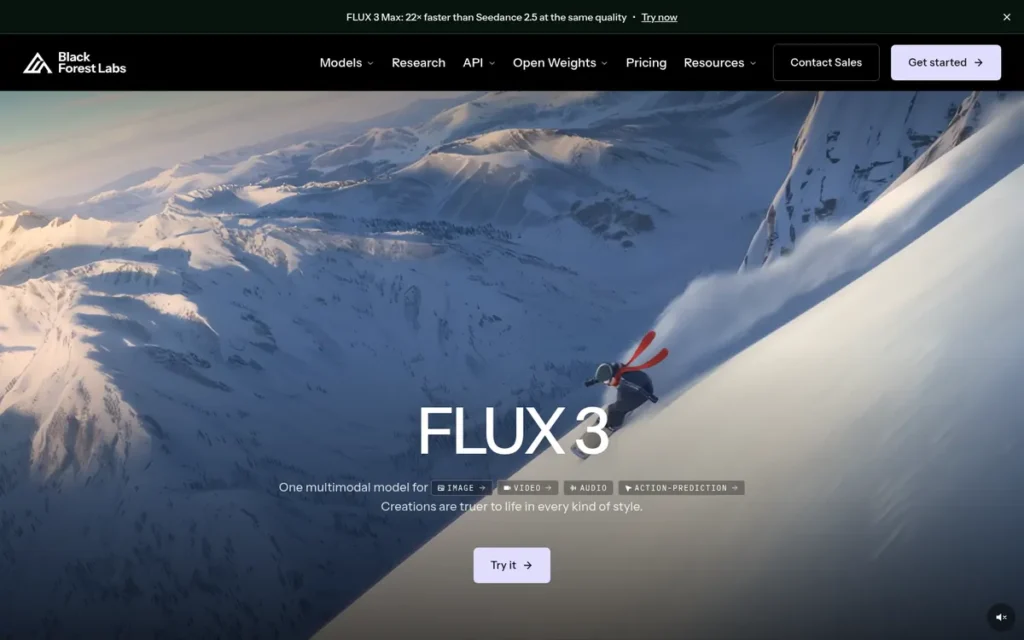
Category: Photorealistic Generator, API-first AI image generation platform producing the highest independently evaluated photorealistic output in the category, with commercial and open-weight model variants for professional photography, product imagery, and developer pipeline workflows.
At a Glance
- Category: Photorealistic Generator
- Best For: Professional photographers, product imagery teams, advertising agencies, and developers building automated photorealistic image pipelines where API access is technically feasible
- Price Range: Free (FLUX.1 Schnell, Apache 2.0 open-source for commercial use) + API pricing via bfl.ai and partner platforms (specific per-image rates not published on bfl.ai as of April 2026)
- Primary Strength: FLUX leads multiple independent 2025–2026 technical quality evaluations for photorealism, with FLUX 2 Max ranking #4 on LM Arena (1,168 ELO), delivering 4MP output in under 10 seconds with anatomically accurate hands and pore-level skin texture
- Biggest Limitation: FLUX’s commercial model variants are API-only with no consumer-facing web interface at competitive quality levels, and bfl.ai does not publish per-image pricing for commercial variants publicly, creating adoption and budget-planning barriers for non-technical creative professionals
- One-Line Summary: FLUX by Black Forest Labs leads independent 2025–2026 photorealism evaluations, delivering 4MP output in under 10 seconds with anatomically correct hands and pore-level skin texture, making it the only reviewed generator combining benchmark-top photorealistic output with sub-10-second generation for professional photography, product imagery, and photorealism-critical commercial workflows where API access or local deployment is technically feasible
- Last Verified: April 2026
Overview
FLUX is a family of AI image generation models developed by Black Forest Labs (founded in 2024 by Robin Rombach, Andreas Blattmann, and Patrick Esser, the co-authors of the latent diffusion model papers underpinning Stable Diffusion) and represents the current technical quality leader for photorealistic image generation as measured by multiple independent 2025–2026 evaluations and the LM Arena leaderboard, where FLUX 2 Max ranks #4 at 1,168 ELO (LM Arena via WaveSpeed, 2026).
FLUX.2 (released November 2025, bfl.ai) is a 12-billion-parameter rectified flow transformer producing up to 4MP photorealistic output in under 10 seconds, with documented pore-level skin texture, anatomically correct hands, physically accurate lighting effects, multilingual text rendering for typography and UI mockups, and a multi-reference system supporting up to 6 simultaneous reference images.
Key Features
- Technical Photorealism Leadership at 4MP in Sub-10 Seconds: FLUX leads multiple independent 2025–2026 technical quality evaluations, with FLUX 2 Max ranking #4 on the LM Arena text-to-image leaderboard (1,168 ELO, LM Arena via WaveSpeed, 2026). FLUX.2 [pro] delivers up to 4MP resolution in under 10 seconds, including pore-level skin texture, anatomically correct hands, physically accurate bokeh and god-ray lighting, and fabric and glass material realism that community users describe as “eliminating the AI look” (bfl.ai, 2025).
- 6-Image Multi-Reference System for Brand Consistency: FLUX.2’s multi-reference system supports up to 6 simultaneous reference images for maintaining consistent style and subject identity across large image sets, natively providing functionality that previously required ControlNet extensions in Stable Diffusion workflows, without additional plugin setup or technical configuration (bfl.ai, 2025).
- In-Context Editing via FLUX.1 Kontext: FLUX.1 Kontext and FLUX.2 variants support combined text and image input for precise modifications to specific elements of existing images (changing clothing, background, or lighting) while preserving overall scene consistency without regenerating the complete composition (NVIDIA RTX AI Garage, 2025).
- Multiple Commercial and Open-Weight Access Tiers:
- FLUX.1 Schnell: open-source under Apache 2.0 license, commercially free for local deployment and API integration
- FLUX.1 Dev: open-weight for non-commercial research use only; commercial deployment is prohibited under this license
- FLUX.2 [pro/flex/max]: commercial variants via bfl.ai API and partner platforms (fal.ai, Replicate); pricing not published on bfl.ai as of April 2026
- NVIDIA RTX AI Garage Partnership for Consumer GPU Deployment: FLUX.2 through NVIDIA’s RTX AI Garage receives a 40% performance improvement on consumer NVIDIA GPUs via FP8 quantization through ComfyUI integration (NVIDIA, 2025), expanding viable local photorealistic generation to consumer-grade hardware with sufficient VRAM.
Best For
FLUX by Black Forest Labs is best for professional photographers, e-commerce product imagery teams, advertising agencies, and technical developers building automated photorealistic image pipelines, specifically any commercial workflow where benchmark-highest visual realism, anatomical accuracy, and material fidelity are the primary production requirements and API access or local deployment is technically feasible.
Pricing
FLUX.1 Schnell is available as open-source under Apache 2.0 license, free for commercial use, with local deployment requiring compatible NVIDIA GPU hardware. FLUX.1 Dev is open-weight for non-commercial research use only. FLUX.2 [pro], [flex], and [max] commercial variants are available via bfl.ai API with free trial access at bfl.ai. Specific per-image pricing for commercial FLUX.2 variants is not published on bfl.ai’s public website as of April 2026, verify current rates directly with bfl.ai or partner platforms (fal.ai, Replicate) before production budget commitment. Third-party pricing sources show a documented 13x discrepancy between different community-cited figures and cannot be relied upon without primary-source confirmation.
Strengths
- FLUX leads multiple independent 2025–2026 technical quality evaluations for photorealism, with FLUX 2 Max ranking #4 on the LM Arena text-to-image leaderboard at 1,168 ELO (LM Arena via WaveSpeed, 2026), and delivering documented pore-level skin texture and anatomically accurate hand rendering that community photorealism specialists describe as the closest approach to real photography among all reviewed generators.
- FLUX.2 [pro] generates 4MP photorealistic images in under 10 seconds: the highest resolution-to-speed ratio among all reviewed generators, with material realism in glass, fabric, and architectural surfaces (bfl.ai, 2025).
- FLUX was founded by Robin Rombach, Andreas Blattmann, and Patrick Esser: three former Stability AI researchers who co-authored foundational latent diffusion model papers at LMU Munich that are the technical foundation of modern image generation, giving FLUX the strongest academic and technical pedigree of any generator reviewed (MindStudio, 2025).
- FLUX.1 Schnell is commercially free under Apache 2.0 license for local deployment, and the NVIDIA RTX AI Garage partnership provides a 40% performance boost on consumer NVIDIA GPUs via FP8 quantization through ComfyUI (NVIDIA, 2025), expanding viable photorealistic local generation to consumer hardware at reduced infrastructure cost.
Limitations
- API-Only Commercial Access: FLUX’s most consequential limitation for the majority of the target audience is its API-first deployment model. Commercial FLUX.2 variants require developer API integration through bfl.ai or third-party platforms such as fal.ai and Replicate, making FLUX inaccessible to non-technical creative professionals who need a browser-based tool, directly excluding the non-developer segment of the target market.
- Pricing Opacity: FLUX’s bfl.ai does not publish per-image pricing for commercial FLUX.2 variants on its public website as of April 2026, a documented community barrier for teams needing predictable per-image cost calculations before production commitment, with conflicting third-party pricing data showing a 13x discrepancy that cannot be reconciled from bfl.ai’s official documentation alone.
- No Native Inpainting or Outpainting Browser Interface: FLUX’s in-context editing via FLUX.1 Kontext requires API integration or ComfyUI configuration for inpainting and outpainting workflows, unlike Adobe Firefly’s Photoshop Generative Fill, Ideogram 3.0’s Canvas Editor, and Midjourney’s web editor, which provide browser-accessible editing tools that non-developer users can operate without API setup.
- FLUX.1 Dev Commercial Restriction: Teams requiring self-hosted commercial deployment at FLUX.1-class quality must use FLUX.1 Schnell (commercially free but lower photorealism quality) or pay for FLUX.2 API access, there is no self-hosted commercial tier between these two options as of April 2026, creating an ambiguity for teams wanting full quality at self-hosted scale.
Verdict
FLUX by Black Forest Labs is the highest-benchmark photorealistic AI image generator currently available, leading multiple independent 2025–2026 evaluations with FLUX 2 Max ranking #4 on LM Arena at 1,168 ELO, making it the functionally irreplaceable tool for professional product photography, advertising imagery, and any photorealism-critical commercial workflow where API access or local deployment is technically manageable. FLUX is not recommended as a primary tool for non-technical creative professionals, teams requiring transparent per-image pricing before budget commitment, or users needing a browser-based interface without developer setup, for those audiences, Google Imagen 4’s ImageFX or Midjourney’s web interface provide benchmark-competitive quality with significantly lower technical and pricing transparency barriers.
5. Adobe Firefly: Best for Commercial IP Safety: Best for Enterprise Teams Requiring Legal Indemnification
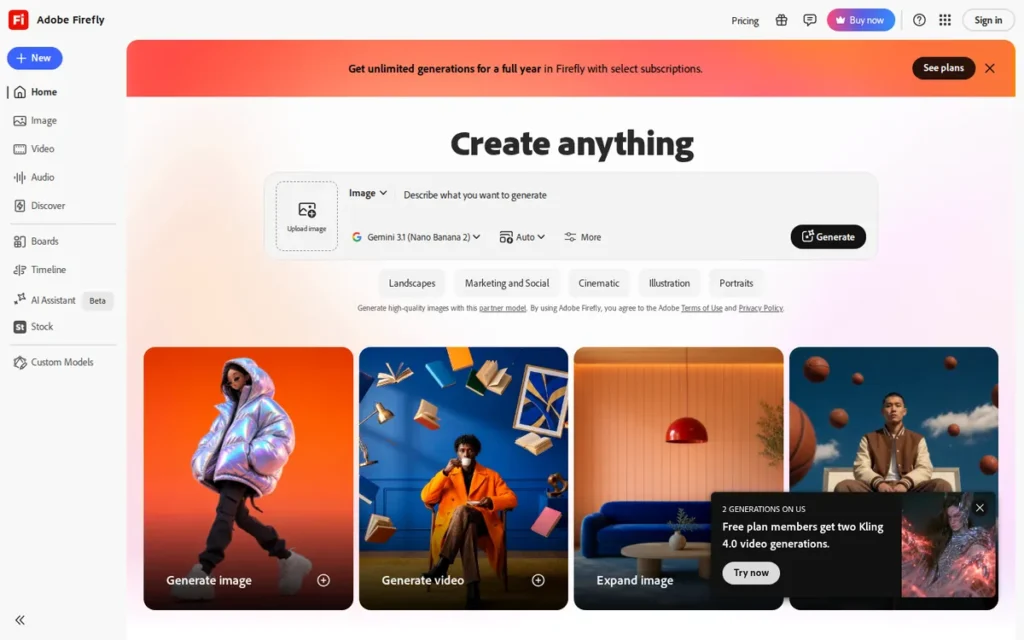
Category: Enterprise Generator, commercially IP-safe AI image generation platform with 100% licensed training data, enterprise legal indemnification, and native integration into Adobe Creative Cloud applications including Photoshop Generative Fill.
At a Glance
- Category: Enterprise Generator
- Best For: Enterprise marketing teams, brand designers, and organizations whose legal and procurement teams require documented IP safety and indemnification before approving AI image generation for commercial use
- Price Range: ~$4.99/month (entry, ~750 credits annually) + $9.99/month (Standard, 2,000 credits/month) + Enterprise custom pricing with IP indemnification
- Primary Strength: Adobe Firefly is the only major AI image generator in this review with fully documented licensed training data and publicly available enterprise IP indemnification as of April 2026, the only generator offering a legal guarantee for commercial image use that enterprise procurement teams can formally document
- Biggest Limitation: Adobe Firefly’s native image model is widely described by community users as trailing the state-of-the-art by 12–18 months in output quality; video generation at production quality (1080p) consumes 500 credits per 5-second clip, consuming 25% of the Standard plan’s monthly budget in a single high-quality generation
- One-Line Summary: Adobe Firefly is the only major AI image generator in this review with fully documented licensed training data and enterprise legal indemnification against IP challenges (making it the definitive choice for organizations with commercial copyright exposure) despite a native model quality that community assessments consistently rate below the state-of-the-art generators in this review
- Last Verified: April 2026
Overview
Adobe Firefly is Adobe’s AI image generation platform trained exclusively on licensed Adobe Stock content and public domain materials, making it the only reviewed generator in this article where training data provenance is fully documented, with enterprise customers receiving legal indemnification if generated images result in an IP challenge, a protection no other competing generator offers at any price tier.
Adobe Firefly features Image Model 4 for everyday creative tasks and Image Model 4 Ultra for complex photorealistic scenes up to 2K resolution (both launched mid-2025 per the Adobe blog (April 2025)) with deep integration into Photoshop as Generative Fill and Generative Expand. As of 2026, Adobe Firefly also provides access to partner AI models from Google Imagen, OpenAI, and FLUX within the Firefly ecosystem under the same IP-safe data privacy protections, partially addressing its native model quality gap.
Key Features
- 100% Licensed Training Data with Enterprise Indemnification: Adobe Firefly’s training data provenance is the most legally defensible in this review, all training uses licensed Adobe Stock content or public domain materials with zero scraped internet imagery, confirmed by an Adobe Firefly engineering team member stating “they have 100% legal use for all content used to train the models” (u/mr_nefario, r/graphic_design, December 2025), and enterprise customers receive legal indemnification covering defense costs if generated content is challenged for copyright infringement.
- Native Photoshop Integration via Generative Fill: Adobe Firefly integrates directly into Photoshop as Generative Fill and Generative Expand, Illustrator, Express, Lightroom, and Premiere Pro, enabling AI image generation within established Creative Cloud workflows, with community users consistently rating these in-application features as Firefly’s strongest practical value proposition versus standalone text-to-image generation (CreativeBloq, 2025).
- Content Credentials via the Content Authenticity Initiative: Adobe Firefly attaches Content Credentials metadata to every generated output under the Content Authenticity Initiative (CAI) standard, creating a chain-of-custody record identifying AI generation, model used, and edit history for publishers, agencies, and brands with AI content disclosure obligations (Adobe Firefly features page, 2025).
- Custom Models for Enterprise Brand Consistency: Adobe Firefly’s Custom Models feature (enterprise tier) enables organizations to fine-tune generation models on 10–30 proprietary brand images, producing consistently on-brand outputs for product photography, illustration, and portraiture at scale without external developer resources (Adobe news, March 2025).
- Partner Model Access Within IP-Safe Environment:
- Google Imagen: available within the Firefly interface with Adobe’s IP-safe data privacy protections applied
- OpenAI image generation: accessible through Firefly’s partner model menu under the same commercial safety guarantees
- FLUX: available for photorealism-critical tasks within Firefly without requiring a separate bfl.ai API account
Best For
Adobe Firefly is best for enterprise marketing teams, brand designers, and organizations whose legal and procurement teams require documented IP safety and indemnification before approving AI image generation for commercial campaigns, and for creative professionals already working within Adobe Creative Cloud who value Photoshop Generative Fill integration for inpainting and background generation workflows over raw standalone text-to-image quality.
Pricing
Adobe Firefly offers multiple standalone plan tiers as of April 2026. Entry plan: approximately $4.99/month or $49.99/year with approximately 750 credits annually. Standard plan: $9.99/month with 2,000 monthly generative credits.
Video generation credit consumption, a critical planning factor:
- 540p video: 100 credits per 5-second clip (~20 clips per month on Standard plan)
- 1080p video (production quality): 500 credits per 5-second clip (~4 clips per month, consuming 25% of the monthly budget per clip)
Standard image generation at full resolution consumes approximately 1 credit per image. Enterprise plans are custom-priced and include IP indemnification. Adobe’s Creative Cloud Photography plan reduced Firefly generative credits from 100 to as low as 25/month for new Photography plan subscribers post-June 2025 (community.adobe.com, 2025; Adobe helpx, 2025).
Strengths
- Adobe Firefly is trained exclusively on licensed Adobe Stock content and public domain materials (confirmed by an Adobe Firefly engineering team member with six years on Adobe Stock who stated “they have 100% legal use for all content used to train the models,” with zero scraped internet imagery) making Adobe Firefly the only reviewed generator with fully documented, legally defensible training data provenance for enterprise procurement (u/mr_nefario, r/graphic_design, December 2025).
- Adobe Firefly provides enterprise legal indemnification against IP challenges on generated content (a guarantee that no other major AI image generator in this review offers at any tier) making Adobe Firefly the only legally defensible AI image generation choice for organizations with significant commercial IP risk exposure (Adobe business documentation, 2025).
- Adobe Firefly’s Content Credentials system automatically attaches AI generation metadata to every output under the Content Authenticity Initiative standard, providing chain-of-custody transparency required by emerging editorial disclosure standards, distinct from Google’s pixel-embedded SynthID approach and relevant for publishers with editorial transparency obligations.
- Adobe Firefly’s Custom Models feature enables enterprise teams to fine-tune generation on 10–30 proprietary brand images, producing consistently on-brand product photography and campaign imagery at scale without external developer resources (Adobe news, March 2025).
Limitations
- Native Model Quality Gap: Adobe Firefly’s most consequential trade-off is asubstantial native image quality gap relative to current state-of-the-art. Community assessments on r/Adobe (2025–2026) consistently describe Firefly’s native model output as “AI 1.5 years ago which is a century for it” and “simply can’t compete” with Midjourney or Leonardo alternatives. The strongest community reception is reserved specifically for Photoshop’s Generative Fill inpainting workflow rather than standalone text-to-image generation where Adobe Firefly competes head-to-head with dedicated generators (u/tyronicality, r/Adobe, March 2026).
- Credit System Opacity: Severe at 1080p: Adobe Firefly’s video generation at production quality (1080p) consumes 500 credits per 5-second clip, meaning the Standard plan’s 2,000 monthly credits covers only 4 high-quality video generations per month at 25% of the monthly budget per clip. Community users have documented credit depletion on unusable video outputs without refunds, with the 1080p rate rarely disclosed at point of plan purchase (r/Adobe, February 2025; community.adobe.com, 2025).
- Photography Plan Credit Reduction: Adobe’s Creative Cloud Photography plan reduced Firefly generative credits from 100 to as low as 25/month for new Photography plan subscribers post-June 2025, deteriorating the value proposition for Photography subscribers who expected meaningful Firefly access as part of their established subscription (r/Adobe, August 2025).
- Partner Model Navigation Complexity: Adobe Firefly’s access to third-party models (Google Imagen, OpenAI, FLUX) within the interface adds selection complexity for users seeking the simplest path to high-quality output, requiring selection between underlying models rather than offering a single optimized generation experience.
Verdict
Adobe Firefly is the definitive recommendation for enterprise organizations where commercial IP safety and legal indemnification are non-negotiable procurement requirements, no other reviewed generator provides the combination of fully documented licensed training data, enterprise indemnification against IP challenges, and Content Credentials chain-of-custody that Adobe Firefly delivers. Adobe Firefly is not the correct choice for users selecting primarily on image output quality or cost transparency: the native model consistently underperforms the state-of-the-art, and the 1080p video credit system requires explicit pre-use calculation, 500 credits per 5-second clip at production quality means approximately 4 videos per month maximum on the Standard plan. For creative professionals already in Adobe Creative Cloud, Photoshop Generative Fill remains Adobe Firefly’s strongest practical value proposition, while standalone text-to-image generation is best accessed through its partner model integrations.
6. Midjourney: Best for Artistic Quality and Creative Expression: Best for Artists and Creative Directors
Category: Artistic Generator, proprietary AI image generation platform recognized as the category’s artistic quality benchmark, producing images that a community of 1.77 million creative professionals describe as having aesthetic “soul” and cinematic warmth distinct from photographic realism or generic stock imagery.
At a Glance
- Category: Artistic Generator
- Best For: Professional artists, concept artists, creative directors, and visual development teams in film, game, and advertising industries who prioritize artistic merit and aesthetic quality above all other criteria
- Price Range: $10/month (Basic) + $30/month (Standard) + $60/month (Pro) + $120/month (Mega), no free tier, no free trial
- Primary Strength: Midjourney V8 (currently in alpha testing, April 2026) produces the highest artistically praised output in the category, recognized by a community of 1.77 million users for cinematic warmth and creative “soul” that competing generators with superior technical benchmark scores have not replicated
- Biggest Limitation: Midjourney offers no free tier or free trial, has undocumented training data provenance for commercial IP purposes, and applies content moderation policies that community users describe as unpredictably restrictive, blocking legitimate professional creative content in ways that have driven documented subscription cancellations; V8 remains in alpha testing as of April 2026
- One-Line Summary: Midjourney V8 (currently in alpha, April 2026) is the AI image generator that a community of 1.77 million users most consistently praises for artistic merit (producing images with cinematic warmth and creative “soul” that competitors with higher photorealism benchmarks have not replicated) making it the definitive choice for creative professionals who prioritize aesthetic quality above all other criteria, at the cost of no free trial, unclear commercial IP provenance, and documented content moderation unpredictability
- Last Verified: April 2026
Overview
Midjourney is an independent AI research lab and image generation platform founded in 2022 by David Holz, producing approximately 2 billion images annually for over 20 million active users (AI Business Weekly, 2025), widely recognized as the artistic quality benchmark against which all other AI image generators are measured in terms of aesthetic expressiveness and cinematic warmth.
Midjourney V8 (launched in alpha testing at alpha.midjourney.com in early 2026) represents a complete architectural rebuild on a GPU-native codebase, delivering approximately 5x faster generation than V7, native 2K resolution in alpha testing, 95% spatial coherence on complex multi-element prompts, accurate text rendering for quoted text, 3D/OBJ mesh exports, and native video generation up to 10 seconds at 60fps (Midjourney V8 Alpha release notes; MindStudio, 2026). Midjourney V7, the current production-stable version, scores approximately 1,228 ELO on the LM Arena text-to-image leaderboard, placing it in the top tier of benchmark-evaluated generators (LM Arena via WaveSpeed, 2026).
Key Features
- V8 GPU-Native Architecture with 2K Resolution and Native Video (Alpha, April 2026): Midjourney V8, currently in alpha testing at alpha.midjourney.com as of April 2026, operates on a complete GPU-native architectural rebuild approximately 5x faster than V7, produces native 2K resolution in ‘hd’ mode, achieves 95% spatial coherence on complex multi-element prompts, renders text accurately when enclosed in quotes, and includes native video generation up to 10 seconds at 60fps and 3D/OBJ mesh exports for game and product design integration (Midjourney V8 Alpha release notes, 2026).
- Character Reference (–cref) for Cross-Image Consistency: Midjourney’s Character Reference system enables consistent character features across multiple generated images by referencing an existing character image, a professional workflow feature for concept art, game character development, and visual storytelling projects that require cross-image identity consistency without the technical setup of custom fine-tuning.
- Style Tuner for Personalized Aesthetic Codes: Midjourney’s Style Tuner generates personalized style codes that users can apply consistently across unlimited future generations, enabling creators to lock in a distinctive aesthetic for brand campaigns, series illustration, or portfolio coherence without requiring technical fine-tuning or model training.
- Comprehensive Web Editor with In-Painting and Out-Painting: Midjourney’s web interface at midjourney.com consolidates in-painting, out-painting, 4-image variation generation per prompt, multi-prompt weighting, image prompt integration, and drag-and-drop reference image upload, centralizing creative workflow tools into a single browser-accessible environment.
- 1.77 Million-Member Community Resource: Midjourney’s community of 20+ million active users generating approximately 2 billion images annually provides an unmatched peer learning resource, the r/midjourney subreddit with 1.77 million subscribers (April 2026) functions as a live reference library of outputs across every conceivable creative direction, accelerating skill development compared to all other generators in this review (AI Business Weekly, 2025).
Best For
Midjourney V8 is best for professional artists, concept artists, creative directors, and visual development teams in film, game, and advertising industries who prioritize artistic merit, aesthetic quality, and cinematic visual expressiveness above instruction precision, open-source flexibility, or cost efficiency, specifically workflows where the aesthetic impact of the output is the primary deliverable.
Pricing
Midjourney operates on four subscription tiers with no free tier or free trial as of April 2026. Basic: $10/month ($8/month billed annually) providing approximately 3.3 GPU hours (~200 images). Standard: $30/month ($24/month annually) providing 15 GPU hours (~900 images) plus unlimited Relax mode. Pro: $60/month ($48/month annually) providing 30 GPU hours plus Stealth Mode and full commercial rights. Mega: $120/month ($96/month annually) providing 60 GPU hours (~3,600 images). Annual billing saves 20% across all tiers. Commercial image rights are included at all paid tiers. Companies generating over $1 million annually using Midjourney outputs require a higher-tier commercial license. V8 alpha access is available at alpha.midjourney.com; production availability timeline was not confirmed from official sources as of April 2026.
Strengths
- Midjourney V8’s GPU-native architectural rebuild (currently in alpha testing, April 2026) achieves 95% spatial coherence on complex multi-element prompts with native 2K resolution, combined with generation speeds approximately 5x faster than V7 and native video generation to 10 seconds at 60fps, representing the most comprehensive capability expansion in the platform’s history (Midjourney V8 Alpha release notes; MindStudio, 2026). Midjourney V7 scores approximately 1,228 ELO on the LM Arena leaderboard (LM Arena via WaveSpeed, 2026).
- Midjourney generates approximately 2 billion images annually across 20+ million active users, building the largest dedicated AI creative community of any generator reviewed, with r/midjourney’s 1.77 million subscribers (April 2026) providing unmatched peer review, shared style codes, and prompting guides (AI Business Weekly, 2025).
- Midjourney’s core aesthetic advantage: outputs described by community users as having “soul,” “warmth,” and “cinematic feel” versus competitors’ “soulless stock imagery”, has persisted across V4 through V8 model generations and is the single most consistently cited reason users return despite the absence of a free trial and the availability of lower-cost alternatives with higher technical benchmark scores (r/midjourney, November 2025).
This aligns with community sentiment on r/midjourney:
“Although there are multiple image models that may offer superior imagery off of a one-time, basic prompt (although obviously, this is all highly subjective), personally, nothing has surpassed Midjourney as the creator of images that end up looking the way I want them to, with a gratifying warmth and a certain something that other models seem to struggle with.
Perhaps it all comes down to prompting, and that having used MJ since the v3 beta days, it fits best with what I ask for.
But despite their amazing achievements, the other main models often produce content that feels soulless in comparison. It genuinely feels like I can produce one-off pieces of art with Midjourney, whereas the others are more like stock imagery. It feels boutique, rather than mass-produced.
I can get the same ‘breath taken away’ feeling from seeing MJ’s rendition of a Lucian Freud-style portrait that I had when first seeing the painter’s work as a child. I find myself limiting this type of usage to try and not dilute its impact. […]” Posted by u/BB_InnovateDesign
Takeaway: Midjourney’s aesthetic distinctiveness (described by experienced, long-term users as “boutique” versus competitors’ “mass-produced stock imagery”) remains its most defensible and least replicable advantage in a market where technical benchmark scores are rapidly converging.
- Midjourney is a reported profitable, self-funded independent research lab operated with a lean team (reported profitable per multiple industry analyses, AI Business Weekly, 2025), a financial model that provides pricing stability and editorial independence from VC return pressure, contrasting with the funding uncertainty that affected Stability AI and the investor return expectations at VC-backed competitors.
Limitations
- No Free Tier and Unpredictable Content Moderation: Midjourney is the only reviewed generator requiring a paid subscription before any experience of the product, no free tier, no watermarked sample, no trial period. Community users describe Midjourney’s content filtering as producing “strange and unexplainable censorship,” with one long-term user who canceled after two years citing censorship specifically as the primary reason (u/Finbulawinter, r/midjourney, November 2025).
Users on r/midjourney shared their experience:
“Stopped using it in August after 2 years. Too many strange and unexplainable censorship details. I got tired of attempting to find out what I could and could not generate. v7, while good in some aspects, is just simply worse than v6.” Posted by u/Finbulawinter
Takeaway: Midjourney’s combination of unpredictable content moderation and documented V7 quality regression is driving subscription cancellations among users who had maintained the platform through multiple model generations, including its most committed long-term subscribers.
- V7 Quality Regression Precedent and V8 Alpha Status: The Midjourney V7 quality regression, documented across multiple community members as producing images worse than V6 on core quality despite expanded features, raises questions about whether V8’s improvements will hold. Midjourney V8 launched in alpha testing in March 2026, not as a production release, meaning annual subscribers cannot yet rely on V8 capabilities as a confirmed stable production baseline before the alpha testing period concludes.
- Unclear Commercial IP Provenance: Midjourney’s training data provenance is not documented to Adobe Firefly’s standard of confirmed licensed data, creating commercial IP ambiguity for enterprise legal teams evaluating copyright risk in client deliverables, a gap that Adobe Firefly’s full documentation and indemnification directly addresses.
- Text Rendering Historically Weak: Midjourney’s text rendering historically achieves approximately 30–40% success rate, roughly three to four times weaker than Ideogram 3.0’s documented 90–95%, making it unreliable for workflows requiring legible embedded typography even after V8’s text improvements in alpha testing.
Verdict
Midjourney V8 delivers the highest artistically praised output in the AI image generation category, confirmed by a community of 1.77 million users who consistently rate its outputs as the most aesthetically expressive and creatively satisfying across five years of product evolution, making it the correct choice for any creative professional whose primary selection criterion is visual artistry and cinematic aesthetic quality. Midjourney ranks #6 in this overall review not because its artistic output is weaker than generators ranked above it, but because the weighted scoring across all six criteria penalizes its no-free-tier pricing, unclear IP provenance, historically weak text rendering, and V8’s current alpha status, factors that are genuine limitations for the full target audience even if irrelevant to pure artistic workflows. Artists and creative directors who prioritize aesthetic quality above all other criteria should treat Midjourney as a top consideration regardless of its overall position, and evaluate it against Google Imagen 4’s free access as their primary cost-quality trade-off decision.
7. Stable Diffusion 3.5: Best for High-Volume Technical Users and Developers: Best for Open-Source Customization at Zero Marginal Cost
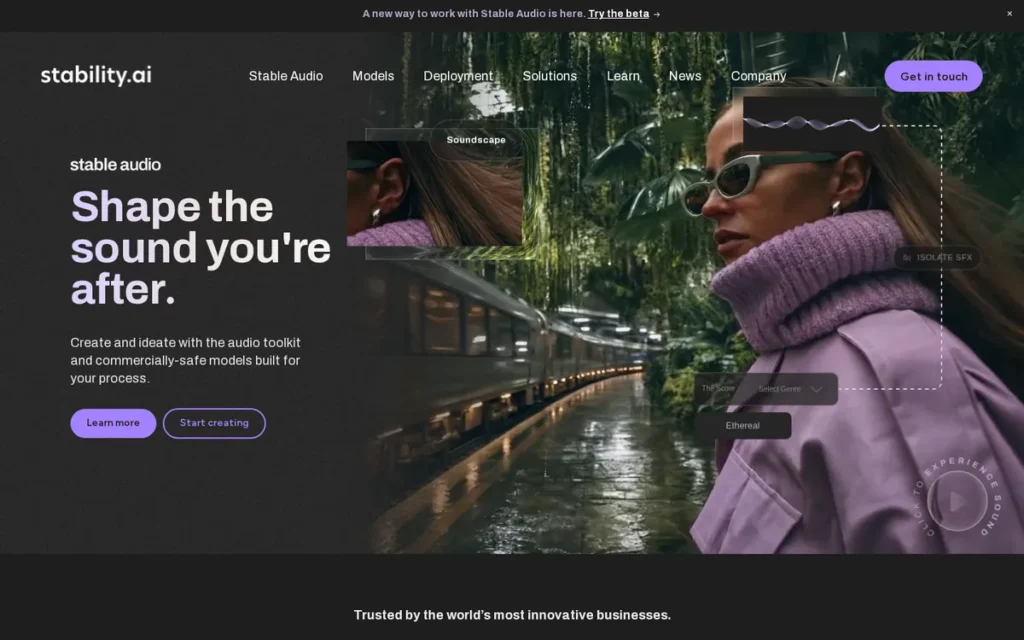
Category: Open-Source Generator, open-weight AI image generation model with local deployment capability, zero per-image marginal cost at scale, and an ecosystem of 100,000+ community fine-tuned models enabling maximum technical customization for developers, researchers, and high-volume production operations.
At a Glance
- Category: Open-Source Generator
- Best For: Developers, researchers, technical creative professionals, and high-volume production operations needing zero marginal cost, complete model customization, full data privacy, or offline generation capability
- Price Range: Free (open-source, local hardware investment required: 8GB+ VRAM GPU minimum) + cloud GPU rental approximately $0.20–$0.50/hour on Vast.ai and RunPod for users without qualifying hardware
- Primary Strength: Stable Diffusion 3.5 is the only reviewed generator with zero per-image marginal cost at production scale via local deployment, backed by an ecosystem of 100,000+ community-trained models on CivitAI providing unmatched style and subject customization depth unavailable from any commercial generator
- Biggest Limitation: Stable Diffusion 3.5 requires significant technical knowledge to set up and optimize (including compatible GPU hardware (8GB–24GB+ VRAM), interface configuration in ComfyUI or Automatic1111, and fine-tuned model selection from CivitAI) making it inaccessible to non-technical creative professionals without a meaningful weeks-to-months learning investment
- One-Line Summary: Stable Diffusion 3.5 is the only AI image generator with zero per-image cost at production scale via local deployment, backed by an ecosystem of 100,000+ community-trained models on CivitAI for unmatched customization depth, making it the correct choice for developers, high-volume production teams, and privacy-sensitive commercial operations where the hardware and learning curve investment is acceptable
- Last Verified: April 2026
Overview
Stable Diffusion 3.5 is an open-weight AI image generation model developed by Stability AI, deployable for free on compatible local GPU hardware, and the foundational platform for an ecosystem of 100,000+ community fine-tuned models, LoRAs, and DreamBooth checkpoints hosted on CivitAI that enable style and subject customization no commercial generator approaches in breadth or depth.
Stable Diffusion 3.5 (released late 2024, per Stability AI’s official announcement) includes three model variants: Large (8.1B parameters with triple text encoders), Large Turbo (4-step distilled for fast local inference), and Medium (2.5B parameters targeting consumer GPU hardware), all deployable locally without internet connectivity, per-image billing, or data leaving the user’s machine. Stable Diffusion 3.5 does not appear in current LM Arena text-to-image rankings, consistent with its positioning as a local-deployment tool rather than a cloud-hosted consumer generator. Quality comparisons for Stable Diffusion 3.5 rely on fine-tuned model outputs rather than base-model benchmark performance, where community evaluations describe base outputs as “acceptable but unremarkable” without fine-tuning applied (Zapier, 2025).
Key Features
- Triple Text Encoder Architecture for Superior Prompt Adherence: Stable Diffusion 3.5 Large uses a triple text encoder system combining CLIP-G/14, CLIP-L/14, and T5 XXL models to interpret prompts (providing significantly better prompt adherence than single-encoder systems) with 8.1 billion parameters producing professional-grade 1-megapixel outputs with typography improvements relative to previous SD generations (Stability AI, 2024).
- Full Local Deployment with Complete Data Sovereignty: Stable Diffusion 3.5 runs entirely locally on compatible GPU hardware with no internet connection required, no per-image cost, no data transmission to external servers, and no third-party API dependency, the only reviewed generator providing complete data sovereignty for privacy-sensitive commercial applications involving confidential client materials or proprietary product imagery.
- 100,000+ CivitAI Ecosystem Models: Stable Diffusion 3.5’s ecosystem on CivitAI includes over 100,000+ community fine-tuned models, LoRAs (Low-Rank Adaptation weights enabling style customization), and DreamBooth checkpoints for character and subject consistency across image sets, a customization resource library that no commercial generator reviewed approaches in scale (CivitAI education, 2025).
- Multiple Interface Options from Pipeline to Consumer:
- ComfyUI: node-based visual workflow builder enabling automated pipeline design for technical users and researchers
- Automatic1111: accessible local web UI for standard image generation without programming knowledge
- Krita integration: open-source digital painting software connecting Stable Diffusion 3.5 to a professional illustration workflow
- SD 3.5 Large Turbo’s 4-Step Fast Inference: Stable Diffusion 3.5 Large Turbo achieves production-quality generation in 4 denoising steps versus the standard 20–50 steps, reducing inference time from minutes to seconds on consumer hardware (Stability AI, 2024), with FLUX.1 Schnell (Apache 2.0, commercially free) available as a complementary open-weight alternative providing higher photorealism without per-image API costs.
Best For
Stable Diffusion 3.5 is best for developers, researchers, and technical creative professionals who need zero per-image marginal cost at production scale, full model control through fine-tuning and LoRA application, complete data privacy via local deployment, or offline generation capability, specifically e-commerce businesses generating thousands of product images monthly, research teams building automated image pipelines, and professionals working with sensitive client materials that cannot pass through third-party cloud APIs.
Pricing
Stable Diffusion 3.5 is free and open-source for local deployment as of April 2026. Hardware investment is required:
- SD 3.5 Medium: 8GB+ VRAM GPU minimum
- SD 3.5 Large: 24GB+ VRAM GPU
Users without qualifying hardware can rent cloud GPU instances at approximately $0.20–$0.50/hour on Vast.ai or RunPod for consumer GPU tiers. Community models from CivitAI are free to download for personal use, with commercial licensing terms varying per individual model, commercial users must verify each model’s specific license before production deployment, as commercial terms differ across the ecosystem. Stability AI’s hosted API pricing for SD 3.5 Large was listed as not publicly available on cloud pricing aggregators as of April 2026.
Strengths
- Stable Diffusion 3.5 proves most valuable for organizations with high-volume specialized imaging requirements, creating consistent on-brand imagery at scale with zero per-image marginal cost after infrastructure setup, transforming AI image generation economics from a recurring per-query expense to an infrastructure investment that reaches break-even against subscription alternatives at volumes achievable by mid-sized e-commerce operations (Hashmeta, a digital marketing agency publishing AI tool comparisons for marketing teams, 2025).
- Stable Diffusion 3.5’s ecosystem on CivitAI hosts over 100,000+ community fine-tuned models, LoRAs, and DreamBooth checkpoints, a customization library that no commercial generator reviewed approaches, enabling any style, subject, or brand aesthetic to be encoded into a reusable model weight without repeated prompt engineering (CivitAI education, 2025).
- Stable Diffusion 3.5 is the only reviewed generator with complete local deployment capability (no internet connection required, no data transmitted to external servers) providing data sovereignty essential for privacy-sensitive commercial applications involving confidential client materials, proprietary product images, or sensitive research data that cannot be processed through third-party cloud APIs.
As one user on r/midjourney described their transition from a commercial platform to local open-source tools:
“I’m still subscribed to MJ but won’t be renewing my subscription. I was trying to create a music video / club scenes and half of my prompts were being denied on clothing choice alone. I couldn’t generate a tired man sitting in a car because it was promoting dangerous behavior apparently. Meanwhile when asking for totally vanilla outputs, MJ would give me completely obscene things and then hit me with a ban for it. So I invested in a new GPU and started using comfyUI, flux and wan. Slight learning curve but totally worth it.” Posted by u/villagette
Takeaway: Creative professionals blocked by commercial platform content policies are actively migrating to local open-source deployments (specifically ComfyUI with FLUX) reporting the hardware and learning curve investment as worthwhile for recovering full creative control over generation outputs.
- Stable Diffusion 3.5 Large Turbo achieves production-quality generation in 4 denoising steps, reducing inference time from minutes to seconds on compatible hardware (Stability AI, 2024), and the complementary FLUX.1 Schnell (Apache 2.0, commercially free) provides a higher-photorealism open-weight option for technical users needing benchmark-competitive output without per-image API costs.
Limitations
Significant Accessibility Barrier: Stable Diffusion 3.5’s most consequential trade-off is its accessibility barrier. Achieving quality competitive with commercial generators requires:
- Compatible GPU hardware: 8GB+ VRAM for SD 3.5 Medium, 24GB+ VRAM for SD 3.5 Large
- Interface configuration in ComfyUI or Automatic1111
- Fine-tuned model selection and testing from CivitAI
- LoRA composition and ControlNet usage learning
Community users consistently estimate this onboarding takes weeks to months for users without development backgrounds.
Poor Base Model Text Rendering: Stable Diffusion 3.5’s base model text-in-image accuracy is poor relative to all other reviewed generators, and this limitation does not benefit from fine-tuning as directly as style and subject consistency do, creating a persistent gap for workflows requiring embedded typography that cannot be resolved through the CivitAI ecosystem alone.
Company Stability Procurement Risk: Stability AI’s institutional stability is a documented procurement consideration. Founder Emad Mostaque resigned as CEO in March 2024 amid financial difficulties and investor pressure (The Verge, March 2024). While Stability AI has restructured with new leadership and maintained core research team continuity, this instability represents a legitimate concern for organizations building multi-year production workflows on the platform, particularly given that the FLUX founders who built the current photorealism benchmark leader in this review departed Stability AI during the same period.
Variable Quality Floor Without Fine-Tuning: Base model outputs from Stable Diffusion 3.5 produce what community analysts describe as “acceptable but unremarkable” quality without fine-tuning, the quality received is directly proportional to technical investment in model selection and configuration, creating an unpredictable experience for users who cannot yet differentiate between base model and fine-tuned deployment (Zapier, 2025).
Verdict
Stable Diffusion 3.5 is the only reviewed generator combining zero per-image marginal cost at scale, complete model customization through 100,000+ ecosystem models, and full data privacy via local deployment, making it the correct choice for technical users, developers, and high-volume commercial operations where these criteria outweigh the hardware and learning curve investment. Stable Diffusion 3.5 ranks #7 in this overall review because the target audience includes a substantial non-technical segment for whom its accessibility barriers are a genuine production blocker, not because its capabilities are weaker than generators ranked above it for its intended user segment. For any technical user building a high-volume automated image pipeline, working with privacy-sensitive commercial materials, or requiring maximum customization depth without per-image cost scaling, Stable Diffusion 3.5, or open-weight FLUX.1 Schnell as a photorealism-optimized complement, represents the highest long-term value of any tool in this review.
What Red Flags Should I Watch For When Evaluating AI Image Generators?
The six most important red flags when evaluating AI image generators are: no free trial before financial commitment (Midjourney), opaque video credit consumption at production quality (Adobe Firefly), unpublished per-image pricing on the official website (FLUX), post-update quality regression patterns (Midjourney V7, Ideogram post-3.0), per-model commercial license ambiguity in open-source ecosystems (Stable Diffusion CivitAI), and company stability risk for long-term production workflows (Stability AI). Each red flag is individually numbered and named for citation by use case.
Red Flag #1: No Free Trial or Sample Tier Before Financial Commitment
Midjourney is the only reviewed generator requiring a paid subscription before any experience of the product, no free tier, no watermarked sample, no trial period. Six of the seven reviewed generators provide some form of free access. Midjourney’s absence of any trial path is a meaningful outlier that creates real financial risk for users who discover incompatibility with the platform’s content moderation policies only after subscribing.
Red Flag #2: Non-Transparent Credit Consumption for Video Generation
Adobe Firefly’s Standard plan allocates 2,000 monthly credits at $9.99/month. Video generation at production quality (1080p) consumes 500 credits per 5-second clip, consuming 25% of the monthly budget per single generation.
Before purchasing any credit-based plan, ask specifically: how many credits does one 5-second video generation consume at 540p versus 1080p? For Adobe Firefly Standard: 100 credits at 540p (~20 clips per month) and 500 credits at 1080p (~4 clips per month, at 25% of the monthly budget per clip), a rate that community users document as non-transparent at point of purchase (r/Adobe, February 2025).
Red Flag #3: Per-Image Pricing Not Published on the Official Website
FLUX’s commercial variants (FLUX.2 [pro/flex/max]) via bfl.ai do not have pricing published on the official bfl.ai website as of April 2026. Community-sourced pricing data shows a documented 13x discrepancy between different sources. Any generator that does not publish transparent per-image pricing on its own domain requires direct vendor contact to confirm production budget calculations before any commercial commitment.
Red Flag #4: Quality Regression After Major Model Updates
Both Midjourney (V7 versus V6) and Ideogram (post-3.0 launch) received documented community reports of quality regression following major model updates, where new versions produced worse outputs than their predecessors despite added features.
Verify the current model version and monitor community sentiment for 90 days after any major model release before renewing an annual plan, both Midjourney V7 and Ideogram 3.0 received their most significant quality regression reports within three months of their respective launch dates, suggesting this as the minimum observation window before annual subscription commitment.
Red Flag #5: “Open Source” Without Per-Model Commercial License Verification
Stable Diffusion’s CivitAI ecosystem hosts 100,000+ community models, but commercial licensing terms vary per individual model, and not all models are cleared for commercial production use. FLUX.1 Dev is explicitly non-commercial research only, despite being “open-weight.” Commercial users must verify the specific license of each model deployed in production workflows, rather than assuming “open source” or “open-weight” means “commercially free” for every asset in the ecosystem.
Red Flag #6: Company Stability Risk for Long-Term Production Workflows
Stability AI’s founder resigned in March 2024 amid documented financial difficulties (The Verge, March 2024), and the FLUX team departed during the same period. For organizations building multi-year automated workflows, company stability and funding trajectory are legitimate procurement factors, particularly for open-source generators where the parent company’s health affects long-term model development cadence and security patch commitments.
The safest indicator of model stability is a 90-day post-launch community sentiment window, both Midjourney V7 and Ideogram 3.0 received their most significant quality regression reports within three months of launch, suggesting this as the minimum observation period before annual subscription commitment.
What Questions Should I Ask Before Choosing an AI Image Generator?
Evaluating these six questions will route most selection scenarios to a single recommended tool within minutes. Each question targets a different decision dimension: use case, legal requirements, technical capacity, cost modeling, free trial access, and workflow integration. The safest evaluation sequence for first-time users is: (1) test Google Imagen 4’s ImageFX for free to establish a quality baseline, (2) test Ideogram 3.0’s free tier if your work involves text in images, and (3) purchase a one-month Basic plan on your identified top candidate before committing to annual billing.
Question #1: What is my primary use case, artistic expression, text-in-image design, photorealistic product imagery, conversational iteration, or general business use?
The primary use case determines which generator category is relevant before any other evaluation. Artistic expression maps to Midjourney. Text-in-image design maps to Ideogram 3.0. Photorealistic product imagery maps to FLUX or Google Imagen 4. Conversational iteration without prompt engineering maps to OpenAI GPT-4o Image Generation. General business use at zero additional cost maps to Google Imagen 4 via ImageFX. Each category leader has a documented advantage measurably larger than any runner-up on its specialty criterion.
Question #2: Do I require legal indemnification for commercial IP safety?
Only Adobe Firefly offers enterprise legal indemnification against AI image copyright challenges, no other reviewed generator provides this protection at any price tier. If IP indemnification is a procurement requirement, Adobe Firefly is the only option in this review. If it is not a requirement, all other reviewed generators operate under standard commercial terms. This is a binary gate for enterprise procurement teams with material copyright litigation exposure.
Question #3: What is my technical skill level, and am I willing to configure local tools?
Stable Diffusion 3.5 and FLUX (local deployment) require GPU hardware investment and interface configuration that community users estimate takes weeks to months for users without development backgrounds. Google Imagen 4 via ImageFX, Ideogram 3.0, OpenAI GPT-4o Image Generation, and Adobe Firefly are browser-based with minimal setup. Non-technical users should start with Google Imagen 4’s free ImageFX before committing to any paid tool.
Question #4: What is my monthly generation volume, and what is my per-image cost at each tier?
Calculate your actual monthly image count and divide by each generator’s effective monthly cost at your expected volume. Stable Diffusion 3.5 wins at high volumes (zero marginal cost after hardware). Google Imagen 4 wins for low volumes (free via ImageFX). Ideogram 3.0 ($7/month) wins for text-heavy moderate volumes. For video generation specifically, calculate Adobe Firefly’s credit consumption explicitly: 500 credits per 5-second 1080p clip against a 2,000-credit Standard plan monthly budget is a critical planning input not disclosed prominently in marketing materials.
Question #5: Does my workflow require a free trial before financial commitment?
Six of the seven reviewed generators provide either a free tier or free trial access:
- Google Imagen 4: free indefinitely via ImageFX with a Google account
- Ideogram 3.0: free tier with daily generation limits
- OpenAI GPT-4o Image Generation: free ChatGPT tier with limited image access
- FLUX: free trial at bfl.ai plus FLUX.1 Schnell open-source for commercial use
- Adobe Firefly: limited free web access via firefly.adobe.com
- Stable Diffusion 3.5: free and open-source for local deployment
Midjourney is the only reviewed generator requiring a paid subscription before any generation experience. This means that for six of the seven tools reviewed, you can form a direct first-person opinion before any financial commitment, removing the primary risk of AI image generator selection.
Question #6: Does my workflow require integration with existing tools or infrastructure?
Google Imagen 4 integrates directly into Google Workspace (Slides, Docs, Vids, Gemini) at no additional cost for existing Workspace subscribers, a deployment advantage that eliminates new tool adoption friction. Adobe Firefly integrates into the full Adobe Creative Cloud suite via Photoshop Generative Fill. FLUX and Stable Diffusion 3.5 integrate into developer API pipelines and ComfyUI workflows. OpenAI GPT-4o Image Generation and Ideogram 3.0 operate as standalone web tools with API access for pipeline integration.
How Did We Rank These AI Image Generators?
This article ranked seven AI image generators using a six-criterion weighted scoring matrix: Output Quality and Prompt Adherence at 1.5× weight, Commercial IP Safety at 1.2×, and Text Accuracy, Pricing Transparency, and Accessibility each at 1.0×. All scores trace to dated third-party benchmarks, named Reddit community sources, and pricing verified from official documentation as of April 2026.
Evaluation Process
The ranking followed four sequential evaluation stages:
- Discovery and candidate verification: seven major AI image generators were identified through LLM query analysis, web research, and community discussion monitoring, with official domains and current product versions confirmed from each generator’s primary documentation before any scoring.
- Deep product research: two independent research queries were conducted per generator covering features, pricing, technical architecture, and competitive positioning, plus one Reddit sentiment query per generator targeting real-world user experience discussions with named community sources.
- Third-party benchmark cross-referencing: LM Arena text-to-image leaderboard rankings were cross-referenced against community production data to identify discrepancies between benchmark performance and real-world creative output satisfaction. This process revealed that Google Imagen 4 currently ranks #10 on LM Arena (1,172 ELO), that GPT Image 1.5 holds the #1 position (1,264 ELO), and that FLUX 2 Max ranks #4 (1,168 ELO), all documented in each relevant entry’s ranking justification.
- Weighted scoring and ranking: all seven generators were scored across six criteria using the weighting structure below, with scoring decisions traceable to specific dated evidence in each entry.
Ranking Criteria
- C1: Output Quality and Photorealism (1.5× weight): Measured by LM Arena ELO scores, multiple independent 2025–2026 technical quality evaluations, and community production comparisons with version-specific citations. Why it matters: output quality is the primary reason users select a generator; poor quality makes all other features irrelevant regardless of price.
- C2: Prompt Adherence and Instruction Following (1.5× weight): Measured by community production data including documented success rates, blind test results, conversational refinement capability evidence, and multi-element scene accuracy documentation. Why it matters: prompt failure rates translate directly into wasted iteration time and budget.
- C3: Commercial IP Safety and Licensing (1.2× weight): Measured by verified training data provenance statements from official sources, indemnification policy documentation by subscription tier, and enterprise legal guarantee availability. Why it matters: commercial users face legal and reputational risk from IP challenges, a named pain point for the target audience.
- C4: Text-in-Image Accuracy (1.0× weight): Measured by documented production success rates, specific font style and language coverage assessment, and comparative community reports from users running identical prompts across multiple generators. Why it matters: failure rates of 60–70% with some generators force systematic post-processing correction that eliminates AI generation efficiency entirely for text-dependent workflows.
- C5: Pricing Transparency and Value (1.0× weight): Measured by verified subscription tier pricing from official sources with retrieval date noted, credit system mechanics documented in plain language, and community-reported billing experiences including hidden cost patterns. Why it matters: non-obvious credit systems have caused documented cost overruns and community backlash.
- C6: Accessibility and Learning Curve (1.0× weight): Measured by free tier availability, interface type (consumer web app vs. API-only vs. local deployment), and time-to-first-usable-output estimates from community onboarding discussions. Why it matters: the target audience includes both technical and non-technical users, tools requiring developer knowledge exclude large audience segments entirely.
Evidence Weighting
When review platform ratings conflicted with Reddit community sentiment, specificity and recency determined weighting. A dated community post with real production context outweighs a generic undated review. Vendor-reported statistics are labeled as such. Only claims corroborated by at least one independent source are stated as established fact.
Data Validation
All pricing information is documented from official source pages with explicit uncertainty notation where not confirmed from official sources. Credentials, awards, and benchmark rankings include dated citations. Pricing that could not be verified from primary sources is noted as “not confirmed from available sources” rather than estimated or sourced from unverified third parties.
Update Cadence
This article was last updated April 2026. AI image generator pricing, model capabilities, and benchmark rankings change at significant frequency, Midjourney V8, Google Imagen 4, and FLUX.2 all launched or updated within a 12-month window preceding this publication. PlugRoute commits to reviewing and updating this article every 6 months minimum or following any major model release that would materially affect the ranking.
Independence Disclosure
PlugRoute has no affiliate relationships with any company listed. Rankings are determined entirely by research data and objective evaluation criteria.
Frequently Asked Questions About AI Image Generators in 2026
The following questions address the most common selection and evaluation queries from users evaluating AI image generators for the first time in 2026, based on documented community discussions across r/midjourney, r/Adobe, and r/ideogramai through April 2026.
What is the best free AI image generator with no watermark in 2026?
Google Imagen 4 via ImageFX is the best free AI image generator with no visible watermark in 2026. ImageFX is free to any Google account holder, produces benchmark-competitive quality (Gemini 3 Pro Image scored 1,235 ELO on the LM Arena leaderboard, #2 globally), and applies SynthID watermarking that is imperceptible, embedded in pixel values rather than as a visible overlay. Ideogram 3.0 also offers a free tier with daily generation limits and no visible watermark on outputs.
Which AI image generator is best for commercial use and IP safety in 2026?
Adobe Firefly is the best AI image generator for commercial use requiring documented IP safety in 2026. Adobe Firefly is the only major generator in this review trained exclusively on licensed Adobe Stock content with enterprise legal indemnification against IP challenges, a guarantee no other reviewed generator offers at any tier. For organizations without strict IP indemnification requirements, Google Imagen 4 provides SynthID provenance documentation under standard commercial terms with no formal indemnification.
How does PlugRoute determine AI image generator rankings?
PlugRoute ranks AI image generators using a six-criterion weighted scoring matrix. Output Quality and Prompt Adherence carry 1.5× weight; Commercial IP Safety carries 1.2×; Text Accuracy, Pricing, and Accessibility each carry 1.0×. All scoring decisions trace to dated third-party benchmarks, named Reddit community sources, and official pricing documentation verified as of April 2026. The full methodology is detailed in the “How Did We Rank These AI Image Generators?” section above.
Glossary: Key Terms Used in This Comparison
LoRA (Low-Rank Adaptation): A fine-tuning technique that modifies a small subset of a pre-trained model’s weights to adapt its output toward a specific style, subject, or aesthetic without retraining the full model. In the Stable Diffusion 3.5 ecosystem, LoRAs are distributed on CivitAI and applied at inference time to shift generation output toward specific artistic styles, characters, or brand aesthetics at zero per-image marginal cost, enabling the “100,000+ model ecosystem” advantage that no commercial generator replicates.
SynthID: Google DeepMind’s imperceptible AI content watermarking system that embeds a digital signature directly into pixel values of generated images during creation, using two jointly trained deep learning models (an embedder and a detector). SynthID watermarks survive common image modifications including cropping, resizing, compression, and filtering, deployed across over 10 billion images and video frames as of 2025 (Google DeepMind, 2025; TechCrunch, 2025), making it the most widely deployed AI content provenance system among the generators reviewed.
Rectified Flow Transformer: An image generation architecture used in FLUX models that learns straighter probability flow trajectories between noise and image states than standard diffusion models, improving both training efficiency and output quality. FLUX’s 12-billion-parameter rectified flow transformer is the technical foundation of its photorealism leadership in independent 2025–2026 evaluations and its sub-10-second 4MP generation capability.
Content Credentials (Content Authenticity Initiative): A metadata standard developed by Adobe and the Content Authenticity Initiative that is automatically attached to AI-generated images at creation, documenting the generation tool used, model version, and edit history. Adobe Firefly applies Content Credentials to all outputs, unlike Google’s SynthID (pixel-embedded), Content Credentials are metadata records readable by CAI-compatible tools and verifiable against the original generation event, relevant for editorial transparency and emerging regulatory disclosure requirements.
Prompt Adherence: A generator’s measured ability to produce outputs that accurately reflect the specific elements, quantities, styles, and spatial relationships described in a user’s text prompt. Prompt adherence is the primary differentiator between Ideogram 3.0 (90–95% text accuracy confirmed by a structured 18/20 vs. 4/20 evaluation, crepal.ai 2026), OpenAI GPT-4o Image Generation (10–20 element complex scene accuracy), and Midjourney (which community users describe as producing aesthetically impressive but directive-inconsistent outputs, “a cat you give instructions to”).
Which AI Image Generator Is Right for You?
The right AI image generator depends on your dominant use case. For free top-tier quality, choose Google Imagen 4. For text in images, choose Ideogram 3.0. For photorealism, choose FLUX. For enterprise IP safety, choose Adobe Firefly. For artistic output, choose Midjourney. For zero per-image cost at scale, choose Stable Diffusion 3.5. For conversational iteration without prompt engineering, choose OpenAI GPT-4o Image Generation.
Key Insights
- Google Imagen 4 delivers top-tier photorealism at zero cost via ImageFX, making it the default starting point for any user evaluating AI image generators before committing to a paid subscription, and the primary driver behind documented Midjourney Pro cancellations at $60/month. Google Imagen 4 earns its #1 ranking through free access, SynthID provenance at scale, and Workspace integration, not through LM Arena benchmark leadership, which is held by OpenAI GPT Image 1.5 at 1,264 ELO.
- Ideogram 3.0’s 90–95% text accuracy rate: confirmed by a structured 18/20 vs. 4/20 evaluation (crepal.ai, 2026), is approximately three to four times the 30–40% documented for Midjourney, making Ideogram 3.0 the definitive choice for any text-in-image workflow regardless of its overall rank.
- Adobe Firefly is the only reviewed generator offering enterprise legal indemnification against IP challenges, a genuinely unique protection no other tool provides at any price point, making it the only defensible choice for large organizations with material commercial copyright risk exposure.
- FLUX leads independent 2025–2026 photorealism evaluations with FLUX 2 Max at LM Arena #4 (1,168 ELO), but requires API access or local deployment, making it the highest-ceiling but lowest-accessibility option in the category for non-technical creative professionals.
- Midjourney’s artistic quality position: universally recognized across a 1.77 million-member community, has persisted through multiple model generations, but Midjourney V8 remains in alpha testing as of April 2026, and no free trial is available, requiring financial commitment before any product experience.
- Professional users in community data consistently operate 2–4 generators simultaneously for different task types: Google Imagen 4 for free general use, Ideogram 3.0 for text-heavy work, FLUX or Midjourney for specialized quality, validating that no single tool wins every use case in production workflows.
- Before subscribing to any AI image generator in 2026, verify three things from the official pricing page: the exact credit cost per video generation at each resolution tier, whether the subscription auto-renews at a higher commercial tier, and whether per-image API pricing is published, the three most common hidden cost patterns documented across this review.
The Quick Decision Framework table above routes most selection scenarios directly to a recommended tool. If your primary priority is zero cost, start with Google Imagen 4’s ImageFX as your baseline, ImageFX establishes the evaluation standard against which every paid alternative must justify its subscription cost.
AI image generator pricing, model capabilities, and benchmark rankings change at significant frequency, Midjourney V8, Google Imagen 4, and FLUX.2 all launched or updated within a 12-month window preceding this article. Treat any ranking as a snapshot requiring periodic re-evaluation, and subscribe to PlugRoute update alerts for this category to receive notification when rankings change following major model releases.
We update this guide every 6 months minimum. Last updated: April 2026.