Pangram leads this ranking for its independently validated near-zero false positive rate; Copyleaks is best for academic institutions requiring Canvas LMS integration and 30+ language support; and GPTZero offers the strongest free tier with Penn State PIKE Lab validation. Every tool claims 98–99.98% accuracy, but independently measured performance ranges from 35% to 85%.
The same essay can receive a 100% AI flag from one tool and a 5% flag from another. For educators, publishers, and compliance officers, a false positive causes immediate institutional harm: wrongful academic proceedings, reputation damage, and disciplinary consequences that no correction fully undoes. No vendor in this category proactively discloses this asymmetric risk.
PlugRoute has no affiliate relationships with any company listed; rankings are determined entirely by research data and objective evaluation criteria.
“Originality.AI is honestly one of the strictest detectors out there, it flags stuff that’s just well-written or edited to read smooth. I got the exact same 100% AI score on my draft last month, and I literally wrote everything myself except for some quick typo fixes in Grammarly.” (u/Ok_Investment_5383, r/gradadmissions, 2025)
Takeaway: Even widely adopted AI content detectors produce false positives on polished, grammar-tool-assisted human writing, the exact writing style that high-achieving students and professional writers produce.
TL;DR: Top Picks at a Glance
- Pangram is the highest-ranked AI content detector in this evaluation, validated by the University of Chicago Becker Friedman Institute for near-zero false positive rates, best where wrongful accusations carry institutional or legal consequences.
- Copyleaks is the most feature-complete platform for academic institutions, combining Canvas LMS integration, 30+ language support, and a Cornell Tech–affiliated accuracy benchmark, best for universities with multilingual student populations.
- GPTZero delivers the most generous free tier (10,000 words/month, no payment required) and Penn State PIKE Lab benchmarking validation, the correct starting point for individual educators without institutional budget.
- ZeroGPT provides unlimited free detection with no account registration, but independently measured accuracy of 35–65% makes it appropriate only for non-consequential sanity checks.
What Are the Different Detection Approaches Used by AI Content Detector Software?
AI content detectors use four primary architectures. Perplexity and burstiness analysis (GPTZero, ZeroGPT) measures how predictably an AI would generate given text and how sentence-level variation compares to human writing. Bidirectional Transformer ensemble modeling (Originality.ai, Copyleaks), Hard Negative Mining (Pangram), and OCR-assisted analysis (Winston AI) offer progressively more robust (and evasion-resistant) alternatives.
Each architecture has distinct accuracy profiles and evasion vulnerabilities that determine real-world enforcement value:
- Perplexity and burstiness statistical analysis: used by GPTZero and ZeroGPT; measures how predictably an AI model would generate a given text and how much sentence-level variation exists. Manual rephrasing to add burstiness can reduce detection accuracy by up to 40%, per AIDetectFlow, 2026.
- Bidirectional Transformer ensemble modeling: used by Originality.ai and Copyleaks; reads text in both directions simultaneously, detecting AI-characteristic contextual patterns that persist even after surface-level vocabulary changes. Copyleaks extends this with a three-investigator consensus requirement before any content is flagged.
- Hard Negative Mining with Synthetic Mirrors: used exclusively by Pangram; iteratively identifies the human documents most likely to be misclassified as AI, generates AI-style “mirror” versions of those documents, and retrains on the resulting pairs, targeting the false positive problem at the architecture level rather than through post-hoc calibration.
- OCR-assisted linguistic pattern analysis: used by Winston AI; adds Optical Character Recognition to extract text from scanned documents and handwritten submissions before standard linguistic analysis, enabling physical document screening that no other evaluated tool offers.
Think of it this way: detecting raw, unmodified ChatGPT output is like spotting someone wearing a neon orange jacket in a crowd. Detecting humanized AI content is like spotting that same person after they changed into civilian clothes. Every tool in this evaluation performs reasonably well on the orange jacket. Most cannot reliably spot the person once the jacket is removed, and in 2026, the jacket is almost always removed before submission.
How Do the Top AI Content Detectors Compare at a Glance?
In independent testing, the most accurate AI content detectors in 2026 are Pangram (near-zero false positive rate per University of Chicago Becker Friedman Institute research), Copyleaks (99.12% on human-authored text per Cornell Tech arXiv study, 2023), and GPTZero (99% on unmodified AI text per Penn State PIKE Lab benchmarking). Vendor-claimed accuracy, consistently 98–99.98% across all seven tools, diverges significantly from these independently measured results.
| Rank | Company | Category | Best For | One-Line Summary | Key Capabilities | Primary Strength | Key Limitation |
|---|---|---|---|---|---|---|---|
| 1 | Pangram | AI Content Detector | Enterprise / lowest false positive rate | Pangram is the most independently validated AI detector in 2026, with University of Chicago BFI research confirming near-zero false positive rates. | Hard Negative Mining architecture; four-tier classification; SOC 2 Type 2; Chrome extension (20+ languages); enterprise API | Near-zero FPR validated by University of Chicago BFI (2026); ICLR 2026 research contribution | No native LMS integration; enterprise API pricing requires direct vendor contact |
| 2 | Copyleaks | AI Content Detector | Academic institutions / Canvas LMS / multilingual teams | Copyleaks is the most feature-complete AI detector for academic institutions, with Canvas LMS integration, 30+ language support, and a Cornell Tech–affiliated accuracy benchmark. | Three-investigator ensemble; AI Source Match fingerprinting; Canvas LMS; 30+ languages; function-level code detection | Cornell Tech–affiliated arXiv study (2023): 99.12% accuracy on human-authored text; named Canvas deployment at University of Illinois Springfield | Accuracy degrades to ~85% on paraphrased content; false positive risk on formal academic writing documented |
| 3 | GPTZero | AI Content Detector | Educators on a budget / developer API | GPTZero offers the most generous free tier and Penn State PIKE Lab–validated accuracy; the strongest free option for educators and developers. | 10,000 words/month free; API in 17 languages; Canvas + Google Classroom integration; Writing Sandbox; sentence-level highlighting | Penn State PIKE Lab benchmarking: 99% on AI text, 96.5% on mixed documents; 10,000 words/month free | Perplexity/burstiness approach increasingly evadable; single-word sensitivity documented; degrades on humanized content |
| 4 | Originality.ai | AI Content Detector | Publishers / SEO agencies | Originality.ai combines AI detection, plagiarism, fact verification, and readability in one subscription; optimized for publishers and SEO agencies. | ELECTRA-style bidirectional Transformer; WordPress plugin; site-level API; four detection model tiers; PAYG option | Multi-feature bundle (AI detection + plagiarism + fact verification + readability + grammar) in one subscription | Third-party accuracy: 83–98.8%; aggressive false positives on formal writing documented; no free tier |
| 5 | QuillBot AI Detector | AI Content Detector | Existing QuillBot subscribers | QuillBot AI Detector is best suited for existing QuillBot subscribers seeking convenient first-pass AI screening; not for consequential enforcement. | Three-way classification (AI / AI-refined / human); 6-language support; batch processing; PDF reports; suite integration | Only tool in this evaluation with three-way AI/AI-refined/human classification | Lowest independent accuracy (78–80%); bidirectional failure modes documented; structural conflict of interest |
| 6 | Winston AI | AI Content Detector | Physical / handwritten submissions | Winston AI is the only AI content detector in 2026 offering OCR analysis of handwritten and scanned submissions; uniquely relevant for K-12 educators. | OCR for handwritten text and scanned documents; AI image/deepfake detection; Google Classroom integration; weekly algorithm updates | Only tool with OCR technology for handwritten student submissions and scanned physical documents | 99.98% claimed vs. 75–85% independently measured; largest accuracy gap in evaluation; bidirectional failures documented |
| 7 | ZeroGPT | AI Content Detector | Zero-registration sanity check (non-consequential only) | ZeroGPT provides the most accessible free AI detection in 2026; unlimited, no registration, 40+ languages; but is independently measured at 35–65% real-world accuracy. | Unlimited free detection; no registration required; 40+ language support; WhatsApp/Telegram bots; batch processing | Zero-friction access: unlimited free scans, no account required, 40+ language support | Real-world accuracy: 35–65% (BrightSEOTools; SkylineAcademic, 2025); 22% detection of humanized content; bundles AI Humanizer alongside detector |
Which AI Content Detector Should I Choose for My Use Case?
The right AI content detector depends entirely on your enforcement context: choose Pangram for the lowest independently validated false positive rate, Copyleaks for Canvas LMS integration and 30+ language support, GPTZero if budget is zero, Originality.ai for publisher and SEO agency workflows, Winston AI exclusively if you receive handwritten submissions, and ZeroGPT only for zero-registration non-consequential checks.
| Your #1 Priority | Recommended Tool | Why | Acceptable Alternative |
|---|---|---|---|
| Lowest false positive rate (institutional enforcement) | Pangram | University of Chicago BFI–validated near-zero FPR; ICLR 2026 research-backed methodology; SOC 2 Type 2 | Copyleaks (~0.03% FPR in controlled conditions; Cornell Tech–affiliated validation) |
| Academic institution with Canvas LMS | Copyleaks | Native Canvas integration; documented deployment at University of Illinois Springfield; 30+ languages; code detection | GPTZero (Canvas + Google Classroom integration; 10,000 words/month free) |
| Educator on zero budget | GPTZero | 10,000 words/month free; Penn State PIKE Lab benchmarking; LMS integrations | ZeroGPT (unlimited free; no signup; 35–65% accuracy only; non-consequential use) |
| Publisher or SEO agency | Originality.ai | AI + plagiarism + fact-check + readability in one subscription; WordPress plugin; site-level API | Copyleaks (API; 30+ languages; model fingerprinting) |
| Physical or handwritten submissions | Winston AI | Only tool in this evaluation with OCR for handwritten text and scanned documents | No equivalent alternative in this evaluation |
| Existing QuillBot subscriber | QuillBot AI Detector | Embedded in QuillBot suite; three-way AI/AI-refined/human classification | GPTZero (cross-check higher-reliability results before any consequential decision) |
| Zero-registration first-pass check | ZeroGPT | Unlimited free; no account required; 40+ languages; for non-consequential scenarios only | GPTZero (requires signup; 10,000 words/month; far higher independent accuracy) |
If your top priority is not captured above, apply this test: What is the single worst outcome if your tool fails? If it is a wrongful accusation, select for the lowest false positive rate (Pangram). If it is a missed AI submission, select for the highest detection sensitivity on your content type (Copyleaks on raw AI text; Pangram on humanized AI content).
1. Pangram: Best Overall: Lowest False Positive Rate, Strongest Independent Academic Validation
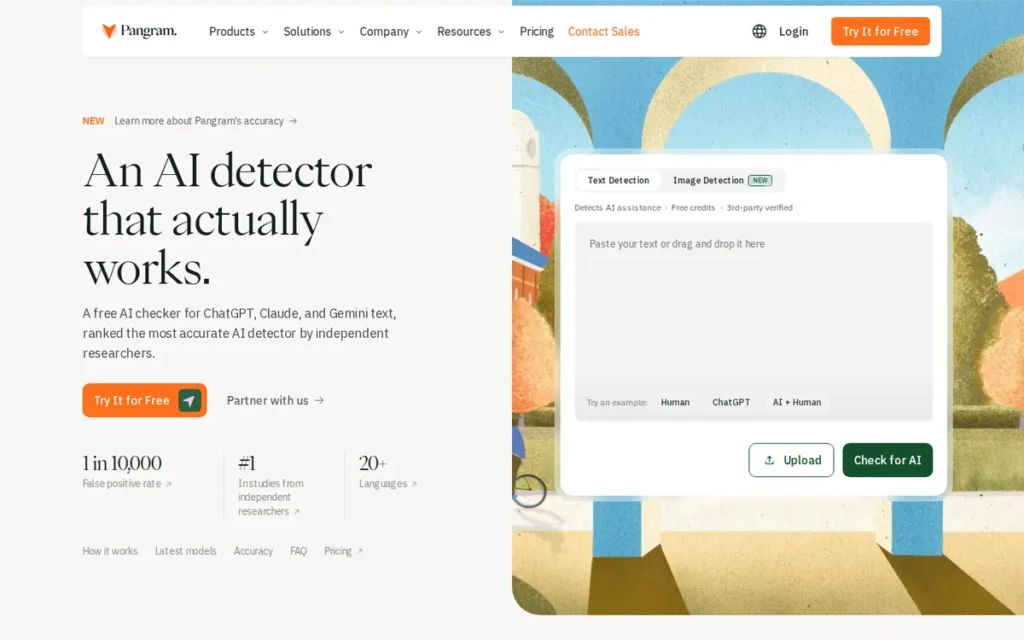
Category: AI Content Detector, software that analyzes text to determine whether it was written by a human or generated by an AI language model, and estimates the degree of AI involvement.
At a Glance
- Category: AI Content Detector
- Best For: Enterprise teams, academic institutions, and publishers requiring the lowest independently validated false positive rate and institutional-grade evidence of detection methodology
- Price Range: Free (5 scans/day after signup); $15/month for up to 600 scans; enterprise and API pricing on request
- Primary Strength: Pangram is the only AI content detector in this evaluation validated by an independent named academic institution (the University of Chicago Becker Friedman Institute) for achieving near-zero false positive and false negative rates on medium-to-long texts, outperforming all competitors under policy-capped testing conditions.
- Biggest Limitation: Pangram does not offer native LMS integration with Canvas or Google Classroom, meaning educators cannot embed Pangram into assignment submission workflows without custom API development, and enterprise pricing requires direct vendor engagement rather than self-service access.
- One-Line Summary: Pangram is the most independently validated AI content detector in 2026, with University of Chicago Becker Friedman Institute research confirming near-zero false positive rates on medium-to-long texts, the top choice where wrongful accusations carry institutional or legal consequences.
- Last Verified: April 2026
Overview
Pangram is an AI content detector built on Hard Negative Mining with Synthetic Mirrors (a peer-reviewed detection architecture developed by a team of AI researchers with experience at leading technology organizations and academic institutions) designed for enterprise teams, academic institutions, and publishers requiring the lowest possible false positive rate and independently validated accuracy. Pangram 3.2, supported by ICLR 2026 research contributions including an arXiv preprint and the EditLens architecture paper, classifies text across four tiers: Fully human-written, Lightly AI-assisted, Moderately AI-assisted, and Fully AI-generated.
The University of Chicago Becker Friedman Institute (Booth School of Business) independently validated Pangram for near-zero false positive and false negative rates on medium-to-long texts, the most credible external benchmark in this evaluation. This independent validation separates Pangram from competitors that rely solely on self-reported accuracy claims.
Key Features
- Hard Negative Mining with Synthetic Mirrors: Pangram’s detection architecture iteratively scans millions of human documents to identify cases most likely to be misclassified as AI, generates AI-style “mirror” versions matching those documents’ style and tone, and retrains on the resulting pairs, reducing false positive rates by 100–1,000x compared to perplexity-based methods in benchmarks validated by the University of Chicago BFI, per Pangram technical report, 2024.
- Four-Tier AI Classification: Pangram 3.2 classifies text as Fully human-written, Lightly AI-assisted, Moderately AI-assisted, or Fully AI-generated, enabling institutions to calibrate enforcement to their specific AI usage policies rather than applying binary verdicts, per Pangram blog, 2026.
- Chrome Extension with 20+ Language Support: Pangram’s Chrome extension (updated March 20, 2026) detects AI content across 20+ languages by analyzing any selected text directly in the browser, covering documents, emails, and web-based submissions without requiring external file uploads.
- SOC 2 Type 2 Certification and Data Privacy: Pangram is SOC 2 Type 2 certified and explicitly commits to not using submitted content for model training, satisfying data privacy requirements for institutions handling FERPA-regulated student content or proprietary enterprise documents.
- Enterprise API Integration: Pangram’s scalable API supports integration into custom content management systems and automated review pipelines, with enterprise and volume pricing available on request for high-throughput institutional deployments.
Best For
Pangram is best for enterprise content teams, university compliance offices, and publishers managing large volumes of submissions where a wrongful false positive carries institutional or legal consequences, and where SOC 2 Type 2 data privacy certification and peer-reviewed methodology are non-negotiable procurement requirements.
Pricing
Pangram’s free tier provides 5 scans per day after signup. A 7-day free trial unlocks paid features including four-tier AI assistance detection. The paid entry tier is $15/month covering up to 600 AI scans, with 1 credit applied per 1,000 words beyond the first 1,000 words per document. Enterprise and API pricing are not publicly listed, institutional buyers must contact Pangram directly. Plagiarism detection is a paid add-on. All pricing verified April 2026 at pangram.com.
Strengths
- The University of Chicago Becker Friedman Institute (Booth School of Business), 2026 (a genuinely independent named academic institution) found Pangram achieved zero false positive and false negative rates on medium-to-long texts and outperformed all evaluated competitors under a 0.5% false positive rate policy cap, representing the most credible external benchmark documented across all seven tools in this evaluation.
- Pangram’s ICLR 2026 research contributions: including an arXiv preprint (2510.03154) and the EditLens architecture paper, represent the only tool in this evaluation with peer-reviewed academic context at the International Conference on Learning Representations, one of the most competitive AI/ML research venues globally, per Pangram research page.
- Pangram achieves near-perfect detection of paraphrased and humanized AI content: including text processed through dedicated AI-bypass tools like StealthGPT, per Pangram technical report, 2024 (vendor-published; not independently replicated on StealthGPT specifically as of April 2026), while competitors using perplexity/burstiness approaches degrade to 22–50% detection rates on those same content types.
- An SEO professional who self-described as having tested over 50 AI content detectors named Pangram “by far the best tool out there” in a 2025 Reddit thread on r/SEO (473K subscribers), the strongest single-tool endorsement found across Reddit research for any tool in this evaluation.
Users on r/SEO shared their findings after testing 50+ detectors head-to-head:
“I’ve tested over 50 AI content detectors this year. Most are average, but some stand out. Copyleaks is pretty solid; however, it’s not perfect. The real test is Pangram Labs – by far the best tool out there. For practical advice: I think you should continue using Copyleaks, but with an open mind. If the tool repeatedly suggests that the text is 80%+ AI, it should be improved either way.” Posted by u/Straight-Clue3515
Takeaway: Among practitioners who have systematically tested 50+ AI detectors head-to-head, Pangram is named the outright winner, the strongest peer-verified practitioner endorsement for any single tool found across this evaluation’s Reddit research.
Limitations
- LMS Integration Gap: Pangram does not offer native LMS integration with Canvas or Google Classroom, meaning educators in those environments cannot embed Pangram into assignment submission workflows without custom API development, a capability that both Copyleaks and GPTZero provide out of the box, making Pangram operationally inaccessible for many institutional educators without dedicated technical support.
- Enterprise Pricing Opacity: Pangram’s API and enterprise pricing are not publicly listed, requiring direct vendor engagement that extends procurement timelines for institutions with formal purchasing processes, a friction not shared by GPTZero or Originality.ai, which publish full tier structures online.
- Limited Multilingual Documentation: Pangram’s Chrome extension supports 20+ languages, but this is narrower than Copyleaks (30+ languages) and ZeroGPT (40+ languages), and multilingual accuracy outside English has not been independently benchmarked in research available as of April 2026.
- Consumer Review Platform Absence: Pangram has no verified aggregate score on G2, Capterra, or Trustpilot, meaning individual educators who rely on consumer review aggregates will find significantly less social proof for Pangram than for GPTZero or ZeroGPT, creating a trust gap for first-time evaluators unfamiliar with academic literature as a credibility signal.
Verdict
Pangram is the most independently validated AI content detector available in 2026, with University of Chicago Becker Friedman Institute research confirming near-zero false positive and false negative rates on medium-to-long texts, the highest-credibility external benchmark documented in this evaluation. Pangram’s Hard Negative Mining architecture is the only detection methodology in this evaluation specifically designed at the research level to solve the false positive problem that causes the most institutional damage in enforcement contexts. Pangram is the top choice for any buyer where wrongful false accusations carry meaningful consequences, where independently verifiable evidence is required for procurement, and where a technical team is available to handle API integration in the absence of native LMS connectivity.
2. Copyleaks: Best for Academic Institutions and Multilingual Enterprise Teams
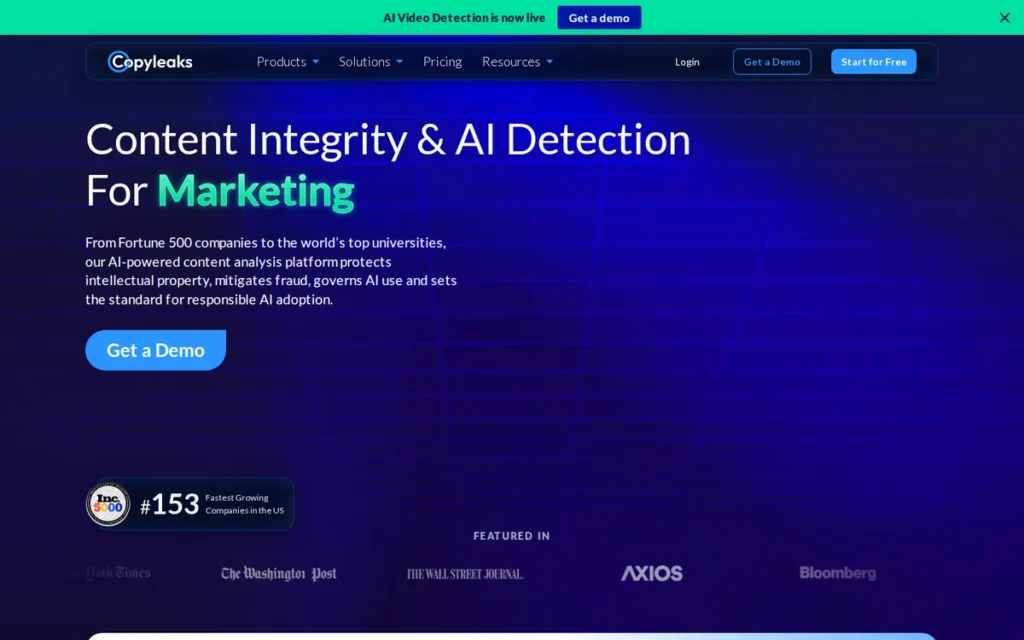
Category: AI Content Detector, software that analyzes text to determine whether it was written by a human or generated by an AI language model, and estimates the degree of AI involvement.
At a Glance
- Category: AI Content Detector
- Best For: Academic institutions with Canvas LMS, multilingual teams needing 30+ language support, and CS programs needing function-level code detection
- Price Range: Free (5 scans/day); from approximately $16.99/month for 100 credits; institutional pricing on request
- Primary Strength: Copyleaks is the only tool combining Canvas LMS integration, 30+ language support, function-level code detection, and AI model fingerprinting, backed by a Cornell Tech–affiliated arXiv study measuring 99.12% accuracy on human-authored text.
- Biggest Limitation: Copyleaks accuracy degrades to approximately 85% on paraphrased or humanized content; formal academic writing carries documented false positive risk including on pre-ChatGPT theses; AI detection and plagiarism checking run as separate scans.
- One-Line Summary: Copyleaks is the most feature-complete AI content detector for academic institutions in 2026, offering Canvas LMS integration, 30+ language support, function-level code detection, and a Cornell Tech–affiliated accuracy benchmark, with the critical caveat that accuracy degrades to approximately 85% on humanized AI content.
- Last Verified: April 2026
Overview
Copyleaks is an enterprise-grade AI content detector and plagiarism platform designed for academic institutions and multilingual enterprise teams, offering Canvas LMS integration, 30+ language support, function-level source code detection, and AI model fingerprinting in a single institutional deployment platform. Copyleaks uses a three-investigator ensemble (three independent AI models that must reach unanimous consensus before flagging content) alongside AI Logic per-sentence explanations that support academic due process.
A Cornell Tech–affiliated arXiv study (2023) measured Copyleaks at 99.12% accuracy on human-authored content, the second-strongest named independent validation in this evaluation. Separately, Copyleaks reports 99.84% overall accuracy with a false positive rate of approximately 0.026%–0.03% across larger multilingual benchmarks, corroborated at approximately 0.03% by external sources, though the commissioning institution for this larger benchmark is Copyleaks itself.
Key Features
- Three-Investigator Ensemble Consensus: Copyleaks requires three independent AI investigator models to reach a unanimous verdict before flagging content as AI-generated, a consensus mechanism designed to reduce false positives by requiring agreement rather than relying on a single model’s output, as all other evaluated tools do.
- AI Source Match Model Fingerprinting: Copyleaks identifies the specific AI model that generated flagged content (including GPT-4, GPT-5, Claude, Gemini, DeepSeek, and Llama) with 99.88% stated precision (vendor-claimed; not independently validated as of April 2026), enabling institutions to enforce model-specific AI usage policies.
- Function-Level Source Code Detection: Copyleaks detects AI-generated content at the function level within source code submissions, the only tool in this evaluation applicable to computer science departments and software companies that need to screen technical work for AI-generated code.
- Canvas LMS Integration: Copyleaks integrates natively with Canvas LMS, embedding AI and plagiarism detection directly into institutional assignment submission workflows, with documented deployment at the University of Illinois Springfield (last updated November 2024) providing evidence of passing higher education procurement standards.
- AI Logic Per-Sentence Explainability: Copyleaks provides written per-sentence explanations of why specific content was flagged, a transparency feature that supports academic due process by giving instructors and students comprehensible grounds for reviewing or contesting a detection result.
Best For
Copyleaks is best for university academic integrity offices requiring native Canvas LMS integration, institutions with multilingual student populations needing detection across 30+ languages, computer science departments screening for AI-generated code, and enterprise compliance teams that need to document which specific AI model was used in flagged submissions.
Pricing
Copyleaks offers a free tier providing 5 scans per day. Paid entry starts at approximately $16.99/month for 100 credits as of April 2026. Institutional and enterprise pricing is structured through contracts and is not fully listed on the public pricing page, institutions should contact Copyleaks directly. Canvas LMS deployments are typically provisioned through institutional licensing agreements. Confirm current figures at copyleaks.com/pricing before purchase.
Strengths
- A Cornell Tech–affiliated arXiv study (2023) measured Copyleaks at 99.12% accuracy on human-authored content from computer science students (the second-strongest named external validation in this evaluation) while a 2026 benchmark that Copyleaks characterizes as independently conducted scored Copyleaks 99.6/100 across 12 contemporary AI models (the commissioning institution for this larger benchmark could not be independently confirmed by PlugRoute), per Copyleaks blog, 2026.
- Copyleaks is the only tool in this evaluation with a documented named institutional deployment at a university, the University of Illinois Springfield via Canvas LMS (last updated November 2024), providing evidence of having passed institutional IT and procurement review processes that most competitors have not publicly documented.
- Copyleaks AI Source Match model fingerprinting: identifying the originating AI model with 99.88% stated precision (vendor-claimed; not independently validated as of April 2026), is a unique capability not offered by any other evaluated tool, enabling universities and enterprise teams to enforce tool-specific AI usage policies.
- Copyleaks’ three-investigator ensemble requiring unanimous consensus is the most transparent false positive reduction mechanism among non-Pangram tools in this evaluation, requiring agreement from three independent AI models rather than relying on a single model’s output.
Limitations
- Paraphrased Content Accuracy Degradation: Copyleaks accuracy falls to approximately 85% when content has been processed through paraphrasing or humanization tools, per Fritz.ai independent testing, 2025 (compared to 99%+ on raw, unmodified AI text) meaning Copyleaks provides meaningfully reduced enforcement value against the most sophisticated real-world evasion scenarios.
- False Positive Risk on Formal Academic Writing: Reddit user u/RoyalVirgin on r/ChatGPT documented a 2021 pre-ChatGPT cum laude master’s thesis flagged at 60–90% AI likelihood, suggesting Copyleaks may detect formal academic writing style rather than AI origin in certain content types, a critical risk for institutions with large non-native English writer populations.
“Either Copyleaks is ridiculously accurate, or the other ones are extremely inaccurate. I put parts of my friend’s Master thesis (Cum laude) from 2021, pre-ChatGPT, in. I could find parts where Copyleaks flagged it as anywhere between 60–90% certain AI.” (u/RoyalVirgin, r/ChatGPT)
Takeaway: A pre-ChatGPT cum laude thesis flagged at 60–90% AI likelihood indicates Copyleaks may be detecting formal academic writing style rather than AI origin, a false positive risk that institutional users must account for before using detection results as enforcement evidence.
- Separate AI and Plagiarism Scans: Copyleaks processes AI detection and plagiarism checking as separate scans rather than simultaneously, adding workflow friction for institutions requiring both checks on every submission, as noted in Copyleaks documentation.
- Institutional Pricing Opacity: Copyleaks’ free tier (5 scans/day) is insufficient for institutional use at meaningful scale, and full institutional pricing requires direct vendor engagement, a procurement friction not shared by GPTZero or Originality.ai, both of which publish full tier pricing online.
Verdict
Copyleaks is the most feature-complete AI content detector for academic institutions in 2026, combining Canvas LMS integration, 30+ language support, function-level source code detection, and AI model fingerprinting, with a Cornell Tech–affiliated arXiv study (2023) confirming 99.12% accuracy on human-authored text as the strongest external anchor for its accuracy validation. Institutions with multilingual populations, computer science programs, or existing Canvas workflows will find Copyleaks the most operationally complete option in this evaluation. The critical caveat that must inform institutional policy: Copyleaks accuracy degrades to approximately 85% on paraphrased content, formal academic writing carries documented false positive risk, and detection results should function as one evidence signal in a multi-factor review process, never as a standalone enforcement verdict.
3. GPTZero: Best for Educators on a Budget: Strongest Free Tier, Penn State–Validated Accuracy, Broadest Developer API
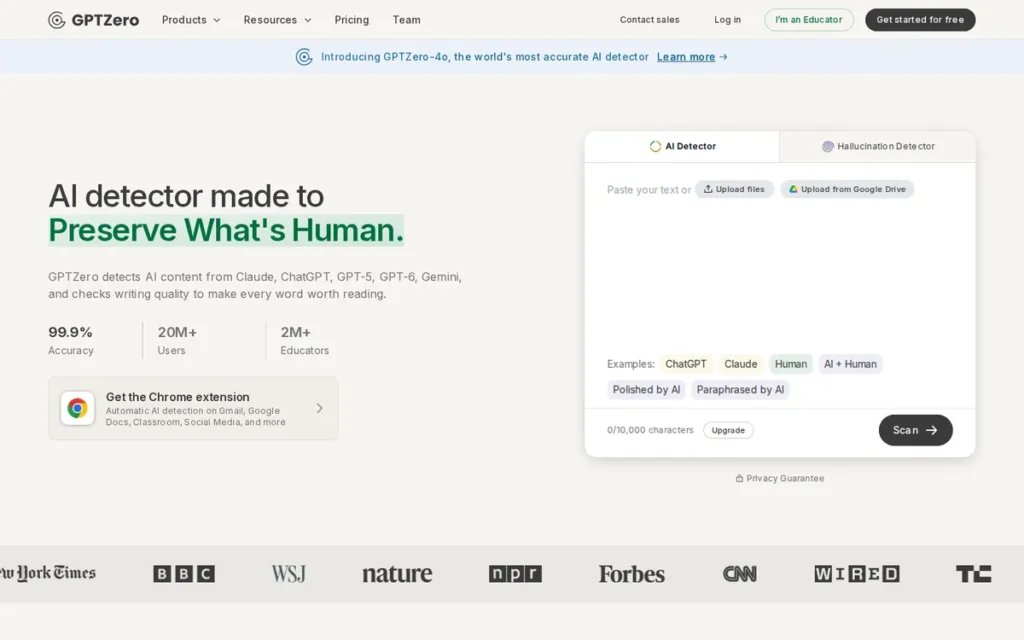
Category: AI Content Detector, software that analyzes text to determine whether it was written by a human or generated by an AI language model, and estimates the degree of AI involvement.
At a Glance
- Category: AI Content Detector
- Best For: Individual educators and K-12 teachers on limited budgets; enterprise developers needing a broad-language API
- Price Range: Free (10,000 words/month, basic scans); Essential ~$8.33/month (billed annually); Premium ~$12.99–$24/month
- Primary Strength: GPTZero offers the most generous free tier in this evaluation (10,000 words/month) and Penn State PIKE Lab–benchmarked accuracy at 99% on AI text and 96.5% on mixed documents, with an API available in 17 programming languages for developer integration.
- Biggest Limitation: GPTZero’s perplexity/burstiness detection approach is increasingly vulnerable to evasion by humanization tools; a single-word change has been documented reversing a full-document verdict in a Reddit community with 2.7 million subscribers.
- One-Line Summary: GPTZero is the most widely adopted free AI content detector in education as of 2026, validated through Penn State PIKE Lab benchmarking at 99% accuracy on unmodified AI text, with the critical limitation that its perplexity-based detection degrades significantly on paraphrased or humanized AI content.
- Last Verified: April 2026
Overview
GPTZero is the pioneering AI content detector in the education sector, launched in January 2023 and now serving over 10 million users (self-reported by GPTZero as of 2026) across education, publishing, legal, and hiring, offering the most generous free tier in this evaluation (10,000 words/month) alongside Penn State PIKE Lab benchmarking for educators, academic integrity officers, and enterprise developers. GPTZero’s current seven-indicator detection model extends beyond its original perplexity and burstiness measurements to include deep learning components, and its Writing Sandbox analyzes real-time composition rather than only final submitted output.
GPTZero’s perplexity-based core approach is increasingly vulnerable to evasion by humanization tools, a limitation that must inform how educators deploy GPTZero’s results in consequential enforcement decisions, per GPTZero technology page.
Key Features
- Seven-Indicator Detection Model: GPTZero uses a multi-layered detection system combining perplexity, burstiness, and deep learning components, benchmarked in collaboration with Penn State’s PIKE Lab (Dr. Dongwon Lee) at 99% accuracy on AI-generated content and 96.5% on mixed human-AI documents with a stated false positive rate under 1%, per GPTZero technology documentation.
- Writing Sandbox: GPTZero’s Writing Sandbox monitors and analyzes a writer’s composition process in real time rather than evaluating only the final submitted output, providing a provenance verification layer that enables educators to review the writing timeline alongside the AI detection score, a capability not available in any other evaluated tool.
- 17-Language API Integration: GPTZero provides an API available in 17 programming languages, including Python, Node.js, Java, C#, and PHP, giving GPTZero the broadest developer integration capability among all seven evaluated tools for building custom AI detection into enterprise CMS, HR, or student information system workflows.
- LMS and Platform Integrations: GPTZero integrates natively with Canvas LMS, Google Classroom, Microsoft Word, and Google Docs, and offers a Chrome Extension for in-browser detection, covering the primary institutional and individual educator workflow environments in a single tool.
- Color-Coded Sentence-Level Highlighting: GPTZero delivers sentence-level and paragraph-level highlighting with individual confidence levels for each flagged segment, enabling educators to review which specific portions of a submission triggered AI classification rather than relying solely on an aggregate percentage score.
Best For
GPTZero is best for individual educators and K-12 teachers who need a high-quality detection tool with no cost commitment, small academic departments checking occasional student submissions without institutional software contracts, and enterprise developers who need AI detection integrated into custom platforms via a broadly compatible multi-language API.
As one professor on r/Professors described the access gap that GPTZero’s free tier directly addresses:
“I’ve got some papers that I am 100% sure are AI generated. I’ve only ever used Turnitin for plagiarism but these are first person observations and not research papers. Any recommendations? I’m not aware of my school having one available so I would prefer some free options.” Posted by u/[OP], r/Professors
Takeaway: Educators who lack institutional access to Turnitin and need a free, immediately deployable detection option represent exactly the audience GPTZero’s 10,000-words-per-month free tier was designed to serve, and the problem this professor describes is routine, not exceptional.
Pricing
GPTZero’s free tier provides 10,000 words per month with basic AI scanning and 5 free advanced scans, no payment required. The Essential plan is $14.99/month or approximately $8.33/month billed annually (~$100/year, a 45% savings), covering 150,000 words/month, a Chrome Extension, and multi-file upload. Premium covers approximately 300,000 words/month with plagiarism checking at approximately $12.99–$24/month, price showed variance across indexed sources, suggesting a recent adjustment; verify current figures at gptzero.me/pricing. All pricing verified April 2026.
Strengths
- GPTZero’s accuracy was benchmarked in collaboration with Penn State’s PIKE Lab (Dr. Dongwon Lee), yielding 99% classification accuracy on pure AI content and 96.5% on mixed human-AI documents, a named academic researcher partnership representing the strongest external validation among all free-tier tools in this evaluation, though it is a collaborative benchmarking effort rather than a fully independent external study, per GPTZero technology page.
- GPTZero’s free tier provides 10,000 words per month without requiring payment: the most substantively useful free option in this evaluation for individual educators who need to check student submissions without institutional budget authorization, significantly more generous than Copyleaks (5 scans/day), Pangram (5 scans/day), and Originality.ai (no free tier).
- GPTZero has served over 10 million users (self-reported) and works with more than 100 organizations (self-reported) across education, publishing, legal, and hiring sectors since its January 2023 founding, the largest documented claimed user base of any tool in this evaluation, with the broadest cross-sector adoption referenced in publicly available vendor materials.
- GPTZero’s API is available in 17 programming languages: the broadest developer integration footprint among all evaluated tools, enabling enterprise and institutional teams to embed AI detection into existing CMS, HR, or student information system workflows without being constrained to a single technical environment.
Limitations
- Perplexity/Burstiness Evasion Vulnerability: GPTZero’s core detection approach is increasingly vulnerable to evasion as AI models produce more varied, human-like output, an r/OpenAI case (2.7M subscribers) documents removing a single word (“intensifies”) reversing an entire document’s AI verdict, a level of brittleness that undermines GPTZero’s reliability in consequential enforcement contexts.
“I typed a long, 400-word paragraph analyzing a lengthy book and did not use AI… Just these 3 sentences made it so my whole paragraph was flagged as written by AI! I removed one word (‘intensifies’) and those sentences got fully cleared by the AI.” (u/[OP], r/OpenAI)
Takeaway: GPTZero’s perplexity-based detection is brittle enough that removing a single vocabulary word can reverse an entire document’s AI verdict, a reliability failure that disqualifies GPTZero as standalone evidence in any consequential enforcement context.
- Paraphrased Content Degradation: An independent community benchmark found GPTZero “fell apart” on paraphrased and humanized AI content despite achieving 97% accuracy on unmodified AI text, per r/BestAIDetectors, 2025, illustrating how dramatically GPTZero’s performance degrades on the content type most relevant to detecting sophisticated real-world AI misuse.
- False Positives on Scientific and Dense Academic Writing: An independent PMC study on medical abstracts found only 80% accuracy and 10% false positives for GPTZero on that specific content type, indicating elevated false positive risk for STEM academic writing styles independent of actual AI use, a finding relevant to institutions with significant science or medicine programs.
- Limited Multilingual Support: GPTZero’s verified multilingual support covers English, German, Portuguese, French, and Spanish (narrower than Copyleaks (30+ languages) or ZeroGPT (40+ languages)) limiting reliability at institutions with diverse international student populations where ESL writing patterns may trigger false positives at higher rates.
Verdict
GPTZero is the strongest free AI content detector available in 2026, backed by Penn State PIKE Lab benchmarking collaboration (99% accuracy on pure AI content) and offering the most generous free tier (10,000 words/month) and broadest API access (17 programming languages) in this evaluation. GPTZero is the correct starting point for individual educators checking submissions from students writing in its five supported languages, and for developers building AI detection into institutional workflows via API. GPTZero’s perplexity-based approach degrades significantly on paraphrased or humanized AI content, and single-word sensitivity is a documented reliability failure, meaning GPTZero should be deployed as a reliable first-pass signal that triggers human review, not as a definitive enforcement instrument against students aware of detection evasion.
4. Originality.ai: Best for Content Publishers and SEO Agencies Managing Outsourced Content at Scale
Category: AI Content Detector, software that analyzes text to determine whether it was written by a human or generated by an AI language model, and estimates the degree of AI involvement.
At a Glance
- Category: AI Content Detector
- Best For: Content publishers, SEO agencies, and editorial teams managing outsourced writing at volume
- Price Range: PAYG $30/3,000 credits; Pro $12.95–$14.95/month; Enterprise $136.58–$179/month
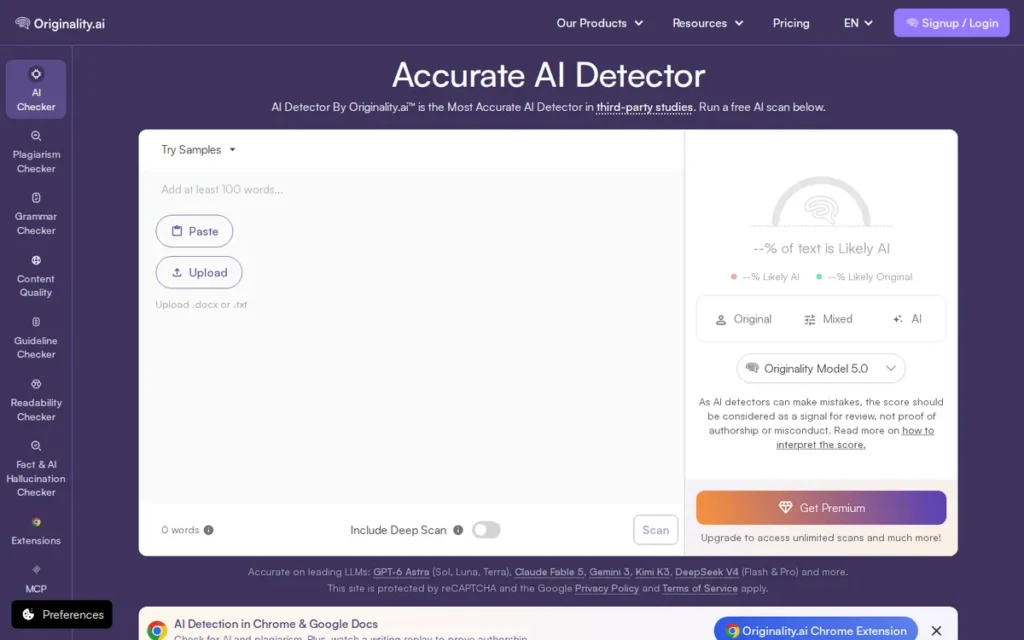
- Primary Strength: Originality.ai combines AI detection, plagiarism checking, real-time fact verification, readability scoring, and grammar checking in a single subscription, with a WordPress plugin and site-level API optimized for publisher and agency workflows.
- Biggest Limitation: Third-party accuracy benchmarks range from 83% (Scribbr independent testing) to 98.8% (vendor-claimed); aggressive false positives are documented on formal and grammar-tool-assisted writing; no meaningful free tier exists.
- One-Line Summary: Originality.ai is the most feature-complete AI content detection platform for publishers and SEO agencies in 2026, combining AI detection, plagiarism, and fact verification in one subscription, with third-party accuracy benchmarks ranging from 83–98.8% requiring it to be used as a directional risk signal rather than standalone proof.
- Last Verified: April 2026
Overview
Originality.ai is a multi-feature AI content analysis platform combining AI detection, plagiarism checking, real-time fact verification, readability scoring, and grammar analysis in a single subscription, designed primarily for content publishers, SEO agencies, and editorial teams managing outsourced writing at volume through its WordPress plugin and bulk scanning API. Originality.ai’s detection engine uses an ELECTRA-style bidirectional Transformer trained on 160 GB of text data, reading content in both directions simultaneously to detect AI-characteristic contextual patterns that can persist even when surface-level vocabulary has been manually altered, per SentiSight analysis, 2025.
Third-party benchmarks for Originality.ai range from 83% in Scribbr’s independent testing to 98.8% in internal testing, a divergence that makes Originality.ai best deployed as a directional risk signal within a multi-step editorial review process, not as a standalone enforcement instrument.
Key Features
- ELECTRA-Style Bidirectional Transformer: Originality.ai’s detection engine reads content in both directions simultaneously (trained on 160 GB of text data and millions of labeled samples) detecting AI-characteristic contextual patterns that can remain present even after basic synonym substitution or light editing, offering a structural advantage over unidirectional perplexity-based methods on lightly modified AI content, per SentiSight, 2025.
- Four Specialized Detection Model Tiers: Originality.ai offers Lite (99% claimed accuracy, 0.5% FPR, tolerates minor AI editing), Turbo (zero-tolerance policy, 1.5% FPR), Academic (STEM-optimized, <1% FPR), and Multi Language (30-language support, 97.81% claimed accuracy), enabling publishers and agencies to calibrate detection sensitivity by content type and editorial policy, per Originality.ai blog, 2026.
- Multi-Feature Content Quality Platform: Originality.ai bundles plagiarism detection, real-time fact verification, readability scoring, and grammar checking alongside AI detection in a single subscription, positioning Originality.ai as a full content quality platform for agencies replacing separate plagiarism and grammar tools.
- WordPress Plugin and Site-Level Scanning API: Originality.ai’s WordPress plugin and site-level API enable publishers to check entire blogs or outsourced content batches without manual copy-paste submission, with a “view writing” replay feature that reconstructs the typing session timeline for supplementary authorship verification.
- Pay-As-You-Go Option: Originality.ai’s PAYG option ($30 for 3,000 credits at 100 words per credit) gives infrequent users access to the full platform without a monthly commitment, the only evaluated tool offering both PAYG and subscription tiers, making Originality.ai accessible at varying editorial volume levels.
Best For
Originality.ai is best for content publishers, SEO agencies, and editorial teams managing outsourced content at volume who need a combined AI detection, plagiarism, and content quality platform integrated with their WordPress or API-based publishing workflow, and who understand that detection results function as directional risk signals within a human review process, not as definitive proof of AI authorship.
Pricing
Originality.ai offers three billing options as of April 2026:
- Pay-as-you-go: $30 one-time for 3,000 credits (1 credit = 100 words of analysis)
- Pro: $14.95/month or $12.95/month billed annually ($155.40/year)
- Enterprise: $179/month or $136.58/month billed annually ($1,638.96/year)
All paid plans include the full platform (AI detection, plagiarism, fact-checking, readability, grammar). Originality.ai has no free tier, the PAYG option is the lowest-friction entry point. Verify current pricing at originality.ai/pricing.
Strengths
- Originality.ai’s ELECTRA-style bidirectional Transformer architecture: trained on 160 GB of text data, provides a theoretical structural advantage over unidirectional perplexity-based methods at detecting lightly modified AI content, offering richer contextual analysis that is harder to fool via basic synonym swapping than single-direction approaches, per SentiSight analysis, 2025.
- Originality.ai bundles five content quality tools: AI detection, plagiarism checking, real-time fact verification, readability scoring, and grammar checking, in a single subscription, making Originality.ai cost-effective for agencies currently paying separately for plagiarism checking and grammar tools alongside a standalone AI detector, per Scribbr review, 2025.
- Originality.ai’s WordPress plugin and site-level scanning API enable editorial teams to check entire content batches (including published archives and incoming outsourced submissions) for AI generation and plagiarism without individual manual submission, delivering meaningful workflow efficiency for agencies processing hundreds of articles monthly.
- Spencer Haws, founder of Niche Pursuits and identified in Reddit community discussions as having early involvement with Originality.ai’s development (Source: r/WebsiteSEO, 2025), lends domain-specific credibility in the publisher and SEO agency community, explaining Originality.ai’s strong orientation toward agency-scale content workflows.
Limitations
- Wide Third-Party Accuracy Range: Originality.ai’s third-party benchmarks range from 83% in Scribbr’s independent testing, 2025 to 98.8% in internal testing, the second-largest divergence between independently measured and vendor-claimed accuracy among all seven evaluated tools, exceeded only by ZeroGPT. Originality.ai is unsuitable as definitive evidence in academic integrity proceedings and best treated as a directional screening tool.
- False Positives on Formal and Grammar-Assisted Writing: Multiple Reddit users on r/gradadmissions (347K subscribers) report 100% AI flags on content they wrote entirely themselves (including documents that received only Grammarly typo fixes) with the Turbo model appearing most aggressive in this behavior, a pattern that disqualifies Originality.ai from academic enforcement contexts.
Users on r/productreview shared a balanced first-hand assessment after comparing Originality.ai against multiple tools:
“Originality ai felt more detailed than the other tools I had tried. The line by line breakdown is useful because it shows exactly which sentences are being flagged instead of just giving one overall score. That helped to understand patterns in writing and spot areas that might look too polished or structured. I still noticed a few false positives with formal or academic style writing. The tool also feels strict sometimes and the results might change after running the same text again later. So for me this can be useful as a signal and helpful for a safety check but I wouldn’t rely on any single tool as the final result.” Posted by u/Ecstatic_Look_1975
Takeaway: Real-world Originality.ai users independently confirm both the tool’s line-level transparency as a genuine operational strength and its false positive pattern on formal academic writing, validating the evaluation’s conclusion that Originality.ai functions as a directional signal, not a standalone enforcement instrument.
- No Meaningful Free Tier: Originality.ai’s minimum entry point is a $30 pay-as-you-go purchase, individual educators and students cannot evaluate Originality.ai’s real-world false positive behavior on their own writing before committing financially, a significant accessibility barrier compared to GPTZero (10,000 words/month free) or Copyleaks (5 scans/day free).
- Not Designed for Academic Use: Originality.ai flagged a formal human-written essay “more aggressively than any other tool, which is a problem if you’re a student or educator,” per a multi-tool Reddit tester at r/BestAIDetectors, 2025, reinforcing Originality.ai’s positioning as a publisher tool, not an academic integrity instrument.
Verdict
Originality.ai is the strongest AI content detection platform for SEO agencies and content publishers in 2026, combining AI detection, plagiarism checking, and fact verification in a single subscription with a WordPress plugin, site-level API, and four-tier model calibration optimized for high-volume outsourced content workflows. Originality.ai’s ELECTRA-style bidirectional architecture provides a theoretical robustness advantage over perplexity-based tools against basic humanization, and Originality.ai’s publisher-audience orientation is a genuine product-market fit signal for the agency community. Originality.ai is not the right tool for academic integrity contexts where false accusations carry institutional and legal consequences, its third-party accuracy range (83–98.8%) and documented false positive patterns on formal writing require it to be deployed as a quality-control signal within a multi-step editorial review, never as a standalone enforcement instrument.
5. QuillBot AI Detector: Best for Existing QuillBot Suite Users: Ecosystem Convenience with Significant Accuracy Limitations
Category: AI Content Detector, software that analyzes text to determine whether it was written by a human or generated by an AI language model, and estimates the degree of AI involvement.
At a Glance
- Category: AI Content Detector
- Best For: Existing QuillBot Premium subscribers wanting AI detection integrated within their familiar writing workflow
- Price Range: Free (up to 1,200 words/scan); QuillBot Premium from approximately $7.99/month (billed annually, full suite)
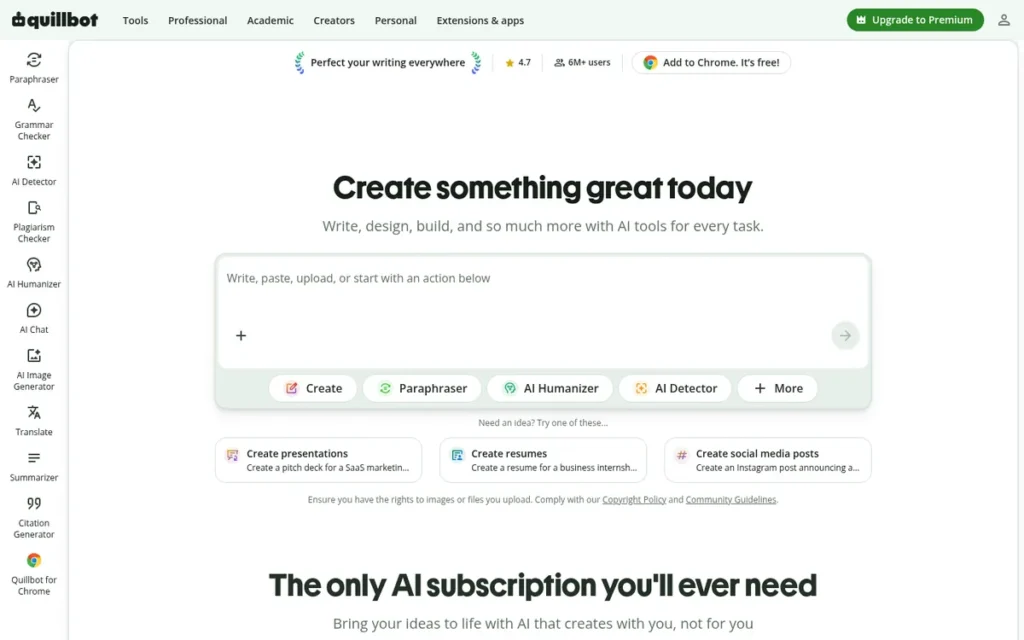
- Primary Strength: QuillBot AI Detector is the only tool in this evaluation classifying content across three categories (AI-generated, human-written and AI-refined, and fully human-written) addressing the dominant real-world mode of AI-assisted writing that binary detectors miss.
- Biggest Limitation: QuillBot AI Detector produces the lowest independent accuracy in this evaluation (78–80%); bidirectional failure modes are documented in the same Reddit threads; a structural conflict of interest exists from selling both paraphrasing and detection tools on the same platform.
- One-Line Summary: QuillBot AI Detector is best suited for existing QuillBot subscribers seeking convenient AI-use screening within their familiar platform, but its 78–80% independent accuracy, documented bidirectional failure modes, and structural conflict of interest make it unsuitable as a standalone enforcement tool for academic or editorial decisions.
- Last Verified: April 2026
Overview
QuillBot AI Detector is an AI content detection tool embedded within the QuillBot writing suite, co-founded in 2017 by Anil Jason, Rohan Gupta (CEO), and David Silin (CTO), backed by approximately $4.27 million in documented seed funding (Source: Preqin; Pulse2, 2021), and subsequently acquired by Course Hero in August 2021, designed primarily for existing QuillBot users who want AI use screening integrated alongside the platform’s paraphrasing, grammar checking, and citation tools. QuillBot AI Detector’s defining feature is its three-way content classification: text is categorized as AI-generated, human-written and AI-refined, or fully human-written, the only tool in this evaluation that explicitly detects the dominant real-world mode of AI-assisted writing.
Independent testing places QuillBot AI Detector’s overall accuracy at 78–80% (the lowest in this evaluation) and Reddit communities document bidirectional failure modes: human-written personal stories flagged at 100% AI while verbatim ChatGPT output is cleared as human in the same discussion thread.
Key Features
- Three-Way Content Classification: QuillBot AI Detector classifies content as AI-generated, human-written and AI-refined, or fully human-written, detecting the dominant real-world mode of AI-assisted writing where a human edited an AI draft, a nuance that produces only binary AI/human verdicts in all other evaluated tools.
- ML Classifier Detection Engine: QuillBot AI Detector uses ML classifiers analyzing perplexity, burstiness, predictability, sentence variation, and repetitiveness (trained on human and AI-generated datasets from ChatGPT, GPT-4/5, Gemini, Claude, and Llama) with results delivered through sentence-level probability highlighting, per QuillBot technology page.
- Multilingual Support with Batch Processing: QuillBot AI Detector supports detection in English, Spanish, French, German, Dutch, and Portuguese, with batch document upload capabilities and downloadable PDF reports for teams processing multiple submissions simultaneously.
- Full Suite Integration: QuillBot AI Detector integrates within the QuillBot suite alongside the paraphrasing tool, grammar checker, citation generator, and summarizer, enabling users to detect, revise, and fact-check content without switching between platforms.
- Lowest Paid Entry Price in This Evaluation: QuillBot AI Detector is available at no additional cost within a QuillBot Premium subscription (approximately $7.99/month billed annually), the lowest per-month cost for a writing platform with integrated AI detection in this evaluation.
Best For
QuillBot AI Detector is best for students, freelance writers, and content creators already subscribed to QuillBot Premium who want a convenient first-pass AI detection check within their existing writing workflow, not for educators, academic integrity officers, or publishers making consequential enforcement decisions that require higher accuracy, lower false positive rates, and vendor neutrality.
Pricing
QuillBot AI Detector’s free tier allows AI detector access up to 1,200 words per scan. QuillBot Premium, approximately $7.99/month on the annual billing plan, unlocks unlimited AI detection, unlimited paraphrasing, advanced grammar checking, and all suite tools. QuillBot AI Detector is a bundled feature, not a standalone product; buyers seeking only AI detection are purchasing a full writing suite. The 1,200-word free-tier limit means most academic essays (1,500–3,000 words) exceed the free limit; the 80-word minimum means very short submissions cannot be reliably analyzed. Verify current pricing at quillbot.com/pricing.
Strengths
- QuillBot AI Detector’s three-way classification system: identifying content as AI-generated, human-written and AI-refined, or fully human-written, is the only tool in this evaluation that directly addresses the dominant real-world mode of AI-assisted writing, enabling detection of content where an AI draft was edited by a human, which binary detectors on all other evaluated tools cannot distinguish from fully AI-generated output.
- QuillBot (co-founded in 2017 by Anil Jason, Rohan Gupta as CEO, and David Silin as CTO; approximately $4.27 million in documented seed funding per Preqin and Pulse2, 2021; acquired by Course Hero in August 2021) is among the more organizationally documented companies in this evaluation, providing named founding team members, a documented founding year, and a verifiable acquisition history.
- QuillBot AI Detector is included within a QuillBot Premium subscription at approximately $7.99/month billed annually (the lowest per-month cost for any writing platform with integrated AI detection in this evaluation) delivering multi-tool value for users who actively use paraphrasing, grammar, citation, and summarization tools alongside detection.
- QuillBot AI Detector supports six languages with batch upload and downloadable PDF reports, providing a workflow-compatible output format for teams managing multiple simultaneous submissions in a multilingual environment, per AIDetectPlus review, 2025.
Limitations
- Lowest Independent Accuracy in This Evaluation: QuillBot AI Detector’s independent accuracy is measured at 78–80% overall (the lowest in this evaluation) and bidirectional failure modes are documented in r/ChatGPT (11.4M subscribers), where personal human-written stories are flagged at 100% AI while copy-pasted ChatGPT essays are cleared as human in the same thread.
“I just typed a story about my soccer career into QuillBot just to see what would happen. 100% AI. lol I didn’t know I was an AI.” (u/jjthejetblame, r/ChatGPT)
Takeaway: QuillBot AI Detector flagging a user’s personal soccer career story at 100% AI likelihood (while simultaneously clearing copy-pasted ChatGPT output as human) illustrates bidirectional failure modes severe enough to make the tool unreliable for any consequential enforcement scenario.
- Structural Conflict of Interest: QuillBot’s platform simultaneously sells paraphrasing tools (among the most widely used methods for creating AI-refined content that evades detection) and the detector designed to catch that same paraphrased content. A useful analogy: a company selling both safes and safe-cracking tools has a structural incentive that exists regardless of whether intentional miscalibration is present, and institutional buyers in academic integrity contexts should evaluate this conflict explicitly before deployment.
- Restrictive Free Tier and Minimum Input: QuillBot AI Detector’s 1,200-word free-tier limit means the majority of academic essays exceed the free limit, and the 80-word minimum input requirement means very short submissions cannot be reliably analyzed, limiting utility for both long-form academic work and short-form content without a paid subscription.
- Secondary Product Priority: QuillBot’s primary business is writing enhancement tools, QuillBot AI Detector has never been the platform’s core offering, which may explain why it has received fewer dedicated R&D resources than standalone detectors like GPTZero or Pangram, contributing to its last-place finish on accuracy among the seven evaluated tools.
Verdict
QuillBot AI Detector earns its place in this evaluation through its unique three-way content classification and its parent company’s organizational transparency, but not through detection reliability. QuillBot AI Detector’s 78–80% independent accuracy and documented bidirectional failure modes (false positives on personal human-written content and false negatives on ChatGPT output in the same thread) make it unsuitable as a standalone enforcement tool for academic integrity or editorial decisions of consequence. QuillBot AI Detector is best used as a convenience feature by existing QuillBot subscribers seeking a rough directional signal within a familiar platform, with results cross-checked against a higher-reliability tool, Pangram, Copyleaks, or GPTZero, before any consequential action is taken.
6. Winston AI: Best for Physical Document and Handwriting Submission Detection
Category: AI Content Detector, software that analyzes text to determine whether it was written by a human or generated by an AI language model, and estimates the degree of AI involvement.
At a Glance
- Category: AI Content Detector
- Best For: K-12 educators and institutions receiving handwritten or scanned physical submissions
- Price Range: 14-day free trial (2,000 words); Premium from approximately $10/month per third-party sources (Cybernews, 2025); verify at gowinston.ai
- Primary Strength: Winston AI is the only AI content detector in this evaluation with OCR technology for analyzing handwritten text and scanned physical documents, a unique capability with no equivalent among the other six evaluated tools.
- Biggest Limitation: Winston AI claims 99.98% accuracy while Cybernews independently measured 75–85%, the largest accuracy gap in this evaluation; bidirectional failure modes are the most frequently documented across Reddit communities; no named personnel or organizational information is publicly available for institutional due diligence.
- One-Line Summary: Winston AI is the only AI content detector in 2026 offering OCR analysis of handwritten and scanned submissions (uniquely relevant for K-12 educators with physical workflows) but its 75–85% independent accuracy, limited pricing self-disclosure, and total absence of organizational transparency make it unsuitable as a sole enforcement instrument.
- Last Verified: April 2026
Overview
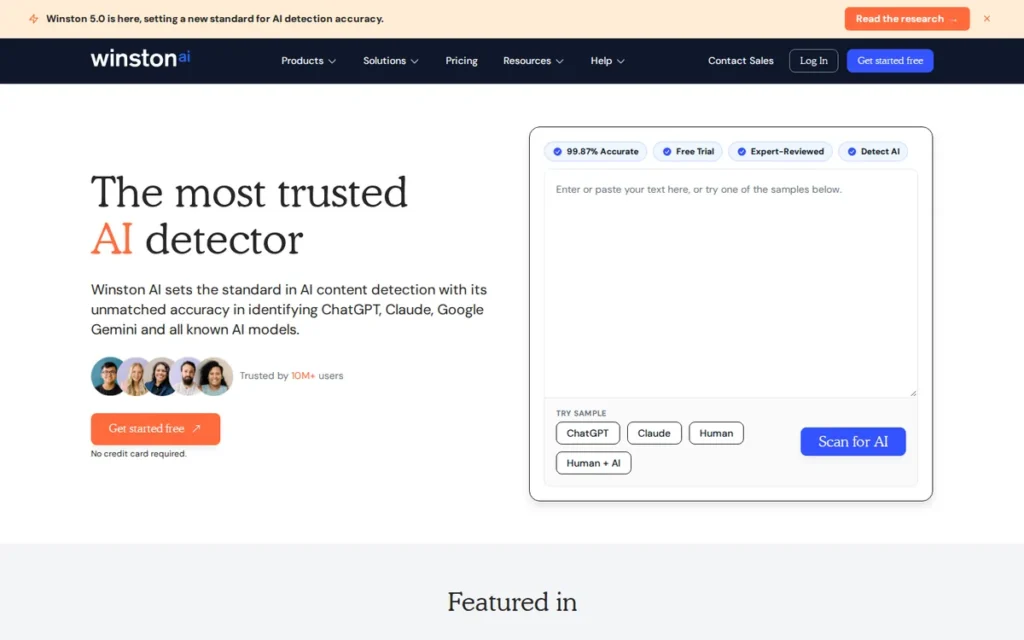
Winston AI is an AI content detector for educators and content teams that uniquely combines OCR technology for handwritten and scanned document analysis with weekly algorithm updates, AI image and deepfake detection, and Google Classroom integration, making it the only tool in this evaluation capable of screening physical student submissions for AI-generated content. Winston AI’s 0–100 color-coded AI prediction map classifies each sentence as “AI Generated,” “Uncertain,” or “Human Written,” with detection algorithms updated weekly to adapt to new AI model releases including GPT-5, Gemini 3, and Claude 4.
Winston AI claims 99.98% accuracy, but Cybernews independent testing, 2025 measured performance at 75–85%, the largest gap between claimed and independently measured accuracy of any tool in this evaluation.
Key Features
- OCR for Handwritten Text and Scanned Documents: Winston AI is the only AI content detector in this evaluation with OCR technology that extracts and analyzes text from scanned documents, image files (.png.jpg), PDFs.docx files, and handwritten text, enabling AI screening of physical student submissions without requiring digital text input from the educator.
- Color-Coded AI Prediction Map with Weekly Updates: Winston AI generates a 0–100 color-coded prediction map classifying each individual sentence as “AI Generated,” “Uncertain,” or “Human Written,” and updates its detection algorithms weekly (the most aggressive model refresh cadence in the evaluation) to adapt to new AI model releases.
- AI Image and Deepfake Detection: Winston AI’s AI image and deepfake detection module extends the platform beyond text screening to identify AI-generated visual content, enabling schools and publishers to check images and multimedia submissions alongside written work in a single tool, a bundled capability not offered by any other evaluated tool.
- Google Classroom Integration: Winston AI integrates with Google Classroom, enabling K-12 and higher education educators to screen student submissions for AI-generated content directly within their existing assignment and grading workflow.
- Plagiarism Checker with 400 Billion Web Pages: Winston AI bundles a plagiarism checker scanning against 400 billion web pages alongside its AI detection, providing both AI authorship screening and plagiarism verification in a single platform, as documented at gowinston.ai.
Best For
Winston AI is best for K-12 educators and teachers at institutions where students submit handwritten assignments or physical documents that are scanned before evaluation, the only scenario where Winston AI’s OCR handwriting detection capability addresses a need that no other evaluated tool can meet.
Pricing
Winston AI offers a 14-day free trial including 2,000 words of credits. Premium plans are available from approximately $10/month for full access, per third-party sources including Cybernews (2025); however, a complete self-service tier breakdown with all feature inclusions was not prominently displayed on the gowinston.ai pricing page as of April 2026. Winston AI’s pricing self-disclosure is materially less transparent than GPTZero, Pangram, and Originality.ai, which publish full tier breakdowns directly. Verify current tier structure at gowinston.ai before purchase.
Strengths
- Winston AI is the only tool in this evaluation offering OCR technology capable of extracting and analyzing text from handwritten student submissions and scanned physical documents, a capability with no equivalent among the other six evaluated tools, and directly relevant to K-12 institutions where physical submission workflows persist alongside digital assignment collection.
- Winston AI updates its detection algorithms weekly: the most aggressive model refresh cadence among all seven evaluated tools, addressing the rapidly evolving AI output landscape (GPT-5.2, Gemini 3, Claude 4) more frequently than competitors relying on less regular update cycles, per Winston AI documentation.
- Winston AI’s AI image and deepfake detection module extends the platform into multimedia content integrity screening, giving educational institutions and publishers a single tool for detecting both AI-written text and AI-generated visual content, a bundled capability not offered as a standard feature by any other evaluated tool.
- An independent third-party review at Logicweb cited 94% accuracy for Winston AI (Source: logicweb.com, 2025), higher than the 75–85% range documented in Cybernews independent testing, suggesting performance may vary significantly by content type, length, and testing methodology, though no named academic institution has independently validated any Winston AI accuracy figure.
Limitations
- Largest Accuracy Gap in This Evaluation: Winston AI claims 99.98% accuracy while Cybernews independent testing, 2025 measured 75–85% real-world performance, a 15–25 percentage point gap representing the largest divergence between vendor claim and independent measurement among all seven evaluated tools. Winston AI’s 99.98% figure is unreliable for institutional purchase decisions without additional external validation.
- Bidirectional Failure Modes Documented: Reddit communities document opposite failure modes in the same Winston AI discussion thread on r/ApplyingToCollege (1.3M subscribers, 58 upvotes), one user’s self-written essay received a 100% AI flag while a second user’s verbatim copy-pasted ChatGPT content was cleared as 99% human, both confirmed by multiple respondents.
“I tested Winston AI with my story: Human Score 100%. Winston has detected the text as 100% human… LOL I copied ChatGPT’s answer and put it straight into Winston AI and it said its 99% Human?!” (u/VoiceLessQ and u/Relevant-Stranger-12, r/ApplyingToCollege)
Takeaway: Winston AI simultaneously returned 100% human on a user’s original essay and 99% human on copy-pasted ChatGPT output, bidirectional failures in the same tool and the same thread that cannot both be attributed to edge cases, indicating a fundamental calibration problem.
- Limited Pricing Self-Disclosure: While third-party sources cite Winston AI premium plans from approximately $10/month, the gowinston.ai pricing page does not prominently self-disclose a full tier breakdown with feature inclusions, creating more friction for cost-effectiveness evaluation than GPTZero, Pangram, and Originality.ai, which publish complete tier structures directly.
- No Organizational Transparency: No named personnel, founding date, team size, funding history, or organizational documentation is publicly available for Winston AI, making institutional procurement due diligence impossible through standard research, a binary disqualifier for enterprise buyers with formal vendor assessment requirements.
Verdict
Winston AI occupies a narrow but genuine niche in this evaluation: Winston AI is the only AI content detector capable of analyzing handwritten student submissions and scanned physical documents via OCR, and this singular capability justifies consideration for K-12 educators at institutions with physical submission workflows where no other evaluated tool can substitute. Outside this specific scenario, Winston AI’s overall profile is the most concerning in the evaluation, the largest accuracy gap between claimed and independently measured performance, the highest volume of bidirectional failure documentation in Reddit communities, limited pricing self-disclosure, and complete absence of organizational accountability information. Winston AI should be used exclusively for its OCR capability, with all detection results treated as preliminary signals requiring cross-validation against a higher-reliability tool before any consequential enforcement action.
7. ZeroGPT: Best Free No-Signup Sanity Check: Lowest Barrier to Access, Lowest Detection Reliability
Category: AI Content Detector, software that analyzes text to determine whether it was written by a human or generated by an AI language model, and estimates the degree of AI involvement.
At a Glance
- Category: AI Content Detector
- Best For: Students and individuals wanting a zero-friction, no-registration first-pass directional check, non-consequential scenarios only
- Price Range: Free unlimited (no signup, ad-supported); from approximately $7.99/month for Premium
- Primary Strength: ZeroGPT provides unlimited free AI detection scans requiring no account registration, with 40+ language support, the lowest barrier to entry in this evaluation.
- Biggest Limitation: Real-world accuracy independently measured at 35–65% (BrightSEOTools; SkylineAcademic, 2025); only 22% detection of humanized AI content in controlled testing; structural conflict of interest from bundling AI Humanizer with the detector.
- One-Line Summary: ZeroGPT is the most accessible free AI content detector in 2026 (unlimited scans, no registration, 40+ languages) but independent testing measures real-world accuracy at 35–65% and detection of humanized AI at 22%, making ZeroGPT a directional sanity check only, not a reliable enforcement instrument.
- Last Verified: April 2026
Overview
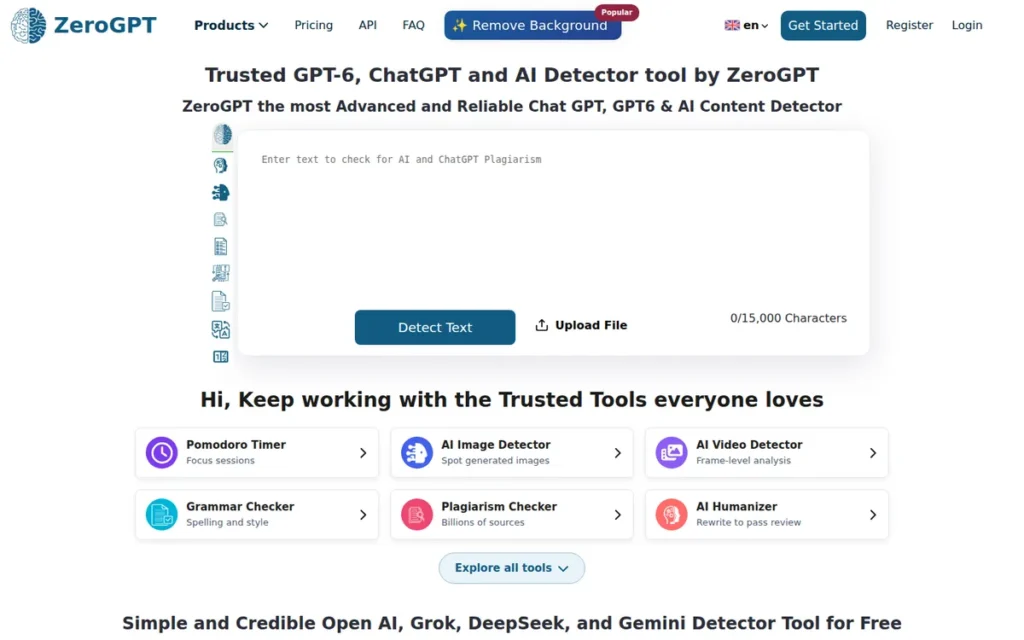
ZeroGPT is a freemium AI content detector providing unlimited free detection scans without requiring user registration (supporting 40+ languages using proprietary DeepAnalyse™ Technology) designed for students, freelancers, and casual users who want a zero-friction first-pass check on content without a subscription commitment. ZeroGPT classifies text as “Human written,” “AI/GPT generated,” “Mixed signals,” or “Likely generated by AI” with sentence-level percentage highlighting, and bundles additional tools including an AI Humanizer, Plagiarism Checker, and Grammar Checker in the same platform.
ZeroGPT’s CEO, identified as Rawad Baroud in a BusinessLeadersReview (2025) profile interview, claims 98% accuracy for DeepAnalyse™. Independent sources BrightSEOTools, 2025 and SkylineAcademic, 2025 independently measured real-world performance at 35–65%, and controlled testing found ZeroGPT detected only 22% of QuillBot-reworded AI content (these figures could not be corroborated by additional independent sources in PlugRoute’s April 2026 research; readers are encouraged to consult BrightSEOTools and SkylineAcademic directly for full methodology details).
Key Features
- Unlimited Free Detection Without Registration: ZeroGPT offers unlimited free AI detection scans without account registration (the lowest-friction access model in this evaluation) classifying text through proprietary DeepAnalyse™ Technology with sentence-level percentage highlighting and no usage caps in the free tier.
- 40+ Language Support: ZeroGPT 2.0 detects AI content from ChatGPT, GPT-4/5, Gemini, Grok, Claude, DeepSeek, and LLaMA across 40+ languages, one of the broadest multilingual detection ranges in the evaluated set, though independently measured accuracy at 35–65% limits the reliability of those multilingual results.
- Batch Processing with PDF Reports: ZeroGPT provides batch file upload processing with auto-generated PDF reports and a developer API for integration into custom workflows, enabling teams to process multiple documents in a single session without individual copy-paste submission.
- WhatsApp and Telegram Bot Integrations: ZeroGPT offers bot integrations for WhatsApp and Telegram, enabling users to submit text for AI detection directly within mobile messaging apps, a unique accessibility feature available in no other evaluated tool. Note: submitting content via third-party messaging app integrations creates an additional data exposure vector that ZeroGPT’s privacy documentation does not appear to address explicitly.
- Bundled Tool Suite: Including AI Humanizer: ZeroGPT bundles an AI Humanizer, Plagiarism Checker, Grammar Checker, Summarization Tool, and Paraphrasing Tool alongside the AI Detector, the simultaneous provision of AI detection and AI humanization tools within the same platform creates a structural conflict of interest that institutional buyers must evaluate explicitly before deployment.
Best For
ZeroGPT is best for students and individual users who want a rough, no-cost, zero-registration first impression of whether content appears AI-generated before sharing or submitting it, not for educators, publishers, academic integrity officers, or institutional teams making any consequential decision based on detection results.
Pricing
ZeroGPT’s free tier provides unlimited scans with no registration required through an ad-supported interface. The Premium tier starts at approximately $7.99/month, removing ads, adding detection history, higher processing limits, and enhanced batch features. The exact Premium tier feature structure was not fully publicly indexed in research as of April 2026, verify current tiers at zerogpt.com before purchase.
Strengths
- ZeroGPT provides completely free, unlimited AI content detection without requiring account creation or email registration, eliminating all access friction for individual users who need a zero-cost directional check, explaining ZeroGPT’s broad adoption across students, freelancers, and educators despite documented accuracy limitations.
- ZeroGPT’s 40+ language support covers the broadest multilingual range among the evaluated tools alongside Copyleaks, making ZeroGPT the most linguistically accessible free option globally for users whose primary language falls outside the five-language coverage of GPTZero or the six-language coverage of Winston AI and QuillBot.
- ZeroGPT’s WhatsApp and Telegram bot integrations enable in-messaging-app AI detection for mobile-first users, a unique accessibility feature available in no other evaluated tool, reducing friction for users who prefer to submit content without visiting a web platform.
- ZeroGPT’s CEO, identified as Rawad Baroud in a BusinessLeadersReview (2025) profile, has given media interviews documenting the platform’s DeepAnalyse™ methodology, providing slightly more executive transparency than Winston AI, whose leadership is entirely undocumented, though substantially less than GPTZero, QuillBot, or Pangram.
Limitations
- Lowest Documented Real-World Accuracy: ZeroGPT’s real-world accuracy is independently measured at 35–65% by BrightSEOTools and SkylineAcademic (2025) (the lowest in this evaluation) with controlled testing finding only 22% detection of QuillBot-reworded AI content, placing ZeroGPT at near-chance-level reliability on the evasion scenario most relevant to real-world AI misuse.
- Structural Conflict of Interest: ZeroGPT simultaneously sells an AI Humanizer product designed to make AI content undetectable alongside an AI Detector designed to catch that same content, a dual-product tension that institutional buyers in academic integrity or enterprise enforcement contexts should treat as a procurement disqualifier, for the same reasons applied to QuillBot above.
“I wouldn’t trust ZeroGPT alone. It’s had a lot of reliability issues reported by users. If you’re trying to verify your writing is human, try running it through GPTZero instead and look at the detailed analysis rather than just the overall score.” (u/CameraNo4105, r/WritingWithAI)
Takeaway: The Reddit recommendation to use GPTZero over ZeroGPT for verification (within a thread specifically asking about ZeroGPT) reflects the community consensus that ZeroGPT is a starting point, not a reliable tool for any use case where accuracy matters.
- Reddit Consensus: Inadequate for Consequential Use: Reddit communities on r/BestAIDetectors and r/WritingWithAI consistently describe ZeroGPT as “barely better than guessing” on humanized AI content, relegated to “vibe check” status suitable only for obviously AI-generated, unmodified text, with GPTZero recommended for any use case where accuracy matters.
- Largest Claimed-vs-Measured Accuracy Gap: ZeroGPT’s CEO-reported 98% accuracy claim diverges from independently measured performance by 33–63 percentage points (the widest absolute gap in this evaluation) and no independent academic institution has validated ZeroGPT’s DeepAnalyse™ detection methodology.
Verdict
ZeroGPT is the appropriate starting point for a user who has never used an AI detector, wants a zero-cost and zero-registration first impression of whether content looks AI-generated, and is making no consequential decision on the result. ZeroGPT’s unlimited free access and 40+ language support make it a uniquely accessible entry point for curious individuals globally, but ZeroGPT’s independently measured 35–65% real-world accuracy and 22% detection rate of humanized AI content mean ZeroGPT is functionally unreliable against any user who has processed content through a paraphrasing or humanization tool. ZeroGPT’s simultaneous sale of AI humanization and AI detection products makes it unlikely to be the right tool for any enforcement-oriented use case in this evaluation, disqualifying ZeroGPT from institutional deployment in academic integrity, editorial, or enterprise enforcement contexts where vendor neutrality and reliable detection are non-negotiable requirements.
What Red Flags Should I Watch For When Evaluating AI Content Detector Software?
When evaluating AI content detector software, five red flags identify the highest-consequence procurement risks: accuracy claims without named independent institutional validation, platforms selling both detection and evasion tools, limited pricing self-disclosure, absence of named leadership or organizational documentation, and accuracy figures that never acknowledge degradation on paraphrased or humanized content. Each flag indicates a specific, actionable risk.
In April 2026, every one of the seven tools evaluated here claims 98–99.98% accuracy, yet independently measured performance ranges from 35% to 85%. The gap between claim and measurement is the most important data point in this entire category, and it is the one vendors are least likely to disclose proactively.
Red Flag #1: Accuracy Claims Without Named Independent Institutional Validation
Any tool claiming 99%+ accuracy without citing a named external institution is providing a marketing claim, not verifiable evidence. A tool with a 1% false positive rate (applied to a class of 30 students submitting 30 assignments over a semester) is expected to make approximately 9 wrongful AI accusations against innocent students. That is the mathematical consequence of a 1% false positive rate at realistic classroom scale, and it is entirely absent from vendor marketing.
Only two of the seven tools evaluated here (Pangram via University of Chicago BFI; Copyleaks via Cornell Tech–affiliated arXiv study) have genuinely independent named academic validation. The remaining five rely on self-published benchmarks or sources that could not be independently confirmed.
Red Flag #2: Same Platform Sells Detection and Evasion Tools
A vendor offering both AI detection and AI humanization or paraphrasing tools on the same platform has a structural conflict of interest. Both QuillBot and ZeroGPT exhibit this pattern. A useful analogy: a company selling both safes and safe-cracking tools has a structural incentive regardless of whether intentional miscalibration is present. Institutional buyers in academic integrity and enterprise compliance contexts should treat this pattern as a disqualifier for enforcement deployment, where vendor neutrality is a reasonable procurement expectation.
Red Flag #3: Limited or Non-Transparent Pricing Self-Disclosure
Tools that do not prominently self-disclose pricing create information asymmetry that favors the vendor in procurement negotiations. Winston AI does not publish a full tier breakdown on its pricing page, a contrast to GPTZero, Originality.ai, and Pangram, which publish tiered pricing with specific dollar amounts. Prospective buyers should be able to evaluate cost-effectiveness before any vendor conversation.
Red Flag #4: No Named Leadership or Organizational Documentation
Institutional buyers cannot responsibly evaluate vendor stability, data privacy accountability, or long-term support likelihood without named executives and a documented organizational track record. Winston AI has no publicly available named personnel, founding date, or team size, making vendor due diligence impossible through standard research. This is a binary disqualifier for enterprise buyers with formal vendor assessment requirements, regardless of the tool’s technical capabilities.
Red Flag #5: Accuracy Figures That Never Acknowledge Degradation on Paraphrased or Humanized Content
A tool publishing only overall accuracy without disclosing performance on humanized AI content is withholding the most relevant real-world performance data. The difference between ZeroGPT’s 22% detection of QuillBot-reworded submissions and Pangram’s near-perfect detection of the same content type is categorical, any vendor who declines to publish this degradation figure makes it impossible for buyers to evaluate real-world enforcement value.
What Questions Should I Ask Before Choosing an AI Content Detector?
Before choosing an AI content detector, ask six critical questions covering false positive rates on your specific content types, independent institutional validation, quantified degradation on humanized content, data privacy commitments, minimum text length thresholds, and whether the vendor sells evasion tools on the same platform. Each question exposes a specific procurement risk that vendors rarely disclose proactively.
Question #1: What is the documented false positive rate specifically on formal academic writing and non-native English text, not just on raw, unmodified AI-generated content?
False positive rates on raw, unmodified AI content are not the most relevant metric for most use cases. A 2021 cum laude thesis flagged at 60–90% AI likelihood by Copyleaks, and students’ self-written essays flagged at 100% AI by Winston AI, illustrate why content-type–specific false positive data is essential. Ask specifically about performance on polished academic writing, pre-AI essays, and non-native English content before deployment in any consequential enforcement context.
Question #2: Has accuracy been validated by a named independent institution, not a vendor-commissioned study, not an anonymous blog test, and not the vendor’s own published benchmark?
Vendor self-reported accuracy figures are systematically higher than independently measured performance across every tool in this evaluation. Ask for the name of the external institution, the date of the study, and whether the methodology is published. The University of Chicago BFI study (Pangram) and Penn State PIKE Lab benchmarking (GPTZero) are examples of credible external endorsements; vendor-authored benchmarks citing unspecified “third-party testing” are not.
Question #3: How does detection performance degrade on paraphrased, edited, or humanization-tool-processed content, and what is the specific quantified degradation rate?
Ask for specific quantified degradation rates on humanized content. ZeroGPT detects 22% of QuillBot-reworded content; Copyleaks degrades to approximately 85%; Pangram achieves near-perfect detection of StealthGPT-processed text per its technical report. These figures determine whether a tool provides real enforcement value against sophisticated AI misuse, the scenario most vendors fail to disclose proactively.
Question #4: Does this vendor’s data privacy policy explicitly commit to not using submitted content to train its detection models?
Submitting student assignments or proprietary documents to a platform whose model trains on user submissions creates legal and ethical exposure for institutions handling FERPA-regulated or confidential content. Pangram explicitly commits to not training on user submissions under SOC 2 Type 2 certification. Ask for an explicit written commitment before submitting any sensitive or regulated content to any detection platform.
Question #5: What is the minimum text length required for reliable analysis, and does that threshold accommodate my specific content types?
All AI detectors produce less reliable results on short texts. QuillBot AI Detector requires a minimum of 80 words; analysis reliability degrades on shorter inputs across all evaluated tools. If your workflow requires screening short-form content (single paragraphs, brief responses, or short-answer exam responses) confirm the minimum reliable input length before selecting a tool, as vendors rarely disclose this threshold proactively.
Question #6: Does this vendor simultaneously sell AI humanization or paraphrasing tools on the same platform?
A vendor offering both AI detection and AI evasion tools on the same platform has a structural conflict of interest. QuillBot and ZeroGPT both exhibit this pattern. Ask vendors directly whether their detection model is independently calibrated and tested against their own paraphrasing or humanization outputs, and whether any independent institution has validated those cross-product results.
How Did We Rank These AI Content Detectors?
PlugRoute ranked these AI content detectors using a six-criteria weighted scoring model. Three primary criteria, independent accuracy evidence, false positive rate and real-world risk, and humanized content detection, are each weighted 3x. Three secondary criteria, feature depth, pricing transparency, and organizational credibility, are each weighted 2x. Vendor-claimed accuracy figures are explicitly excluded as primary ranking inputs throughout.
How Did We Evaluate Each Tool?
Seven products were identified and each was researched across:
- Official documentation and vendor websites
- Third-party editorial reviews (Scribbr, Cybernews, Fritz.ai, Elegant Themes, SentiSight)
- Reddit community discussions across eight major subreddits covering 2024–2026 data
- Academic publications (arXiv, ICLR 2026, University of Chicago BFI)
- Independent testing reports (BrightSEOTools, SkylineAcademic, Logicweb)
All data was cross-referenced against independent sources to distinguish vendor-claimed figures from independently measured results before scoring.
Ranking Criteria
Criterion 1 (Primary, 3x weight): Independent Third-Party Accuracy Evidence
Only tools with named, independent institutional validation (peer-reviewed studies, university research labs, or named external benchmarks) receive full scores. Why it matters: every vendor in this category claims 98–99.98% accuracy, making vendor-claimed figures useless for differentiation without independent validation. The gap between claimed and measured accuracy is itself a credibility signal.
Criterion 2 (Primary, 3x weight): False Positive Rate and Real-World Risk
Independently measured false positive rates, Reddit-documented false positive frequency on specific content types (formal academic writing, pre-ChatGPT essays, non-native English writing, grammar-tool-assisted writing), and architectural design choices targeting false positive reduction. Why it matters: a false accusation causes immediate, asymmetric institutional harm (more damaging than a missed detection) and this asymmetry is entirely absent from vendor marketing materials across this entire category.
Criterion 3 (Primary, 3x weight): Paraphrased and Humanized AI Detection Performance
Quantified detection rates on paraphrased or humanized AI content where independently documented, and detection architecture analysis. Why it matters: tools that catch only raw AI output but fail on modified content provide limited real-world enforcement value against the most sophisticated AI misuse scenarios. Perplexity/burstiness approaches are scored lower due to documented evasion vulnerability.
Criterion 4 (Secondary, 2x weight): Use-Case Fit and Feature Depth
Documented feature inventory across:
- LMS integrations: Canvas, Google Classroom compatibility
- API capabilities: programming language count and scalability for enterprise workflows
- Multilingual support: total language count with accuracy documentation
- Specialized detection: OCR for handwriting, source code detection, AI image/deepfake detection
- Output granularity: sentence-level heatmaps, model fingerprinting, four-tier classification
- Workflow integrations: Google Docs, WordPress, Chrome Extension, messaging app bots
Why it matters: feature breadth determines whether a tool can serve the buyer’s actual workflow, not just produce a detection score.
Criterion 5 (Secondary, 2x weight): Pricing Transparency and Value
Transparency: is full pricing publicly listed without requiring direct vendor contact? Free tier utility: what volume is available at no cost, with or without registration? Why it matters: buyers cannot make informed decisions without specific pricing, and free tier quality is especially critical for educators operating without dedicated institutional budget.
Criterion 6 (Secondary, 2x weight): Organizational Credibility and Data Privacy
Named C-suite leadership identified publicly; documented founding date; funding or institutional backing; data privacy certifications (SOC 2 Type 2); explicit commitment to not training on user submissions; published peer-reviewed research at named venues; evidence of named institutional deployments. Why it matters: institutional buyers need confidence in vendor stability and data handling before submitting student work or proprietary content to an external platform.
How Do We Weight Conflicting Evidence Sources?
When review platform ratings conflict with Reddit sentiment, this analysis weights specificity and recency, a detailed 2025 Reddit post documenting a specific false positive case on a named content type outweighs a generic 2023 third-party blog review citing claimed accuracy. When vendor-published benchmarks conflict with independent third-party testing, independent testing is weighted as primary evidence. Vendor figures are documented separately and labeled as self-reported throughout this article.
When a claim appears in only one source and could not be corroborated, it is noted with a qualification. Readers are encouraged to verify all figures directly with vendors before making institutional or editorial policy decisions.
Update Cadence
This article was last fully updated in April 2026. The AI content detection market evolves rapidly, new AI model releases alter detection landscapes within weeks. PlugRoute reviews and updates this ranking quarterly.
Independence Statement
PlugRoute has no affiliate relationships with any company listed. Rankings are determined entirely by research data and objective evaluation criteria.
Frequently Asked Questions: AI Content Detector Software 2026
These questions address the most common selection decisions and misconceptions about AI content detector software in 2026. For tool-specific answers, see each tool’s entry above. For the ranking methodology, see “How Did We Rank These AI Content Detectors?” above.
What is the most accurate AI content detector software in 2026?
Pangram is the most independently validated AI content detector in 2026, with the University of Chicago Becker Friedman Institute confirming near-zero false positive and false negative rates on medium-to-long texts. Copyleaks is the runner-up, with a Cornell Tech–affiliated arXiv study (2023) measuring 99.12% accuracy on human-authored text, the only two tools with genuinely independent named academic validation in this evaluation.
Can AI content detectors reliably detect paraphrased or humanized AI text?
No AI content detector in this evaluation reliably detects all humanized or paraphrased AI text. Pangram achieves near-perfect detection per its technical report; ZeroGPT detects only approximately 22% of QuillBot-reworded content in controlled testing. This roughly 78-percentage-point performance gap between the best and worst tool on the most consequential evasion scenario is the central unreported story in AI content detection as of 2026.
How does PlugRoute determine its AI detector software rankings?
PlugRoute uses a six-criteria weighted model: three primary criteria (independent accuracy evidence, false positive rate, and humanized content detection (each 3x weight) and three secondary criteria (feature depth, pricing transparency, and organizational credibility) each 2x weight). Vendor-claimed accuracy figures are explicitly excluded as primary ranking inputs. Only independently validated benchmarks from named academic institutions qualify as full Criterion 1 evidence.
What Do These AI Detection Terms Mean? A Glossary for Buyers
These five terms appear throughout this article and are frequently misunderstood in discussions of AI content detection accuracy, understanding them is essential for interpreting vendor accuracy claims and independent benchmark results correctly.
Perplexity: A statistical measure of how predictably an AI language model would generate a given text, low perplexity signals that an AI model would have easily produced that sequence. Perplexity is used by GPTZero and ZeroGPT as a primary detection indicator, though modern AI models increasingly produce higher-perplexity outputs that narrow this signal’s reliability, particularly after content has been processed through humanization tools.
Burstiness: A measure of variation in sentence-level perplexity across a document. Human writing typically alternates between complex and simple sentences (high burstiness), while AI-generated text tends toward uniformly low perplexity and uniform sentence length (low burstiness). Humanization tools explicitly exploit this pattern by artificially adding sentence variety, reducing perplexity/burstiness-based detection rates by up to 40%, per AIDetectFlow, 2026.
False Positive Rate (FPR): In AI content detection, a false positive occurs when a detector incorrectly flags human-written content as AI-generated. A false positive rate of approximately 0.03% (Copyleaks, Cornell Tech–affiliated benchmark conditions, 2023) means roughly 3 wrongful flags per 10,000 documents. False positive rate is a primary ranking criterion in this evaluation because wrongful AI accusations in academic or editorial settings carry asymmetric institutional consequences, more immediately damaging than a missed detection.
Hard Negative Mining: A machine learning training technique used by Pangram in which the model iteratively identifies the human documents most likely to be misclassified as AI-generated (“hard negatives”), generates AI-style “mirror” versions of those documents, and retrains on the resulting pairs. Hard Negative Mining directly targets the false positive failure mode at the architecture level, reducing false positive rates by 100–1,000x compared to standard perplexity-based methods in Pangram’s internal benchmarks, validated externally by the University of Chicago Becker Friedman Institute.
SOC 2 Type 2: A third-party security and privacy certification that audits a vendor’s data handling practices over a minimum six-month observation period, as opposed to SOC 2 Type 1, which is a point-in-time snapshot. SOC 2 Type 2 certification, held by Pangram among the evaluated tools, is a binary procurement qualifier for many academic and enterprise buyers submitting FERPA-regulated student work or proprietary documents to external detection platforms, and includes an explicit audit of whether submitted content is used for model training.
Glossary: Key Terms Used in This Comparison
Perplexity: A statistical measure of how predictably an AI language model would generate a given sequence of text, low perplexity indicates the text closely follows patterns an AI model would naturally produce. AI content detectors such as GPTZero and ZeroGPT use perplexity as a primary detection signal, though modern AI models and humanization tools increasingly reduce its reliability.
Burstiness: A measure of sentence-level variation in perplexity across a document, used to distinguish human writing (which tends to alternate between complex and simple sentences) from AI-generated text (which tends toward uniform sentence length and predictability). Humanization tools explicitly exploit burstiness patterns to evade detection, reducing perplexity/burstiness-based detection rates by up to 40%.
False Positive Rate (FPR): The proportion of human-written content that an AI detector incorrectly flags as AI-generated. In academic and editorial enforcement contexts, false positives carry asymmetric institutional consequences, wrongful accusations cause immediate harm to students and authors that corrections rarely fully undo.
Hard Negative Mining: A machine learning training technique in which a model iteratively identifies human documents most likely to be misclassified as AI-generated, generates AI-style “mirror” versions of those documents, and retrains on the resulting pairs to directly reduce false positive rates at the architecture level. Pangram is the only tool in this evaluation that uses Hard Negative Mining as its core detection methodology.
SOC 2 Type 2: A third-party security and privacy certification that audits a vendor’s data handling practices over a minimum six-month observation period (as opposed to a point-in-time snapshot) verifying controls around data storage, access, and whether submitted content is used for model training. SOC 2 Type 2 certification is a common binary procurement qualifier for institutions submitting FERPA-regulated student work or proprietary documents to external platforms.
Which AI Content Detector Is Right for You?
Key Insights
- No AI content detector in 2026 achieves reliable accuracy across all content types, vendor-claimed figures of 98–99.98% consistently and significantly diverge from independently measured real-world performance ranging from 35% to 85%, making independent institutional validation the only defensible selection criterion for consequential enforcement decisions.
- In AI content detection, the right question is not which tool is most accurate: it is which tool produces the fewest wrongful accusations in your specific enforcement context.
- False positive risk: not detection sensitivity, is the primary decision variable for academic integrity and editorial enforcement contexts; a wrongful accusation in an academic setting causes more immediate institutional damage than a missed detection, and this asymmetry is entirely absent from vendor marketing across this entire category.
- Pangram is the only tool in this evaluation with University of Chicago Becker Friedman Institute independent validation for near-zero false positive rates, making Pangram the top technical choice for any buyer where accuracy evidence must be institutional-grade and wrongful false accusations carry meaningful consequences.
- Copyleaks is the most operationally complete institutional platform for academic use, with Canvas LMS integration, 30+ language support, function-level code detection, and the second-strongest named independent validation in this evaluation (Cornell Tech–affiliated arXiv study, 2023).
- GPTZero provides the best free option in this evaluation: 10,000 words/month free, Penn State PIKE Lab benchmarking, and 17-language API access, and is the correct starting point for individual educators without institutional budget, with the understanding that its perplexity-based approach degrades on humanized content.
- PlugRoute strongly recommends that no single AI content detection tool serve as sole evidence in any consequential enforcement decision, a position supported by MIT Sloan EdTech (2026), dominant Reddit community practice, and the documented accuracy limitations of every tool in this evaluation.
For institutional buyers requiring the lowest documented false positive rate and peer-reviewed methodology: select Pangram and plan for API integration in the absence of native LMS connectivity. For academic institutions with Canvas LMS requiring multilingual and code detection: select Copyleaks, with clear institutional policy language that detection results are one signal in a multi-factor review process. For individual educators without budget: start with GPTZero’s free tier, then consider the Essential plan at approximately $8.33/month annually when volume requires it.
For content publishers and SEO agencies: Originality.ai’s multi-feature platform and publisher-oriented infrastructure make it the strongest single-subscription fit. For K-12 educators with physical submission workflows: Winston AI is the only tool offering OCR for handwritten text, but treat all results as requiring cross-validation against a higher-reliability tool before consequential action.
This multi-tool approach reflects how experienced practitioners have independently learned to work with AI detectors, as documented on r/ChatGPTPromptGenius:
“I’ve tried a bunch – Scribbr, AIHumanizer, and AIDetectPlus – and noticed that they all have dramatically different results on the same text. Sometimes Copyleaks or GPTZero will flag stuff that Turnitin doesn’t even touch, and vice versa. For bigger projects I sometimes just run things through 3-4 detectors and hope at least two come back clean lol.” Posted by u/ParticularShare1054
Takeaway: Experienced users of AI content detectors have independently converged on a multi-tool cross-validation workflow (the same recommendation this article makes) because no single detector produces consistent results across content types or enforcements contexts.
Recommended two-tool cross-validation workflow: Run GPTZero first (free, fast). If GPTZero flags content above 50% AI likelihood, run Pangram or Copyleaks as a second opinion. If both tools flag, treat the result as one evidence signal in a multi-factor human review, not as proof. If GPTZero flags but Pangram does not, treat as inconclusive pending further assessment.
The AI content detection landscape changes weekly as new AI models are released and humanization tools evolve to exploit detection patterns. Accuracy benchmarks valid today may not reflect performance within three months. PlugRoute updates this ranking quarterly, check the date at the top of this article and verify current pricing and accuracy benchmarks directly with vendors before making any institutional or editorial policy decision. The right tool exists for your use case, and for the first time, the independent evidence to select it exists too.
We update this guide quarterly. Last updated: April 2026.