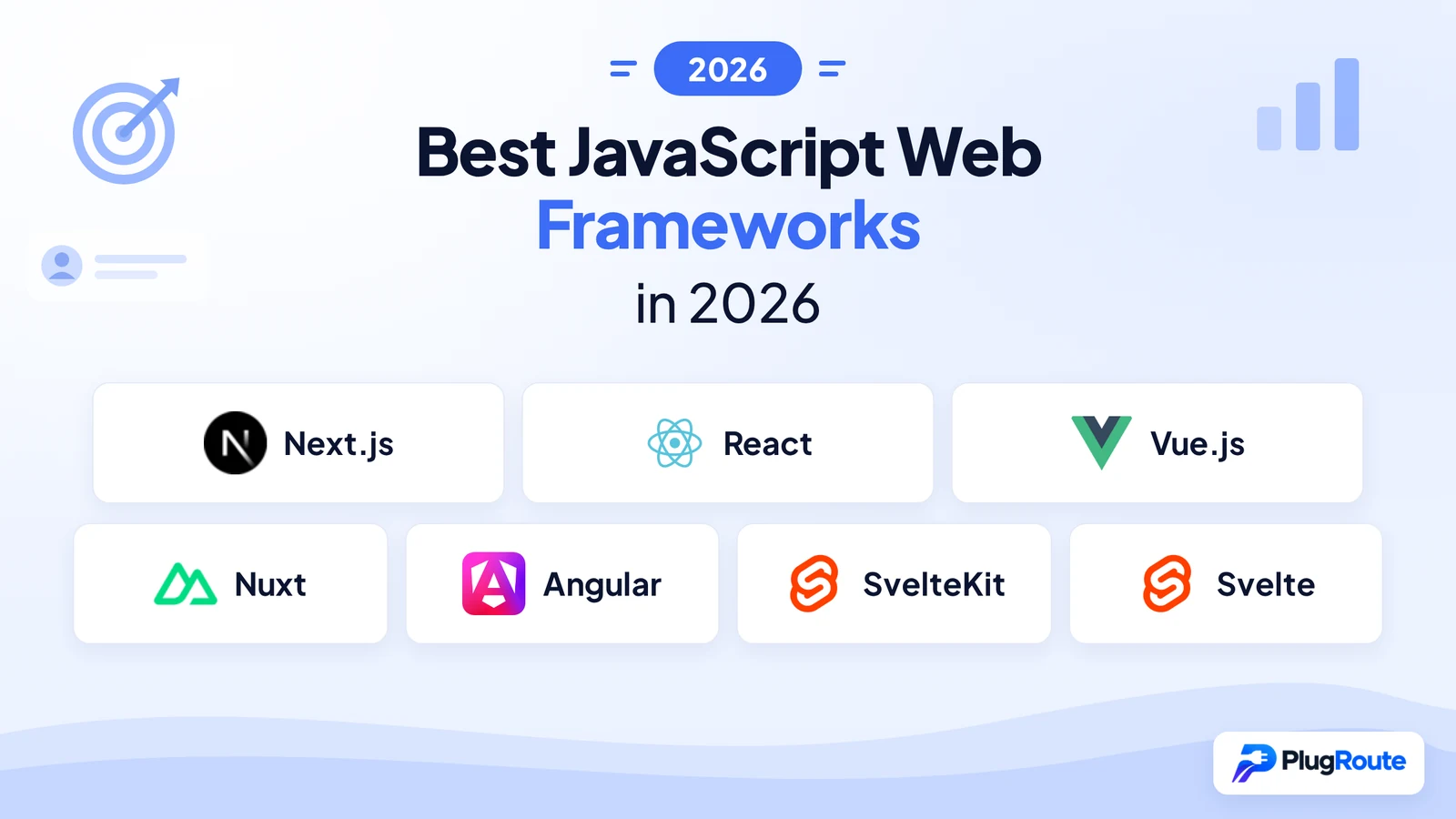
Next.js leads this ranking as the best overall full-stack React framework in 2026, React earns #2 for the deepest hiring pool and widest ecosystem, and Vue.js ranks #3 for the best developer experience. No single framework wins every use case, the right choice depends on team size, hiring market, and whether you need a meta-framework or a base UI library.
The JavaScript framework landscape in 2026 is more nuanced than the “just use React” shorthand suggests. Compile-time compilers, server-first rendering architectures, TypeScript integration depth, geographic hiring disparities, and AI coding tool quality gaps create decision complexity that popularity rankings alone cannot resolve. Most developers making this choice make the same three mistakes: comparing frameworks without knowing their category, prioritizing download volume over hiring market fit, and conflating base UI libraries with their meta-frameworks.
PlugRoute has no affiliate relationships with any framework, hosting platform, or company listed in this review.
“React has 40 million [npm weekly downloads], Vue has 6… If I have a bunch more devs using the same tool I’m using, that tool will have way more answers when something goes weird.” (u/pampuliopampam, r/javascript)
Takeaway: Community scale is a self-reinforcing competitive advantage, more users generate more answered questions, more tutorials, and more AI training data, which in turn attracts more users. Teams choosing Vue.js or Svelte for developer experience reasons must explicitly model this ecosystem depth differential as a compounding trade-off, not a static feature comparison.
TL;DR: Top Picks at a Glance
- Next.js: optimal for full-stack React production apps requiring built-in SSR, SSG, and deployment infrastructure out of the box
- React: widest ecosystem and deepest hiring pool for teams assembling their own stack or pairing with a meta-framework
- Vue.js: most intuitive developer experience with cohesive official tooling for teams where Vue hiring is accessible
- Angular: enforced consistency and TypeScript-first design for large enterprise teams of 20 or more developers
- Nuxt: official Vue meta-framework with deployment-agnostic Nitro infrastructure; the necessary production layer for Vue teams building SSR applications
- SvelteKit: smallest JavaScript bundles and genuine deployment independence for performance-critical applications where bundle size drives Time to Interactive
- Svelte: developer satisfaction scores among the highest of any evaluated framework with compile-time virtual DOM elimination; best for solo developers and small teams on performance-critical projects
What Are the Five Categories of JavaScript Web Frameworks?
JavaScript web frameworks in 2026 fall into five distinct categories: UI Libraries (React), Progressive UI Frameworks (Vue.js), Compiler Frameworks (Svelte), Full Application Frameworks (Angular), and Full-Stack Meta-Frameworks (Next.js, Nuxt, SvelteKit). Understanding which category a framework belongs to is the single most important prerequisite for accurate comparison, conflating categories is the root cause of most poor framework selection decisions.
Each category makes fundamentally different architectural assumptions about what belongs inside the framework versus what teams assemble independently:
- UI Libraries: React provides only the component rendering layer. Teams must separately select routing, state management, SSR, and data-fetching solutions. Maximum flexibility, maximum assembly responsibility.
- Progressive UI Frameworks: Vue.js provides a complete component architecture with an official ecosystem (Pinia, Vue Router, Vite) covering most needs, without requiring an opinionated full-stack meta-framework.
- Compiler Frameworks: Svelte performs its work at build time, compiling components to optimized vanilla JavaScript rather than shipping a runtime to the browser, no virtual DOM, no reactive runtime, minimal JavaScript payload.
- Full Application Frameworks: Angular is the only fully batteries-included option, providing routing, forms, HTTP client, dependency injection, testing utilities, and CLI code generation in a single TypeScript-native package.
- Full-Stack Meta-Frameworks: Next.js, Nuxt, and SvelteKit are opinionated application layers built on top of their respective base frameworks, adding file-based routing, SSR, SSG, API routes, and deployment infrastructure that the base framework deliberately omits.
A concrete example of why this distinction matters: a team that chooses React expecting a complete solution, then discovers three months in that they must separately evaluate React Router vs. TanStack Router, choose between Zustand and Redux Toolkit, and decide whether to add Next.js for SSR, has made four architectural decisions they thought they were avoiding. Conversely, a team that chooses Next.js understands upfront that Vercel has made those decisions, at the cost of accepting Vercel’s architectural opinions.
How Do the Top 7 JavaScript Frameworks Compare at a Glance?
The 7 best JavaScript frameworks in 2026 span five distinct categories, from UI libraries (React, Vue.js, Svelte) to full-stack meta-frameworks (Next.js, Nuxt, SvelteKit) to a complete application framework (Angular). Weekly npm downloads range from React’s 50.3 million to SvelteKit’s 1.6 million (pkgpulse.com, June 2026, filtering CDN and mirror traffic). The table below compares all seven on category, best use case, primary strength, and key limitation.
| Rank | Company | Category | Best For | One-Line Summary | Key Capabilities | Primary Strength | Key Limitation |
|---|---|---|---|---|---|---|---|
| #1 | Next.js | Full-Stack Meta-Framework | Full-stack React production apps with SSR/SSG | Next.js is the most widely adopted full-stack React meta-framework in 2026, used by ~20.8% of all web developers (Statista, 2025). | SSR, SSG, ISR, React Server Components, Server Actions, Edge Runtime | React ecosystem scale plus built-in full-stack architecture | Dual App/Pages Router fragmentation; Vercel commercial coupling for ISR and Edge |
| #2 | React | UI Library | Teams needing max ecosystem flexibility and hiring access | React is the most widely adopted JavaScript UI library, used by 44.7% of all surveyed developers globally (Statista, 2025). | Component model, React Compiler, Server Components, Concurrent Rendering, Hooks API | Dominant ecosystem (50.3M weekly downloads), deepest hiring pool | Requires full-stack assembly; counter-intuitive component-as-reactive-callback model |
| #3 | Vue.js | Progressive UI Framework | Mid-size apps with cohesive official tooling | Vue.js is the #2 JavaScript UI framework with 7.1M weekly npm downloads and an ~80% developer re-adoption rate. | Dual API, Proxy-based reactivity, Single-file components, Pinia, Progressive adoption | Most intuitive reactivity model; cohesive official ecosystem (Pinia, Vue Router, Vite) | Smaller hiring pool in North America/UK; React-first third-party SDK prioritization |
| #4 | Nuxt | Full-Stack Meta-Framework (Vue) | Vue teams needing SSR/SSG with deployment independence | Nuxt is the official full-stack Vue meta-framework with SSR, SSG, auto-imports, and Nitro deployment-agnostic infrastructure. | Auto-imports, Nitro server engine, Hybrid rendering, Nuxt DevTools, 300+ modules | Deployment-agnostic Nitro adapters; higher meta-framework penetration within Vue than Next.js within React | Community scale gap vs. Next.js; Nuxt 3 EOL July 31, 2026 |
| #5 | Angular | Full Application Framework | Large enterprise teams (20+ devs) requiring enforced consistency | Angular is Google’s batteries-included TypeScript framework with built-in routing, DI, forms, and a predictable 6-month LTS release cycle. | Built-in DI, Signals, Standalone components, Control flow syntax, Angular CLI | Only framework with TypeScript-required plus built-in DI, forms, router, and testing in one package | Steepest learning curve; lowest State of JS satisfaction scores among major frameworks |
| #6 | SvelteKit | Full-Stack Meta-Framework (Svelte) | Performance-critical apps needing smallest bundles and deployment independence | SvelteKit delivers 20–50% smaller JavaScript bundles than Next.js through compile-time optimization with free deployment-agnostic adapters. | Adapter system, Progressive enhancement form actions, Server/client separation, Compile-time optimization | Best-in-class bundle sizes; genuine deployment independence via free open-source adapters | Second-smallest community; thinnest enterprise integration library ecosystem |
| #7 | Svelte | Compiler Framework | Solo developers and small teams on performance-critical UI projects | Svelte is a compile-time JavaScript UI framework with developer satisfaction scores among the highest in State of JS surveys and the smallest browser-side bundles. Note: Svelte holds a satisfaction-adoption paradox; among the highest satisfaction scores + smallest hiring pool of any evaluated framework. See entry for analysis. | Compile-time virtual DOM elimination, Runes system, HTML-adjacent syntax, js-framework-benchmark performance, Scoped CSS | Among the highest developer satisfaction scores; compile-time virtual DOM elimination | Smallest job market and thinnest production-grade library ecosystem; requires SvelteKit for full-stack use |
Which JavaScript Framework Should I Choose for My Use Case?
The right JavaScript framework in 2026 depends on four variables: whether you need a UI library or a full-stack meta-framework, your primary hiring market, your application’s performance requirements, and your team’s tolerance for ecosystem assembly. Use the table below to map your primary need to a framework recommendation with rationale and an acceptable alternative.
| Your #1 Priority | Recommended Tool | Why | Acceptable Alternative |
|---|---|---|---|
| Best overall production default | Next.js | Combines React’s ecosystem with built-in SSR, SSG, ISR, Server Components | React + custom stack |
| Maximum ecosystem and hiring access | React | 50.3M weekly downloads, 44.7% global adoption, deepest hiring pool | Next.js (adds structure) |
| Best developer experience for mid-size apps | Vue.js | Most intuitive reactivity, cohesive official tooling, ~80% re-adoption rate | Nuxt (adds SSR) |
| Best Vue full-stack with SSR | Nuxt | Official Vue meta-framework with deployment-agnostic Nitro engine | Vue.js + custom SSR |
| Best for large enterprise teams | Angular | TypeScript-required, built-in DI, predictable LTS, enforced consistency | Next.js (if React-only team) |
| Smallest JavaScript bundles | SvelteKit | 20–50% smaller bundles than Next.js; compile-time virtual DOM elimination | Next.js with aggressive optimization |
| Performance-critical solo projects | Svelte | Among highest satisfaction scores; compile-time approach; smallest runtime overhead | SvelteKit (adds full-stack layer) |
| Genuine deployment platform independence | SvelteKit | All official adapters free and open source; no commercial hosting coupling | Nuxt via Nitro adapters |
| Learning JavaScript and building first real project | Vue.js | Options API mirrors OOP patterns; intuitive reactivity; cohesive official documentation | React (if North American/UK job market is the priority) |
No framework choice is irreversible. React, Vue.js, Next.js, Nuxt, Angular, Svelte, and SvelteKit all use standard JavaScript and can share utility functions across migrations. The real cost of switching frameworks is developer re-learning time (typically 1–3 months per individual) and codebase refactoring investment that scales with project size. The frameworks ranked lower in this evaluation are not bad choices; they are choices with specific trade-off profiles that may or may not match your team’s context.
1. Next.js: Best Overall for Full-Stack React Production Applications
Category: Full-Stack Meta-Framework, A production-ready React framework that provides built-in file-based routing, server-side rendering (SSR), static site generation (SSG), incremental static regeneration (ISR), React Server Components, Server Actions, and edge deployment infrastructure on top of React, eliminating the need to assemble these layers independently.
At a Glance
- Category: Full-Stack Meta-Framework
- Best For: React developers and teams building production full-stack web applications that need SSR, SEO optimization, and deployment infrastructure without assembling their own routing, data-fetching, and rendering stack
- Price Range: Framework free (MIT); Vercel hosting: Hobby $0/month, Pro $20/user/month, Enterprise at custom pricing (2026)
- Primary Strength: Next.js combines React’s dominant ecosystem scale with built-in SSR, SSG, ISR, Server Components, and Server Actions, a complete full-stack production architecture adopted by roughly half of all React developers (Statista, 2025)
- Biggest Limitation: Next.js maintains two parallel routing systems (App Router and Pages Router) that split documentation and community tutorials between incompatible architectural models, and Vercel’s commercial hosting relationship creates a soft vendor dependency for ISR and Edge Middleware features that perform most reliably on Vercel’s own infrastructure
- One-Line Summary: Next.js is the most widely adopted full-stack React meta-framework in 2026, used by approximately 20.8% of all web developers (Statista, 2025), offering built-in SSR, file-based routing, React Server Components, and edge deployment infrastructure that make it the leading production choice for React teams worldwide
- Last Verified: June 2026
Composite Score: 8.0/10: Ecosystem Scale and Adoption (C1, 2x): 8/10 | Developer Experience (C2, 2x): 6/10 | Production-Readiness (C3, 2x): 9/10 | Hiring Market Viability (C4, 2x): 8/10 | Performance Architecture (C5, 1x): 6/10 | Full-Stack Capability (C6, 1x): 10/10
Overview
Next.js is a full-stack meta-framework built on React that provides file-based routing, server-side rendering, static site generation, incremental static regeneration, React Server Components, and Server Actions, making it the leading production choice for React teams who need a complete application architecture without assembling their own infrastructure stack.
Next.js is maintained by Vercel and used by approximately 20.8% of all web developers (Statista, 2025), representing roughly half of all React developers, making it the dominant meta-framework by a substantial margin over Nuxt (3.1M) and SvelteKit (1.6M) in weekly npm downloads (pkgpulse.com, June 2026).
Next.js serves teams ranging from early-stage startups on Vercel’s free Hobby tier to enterprise organizations running custom Node.js deployments with ISR-powered content pipelines at scale.
Key Features
- App Router with React Server Components: Next.js’s App Router: recommended for all new projects, uses React Server Components as the default, enabling components to fetch data directly from databases or APIs on the server and stream rendered HTML to the client without shipping component JavaScript or triggering client-side data-fetching waterfalls.
- Four Per-Route Rendering Modes: Next.js supports Client-Side Rendering (CSR), Server-Side Rendering (SSR), Static Site Generation (SSG), and Incremental Static Regeneration (ISR) configurable per route, allowing teams to apply the optimal rendering strategy to each page independently within a single application codebase.
- Server Actions: Next.js Server Actions enable server-side form handling and data mutations directly from React components without requiring separate REST API endpoints, reducing round-trip latency and eliminating API surface area overhead for common form-heavy applications.
- Built-In Image Optimization: Next.js includes the
next/imagecomponent, which automatically applies WebP conversion, responsive sizing, and lazy loading to improve Core Web Vitals scores without manual configuration or third-party image optimization services. - Edge Runtime: Next.js’s Edge Runtime executes server-side logic at globally distributed CDN edge locations (reducing Time to First Byte for server-rendered pages by processing requests geographically close to end users) available natively on Vercel and configurable via third-party adapters.
Best For
Next.js is best for React developers and cross-functional teams building production full-stack web applications (including e-commerce platforms, SaaS dashboards, content-driven sites, and enterprise portals) who need SSR, SEO infrastructure, and API routes available from day one without allocating engineering time to stack assembly.
Next.js is particularly well-suited to teams using Vercel’s deployment platform, where ISR, Edge Middleware, and image optimization integrate natively, significantly reducing DevOps overhead for teams without dedicated infrastructure engineers.
Pricing
Next.js itself is free and MIT-licensed. Vercel hosting tiers as of 2026: Hobby plan at $0/month for personal and non-commercial projects; Pro plan at $20 per user per month for production teams; Enterprise plan at custom pricing with SLAs and dedicated support (Vercel pricing).
Next.js can be self-hosted on any Node.js infrastructure, though ISR and Edge Middleware features perform most reliably on Vercel’s own CDN. Teams should factor Vercel platform costs into total cost of ownership when evaluating Next.js at team scale.
Strengths
- Next.js is used by approximately 20.8% of all web developers (Statista, 2025): representing roughly half of all React developers, with enterprise production deployments at TikTok, Hulu, Notion, and Loom, attributed in technology press and engineering blogs; Vercel’s official site describes Next.js as used by leading global companies without naming specific organizations (Vercel.com/customers, referenced in multiple secondary sources, 2025).
- Next.js generates 11.2 million weekly npm downloads (pkgpulse.com, June 2026): 3.6x higher than Nuxt’s 3.1 million and 7x higher than SvelteKit’s 1.6 million, representing the deepest community resource base, most-answered Stack Overflow questions, and largest experienced meta-framework developer pool available for hiring.
- Next.js’s App Router, built on React Server Components, enables a server-first rendering model where components access databases and APIs directly on the server, reducing Time to First Byte and JavaScript payload simultaneously for data-heavy applications without requiring teams to maintain a separate API layer for standard data-fetching patterns.
- Next.js receives high-quality AI-generated code support from GitHub Copilot, ChatGPT, and Claude due to the volume of React and Next.js examples in training datasets, a compounding productivity advantage that developer community discussions in 2025–2026 explicitly cite as a framework selection factor (r/javascript, June 2026).
Limitations
- Dual Routing System Fragmentation: Next.js maintains two parallel routing systems (the App Router (recommended, built on React Server Components) and the Pages Router (legacy, still fully supported)) fragmenting documentation, tutorials, and Stack Overflow answers between incompatible architectural models, meaning developers frequently encounter outdated Pages Router patterns when searching for App Router guidance.
- Vercel Commercial Coupling: Next.js’s deepest production features: ISR with fine-grained cache control, Edge Middleware with geolocation and A/B testing, Image Optimization CDN, are optimized for Vercel’s own infrastructure, creating a soft commercial dependency that increases migration complexity and cost for teams that later need to move to self-hosted deployments (Pagepro, 2025).
Users on r/nextjs shared their experience:
“While yes they say ‘you can run next elsewhere’ you really can’t with the same benefits you’d see on Vercel. This is why projects like Open Next exist in the first place. And those are flawed too because they also aren’t identical to next’s implementation of things. Next is fairly vendor locked in, and it stinks. I actually like vercel and use it for personal projects but at work I can’t really get us to embrace next because we aren’t on vercel and next doesn’t work as well out of vercel” Posted by u/highbonsai
Takeaway: For teams building outside Vercel’s infrastructure, Next.js’s vendor coupling is not a theoretical concern, it is a practical barrier that limits real-world adoption despite the framework’s technical portability.
- Page Transition Limitations: Next.js requires View Transitions API workarounds for animated page transitions in the App Router rather than a native framework solution, creating friction for teams building SPA-like user experiences that Vue-based and Svelte-based alternatives handle more elegantly, as documented by community members at r/nextjs (June 2026).
Verdict
Next.js is the highest-composite-scoring JavaScript meta-framework in 2026, earning its #1 ranking through the combination of React’s dominant ecosystem scale, a complete built-in full-stack architecture encompassing SSR, SSG, ISR, React Server Components, and Server Actions, and enterprise production adoption attributed at TikTok, Hulu, and Notion. Teams already working in React who need production SSR, SEO, and server-side data fetching should strongly favor Next.js over assembling their own meta-framework stack from independent packages. Teams for whom Vercel’s commercial hosting relationship represents an unacceptable architectural dependency should evaluate Nuxt (Vue teams, ranked #4) or SvelteKit (performance-first projects, ranked #6) as alternatives with comparable full-stack capability and more genuinely platform-agnostic deployment models.
2. React: Best for Maximum Ecosystem Flexibility and Hiring Pool Depth
Category: UI Library, A component-based JavaScript library providing the view layer only; React handles rendering and component composition but deliberately omits routing, state management, server-side rendering, and build configuration, requiring teams to assemble these layers independently or adopt a meta-framework like Next.js.
At a Glance
- Category: UI Library
- Best For: Teams with existing React expertise, access to React-specialized developers in their hiring market, and either a Next.js adoption plan or the engineering bandwidth to make sound architectural decisions about routing, state management, and SSR
- Price Range: Free (MIT license); no paid tiers for the React library itself (2026)
- Primary Strength: React’s 50.3 million weekly npm downloads (pkgpulse.com, June 2026) and 44.7% global developer adoption (Statista, 2025) create a dominant ecosystem, the deepest hiring pool, and the strongest AI coding tool support of any JavaScript UI framework
- Biggest Limitation: React deliberately omits routing, server-side rendering, and state management, requiring teams to assemble and maintain their own full-stack architecture from independent packages, an “assembly tax” in decision-making and integration time that more opinionated alternatives like Next.js, Angular, and Nuxt eliminate by design
- One-Line Summary: React is the most widely adopted JavaScript UI library in 2026, used by 44.7% of all surveyed developers (Statista, 2025) with 50.3 million weekly npm downloads, offering the largest ecosystem and hiring pool of any framework, but requiring teams to assemble their own full-stack architecture or adopt Next.js for production SSR and routing
- Last Verified: June 2026
Composite Score: 7.4/10: Ecosystem Scale and Adoption (C1, 2x): 10/10 | Developer Experience (C2, 2x): 7/10 | Production-Readiness (C3, 2x): 7/10 | Hiring Market Viability (C4, 2x): 10/10 | Performance Architecture (C5, 1x): 5/10 | Full-Stack Capability (C6, 1x): 3/10
Overview
React is a JavaScript UI library (created by Meta (Facebook) and first released publicly in 2013) that provides a component-based declarative model for building user interfaces where UI is expressed as composable functions returning JSX, and state changes trigger efficient re-renders through virtual DOM diffing.
React generates 50.3 million weekly npm downloads (pkgpulse.com, June 2026, filtering CDN and mirror traffic) and is used by 44.7% of all surveyed developers globally (Statista, 2025), making it the most widely adopted JavaScript UI library by a margin no competing framework approaches.
React is the right choice for teams with existing React expertise who prioritize maximum ecosystem breadth, are comfortable selecting their own router and state management solution, and plan to either adopt Next.js as their meta-framework layer or have the architectural leadership to self-assemble a coherent production stack.
Key Features
- Component Model and JSX: React’s component model organizes UI as composable JavaScript functions accepting props and returning JSX, enabling teams to build complex interfaces from isolated, independently testable units that can be published to npm and consumed across projects, driving the largest open-source UI component library ecosystem in JavaScript.
- React Compiler (React 19): React 19’s React Compiler analyzes component code at build time and automatically inserts memoization where re-renders are unnecessary, eliminating the manual
useMemoanduseCallbackcalls that have been React’s most consistently cited developer experience pain point since hooks were introduced in React 16.8. - React Server Components: React Server Components (stable in React 19, enabled by default in Next.js App Router) allow individual components to execute on the server and access databases or internal APIs directly, streaming rendered HTML to the client without shipping those components’ JavaScript or triggering client-side data-fetching waterfalls.
- Concurrent Rendering: React’s concurrent rendering mode (introduced in React 18) enables interruptible rendering (allowing React to pause expensive renders in response to higher-priority user interactions) improving perceived responsiveness in data-heavy interfaces without requiring manual rendering priority optimization.
- Comprehensive Hooks API: React’s hooks API:
useState,useEffect,useContext,useReducer,useMemo,useCallback,useRef, and theuse()hook in React 19 for async resources, provides a complete primitive set for stateful component logic without class component or lifecycle method boilerplate.
Best For
React is best for teams that already have React expertise, work in a hiring market where React developers are available (particularly North America and the UK, where React dominates job postings), and either plan to use Next.js as their meta-framework layer or have the architectural maturity to select and integrate their own routing, state management, and SSR solutions.
React is also the optimal choice for teams building component libraries, design systems, or packages that will be consumed by other React projects, where the library’s ecosystem reach creates the broadest possible distribution surface.
Pricing
React is free and MIT-licensed with no paid tiers at any scale (react.dev). UI component libraries range from entirely free (shadcn/ui, Radix UI Primitives) to paid enterprise tiers for premium components.
The primary hidden cost of a bare React stack is engineering time (selecting, integrating, and maintaining ecosystem packages across router, state manager, data-fetching layer, and SSR solution) a recurring overhead the developer community describes as the “assembly tax” (Wearefram.com, 2026).
Strengths
- React is used by 44.7% of all surveyed web developers globally (Statista, 2025) and generates 50.3 million weekly npm downloads (pkgpulse.com, June 2026), adoption figures several times higher than Vue’s 7.1 million and Svelte’s 1.8 million, creating the deepest community resource base, most-answered Stack Overflow questions, and largest available developer talent pool in the JavaScript ecosystem.
This aligns with community sentiment on r/reactjs:
“Whatever your opinions about React/NextJS, the reality is that people don’t necessarily pick something because they are good, things get picked because they are good enough. It’s far more important for a business that whatever framework they chose have good community support and popularity. This makes it easier to find devs to hire, and find resources online when they get stuck on some edge case issue.” Posted by u/neighbortotoro
Takeaway: React’s hiring pool and community depth are not vanity metrics, they are the primary business reason organizations standardize on it, independent of any technical superiority argument.
- Meta actively employs a dedicated React core engineering team and deploys React in production across Facebook, Instagram, and WhatsApp (applications serving billions of users) providing a scale-validation benchmark for React’s reliability at extreme load that no available academic or analyst benchmark can replicate (react.dev).
- React 19’s React Compiler, released in 2024, automatically inserts memoization at build time across React codebases without requiring code changes, directly addressing the most consistently cited React developer experience complaint and reducing cognitive overhead for production-scale teams (Telerik, 2026).
- React benefits from measurably higher-quality AI-assisted code generation from GitHub Copilot, ChatGPT, and Claude compared to any alternative JavaScript framework (a direct consequence of React’s dominant share of the JavaScript training corpus) creating a compounding developer productivity advantage that developer community discussions explicitly identify as a framework selection factor (r/javascript, June 2026).
Limitations
- Assembly Tax: React’s most consequential limitation is architectural: as a UI library, React deliberately omits routing, server-side rendering, state management, and build configuration, requiring teams to select, integrate, and keep compatible a router (React Router v7 vs. TanStack Router), a state manager (Zustand vs. Jotai vs. Redux Toolkit, with Recoil now deprecated), and an SSR solution before writing a single line of product code.
- Inverted Reactivity Model: React’s reactivity model: where the entire component function re-executes on any state change, is widely acknowledged as counter-intuitive relative to Vue’s dependency-tracked reactive system and Svelte’s compile-time declarations. Veteran React developers with over a decade of experience openly describe React’s inverted reactivity model as a core design complexity in community discussions (r/javascript, June 2026).
- State Management Fragmentation: React’s ecosystem spans Redux Toolkit, Zustand, Jotai, Valtio, Context API, and React Query for server state (with no canonical answer) meaning developers frequently face expensive architectural choices early in projects that are costly to change later, unlike Vue (Pinia) or Angular (Signals) which offer fewer but more opinionated options.
Verdict
React is the highest-adoption, deepest-hiring-pool, and strongest-AI-tool-coverage JavaScript UI library in 2026, and for teams operating in React-dominated hiring markets with existing React expertise, it remains the lowest-risk foundational choice for any production application. Teams evaluating “React” should recognize they are making two distinct decisions: whether to use React’s component model, and how to assemble their full-stack architecture, because React alone does not provide routing, SSR, or state management. For most production applications requiring server-side rendering and built-in routing from day one, Next.js (ranked #1 in this review) is the more architecturally complete choice; bare React is the right selection for component library development, design system publication, or situations where teams have specific reasons to avoid Next.js’s Vercel ecosystem coupling.
3. Vue.js: Best Developer Experience for Mid-Size Applications With Cohesive Official Tooling
Category: Progressive UI Framework, An incrementally adoptable JavaScript framework that can be used as a lightweight script-tag library for simple page interactivity, a full component-based SPA, or, when combined with Nuxt, a complete full-stack application platform; Vue.js provides an official ecosystem covering routing (Vue Router), state management (Pinia), and building (Vite) without requiring third-party assembly.
At a Glance
- Category: Progressive UI Framework
- Best For: Teams prioritizing developer experience and cohesive official tooling, mid-size SPA or SSR applications, teams with Vue expertise in Asia-Pacific or Europe, and developers who find React’s component-as-reactive-callback model cognitively overhead-heavy
- Price Range: Free (MIT license); complete official ecosystem (Pinia, Vue Router, Vite, Vue Test Utils) is free (2026)
- Primary Strength: Vue.js offers the most intuitive reactivity model of any major framework (tracking dependencies automatically without manual memoization) backed by a cohesive official tooling ecosystem (Pinia, Vue Router, Vite) that eliminates ecosystem assembly decisions, with 7.1 million weekly npm downloads as the #2 JavaScript UI framework globally (pkgpulse.com, June 2026)
- Biggest Limitation: Vue.js has a structurally smaller hiring pool than React in North American and UK job markets, third-party SaaS SDKs consistently prioritize React integrations first, and the Vue 2-to-Vue 3 migration created lasting community trust concerns that persist in enterprise adoption conversations
- One-Line Summary: Vue.js is the #2 JavaScript UI framework by download volume (7.1M weekly npm downloads, pkgpulse.com, June 2026), offering the most intuitive reactivity model in the category, a cohesive official tooling ecosystem, and an approximately 80% developer re-adoption rate, best for teams in markets where Vue hiring is accessible and for developers who prioritize development experience over raw ecosystem breadth
- Last Verified: June 2026
Composite Score: 6.7/10: Ecosystem Scale and Adoption (C1, 2x): 7/10 | Developer Experience (C2, 2x): 9/10 | Production-Readiness (C3, 2x): 7/10 | Hiring Market Viability (C4, 2x): 6/10 | Performance Architecture (C5, 1x): 7/10 | Full-Stack Capability (C6, 1x): 4/10
Overview
Vue.js is a progressive JavaScript framework (created by Evan You in 2014 and maintained by an independent community-funded team) that builds reactive user interfaces through a Proxy-based reactivity system that automatically tracks dependencies and updates only the DOM nodes that need to change, without virtual DOM diffing overhead or manual memoization requirements.
Vue.js generates 7.1 million weekly npm downloads (pkgpulse.com, June 2026), making it the second most widely adopted JavaScript UI framework, with production deployments at Alibaba, GitLab, and Nintendo, and an approximately 80% re-adoption rate among surveyed developers reflecting genuine satisfaction rather than ecosystem inertia (Articsledge, 2025).
Vue.js is best suited to teams seeking a complete, cohesive official tooling ecosystem (Pinia for state management, Vue Router for navigation, Vite for builds) who operate in hiring markets where Vue developers are accessible and build mid-size applications where Vue’s superior developer experience translates into measurable team productivity advantages.
Key Features
- Dual API System: Vue.js provides two component authoring APIs simultaneously: the Options API (organized by
data,methods,computed,watch, and lifecycle hooks, familiar to OOP developers) and the Composition API (logic organized by feature usingref(),computed(), andonMounted(), optimized for TypeScript and complex code reuse), allowing teams to choose the style matching their background without migrating existing code. - Proxy-Based Reactive System: Vue.js 3’s Proxy-based reactivity system automatically tracks which reactive values each template expression depends on and updates only the specific DOM nodes referencing changed values, without requiring developers to declare dependencies manually or triggering full component re-renders, matching the mental model of vanilla JavaScript event-listener patterns.
- Compiler-Optimized Single-File Components: Vue.js’s single-file component format co-locates
<template>,<script>, and<style>blocks in a single.vuefile and applies static hoisting (skipping re-evaluation of template nodes containing no reactive data) improving rendering performance without requiring developer-level memoization decisions. - Pinia State Management: Vue.js’s official state management library, Pinia, provides type-safe stores with automatic TypeScript inference, Vue DevTools integration, and a unified API working identically with both the Options API and Composition API, eliminating the state management fragmentation that characterizes the React ecosystem.
- Progressive Adoption: Vue.js can be adopted incrementally: from a CDN script tag for simple page interactivity, to a full component-based SPA built with Vite, to a server-rendered application with Nuxt, allowing teams to introduce Vue without committing to a full framework migration upfront.
Best For
Vue.js is best for development teams where at least some members have Vue experience, teams operating in hiring markets where Vue developers are available (particularly Asia-Pacific and parts of Europe), and mid-size SPA and SSR applications where a cohesive official tooling ecosystem eliminates architecture assembly decisions.
Vue.js is also well-suited to teams doing progressive enhancement of server-rendered pages, where Vue’s incremental adoption model enables adding interactivity without a full SPA rewrite.
Pricing
Vue.js is free and MIT-licensed. The complete official Vue ecosystem (Vue Router, Pinia, Vite, Vue Test Utils, Vue DevTools) is free (vuejs.org). Premium UI component libraries include Vuetify (free community edition, paid Pro license) and PrimeVue (free community tier, paid premium components).
No official Vue commercial support tier exists; the project is independently maintained through GitHub Sponsors and Open Collective, with Evan You and core team members funded through this community model as of 2026 (Vue School, 2025).
Strengths
- Vue.js achieves approximately 80% re-adoption rate among surveyed developers (Articsledge, 2025, citing Vue ecosystem survey data; sample size and methodology not publicly disclosed) and has maintained above-average satisfaction scores in State of JavaScript annual surveys across multiple years, a retention signal reflecting genuine developer satisfaction rather than ecosystem inertia.
- Vue.js’s Proxy-based reactivity executes reactive callbacks only when specific tracked dependencies change (matching the mental model of vanilla JavaScript event listeners and providing measurably lower cognitive overhead than React’s component-as-reactive-callback model) a distinction explicitly cited by developers in r/javascript discussions (June 2026) as the primary Vue developer experience advantage.
- Vue.js’s creator Evan You also built Vite: now the industry-standard JavaScript build tool adopted by Vue, Svelte, React, and Angular ecosystems (Vue School, 2025), demonstrating that Vue’s core team has outsized positive influence on the broader JavaScript tooling ecosystem beyond its own framework adoption numbers.
- Vue.js’s production deployments at Alibaba, GitLab, and Nintendo (Articsledge, 2025) validate Vue’s enterprise production capability at scale, directly addressing the concern that Vue’s smaller North American job market share reflects limited technical merit rather than limited market positioning.
Limitations
- Geographic Hiring Pool Concentration: Vue.js’s most consequential limitation for North American and UK-based teams is a structurally smaller hiring pool relative to React, React-specialized developers are more available in those markets, third-party SaaS SDKs ship React integrations first, and enterprise procurement processes frequently favor React-based internal tooling for compatibility reasons.
“First, it was almost impossible to transfer smoothly from Vue 2 to Vue 3. Second, we were getting tired of libraries or services not supporting Vue officially. Third, it was hard to find a new developer when we use Vue.” (u/LuiGee_V3, r/nextjs (June 2026))
Takeaway: Teams that migrated away from Vue to React cite three recurring pain points (painful version migration, React-first SDK support, and hiring difficulty) that Vue’s superior developer experience cannot fully compensate for in markets where React dominates.
- Third-Party SDK Prioritization: Third-party SaaS SDKs and API libraries consistently ship React integrations first (often months before Vue equivalents arrive) creating compounding integration friction for teams that rely on a broad range of third-party services, where every new vendor adds the risk of React-first-only SDK support.
- Version Migration Trust Gap: Vue’s 2-to-Vue 3 migration created lasting community trust concerns that persist in enterprise architecture conversations even though Vue 3 is now fully stable, teams that experienced the migration describe it as “almost impossible to transfer smoothly,” and this risk-aversion continues to factor into enterprise framework selection discussions.
Verdict
Vue.js is the best-developer-experience JavaScript UI framework among the three major options, delivering a cohesive official tooling ecosystem, the most intuitive reactivity model, and approximately 80% developer re-adoption rate, but the right choice only for teams in hiring markets where Vue developers are accessible or where an existing Vue team does not face near-term scaling pressure in React-dominated talent markets. Teams in North American or UK markets where React dominates job postings face real hiring risk with Vue, and teams requiring extensive third-party SDK integrations will consistently encounter React-first library support as a friction point. Vue.js teams building production applications with SSR requirements should plan to adopt Nuxt (ranked #4 in this review) as the necessary full-stack layer. Vue.js is what React would be if it prioritized developer joy over ecosystem dominance, and whether that trade-off is worth it depends almost entirely on where your team hires engineers.
4. Nuxt: Best Full-Stack Framework for Vue Teams Requiring SSR, SSG, and Deployment Independence
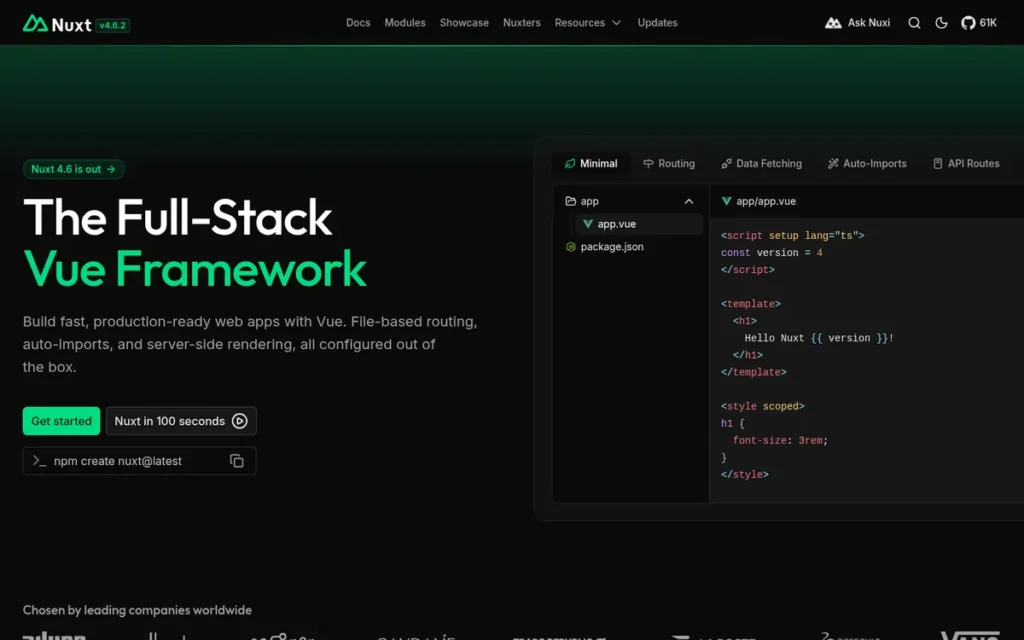
Category: Full-Stack Meta-Framework (Vue), A Vue-based application framework providing file-based routing, server-side rendering, static site generation, incremental static regeneration, and hybrid per-route rendering via the Nitro server engine, with auto-imports, 300+ ecosystem modules, and deployment adapters for Node.js, Vercel, Cloudflare Workers, and AWS Lambda.
At a Glance
- Category: Full-Stack Meta-Framework (Vue)
- Best For: Vue.js teams building production full-stack applications with SSR, SSG, or hybrid rendering requirements, content-driven sites needing SEO optimization, and teams prioritizing genuine deployment platform independence over managed hosting convenience
- Price Range: Framework free (MIT); NuxtHub managed deployment: free tier available; enterprise support pricing not publicly disclosed (2026)
- Primary Strength: Nuxt’s auto-imports system eliminates import boilerplate and its Nitro server engine provides deployment-agnostic infrastructure, enabling the same Nuxt application to deploy to Cloudflare Workers, AWS Lambda, Vercel, or self-hosted Node.js by changing a single configuration line, without compromising SSR or ISR on any target
- Biggest Limitation: Nuxt’s community is significantly smaller than Next.js’s, with GitHub issues remaining unresolved for months and fewer documented solutions for advanced Nitro customizations, teams pushing Nuxt beyond standard patterns frequently encounter documentation gaps with no community-answered precedent
- One-Line Summary: Nuxt is the official full-stack Vue meta-framework for production applications, offering SSR, SSG, ISR, auto-imports, and deployment-agnostic infrastructure via the Nitro server engine, the official and most widely adopted full-stack layer for Vue teams, best when genuine deployment platform independence is a priority alongside Vue’s developer experience advantages
- Last Verified: June 2026
Composite Score: 6.7/10: Ecosystem Scale and Adoption (C1, 2x): 5/10 | Developer Experience (C2, 2x): 8/10 | Production-Readiness (C3, 2x): 8/10 | Hiring Market Viability (C4, 2x): 4/10 | Performance Architecture (C5, 1x): 7/10 | Full-Stack Capability (C6, 1x): 9/10
Overview
Nuxt is the official full-stack meta-framework for Vue.js (developed by NuxtLabs and the open-source community) that adds file-based routing, server-side rendering, static site generation, and hybrid per-route rendering to Vue applications through the Nitro server engine, making it the necessary production layer for Vue teams building applications with SSR or SSG requirements.
Nuxt generates 3.1 million weekly npm downloads (pkgpulse.com, June 2026), representing approximately 44% of Vue’s total install base, a higher meta-framework penetration rate than Next.js achieves within the React ecosystem, with Nuxt 4 as the current release and Nuxt 3 reaching end-of-life on July 31, 2026.
Nuxt is best suited to Vue teams building content-driven sites, e-commerce applications, or full-stack SaaS products where SSR or SSG is required and deployment platform independence is valued over managed hosting convenience.
Key Features
- Auto-Imports System: Nuxt’s auto-imports system automatically detects usage of Vue composables (
ref,computed,watch), Nuxt utilities (useFetch,useRoute,useHead), and project-level components and composables, injecting imports at build time without explicit import statements, measurably reducing per-file boilerplate compared to equivalent Next.js codebases. - Nitro Server Engine: Nuxt’s Nitro server engine provides a unified server runtime with native adapters for Node.js, Vercel, Cloudflare Workers, AWS Lambda, Netlify, and static file hosting, enabling the same Nuxt application to deploy to different infrastructure targets by changing a single configuration line, without losing SSR or ISR functionality on any target.
- Hybrid Rendering with Route Rules: Nuxt supports per-route rendering strategy configuration via route rules (designating individual routes as SSR (server-rendered on request), SSG (pre-generated at build), ISR (pre-generated with time-based revalidation), or SPA (client-rendered)) enabling hybrid rendering architectures within a single application without maintaining separate codebases.
- Nuxt DevTools: Nuxt DevTools, a browser-based inspector integrated into the Nuxt development server, provides real-time visibility into page components, auto-imported composables, module configurations, and server-side timing, a built-in debugging capability that Next.js lacks natively, reducing tooling setup overhead during development.
- 300+ Modules Ecosystem: Nuxt’s modules ecosystem: including Nuxt Content (Markdown/MDX management), Nuxt Image (automatic image optimization), Nuxt Auth (authentication providers), and Nuxt i18n (internationalization), reduces integration setup time compared to equivalent manual configuration in Next.js.
Best For
Nuxt is best for Vue.js development teams that need SSR, SSG, or hybrid rendering for production applications, particularly content-heavy sites, e-commerce platforms requiring SEO optimization, and full-stack SaaS products where Vue’s developer experience advantages are valued alongside server-side rendering capabilities.
Nuxt is particularly well-suited to teams that want genuine deployment platform independence, as Nitro’s adapter system provides a more platform-agnostic deployment model than Next.js’s Vercel-optimized architecture, a meaningful cost and flexibility advantage for teams managing their own infrastructure or deploying to Cloudflare Workers.
Pricing
Nuxt itself is free and MIT-licensed. NuxtHub, Nuxt’s managed deployment and database platform, offers a free tier for personal projects; enterprise pricing is not publicly disclosed on the NuxtHub site as of 2026 (nuxt.com). NuxtLabs commercial support includes priority issue resolution, architecture consulting, and custom module development, contact details available at nuxt.com/enterprise (2026).
Teams deploying to Cloudflare Workers, AWS Lambda, or generic Node.js via Nitro adapters incur only those platforms’ standard costs. Teams on Nuxt 3 must plan migration to Nuxt 4 before the July 31, 2026 end-of-life deadline.
Strengths
- Nuxt captures approximately 44% of Vue.js’s total npm install base (3.1M Nuxt vs. 7.1M Vue weekly downloads, pkgpulse.com, June 2026), a higher meta-framework penetration rate than Next.js achieves within the React ecosystem, reflecting Vue developers’ strong preference for Nuxt as their production application framework over DIY SSR approaches.
- Nuxt’s Nitro server engine provides deployment-agnostic infrastructure with free, first-class adapters for Cloudflare Workers, AWS Lambda, Vercel, Netlify, and Node.js, enabling Nuxt applications to deploy across edge compute, serverless, and traditional server environments without the Vercel commercial coupling that constrains some Next.js deployment decisions.
- Nuxt is used in production by teams at GitLab for documentation infrastructure and by organizations across the European technology sector where Vue adoption is strongest, validating Nuxt’s enterprise production capability beyond pure download metrics, and addressing the concern that its smaller community scale limits Nuxt to non-production contexts.
- Nuxt’s auto-imports system is consistently cited in developer community comparisons as one of its most productivity-enhancing features, with one developer noting that “Next.js still has to push a lot to match Nuxt-like DX” even after switching to Next.js for pragmatic hiring reasons (r/nextjs, June 2026).
Limitations
- Community Scale Gap: Nuxt’s most consequential limitation is community size relative to Next.js, with 3.1 million weekly downloads compared to Next.js’s 11.2 million, Nuxt has roughly one-quarter the community, translating directly into fewer answered Stack Overflow questions, longer waits on unresolved GitHub issues, and fewer tutorials covering advanced Nitro customization.
“GitHub issues sit unresolved for months or years. Even on r/Nuxt or r/vuejs, questions sometimes just go unanswered… I could go on and on, but that’s why I’m making the switch to Next.js.” (u/Emotional-Ask-9788, r/nextjs (June 2026))
Takeaway: The community scale gap between Nuxt and Next.js is not a vanity metric, it directly predicts how quickly teams find solutions to novel integration problems, which compounds with project complexity and team size.
- Rapid Version Cycle Migration Overhead: The version progression: Nuxt 2, Nuxt 3, and Nuxt 4 within a few years, with Nuxt 3 end-of-life on July 31, 2026: creates migration overhead for teams on slower upgrade cycles, requiring planned engineering investment in version transitions before meaningful product work can resume on the new version.
- NuxtHub Platform Maturity: The NuxtHub managed deployment platform is less mature than Vercel’s Next.js offering for teams wanting fully managed production hosting, meaning Nuxt teams more frequently deploy to generic infrastructure rather than a Nuxt-specific platform with equivalent ease-of-use to Vercel’s Next.js integration.
Verdict
Nuxt is the official and most widely adopted full-stack framework for Vue.js teams in 2026, providing SSR, SSG, hybrid rendering, auto-imports, and deployment-agnostic infrastructure through the Nitro server engine, and for Vue teams building applications that require server-side rendering, Nuxt is not optional but the necessary production layer. Nuxt’s ranking at #4 reflects its smaller community scale and shallower documentation depth relative to the React ecosystem, not a limitation of Nuxt’s technical architecture, which genuinely competes with and in some deployment flexibility dimensions exceeds Next.js. Teams choosing Vue.js should plan to adopt Nuxt as their production application framework, account for the July 31, 2026 Nuxt 3 end-of-life deadline when planning upgrade timelines, and weight the Nitro deployment independence advantage when comparing total infrastructure cost against Next.js’s Vercel-coupled architecture.
5. Angular: Best for Large Enterprise Teams Requiring Enforced Architectural Consistency
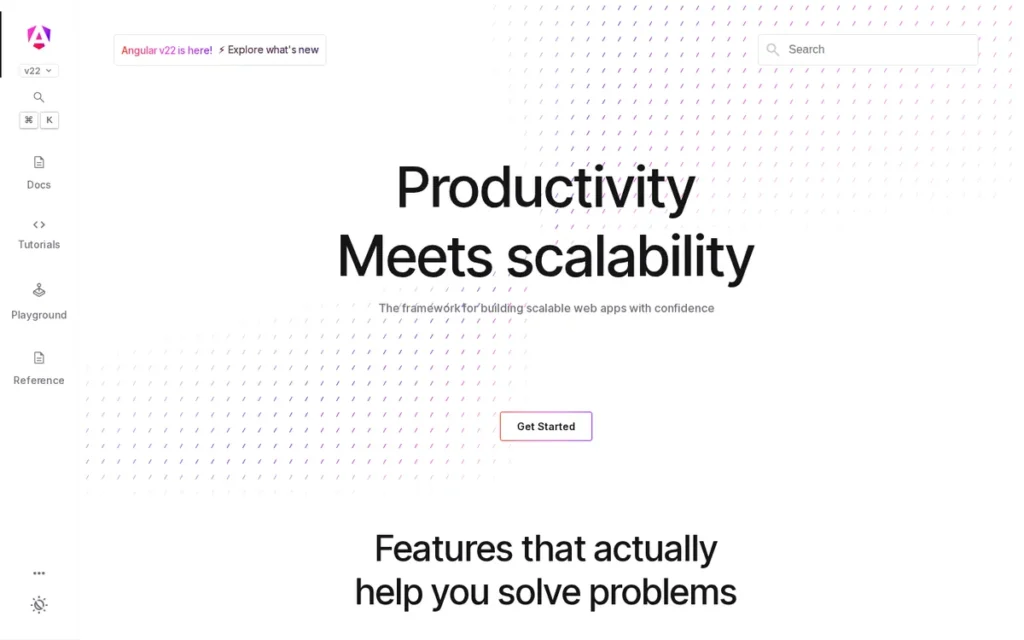
Category: Full Application Framework, A batteries-included, opinionated TypeScript platform maintained by Google that provides built-in routing, reactive and template-driven forms, HTTP client, dependency injection, component testing utilities, and a CLI code generator, requiring no third-party ecosystem assembly and enforcing consistent architectural patterns across large team codebases.
At a Glance
- Category: Full Application Framework
- Best For: Large enterprise engineering teams (typically 20 or more developers) that need enforced architectural consistency, TypeScript throughout the codebase by default, built-in dependency injection for modular and testable architectures, and a Google-backed LTS model with a predictable 6-month release cadence
- Price Range: Free (MIT license); no commercial tiers, no enterprise licensing fees for the Angular framework (2026)
- Primary Strength: Angular is the only evaluated framework that provides built-in routing, forms, HTTP client, dependency injection, testing utilities, and a CLI code generator in a single TypeScript-first package, eliminating all ecosystem assembly decisions and enforcing consistent architectural patterns that scale predictably as engineering teams grow beyond 20 developers
- Biggest Limitation: Angular has the steepest learning curve of any evaluated framework, requiring mastery of TypeScript decorators, RxJS observables (partially replaced by Signals), dependency injection patterns, standalone component architecture, and Angular CLI conventions before teams become productive
- One-Line Summary: Angular is Google’s batteries-included TypeScript framework for large-scale enterprise applications, offering built-in routing, forms, HTTP, dependency injection, and a predictable 6-month LTS release cycle, the most opinionated and architecturally enforcing framework in this evaluation, best suited to teams of 20 or more developers building complex, long-lived business applications
- Last Verified: June 2026
Composite Score: 6.4/10: Ecosystem Scale and Adoption (C1, 2x): 6/10 | Developer Experience (C2, 2x): 4/10 | Production-Readiness (C3, 2x): 9/10 | Hiring Market Viability (C4, 2x): 7/10 | Performance Architecture (C5, 1x): 6/10 | Full-Stack Capability (C6, 1x): 5/10
Overview
Angular is Google’s batteries-included TypeScript framework for large enterprise teams (providing built-in routing, forms, HTTP client, dependency injection, and testing utilities without third-party assembly) maintained with a documented 6-month release cadence and 18-month LTS support per version, making it the most organizationally enforcing framework in this evaluation.
Angular generates 4.5 million weekly npm downloads for @angular/core (pkgpulse.com, June 2026), reflecting a stable enterprise install base, and was significantly modernized in Angular 17–19 with standalone components now the default, a Signals-based reactivity system replacing Zone.js-driven change detection, and an esbuild-powered build pipeline.
Angular’s #5 composite ranking primarily reflects lower developer satisfaction survey scores (not inferior technical architecture) because surveys weight individual developers and small-team respondents equally with enterprise architects, the demographic for whom Angular’s organizational advantages are most valuable.
Key Features
- Built-In Dependency Injection: Angular’s built-in dependency injection (DI) system enables modular, testable service architectures (components declare dependencies as constructor parameters, Angular’s injector resolves and provides them) creating a consistently testable codebase pattern that React and Vue achieve only through optional third-party libraries rather than as a built-in framework feature.
- Signals-Based Reactivity: Angular’s Signals system (introduced in Angular 16, fully integrated in Angular 17–19) enables fine-grained reactive updates (only re-rendering specific DOM elements that depend on changed signal values) replacing Zone.js-based change detection, with Zone.js now optional in Angular 19 (Angular blog, 2023).
- Standalone Components: Angular’s standalone components: the default since Angular 17, eliminate the NgModule declaration requirement that was historically one of the most consistently criticized sources of Angular boilerplate, allowing components to directly import their dependencies without an intermediate module registration step.
- Built-In Control Flow Syntax: Angular’s control flow syntax (
@if,@for,@switch,@empty), introduced in Angular 17, replaces old structural directives with template-native syntax that the Angular team benchmarked at “up to 90% faster runtime” specifically for the@forloop versus the previous*ngFordirective in large list rendering scenarios (Angular blog, 2023). - Angular CLI Code Scaffolding: Angular CLI (
ng generate component,ng generate service,ng generate guard) provides opinionated code scaffolding generating consistently structured files across a team, reducing architectural decision overhead for new engineers and enforcing naming and organizational conventions that scale across large multi-team monorepo codebases.
Best For
Angular is best for large enterprise engineering teams (typically 20 or more developers) where preventing architectural inconsistency, enforcing type safety, and enabling modular testability are higher priorities than minimizing learning curve or maximizing developer experience scores.
Angular is particularly well-suited to organizations building complex, long-lived business applications (ERP dashboards, CRM systems, internal enterprise tools, financial applications) where Google’s LTS support model, built-in testing architecture, and TypeScript-first design reduce long-term maintenance risk relative to assembled React stacks with diverse third-party dependency choices.
Pricing
Angular is completely free and MIT-licensed with no commercial tiers, enterprise licensing fees, or paid support plans from Google for the core Angular framework, Angular CLI, Angular Material, or any official Angular packages (angular.dev/reference/releases).
Google maintains Angular for use in its own internal products with no revenue motive from framework adoption, creating genuine alignment between Google’s maintenance priorities and enterprise development needs. Commercial support contracts are available through third-party consulting firms; no first-party paid support exists as of 2026.
Strengths
- Angular is the only evaluated framework where TypeScript is the required development language rather than optional or recommended, enforcing type safety, interface definitions, and strict typing across the entire codebase by default, a structural characteristic that enterprise engineering teams consistently associate with lower defect rates in large, multi-contributor codebases.
This aligns with what enterprise teams report on r/Angular2:
“For our team the primary reason was because Angular is very opinionated on how it is organized. Meaning that when we bring in new people who know angular they should have a reasonable idea of where to find things. Up until now our JavaScript code base has been a mess with a hodgepodge of different styles, inconsistent patterns, and many different libraries. While I have no doubt that we could accomplish a clean code base with React that’s just not how enterprise software works. Enterprise software is an ever evolving application and we don’t replace working code without a good reason. With JavaScript’s track record of a new hotness every three minutes we didn’t even adopt Angular until we were confident it was going to stick around for awhile.” Posted by u/alanbdee
Takeaway: Angular’s opinionated architecture is not a constraint for enterprise teams, it is the feature, solving the real-world problem of codebases that grow incoherent when developer discretion goes unchecked across large, long-lived projects.
- Google maintains Angular with a publicly documented 6-month major release cycle and 18-month LTS support per version (angular.dev/reference/releases), among the most transparent and predictable long-term support commitments of any evaluated framework, with specific versiontimelines that Vue, React, and Svelte do not offer in equivalent formal commitment, enabling enterprise procurement committees to plan upgrades within known timelines.
- Angular’s built-in dependency injection provides modular, testable service architecture as a first-class framework feature (enabling unit testing of individual services without component coupling) a testability pattern that React and Vue achieve only through optional third-party library adoption rather than built-in framework primitives.
- Angular 17–19’s Signals-based reactivity system and Zone.js-optional mode represent genuine architectural modernization (enabling fine-grained DOM updates without global async API patching overhead) positioning Angular for competitive performance in data-intensive enterprise dashboards where old Zone.js change detection created measurable inefficiency (Angular blog, 2023).
Limitations
- Steepest Learning Curve in the Category: Angular’s most consequential limitation is its learning curve (the steepest of any evaluated framework) requiring mastery of TypeScript decorators, RxJS observable streams (still prevalent in documentation despite Signals replacement), dependency injection token patterns, standalone component import declarations, and Angular CLI conventions before developers become productive. This upfront investment is justified for large teams building long-lived enterprise applications, but is genuinely excessive for teams under 20 developers or for projects with timelines under 12 months.
- Developer Satisfaction Gap: State of JavaScript surveys consistently show Angular with the lowest developer satisfaction scores among the three major frameworks, reflecting friction for individual developers and small teams who experience Angular’s organizational conventions as excessive overhead compared to Vue’s intuitive reactivity and React’s ecosystem breadth (State of JS, 2024).
- Limited Full-Stack SSR Maturity: Angular’s server-side rendering implementation (
@angular/ssr) sees significantly lower adoption relative to Angular’s core install base,@angular/ssrdownloads represent a small fraction of@angular/core‘s 4.5M weekly downloads, compared to Next.js (11.2M) and Nuxt (3.1M) where meta-framework downloads approach the base framework (pkgpulse.com, June 2026), confirming that SSR is not Angular’s primary production deployment pattern for the enterprise teams it serves best.
Verdict
Angular is the highest-production-readiness framework for large enterprise teams in 2026, earning its #5 ranking through strong scores on architectural consistency, TypeScript-first design, and Google’s predictable LTS support model, offset by the lowest developer experience score and steepest learning curve of any evaluated framework. For a team of 20 or more developers building a complex, long-lived business application where enforced consistency, testability, and predictable maintenance matter more than developer experience metrics, Angular remains the most architecturally defensible choice in the JavaScript ecosystem. Angular is the only JavaScript framework where choosing it for a five-person team would be considered over-engineering, and choosing it for a five-hundred-person team would be considered prudent, the team-size threshold for Angular’s advantages is that precise.
6. SvelteKit: Best for Performance-First Full-Stack Applications With Genuine Deployment Independence
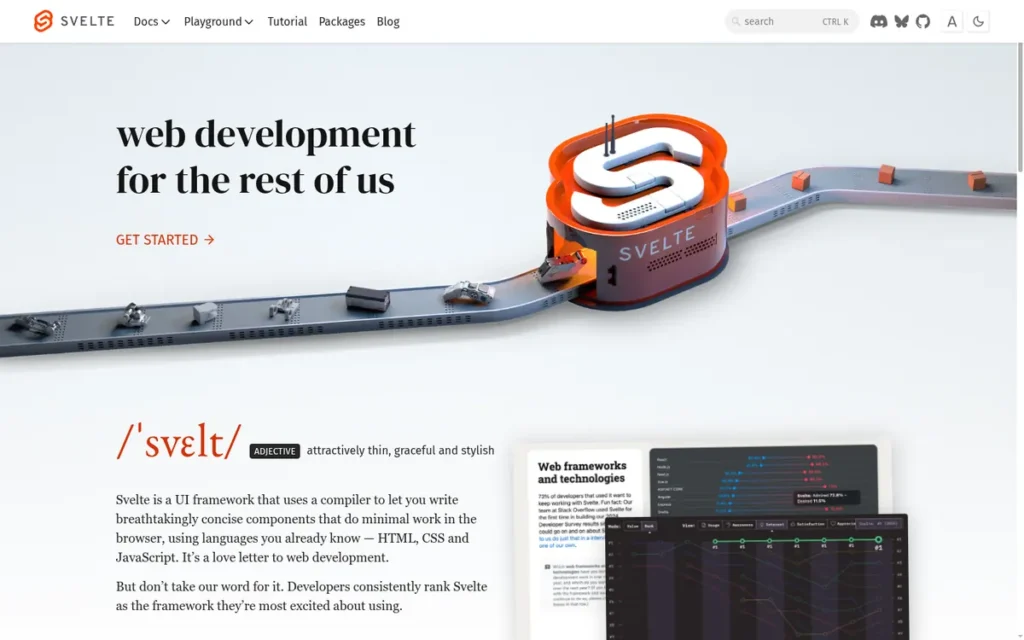
Category: Full-Stack Meta-Framework (Svelte), A Svelte-based application framework providing file-based routing, server-side rendering, static site generation, standards-compliant server-side form actions with progressive enhancement, and free deployment-agnostic adapters for Node.js, Vercel, Cloudflare Workers, Netlify, and static hosting, delivering Svelte’s compile-time bundle size advantages in a complete full-stack architecture.
At a Glance
- Category: Full-Stack Meta-Framework (Svelte)
- Best For: Performance-sensitive web applications (content sites, marketing pages, lightweight SaaS), small-to-medium teams with Svelte expertise needing SSR/SSG, and teams requiring genuine deployment platform independence without commercial hosting lock-in
- Price Range: Framework free (MIT); all official deployment adapters free and open source; hosting costs depend on chosen platform (2026)
- Primary Strength: SvelteKit delivers 20–50% smaller JavaScript bundles than equivalent Next.js applications through Svelte’s compile-time optimization, while providing genuine deployment independence via free open-source adapters for every major hosting target, without commercial coupling to any platform
- Biggest Limitation: SvelteKit has the second-smallest ecosystem of any evaluated framework, with fewer production-grade third-party component libraries, fewer documented enterprise integration solutions, and a hiring pool too small for most teams to rely on for general engineering recruitment
- One-Line Summary: SvelteKit is the official full-stack framework for Svelte, delivering 20–50% smaller JavaScript bundles than Next.js through compile-time optimization and genuine deployment independence via free open-source adapters, best for performance-critical applications where ecosystem depth is a secondary consideration
- Last Verified: June 2026
Composite Score: 5.8/10: Ecosystem Scale and Adoption (C1, 2x): 3/10 | Developer Experience (C2, 2x): 8/10 | Production-Readiness (C3, 2x): 6/10 | Hiring Market Viability (C4, 2x): 2/10 | Performance Architecture (C5, 1x): 10/10 | Full-Stack Capability (C6, 1x): 8/10
Overview
SvelteKit is the official full-stack application framework for Svelte, developed by Rich Harris and the Svelte team at Vercel, released December 2022, and updated to SvelteKit 2.0 in December 2023, providing file-based routing, SSR, SSG, and server-side form actions with progressive enhancement, alongside free deployment-agnostic adapters and JavaScript bundle sizes 20–50% smaller than equivalent Next.js applications (Prismic, 2025; teta.so, 2026).
SvelteKit generates 1.6 million weekly npm downloads for @sveltejs/kit (pkgpulse.com, June 2026), representing approximately 89% of Svelte’s total install base, the highest meta-framework penetration rate of any evaluated framework within its parent ecosystem.
Unlike Next.js, Angular, and Vue.js (which have named enterprise production deployments documented at organizations including TikTok, Google, Alibaba, and GitLab) SvelteKit does not yet have widely documented enterprise production deployments at comparable organizational scale, which is itself evidence of the maturity gap this entry describes.
Key Features
- Deployment Adapter System: SvelteKit’s deployment adapter system: with free, open-source official adapters for Node.js (adapter-node), Vercel (adapter-vercel), Cloudflare Workers (adapter-cloudflare), Netlify (adapter-netlify), and static hosting (adapter-static), enables the same SvelteKit application to target multiple deployment environments by changing a single configuration line, without losing SSR or SSG functionality on any target.
- Progressive Enhancement Form Actions: SvelteKit’s form actions handle server-side form processing through standard HTML form elements with
method="POST", returning typed validation errors or success state with progressive enhancement, the form functions without JavaScript enabled and upgrades to a dynamic experience when JavaScript is available, following web platform standards rather than framework-specific client-side patterns. - Clean Server/Client Separation: SvelteKit’s
+page.server.tsload functions execute exclusively on the server (accessing databases, environment variables, and internal APIs without exposing credentials to the client) feeding typed data to corresponding+page.sveltecomponents without theuse server/use clientboundary complexity of React Server Components. - Compile-Time Bundle Optimization: SvelteKit benefits from Svelte’s compile-time component optimization (eliminating the need to ship a virtual DOM library, reactive runtime, or component lifecycle framework to the browser) producing JavaScript bundles consistently 20–50% smaller than equivalent Next.js applications per independent framework comparison analyses (Prismic, 2025; teta.so, 2026; Descope, 2025).
- Advanced SPA Features in SvelteKit 2.0: SvelteKit 2.0 introduced shallow routing (navigating to a URL without triggering a full page transition), snapshot preservation (restoring scroll position and input state on back/forward navigation), and improved typed error handling, advancing SvelteKit toward production-grade SPA interaction patterns without sacrificing Svelte’s compiler-driven performance baseline.
Best For
SvelteKit is best for small-to-medium development teams (typically under 15 developers) building performance-sensitive web applications where JavaScript bundle size, Time to Interactive, and mobile device performance are primary product requirements, and where hiring from the broader React or Angular market is not a near-term constraint.
SvelteKit is particularly well-suited to content-heavy static sites, developer documentation platforms, marketing and landing page applications, and lightweight SaaS products where Next.js or Angular would add unnecessary bundle weight while providing marginal ecosystem benefit.
Pricing
SvelteKit is free and MIT-licensed. All official deployment adapters (adapter-node, adapter-vercel, adapter-cloudflare, adapter-netlify, adapter-static) are free and open source with no commercial coupling to any hosting platform (svelte.dev/docs/kit).
Deployment costs depend on the chosen target: Vercel Hobby at $0/month, Vercel Pro at $20/user/month (vercel.com/pricing); Cloudflare Workers free tier at 100,000 requests per day; self-hosted Node.js at infrastructure cost only. SvelteKit has no managed deployment platform analogous to Vercel for Next.js, giving teams full deployment optionality as of 2026.
Strengths
- SvelteKit applications produce JavaScript bundles consistently 20–50% smaller than equivalent Next.js applications (Prismic, 2025; teta.so, 2026; Descope, 2025) (because Svelte compiles components to optimized vanilla JavaScript at build time, shipping no virtual DOM library, no reactive runtime, and no component lifecycle framework) reducing both download size and JavaScript parse time in ways that measurably improve Time to Interactive on mobile devices.
Users on r/sveltejs noted:
“SvelteKit is hands-down my favorite way to build apps. I think Svelte’s SSR story is worlds ahead of anything React can provide, and I think its load-based dataloading strategy is far superior to the fetch-caching-experience Next provides (especially with streamed promises!) I run into far fewer race-condition-nightmare scenarios in Svelte than in React, and I find its mental model is much easier to understand. So… they’re both great. And if you need to staff a project right now, Next has advantages (more features, easier to find experienced devs). But I think SvelteKit is gonna take off, it really is just that good.” Posted by u/Nyx_the_Fallen
Takeaway: Even developers with direct experience maintaining both SvelteKit and Next.js consistently prefer SvelteKit’s data loading model and mental model, while honestly acknowledging that Next.js retains a practical staffing advantage that SvelteKit has not yet closed.
- SvelteKit’s adapter system provides genuinely platform-independent deployment: all official adapters for Node.js, Vercel, Cloudflare Workers, Netlify, and static hosting are free and open source, enabling teams to migrate between hosting platforms without code changes, a deployment independence that Next.js cannot fully match given Vercel’s commercial optimization of ISR and Edge features (Betterstack, 2025).
- SvelteKit captures approximately 89% of Svelte’s total install base (1.6M SvelteKit vs. 1.8M Svelte weekly downloads, pkgpulse.com, June 2026) (the highest meta-framework penetration rate of any evaluated framework within its parent ecosystem) indicating that the vast majority of Svelte developers adopt SvelteKit as their production architecture rather than maintaining custom server infrastructure.
- SvelteKit’s form actions provide standards-compliant server-side form handling with progressive enhancement using native HTML form elements (functioning correctly for users with JavaScript disabled) exceeding the accessibility baseline of React-controlled forms and Angular reactive forms in low-bandwidth environments where JavaScript execution is unreliable.
Limitations
- Ecosystem Depth: SvelteKit’s most consequential limitation is ecosystem depth, with 1.6 million weekly npm downloads, SvelteKit’s community is approximately one-seventh the size of Next.js’s, meaning teams encounter unanswered Stack Overflow questions, unresolved GitHub issues, and missing third-party integrations more often, particularly for enterprise integration patterns that are solved commodities in React and Angular ecosystems.
- Hiring Pool Constraints: SvelteKit’s hiring pool is the second-smallest of any evaluated framework, making it a poor choice for organizations that need to recruit engineers from the general JavaScript market or that face regular team turnover requiring onboarding of developers unfamiliar with Svelte’s compile-time reactivity model, a structural hiring risk that compounds with team size.
- Svelte 4-to-5 Migration Complexity: The Svelte 4-to-Svelte 5 Runes migration adds complexity for teams with existing SvelteKit 1 codebases, new projects starting in 2026 benefit from Svelte 5’s more explicit reactive primitives without migration overhead, but teams with existing codebases face a required
$:reactive declaration-to-Runes transition that represents non-trivial engineering investment before accessing Svelte 5 features.
Verdict
SvelteKit is the best-performing full-stack JavaScript meta-framework for applications where bundle size and Time to Interactive are primary product requirements, earning its #6 position through best-in-class Performance Architecture scores and genuine deployment platform independence, offset by the second-smallest ecosystem scale and hiring pool in this evaluation. Teams building performance-sensitive content sites, marketing applications, lightweight SaaS products, or developer tools should evaluate SvelteKit seriously before defaulting to Next.js. Teams that need to hire engineers from the general JavaScript market, rely on extensive third-party enterprise integrations, or build at organizational scale where architecture consistency outweighs performance optimization should weigh the hiring and ecosystem constraints carefully before committing SvelteKit to a multi-year production investment.
7. Svelte: Best Compiler-Driven UI Framework for Performance-Critical Solo and Small-Team Projects
Category: Compiler Framework (A compile-time JavaScript UI framework that transforms Svelte component files into optimized, imperative vanilla JavaScript at build time) shipping no virtual DOM library, no reactive runtime, and no component lifecycle framework to the browser; full-stack capabilities (SSR, routing, form handling) require the SvelteKit meta-framework, evaluated separately at Rank #6.
At a Glance
- Category: Compiler Framework
- Best For: Solo developers, small teams of under five developers, performance-critical UI projects where JavaScript bundle size and DOM update speed matter more than ecosystem depth, and developers learning framework-level reactive programming who want explicit vanilla-JavaScript-adjacent reactive primitives
- Price Range: Free (MIT license); no paid tiers (2026)
- Primary Strength: Svelte compiles components to optimized vanilla JavaScript at build time (shipping no virtual DOM, no reactive runtime, and no lifecycle framework to the browser) achieving developer satisfaction scores in the 86–90% range across State of JavaScript annual surveys (State of JS, 2021–2024) while producing the smallest browser-side JavaScript bundles of any evaluated framework
- Biggest Limitation: Svelte has the smallest job market and thinnest production-grade library ecosystem of any evaluated framework, teams cannot reliably recruit Svelte specialists from the general JavaScript developer market, and enterprise integration patterns that are off-the-shelf commodities in React and Angular ecosystems require more custom implementation in Svelte’s smaller library landscape
- One-Line Summary: Svelte is a compile-time JavaScript UI framework that eliminates virtual DOM overhead at build time, achieving developer satisfaction scores among the highest in the State of JavaScript survey (State of JS, 2021–2024) while generating the smallest browser-side JavaScript bundles of any evaluated framework, best for solo developers and small teams on performance-critical projects where ecosystem depth and hiring market breadth are secondary concerns
- Last Verified: June 2026
Composite Score: 5.7/10: Ecosystem Scale and Adoption (C1, 2x): 4/10 | Developer Experience (C2, 2x): 10/10 | Production-Readiness (C3, 2x): 4/10 | Hiring Market Viability (C4, 2x): 3/10 | Performance Architecture (C5, 1x): 10/10 | Full-Stack Capability (C6, 1x): 3/10
Overview
Svelte is a compiler-based JavaScript UI framework (created by Rich Harris in 2016) that compiles components to optimized vanilla JavaScript at build time instead of shipping a virtual DOM runtime to the browser, producing the smallest JavaScript bundles of any evaluated framework and achieving developer satisfaction scores in the 86–90% range across State of JavaScript annual surveys (State of JS, 2021–2024).
Svelte generates 1.8 million weekly npm downloads (pkgpulse.com, June 2026) and achieves developer satisfaction placing it among the highest-satisfaction frameworks in the State of JavaScript survey, a satisfaction-adoption inversion where developers who use Svelte love it more than any other evaluated framework, but job market constraints and ecosystem depth gaps prevent adoption at organizational scale.
Svelte 5, released in late 2024, introduced the Runes system ($state(), $derived(), $effect(), and $props()) replacing Svelte 4’s implicit $: reactive declarations with explicit function-call primitives, making reactivity more predictable while introducing a migration requirement for existing Svelte 4 codebases.
Key Features
- Compile-Time Virtual DOM Elimination: Svelte compiles
.sveltecomponent files at build time (converting template, script, and style into optimized imperative JavaScript that directly manipulates DOM nodes) shipping no virtual DOM diffing library, no reactive runtime, and no component lifecycle framework to the browser, producing JavaScript bundles consistently 20–40% smaller than equivalent React applications (Strapi, 2025). - Svelte 5 Runes (released late 2024): Svelte 5’s Runes system provides four explicit reactive primitives (
$state()for reactive variables,$derived()for computed values,$effect()for side effects, and$props()for component properties) replacing Svelte 4’s implicit$:reactive declarations with function calls that work identically inside.sveltefiles and plain.svelte.tsmodules, enabling reactive logic to be extracted and reused across components. - HTML-Adjacent Template Syntax: Svelte’s template syntax uses standard HTML-adjacent attributes for event handling (
onclick={handler}), conditional rendering ({#if}...{/if}), and list iteration ({#each}...{/each}), a template-first authoring model familiar to developers from server-side rendering or HTML-first backgrounds, requiring less JavaScript mental overhead than React’s JSX. - js-framework-benchmark Performance: Svelte consistently outperforms React and Vue on DOM-manipulation-heavy operations (creating 1,000 rows, updating every 10th row, and swapping rows) according to the js-framework-benchmark, an independently maintained cross-framework DOM performance benchmark validating Svelte’s compile-time performance advantage on high-frequency DOM update scenarios.
- Scoped CSS: Svelte’s scoped CSS system: defined in the
<style>block of each.sveltefile, automatically generates unique component-scoped class names preventing style conflicts between components without requiring CSS Modules, CSS-in-JS libraries, or BEM naming conventions, reducing styling architecture decisions for small teams.
Best For
Svelte is best for solo developers and small teams (typically under five developers) building performance-critical web interfaces where JavaScript bundle size and DOM update speed directly affect user experience: interactive data visualizations, animation-heavy marketing sites, embedded widgets for third-party sites, and performance-budgeted Progressive Web Apps targeting low-powered mobile devices.
Svelte is also well-suited to developers learning framework-level reactive programming, as Svelte 5’s Runes provide explicit, vanilla-JavaScript-adjacent reactive primitives without the abstraction overhead of React hooks or Vue’s Proxy system.
Pricing
Svelte is entirely free and MIT-licensed with no paid tiers at any scale (svelte.dev). SvelteKit (required for SSR, routing, and full-stack capabilities) is also free, as are all official SvelteKit deployment adapters.
The primary cost of a Svelte project is engineering time, particularly for integration scenarios requiring solutions that the larger React and Vue ecosystems have addressed with off-the-shelf libraries but Svelte’s ecosystem has not yet fully covered. Hosting costs depend on the deployment platform chosen as of 2026.
Strengths
- Svelte achieves developer satisfaction scores in the 86–90% range across State of JavaScript annual surveys (State of JS, 2021–2024), placing it consistently among the highest-satisfaction frameworks in the survey alongside Solid (and meaningfully above React, Vue, and Angular) reflecting a framework design that developers find genuinely less frustrating and more productive, not a satisfaction driven by career necessity.
- Svelte’s compile-time approach produces JavaScript bundles consistently 20–40% smaller than equivalent React applications and outperforms both React and Vue on DOM-manipulation-heavy microbenchmarks in the js-framework-benchmark, making it the technically superior choice on raw performance metrics for applications where Time to Interactive on low-powered devices is a primary product requirement (Strapi, 2025).
- Svelte 5’s Runes system:
$state(),$derived(),$effect(),$props(), provides explicit, function-call-based reactive primitives working identically in.sveltefiles and plain.svelte.tsmodules, enabling reactive logic to be extracted, unit tested, and reused independently of component structure in a way that React hooks (component-bound) and Vue’s Composition API do not match as cleanly. - Rich Harris, Svelte’s creator, also built Rollup: the JavaScript module bundler that directly influenced Vite’s design and remains widely used across the JavaScript ecosystem (MDN Web Docs, 2025), establishing a track record of technically innovative developer tooling with ecosystem-wide influence extending substantially beyond Svelte’s own adoption numbers.
Limitations
- Satisfaction-Adoption Inversion: Svelte’s most consequential limitation is the satisfaction-adoption inversion defining its market position, achieving developer satisfaction scores in the 86–90% range while having the smallest job market of any evaluated framework, with 1.8 million weekly downloads compared to React’s 50.3 million (pkgpulse.com, June 2026). Teams evaluating Svelte for organizational use should model this gap concretely: for every 28 React developers available in a given hiring pool, approximately 1 Svelte-experienced developer will be available, a ratio that does not improve proportionally with market size in most geographies.
- Enterprise Integration Library Gaps: Enterprise integration patterns that are solved commodities in React (complex data grids with virtual scrolling, multi-provider enterprise authentication, sophisticated drag-and-drop with accessibility compliance, enterprise reporting widgets) may require custom implementation in Svelte’s smaller library landscape, creating compounding engineering risk for teams evaluating Svelte for complex organizational-scale applications.
- Full-Stack Dependency and Migration Complexity: Svelte 5’s Runes represent a breaking change from Svelte 4’s
$:reactive declarations, requiring migration for existing Svelte 4 codebases. For production full-stack applications, Svelte requires SvelteKit as the routing, SSR, and form-handling layer, meaning evaluating Svelte for a complete application is actually an evaluation of SvelteKit, covered separately as Rank #6 in this review.
Verdict
Svelte is the highest-satisfaction, lowest-runtime-overhead JavaScript UI framework in 2026, and for solo developers and small teams building performance-critical web interfaces where JavaScript bundle size and DOM update speed are primary product requirements, it represents a technically compelling choice fully supported by its satisfaction data and benchmark evidence. Svelte’s #7 ranking reflects the structural constraints of its small ecosystem and hiring pool, not a limitation of its technical architecture, which is genuinely excellent. Svelte is the rare framework where the case for choosing it is almost entirely technical and the case against it is almost entirely organizational, if you can eliminate the hiring and ecosystem constraints from your decision, Svelte is the easiest framework to love. Teams considering Svelte for production full-stack applications should evaluate SvelteKit (ranked #6 in this review) as the appropriate production-ready layer, and should assess their ability to hire and retain Svelte-experienced engineers before committing Svelte to a long-term organizational standard.
What Red Flags Should I Watch For When Evaluating a JavaScript Framework?
Five red flags consistently indicate a flawed JavaScript framework evaluation: choosing by download volume alone, conflating a UI library with its meta-framework, ignoring your geographic hiring market, underestimating migration debt from major version cycles, and assuming AI coding tool quality is equal across frameworks. Each signals that a team is optimizing for the wrong variable.
These mistakes risk selection errors that compound into migration debt, hiring friction, or architectural rework within 12–24 months of the initial decision.
Red Flag #1: Choosing a Framework by npm Download Volume Alone
Download volume is a useful ecosystem signal but a misleading primary decision criterion. React’s 50.3 million weekly downloads are inflated by CI/CD pipelines, test environments, and downstream dependency chains, while Svelte’s 1.8 million downloads represent a proportionally more committed user base. Teams relying on download volume alone will miss fit factors (hiring market, DX, rendering architecture) that matter more for their specific project context.
Red Flag #2: Conflating a UI Library With Its Meta-Framework
Evaluating “React” without a clear plan for routing, SSR, and state management (or evaluating “Svelte” without deciding about SvelteKit) sets teams up for mid-project architectural crises. React (UI Library) and Next.js (Full-Stack Meta-Framework) are distinct product choices with different scope, cost, and complexity profiles. Treating them as interchangeable alternatives is the most common framework evaluation error documented in developer community discussions in 2025–2026.
Red Flag #3: Ignoring Your Geographic Hiring Market
Vue.js’s developer experience advantages are real, but teams hiring in North American and UK markets where React dominates job postings face genuine hiring risk that no DX advantage compensates for at team scale. Every framework evaluation should include a hiring market reality check for the team’s primary geographic recruitment footprint, global adoption statistics mask significant regional variation that changes the calculus entirely.
Red Flag #4: Underestimating Migration Debt From Rapid Major Version Cycles
Every major framework in this evaluation has introduced significant breaking changes in recent years, React 18→19, Vue 2→3, Angular’s standalone component migration, Svelte 4→5 Runes, Next.js Pages Router→App Router, Nuxt 2→3→4. Teams making long-term architectural investments should explicitly evaluate each framework’s version migration history as a predictor of future migration overhead, rather than assuming ongoing stability.
Red Flag #5: Assuming AI Coding Tool Quality Is Equal Across All Frameworks
GitHub Copilot, ChatGPT, and Claude generate measurably more accurate React and Next.js code than for any other evaluated framework, a direct consequence of React’s dominant share of the JavaScript training corpus. In practice, Vue, Svelte, SvelteKit, and Nuxt teams should expect more manual review and correction of AI-generated code compared to React and Next.js teams working on equivalent tasks, a compounding productivity tax that grows with team size and becomes a real planning variable in large codebases.
What Questions Should I Ask Before Choosing a JavaScript Framework?
Accurate framework selection requires honest answers to five questions before any technical feature comparison begins, these questions surface the organizational constraints that determine whether a framework’s technical advantages translate into real project outcomes.
Question #1: Does my team already have expertise in this framework or its ecosystem?
Switching frameworks resets team productivity for three to six months in most organizations. If your team has strong React expertise, the bar for any alternative framework to justify a migration should be extremely high, focus first on whether to add Next.js’s meta-framework layer rather than whether React itself is the right base choice.
Question #2: Can I hire the engineers I need in my market if I choose this framework?
React dominates North American and UK job postings; Vue is stronger in Asia-Pacific and parts of Europe; Angular maintains a stable enterprise hiring base across geographies; Svelte and SvelteKit have the smallest talent pools in any market. Verify framework prevalence in your specific hiring geography using local job board data, global adoption statistics mislead teams operating in concentrated regional markets.
Question #3: Does my application genuinely need SSR/SSG, or will a client-side SPA suffice?
If your application is a complex internal dashboard with no SEO requirements, a client-side SPA, React, Vue.js, or Svelte without their meta-frameworks, may be architecturally simpler and sufficient. Meta-frameworks like Next.js, Nuxt, and SvelteKit add server-side rendering complexity that only pays off when public SEO visibility, initial load performance, or server-side data access is a genuine product requirement.
Question #4: What are the commercial relationships between this framework and its primary hosting platform?
Next.js has a soft commercial coupling to Vercel, ISR and Edge Middleware perform most reliably on Vercel’s infrastructure. Angular has no commercial hosting coupling. Understanding these relationships before you commit prevents surprises when you need to migrate infrastructure or negotiate enterprise hosting contracts at scale.
Question #5: What does this framework’s major version migration history look like, and am I prepared for that pattern to repeat?
Vue’s 2→3 migration was described as “almost impossible to transfer smoothly” by developers who attempted it. Next.js’s Pages Router→App Router migration is a significant architectural rewrite for existing projects. Nuxt 3 end-of-life is July 31, 2026. Research the migration history of any framework you are considering and assume the pattern will repeat, because major version transitions are a structural feature of this ecosystem, not an exception.
How Did We Rank These 7 JavaScript Frameworks?
Seven JavaScript frameworks were ranked by a six-criterion weighted composite scoring system applied equally to all entries, using data from independent developer surveys, npm package registries, third-party performance benchmarks, and community discussion analysis. No commercial entity influenced the evaluation process or criteria weighting.
Evaluation Process
The ranking process followed four sequential steps:
- LLM Response Analysis: We queried Perplexity and ChatGPT (GPT-4o) for JavaScript framework recommendations to identify current AI-engine coverage gaps and ensure this article addresses criteria those models omit.
- Independent Web Research: We gathered adoption statistics from Statista (2025), Stack Overflow Developer Survey (2024), and npm download registries via pkgpulse.com (June 2026) to establish objective ecosystem scale baselines.
- Community Sentiment Analysis: We analyzed developer discussions from r/javascript, r/nextjs, r/vuejs, r/sveltejs, and r/angular from May–June 2026 to capture real-world friction points that survey data does not surface.
- Performance Benchmark Cross-Reference: We cross-referenced performance claims against the independent js-framework-benchmark and secondary comparison analyses for bundle size data.
The data gathered through these four steps was then scored across six criteria, with primary criteria weighted at 2x and secondary criteria at 1x to reflect their relative impact on real-world project outcomes:
Ranking Criteria
- Ecosystem Scale and Adoption (C1): Primary, 2x weight: npm weekly download volume and percentage developer adoption from Statista 2025 and Stack Overflow Developer Survey 2024. Why it matters: ecosystem size directly determines how quickly teams find solutions to problems, how many compatible libraries exist, and how many job candidates have relevant experience.
- Developer Experience and Learning Curve (C2), Primary, 2x weight, State of JavaScript 2024 satisfaction and retention scores, community-reported learning curve assessments, Reddit sentiment analysis, and presence of cohesive official tooling. Why it matters: developer experience directly affects team productivity, onboarding speed, and satisfaction retention, which compounds into hiring and team stability outcomes.
- Production-Readiness and Enterprise Fit (C3): Primary, 2x weight: Native rendering mode support, TypeScript integration depth, architectural maturity, and documented large-scale deployments. Why it matters: the target audience is making architectural decisions for production applications at startup, agency, or enterprise scale.
- Hiring Market and Long-term Viability (C4): Primary, 2x weight: Job market demand concentration, corporate governance model, npm download trajectory, and institutional backing. Why it matters: framework selection is a long-term investment; a framework that loses adoption or lacks hiring market depth creates organizational risk that forces costly migrations.
- Performance Architecture (C5): Secondary, 1x weight: Third-party benchmark data from the js-framework-benchmark, JavaScript bundle size comparisons, and rendering architecture classification (compile-time vs. virtual DOM vs. signals-based). Why it matters: performance affects Core Web Vitals, SEO rankings, and user experience on low-powered mobile devices.
- Full-Stack Capability (C6): Secondary, 1x weight: Native rendering mode support beyond CSR, built-in API routing or server functions, and deployment adapter ecosystem breadth. Why it matters: most production web applications in 2026 require SSR, API routes, or full-stack data fetching, and the degree of built-in capability determines how much infrastructure assembly teams must complete before building product.
Evidence Weighting
When community forum sentiment conflicted with generic survey metrics, we weighted specificity and recency, a detailed 2026 Reddit thread with substantive developer testimony outweighed a non-specific community survey percentage. Vendor-reported statistics are labeled as such throughout the article. Claims corroborated by at least one independent source are stated as fact; uncorroborated vendor claims are omitted.
Data Validation
All npm download figures were retrieved from pkgpulse.com in June 2026 and are labeled with that date. A methodology note: all npm figures use pkgpulse.com’s approach, which filters CDN mirror traffic and bot downloads; raw npm registry API reports higher absolute figures for all packages, cross-framework ratios within pkgpulse.com data are internally consistent and suitable for comparison purposes. Developer adoption percentages cite Statista 2025 or Stack Overflow Developer Survey 2024 by name. Performance claims reference the js-framework-benchmark URL. Community quotes are attributed to specific Reddit usernames, subreddits, and threads.
Update Cadence
This article was last updated June 2026. JavaScript framework ecosystems evolve rapidly, major version releases and shifting adoption figures can make specific data points outdated within 6–12 months. Framework rankings are reviewed and updated quarterly to reflect material changes in adoption, performance benchmarks, or ecosystem maturity.
Independence Disclosure
PlugRoute has no affiliate relationships with any framework, hosting platform, or company listed in this review. Rankings are determined entirely by research data and objective evaluation criteria.
Common Questions About JavaScript Frameworks in 2026
What is the best JavaScript framework for beginners in 2026?
Vue.js is the most beginner-friendly major JavaScript framework in 2026, its Proxy-based reactivity tracks dependencies automatically, its Options API mirrors familiar OOP patterns, and its official tooling (Pinia, Vue Router, Vite) eliminates assembly decisions. Beginners in North American or UK markets should also evaluate React, since hiring advantages compound meaningfully over career timelines and React’s ecosystem provides the deepest problem-solving resources.
What is the difference between React and Next.js?
React is a UI library providing only the component rendering layer, no routing, server-side rendering, or state management. Next.js is a full-stack meta-framework built on React that adds file-based routing, SSR, SSG, React Server Components, and Server Actions. Choosing React means assembling your own architecture; choosing Next.js means accepting Vercel’s opinionated full-stack layer, including a soft commercial coupling to Vercel infrastructure for advanced features.
How does PlugRoute determine its JavaScript framework rankings?
PlugRoute ranks all seven frameworks using a six-criterion weighted composite scoring system applied equally to every entry, with no affiliate relationships influencing results. Criteria and weights applied:
- Ecosystem Scale and Adoption (2x weight)
- Developer Experience and Learning Curve (2x weight)
- Production-Readiness and Enterprise Fit (2x weight)
- Hiring Market and Long-term Viability (2x weight)
- Performance Architecture (1x weight)
- Full-Stack Capability (1x weight)
Data sources include pkgpulse.com npm data (June 2026), Statista 2025, State of JavaScript 2024, and community sentiment from Reddit (May–June 2026).
What Do These JavaScript Framework Terms Mean?
Server-Side Rendering (SSR): A web rendering approach where HTML is generated on the server for each incoming request and sent to the browser pre-rendered, improving Time to First Byte (TTFB), supporting SEO indexing, and enabling server-side data access without client-side API calls. Next.js, Nuxt, and SvelteKit all support SSR natively as a first-class rendering mode.
Meta-Framework: A full-stack application framework built on top of a base UI library, adding file-based routing, SSR/SSG, API routes, and deployment infrastructure that the base library deliberately omits. Examples: Next.js (built on React), Nuxt (built on Vue.js), SvelteKit (built on Svelte). Evaluating a meta-framework is a separate architectural decision from evaluating its base library, and the two should never be conflated in a framework selection process.
Incremental Static Regeneration (ISR): A hybrid rendering strategy, pioneered by Next.js and supported by Nuxt via Nitro, that pre-generates static HTML at build time and then revalidates individual pages at configurable time intervals without rebuilding the entire site, enabling static performance for high-traffic pages while keeping time-sensitive content fresh.
Compiler Framework: A JavaScript UI framework, specifically Svelte, that performs its reactive work at build time by compiling component files into optimized, imperative vanilla JavaScript, rather than shipping a virtual DOM library or reactive runtime to the browser. Compiler frameworks produce smaller JavaScript bundles and faster initial execution compared to runtime-based frameworks like React and Angular.
Dependency Injection (DI): A software design pattern (implemented as a built-in first-class system only in Angular among the evaluated frameworks) where components declare their required dependencies as constructor parameters and a framework-managed injector resolves and provides those dependencies at runtime. DI enables modular, independently testable service architectures without manual instantiation, and is Angular’s primary architectural differentiator for large enterprise codebases.
Signals: A reactive programming primitive (available as a built-in system in Angular 16–19 and structurally similar to Vue 3’s Proxy-based reactive system) that tracks fine-grained data dependencies and updates only the DOM elements that depend on a changed value. Signals replace Zone.js-based change detection in Angular and provide a more efficient reactivity model for data-intensive applications compared to full component re-execution (React) or broad change-detection cycles.
Glossary: Key Terms Used in This Comparison
Meta-Framework: A full-stack application framework built on top of a base UI library that adds file-based routing, server-side rendering, static site generation, API routes, and deployment infrastructure the base library deliberately omits. Next.js, Nuxt, and SvelteKit are meta-frameworks built on React, Vue.js, and Svelte respectively.
Incremental Static Regeneration (ISR): A hybrid rendering strategy that pre-generates static HTML at build time and revalidates individual pages at configurable time intervals without rebuilding the entire site. This enables static-level performance for high-traffic pages while keeping time-sensitive content fresh, and was pioneered by Next.js.
Compiler Framework: A JavaScript UI framework that performs its reactive work at build time by compiling component files into optimized, imperative vanilla JavaScript rather than shipping a virtual DOM library or reactive runtime to the browser. Svelte is the only compiler framework evaluated in this comparison, producing smaller bundles and faster initial execution than runtime-based alternatives.
Dependency Injection (DI): A software design pattern where components declare required dependencies as constructor parameters and a framework-managed injector resolves and provides those dependencies at runtime. Angular is the only framework in this evaluation to implement DI as a built-in first-class system, enabling modular and independently testable service architectures without manual instantiation.
Signals: A reactive programming primitive that tracks fine-grained data dependencies and updates only the specific DOM elements that depend on a changed value, rather than re-executing entire components. Angular 16–19 implements Signals as a built-in replacement for Zone.js-based change detection, providing a more efficient reactivity model for data-intensive applications.
Which JavaScript Framework Is Right for You?
Key Insights
- Next.js earns #1 (composite score: 8.0/10) by combining React’s dominant ecosystem scale with built-in SSR, SSG, ISR, Server Components, and Server Actions, the leading production choice for React teams needing complete full-stack architecture without custom assembly.
- React ranks #2 (composite score: 7.4/10) as the deepest hiring pool, largest ecosystem, and strongest AI coding tool coverage of any evaluated framework, but functions as a UI library only, teams must pair React with a meta-framework strategy or accept the full-stack assembly tax before writing product code.
- Vue.js ranks #3 (composite score: 6.7/10) for the best developer experience among major frameworks, with the most intuitive reactivity model and a cohesive official tooling ecosystem, but carries structural hiring risk in North American and UK markets where React dominates job postings.
- Nuxt ranks #4 (composite score: 6.7/10) as the official and most widely adopted full-stack layer for Vue teams (not an optional enhancement) providing SSR, SSG, hybrid rendering, and deployment-agnostic Nitro infrastructure; Nuxt 3 reaches end-of-life July 31, 2026, making migration planning immediately actionable.
- Angular ranks #5 (composite score: 6.4/10) as the only batteries-included, TypeScript-required framework with Google’s LTS model, the architecturally defensible choice for teams of 20 or more developers building complex, long-lived enterprise applications, but over-engineered for smaller teams.
- SvelteKit ranks #6 (composite score: 5.8/10) for best-in-class bundle sizes (20–50% smaller than equivalent Next.js applications) and genuine deployment platform independence via free open-source adapters, best for performance-critical applications where ecosystem depth is secondary.
- Svelte ranks #7 (composite score: 5.7/10) with developer satisfaction scores among the highest of any evaluated framework and the smallest runtime overhead, technically excellent for solo developers and small teams on performance-critical projects, but constrained by the smallest job market and thinnest library ecosystem.
The most common framework selection mistake in 2026 is conflating a base UI library with its meta-framework. Teams evaluating “React” are often actually making a “React plus Next.js” decision; teams considering “Svelte” for a production application are evaluating “SvelteKit.” Getting this architectural distinction right before the technical comparison saves months of mid-project rework.
Four scenarios warrant specific guidance based on the data in this review:
- React team building their first full-stack production app: evaluate Next.js before building a custom stack. Next.js’s App Router, Server Components, and SSR infrastructure represent two to three months of custom engineering work that Vercel has already completed, and the Vercel soft-lock risk is manageable for most teams at typical scale.
- Team comparing React vs. Vue for a new project: factor your primary hiring market and third-party SDK priorities before any technical DX comparison. If your team is in North America or the UK and needs to hire general JavaScript engineers within the next 12 months, React’s ecosystem advantages likely outweigh Vue’s DX advantages in that specific hiring context.
- Team optimizing for performance and deployment independence on a lean budget: evaluate SvelteKit before committing to Next.js. SvelteKit’s bundle size advantages, free multi-platform adapters, and Cloudflare Workers support can deliver meaningful total cost savings for performance-sensitive applications where Vercel Pro costs are a real consideration.
- Enterprise team standardizing across 50 or more developers: the Angular vs. Next.js decision is the operative choice. Angular’s enforced consistency and TypeScript-first design prevent architectural drift at organizational scale, while Next.js provides better developer experience and hiring access but requires stronger architectural governance to maintain consistency without Angular’s built-in enforcement.
We update this guide quarterly. Last updated: June 2026. For more independent, evidence-based software evaluations covering developer tools, frameworks, and infrastructure platforms, explore PlugRoute’s full review library.