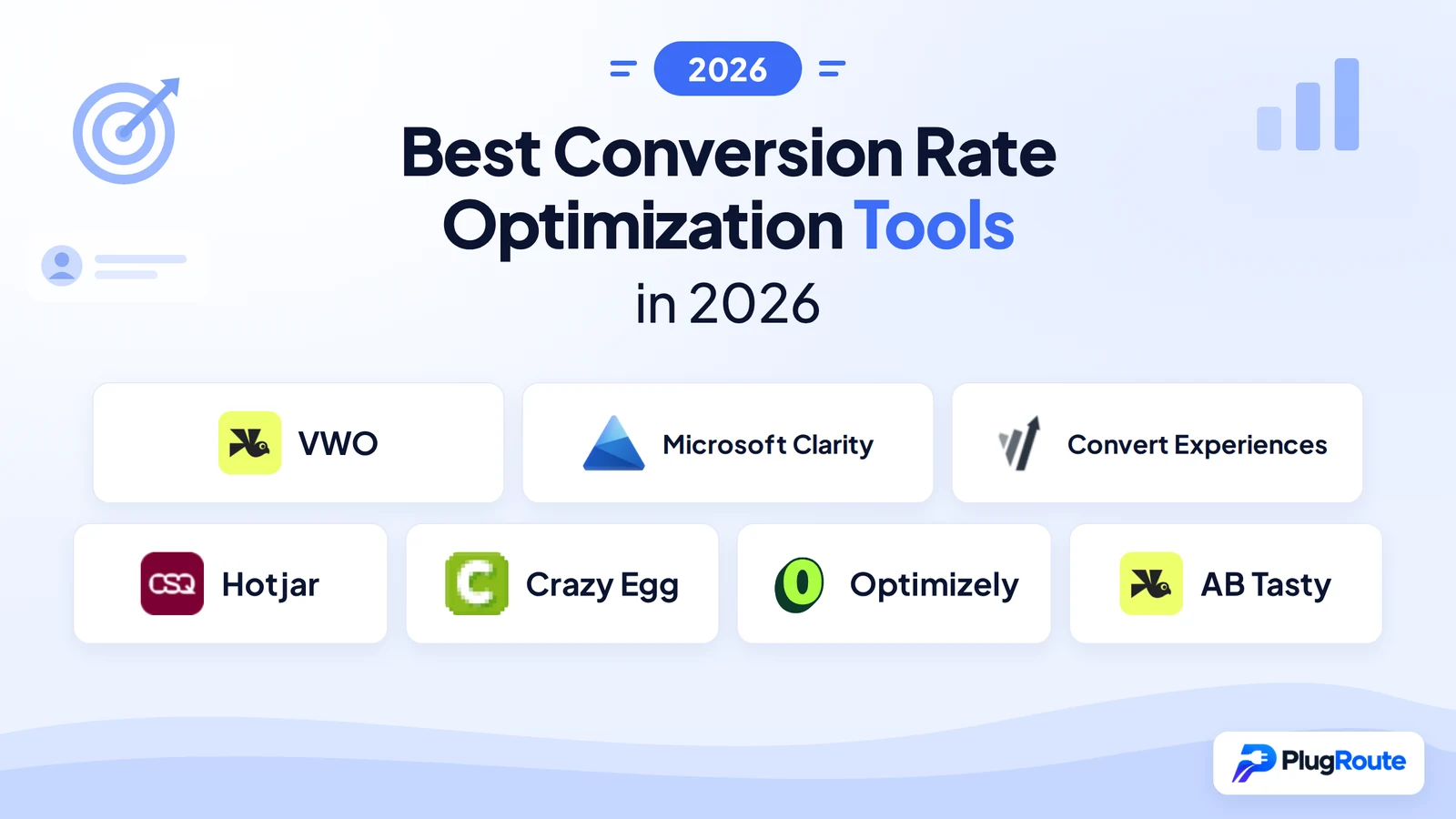
The best conversion rate optimization tools in 2026 are VWO for an all-in-one diagnose-and-test suite, Microsoft Clarity as the best free starting point, and Convert Experiences for privacy-first A/B testing with published pricing. CRO tools do three jobs: they measure where visitors drop off, diagnose why, and test whether a fix works.
CRO tools do different jobs, so most teams need a stack rather than one tool. Comparing these tools is confusing because behavior tools and testing tools solve different problems, yet most “best” lists rank them side by side. Teams also risk overspending on custom-priced enterprise platforms when free tools may cover what they need today.
This guide scores seven tools on the same six weighted criteria, with dated evidence for each claim. Lower-ranked tools can still be the best choice for a specific job. Hotjar, for example, is the strongest option for visitor surveys.
PlugRoute has no affiliate relationships with any company listed, and rankings are determined entirely by research data and objective evaluation criteria.
What Are the 3 Categories of Conversion Rate Optimization Tools?
CRO tools fall into three ranked categories:
- Behavior Analyzers (Microsoft Clarity, Hotjar) show why visitors drop off.
- Diagnose-and-Test Suites (VWO, Crazy Egg) find problems and test fixes in one product.
- Experimentation Platforms (Convert Experiences, AB Tasty, Optimizely) prove whether a change causes a lift.
GA4 sits underneath all three as the free measurement layer.
The three ranked categories, plus the measurement layer, are defined as follows:
- Behavior Analyzer: A Behavior Analyzer shows why visitors drop off through heatmaps, session recordings, and sometimes surveys. A Behavior Analyzer does not prove that a fix works. Microsoft Clarity and Hotjar are Behavior Analyzers.
- Diagnose-and-Test Suite: A Diagnose-and-Test Suite finds why visitors drop off and tests fixes in the same platform. VWO and Crazy Egg are Diagnose-and-Test Suites.
- Experimentation Platform: An Experimentation Platform tests whether a change causes a conversion improvement. It runs client-side tests in the browser or server-side tests in application code, often with personalization and feature flags. Convert Experiences, AB Tasty, and Optimizely are Experimentation Platforms.
- Measurement layer (not ranked): GA4 shows where visitors drop off. PlugRoute treats GA4 as the free foundation of every stack, not as a competitor to the seven ranked tools.
GA4 has five limits that stop it from being a complete CRO tool on its own (EyeCaptain, 2026; Adwave, 2026):
- GA4 has had no native A/B testing since Google Optimize shut down on September 30, 2023.
- GA4 loses data to ad blockers and to visitors who refuse consent.
- GA4 has imperfect cross-device identity.
- GA4 isn’t designed to enforce rules for when to stop a test.
- GA4 can’t explain why visitors behave the way they do.
Do You Have Enough Traffic to Run A/B Tests?
Many small sites don’t have enough traffic for reliable A/B tests. A page converting at 2.5% needs roughly 15,000 visitors per variant to detect a 20% relative lift, which is the minimum detectable effect. That figure assumes 95% statistical significance and 80% power (EyeCaptain, 2026).
A simple two-variant test therefore needs about 30,000 visitors to that page. Run a sample size calculator with your own baseline conversion rate before you buy testing software.
Low-traffic teams should keep three points in mind:
- Low win rates are normal. A commonly cited planning range says only 10–30% of tests produce a statistically reliable winner (industry rule of thumb; unverified). This range doesn’t come from a single verified study.
- High win rates are a warning sign. A reported win rate above 50% usually signals loose stopping rules rather than unusually good ideas.
- Small samples give unclear results. One creator with about 50 views per video reported that “most of the A/B tests come back inconclusive” (r/YouTubeCreators, 2026). The example comes from video testing, but the traffic lesson applies to websites too.
If your key pages fall well below roughly 15,000 visitors per variant, start with GA4 and a Behavior Analyzer such as Microsoft Clarity. Fix the obvious usability problems first. Buy an Experimentation Platform only when your traffic can support valid tests.
As one user on r/copywritingsecrets described:
“one thing I ran into tho is a lot of A/B testing tools assume you already have a “good enough” page to optimize
in a lot of cases the bigger wins came before testing, just simplifying the structure and making the path clearer” Posted by u/ernoldri
Takeaway: Fixing obvious friction before buying A/B testing software often delivers bigger CRO wins than testing variations of a broken page.
How Do the Top CRO Tools Compare at a Glance?
VWO ranks first (36/45) because it covers the most of the diagnose-and-test workflow and has the largest G2 review base among the testing tools. Microsoft Clarity ranks second (32/45) as the strongest free option. Convert Experiences ranks third (31/45) for transparent, privacy-first testing.
| Rank | Company | Category | Best For | One-Line Summary | Key Capabilities | Primary Strength | Key Limitation |
|---|---|---|---|---|---|---|---|
| 1 (36/45) | VWO | Diagnose-and-Test Suite | Growing ecommerce and SaaS teams that test regularly | VWO is the most complete single-vendor CRO suite PlugRoute evaluated, connecting behavior analysis and A/B testing. | Heatmaps, recordings, surveys, A/B/MVT, server-side tests, personalization | Broadest job coverage; VWO Testing G2 4.4/5 (929 reviews, 2026) | Module-plus-MTU pricing is only partly public |
| 2 (32/45) | Microsoft Clarity | Behavior Analyzer | Beginners and small businesses | Microsoft Clarity is the highest-ranked free CRO tool PlugRoute evaluated for finding why visitors drop off. | Heatmaps, recordings, rage/dead-click detection, Copilot AI, GA4 integration | $0 with no stated traffic limits | No A/B testing or surveys; ~30-day standard retention |
| 3 (31/45) | Convert Experiences | Experimentation Platform | Privacy-conscious teams that want published prices | Convert Experiences is the most transparent, privacy-focused A/B testing platform PlugRoute evaluated. | A/B, MVT, full-stack, feature flags, frequentist and Bayesian stats | Fully public pricing; EU hosting since 2016 | No heatmaps or recordings; overage fees above 100K MTUs |
| 4 (29/45) | Hotjar | Behavior Analyzer | Teams that need visitor feedback | Hotjar is the top-ranked tool PlugRoute evaluated for asking visitors why they leave, not just watching what they do. | Heatmaps, recordings, funnels, surveys, user interviews | Only tool evaluated that combines behavior data, surveys, and interview recruitment | Session caps, separately billed products, Trustpilot billing complaints |
| 5 (28/45) | Crazy Egg | Diagnose-and-Test Suite | Small businesses on a budget | Crazy Egg is the most affordable single tool PlugRoute evaluated for heatmaps plus simple A/B tests. | Heatmaps, Confetti reports, recordings, surveys, visual A/B editor | Every tier, cap, and storage limit published | Light testing depth; annual billing complaints |
| 6 (28/45) | Optimizely | Experimentation Platform | Enterprise multi-team programs | Optimizely has the deepest experimentation feature set PlugRoute evaluated. | Web and feature experimentation, Stats Engine, personalization, CMS, warehouse analytics | Deepest experimentation; Forrester and Gartner Leader placements (vendor-reported) | Highest, least transparent pricing (Vendr median ~$81K/yr, 2026) |
| 7 (26/45) | AB Tasty | Experimentation Platform | Mid-market ecommerce marketing teams | AB Tasty is the best fit PlugRoute evaluated for mid-market ecommerce testing plus personalization. | A/B/MVT, personalization, EmotionsAI, feature flags, recommendations | Testing plus personalization for marketers; G2 4.4/5 (424 reviews, 2026) | Quote-only pricing from ~€15,000/year |
Which CRO Tool Should I Choose for My #1 Priority?
Pick a tool based on the job you need done first, not the brand. If you want free diagnosis, start with Microsoft Clarity. If you want one vendor for both diagnosis and testing, choose VWO. The table below maps seven common priorities to a recommended tool, the reason for it, and an acceptable alternative.
| Your #1 Priority | Recommended Tool | Why | Acceptable Alternative |
|---|---|---|---|
| Free heatmaps and recordings | Microsoft Clarity | $0 with no stated traffic limits | Hotjar free Basic plan |
| Visitor surveys plus behavior data | Hotjar | Only tool evaluated that bundles surveys and interviews with recordings | Crazy Egg (includes on-site surveys) |
| Heatmaps plus simple A/B tests on a small budget | Crazy Egg (Plus) | A/B testing from $99/month billed annually, with published caps | Microsoft Clarity now; add testing once traffic allows |
| One vendor for diagnosis and regular testing | VWO | Insights and Testing modules in one platform | Crazy Egg (lighter testing) |
| Privacy-first testing with public pricing | Convert Experiences | EU hosting, consent-first design, published tiers | No close equivalent evaluated; pair with Microsoft Clarity in consent mode for diagnosis |
| Ecommerce personalization with a $20K+ budget | AB Tasty | Personalization, EmotionsAI, recommendations | VWO Personalize |
| Enterprise multi-team feature experimentation | Optimizely | Sequential Stats Engine, feature experimentation, analyst recognition | AB Tasty Flagship |
What Are the 7 Best Conversion Rate Optimization Tools in 2026?
PlugRoute ranked the seven best conversion rate optimization tools in 2026 by weighted score out of 45. The rankings show overall value for small-to-mid-market teams building a CRO stack. They don’t measure how good each tool is at its own job, so a lower rank doesn’t mean a tool is worse at what it does.
- VWO scored 36/45 and ranks first overall.
- Microsoft Clarity scored 32/45 and ranks second.
- Convert Experiences scored 31/45 and ranks third.
- Hotjar scored 29/45 and ranks fourth.
- Crazy Egg scored 28/45 and ranks fifth on the tie-break.
- Optimizely scored 28/45 and ranks sixth on the tie-break.
- AB Tasty scored 26/45 and ranks seventh.
Every entry below uses the same structure, so you can compare evidence, pricing, and limitations directly.
1. VWO: Best Overall All-in-One Diagnose-and-Test Suite for Growing Teams
Category: Diagnose-and-Test Suite. It finds why visitors drop off and tests fixes in the same platform.
PlugRoute Score: 36/45 (Job Coverage 5, Ratings 5, Pricing 3, Proof 4, Privacy & Reliability 3, Adoption 3). VWO ranks #1 because it scored highest on job coverage and review volume. Its partly published pricing held it back.
At a Glance
- Category: Diagnose-and-Test Suite
- Best For: Growing ecommerce and SaaS teams with enough traffic for regular A/B tests that want behavior insights and testing from one vendor
- Price Range: VWO references a free Starter plan, but its limits are unconfirmed. Paid web testing is reported from ~$219/month billed annually (SalesHive, 2026; third-party estimate), and cost rises with monthly tracked users (MTUs) and modules.
- Primary Strength: VWO combines heatmaps, recordings, surveys, and A/B, multivariate, and server-side testing in one platform, with the largest G2 review base among the testing tools evaluated.
- Biggest Limitation: VWO’s module-plus-MTU pricing is only partly published and adds up quickly as traffic and modules grow.
- One-Line Summary: VWO is the most complete single-vendor CRO suite PlugRoute evaluated, connecting behavior analysis and A/B testing for teams that have outgrown free tools.
- Last Verified: November 2026
Overview
VWO is a conversion optimization platform from Wingify. VWO combines behavior analytics, including heatmaps, recordings, and surveys, with A/B, multivariate, and server-side testing, and it’s built for growing ecommerce and SaaS teams that want to diagnose and test in one tool.
VWO’s parent company, Wingify, sold a majority stake to Everstone Capital in January 2025. Wingify and AB Tasty then announced their combination on January 20, 2026, with Sparsh Gupta as CEO. Financial terms were not disclosed (Wingify, 2026). VWO was still sold separately in November 2026.
Key Features
- VWO Testing supports A/B, split-URL, and multivariate tests through a visual editor.
- VWO Insights adds heatmaps, session recordings, on-site surveys, and form analytics alongside test reports.
- VWO SmartStats, a Bayesian engine, reports results as the probability that a variant beats the control.
- VWO Personalize lets teams serve targeted experiences to defined audience segments.
- VWO Feature Experimentation (FullStack) supports server-side tests, feature flags, and gradual rollouts.
Best For
VWO is best for growing ecommerce stores and SaaS companies whose key pages already reach roughly 15,000 visitors per variant. VWO suits teams that want one vendor for both diagnosis and testing.
Pricing
VWO prices by module and by monthly tracked users (MTUs). Third-party estimates for annual billing don’t agree with each other (SalesHive, 2026; Costbench, 2026; Donnuab, 2026):
- VWO web testing is reported from about $219/month.
- VWO Pro is reported at about $275+/month.
- VWO Enterprise is reported at about $775+/month.
VWO references a free Starter plan, but its limits couldn’t be confirmed. Ask VWO for a written quote based on your MTUs before you commit.
Strengths
- VWO Testing holds a 4.4/5 G2 rating across 929 reviews (G2, 2026), the largest G2 review base among the testing tools PlugRoute evaluated.
- VWO documents Ubisoft raising conversions on its For Honor Buy Now page from 38% to 50%, about a 31.6% relative lift, over roughly three months (VWO, 2023; vendor-published).
- Among the seven tools evaluated, VWO is the only one that combines native heatmaps and recordings with client-side testing, server-side feature experimentation, and personalization from one vendor.
- VWO holds a 4.5/5 Capterra rating across 91 reviews (SalesHive, 2026; secondary source). VWO also markets ISO 27001, SOC 2, and GDPR compliance (DevTune, 2026; self-reported).
Limitations
VWO’s breadth comes at the cost of pricing clarity and setup friction.
- VWO’s module-plus-MTU pricing is only partly public, and reviewers say it adds up quickly as traffic and modules grow (Costbench, 2026).
- VWO’s visual editor is reported to be finicky on JavaScript-heavy pages, and reviewers also raise flicker and page-speed concerns (Lean Experiments, 2026).
- VWO users report data discrepancies against other systems and a learning curve when reading Bayesian results (Kirro, 2026; Costbench, 2026).
- VWO’s 929-review G2 base belongs to VWO Testing. The separately listed VWO Insights – Web module rates lower, at 4.2/5 across 62 reviews (G2, 2026).
- VWO’s January 2026 combination with AB Tasty creates near-term uncertainty about roadmaps and contract terms (Wingify, 2026).
Verdict
VWO is the highest-scoring all-in-one CRO platform PlugRoute evaluated for growing teams in 2026, earning the top ranking (36/45) on job coverage and review volume.
VWO suits teams that are ready to test. Teams that only need heatmaps can get them free from Microsoft Clarity. Get a written MTU quote, and confirm how the AB Tasty combination affects your contract before you sign.
2. Microsoft Clarity: Best Free CRO Tool and Best Starting Point for Small Businesses
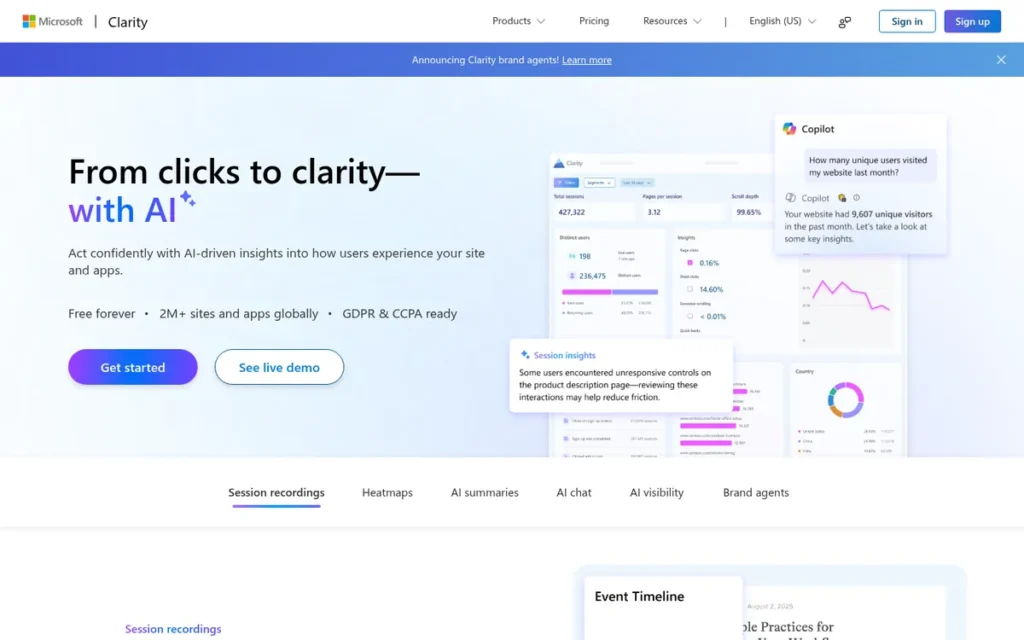
Category: Behavior Analyzer. It shows why visitors drop off through heatmaps and session recordings.
PlugRoute Score: 32/45 (Job Coverage 2, Ratings 4, Pricing 5, Proof 2, Privacy & Reliability 3, Adoption 5). Microsoft Clarity earned maximum marks for cost and ease of adoption. It ranks #2 because those scores are offset by a diagnose-only scope and no named-client proof.
At a Glance
- Category: Behavior Analyzer
- Best For: Beginners, small businesses, and any team that needs free heatmaps and session recordings to pair with GA4
- Price Range: Free ($0) with no paid tier (Microsoft, 2025)
- Primary Strength: Microsoft Clarity provides heatmaps, session recordings, and frustration-signal detection free, with no stated traffic limits.
- Biggest Limitation: Microsoft Clarity has no A/B testing or surveys, so it can’t confirm whether a fix actually works.
- One-Line Summary: Microsoft Clarity is the highest-ranked free CRO tool PlugRoute evaluated in 2026 for finding why visitors drop off, but it must be paired with a testing tool to prove fixes work.
- Last Verified: November 2026
Overview
Microsoft Clarity is a free behavior analytics tool from Microsoft that records sessions, generates heatmaps, and flags rage and dead clicks. Microsoft Clarity is built for beginners and small businesses that want to see why visitors drop off without paying for software.
Microsoft Clarity launched in 2020 and integrates natively with GA4. Microsoft acts as the data controller, and Microsoft Clarity is described as funded by Microsoft’s advertising business (Microsoft Clarity FAQ, 2026).
Key Features
- Microsoft Clarity generates click, scroll, area, conversion, and attention heatmaps for tracked pages.
- Microsoft Clarity records sessions and automatically flags rage clicks, dead clicks, and excessive scrolling.
- Microsoft Clarity Copilot produces AI summaries of sessions and heatmap patterns.
- Microsoft Clarity integrates with GA4, Shopify, WordPress, WooCommerce, Squarespace, and Google Tag Manager.
- Microsoft Clarity includes a mobile app SDK for analyzing app sessions alongside web traffic.
Best For
Microsoft Clarity is best for beginners, small businesses on a low budget, and low-traffic sites. It fits teams that need to diagnose usability problems before they can justify paid testing software.
Pricing
Microsoft Clarity’s unlimited plan covers capture, not history: standard recordings expire after about 30 days (Microsoft Clarity FAQ, 2026). Microsoft says Microsoft Clarity has no paid tier and no traffic or site limits (Microsoft, 2025).
- Microsoft Clarity keeps favorited recordings and a random sample for up to 9 months (Microsoft Clarity FAQ, 2026).
- Microsoft Clarity may sample data on very high-traffic sites, according to third-party reports (Plerdy, 2026; unverified).
Strengths
- Microsoft Clarity holds a 4.8/5 Capterra rating across 57 reviews and a 4.5/5 G2 rating across 55 reviews (Capterra, 2026; G2, 2026). Its Capterra score is the highest among the seven tools evaluated.
- Microsoft Clarity has been free with no stated traffic or site limits since its 2020 launch (Microsoft, 2025).
- Microsoft Clarity is reportedly installed on more than 2 million sites (SaaSTracker, 2026; third-party estimate, directional).
- Microsoft Clarity users describe it as lighter on page load than Hotjar and easy to run side by side with other tools (r/AskMarketing, 2020; historical).
Limitations
Microsoft Clarity’s zero cost comes with a narrow job and a data trade-off.
- Microsoft Clarity has no A/B testing and no surveys, so teams still need a separate testing tool to prove that a fix works.
- Microsoft Clarity’s roughly 30-day standard recording retention makes year-over-year analysis difficult (Microsoft Clarity FAQ, 2026).
- Microsoft Clarity’s data-controller status and advertising-funded model (Microsoft Clarity FAQ, 2026) have prompted user concerns about how site data is used (r/AskMarketing, 2020; historical).
- Since October 31, 2025, Microsoft Clarity has required a consent signal for EEA, UK, and Swiss visitors. Without that signal, funnels may be incomplete and each pageview may appear as a separate session (Microsoft Learn, 2025).
- Microsoft Clarity has no verified case study with a named client and percentage lift.
Users on r/PPC noted:
“Yep, Hotjar really doesn’t offer much more in the way of features. One thing to always be wary about though is the fact this is a free tool from a major player. Microsoft, Google, and others are well known to simply decide one day to nix free tools.
Remember Google Optimize? Even when Google sunset the tool they were saying they’d be launching something better… nothing ever materialized.” Posted by u/TTFV
Takeaway: Microsoft Clarity matches paid heatmap tools on core features, but teams building their CRO stack on it carry the risk that Microsoft could discontinue the free product, as Google did with Optimize.
Verdict
Microsoft Clarity is the highest-ranked free CRO tool among the seven PlugRoute evaluated in 2026. Most beginner stacks can start with Microsoft Clarity alongside GA4, as long as consent is configured for EU visitors.
Microsoft Clarity covers only the “why” layer. Add Hotjar if you need surveys, and add a testing tool once your traffic supports valid tests.
3. Convert Experiences: Best Privacy-First A/B Testing Platform with Transparent Pricing
Category: Experimentation Platform. It tests whether a fix actually improves conversions.
PlugRoute Score: 31/45 (Job Coverage 2, Ratings 4, Pricing 4, Proof 3, Privacy & Reliability 5, Adoption 3). Convert Experiences ranks #3 because it leads all seven tools on privacy and reliability and publishes full pricing. Its testing-only scope held it back.
At a Glance
- Category: Experimentation Platform
- Best For: Privacy-conscious ecommerce and SaaS teams that test regularly and want published pricing without enterprise contracts
- Price Range: $299–$420/month billed annually ($399–$599 billed monthly) for 100K monthly tested users, with Enterprise priced on request (Convert, 2026)
- Primary Strength: Convert Experiences offers full A/B, multivariate, and full-stack testing with fully public pricing and privacy-first, EU-hosted data handling.
- Biggest Limitation: Convert Experiences has no built-in heatmaps or recordings, so it must be paired with a behavior analytics tool.
- One-Line Summary: Convert Experiences is the most transparent and privacy-focused A/B testing platform PlugRoute evaluated in 2026, best paired with a free behavior tool such as Microsoft Clarity.
- Last Verified: November 2026
Overview
Convert Experiences is an A/B testing and personalization platform from Convert Insights that offers web, multivariate, and full-stack testing with privacy-first, EU-hosted data handling. Convert Experiences is built for growing ecommerce and SaaS teams that want experimentation with published prices.
Convert Experiences lets teams choose frequentist, Bayesian, or sequential statistics. Convert Insights Inc. has operated since 2009 and moved its servers from the US to the EU in 2016 (Convert, 2026).
Key Features
- Convert Experiences supports A/B, split-URL, multivariate, and multipage testing on the web.
- Convert Experiences offers full-stack testing, feature flags, and multi-armed bandits on its Pro plan.
- Convert Experiences lets teams pick frequentist, Bayesian, or sequential statistics for each experiment.
- Convert Experiences imports GA4 goals and revenue data and supports Shopify price testing.
- Convert Experiences delivers each experiment snippet as one bundle up front and markets this as flicker-free (Convert, 2026; self-reported).
Best For
Convert Experiences is best for growing ecommerce and SaaS teams that already have enough traffic for valid tests. It suits teams that care about GDPR-friendly data handling and want to budget from published prices.
Pricing
Convert Experiences publishes its tiers (Convert, 2026):
| Plan | Monthly billing | Annual billing | Included |
|---|---|---|---|
| Growth | $399/mo | $299/mo ($3,588/yr) | 100K MTUs; A/B, split-URL, personalization |
| Pro | $599/mo | $420/mo ($5,040/yr) | 100K MTUs; adds multivariate, full-stack, flags, bandits |
| Enterprise | Custom | Custom | From 1M MTUs; compliance, SLAs |
Convert Experiences announced a $199/month Community plan in April 2025, which conflicts with the current pricing page. Trial terms were not confirmed.
Strengths
- Convert Experiences holds a 4.6/5 G2 rating across 98 reviews (G2, 2026), with praise for GDPR-friendliness and no sampling. Convert’s own site cites 4.7, a figure that should be treated as self-reported.
- Convert Experiences is the only experimentation platform among the seven evaluated that publishes full tier pricing and MTU allowances (Convert, 2026).
- Convert Experiences documents a +12% revenue-per-visitor lift for Conscious Items from a sticky-cart variant, in a case study with agency OnTrack Digital (Convert, 2026; vendor-published).
- Convert Experiences claims GDPR, CCPA, LGPD, and HIPAA compliance under a “Privacy by Design” approach (Convert, 2026; self-reported).
Limitations
Convert Experiences’ focus on testing means teams need a second tool for diagnosis and must watch usage costs.
- Convert Experiences has no built-in heatmaps or recordings, so teams must pair it with Microsoft Clarity or Hotjar.
- Convert Experiences starts at $299/month billed annually, which is hard to justify for low-traffic sites that can’t reach statistical significance anyway.
- Convert Experiences charges overages beyond the included 100K monthly tested users: $399 per additional 100K on Growth and $699 per additional 250K on Pro (Convert, 2026).
- Convert Experiences reviewers cite discrepancies with GA4 data, a UI some find dated, and a high price relative to some alternatives (G2, 2026).
- Convert Experiences’ “no personal data” claim means data minimization, not zero data collection (Convert, 2026).
Verdict
Convert Experiences is the top-ranked dedicated A/B testing platform PlugRoute evaluated in 2026 for privacy-conscious teams that want published pricing instead of enterprise sales quotes.
Convert Experiences pairs well with Microsoft Clarity for a transparent diagnose-and-test stack. Confirm that your traffic supports valid tests before buying, and plan to reconcile Convert’s data against GA4.
4. Hotjar: Best for Combining Behavior Data with Visitor Surveys and Feedback
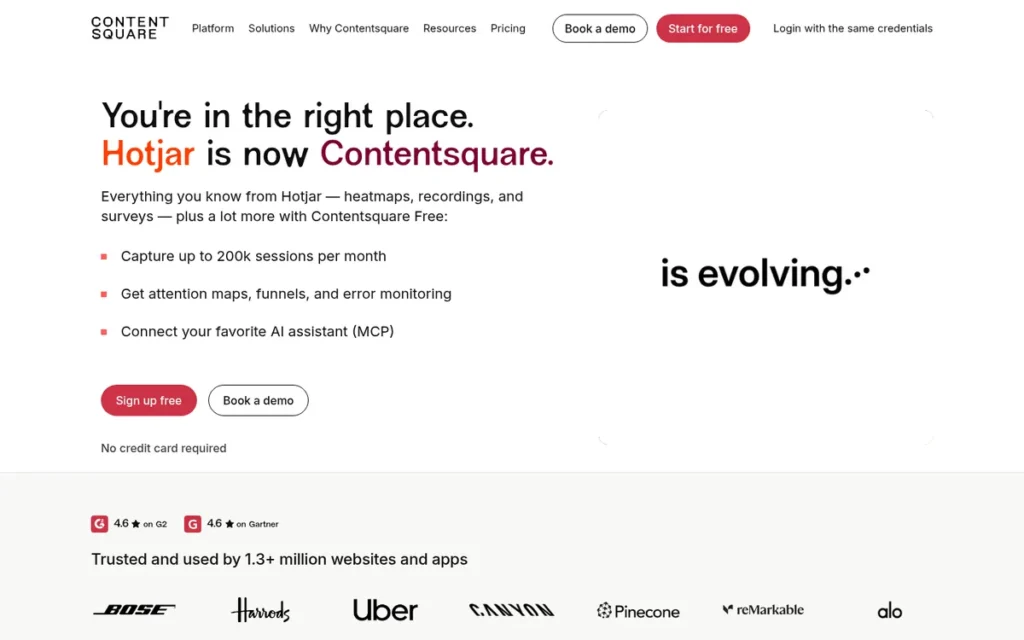
Category: Behavior Analyzer. It shows why visitors drop off through heatmaps, recordings, and visitor feedback.
PlugRoute Score: 29/45 (Job Coverage 3, Ratings 4, Pricing 3, Proof 2, Privacy & Reliability 3, Adoption 4). Hotjar ranks #4 because its strong ratings and easy adoption are offset by unverified paid pricing and no Hotjar-specific named-client proof.
At a Glance
- Category: Behavior Analyzer
- Best For: Marketing and product teams that want to pair observed behavior with direct visitor feedback through surveys and interviews
- Price Range: A free Basic plan has been listed at 35 recorded sessions/day. Hotjar Plus is reported at about $32/month billed annually or $39 billed monthly (Spike, 2026; third-party estimate). Confirm tiers on hotjar.com/pricing.
- Primary Strength: Hotjar is the only tool evaluated that combines heatmaps and recordings with on-site surveys and user interview recruitment.
- Biggest Limitation: Hotjar’s recorded-session caps and separately billed products make costs hard to predict, and its Trustpilot reviews cite billing and cancellation problems.
- One-Line Summary: Hotjar is the top-ranked CRO tool PlugRoute evaluated in 2026 for teams that need to ask visitors why they leave, not just watch what they do.
- Last Verified: November 2026
Overview
Hotjar is a behavior analytics and user feedback platform, owned by Contentsquare since 2021, that combines heatmaps, recordings, surveys, and user interviews. Hotjar is built for marketing and product teams that want both observed behavior and visitors’ own explanations.
Hotjar sells three separately billed products: Observe, Ask, and Engage. Sources disagree on whether Hotjar offers native A/B testing. G2 lists the feature, while comparison sites say Hotjar has no robust native testing (G2, 2026; Humblytics, 2026).
Key Features
- Hotjar Observe provides heatmaps, session recordings, and funnel analysis.
- Hotjar Ask offers on-site surveys and feedback widgets that collect visitor explanations in context.
- Hotjar Engage recruits users and hosts interview sessions for qualitative research.
- Hotjar includes privacy controls that support GDPR and CCPA configuration, although compliance depends on how each site is set up.
- Hotjar is positioned as simpler than FullStory and richer in surveys than Microsoft Clarity (Amplitude, 2026; Qualaroo, 2026).
Best For
Hotjar is best for marketing and product teams that already know where visitors drop off. It suits teams that now need direct visitor feedback to explain why.
Pricing
Hotjar’s free Basic plan has been listed at 35 recorded sessions per day, or about 1,050 per month. The plan has no filtering, segmentation, or custom events (G2, 2026).
Hotjar’s 200,000-sessions figure, cited by one third party, likely counts tracked sessions rather than recordings.
- Hotjar Plus is reported at about $32/month billed annually or $39 billed monthly for 100 recorded sessions per day (Spike, 2026; third-party estimate).
- Hotjar bills Observe, Ask, and Engage separately.
- Confirm Hotjar’s official tier prices on hotjar.com/pricing before purchase, because some 2026 sources report a move to Contentsquare plans.
Strengths
- Hotjar holds a 4.6/5 Capterra rating across 545 reviews (Capterra, 2026), the largest Capterra review base among the seven tools PlugRoute evaluated.
- Hotjar is the only tool evaluated that bundles behavior analytics, on-site surveys, and user interview recruitment, so teams can learn both what visitors did and why.
- Hotjar holds a 4.3/5 G2 rating across roughly 307–345 reviews (G2, 2026), with reviewers praising simple setup and visual insights.
- Hotjar’s surveys are the main reason practitioners keep it alongside free Microsoft Clarity (r/AskMarketing, 2020; historical).
This aligns with community sentiment on r/PPC:
“Hotjar also has surveys, which can be useful in helping diagnose conversion problems, but that’s the only thing I miss from Hotjar that Clarity doesn’t provide.” Posted by u/wearethemonstertruck
Takeaway: Visitor surveys are Hotjar’s one clear advantage over free Microsoft Clarity, so teams that don’t need visitor feedback have little reason to pay for it.
Limitations
Hotjar’s breadth of feedback tools comes with unpredictable costs and a weak test step.
- Hotjar’s ~2.4/5 Trustpilot rating across 52 reviews contrasts sharply with its 4.6 Capterra score, and the complaints focus on billing and cancellation (Subscribed.fyi, 2026).
- Hotjar’s tight recording caps and separately billed products make total cost hard to predict, and a reported move to Contentsquare plans may change tiers (third-party reports, 2026).
- Hotjar shouldn’t be counted on for the test step, because sources disagree on whether it has native A/B testing.
- Hotjar has been described by practitioners as having a noticeable page-speed impact (r/AskMarketing, 2020; historical).
- Hotjar has no verified Hotjar-specific case study with a named client and percentage lift. Contentsquare’s results, such as L’Occitane’s +25% mobile conversion, may describe Contentsquare’s own platform (Contentsquare, 2024).
Verdict
Hotjar is the strongest choice among the seven tools PlugRoute evaluated in 2026 for teams that need visitor surveys and interviews alongside heatmaps and recordings.
If you don’t need surveys, Microsoft Clarity covers heatmaps and recordings for free. Confirm Hotjar’s session caps, per-product pricing, and cancellation terms before you upgrade.
5. Crazy Egg: Best Budget Tool for Heatmaps Plus Simple A/B Testing in One Product
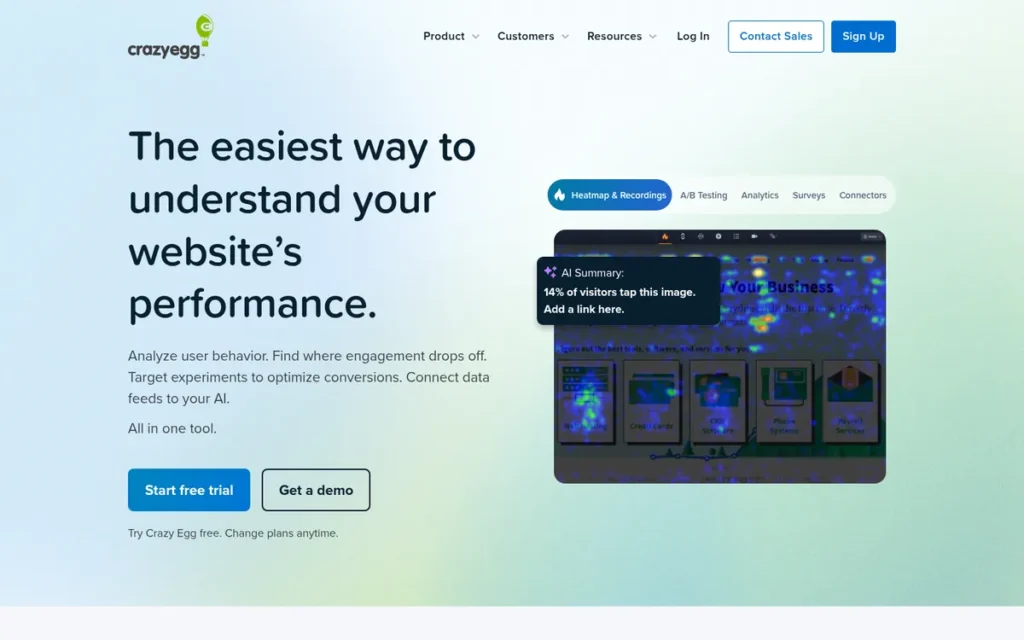
Category: Diagnose-and-Test Suite.
PlugRoute Score: 28/45 (Job Coverage 3, Ratings 3, Pricing 5, Proof 1, Privacy & Reliability 2, Adoption 3). Crazy Egg ranks #5, ahead of Optimizely on the primary-criteria tie-break (11 vs. 10). It has maximum pricing transparency but the lowest proof score evaluated.
At a Glance
- Category: Diagnose-and-Test Suite
- Best For: Small businesses and low-to-mid-traffic sites that want heatmaps and basic A/B testing in one affordable product
- Price Range: $29–$599/month billed annually, with A/B testing from $99/month on Plus (Crazy Egg, 2026)
- Primary Strength: Crazy Egg combines segmented click heatmaps, recordings, and a visual A/B editor with fully published pricing and caps.
- Biggest Limitation: Crazy Egg’s testing is lighter than dedicated platforms, and its annual prepaid billing draws cancellation complaints.
- One-Line Summary: Crazy Egg is the most affordable single tool PlugRoute evaluated in 2026 for small businesses that want both heatmaps and simple A/B tests.
- Last Verified: November 2026
Overview
Crazy Egg is a website optimization tool that combines heatmaps, recordings, surveys, and a visual A/B testing editor. Crazy Egg is built for small businesses that want to find and test fixes in one affordable product.
Crazy Egg tracks pages through per-page “Snapshots” rather than capturing the whole site automatically. Crazy Egg was co-founded in 2005 by Neil Patel and Hiten Shah, according to Shah’s own account (Hiten Shah blog, undated). Some G2 listings cite 2006.
Key Features
- Crazy Egg Confetti reports show individual clicks segmented by traffic source, device, referrer, and campaign.
- Crazy Egg provides heatmaps, scrollmaps, and session recordings within fixed plan caps.
- Crazy Egg includes a visual A/B testing editor on the Plus plan and above.
- Crazy Egg offers on-site surveys, traffic analysis, and error tracking.
- Crazy Egg uses per-page Snapshots to set up focused tracking for each page.
Best For
Crazy Egg is best for small businesses and moderate-traffic sites that want one product for diagnosing page problems and running simple A/B tests. Crazy Egg fits teams that want to avoid enterprise contracts.
Pricing
Crazy Egg publishes every tier, billed annually, with no overage charges (Crazy Egg, 2026):
| Plan | Price | Pageviews/mo | Recordings/mo | Storage |
|---|---|---|---|---|
| Starter | $29/mo | 5,000 | 50 | 6 months (no A/B testing) |
| Plus | $99/mo | 150,000 | 1,000 | 2 years |
| Pro | $249/mo | 500,000 | 5,000 | 2 years |
| Enterprise | $599/mo | 1,000,000 | 10,000 | 2 years |
Crazy Egg’s trial length was not confirmed.
Strengths
- Crazy Egg publishes every tier price, pageview cap, recording allowance, and storage limit (Crazy Egg, 2026), the most complete public pricing among the tools evaluated.
- Crazy Egg holds a 4.4/5 Capterra rating across 87 reviews and a 4.2/5 G2 rating across roughly 125 reviews (Capterra, 2026; G2, 2026). Reviewers single out the Confetti view.
- Crazy Egg combines heatmaps and A/B testing in one product from $99/month, which simplifies the stack for small teams.
- Crazy Egg heatmaps have surfaced concrete usability problems, such as visitors typing zip codes into a site search box (r/SEO, 2014; historical).
Limitations
Crazy Egg’s simplicity costs it testing rigor and setup speed.
- Crazy Egg users report test variants flickering after page load, and PlugRoute found no published statistics methodology (Capterra, 2026; GetApp, 2026).
- Crazy Egg’s per-page Snapshot setup is slower than whole-site capture for large ecommerce catalogs (G2, 2026).
- Crazy Egg’s $29 Starter plan excludes A/B testing entirely (Crazy Egg, 2026).
- Crazy Egg reviewers cite trial-to-annual billing and confusing cancellation, including one unexpected annual charge of over $1,100 (Trustpilot, 2026).
- Crazy Egg has no verified case study with a named client and percentage lift.
Verdict
Crazy Egg is the most affordable all-in-one option PlugRoute evaluated in 2026 for small businesses that want heatmaps and basic A/B testing without a second tool.
Choose Crazy Egg Plus or higher if you need testing, and check cancellation terms before starting a trial. Teams that need rigorous testing should consider Convert Experiences or VWO.
6. Optimizely: Best for Enterprise, Multi-Team Experimentation Programs
Category: Experimentation Platform. It tests whether a fix actually improves conversions, at enterprise scale.
PlugRoute Score: 28/45 (Job Coverage 5, Ratings 4, Pricing 1, Proof 4, Privacy & Reliability 3, Adoption 1). Optimizely ranks #6 because its depth is offset by the lowest pricing transparency and ease of adoption evaluated. It trails Crazy Egg on the tie-break (10 vs. 11).
At a Glance
- Category: Experimentation Platform
- Best For: Enterprises running multi-team web and feature experimentation programs with dedicated engineering and analytics resources
- Price Range: Pricing on request. Vendr reports a median of ~$81,447/year, with deals from ~$50K to $500K+ (Vendr, 2026). Costbench estimates entry deals from ~$36K/year (Costbench, 2026).
- Primary Strength: Optimizely offers the deepest experimentation feature set evaluated, including a sequential Stats Engine, server-side feature experimentation, and analyst-recognized personalization.
- Biggest Limitation: Optimizely has the highest and least transparent pricing evaluated, with reported contracts starting in the tens of thousands of dollars per year.
- One-Line Summary: Optimizely has the deepest experimentation feature set PlugRoute evaluated in 2026, but its cost and complexity make it unsuitable for most small and mid-sized teams.
- Last Verified: November 2026
Overview
Optimizely is an enterprise digital experience platform that combines web and feature experimentation, personalization, content management, and warehouse-native analytics. Optimizely is built for large organizations running multi-team experimentation programs with engineering support.
Optimizely was founded in 2010 and acquired by Episerver in 2020, after which the combined company took the Optimizely name. Optimizely is owned by Insight Partners (Optimizely, 2020).
Key Features
- Optimizely Web Experimentation runs client-side A/B and multivariate tests with audience targeting.
- Optimizely Feature Experimentation supports server-side tests, feature flags, and rollouts.
- Optimizely Stats Engine uses sequential testing with false-discovery-rate control, so teams can check results mid-test without inflating false positives.
- Optimizely Opal provides AI agents for experimentation and content workflows.
- Optimizely offers warehouse-native analytics through the NetSpring acquisition reported in 2024, plus CMS and commerce products.
Best For
Optimizely is best for enterprises with multiple teams running high volumes of web and product experiments. Optimizely fits organizations with dedicated developers and budgets above $50K per year.
Pricing
Optimizely doesn’t publish pricing. Vendr reports a median annual contract of $81,447 (Vendr, 2026), and estimates cover a wide range:
- Optimizely’s smaller deals start around $50K per year (Vendr, 2026).
- Optimizely’s entry-level deals are estimated from about $36K per year (Costbench, 2026; third-party estimate).
- Optimizely’s enterprise multi-product deals exceed $500K per year (Vendr, 2026).
- Optimizely contracts reportedly include auto-renewal and limited downgrade options, so negotiate those clauses in writing (Costbench, 2026).
Strengths
- Optimizely was named a Leader in The Forrester Wave: Experience Optimization Solutions, Q4 2024, and the Gartner Magic Quadrant for Personalization Engines in February 2025 (Optimizely, 2025; vendor-reported).
- Optimizely Web Experimentation holds a 4.2/5 G2 rating across 415 reviews (G2, 2026).
- Optimizely’s sequential Stats Engine is the main methodological differentiator among the testing tools evaluated, because it reduces false positives caused by checking results early.
- Optimizely is the only platform evaluated that combines experimentation with a full CMS, commerce, and warehouse-native analytics.
- Optimizely reported more than 900 experimentation customers and over 2 million experiments run as of 2020 (Optimizely, 2020).
Limitations
Optimizely’s depth comes with the highest cost and complexity evaluated.
- Optimizely’s quote-only pricing has a reported median of about $81,000 per year, the highest cost evaluated (Vendr, 2026).
- Optimizely reviewers cite a steep learning curve, reliance on developers, and multi-week engineering setups (Costbench, 2026).
- Optimizely Web Experimentation’s 4.2/5 G2 rating is the lowest G2 score among the experimentation platforms evaluated (G2, 2026).
- Optimizely has no independently verified named-client lift, and its customer counts date from 2020.
- Optimizely’s customer praise for Opal comes from Optimizely’s own write-up of Forrester’s 2026 evaluation (Optimizely, 2026; promotional).
Verdict
Optimizely offers the most extensive enterprise experimentation capability among the seven tools PlugRoute evaluated in 2026, but it’s overkill for teams without engineering resources and a five-to-six-figure budget.
Users on r/GoogleAdsDiscussion shared their experience:
“I’d usually pick VWO or Convert over Optimizely for basic LP testing because they’re simpler and more practical. Optimizely is great, but it makes more sense when you need a true enterprise experimentation setup.” Posted by u/ppcwithyrv
Takeaway: Practitioners rate Optimizely highly but reserve it for true enterprise experimentation programs, and they pick VWO or Convert Experiences for everyday landing page testing.
Most small and mid-sized teams will get more value from VWO or Convert Experiences. Enterprises considering Optimizely should get renewal and downgrade terms in writing.
7. AB Tasty: Best for Marketing-Led Ecommerce Experimentation and Personalization
Category: Experimentation Platform. It tests whether a fix actually improves conversions and personalizes experiences by audience.
PlugRoute Score: 26/45 (Job Coverage 4, Ratings 4, Pricing 1, Proof 3, Privacy & Reliability 3, Adoption 2). AB Tasty ranks #7 because strong coverage of testing plus personalization is offset by quote-only pricing from about €15,000 and setup complexity that reviewers report for small teams.
At a Glance
- Category: Experimentation Platform
- Best For: Mid-market and enterprise ecommerce marketing teams that want A/B testing combined with audience personalization
- Price Range: Pricing on request. Capterra lists a starting price of ~€15,000/year (Capterra, 2026), and Vendr reports contracts of ~$20K–$150K+/year (Vendr, 2026; third-party estimate).
- Primary Strength: AB Tasty combines A/B and multivariate testing with audience personalization, emotion-based segmentation, and recommendations for ecommerce marketers.
- Biggest Limitation: AB Tasty’s custom pricing starts around €15,000 per year, which puts it beyond most small-business budgets.
- One-Line Summary: AB Tasty is the best fit PlugRoute evaluated in 2026 for mid-market ecommerce brands that want personalization alongside A/B testing, but its quote-only pricing makes it a poor fit for small businesses.
- Last Verified: November 2026
Overview
AB Tasty is a web experimentation and personalization platform that offers A/B and multivariate testing with audience targeting, feature flags, and product recommendations. AB Tasty is built for marketing-led mid-market and enterprise ecommerce teams.
AB Tasty uses Bayesian reporting. Wingify (VWO) and AB Tasty announced their combination on January 20, 2026, with AB Tasty co-founder Rémi Aubert as Chief Customer & Strategy Officer. Financial terms were not disclosed (Wingify, 2026). AB Tasty was still sold separately in November 2026.
Key Features
- AB Tasty supports A/B, split, multivariate, and multipage web experiments through an AI-assisted visual editor.
- AB Tasty Personalization serves targeted experiences to defined audience segments.
- AB Tasty EmotionsAI segments visitors by inferred emotional needs for targeting.
- AB Tasty Flagship provides feature flags and progressive rollouts.
- AB Tasty offers recommendations and search through its Epoq acquisition, plus a library of prebuilt widgets.
Best For
AB Tasty is best for mid-market and enterprise ecommerce marketing teams with budgets of $20K+ per year. AB Tasty suits teams that want to decide which experience each audience should see, not just which page wins.
Pricing
AB Tasty doesn’t publish pricing. Capterra lists a starting price of €15,000 (Capterra, 2026). Vendr reports these annual ranges (Vendr, 2026; third-party estimates):
- AB Tasty experimentation costs about $20K–$50K/year at 100K–500K monthly sessions.
- AB Tasty mid-market personalization costs about $35K–$70K/year.
- AB Tasty’s full platform costs about $60K–$150K+/year.
One Capterra reviewer found AB Tasty more affordable than VWO for basic testing (Capterra, 2026).
Strengths
- AB Tasty holds a 4.4/5 G2 rating across 424 reviews (G2, 2026), with reviewers praising its visual editor and segmentation. Its 4.6/5 Capterra rating rests on only 11 reviews (Capterra, 2026).
- AB Tasty reports more than 900 enterprise customers, including L’Oréal, Sephora, LUSH, and Clarins (Capterra AU, 2026; TrustRadius, 2026; vendor-reported).
- AB Tasty combines testing, personalization, feature flags, and recommendations, giving ecommerce marketers more than page-level A/B testing.
- AB Tasty’s Vendr-reported experimentation range (~$20K–$50K/year) sits below Optimizely’s reported $81,447 median (Vendr, 2026).
Limitations
AB Tasty’s depth for marketers comes with a high entry cost and setup friction.
- AB Tasty’s quote-only pricing starts around €15,000 per year, which puts it out of reach for most small businesses (Capterra, 2026).
- AB Tasty reviewers report complex advanced setups and a visual editor that struggles with React apps that use dynamic class names (G2, 2026).
- AB Tasty users cite difficult cross-domain tracking and slower performance when many campaigns are running (Kirro, 2026).
- AB Tasty’s AI page suggestions were called “generic” by one G2 reviewer (G2, 2026).
- AB Tasty has no independently verified named-client lift, and its 2026 combination with VWO creates roadmap uncertainty (Wingify, 2026).
Verdict
AB Tasty is the best fit among the seven tools PlugRoute evaluated in 2026 for mid-market ecommerce brands that want personalization alongside A/B testing and have a five-figure annual budget.
Small businesses should start with Microsoft Clarity plus Convert Experiences or Crazy Egg instead. Request a scoped AB Tasty quote, and confirm how the VWO combination affects your contract.
Which CRO Tool Stack Fits My Budget and Business Type?
The right CRO stack depends on your budget, traffic, and team maturity. Beginners should start with GA4 plus Microsoft Clarity for $0. Small businesses can add Crazy Egg Plus or a paid Hotjar plan. Growing teams should add a testing tool only when traffic supports valid tests.
| Segment | Suggested Stack |
|---|---|
| Beginner / $0 budget | GA4 + Microsoft Clarity, plus Hotjar’s free plan if surveys matter. Don’t buy testing software until traffic supports roughly 15,000 visitors per variant. |
| Small business / low-traffic ecommerce | Microsoft Clarity + Crazy Egg Plus ($99/month billed annually) for diagnosis plus simple tests, or a paid Hotjar plan for feedback. |
| Growing SaaS or ecommerce running regular tests | Microsoft Clarity + Convert Experiences Growth ($299/month billed annually), or VWO for one-vendor testing plus insights (get a written MTU quote). |
| Enterprise with multiple teams and feature experimentation | Optimizely (median ~$81K/year; Vendr, 2026); negotiate renewal and downgrade terms. |
| Mid-market ecommerce focused on personalization | AB Tasty (~$20K–$70K/year; Vendr, 2026). |
A transparent mid-market stack of Microsoft Clarity plus Convert Experiences Growth costs $3,588 per year billed annually. That is about one twenty-third of Optimizely’s Vendr-reported median contract of $81,447 (Convert, 2026; Vendr, 2026).
What does the cheapest plan with A/B testing cost?
- Microsoft Clarity does not offer A/B testing at any price.
- Hotjar shouldn’t be relied on for A/B testing, because sources disagree on whether the feature exists (G2, 2026; Humblytics, 2026).
- Crazy Egg’s cheapest plan with A/B testing is Plus at $99/month billed annually (Crazy Egg, 2026).
- VWO’s paid web testing is reported from about $219/month billed annually (SalesHive, 2026; third-party estimate).
- Convert Experiences’ cheapest plan is Growth at $299/month billed annually (Convert, 2026).
- AB Tasty’s experimentation contracts are reported at about $20K–$50K per year (Vendr, 2026; third-party estimate).
- Optimizely’s contracts have a reported median of $81,447 per year (Vendr, 2026; third-party estimate).
What should ecommerce teams check?
- Ecommerce teams should diagnose cart abandonment and checkout-funnel drop-off with a Behavior Analyzer before testing product page or checkout changes.
- Ecommerce teams should judge tests on revenue per visitor and average order value, not clicks alone.
- Microsoft Clarity offers plugins for Shopify and WooCommerce, which makes setup simple on most store platforms.
- Convert Experiences supports Shopify price testing and imports GA4 revenue data.
- Crazy Egg’s per-page Snapshot setup can be slow for large catalogs, a complaint ecommerce users have raised since at least 2014 (r/SEO, 2014; historical).
B2B lead-generation teams can apply the same three-layer logic. Measure form drop-off in GA4, diagnose it with a Behavior Analyzer, and test fixes once lead volume supports valid tests. PlugRoute didn’t evaluate B2B-specific tools for this review.
What Red Flags Should I Watch For When Evaluating Conversion Rate Optimization Tools?
The two biggest red flags when you evaluate CRO tools are buying testing software before you have enough traffic and accepting custom pricing without a written usage quote. Either mistake can cost thousands of dollars before a single valid result comes back. The six numbered red flags below cover every major risk PlugRoute found.
Red Flag #1: Buying a Testing Tool Before You Have the Traffic
An A/B testing platform is unlikely to detect a 20% relative lift reliably if each variant gets far fewer than about 15,000 visitors at a 2.5% baseline (EyeCaptain, 2026). Below that level, a free Behavior Analyzer such as Microsoft Clarity usually delivers more value than paid testing software.
Users on r/googleads noted:
“sometimes those AB test wins are just a good week, better traffic batch, or algo luck 😅 especially if you didn’t test long enough or didn’t have a big enough sample size. 30% better can be real… or it can be noise.” Posted by u/growtomax
Takeaway: Underpowered A/B tests produce “wins” that can vanish at full rollout, so the sample size determines whether any testing tool’s results can be trusted.
Red Flag #2: Custom Pricing With No Written Usage Quote
Optimizely and AB Tasty price by quote only, and VWO publishes only part of its module pricing, so costs can grow quickly with traffic. Always get a written quote tied to your sessions, pageviews, or monthly tracked users (MTUs) before signing. Also confirm overage fees, such as Convert Experiences’ published per-user charges.
Red Flag #3: Variant Flicker and Page-Speed Impact
Flicker happens when the original page briefly appears before the test variant, and it can hurt both user experience and test validity. Users have reported flicker or page-speed concerns with Crazy Egg, VWO, and Hotjar. Users have also reported slower performance on AB Tasty when many campaigns are running.
Convert Experiences markets its delivery as flicker-free (Convert, 2026; self-reported). Test any script on a staging page first.
Red Flag #4: Session Recording Without Consent and Masking
Session recording creates privacy risk when scripts load before consent or capture form inputs. Session replay tools have been named in US lawsuits under state wiretapping laws such as California’s Invasion of Privacy Act (CIPA). This is general risk awareness, not legal advice.
- Teams should load session replay scripts only after a visitor consents.
- Teams should mask form fields and text inputs by default.
- Teams should block recording on sensitive pages such as checkout or account screens.
- Teams should review vendor contracts and indemnities with counsel.
Red Flag #5: Vendor Case Studies Presented as Independent Proof
Vendor case studies are claims, not independent proof that a tool will lift your conversions. In PlugRoute’s 2026 research, none of the seven CRO tools had an independently verified, named-client conversion lift. Every quantified result found was vendor-published, including VWO’s Ubisoft result and Convert Experiences’ Conscious Items result.
Red Flag #6: Annual Prepay, Auto-Renewal, and Hard Cancellation
Annual prepayment and difficult cancellation come up again and again in CRO tool reviews. Crazy Egg reviewers cite trial-to-annual billing (Trustpilot, 2026). Hotjar’s Trustpilot reviews cite cancellation problems (Subscribed.fyi, 2026). Optimizely contracts reportedly include auto-renewal with limited downgrades (Costbench, 2026).
What Questions Should I Ask Before Choosing a Conversion Rate Optimization Tool?
Before choosing a CRO tool, confirm which job you need first and whether the plan you’d actually buy includes A/B testing. Then check technical fit and consent handling on your own site, and read the renewal terms before you sign. The six numbered questions below turn those checks into a buying script.
Question #1: Which job do I need first: measure, diagnose, or test?
The first job determines the first tool. GA4 measures where visitors drop off, a Behavior Analyzer such as Microsoft Clarity explains why, and an Experimentation Platform proves whether a fix works. Most beginners should diagnose before they test, because diagnosis is free and testing needs traffic.
“The power of VWO is in AB testing, if you just want surveys, recordings, and heatmaps you can start for free with HotJar.” (u/temmink, r/userexperience (2020; historical))
Takeaway: Pay for a testing suite only when A/B testing is the actual goal. Diagnosis alone can start on a free plan.
Question #2: Does the plan I’ll actually buy include A/B testing, and what are its session, pageview, or MTU caps?
The advertised starting price often leaves out the capability you need. Crazy Egg advertises $29/month, but its A/B testing starts at $99/month on Plus (Crazy Egg, 2026). Microsoft Clarity and Hotjar offer no reliable native testing at any price, so “free” covers only diagnosis. Compare the cheapest plan that includes testing.
Question #3: Does the visual editor work on my site’s framework (e.g., React)?
Visual editors can break on JavaScript-heavy sites. Reviewers report that VWO’s editor is finicky on JavaScript-heavy pages (Lean Experiments, 2026). They also report that AB Tasty’s editor struggles with React apps that use dynamic class names (G2, 2026). Run a trial test on your real site before committing.
Question #4: How will consent, masking, and data retention be configured?
Consent setup determines how much data you actually collect. Without a consent signal, an EEA visitor’s three-page visit may appear in Microsoft Clarity as three one-page sessions. That can make a working funnel look like total drop-off (Microsoft Learn, 2025). Confirm masking defaults and retention periods for every tool.
Microsoft Clarity accepts consent through a consent management platform (CMP), Google Consent Mode, or the Clarity Consent API (Microsoft Learn, 2025). Microsoft Clarity keeps standard recordings for about 30 days (Microsoft Clarity FAQ, 2026).
Question #5: How closely does the tool’s data reconcile with GA4?
Data mismatches with GA4 are a recurring complaint from Convert Experiences and VWO users (G2, 2026; Kirro, 2026). Ask each vendor how it counts users and conversions. Run a reconciliation check against GA4 before you report any test result to stakeholders.
Question #6: What are the renewal, downgrade, and cancellation terms?
Contract terms can end up costing more than the subscription itself. Ask whether billing is annual or monthly, whether trials convert to annual plans automatically, and whether you can downgrade mid-term. Get every answer in writing before you enter payment details, because cancellation complaints are common in CRO tool reviews.
How Did We Rank These Conversion Rate Optimization Tools?
PlugRoute scored all seven CRO tools on six weighted criteria using research checked in November 2026. Three primary criteria count double: job coverage, independent ratings, and pricing transparency. Three secondary criteria count once: documented proof, privacy and reliability, and ease of adoption. The maximum weighted score is 45.
The six ranking criteria, and why each one matters:
- Stack Job Coverage (primary, 2x): Tools that cover more of the diagnose-and-test workflow reduce stack cost and complexity for small teams.
- Independent Review Ratings and Volume (primary, 2x): G2 and Capterra ratings with review counts are the most comparable real-user signal available for every tool.
- Pricing Transparency and Entry Cost (primary, 2x): Public tiers and low-cost entry points protect readers from overspending on hidden enterprise pricing.
- Documented Proof and Credentials (secondary, 1x): Named-client results and analyst recognition separate what a feature does from evidence that it works.
- Privacy, Consent, and Technical Reliability (secondary, 1x): Consent handling, flicker, editor breakage, and GA4 mismatches decide whether a tool works on real sites.
- Ease of Adoption (secondary, 1x): Setup effort, developer dependency, and contract friction decide whether lean teams actually use a tool.
Each weighted total equals 2 × (Job Coverage + Ratings + Pricing) plus (Proof + Privacy & Reliability + Adoption). Every score is a whole number from 1 to 5.
| Rank | Tool | Job Coverage (2x) | Ratings (2x) | Pricing (2x) | Proof (1x) | Privacy & Reliability (1x) | Adoption (1x) | Weighted Total |
|---|---|---|---|---|---|---|---|---|
| 1 | VWO | 5 | 5 | 3 | 4 | 3 | 3 | 36 |
| 2 | Microsoft Clarity | 2 | 4 | 5 | 2 | 3 | 5 | 32 |
| 3 | Convert Experiences | 2 | 4 | 4 | 3 | 5 | 3 | 31 |
| 4 | Hotjar | 3 | 4 | 3 | 2 | 3 | 4 | 29 |
| 5 | Crazy Egg | 3 | 3 | 5 | 1 | 2 | 3 | 28 |
| 6 | Optimizely | 5 | 4 | 1 | 4 | 3 | 1 | 28 |
| 7 | AB Tasty | 4 | 4 | 1 | 3 | 3 | 2 | 26 |
PlugRoute applied the following rules the same way to every tool:
- Ties: Ties are broken first by the primary-criteria subtotal (Job Coverage + Ratings + Pricing), then by verified review volume. Crazy Egg and Optimizely both scored 28, and Crazy Egg ranks higher on primary subtotal (11 vs. 10).
- Cross-category comparison: Tools that do different jobs share one list because readers buy them from one budget. A lower rank doesn’t mean a tool is worse at its own job. For example, Optimizely has the deepest experimentation feature set evaluated.
- Evidence labels: Each data point is labeled as verified, third-party estimate, vendor-published, self-reported, or unverified, and carries a year.
- Missing data: Unverifiable ratings receive a neutral score of 3 and are disclosed, not penalized. Optimizely’s ratings score was set to 4 once its G2 rating (4.2/5, 415 reviews; G2, 2026) became verifiable, which matches how Hotjar and AB Tasty are scored.
- Ownership disclosure: Wingify (VWO) and AB Tasty announced their combination on January 20, 2026 (Wingify, 2026). PlugRoute ranks them separately because both are still sold separately, with separate pricing and review profiles. Hotjar is owned by Contentsquare, and Optimizely is owned by Insight Partners.
PlugRoute has no affiliate relationships with any company listed, and rankings are determined entirely by research data and objective evaluation criteria.
What Do Buyers Most Often Ask About CRO Tools?
Buyers most often ask which CRO tools suit a small business, whether VWO and AB Tasty are now one company, and how PlugRoute decides its rankings. Each short answer below stands on its own and draws on the dated evidence in the ranked entries above.
What are the best CRO tools for small businesses?
Microsoft Clarity is the best starting CRO tool for most small businesses because it offers free heatmaps and session recordings with no stated traffic limits (Microsoft, 2025). Small businesses that also want simple A/B tests can add Crazy Egg Plus at $99/month billed annually (Crazy Egg, 2026), but only once key pages reach testable traffic.
Are VWO and AB Tasty the same company now?
VWO and AB Tasty are now part of one combined company. Wingify, VWO’s owner, announced the combination on January 20, 2026, creating a business with more than $100 million in revenue and about 800 employees (Wingify, 2026). Both platforms were still sold separately in November 2026, so PlugRoute ranks them as separate products.
How does PlugRoute determine its rankings?
PlugRoute scores every tool on the same six weighted criteria, for a maximum of 45 points. Primary criteria, such as job coverage and pricing transparency, count double. Secondary criteria, such as documented proof, count once. Every data point is dated and labeled by evidence type, and missing data receives a neutral score and is disclosed.
What Do Key Conversion Rate Optimization Tool Terms Mean?
Behavior Analyzer: A tool that uses heatmaps, session recordings and sometimes surveys to show why visitors drop off. It can’t prove that a fix works, so you’ll need to pair it with a testing tool once your traffic can support valid tests.
Experimentation Platform: A tool that tests whether a change causes a conversion improvement, often with personalization and feature flags included. Buy one only when your key pages get enough traffic to produce reliable results.
Diagnose-and-Test Suite: A single product that finds why visitors drop off and also tests fixes. It can cut the cost and complexity of running two separate tools, but its testing may be lighter than what a dedicated platform offers.
Monthly Tracked Users (MTUs): A pricing unit based on how many visitors a tool tracks or tests each month. Costs can rise quickly as traffic grows, so get a written quote tied to your MTUs and confirm any overage fees before you sign.
Minimum Detectable Effect: The smallest relative lift a test is set up to detect reliably. For example, finding a 20% lift on a page converting at 2.5% takes roughly 15,000 visitors per variant, which tells you whether testing software is worth buying yet.
Statistical Significance and Power: Two settings that control how sure a test needs to be before it declares a winner. The traffic figures in this guide assume 95% significance and 80% power. Tests with too little traffic often come back inconclusive or produce “wins” that turn out to be noise.
Client-Side vs. Server-Side Testing: Client-side tests change the page in the visitor’s browser. Server-side tests run in your application code. Server-side testing supports feature experimentation, but it usually needs developer involvement.
Multivariate Testing (MVT): A test that changes several page elements at once to see which combination performs best. It needs more traffic than a simple A/B test, and some vendors include it only in higher-priced plans.
Bayesian, Frequentist, and Sequential Statistics: Different methods for judging test results. Bayesian reports show the probability that a variant beats the control. Sequential methods let you check results partway through a test without increasing false positives. Ask which methods a tool supports, because some users find Bayesian results harder to read.
Feature Flags: Switches that let a team turn a feature on for some users and roll it out gradually. They matter if you plan to test product changes as well as marketing pages.
Flicker: The original page briefly shows before the test variant loads. Flicker can hurt both the user experience and the validity of a test, so try any testing script on a staging page before you commit.
Consent Signal and Input Masking: A consent signal tells a tool that a visitor has agreed to tracking. Input masking hides what visitors type into forms. Without a consent signal, funnels can look incomplete. Without masking, session recording carries privacy and legal risk.
Which Conversion Rate Optimization Tool Is Right for You?
Key Insights
The right conversion rate optimization tool depends on the job you need done first and whether your traffic supports testing. Most teams should start free with GA4 and Microsoft Clarity. Once traffic allows, they can add a testing tool such as Convert Experiences, Crazy Egg, or VWO. Optimizely and AB Tasty are best kept for funded enterprise programs.
- Conversion rate optimization requires three jobs (measuring, diagnosing, and testing), and no affordable tool PlugRoute evaluated covers all three equally well.
- GA4 plus Microsoft Clarity is the strongest $0 starting stack for beginners and small businesses in 2026.
- A/B testing tools typically pay off only when key pages reach roughly 15,000 visitors per variant at a 2.5% baseline (EyeCaptain, 2026).
- CRO buyers should compare the cheapest plan that includes testing, not the advertised starting price.
- Vendor case studies, including VWO’s Ubisoft result, are vendor claims rather than independent proof.
- Session recording tools should be configured for consent and input masking before they go live.
What should I do first?
- Install GA4 and Microsoft Clarity this week, with consent configured for EU visitors.
- Watch 20–30 recordings of the page with your highest drop-off.
- Fix the obvious usability problems those recordings reveal.
- Check whether that page reaches about 15,000 visitors per variant.
- Shortlist a testing tool only after the page meets that traffic threshold.
If you need diagnosis on a small budget, start with Microsoft Clarity and add Hotjar if you need visitor feedback. If you’re ready to test regularly, Convert Experiences offers published pricing and privacy-first data handling, while VWO offers diagnosis and testing from one vendor.
The CRO market is consolidating and adding AI features quickly, so expect pricing, ownership, and plan limits to keep changing. We update this guide quarterly. Last updated: November 2026.
Want to see how we score every product? Read PlugRoute’s full methodology and explore our other independent SaaS reviews.
Editor note: The weighted totals were recalculated using the article’s own published formula, 2×(C1+C2+C3) + (C4+C5+C6). The draft listed Convert Experiences at 29 and AB Tasty at 27, but their criterion scores add up to 31 and 26. Optimizely’s Ratings score was raised to 4 based on its verified G2 rating, which brings its total to 28. As a result, Convert Experiences moves to #3 and Hotjar to #4. Crazy Egg stays #5 over Optimizely (#6) on the primary-subtotal tie-break, and AB Tasty is #7. Following the “3+ entries without public pricing” rule, Pricing subsections were kept because only AB Tasty and Optimizely publish no pricing at all. Following the structural rules, the FAQ was limited to 3 questions and the main table to 8 columns.