Convert Experiences is the best A/B testing tool for privacy-first marketers who want published pricing. GrowthBook is best for warehouse-first teams that must own their data, and PostHog is best for developer-led startups on a $0 budget. The right choice depends on who runs your tests and how costs grow with traffic.
Picking a tool is harder than it should be. Enterprise vendors hide prices behind sales calls, and usage meters push costs up as traffic grows. Buying the wrong type of tool often means paying twice. The top four tools, including Statsig for product teams, scored within 0.75 points of each other.
PlugRoute has no affiliate relationships with any company listed. Rankings are determined entirely by research data and objective evaluation criteria.
“the pricing in the market for AB Testing is crazy” (u/IReallyHateAsthma, a commenter promoting their own tool (Reddit r/UXDesign, September 2026; practitioner))
Takeaway: Pricing frustration is common enough that new low-cost vendors use it as their sales pitch. That is why PlugRoute weights pricing transparency as a primary ranking criterion.
What Are the 5 Categories of A/B Testing Tools?
There are five categories of A/B testing tools. Visual CRO Suites serve marketers, while Product Experimentation Platforms and Warehouse-Native Open-Source Platforms serve engineering and data teams. All-in-One Product Suites bundle analytics, and Enterprise Experimentation Platforms serve governed programs. The deciding question is who launches tests: marketers in a visual editor or developers using feature flags.
The five categories, with short table labels in brackets:
- Visual CRO Suite [Visual]: A Visual CRO Suite runs client-side (browser) tests that marketers launch through a visual editor. Convert Experiences, VWO and AB Tasty fall here.
- Product Experimentation Platform [Product]: A Product Experimentation Platform runs server-side, feature-flag-based experiments through SDKs that engineering teams manage. Statsig falls here.
- Warehouse-Native Open-Source Platform [Warehouse]: A Warehouse-Native Open-Source Platform calculates experiment results inside the customer’s own data warehouse and can be self-hosted. GrowthBook falls here.
- All-in-One Product Suite [All-in-One]: An All-in-One Product Suite bundles experiments with product analytics, session replay and feature flags. PostHog falls here.
- Enterprise Experimentation Platform [Enterprise]: An Enterprise Experimentation Platform sells governed web and full-stack experimentation to large organizations, often as separate products. Optimizely falls here.
The lines between categories blur. Convert Experiences offers full-stack SDKs, and GrowthBook adds a visual editor on its Pro plan. Optimizely and AB Tasty each sell a separate server-side product alongside their visual editors.
How Do the Top A/B Testing Tools Compare at a Glance?
The seven tools split into marketer-first visual editors (Convert Experiences, VWO, AB Tasty) and developer-first platforms (GrowthBook, PostHog, Statsig). Optimizely covers both through two products. Convert Experiences leads on balanced marketer features with verified pricing, GrowthBook on data control, PostHog on free entry and Statsig on statistics.
| Rank | Company | Category | Best For | One-Line Summary | Key Capabilities | Primary Strength | Key Limitation |
|---|---|---|---|---|---|---|---|
| 1 | Convert Experiences | Visual | Privacy-first marketers and agencies | Convert Experiences is a privacy-first A/B testing platform and the only visual-editor tool among PlugRoute’s seven evaluated products whose dollar pricing PlugRoute could verify on the vendor’s own page (November 2026). | Visual and code editors, SPA mode, 6 SDKs including iOS and Android, 90+ integrations | Verified published pricing plus a choice of statistical methods | No free tier; entry price is $299/month (billed annually) |
| 2 | GrowthBook | Warehouse | Warehouse-first and privacy-sensitive teams | GrowthBook is an open-source, warehouse-native experimentation platform with the strongest data control among the seven tools PlugRoute evaluated in November 2026. | 24+ SDKs, warehouse-native analysis, full self-hosting, visual editor (Pro) | Experiment data stays in your warehouse; free tier has unlimited experiment traffic (1M CDN requests included) | Needs a warehouse and SQL skills; only 26 G2 reviews |
| 3 | PostHog | All-in-One | Developer-led startups on a $0 budget | PostHog is an open-source product suite whose experiments share a free allowance of 1 million flag requests per month, the lowest-cost entry point among PlugRoute’s evaluated tools as of November 2026. | Flag-based experiments, analytics, session replay, self-hosting (with limits), basic no-code toolbar | Testing, analytics and replay bundled on a free tier with published overage rates | Experiments mostly need code |
| 4 | Statsig | Product | Product and engineering teams shipping behind flags | Statsig is a unified feature-flag, experimentation and product analytics platform with the highest G2 rating (4.7/5, ~348 reviews) among high-volume A/B testing tools as of November 2026. | Server-side SDKs, flags, analytics, session replay, warehouse-native (Enterprise) | Broadest documented statistical toolkit (CUPED, stratification, switchback) | No real visual editor; can’t be self-hosted; brand and customers moved to Amplitude in May 2026 |
| 5 | VWO | Visual | Mid-market marketing teams wanting testing plus heatmaps | VWO is a marketer-focused conversion optimization suite with the largest independent review footprint among visual-editor A/B testing tools, including 4.4/5 from 929 G2 reviews as of November 2026. | Visual and code editors, SPA support, heatmaps, session recordings, surveys, feature experimentation | Diagnose-then-test workflow in one tool | Pricing not published; scales with monthly tracked users |
| 6 | Optimizely | Enterprise | Enterprises with governance and DXP needs | Optimizely is an enterprise experimentation platform that sells separate web and feature experimentation products. According to Optimizely, it was named a Leader in The Forrester Wave: Experience Optimization Solutions, Q3 2026. | Visual editor (Web), SDKs and flags (Feature), warehouse analytics (NetSpring) | Web plus full-stack coverage with a sequential Stats Engine | Lowest G2 rating of the seven; quote-only pricing |
| 7 | AB Tasty | Visual | Enterprise ecommerce personalization | AB Tasty is an experience optimization platform that pairs visual A/B testing with server-side feature experimentation and AI personalization, rated 4.4/5 from ~417 G2 reviews as of November 2026. | Visual editor, server-side Feature Experimentation, recommendations, personalization | Testing, personalization and recommendations from one vendor | Quote-only; proof of concept instead of a trial; uncertainty after the merger |
Which A/B Testing Tool Should I Choose for My Use Case?
Choose by your top priority:
- Convert Experiences fits non-technical marketers who want published pricing.
- GrowthBook fits teams that must self-host.
- PostHog fits startups with developers and no budget.
- Statsig fits product teams shipping behind flags.
- Optimizely and AB Tasty fit enterprises that have governance or personalization needs and the budget for quoted contracts.
| Your #1 Priority | Recommended Tool | Why | Acceptable Alternative |
|---|---|---|---|
| Non-technical marketers testing web pages with published pricing | Convert Experiences | Visual editor plus published Growth and Pro tiers | VWO, if quoted pricing is acceptable |
| Non-technical small business with a $0 budget | No ranked tool offers a permanent free full visual editor | Trials are the lowest-risk way to evaluate | Convert Experiences (15-day trial) or VWO (30-day trial, reported) |
| Heatmaps and testing in one marketer tool | VWO | Testing bundled with heatmaps, recordings, surveys and funnels | Convert Experiences connected to your existing analytics |
| Warehouse-first, or must self-host | GrowthBook | Warehouse-native core and full self-hosting | Statsig Enterprise (warehouse-native, not self-hosted) |
| Startup with developers and a $0 budget | PostHog | Free 1M flag requests plus analytics and replay | GrowthBook Starter or Statsig Developer |
| Product or engineering teams shipping behind flags | Statsig | Any flag can become an experiment; broadest documented statistics; now operated by Amplitude | GrowthBook or PostHog |
| Enterprise with governance or DXP needs | Optimizely | Web and full-stack products plus DXP integration | AB Tasty |
| Enterprise ecommerce personalization | AB Tasty | Testing, personalization and Epoq recommendations | Optimizely or VWO |
| Already own LaunchDarkly, Adobe or Amplitude | Check built-in experimentation first (not ranked) | Avoids paying for duplicate tools | A ranked tool only if gaps remain |
| Mixed marketer and developer team | Convert Experiences (visual plus SDKs) or GrowthBook Pro (SDKs plus visual editor) | One product covers both workflows | Optimizely Web plus Feature, budgeted as two products |
What Are the 7 Best A/B Testing Tools in 2026?
PlugRoute’s November 2026 ranking puts Convert Experiences first with 31.75 of 37.5 points. GrowthBook follows at 31.5, then PostHog at 31.25 and Statsig at 31.0. The top four sit within 0.75 points of each other, so each tool’s “best for” label matters more than its rank number.
The full weighted scores are:
- Convert Experiences scored 31.75 of 37.5.
- GrowthBook scored 31.5 of 37.5.
- PostHog scored 31.25 of 37.5.
- Statsig scored 31.0 of 37.5.
- VWO scored 25.75 of 37.5.
- Optimizely scored 24.5 of 37.5.
- AB Tasty scored 23.75 of 37.5.
Scores changed in November 2026 after PlugRoute verified new pricing, compliance and ownership evidence. The methodology section lists every change.
1. Convert Experiences: Top Weighted Score, Best for Privacy-First Marketers and Agencies
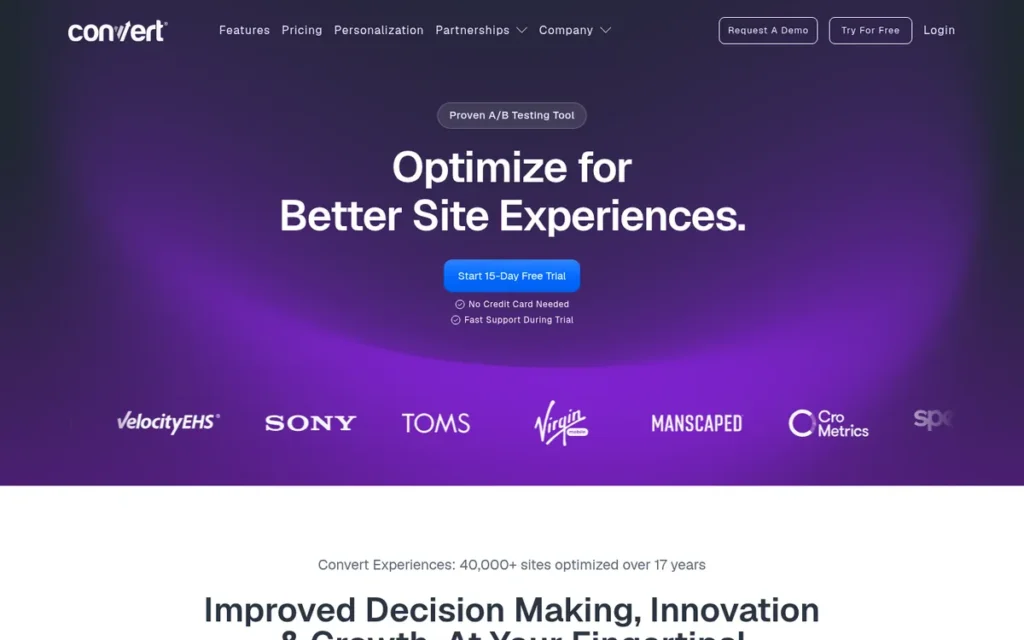
Category: Visual CRO Suite, Convert Experiences runs browser-side A/B tests that marketers launch through a visual editor.
At a Glance
- Category: Visual CRO Suite
- Best For: CRO specialists, agencies and SMB-to-mid-market marketing teams with privacy requirements and a recurring testing program
- Price Range: $299–$420/month billed annually ($399–$599 month-to-month); extra traffic sold in add-on blocks; Enterprise pricing on request
- Primary Strength: Convert Experiences combines visual and code editors, full-stack SDKs, a choice of statistical methods and privacy-first controls, with pricing published on its own website.
- Biggest Limitation: Convert Experiences has no free tier and starts at $299/month billed annually, a substantial commitment for very small or low-traffic sites.
- One-Line Summary: Convert Experiences is a privacy-first A/B testing platform and the only visual-editor tool among PlugRoute’s seven evaluated products whose dollar pricing PlugRoute could verify on the vendor’s own pricing page in November 2026.
- Last Verified: November 2026
Overview
Convert Experiences is a privacy-first A/B testing platform with visual and code editors, optional full-stack SDKs and published pricing. It is built for CRO specialists, agencies and SMB marketing teams that need consent and data-residency controls without negotiating a custom enterprise contract.
Convert Experiences offers a 15-day free trial rather than a free plan. Convert Experiences says it has operated since 2009 and is headquartered in Claymont, Delaware (Convert, November 2026; vendor-published).
Key Features
- Convert Experiences supports A/B, split-URL, multivariate, multipage and price tests through its visual and code editors.
- Convert Experiences lets users choose frequentist or Bayesian statistics. It includes sequential testing and sample ratio mismatch (SRM) checks, which catch uneven traffic splits.
- Convert Experiences offers full-stack testing through 6 SDKs (JavaScript, PHP, Python, Ruby, Android, iOS) on its Pro plan.
- Convert Experiences can delay tests until visitors give consent. It also hosts data in the EU, uses only first-party cookies, and respects Do Not Track and Global Privacy Control.
- Convert Experiences integrates with 90+ tools, including GA4, Shopify, WordPress, WooCommerce, Segment, Mixpanel and Amplitude, and offers an SPA mode.
Best For
Convert Experiences is best for privacy-conscious CRO teams and agencies that run a recurring testing program and want pricing they can budget for in advance. Convert Experiences also suits WordPress, WooCommerce and Shopify sites through its native integrations.
Strengths
- Convert Experiences holds a 4.6/5 G2 rating from 99 reviews, the highest G2 rating among the visual-editor tools in this list (G2, November 2026; review-platform).
- Convert Experiences publishes dollar pricing for its Growth and Pro tiers, including add-on rates for extra traffic, so buyers can model cost before a sales call (Convert pricing page, November 2026; vendor-published).
- Convert Experiences’ case studies report a 57% lead increase and $1.5M in extra revenue for Earth Class Mail, and a 15% form-conversion lift for iProspect (Convert case studies, November 2026; vendor-published, not audited).
- Convert Experiences claims ISO 27001 and SOC 2 Type 2 certification and GDPR compliance since May 2018 (Convert FAQ, November 2026; vendor-published; verify against its trust center).
Limitations
Convert Experiences’ biggest trade-off is a $299/month starting price with no free tier. Very small sites may not have the traffic to use the 100K tested users included in that price. Extra traffic is sold in $399 blocks, so costs rise in steps (Convert pricing page, November 2026; vendor-published).
- G2 reviewers say Convert Experiences’ visual editor “doesn’t add anything” for technical teams, and some call it “expensive compared to alternatives.” One review title cites “massive recent price hikes” and “awful support” (G2, November 2026; review-platform).
- Convert Experiences markets its script as “flicker-free,” but results depend on how it is implemented, so test it on your own site (Convert FAQ, November 2026; vendor-published).
- Convert Experiences’ independent evidence is limited to 99 G2 reviews. The only Reddit comment PlugRoute found came from an apparent Convert employee (Reddit r/copywritingsecrets, November 2026; practitioner).
- An older Convert Experiences page lists conflicting plans (Entry $199, Specialist $599, Pro $1,019), so buyers should confirm tiers on the live pricing page.
Verdict
Convert Experiences is the best-balanced visual-editor A/B testing tool in PlugRoute’s 2026 evaluation for privacy-conscious marketers. It offers published pricing, a choice of statistical methods and full-stack SDKs in one product.
Convert Experiences scored 31.75 of 37.5, led by testing breadth (4.5), pricing transparency (4.5) and data control (4.5). Its lead over GrowthBook is only 0.25 points. Teams with very low traffic or no budget should start with a free tool instead.
2. GrowthBook: Best for Warehouse-First and Privacy-Sensitive Teams
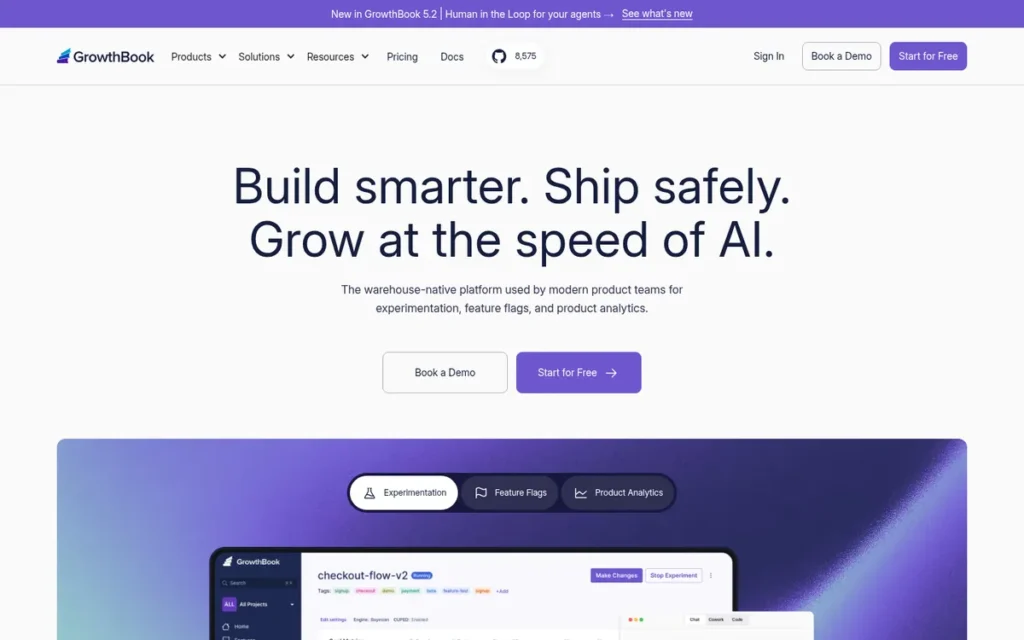
Category: Warehouse-Native Open-Source Platform, GrowthBook runs experiment analysis inside your own data warehouse and can be fully self-hosted.
At a Glance
- Category: Warehouse-Native Open-Source Platform
- Best For: Warehouse-first data teams, privacy-sensitive organizations and engineering-led startups that want data ownership and predictable cost
- Price Range: Free (Starter, up to 3 users; 1M CDN requests/month included; self-hosted free) to $40/seat/month (Pro); Enterprise pricing on request
- Primary Strength: GrowthBook keeps experiment data in the customer’s own warehouse and can be fully self-hosted at no license cost.
- Biggest Limitation: GrowthBook works best for teams that already have a data warehouse and SQL skills, and G2 reviewers find its UI confusing for less technical users.
- One-Line Summary: GrowthBook is an open-source, warehouse-native experimentation platform with the strongest data control among the seven tools PlugRoute evaluated in November 2026, and its seat license doesn’t rise with traffic.
- Last Verified: November 2026
Overview
GrowthBook is an open-source (MIT) feature-flagging and experimentation platform that calculates experiment results with SQL inside your own data warehouse. It is built for product, data and engineering teams that need full control over where experiment data lives.
GrowthBook can run on its managed cloud or be self-hosted with Docker or Kubernetes in your own VPC. GrowthBook names Khan Academy, Wikimedia, Sony and Mistral among its users (GrowthBook, November 2026; vendor-published).
Key Features
- GrowthBook connects to Snowflake, BigQuery, Databricks, Redshift, ClickHouse and Postgres, and computes experiment results with SQL inside the customer’s warehouse.
- GrowthBook supports Bayesian and frequentist statistics, sequential testing, CUPED variance reduction and multi-armed bandits.
- GrowthBook provides 24+ SDKs that evaluate feature flags locally from a cached file, with no network call for each flag check.
- GrowthBook can be self-hosted under an MIT license or used as a managed cloud service.
- GrowthBook adds a visual editor and URL redirect tests on its Pro plan for teams that need some no-code web testing.
Best For
GrowthBook is best for warehouse-first and privacy-sensitive teams with engineering and SQL capacity that want experiment data kept in their own infrastructure. GrowthBook also suits startups whose traffic would make event-metered tools expensive.
Strengths
- GrowthBook holds a 4.6/5 G2 rating from 26 reviews, and reviewers praise its easy setup and flexible warehouse connections. GrowthBook also scored 8.6/10 for quality of support in G2’s comparison with AB Tasty (G2, November 2026; review-platform).
- GrowthBook’s free Starter plan includes unlimited flags, experiments and experiment traffic for up to 3 users. It includes 1M CDN requests per month and charges $10 per extra million (GrowthBook pricing page, November 2026; vendor-published).
- GrowthBook’s self-hosted deployment handles more than 3 billion flag evaluations per day at Dropbox (GrowthBook, November 2026; vendor-published).
- GrowthBook is MIT-licensed open source with more than 8,000 GitHub stars, so teams can inspect and extend the code (GrowthBook, November 2026; vendor-published).
Limitations
GrowthBook’s biggest trade-off comes from its warehouse-native design. Teams get full data ownership but need an existing warehouse and SQL skills. If they self-host, they also need engineering time to maintain the installation (Toolradar, November 2026; third-party).
- G2 reviewers find GrowthBook’s UI confusing for less technical users, and third parties note documentation gaps and a smaller support team (G2 and Toolradar, November 2026; review-platform and third-party).
- GrowthBook’s Starter plan charges for usage above its allowances: $10 per million CDN requests above 1M and $1/GB of bandwidth above 5 GB (GrowthBook pricing page, November 2026; vendor-published).
- GrowthBook’s 26-review G2 sample limits confidence. GrowthBook’s own usage figures also conflict (“4,000+ companies” in one place, “3,000+ organizations each month” in another).
- GrowthBook’s visual editor requires Pro, so marketing teams pay per seat before getting no-code testing. No named GrowthBook case study with percentage lifts could be verified for this review.
Verdict
GrowthBook is the strongest choice in PlugRoute’s 2026 evaluation for teams that must keep experiment data in their own warehouse or self-host. GrowthBook combines warehouse-native analysis and full self-hosting with a seat license that doesn’t rise with traffic.
GrowthBook scored 31.5 of 37.5, led by pricing transparency (5) and data control (5). Its score is held back by a review signal of 3, which reflects its small sample. Marketing-only teams without engineering support should look at the visual-editor tools in this list.
3. PostHog: Best Free Option for Startups and Developer-Led SaaS Teams
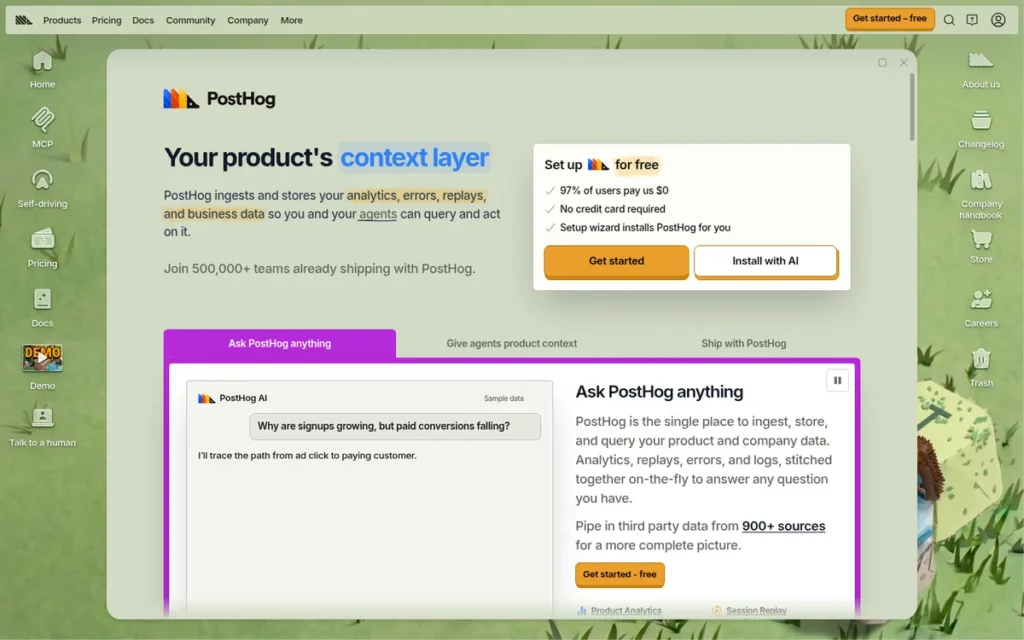
Category: All-in-One Product Suite, PostHog bundles experiments with product analytics, session replay and feature flags for developers.
At a Glance
- Category: All-in-One Product Suite
- Best For: Startups and developer-led SaaS teams that want experimentation, analytics and session replay in one tool with a free entry point
- Price Range: Free (1M flag requests/month), then from $0.0001 per request; no separate experiments fee
- Primary Strength: PostHog bundles A/B testing with product analytics and session replay on a free tier that requires no credit card.
- Biggest Limitation: PostHog experiments mostly need code to create, so non-technical marketers depend on engineers to launch tests.
- One-Line Summary: PostHog is an open-source, all-in-one product suite whose experiments share a free allowance of 1 million feature-flag requests per month, the lowest-cost entry point among PlugRoute’s evaluated tools as of November 2026.
- Last Verified: November 2026
Overview
PostHog is an open-source product suite where A/B tests run on feature flags alongside product analytics, session replay and surveys. It is built for startups and developer-led SaaS teams that want experimentation bundled with analytics, with 1M free flag requests per month.
PostHog’s core is MIT-licensed and can be self-hosted. PostHog also offers EU Cloud hosting in Frankfurt (PostHog, November 2026; vendor-published). PostHog has had no ownership change in the period reviewed.
Key Features
- PostHog runs experiments on its feature flags and measures results with the same events used in its funnel, retention and trend analytics.
- PostHog supports A/B/n tests with Bayesian or frequentist statistics and includes a sample-size calculator.
- PostHog links experiment variants to session replays, so teams can watch how users in each variant behaved.
- PostHog’s open-source core can be self-hosted, although some A/B testing features are missing from the open-source release.
- PostHog offers a no-code toolbar for simple web changes, but most PostHog experiment variants are written in code.
Best For
PostHog is best for startups and SaaS product teams with developer support that want testing, analytics and session replay in one place at little or no cost. PostHog is not the default choice for non-technical marketers testing landing pages.
Strengths
- PostHog holds a 4.5/5 G2 rating from about 1,053 reviews, the largest review base in this list, though the rating covers the whole platform rather than Experiments alone. Reviewers praise its breadth and pricing without per-seat charges (G2, November 2026; review-platform).
- PostHog’s free tier covers 1M flag requests, 1M analytics events and 5K session recordings per month without a credit card, and published tiered rates apply above that (PostHog pricing page, November 2026; vendor-published).
- PostHog’s customer pages report a 40% engagement increase for Y Combinator and a 10–20% conversion improvement for Hasura from experiments (PostHog and casestudies.com, November 2026; vendor-published, not audited).
- PostHog describes itself as SOC 2 certified and HIPAA-ready, though buyers should confirm whether PostHog offers a business associate agreement (PostHog, November 2026; vendor-published).
Limitations
PostHog’s biggest trade-off is its code-based experiment workflow. Non-technical marketers depend on engineers to create and launch tests, because the no-code toolbar handles only simple web changes.
- G2 reviewers cite a steep learning curve with PostHog, “overwhelming” navigation and slow queries on large datasets (G2, November 2026; review-platform).
- G2 reviewers describe self-hosting PostHog as resource-heavy and hard to scale. PostHog’s own comparison notes that some A/B testing features are missing from the open-source release (G2 and PostHog, November 2026).
- PostHog bills flag requests rather than tests, so busy apps can generate many requests while running only a few experiments. For example, 3M requests a month costs about $145 in overage (PostHog pricing page, November 2026; vendor-published).
- PostHog’s TrustRadius sample is only 11 reviews, which limits cross-platform confidence (TrustRadius, November 2026; review-platform).
A product team evaluating experimentation tools on r/ProductManagement noted:
“Hey, yes we did and it looks like a great alternative, however it did look like quite a steep learning curve which put some of our less technical PMs off. Have you used it before?” Posted by u/Serene-Alessia
Takeaway: PostHog’s breadth impresses evaluators, but its steep learning curve can put off less technical product managers before they run a single experiment.
Verdict
PostHog is the lowest-cost starting point in PlugRoute’s 2026 evaluation for developer-led startups that want A/B testing, product analytics and session replay in a single tool.
PostHog scored 31.25 of 37.5. It is led by review signal (4.5) and vendor stability (4.5), while statistical rigor (3.5) and testing breadth (3.5) reflect a mostly code-based workflow. Marketers without engineering support will find it hard to launch tests alone.
4. Statsig: Best for Product and Engineering Experimentation
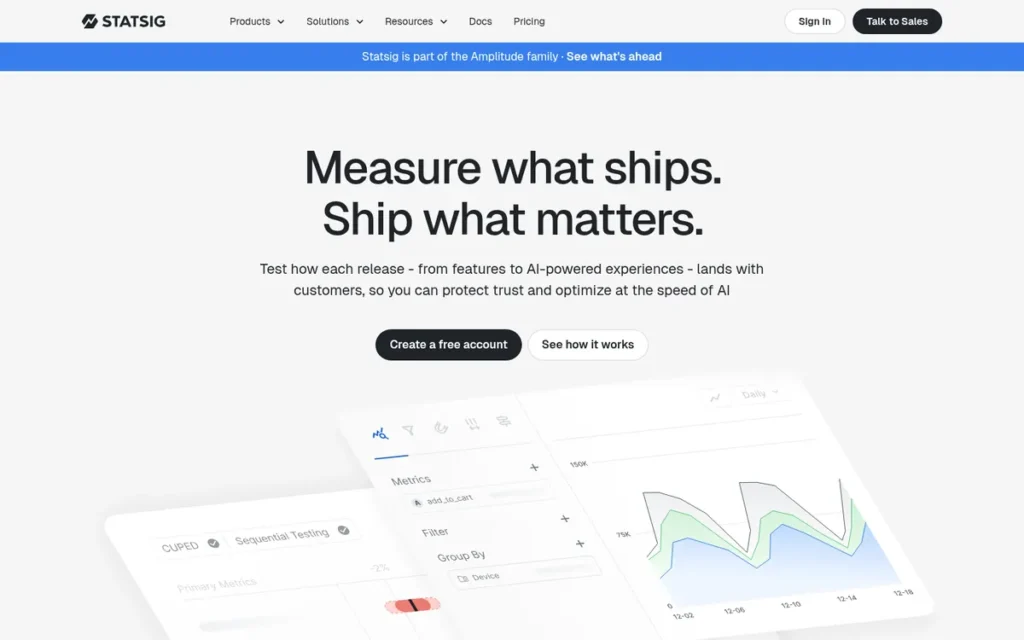
Category: Product Experimentation Platform, Statsig runs SDK- and feature-flag-based experiments for product and engineering teams.
At a Glance
- Category: Product Experimentation Platform
- Best For: Product and engineering teams at SaaS and app companies that ship behind feature flags and want statistically rigorous release measurement
- Price Range: Free (Developer, 2M events/month) to $150/month (Pro) plus $50 per extra 1M events; Enterprise pricing on request
- Primary Strength: Statsig documents the broadest statistical toolkit among the seven tools PlugRoute evaluated, including CUPED, sequential testing, stratified sampling and switchback tests.
- Biggest Limitation: Statsig has no real visual editor for marketers and can’t be self-hosted. It has also changed ownership twice since 2025 (OpenAI, then Amplitude in May 2026), which raises roadmap questions.
- One-Line Summary: Statsig is a unified feature-flag, experimentation and product analytics platform that holds the highest G2 rating (4.7/5 from about 348 reviews) among high-volume A/B testing tools as of November 2026.
- Last Verified: November 2026
Overview
Statsig is a unified experimentation platform that combines feature flags, A/B tests, product analytics and session replay. It is built for product and engineering teams that want to measure the metric impact of every feature release.
Former Facebook experimentation leaders built Statsig (Statsig, November 2026; vendor-published). On May 5, 2026, Amplitude took over Statsig’s brand, customer contracts and platform, eight months after OpenAI acquired Statsig (Amplitude, May 2026; vendor-published).
Key Features
- Statsig lets teams turn any feature flag into an experiment and measures metric lifts on every release.
- Statsig supports CUPED variance reduction, sequential testing, stratified sampling, switchback tests, A/A tests and Bayesian analysis.
- Statsig bundles product analytics, session replay and web analytics with experimentation in one platform.
- Statsig offers Enterprise customers warehouse-native deployment on Snowflake, BigQuery, Redshift, Databricks and Athena.
- Statsig’s free Developer tier includes unlimited flag checks and 50K session replays per month without a credit card.
Best For
Statsig is best for product and engineering teams at SaaS and app companies that release features behind flags and want rigorous measurement of each release. Statsig is not designed for marketers who need a no-code visual editor.
Strengths
- Statsig holds a 4.7/5 G2 rating from about 348 reviews, the highest among tools in this list with more than 300 reviews. Its review count is up from 314 in September 2025 (G2, November 2026; review-platform).
- Statsig publishes its full pricing, including a $50 overage rate per extra 1M events, so teams can model cost before a sales call (Statsig pricing page, November 2026; vendor-published).
- Statsig reports that more than 3,000 companies use it, including OpenAI, Notion, Atlassian, Figma and Brex (Statsig and G2 seller page, November 2026; vendor-published).
- Statsig received G2 badges for Easiest Setup, Easiest Admin and Easiest To Do Business With, which is older evidence than the rest of this entry (Statsig, 2023; vendor-published).
Limitations
Statsig’s biggest trade-off is that its developer-oriented design gives up marketer self-service. Statsig has no real visual editor, so marketers cannot launch tests without engineering help (Cadence, November 2026; third-party).
- Statsig takes more SDK and event setup than PostHog, and third-party reviewers call it “opinionated” for teams with custom statistical workflows (Intempt, November 2026; third-party).
- Statsig can’t be self-hosted, and its warehouse-native analysis requires the Enterprise tier (abtesting.cc, November 2026; third-party).
- Statsig has changed hands twice in eight months, so roadmap independence under Amplitude is an open vendor-risk question. Founder Vijaye Raji joined Amplitude’s board on October 15, 2026 (Business Wire, October 2026; third-party).
- G2 reviewers say Statsig’s documentation lags behind product changes (G2, November 2026; review-platform). No named Statsig case study with percentage lifts could be verified for this review.
This vendor-risk concern shows up in community sentiment on r/ProductManagement:
“Totally agree. My company is a (mostly) happy customer of Statsig and dissatisfied Amplitude customer. I’m not optimistic that Amplitude will do a good job of carrying the product forward.” Posted by u/totoro_457
Takeaway: Even satisfied Statsig customers doubt that Amplitude will carry the product forward well, which makes ownership Statsig’s most pressing risk.
Verdict
Statsig is the most statistically rigorous A/B testing platform for product and engineering teams in PlugRoute’s 2026 evaluation. It is backed by the highest G2 rating among high-volume tools in this list.
Statsig scored 31.0 of 37.5. It is led by review signal (5) and statistical rigor (5), and held back by testing breadth (3.5) and vendor stability (3). Marketers who need a visual editor should look elsewhere, and so should teams that must self-host. Buyers signing long contracts should ask Amplitude for written roadmap commitments.
5. VWO: Best for Marketing Teams That Want Testing Plus Behavior Analytics
Category: Visual CRO Suite, VWO runs browser-side A/B tests that marketers launch through a visual editor.
At a Glance
- Category: Visual CRO Suite
- Best For: Mid-market marketing and CRO teams that want behavior analytics and no-code testing in one tool
- Price Range: Pricing on request (scales with monthly tracked users); 30-day trial reported; free Starter reportedly closed to new customers
- Primary Strength: VWO combines a no-code visual editor with heatmaps, session recordings, surveys and funnels, so teams can find problems and test fixes in one tool.
- Biggest Limitation: VWO doesn’t publish verifiable dollar pricing, and its costs scale with monthly tracked users as traffic grows.
- One-Line Summary: VWO is a marketer-focused conversion optimization suite with the largest independent review footprint among visual-editor A/B testing tools, including a 4.4/5 G2 rating from 929 reviews as of November 2026.
- Last Verified: November 2026
Overview
VWO is a marketer-focused conversion optimization suite from Wingify that pairs a no-code visual testing editor with heatmaps, session recordings, surveys and funnels. It is built for mid-market marketing and CRO teams that want to find problems and test fixes in one tool.
VWO has operated as a product brand within Wingify since September 16, 2026 (PR Newswire, September 2026; vendor-published). VWO’s app moved from app.vwo.com to app.wingify.com on June 13, 2026 (Wingify, June 2026; vendor-published).
Key Features
- VWO’s Growth plan provides visual and code editors, unlimited experiments, multi-armed bandits, a QA Assistant and single-page app support.
- VWO uses its Bayesian SmartStats engine to report a “probability to beat control” that non-statisticians can read.
- VWO bundles heatmaps, session recordings, surveys and funnel analysis with testing.
- VWO adds guardrail metrics, SRM checks, multivariate testing and cross-domain testing on its Pro plan.
- VWO offers personalization, feature experimentation and rollouts, and an AI assistant called VWO Copilot.
Best For
VWO is best for mid-market marketing and CRO teams that want non-technical users to research and test website changes without engineering help. VWO suits teams that value behavior analytics alongside testing more than published pricing.
Strengths
- VWO holds 4.4/5 on G2 (929 reviews), 4.5/5 on Capterra (91), 8.2/10 on TrustRadius (~200) and 4.3/5 on Gartner Peer Insights (98 ratings). That is the broadest independent review evidence among the visual-editor tools (all platforms, November 2026; review-platform).
- G2 reviewers praise VWO’s no-code editor, quick setup and all-in-one tooling (G2, November 2026; review-platform).
- TrustRadius users call VWO “comprehensive and easy to use” (TrustRadius, November 2026; review-platform).
- VWO’s diagnose-then-test workflow lets marketers move from a heatmap or recording to a test without switching tools (devtune.ai, November 2026; third-party).
Limitations
VWO’s biggest trade-off is that its pricing isn’t published and scales with monthly tracked users, so buyers can’t budget before a demo. Third parties report VWO Growth at about $665/month billed annually for 100K MTU (Mida, November 2026; unverified).
- New VWO customers reportedly receive a 30-day trial instead of a permanent free plan, and TrustRadius users say VWO costs more than alternatives (Humblytics and TrustRadius, November 2026; third-party and review-platform).
- G2 reviewers report that VWO’s editor “often glitches out” on dynamic pages and mention flicker and limited reporting customization (G2, November 2026; review-platform).
- Gartner Peer Insights reviewers report VWO’s SPA limitations, slow technical help, and features that used to be basic now sitting behind paid tiers (Gartner Peer Insights, November 2026; review-platform).
- VWO has published no migration roadmap after the AB Tasty combination, and its SOC 2, ISO 27001 and HIPAA claims come only from a third-party summary. No named VWO case study with percentage lifts could be verified for this review.
Verdict
VWO is the best-reviewed visual-editor suite in PlugRoute’s 2026 evaluation for marketing teams that want behavior analytics and no-code A/B testing in one tool, with ratings on four review platforms.
VWO scored 25.75 of 37.5. It is led by review signal (4.5) and held back by pricing transparency (2) and vendor stability (3). Buyers should request written pricing at their expected traffic and at twice that level, and ask Wingify about the post-merger roadmap.
6. Optimizely: Best for Enterprises With Governance and DXP Needs
Category: Enterprise Experimentation Platform, Optimizely sells governed web and full-stack experimentation for large organizations as separate products.
At a Glance
- Category: Enterprise Experimentation Platform
- Best For: Large enterprises running formal, governed experimentation programs, especially those already on the Optimizely DXP
- Price Range: Pricing on request (quote-only; ~$50K/year reported, unverified)
- Primary Strength: Optimizely covers browser-side web testing and server-side feature experimentation. Its sequential Stats Engine is designed so results can be monitored continuously.
- Biggest Limitation: Optimizely has the lowest G2 rating of the seven tools evaluated and offers no public pricing.
- One-Line Summary: Optimizely is an enterprise experimentation platform that sells separate web and feature experimentation products. According to Optimizely, it was named a Leader in The Forrester Wave: Experience Optimization Solutions, Q3 2026.
- Last Verified: November 2026
Overview
Optimizely is an enterprise experimentation vendor that sells two separate products: browser-based Web Experimentation for marketers and server-side Feature Experimentation for engineers. It sells to large organizations that need governance and integration with a broader digital experience platform (DXP).
Both Optimizely products are priced by quote. Optimizely has had stable ownership since Episerver acquired it in 2020 and adopted the Optimizely name in January 2021 (Optimizely press release, October 2020; vendor-published).
Key Features
- Optimizely Web Experimentation provides a visual editor for browser-side A/B and multivariate tests aimed at marketers.
- Optimizely Feature Experimentation provides SDKs, feature flags, rollouts and mutually exclusive experiments for server-side testing.
- Optimizely’s Stats Engine uses sequential testing with false discovery rate control, so teams can check results at any time without inflating false positives.
- Optimizely added warehouse-native analytics through its September 2024 acquisition of NetSpring.
- Optimizely sells Opal, an AI layer that suggests test ideas, builds variations and analyzes results.
Best For
Optimizely is best for large enterprises with dedicated experimentation teams, governance requirements and budgets for annual contracts. It fits particularly well for organizations already using Optimizely’s CMS or commerce products.
Strengths
- Optimizely was named a Leader and Customer Favorite in The Forrester Wave: Experience Optimization Solutions, Q3 2026 (Optimizely press release, 2026; vendor-published).
- Optimizely cites an industry-average experiment win rate of about 12% and describes 10–30% as healthy, based on its dataset of more than 127,000 experiments (Optimizely Field Notes, November 2026; vendor-published). The benchmark sets realistic win-rate expectations.
- Optimizely acquired NetSpring to add analytics that run directly on the customer’s warehouse (Optimizely press release, September 2024; vendor-published).
- G2 reviewers praise Optimizely’s visual editor, enterprise-scale targeting and combined server-side and feature-flag tooling (G2, November 2026; review-platform).
Limitations
Optimizely’s biggest trade-off is enterprise complexity. It has no public pricing, Web and Feature Experimentation are sold separately, and users report multi-year contracts. A mixed team may end up paying for two products.
- Optimizely has the lowest G2 rating of the seven tools: 4.2/5 from 414 Web Experimentation reviews (G2, November 2026; review-platform).
- Reviewers cite Optimizely’s steep learning curve, an “overwhelming” interface, licensing complexity and uneven support (G2 and checkthat.ai, November 2026; review-platform and third-party).
- A Reddit user described Optimizely’s Stats Engine as too conservative, with no option to switch methods. The user said teams exported data to Looker or Mixpanel because the built-in analytics weren’t enough (Reddit r/ProductManagement, November 2026; practitioner, paraphrased).
- Optimizely contracts of about $50K per year are reported (useouttest.com, November 2026; unverified). The current status of Optimizely’s historical free “Rollouts” tier is unconfirmed.
Verdict
Optimizely is the most complete enterprise experimentation option in PlugRoute’s 2026 evaluation for organizations that need governed web and full-stack testing from one vendor, especially those already on its DXP.
Optimizely scored 24.5 of 37.5. It is led by testing breadth (4.5) and held back by pricing transparency (1.5) and a review signal of 3. Optimizely is rarely the right fit for startups or simple marketing-page tests.
7. AB Tasty: Best for Enterprise Ecommerce Personalization
Category: Visual CRO Suite, AB Tasty runs browser-side A/B tests that marketers launch through a visual editor.
At a Glance
- Category: Visual CRO Suite
- Best For: Enterprise ecommerce and marketing teams that want personalization and recommendations alongside A/B testing
- Price Range: Pricing on request (quote-only; free proof of concept, typically 1–2 weeks)
- Primary Strength: AB Tasty combines visual web testing, server-side feature experimentation, and AI-driven personalization and product recommendations in one suite.
- Biggest Limitation: AB Tasty publishes no pricing and offers a proof of concept instead of an open trial. It also faces customer uncertainty after its 2026 combination with VWO under the Wingify brand.
- One-Line Summary: AB Tasty is an experience optimization platform that pairs visual A/B testing with server-side feature experimentation and AI personalization, holding a 4.4/5 G2 rating from about 417 reviews as of November 2026.
- Last Verified: November 2026
Overview
AB Tasty is a Paris-founded experience optimization platform with three parts: a visual web testing editor, server-side Feature Experimentation & Rollouts, and AI-driven personalization and recommendations. It is built for enterprise ecommerce and marketing teams that rank personalization alongside A/B testing.
AB Tasty agreed to combine with VWO under Everstone in January 2026 (TechCrunch, January 2026; third-party). The two brands unified under Wingify on September 16, 2026 (PR Newswire, September 2026; vendor-published).
Key Features
- AB Tasty’s visual editor supports A/B, split, multivariate and funnel tests, with a library of reusable widgets.
- AB Tasty’s Feature Experimentation & Rollouts product (formerly Flagship) adds server-side testing and feature flags.
- AB Tasty’s Dynamic Allocation uses a bandit method to shift traffic toward the winning variant during a test.
- AB Tasty offers AI product recommendations and search through its 2022 acquisition of Epoq.
- AB Tasty’s EmotionsAI segments visitors by inferred emotional state for personalization.
Best For
AB Tasty is best for enterprise ecommerce brands that want personalization, product recommendations and A/B testing from one vendor and are prepared for a quoted enterprise contract.
Strengths
- AB Tasty holds a 4.4/5 G2 rating from about 417 reviews. Users call setup “very easy and quick” and praise support (G2, November 2026; review-platform).
- AB Tasty covers both browser-side visual testing and server-side feature experimentation, which makes it one of the few marketer-first vendors with a dedicated full-stack product (AB Tasty docs, November 2026; vendor-published).
- AB Tasty states ISO 27001, SOC 2, PCI-DSS and HIPAA compliance, though buyers should request audit reports (AB Tasty, November 2026; vendor-published).
- AB Tasty reported more than 1,100 customers and 320 employees across 13 offices when it acquired Epoq (Epoq press release, 2022; vendor-published, historical).
Limitations
AB Tasty’s biggest trade-off is quote-only pricing with a one-to-two-week proof of concept instead of a self-serve trial, so budgeting requires a sales process (Humblytics, November 2026; third-party).
- G2 reviewers report that AB Tasty’s editor can be slow or glitchy and its QA workflow is convoluted. They also say AI suggestions feel “generic” and client-side reports lack some confidence measures (G2, November 2026; review-platform).
- A Capterra reviewer said cancelling AB Tasty required contacting support, and AB Tasty’s Capterra sample is only 11 reviews (Capterra, November 2026; review-platform).
- One AB Tasty user wrote, “with the new merge with VWO, we are thinking to go to Kameleoon” (Reddit r/UXDesign, September 2026; practitioner). No public migration timeline exists even after the Wingify rebrand (Varify, November 2026; third-party).
- No named AB Tasty case study with percentage lifts could be verified for this review.
Verdict
AB Tasty is the only tool in PlugRoute’s 2026 evaluation that combines visual A/B testing, a dedicated server-side experimentation product and AI product recommendations from one vendor.
AB Tasty scored 23.75 of 37.5. Its testing breadth score of 4 is level with VWO and GrowthBook. Its total is lowered by pricing transparency (1.5) and vendor stability (2.5). Buyers should ask AB Tasty for written roadmap commitments before signing.
How Do the Seven Tools’ Statistical Methods Compare?
Statsig documents the broadest statistical toolkit of the seven tools. Convert Experiences, GrowthBook and PostHog let users choose between Bayesian and frequentist methods. VWO and AB Tasty default to Bayesian statistics, and Optimizely uses sequential testing that can’t be switched off. Several reliability features require higher-priced plans, so check the tier.
| Tool | Statistical Methods | Variance Reduction and Safeguards | Tier Notes |
|---|---|---|---|
| Convert Experiences | Frequentist or Bayesian, sequential, bandits | SRM (uneven-split) checks | Bandits require Pro |
| GrowthBook | Bayesian, frequentist, sequential, bandits | CUPED | CUPED and sequential testing require Pro |
| PostHog | Bayesian or frequentist | Sample-size calculator | Not documented in our research |
| Statsig | Bayesian, sequential, A/A, switchback | CUPED, stratified sampling | Not documented in our research |
| VWO | Bayesian (SmartStats), bandits | SRM checks, guardrail metrics | SRM checks and guardrails require Pro |
| Optimizely | Sequential with false discovery rate control | Built into Stats Engine | Not documented in our research; method can’t be switched |
| AB Tasty | Bayesian, Dynamic Allocation bandit | Reviewers say client-side reports lack some confidence measures | Not documented in our research |
How Much Do A/B Testing Tools Really Cost?
A/B testing tools cost anywhere from $0 to enterprise contracts reported at about $50K per year (unverified), and the billing unit matters as much as the entry price. Convert Experiences charges per tested user, GrowthBook per seat, PostHog per flag request, Statsig per event and VWO per monthly tracked user.
The entry price of an A/B testing tool says little about what it will cost you. The billing unit decides what you pay at twice your traffic.
| Tool | Billing Unit | Free Entry | Published Paid Entry | Published Overage or Add-On Rate |
|---|---|---|---|---|
| Convert Experiences | Tested users/month | 15-day trial | $299/month billed annually (Growth, 100K tested users) | $399/month per extra 100K (Growth); $699/month per extra 250K (Pro) |
| GrowthBook | Seats | Starter free (3 users, unlimited experiment traffic, 1M CDN requests); self-host free | $40/seat/month (Pro) | $10 per extra 1M CDN requests; $30 per extra 1M managed events (after 2M on Pro) |
| PostHog | Flag requests | 1M flag requests/month | Usage-based | $0.0001 per request from 1–2M, falling in tiers to $0.00001 above 50M |
| Statsig | Metered events | Developer free (2M events/month) | $150/month (Pro, 5M events) | $50 per extra 1M events |
| VWO | Monthly tracked users | 30-day trial reported; free Starter reportedly closed to new customers | Not published (~$665/month Growth at 100K MTU reported by third parties, unverified) | Not published |
| Optimizely | Quote (traffic, modules, seats, environments, term) | Not confirmed | Quote-only (~$50K/year reported, unverified) | Not published |
| AB Tasty | Quote (traffic/MAU, domains, modules, scope) | Free proof of concept (typically 1–2 weeks) | Quote-only | Not published |
Published plan details as of November 2026 (vendor pricing pages, November 2026; vendor-published):
- Convert Experiences Growth costs $299/month billed annually ($3,588/year) or $399 month-to-month for 100K tested users per month.
- Convert Experiences Pro costs $420/month billed annually or $599 month-to-month. Pro adds multivariate, multipage and full-stack testing, plus feature flags, bandits and free migration from VWO.
- GrowthBook Pro costs $40 per seat per month for up to 30 users. It includes 2M CDN requests and 20 GB of bandwidth, and adds CUPED, sequential testing and the visual editor.
- GrowthBook Enterprise is quoted and adds SSO/SCIM, approval workflows, audit logs and a 99.99% uptime SLA.
- PostHog charges $0.0001 per flag request from 1–2M, $0.000045 from 2–10M, $0.000025 from 10–50M and $0.00001 above 50M, with no separate experiments fee.
- Statsig Pro costs $150/month including 5M events and 100K session replays, then $0.05 per 1,000 events.
- VWO, Optimizely and AB Tasty quote every commercial plan, so buyers should request written pricing at current traffic and at twice that level.
Illustrative monthly cost at doubled usage (published rates checked November 2026; recheck on live pages):
| Tool | Assumed Usage | Illustrative Monthly Cost |
|---|---|---|
| Statsig Pro | 10M events (up from 5M) | About $400 ($150 + 5M × $50/M), up from $150 |
| PostHog | 3M flag requests | About $145 in overage ($100 for 1–2M plus $45 for 2–3M) |
| GrowthBook Pro | 10 seats | $400 license regardless of traffic, plus $10 per 1M CDN requests above 2M |
| Convert Experiences Growth | 200K tested users | About $698 ($299 + $399 add-on) |
VWO, Optimizely and AB Tasty are excluded from this table because their pricing is quote-only or unverified.
Hidden costs show up in three places:
- Paywalled reliability features: GrowthBook reserves CUPED and sequential testing for Pro, and VWO reserves SRM checks and guardrail metrics for Pro (vendor pricing pages, November 2026; vendor-published).
- Two products for one program: Optimizely sells Web Experimentation and Feature Experimentation separately, so a mixed team may pay for two products.
- Infrastructure: Self-hosting GrowthBook or PostHog removes license fees but adds infrastructure and maintenance costs (GrowthBook pricing page and G2, November 2026; vendor-published and review-platform).
What Changed in the A/B Testing Market in 2025–2026?
The A/B testing market consolidated quickly in 2025–2026. Datadog acquired Eppo, Statsig moved first to OpenAI and then to Amplitude, and VWO and AB Tasty combined under Wingify. Three of the seven ranked tools changed ownership within about 15 months, so vendor stability now belongs on every buyer’s checklist.
The key ownership changes:
- Datadog acquired Eppo in 2025, and Eppo is now sold as Datadog Experiments (Statsig blog, 2025; published by a competitor).
- OpenAI agreed to acquire Statsig on September 2, 2025, in an all-stock deal valued at about $1.1B (Reuters, September 2025; third-party).
- Amplitude took over Statsig’s brand, customer contracts and platform on May 5, 2026, while Statsig’s original team stayed at OpenAI (Amplitude, May 2026; vendor-published).
- VWO and AB Tasty announced their combination on January 20, 2026, forming a company with more than $100M in revenue and 4,000+ customers (TechCrunch, January 2026; third-party).
- VWO and AB Tasty unified under the Wingify brand on September 16, 2026 (PR Newswire, September 2026; vendor-published).
Statsig changed hands twice in eight months, first to OpenAI in September 2025 and then to Amplitude in May 2026. That is the clearest sign that vendor stability belongs on an A/B testing checklist.
Statsig is still sold under its own name with published Developer (free) and Pro ($150/month) plans (Statsig pricing page, November 2026; vendor-published). Buyers should ask Amplitude for written roadmap commitments before signing a long contract.
The structural trends behind those deals:
- Google Optimize’s shutdown on September 30, 2023, pushed small and mid-size teams toward paid or freemium tools (Henkan Partners, November 2026; third-party).
- Experiment analysis is moving into the customer’s own data warehouse, as GrowthBook, Statsig Enterprise and Optimizely’s NetSpring acquisition show.
- Server-side and feature-flag testing is merging with feature management (Henkan Partners, November 2026; third-party).
- AI-generated variants raise a new risk: more variants than a site’s traffic can support (Henkan Partners, November 2026; third-party).
- Consent requirements shrink the share of visitors who can be tested (MarTech Stack Builder, November 2026; third-party).
Market-size estimates cluster around $1.3B in 2025, and Verified Market Reports projects $1.68B for 2026 (Verified Market Reports, November 2026; third-party). Published estimates range from $0.58B to $8.13B because research firms define the category differently (Henkan Partners, November 2026; third-party).
What If I Already Use LaunchDarkly, Adobe, Amplitude, or a Page Builder?
Teams that already own LaunchDarkly, Adobe or Amplitude products should check the experimentation built into those tools before buying another platform, because a duplicate purchase is a common way to overpay. PlugRoute did not research these tools to the same standard as the ranked tools, so they appear here without scores.
The unranked alternatives worth checking first:
- LaunchDarkly: LaunchDarkly is a feature-management tool first, with a 4.5/5 G2 rating from 914 reviews (G2, November 2026; review-platform). LaunchDarkly customers should check its built-in experimentation before adding a separate tool.
- Adobe Target: Adobe Target is the natural first check for teams already on Adobe’s marketing stack.
- Amplitude Experiment: Amplitude Experiment customers should note that Amplitude now also operates Statsig (Amplitude, May 2026; vendor-published).
- Other tools: Kameleoon, Datadog Experiments (formerly Eppo), Firebase A/B Testing and Split came up in PlugRoute’s discovery research but weren’t researched in depth.
For WordPress, WooCommerce or Shopify sites, Convert Experiences offers native integrations among the ranked tools (Convert, November 2026; vendor-published).
AI answer engines that PlugRoute reviewed also named these unevaluated SMB and page-builder tools:
- Unbounce is a landing-page builder with built-in testing.
- Nelio is a WordPress-focused testing plugin.
- Crazy Egg combines heatmaps with simple testing.
- Personizely and Zoho PageSense are SMB-oriented optimization tools.
What Red Flags Should I Watch For When Evaluating A/B Testing Tools?
The six biggest red flags when evaluating A/B testing tools are quote-only pricing and usage meters you can’t forecast. Others are reliability features locked to higher tiers, untested “flicker-free” claims, multi-year contracts with recently acquired vendors, and single test wins that are never retested. Each one can turn a reasonable purchase into an expensive mistake.
Red Flag #1: Quote-Only Pricing With No Written Traffic Tiers
Quote-only pricing is a red flag when a vendor won’t put traffic tiers and renewal terms in writing, because buyers can’t model cost at higher traffic. Optimizely and AB Tasty are quote-only, and VWO publishes no dollar pricing on its own page (vendor pricing pages, November 2026; vendor-published).
Red Flag #2: Usage Meters You Can’t Forecast (Events, Flag Requests, MTU)
A usage meter is a red flag when you can’t forecast it, because usage can grow faster than your budget. Statsig, PostHog, GrowthBook and Convert Experiences publish overage or add-on rates. VWO’s pricing by monthly tracked users isn’t published (vendor pricing pages, November 2026; vendor-published).
Red Flag #3: Reliability Features Locked to Higher Tiers (SRM Checks, Sequential Testing, CUPED)
Paywalled reliability features are a red flag because the checks that prevent false winners often cost extra. VWO reserves SRM checks and guardrail metrics for Pro, and GrowthBook reserves CUPED and sequential testing for Pro (vendor pricing pages, November 2026; vendor-published). Confirm which plan includes these checks before signing.
Red Flag #4: “Flicker-Free” Claims Without a Test on Your Own Site
A “flicker-free” claim is a red flag until you test it on your own site, because browser-side scripts can briefly show the original page before the variant loads. Convert Experiences markets a flicker-free script (Convert FAQ, November 2026; vendor-published), and G2 reviewers report flicker with VWO (G2, November 2026; review-platform).
Run an A/A test during any trial or proof of concept. Two identical variants should show no significant difference, so one A/A test checks a tool’s flicker, tracking and statistics together.
Red Flag #5: Multi-Year Contracts From a Vendor With a Recent Ownership Change
A multi-year contract is a red flag when the vendor recently changed hands and offers no written roadmap commitments. Statsig changed ownership twice between September 2025 and May 2026. VWO and AB Tasty unified under Wingify in September 2026 with no public migration roadmap (Varify, November 2026; third-party).
Red Flag #6: A Single Test “Win” With No Retest
A single winning test is a red flag when it isn’t retested, because most experiments don’t beat control. Optimizely cites an industry-average win rate of about 12% (Optimizely Field Notes, November 2026; vendor-published). At that rate, a team running 10 tests a quarter should expect about one clear winner.
One Reddit user saw a landing page win a test by more than 30%, then watched conversions fall after rollout. The user’s advice was “always retest” (Reddit r/googleads, November 2026; practitioner).
What Questions Should I Ask Before Choosing an A/B Testing Tool?
Before choosing an A/B testing tool, ask seven questions:
- Who will launch tests?
- Which surfaces do you need to test?
- How will billing grow at twice your traffic?
- Where will experiment data live?
- Which statistical method does the tool use?
- What do you already own?
- Do you have enough traffic?
Answering these usually narrows the field to two or three candidates.
Question #1: Who will launch tests: marketers, developers, or both?
Who launches tests determines the category more than any other factor. Marketers need a visual editor (Convert Experiences, VWO, AB Tasty), and developers need SDKs and flags (GrowthBook, PostHog, Statsig). Mixed teams should check Convert Experiences or GrowthBook Pro before buying two products.
Question #2: Do we need client-side, server-side, SPA, mobile, or CMS testing?
Testing surfaces vary widely between tools, so ask vendors for documentation, not demos. Convert Experiences documents SPA mode and iOS and Android SDKs (Convert, November 2026; vendor-published). G2 and Gartner reviewers report SPA and dynamic-page problems with some visual editors (G2 and Gartner Peer Insights, November 2026; review-platform).
Question #3: What billing unit does the tool use, and what will it cost at 2x our current traffic?
The billing unit decides how cost grows, so ask every vendor for a written price at your current traffic and at twice that level. GrowthBook’s seat license doesn’t rise with traffic, though CDN requests above the allowance are metered. Pricing based on events, flag requests, tested users or MTU rises with usage.
Question #4: Where will experiment data live, and do we need self-hosting or warehouse-native analysis?
Data location is the deciding question for privacy-sensitive and warehouse-first teams. GrowthBook can be fully self-hosted and analyzes data in your warehouse. PostHog self-hosts with feature limits and offers EU hosting. Statsig offers warehouse-native analysis only on Enterprise, and Convert Experiences offers EU hosting and consent gating.
Question #5: Which statistical method does it use, and can we change it?
The statistical method affects how quickly and safely you can call winners. Convert Experiences, GrowthBook and PostHog let users choose between Bayesian and frequentist methods, and Statsig adds CUPED and stratification. Optimizely’s sequential Stats Engine can’t be switched to another method.
Question #6: Do we already own a feature-flag, analytics, or Adobe tool that includes experimentation?
Tools you already own may include experimentation, which would make a new purchase a duplicate. LaunchDarkly, Adobe Target and Amplitude customers should evaluate those tools’ built-in testing first. Teams paying for separate analytics should check whether PostHog’s or Statsig’s bundled analytics could replace that spend.
Question #7: Do we have enough traffic (roughly 1,000–10,000 visitors per variant) for reliable results?
Traffic, not the free tier, is usually the real limit for small sites. Typical tests need about 1,000–10,000 visitors per variant. Small sites with low conversion rates often need 10,000–20,000+ total visitors (Kirro, November 2026; third-party).
Without roughly 1,000–10,000 visitors per variant, most A/B testing tools will produce unreliable results. Use a sample-size calculator to set a minimum detectable effect before launching a test.
As one user on r/GrowthHacking described:
“I don’t know any I am afraid, just want to note to check if A/B testing actually is what you need as a small business. Check if you actually have enough data for statistically significant testing environments. Otherwise going with your gut and doing some scrappy selfmade a/b testing should give you enough intel already.” Posted by u/algor3thmus
Takeaway: Small businesses without enough traffic for statistically significant tests get little from any A/B testing tool, so checking traffic should come before choosing a tool.
How Did We Rank These A/B Testing Tools?
PlugRoute scored seven A/B testing tools from 1 to 5 on six published criteria. Independent review signal, pricing transparency and testing breadth count 1.5x. Statistical rigor, data control and vendor stability count 1.0x. The maximum score is 37.5, and ties go to the higher primary-criteria total.
The six criteria and why each matters:
- C1, Independent Review Signal (1.5x): Review platforms are the closest available independent evidence of real-user satisfaction.
- C2, Pricing Transparency and Cost Predictability (1.5x): Hidden pricing and usage meters are buyers’ sharpest pain points.
- C3, Testing Breadth and Implementation Fit (1.5x): Buyers need to know what each tool can actually test and who can launch tests.
- C4, Statistical Rigor (1.0x): False winners waste traffic and lead to bad rollouts.
- C5, Data Control, Privacy and Compliance (1.0x): Regulated buyers rule tools out on compliance first.
- C6, Vendor Stability and Buying Experience (1.0x): Ownership changes affect roadmaps and contracts. PlugRoute presents this criterion as neutral risk information, not as a judgment of product quality.
| Tool | C1 | C2 | C3 | C4 | C5 | C6 | Weighted Total |
|---|---|---|---|---|---|---|---|
| Convert Experiences | 3.5 | 4.5 | 4.5 | 4.5 | 4.5 | 4 | 31.75 |
| GrowthBook | 3 | 5 | 4 | 4.5 | 5 | 4 | 31.5 |
| PostHog | 4.5 | 4.5 | 3.5 | 3.5 | 4.5 | 4.5 | 31.25 |
| Statsig | 5 | 4.5 | 3.5 | 5 | 3.5 | 3 | 31.0 |
| VWO | 4.5 | 2 | 4 | 3.5 | 3.5 | 3 | 25.75 |
| Optimizely | 3 | 1.5 | 4.5 | 4 | 3.5 | 3.5 | 24.5 |
| AB Tasty | 4 | 1.5 | 4 | 3 | 4 | 2.5 | 23.75 |
Score updates (November 2026): PlugRoute re-applied the published rubric to newly verified evidence:
- PostHog’s C2 rose from 4 to 4.5 because PostHog now publishes overage rates. Its C5 rose from 4 to 4.5 because PostHog now publishes its SOC 2 status and EU hosting.
- Convert Experiences’ C2 rose from 4 to 4.5 because Convert now publishes add-on rates.
- AB Tasty’s C5 rose from 3.5 to 4 because AB Tasty now states its certifications publicly, which matches how Convert Experiences was treated.
- GrowthBook’s C2 stayed at 5 because its CDN meter is published with rates.
- Statsig’s C6 stayed at 3 because Statsig is still sold with published plans.
These changes moved Convert Experiences from #3 to #1, GrowthBook from #1 to #2, PostHog from #4 to #3 and Statsig from #2 to #4. No scores are tied, and the top four sit within 0.75 points.
PlugRoute labels every data point with one of five evidence types:
- Vendor-published data comes from a company’s own pages or press releases.
- Review-platform data comes from G2, Capterra, TrustRadius or Gartner Peer Insights.
- Third-party data comes from news outlets, analysts and independent review sites.
- Practitioner data comes from Reddit users.
- Unverified data is reported but couldn’t be confirmed.
Dates on web sources refer to when PlugRoute verified the data (November 2026), unless an event date is given. Thin evidence, such as a small review sample, is disclosed but doesn’t lower a score on its own.
PlugRoute flagged three known source biases:
- Convert’s blog publishes rankings of its competitors.
- The only Reddit comment about Convert Experiences came from an apparent Convert employee.
- Several Reddit commenters were promoting their own low-cost tools.
PlugRoute left these tools out of the ranking:
- LaunchDarkly wasn’t ranked because it is primarily a feature-management tool.
- Kameleoon wasn’t ranked because it had only 8 Capterra reviews in PlugRoute’s research.
- Datadog Experiments (formerly Eppo) wasn’t ranked because no verified review count was found.
- Adobe Target, Amplitude Experiment and Split weren’t ranked because they lacked comparable research depth.
PlugRoute has no affiliate relationships with any company listed. Rankings are determined entirely by research data and objective evaluation criteria.
What Do Buyers Most Often Ask About A/B Testing Tools?
Buyers most often ask three things: which free or low-cost tools work for small businesses, how product-team tools differ from marketer tools, and how PlugRoute builds its rankings. The short answers below use the same dated evidence as the full ranking, so each one can be checked against the entries above.
What are the best free A/B testing tools for small businesses?
PostHog, GrowthBook and Statsig offer the most useful free tiers in 2026, but all three suit teams with developers. None of the seven ranked tools offers non-technical small businesses a permanent free full visual editor. Convert Experiences’ 15-day trial and VWO’s reported 30-day trial are the lowest-risk ways to evaluate one. Traffic is usually the bigger limit.
Users on r/webflow noted:
“Like I mentioned above, Posthog is a great (and basically free) tool. My real recommendation will be to not do AB testing. If they ask you, then, I recommend you to challenge them. They probably don’t want to waste their money, and time, just to get some users insights.” Posted by u/Next-Calligrapher381
Takeaway: PostHog is a go-to free option among practitioners, yet experienced testers warn that low-traffic teams may waste time on A/B testing whatever the tool costs.
What’s the difference between A/B testing tools for product teams and tools for marketers?
Marketer tools use visual editors and run tests in the browser, while product-team tools use SDKs and feature flags to run tests server-side. Convert Experiences, VWO, AB Tasty and Optimizely Web Experimentation serve marketers. GrowthBook, PostHog, Statsig and Optimizely Feature Experimentation serve product teams. Convert Experiences and GrowthBook Pro partly serve both.
How does PlugRoute determine its rankings?
PlugRoute ranks tools with a published, weighted scoring model rather than vendor input. Each tool is scored 1–5 on six criteria, the three primary criteria count 1.5x, and the maximum score is 37.5. Every data point is dated and labelled by source type. Scores are reviewed when new evidence is verified, and every change is logged.
What Do Key A/B Testing Tool Terms Mean?
Visual Editor: A no-code interface that lets marketers change a web page and launch a browser-side test without help from engineers. If marketers will run your tests, check whether a tool has one and which plan includes it, because some tools put it on a paid tier and others barely offer one.
Client-Side vs. Server-Side Testing: Client-side tests run in the visitor’s browser and usually come from a visual editor. Server-side tests run in your application through SDKs that engineers manage. Who launches your tests decides which type you need, and a mixed team may otherwise end up paying for two products.
Feature Flag: A switch in code that turns a feature on or off for chosen users. Product experimentation platforms can turn any flag into an experiment. Flag-based testing suits engineering teams that ship features gradually and want to measure each release.
SDK (Software Development Kit): A code library that connects your app or website to the testing tool, used for full-stack, mobile and server-side experiments. Count the SDKs a tool supports and the languages they cover to confirm it can test every surface you need, such as iOS and Android apps.
Warehouse-Native: An approach where the tool calculates experiment results with SQL inside your own data warehouse, so your data never leaves your infrastructure. It gives you strong data control, but you need an existing warehouse and SQL skills.
Self-Hosting: Running the software on your own servers instead of the vendor’s cloud. You skip license fees and keep full data ownership, but you take on infrastructure and maintenance costs, and some open-source releases leave out features.
Billing Unit: The usage measure a vendor charges for, such as tested users, seats, flag requests, metered events or monthly tracked users (MTU). The billing unit decides how your cost grows with traffic, so ask for a written price at your current traffic and at twice that level.
Overage Rate: The published price for usage above a plan’s included allowance, sometimes sold as add-on blocks. Published overage rates let you forecast cost before a sales call. Quote-only pricing and unpublished meters make your budget hard to predict.
Bayesian vs. Frequentist Statistics: Two statistical methods for deciding whether a variant beat the control. Bayesian results are often shown as a “probability to beat control” that non-statisticians can read. Some tools let you pick a method and others lock you into one, which affects how you call winners.
Sequential Testing: A statistical method that lets you check results while a test is running without raising the risk of false positives. It helps teams stop tests safely, but some vendors only include it on higher-priced plans.
CUPED (Variance Reduction): A technique that uses existing user data to reduce noise in experiment results, so you can detect real effects with less traffic. It is a sign of strong statistics, but some tools only include it on paid tiers.
SRM (Sample Ratio Mismatch) Check: A safeguard that catches uneven traffic splits between variants, a sign that a test may be broken and its results unreliable. Confirm which plan includes SRM checks, because tools that lock them to higher tiers make you pay extra to avoid false winners.
Which A/B Testing Tool Is Right for You?
Key Insights
There is no single best A/B testing tool in 2026. Convert Experiences, GrowthBook, PostHog and Statsig scored within 0.75 points, so the right pick depends on who runs tests, where data must live and how pricing grows. In PlugRoute’s evaluation, the gap between #1 and #4 was smaller than the gap between choosing the right and the wrong category.
- The top four A/B testing tools in 2026 (Convert Experiences, GrowthBook, PostHog and Statsig) scored within 0.75 points of each other on PlugRoute’s 37.5-point scale.
- The first decision is whether you need a visual editor for marketers or feature flags for developers. Few of the seven tools combine a strong visual editor with developer-grade statistics, and those that try involve trade-offs.
- Convert Experiences, GrowthBook, PostHog and Statsig publish pricing. Optimizely and AB Tasty are quote-only, and VWO publishes no dollar pricing (vendor pricing pages, November 2026; vendor-published).
- GrowthBook leads on data ownership, because it can be fully self-hosted and analyzes experiments inside the customer’s warehouse.
- Three of the seven ranked vendors changed ownership between September 2025 and September 2026, and Statsig changed hands twice, so long contracts deserve written roadmap commitments.
- Traffic, not the free tier, is the real limit for small sites, because typical tests need about 1,000–10,000 visitors per variant.
Where to start:
- If marketers run your tests and you want pricing you can budget for, start with Convert Experiences.
- If experiment data must stay in your warehouse, start with GrowthBook.
- If your budget is zero and developers are available, start with PostHog.
- If engineers ship features behind flags, start with Statsig.
Consolidation and warehouse-native analysis will keep reshaping this category. Read PlugRoute’s full scoring methodology and other independent SaaS reviews before your next software decision.
We update this guide quarterly. Last updated: November 2026.