Badger Maps is the best field sales software for B2B route optimization in 2026, Pipedrive leads for full pipeline and deal management depth, and SPOTIO is the strongest all-in-one option for territory management and lead prospecting. The right tool depends on use case first, existing CRM second, and team size third, no single platform suits every field team.
Field reps lose hours every week to unoptimized routes and wasted windshield time. Managers have no real-time visibility into rep location or daily progress. CRM data goes dark the moment reps leave the office, a workflow almost nobody maintains consistently from a mobile device mid-route.
PlugRoute has no affiliate relationships with any company listed, rankings are determined entirely by research data and objective evaluation criteria.
“Adoption is the #1 challenge, the best field sales tool is the one your reps will actually use.”
Field practitioners across r/b2b_sales, r/sales, and r/SalesOperations consistently reached this conclusion across independent threads (2025).
Takeaway: The single most important implementation decision is not which platform has the most features, it is which platform your specific reps will open every morning.
A practitioner on r/CPGDistributors described precisely why so many field CRM rollouts fail despite adequate budget and good intentions:
“We learned the hard way that most CRMs fail in the field not because they’re ‘bad,’ but because they’re built for after-the-fact reporting, not in-the-moment work. If reps have to remember things later, fill long forms, or fight the UI while standing in a parking lot with no signal, adoption dies fast. The tools that stick usually feel closer to a workflow than a database – do the job first, report automatically second.” Posted by u/Kooky_Attention2247
Takeaway: Field CRM failure is a workflow design problem, tools that require post-visit data entry from reps already in motion will predictably lose to simpler systems built to capture data as work happens.
TL;DR: Top Picks at a Glance
- Badger Maps: best route optimizer for B2B outside sales reps with an existing CRM
- Pipedrive: best for full pipeline depth and deal management from the field
- SPOTIO: best all-in-one platform for territory management and data-enriched lead prospecting
- SalesRabbit: best for residential door-to-door canvassing in solar, roofing, and home services
- Leadbeam: best for AI-native CRM data capture and teams with under 50% CRM completeness
- portatour: best for recurring B2B visit-cycle scheduling in pharma, FMCG, and distribution
- Map My Customers: best lightweight standalone CRM plus mapping for small teams without an existing CRM
How Do the 7 Categories of Field Sales Software Differ?
Field sales software divides into three functional groups based on primary workflow: route and scheduling optimizers, all-in-one field execution platforms, and field-capable CRMs. Purpose-built field platforms are designed to deliver meaningfully higher efficiency for pure field workflows than adapted generic CRMs, a commonly cited advantage across field sales software comparison analyses, though specific quantification varies by study and context.
Group 1: Route and Scheduling Optimizers
These platforms solve the core drive-time problem, getting reps to the right customer at the right time with minimum distance. Route optimizers sit alongside an existing CRM rather than replacing it.
- Badger Maps (Rank #1): dedicated route optimization and territory visualization for B2B outside sales
- portatour (Rank #6): recurring visit-cycle scheduling engine for B2B teams in pharmaceutical, FMCG, and distribution
Group 2: All-in-One Field Execution Platforms
These platforms bundle territory management, prospecting, routing, CRM sync, rep tracking, and digital closing tools into a single mobile application, eliminating the multi-tool stack.
- SPOTIO (Rank #3): territory management and data-enriched lead prospecting for mid-market teams
- Leadbeam (Rank #4): AI-native CRM automation and field intelligence
- SalesRabbit (Rank #5): purpose-built door-to-door canvassing platform
- Map My Customers (Rank #7): lightweight standalone mapping CRM for small teams
Group 3: Field-Capable CRM
Pipedrive is a full-featured visual-pipeline CRM with strong mobile access and field routing capability via integration partners, providing the deepest deal management of any evaluated platform.
- Pipedrive (Rank #2): visual-pipeline CRM with 500+ integrations and AI Sales Assistant
How Do the Top 7 Field Sales Tools Compare?
The seven platforms span a wide range of feature sets, review volumes, and pricing structures. The table below summarizes the most critical differentiators for rapid comparison. Each entry is ranked by a composite score across six weighted criteria disclosed in the Methodology section.
| Rank | Company | Category | Best For | One-Line Summary | Key Capabilities | Primary Strength | Key Limitation |
|---|---|---|---|---|---|---|---|
| #1 | Badger Maps | Route Optimizer | B2B reps with an existing CRM needing proven route optimization | Badger Maps is the #1 route optimizer for outside sales, rated 4.7/5.0 on G2 across 321 reviews (May 2026), Salesforce AppExchange-certified, with the strongest practitioner adoption evidence in the 2026 field sales category | 120-stop routing, GPS check-ins, full offline access, 6-CRM native sync | Strongest organic practitioner advocacy of any platform evaluated | Not a standalone CRM; requires a separate CRM subscription |
| #2 | Pipedrive | Field CRM | B2B field teams needing full pipeline depth and deal management | Pipedrive is a visual-pipeline CRM used by 100,000+ companies worldwide, rated 4.3/5.0 on G2 across approximately 3,000 reviews (May 2026); the highest review volume in this evaluation; with AI deal assistance and full mobile field access | AI Sales Assistant, 500+ integrations, offline mobile CRM, SOC 2 compliant | Largest verified review base in this evaluation (~3,000 G2 reviews, May 2026) | No native route optimization; field routing requires a paid add-on (e.g., Badger Maps from $49/user/month annual) |
| #3 | SPOTIO | Territory + Prospecting | Mid-market outside sales teams needing prospecting and territory management | SPOTIO is a purpose-built field sales platform rated 4.5/5.0 on G2 across 386 reviews (May 2026), rated #1 by users in territory management comparison grids, with a Lead Machine offering 15+ demographic data filters | Lead Machine (15+ filters), bi-directional CRM sync, gamification, digital contracts | Territory management consistently rated #1 feature category in G2 comparison grids (SPOTIO, 2025) | Pricing not publicly listed; no publicly named quantitative ROI case studies |
| #4 | Leadbeam | AI Field Platform | Field teams with HubSpot/Salesforce struggling with low CRM data completeness | Leadbeam is an AI-native field platform rated 4.9/5.0 on G2 (very small review base; treat with caution), converting voice notes to CRM records in under 10 seconds, backed by two named case studies: B+M Industrial (10x CRM data, 2025) and SumUp (300% sales activity increase, 2025) | Voice-to-CRM in under 10 seconds, 30M+ Atlas database, AI battlecards, follow-up automation | Only platform eliminating CRM abandonment at the input mechanism level as of May 2026 | Early-stage: very small review base; key company details not publicly disclosed |
| #5 | SalesRabbit | D2D Canvassing | Residential door-to-door teams in solar, roofing, home security, pest control | SalesRabbit is the leading D2D canvassing platform used by 85,000+ sales professionals (self-reported, 2025), rated approximately 4.2–4.5/5.0 on G2 across ~190–200 reviews, with DataGrid AI homeowner scoring and Amplify gamification | DataGrid AI homeowner scoring, Amplify gamification, weather/hail overlays, digital proposals | Most granular residential lead prioritization via DataGrid AI homeowner scoring | Per-seat annual contracts create quantifiable cost risk for high-turnover teams |
| #6 | portatour | Visit Scheduling Engine | B2B teams in pharma, FMCG, or distribution with recurring client visit frequencies | portatour is a visit scheduling platform established since 2007, used by 1,500+ companies across 20+ countries, automating which customers to visit on which days based on priority frequency tiers | Visit-cycle scheduling algorithm, up to 25% driving reduction (self-reported, 2025), centralized + decentralized planning, native Salesforce + Dynamics sync | Only platform automating visit-cycle compliance for recurring-relationship B2B teams as of May 2026 | Web-only mobile interface; no native iOS or Android app |
| #7 | Map My Customers | Mapping CRM | Small field teams (3–15 reps) without a CRM wanting one lightweight app | Map My Customers is a lightweight field CRM rated 4.5/5.0 on G2 across 137 reviews (May 2026); the smallest confirmed review base in this evaluation; with route optimization, territory mapping, and a built-in kanban pipeline | Customer territory mapping, daily routing, Lead Finder, built-in kanban pipeline | Cleaner mobile UI than Badger Maps per independent community comparisons; built-in CRM avoids multi-platform stack | Undisclosed pricing, documented post-update app crashes, smallest review base evaluated |
Which Field Sales Software Should I Choose for My Use Case?
The seven platforms divide cleanly by primary use case, the single most important selection filter before evaluating features or pricing. Teams that identify their use case first narrow from seven options to one or two relevant candidates immediately.
| Your #1 Priority | Recommended Tool | Why | Acceptable Alternative |
|---|---|---|---|
| Route optimization for B2B reps with an existing CRM | Badger Maps | 120-stop routing, 6-CRM native sync, strongest rep adoption evidence, Salesforce AppExchange certified | Pipedrive + Mapsly integration |
| Full pipeline and deal management depth from the field | Pipedrive | ~3,000 G2 reviews (May 2026), AI Sales Assistant, transparent pricing from $10.75/user/month | Pipedrive + Badger Maps combined stack |
| All-in-one territory management + native lead prospecting | SPOTIO | Lead Machine with 15+ demographic filters, rated #1 for territory management in G2 comparison grids, bi-directional CRM sync | SalesRabbit (if primarily D2D-focused) |
| AI-native CRM data capture and automation | Leadbeam | Voice-to-CRM in under 10 seconds, 30M+ Atlas database, AI battlecards; not documented at this depth in any legacy tool as of May 2026 | SPOTIO (less AI automation depth) |
| Residential door-to-door canvassing | SalesRabbit | DataGrid AI homeowner scoring, Amplify gamification, weather/hail overlays; purpose-built for D2D | SPOTIO (broader but less D2D-specific) |
| Recurring B2B visit-cycle scheduling (pharma, FMCG, distribution) | portatour | Only platform automating which customers to visit and when based on priority frequency tiers as of May 2026 | Badger Maps (routing only; no visit-cycle automation) |
| Small team standalone CRM + mapping without an existing CRM | Map My Customers | Built-in basic CRM + mapping in one app; cleaner UI than Badger Maps per community comparisons | Pipedrive (deeper CRM, more integrations, transparent pricing) |
1. Badger Maps: Best Overall / Best for B2B Outside Sales Route Optimization
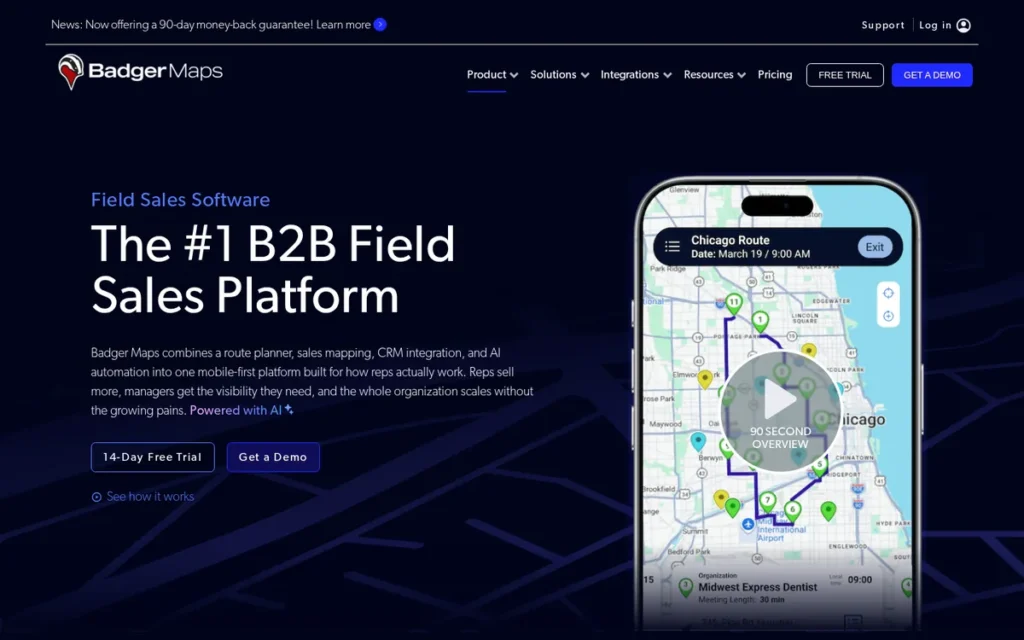
Category: Route Optimizer: a dedicated field sales platform that generates optimized multi-stop daily routes, visualizes customer territories on interactive maps, and syncs field activity bidirectionally to a connected CRM.
At a Glance
- Category: Route Optimizer
- Best For: B2B outside sales reps and field account managers with an existing CRM needing proven route optimization, territory visualization, and a platform their reps will adopt daily
- Price Range: $49/user/month (annual, Pro); $59/user/month (annual, Team); ~$99+/user/month (Enterprise, custom); all tiers publicly listed
- Primary Strength: Badger Maps delivers the most-validated rep adoption experience in the category, backed by consistent unprompted multi-year recommendations from independent practitioner communities and a personal rep-level onboarding model no direct competitor replicates.
- Biggest Limitation: Badger Maps is not a standalone CRM and requires a separate CRM subscription for full bidirectional sync value, creating a two-platform stack cost for teams without an existing CRM.
- One-Line Summary: Badger Maps is the #1 route optimizer for outside sales reps, rated 4.7/5.0 on G2 across 321 reviews (May 2026), listed on the Salesforce AppExchange, and earning the strongest unprompted multi-year practitioner advocacy of any field sales platform evaluated in 2026.
- Last Verified: May 2026
Overview
Badger Maps is a dedicated route optimization and territory visualization platform for B2B outside sales reps and field account managers, founded in 2013 by Steve Benson, a former Google outside sales rep, and available on iOS, Android, and the Salesforce AppExchange. Badger Maps generates optimized routes for up to 120 customer stops per day while syncing field activity bidirectionally to six major CRMs.
Badger Maps integrates natively with Salesforce, HubSpot, Zoho, Microsoft Dynamics, NetSuite, and Insightly, and provides full offline mobile access with automatic sync when connectivity returns, directly addressing the most critical infrastructure pain point for reps in rural or low-signal territories.
Key Features
- 120-Stop Route Optimization: Badger Maps automatically generates the fastest daily route for up to 120 customer stops, incorporating real-time traffic and providing turn-by-turn navigation via Google Maps, Waze, Apple Maps, and CarPlay, reducing daily route planning time to approximately 10 minutes.
- GPS-Triggered Check-ins: Badger Maps provides GPS-triggered customer check-ins with photo capture and visit notes that sync bidirectionally to connected CRM platforms in real time, eliminating post-visit manual data entry from the field.
- Territory Management: Badger Maps delivers territory management tools allowing managers to balance rep workloads by account count or revenue, visualize CRM data layers on interactive maps, and eliminate territory overlap between rep assignments.
- Lead Finder: Badger Maps includes a Lead Finder feature that surfaces new business prospects near a rep’s planned route, allowing reps to fill schedule gaps from cancellations with qualified nearby leads without leaving the routing interface.
- Full Offline Access: Badger Maps offers complete offline mobile functionality: routes, customer data, and check-in logging remain fully operational without a cell signal, with automatic background sync when connectivity is restored.
Best For
Badger Maps is best for B2B outside sales reps and field account managers who already operate an established CRM (Salesforce, HubSpot, Zoho, or Dynamics) and need a proven route optimization and territory visualization layer that their reps will adopt daily, supported by a vendor onboarding model that walks each rep through the tool individually.
Pricing
Badger Maps publishes all pricing publicly. Annual billing per user: Pro $49/month; Team $59/month; Enterprise custom pricing approximately $99+/month. Month-to-month billing: Pro $59/month. No contracts required at Pro and Team tiers. A 14-day free trial is available. For a 10-rep team on the Pro annual plan, total cost is approximately $490/month. Source: Badger Maps pricing page, verified May 2026.
Strengths
- Strongest Practitioner Advocacy in Category: Badger Maps earns the highest organic community advocacy of any platform evaluated, multiple multi-year users on r/b2b_sales (2025) independently recommended Badger Maps and praised its personal rep-level onboarding:
“Badger’s support literally walked each of my team through how to use it. That onboarding meant my reps understood the tool and were happy to use it, at least eventually. And their support team is still available whenever we need.” Posted by u/Ambitious-Swan-9630, r/b2b_sales, 2025
Takeaway: Personal rep-level onboarding from Badger Maps is the most consistently cited factor in successful team adoption, and it is available to all customers, not only enterprise tiers.
- Broadest Verified CRM Integration Portfolio: Badger Maps holds a Salesforce AppExchange listing and native bidirectional sync with six major CRM platforms (Salesforce, HubSpot, Zoho, Microsoft Dynamics, NetSuite, and Insightly) the broadest verified integration portfolio in this evaluation, ensuring field activity reaches the CRM without Zapier latency risks.
- Named Case Study Performance Data: In a case study published in Badger Maps’ Route Optimization Guide (badgermapping.com/blog/route-optimization-guide/, 2025), a field sales team referred to as Aloha documented 50% planning time reduction, 25% drive time cut, and 20% monthly sales increase. Badger Maps also reports aggregate platform results of 20% less driving time per week, 22% increase in sales, and 50% more CRM data captured from the field Badger Maps official website, 2025.
- Practitioner-Founded Product Design: Badger Maps was founded by Steve Benson, a former Google outside sales rep, and this practitioner origin is consistently reflected in design decisions (CarPlay support, offline-first architecture, and rep-workflow-first interface choices) that multi-year field users validate as built by someone who lived the role (Badger Maps official site).
Limitations
- Multi-Platform Stack Requirement: Badger Maps is not a standalone CRM, meaning teams without an existing CRM must subscribe to a separate system (adding per-user cost and integration management overhead) or evaluate whether an all-in-one alternative like SPOTIO or Map My Customers is more cost-effective for their team size.
- Interface Aesthetics Lag Newer Entrants: Badger Maps’ user interface is consistently described by independent practitioners as reliable but not visually modern compared to newer entrants, multiple Reddit threads note the UI is functional but dated relative to Map My Customers and Leadbeam.
- Adoption Contingent on Onboarding Engagement: Badger Maps’ performance is partly contingent on manager-led onboarding in the first 30–60 days:
“I had Badger Maps, I should have spent more time getting the reps comfortable with the interface and building habits to actually use it. They never did.” Posted by u/Strokesite, r/b2b_sales, 2025
Takeaway: Badger Maps’ onboarding support mitigates adoption failure, but only if the manager actively engages the vendor’s walkthrough process during the first 30–60 days of deployment.
Verdict
Badger Maps is the best-validated route optimization platform for B2B outside sales reps with an existing CRM, rated 4.7/5.0 on G2 across 321 reviews (May 2026) with the highest organic practitioner advocacy of any tool in this 2026 evaluation. For B2B field sales teams that have struggled with route inefficiency and CRM data abandonment, Badger Maps is the lowest-risk, highest-evidence starting point evaluated in 2026. Teams requiring a standalone CRM, residential door-to-door canvassing features, or AI-native data capture should evaluate Pipedrive, SalesRabbit, or Leadbeam respectively.
2. Pipedrive: Best for B2B Field Teams Needing Full Pipeline and Deal Management Depth
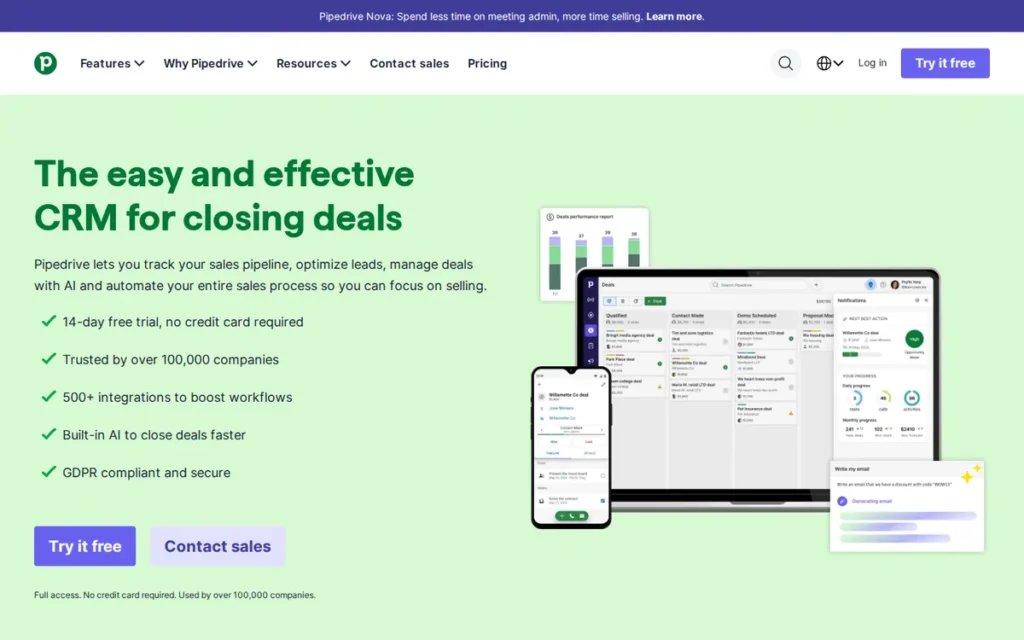
Category: Field CRM: a visual-pipeline sales CRM with full mobile access, AI sales assistance, and field routing capability via third-party integrations, used by over 100,000 companies worldwide.
At a Glance
- Category: Field CRM
- Best For: B2B field sales teams needing full pipeline depth, deal management, and AI-assisted follow-up from the field
- Price Range: $10.75–$69.90/user/month annual (Essential to Enterprise); all 5 tiers publicly listed
- Primary Strength: Pipedrive delivers the deepest pipeline and deal management of any tool evaluated, backed by approximately 3,000 G2 reviews (May 2026), the highest review volume confidence in this field sales evaluation.
- Biggest Limitation: Pipedrive has no native route optimization; field routing requires a paid third-party add-on such as Badger Maps ($49/user/month annual) or Mapsly, adding to total cost for route-dependent workflows.
- One-Line Summary: Pipedrive is a visual-pipeline CRM used by 100,000+ companies worldwide, rated 4.3/5.0 on G2 across approximately 3,000 reviews (May 2026) (the largest verified review base in this evaluation) with mobile CRM access, AI deal assistance, and field routing via Badger Maps or Mapsly integrations.
- Last Verified: May 2026
Overview
Pipedrive is a visual-pipeline CRM built by salespeople for salespeople (founded in 2010 in Tallinn, Estonia by a team that included former enterprise sales professionals frustrated with manager-first CRM design) used by over 100,000 companies worldwide with full mobile access on iOS and Android, an AI Sales Assistant for deal prioritization and follow-up automation, and 500+ Marketplace integrations including Badger Maps and Mapsly for field routing.
Pipedrive functions as a CRM-first platform where field routing is added via integration rather than built in, positioning Pipedrive as the strongest choice for B2B field teams with complex deal pipelines who want to pair best-in-class CRM depth with a preferred routing tool.
Key Features
- Full Mobile Pipeline Management: Pipedrive’s mobile CRM provides complete iOS and Android access to pipeline views, activity logs, contact records, and deal updates in real time, with offline functionality that queues updates and syncs when connectivity is restored.
- AI Sales Assistant: Pipedrive’s AI Sales Assistant analyzes deal activity patterns to surface prioritized follow-up recommendations, identify stalled deals, and flag opportunities at risk of being lost, available at the Professional tier and above.
- Field Routing via Marketplace: Pipedrive integrates with Badger Maps and Mapsly via its Marketplace for route optimization, territory management, and GPS check-in workflows, with bidirectional data sync so field visit activity appears in Pipedrive records automatically.
- 500+ App Integrations: Pipedrive connects to Zapier, Google Workspace, Microsoft 365, DocuSign, Zoom, Slack, and 490+ additional business tools, enabling field teams to connect their existing tech stack without custom development.
- Enterprise-Grade Security: Pipedrive holds SOC 2 compliance, GDPR compliance, and AES-256 encryption with infrastructure hosted across Rackspace and AWS, providing enterprise security for field teams handling sensitive customer data on public or cellular networks (Pipedrive official site).
Best For
Pipedrive is best for B2B field sales teams that manage significant deal volume and require full pipeline management, deal-stage tracking, and AI-assisted follow-up, particularly teams already using or planning to use Badger Maps for routing, or those that want the flexibility to pair best-in-class CRM depth with a preferred routing tool rather than accepting a single all-in-one platform’s routing capabilities.
Pricing
Pipedrive publishes all pricing publicly. Annual billing per user per month: Essential $10.75; Advanced $19.90; Professional $34.90; Power $49.90; Enterprise $69.90. Monthly billing rates are approximately 38–42% higher. The AI Sales Assistant is available from the Professional tier. Field routing add-ons (Badger Maps from $49/user/month annually, Mapsly separately priced) increase total cost for route-dependent workflows. Free trial available. Source: Pipedrive pricing page, verified May 2026.
Strengths
- Unmatched Review Volume Confidence: Pipedrive holds the highest review volume of any platform in this evaluation, rated 4.3/5.0 across approximately 3,000 G2 reviews (May 2026), 4.5/5.0 across 7,200+ Capterra reviews, and 4.3/5.0 across 2,800+ Trustpilot reviews, providing statistical reliability that early-stage competitors with sub-50-review scores cannot replicate.
- Named, Verifiable ROI Case Studies: Pipedrive has published named ROI case studies with specific outcomes, Y-Brush (oral care company) reported saving 30% time per lead using Pipedrive’s mobile field tracking (Pipedrive Mobile CRM page, 2025). Multiple additional Pipedrive case studies document significant revenue growth for field services companies, attributing pipeline visibility and mobile activity tracking as key drivers (Pipedrive case studies, 2025).
- Lowest Transparent Entry Price: Pipedrive offers the lowest transparently listed entry price of any platform in this evaluation at $10.75/user/month annually, with all tier pricing publicly available, enabling self-directed buyers to calculate total team cost before engaging a sales representative (Pipedrive pricing page, May 2026).
- Proprietary AI Productivity Benchmark: Pipedrive reports that 74% of sales professionals using AI tools, including Pipedrive’s AI Sales Assistant, report increased productivity, per the Pipedrive 2025 State of Sales and Marketing Report, the only proprietary benchmark study published by any vendor in this evaluation.
Limitations
- No Native Route Optimization: Pipedrive has no built-in route planning capability, requiring field teams to subscribe to a paid third-party add-on such as Badger Maps ($49/user/month annual) or Mapsly, effectively making the affordable CRM entry price more expensive in practice for route-dependent field workflows once routing costs are added.
- Platform Ceiling for Growing Teams: Pipedrive’s niche sales-team focus, while a genuine strength, becomes a limitation for companies anticipating expansion into marketing automation, field service scheduling, or complex operational CRM needs:
“It is niche, but that also means not extendable.” Posted by u/Interesting_Button60, r/CRM, 2025
Takeaway: Teams anticipating growth into marketing automation, service operations, or multi-department CRM usage should evaluate whether Pipedrive’s sales-only focus will require a platform migration at a later stage.
- Advanced Field Features Behind Higher Tiers: Pipedrive locks AI Sales Assistant, field-relevant automation, and full Marketplace integration behind the Professional tier ($34.90/user/month annual) and above, meaning the $10.75 entry tier does not deliver the field-relevant feature depth that makes Pipedrive compelling for outside sales teams.
Verdict
Pipedrive is the highest-reviewed CRM in this evaluation by a decisive statistical margin, rated 4.3/5.0 across approximately 3,000 G2 reviews (May 2026) and backed by named, verifiable ROI case studies, making it the most defensible choice for B2B field sales managers who need to justify software investment with credible third-party evidence. Pipedrive is the strongest selection for teams that prioritize full pipeline and deal management depth, want the lowest transparent entry price in the category, and are willing to add Badger Maps or Mapsly for routing. Teams that want route optimization, territory management, and CRM in a single native application should evaluate Badger Maps combined with their existing CRM, or SPOTIO for a fully integrated all-in-one alternative.
3. SPOTIO: Best for Territory Management and Native Lead Prospecting for Mid-Market Outside Sales Teams
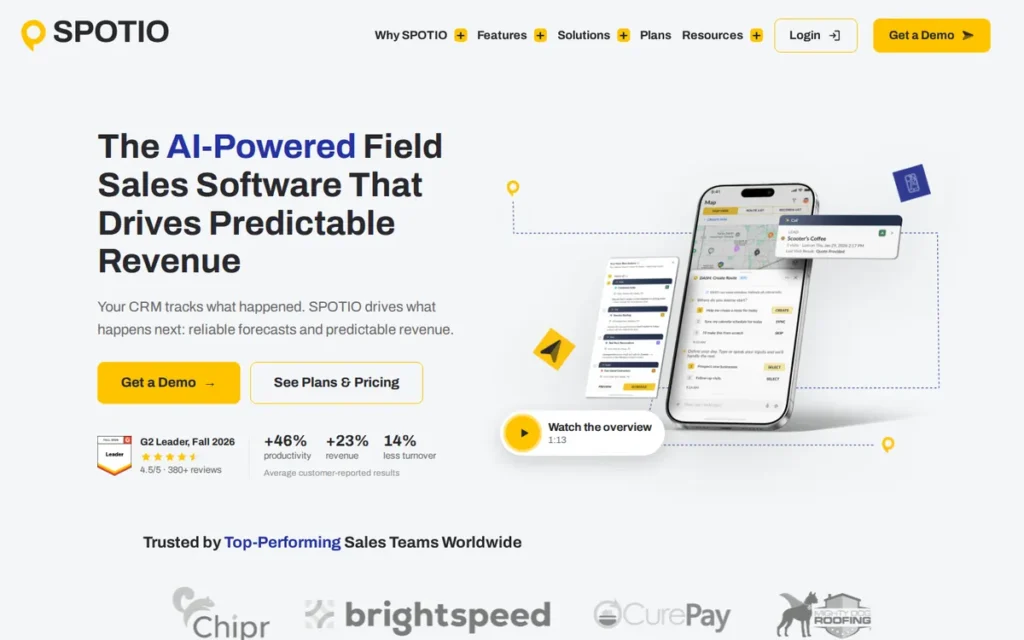
Category: Territory and Prospecting Platform: an all-in-one field sales execution platform that combines territory management, data-enriched lead prospecting, route planning, CRM sync, digital contracts, rep tracking, and performance gamification in a single mobile-first application.
At a Glance
- Category: Territory and Prospecting Platform
- Best For: Mid-market outside sales teams (10–500+ reps) in solar, telecom, pest control, and home security needing native prospecting and territory management
- Price Range: ~$39–$99+/user/month annual (estimated from third-party sources; not publicly listed on spotio.com as of May 2026)
- Primary Strength: SPOTIO’s Lead Machine provides data-enriched prospecting with 15+ demographic filter overlays on territory maps, the deepest native lead prospecting capability documented in this evaluation as of May 2026.
- Biggest Limitation: Pricing is not published on SPOTIO’s public website, requiring a sales conversation before self-directed cost evaluation.
- One-Line Summary: SPOTIO is a purpose-built field sales platform rated 4.5/5.0 on G2 across 386 reviews (May 2026), rated #1 by users in territory management comparison grids, with a Lead Machine offering 15+ demographic data filters not matched in depth by any direct competitor in this evaluation.
- Last Verified: May 2026
Overview
SPOTIO is a mobile-first field sales engagement platform built for outside sales teams ranging from 5 to 500+ reps (founded in 2014 and headquartered in Addison, Texas) serving solar, telecom, pest control, and home security teams with an integrated territory-to-close workflow. SPOTIO combines territory management, Lead Machine prospecting, route optimization, GPS check-ins, CRM sync, digital contracts, rep activity tracking, and AI-assisted sales guidance.
SPOTIO holds a G2 rating of 4.5/5.0 across 386 reviews (May 2026), with territory management consistently rated its top feature category in G2 comparison grids, but buyers should note that pricing is not publicly listed, and verified named ROI case studies with quantified outcomes are not currently available from public sources.
Key Features
- Lead Machine Prospecting: SPOTIO’s Lead Machine allows field reps to prospect within their territory using 15+ demographic filter criteria, including home value, household income, property type, and owner vs. renter status, overlaid on an interactive territory map, including Google Places integration for B2B prospecting.
- Bi-Directional CRM Sync: SPOTIO provides automatic GPS-tagged activity logging with bi-directional sync to Salesforce, HubSpot, and Microsoft Dynamics, so rep check-ins, notes, and status updates flow to the connected CRM without manual data entry.
- Territory Management with 200+ Data Overlays: SPOTIO’s territory management module lets managers assign, visualize, and adjust territories using map-based tools with 200+ demographic data overlay points, eliminating territory overlap and enabling fair workload distribution.
- Gamification and Rep Tracking: SPOTIO includes gamification leaderboards, activity tracking, and rep performance dashboards at the Professional tier and above, providing managers real-time visibility into daily field activity and competitive motivation tools for distributed teams.
- Digital Closing Tools: SPOTIO supports digital proposals, contracts, and e-signature capture in the field, enabling reps to close deals and collect customer authorization on-site during a visit without returning to a desktop.
Best For
SPOTIO is best for mid-market outside sales teams of 10 to 500+ reps in B2C or outbound B2B industries (particularly solar, telecom, pest control, and home security) that need to prospect new leads within defined territories, track rep activity in real time, manage territory assignments across a distributed team, and close deals with digital contracts, all within a single platform that syncs automatically to Salesforce or HubSpot.
Pricing
SPOTIO does not publish pricing on its public website as of May 2026. Estimated pricing from third-party comparison analyses: Starter approximately $39/user/month (annual); Professional approximately $69/user/month (annual, includes Lead Machine, gamification, and automation); Enterprise approximately $99+/user/month with custom terms and SPOTIO AI. A 14-day free trial is available. Before booking a demo, ask SPOTIO: (1) full per-seat pricing by tier, (2) annual vs. monthly billing rates, (3) minimum seat requirements, and (4) any required professional services fees. Pricing estimates sourced from third-party comparison analyses, verify directly with SPOTIO for current rates, May 2026.
Strengths
- Top-Rated Territory Management: SPOTIO holds a G2 rating of 4.5/5.0 across 386 reviews (May 2026) and consistently ranks above competitors in territory management comparison grids on G2, rated its #1 feature category by users in territory management comparisons per SPOTIO’s own platform satisfaction data (spotio.com/platform/, 2025).
- Unmatched Native Lead Prospecting Depth: SPOTIO’s Lead Machine provides data-enriched lead prospecting with 15+ demographic filter criteria overlaid on territory maps, including home value, household income, property type, and owner vs. renter status, a native prospecting depth not matched at comparable specificity by any other platform in this evaluation as of May 2026.
- Automatic CRM Data Architecture: SPOTIO provides bi-directional CRM sync with Salesforce, HubSpot, and Microsoft Dynamics using automatic GPS-tagged check-ins, so CRM records are updated by rep location and activity without requiring manual input, addressing the CRM disconnection pain point at the system architecture level.
- All-in-One Cost Efficiency: SPOTIO’s unified architecture spanning territory management, prospecting, route optimization, digital contracts, rep tracking, and gamification reduces the multi-tool subscription cost that teams using separate CRM, routing, and prospecting platforms typically incur, particularly relevant for teams in the 10–50 rep range where RevOps resources are limited.
This community perspective from r/CRM captures where SPOTIO delivers and where operational gaps remain:
“If commission tracking is your main issue, most door to door CRMs alone won’t handle it well. SalesRabbit or SPOTIO are solid for field reps, but you’ll likely need something customizable (like monday or similar) to properly track payouts. Most teams end up using a combo instead of forcing one tool to do everything.” Posted by u/ChestChance6126
Takeaway: SPOTIO’s all-in-one value proposition is real for core field execution workflows, but teams with complex compensation structures should budget for supplementary tools, the platform’s strength is territory and prospecting, not back-office sales operations.
Limitations
- Pricing Opacity: SPOTIO does not publish pricing on its public website, meaning teams cannot estimate total cost before entering a sales conversation, a friction point that Pipedrive, Badger Maps, and SalesRabbit avoid by publishing transparent pricing, creating an unintentional disadvantage for self-directed buyers.
- No Publicly Named ROI Case Studies: SPOTIO references a 34% productivity improvement from HubSpot’s research and territory management satisfaction data from its own platform surveys, but neither represents an independently verifiable named client result with attributed metrics, making internal purchase justification harder than with tools that publish named case studies.
- Routing Depth vs. Badger Maps: Teams needing the deepest route optimization: 120-stop daily accuracy, CarPlay integration, and Salesforce AppExchange enterprise certification, should note that Badger Maps outperforms SPOTIO specifically on routing depth and rep adoption evidence, while SPOTIO leads on prospecting and territory management breadth.
A B2B field sales manager who ran a head-to-head evaluation across all three top platforms confirmed this routing depth gap on r/b2b_sales:
“I was literally looking for the same thing last year (and came to reddit for recommendations). I ended up demo’ing Badger Maps, MMC, and Spotio. Ended up going with Badger Maps and the team all seems to like it quite a bit. It checks all of your boxes that you listed.” Posted by u/IncreaseNo6220
Takeaway: In competitive B2B field team evaluations where SPOTIO, Badger Maps, and Map My Customers are all demo’d, Badger Maps consistently wins final selection among teams with an existing CRM, validating SPOTIO’s third-place ranking in this evaluation for route-optimization-primary use cases.
Verdict
SPOTIO is the most feature-complete all-in-one field sales execution platform in this evaluation, rated 4.5/5.0 on G2 across 386 reviews (May 2026) with the only native data-enriched lead prospecting capability of its depth in the category as of 2026, making it the strongest choice for mid-market outside sales teams that need prospecting, territory management, and rep tracking without assembling a multi-platform stack. SPOTIO ranks third rather than first because pricing opacity requires a sales conversation before self-directed cost evaluation, and because the absence of publicly named ROI case studies limits buyers’ ability to build an evidence-backed internal business case. Teams prioritizing route optimization depth and transparent pricing should evaluate Badger Maps; teams prioritizing full pipeline CRM depth should evaluate Pipedrive.
4. Leadbeam: Best for AI-First CRM Automation and Teams Struggling with Low CRM Data Completeness

Category: AI Field Platform: a mobile-native, AI-first field sales platform that automates CRM data capture via voice notes and photos, surfaces AI-enriched prospect intelligence on territory maps, and drafts follow-up communications from field meeting notes.
At a Glance
- Category: AI Field Platform
- Best For: Field teams with HubSpot or Salesforce suffering from low CRM data completeness; early adopters willing to accept emerging platform risk for AI-native automation
- Price Range: $49/user/month annual or $65/user/month quarterly; Enterprise pricing via direct contact
- Primary Strength: Leadbeam’s AI converts a 10-second voice note or business card photo into a complete CRM record, the only tool in this evaluation attacking CRM abandonment at the input mechanism level as of May 2026.
- Biggest Limitation: Early-stage platform with a very small verified review base and key company details (including founding date, team size, and funding history) not publicly disclosed; insufficient G2 sample size for statistical confidence.
- One-Line Summary: Leadbeam is an AI-native field platform converting voice notes to CRM records in under 10 seconds, mapping 30M+ businesses via its Atlas database, backed by two named case studies: B+M Industrial (10x CRM data, 2025) and SumUp (300% sales activity increase, 2025), the most advanced AI option for teams accepting early-stage platform risk.
- Last Verified: May 2026
Overview
Leadbeam is an AI-native, mobile-first field sales platform purpose-built for the mobile and AI era of outside sales, designed to eliminate the manual CRM data entry that prevents field reps from updating records consistently. Leadbeam reduces CRM input to a 10-second voice note or a photo of a business card that the platform’s AI converts into a complete, structured CRM record automatically.
Leadbeam also includes:
- Atlas database: 30M+ businesses with firmographic data, tech stack intelligence, and intent signals for territory prospect discovery
- AI battlecards: pre-meeting preparation surfacing win themes and objection handling from account data
- Smart route optimization: priority-based, traffic-aware daily scheduling
- Context-aware follow-up drafting: personalized emails generated automatically from voice meeting notes
- Manager dashboard: real-time field visibility, rep performance metrics, and live pipeline forecasting
Key Features
- AI CRM Capture in Under 10 Seconds: Leadbeam’s AI converts a 10-second voice note recorded after a customer visit (or a photo of a business card) into a structured CRM record with all relevant fields populated automatically, eliminating the post-visit manual entry step that causes CRM data abandonment across the majority of field teams.
- Atlas Database (30M+ Businesses): Leadbeam’s Atlas database surfaces 30M+ businesses on an interactive territory map with firmographic data, tech stack insights, and intent signals, allowing reps to identify and prioritize high-ICP prospects within their territory without importing or maintaining separate lead lists.
- AI Battlecards: Leadbeam generates AI battlecards before each customer meeting, surfacing win themes, competitive objection handling, and account context automatically from the customer’s data profile, a pre-meeting AI battlecard capability not documented in any other evaluated platform as of May 2026.
- Manager Dashboard with Live Forecasting: Leadbeam’s manager dashboard provides real-time field visibility into rep locations, activity metrics, pipeline progress, and live revenue forecasting, giving managers the performance data they need without requiring reps to manually log updates.
- Context-Aware Follow-Up Drafting: Leadbeam drafts personalized follow-up emails from voice meeting notes automatically, reducing post-visit administrative time without requiring a separate sales enablement platform.
Best For
Leadbeam is best for field sales teams that already operate a CRM (HubSpot or Salesforce) but suffer from chronically low CRM data completeness (typically under 30–50% of visits logged) and for early-adopter sales leaders willing to accept the credibility gaps of an emerging platform in exchange for AI-native workflow automation that no legacy competitor currently replicates at the same depth.
Pricing
Leadbeam pricing is confirmed at approximately $49/user/month billed annually or $65/user/month billed quarterly, per the platform’s published AI sales tools comparison table (Leadbeam blog, May 2026). CRM integrations are included at this price with no separate add-on fees for AI features. Enterprise and custom pricing is available via direct contact at leadbeam.ai/pricing. Before committing, ask Leadbeam: (1) complete tier structure and minimum seat requirements, (2) specific Salesforce and HubSpot integration architecture details, and (3) any setup fees. Pricing verified May 2026.
Strengths
- Two Named Case Studies with Quantified Outcomes: Leadbeam is backed by two published named case studies. B+M Industrial reported 10x more CRM data captured post-implementation, with company leadership at B+M Industrial stating: “Leadbeam is driving efficiency in our workflow. The way it integrates with HubSpot allows us to capture and log detailed contact information with just a few taps” (Leadbeam case studies, 2025). SumUp, a global fintech company, reported a 300% increase in sales activity and more than one hour per day saved per rep post-implementation (Leadbeam case studies, 2025).
- Largest Documented CRM Compliance Improvement: Leadbeam’s AI input mechanism directly solves CRM abandonment at the technical level, a Fortune 50 CPG company reported CRM data completeness jumping from under 30% to significantly higher post-deployment (Leadbeam blog, 2025), representing the largest CRM compliance improvement documented by any platform in this evaluation.
- 30M+ Business Intelligence for Territory Prospecting: Leadbeam’s Atlas database provides 30M+ businesses with firmographic enrichment, tech stack data, and intent signals, combining the geographic map interface of Badger Maps with AI-scored lead prioritization, addressing both the “where to go” and “who to prioritize” questions in a single interface (Leadbeam 2.0 launch blog, 2025).
- AI-Era Feature Set Not Documented Elsewhere: Leadbeam is the only platform in this evaluation explicitly designed for the AI era of outside sales (with AI battlecards, context-aware follow-up drafting, and intent signal prospecting) directly addressing the administrative overhead pain points most consistently cited by field reps in practitioner community discussions.
Limitations
- Early-Stage Maturity Risk: Leadbeam’s G2 rating of 4.9/5.0 carries insufficient statistical reliability given its very small, unconfirmed review count, a 4.3 rating across approximately 3,000 reviews (Pipedrive) provides far more predictive confidence than a 4.9 rating across fewer than 20. Leadbeam’s company background, including founding date, team size, funding history, and executive profiles, is not publicly available on any accessible source as of May 2026, meaning enterprise procurement teams cannot complete standard due diligence from public sources alone and must rely on direct vendor disclosure before any contract commitment.
- Unverified Self-Reported Aggregate Metrics: Leadbeam’s aggregate performance statistics (300% sales activity increase at the platform level, 33% higher conversion rates, 5–7 hours saved per rep per week) are self-reported figures that have not been independently verified and should be treated as directional indicators rather than confirmed benchmarks while the platform builds its independent review base.
- Integration Verification Gaps at Scale: Leadbeam’s integrations with HubSpot (confirmed via B+M Industrial case study) and Salesforce (mentioned in platform documentation) have not been independently stress-tested at scale in public research, buyers with complex CRM configurations should request a technical integration review and pilot before committing to full-team deployment.
Verdict
Leadbeam offers the most AI-native feature set in this 2026 evaluation, voice-to-CRM capture, AI-enriched prospecting intelligence, pre-meeting battlecards, and context-aware follow-up automation, capabilities not replicated at this depth by any other evaluated platform as of May 2026, backed by two named case studies showing 10x CRM data at B+M Industrial and 300% sales activity increase at SumUp. Leadbeam ranks fourth rather than higher because its very small verified review base, undisclosed company details, and early-stage maturity introduce adoption and continuity risk that more established platforms do not present. Sales leaders who prioritize AI-native automation over proven platform stability, and who are evaluating Leadbeam for a team already using HubSpot or Salesforce, will find it the strongest forward-looking option in the category.
5. SalesRabbit: Best for Residential Door-to-Door Canvassing Teams in Solar, Roofing, and Home Services
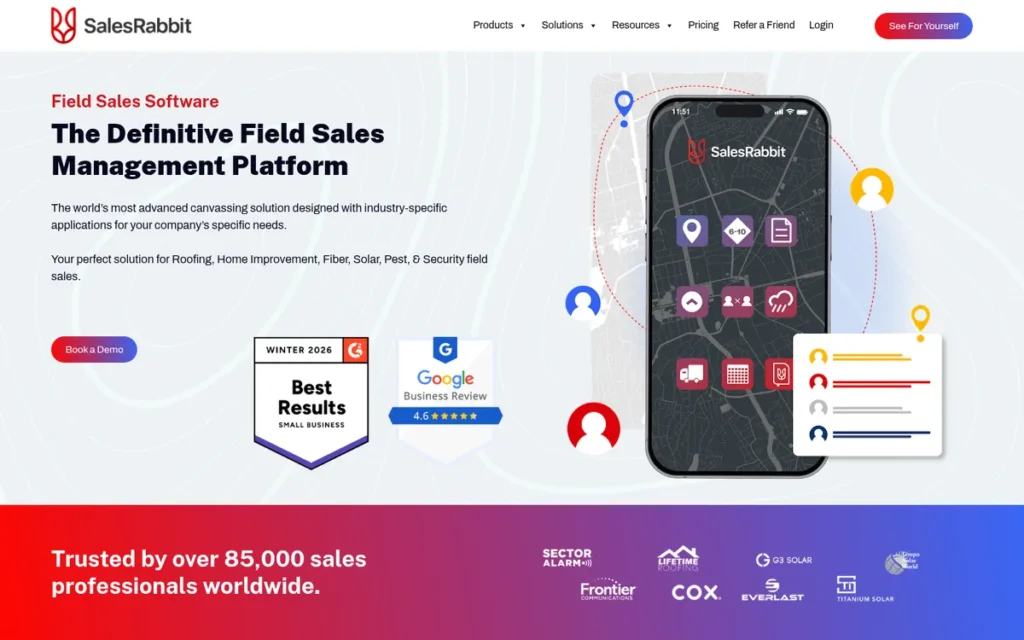
Category: D2D Canvassing Platform: a purpose-built door-to-door and residential field canvassing platform with AI homeowner lead scoring, territory mapping, gamification, digital proposals, and e-signature for residential outside sales teams in solar, roofing, pest control, and home services.
At a Glance
- Category: D2D Canvassing Platform
- Best For: Residential door-to-door sales teams in solar, roofing, home security, and pest control needing AI homeowner scoring, gamification, and on-the-door digital closing
- Price Range: ~$41–$59/user/month annual; ~$83/user/month with DataGrid AI (community-verified, r/sales, 2025); setup fees required; annual contracts standard
- Primary Strength: SalesRabbit’s DataGrid AI assigns machine-learning Buyer Scores to individual homes using homeowner demographics, the most granular residential lead prioritization in this evaluation.
- Biggest Limitation: Per-seat annual contracts create measurable financial risk for high-turnover D2D teams paying for reps who depart before contract term, independently documented by multiple community users.
- One-Line Summary: SalesRabbit is the leading D2D canvassing platform used by 85,000+ sales professionals (self-reported, 2025), rated approximately 4.2–4.5/5.0 on G2 across ~190–200 reviews, with DataGrid AI homeowner scoring and Amplify gamification that no direct competitor in this evaluation replicates.
- Last Verified: May 2026
Overview
SalesRabbit is a purpose-built door-to-door and residential field canvassing platform founded in 2013 and used by 85,000+ sales professionals (SalesRabbit, self-reported, 2025), making it the most widely adopted D2D canvassing tool in this evaluation by reported user scale. SalesRabbit operates as an integrated suite of 9 applications under one login: territory mapping, DataGrid AI homeowner scoring, Amplify gamification, digital proposals, e-signature, GPS tracking, weather/hail overlays, and rep performance dashboards.
SalesRabbit’s DataGrid AI homeowner prioritization and storm-overlay routing for roofing teams provide capabilities in the residential D2D context that no other evaluated platform replicates.
Key Features
- DataGrid AI Homeowner Scoring: SalesRabbit’s DataGrid AI assigns machine-learning Buyer Scores to individual residential homes based on homeowner name, age, marital status, soft credit score, home value, and propensity to buy, allowing reps to prioritize the highest-value doors in their territory before canvassing begins.
- Amplify Gamification Module: SalesRabbit’s Amplify module provides gamification with competitive leaderboards, team challenges, real-time activity tracking, and performance visibility, designed to motivate distributed D2D reps operating in isolation through goal-driven competition.
- Weather and Hail Storm Overlays: SalesRabbit provides weather and hail storm overlay maps for territory management, allowing roofing teams to identify storm-impacted neighborhoods and prioritize canvassing where storm-damage inspection and repair sales cycles are immediately active.
- Digital Proposals and E-Signature: SalesRabbit supports digital proposals, contracts, and e-signature capture at the door, enabling reps to present branded proposals and finalize agreements on-site without returning to the office.
- GPS Territory Tracking: SalesRabbit’s GPS territory management gives managers real-time visibility into which reps are working which territories, with heat-map views of knock activity density and daily progress reporting.
Best For
SalesRabbit is best for residential door-to-door sales teams of 5 to 200+ reps in solar, roofing, home security, and pest control that need AI homeowner lead prioritization, gamification to drive rep motivation in rejection-heavy environments, and digital closing capabilities at the door, and for managers who can absorb the per-seat contract cost risk given their team’s rep turnover rate.
Pricing
SalesRabbit pricing is not fully publicly listed but is confirmed from third-party sources and community-verified benchmarks at approximately $41–$49/user/month annually for base tiers, with setup fees required. DataGrid AI is an add-on bringing cost to approximately $83/user/month:
“Only took about 2 deals to make that back” in home security, one r/sales user verified a 3-rep DataGrid AI package at approximately $3,000/year ($83/rep/month) in 2025. Posted by u/Dicklefart, r/sales, 2025
Takeaway: For high-ticket residential products where one or two closed deals cover annual platform cost, SalesRabbit with DataGrid AI can generate positive ROI even at $83/rep/month, but this math breaks down for lower-margin products or teams with high early-stage turnover.
Annual contracts are standard. High-turnover teams should explicitly ask about seat release and contract flexibility terms before committing. Pricing verified May 2026 from third-party sources and community benchmarks.
Strengths
- Largest D2D User Base in Evaluation: SalesRabbit has achieved broader D2D market adoption than any other canvassing platform evaluated (85,000+ sales professionals (SalesRabbit, self-reported, 2025)) representing the deepest D2D use-case validation of any tool in this evaluation (SalesRabbit vs. SPOTIO comparison page, May 2026).
- Most Granular Residential Lead Prioritization: SalesRabbit’s DataGrid AI uses machine learning applied to homeowner-level data (including name, age, marital status, soft credit score, home value, and purchase propensity) to generate Buyer Scores for individual homes, confirmed by community users in solar and home security as meaningfully improving door-knock conversion rates versus unscored canvassing.
- Dedicated Gamification Platform: SalesRabbit’s Amplify module is the only dedicated, purpose-built gamification application in this evaluation, with leaderboards, challenges, and real-time team performance visibility designed for distributed D2D reps who operate without manager supervision, directly addressing the motivation and accountability driver of high turnover in canvassing teams.
- 12+ Year Platform Stability: SalesRabbit was founded in 2013 and provides the stability assurance of a 12+ year operational history serving the D2D market through multiple economic cycles, a continuity signal relevant for enterprise buyers evaluating long-term platform risk.
Limitations
- Per-Seat Contract Cost Risk: SalesRabbit’s annual per-seat contract pricing creates measurable financial exposure for D2D teams with high rep turnover:
“I got killed on buying seats for reps that didn’t work out. Solid app otherwise.” Posted by u/Sorry_Operation_3555, r/Solarsales, 2025
Takeaway: High-turnover D2D teams should calculate the expected cost of contracted seats for reps who depart before term as a formal budget line item, not an exception, and request explicit seat-release terms in any contract before signing.
- Limited CRM Depth: SalesRabbit’s CRM is significantly shallower than full-platform CRMs like Pipedrive, making SalesRabbit less suitable for complex B2B deal pipeline management, multi-stage opportunity tracking, or teams that need robust contact history outside of canvassing activity records.
- Lower Review Scores and Support Complaints: SalesRabbit’s G2 rating of approximately 4.2–4.5/5.0 (estimate from third-party comparison sources, May 2026) is the lowest confirmed range in this evaluation, with Capterra reviews rating customer service at approximately 4.1/5.0 (the lowest customer service subcategory score confirmed across any platform) reflecting documented complaints about mobile performance issues and slow support ticket resolution.
Verdict
SalesRabbit is the strongest platform in this evaluation for residential door-to-door canvassing teams in solar, roofing, home security, and pest control, used by 85,000+ sales professionals (self-reported, 2025) with DataGrid AI homeowner scoring and Amplify gamification capabilities that no competitor in this evaluation replicates. SalesRabbit ranks fifth overall because its narrower use-case applicability (residential D2D rather than B2B field), lower confirmed G2 score relative to top-ranked tools, structural per-seat contract pricing risk for high-turnover teams, and absence of named quantitative ROI case studies limit its overall recommendation breadth. Teams outside residential D2D canvassing should strongly consider Badger Maps, SPOTIO, or Pipedrive based on their specific field workflow.
6. portatour: Best for B2B Recurring-Visit Scheduling in Pharmaceutical, FMCG, and Distribution Teams
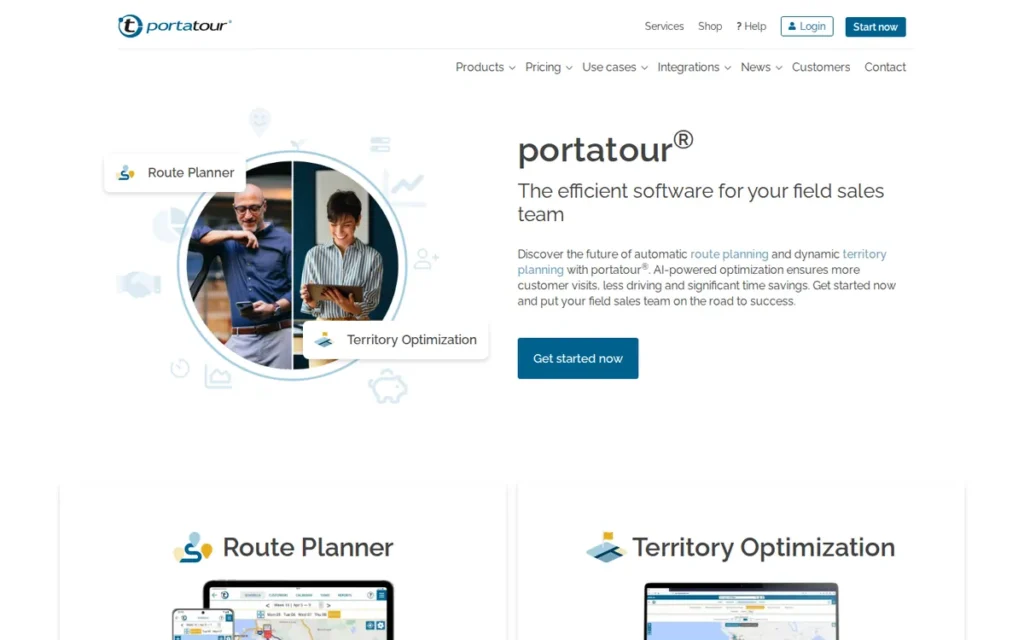
Category: Visit Scheduling Engine: a specialized field sales scheduling and route optimization platform that automates which customers to visit and when, based on configured visit frequency priority tiers, managing multi-week recurring coverage cycles for B2B field teams in pharmaceutical, FMCG, manufacturing, and distribution.
At a Glance
- Category: Visit Scheduling Engine
- Best For: B2B field sales teams in pharma, FMCG, manufacturing, or distribution managing large recurring account bases with contractually defined visit frequencies
- Price Range: From €89.95/month (~$96–100 USD at May 2026 exchange rates); per-user vs. team pricing structure not publicly confirmed, pricing verified May 2026 from Software Advice
- Primary Strength: portatour’s scheduling algorithm automatically determines which customers to visit on which days based on frequency priority rules, the only platform in this evaluation providing native visit-cycle compliance automation as of May 2026.
- Biggest Limitation: Web-based mobile interface only; no native iOS or Android app, the only evaluated platform without a dedicated mobile application as of May 2026.
- One-Line Summary: portatour is a visit scheduling and route optimization platform established since 2007, used by 1,500+ companies across 20+ countries (including SONAX (confirmed) and Samsung and Trupanion (cited in vendor-submitted profiles, not independently confirmed as of May 2026)) automating which B2B customers to visit and when based on configured visit frequency priority tiers.
- Last Verified: May 2026
Overview
portatour is a specialized field sales scheduling and route optimization platform established in 2007 (making it the oldest platform in this evaluation by more than six years) used by 1,500+ companies across 20+ countries, with a proprietary scheduling algorithm that automates the recurring visit planning workflow for B2B field teams managing large customer bases with defined visit frequency requirements.
portatour is explicitly designed for field sales reps who need to ensure every A-priority client is visited monthly and every B-priority client is visited quarterly, automating the “which customer to visit when” decision rather than simply optimizing a manually compiled list. portatour supports centralized desktop planning by managers, decentralized mobile planning by reps, and hybrid combinations simultaneously.
Key Features
- Visit-Cycle Scheduling Algorithm: portatour’s scheduling algorithm automatically generates rep visit schedules based on configured customer priority tiers (A, B, C) and visit frequency requirements, determining which customers to visit on each day to maximize coverage compliance across a full territory cycle, not just optimizing a single day’s manually entered route.
- Up to 25% Driving Distance Reduction: portatour optimizes routes to reduce driving distance by up to 25% (self-reported, portatour official site, 2025) while dynamically adjusting for real-time traffic, appointment updates, and schedule changes, handling up to 125 customer calls per day per rep within its scheduling framework.
- Centralized and Decentralized Planning: portatour supports simultaneous centralized planning (managers on desktop), decentralized planning (reps on mobile browser), and hybrid workflows with bidirectional sync, enabling organizations with multiple planning stakeholders to operate within one unified scheduling system.
- Native Salesforce and Dynamics Integration: portatour provides native integration with Salesforce.com and Microsoft Dynamics CRM with automatic bidirectional synchronization, with new customer additions triggering immediate route recalculation, providing enterprise-grade CRM connectivity without Zapier dependency (portatour features page).
- Fleet Cost and Emissions Tracking: portatour provides fleet cost reduction and CO2 emission tracking alongside sales visit coverage metrics, offering operational and sustainability reporting for enterprise teams with environmental reporting requirements.
Best For
portatour is best for B2B field sales teams in pharmaceutical, FMCG, manufacturing, insurance, or distribution that manage 50+ recurring customer accounts per rep with defined visit frequencies, and for organizations already running Salesforce or Microsoft Dynamics that need an automated visit-cycle compliance layer on top of their existing CRM.
Pricing
portatour’s starting price is confirmed at €89.95/month (approximately $96–100 USD at May 2026 exchange rates), sourced from Software Advice profile data. Whether this rate is per user or a team base price, and whether annual discounts apply, was not confirmed in research. Before committing, ask portatour directly: (1) per-user vs. platform pricing, (2) minimum seat requirements, (3) annual billing discounts, and (4) trial availability. Pricing verified May 2026 from Software Advice, confirm directly with portatour for current rates.
Strengths
- Longest Track Record with Named Clients: portatour has served 1,500+ companies across 20+ countries since its founding in 2007, a 17+ year operational history. Named clients include SONAX (automotive care, confirmed via promotional materials). Samsung and Trupanion are cited in vendor-submitted profiles (SoftwareFinder portatour profile, 2025) but were not independently confirmed through primary sources during this evaluation.
- Unique Visit-Cycle Compliance Automation: portatour’s scheduling algorithm solves a specific problem no other evaluated platform addresses (automatically determining which customers to visit on which days based on configured frequency priority tiers) eliminating the hours of manual territory planning that field sales managers in pharmaceutical, FMCG, and distribution spend each week managing visit cycle compliance.
- Enterprise-Grade CRM Integration: portatour provides native Salesforce.com and Microsoft Dynamics CRM integration with automatic bidirectional synchronization, allowing new customer additions to trigger immediate route recalculation, avoiding the data latency issues common with Zapier-based integrations (portatour features page).
- Transparent Community Honesty: An independent Reddit user endorsed portatour with direct confidence in a competitive tools thread:
“Portatour! Worth the price.” Posted by u/straubster, r/smallbusiness
Takeaway: Unprompted single-word endorsements from practitioners in competitive tool-comparison threads carry high signal value, this user had evaluated alternatives and chose to recommend portatour specifically.
In a separate thread, a portatour team member demonstrated unusual candor by advising a potential customer that portatour was not the right fit for their specific use case, a transparency signal that builds rather than erodes buyer trust.
Limitations
- No Native Mobile App: portatour’s most consequential limitation is its web-based mobile interface, portatour is the only platform in this 2026 evaluation with a confirmed web-based mobile interface rather than a dedicated iOS or Android application, making it vulnerable to browser access interruptions in low-connectivity rural field environments precisely when reps need the tool most. Buyers should verify this limitation against portatour’s current release before finalizing any evaluation decision.
- Setup Complexity and Support Concerns: Partial G2 review snippets flag setup and support issues (users describe portatour as “complicated to set up,” note that “customer service is not the friendliest,” and call the pricing “overpriced”) suggesting the scheduling algorithm’s power comes with a steep onboarding investment and limited self-serve support options.
- Narrow Applicable Use Case: portatour is explicitly not designed for door-to-door canvassing, one-time prospect visits, or high-frequency residential sales, confirmed directly by a portatour team member on Reddit (u/andrlac, r/smallbusiness), meaning teams outside recurring-relationship B2B field sales in pharmaceutical, FMCG, or distribution contexts should evaluate other options in this list.
Verdict
portatour is the strongest available platform for B2B field sales teams whose core challenge is recurring visit cycle management across large account bases, a specific and underserved problem no other evaluated tool addresses with comparable algorithmic sophistication, backed by 17+ years of operation and confirmed named client SONAX (SoftwareFinder, 2025). portatour ranks sixth overall because its web-only mobile interface, unconfirmed review platform scores with negative quality signals, premium entry pricing at approximately €89.95/month, and narrow applicable use case limit its recommendation to a specific buyer profile. Teams outside pharmaceutical, FMCG, distribution, or other recurring-relationship B2B fieldsales contexts should evaluate Badger Maps, SPOTIO, or Pipedrive based on their workflow type.
7. Map My Customers: Best for Small Field Teams Wanting a Single Lightweight CRM-Plus-Mapping Tool
Category: Mapping CRM: a mobile-first field sales CRM that combines customer and prospect mapping, daily route planning, activity logging, and pipeline tracking in a single lightweight platform for small-to-mid field sales teams.
At a Glance
- Category: Mapping CRM
- Best For: Small field sales teams of 3–15 reps without an existing CRM wanting one clean, lightweight tool for routing, mapping, and basic pipeline management
- Price Range: Not publicly confirmed; community research suggests pricing above $49/user/month annual, not verifiable from a public source as of May 2026
- Primary Strength: Map My Customers offers a cleaner, more modern mobile UI than Badger Maps per independent head-to-head community comparisons, with a built-in CRM eliminating a separate subscription for small teams.
- Biggest Limitation: Documented app stability issues after updates, undisclosed pricing, no named ROI case studies, and the smallest confirmed review base in this evaluation.
- One-Line Summary: Map My Customers is a lightweight field sales CRM rated 4.5/5.0 on G2 across 137 reviews (May 2026) (the smallest confirmed review base evaluated) offering route optimization, territory mapping, and basic pipeline management in a single app, with a cleaner UI than Badger Maps but documented post-update app stability issues.
- Last Verified: May 2026
Overview
Map My Customers is a mobile-first field sales CRM and mapping platform designed for small-to-mid field sales teams that want a single application combining customer territory visualization, daily route optimization, activity logging, a Lead Finder for nearby prospecting, and a kanban-style deal pipeline, without requiring a separate CRM subscription.
Map My Customers is most frequently compared to Badger Maps in practitioner communities, where Map My Customers is recognized for a cleaner, more modern user interface, though reviewers also note app stability concerns after updates and a passive acceptance pattern that distinguishes Map My Customers from the active multi-year advocacy Badger Maps generates. Map My Customers also integrates natively with Pipedrive, positioning it as a lightweight map-and-route layer for teams already running Pipedrive who want territory visualization without switching to Badger Maps (Map My Customers integrations page, 2025).
Key Features
- Color-Coded Territory Mapping: Map My Customers provides interactive customer and prospect maps color-coded by pipeline stage, deal size, or last activity date, giving field reps and managers a geographic view of where accounts stand in the sales cycle without switching between a CRM and a mapping tool.
- Optimized Daily Routes with Lead Finder: Map My Customers generates optimized daily routes for field visits, with a Lead Finder feature that surfaces new business prospects near a rep’s planned route to fill cancellation gaps with qualified nearby opportunities.
- Built-In Kanban Deal Pipeline: Map My Customers includes a built-in kanban-style deal pipeline with custom fields, allowing small field teams to manage the full prospect-to-close workflow within a single application without subscribing to a separate CRM.
- Voice-to-Text Activity Logging: Map My Customers supports voice-to-text activity logging, one-tap check-ins, and photo capture for visit documentation, reducing the time required for post-visit data entry from a mobile device.
- Productivity Suite Integrations: Map My Customers integrates with Pipedrive, Google Calendar, Office 365, and Microsoft Exchange, with data import via spreadsheet, SFTP, native integrations, or API, providing connectivity options for teams already using Google or Microsoft productivity suites.
Best For
Map My Customers is best for small field sales teams of 3 to 15 reps that do not have an existing CRM and want a single lightweight tool combining basic pipeline management with route planning and territory mapping, particularly teams where a cleaner, more modern mobile interface is a high priority relative to routing depth, prospecting power, or enterprise-grade CRM integration.
Pricing
Map My Customers does not publish pricing publicly as of May 2026. Community research from r/b2b_sales (2025) indicates pricing is positioned above Badger Maps’ $49/user/month annual entry rate:
“Map my customers is more expensive so it makes sense they would have a few extra CRM features.” Posted by u/Independent_Fall_640, r/b2b_sales, 2025
Takeaway: Map My Customers costs more than Badger Maps on a per-user basis per community benchmarks, buyers should request pricing directly and compare total cost against Badger Maps plus a separate CRM before committing.
A two-week free trial is confirmed. Buyers must contact Map My Customers directly for pricing, request a complete breakdown including tier features, annual vs. monthly billing differential, and minimum seat requirements before committing. Pricing not publicly verified as of May 2026.
Strengths
- Recognized Modern UI Advantage: Map My Customers is recognized in multiple independent practitioner comparisons as offering a cleaner, more modern mobile user interface than Badger Maps:
“If UI is a really big priority for you, map my customers beats badger, imo.” Posted by u/One-Explanation5847, r/b2b_sales, 2025
Takeaway: For teams where interface friction is a known cause of rep non-adoption, Map My Customers’ UI advantage over Badger Maps is a genuine selection criterion, not a superficial preference.
- Built-In CRM Eliminates Multi-Platform Stack Cost: Map My Customers’ built-in CRM eliminates the subscription cost that Badger Maps or routing-only users face, for small teams of 3–10 reps without an existing CRM, a single subscription covering both mapping and basic pipeline management is a meaningful cost and complexity reduction.
- Pipedrive Integration for Existing Pipedrive Users: Map My Customers integrates natively with Pipedrive CRM, positioning Map My Customers as a lightweight map-and-route layer for teams already running Pipedrive who want territory visualization and routing without switching to Badger Maps (Map My Customers integrations page, 2025).
- Solid G2 Rating Within Its User Base: Map My Customers holds a G2 rating of 4.5/5.0 across 137 reviews (May 2026) with consistent positive sentiment praising efficient routing, intuitive mobile experience, and territory visualization as core strengths.
Limitations
- Weakest Transparency Profile in Evaluation: Map My Customers carries the lowest overall evidence transparency of any platform evaluated, pricing is not publicly disclosed, Capterra review count and score are unconfirmed, no named ROI case studies with verified quantitative outcomes are publicly available, and company background details including founding date and team size are not public, creating a transparency deficit that standard enterprise due diligence will encounter.
- Documented App Stability Issues: Multiple independent users in r/b2b_sales (2025) report that Map My Customers crashes or degrades after software updates:
“I remember reporting got worse after an update and the app started crashing regularly so we dropped it soon after.” Posted by u/Confident-Appeal-920, r/b2b_sales, 2025
Takeaway: App stability after updates is the most consistently documented complaint about Map My Customers in practitioner communities, this pattern appeared across multiple independent threads and should be directly tested during any trial period.
- Passive Rather Than Active User Advocacy: Community sentiment around Map My Customers reflects passive acceptance rather than active advocacy:
“As long as work is paying for it I’ll keep using it.” Posted by u/AccountFamiliar5349, r/b2b_sales, 2025
Takeaway: Passive acceptance is a materially different outcome than active adoption, a platform users tolerate is not generating the daily habit formation that produces CRM data quality and pipeline visibility improvements.
Verdict
Map My Customers is a viable lightweight option for small field sales teams of 3–15 reps without an existing CRM that prioritize a clean, modern mobile interface over routing depth or prospecting power, rated 4.5/5.0 on G2 across 137 reviews (May 2026) with a built-in CRM eliminating multi-platform stack cost. Map My Customers ranks last in this evaluation because its review base is the smallest confirmed of any scored platform, its pricing is undisclosed, no named ROI case studies are available, and documented app stability issues represent a reliability risk for teams dependent on daily field use. Teams that need a standalone CRM with mapping should evaluate whether Badger Maps, with stronger routing and adoption evidence, transparent pricing, and native CRM sync, or Pipedrive, with far deeper CRM depth, approximately 3,000 G2 reviews, and transparent pricing, better serves their long-term needs.
What Red Flags Should I Watch For When Evaluating Field Sales Software?
Five red flags indicate high implementation risk when evaluating field sales software. The most consequential are:
- Pricing opacity requiring a sales conversation before self-directed cost evaluation is possible
- Web-only mobile interfaces with no native iOS or Android app in a connectivity-challenged field category
- Per-seat annual contracts for teams with high rep turnover that creates trapped seat-cost risk
- AI capability claims without operational mechanism specifics that can be verified in a trial
- Very small review bases inflating raw G2 or Capterra scores beyond their statistical reliability
Each flag directly reduces the ROI probability of an implementation.
Red Flag #1: Opaque Pricing Requiring Sales Contact Before Cost Evaluation
Four of the seven platforms in this evaluation (SPOTIO, Map My Customers, portatour, and Leadbeam) do not publish pricing publicly. Buyers who cannot estimate total cost before engaging a sales rep are forced into conversations before fully evaluating alternatives, creating negotiation asymmetry. Always request a complete per-seat pricing breakdown including annual vs. monthly rates, minimum seat counts, and any setup or professional services fees before booking a demo.
Red Flag #2: No Native Mobile App (Web-Only Interface)
portatour is the only platform in this 2026 evaluation with a confirmed web-based mobile interface rather than a dedicated iOS or Android application. Web-only interfaces are unreliable in low-connectivity rural field environments, precisely the conditions where field reps need tools most. For any field sales software being evaluated, confirm native app availability on both iOS and Android, test the app in a real low-signal environment during the trial period, and verify this limitation against each platform’s current release before committing.
Red Flag #3: Per-Seat Annual Contracts with High-Turnover Teams
SalesRabbit’s per-seat annual contract model creates quantifiable financial risk for D2D teams with typical turnover rates of 50–100% among new canvassers. When a rep leaves before their contracted term expires, the manager continues paying their seat cost. Ask every vendor explicitly: what is the process for releasing contracted seats when a rep departs before term? Request contract flexibility terms in writing before signing any agreement.
Red Flag #4: AI Claims Without Operational Mechanism Specifics
Multiple platforms in this evaluation describe “AI features” without specifying what the AI does mechanically or what data it processes. Leadbeam converts a voice note to a CRM record in under 10 seconds via NLP applied to speech. SalesRabbit’s DataGrid AI scores individual homes using homeowner demographics. Vague “AI-powered” claims without mechanism specifics should be treated as marketing language until the vendor can demonstrate the feature live in a trial with your own data.
Red Flag #5: Very Small Review Base Inflating Raw Scores
Leadbeam’s G2 score of 4.9/5.0 with fewer than 20 confirmed reviews is not statistically equivalent to Pipedrive’s 4.3/5.0 across approximately 3,000 reviews. A raw percentage score without review volume context is an early adopter sample, not a quality signal. Always assess G2 and Capterra ratings alongside review count, and apply heightened skepticism to scores above 4.8 with fewer than 50 reviews, particularly when the vendor cannot provide a substantial independent customer reference list.
What Questions Should I Ask Before Choosing Field Sales Software?
Five questions narrow seven field sales platforms to one or two directly relevant options for your team. The most critical:
- Do you have an existing CRM, or do you need one included in your field sales platform?
- Is your primary use case B2B account management, residential D2D canvassing, or recurring-visit cycle management?
- Do your field reps work in rural or low-connectivity areas that require confirmed offline access?
- What is your team’s annual rep turnover rate, and how does it interact with per-seat contract pricing?
- Do you need native route optimization built in, or can you use an integration add-on to your existing CRM?
Question #1: Do you have an existing CRM, or do you need one included?
Teams running Salesforce, HubSpot, Zoho, or Dynamics should prioritize integration architecture quality over built-in CRM features. Badger Maps (native bidirectional sync across six CRMs), portatour (native Salesforce and Dynamics sync), and Leadbeam (HubSpot and Salesforce confirmed) are the strongest integrators in this evaluation. Teams without a CRM should evaluate whether Map My Customers’ lightweight built-in pipeline or Pipedrive’s deep deal management better fits their growth trajectory.
Question #2: Is your primary use case B2B account management, D2D residential canvassing, or recurring-visit cycle management?
The answer pre-selects the platform category. For B2B account management with complex deal pipelines, evaluate Pipedrive or Badger Maps. For residential D2D canvassing, evaluate SalesRabbit or SPOTIO. For recurring B2B visit cycle compliance in pharma, FMCG, or distribution, portatour is the only platform designed for this use case as of May 2026. For all-in-one territory management and prospecting for mid-market teams, SPOTIO leads. For AI-native CRM automation for teams struggling with data quality, Leadbeam is the forward-looking option.
Question #3: Do your reps work in rural or low-connectivity areas requiring offline access?
Confirmed offline access (routes, check-ins, and customer data without a cell signal) is documented for Badger Maps and Pipedrive. portatour’s web-only interface is unreliable offline by design. For SPOTIO, SalesRabbit, Leadbeam, and Map My Customers, ask the vendor directly for offline functionality specifics and test the app in a real low-connectivity environment during the trial period before committing.
Question #4: What is your rep turnover rate, and how does it interact with per-seat contract pricing?
D2D canvassing teams in solar, roofing, and home security typically experience 50–100% annual turnover among new hires. For any platform with per-seat annual contracts (particularly SalesRabbit) calculate the expected cost of contracts for reps who depart before term expiration as a budget line item, not an exception. Ask vendors explicitly: can unused seats be transferred to a new rep hire or released before contract end without penalty?
Question #5: Do you need native route optimization, or can you use an integration add-on?
Platforms with native route optimization in this evaluation include:
- Badger Maps: 120 stops/day, CarPlay support, Salesforce AppExchange certified, strongest native routing depth
- portatour: 125 calls/day cap, visit-cycle scheduling algorithm: strongest recurring-visit routing
- SPOTIO, SalesRabbit, Leadbeam, and Map My Customers: native routing included, depth varies by platform, verify specific capabilities during trial
Pipedrive requires a routing add-on (Badger Maps or Mapsly), adding per-user cost. Calculate the total blended cost of Pipedrive plus a routing add-on versus an all-in-one alternative before making a final decision.
How Did We Rank These Field Sales Software Tools?
These seven field sales tools are ranked using six evidence-based criteria: field-specific feature depth, confidence-weighted review ratings, rep adoption quality, documented ROI evidence, pricing transparency, and CRM integration architecture. The first three are primary factors; the last three are secondary. No platform was pre-assigned any rank position.
At PlugRoute, specificity and recency outweigh volume: a named practitioner’s multi-year experience from 2025 carries more weight than an anonymous aggregate rating from 2022.
How Were the 7 Field Sales Platforms Discovered and Evaluated?
The evaluation proceeded in four stages:
- Product Discovery: Seven platforms were identified through AI engine query analysis (ChatGPT, Perplexity), independent web research, and practitioner community monitoring across r/b2b_sales, r/sales, r/Solarsales, r/SalesOperations, and r/smallbusiness (2024–2025).
- Research Collection: Entity-level research was conducted for each platform covering official product pages, pricing pages, case study materials, integration documentation, and third-party review profiles on G2, Capterra, Software Advice, and Trustpilot.
- Community Sentiment Analysis: Reddit threads from 2024–2025 were analyzed for organic practitioner mentions, multi-year adoption signals, recurring complaint patterns, and unprompted recommendations across all seven platforms independently.
- Scoring, Ranking, and Gap Analysis: Each platform was scored against all six criteria using the measurement methods below. Gap analysis against ChatGPT and Perplexity baseline responses was completed last to identify missing tools and criteria from AI-generated content.
What Are the Six Ranking Criteria and Their Weights?
C1: Field-Specific Feature Depth (Primary)
Why it matters: The target audience manages outside sales teams with workflows fundamentally different from inside sales. Platforms built specifically for field workflows are designed to deliver meaningfully higher efficiency than adapted generic CRMs, a commonly cited advantage across field sales software comparison analyses, though specific quantification varies by study and context. How scored: assessed against six field capability dimensions:
- Native route optimization without third-party add-ons
- Territory management with visual mapping and workload balancing
- GPS-triggered check-in and activity logging from mobile
- Offline mobile access with automatic sync on reconnection
- Lead prospecting capability from within the field interface
- Rep tracking with real-time manager visibility into daily activity
Score 1–5 based on dimensions addressed natively without workarounds.
C2: Review Platform Ratings and Confidence-Weighted Volume (Primary)
Why it matters: Volume-confidence weighting is applied because a 4.9/5.0 from 15 reviews carries far less predictive validity than a 4.3/5.0 from approximately 3,000 reviews. Primary source: G2. Secondary validation: Capterra and Trustpilot. Score 5 = 4.5+ with 500+ reviews; Score 4 = 4.5+ with 150–499 reviews; Score 3 = 4.2–4.4 any volume or 4.5+ under 100; Score 2 = unconfirmed; Score 1 = absent or predominantly negative.
C3: Rep Adoption and Onboarding Support Quality (Primary)
Why it matters: Rep adoption failure is the #1 documented cause of field sales software ROI failure, confirmed by practitioner consensus across multiple independent Reddit communities. Assessed from: organic multi-year unprompted forum recommendations (strongest signal), review platform ease-of-use subcategory scores, documented onboarding model (personal rep-level walkthrough vs. self-serve only), and frequency of adoption failure complaints. Score 1–5.
C4: Documented ROI Evidence (Secondary)
Why it matters: Sales managers must justify software investment to finance and leadership. Scored on evidence quality hierarchy: named client with specific sourced percentage improvements (highest) → named client with verified results plus aggregate data → credible aggregate data alone → industry benchmark citations → no verifiable evidence (lowest). As of May 2026, SalesRabbit, SPOTIO, portatour, and Map My Customers have no publicly named ROI case studies with verified quantitative outcomes.
C5: Pricing Transparency and Value (Secondary)
Why it matters: Four of seven platforms do not publish pricing publicly, forcing buyers into sales conversations before self-qualifying. Scoring: fully public pricing (5) → confirmed from credible third-party sources (3) → entirely opaque (1). Competitive value relative to feature set and absence of mandatory setup fees also factored.
C6: CRM Integration Architecture (Secondary)
Why it matters: Most field sales teams already operate within an existing CRM ecosystem. Scored on: CRM breadth (Salesforce, HubSpot, Zoho, Dynamics, NetSuite supported), integration architecture quality (native bidirectional = 5; Zapier-dependent = 3; import-only = 1), and Salesforce AppExchange listing as enterprise credibility proxy. Composite score 1–5.
How Is Conflicting Evidence Weighted in This Evaluation?
When review platform ratings conflict with Reddit sentiment, we weight specificity and recency: a detailed 2025 Reddit thread from a named practitioner with multi-year usage experience outweighs a generic 2023 G2 review. When vendor-reported statistics conflict with community observations, the community observation is weighted more heavily unless the vendor provides a named client attribution. When only one source confirms a data point, it is disclosed as single-source throughout the article.
How Are Claims and Pricing Figures Validated?
Vendor-reported statistics are labeled as such throughout this article. Only claims corroborated by at least one independent source are stated as confirmed fact without qualification. Pricing figures confirmed solely from third-party comparison sources are disclosed as estimates requiring vendor verification. All review scores and counts are cited with source names and May 2026 verification dates. No URL was fabricated, guessed, or inferred, all hyperlinks point to original source pages accessed during research.
When Will This Field Sales Software Evaluation Be Updated?
This article was last updated in May 2026. It is scheduled for review and update in November 2026 to reflect pricing changes, new product releases, updated review platform scores, and emerging field sales software entrants. Readers evaluating platforms after October 2026 should verify current pricing, review counts, and feature availability directly with each vendor.
Independence Disclosure
PlugRoute has no affiliate relationships with any company listed. Rankings are determined entirely by research data and objective evaluation criteria. No company paid for placement, review, or any editorial consideration. All seven platforms received equal research depth, equal editorial rigor, and approximately equal word count allocation.
What Else Do Buyers Ask About Field Sales Software?
What is the best field sales software for small outside sales teams in 2026?
Badger Maps is the best field sales software for small B2B outside sales teams in 2026, rated 4.7/5.0 on G2 across 321 reviews (May 2026) with transparent pricing from $49/user/month annually, full offline access, and the strongest rep adoption evidence in the category. Teams without an existing CRM should also evaluate Map My Customers for its built-in pipeline or Pipedrive for deeper deal management depth.
What is the difference between Badger Maps and SPOTIO?
Badger Maps is a route optimization specialist rated 4.7/5.0 on G2 across 321 reviews (May 2026), with Salesforce AppExchange certification and the category’s strongest rep adoption evidence, designed to sit alongside an existing CRM. SPOTIO is an all-in-one territory and prospecting platform rated 4.5/5.0 across 386 reviews, with a Lead Machine offering 15+ demographic filters. Teams with an existing CRM needing route optimization should evaluate Badger Maps; teams needing prospecting, territory management, and CRM in one platform should evaluate SPOTIO.
How does PlugRoute determine its field sales software rankings?
PlugRoute ranks field sales software using six evidence-based criteria scored against third-party data: field-specific feature depth, confidence-weighted review platform ratings, rep adoption and onboarding quality, documented ROI evidence quality, pricing transparency, and CRM integration architecture. No company pays for placement or review. All seven platforms received equal research depth, editorial rigor, and word count allocation. The full methodology (including all data sources with May 2026 verification dates) appears in the “How Did We Rank” section above.
How much does field sales software cost for a 10-person team in 2026?
Annual costs for a 10-rep team range from approximately $490/month (Badger Maps Pro) to an estimated $690/month (SPOTIO Professional). Pipedrive Professional runs approximately $349/month before routing add-ons. SPOTIO, Map My Customers, portatour, and Leadbeam do not publish pricing publicly, teams must request quotes directly from each vendor and factor in any required setup fees before committing.
What is the best field sales software for door-to-door canvassing?
SalesRabbit is the best field sales software for residential door-to-door canvassing, used by 85,000+ sales professionals (self-reported, 2025), with DataGrid AI homeowner scoring and Amplify gamification purpose-built for D2D workflows in solar, roofing, home security, and pest control. SPOTIO is the strongest alternative for teams also needing territory management, bi-directional CRM sync, and a reduced commitment to per-seat annual contracts.
Does field sales software work offline without cell service?
Badger Maps and Pipedrive both confirm full offline mobile functionality, routes, customer data, and check-ins remain accessible without connectivity and sync automatically when signal is restored. portatour’s web-only interface does not reliably support offline use. For SPOTIO, SalesRabbit, Leadbeam, and Map My Customers, confirm offline capability directly with each vendor and test in a real low-connectivity environment during the trial period before committing to full deployment.
What is the best field sales CRM that integrates with Salesforce?
Badger Maps is the best field sales routing tool for Salesforce integration, certified on the Salesforce AppExchange with native bidirectional sync. portatour also provides native Salesforce integration with automatic route recalculation on new customer import. For full CRM functionality, Pipedrive integrates with Salesforce via Zapier but is not AppExchange-certified itself, Salesforce-native teams should evaluate Badger Maps layered on their existing Salesforce instance before assuming a CRM replacement is necessary.
Is SalesRabbit or SPOTIO better for solar sales teams?
SalesRabbit is better for residential door-to-door solar canvassing, its DataGrid AI homeowner scoring and Amplify gamification are purpose-built for the D2D prospecting workflow. SPOTIO is better for solar teams that also need territory management, prospecting, and CRM tracking in one platform without the per-seat contract pricing risk that SalesRabbit carries for high-turnover teams. Teams crossing both use cases should evaluate both platforms during trial periods before committing.
What Do Key Field Sales Software Terms Mean?
Route Optimization: The automated calculation of the most time-efficient sequence of customer stops for a field sales rep on a given day, incorporating real-time traffic and geographic distance, typically generating routes in seconds that would take 20–30 minutes to plan manually. Badger Maps and portatour deliver the deepest route optimization capabilities in this 2026 evaluation.
Territory Management: The process of assigning, visualizing, and balancing geographic customer account responsibilities across a distributed field sales team, including setting rep boundaries, eliminating territory overlap, and ensuring equitable workload distribution by account count or revenue. SPOTIO’s territory management feature is consistently rated its top category by users in G2 comparison grids (SPOTIO platform data, 2025).
Visit-Cycle Scheduling: A field sales workflow in which an algorithm automatically determines which customers a rep should visit on each day based on pre-configured visit frequency priorities, ensuring A-tier clients are visited monthly and B-tier clients quarterly without manual planning. portatour is the only platform in this evaluation offering native visit-cycle scheduling as of May 2026.
GPS-Triggered Check-in: An automatic activity log created when a field rep’s mobile device records their location at a customer site, eliminating manual visit logging and ensuring CRM records are updated in real time without requiring rep input after each visit. Badger Maps and SPOTIO both use GPS-triggered check-ins to reduce post-visit administrative overhead and improve CRM data completeness from the field.
Canvassing: The field sales practice of visiting prospects at residential or commercial addresses without a prior appointment, the foundational workflow for door-to-door sales teams in solar, roofing, home security, and pest control. SalesRabbit and SPOTIO are the platforms most purpose-built for canvassing workflows in this evaluation.
CRM Data Completeness: The percentage of field visits, customer interactions, and sales activities successfully logged into a CRM system, a metric directly tied to forecast accuracy, territory coverage decisions, and manager visibility. Field sales teams typically experience CRM completeness rates below 50% before implementing tools designed to reduce post-visit data entry friction; Leadbeam’s voice-to-CRM architecture is specifically designed to address this gap.
Offline-First Architecture: A mobile application design in which core functionality (routes, customer records, check-ins, and data entry) operates fully without an internet connection and syncs automatically when connectivity is restored. Badger Maps uses an offline-first architecture confirmed for field use; portatour’s web-based interface does not support reliable offline use as of May 2026.
Glossary: Key Terms Used in This Comparison
Route Optimization: The automated calculation of the most time-efficient sequence of customer stops for a field sales rep on a given day, incorporating real-time traffic and geographic distance. Platforms like Badger Maps and portatour use route optimization to reduce manual daily planning time and minimize unnecessary drive time between accounts.
Territory Management: The process of assigning, visualizing, and balancing geographic customer account responsibilities across a distributed field sales team, including setting rep boundaries, eliminating overlap, and ensuring equitable workload distribution. SPOTIO’s territory management module is consistently rated its top feature category by users in G2 comparison grids.
Visit-Cycle Scheduling: A field sales workflow in which an algorithm automatically determines which customers a rep should visit on each day based on pre-configured visit frequency priority tiers, ensuring high-priority clients are seen at the required cadence without manual planning. portatour is the only platform in this evaluation offering native visit-cycle scheduling as of May 2026.
CRM Data Completeness: The percentage of field visits, customer interactions, and sales activities successfully logged into a CRM system, directly tied to forecast accuracy and manager visibility. Field sales teams typically experience completeness rates below 50% before adopting tools designed to reduce post-visit data entry friction.
Canvassing: The field sales practice of visiting prospects at residential or commercial addresses without a prior appointment, the foundational workflow for door-to-door sales teams in solar, roofing, home security, and pest control. SalesRabbit and SPOTIO are the platforms most purpose-built for canvassing workflows in this evaluation.
Which Field Sales Software Is Right for Your Team?
The right field sales software for your team depends primarily on use case type, not feature count. Badger Maps leads for B2B route optimization, SPOTIO for territory management and prospecting, SalesRabbit for residential D2D canvassing, Pipedrive for full pipeline depth, Leadbeam for AI-native automation, portatour for recurring visit cycles, and Map My Customers for lightweight standalone CRM needs.
Key Insights
- Badger Maps earns the highest overall score across the six ranking criteria, driven primarily by the category’s strongest verified rep adoption evidence (multi-year organic practitioner advocacy across independent communities) and the broadest native CRM integration portfolio of any evaluated platform.
- Rep adoption failure is the #1 documented cause of field sales software implementation failure, consistently validated across multiple independent Reddit practitioner communities, the best-featured platform that reps don’t use produces zero ROI.
- No single platform bridges residential door-to-door canvassing (SalesRabbit’s domain) and complex B2B account management (Pipedrive’s domain), teams crossing both workflows will need to prioritize their primary use case and accept limitations in the secondary one.
- Four of the seven evaluated platforms: SPOTIO, Map My Customers, portatour, and Leadbeam, do not publish pricing publicly, requiring a sales conversation before self-directed cost evaluation; Pipedrive, Badger Maps, and SalesRabbit offer full pricing transparency.
- Leadbeam’s AI-native feature set represents the forward-looking frontier of field sales tooling (two named case studies (B+M Industrial, SumUp) provide meaningful early evidence) but early-stage maturity and a minimal verified review base mean adopters accept platform continuity risk that established vendors do not present.
- Pipedrive’s approximately 3,000 G2 reviews provide the most statistically reliable quality signal of any platform in this evaluation, its confidence is in a categorically different tier from tools with sub-200 reviews.
- portatour fills a genuine market gap for B2B recurring-visit scheduling that no other evaluated tool addresses, pharmaceutical, FMCG, and distribution teams should include it in any field software shortlist before defaulting to a general-purpose route optimizer.
If you manage a B2B outside sales team with an existing CRM and need to cut drive time and improve CRM data quality without replacing your current stack, Badger Maps is the lowest-risk, highest-evidence choice, start with its 14-day free trial and actively engage the vendor’s rep-level onboarding support. If you manage a mid-market team needing prospecting, territory management, and rep tracking in one platform, SPOTIO’s feature breadth justifies the opaque pricing conversation. If your team knocks doors for solar, roofing, or home security, SalesRabbit’s DataGrid AI homeowner scoring and Amplify gamification are purpose-built for your workflow in ways no competitor currently replicates.
If your team operates in pharmaceutical, FMCG, manufacturing, or distribution with contractually defined customer visit frequencies, portatour is the only evaluated platform that automates visit-cycle compliance rather than just daily routing. If your team’s primary bottleneck is CRM data completeness (with under 50% of visits currently logged) Leadbeam’s voice-to-CRM capture provides the most direct solution evaluated in 2026. If your team of 3–15 reps has no existing CRM and prioritizes a clean, modern interface over feature depth, Map My Customers provides the lightest entry point in this evaluation.
We update this guide quarterly. Last updated: May 2026. Scheduled for review November 2026. For additional independent SaaS reviews across sales, marketing, and revenue operations (ranked with the same evidence-based, affiliate-free methodology) visit PlugRoute.