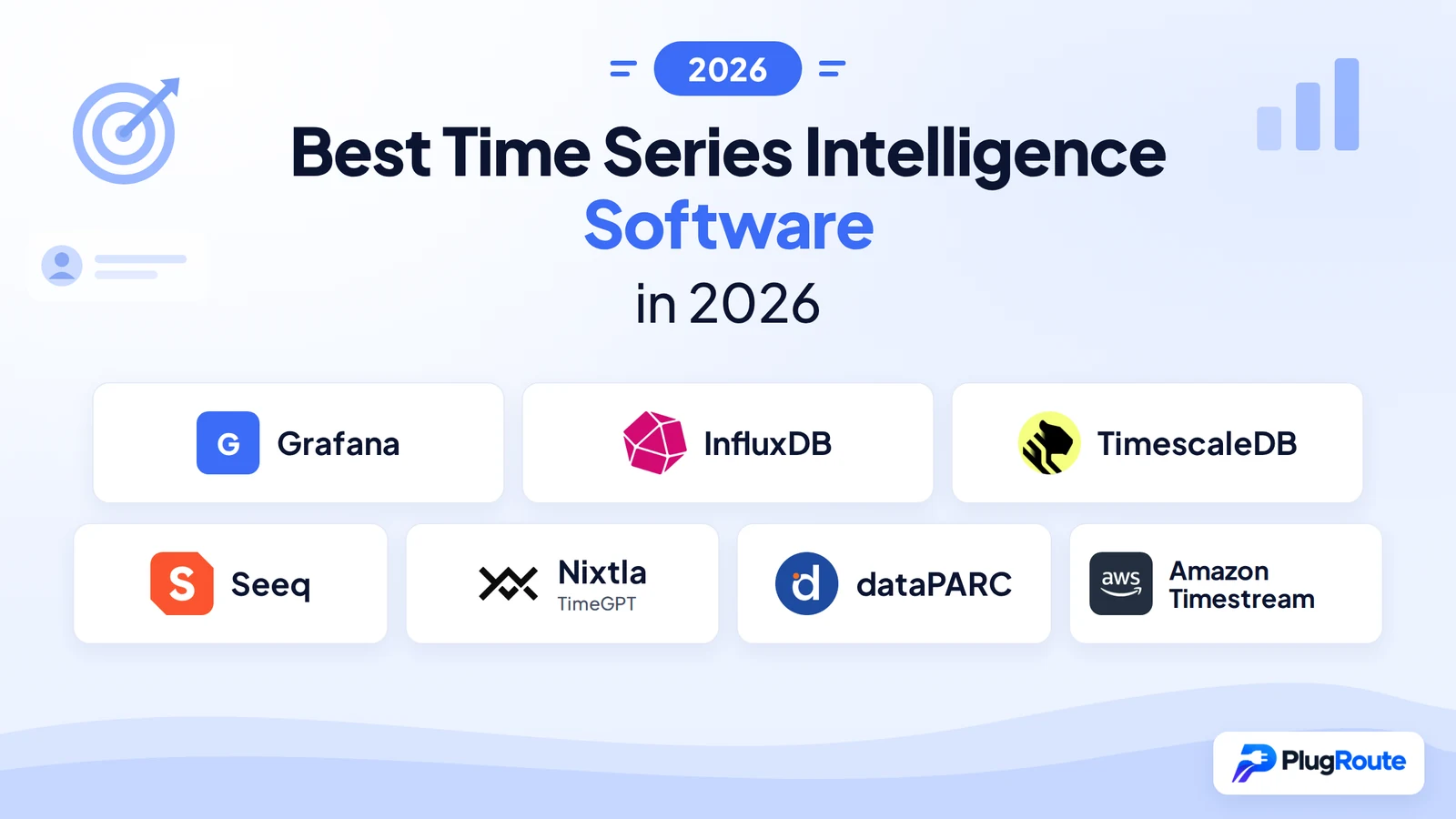
Grafana ranks first for DevOps and observability teams, earning 2,500+ G2 reviews at 4.7/5.0 and Gartner Magic Quadrant Leader status from 2023 through 2025. InfluxDB is the leading purpose-built time series database for developers. TimescaleDB is the top SQL-native option for PostgreSQL teams requiring relational JOIN support. No single platform dominates every dimension.
The category is genuinely fragmented. “Time series intelligence software” spans purpose-built databases, industrial historians, visualization layers, and foundation-model forecasting engines, tools with almost no overlapping architecture but a shared category label. Organizations that select a storage engine when they need an intelligence layer pay the price in re-architecture cycles and wasted licenses.
PlugRoute has no affiliate relationships with any company in this comparison; rankings are determined solely by verified review data, documented performance benchmarks, and independently sourced material.
“TSFM is a strong cold-start prior on series with no usable history, a weak refinement on series with 500+ samples of history, and almost never the best single answer at company-wide scope.”, u/ikkiho, r/datascience, May 2026
Takeaway: Pre-trained foundation models for time series are most valuable for cold-start scenarios with sparse history; for data-rich series with 500+ historical samples, well-tuned statistical models often outperform them at a fraction of the inference cost.
TL;DR: Top Picks at a Glance (Start here if short on time)
- Grafana is the highest-rated open-source observability platform in this comparison, with 2,500+ G2 reviews at 4.7/5.0 and Gartner Magic Quadrant Leader status from 2023 through 2025 [Source: G2, verified May 2026].
- InfluxDB is among the most widely deployed purpose-built time series databases globally, delivering sub-10ms last-value query latency and unlimited cardinality in version 3 via its open FDAP columnar architecture [Source: InfluxData Blog, June 2025].
- TimescaleDB is the strongest SQL-native time series option for PostgreSQL teams, providing full JOIN support, 90–95% storage compression, and transparent published pricing from approximately $30 per month [Source: Timescale pricing page; Cloudflare Engineering Blog].
- Seeq is the leading industrial AI platform for process manufacturers with existing historian infrastructure, enabling process engineers (not data scientists) to perform root-cause analysis and predictive maintenance through its Agent Q natural-language interface.
What Are the Main Categories of Time Series Intelligence Software?
Time series intelligence software divides into three categories: Operational Monitoring Platforms (visualization layers such as Grafana and dataPARC), Time Series Database Engines (storage-first platforms such as InfluxDB, TimescaleDB, and Amazon Timestream), and AI-Powered Intelligence Platforms (forecasting and analytics workbenches such as Seeq and Nixtla). Most production use cases require tools from only one category.
Choosing a tool from the wrong category is the most common cause of time series platform re-platforming. A common and expensive mistake: a DevOps team purchases Seeq (industrial AI) for infrastructure monitoring, or a chemical plant buys Grafana (visualization-only) expecting built-in forecasting. Both tools are excellent, in the wrong category, neither solves the problem.
Category 1, Operational Monitoring Platforms focus on visualization, dashboards, and real-time operational intelligence. These platforms sit above data stores and connect to multiple sources without owning the storage layer. Grafana (#1) and dataPARC (#6) belong here.
Category 2, Time Series Database Engines are storage-first platforms optimized for high-throughput ingestion, efficient compression, and fast time-range queries. They typically require a separate visualization layer unless bundled. InfluxDB (#2), TimescaleDB (#3), and Amazon Timestream (#7) belong here.
Category 3 (AI-Powered Intelligence Platforms layer machine learning, anomaly detection, and forecasting directly on time series data) through pre-trained foundation models or industrial analytics workbenches. Seeq (#4) and Nixtla (#5) belong here.
Before selecting any tool, identify your category first:
- Do you primarily need to store and query large volumes of time-stamped data? → Evaluate Category 2: InfluxDB, TimescaleDB, or Amazon Timestream.
- Do you primarily need to visualize and monitor existing time series data from multiple sources? → Evaluate Category 1: Grafana or dataPARC.
- Do you primarily need to forecast future values, detect anomalies automatically, or enable non-technical analysis? → Evaluate Category 3: Seeq or Nixtla.
- Answered yes to multiple? Start with Category 2 (storage first), then layer Category 1 or 3 on top.
How Do the Top Time Series Intelligence Platforms Compare at a Glance?
Seven platforms compete across three categories: Grafana leads on peer-validation depth, InfluxDB and TimescaleDB target database workloads with different SQL trade-offs, Seeq and dataPARC serve industrial manufacturing at different scales, Nixtla addresses zero-shot AI forecasting, and Amazon Timestream serves AWS-native teams. The table below enables direct capability comparison.
How to read the ratings in this table: A high score with low review volume (dataPARC: 4.8/5.0, 12 reviews) is statistically less reliable than a slightly lower score with high volume (Grafana: 4.7/5.0, 2,500+ reviews). Both the score and the sample size matter. See the Methodology section for how PlugRoute weights review count alongside score.
| Rank | Company | Category | Best For | One-Line Summary | Key Capabilities | Primary Strength | Key Limitation |
|---|---|---|---|---|---|---|---|
| 1 | Grafana | Monitoring Platform | DevOps/SRE observability at any scale | Grafana is the most widely reviewed open-source observability platform, scaling to 1B+ active time series across the composable LGTM stack. | LGTM stack (Loki, Tempo, Mimir); 100+ data source plugins; Gartner MQ Leader 2023–2025 | 2,500+ G2 reviews at 4.7/5.0 [verified May 2026]; highest review volume in this comparison | Steep learning curve requiring PromQL/LogQL for non-developer users |
| 2 | InfluxDB | Time Series DB | Developer IoT, DevOps, and metrics pipelines | InfluxDB is a purpose-built time series database delivering sub-10ms last-value query latency and unlimited cardinality via its open FDAP columnar architecture. | FDAP open columnar architecture; 500+ Telegraf plugins; embedded Python processing engine | 450+ G2 reviews at 4.5/5.0 [verified May 2026]; free OSS tier with no usage caps | No native relational JOINs; Flux language deprecation creates v1/v2 migration burden |
| 3 | TimescaleDB | Time Series DB | SQL-native mixed relational and time series analytics | TimescaleDB extends PostgreSQL into a high-performance time series engine with full SQL JOIN support and 90–95% independently validated storage compression. | Hypertables; Continuous Aggregates; Hypercore columnar storage; pgvector integration | 4.7/5.0 G2 (248 reviews) [verified May 2026]; transparent pricing from ~$30/month | Hypertable chunk interval configuration complexity; cloud costs compound at scale |
| 4 | Seeq | Industrial AI Platform | Process manufacturers with existing historian investments | Seeq enables process engineers to perform root-cause analysis and predictive maintenance directly on operational historian data without data migration. | Agent Q natural-language analyst; federated historian connectivity (OSIsoft PI, Aspen IP.21); Build Your Own Agent | G2 Leader and Top Trending at 4.6/5.0; documented 98.75% analysis time reduction [Microsoft case study, 2023] | Enterprise-only pricing; requires existing industrial historian infrastructure |
| 5 | Nixtla (TimeGPT) | AI Forecasting Engine | Data scientists needing zero-shot forecasting at scale | TimeGPT is among the first published pretrained foundation models for time series, enabling zero-shot forecasting on new datasets without per-dataset model training. | 100B+ row pre-training corpus; multivariate and agentic forecasting (TimeGPT 2.1); StatsForecast/NeuralForecast OSS | Top-2 on GiftEval multi-domain leaderboard [tsfm.ai, May 2026]; Fortune 500 adoption across five verticals | Black-box inference; inference cost 100x–1,000x vs. ARIMA at production scale |
| 6 | dataPARC | Industrial Process Platform | Small-to-mid process plants needing all-in-one historian and visualization | dataPARC is an all-in-one industrial time series platform combining a dual-archive historian, PARCview real-time visualization, and PCA-based anomaly detection under a single per-tag license. | Dual-archive historian; PARCview trending; PARCgraphics; PARCxla Excel add-in | 4.9/5.0 Capterra (8 reviews); unlimited concurrent users; per-tag licensing model | Primarily Windows-based deployment; limited cloud-native options; minimal AI/ML depth |
| 7 | Amazon Timestream | Cloud Time Series DB | AWS-native teams managing IoT fleets or serverless monitoring | Amazon Timestream is a fully managed, serverless AWS time series database with automatic memory-to-magnetic storage tiering, processing trillions of events per day with zero capacity management. | Dual-engine (LiveAnalytics + Timestream for InfluxDB); Kinesis/IoT Core integration; automatic tiered storage | Zero ops overhead; 99.99% availability SLA [Source: AWS, May 2026] | Lowest G2 rating in this comparison (4.3/5.0); pricing unpredictability on high-scan workloads; strict AWS lock-in |
Quick Decision Framework (Start here if short on time)
| Your #1 Priority | Recommended Tool | Why | Acceptable Alternative |
|---|---|---|---|
| Maximum peer-validated reliability | Grafana | 2,500+ G2 reviews at 4.7/5.0; Gartner MQ Leader 2023–2025 | InfluxDB (450+ reviews at 4.5/5.0) |
| Pure time series database performance | InfluxDB | Sub-10ms queries; FDAP open architecture; free OSS tier | TimescaleDB |
| SQL JOINs with time series data | TimescaleDB | Full PostgreSQL compatibility; no new query language required | Amazon Timestream |
| Industrial AI for process manufacturing | Seeq | Agent Q; historian connectivity; G2 Leader designation | dataPARC |
| AI forecasting without model training | Nixtla (TimeGPT) | Pre-trained foundation model; zero-shot across domains | Seeq Intelligence |
| AWS-native IoT monitoring | Amazon Timestream | Serverless; Kinesis/IoT Core integration; zero ops overhead | InfluxDB Cloud |
| All-in-one industrial ops (small/mid plant) | dataPARC | Historian and visualization in one vendor; unlimited users | Seeq |
| Zero upfront cost | Grafana, InfluxDB, or TimescaleDB OSS | All three are free, open-source, and production-capable | N/A |
#1: Grafana, Best Overall for Observability and Time Series Visualization
Category: Operational Monitoring Platform, vendor-neutral visualization layer connecting 100+ data sources without owning the storage tier.
At a Glance
- Category: Observability Platform
- Best For: DevOps, SRE, and data engineering teams monitoring infrastructure and applications at any scale
- Price Range: Free OSS tier; Cloud Pro usage-based from ~$8/GB logs; Enterprise ~$100,000+/year
- Primary Strength: 2,500+ G2 reviews at 4.7/5.0 [verified May 2026]: highest review volume and most robust satisfaction signal in this comparison
- Biggest Limitation: Developer-centric query languages (PromQL, LogQL, TraceQL) create steep onboarding barriers for non-technical business users
- One-Line Summary: Grafana is the most widely reviewed open-source observability platform, connecting 100+ data sources and scaling to 1 billion+ active time series via the composable LGTM stack.
- Last Verified: May 2026
Overview
Grafana is an open-core observability platform built around the composable LGTM stack (Loki for logs, Grafana for dashboards, Tempo for distributed traces, and Mimir for petabyte-scale metrics) serving DevOps, SRE, and data engineering teams who need a vendor-neutral view across 100+ data sources without proprietary lock-in.
Grafana Labs was founded in 2014 by Torkel Ödegaard and is headquartered in New York and San Francisco. The company raised a $220 million Series C in September 2021 at a $3 billion valuation and a $240 million Series D in April 2022 at a $6 billion valuation [Source: Grafana Labs blog, April 2022].
Cumulative funding exceeds $800 million following a 2024 Series D Extension [Source: TechCrunch, August 2024], making Grafana Labs one of the most capitalized open-source infrastructure companies in the observability space, with 1,000+ employees.
Key Features
- LGTM Stack Composability: Grafana’s Loki, Grafana, Tempo, and Mimir components are independently deployable open-source projects, allowing organizations to replace individual stack components without re-platforming their entire observability environment.
- 100+ Data Source Plugins: Grafana connects natively across three connector categories, monitoring and metrics (Prometheus, CloudWatch, InfluxDB, Datadog, Splunk), databases and data warehouses (PostgreSQL, Elasticsearch, Snowflake, MongoDB), and enterprise systems (Salesforce, SAP HANA, ServiceNow, GitHub), the broadest native connector coverage of any platform in this comparison.
- Grafana Mimir: Petabyte-Scale Metrics: Grafana Mimir handles 1 billion+ active time series with 13-month metrics retention and a 99.5% uptime SLA [Source: grafana.com/oss-vs-cloud/, May 2026], enabling enterprise deployments at hyperscaler-adjacent scale.
- Grafana Cloud Free Tier: Grafana Cloud provides 10,000 active time series, 50 GB logs, and 50 GB traces at no cost, a production-capable free tier for teams evaluating the platform or running small-to-medium deployments.
- Gartner Magic Quadrant Recognition: Grafana Labs received Gartner Magic Quadrant Leader recognition in Observability from 2023 through 2025, requiring high scores in both “Ability to Execute” and “Completeness of Vision” to qualify.
- 71,000+ GitHub Stars: Grafana’s GitHub repository has surpassed 71,000 stars as of May 2026 [Source: github.com/grafana/grafana, May 2026], one of the highest star counts for any open-source infrastructure project globally, confirming deep developer adoption independent of marketing claims.
Best For
Grafana is best suited for DevOps, SRE, platform engineering, and data engineering teams at mid-to-large organizations who need a vendor-neutral visualization layer across heterogeneous data stacks, particularly teams running Kubernetes, Prometheus, or mixed cloud environments at production scale.
Strengths
- Grafana holds a G2 rating of 4.7/5.0 with 2,500+ verified reviews [Source: G2, g2.com/products/grafana, verified May 2026], the highest review count of any platform in this analysis and a statistically robust indicator of genuine widespread satisfaction.
- Grafana Labs received Gartner Magic Quadrant Leader designation in Observability from 2023 through 2025 [Source: Grafana Labs blog, 2023], reflecting high scores in both “Ability to Execute” and “Completeness of Vision”, requiring peer-level market presence, not just technical merit.
- Grafana’s GitHub repository has surpassed 71,000 stars as of May 2026 [Source: github.com/grafana/grafana, May 2026], one of the highest star counts for any open-source infrastructure tool globally, providing a developer adoption signal independent of marketing.
- Grafana Mimir scales to 1 billion+ active time series with a 99.5% uptime SLA [Source: grafana.com/oss-vs-cloud/, May 2026], supporting enterprise deployments at a scale that most purpose-built databases cannot match without external clustering.
Limitations
- Steep Developer Learning Curve: Grafana’s query-language-first approach: requiring PromQL for Prometheus metrics, LogQL for Loki logs, and TraceQL for Tempo traces, creates significant onboarding friction for business analysts and non-engineering users accustomed to drag-and-drop BI tools such as Tableau or Power BI.
- Self-Hosting Operational Complexity: Running Grafana’s full LGTM stack at production scale requires Kubernetes expertise, infrastructure provisioning, and ongoing operational maintenance, a meaningful burden for teams without dedicated platform engineering resources.
Users on r/devops noted:
“With three engineers and at seed stage (where product > all) your monitoring needs to be as hands-off as possible. Look for a SaaS product that covers your needs and is within budget. Honeycomb Pro or similar will be far cheaper than the time you’ll spend maintaining a Grafana stack.” Posted by u/VindicoAtrum
Takeaway: For smaller teams without dedicated platform engineering, Grafana’s self-hosted LGTM stack extracts a heavy operational tax that can outweigh the cost savings versus managed alternatives.
- Alerting Limitations in OSS Tier: Advanced alert silencing, deduplication, and group-routing features are limited in Grafana OSS, requiring Cloud or Enterprise subscriptions for production-grade multi-team alerting.
- Dashboard Performance at Scale: Users consistently report performance degradation when dashboards contain 100+ panels or when queries scan large historical datasets without pre-aggregation [Source: siriusopensource.com comprehensive review, 2024].
Verdict
Grafana is the most peer-validated time series visualization platform in this comparison, combining 2,500+ G2 reviews at 4.7/5.0, three consecutive Gartner Magic Quadrant Leader designations (2023–2025), and 71,000+ GitHub stars as of May 2026. Grafana ranks #1 on the strength of this peer-validation depth, making it the lowest-risk starting point for organizations new to the category; readers prioritizing AI/ML depth over peer-validation should evaluate Seeq (#4) or Nixtla (#5) instead. Grafana’s developer-first design makes it inappropriate as a standalone tool for non-technical business users, organizations needing no-code analytics for business planners should pair Grafana with a separate BI layer or evaluate industrial-specific alternatives.
#2: InfluxDB, Best Purpose-Built Time Series Database for Developers
Category: Time Series Database Engine, purpose-built high-throughput ingestion and query layer for time-stamped metrics, events, and telemetry data.
At a Glance
- Category: Time Series Database
- Best For: Developers, DevOps engineers, and data architects building IoT, metrics, or monitoring pipelines
- Price Range: Free OSS (MIT/Apache 2.0); Cloud usage-based; Cloud Dedicated and Enterprise require sales contact
- Primary Strength: 450+ G2 reviews at 4.5/5.0 [verified May 2026]; sub-10ms last-value queries; FDAP open architecture with unlimited cardinality
- Biggest Limitation: No native relational JOINs; Flux language deprecation creates migration burden for existing v1/v2 users
- One-Line Summary: InfluxDB is a purpose-built time series database delivering sub-10ms last-value query latency and unlimited cardinality via its FDAP columnar architecture in version 3, with a free open-source tier and 500+ Telegraf integration plugins.
- Last Verified: May 2026
Overview
InfluxDB is a purpose-built time series database engine designed for high-throughput ingestion and fast retrieval of time-stamped data, metrics, events, telemetry, and sensor readings. InfluxDB holds 450+ verified G2 reviews at 4.5/5.0 [Source: G2, verified May 2026], the highest review volume among purpose-built time series databases in this comparison.
InfluxData was founded in 2013 by Paul Dix and is headquartered in San Francisco, making InfluxDB one of the most tenured purpose-built time series platforms available. InfluxDB version 3 is a complete architectural rewrite, adopting the FDAP stack, Apache Flight, DataFusion, Apache Arrow, and Parquet.
This architectural shift delivers unlimited cardinality, native SQL support, and open columnar storage, ending the dependency on InfluxDB’s proprietary Flux query language that was a persistent migration barrier in earlier versions.
Key Features
- FDAP Open Columnar Architecture: InfluxDB 3 stores data as Apache Parquet files on object storage (Amazon S3), enabling native consumption by any Arrow/Parquet-compatible tool (DuckDB, Apache Spark, or Pandas) without ETL, transforming InfluxDB from a closed database into an open analytics substrate.
- Sub-10ms Last-Value Queries: InfluxDB 3’s Last Value Cache (LVC) and Distinct Value Cache (DVC) deliver sub-10ms last-value query response and 30ms distinct metadata queries [Source: InfluxData Blog, June 17, 2025], meeting real-time dashboard latency requirements of production IoT and infrastructure monitoring.
- Embedded Python Processing Engine: InfluxDB 3.1’s Embedded Python VM brings real-time computation directly to the storage layer [Source: InfluxData Blog, 2025], enabling triggers, scheduled processing, and in-database transformations without an external compute service.
- 500+ Telegraf Agent Plugins: InfluxDB’s Telegraf data collection agent includes 500+ plugins covering AWS CloudWatch, Kubernetes, PostgreSQL, Kafka, Prometheus, SNMP, and hundreds of additional sources, minimizing custom connector development for common infrastructure stacks.
- Native SQL Support in v3: InfluxDB 3 replaces the proprietary Flux language with standard SQL and InfluxQL, enabling data engineers without InfluxDB-specific expertise to query time series data using familiar syntax.
- Unlimited Cardinality: InfluxDB 3’s disk-based object storage architecture removes the cardinality ceiling that constrained InfluxDB v1 and v2, enabling deployments with millions of unique metric streams without performance degradation.
Best For
InfluxDB is best suited for developers, DevOps engineers, and data architects building high-throughput time series pipelines where sub-10ms query latency, unlimited cardinality, and broad integration via Telegraf are the primary requirements, provided those use cases do not require JOIN operations with relational metadata tables.
Strengths
- InfluxDB holds a G2 rating of 4.5/5.0 with 450+ verified reviews [Source: G2, g2.com/products/influxdb, verified May 2026] and a Capterra rating of 4.6/5.0 with 100+ reviews [Source: Capterra, verified May 2026], the highest review volume among purpose-built time series databases in this comparison.
- InfluxDB 3 achieves sub-10ms last-value queries and 30ms distinct metadata queries through its LVC and DVC caching layers [Source: InfluxData Blog, June 17, 2025], meeting production-critical real-time monitoring latency requirements across IoT and DevOps use cases.
- InfluxDB’s FDAP stack is built entirely on Apache-backed open technologies, meaning InfluxDB data can be natively consumed by any Arrow/Parquet-compatible analytics tool without ETL, a genuine portability advantage over proprietary time series engines with closed storage formats.
- InfluxDB 3.1’s Embedded Python Processing Engine [Source: InfluxData Blog, 2025] enables in-database computation without an external compute cluster, reducing infrastructure complexity for teams processing data at the edge or in resource-constrained environments.
Limitations
- No Native Relational JOINs: InfluxDB’s measurement/tag/field data model does not natively support relational joins with metadata tables (a hard limitation documented by practitioners: “InfluxDB: Fast ingest, but non-relational) how do I join metadata?” [Source: u/Aggressive_Ad_5454, r/Database, June 2025]. Organizations with mixed relational and time series data requirements must implement workarounds. → If JOIN support is required, see TimescaleDB (#3), which provides full PostgreSQL SQL.
- Flux Language Migration Burden: InfluxDB’s decision to deprecate the Flux query language in v3 (after years of investment from both the vendor and users in complex Flux pipelines) creates non-trivial migration work for organizations on v1 or v2 [Source: Infoworld, 2024].
- Cloud Cost Unpredictability: Multiple users report difficulty predicting InfluxDB Cloud costs at production scale under usage-based billing, with costs accruing across ingestion, query, and storage dimensions simultaneously, a budgeting challenge compared to predictable per-vCPU alternatives.
- AI/ML Depth Requires External Tooling: InfluxDB’s embedded Python engine provides processing capability but does not include native anomaly detection, forecasting, or ML model management, capabilities that require external integration with Python ML libraries or a dedicated AI layer such as Nixtla (#5) or Seeq (#4).
Verdict
InfluxDB is among the most widely deployed purpose-built time series databases available, combining sub-10ms query latency, unlimited cardinality, an open FDAP columnar architecture, and a free open-source tier across 450+ verified G2 reviews at 4.5/5.0. InfluxDB’s shift to standard SQL in v3 removes the biggest historical adoption barrier. The absence of native JOIN support is a decisive limitation for use cases requiring correlation of time series measurements with relational metadata, teams facing this requirement should evaluate TimescaleDB (#3), while teams with existing Flux pipelines face meaningful migration investment before realizing v3’s improvements.
#3: TimescaleDB, Best for SQL-Native Time Series Analytics
Category: Time Series Database Engine, PostgreSQL extension transforming a familiar relational database into a high-performance time series engine with full SQL compatibility.
At a Glance
- Category: Time Series Database
- Best For: Data engineers and analytics teams with PostgreSQL expertise and mixed relational and time series data requirements
- Price Range: Free OSS (Apache 2.0); Cloud Scale ~$30/month; Cloud Pro ~$530+/month; Enterprise contact sales
- Primary Strength: Full PostgreSQL SQL with JOINs, 90–95% storage compression independently validated by Cloudflare, and transparent published pricing from ~$30/month
- Biggest Limitation: Hypertable configuration and chunk interval tuning require specialized knowledge; cloud costs compound at scale
- One-Line Summary: TimescaleDB extends PostgreSQL into a high-performance time series database, delivering 2–3 million rows per second ingestion, 90–95% storage compression, and full SQL JOIN support, without requiring teams to learn a new query language.
- Last Verified: May 2026
Overview
TimescaleDB is a PostgreSQL extension that adds time series–specific capabilities (Hypertables, Continuous Aggregates, native compression, and approximately 200 time series Hyperfunctions) to standard PostgreSQL, enabling 2–3 million row/second ingestion at 90–95% compression without abandoning SQL.
TimescaleDB was co-founded in 2017 by Ajay Kulkarni (CEO) and Mike Freedman (CTO, Princeton University distributed systems professor), is headquartered in New York City, and has raised $110 million+ from investors including Benchmark, Iconiq, and Redpoint.
The company rebranded as TigerData in June 2025, though the TimescaleDB product name remains active. TimescaleDB’s defining differentiator is full PostgreSQL compatibility, every ORM, tool, and extension that works with PostgreSQL works with TimescaleDB, including PostGIS, pgvector, and pgml.
Key Features
- Hypertables: Automatic Time-Based Partitioning: TimescaleDB’s Hypertables automatically partition data into time-based and ID-based chunks, enabling query engines to skip irrelevant time ranges entirely, delivering significantly faster aggregate query performance vs. unpartitioned PostgreSQL on large datasets.
- Continuous Aggregates: Incremental Materialized Views: TimescaleDB’s Continuous Aggregates refresh incrementally in the background as new data arrives, eliminating the full-rebuild requirement of standard PostgreSQL materialized views that can take hours on large datasets.
- 90–95% Storage Compression: TimescaleDB’s native columnar compression reduces storage footprint by 90–95% vs. uncompressed PostgreSQL, as independently validated in Cloudflare’s production deployment where compression eliminated an entire server [Source: Cloudflare Engineering Blog, blog.cloudflare.com/timescaledb-art/].
- Full PostgreSQL SQL with JOINs: TimescaleDB retains complete ACID compliance and full SQL JOIN capability, enabling direct joins between time series measurements and relational metadata tables, a hard requirement InfluxDB cannot meet natively.
- Hypercore Columnar Storage: TimescaleDB’s Hypercore storage engine delivers significantly faster complex query performance vs. InfluxDB on TSBS (Time Series Benchmark Suite) analytical workloads [Source: Timescale Benchmarking Whitepaper, timescale.com, 2023], with performance advantage scaling with query complexity.
- ~200 Time Series Hyperfunctions: TimescaleDB includes built-in SQL functions for time-weighted averages, last-observation-carried-forward interpolation, percentile approximations, time_bucket(), and gap-filling, eliminating custom application-layer code for common time series analytics patterns.
Best For
TimescaleDB is best suited for data engineering, analytics, and BI teams at organizations with existing PostgreSQL expertise and mixed relational and time series data requirements, including IoT platforms, financial analytics, and business intelligence applications where JOIN support with relational metadata is a hard requirement generating 1 million+ rows per second.
Strengths
- TimescaleDB holds a G2 rating of 4.7/5.0 across 248 reviews [Source: G2, g2.com/products/timescaledb, verified May 2026] and a Capterra rating of 4.6/5.0 across 112 reviews [Source: Capterra, verified May 2026], high satisfaction scores backed by a statistically meaningful review base.
- Cloudflare’s production deployment independently confirms 90%+ data size reduction and infrastructure server elimination through TimescaleDB’s compression and auto-aggregation policies [Source: Cloudflare Engineering Blog, blog.cloudflare.com/timescaledb-art/], named-customer validation of real-world storage savings.
- TimescaleDB benchmarks demonstrate 2–3 million rows/second write throughput [Source: TimescaleDB Starter Guide, assets.timescale.com] (a 20–30x improvement over raw PostgreSQL) enabling large-scale IoT and metrics ingestion without migrating to a new database technology.
- TimescaleDB is the only platform in this comparison offering genuinely transparent published pricing starting at approximately $30/month with no sales engagement required for trial access, reducing procurement friction for budget-conscious buyers.
This aligns with community sentiment on r/PLC:
“I don’t understand the idea that SQL isn’t cut out for this kind of workload. I guess it’s a pretty dated view. We have columnar-oriented databases (Clickhouse, duckdb, timescaledb, many others) that can run queries on terabytes of data at incredible speeds, powering huge e-com data warehouses, designed specifically for time-series data, all open source. The bonus is you get advanced analytics with all of that. Grouping, averaging, aggregations. Timescaledb/postgres can reduce granularity of old data to manage storage. Data historians can offer a more ‘finished package’ but they totally lost the war on high-speed data storage and analytics.” Posted by u/mediaman2
Takeaway: Practitioner consensus has shifted firmly toward SQL-native time series databases like TimescaleDB: the performance gap that once justified proprietary historians has closed, while SQL’s analytical flexibility advantage has grown substantially.
Limitations
- Hypertable Configuration Complexity: TimescaleDB’s performance depends heavily on correct hypertable chunk interval configuration for the specific data volume and query pattern, misconfigured chunk intervals create chunk bloat and degraded query performance, requiring DBA expertise not all PostgreSQL teams possess.
- Cloud Cost Scaling: Timescale Cloud egress fees ($0.09/GB) and per-vCPU billing compound at scale for data-intensive applications, making total cost of ownership more complex to project than the entry price suggests.
- No Native AI/ML: TimescaleDB provides no native forecasting, anomaly detection, or ML model management, teams needing intelligence capabilities must integrate external tools such as Python ML libraries, Nixtla (#5), or a separate analytics layer.
- Performance Uncertainty at Extreme Scale: Community discussions on r/Database (June 2025) show practitioners expressing uncertainty about TimescaleDB’s performance ceiling for workloads exceeding approximately 15 billion total rows with aggressive parallel query concurrency, where specialized columnar stores such as ClickHouse may be warranted [Source: r/Database, reddit.com/r/Database/comments/1labnhv/, June 2025].
Verdict
TimescaleDB is the strongest time series option for PostgreSQL-native teams, combining full SQL JOIN support, 90–95% independently validated storage compression, 2–3 million row/second ingestion, and transparent pricing from ~$30/month, all without requiring teams to learn a new query language or migrate to a new database paradigm. The Cloudflare production case study provides named-customer validation of real-world compression and performance claims. TimescaleDB is not the right choice for teams prioritizing AI/ML forecasting, pure DevOps observability without relational data, or very high-cardinality workloads at the 1 billion+ active series scale, where Grafana Mimir is the more appropriate solution.
#4: Seeq, Best Industrial AI Platform for Process Manufacturers

Category: AI-Powered Intelligence Platform, industrial analytics workbench layered above existing historians, providing AI-driven root-cause analysis, anomaly detection, and agentic decision support.
At a Glance
- Category: Industrial AI Platform
- Best For: Process manufacturing and energy companies with existing OSIsoft PI, Aspen IP.21, or equivalent historian investments
- Price Range: Enterprise quote only; structured Success Plans tiers; contact sales for pricing
- Primary Strength: G2 Leader and Top Trending designation at 4.6/5.0; Agent Q natural-language AI analyst; documented 98.75% reduction in analysis time from a named Microsoft Azure case study
- Biggest Limitation: Requires existing industrial historian infrastructure; enterprise-only pricing with no self-serve or free trial tier
- One-Line Summary: Seeq is an industrial AI platform that enables process engineers (not data scientists) to perform root-cause analysis, predictive maintenance, and closed-loop automation directly on operational historian data without data migration.
- Last Verified: May 2026
Overview
Seeq is a purpose-built industrial time series intelligence platform for process manufacturing, refining, chemicals, and energy environments. Seeq’s read-optimized design layers analytics intelligence on top of existing historian investments, OSIsoft PI, Aspen IP.21, Honeywell, GE, and Aveva, without requiring data migration.
Seeq is headquartered in Seattle, Washington, and describes itself as a “Global leader in Industrial AI” as of its March 2026 press release, a designation not independently verified by third-party analyst rankings in the industrial AI category as of May 2026.
In March 2026, Seeq launched “Seeq Intelligence”, a major AI layer featuring Agent Q (a natural-language AI analyst), Build Your Own Agent for custom multi-step AI workflows, and Agent Extensibility for closed-loop automation [Source: PR Newswire, prnewswire.com, March 3, 2026].
Key Features
- Agent Q: Natural-Language AI Analyst: Seeq Intelligence’s Agent Q is a domain-aware AI analyst [Source: seeq.com, March 2026] that interprets natural-language queries over operational data, writes and executes analytical code, and surfaces opportunities, enabling process engineers to conduct complex analysis without SQL or scripting expertise.
- Build Your Own Agent: Seeq Intelligence’s Build Your Own Agent capability enables custom multi-step AI workflows that can transition scheduled queries into live ML monitors, creating continuously evolving learning systems within industrial environments.
- Federated Historian Connectivity: Seeq connects natively to OSIsoft PI, Aspen IP.21, Honeywell, GE, Aveva, Microsoft Azure, and Databricks without requiring data migration, allowing process manufacturers to retain existing historian investments while adding analytics intelligence.
- Purpose-Built Industrial DSP Algorithms: Seeq’s Workbench applies proprietary digital signal processing algorithms and multi-timezone interpolation specifically designed for industrial data challenges, data gaps, competing units of measure, and tag-level interpolation that defeat general analytics tools.
- Cloud and Lakehouse Integration: Seeq integrates with Microsoft Azure, Databricks, and TDengine, enabling hybrid deployments that span on-premises historian data and cloud-based analytics platforms.
- Predictive Maintenance Pipelines: Seeq supports transitions from reactive to predictive operations through scheduled monitoring, anomaly detection, and correlation discovery, as documented in the Microsoft Azure case study where refinery analysis was reduced from 4 months to 30 minutes [Source: Microsoft Partner Network, partner.microsoft.com/case-studies/seeq, 2023].
Best For
Seeq is best suited for enterprise process manufacturing, refining, chemicals, oil and gas, and energy companies that already have OSIsoft PI, Aspen IP.21, or equivalent historian infrastructure and need to enable process engineers (not data scientists) to perform sophisticated analytics and predictive maintenance without code.
Strengths
- Seeq holds a G2 Leader and Top Trending designation at 4.6/5.0 [Source: G2, g2.com/products/seeq/reviews, verified May 2026], note: Seeq does not publish its G2 review count; the Leader designation is based on satisfaction scores and market presence metrics, and buyers should independently verify the current review count at G2 before using Seeq’s score as a peer-comparison benchmark.
- A Microsoft partner case study documents refinery analysis workflows being reduced from 4 months to 30 minutes using Seeq on Azure [Source: Microsoft Partner Network, partner.microsoft.com/case-studies/seeq, 2023], a 98.75% reduction in analysis time representing the most specific publicly accessible quantified ROI validation for this platform.
- Seeq’s March 2026 Seeq Intelligence launch introduces Agent Q and agentic automation capabilities [Source: PR Newswire, prnewswire.com, March 3, 2026], directly aligning with Gartner’s projection that 40% of enterprise applications will integrate task-specific AI agents by end of 2026 [Source: Gartner, as cited by SaaStr, saastr.com, 2026].
- Seeq holds strategic partnerships with Microsoft Azure, Databricks, and TDengine: indicating validated integration within the enterprise hyperscaler ecosystem.
Limitations
- Requires Existing Historian Infrastructure: Seeq assumes existing historian infrastructure such as OSIsoft PI or Aspen IP.21, plants without this foundation cannot use Seeq without first purchasing a historian, adding significant cost and complexity [Source: dataPARC competitive analysis, dataparc.com/blog, 2024]. → For plants without an existing historian, see dataPARC (#6), which includes a historian in the base product.
- Pricing Opacity: Seeq’s contact-sales-only pricing model makes it impossible to benchmark cost against InfluxDB, TimescaleDB, or dataPARC without deep sales engagement, a documented friction point for mid-market buyers in competitive evaluation processes.
Users on r/ChemicalEngineering noted:
“I like seeq but at the end of the day would stick to Python.. Open source and will not disappear like all Saas do when they increase the prices and management do not buy license. Softwares like seeq work on business model of enticing companies and then charging exorbitant rates once they get you hooked on to it. In our industries where profit margins are already thin these prices are hard to justify.” Posted by u/People_Peace
Takeaway: Seeq’s SaaS pricing model draws consistent criticism from process industry practitioners on tight margins, who flag the risk of escalating costs once organizational dependency is established.
- Narrowly Industrial Focus: Seeq’s architecture is optimized exclusively for process manufacturing and energy, a retail analyst wanting demand forecasting cannot use Seeq, as the platform provides no connectors to CRM, ERP, or transactional databases and is not designed for non-process-data use cases.
- No Self-Serve Trial: Unlike InfluxDB, TimescaleDB, Grafana, and Nixtla (all offering free tiers or OSS versions), Seeq provides no publicly accessible trial path, buyers must engage sales before testing the platform on their actual data.
Verdict
Seeq is the most capable industrial AI platform in this comparison, combining G2 Leader recognition, a 98.75% analysis time reduction documented in a named Microsoft Azure case study, and the March 2026 Seeq Intelligence launch that adds agentic AI capabilities. Seeq ranks above dataPARC (#6) because it serves a larger addressable market (enterprises with existing historian investments) and adds agentic AI capabilities that dataPARC does not yet offer. Seeq ranks above Nixtla (#5) in industrial use cases because its historian connectivity and domain-specific DSP algorithms address operational deployment requirements that a forecasting API cannot fulfill.
Users on r/ChemicalEngineering shared real deployment outcomes:
“I’ve seen it implemented at two different sites. One was transformative – they went from 3-4 hours of manual data wrangling for weekly reports to about 20 minutes of actual analysis. The other… well, it sat mostly unused because they didn’t invest in proper training and change management.” Posted by u/bockchoyguy
Takeaway: Seeq’s ROI depends heavily on organizational investment in change management and training, the platform delivers transformative results where adoption is properly driven, and near-zero results where it is not.
The platform is not appropriate for organizations without historian infrastructure, those requiring transparent pre-sales pricing, or use cases outside process manufacturing and energy.
#5: Nixtla (TimeGPT), Best AI Forecasting Engine for Data Science Teams
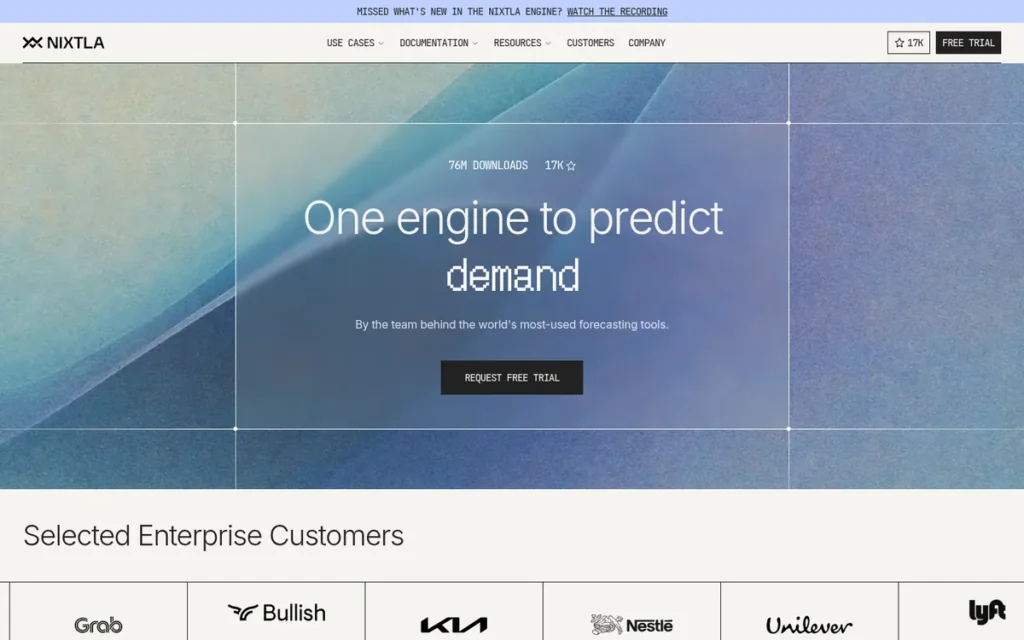
Category: AI-Powered Intelligence Platform, pretrained foundation model for time series enabling zero-shot forecasting across domains without per-dataset model training.
At a Glance
- Category: AI Forecasting Engine
- Best For: Data scientists, ML engineers, and analytics teams needing scalable forecasting without the overhead of per-dataset model training
- Price Range: Free exploratory tier; API usage-based for production; Enterprise self-hosted requires sales contact
- Primary Strength: Among the first published pretrained foundation models for time series; top-2 on GiftEval leaderboard [tsfm.ai, May 2026]; 15,000+ GitHub stars; Fortune 500 adoption across five verticals
- Biggest Limitation: Black-box inference incompatible with regulated industry auditability requirements; inference cost 100x–1,000x vs. ARIMA at production scale
- One-Line Summary: Nixtla’s TimeGPT is among the first published pretrained foundation models for time series, trained on 100+ billion rows of diverse temporal data and enabling zero-shot forecasting on new datasets in minutes without per-dataset model training.
- Last Verified: May 2026
Overview
Nixtla is an AI-first forecasting company founded in 2021 by Max Mergenthaler-Canseco (CEO), Cristian Challu, and Kin Gutierrez (CTO), headquartered in San Francisco. Nixtla describes TimeGPT as “the first published pretrained foundation model for time series”, a claim not independently verified by academic consensus as of May 2026.
TimeGPT uses a Transformer-based encoder-decoder architecture trained on 100+ billion rows of diverse temporal data spanning financial markets, weather, energy grids, and web traffic. It generates point forecasts and calibrated prediction intervals without requiring users to train a model on their own data.
Nixtla has raised $22.64 million in total funding, including a $16 million Series A announced in February 2026 led by Energize Capital [Source: Pulse2, February 2026; CB Insights, 2026]. At $22.64 million total, Nixtla is the earliest-stage company in this comparison.
Key Features
- Zero-Shot Foundation Model Forecasting: TimeGPT enables meaningful forecasts on a new dataset within minutes of data upload, transferring learned temporal patterns from a 100B+ row pre-training corpus, eliminating weeks of model training, tuning, and validation required by traditional ARIMA, Prophet, or XGBoost approaches.
- TimeGPT 2.1: Multivariate and Agentic Forecasting: TimeGPT 2.1, the most recent release, adds multivariate modeling (forecasting multiple related series simultaneously) and agentic forecasting capabilities, automatically selecting forecasting strategies and anomaly detection thresholds without manual configuration.
- Calibrated Prediction Intervals: TimeGPT generates probabilistic forecasts with calibrated uncertainty intervals, enabling decision-makers to understand forecast confidence ranges rather than relying on single point estimates, a critical capability for supply chain, capacity planning, and financial applications.
- Open-Source Forecasting Ecosystem: Nixtla’s StatsForecast, NeuralForecast, and MLForecast libraries [Source: nixtla.io/docs/about/sub-categoria, verified May 2026] cover classical statistical methods (ARIMA, ETS), deep learning architectures (N-BEATS, TFT), and ML-based approaches in a unified Python API, enabling direct comparison against TimeGPT on the same data.
- Enterprise Self-Hosted Deployment: Nixtla offers air-gapped, SOC 2–compliant enterprise deployments with GPU/CPU scaling for millions of series, addressing regulated industry data sovereignty requirements.
- Cross-Domain Generalization: TimeGPT ranks among the top-2 models on the GiftEval multi-domain leaderboard [Source: tsfm.ai/benchmarks/gift-eval, verified May 2026] and performs consistently across FEV and VN1 multi-horizon benchmarks, with confirmed adoption across retail (Walmart, Zalando), logistics (DoorDash, Lyft), technology (Microsoft, OpenAI), and financial services (Prudential).
Best For
Nixtla TimeGPT is best suited for data science and ML engineering teams at technology, retail, logistics, and financial services companies who need to scale forecasting across hundreds or thousands of series, particularly cold-start scenarios where new products, new markets, or sparse historical data prevent traditional model training.
Strengths
- TimeGPT ranks among the top-2 models on the GiftEval multi-domain leaderboard [Source: tsfm.ai/benchmarks/gift-eval, verified May 2026] and performs consistently across FEV and VN1 multi-horizon accuracy benchmarks, independent multi-domain evaluations that validate cross-domain generalization claims.
- Nixtla reports accuracy improvements over traditional statistical models in select benchmark comparisons [Source: nixtla.io/docs/introduction/why_timegpt, 2025]; specific percentage figures cited in promotional materials were not independently confirmed in peer-reviewed sources as of May 2026, buyers should request benchmark documentation from Nixtla for independent validation.
- Nixtla’s open-source ecosystem has accumulated 15,000+ GitHub stars and 45 million+ downloads [Source: nixtla.io/docs/about/sub-categoria, verified May 2026], providing a reliable independent signal of genuine practitioner adoption at a scale that review platforms alone cannot capture.
- Confirmed enterprise relationships span multiple verticals [Source: checkthat.ai/brands/nixtla, May 2026, brand intelligence aggregator; customer relationships not independently verified through primary company statements]: Technology (Microsoft, OpenAI, Tesla, Amazon), Retail (Walmart, Zalando, Decathlon), Logistics (DoorDash, Lyft), Financial Services (Prudential), and Consumer Goods (Unilever).
Limitations
Black-Box Inference: TimeGPT lacks built-in interpretability for regulated industry use cases, practitioners flag that black-box results create a compliance barrier because “SHAP/LIME are post hoc explainability methods” [Source: u/Technical-Brush7204, r/datascience, May 2026], meaning for financial risk, healthcare, and energy dispatch applications where model decisions must be auditable, TimeGPT is a hard blocker.
Takeaway: SHAP and LIME are post-hoc workarounds, not native explainability, they may not satisfy formal compliance or audit requirements in regulated industries.
Inference Cost at Scale: Community consensus from practitioners is that time series foundation models such as TimeGPT are “two to three orders of magnitude more expensive than ARIMA-X or Prophet” per prediction at production scale [Source: u/ikkiho, r/datascience, May 2026]. For workloads of 10,000+ time series forecasted daily, TimeGPT API costs could represent a significant budget line item, request specific per-call pricing from Nixtla before building production cost models.
Takeaway: Budget TimeGPT API costs at 100x–1,000x the cost of ARIMA-equivalent predictions before committing to production-scale deployments; the economics favor foundation models for sparse data, not for high-volume series with rich history.
Weak on Data-Rich Series: Community consensus from practitioners characterizes TimeGPT as performing best as a cold-start prior for series with sparse history, but delivering weaker results for series with 500+ samples of history, and not automatically adapting to regime shifts such as COVID-era demand disruptions that fall outside its pre-training distribution [Source: u/ikkiho, u/latent_threader, r/datascience, May 2026].
Early-Stage Business Risk: At $22.64 million in total funding [Source: CB Insights, 2026], Nixtla is significantly less capitalized than Grafana Labs ($800M+), Timescale ($110M+), or InfluxData, introducing higher long-term business continuity risk for organizations considering deep production dependencies on the platform.
Verdict
Nixtla TimeGPT introduces the most architecturally distinct approach in this comparison, applying a pre-trained foundation model paradigm to time series forecasting rather than storage optimization or visualization. TimeGPT ranks #5, above dataPARC (#6) and Amazon Timestream (#7), because it represents a broadly applicable capability with independently documented Fortune 500 enterprise adoption across five verticals. Practitioners should apply the nuanced community consensus: TimeGPT is most valuable for cold-start forecasting problems with sparse history, not as a universal replacement for well-tuned statistical models on data-rich production series. The black-box limitation is a genuine hard blocker for regulated industries, and inference economics at large scale require careful total cost of ownership modeling.
#6, dataPARC: Best All-in-One Platform for Process Manufacturing Operations
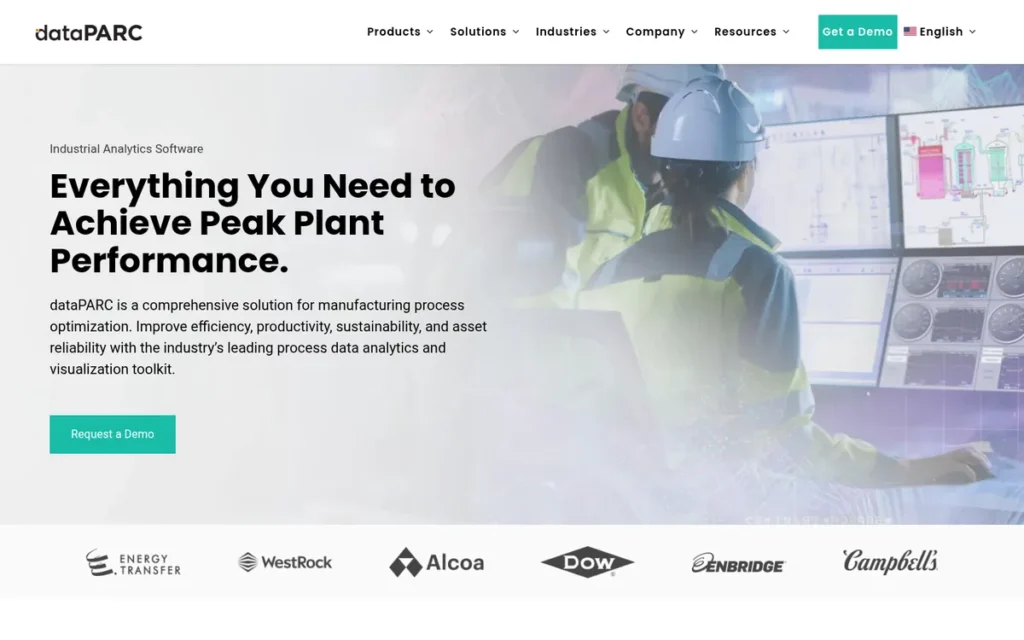
Category: Operational Monitoring Platform, integrated historian, real-time visualization, and anomaly detection in a single per-tag-licensed system purpose-built for continuous process manufacturing.
At a Glance
- Category: Industrial Process Platform
- Best For: Small-to-mid process manufacturing plants needing a complete historian and visualization solution under one vendor
- Price Range: Per-tag licensing with unlimited concurrent users; specific pricing requires sales contact
- Primary Strength: 4.9/5.0 Capterra rating (8 reviews); unlimited users per-tag model; per-tag licensing that eliminates per-seat barriers
- Biggest Limitation: Primarily Windows-based deployment architecture; limited cloud-native options; minimal AI/ML depth vs. Seeq
- One-Line Summary: dataPARC is an all-in-one industrial time series platform combining a dual-archive historian, PARCview real-time visualization, PCA-based anomaly detection, and an Excel add-in under a single per-tag license with unlimited concurrent users.
- Last Verified: May 2026
Overview
dataPARC is a purpose-built industrial time series platform integrating a high-performance historian, PARCview real-time visualization, PARCgraphics (WPF-based process graphics), PARCxla (Excel add-in for operational reporting), and PCA-based anomaly detection in a single vendor offering, directly addressing the multi-vendor pain of purchasing separate historian software and a separate analytics layer.
dataPARC was founded in 1993 and is headquartered in Kamloops, British Columbia, Canada, with over 30 years of continuous operation as a privately held company, the longest tenure of any vendor in this comparison. This independence from venture capital may enable longer-term, customer-centric product decisions without exit-timeline pressures.
dataPARC serves chemical plants, refineries, food manufacturing, and continuous process industries worldwide, positioning itself as the all-in-one alternative to the OSIsoft PI plus separate analytics layer approach that larger enterprises frequently adopt.
Key Features
- Dual-Archive Historian System: dataPARC’s Historian uses a dual-archive architecture, an Aggregate Archive for high-resolution real-time data and a Rollup Archive for long-term compressed historical values, enabling retrieval of large historical timeframes in seconds rather than hours vs. single-archive systems [Source: metafactor.ca historian review, 2024, third-party reseller review].
- Per-Tag Licensing with Unlimited Users: dataPARC’s per-tag licensing model [Source: dataparc.com/blog, 2024] grants unlimited concurrent user access, a decisive cost advantage over per-user licensing that makes broad organizational data access prohibitively expensive in large manufacturing plants with hundreds of operators and managers.
- Self-Reported Performance vs. OSIsoft PI: dataPARC reports its PDE engine delivers data 10x–50x faster than OSIsoft PI for common manufacturing analytics scenarios [Source: dataparc.com/blog/dataparc-vs-pi/, 2024, vendor self-report; no independent third-party benchmark verified as of May 2026]. Buyers should request controlled benchmark data from dataPARC before using this figure in procurement decisions.
- PARCview: Real-Time Operational Visualization: PARCview provides engineers and operators with real-time trending, historical period comparison, and process visualization directly connected to the dataPARC Historian, without requiring a separate analytics layer or licensing Seeq or PI Vision.
- PCA Anomaly Detection: dataPARC includes Principal Component Analysis (PCA) modeling for multivariate anomaly detection (detecting unusual process conditions across correlated tag groups) without requiring a separate ML platform or data science team.
- PARCxla: Excel Integration: dataPARC’s PARCxla Excel add-in enables operations, maintenance, and management personnel to access and report on historian data directly within Microsoft Excel, meeting a real-world requirement for industrial organizations where Excel remains the dominant reporting tool.
Best For
dataPARC is best suited for small-to-mid-sized process manufacturing plants in chemical, refining, food and beverage, and continuous manufacturing that need a complete historian and real-time visualization solution under a single vendor, particularly organizations currently on OSIsoft PI evaluating a cost-effective alternative with unlimited user access.
Strengths
- dataPARC holds a Capterra rating of 4.9/5.0 with 8 reviews [Source: Capterra, capterra.com/p/100045/dataPARC/, verified May 2026] and a G2 rating of 4.8/5.0 with 12 reviews [Source: G2, g2.com/products/dataparc, verified May 2026], the highest per-review satisfaction scores of any platform in this analysis, though statistically less robust than Grafana’s 2,500+ or InfluxDB’s 450+.
- dataPARC’s per-tag unlimited-user model [Source: dataparc.com/blog, 2024] eliminates per-seat cost barriers that make broad analytics adoption financially prohibitive in large plants, enabling organization-wide data access that per-user licensed competitors cannot match at comparable cost.
- dataPARC has operated continuously for over 30 years as a privately held company: a meaningful business continuity signal for industrial organizations with 20–30 year asset lifecycles requiring long-term vendor stability.
- dataPARC’s dual-archive historian enables large historical timeframe retrieval in seconds rather than hours [Source: metafactor.ca, 2024, third-party reseller review; no independent peer-reviewed benchmark published], addressing production-critical process comparison analysis requirements that single-archive systems cannot meet efficiently.
Limitations
- Primarily Windows-Based Deployment: dataPARC’s WPF-based PARCgraphics architecture is primarily Windows-based, a significant constraint for organizations moving toward Linux-native, container-based, or cloud-first infrastructure strategies.
- Limited Cloud-Native Options: dataPARC does not offer a cloud-native SaaS or DBaaS deployment model comparable to Grafana Cloud, InfluxDB Cloud, or Timescale Cloud, limiting applicability for organizations standardizing on cloud infrastructure.
- Minimal AI/ML Depth: dataPARC’s AI capability is limited to PCA-based anomaly detection; it does not include the agentic AI workflows, natural-language interfaces, or foundation model forecasting available in Seeq (Agent Q) or Nixtla (TimeGPT), a meaningful gap for industrial organizations pursuing advanced AI-driven operations.
- Low Public Review Volume with Statistical Uncertainty: With 12 G2 reviews and 8 Capterra reviews, dataPARC’s satisfaction scores are the statistically least robust in this comparison, a single negative review among the 12 could shift the composite G2 score by approximately 0.3–0.4 points, meaning the 4.8/5.0 score should be interpreted as indicative rather than definitive. Low review volume warrants direct reference customer checks before procurement.
- No Publicly Documented Quantified ROI Case Studies: Unlike Seeq (98.75% analysis time reduction, named Microsoft case study) or TimescaleDB (Cloudflare server elimination through compression), dataPARC has no named, quantified client outcomes in publicly accessible sources, prospective buyers must rely on 12 G2 reviews and direct reference customer requests for independent outcome data.
Verdict
dataPARC is the highest-satisfaction industrial platform in this comparison on a per-review basis, delivering an all-in-one historian, visualization, and anomaly detection stack with an unlimited-user per-tag model that removes per-seat cost barriers endemic to enterprise industrial software. dataPARC is the most compelling option for smaller process manufacturing plants replacing separate historian and analytics purchases, and particularly compelling for organizations where the self-reported performance advantage over OSIsoft PI is a direct operational priority pending independent validation. The primarily Windows-based architecture and limited cloud-native capabilities make dataPARC a poor fit for organizations on a cloud-first or Linux infrastructure trajectory, where Seeq’s cloud and Databricks integration provides a clearer path forward.
#7: Amazon Timestream, Best for AWS-Native IoT and Serverless Monitoring
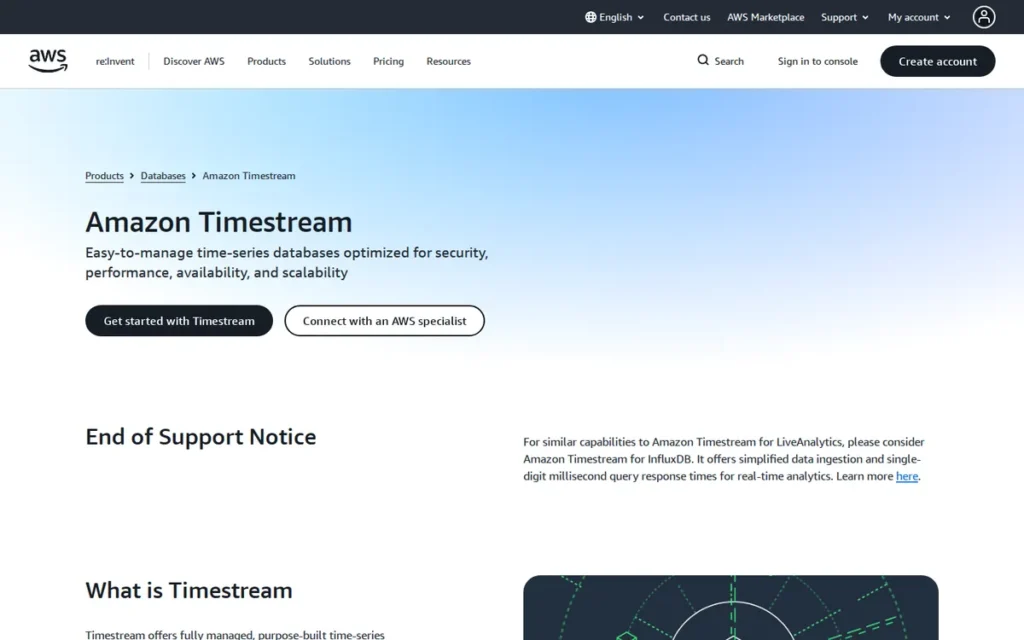
Category: Time Series Database Engine, fully managed, serverless AWS database with automatic memory-to-magnetic storage tiering designed for IoT fleets, operational monitoring, and server metrics within the AWS ecosystem.
At a Glance
- Category: Cloud Time Series Database
- Best For: AWS-native engineering teams managing IoT fleets, server monitoring, or operational analytics within the AWS ecosystem
- Price Range: Pay-per-use: $0.01/1M writes; $0.036/GB-month Memory Store; $0.03/GB-month Magnetic Store; $0.005/GB scanned
- Primary Strength: Zero ops overhead; automatic storage tiering; native AWS Kinesis/IoT Core/Lambda/SageMaker integration; 99.99% availability SLA
- Biggest Limitation: Lowest G2 rating in this comparison (4.3/5.0); pricing unpredictability on high-scan workloads; strict AWS vendor lock-in
- One-Line Summary: Amazon Timestream is a fully managed, serverless AWS time series database offering automatic memory-to-magnetic storage tiering, processing trillions of events per day with zero capacity management and native integration across the AWS ecosystem.
- Last Verified: May 2026
Overview
Amazon Timestream is a fully managed, serverless time series database service within AWS, first previewed at AWS re:Invent 2018 and reaching general availability in December 2020. Amazon Timestream operates in two engines: Timestream for LiveAnalytics (SQL plus time series extensions for analytics on historical data) and Timestream for InfluxDB (fully managed InfluxDB with InfluxQL/Flux API compatibility for single-digit millisecond real-time monitoring queries).
Both engines run without server provisioning or capacity management, users ingest data and query it without configuring clusters, storage volumes, or scaling parameters. This zero-ops model is Amazon Timestream’s primary differentiator from self-managed alternatives such as InfluxDB OSS or TimescaleDB OSS.
Amazon Timestream’s deep integration across Lambda, Kinesis, IoT Core, SageMaker, S3, and Grafana creates end-to-end pipelines within the AWS ecosystem without adding external vendors, a compelling advantage for organizations already substantially invested in AWS infrastructure.
Key Features
- Serverless Auto-Scaling Architecture: Amazon Timestream automatically scales ingestion, compute, and storage without capacity planning, processing tensof GB per minute and trillions of events per day [Source: aws.amazon.com/timestream/, verified May 2026] with no cluster management, providing the lowest operational overhead of any time series platform in this comparison.
- Dual-Tier Memory-to-Magnetic Storage Tiering: Amazon Timestream automatically transitions data from Memory Store (recent data in RAM for millisecond-latency queries) to Magnetic Store (disk-based historical storage for cost-efficient retention) based on user-configured retention policies, eliminating manual archival and data lifecycle management.
- Dual-Engine Architecture: Amazon Timestream for LiveAnalytics handles analytical queries on historical data [Source: aws.amazon.com/timestream/features/, May 2026]; Amazon Timestream for InfluxDB provides real-time IoT monitoring with InfluxQL/Flux API compatibility, enabling teams to choose the right engine for their query pattern.
- Native AWS Ecosystem Integration: Amazon Timestream integrates natively with AWS Lambda, Kinesis (streaming ingestion), IoT Core (device telemetry), S3 (backup and export), SageMaker (ML model training), and Grafana, enabling end-to-end pipelines without adding external vendors for AWS-native teams.
- 99.99% Availability SLA: Amazon Timestream provides a 99.99% uptime SLA [Source: aws.amazon.com/timestream/features/, May 2026], consistent with other AWS managed database services and backed by AWS’s global multi-AZ infrastructure.
- Scheduled Queries: Amazon Timestream’s scheduled query feature automatically computes and stores aggregate rollups on a configured schedule, reducing query costs on repetitive analytical workloads by pre-materializing commonly accessed aggregations.
Best For
Amazon Timestream is best suited for AWS-native engineering teams managing IoT device fleets, server and application monitoring, or operational metrics pipelines where zero operational overhead and native integration with Kinesis, IoT Core, and Lambda are higher priorities than multi-cloud portability or lowest-cost-per-query analytics.
Strengths
- Amazon Timestream eliminates all server provisioning, cluster management, and capacity planning, providing the lowest operational overhead of any time series platform in this comparison, a genuine value for teams without dedicated database administration resources.
- Amazon Timestream’s Memory Store delivers single-digit millisecond query latency on recent data [Source: aws.amazon.com/timestream/features/, May 2026] with automatic tiering to cost-efficient Magnetic Store, transparently spanning both tiers in queries, handling a data lifecycle challenge that requires manual archival scripts with most alternative databases.
- Amazon Timestream provides a 99.99% availability SLA [Source: aws.amazon.com/timestream/features/, May 2026] with automatic multi-AZ durability, backed by AWS’s global infrastructure reliability track record.
- Amazon Timestream’s native integration with AWS IoT Core, Kinesis, and Lambda creates turnkey IoT analytics pipelines within the AWS ecosystem, reducing integration development effort compared to self-managed time series databases requiring custom connector work.
Limitations
- Lowest G2 Rating in This Comparison: Amazon Timestream holds a G2 rating of 4.3/5.0 (~12 reviews) [Source: G2, verified May 2026] and a Gartner Peer Insights rating of 4.4/5.0 (18 reviews) [Source: Gartner Peer Insights, verified May 2026] with notably weak pricing transparency scores (3.8/5.0), the lowest ratings of any platform in this analysis, reflecting real user friction with cost predictability.
- Pricing Unpredictability: The per-GB-scanned query billing model ($0.005/GB on Magnetic Store) creates cost uncertainty for high-scan analytical workloads (practitioners have directly documented: “query costs explode on large scans) predictability lacks vs. fixed InfluxDB” [Source: Hacker News discussion, news.ycombinator.com/item?id=25287793]. This contrasts with InfluxDB Enterprise’s or TimescaleDB’s per-vCPU pricing.
- Strict AWS Vendor Lock-In: Amazon Timestream data cannot be easily exported to other cloud providers or on-premises environments, no open-source version, no self-hosted alternative, and no native multi-cloud portability path. This contrasts with InfluxDB (Apache Parquet on S3), TimescaleDB (PostgreSQL dump), and Grafana (self-hosted OSS).
- Cardinality Ceiling for Observability Workloads: User-reported observations suggest Amazon Timestream performs best for workloads below approximately 10 million unique series keys [Source: mactores.com/blog, 2024 (user-reported observation; verify against current AWS Timestream documentation for official limits]) far below Grafana Mimir’s 1 billion+ active series capacity, limiting applicability for large-scale microservices observability.
Verdict
Amazon Timestream delivers genuine value as a zero-ops, serverless time series solution for AWS-native teams managing IoT fleets and operational monitoring workloads where eliminating database administration overhead justifies the AWS lock-in trade-off. Amazon Timestream ranks #7 in this comparison due to the lowest peer ratings (4.3/5.0 G2), the weakest pricing transparency score (3.8/5.0 Gartner Peer Insights), and the strictest vendor lock-in of any platform reviewed. Organizations running high-volume analytical queries against historical data should model expected scan costs carefully before committing. For teams already deeply invested in the AWS ecosystem with modest cardinality requirements, Amazon Timestream remains a pragmatic choice, for teams prioritizing multi-cloud portability, transparent pricing, or observability at 1 billion+ series scale, alternatives in this ranking are more appropriate.
What Red Flags Should I Watch For When Evaluating Time Series Intelligence Software?
Six red flags account for most regretted time series software purchases: unpublished pricing (Seeq, dataPARC, Nixtla at scale), version migration debt (InfluxDB Flux deprecation), hidden cardinality ceilings (Amazon Timestream), non-linear pricing at scale (Timestream and Grafana Cloud), black-box AI without explainability (Nixtla TimeGPT), and low review volume inflating satisfaction scores. Each is drawn from documented user experiences.
Red Flag #1: No Published Pricing
Three platforms in this comparison (Seeq, dataPARC, and Nixtla at production scale) do not publish pricing and require sales engagement for any cost data. This prevents like-for-like cost comparison during vendor evaluation and typically signals enterprise-minimum contract structures. Platforms unable to provide indicative pricing ranges on request should be scrutinized during procurement.
Red Flag #2: Version Migration Debt
InfluxDB’s history illustrates how proprietary query language investments become liabilities: the company developed Flux as a major differentiator in v2, then deprecated it in v3, leaving customers with non-trivial migration work. Before committing to a platform, confirm the vendor’s version migration path, whether breaking changes have occurred in the past 3–4 years, and whether the current version represents a stable long-term architecture.
Red Flag #3: Cardinality Ceilings Not Stated in Marketing
Several platforms perform well at small-to-medium cardinality but degrade significantly at high series counts. Amazon Timestream’s practical ceiling of approximately 10 million unique series keys (reported by users but absent from AWS marketing materials) is a representative example. Always benchmark on your actual data volume and cardinality before signing a production contract.
Red Flag #4: Pricing Models That Scale Non-Linearly
Per-GB-scanned query pricing (Amazon Timestream: $0.005/GB on Magnetic Store) and per-active-series pricing (Grafana Cloud: $49/series/month at Pro tier) can create cost surprises that dwarf initial estimates when workloads grow. Confirm total cost of ownership at 3x and 10x current data volume before selecting a usage-based platform.
Red Flag #5: Black-Box AI/ML Without Explainability Options
For organizations in regulated industries (financial services, pharmaceuticals, energy, healthcare) AI-powered forecasting that cannot produce auditable, interpretable outputs is a compliance risk. Practitioners explicitly flag TimeGPT’s black-box results as a production limitation [Source: u/Technical-Brush7204, r/datascience, May 2026]. Before deploying AI forecasting in regulated environments, confirm the platform provides documented interpretability methods that satisfy your compliance requirements.
Red Flag #6: Low Review Volume That Inflates Satisfaction Scores
Platforms with fewer than 50 G2 reviews carry higher statistical uncertainty in their satisfaction ratings:
- dataPARC: 12 G2 reviews, 8 Capterra reviews: highest per-review scores (4.8–4.9/5.0) but smallest statistical base; a single negative review could shift the composite score by approximately 0.3–0.4 points
- Amazon Timestream: ~12 G2 reviews, 18 Gartner Peer Insights reviews: lowest ratings in this comparison (4.3/5.0 G2)
- Nixtla (TimeGPT): ~50 G2 reviews: reflects recency as a commercial product; GitHub metrics (15,000+ stars) provide a more reliable adoption signal at this stage
Low review volume does not indicate a poor product, it signals that independent outcome data is limited and direct reference customer checks are more important than score comparisons.
What Questions Should I Ask Before Choosing a Time Series Intelligence Platform?
Six due-diligence questions surface the decision points most commonly missed until post-procurement: SQL and JOIN capability, total cost at growth scale, data portability and exit strategy, AI/ML explainability for regulated use, data residency options, and vendor API stability history. Each question below maps directly to a documented platform limitation in this comparison.
Question #1: Does the platform support relational JOINs between time series data and metadata tables?
If your use case requires correlating sensor readings with asset metadata, production schedules, or customer records stored in relational tables, confirm native SQL JOIN support before purchasing. InfluxDB and Amazon Timestream do not support native relational JOINs; TimescaleDB does. Discovering this limitation post-procurement forces expensive workarounds or full re-platforming.
Question #2: What is the total cost of ownership at 3x and 10x current data volume?
Request a cost model at three scales: current volume, 3x growth (18-month projection), and 10x growth (3-year projection). Usage-based pricing models (per-GB-scanned, per-active-series) that appear inexpensive at current scale can increase non-linearly as data volumes grow. Compare against fixed-rate alternatives at each scale point before committing.
Question #3: What is the data migration path if I need to switch platforms in 3–5 years?
Ask specifically: Can I export my data in an open format such as Parquet, CSV, or PostgreSQL dump? Platforms built on open formats (TimescaleDB on PostgreSQL, InfluxDB on Apache Parquet) provide substantially more portability than proprietary formats or AWS-managed-only services. Understanding exit costs before purchase protects against vendor lock-in.
Question #4: Does the platform provide model explainability for AI/ML outputs?
If evaluating platforms with AI forecasting or anomaly detection (Seeq Intelligence, Nixtla TimeGPT, or Grafana’s ML alerting) ask how the platform explains its model outputs. Can it provide feature importance rankings, prediction interval decompositions, or audit trails? In regulated industries, AI outputs that cannot be explained to a compliance team cannot be relied upon for operational decisions.
Question #5: What are the self-hosting and data residency options?
For organizations subject to data sovereignty requirements (GDPR, HIPAA, FedRAMP), confirm whether the platform can be self-hosted in your own infrastructure and whether the self-hosted version retains full feature parity with the managed cloud version. Amazon Timestream and some Grafana Cloud enterprise features do not offer complete parity between self-hosted and managed deployments.
Question #6: How does the vendor’s version history reflect API and data model stability?
Request a 3-year version history from each vendor. Platforms that have made breaking changes to their query language (InfluxDB Flux → SQL), data model, or API introduce re-development costs that compound across customer integrations. Evaluate whether the vendor provides long-term support releases, deprecation timelines, and migration tooling when breaking changes are introduced.
How Did We Rank These Time Series Intelligence Software Platforms?
PlugRoute ranks time series platforms on six criteria: peer-validated review ratings and volume (G2, Capterra, Gartner Peer Insights), real-world community sentiment from Reddit and practitioner forums, pricing transparency, documented benchmarks and named case study outcomes, AI and ML capability depth, and data portability and integration breadth. No vendor paid for or influenced any ranking position in this comparison.
How Did We Evaluate Each Platform?
Research for each of the seven platforms covered:
- Independent web research on product capabilities, published benchmarks, pricing, and named case study outcomes
- G2, Capterra, and Gartner Peer Insights rating and review volume verification as of May 2026
- GitHub star count and community activity assessment
- Reddit community sentiment analysis across r/datascience, r/dataengineering, r/Database, r/devops, r/selfhosted, and r/homelab
- Cross-referencing all vendor claims against at least one independent source before inclusion as a stated fact
- No vendor contact, vendor review, or vendor payment at any stage of research or editorial review
All platforms were evaluated simultaneously using identical criteria with no variation in depth or rigor between ranked entries.
What Criteria Determine the Rankings?
Review Platform Ratings and Volume: why it matters: High review volume with strong ratings provides a statistically robust satisfaction signal. A 4.7/5.0 from 2,500 reviews (Grafana) is a stronger signal than 4.8/5.0 from 12 reviews (dataPARC), even though the latter has the higher score. PlugRoute weights both the rating and the review count.
Real-World User Sentiment (Reddit, Forums): why it matters: Formal G2 reviews skew toward satisfied customers who chose to leave a review. Reddit discussions capture the frustrations, failure modes, and genuine trade-offs that formal reviews underreport. A practitioner’s direct quote about a production limitation carries higher confidence than a generic five-star review.
Pricing Transparency and Value: why it matters: Pricing opacity disadvantages buyers and introduces procurement risk. Platforms with published pricing receive credit for enabling informed decision-making; platforms requiring sales contact for any pricing information are rated lower on this criterion.
Data Quality, Performance, and Feature Depth: why it matters: Documented benchmarks and independent case study outcomes are weighed against vendor self-reports. Claims corroborated by named customers (Cloudflare for TimescaleDB, Microsoft case study for Seeq) carry more weight than uncorroborated vendor assertions.
AI/ML Capability Depth: why it matters: With 49% of enterprises adopting AI-enabled time series capabilities in 2025 [Source: SNS Insider, snsinsider.com, 2025], platforms without native AI/ML face increasing competitive pressure. AI depth is evaluated on documented capabilities only, not roadmap claims.
Integration Quality and Portability: why it matters: Platforms that lock data into proprietary formats impose switching costs that compound over time. Open standards (SQL, Apache Parquet, PostgreSQL) and broad connector ecosystems are weighted positively.
How Is Conflicting Evidence Resolved?
When review platform ratings conflict with Reddit community sentiment, PlugRoute weights specificity and recency. A detailed May 2026 Reddit post with substantive practitioner comments outweighs a generic 2023 G2 review with no specific detail.
When vendor-stated performance benchmarks are contradicted by independent practitioner reports, both data points are presented rather than defaulting to the vendor claim. Claims are classified at three levels: (1) Confirmed, corroborated by at least one independent source with URL; (2) Vendor-Reported, stated by the vendor in official documentation, labeled as such; (3) Community-Observed, based on practitioner reports from Reddit or forums, labeled with source thread.
How Are Vendor Claims Verified?
Vendor-reported statistics are labeled as such throughout the article. Only claims corroborated by at least one independent source are stated as facts. Statistics with a confirmed source URL are hyperlinked for direct verification. Pricing is presented at levels documented in publicly accessible sources as of May 2026, readers should verify current rates at vendor websites before making procurement decisions.
How Often Is This Comparison Updated?
This article was last updated May 2026. PlugRoute reviews and refreshes ranked comparison articles on a rolling basis as significant product launches, pricing changes, or new independent research warrants updates. The “Last Verified” date in each product’s At a Glance block indicates when that specific entry’s data was last confirmed.
Does PlugRoute Have Any Commercial Relationships With These Vendors?
PlugRoute has zero affiliate relationships with any company listed in this comparison. No vendor paid for placement, influenced the research, or reviewed this content before publication. Rankings are determined solely by the criteria described above.
Frequently Asked Questions About Time Series Intelligence Software
What Is the Difference Between a Time Series Database and a Time Series Intelligence Platform?
A time series database (such as InfluxDB, TimescaleDB, or Amazon Timestream) stores and retrieves time-stamped data at high throughput but provides no analytics layer. A time series intelligence platform (such as Seeq or Nixtla) adds AI forecasting, anomaly detection, and decision support on top of stored data. Most production architectures require both layers.
Is Open-Source Time Series Software Suitable for Enterprise Production Workloads?
Yes. Grafana (4.7/5.0, 2,500+ G2 reviews), InfluxDB (4.5/5.0, 450+ reviews), and TimescaleDB (4.7/5.0, 248 reviews) all have validated enterprise production deployments at scale [Source: G2, verified May 2026], including Grafana’s Gartner MQ Leader status and TimescaleDB’s named Cloudflare production case study. All three offer managed cloud tiers and enterprise support contracts with SLAs.
How Does PlugRoute Determine Its Rankings?
PlugRoute ranks platforms on six equally applied criteria: peer-validated review ratings and volume (G2, Capterra, Gartner Peer Insights), real-world community sentiment, pricing transparency, documented benchmarks and named case study outcomes, AI/ML capability depth, and integration portability. All criteria are applied identically to every platform; ranking positions are determined entirely by evidence from independent sources.
What Key Terms Should I Know Before Evaluating Time Series Software?
This glossary defines five technical terms used throughout this comparison that may be unfamiliar to buyers new to time series software. Each definition is self-contained and independently citable, understanding these terms reduces evaluation time and improves the precision of vendor conversations.
Cardinality: In time series databases, cardinality refers to the number of unique combinations of metric names and label or tag values (that is, distinct time series streams) that a database must index and store. High-cardinality workloads (tracking metrics for millions of individual IoT devices, each with unique device IDs) can overwhelm databases not architecturally designed for them, causing query latency and storage costs to increase non-linearly.
FDAP Stack: An open-technology data architecture used by InfluxDB 3, comprising Apache Flight (efficient network data transfer), DataFusion (query engine), Apache Arrow (in-memory columnar data format), and Parquet (columnar storage format on disk). The FDAP stack enables InfluxDB data to be consumed natively by any Arrow/Parquet-compatible analytics tool (DuckDB, Spark, Pandas) without ETL transformation.
Historian: In industrial and process manufacturing contexts, a historian (or process historian) is a purpose-built database that records and stores time-stamped sensor and process tag data from plant operations (temperature, pressure, flow rates, valve positions) at high frequency and over long retention periods. Common historians include OSIsoft PI System, Aspen IP.21, and Honeywell PHD. Seeq and dataPARC both connect to or function as historians.
Hypertable: A TimescaleDB abstraction that transparently partitions a standard PostgreSQL table into time-based and optionally space-based chunks. Hypertables allow the TimescaleDB query engine to skip irrelevant time partitions entirely during queries, achieving significantly faster aggregate performance vs. unpartitioned PostgreSQL tables on large time series datasets, the primary source of TimescaleDB’s query speed advantage.
Zero-Shot Forecasting: A forecasting approach where a pre-trained model generates predictions for a new, unseen dataset without any training on that specific dataset. TimeGPT’s zero-shot capability (derived from pre-training on 100+ billion rows of diverse temporal data) allows it to forecast new time series within minutes of data upload, contrasting with traditional approaches (ARIMA, Prophet) that require model fitting on each individual series before any forecasts can be generated.
Glossary: Key Terms Used in This Comparison
Cardinality: In time series databases, cardinality refers to the number of unique combinations of metric names and label or tag values (that is, distinct time series streams) that a database must index and store. High-cardinality workloads can overwhelm databases not architecturally designed for them, causing query latency and storage costs to increase non-linearly.
FDAP Stack: An open-technology data architecture used by InfluxDB 3, comprising Apache Flight, DataFusion, Apache Arrow, and Parquet. The FDAP stack enables InfluxDB data to be consumed natively by any Arrow/Parquet-compatible analytics tool (such as DuckDB, Spark, or Pandas) without ETL transformation.
Historian: In industrial and process manufacturing contexts, a historian (or process historian) is a purpose-built database that records time-stamped sensor and process tag data from plant operations (temperature, pressure, flow rates, valve positions) at high frequency and over long retention periods. Common historians include OSIsoft PI System and Aspen IP.21; both Seeq and dataPARC connect to or function as historians.
Hypertable: A TimescaleDB abstraction that transparently partitions a standard PostgreSQL table into time-based and optionally space-based chunks. Hypertables allow the TimescaleDB query engine to skip irrelevant time partitions entirely during queries, achieving significantly faster aggregate performance versus unpartitioned PostgreSQL tables on large time series datasets.
Zero-Shot Forecasting: A forecasting approach where a pre-trained model generates predictions for a new, unseen dataset without any training on that specific dataset. TimeGPT’s zero-shot capability (derived from pre-training on 100+ billion rows of diverse temporal data) allows it to forecast new time series within minutes of data upload, contrasting with traditional approaches such as ARIMA or Prophet that require per-series model fitting before forecasts can be generated.
Which Time Series Intelligence Tool Is Right for You?
Key Insights
- Grafana is the most peer-validated choice for observability and visualization, backed by 2,500+ G2 reviews at 4.7/5.0 and Gartner Magic Quadrant Leader status from 2023 through 2025, making it the lowest-risk selection for DevOps, SRE, and platform engineering teams.
- InfluxDB and TimescaleDB serve distinct database needs: InfluxDB wins for high-frequency metric ingestion where time-stamped data is queried in isolation; TimescaleDB wins when time series measurements must be combined (JOINed) with relational metadata tables such as equipment records, customer data, or product catalogs in a single SQL query.
- Seeq and dataPARC address the industrial process manufacturing segment specifically, Seeq at enterprise scale with existing historian infrastructure and Agent Q agentic AI, and dataPARC as the all-in-one alternative for smaller plants needing historian and visualization from a single vendor without multi-vendor integration complexity.
- Nixtla TimeGPT is the right choice for cold-start forecasting problems where traditional models cannot be trained effectively, but practitioners should model inference economics carefully at scale (where API costs can be 100x–1,000x higher than statistical alternatives) and should not use TimeGPT in regulated industries without a validated explainability approach.
If your primary need is production-grade observability with the broadest data source compatibility and the strongest peer-review record, Grafana is the clear starting point. If you are a PostgreSQL team adding time series capabilities and cannot compromise on JOIN support, TimescaleDB’s transparent pricing and Cloudflare-validated performance make it the most risk-free upgrade path.
For industrial manufacturing teams, the decision hinges on infrastructure maturity: organizations with OSIsoft PI or Aspen IP.21 already deployed should evaluate Seeq for its agentic AI capabilities and documented ROI; plants without an existing historian should evaluate dataPARC’s all-in-one model to avoid multi-vendor integration complexity.
In a market growing at 12.5% CAGR toward a projected $6.1 billion by 2033 [Source: Verified Market Reports, February 2025], platforms built on open standards (SQL, Apache Parquet, and open-source cores) that give buyers a clear exit ramp will be better positioned for long-term viability than those bundling data into proprietary formats or single-cloud services.
Immediate next step: Identify which of the three categories (monitoring platform, database engine, or AI intelligence platform) your primary use case belongs to. Then request free tier or trial access from the top two candidates in that category. TimescaleDB, InfluxDB, and Grafana all offer production-capable free tiers with no sales engagement required; begin there before evaluating paid-only options.
For deeper comparisons, head-to-head benchmarks, and updates as platforms evolve, visit PlugRoute, where every ranking is earned, not purchased.
We update this guide quarterly. Last updated: May 2026.