Stripe Connect is the best overall embedded payments software for fast, multi-country launches. Adyen for Platforms is best for enterprise omnichannel platforms, and Rainforest is best for U.S. vertical SaaS that wants to keep the payments spread. The right choice depends on how much margin and compliance control you want versus how fast you must launch.
People often confuse embedded payments with standard payment processing. Most vendors only give prices on request, and there are few independent reviews. This ranking is for platforms whose customers or sellers accept payments inside the product. It does not cover a company’s own checkout or subscription billing.
PlugRoute has no affiliate relationships with any company listed. Rankings are determined entirely by research data and objective evaluation criteria.
“There is Stripe Connect, Stax Connect, Moov, Finix, Tilled, Adyen… It’s very difficult to compare them. Many, if not most, have custom pricing. It’s also difficult to find review and feedback online for the majority of them.” (u/TasteNo9746 (Reddit r/PaymentProcessing, 2025; independent))
Takeaway: Most embedded payments providers use custom pricing and have few independent reviews. That is why PlugRoute scores missing evidence as missing.
What Are the 4 Categories of Embedded Payments Software?
Embedded payments software falls into four categories. From least to most platform control, they are self-serve platform providers, enterprise acquirer platforms, managed PayFac-as-a-Service and PayFac enablement platforms. Each step toward more control gives the platform more payments margin. It also gives the platform more compliance responsibility. The right category depends on your volume and how much risk you can take on.
- Self-Serve Platform Provider: Stripe Connect lets a platform sign up and onboard its users as connected accounts without signing a sales-led contract.
- Enterprise Acquirer Platform: Adyen for Platforms and Worldpay for Platforms are platform payments products from large acquirers, sold under negotiated contracts.
- Managed PayFac-as-a-Service: Rainforest, Tilled and Stax Connect hold the payment facilitator (PayFac) registration with a sponsor bank and onboard the platform’s users as sub-merchants, while the platform puts its own brand on the experience.
- Managed PayFac-as-a-Service economics: Rainforest uses a buy-rate spread, Tilled publishes a revenue share, and Stax Connect uses a revenue share it does not publish.
- PayFac Enablement Platform: Finix lets a platform start on managed payments and later register as its own PayFac without switching providers.
Embedded payments software is the wrong category if your company only takes payments for its own sales or bills its own subscribers. In that case you need a standard processor or a subscription billing tool. Merchant-of-record services are a related model, but this ranking does not cover them.
Market data shows how much this choice matters:
- Software platforms earn about 47% of U.S. SMB acquiring revenue in 2025, and that share is projected to reach about 60% by 2030 (Chargeforward citing UBS, 2026; third-party).
- About 82% of vertical SaaS platforms use managed PayFac or PayFac-as-a-Service, compared with about 10% that register as their own PayFac (Rainforest benchmark via Chargeforward, 2026; vendor-published).
How Do the Top Embedded Payments Providers Compare at a Glance?
Stripe Connect leads PlugRoute’s 2026 ranking with 37 of 45 points. Adyen for Platforms follows with 33. Rainforest and Finix both score 28, and Rainforest takes third on the tiebreak rule. Tilled scores 26. Worldpay for Platforms (21) and Stax Connect (19) score lower because their pricing is quote-only and their independent support evidence is weaker. Stax Connect also does not disclose its sponsor bank.
Ranks 3 to 5 are only two points apart. Choose among Rainforest, Finix and Tilled by the economics model you want, not by rank.
| Rank | Company | Category | Best For | One-Line Summary | Key Capabilities | Primary Strength | Key Limitation |
|---|---|---|---|---|---|---|---|
| 1 | Stripe Connect | Self-Serve Platform Provider | Fast launches and multi-country marketplaces | Stripe Connect is the fastest self-serve route to embedded payments, with published pricing and connected accounts in 46+ countries. | Embedded onboarding components, split payouts, Terminal, instant payouts | Broadest documented connected-account and payout coverage; published platform pricing | Thin margins at small scale; platform may be liable for negative balances |
| 2 | Adyen for Platforms | Enterprise Acquirer Platform | Enterprise, multi-country, unified commerce | Adyen for Platforms suits enterprise platforms that need unified online and in-person payments on a direct acquirer. | Balance Platform, hosted or API onboarding, Issuing, Capital | Own acquiring licenses in multiple markets | Sales-led setup; €5M revenue threshold reported by users (anecdotal) |
| 3 | Rainforest | Managed PayFac-as-a-Service | U.S. vertical SaaS maximizing margin | Rainforest publishes interchange-plus buy rates and lets U.S. vertical SaaS platforms keep the full payments spread. | White-label onboarding, card, ACH, in-person, deposit reporting | Most transparent platform economics; no minimums | No independent reviews; U.S.-focused |
| 4 | Finix | PayFac Enablement Platform | U.S. and Canadian platforms planning to own their PayFac | Finix offers a staged path from managed payments to a platform’s own registered PayFac on one infrastructure. | Direct card-network connections, fee profiles, token migration | Clearest documented managed-to-owned PayFac path | Partly custom pricing; U.S. and Canada only |
| 5 | Tilled | Managed PayFac-as-a-Service | Fast launch with predictable revenue share | Tilled publishes a 70–80% platform revenue share and has the fastest cited launch timeline of the seven providers. | White-label payments, ACH, subscriptions, card-present (U.S./Canada) | Published revenue-share tiers; 2–4 week cited launch | $500/month fee and shortfall obligation |
| 6 | Worldpay for Platforms | Enterprise Acquirer Platform | Large U.S. ISVs with card-present volume | Worldpay for Platforms, formerly Payrix, pairs managed PayFac-as-a-Service with Global Payments’ acquirer scale. | Payrix Pro and Flex models, white-label onboarding, card-present | Global acquirer backing with a managed-to-owned option | Quote-only pricing; 2.7/5 Capterra support score |
| 7 | Stax Connect | Managed PayFac-as-a-Service | U.S. SMB-focused SaaS wanting full management | Stax Connect is a fully managed PayFac-as-a-Service program that minimizes a platform’s payments workload. | End-to-end onboarding, underwriting, compliance and payouts | Fully managed operations | Unpublished revenue share and sponsor bank |
Which Embedded Payments Software Should I Choose for My Use Case?
Match your top priority to one recommended provider and one fallback. Stripe Connect fits speed and global reach. Adyen for Platforms fits enterprise omnichannel commerce. Rainforest and Tilled fit U.S. margin goals, and Finix fits a planned move to your own PayFac. PlugRoute’s Quick Decision Framework maps seven common priorities to one recommended provider and one alternative.
| Your #1 Priority | Recommended Tool | Why | Acceptable Alternative |
|---|---|---|---|
| Launch fast as a pre-revenue platform or global marketplace | Stripe Connect | Self-serve signup, published pricing, connected accounts in 46+ countries | Rainforest (U.S. only; no monthly minimums) |
| Enterprise, multi-country, unified commerce with established volume | Adyen for Platforms | Own acquiring licenses; online and in-person payments on one platform | Stripe Connect |
| Keep the full payments spread as U.S. vertical SaaS | Rainforest | Published buy rates; no minimums or annual fees | Tilled |
| Become your own registered PayFac later | Finix | Clearest documented managed-to-owned path; documented token migration | Worldpay for Platforms |
| Fast launch with predictable revenue share | Tilled | Published 70–80% share; 2–4 week cited launch | Rainforest |
| Acquirer scale for a large U.S. ISV with card-present volume | Worldpay for Platforms | Global Payments backing; card-present depth in specific verticals | Adyen for Platforms |
| Fully managed program for U.S. SMB-focused SaaS | Stax Connect | Stax runs onboarding, underwriting and payouts end to end | Tilled |
What Are the 7 Best Embedded Payments Software Providers in 2026?
By PlugRoute’s weighted score, the seven best embedded payments software providers in 2026 are Stripe Connect, Adyen for Platforms, Rainforest, Finix, Tilled, Worldpay for Platforms and Stax Connect. Rainforest, Finix and Tilled are effectively one tier. Every entry follows the same structure, and every data point is labeled independent, third-party or vendor-published.
1. Stripe Connect: Best Overall for Fast Self-Serve Launch and Global Marketplaces
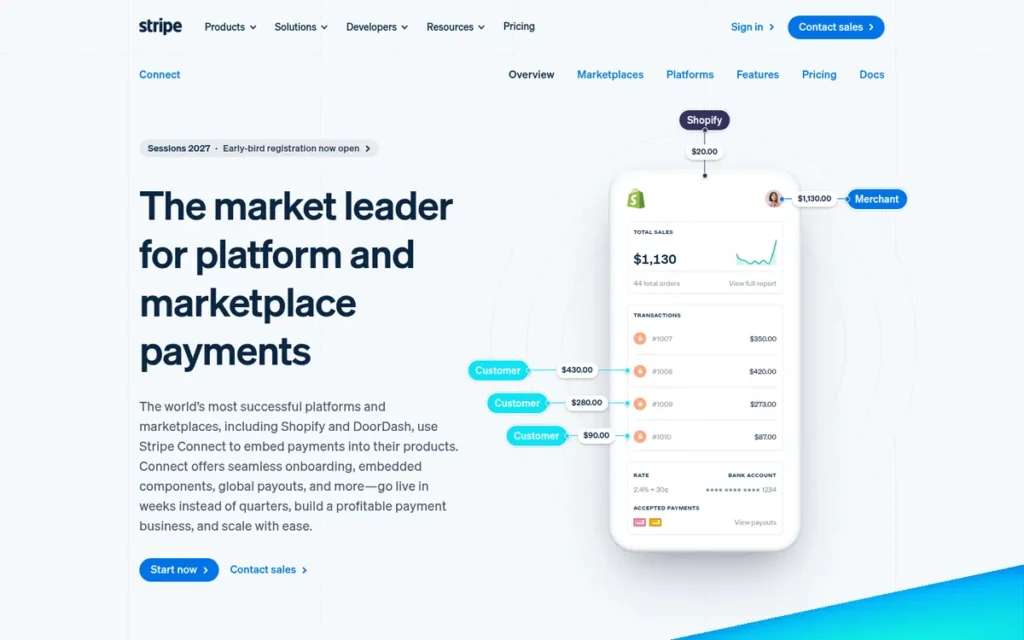
Category: Self-Serve Platform Provider. This is a platform payments product that a SaaS company or marketplace can sign up for and launch without a sales-led contract.
At a Glance
- Category: Self-Serve Platform Provider
- Best For: Pre-revenue to growth-stage SaaS platforms and multi-country marketplaces that need to launch quickly
- Price Range: From 2.9% + 30¢ per U.S. card transaction; the “you handle pricing” model adds $2 per monthly active account + 0.25% + $0.25 per payout
- Primary Strength: Stripe Connect has the broadest documented connected-account and payout coverage of the seven providers, subject to cross-border payout limits, and the most publicly inspectable platform pricing.
- Biggest Limitation: Stripe Connect leaves thin payment margins at small scale, and depending on account settings the platform can be liable for connected accounts’ negative balances.
- One-Line Summary: Stripe Connect is the fastest self-serve route to embedded payments for SaaS platforms and marketplaces, with published pricing, embedded onboarding components and connected accounts in 46+ countries, but its margins are thinner than buy-rate PayFac-as-a-Service providers offer.
- Last Verified: November 2026
Overview
Stripe Connect is Stripe’s platform payments product for SaaS platforms and marketplaces. Platforms use Stripe Connect to onboard connected accounts, accept online and in-person payments, split funds and pay out users. Stripe Connect is built for teams that want a self-serve launch with global reach.
Stripe Connect offers Standard, Express and Custom account types, so each platform chooses how much of onboarding it brands and controls.
Key Features
- Stripe Connect’s embedded components put onboarding, account management, payout dashboards, refunds, disputes and reporting inside the platform’s own product.
- Stripe Connect’s controller properties let a platform decide separately who owns the dashboard, who pays Stripe’s fees and who is liable for losses.
- Stripe Connect supports connected accounts in 46+ countries and 135+ currencies, and Stripe’s marketplace page cites payouts to users in 118+ countries (Stripe, 2026; vendor-published).
- Stripe Connect runs in-person payments through Stripe Terminal under the same connected account as online payments, and it offers instant payouts.
- Stripe Connect runs on Stripe’s infrastructure, which Stripe states is certified to PCI DSS Level 1 (Stripe, 2026; vendor-published).
Best For
Stripe Connect is best for pre-revenue and growth-stage platforms that sell in several countries and care more about launch speed and documentation than payment margin.
Pricing
Stripe Connect publishes its platform pricing (Stripe, 2026; vendor-published):
- Stripe Connect’s card processing starts at 2.9% + 30¢ per U.S. transaction.
- Stripe Connect’s “you handle pricing” model costs $2 per monthly active account plus 0.25% + $0.25 per payout.
- Stripe Connect’s cross-border payouts start at 0.25% of payout volume, and interchange-plus pass-through is available.
Stripe Connect’s published rates are fee components, not an all-in total cost.
Strengths
- Stripe Connect holds a 4.3/5 rating on G2, where reviewers praise less manual finance work and global infrastructure (G2, 2026; independent). The review count G2 displays may combine all Stripe products.
- Stripe reports that more than 40% of all Lyft payouts used Express Pay instant payouts within six months (Stripe, 2026; vendor-published).
- Stripe reports that Thinkific Payments passed $100M in cumulative volume on Stripe Connect, including $29M in one quarter (Stripe, 2026; vendor-published).
- A Reddit practitioner called Stripe Connect “probably still your best bet” for global platforms despite its fees (Reddit r/PaymentProcessing, 2025; independent).
Limitations
Stripe Connect trades margin for speed. Platform operators described 2.9% + 30¢ as too high for tight margins and said Stripe rarely negotiates below very high volume (Reddit r/PaymentProcessing, 2025; independent).
- Depending on configuration, Stripe Connect can make the platform liable for connected accounts’ negative balances (Apideck, 2026; third-party).
- Stripe Connect reviewers on G2 report accounts shut down without notice, funds held and support that is hard to reach (G2, 2026; independent).
- Stripe Connect allows self-serve cross-border payouts only for platforms based in the U.S., U.K., EEA, Canada or Switzerland (Stripe docs, 2026; vendor-published).
- According to a comparison written by a competitor, Stripe Connect means single-processor lock-in and less underwriting control than a PayFac model (Finix, 2026; competitor-authored).
A marketplace operator on r/PaymentProcessing shared their experience:
“Stripe Connect technically handles all of this but the recurring plus split combination has some rough edges. When a subscription payment comes in you have to handle the split logic separately via transfers, and failed payment retries across connected accounts need custom handling. It works but you will write more code than you expect.” Posted by u/Aggressive_Post1368
Takeaway: Stripe Connect covers split payouts and subscriptions, but platforms that combine the two should expect more custom engineering than its self-serve reputation suggests.
Verdict
Stripe Connect is the strongest overall embedded payments choice in 2026 for platforms that need a fast, self-serve launch across many countries, because it combines published platform pricing with the broadest documented connected-account and payout coverage PlugRoute found.
Stripe Connect scored 37 of 45. It led on coverage (C2: 5), launch speed (C5: 5) and independent review depth (C4: 4), and it lost points on liability clarity (C3: 3). Stripe Connect’s weakness is cost at scale, so teams should model both pricing paths before launch.
2. Adyen for Platforms: Best for Enterprise, Multi-Country and Unified Online/In-Person Commerce
Category: Enterprise Acquirer Platform. This is a large acquirer that sells platform payments under negotiated, sales-led contracts.
At a Glance
- Category: Enterprise Acquirer Platform
- Best For: Enterprise platforms and marketplaces with established volume that need multi-country online and in-person payments
- Price Range: Standard card pricing of about $0.13 + Interchange++ + 0.60% markup (adyen.com/pricing); platform-specific fees quoted
- Primary Strength: Adyen for Platforms combines one global integration with Adyen’s own acquiring licenses, giving enterprise platforms unified online and in-person processing across markets.
- Biggest Limitation: Adyen for Platforms is sales-led and publishes no universal minimum, but Reddit users in 2025 reported rejections citing a €5M annual revenue requirement (anecdotal), so many early-stage platforms may not qualify.
- One-Line Summary: Adyen for Platforms is the strongest embedded payments option for enterprise, multi-country platforms that need unified online and in-person commerce on a direct acquirer, but its sales-led setup and reported eligibility thresholds put it out of reach for many early-stage teams.
- Last Verified: November 2026
Overview
Adyen for Platforms is Adyen’s embedded payments product for enterprise platforms and marketplaces. Platforms use Adyen for Platforms to onboard users, split payments, and process online and in-person transactions on Adyen’s own acquiring licenses. Adyen for Platforms is built for multi-country businesses with established volume.
Adyen for Platforms is set up through a sales-led process rather than self-serve signup.
Key Features
- Adyen for Platforms’ Balance Platform provides balance accounts, transfers, split payments, and payouts managed either by Adyen or by the platform.
- Adyen for Platforms offers hosted or API-only onboarding, and Adyen runs KYC/KYB checks on the platform’s users.
- Adyen for Platforms processes online and in-person terminal payments on one platform.
- Adyen for Platforms’ reconciliation reports show interchange, scheme fees and Adyen’s markup separately.
- Adyen for Platforms bundles Adyen Issuing cards, business accounts and Adyen Capital financing, which is repaid as a share of volume.
Best For
Adyen for Platforms is best for enterprise platforms that operate in several countries, have established volume and have engineering capacity for a scoped integration. Reddit users report eligibility thresholds of roughly €5M–€10M a year.
Pricing
Adyen for Platforms uses Interchange++ pricing, and Adyen publishes its standard card rates (Adyen, 2026; vendor-published):
- Adyen’s standard card pricing is about $0.13 per transaction plus Interchange++ and a 0.60% Adyen markup.
- Adyen advertises no setup or monthly subscription fee, though third-party summaries report that a contractual minimum monthly invoice can apply (DevTune, 2026; third-party).
- Adyen for Platforms’ platform-specific fees are quoted individually, and Adyen’s documentation notes that fees can apply to refused or cancelled payments.
Strengths
- Adyen holds a 4.0/5 rating on G2 from 44 reviews, where reviewers praise global reach, fraud tools and reporting (G2, 2026; independent). G2 has no separate Platforms listing.
- Adyen for Platforms runs on Adyen’s own acquiring licenses in multiple markets rather than on third-party acquirers (whop.com, 2025; third-party).
- Adyen’s documentation states that manual KYC reviews are generally processed within 48 hours (Adyen docs, 2026; vendor-published).
- Adyen, founded in 2006 in Amsterdam, is publicly listed, which earned it the only C6 score of 5 in this ranking (Adyen, 2026; vendor-published).
Limitations
Adyen for Platforms trades accessibility for enterprise depth. Its setup is sales-led and Adyen publishes no universal minimum. Even so, Reddit users reported a 10M/year card-volume minimum and a rejection email that cited €5M in annual revenue (Reddit r/PaymentProcessing and r/BuyFromEU, 2025; independent, anecdotal).
- One Reddit user read Adyen for Platforms’ “talk to our team” signup as a sign that smaller platforms would not qualify (Reddit r/BuyFromEU, 2025; independent).
- Adyen for Platforms reviews mention integration complexity, multiple contracts and dashboards that are heavy for small teams (Airframe, 2026; third-party).
- Adyen for Platforms has thinner sub-merchant coverage outside Europe and North America, according to an Airframe review summary (Airframe, 2026; third-party).
- Adyen for Platforms does not publish its platform-specific fees separately (Adyen docs, 2026; vendor-published).
Users on r/PaymentProcessing noted:
“stripe connect is usually the default answer here. it handles splits + subscriptions, but yeah, the onboarding/KYC flow for each “owner” can be painful, especially outside US/EU. still, most platforms in this space accept that tradeoff early on
adyen for platforms or BaaS tools (unit, synctera, etc.) can also do this, but they’re heavier, more expensive, and not really v1-friendly” Posted by u/Plus_Imagination7906
Takeaway: Practitioners see Adyen for Platforms as a heavier, costlier option than Stripe Connect that is poorly suited to a first-version launch.
Verdict
Adyen for Platforms is the best embedded payments choice in 2026 for enterprise platforms that need multi-country, unified online and in-person commerce on a direct acquirer.
Adyen for Platforms scored 33 of 45. It ranks second because its documented sales-led setup and its reported volume thresholds (anecdotal) shut out many early-stage platforms. Qualified teams should ask for an Interchange++ quote based on their real transaction mix.
3. Rainforest: Best for U.S. Vertical SaaS That Wants to Keep the Payments Spread

Category: Managed PayFac-as-a-Service. The provider holds the PayFac registration and handles onboarding, underwriting and processing, while the platform brands the experience and earns payments revenue.
At a Glance
- Category: Managed PayFac-as-a-Service
- Best For: U.S. vertical SaaS platforms processing roughly $1M–$60M per year that want to maximize payments margin
- Price Range: Published buy rates from about interchange + 0.30% + $0.30, falling toward 0.20% + $0.20 at higher volume; no monthly minimums or annual fees; risk, payout, dispute and terminal fees may apply
- Primary Strength: Rainforest publishes interchange-plus buy rates and lets the platform keep the full spread, with no exclusivity, monthly minimums or annual fees.
- Biggest Limitation: Rainforest has no verified independent reviews on G2, Capterra or Trustpilot, and its coverage is focused on the U.S.
- One-Line Summary: Rainforest is a buy-rate PayFac-as-a-Service provider for U.S. vertical SaaS that publishes its interchange-plus rates and lets platforms keep the full payments spread, though buyers must rely on vendor-published evidence because no independent reviews exist.
- Last Verified: November 2026
Overview
Rainforest is an Atlanta-based PayFac-as-a-Service provider, founded in 2021, that gives U.S. vertical SaaS platforms white-label onboarding and payment acceptance at published interchange-plus buy rates.
Rainforest is built for software companies that want to keep the full payments spread. Rainforest’s CEO, Joshua Silver, previously helped build Payrix.
Key Features
- Rainforest provides white-label onboarding components with KYC/KYB checks that platforms embed in their own product.
- Rainforest supports card, ACH and in-person payments, plus merchant payouts and embeddable deposit reporting.
- Rainforest says it is sponsored directly by banks, which gives Rainforest control of underwriting and credit policy (Rainforest, 2026; vendor-published).
- Rainforest lets the platform set merchant pricing and keep the full spread above Rainforest’s buy rate.
- Rainforest states that the platform owns merchant data and that merchants are portable (Rainforest, 2026; vendor-published).
Best For
Rainforest is best for U.S. vertical SaaS platforms with roughly $1M–$60M in annual volume that want payments to become a real second revenue line.
Pricing
Rainforest publishes interchange-plus buy rates (Rainforest, 2026; vendor-published). A comparison site lists the volume tiers (Chargeforward, 2026; third-party):
- Rainforest’s $0–5M monthly tier is interchange + 0.30% + $0.30.
- Rainforest’s $5–15M monthly tier is interchange + 0.25% + $0.25.
- Rainforest’s $15–25M monthly tier is interchange + 0.20% + $0.20.
- Rainforest charges no exclusivity fee, monthly minimum or annual fee, but lists about $0.20 per payout, $15 per dispute or return and $0.23 per account-updater event.
Rainforest’s implementation is cited at 2–6 weeks (Chargeforward, 2026; third-party).
Strengths
- Rainforest publishes its buy rates on its pricing page, making it one of three providers in this ranking with complete published platform pricing (Rainforest, 2026; vendor-published).
- Rainforest reports that one SaaS customer raised its margin from 23 to 54 basis points, or $540K per $100M in volume, by leaving a referral partner and adding Level 2/3 card data (Rainforest, 2026; vendor-published).
- Rainforest raised a $29M Series B in September 2025, co-led by Matrix and Infinity Ventures, bringing total funding to $57.5M (Crunchbase News, 2025; independent).
- Rainforest reports that RoadSync cut chargebacks by 55% and that one customer migrated 1,600+ merchants in a few weeks (Rainforest, 2026; vendor-published).
Limitations
Rainforest trades independent proof for margin upside. PlugRoute found no verified reviews on G2, Capterra or Trustpilot and no meaningful Reddit discussion of Rainforest (G2, Capterra and Trustpilot, 2026; independent).
- Rainforest’s coverage is U.S.-focused and supports few global payment methods (Chargeforward, 2026; third-party). Canada is limited or in pilot, and part of the Series B was set aside for Canadian expansion (Rainforest, 2025; vendor-published).
- Under Rainforest’s model, the platform may be exposed to losses and negative balances (Chargeforward, 2026; third-party).
- Rainforest, founded in 2021, is the youngest provider in this ranking.
- Rainforest’s public materials do not name its sponsor banks. One third-party comparison names First Citizens and JPMorgan Chase, but PlugRoute could not confirm them (Flint, 2026; third-party).
Verdict
Rainforest offers the most transparent platform economics of any embedded payments provider PlugRoute evaluated in 2026: it publishes interchange-plus buy rates and lets U.S. vertical SaaS platforms keep the full spread.
Rainforest scored 28 of 45, tying Finix, and ranks third because its primary-criteria subtotal is higher (10 vs. 9). Rainforest, Finix and Tilled are two points apart, so choose by economics model. Use reference calls to check Rainforest’s vendor-published results.
4. Finix: Best for Platforms Planning to Become Their Own PayFac
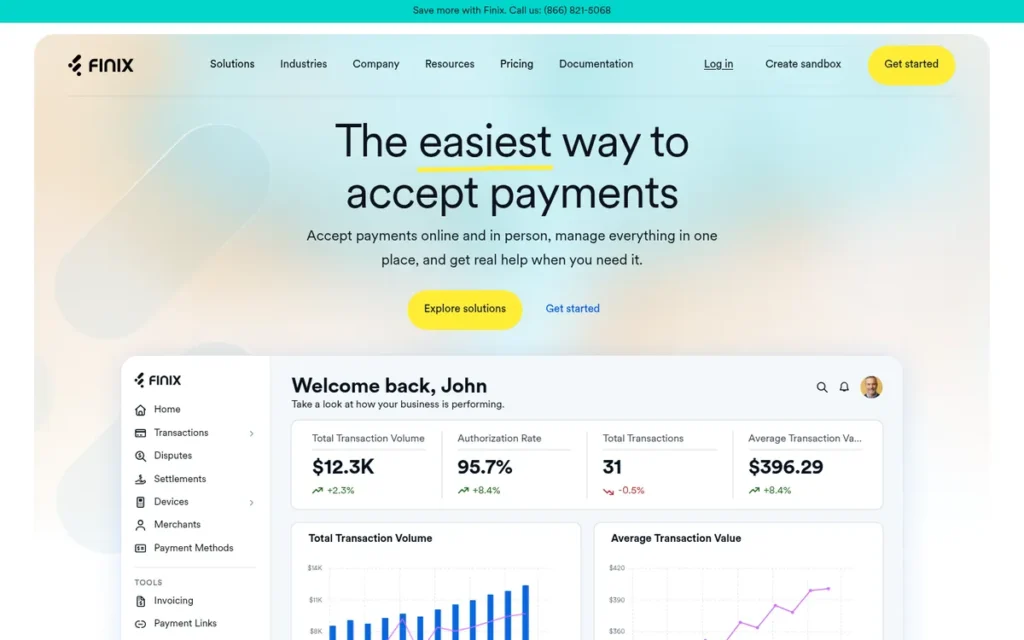
Category: PayFac Enablement Platform. This is a processor that lets a platform start on managed payments and later register as its own payment facilitator without switching providers.
At a Glance
- Category: PayFac Enablement Platform
- Best For: U.S. and Canadian software platforms that expect to grow into their own registered PayFac and want control over fees and underwriting
- Price Range: ACH 1.00% + $0.25 (capped at $10); flat-rate example 2.9% + $0.30; interchange-plus available; PayFac pricing custom
- Primary Strength: Finix lets a platform start on managed payments and later become its own registered PayFac on the same infrastructure.
- Biggest Limitation: Finix’s coverage is limited to the U.S. and Canada, and Finix’s PayFac pricing is custom, so total cost requires a quote.
- One-Line Summary: Finix is an embedded payments processor for U.S. and Canadian software platforms that want a staged path from managed payments to owning their own PayFac, with configurable fee profiles and documented token migration, though its pricing is partly custom.
- Last Verified: November 2026
Overview
Finix is a San Francisco-based payments processor, founded in 2015, that lets U.S. and Canadian software platforms start on managed embedded payments and later become their own registered PayFac on the same infrastructure.
Finix is built for platforms that want long-term control over margins and underwriting without taking on that compliance burden on day one.
Key Features
- Finix lets platforms move from managed payments to their own registered PayFac without switching providers.
- Finix operates as a full-stack acquirer and processor with direct connections to Visa, Mastercard, American Express and Discover.
- Finix lets platforms configure fee profiles, ACH caps and interchange-based merchant pricing.
- Finix supports tokenization, payment links, virtual terminal and real-time payouts alongside card, ACH and in-person acceptance.
- Finix documents token and payment-data migration in its developer docs, which reduces lock-in.
Best For
Finix is best for U.S. and Canadian software platforms that expect enough volume to justify running their own PayFac and want to start without that compliance burden.
Pricing
Finix publishes part of its pricing (Finix, 2026; vendor-published):
- Finix charges 1.00% + $0.25 for ACH, capped at $10.
- Finix cites a flat-rate example of 2.9% + $0.30, offers interchange-plus, and lists a restaurant interchange-plus plan at $250/month.
- Finix’s PayFac pricing is custom.
Finix’s implementation is cited at 4–10 weeks (Chargeforward, 2026; third-party).
Strengths
- Finix announced direct connections to Visa, Mastercard, American Express and Discover alongside a $75M Series C in October 2024, led by Acrew Capital with Citi Ventures participating (Finextra, 2024; independent).
- Finix holds a 4.7/5 Capterra rating from 42 reviews, as reported by PaymentReview (PaymentReview, 2026; third-party).
- Finix documents token and payment-data migration, one of the few published paths in this ranking for moving merchants in or out (Finix docs, 2026; vendor-published).
- Finix reports that AgVend saw 25% more online ACH payments and Meadow Pay saw up to 47% more on-time payments (Finix, 2026; vendor-published).
Limitations
Finix gives up a simple launch in exchange for long-term control. One review notes that implementation can take longer and cost more than simpler options (Softcircles, 2026; third-party).
- Finix supports only the U.S. and Canada (Canada since 2024, through Peoples Trust Company), so it does not suit platforms onboarding sellers in Europe or elsewhere (Finix, 2024; vendor-published).
- Finix has a smaller ecosystem than Stripe or Adyen (Trio, 2025; third-party).
- Finix’s PayFac pricing is custom, so you need a quote to know total cost.
- Finix has no G2 or Trustpilot data and no independent Reddit discussion, and PlugRoute excluded the vendor-run r/UseFinix subreddit as evidence.
Verdict
Finix offers the clearest documented path from managed payments to a platform’s own registered PayFac of the seven embedded payments providers PlugRoute evaluated in 2026.
Finix scored 28 of 45, tying Rainforest, and ranks fourth on the primary-criteria tiebreak. Worldpay for Platforms’ Payrix Flex offers a similar option, but its terms are not publicly documented. Teams should request a quote for Finix’s custom PayFac pricing based on their volume.
5. Tilled: Best for Fast Launch With Published Revenue-Share Economics
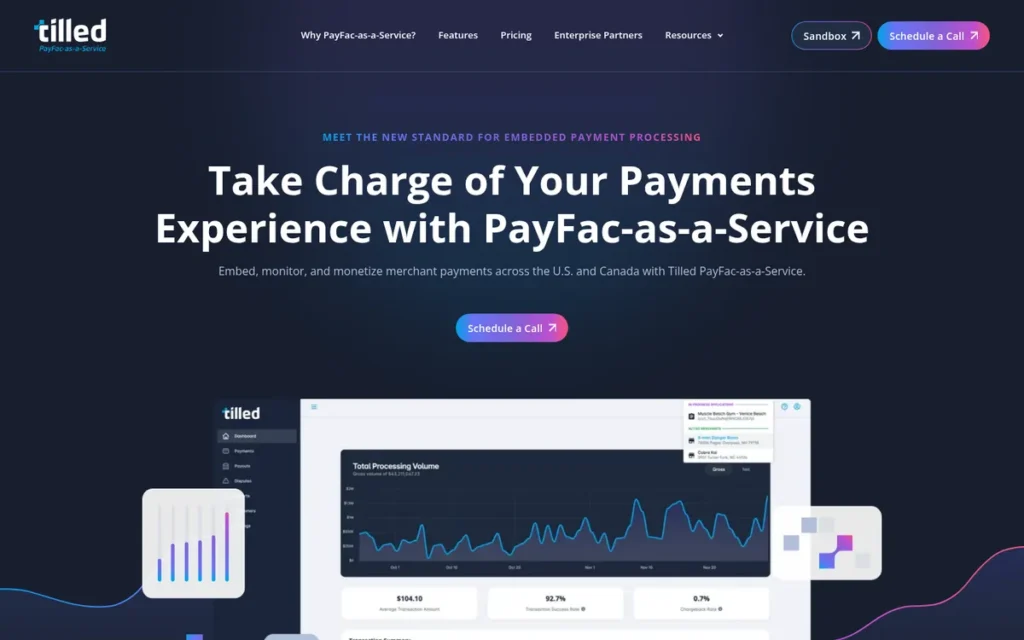
Category: Managed PayFac-as-a-Service.
At a Glance
- Category: Managed PayFac-as-a-Service
- Best For: U.S. and Canadian software platforms with steady volume that want a fast launch and predictable revenue share
- Price Range: Below $5M monthly volume, the platform keeps 70% of margin and pays Tilled $500/month; above $5M, it keeps 80% and pays $2,500/month
- Primary Strength: Tilled publishes its revenue-share percentages and has the fastest cited implementation timeline of the seven providers PlugRoute evaluated.
- Biggest Limitation: Tilled charges a fixed monthly fee and makes the platform cover shortfalls when merchant revenue does not cover Tilled’s costs, which can hurt early-stage platforms.
- One-Line Summary: Tilled is a PayFac-as-a-Service provider for U.S. and Canadian software platforms that publishes a 70–80% revenue share and cites 2–4 week launches, but its fixed monthly fee, shortfall obligation and lack of independent reviews add risk for early-stage teams.
- Last Verified: November 2026
Overview
Tilled is a Boulder-based PayFac-as-a-Service provider, founded in 2019, that gives U.S. and Canadian software platforms white-label payments and card-present terminals under a published revenue-share model.
Tilled is built for platforms that want a fast launch with predictable economics. Tilled is also moving upmarket by running PayFac programs for enterprise payments partners.
Key Features
- Tilled provides white-label payment acceptance, ACH, subscriptions and Apple Pay that platforms embed under their own brand.
- Tilled supports card-present terminals in the U.S. and Canada through a Handpoint partnership launched in 2024.
- Tilled lets platforms configure merchant pricing and earn a published share of the margin.
- Tilled operates as an ISO/MSP of Pinnacle Bank (dba Synovus) and an ISO of Citizens Bank (REMWM, 2026; third-party).
- Tilled runs PayFac programs for 12 enterprise partners, including North, Paysafe and KORT Payments (Tilled, 2026; vendor-published).
Best For
Tilled is best for U.S. and Canadian platforms whose volume makes a $500 monthly fee immaterial and that prefer a simple revenue share to managing a spread.
Pricing
Tilled publishes its revenue-share tiers (Tilled, 2026; vendor-published):
- Below $5M in monthly volume, the platform keeps 70% of Tilled’s margin and pays Tilled a $500/month SaaS fee.
- Above $5M in monthly volume, the platform keeps 80% of Tilled’s margin and pays Tilled $2,500/month.
- Tilled requires the platform to cover shortfalls when merchant revenue does not cover Tilled’s costs.
Tilled’s worked example assumes merchant pricing of 2.9% + $0.30 against all-in costs of 2.27% + $0.15.
Strengths
- Tilled publishes its revenue-share tiers on its pricing page, which makes it the only provider in this ranking whose platform margin share is public (Tilled, 2026; vendor-published).
- Tilled’s implementation is cited at 2–4 weeks, the fastest of the seven providers (Chargeforward, 2026; third-party).
- Tilled reports that its enterprise revenue grew 5× year over year (Tilled, 2026; vendor-published).
- Tilled reports more than $50M raised, including a $10M+ round announced in October 2026 led by UPC Capital (Tilled, 2026; vendor-published). Third-party databases list lower totals.
Limitations
Tilled trades margin ownership for simplicity: the platform shares margin with Tilled instead of keeping the full spread (Tilled, 2026; vendor-published).
- Tilled’s fixed $500 monthly fee and shortfall obligation can make it costly before volume ramps up.
- Tilled has no G2, Capterra or Trustpilot reviews and no Tilled-specific Reddit discussion, so all performance claims come from the company.
- Tilled’s coverage is limited to the U.S. and Canada (Tilled, 2024; vendor-published).
- Tilled’s success-stories page offered no quantified partner metrics that PlugRoute could retrieve.
Verdict
Tilled is the most transparent revenue-share PayFac-as-a-Service option PlugRoute evaluated in 2026, publishing its 70–80% platform share and citing the fastest launch timeline of any provider ranked.
Tilled scored 26 of 45. Its C1 score was cut from 5 to 4 for the fixed monthly fee and shortfall obligation, and it has no independent reviews. Platforms with meaningful volume should compare Tilled’s revenue share against Rainforest’s buy rate using their own numbers.
6. Worldpay for Platforms (formerly Payrix): Best for Large U.S. ISVs Wanting Acquirer Scale
Category: Enterprise Acquirer Platform.
At a Glance
- Category: Enterprise Acquirer Platform
- Best For: Large U.S. independent software vendors with card-present volume that want acquirer scale and an option to take on more control later
- Price Range: Pricing on request (quote-based revenue share and spread, setup and monthly fees, reserves and terminals)
- Primary Strength: Worldpay for Platforms combines a managed PayFac-as-a-Service program with an option to take on more control, backed by a large global acquirer.
- Biggest Limitation: Worldpay for Platforms publishes no pricing and has the weakest independent support score in this ranking, at 2.7/5 on Capterra.
- One-Line Summary: Worldpay for Platforms, formerly Payrix, is a managed-to-owned PayFac-as-a-Service program for large U.S. software vendors that offers acquirer scale and card-present depth, but it has quote-only pricing, weak support scores, a 2025 rebrand and a January 2026 ownership change.
- Last Verified: November 2026
Overview
Worldpay for Platforms, formerly Payrix, is a PayFac-as-a-Service program now owned by Global Payments. Worldpay for Platforms offers white-label onboarding and card-present payments to large U.S. software vendors that want acquirer scale.
Worldpay for Platforms lets platforms choose how much of the payments operation they control. Global Payments’ 2026 materials market Payrix Pro within its Integrated and Platforms business (Global Payments, 2026; vendor-published).
Key Features
- Worldpay for Platforms offers Payrix Pro, which onboards sub-merchants under Payrix’s registration, and Payrix Flex, which gives the platform more control, though the exact differences are not publicly documented.
- Worldpay for Platforms provides white-label onboarding, underwriting, risk management, settlement and payouts.
- Worldpay for Platforms supports card-present payments for verticals such as auto dealerships, retail and field service.
- Worldpay for Platforms lets platforms keep their customer relationships, data and contracts (Apideck, 2026; third-party).
- Worldpay for Platforms has been backed by Global Payments’ acquiring scale since January 2026.
Best For
Worldpay for Platforms is best for large U.S. software vendors with significant card-present volume that are prepared to negotiate support SLAs and reserve terms in writing.
Pricing
Worldpay for Platforms publishes no price sheet (Worldpay, 2026; vendor-published):
- Worldpay for Platforms quotes revenue share and spread individually.
- Worldpay for Platforms quotes setup fees, monthly fees and reserves individually.
- Worldpay for Platforms quotes terminal costs individually.
PlugRoute rates Worldpay for Platforms’ pricing as the least publicly comparable of the seven providers. Its implementation is cited at 6–16 weeks (Chargeforward, 2026; third-party).
Strengths
- Global Payments completed its acquisition of Worldpay on January 9, 2026, in a deal based on a $24.25B enterprise value, which places Worldpay for Platforms inside a major merchant acquirer (Global Payments, 2026; independent).
- Global Payments expanded its embedded payments partnership with Lightspeed DMS, a dealership software provider, in May 2026, a deal that involves Worldpay for Platforms’ card-present offering (BusinessWire, 2026; independent).
- Worldpay for Platforms holds a 4.2/5 overall Capterra rating from 6 reviews of the Payrix listing, with a features sub-score of 4.5 (Capterra, 2026; independent).
- A SaaS reviewer on G2 credits Worldpay for Platforms with launching its embedded payments and raising per-customer profit without raising software prices (G2, 2026; independent).
Limitations
Worldpay for Platforms trades price transparency and support quality for acquirer scale. Its customer-support sub-score on Capterra is 2.7/5 (Capterra, 2026; independent).
- Worldpay for Platforms reviewers on G2 and Software Advice report withheld funds, unexpected fees, incorrect MIDs and payments failing hours after approval (G2 and Software Advice, 2026; independent).
- Payrix was folded into the Worldpay brand in March 2025, and Worldpay changed ownership to Global Payments in January 2026, which adds integration and roadmap risk for Worldpay for Platforms (Global Payments, 2026; independent).
- Worldpay for Platforms’ cited 6–16 week implementation is the longest in this ranking.
- Worldpay for Platforms may have limited platform coverage in Europe, because one U.S. user reported searching for an EU equivalent (Reddit r/PaymentProcessing, 2025; independent).
Verdict
Worldpay for Platforms is a credible embedded payments option in 2026 for large U.S. software vendors that want acquirer-scale backing and card-present depth.
Worldpay for Platforms scored 21 of 45. It ranks sixth because of quote-only pricing (C1: 1), weak independent support evidence (C4: 2) and the longest cited implementation (C5: 2). Buyers should get support SLAs and reserve terms in writing.
7. Stax Connect: Best for U.S. SMB-Focused SaaS Wanting a Fully Managed Program
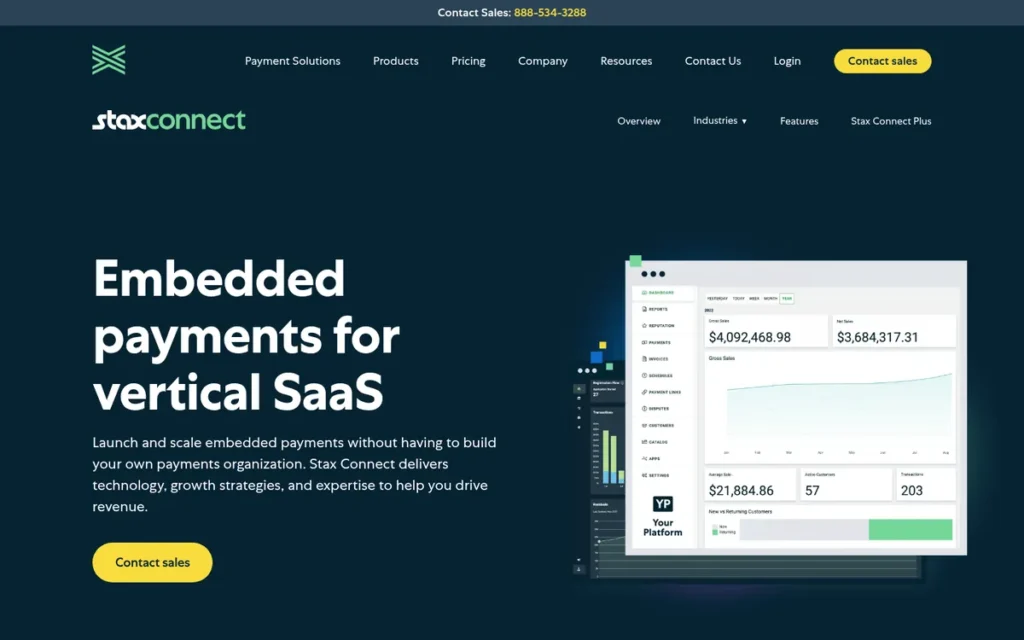
Category: Managed PayFac-as-a-Service.
At a Glance
- Category: Managed PayFac-as-a-Service
- Best For: U.S. SMB-focused vertical SaaS platforms that want a fully managed, hands-on payments program
- Price Range: Pricing on request (Stax Connect revenue share not published)
- Primary Strength: Stax Connect handles onboarding, underwriting, compliance, processing and payouts end to end, so the platform needs minimal internal payments operations.
- Biggest Limitation: Stax Connect does not publish its revenue share or sponsor bank, and Stax’s BBB profile lists 52 complaints in three years, including reports of held funds and slow funding.
- One-Line Summary: Stax Connect is a fully managed PayFac-as-a-Service program for U.S. SMB-focused vertical SaaS that minimizes the platform’s payments workload, but it has unpublished revenue-share terms, an undisclosed sponsor bank and reported held-funds complaints.
- Last Verified: November 2026
Overview
Stax Connect is the managed PayFac-as-a-Service product from Orlando-based Stax Payments, founded in 2014 as Fattmerchant. Stax Connect is built for U.S. vertical SaaS platforms that want a fully managed, branded payments program.
Stax Connect is separate from Stax Pay, Stax’s subscription product for individual merchants. Stax appointed John Cimba as CEO in February 2026 (PaymentCompanies, 2026; third-party).
Key Features
- Stax Connect handles merchant onboarding, underwriting, compliance, processing and payouts on the platform’s behalf.
- Stax Connect lets the platform brand the payments experience and share in payments revenue.
- Stax Connect supports online and in-person payment acceptance for U.S. merchants.
- Stax Connect provides partner support for onboarding and payment operations alongside its technology.
- Stax Connect’s average implementation is about 45 days, according to Stax documentation cited by a comparison site (Flint, 2026; third-party).
Best For
Stax Connect is best for U.S. vertical SaaS platforms serving small and mid-sized merchants that want Stax to run nearly all payments operations.
Pricing
Stax Connect does not publish its revenue-share percentages (Stax, 2026; vendor-published). Stax Pay’s merchant plans are listed below, but they are not Stax Connect’s platform terms (Merchant Insiders, 2026; third-party):
- Stax Pay Growth costs $99/month for up to about $150K in annual volume.
- Stax Pay Pro costs $139–$159/month, depending on the source.
- Stax Pay Premium/Ultimate costs $199+/month.
- All Stax Pay plans add interchange plus roughly 8–10¢ per in-person or 15¢ per online transaction.
Strengths
- Stax holds a 4.4/5 Trustpilot rating from about 1,250 reviews and a 4.9/5 G2 rating from 12 reviews (Trustpilot and G2, 2026; independent). These ratings cover Stax overall and mainly reflect its merchant product.
- Stax reported $23B+ processed for about 22,000 businesses when it raised $245M at a ~$1B valuation (FinTech Futures, 2022; independent).
- Stax holds an A+ rating and accreditation from the Better Business Bureau (BBB, 2026; independent).
- Stax Connect’s cited ~45-day implementation sits in the middle of the 2–16 week timelines cited across this ranking (Flint, 2026; third-party).
As one user on r/smallbusiness described:
“I have a high dollar-volume client who has aggressively shopped for a payment processor twice in the past four years. Each time, Fattmerchant by Stax beat the competition, even after their high monthly subscription fees.” Posted by u/Dem_Joints357
Takeaway: Stax’s merchant-side pricing holds up for high-volume businesses despite its subscription fees, though that evidence describes Stax’s merchant product rather than Stax Connect’s platform terms.
Limitations
Stax Connect trades transparency for full management. Stax does not publish Stax Connect’s revenue share, sponsor bank or PayFac registration holder (Flint, 2026; third-party).
- Stax’s BBB profile lists 52 complaints in three years, 15 of them in the past 12 months, alleging funding delays, long holds, cancellation friction and unexplained fees (BBB, 2026; independent). These are reported complaints, not findings of fault.
- Stax Connect’s coverage is U.S.-only.
- Most independent review data for Stax reflects the merchant product rather than Stax Connect.
Verdict
Stax Connect is a fully managed embedded payments option in 2026 for U.S. SMB-focused platforms that want to hand off almost all payments operations.
Stax Connect scored 19 of 45 and ranks seventh. Its unpublished pricing (C1: 1) and undisclosed sponsor bank (C3: 2) weigh on its score more than complaint volume does. Platforms that shortlist Stax Connect should get the revenue share, reserve policy and cancellation terms in writing.
How Much Does Embedded Payments Software Cost?
On standard pricing, Stripe Connect charges 2.9% + 30¢ per card transaction. Rainforest charges interchange plus a 0.20–0.30% buy rate, and on Tilled the platform gives up a 20–30% share of margin. Enterprise providers such as Adyen for Platforms and Worldpay for Platforms negotiate pricing. Your total cost depends on who sets merchant pricing and which fixed fees apply.
As of November 2026, three of the seven providers publish complete platform pricing: Stripe Connect, Rainforest and Tilled. Finix and Adyen for Platforms publish partial rate cards. Worldpay for Platforms and Stax Connect are quote-only.
Table 1: Pricing and Platform Economics (verified November 2026)
| Provider | Platform Pricing Published? | Monetization Model | Published Figures | Fixed Fees or Shortfall Obligations | Cited Implementation (Source Type) | Reported Eligibility Minimums |
|---|---|---|---|---|---|---|
| Stripe Connect | Yes | Stripe-set or platform-set pricing | 2.9% + 30¢; $2/active account + 0.25% + $0.25 per payout | $2 per monthly active account in platform-pricing model | Self-serve signup; no week range cited | None reported |
| Adyen for Platforms | Partial | Interchange++, negotiated | $0.13 + Interchange++ + 0.60% standard card pricing; platform fees quoted | No setup or subscription fee; minimum invoice may apply (third-party); fees may apply to refused payments | Sales-led; manual KYC ~48 hours (official) | No universal minimum published; €5M revenue reported (anecdotal) |
| Rainforest | Yes | Buy rate; platform keeps spread | Interchange + 0.30% + $0.30, down to 0.20% + $0.20 | No monthly or annual fees; $0.20/payout, $15/dispute (third-party) | 2–6 weeks (third-party) | None |
| Finix | Partial | Interchange-plus with configurable fee profiles | ACH 1.00% + $0.25 (cap $10); 2.9% + $0.30 example | $250/month restaurant plan example | 4–10 weeks (third-party) | None reported |
| Tilled | Yes | Revenue share | Platform keeps 70% below $5M/month; 80% above | $500 or $2,500/month; platform covers shortfalls | 2–4 weeks (third-party) | None reported |
| Worldpay for Platforms | No | Quote-based revenue share and spread | None | Setup and monthly fees and reserves quoted | 6–16 weeks (third-party) | None reported |
| Stax Connect | No | Undisclosed revenue share | None for Connect | Not published | ~45 days (third-party citing Stax) | None reported |
Table 2: Coverage, Channels and Compliance Disclosure (verified November 2026)
| Provider | Onboarding vs. Payout Coverage | In-Person Support | Sponsor Bank, Acquiring or Compliance Disclosure |
|---|---|---|---|
| Stripe Connect | Connected accounts in 46+ countries; payouts to 118+ (marketplace page); self-serve cross-border payouts limited to U.S./U.K./EEA/Canada/Switzerland platforms | Yes, via Stripe Terminal | Stripe states PCI DSS Level 1; sponsor and acquirer details not assessed |
| Adyen for Platforms | Global; thinner sub-merchant coverage outside EU/North America (third-party) | Yes, unified terminals | Own acquiring licenses in multiple markets |
| Rainforest | U.S.-focused; Canada limited or in pilot | Yes | Bank-sponsored; banks not named by Rainforest, named only by a third party |
| Finix | U.S. and Canada (Canada since 2024 via Peoples Trust) | Yes | Direct card-network connections (2024) |
| Tilled | U.S. and Canada | Yes, via Handpoint (since 2024) | Pinnacle Bank (dba Synovus) and Citizens Bank (third-party) |
| Worldpay for Platforms | Global acquirer; EU coverage at platform level unclear | Yes, vertical card-present | Part of acquirer Global Payments |
| Stax Connect | U.S. only | Yes | Not published |
What Do the Pricing Models Mean in Dollars?
A platform processing $10M a year would keep roughly $48,600 on Tilled’s published model, based on Tilled’s own assumptions. Rainforest’s vendor-published case study implies about $54,000 per $10M. The two cases use different merchant mixes, so the figures are not directly comparable.
- Tilled illustration: At $10M in annual volume with a $100 average ticket, 100,000 transactions produce a margin pool of about $78,000, using Tilled’s own pricing (2.9% + $0.30) and cost (2.27% + $0.15) assumptions (Tilled, 2026; vendor-published).
- Tilled net: On Tilled’s tier for platforms below $5M a month, the platform keeps 70% (about $54,600) minus $6,000 in annual SaaS fees, which leaves about $48,600.
- Rainforest case: Rainforest reports a customer margin of 54 basis points, which equals about $54,000 per $10M in volume (Rainforest, 2026; vendor-published).
- Your model: Each platform should rerun both models with its own ticket size and interchange mix before comparing providers.
Merchant adoption also shapes payments revenue, not just rates:
- Many platforms plateau at 15–20% merchant adoption of embedded payments (Bridges, 2026; third-party).
- The commonly cited target is about 71% merchant adoption (Bridges, 2026; third-party).
- For most platforms, merchant adoption moves payments revenue more than the buy rate does. A platform at 70% adoption earns about 3.5× the revenue of one stuck at 20%, whichever provider it uses.
Which Providers Did We Consider but Not Rank?
PlugRoute looked at six other providers during discovery and did not rank them in this edition. Two were left out because they are not like-for-like embedded payments providers. The other four were outside this edition’s scoring scope, and PlugRoute makes no judgment about their quality.
- Infinicept was excluded because Infinicept is tooling for running your own PayFac rather than an embedded payments provider.
- Gr4vy was excluded because Gr4vy is a payment orchestration layer rather than an embedded payments provider.
- PayPal/Braintree Marketplace was considered during discovery but not scored in this edition.
- WePay was considered during discovery but not scored in this edition.
- Payabli was considered during discovery but not scored in this edition.
- Moov was considered during discovery but not scored in this edition.
What Red Flags Should I Watch For When Evaluating Embedded Payments Software?
The most important red flags when evaluating embedded payments software are hidden economics, unclear liability and limited portability. PlugRoute identifies six warning signs that apply equally to every vendor. Each one raises the risk that your platform loses margin, merchant trust or control of its payments stack after signing.
Red Flag #1: Unpublished Pricing or Hidden Fixed-Fee Obligations A provider without published platform pricing makes total cost impossible to estimate. Fixed monthly fees or shortfall obligations can make a payments program lose money before adoption grows. Ask for a written quote at your volume, and model your first 12–24 months.
Red Flag #2: Undisclosed Sponsor Bank or PayFac Registration Holder A provider that will not name its sponsor bank or PayFac registration holder hides who ultimately controls underwriting. That party decides merchant approvals, holds and terminations, so ask for the name in writing before you sign any embedded payments contract.
Red Flag #3: Unwritten Reserve and Negative-Balance Liability Terms A contract without written reserve and negative-balance terms can leave your platform covering merchant losses you did not expect. Make sure the agreement says who absorbs chargebacks, fraud losses and negative balances, and how reserves are calculated and released.
Red Flag #4: Recurring Independent Complaints About Held Funds A pattern of independent complaints about held funds or frozen accounts puts your merchants’ cash flow at risk, and with it your relationship with them. Check G2, Capterra, Trustpilot and BBB records, and ask each provider how it explains holds to merchants.
Red Flag #5: Non-Portable Tokens or Merchant Data A provider that will not let you export payment tokens and merchant data locks you in, and leaving could force every merchant to re-onboard. Ask for documented token migration terms before signing, especially if you plan to become your own PayFac.
Red Flag #6: “Talk to Our Team” With Undisclosed Volume Minimums A sales-only signup process with undisclosed volume minimums can waste weeks of evaluation for platforms that will never qualify. Ask about minimum revenue, transaction volume and pre-revenue eligibility in the first conversation with any embedded payments vendor.
What Questions Should I Ask Before Choosing Embedded Payments Software?
Before choosing embedded payments software, ask questions that expose economics, liability, coverage and exit terms. PlugRoute recommends asking every finalist the seven questions below. Written answers show whether a provider fits your model and whether its total cost and risk will hold up as your volume grows.
Question #1: Do we pass payments through or move and split funds between users? Platforms that only pass payments through need a standard processor. Platforms that split funds and pay out users need embedded payments software. Answering this question first keeps the wrong type of vendor off your shortlist before any sales calls begin.
Question #2: Who sets merchant pricing, and what share of margin do we keep in writing? The answer tells you whether the provider uses a buy-rate, revenue-share or provider-set model. Ask each finalist for a written example at your volume that shows merchant pricing, your margin and every fixed fee, so you can compare like for like.
Question #3: Who runs KYC/KYB and underwriting, and who absorbs chargebacks and negative balances? The answer defines your compliance workload and your exposure to losses. Look for a written split of onboarding checks, underwriting authority, dispute handling and negative-balance liability rather than verbal assurances from the provider’s sales team.
Question #4: Which countries can we onboard sellers in versus pay out to, and do you support in-person terminals? Onboarding coverage and payout coverage often differ, and cross-border restrictions can block expansion. For example, Stripe Connect limits self-serve cross-border payouts to platforms based in the U.S., U.K., EEA, Canada or Switzerland (Stripe docs, 2026; vendor-published). Confirm each target country separately.
Question #5: What reserve, payout-timing and hold policies apply to our merchants? Reserve and payout policies directly affect your merchants’ cash flow and your support workload. Ask each finalist for its standard payout timing and the triggers for reserves. Also ask how merchants are told why their funds are being held.
Question #6: Can we migrate tokens and merchants if we leave or become our own PayFac? Token and merchant portability decide whether you can change providers later without re-onboarding every merchant. Look for documented migration procedures, and contract terms confirming that your platform owns its merchant data.
Question #7: What is the realistic go-live timeline and support SLA? A realistic embedded payments go-live takes 2 to 16 weeks depending on the provider, so ask each finalist for a dated launch plan and a written support SLA with response times. Cited timelines run from 2–4 weeks for Tilled to 6–16 weeks for Worldpay for Platforms (Chargeforward, 2026; third-party).
This aligns with community sentiment on r/PaymentProcessing:
“One thing to consider: KYC for the owners receiving payouts is mandatory regardless of provider since you’re acting as a payment facilitator. Budget time for that onboarding flow, it’s usually the part that slows down launch the most.” Posted by u/Impressive-Dust5395
Takeaway: Seller KYC onboarding is the most common bottleneck in embedded payments launches, so go-live plans should budget for it whichever provider a platform picks.
When you call a provider’s reference customers, cover three points:
- Ask each reference customer what percentage of its merchants adopted embedded payments.
- Ask each reference customer how long go-live actually took compared with the quoted timeline.
- Ask each reference customer how the provider explained held funds to its merchants.
How Did We Rank These Embedded Payments Providers?
PlugRoute scored seven embedded payments providers from 1 to 5 on six criteria. The three primary criteria count double, so the maximum weighted score is 45. Each provider’s weighted total sets its rank. Where evidence is missing, PlugRoute scores it as missing rather than assuming it is favorable.
Primary criteria (double weight):
- C1: Pricing Transparency and Platform Economics: This criterion matters because quote-only pricing hides total cost and payments revenue.
- C2: Geographic and Channel Coverage: This criterion matters because a provider that cannot onboard or pay out in your markets, or run terminals, is eliminated.
- C3: Compliance, Liability and Risk Clarity: This criterion matters because unclear KYC, underwriting and loss liability damage a platform’s merchant relationships.
Secondary criteria (single weight):
- C4: Independent Reputation and Support Evidence: This criterion matters because verifiable third-party feedback reduces selection risk.
- C5: Launch Speed and Eligibility Accessibility: This criterion matters because sales-led setup, minimums and long implementations can rule providers out.
- C6: Corporate Stability and Control Path: This criterion matters because ownership changes and lock-in affect long-term margin and roadmap risk.
Formula: Weighted total = 2 × (C1 + C2 + C3) + (C4 + C5 + C6). Tiebreak: If totals tie, the higher primary-criteria subtotal (C1 + C2 + C3) ranks first.
| Rank | Provider | C1 | C2 | C3 | C4 | C5 | C6 | Total (/45) |
|---|---|---|---|---|---|---|---|---|
| 1 | Stripe Connect | 4 | 5 | 3 | 4 | 5 | 4 | 37 |
| 2 | Adyen for Platforms | 3 | 5 | 4 | 3 | 1 | 5 | 33 |
| 3 | Rainforest | 5 | 2 | 3 | 1 | 4 | 3 | 28 |
| 4 | Finix | 3 | 2 | 4 | 3 | 3 | 4 | 28 |
| 5 | Tilled | 4 | 2 | 3 | 1 | 4 | 3 | 26 |
| 6 | Worldpay for Platforms | 1 | 3 | 3 | 2 | 2 | 3 | 21 |
| 7 | Stax Connect | 1 | 2 | 2 | 3 | 3 | 3 | 19 |
PlugRoute changed three scores after checking live sources in November 2026:
- Adyen for Platforms’ C1 rose from 2 to 3 because Adyen publishes standard card rates at adyen.com/pricing.
- Finix’s C4 rose from 2 to 3 because a third party reports a 4.7/5 Capterra rating from 42 reviews.
- Stax Connect’s C4 rose from 2 to 3 because Stax’s current Trustpilot rating is 4.4/5 from about 1,250 reviews.
Stripe Connect’s C2 score of 5 still holds. Connected accounts in 46+ countries plus payout reach is the broadest documented coverage of the seven, even with cross-border payout limits.
Rainforest and Finix tie at 28. Rainforest ranks third on the tiebreak, 10 to 9. Rainforest, Finix and Tilled are effectively one tier.
PlugRoute labels every data point with one of three evidence types:
- Independent evidence includes review platforms, BBB records, unaffiliated Reddit practitioners, SEC filings and press coverage.
- Third-party evidence includes comparison sites such as Chargeforward, Apideck, whop.com and Flint.
- Vendor-published evidence includes company case studies, pricing pages and press releases. Criticism of Stripe sourced from Finix is labeled competitor-authored.
Rainforest and Tilled have no presence on G2, Capterra or Trustpilot, and Finix’s ratings are reported only through third parties. Buyers should treat reference calls as required due diligence. PlugRoute excluded or flagged vendor-run communities and commentators who may be affiliated with vendors.
What this ranking does not measure:
- PlugRoute did not run live integrations or process test transactions with any provider.
- PlugRoute’s scores reflect documented evidence available in November 2026, not negotiated pricing.
- None of the seven providers publishes liability and reserve terms, so PlugRoute’s C3 scores reflect disclosure, not contract terms.
PlugRoute has no affiliate relationships with any company listed. Rankings are determined entirely by research data and objective evaluation criteria.
What Do Buyers Most Often Ask About Embedded Payments Software?
What’s the best embedded payments software for SaaS platforms and marketplaces in 2026?
Stripe Connect is the best embedded payments software for most SaaS platforms and marketplaces in 2026. It offers self-serve signup, split payments, instant payouts and connected accounts in 46+ countries (Stripe, 2026; vendor-published). Enterprise platforms with established volume should also evaluate Adyen for Platforms. U.S. vertical SaaS focused on margin should compare Rainforest and Tilled.
Who is liable for chargebacks and negative balances in embedded payments?
Liability for chargebacks and negative balances depends on the provider and the contract, so it must be confirmed in writing. On Stripe Connect, liability depends on account configuration. Under managed PayFac-as-a-Service, the provider usually underwrites, but the platform may still carry some losses. None of the seven providers publishes clear liability or reserve terms.
How does PlugRoute determine its embedded payments rankings?
PlugRoute scores each provider from 1 to 5 on six published criteria. Pricing transparency, coverage and liability clarity count double, for a maximum of 45 points. Every data point is labeled independent, third-party or vendor-published. Missing evidence, such as absent independent reviews, is scored as missing, and the full score table is published.
What Do Key Embedded Payments Software Terms Mean?
Embedded Payments: Software that lets a platform’s customers or sellers accept payments inside the platform’s own product, with funds split and paid out to users. It is not the same as standard payment processing for a company’s own checkout or subscription billing, so check that you need it before you build a shortlist.
Payment Facilitator (PayFac): A company registered with a sponsor bank to onboard other businesses as sub-merchants under its own registration. Whoever holds the PayFac registration controls underwriting and takes on compliance responsibility, so buyers should know who that party is.
Managed PayFac-as-a-Service: A model where the provider holds the PayFac registration and handles onboarding, underwriting and processing, while the platform puts its own brand on the experience and earns payments revenue. It lets a platform earn payments revenue without carrying the full compliance burden.
Sponsor Bank: The bank that sponsors a PayFac’s registration and ultimately controls merchant approvals, holds and terminations. A provider that won’t name its sponsor bank is a red flag, so ask for the name in writing before signing.
Interchange-Plus (Interchange++): A pricing model that passes card-network interchange costs through and adds a separate provider markup. It makes costs easier to compare across vendors than a single flat rate, as long as you model it against your real transaction mix.
Buy Rate: The wholesale price a provider charges the platform for processing (for example, interchange plus a percentage and a per-transaction fee). The platform sets its own merchant pricing above the buy rate and keeps the full difference, called the spread.
Revenue Share: An economics model where the platform keeps an agreed percentage of the payments margin and the provider keeps the rest. It is simpler than managing a spread, but some revenue-share deals add fixed monthly fees or shortfall obligations that cut into early earnings.
Shortfall Obligation: A contract term that makes the platform cover the gap when merchant revenue does not cover the provider’s costs. Combined with fixed monthly fees, it can make a payments program lose money before merchant adoption grows.
Connected Account: An account a platform creates for each of its users or sellers so they can accept payments and receive payouts through the platform. The countries where connected accounts can be onboarded may differ from the countries where payouts can be sent, so confirm both for each market.
KYC/KYB: Know Your Customer and Know Your Business checks that verify the identity of sellers before they can accept payments. These checks are required whichever provider you pick and often slow launches down the most, so make sure your go-live plan allows time for them.
Negative-Balance Liability: Responsibility for covering losses when a seller’s account goes below zero, often because of chargebacks or fraud. Depending on the provider and configuration, the platform may carry this risk, so the contract should state who absorbs these losses.
Reserve: Funds a provider holds back from a merchant’s payouts to cover possible future losses. Reserve and hold policies directly affect your merchants’ cash flow, so get the terms for how reserves are calculated and released in writing.
Token Migration: Moving stored payment tokens and merchant data from one provider to another. Documented token portability lets you switch providers or become your own PayFac without making every merchant sign up again.
Which Embedded Payments Software Is Right for You?
Key Insights
- Stripe Connect is the fastest self-serve route to embedded payments in 2026, with published pricing and connected accounts in 46+ countries, but its margins are thinner.
- Adyen for Platforms is the strongest enterprise option for unified multi-country commerce, though its sales-led setup and reported volume thresholds shut out many early-stage platforms.
- Rainforest and Tilled publish the clearest platform economics PlugRoute found: Rainforest as a buy-rate spread and Tilled as a 70–80% revenue share.
- Finix documents the clearest managed-to-owned PayFac path of the seven providers PlugRoute evaluated.
- Worldpay for Platforms and Stax Connect publish no platform pricing, so buyers should get revenue share, reserve and support terms in writing.
Narrow your shortlist to two or three finalists in three steps:
- Apply hard filters first: the countries your sellers are in, your in-person needs and each provider’s eligibility minimums.
- Choose your economics model: provider-set pricing, buy-rate spread or revenue share.
- Compare written liability, reserve and portability terms to settle on your finalists.
For global reach now, start with Stripe Connect. For U.S. margin, compare Rainforest and Tilled, and add Finix if you plan to own your PayFac. Read PlugRoute’s full methodology and our other independent payments reviews to keep comparing.
We update this guide quarterly. Last updated: November 2026.