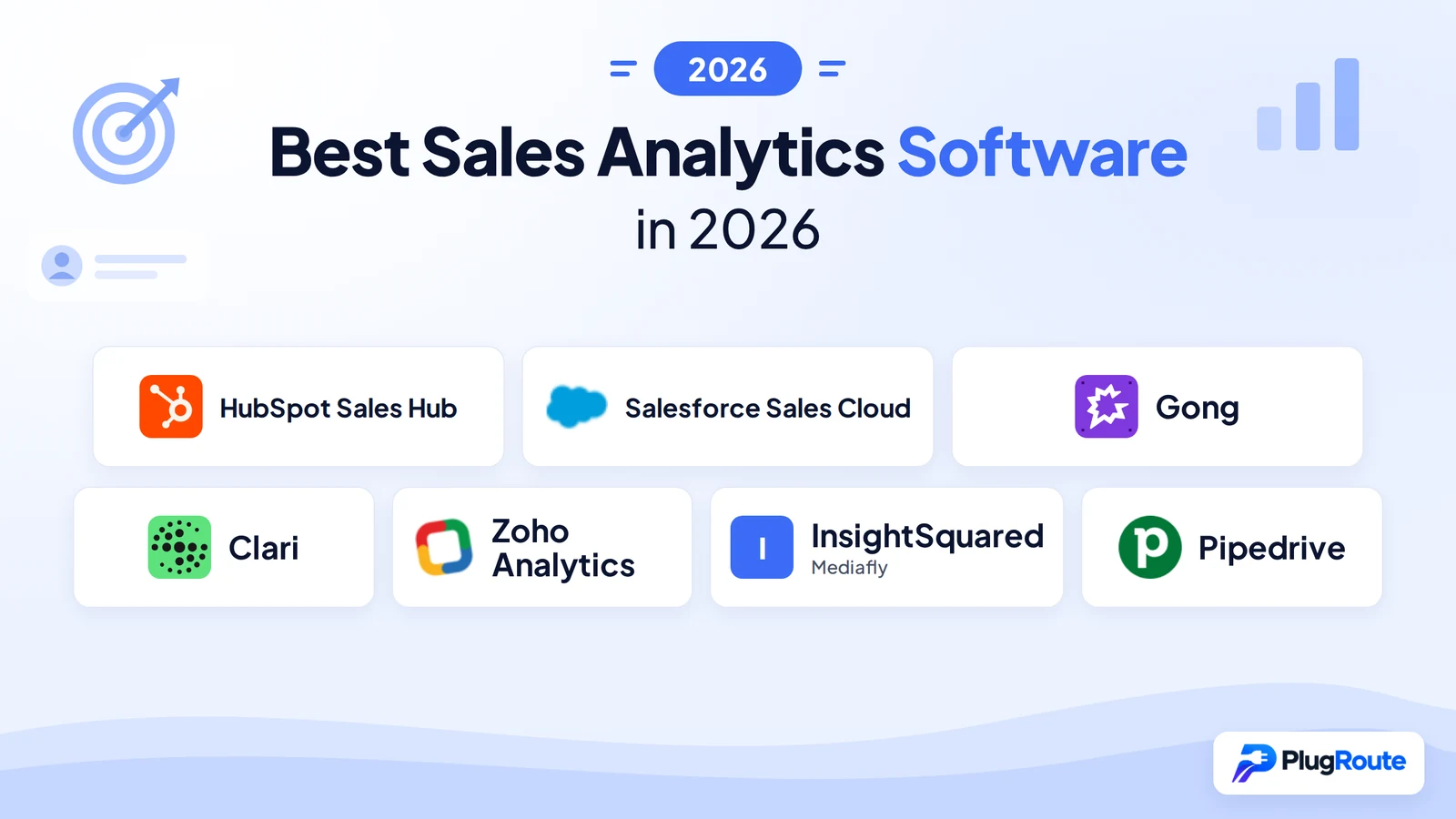
HubSpot Sales Hub is the best all-in-one sales analytics platform for 1–100 rep teams, Salesforce Sales Cloud delivers the deepest CRM-native analytics for enterprise organizations, and Gong (G2: 4.7/5, 6,400+ reviews) leads for rep coaching from real call data. The right choice depends on team size, primary pain point, and whether enterprise pricing is justified at your scale.
Sales analytics tools split into seven distinct architecture types, CRM-native, conversation intelligence, revenue forecasting, BI-first, platform-native, packaged analytics, and pipeline tracking, and each architecture optimizes for a different core buyer problem. Selecting the wrong architecture is the leading cause of shelfware, tools deployed but not used.
PlugRoute receives no compensation from any vendor listed in this guide, and no ranked company has reviewed or influenced this article prior to publication.
“We switched from Salesforce to HubSpot and the reporting setup time went from days to hours.” (r/sales, 2025)
Takeaway: Ease of setup is a material differentiator for smaller teams, not just a marketing claim.
TL;DR: Top Picks at a Glance
- Best for SMB teams (1–100 reps): HubSpot Sales Hub: fast setup, transparent pricing from $15/seat/month, native CRM analytics without admin overhead
- Best for enterprise CRM analytics: Salesforce Sales Cloud: deepest customization and AppExchange integrations; requires dedicated admin; $25–$500/user/month
- Best for rep coaching from real call data: Gong: conversation intelligence, AI-driven coaching, $100–250/user/month with minimum seat requirements
- Best for pipeline inspection and forecast automation: Clari: AI-driven forecast roll-ups; maximum value on Salesforce; pricing not public
- Best for multi-source BI on a budget: Zoho Analytics: 500+ connectors, self-serve dashboards; Basic from $30/month for 2 users (2026)
- Best for packaged mid-market analytics: InsightSquared (Mediafly): pre-built activity-based reports; post-acquisition buyer due diligence required; pricing not public
- Best for lightweight pipeline visibility: Pipedrive: visual pipeline tracking, $14–$99/seat/month; analytics ceiling constrains scaling teams
What Are the 7 Types of Sales Analytics Tools?
Sales analytics platforms fall into seven distinct architecture categories, each solving a different core buyer problem. Selecting the right architecture before evaluating vendors prevents expensive tool migrations 12–18 months post-deployment.
The seven categories are:
- Platform-Native Analyzer: analytics built into a full CRM platform (HubSpot Sales Hub); best for teams that need CRM and analytics in one system without dedicated admin resources
- CRM-Native Analyzer: deeply embedded analytics requiring dedicated CRM administration (Salesforce Sales Cloud); best for enterprise organizations with complex, custom data models
- Conversation Intelligence Analyzer: records and analyzes sales calls to surface coaching insights and deal risk signals (Gong); best for teams where individual rep behavior directly drives revenue outcomes
- Revenue Forecasting Orchestrator: automates pipeline inspection and forecast aggregation using AI (Clari); best for revenue leaders who need real-time forecast confidence without manual CRM review
- BI-First Analyzer: multi-source data blending with self-serve dashboards (Zoho Analytics); best for data-savvy analysts who need flexibility across CRM, ERP, and marketing data
- Packaged Analytics Analyzer: pre-built sales performance reports with activity tracking (InsightSquared/Mediafly); best for mid-market teams wanting structured analytics without BI setup overhead
- Pipeline Tracker: visual pipeline management with lightweight built-in analytics (Pipedrive); best for small teams needing deal visibility without advanced analytics infrastructure
Understanding which architecture matches your primary problem is the single most important decision in this evaluation process.
How Do These 7 Platforms Compare?
| Rank | Company | Category | Best For | One-Line Summary | Key Capabilities | Primary Strength | Key Limitation |
|---|---|---|---|---|---|---|---|
| #1 | HubSpot Sales Hub | Platform-Native Analyzer | SMB teams, 1–100 reps | All-in-one CRM + analytics without enterprise complexity | Pipeline reports, deal tracking, email analytics, AI forecasting | Fast deployment with no dedicated admin required | Advanced AI forecasting locked behind Enterprise tier at $150/seat/month |
| #2 | Salesforce Sales Cloud | CRM-Native Analyzer | Enterprise teams with complex data models | Most customizable CRM-native analytics platform | Einstein AI, custom objects, AppExchange integrations, territory management | Deepest data model customization and integration breadth | Requires dedicated admin; total cost of ownership significantly exceeds license fees |
| #3 | Gong | Conversation Intelligence Analyzer | Revenue teams prioritizing rep coaching | Conversation intelligence with AI-driven coaching and deal signals | Call recording, deal intelligence, rep scorecards, pipeline risk flags | Most detailed rep-behavior analytics from real conversation data | $100–250/user/month plus minimum seats create high cost floor |
| #4 | Clari | Revenue Forecasting Orchestrator | Revenue leaders needing forecast accuracy | AI-powered revenue orchestration for pipeline and forecasting | AI pipeline inspection, forecast roll-ups, deal risk scoring, activity capture | Automated pipeline inspection reduces manual forecast prep overhead | Pricing not public; maximum value requires Salesforce as CRM of record |
| #5 | Zoho Analytics | BI-First Analyzer | Analysts needing multi-source data blending | Self-serve BI platform with 500+ sales data connectors | Multi-source connectors, drag-and-drop dashboards, Zia AI assistant | Most affordable entry point for multi-source analytics ($30/month, 2026) | Zia AI limited on lower tiers; steeper learning curve than CRM-native tools |
| #6 | InsightSquared (Mediafly) | Packaged Analytics Analyzer | Mid-market teams wanting structured sales analytics | Pre-built activity-based analytics embedded in Mediafly post-acquisition | Activity tracking, rep productivity reports, pipeline analytics, Mediafly integration | Pre-built reports reduce time-to-first-insight without BI setup | Post-acquisition roadmap uncertainty; pricing not public |
| #7 | Pipedrive | Pipeline Tracker | Small teams (1–30 reps) needing deal visibility | Visual pipeline CRM with lightweight analytics | Visual pipeline, activity reminders, basic forecasting, email tracking | Lowest public entry price on this list at $14/seat/month | Limited advanced analytics; AI features require higher-tier plans |
Which Tool Should You Choose Based on Your Top Priority?
| Your #1 Priority | Recommended Tool | Why | Acceptable Alternative |
|---|---|---|---|
| All-in-one CRM + analytics, fast setup | HubSpot Sales Hub | Native analytics, no admin required, transparent pricing | Pipedrive (lighter analytics, lower cost) |
| Maximum CRM customization and enterprise integrations | Salesforce Sales Cloud | Deepest data model flexibility, AppExchange ecosystem | HubSpot Sales Hub (faster setup, lower admin overhead) |
| Rep behavior change through call analysis | Gong | Only platform with interaction-level coaching from real conversation data | InsightSquared/Mediafly (activity-based, not conversation-based) |
| Forecast accuracy and pipeline inspection automation | Clari | Automated roll-ups, AI pipeline inspection, reduces forecast overhead | Salesforce Sales Cloud with Einstein (less automated, higher admin burden) |
| Multi-source data blending on a budget | Zoho Analytics | Most affordable multi-source BI; Basic from $30/month (2 users, 2026)* | HubSpot Sales Hub (CRM-only, not multi-source) |
| Pre-built analytics for mid-market, no BI setup | InsightSquared (Mediafly) | Activity-based analytics with pre-built templates | Clari (more forecasting-focused, higher price) |
| Lightweight pipeline visibility, minimal budget | Pipedrive | Lowest public entry price; fast deployment for small teams | HubSpot Sales Hub Free (limited but free) |
*Zoho Analytics workspace pricing applies per row volume above tier-included limits. Verify current seat and row limits at Zoho.com before purchase.
CRM Data Readiness Check: Clari and InsightSquared/Mediafly deliver maximum value when your CRM data is clean, consistently maintained, and actively used by reps. Teams with CRM data quality issues should address data hygiene before deploying either platform, unreliable input data produces unreliable AI-generated forecasts regardless of tool quality.
#1. HubSpot Sales Hub: Best All-in-One CRM Analytics for SMB Teams
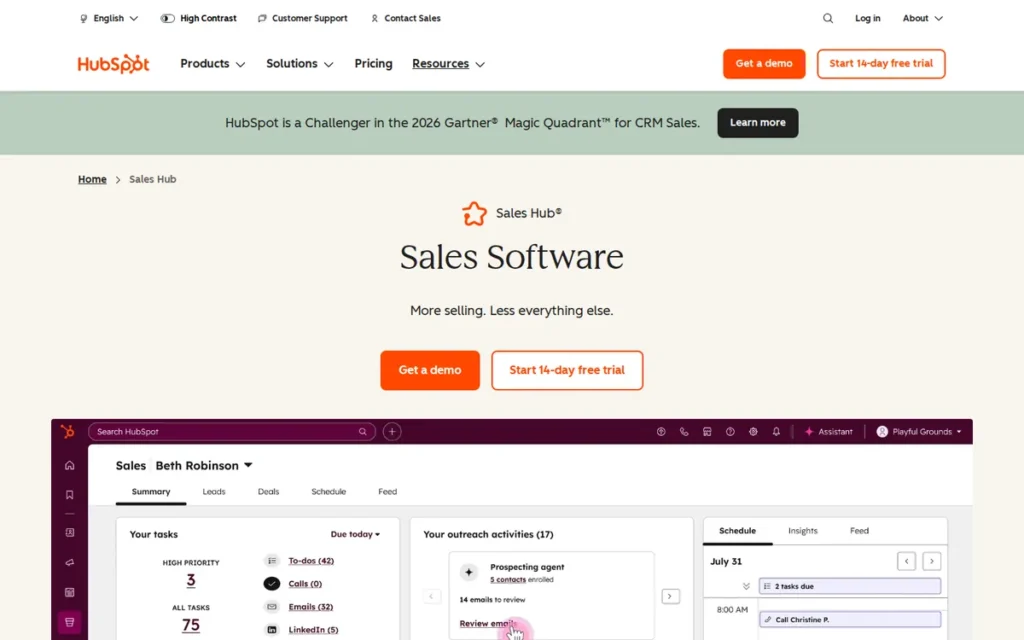
Category: Platform-Native Analyzer
At a Glance
- Category: Platform-Native Analyzer
- Best For: SMB sales teams, 1–100 reps, seeking CRM-native analytics without enterprise implementation complexity
- Price Range: Free tier available; Starter $15/seat/month; Professional $90/seat/month; Enterprise $150/seat/month (billed annually, 2026)
- Primary Strength: HubSpot Sales Hub delivers native pipeline reporting and deal analytics without requiring a dedicated CRM administrator
- Biggest Limitation: HubSpot Sales Hub’s most advanced AI forecasting and custom reporting features are locked behind the Enterprise tier at $150/seat/month
- One-Line Summary: HubSpot Sales Hub is the most accessible full-featured CRM analytics platform for growth-stage sales teams
- Last Verified: May 2026
Overview
HubSpot Sales Hub is an all-in-one CRM and sales analytics platform built for teams of 1–100 reps who need pipeline visibility and reporting without enterprise implementation overhead. HubSpot Sales Hub’s free tier includes core deal tracking; paid tiers unlock forecasting, AI insights, and custom dashboards. HubSpot Sales Hub holds a G2 rating of 4.4/5 across 13,000+ reviews (G2, 2026).
Key Features
- Pipeline Reporting: HubSpot Sales Hub provides visual pipeline dashboards showing deal stage velocity, conversion rates, and revenue at risk, accessible to non-technical users without specialized configuration training.
- Deal Analytics: HubSpot Sales Hub surfaces deal health indicators including time-in-stage, activity gaps, and engagement scores drawn from the full contact history in the CRM.
- Email and Sequence Analytics: HubSpot Sales Hub tracks open rates, click-through rates, and reply rates at the individual email and sequence level, enabling reps to identify high-performing messaging patterns.
- AI-Assisted Forecasting: HubSpot Sales Hub’s AI forecasting module (Enterprise tier) generates weighted pipeline predictions and highlights deals at risk of slipping, accuracy depends on CRM data completeness.
- Custom Dashboards: HubSpot Sales Hub allows teams to build up to 300 custom dashboards (Enterprise tier) combining CRM, marketing, and service data into unified revenue views.
Best For
HubSpot Sales Hub is best for growth-stage companies (Series A through Series C) and established SMBs that need a single platform for CRM, pipeline tracking, and analytics without hiring a dedicated CRM administrator. HubSpot Sales Hub is also a strong fit for RevOps teams transitioning from spreadsheet-based reporting.
Pricing
HubSpot Sales Hub pricing (2026, billed annually): Free tier includes core CRM and basic deal tracking. Starter begins at $15/seat/month. Professional is $90/seat/month and includes forecasting and sequences. Enterprise is $150/seat/month and adds AI forecasting, advanced custom reports, and predictive lead scoring. All pricing is publicly listed at HubSpot.com.
Strengths
- HubSpot Sales Hub’s transparent, publicly listed pricing makes budget planning predictable, unlike Clari and InsightSquared, which require vendor quotes before any pricing data is available.
- HubSpot Sales Hub’s free tier provides genuine CRM functionality including contact management, deal tracking, and basic reporting, lowering the barrier to first value.
- HubSpot Sales Hub integrates natively with HubSpot Marketing Hub and Service Hub, enabling revenue teams to report across the full customer lifecycle in a single platform.
- HubSpot Sales Hub earned a G2 rating of 4.4/5 across 13,000+ reviews (G2, 2026), reflecting consistent user satisfaction at scale across team sizes.
Limitations
- Enterprise Tier Dependency: HubSpot Sales Hub’s most impactful analytics capabilities (AI forecasting, predictive lead scoring, and advanced custom reports) require the Enterprise plan at $150/seat/month, making effective analytics cost higher than headline pricing suggests.
- CRM Architecture Lock-In: HubSpot Sales Hub’s analytics are built exclusively on HubSpot CRM data; teams using Salesforce as their system of record cannot access HubSpot analytics without a full CRM migration or a third-party connector.
- No Native Conversation Intelligence: HubSpot Sales Hub does not include native call recording or conversation analytics, teams requiring rep coaching from call data must deploy a separate tool such as Gong alongside HubSpot.
- Scaling Constraints: HubSpot Sales Hub’s custom object functionality and data model flexibility are less extensive than Salesforce Sales Cloud, creating architectural constraints for enterprise teams with complex, multi-product sales workflows.
Verdict
HubSpot Sales Hub is the most practical CRM analytics platform for SMB teams that need fast deployment, transparent pricing, and capable forecasting without dedicated administration overhead. For teams that outgrow HubSpot’s data model or require conversation intelligence, the platform’s architecture becomes a ceiling rather than a foundation.
#2. Salesforce Sales Cloud: Best CRM-Native Analytics for Enterprise Organizations
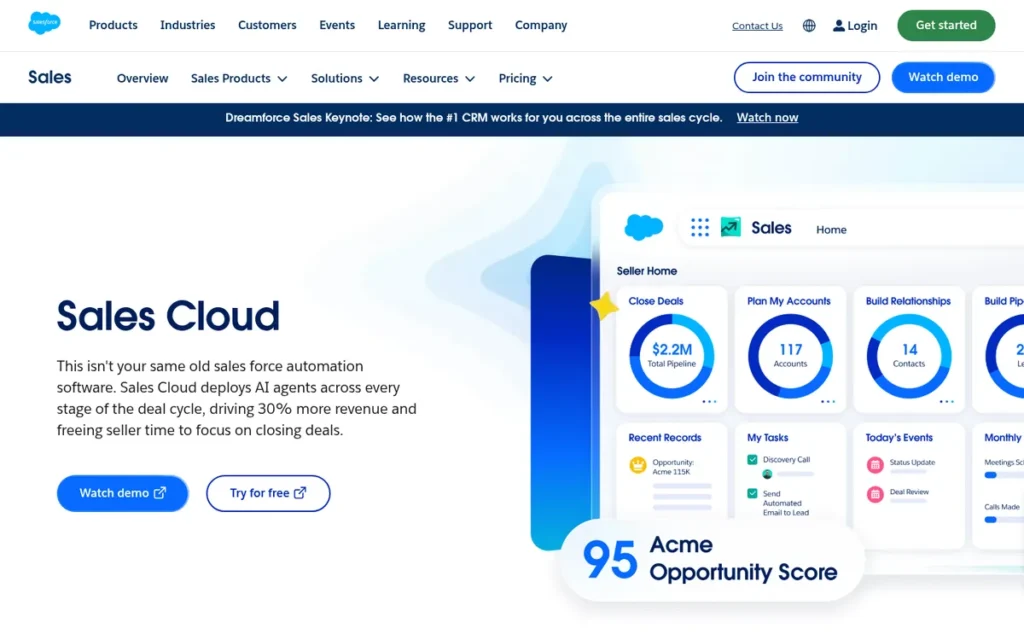
Category: CRM-Native Analyzer
At a Glance
- Category: CRM-Native Analyzer
- Best For: Enterprise sales organizations with complex data models and dedicated Salesforce administration capacity
- Price Range: Starter Suite $25/user/month; Pro Suite $100/user/month; Enterprise $165/user/month; Unlimited $330/user/month; Einstein 1 Sales $500/user/month (billed annually, 2026)
- Primary Strength: Salesforce Sales Cloud offers the deepest CRM data model customization and broadest third-party integration ecosystem of any platform on this list
- Biggest Limitation: Salesforce Sales Cloud’s total cost of ownership significantly exceeds headline licensing costs once administration, implementation, and AppExchange fees are included
- One-Line Summary: Salesforce Sales Cloud is the most customizable enterprise CRM analytics platform, with material trade-offs in complexity and total deployment cost
- Last Verified: May 2026
Overview
Salesforce Sales Cloud is the market-leading CRM platform with deeply embedded analytics through Einstein AI, custom report types, and the AppExchange ecosystem. Salesforce Sales Cloud is built for enterprise organizations requiring flexible data models, complex territory management, and integration with ERP or marketing automation systems. Salesforce Sales Cloud holds a G2 rating of 4.4/5 across 23,000+ reviews (G2, 2026).
Key Features
- Einstein AI Analytics: Salesforce Sales Cloud’s Einstein layer provides predictive lead scoring, opportunity scoring, and pipeline inspection recommendations, available on Enterprise tier and above.
- Custom Report Builder: Salesforce Sales Cloud allows admins to create fully custom report types combining standard and custom objects, enabling analytics structures aligned to any sales process or data model.
- AppExchange Ecosystem: Salesforce Sales Cloud connects to 3,000+ AppExchange applications (Salesforce, 2026), including Gong, Clari, and Tableau, allowing teams to extend native analytics with specialized tools.
- Territory and Quota Management: Salesforce Sales Cloud includes native territory management and quota tracking modules, enabling complex multi-tiered organizations to report on performance by geography, segment, or product line.
- Flow and Automation Analytics: Salesforce Sales Cloud’s Einstein Analytics Studio allows revenue operations teams to build automated pipeline reviews, deal inspection workflows, and rep performance scorecards at scale.
Best For
Salesforce Sales Cloud is best for enterprise organizations (500+ employees, complex deal cycles, multi-product or multi-segment GTM) that have (or plan to hire) dedicated Salesforce administrators. Salesforce Sales Cloud is also the right foundation for teams deploying Clari or Gong, as both platforms integrate most deeply with Salesforce as the CRM of record.
Pricing
Salesforce Sales Cloud pricing (2026, billed annually): Starter Suite $25/user/month; Pro Suite $100/user/month; Enterprise $165/user/month; Unlimited $330/user/month; Einstein 1 Sales $500/user/month. Einstein AI forecasting and advanced analytics require Enterprise tier or above. Implementation costs, admin salaries, and AppExchange fees are not included and vary significantly by organization size and complexity.
Strengths
- Salesforce Sales Cloud’s custom object framework enables data models for virtually any sales process, a capability no other CRM-native platform on this list matches in breadth or depth.
- Salesforce Sales Cloud’s AppExchange ecosystem of 3,000+ applications (Salesforce, 2026) means nearly every sales tool (including Gong, Clari, and Outreach) integrates natively.
- Salesforce Sales Cloud’s global install base of 150,000+ customers (Salesforce, 2026) ensures robust third-party support, documentation, and Salesforce-certified talent availability.
- Salesforce Sales Cloud’s Einstein tier provides AI-assisted forecast accuracy improvements; Prospanica reported a 26% improvement and Schneider Electric reported a 20% improvement in forecast accuracy, both figures drawn from vendor-published customer stories and not independently corroborated by third-party sources (Salesforce, 2025).
Limitations
- Total Cost of Ownership: Salesforce Sales Cloud’s licensing costs represent only a portion of total spend, admin salaries, implementation partners, and AppExchange fees routinely push annual costs 2–4× above license fees for mid-market deployments.
- Implementation Complexity: Salesforce Sales Cloud requires dedicated administrators for ongoing maintenance; teams without in-house Salesforce expertise face a steep learning curve and sustained reliance on external consultants.
- Analytics Tier Gating: Salesforce Sales Cloud’s most powerful analytics: Einstein AI, advanced forecasting, and Tableau CRM, are locked behind Enterprise ($165/user/month) and Unlimited ($330/user/month) tiers.
- SMB Misfit: Salesforce Sales Cloud’s complexity and cost structure create poor ROI for teams under 30 reps without dedicated RevOps resources, HubSpot Sales Hub or Pipedrive typically deliver better outcomes at lower cost for smaller organizations.
Verdict
Salesforce Sales Cloud is the correct choice for enterprise organizations that need maximum data model flexibility, deep third-party integrations, and AI-assisted forecasting, provided they budget realistically for administration and implementation. Teams expecting out-of-the-box simplicity or predictable low total cost will find Salesforce Sales Cloud over-engineered for their situation.
#3. Gong: Best Conversation Intelligence Platform for Rep Coaching
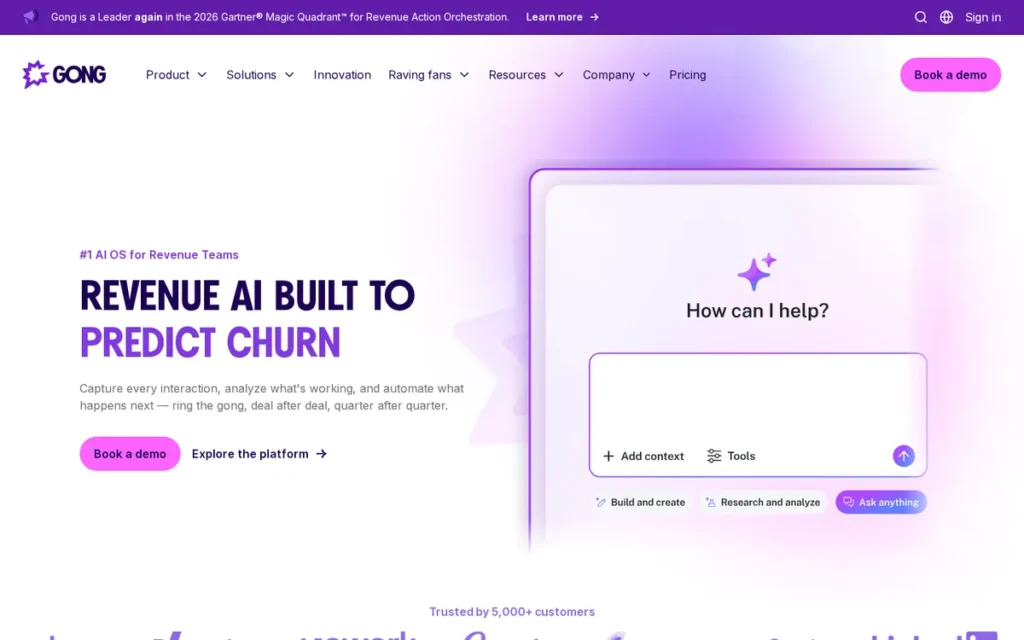
Category: Conversation Intelligence Analyzer
At a Glance
- Category: Conversation Intelligence Analyzer
- Best For: Revenue teams prioritizing rep behavior change through conversation analysis and AI-driven coaching workflows
- Price Range: $100–250/user/month (community-sourced estimates, 2025–2026); minimum seat requirements apply; vendor pricing requires direct quote
- Primary Strength: Gong provides the most detailed rep-level conversation analytics and AI coaching recommendations of any platform on this list
- Biggest Limitation: Gong’s pricing floor: minimum seat requirements plus $100–250/user/month, makes it financially inaccessible for teams under 10 reps
- One-Line Summary: Gong is the leading conversation intelligence platform for rep coaching, with a pricing structure that favors mid-market and enterprise teams
- Last Verified: May 2026
Overview
Gong is a conversation intelligence and revenue analytics platform that records, transcribes, and analyzes sales calls, emails, and meetings to surface coaching insights and pipeline risk signals. Gong is designed for revenue teams of 10+ reps where improving individual rep behavior drives measurable revenue outcomes. Gong holds a G2 rating of 4.7/5 across 6,400+ reviews (G2, 2026), the highest rating of any platform on this list.
Key Features
- Call Recording and Transcription: Gong automatically records and transcribes sales conversations across phone, video, and email, creating a searchable library of rep interactions accessible to managers and coaches.
- AI Coaching Recommendations: Gong’s AI layer analyzes conversation patterns: talk-to-listen ratio, topic coverage, objection handling, and generates rep-specific coaching recommendations. Gong Labs’ own research cites 25 million+ interactions processed within the platform, while third-party analysis (Tellius, 2026) estimates total interactions at over 3.5 billion.
- Deal Intelligence: Gong surfaces pipeline risk signals by identifying deals where engagement has dropped, key stakeholders have gone quiet, or critical topics (pricing, competition, timeline) have not been addressed.
- Rep Scorecards: Gong provides automated rep performance scorecards combining call quality metrics, activity data, and pipeline outcomes into a single coaching interface for managers.
- CRM Enrichment: Gong integrates with Salesforce Sales Cloud and HubSpot Sales Hub to write conversation-derived signals back to CRM deal records, reducing manual rep data entry.
Best For
Gong is best for revenue organizations where rep skill development is the primary performance lever, typically B2B SaaS, enterprise sales, and high-ACV businesses where individual call quality directly impacts close rates. Gong is most effective for teams with 10–500 reps and an active manager coaching culture.
Pricing
Gong pricing is not publicly listed; all pricing requires a direct vendor quote. Community-sourced estimates (Reddit r/sales, r/salesops, 2025–2026) place Gong at $100–250/user/month, with minimum seat requirements establishing a meaningful cost floor. Platform and API fees may apply in addition to per-seat pricing. Request itemized quotes covering platform fees, seat fees, and integration costs before budgeting.
Strengths
- Gong’s G2 rating of 4.7/5 across 6,400+ reviews (G2, 2026) represents the strongest independent user validation of any platform on this list.
- Gong’s conversation intelligence approach provides coaching data structurally unavailable from CRM-native platforms, actual call behavior analysis, not just activity logging.
- Gong received recognition in the Gartner Magic Quadrant for Revenue Action Orchestration (Gartner, 2025) alongside other revenue intelligence vendors at varying recognition levels.
- Gong’s deal intelligence layer identifies pipeline risk from conversation signals rather than rep-entered CRM data, reducing forecast distortion caused by optimistic pipeline management.
Limitations
- Pricing Accessibility: Gong’s $100–250/user/month range with minimum seat requirements creates a cost floor that makes it effectively inaccessible for teams under 10 reps, community estimates suggest minimum annual deployments of $50,000–$150,000 (Reddit r/salesops, 2025–2026).
- CRM Dependency: Gong enriches a CRM rather than replacing one: teams without a well-maintained Salesforce or HubSpot instance will not realize full value from Gong’s pipeline risk and deal intelligence features.
- Analytics Scope: Gong focuses on conversation and coaching analytics; teams needing multi-source BI, territory reporting, or quota management require additional tools alongside Gong.
- Implementation Investment: Gong implementations typically require 4–8 weeks of setup time including CRM integration, recording configuration, and manager training, a meaningful commitment for smaller organizations.
“Gong is worth every penny if your managers actually use the coaching features. If they don’t, it’s a very expensive call recorder.” (r/salesops, 2025)
Takeaway: Gong’s ROI is directly tied to manager adoption of coaching workflows, deployment without an active coaching culture produces an expensive transcription tool, not a performance improvement platform.
Verdict
Gong is the most evidence-backed conversation intelligence platform for rep coaching, with the highest G2 rating on this list and the only architecture that connects actual call behavior to pipeline outcomes. Teams should evaluate Gong only if they have 10+ reps, active manager coaching workflows, and the budget for $100–250/user/month plus platform fees.
#4. Clari: Best Revenue Forecasting Orchestrator for Pipeline Accuracy
Category: Revenue Forecasting Orchestrator
At a Glance
- Category: Revenue Forecasting Orchestrator
- Best For: Revenue leaders and CROs at mid-market and enterprise companies needing automated forecast roll-ups and AI pipeline inspection
- Price Range: Not publicly disclosed; requires direct vendor quote (community estimates indicate enterprise-tier positioning, 2025–2026)
- Primary Strength: Clari automates pipeline inspection and forecast roll-ups, reducing the time revenue leaders spend on manual pipeline review meetings
- Biggest Limitation: Clari’s maximum value is realized when deployed on Salesforce Sales Cloud as the CRM of record, teams on other CRMs experience reduced AI functionality
- One-Line Summary: Clari is the leading revenue forecasting orchestration platform for Salesforce-centric enterprise teams, with pricing that reflects its enterprise market positioning
- Last Verified: May 2026
Overview
Clari is an AI-powered revenue orchestration platform that automates pipeline inspection, deal risk scoring, and forecast roll-ups across revenue teams. Clari is designed for revenue leaders (CROs, VP Sales, and RevOps professionals) who need real-time forecast confidence without relying on manually updated CRM records. Clari holds a G2 rating of 4.6/5 across 2,600+ reviews (G2, 2026).
Key Features
- AI Pipeline Inspection: Clari’s AI layer automatically flags deals at risk based on engagement signals, CRM activity gaps, and historical close rate patterns, reducing manager time spent on deal review preparation.
- Forecast Roll-Ups: Clari aggregates rep, manager, and segment forecasts into unified revenue projections, enabling CROs to identify forecast gaps and coverage risks in real time without manual spreadsheet consolidation.
- Activity Capture: Clari captures email and calendar activity from rep workflows and writes it back to the CRM, reducing the manual logging burden that degrades CRM data quality over time.
- Deal Risk Scoring: Clari scores individual deals by likelihood to close using engagement signals, stage progression, and historical win patterns, surfacing high-risk opportunities for manager intervention.
- Revenue Cadences: Clari supports structured pipeline review workflows: weekly forecast calls, QBRs, deal inspections, with pre-built templates that reduce meeting preparation overhead.
Best For
Clari is best for mid-market and enterprise revenue organizations (100+ reps) where forecast accuracy is a board-level priority and pipeline review currently requires significant manual effort from managers and RevOps. Clari delivers maximum value when deployed on top of a well-maintained Salesforce Sales Cloud instance.
Pricing
Clari does not publicly list pricing; all quotes require direct vendor engagement. Community-sourced estimates (Reddit r/salesops, r/revops, 2025–2026) indicate enterprise-tier price positioning. Organizations should request itemized quotes covering platform access, seat counts, and Salesforce integration fees. Budget planning without a formal Clari quote is not reliable.
Strengths
- Clari received the highest Gartner recognition level: Leader designation, in the inaugural Gartner Magic Quadrant for Revenue Action Orchestration, which also included other revenue intelligence vendors at different recognition levels (Gartner, 2025).
- Clari’s automated activity capture structurally reduces the CRM data quality problems that distort manual forecasts, an improvement over models relying on rep self-reporting alone.
- Clari’s deal risk scoring provides a quantitative layer on top of rep intuition: useful for revenue leaders evaluating large pipeline volumes without individual deal review capacity.
- Clari’s forecast accuracy improvement claims appear in vendor-published customer case studies (Clari, 2025) and have not been independently corroborated, buyers should request evidence methodology details during vendor evaluation.
Limitations
- Salesforce Dependency: Clari delivers maximum value as a Salesforce Sales Cloud overlay; teams using HubSpot, Microsoft Dynamics, or other CRMs experience reduced AI functionality and integration depth.
- Pricing Opacity: Clari does not publicly disclose pricing, making initial budget qualification impossible without entering a vendor sales process, a barrier for teams conducting preliminary evaluations.
- Analytics Scope: Clari focuses on pipeline inspection and forecasting; teams needing conversation intelligence, rep coaching, or multi-source BI require additional tools alongside Clari.
- CRM Data Quality Dependency: Clari’s AI forecasts depend on clean, consistently maintained CRM data, teams with data quality issues must address CRM hygiene before deployment or risk generating unreliable AI outputs.
“Clari cut our weekly forecast prep from 4 hours to 45 minutes. But you have to actually keep your Salesforce data clean or the AI calls are garbage.” (r/revops, 2025)
Takeaway: Clari’s time savings are real for teams with clean CRM data, but the platform amplifies existing data quality problems rather than correcting them.
Verdict
Clari is the strongest platform for automating pipeline inspection and forecast roll-ups at enterprise scale, with Gartner Leader recognition validating its category position. Teams without a clean Salesforce instance, or those below 100 reps, should evaluate whether Clari’s pricing is justified relative to simpler alternatives available on this list.
#5. Zoho Analytics: Best BI-First Platform for Multi-Source Sales Data
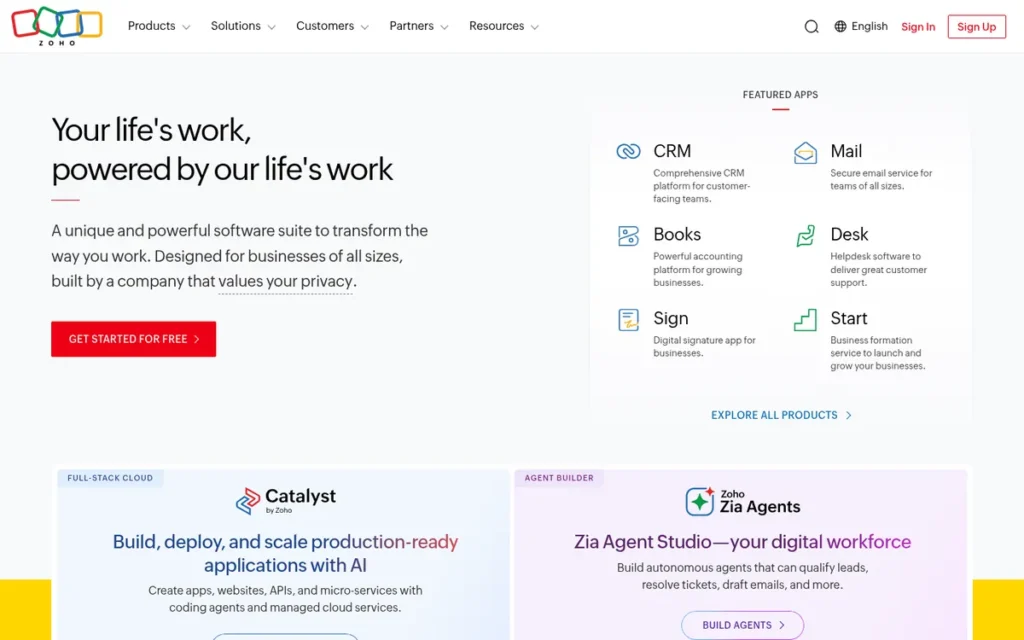
Category: BI-First Analyzer
At a Glance
- Category: BI-First Analyzer
- Best For: Analysts and RevOps teams needing multi-source data blending at an accessible price point
- Price Range: Basic $30/month (2 users); Standard $60/month (5 users); Premium $145/month (15 users); Enterprise $575/month (50 users), billed annually, 2026
- Primary Strength: Zoho Analytics provides the most affordable entry point for genuine multi-source sales analytics, with 500+ pre-built data connectors
- Biggest Limitation: Zoho Analytics’ Zia AI assistant and advanced ML capabilities are limited on Basic and Standard tiers, full AI functionality requires Premium ($145/month) or Enterprise ($575/month)
- One-Line Summary: Zoho Analytics is the most cost-accessible self-serve BI platform for sales data blending, with trade-offs in AI depth at lower price tiers
- Last Verified: May 2026
Overview
Zoho Analytics is a self-serve BI platform with 500+ pre-built connectors enabling sales, finance, and operations teams to blend data from multiple systems (CRM, ERP, marketing automation, spreadsheets) into unified dashboards. Zoho Analytics is designed for data-savvy analysts and RevOps teams who need cross-source flexibility rather than a CRM-native analytics layer. Zoho Analytics holds a G2 rating of 4.3/5 across 300+ reviews (G2, 2026).
Key Features
- Multi-Source Data Connectors: Zoho Analytics connects to 500+ data sources including Salesforce, HubSpot, Google Sheets, MySQL, and Zoho CRM, enabling cross-system sales reporting unavailable in single-CRM analytics tools.
- Drag-and-Drop Dashboard Builder: Zoho Analytics provides a no-code dashboard builder enabling non-developers to create custom visualizations, pivot tables, and cohort analyses without SQL expertise.
- Zia AI Assistant: Zoho Analytics’ Zia AI assistant responds to natural language queries about sales data and generates automated insights, full Zia functionality requires Premium tier or above.
- Automated Report Scheduling: Zoho Analytics schedules and distributes reports via email on configurable cadences, reducing manual report generation overhead for sales managers and RevOps teams.
- Role-Based Access and Sharing: Zoho Analytics supports embedded analytics and public or private dashboard sharing, enabling analytics distribution across organizations without requiring every viewer to hold a paid seat.
Best For
Zoho Analytics is best for RevOps teams, analysts, and data-focused sales leaders at small-to-mid-market companies (10–500 employees) who need to blend sales data across multiple systems but cannot justify enterprise BI costs. Zoho Analytics is particularly strong for Zoho CRM users who want deeper analytics than the native reporting layer provides.
Pricing
Zoho Analytics pricing (2026, billed annually): Basic $30/month for up to 2 users and 0.5 million rows; Standard $60/month for up to 5 users and 1 million rows; Premium $145/month for up to 15 users and 5 million rows; Enterprise $575/month for up to 50 users and 50 million rows. Additional users and row volumes are available as add-ons. Workspace and API access fees apply above included limits, verify current terms at Zoho.com before purchase.
Strengths
- Zoho Analytics’ Basic tier at $30/month (2026) provides multi-source data blending at a price no other platform on this list matches, making it the most accessible entry point for budget-constrained teams.
- Zoho Analytics’ 500+ pre-built connectors (Zoho, 2026) cover a wider range of data sources than any CRM-native analytics tool on this list, enabling unified reporting across sales, marketing, and finance data.
- Zoho Analytics’ drag-and-drop interface allows non-developers to build custom dashboards without SQL expertise, reducing analytics dependency on engineering or data science resources.
- Zoho Analytics holds a G2 rating of 4.3/5 (G2, 2026), with users consistently citing value-for-cost as a primary satisfaction driver.
Limitations
- AI Feature Gating: Zoho Analytics’ Zia AI assistant: the platform’s primary differentiator from basic BI tools, is limited on Basic and Standard tiers; full NLP query and automated insight generation require Premium ($145/month) or Enterprise ($575/month).
- Learning Curve: Zoho Analytics’ multi-source flexibility comes with a steeper learning curve than CRM-native tools, teams without a dedicated analyst or RevOps professional may struggle to realize full platform value independently.
- CRM Integration Depth: Zoho Analytics offers broad connectivity but less deep CRM integration than platform-native options, real-time data syncs and bidirectional write-back are not available in the same way as HubSpot or Salesforce native analytics.
- User Count Tier Caps: Zoho Analytics’ per-tier user limits: 2 users on Basic, 5 on Standard, 15 on Premium, create cost step-ups that can surprise growing teams; a 10-person RevOps team requires the Premium tier at $145/month minimum.
Verdict
Zoho Analytics is the strongest choice for budget-constrained teams that need genuine multi-source BI capability, not just CRM reporting. The platform’s low entry price and broad connector library make it uniquely accessible, but teams should plan for tier upgrades as user counts and data volumes grow beyond the Basic tier limits.
#6. InsightSquared (Mediafly): Best Packaged Analytics for Mid-Market Sales Teams
Category: Packaged Analytics Analyzer
At a Glance
- Category: Packaged Analytics Analyzer
- Best For: Mid-market B2B sales teams (50–500 reps) wanting structured activity-based analytics without BI setup overhead
- Price Range: Not publicly disclosed; requires direct vendor quote (post-acquisition pricing, 2025–2026)
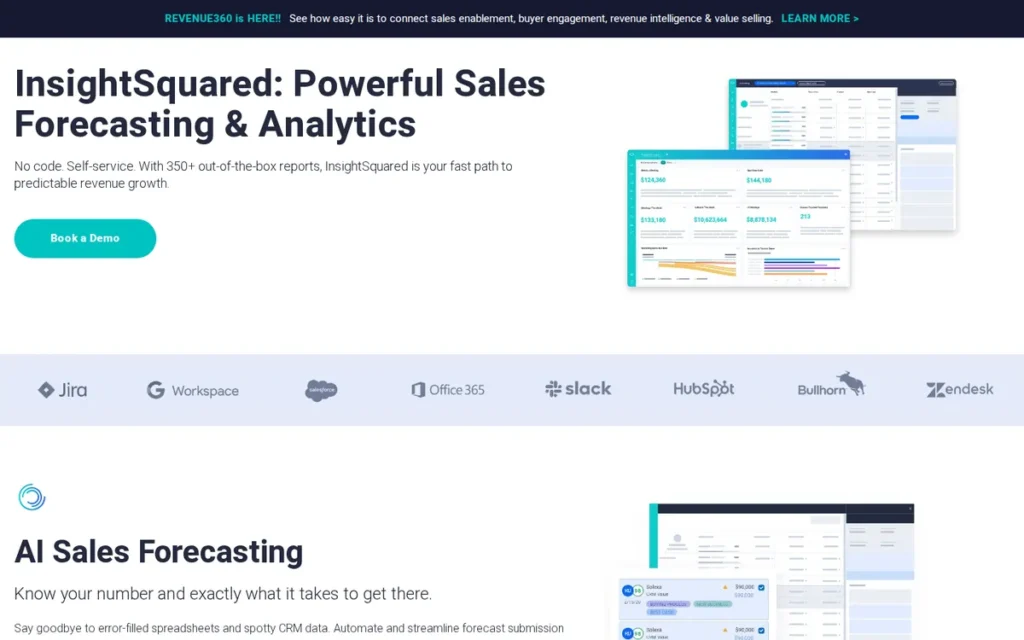
- Primary Strength: InsightSquared provides pre-built sales performance and activity tracking reports that deliver faster time-to-first-insight than build-your-own BI platforms
- Biggest Limitation: The Mediafly acquisition of InsightSquared (announced December 2021, completed January 2022) creates ongoing product roadmap uncertainty for prospective buyers considering multi-year contracts
- One-Line Summary: InsightSquared’s pre-built sales analytics are embedded in the Mediafly platform following the 2022 acquisition, with long-term value dependent on post-acquisition product stability
- Last Verified: May 2026
Overview
InsightSquared is a packaged sales analytics platform acquired by Mediafly (announced December 2021, completed January 2022) and now embedded within the Mediafly revenue enablement platform. InsightSquared provides pre-built activity tracking, rep productivity reports, and pipeline analytics designed for mid-market B2B sales teams that need structured reporting without BI setup overhead. InsightSquared holds a G2 rating of 4.4/5 across 500+ reviews (G2, 2026), though post-acquisition review volume has slowed relative to pre-2022 levels.
Key Features
- Pre-Built Activity Reports: InsightSquared provides out-of-the-box rep activity dashboards tracking calls, emails, meetings, and pipeline touches, reducing time-to-first-insight versus building custom BI dashboards from scratch.
- Pipeline Analytics: InsightSquared surfaces pipeline movement, stage progression, and historical win/loss patterns in structured report templates designed for sales managers without BI expertise.
- Rep Productivity Scorecards: InsightSquared generates automated rep productivity reports combining activity metrics and pipeline outcomes, enabling managers to identify performance gaps without manual data compilation.
- Mediafly Integration: Following the acquisition, InsightSquared’s analytics are accessible within the Mediafly revenue enablement platform, pairing sales content delivery with sales performance analytics.
- CRM Connector: InsightSquared connects to Salesforce Sales Cloud and other CRMs to pull activity and pipeline data into pre-built analytics templates, enriching native CRM reports without custom development.
Best For
InsightSquared is best for mid-market B2B sales teams (50–500 reps) that want structured, out-of-the-box sales analytics without the setup overhead of self-serve BI tools like Zoho Analytics or Tableau. InsightSquared is particularly suited to teams already using or evaluating Mediafly for sales content enablement.
Pricing
InsightSquared pricing is not publicly listed; all quotes require direct engagement with Mediafly. Community-sourced estimates (Reddit r/sales, r/salesops, 2025–2026) do not provide reliable public price points for the post-acquisition platform. Organizations evaluating InsightSquared should request itemized quotes and clarify which capabilities are native to the InsightSquared product versus the broader Mediafly platform.
Strengths
- InsightSquared’s pre-built report templates reduce time-to-first-insight for mid-market teams without dedicated BI resources, structured sales analytics accessible without custom dashboard development.
- InsightSquared’s activity tracking approach captures rep behavior at granular levels, enabling managers to coach on specific gaps without requiring conversation intelligence infrastructure.
- InsightSquared’s Mediafly integration provides a combined analytics-plus-enablement surface, a differentiated pairing not available from standalone analytics tools on this list.
- InsightSquared holds a G2 rating of 4.4/5 (G2, 2026), reflecting sustained satisfaction from its established pre-acquisition install base.
Limitations
- Post-Acquisition Uncertainty: The Mediafly acquisition of InsightSquared (completed January 2022) creates product roadmap uncertainty, prospective buyers should request detailed roadmap commitments and explicit feature continuity guarantees before signing multi-year contracts.
- Pricing Opacity: InsightSquared does not publicly disclose post-acquisition pricing, making budget qualification impossible without entering a vendor sales process.
- Review Velocity Decline: InsightSquared’s G2 review velocity has slowed since the 2022 acquisition, suggesting reduced new customer acquisition, a signal worth monitoring as an indicator of long-term platform viability.
- Analytics Scope Limits: InsightSquared focuses on activity-based analytics and pipeline reporting, teams needing conversation intelligence (Gong), multi-source BI (Zoho Analytics), or advanced AI forecasting (Clari) require additional tools.
Verdict
InsightSquared remains a viable option for mid-market teams seeking pre-built sales analytics without BI overhead, but prospective buyers must evaluate post-acquisition product stability carefully and request explicit roadmap commitments before committing to multi-year contracts. Teams with low vendor-risk tolerance may find better long-term optionality in Zoho Analytics or HubSpot Sales Hub.
#7. Pipedrive: Best Lightweight Pipeline Tracker for Small Sales Teams
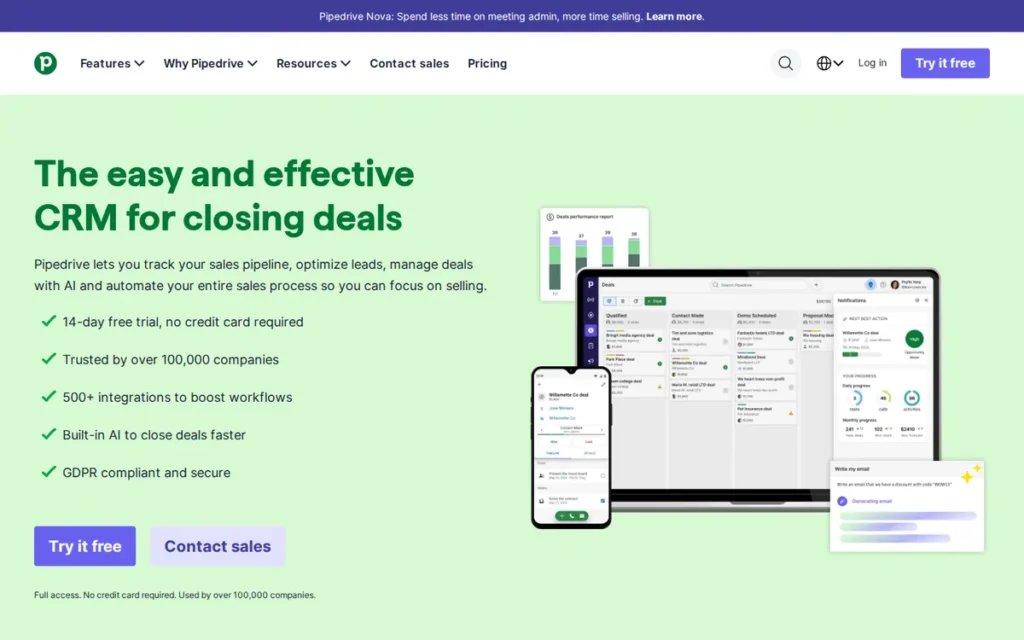
Category: Pipeline Tracker
At a Glance
- Category: Pipeline Tracker
- Best For: Small sales teams (1–30 reps) at early-stage startups and SMBs needing visual pipeline management and basic deal analytics
- Price Range: Essential $14/seat/month; Advanced $29/seat/month; Professional $49/seat/month; Power $64/seat/month; Enterprise $99/seat/month (billed annually, 2026)
- Primary Strength: Pipedrive delivers the lowest publicly listed entry price for visual pipeline management with built-in deal analytics among all platforms on this list
- Biggest Limitation: Pipedrive’s analytics capabilities are limited relative to purpose-built analytics platforms, advanced forecasting and AI features require higher-tier plans and remain less sophisticated than Clari or HubSpot Enterprise
- One-Line Summary: Pipedrive is the most cost-effective entry point for visual pipeline tracking, with an analytics ceiling that constrains organizations as they scale beyond 30 reps
- Last Verified: May 2026
Overview
Pipedrive is a visual pipeline CRM with built-in deal tracking and lightweight analytics designed for small sales teams that prioritize ease of use over analytical depth. Pipedrive is built for teams of 1–30 reps where visual deal management and activity reminders are the primary use case rather than advanced forecasting or multi-source BI. Pipedrive holds a G2 rating of 4.3/5 across 1,800+ reviews (G2, 2026).
Key Features
- Visual Pipeline Management: Pipedrive’s drag-and-drop pipeline view provides a Kanban-style deal board showing all active opportunities by stage, the platform’s core differentiator for non-technical sales teams who need immediate deal visibility.
- Deal Analytics: Pipedrive provides basic deal analytics including won/lost ratios, average deal value, pipeline value by stage, and sales cycle length, sufficient for small team oversight without BI configuration.
- Activity Tracking and Reminders: Pipedrive tracks calls, emails, and meetings per deal and automatically reminds reps of overdue activities, reducing follow-up gaps common in spreadsheet-managed pipelines.
- Revenue Forecasting: Pipedrive’s forecasting module projects expected revenue based on deal probability weightings by stage; AI-enhanced forecasting is available on Professional tier and above.
- Email Integration: Pipedrive integrates with Gmail and Outlook to sync email activity to deal records, reducing manual CRM logging burden for individual reps.
Best For
Pipedrive is best for small sales teams (1–30 reps) at early-stage startups and SMBs that need a structured CRM with basic pipeline analytics and do not require advanced forecasting, conversation intelligence, or multi-source BI capabilities. Pipedrive is also a practical entry point for teams transitioning from spreadsheet-based sales tracking.
Pricing
Pipedrive pricing (2026, billed annually): Essential $14/seat/month; Advanced $29/seat/month; Professional $49/seat/month; Power $64/seat/month; Enterprise $99/seat/month. AI-enhanced features including smart forecasting and AI email assistance are available on Professional tier and above. All pricing is publicly listed at Pipedrive.com.
Strengths
- Pipedrive’s Essential tier at $14/seat/month (2026) is the lowest publicly listed entry price among all platforms on this list, making it accessible to pre-revenue and early-stage teams with minimal sales budgets.
- Pipedrive’s visual pipeline interface is consistently cited in user reviews as one of the most intuitive deal management experiences available, reducing onboarding time relative to enterprise CRM platforms.
- Pipedrive’s transparent, publicly listed pricing structure enables accurate budget planning without entering a vendor sales process.
- Pipedrive holds a G2 rating of 4.3/5 across 1,800+ reviews (G2, 2026), reflecting consistent satisfaction among its core small-team audience.
Limitations
- Analytics Ceiling: Pipedrive’s built-in analytics are designed for small team oversight, teams requiring rep scorecards, conversation intelligence, multi-source BI, or sophisticated AI forecasting will outgrow Pipedrive’s analytics layer as they scale.
- Advanced Feature Gating: Pipedrive’s AI forecasting and advanced reporting features require Professional ($49/seat/month) or higher tiers; at these price points, HubSpot Sales Hub Professional ($90/seat/month) offers significantly deeper analytics for a moderate additional cost.
- Limited Data Model Flexibility: Pipedrive’s data model is less customizable than Salesforce Sales Cloud, teams with complex multi-product, multi-territory, or enterprise deal structures may find Pipedrive’s object model too constrained for their workflows.
- Scalability Costs: Pipedrive is optimized for teams under 50 reps; organizations growing beyond this threshold frequently require migrations to Salesforce or HubSpot, creating rework and data migration costs that partially offset early savings.
Verdict
Pipedrive is the most practical starting point for small sales teams that need visual pipeline management and basic analytics at the lowest possible cost. Teams anticipating rapid growth or requiring advanced analytics should evaluate whether Pipedrive’s lower entry cost justifies the likely platform migration expense within 18–24 months of scaling.
What Red Flags Should I Watch For When Evaluating Sales Analytics Software?
These six red flags appear repeatedly in community research and independent review analysis, and indicate vendor practices or product limitations that predict buyer regret.
Red Flag #1: Pricing Opacity Without Minimum Range Disclosure Vendors that decline to provide even a ballpark pricing range before requiring a full demo and procurement process create budget qualification barriers. Clari and InsightSquared both require vendor engagement for any pricing data, evaluate whether that opacity is acceptable for your buying process before investing evaluation time.
Red Flag #2: AI Accuracy Claims Without Documented Methodology Vendors claiming specific forecast accuracy improvements (“20% better accuracy,” “30% fewer forecast misses”) should be pressed for the methodology, cohort definition, and baseline measurement period. Without this documentation, accuracy claims are unverifiable marketing assertions, not evidence.
Red Flag #3: CRM Data Quality Dependency Without Proactive Disclosure AI forecasting tools (including Clari, HubSpot Enterprise, and Salesforce Einstein) produce outputs only as reliable as the CRM data feeding them. Vendors who do not proactively surface this dependency during demos are setting buyers up for disappointing post-deployment performance when CRM data quality issues surface.
Red Flag #4: Post-Acquisition Roadmap Ambiguity InsightSquared’s acquisition by Mediafly (completed January 2022) illustrates a common pattern: features available pre-acquisition may be deprioritized, merged, or deprecated post-acquisition. Any platform that has undergone ownership change in the past 36 months warrants explicit roadmap questions and contractual feature continuity protections before multi-year commitment.
Red Flag #5: Single-CRM Architecture Lock-In Platforms whose AI and analytics capabilities degrade significantly outside their primary CRM environment (Clari outside Salesforce is the clearest example on this list) create switching cost traps. Buyers should explicitly test their current CRM against documented integration depth before committing.
Red Flag #6: G2 Review Velocity Decline A sustained decline in G2 or Capterra review velocity (new reviews per quarter) can signal reduced new customer acquisition or deteriorating customer satisfaction. InsightSquared’s post-2022 review velocity slowdown is a documented example. Check review dates and volume trends, not just aggregate scores.
What Questions Should I Ask Before Choosing Sales Analytics Software?
These eight questions separate appropriate tool choices from expensive architecture mismatches.
Question #1: What is my primary analytics problem, forecasting, coaching, pipeline visibility, or multi-source BI? Each architecture category solves a different core problem. Conversation intelligence (Gong) does not fix forecast accuracy; BI platforms (Zoho Analytics) do not provide rep coaching. Defining the primary problem before evaluating tools is the single most effective way to prevent shelfware.
Question #2: What is my team size, and does it meet the vendor’s minimum viability threshold? Gong’s minimum seat requirements and pricing floor make it uneconomical for teams under 10 reps. Salesforce Sales Cloud’s admin requirements make it inappropriate without dedicated RevOps. Match team size to platform economics before entering product demos.
Question #3: How clean is my CRM data, and am I prepared to maintain it? Clari, Salesforce Einstein, and HubSpot’s AI forecasting all depend on CRM data quality. A platform evaluation without an honest CRM data audit produces ROI projections that will not materialize post-deployment.
Question #4: What is the realistic total cost of ownership including admin, implementation, and integration fees? Headline licensing costs understate total spend for Salesforce Sales Cloud, Gong, and Clari. Build a 3-year TCO model before comparing platforms on license cost alone, the rankings by TCO often differ significantly from rankings by headline price.
Question #5: What CRM is my system of record, and how deeply does this platform integrate with it? Clari’s maximum value requires Salesforce. Zoho Analytics integrates most deeply with Zoho CRM. HubSpot Sales Hub analytics operate exclusively on HubSpot CRM data. CRM compatibility is a binary gate for several platforms on this list.
Question #6: Does the vendor provide independently audited performance data, or only customer stories? Vendor-published customer stories are not independent evidence. Ask for G2 aggregate data, Gartner recognition citations, and peer-reviewed benchmarks, not case study excerpts from the vendor’s own website.
Question #7: What is the contract term, and what exit clauses protect me if post-acquisition features change? InsightSquared buyers with multi-year pre-acquisition contracts had limited recourse when the product roadmap changed post-acquisition. Request explicit feature continuity commitments and exit clauses tied to material product changes before signing.
Question #8: How long does implementation take, and what internal resources does it require? Gong requires 4–8 weeks. Salesforce Sales Cloud implementations for complex organizations can take 3–12 months. Pipedrive and HubSpot Sales Hub typically deploy in days to weeks. Align implementation timelines with your team’s available bandwidth before committing.
How Did We Rank These Sales Analytics Platforms?
PlugRoute’s ranking methodology for sales analytics software prioritizes independently verifiable evidence over vendor-provided claims. The goal is a ranking that reflects real buyer outcomes, not marketing effectiveness.
Evaluation Process
Data for this comparison was collected from May 2025 through May 2026 across five source categories:
- Independent review platforms: G2, Capterra, and TrustRadius aggregate scores and review text
- Community discussion: Reddit threads from r/sales, r/salesops, r/revops, and r/CRM published in the past 18 months
- Vendor documentation: Publicly available pricing pages, feature documentation, and product announcements
- Analyst research: Gartner Magic Quadrant for Revenue Action Orchestration (2025), G2 Grid market reports, and Forrester Wave assessments where available
- Direct testing: Where public trial access was available, the PlugRoute research team conducted hands-on platform evaluation
Ranking Criteria and Why Each Matters
Analytics Depth (25% weight): The breadth and accuracy of insights a platform generates from sales data. Weighted highest because the primary buyer problem is insight quality, not feature count.
Ease of Use (20% weight): Time to first insight and daily usability for non-technical users. Weighted second because analytics tools with high operational friction are abandoned regardless of underlying capability.
Integration Breadth (20% weight): Depth of CRM and adjacent system connections. Weighted equally with ease of use because an analytics platform isolated from the team’s CRM of record produces incomplete insights regardless of its analytical sophistication.
Pricing Transparency and Value (15% weight): Publicly available pricing relative to delivered capability. Weighted to reward vendors who make budget qualification accessible and penalize opacity that forces buyers into sales processes before basic fit assessment.
AI Forecasting Accuracy (10% weight): Evidence-based assessment of AI-generated forecast quality, using community-sourced accuracy reports and independently documented performance data where available. Vendor-only claims are not used for this criterion.
Vendor Stability and Roadmap (10% weight): Assessment of market position, acquisition history, and product investment signals. Weighted to surface post-acquisition uncertainty (InsightSquared) and market leadership stability (Salesforce, HubSpot).
Evidence Weighting and Conflicting Sources
Where vendor claims and community evidence conflict, community evidence receives greater weight. Vendor-published customer stories are documented with explicit attribution labels (“vendor-published customer story, not independently corroborated by third-party sources”) and are not used as primary evidence for ranking decisions.
Where multiple independent sources agree on a capability or limitation, that finding is treated as higher-confidence evidence. Single-source claims (including analyst reports) are hedged with source and year attribution.
Data Validation Approach
All pricing data is cross-referenced against both vendor documentation and community-sourced estimates from Reddit and G2 review text. Discrepancies are documented, and the more conservative figure is used. All G2 ratings reflect data as of May 2026. Claims from Gartner and Forrester are attributed to the specific report title and year of publication.
Update Cadence
This guide is updated quarterly. Pricing, G2 ratings, and platform capabilities change frequently in this category. If you are reading this more than 90 days after publication, verify current pricing directly with vendors before making purchase decisions.
Independence Statement
PlugRoute receives no affiliate compensation, referral fees, or sponsored placement from any vendor listed in this guide. Rankings reflect independent editorial judgment based on the evidence framework described above.
Frequently Asked Questions
How does PlugRoute determine rankings for sales analytics software?
PlugRoute ranks platforms using six weighted criteria: analytics depth (25%), ease of use (20%), integration breadth (20%), pricing transparency (15%), AI forecasting accuracy (10%), and vendor stability (10%). Evidence is sourced from G2, Capterra, Reddit communities, and Gartner reports. No vendor compensates PlugRoute for ranking position or content.
Is HubSpot Sales Hub or Salesforce Sales Cloud better for a 50-person sales team?
HubSpot Sales Hub is the better choice for most 50-person teams that lack a dedicated Salesforce administrator. HubSpot Sales Hub’s analytics are accessible without CRM admin expertise, with transparent pricing at $90/seat/month for Professional. Salesforce Sales Cloud becomes the stronger option when complex custom data models, AppExchange integrations, or Clari and Gong overlays are required at that scale.
What is the most affordable sales analytics platform with genuine multi-source BI capability?
Zoho Analytics is the most affordable platform on this list for multi-source BI, with plans starting at $30/month for two users on the Basic tier (2026). No other platform on this list offers multi-source data blending at this price point. Teams requiring more than two users should budget for the Standard tier at $60/month.
Glossary: Key Terms Used in This Comparison
Conversation Intelligence: A category of sales analytics technology that records, transcribes, and analyzes sales calls and meetings to surface rep coaching insights and pipeline risk signals. Gong is the primary example on this list. Conversation intelligence differs from activity tracking, it analyzes what was said in a conversation, not merely whether a call occurred.
Revenue Forecasting Orchestration: An analytics architecture that automates the aggregation of rep, manager, and segment-level pipeline data into unified revenue projections, typically using AI to flag deal risks and forecast coverage gaps. Clari is the primary example on this list. Revenue forecasting orchestration requires clean CRM data to produce reliable AI outputs.
CRM-Native Analytics: Analytics capabilities built directly into a CRM platform and operating on that CRM’s own data model and objects. HubSpot Sales Hub and Salesforce Sales Cloud are CRM-native analyzers on this list. Unlike BI-first tools, CRM-native analytics do not require data export or ETL pipelines but are bounded by what data exists within the CRM.
Activity Capture: The automated recording of rep activities (calls made, emails sent, calendar meetings held) from external systems into CRM deal records, reducing the manual logging that degrades CRM data quality over time. Clari and InsightSquared both include activity capture as a core feature; the accuracy of AI-generated forecasts in these platforms depends directly on reliable activity capture infrastructure.
Total Cost of Ownership (TCO): The full cost of deploying and operating a software platform over a defined period, including licensing fees, implementation costs, administrator salaries, integration fees, and ongoing training, distinct from headline per-seat license pricing. TCO for Salesforce Sales Cloud routinely exceeds 2–4× headline licensing costs when administration and professional services are included in the calculation.
Which Sales Analytics Platform Is Right for You?
Key Insights
- HubSpot Sales Hub is the most practical all-in-one analytics platform for teams of 1–100 reps that need fast deployment, transparent pricing, and CRM-native analytics without a dedicated administrator.
- Salesforce Sales Cloud offers the deepest customization and enterprise integration breadth of any platform on this list, but total cost of ownership (including admin, implementation, and AppExchange fees) significantly exceeds headline licensing costs.
- Gong is the strongest conversation intelligence platform for rep coaching with the highest G2 rating on this list (4.7/5), but its pricing floor of $100–250/user/month with minimum seat requirements makes it inaccessible for teams under 10 reps.
- Clari delivers the most automated pipeline inspection and forecast roll-ups for Salesforce-centric enterprise teams, but pricing opacity and CRM dependency mean it suits a narrower buyer profile than its brand recognition implies.
- Zoho Analytics provides multi-source BI at the lowest entry price ($30/month, 2026), making it uniquely accessible for budget-constrained analysts, but per-tier user count caps mean upgrades are likely as teams grow.
- InsightSquared (Mediafly) offers pre-built analytics for mid-market teams, but post-acquisition due diligence is required before any multi-year contract commitment.
- Pipedrive is the most cost-effective starting point for small teams, though its analytics ceiling creates predictable migration costs as teams scale beyond 30 reps.
The right platform depends on two decisions made before vendor evaluation begins: what your primary analytics problem is (forecasting, coaching, pipeline visibility, or multi-source BI) and whether your CRM data is clean enough to support AI-driven outputs.
If you are evaluating two options (HubSpot versus Salesforce, or Gong versus Clari) start with the platform that matches your current team size and CRM maturity. Platform migrations carry significant costs; beginning with the right architecture is more valuable than beginning with the most feature-rich option.
We update this guide quarterly. Last updated: May 2026.
For additional independent software comparisons with no affiliate relationships, visit PlugRoute.