Gong is the top choice for revenue intelligence and conversation-grounded coaching, Mindtickle for dynamic AI role-play and rep skill development, and Showpad for full-suite mid-to-enterprise enablement. The right platform depends on team size and primary failure mode, whether that gap is rep skill, content discovery, or adoption resistance that no portal overcomes through training alone.
Most sales enablement failures are adoption failures. Teams invest in enterprise platforms (Seismic, Highspot, Showpad) then watch reps revert to email threads and Google Drive within 90 days because navigating a separate portal breaks the selling rhythm.
PlugRoute has no affiliate relationships with any company listed. Rankings are determined entirely by research data and objective evaluation criteria.
“You have a Ferrari and need a Ford. If you are under contract for a while, use it, it is powerful. But for 10 people, use Google Drive, that’s overkill.”, u/Hot-Government-5796 (former Seismic employee), r/sales, 2026
Takeaway: Platform fit (by team size and operational maturity) consistently outweighs feature breadth in practitioner evaluations.
TL;DR: Top Picks at a Glance
- Gong: AI-orchestrated revenue intelligence and coaching grounded in real customer conversations, for enterprise teams of 50+ reps
- Mindtickle: dynamic AI role-play simulations and Readiness Index scoring for measurable enterprise rep skill development
- Showpad: unified enablement OS with EMEA-native architecture for global mid-to-enterprise and field-sales-heavy teams
- Dock: AI-native buyer workspaces with transparent public pricing for SMB and growth-stage teams upgrading from Google Drive
What Are the Different Types of Sales Enablement Software in 2026?
Sales enablement platforms fall into three architectural categories, each solving a distinct failure mode. Revenue Intelligence and Readiness platforms work from conversation data and skill diagnostics. Enterprise Content Suites manage the full asset lifecycle through buyer delivery. In-Workflow and Buyer Engagement tools eliminate portal navigation entirely. Choosing the wrong category costs more than choosing the wrong platform within the right one.
Category 1: Revenue Intelligence and Readiness
Revenue Intelligence and Readiness platforms work backward from actual customer interactions or skill diagnostics rather than forward from content libraries. These platforms address whether reps can execute a conversation, not just whether they have the right material.
- Gong: conversation intelligence, Revenue AI OS with Gong Orchestrate, pipeline forecasting, and coaching grounded in real customer calls
- Mindtickle: sales readiness, dynamic AI role-play simulations generating novel buyer responses, and Readiness Index scoring tied to CRM outcomes
Category 2: Enterprise Content Enablement Suites
Enterprise Content Enablement Suites manage the content lifecycle from creation through buyer delivery, ensuring reps access the right materials at the right deal stage. All three platforms in this category require dedicated portal navigation and enablement administration.
- Seismic: enterprise content governance, LiveDocs CRM document assembly, and regulated-industry compliance workflows
- Highspot: Nexus AI proactive content surfacing from live deal signals, SmartPage™ interactive guided selling experiences
- Showpad: full eOS covering content management, manager coaching, buyer engagement, and analytics in one platform
Category 3: In-Workflow and Buyer Engagement
In-Workflow and Buyer Engagement platforms eliminate portal navigation by meeting reps and buyers inside the tools they already use. These platforms address adoption at the architecture level rather than requiring behavioral change.
- Spekit: Chrome Extension ambient delivery inside Salesforce, Slack, Gmail, and Outreach with Salesforce CRM-context awareness
- Dock: persistent collaborative buyer workspaces, AI Documents generated from CRM and call data, mutual action plans
How Do the Top 7 Sales Enablement Platforms Compare?
The seven platforms below span the full spectrum of the 2026 sales enablement market, from enterprise revenue intelligence platforms with 5,700+ verified user reviews to AI-native buyer engagement tools for growing B2B teams. The primary differentiator is not feature count: it is which failure mode each platform is architecturally designed to solve.
| Rank | Company | Category | Best For | One-Line Summary | Key Capabilities | Primary Strength | Key Limitation |
|---|---|---|---|---|---|---|---|
| 1 | Gong | Revenue Intelligence | Enterprise, 50+ reps | Gong records and analyzes every customer interaction to surface real-time coaching signals, deal risk, and forecast intelligence. | Revenue AI OS, Gong Orchestrate, Revenue Graph, conversation intelligence, pipeline forecasting | 5,700+ G2 reviews at 4.8/5; Forrester Wave Leader; $7.25B valuation | No content management; ~$1,600/seat/year pricing excludes sub-25-rep teams |
| 2 | Mindtickle | Sales Readiness | Enterprise, 50+ reps | Mindtickle delivers dynamic AI role-play and Readiness Index scoring; the leading platform for measurable rep skill development. | Dynamic AI role-play, Readiness Index, Copilot AI, manager coaching workflows, content management | 2,200+ G2 reviews at 4.7/5; Gartner MQ Leader; $281M SoftBank-backed funding | Enterprise minimums; content management less mature than Seismic/Highspot |
| 3 | Showpad | Enablement OS | Mid-to-enterprise, 50–1,000+ reps | Showpad is the full-suite enablement OS with the deepest EMEA footprint and a Sales Manager Hub no competitor has replicated. | Sales Manager Hub, eOS architecture, EMEA data residency, buyer engagement analytics, multilingual delivery | Dual Gartner MQ + Forrester Wave; 1,600+ G2 reviews at 4.6/5 | Portal-based delivery; less AI role-play depth than Mindtickle |
| 4 | Seismic | Enterprise Content | Large enterprise, 200+ reps | Seismic is the 15-year enterprise content standard-setter with LiveDocs CRM document assembly and Aura AI. | LiveDocs, Aura AI, Enablement Cloud, Lessonly training, compliance workflows, regulated-industry architecture | Triple analyst recognition: Gartner MQ + Forrester Wave + Gartner Customers’ Choice | Requires 200+ reps and a dedicated enablement team; highest admin burden in this evaluation |
| 5 | Highspot | AI-Guided Enablement | Large enterprise, 200+ reps | Highspot uses Nexus AI to surface content from live deal signals and SmartPage™ to deliver interactive guided selling experiences. | Nexus AI, SmartPage™, Scorecards, Microsoft ecosystem integration, buyer engagement module | Dual Gartner MQ + Forrester Wave; $3.5B unicorn valuation; $600M+ funding | Enterprise-only pricing; portal-based delivery; steep admin and onboarding curve |
| 6 | Spekit | In-Workflow Enablement | CRM-centric, 20–150 reps | Spekit solves rep adoption at the architecture level by delivering AI-guided content inside Salesforce, Slack, and Gmail via Chrome Extension. | Chrome Extension ambient delivery, Salesforce CRM-context awareness, AI Sidekick, Gong integration, content governance | Only portal-free ambient delivery solution in this evaluation; independently endorsed adoption fix | No buyer engagement features; no confirmed Gartner/Forrester recognition as of May 2026 |
| 7 | Dock | Digital Sales Room | SMB/growth, 5–100 reps | Dock creates persistent buyer workspaces with AI Documents and mutual action plans; the highest-rated platform in this evaluation at 4.9/5 G2. | Buyer workspaces, AI Documents, AI Enablement Agent, mutual action plans, buyer engagement analytics | 4.9/5 G2 rating (highest in evaluation); public pricing with free tier | ~$17M total funding; no Gartner/Forrester recognition; narrow feature scope vs. full-suite platforms |
Which Sales Enablement Software Should I Choose for My Use Case?
The best sales enablement platform depends on team size, primary failure mode, and budget tier. The table below maps the most common buyer scenarios to the recommended platform using the same criteria that determined the rankings above.
| Your #1 Priority | Recommended Tool | Why | Acceptable Alternative |
|---|---|---|---|
| Coaching quality from real customer calls | Gong | 5,700+ G2 reviews at 4.8/5; Revenue AI OS; Gong Orchestrate workflow automation | Mindtickle for coaching via AI role-play rather than live-call analysis |
| Rep skill gaps and methodology enforcement | Mindtickle | Dynamic AI role-play; Readiness Index–CRM correlation; 2,200+ G2 reviews at 4.7/5 | Showpad for lighter coaching alongside full content management |
| Full-suite enablement for EMEA or field sales | Showpad | eOS architecture; EMEA data residency; Sales Manager Hub; 1,600+ G2 reviews | Seismic for deeper regulated-industry content compliance workflows |
| Enterprise content governance in regulated industries | Seismic | LiveDocs CRM document assembly; Aura AI; 15 years of regulated-industry depth | Highspot for AI-guided content surfacing without compliance assembly depth |
| AI-guided content delivery for Microsoft-first enterprises | Highspot | Nexus AI deal-signal surfacing; SmartPage™; deepest Microsoft ecosystem integration | Seismic for compliance-heavy document workflows in regulated verticals |
| Rep adoption without portal navigation | Spekit | Only Chrome Extension ambient delivery in this evaluation; Salesforce CRM-context awareness | Dock for buyer-side coordination without rep-side portal friction |
| Multi-stakeholder buyer coordination for SMB/growth teams | Dock | 4.9/5 G2 rating; public pricing; free tier; AI Documents; mutual action plans | Spekit for rep-side in-workflow guidance instead of buyer-side coordination |
1. Gong: Best Overall: Revenue Intelligence, Conversation-Grounded Coaching, and Enterprise AI Orchestration
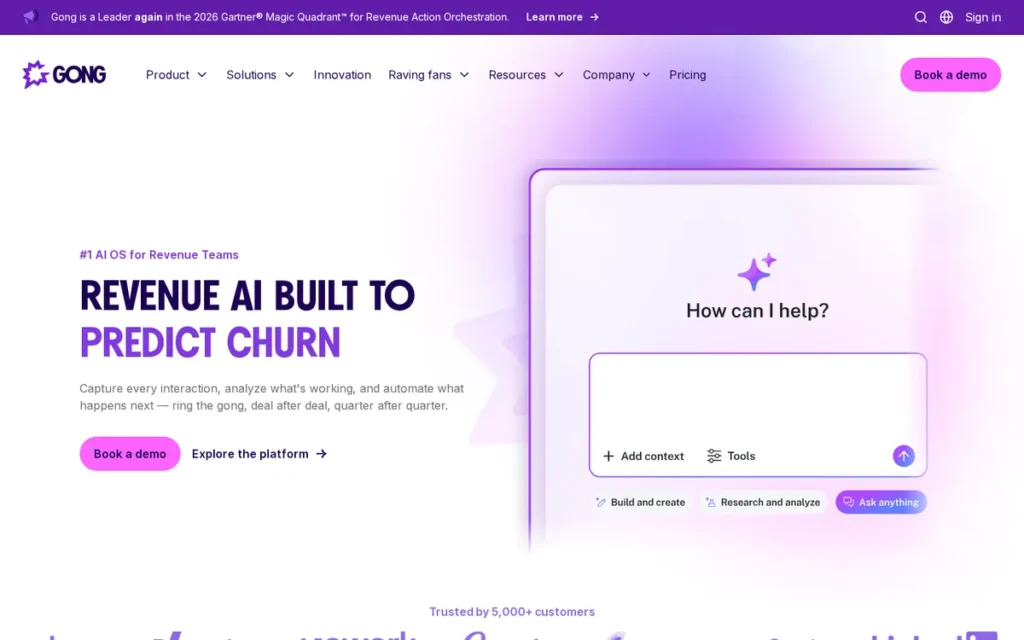
Category: Conversation Intelligence / Revenue Intelligence Platform, records, transcribes, and analyzes every customer-facing interaction (calls, emails, meetings) to surface deal risk, coaching insights, forecast signals, and AI-orchestrated next actions across the entire go-to-market team.
At a Glance
- Category: Revenue Intelligence / Conversation Intelligence
- Best For: Enterprise B2B, 50+ reps, dedicated RevOps function, coaching from real deals, forecast accuracy, and pipeline visibility
- Price Range: ~$1,600/seat/year + ~$5,000 platform fee (Vendr, 2026); enterprise minimums apply; no public pricing, quote required
- Primary Strength: Gong has 5,700+ verified G2 reviews at 4.8/5: the largest independently verified satisfaction sample in the sales technology category as of May 2026.
- Biggest Limitation: Gong provides no content management or sales readiness capabilities, and its per-seat pricing model excludes teams under 25–30 reps who cannot distribute the platform fee across enough seats to achieve defensible unit economics.
- One-Line Summary: Gong is the revenue intelligence platform with 5,700+ G2 reviews at 4.8/5 and enterprise deployment at 4,500+ companies including Microsoft, LinkedIn, and Shopify, the most validated sales technology platform in this evaluation as of May 2026.
- Last Verified: May 2026
Overview
Gong is a revenue intelligence platform for enterprise B2B organizations with 50+ quota-carrying reps and dedicated RevOps support, recording, transcribing, and analyzing every customer-facing call, email, and meeting to surface deal risk, coaching insights, and forecast signals for the entire go-to-market team.
Gong’s platform architecture has evolved from call recording into a Revenue AI OS: a unified system combining Gong Orchestrate for AI workflow automation, a proprietary Revenue Graph for structured interaction data, and AI agents that trigger follow-up actions based on live customer conversation signals.
Gong holds 4.8/5 with 5,700+ verified G2 reviews as of May 2026, more reviews than the next three platforms in this evaluation combined, covering enterprise deployments at 4,500+ companies including Microsoft, LinkedIn, Shopify, PayPal, and Slack.
Key Features
- Call and Meeting Intelligence: Gong records and analyzes every customer interaction across Zoom, Microsoft Teams, Google Meet, Salesforce, and email platforms, transcribing calls and surfacing key moments, competitor mentions, objection patterns, and pipeline risk signals without requiring manual note-taking or rep self-reporting.
- Revenue AI OS Architecture: Gong’s Revenue AI OS includes Gong Orchestrate: an AI agent layer that automates follow-up workflows and rep task management from live conversation signals, plus the Revenue Graph, a structured data model enabling natural-language queries of all customer interaction history (Gong PR Newswire, 2024).
- Conversation-Grounded Coaching: Gong’s coaching module surfaces the exact moments in recorded calls where top performers diverge from average performers, enabling managers to deliver targeted, evidence-based feedback grounded in actual customer conversations rather than role-play assumptions or manager intuition.
- Forecasting Engine: Gong’s forecasting engine uses conversation signal data: engagement frequency, sentiment, stakeholder mentions, risk language, and next-step commitments, to generate deal-level predictions, with 95% forecast accuracy reported by named customers Upwork and PointClickCare (vendor-stated metric, 2025–2026).
- Gong Orchestrate Workflow Automation: Gong Orchestrate enables AI agents to trigger follow-up actions, update CRM records, and manage rep task queues from live deal signals, extending Gong beyond call intelligence into revenue team workflow execution (Gong PR Newswire, 2024).
Best For
Gong is best for enterprise B2B revenue teams with 50+ quota-carrying reps, a dedicated RevOps or sales operations function, and a primary need to improve coaching quality, forecast accuracy, and pipeline visibility from real conversation data, particularly teams in SaaS, technology, or professional services where deal intelligence from every customer touchpoint materially affects win rates.
Strengths
- Gong has 4.8/5 with 5,700+ verified G2 reviews as of May 2026, the highest review volume of any sales enablement platform in this evaluation, covering enterprise deployments at 4,500+ companies including Microsoft, LinkedIn, Shopify, PayPal, and Slack, making it the most statistically reliable independent satisfaction signal available.
- Gong is recognized as a Leader in the Forrester Wave for Revenue Intelligence (2025) and has been named to the Forbes Cloud 100, providing dual analyst-and-industry credibility required for enterprise procurement shortlisting, backed by a $7.25B valuation that is the highest in the sales enablement category globally.
- Gong’s Revenue AI OS architecture: combining Gong Orchestrate, the Revenue Graph, and embedded AI agents, represents the most ambitious platform evolution in the category, unifying conversation data capture, workflow automation, and AI agents in a single system rather than retrofitting AI features onto a legacy call recording product (Gong PR Newswire, 2024).
- Gong documents 50% faster new rep ramp-up through learning from real customer conversations and proven talk tracks, a vendor-stated metric (2026) whose mechanism reflects a more evidence-based onboarding approach than scripted simulation alternatives, as reps learn from actual top-performer calls rather than classroom scenarios.
Limitations
- Architectural Scope: Gong is a conversation intelligence platform: not a content management or sales readiness system, so organizations expecting a complete enablement stack must pair Gong with a dedicated content platform (Seismic, Highspot) and potentially a readiness platform (Mindtickle), with the combined cost of that stack being substantial.
- Per-Seat Pricing: Gong’s approximately $1,600/seat/year model (Vendr, 2026) makes it one of the most expensive platforms in this evaluation per user, pricing out teams under 25–30 reps who cannot distribute the platform fee across enough seats to achieve defensible unit economics.
- Adoption Gap: Community and review data consistently show a gap between Gong’s Revenue AI OS platform vision and typical user behavior, most practitioners report using Gong primarily for call recording and note-taking, a fraction of full capability, requiring dedicated RevOps investment that is not self-correcting without active program management.
- Market Saturation Risk: A practitioner on r/sales observed that Gong may face market saturation (“everyone who has wanted to buy it, has already purchased”) with growing competition from AI-native conversation intelligence tools increasingly bundled within CRM platforms at lower per-seat costs (r/sales, 2024).
“I’ve personally used Gong, the intelligent AI scriptor that summarises key discussion pointers, turns it into transcript and offers AI-note taking services to make the most of your sales meetings.”, u/Agitated-Army546, r/Entrepreneur, 2024
Takeaway: Practitioners most often use Gong for recording and note-taking (a fraction of its Revenue AI OS capability) highlighting the RevOps investment required to extract the platform’s full value beyond basic call intelligence.
Verdict
Gong is the most extensively validated sales technology platform in this evaluation, with 5,700+ independent G2 reviews at 4.8/5 and enterprise deployment at 4,500+ companies including Microsoft, LinkedIn, and Shopify as of May 2026. Gong’s Revenue AI OS (combining Gong Orchestrate, the Revenue Graph, and embedded AI agents) is the most advanced platform evolution in the category, confirmed by Forrester Wave Leadership and a $7.25B valuation. Gong earns the #1 rank on its unmatched evidence density, with the important caveat that organizations with content-first or training-first primary needs will find more purpose-built solutions at ranks #2 through #5.
2. Mindtickle: Best for Sales Readiness, Dynamic AI Role-Play Coaching, and Rep Skill Development
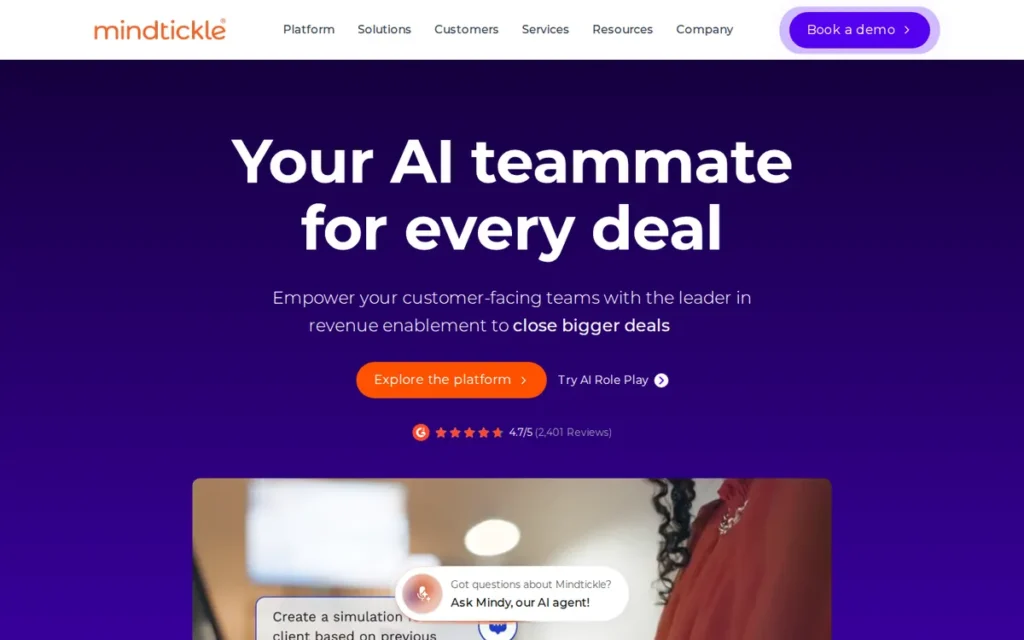
Category: Sales Readiness Platform, diagnoses rep skill gaps, delivers dynamic AI-powered role-play simulations, measures Readiness Index scores, and correlates those scores to CRM outcomes (quota attainment, win rate, deal size) to create a measurable loop between enablement investment and revenue results.
At a Glance
- Category: Sales Readiness
- Best For: Enterprise B2B, 50+ reps; skill gaps, AI role-play, readiness measurement, and methodology enforcement (MEDDIC, Challenger, SPIN)
- Price Range: Enterprise minimums apply; demo required; no public pricing (2026)
- Primary Strength: Mindtickle’s dynamic AI role-play simulations generate novel buyer responses (not scripted decision trees) enabling reps to practice handling unfamiliar objections before live customer interactions, the most advanced rep practice environment in this evaluation.
- Biggest Limitation: Mindtickle’s content management capabilities are less mature than dedicated content platforms like Seismic and Highspot, and enterprise contract minimums make the platform cost-prohibitive and operationally demanding for teams under 50 reps without a dedicated enablement function.
- One-Line Summary: Mindtickle is the sales readiness platform delivering dynamic AI role-play simulations, Readiness Index scoring tied to CRM outcomes, and Copilot AI workflow assistance, with 2,200+ G2 reviews at 4.7/5 and enterprise customers including Salesforce, Cisco, and MongoDB as of May 2026.
- Last Verified: May 2026
Overview
Mindtickle is a sales readiness and revenue enablement platform for enterprise B2B organizations where rep skill and confidence gaps (not content access) are the primary barrier to revenue growth, covering dynamic AI role-play simulations, Readiness Index scoring, training delivery, content management, and the Copilot AI productivity assistant in a unified system.
Mindtickle’s founding thesis distinguishes it from content-first platforms: where Seismic and Highspot ask “how do we get reps using the right content?”, Mindtickle asks “are reps equipped to have that conversation at all?”, a fundamentally different diagnostic that addresses the root cause most content platforms leave unresolved.
Mindtickle holds 4.7/5 with 2,200+ verified G2 reviews as of May 2026, Gartner Magic Quadrant recognition, $281M in SoftBank Vision Fund-backed funding, and named enterprise customers including Salesforce, Cisco, MongoDB, and Juniper Networks.
Key Features
- Dynamic AI Role-Play: Mindtickle’s AI role-play simulations generate dynamic buyer responses to rep inputs (not scripted decision trees) enabling reps to practice handling novel objections, custom buyer personas, and real deal contexts before live customer interactions, with instant objective scoring and feedback delivered after each session (Mindtickle AI Role-Play platform, 2026).
- Readiness Index: Mindtickle’s Readiness Index scores each rep quantitatively across training completion, skill assessments, and coaching activity, then correlates those scores with CRM data including quota attainment, win rate, and deal size, providing managers with a platform-native link between enablement investment and pipeline outcome.
- Mindtickle Copilot: Mindtickle’s Copilot AI assistant answers rep questions in real time, surfaces relevant content and playbook guidance, generates email drafts, and delivers assessment prompts throughout the selling day, extending readiness from scheduled training events into the daily workflow.
- Manager Coaching Workflows: Mindtickle’s coaching module includes structured call observation tools, scoring rubrics aligned to the organization’s chosen methodology, and feedback templates designed to build sustained manager coaching habits rather than enable one-off reviews that lapse within 60–90 days.
- Content Management Module: Mindtickle’s content layer stores, organizes, and distributes sales assets with version control and usage analytics, functioning as a readiness-integrated layer that is best deployed after the core readiness and role-play system is operationalized.
Best For
Mindtickle is best for enterprise B2B sales organizations of 50+ reps where leadership has identified specific, repeatable skill gaps (handling objections under pressure, delivering value propositions across complex product lines, or navigating multi-stakeholder procurement conversations) particularly organizations with high hiring velocity (20+ new reps per quarter), methodology enforcement requirements, or verticals like enterprise SaaS and high-tech hardware where technical product fluency is a prerequisite for credibility.
Strengths
- Mindtickle has 4.7/5 with 2,200+ verified G2 reviews as of May 2026 (the second-highest review volume in this evaluation) with named enterprise customers including Salesforce, Cisco, MongoDB, and Juniper Networks confirming deployment in environments where sales readiness investments carry the highest revenue stakes and most rigorous vendor evaluation standards.
- Mindtickle is recognized in the Gartner Magic Quadrant for Revenue Enablement Platforms (2025), validating the platform against analyst-driven shortlisting requirements of large enterprise procurement processes, a credential Spekit and Dock do not yet hold and a procedural threshold in many enterprise RFPs.
- Mindtickle’s $281M in funding from SoftBank Vision Fund and Canaan Partners provides financial runway for rapid AI feature development, with Copilot and dynamic AI role-play representing the most advanced AI coaching capability in the evaluation as of May 2026 (Mindtickle platform documentation, 2026).
- Mindtickle is the top-cited platform in practitioner communities when the evaluation question specifically involves AI-powered coaching with dynamic role-play: “For AI sales coaching with realistic SaaS simulations specifically, a few names worth looking at are Mindtickle, Highspot, Seismic, Allego, and Second Nature” (r/elearning, May 2026).
Limitations
- Content Management Gap: Mindtickle’s content management capabilities are meaningfully less mature than dedicated content platforms like Seismic and Highspot, organizations evaluating primarily for content delivery governance, compliance workflows, and version-controlled document assembly will find Seismic’s and Highspot’s content architectures more capable, making Mindtickle most powerful when paired with a dedicated content platform at higher total stack cost.
- Enterprise Minimums: Mindtickle’s enterprise contract minimums and admin learning curve make the platform operationally inappropriate for teams under 50 reps without a dedicated enablement function, confirmed by a disclosed Mindtickle employee’s own public advice: “Keep an eye on implementation complexity and minimums with any of the bigger players” (r/SaaS, 2026).
- Implementation Overhead: Mindtickle requires significant investment in readiness program design, AI role-play scenario authoring, and methodology alignment before the platform delivers measurable outcomes, making it a readiness-first investment that demands dedicated enablement program management, not a quick-deployment tool.
This aligns with practitioner feedback on r/Training:
“Honestly the hardest part isn’t picking the tool, it’s proving it will actually change behavior. Most tools improve access or engagement, but reps still don’t get better. What helped us was framing it simply, today reps consume content but performance doesn’t change. What we wanted was reps improving in real scenarios like calls and objections. Tools like Seismic or Highspot fix access. Mindtickle helps with training, but we still felt the gap was practice.” Posted by u/ocludintvp
Takeaway: Teams that evaluated Mindtickle alongside content platforms report a persistent gap between training completion and live conversation performance, confirming that the platform’s ROI depends on whether AI role-play scenarios are designed around exact deal contexts, not generic objection scripts.
- Experience Variance: A documented negative practitioner sentiment thread in r/LearningDevelopment (2026) suggests Mindtickle’s product experience can vary significantly by implementation quality and program design investment, buyers should probe vendor references specifically on implementation experience before contracting.
Verdict
Mindtickle is the leading sales readiness platform in this evaluation, defined by dynamic AI role-play simulations, Readiness Index measurement, 2,200+ G2 reviews at 4.7/5, and named enterprise customers including Salesforce, Cisco, and MongoDB as of May 2026. Mindtickle earns the #2 rank because it addresses the root cause that content-first platforms miss: reps who cannot handle the conversation once they have the right content are more often the bottleneck than reps who cannot find content. Teams whose primary gap is content management infrastructure should evaluate Seismic (#4) or Highspot (#5); teams whose primary gap is rep readiness, coaching consistency, or methodology enforcement should evaluate Mindtickle before any other platform.
3. Showpad: Best for Full-Suite Mid-to-Enterprise Teams, EMEA-Deployed Organizations, and Field Sales-Heavy Industries
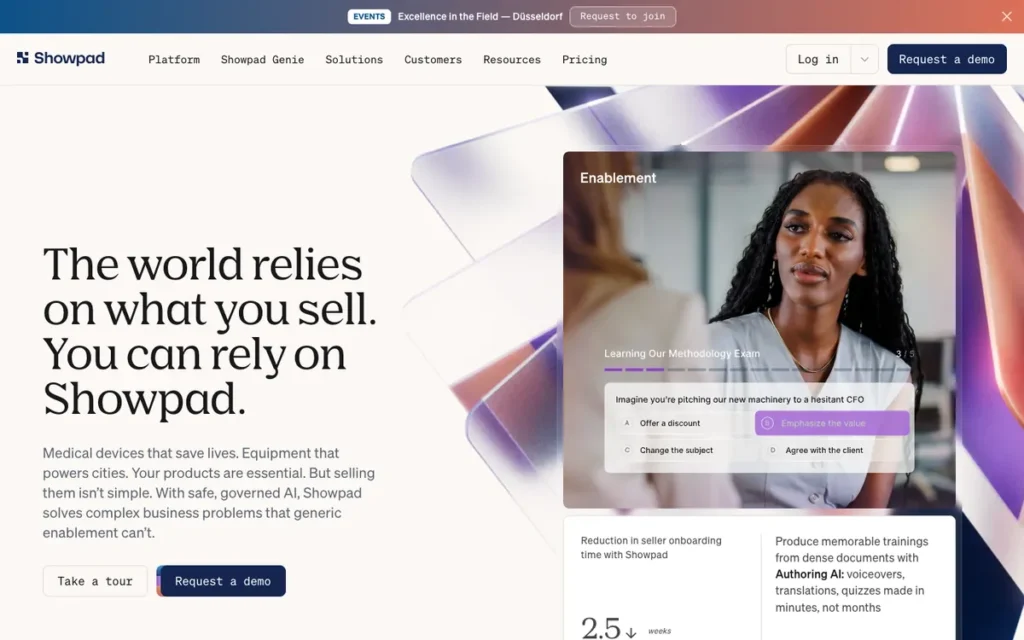
Category: Enablement Operating System (eOS), covers sales content management, seller effectiveness and training, buyer engagement, manager coaching, and analytics in a single unified user experience, designed to eliminate the operational fragmentation of multi-vendor enablement stacks for global enterprise and mid-market organizations.
At a Glance
- Category: Enablement OS (eOS)
- Best For: Mid-to-enterprise B2B, 50–1,000+ reps; EMEA operations; field sales in manufacturing, life sciences, and industrial verticals
- Price Range: Quote required; community evidence positions Showpad as more accessible than Seismic/Highspot for mid-market buyers; no public pricing (2026)
- Primary Strength: Showpad’s eOS architecture is the most complete unified enablement platform at a price tier accessible to mid-market teams (covering content, coaching, buyer engagement, and analytics) with the deepest EMEA footprint and a Sales Manager Hub no competitor has shipped in equivalent form.
- Biggest Limitation: Showpad’s coaching depth is less specialized than Mindtickle’s dedicated readiness architecture, and its portal-based delivery model is susceptible to the same adoption failure patterns documented across all portal-based enablement platforms when manager enforcement lapses.
- One-Line Summary: Showpad is the enablement operating system with the deepest EMEA footprint, 1,600+ G2 reviews at 4.6/5, dual Gartner and Forrester recognition, and a Sales Manager Hub that no competitor has shipped in equivalent form as of May 2026.
- Last Verified: May 2026
Overview
Showpad is an Enablement Operating System (eOS) built for mid-market to enterprise B2B sales organizations that need a single unified platform covering content management, rep training, manager coaching, buyer engagement, and analytics, without assembling a multi-vendor stack or absorbing the enterprise-only pricing of Seismic and Highspot.
Showpad’s European founding in Ghent, Belgium (2011) gives it the deepest EMEA presence of any platform in this evaluation (including GDPR-native data architecture, multilingual content delivery, EU data residency options, and European regional customer success operations) structural advantages for enterprises managing revenue teams across EU member states.
Showpad holds 4.6/5 with 1,600+ G2 reviews as of May 2026, dual Gartner and Forrester recognition, and named customers including Abbott, GE, Bayer, Honeywell, and Thyssenkrupp.
Key Features
- Sales Manager Hub: Showpad’s Sales Manager Hub is a dedicated coaching workspace providing managers with structured call observation tools, scoring rubrics, feedback templates, and activity tracking, making Showpad the only platform in this evaluation with a named, purpose-built manager coaching experience designed to sustain coaching cadence rather than enable one-off reviews.
- EMEA-Native Architecture: Showpad’s EMEA infrastructure includes GDPR-compliant data processing, EU data residency options for regulated industries, multilingual interface and content delivery support, and European regional customer success teams, structural advantages for enterprises managing revenue teams across EU member states where data sovereignty is a procurement requirement.
- Content Management with Revenue Attribution: Showpad’s content layer includes AI-powered search, version control, smart tagging, and analytics connecting assets to deal outcomes, validated by independent practitioners: “Showpad and Highspot are tools that can tie content back to revenue, not loosely at all” (r/ProductMarketing, May 2026).
- Onboarding and Training Module: Showpad’s training layer includes guided learning paths, microlearning modules, certification tracks, and AI-assisted content recommendations, with Showpad documenting a 2.5-week reduction in field seller onboarding time and a 60% reduction in new hire ramp time (vendor-stated aggregate client data, Showpad sales enablement guide, 2026).
- Buyer Engagement Analytics: Showpad’s buyer engagement module delivers personalized, trackable content shares with analytics reporting which stakeholders engaged with which content and when, connecting content delivery to deal progression signals without requiring rep check-in calls to surface the information.
Best For
Showpad is best for mid-to-enterprise B2B sales organizations of 50–1,000+ reps that need a unified platform rather than a multi-vendor stack, have significant field sales complexity in manufacturing, life sciences, or industrial equipment verticals (where named customers Abbott, Bayer, and Thyssenkrupp validate Showpad’s depth) or operate across EMEA markets requiring GDPR-native data architecture and multilingual content management.
Strengths
- Showpad has 4.6/5 with 1,600+ verified G2 reviews as of May 2026 (the third-highest review volume in this evaluation) with named enterprise customers including Abbott, GE, Bayer, Honeywell, Thyssenkrupp, and ManpowerGroup confirming deployment across complex field sales environments in manufacturing, life sciences, industrial services, and global staffing.
- Showpad holds dual recognition in the Gartner Magic Quadrant for Revenue Enablement Platforms and the Forrester Wave: Revenue Enablement Platforms (2025), a credential shared only with Seismic and Highspot among the seven platforms evaluated, satisfying the analyst validation requirements that enterprise procurement processes routinely demand as a shortlisting threshold.
- Showpad’s EMEA-native architecture: founded in Ghent, Belgium in 2011, with GDPR-compliant data residency, multilingual content delivery, and EU-based customer success teams, provides structural procurement advantages for global enterprises with European revenue operations that no US-founded competitor in this evaluation matches at equivalent institutional depth (Showpad About page, 2026).
- Showpad publicly documents aggregate client outcomes including a 40% increase in cross-sells and upsells, a 60% reduction in new hire ramp time, and a 300% increase in content usage, vendor-stated aggregate client data representing reported outcome ranges rather than guaranteed results (Showpad sales enablement guide, 2026).
Users on r/Training shared their decision-making process after evaluating multiple platforms:
“In my seven years running enablement, we partnered with RevOps to estimate how much time reps spend hunting for content and how that translates into pipeline velocity, then compared tools on usability and reporting. We ended up choosing Showpad because it combines content management, AI powered coaching and learning, and robust analytics that link content use to deals won, having one platform made it easier to get executive buy in since we could model rep efficiency gains and ramp time improvements.” Posted by u/enablementpro001
Takeaway: Experienced enablement leaders consistently cite Showpad’s unified platform architecture (combining content, coaching, and analytics under one contract) as the decisive factor in securing executive buy-in over point-solution stacks that require separate ROI justification for each vendor.
Limitations
- Coaching Specialization Depth: Showpad’s coaching module is one component of an operating system rather than the platform’s primary architecture, teams whose primary investment thesis is dynamic AI role-play simulations, quantitative readiness scoring, or systematic skill-gap diagnosis will find Mindtickle’s purpose-built readiness approach more specialized than Showpad’s coaching capabilities.
- Portal-Based Delivery: Showpad’s portal-based delivery model requires reps to navigate to the platform for content and guidance rather than receiving it contextually in Salesforce, Slack, or Gmail, making Showpad susceptible to the adoption failure pattern documented across all portal-based enablement platforms when manager reinforcement lapses.
- Engagement-vs-Effectiveness Gap: A practitioner observation on r/ProductMarketing (May 2026) notes that analytics can show high content engagement while reps privately report those assets as ineffective, the “engagement does not equal effectiveness” gap that no analytics layer resolves without active human manager engagement bridging data to behavioral change.
- Less AI-Native Architecture: Practitioners describe Showpad’s AI integration as less AI-native compared to newer platforms, a pattern consistent with a 14-year-old architecture adding AI capabilities to established product areas rather than building them into a foundational data model from the ground up.
Verdict
Showpad is the most broadly validated full-suite enablement platform accessible to mid-market teams that enterprise-only alternatives structurally price out, earning the #3 rank with 1,600+ G2 reviews at 4.6/5, dual Gartner and Forrester recognition, and the deepest EMEA and field sales capabilities in this evaluation as of May 2026. Showpad’s eOS architecture makes it the natural recommendation for globally distributed teams in manufacturing, life sciences, and industrial sales who need content, coaching, buyer engagement, and analytics under one contract. Teams prioritizing dynamic AI role-play coaching depth as their primary criterion should evaluate Mindtickle (#2) first; teams requiring in-workflow rep guidance without portal navigation should evaluate Spekit (#6).
4. Seismic: Best for Large Enterprise Content Management, Regulated Industries, and CRM-Driven Personalized Document Assembly
Category: Enterprise Content Enablement Platform, provides large distributed enterprise sales and revenue teams with AI-driven content management, CRM-integrated personalized document assembly (LiveDocs), training and learning (Lessonly), coaching, and unified analytics across the full go-to-market motion under a single Enablement Cloud architecture.
At a Glance
- Category: Enterprise Content Platform
- Best For: Large enterprise B2B, 200+ reps; regulated industries (financial services, pharma, insurance); complex content governance with dedicated enablement teams
- Price Range: Enterprise-only; quote required; dedicated admin team required; widely categorized as upper-enterprise spend (2026)
- Primary Strength: Seismic’s LiveDocs enables CRM-data-driven personalized document assembly (proposals, contracts, and presentations auto-populated from live CRM data with compliance governance) with no direct architectural equivalent among the other six platforms in this evaluation.
- Biggest Limitation: Seismic is designed exclusively for large enterprise organizations with 200+ reps and dedicated enablement teams, deploying it without that infrastructure is one of the most consistently documented failure modes in the category, confirmed directly by a former Seismic employee.
- One-Line Summary: Seismic is the enterprise content enablement platform with LiveDocs CRM document assembly, Aura AI cross-platform intelligence, and the most complete analyst credentialing stack in this evaluation (Gartner MQ Leader, Forrester Wave Leader, and Gartner Customers’ Choice) the 15-year original category standard-setter as of May 2026.
- Last Verified: May 2026
Overview
Seismic is a large enterprise content enablement platform and the original category standard-setter, built around its Enablement Cloud (a unified architecture covering content management, LiveDocs personalized document assembly, Aura AI cross-platform intelligence, Lessonly training and learning, coaching, and engagement analytics) designed for global enterprise sales organizations with 200+ reps, dedicated enablement teams, and regulated industry compliance requirements.
Seismic’s 15 years of enterprise deployments since founding in 2010 and $300M+ in funding have produced the deepest financial services and regulated industry specialization in the category, with named customers including IBM, GE, Honeywell, American Express, and Siemens validating the platform at global scale.
Seismic holds 4.7/5 with 1,200+ G2 reviews as of May 2026, combined with dual Gartner Magic Quadrant Leader and Forrester Wave Leader status plus Gartner Peer Insights Customers’ Choice recognition, the most complete analyst credentialing stack of any platform in this evaluation.
Key Features
- LiveDocs: Seismic’s LiveDocs enables reps to dynamically assemble personalized, compliance-ready proposals, contracts, and presentations that auto-populate from CRM data, replacing static PDF workflows with modular, version-controlled document assembly that eliminates manual data entry and compliance risk for each regulated client communication (Seismic Platform Overview, 2026).
- Aura AI: Seismic’s Aura AI engine operates as a cross-platform intelligence layer embedded across the entire Enablement Cloud, surfacing content recommendations, generating email drafts, delivering AI role-play coaching, producing call summaries, and recommending next best actions across content, training, and analytics simultaneously (Seismic Aura page, 2026).
- Enablement Cloud Architecture: Seismic’s Enablement Cloud unifies content management, Lessonly learning and coaching (carrying a separate 4.7/5 G2 rating across 450+ independent reviews), content automation, strategy and planning, and buyer engagement analytics in a single platform architecture designed for enterprise-scale governance.
- Regulated Industry Workflows: Seismic’s financial services and regulated industry architecture includes advisor-specific workflow tools, compliance content approval workflows, regulatory audit trails, and client communication personalization validated over 15 years of deployments in financial advisory, insurance, and pharmaceutical environments.
- Content Revenue Attribution: Seismic’s analytics layer tracks which content was shared, when buyers engaged, which materials correlated with pipeline advancement, and which compliance-required materials were used, connecting content investment to sales outcomes at the individual asset level.
Best For
Seismic is best for large enterprise sales organizations with 200+ quota-carrying reps, a dedicated enablement team of 1–5 FTEs, complex content governance requirements (high asset volume, multiple product lines, frequent regulatory update cycles), and regulated industry compliance needs in financial services, pharma, or insurance, with the operational maturity to staff the implementation and ongoing administration the platform requires.
Strengths
- Seismic holds recognition as a Leader in both the Gartner Magic Quadrant for Revenue Enablement Platforms and the Forrester Wave: Revenue Enablement Platforms (2025), plus Gartner Peer Insights Customers’ Choice, the most complete analyst credentialing stack of any platform in this evaluation, satisfying the shortlisting requirements of even the most demanding enterprise procurement processes.
- Seismic’s LiveDocs personalized document assembly: auto-populating proposals, contracts, and presentations from live CRM data with modular version control and compliance approval workflows, has no direct architectural equivalent among the other six platforms in this evaluation, making it a procurement-level differentiator for regulated industries where every client communication may require compliance sign-off (Seismic Enablement Cloud, 2026).
- Seismic’s 15-year market tenure (founded 2010) and $300M+ in funding have produced the deepest integration library, the longest enterprise deployment validation history, and the most mature admin tooling in the category, a longevity signal meaningful for organizations committing to 3–5 year platform relationships with significant change management investment.
- Seismic’s Lessonly training product carries a separate 4.7/5 G2 rating with 450+ independent reviews, confirming that the training component maintains user loyalty post-acquisition and delivers independently validated value alongside the main platform’s content governance capabilities.
Limitations
- Organizational Fit: Seismic is architected, priced, and operationally designed for large enterprise organizations with dedicated enablement teams, a former Seismic employee stated this directly on r/sales (2026): “You have a Ferrari and need a Ford. If you are under 10 people, use Google Drive, that’s overkill.”
- Implementation Complexity: Consistent verified criticisms across G2 and TrustRadius include complex admin setup, long implementation timelines that frequently exceed initial estimates, and integration friction outside the Salesforce ecosystem, structural tradeoffs in an architecture that prioritizes governance and scale over self-serve simplicity.
- Size Exclusion: Seismic is consistently described in practitioner communities as appropriate only for 200+ rep organizations, multiple independent community users describe it as “not making sense to a small team” (r/sales, 2026), making it structurally inappropriate for teams below the mid-enterprise threshold regardless of feature preferences.
- Pricing Opacity: Seismic’s enterprise-only pricing with no publicly disclosed tiers and no self-serve trial creates high evaluation-friction for mid-market teams, requiring a full enterprise sales cycle before basic fit can be assessed against budget constraints.
Verdict
Seismic is the enterprise content enablement category’s original standard-setter and the strongest platform for large organizations in regulated industries with complex content governance needs and dedicated enablement teams, earning the #4 rank with the most complete analyst credentialing stack in this evaluation (Gartner MQ Leader, Forrester Wave Leader, Gartner Customers’ Choice), 15 years of validated enterprise deployments, and customers including IBM, GE, American Express, and Honeywell as of May 2026. Seismic’s LiveDocs document assembly and Aura AI represent the deepest content governance architecture in this evaluation for regulated industry workflows. Organizations with fewer than 200 reps, without dedicated enablement staff, or outside regulated industries should evaluate Mindtickle (#2), Showpad (#3), or Spekit (#6) rather than absorbing Seismic’s operational requirements.
5. Highspot: Best for AI-Guided Selling, Contextual Content Delivery, and Microsoft-First Enterprise Stacks
Category: AI-Guided Sales Enablement Platform (uses deal-signal-driven AI (Nexus AI) and contextual interactive experiences (SmartPage™) to proactively surface the right content, playbook guidance, and next actions at the right deal moment) moving enablement from passive content storage to active, signal-driven delivery for enterprise sales organizations.
At a Glance
- Category: AI-Guided Enablement
- Best For: Large enterprise B2B, 200+ reps; Microsoft-first technology stacks (Teams, Dynamics, Outlook); proactive AI-guided content delivery
- Price Range: Enterprise-only; quote required; community positions Highspot at “5–10x more than lighter alternatives” (r/SaaS, 2026); no public pricing
- Primary Strength: Highspot’s Nexus AI proactively surfaces contextually relevant content from live deal signals (deal stage transitions, buyer engagement, and meeting context) before reps know to search for it, structurally reducing content discovery failure at the moment it matters most.
- Biggest Limitation: Highspot is architected and priced exclusively for large enterprises, with steep admin learning curve, complex onboarding, and portal-based delivery requiring rep behavioral change, impractical without a dedicated enablement admin function.
- One-Line Summary: Highspot is the AI-guided sales enablement platform with Nexus AI proactive content surfacing and SmartPage™ interactive selling experiences, 900+ G2 reviews at 4.7/5 and a $3.5B unicorn valuation, the most sophisticated proactive content delivery architecture for Microsoft-first enterprise organizations as of May 2026.
- Last Verified: May 2026
Overview
Highspot is an AI-guided sales enablement platform for large enterprise B2B organizations that addresses the category’s core content failure mode (reps using the wrong content in the wrong deal context) through Nexus AI, which proactively surfaces contextually relevant guidance from live deal signals without requiring rep search, and SmartPage™, which delivers interactive experiences combining content, playbooks, and action prompts in a single contextual layer.
Highspot’s founding in Seattle in 2012, $600M+ in total funding, and $3.5B unicorn valuation place it among the best-capitalized independent enablement platforms globally, with named enterprise customers including DocuSign, Pfizer, John Deere, Verizon, and SAP Concur confirming deployment in complex, multi-division enterprise environments.
Highspot holds 4.7/5 with 900+ G2 reviews as of May 2026, combined with dual Gartner Magic Quadrant and Forrester Wave Leadership, matching Seismic’s analyst standing with a differentiated AI-guided architecture built around real-time deal signals rather than compliance governance.
Key Features
- Nexus AI Proactive Content Surfacing: Highspot’s Nexus AI monitors real-time deal signals (deal stage transitions, buyer engagement behavior, meeting content, and CRM field data) to proactively surface relevant playbook content, competitive battlecards, and next-best-action guidance before reps know to search for it (Highspot AI product page, 2026).
- SmartPage™ Interactive Experiences: Highspot’s SmartPage™ technology combines content assets, interactive dashboards, embedded web apps, and guided selling playbooks into dynamic contextual experiences that deliver the right message, content, and action sequence for a specific deal scenario, a proprietary architecture with no named equivalent in this evaluation (Highspot SmartPage announcement, 2024).
- Scorecards Coaching Layer: Highspot’s Scorecards connects enablement program outcomes (training completion, content usage, and playbook adherence) to rep behavior metrics in actual customer conversations, bridging the gap between training completion rates and behavioral change in live deals.
- Microsoft Ecosystem Integration: Highspot’s native Teams, Dynamics, Outlook side-panel, and Microsoft Copilot integrations are among the deepest in this evaluation, making Highspot the natural enterprise recommendation for organizations running Microsoft-first revenue technology stacks.
- Buyer Engagement Module: Highspot’s buyer engagement module delivers personalized, trackable content experiences with analytics reporting stakeholder engagement, content section attention, and timing signals, providing deal risk indicators and multi-stakeholder visibility without requiring rep check-in calls.
Best For
Highspot is best for large enterprise B2B organizations with 200+ reps, Microsoft-first technology stacks (Teams, Dynamics, Outlook), complex content libraries spanning multiple product lines, and a primary investment thesis around AI-guided selling, specifically where “reps have content access but consistently use the wrong asset in the wrong deal context” is the problem to solve, rather than skill gaps (Mindtickle), buyer-side coordination (Dock), or in-workflow rep adoption (Spekit).
Strengths
- Highspot is recognized as a Leader in both the Gartner Magic Quadrant for Revenue Enablement Platforms and the Forrester Wave: Revenue Enablement Platforms (2025), holding sustained G2 Leader status, providing the dual analyst validation required for enterprise procurement shortlisting alongside only Seismic and Showpad among the seven platforms evaluated.
- Highspot’s $600M+ in total funding and $3.5B unicorn valuation: the second-highest in this evaluation after Gong’s $7.25B, provide financial runway for sustained enterprise product development and global customer support, a longevity signal relevant for organizations making 3–5 year platform commitments (Highspot official site, 2026).
- Highspot’s Nexus AI proactive content surfacing architecture: validated by named enterprise customers DocuSign, Pfizer, John Deere, Verizon, and SAP Concur, is the most advanced deal-signal-driven content recommendation engine in this evaluation, moving from passive content storage to active, signal-driven delivery at the moment reps need it.
- Highspot’s SmartPage™ technology is a proprietary, named architectural capability that no competitor has shipped in equivalent form, combining content assets, dashboards, applications, and guided playbooks into interactive contextual experiences that deliver complete selling guidance packages rather than individual assets (Highspot SmartPage, 2024).
Limitations
- Structural Enterprise Fit: Highspot shares Seismic’s core structural limitation (it is a large enterprise platform requiring dedicated enablement staff, significant implementation investment, and rep behavioral change) with consistent verified criticisms on G2 and TrustRadius citing steep admin learning curve, onboarding complexity, and categorization as “overkill for smaller businesses” (CROclub, 2026).
- Support Quality Risk: A documented support quality concern exists in practitioner communities (users reported receiving “zero support from them” during initial onboarding (r/salestechniques, 2026)) representing a real deployment risk that buyers should probe specifically in vendor references before contracting.
Users on r/salestechniques noted:
“We tried High Spot and with zero support from them we ditched it quickly. To find things we all found very hard without support from High Spot.” Posted by u/shadowpawn
Takeaway: Highspot’s onboarding support gap (confirmed by practitioners who abandoned the platform early) is the highest-risk deployment scenario for teams without a dedicated enablement admin to compensate for insufficient vendor-side implementation guidance.
- Perception vs. Vision Gap: A practitioner described Highspot as “cool if you need a web portal to house content, a reliable product” despite Highspot’s platform vision being AI-guided selling (r/salestechniques, 2026), suggesting that Nexus AI and SmartPage™ capabilities are not universally realized without intentional onboarding investment.
- Portal-Based Architecture: Highspot’s portal-based delivery model requires reps to navigate to a separate tool rather than receiving guidance inside Salesforce, Slack, or Gmail, a structural limitation shared with Seismic and Showpad that Spekit’s Chrome Extension architecture explicitly and architecturally addresses.
Verdict
Highspot is the AI-guided sales enablement platform with the most sophisticated proactive content delivery architecture in this evaluation (Nexus AI and SmartPage™ are genuine product innovations for organizations whose primary problem is “reps have content but use the wrong asset at the wrong deal stage”) earning the #5 rank with dual Gartner and Forrester Leadership, a $3.5B unicorn valuation, and named customers including DocuSign, Pfizer, and Verizon as of May 2026. Highspot shares Seismic’s structural limitations: enterprise-only pricing, portal-based delivery, and deployment complexity requiring dedicated enablement infrastructure. Organizations choosing between Highspot and Seismic should filter by primary need: Highspot for AI-guided content delivery and Microsoft-stack deployments; Seismic for compliance-heavy document assembly and regulated industry workflows.
6. Spekit: Best for In-Workflow, Just-in-Time Enablement: Solving Rep Adoption at the Architecture Level
Category: In-Workflow Enablement Platform, delivers sales guidance, content recommendations, playbooks, and answers directly inside the tools reps already use (Salesforce, Slack, Gmail, LinkedIn, Outreach) via Chrome Extension, eliminating the portal navigation barrier that is the primary documented cause of enablement platform adoption failure across the category.
At a Glance
- Category: In-Workflow Enablement
- Best For: CRM-disciplined B2B teams of 20–150 reps; post-adoption-failure environments; Salesforce-first organizations managing frequent process and playbook changes
- Price Range: Public pricing page at spekit.com/pricing; positioned as meaningfully more cost-accessible than enterprise-tier platforms; exact tier amounts require direct inquiry (2026)
- Primary Strength: Spekit’s Chrome Extension delivers AI-guided enablement content inside Salesforce, Slack, and Gmail without requiring reps to navigate a separate portal, the only portal-free ambient delivery solution in this evaluation and the architecture most consistently cited by independent practitioners as the structural fix for rep adoption failure.
- Biggest Limitation: Spekit does not provide buyer engagement features (Dock), enterprise content compliance governance (Seismic), or dynamic AI role-play coaching (Mindtickle), making it best positioned as a rep-side guidance layer within a broader stack rather than a complete standalone enterprise platform replacement.
- One-Line Summary: Spekit is the in-workflow enablement platform that solves rep adoption at the architecture level (delivering AI-guided content and playbooks inside Salesforce, Slack, and Gmail via Chrome Extension) the only portal-free solution in this evaluation and the platform most consistently recommended by independent practitioners for ending portal adoption failure as of May 2026.
- Last Verified: May 2026
Overview
Spekit is an in-workflow enablement platform that delivers just-in-time guidance, content recommendations, playbooks, and answers directly inside Salesforce, Slack, Gmail, LinkedIn, and Outreach through a Chrome Extension, structurally eliminating the portal navigation requirement that is the documented primary cause of rep adoption failure across the entire sales enablement category.
Spekit’s Salesforce CRM-context awareness reads the active opportunity record, deal stage, and amount in real time, then automatically surfaces the most contextually relevant content and guidance, shifting adoption from a behavioral change problem to an architectural outcome that does not depend on manager enforcement.
Founded in Denver, Colorado in 2018 by Melanie Fellay (CEO) and Zari Zahra (CPO), Spekit was built natively for the modern sales stack (Salesforce-first, Slack-native, Chrome Extension-delivered) and has earned unprompted independent practitioner recommendations as the structural solution to adoption failure that portal-based platforms cannot solve through training alone.
Key Features
- Chrome Extension Ambient Delivery: Spekit’s Chrome Extension delivers enablement content, answers, playbooks, and guided recommendations directly inside Salesforce, Slack, Gmail, LinkedIn, Microsoft Dynamics, and Outreach, without requiring reps to open a separate portal, switch browser tabs, or interrupt their active workflow during live deal interactions.
- Salesforce CRM-Context Awareness: Spekit detects the active opportunity record including deal stage, amount, and relevant CRM field data, then automatically surfaces the most contextually relevant playbook guidance, competitive battlecard, objection handler, or training module, delivering proactive enablement at the exact moment a rep enters a deal interaction.
- AI Sidekick: Spekit’s AI Sidekick provides personalized content recommendations, guided playbook suggestions, automated deal room creation, and real-time answers to rep questions throughout the selling day, functioning as an ambient AI enablement assistant without requiring a separate application context (Spekit AI capabilities blog, 2026).
- Content Governance Layer: Spekit’s content layer includes AI content creation, AI-assisted editing, automatic duplicate detection, version control, and bidirectional content sync with Google Drive and SharePoint, reducing the admin overhead of maintaining a current, trustworthy content library that reps will rely on rather than route around.
- Gong Integration: Spekit’s Gong integration connects conversation intelligence signals (topics discussed on calls, objections raised, next steps committed) with in-workflow content recommendations, creating a closed-loop architecture where what happened on a real customer call directly informs what guidance Spekit surfaces next (Spekit homepage, 2026).
Best For
Spekit is best for CRM-disciplined B2B sales teams of 20–150 reps that have experienced adoption failure with a portal-based enablement platform and traced the failure to navigation friction rather than content quality, and for RevOps and enablement teams managing frequent process and playbook changes in Salesforce who need reps to absorb updates contextually in the moment rather than through scheduled training sessions.
Strengths
- Multiple independent practitioners in r/salestechniques and r/SalesOperations: non-Spekit employees, have specifically recommended Spekit’s Chrome Extension as the structural solution to portal adoption failure: “Look for something with a Chrome Extension like Spekit so that it can deliver content based on the systems your reps are currently working in” (u/Back4aStack, r/SalesOperations, May 2026).
- Spekit’s in-workflow delivery architecture directly addresses the category’s most consistently documented failure mode (reps ignoring portal-based enablement platforms) by eliminating context-switching entirely rather than attempting to train reps to adopt a new behavioral routine, making adoption a structural outcome rather than a change management project.
- Spekit’s Gong integration creates a closed-loop enablement system where what happens on a real customer call directly informs what guidance Spekit surfaces next, a data flow architecture that no other platform in this evaluation executes in equivalent form, closing the gap between call analysis and in-workflow enablement action (Spekit homepage, 2026).
- Spekit’s $43M+ in institutional venture funding, public pricing page, and 2018 founding position it as a financially stable, architecturally modern platform built natively for the Salesforce/Slack/Chrome ecosystem (not retrofit for it) with lower total cost of ownership and faster implementation timelines than enterprise incumbents.
“If you’re looking for something super easy for reps to use and for enablement to manage I’d check out Spekit. Can sync or house all your content and automatically surface anywhere reps are selling with a simple Chrome Extension. Reps love it.”, u/AnimatorSavings7454, r/salestechniques, 2026
Takeaway: The “reps love it” framing reflects Spekit’s core architectural advantage, Chrome Extension delivery removes the portal login friction that kills adoption in platforms requiring reps to navigate to a separate tool during live deal interactions.
Limitations
- Architectural Scope: Spekit is a rep-side in-workflow guidance layer: not a full enablement stack, and does not provide Seismic’s LiveDocs compliance governance, Highspot’s SmartPage buyer experiences, Dock’s persistent buyer workspaces and mutual action plans, or Mindtickle’s dynamic AI role-play coaching and Readiness Index measurement, making it best positioned as one layer within a broader stack.
- No Buyer-Facing Features: Spekit’s architecture optimizes entirely for the rep’s workflow and does not include buyer-facing engagement features, organizations that need both rep-side in-workflow guidance and buyer-side coordination must add a separate tool (such as Dock), increasing total stack cost and operational complexity.
- Limited Analyst Recognition: Spekit has no confirmed Gartner Magic Quadrant or Forrester Wave placement as of May 2026, a procurement risk in enterprise organizations whose RFP processes require analyst-validated vendors in the shortlist, limiting Spekit’s competitiveness in the largest formal enterprise evaluations despite strong practitioner endorsement.
- CRM Dependency: Spekit’s most differentiated capabilities: CRM-context-aware delivery and proactive deal-stage guidance, require strong Salesforce CRM adoption and consistent data quality, meaning teams with inconsistent CRM hygiene, weak deal stage discipline, or non-Salesforce primary CRMs will see reduced effectiveness from the context-awareness layer that is the platform’s core differentiator.
Verdict
Spekit is the only platform in this evaluation architecturally designed to solve the rep adoption problem, not by training reps to use a new tool, but by delivering guidance inside the tools reps already use, earning the #6 rank through genuine architectural differentiation and independent practitioner endorsement in communities that consistently identify adoption failure as the category’s defining challenge. Spekit’s Chrome Extension ambient delivery, Salesforce CRM-context awareness, AI Sidekick, and Gong integration create a rep-side enablement system that no portal-based competitor in this evaluation replicates. Teams that have experienced adoption failure with Seismic, Highspot, or other portal-based platforms, or that run high-volume CRM-centric sales motions where context-switching is a daily productivity drain, should evaluate Spekit as either a standalone mid-market solution or a complementary in-workflow guidance layer within an existing enterprise stack.
7. Dock: Best for SMB and Growth-Stage Teams, Buyer-First Deal Rooms, and Multi-Stakeholder Deal Coordination
Category: AI-Native Buyer Engagement Platform / Digital Sales Room, creates persistent collaborative buyer workspaces consolidating content, mutual action plans, pricing, stakeholder lists, and AI-generated documents in a single shared link that evolves from first sales call through deal closure, onboarding, and renewal, designed for growth-stage to mid-market B2B teams running complex multi-stakeholder deals.
At a Glance
- Category: Digital Sales Room / AI-Native Buyer Engagement
- Best For: SMB/growth B2B, 5–100 reps; multi-stakeholder deals; long sales cycles (60–180 days); teams upgrading from Google Drive
- Price Range: Public pricing at dock.us/pricing; free tier available; community reports Dock as “5–10x less than Highspot/Seismic” (r/SaaS, 2026)
- Primary Strength: Dock’s persistent buyer workspace consolidates all deal content, mutual action plans, stakeholder tracking, and AI-generated follow-up documents in a single shareable link, the only platform in this evaluation architected primarily around the external buyer’s experience rather than the internal rep’s workflow.
- Biggest Limitation: Dock is a 4-year-old company with approximately $17M in total funding and no Gartner or Forrester analyst recognition as of May 2026, limiting its viability as a standalone enterprise platform replacement for teams with governance, compliance, or full-stack coaching requirements.
- One-Line Summary: Dock is the AI-native buyer engagement platform with the highest G2 rating in this evaluation at 4.9/5, persistent buyer workspaces, AI Documents generated from live CRM and call data, mutual action plans, transparent public pricing, and a free tier, purpose-built for growth-stage and mid-market B2B teams running complex multi-stakeholder sales cycles as of May 2026.
- Last Verified: May 2026
Overview
Dock is an AI-native revenue enablement platform built around collaborative buyer workspaces, a single persistent shared link consolidating deal content, mutual action plans, pricing, next steps, and stakeholder coordination from first sales call through deal closure, customer onboarding, and renewal, designed for growth-stage to mid-market B2B sales teams where email chains and shared folders create coordination failure.
Founded in 2021 by Alex Kracov (former VP Marketing at Lattice, who built the platform to solve a problem he experienced firsthand in enterprise sales cycles) Dock takes a fundamentally different architectural bet: while Seismic, Highspot, Mindtickle, and Showpad optimize for internal rep readiness and content governance, Dock optimizes for the external buyer’s experience.
Dock holds 4.9/5 G2 rating as of May 2026 (the highest absolute rating in this evaluation) with public pricing, a free tier, and community endorsement as “a big step up from Google Drive” making it the most accessible platform for teams that enterprise alternatives price out entirely.
Key Features
- Collaborative Buyer Workspaces: Dock’s buyer workspaces provide a single persistent shareable link containing all deal content, mutual action plans, pricing documentation, implementation resources, and stakeholder lists, replacing fragmented email threads and Google Drive folders with a single source of truth that both the seller and the buying committee access, update, and navigate throughout evaluation and onboarding (Dock homepage, 2026).
- AI Documents: Dock’s AI Documents feature generates customer-facing business cases, proposals, follow-up summaries, QBR decks, and implementation plans by pulling from CRM records (Salesforce, HubSpot), call transcripts (Gong, Zoom, Fathom), and workspace history, producing a first draft in seconds for rep review, eliminating manual template data entry (Dock AI launch post, 2026).
- AI Enablement Agent: Dock’s AI Enablement Agent integrates with CRM systems, call recording platforms, content wikis (Notion, Confluence), and document stores (Google Drive, SharePoint, OneDrive) to answer rep questions in real time, surfacing relevant playbook content, deal history, and competitive information without requiring reps to search multiple tools (Dock AI Enablement Agent, 2026).
- Mutual Action Plans: Dock’s mutual action plan functionality creates a shared, visually tracked timeline of commitments between seller and buyer (documenting ownership, deadlines, and blockers for each next step) surfacing deal risk and accelerating close through shared accountability rather than unilateral seller follow-up and buyer silence.
- Buyer Engagement Analytics: Dock’s analytics identify which stakeholders have opened the workspace, which content sections received attention, which links were clicked, and when buyer engagement drops off, providing objective deal risk signals that allow proactive intervention before a deal goes dark.
Best For
Dock is best for growth-stage to mid-market B2B sales teams of 5–100 reps running complex sales cycles with multiple buyer stakeholders, long evaluation periods (60–180 days), or high-value transactions where the sophistication of the buying experience is itself a competitive differentiator, and for teams currently coordinating deals through email chains, Google Drive folders, and Notion pages who need a professional, trackable buyer environment without committing to enterprise contract minimums or dedicated enablement administration.
Strengths
- Dock holds a 4.9/5 G2 rating as of May 2026 (the highest absolute user satisfaction score of any platform in this evaluation) with users describing Dock as “a big step up from Google Drive” for multi-stakeholder deal coordination and “more of a content management system with a digital sales room” serving dual internal and external coordination purposes (r/EduSalesUSA, 2026).
- Dock’s buyer-workspace-first architecture is the only approach in this evaluation designed around the external buyer’s experience, validated by independent practitioners: “If you have a long sales cycle and multiple stakeholders, it makes sense to use a sales room” (u/CommonReasonable2998, r/b2bmarketing, May 2026).
Users on r/EduSalesUSA shared their firsthand evaluation of digital sales rooms including Dock:
“In my opinion yes, providing you spend the time creating strong templates that are easy to use. The providers we checked out were: Aligned, Trumpet, and Dock. Regardless of the solution the main benefits I have found are: Consolidation of Materials, Don’t have to gather a load of PDFs. Transparent Deal Tracking, Buyers can see where they are in the process and who needs to act next. You can also see when someone reopens a site having ghosted you so you know to re-engage. On-Demand Resources: Stakeholders can self-educate using preloaded product FAQs, recorded videos and calls. This SIGNIFICANTLY reduces the need for repetitive conversations and demos. Tbh if you have nothing today I think all of these products are great.” Posted by u/CalcBongo
Takeaway: Practitioners who evaluated Dock alongside competing digital sales room platforms report that transparent deal tracking and on-demand stakeholder self-education are the highest-impact features, directly addressing the two most common failure points in long-cycle B2B deals: ghosting and repetitive demo requests.
- Dock’s public pricing, free tier, and community-reported cost position (5–10x less than Highspot/Seismic per r/SaaS, 2026) make it the most financially accessible platform in this evaluation for teams of 5–100 reps, removing sales-cycle friction, enabling self-serve evaluation, and eliminating enterprise minimum contract thresholds.
- Dock’s AI Documents and AI Enablement Agent create dual-sided AI in a single platform, one generating customer-facing proposals and follow-ups from CRM and call data (buyer-facing) and one answering rep questions from call recordings, CRM history, and content wikis in real time (rep-facing), a combined AI architecture unique in this evaluation that reduces two of the highest-friction manual tasks in complex B2B enterprise selling.
Limitations
- Company Stage Risk: Dock is a 4-year-old company with approximately $17M in total funding and no confirmed Gartner Magic Quadrant or Forrester Wave recognition as of May 2026, carrying a platform longevity risk that buyers committing to multi-year relationships must evaluate carefully, particularly in formal RFP processes requiring analyst-validated vendors in the shortlist.
- Narrow Feature Scope: Dock’s feature set does not provide the depth of sales readiness and dynamic AI role-play coaching (Mindtickle), in-workflow rep guidance (Spekit), enterprise content governance and compliance workflows (Seismic), or comprehensive analytics connecting training and coaching activity to CRM outcomes (Highspot and Showpad).
- Stack vs. Standalone Positioning: Dock is most accurately described as the buyer engagement and digital sales room layer of an enablement stack, best deployed alongside a content or readiness platform rather than as a complete standalone replacement, which may reduce some of Dock’s cost advantage for organizations needing capabilities beyond multi-stakeholder deal coordination.
- No Coaching Functionality: Dock does not provide any rep coaching, training delivery, or sales readiness features, organizations needing buyer engagement AND rep skill development in a single platform must add a separate readiness tool (Mindtickle, Showpad), reducing total cost-of-ownership advantages over full-suite alternatives.
Verdict
Dock is the highest-rated platform in this evaluation on absolute G2 satisfaction score (4.9/5 as of May 2026) and the most accessible on pricing transparency, free tier availability, and team-size fit, earning the #7 rank not because of product quality gaps for the use cases it serves, but because of evidence density limitations structural to its 4-year age and $17M funding history relative to 10–15 year incumbents with $185M–$600M in capital. Dock is the clear recommendation for growth-stage and mid-market B2B teams of 5–100 reps running multi-stakeholder deals who need to graduate from email chains and Google Drive into a professional buyer workspace with AI document generation, without the operational overhead or dedicated enablement administration that higher-ranked platforms require.
When Should You Stack Sales Enablement Platforms?
Most enterprise organizations running complex sales motions deploy a combination of platforms rather than relying on a single tool. A stack is appropriate when distinct owners exist for content governance, rep training, and buyer engagement, each with separate success metrics and separate enablement programs.
When one enablement manager owns all three functions, choosing the single platform that addresses the primary failure mode is the better starting point before adding stack complexity and cost.
Pattern 1: Gong + Seismic or Highspot, The 100+ Rep Enterprise Stack
Gong handles conversation intelligence and rep coaching from real customer calls; Seismic or Highspot handles content governance, personalization, and delivery. This is the most commonly referenced enterprise stack in practitioner communities: “an interactive demo platform + CRM + call intelligence tends to deliver the most lift, often paired with Gong and Highspot/Seismic” (r/salestechniques, 2026).
This stack makes economic sense when:
- 100+ quota-carrying reps with dedicated RevOps capacity for Gong data operationalization exist
- A dedicated enablement function manages Seismic or Highspot content governance independently
- Budget simultaneously supports both enterprise platform contracts
Pattern 2: Mindtickle + Seismic, Readiness Plus Content Governance
Mindtickle delivers rep skill development, dynamic AI role-play, and Readiness Index scoring; Seismic delivers enterprise content governance, LiveDocs document assembly, and compliance workflows. This pairing serves regulated-industry organizations that need both “are reps equipped to have the conversation?” (Mindtickle) and “do they have the right compliant content to use?” (Seismic).
Pattern 3: Spekit as In-Workflow Layer Over Any Content Repository
Spekit can be deployed over an existing content repository, Seismic, Highspot, or even Google Drive, to solve rep adoption without replacing the underlying content architecture. The key signal: if reps rate content quality highly but adoption remains low, the problem is delivery architecture, not content quality, and Spekit addresses delivery structurally via Chrome Extension rather than through training.
Pattern 4: Dock as Buyer Engagement Layer Within a Broader Stack
Dock functions as the buyer-facing coordination layer alongside a rep-side content platform (Seismic, Highspot) or readiness tool (Mindtickle). Dock is a standalone solution when multi-stakeholder buyer coordination is the primary unmet need; Dock becomes a complementary stack component when an organization has rep-side enablement covered and specifically needs to upgrade the external buyer experience.
What Red Flags Should I Watch For When Evaluating Sales Enablement Platforms?
Six red flags appear consistently in enterprise sales enablement evaluations, each representing a documented failure mode in vendor claims, market information quality, or procurement practice. Identifying these red flags before a shortlist demonstration protects buyers from predictable post-contract disappointment.
Red Flag #1: Merger Status Claims Without Official Verification
Some AI-generated content circulating in 2026 claims that Seismic and Highspot have merged, and that Showpad and Bigtincan have merged. Research compiled for this analysis (including May 2026 practitioner community discussions, independent market research databases, and company profile sources) did not corroborate either claim. Verify current corporate structure through official press releases and regulatory filings before any procurement decision assumes either merger has occurred.
Red Flag #2: “AI-Powered” Claims Without a Named Engine or Mechanism
Vendors claiming AI capabilities without naming the specific engine or describing its mechanism (“AI-powered content recommendations” versus Highspot’s Nexus AI (deal-signal-driven proactive surfacing) or Seismic’s Aura AI (cross-platform embedded orchestration)) are offering a feature label, not a technical differentiator. Ask vendors to name the engine, describe the training data source, and demonstrate how it surfaces guidance in the specific workflow where reps will encounter it.
Red Flag #3: Outcome Claims Without Named Customer Attribution or Timeframe
Percentage-lift claims (“64% increase in sales rep revenue,” “50% faster ramp time”) without a named customer, implementation methodology, defined baseline, and timeframe should be treated as upper-bound benchmarks rather than typical results. This article labels all vendor-stated metrics as such throughout. Ask vendors in demonstrations to provide named case studies with methodology disclosure and a defined baseline.
Red Flag #4: Analyst Recognition Claims Without Quadrant Specificity
“Recognized by Gartner” can mean a Magic Quadrant Leader placement, a Peer Insights Customers’ Choice badge, or a general category listing, these carry meaningfully different procurement weights. When a vendor cites analyst recognition, verify the specific report name, quadrant placement tier, and publication year before applying it as a shortlisting threshold. The distinction between confirmed MQ Leaders (Seismic, Highspot, Showpad, Mindtickle) and platforms with no confirmed MQ placement (Spekit, Dock) is material to formal enterprise procurement.
Red Flag #5: Pricing Opacity Without Any Community Anchors
Five of seven platforms in this evaluation offer no public pricing. Complete pricing opacity (where no community-reported ranges, no procurement platform data, and no practitioner testimony establishes any cost anchor) prevents basic budget-stage evaluation without committing to a full sales cycle. Platforms with some pricing transparency signal confidence in their value; platforms with zero transparency require significant evaluation time investment before determining basic fit.
Red Flag #6: Rep Adoption Not Addressed in Vendor Demonstrations
If a vendor demonstration does not address rep adoption (how the platform reaches reps in their existing workflow, what happens when manager enforcement lapses, and what the 90-day active usage rate looks like in comparable deployments) treat that omission as a procurement risk signal. The practitioner community is unambiguous: the best enablement platform is the one reps will actually use, and platforms that cannot answer “how do you structurally solve the adoption problem?” are requiring the buyer to solve it themselves through post-contract change management.
What Questions Should I Ask Before Choosing Sales Enablement Software?
Asking the right diagnostic questions before a vendor demonstration separates the platforms that match your team’s specific failure mode from those addressing a generic definition of enablement. These eight questions are ordered by the sequence in which they typically eliminate the most options earliest in an evaluation.
Question #1: What Is Your Team’s Documented Adoption Failure History?
If your organization has previously deployed an enablement platform that reps abandoned within 90 days, trace the root cause before evaluating new vendors:
- Content quality failure (reps couldn’t find useful material) → Seismic, Highspot, or Showpad
- Skill gap failure (reps had content but couldn’t use it effectively) → Mindtickle
- Navigation friction failure (reps wouldn’t switch to another tool) → Spekit
- Buyer-side coordination failure (buyers received inconsistent, fragmented communications) → Dock
Question #2: How Many Dedicated FTEs Do You Have for Enablement Administration?
Platform complexity scales directly with administrative requirement. Seismic and Highspot require 1–5 dedicated enablement admins to deliver their full value. Mindtickle requires dedicated program design investment for readiness assessments and role-play scenario maintenance. Spekit and Dock are the most accessible options for teams where enablement is one of many responsibilities rather than a full-time organizational function, and where adding an enterprise platform without admin capacity is a documented failure mode.
Question #3: What Is the Primary Buyer-Stage Moment You Need to Solve?
Sales enablement addresses three distinct moments in the customer-facing workflow:
- Before the call (rep preparation): Mindtickle, Showpad, Seismic, Highspot
- During the call (guidance and content surfacing): Spekit’s CRM-context delivery, Gong’s Revenue AI OS, Highspot’s Nexus AI
- After the call (buyer coordination and deal room management): Dock, Showpad’s buyer engagement module
Question #4: What Are Your EMEA Data Residency and Compliance Requirements?
For organizations managing revenue teams across EU member states where GDPR-native data architecture is a procurement requirement (not just a preference) Showpad’s European founding and structural EMEA architecture is a material differentiator. Ask any platform shortlisted for EMEA deployment to specify data residency options by geography, GDPR processing agreement structure, and regional customer success coverage before finalizing the shortlist.
Question #5: What Is Your Evaluation Timeline and Budget-Stage Process?
If your evaluation requires budget approval before full vendor engagement, prioritize platforms with public pricing (Dock, Spekit) for initial assessment. If your evaluation requires Gartner or Forrester validation in the shortlist, prioritize platforms with confirmed Magic Quadrant placements (Seismic, Highspot, Showpad, Mindtickle) before any feature comparison, matching the platform’s pricing transparency model to your procurement stage prevents spending evaluation cycles on platforms that won’t clear budget approval.
Question #6: What Is Your Team’s CRM Adoption and Data Hygiene Quality?
Spekit’s most differentiated capabilities (CRM-context-aware delivery and proactive deal-stage guidance) require strong Salesforce CRM adoption and consistent deal stage discipline. Gong’s forecasting accuracy and Highspot’s Nexus AI signal quality also depend on CRM data integrity. Teams with inconsistent CRM hygiene should address data quality before evaluating platforms that use CRM context as a core delivery mechanism.
Question #7: Are You Solving a Rep-Side Problem, a Buyer-Side Problem, or Both?
Rep-side problems (skill gaps, adoption failure, content discovery) map to Mindtickle, Spekit, Gong, Seismic, and Highspot. Buyer-side problems (multi-stakeholder coordination, deal room management, follow-up documentation) map to Dock and Showpad’s buyer engagement module. Solving both with a single platform requires Showpad’s eOS or a complementary stack pairing, such as Spekit for rep-side guidance alongside Dock for buyer-side coordination.
Question #8: What Is Your Team’s Realistic Change Management Capacity?
Enterprise platforms (Seismic, Highspot, Gong) require sustained change management investment to move reps from old workflows to new ones. Spekit’s in-workflow delivery and Dock’s buyer workspace reduce the behavioral change requirement structurally by meeting users where they already work. Teams without dedicated change management capacity should weight adoption architecture as the most important evaluation factor before comparing any other platform features.
How Did We Rank These Sales Enablement Platforms?
The seven platforms in this evaluation were ranked using six objective criteria applied equally to every entry, no platform received preferential treatment, and no affiliate relationship influenced any ranking decision.
PlugRoute has no affiliate relationships with any company listed. Rankings are determined entirely by research data and objective evaluation criteria.
Evaluation Process
This evaluation followed a four-stage research methodology:
- Stage 1: Product Discovery: Parallel queries to multiple AI search engines identified the full competitive landscape and all credible platforms in the category
- Stage 2: Per-Platform Research: Company profile data, features, pricing signals, and performance claims gathered from official product pages for all seven platforms
- Stage 3: Independent Validation: G2, TrustRadius, Gartner Peer Insights, Forrester Wave reports, and Capterra for review data; Reddit communities (r/sales, r/SalesOperations, r/ProductMarketing, r/salestechniques, r/LearningDevelopment, r/b2bmarketing, r/elearning, r/EduSalesUSA, r/SaaS) for practitioner sentiment; Vendr and procurement community data for pricing anchors
- Stage 4: Cross-Source Conflict Resolution: Evidence-weighting rules applied to resolve conflicting sources, with specificity and recency prioritized over generality and age
Ranking Criteria
All criteria were scored on a 1–5 scale. Primary criteria (C1–C3) were weighted 2x; secondary criteria (C4–C6) were weighted 1x.
| Criterion | Weight | Why It Matters |
|---|---|---|
| C1: Review Platform Ratings and Volume | Primary (2x) | High review counts on G2 represent statistically meaningful samples of actual enterprise deployments. A 4.8/5 with 5,700 reviews is more reliable evidence than a 4.9/5 with 50 reviews. This is the most objective proxy for real-world user satisfaction available to external researchers and the least susceptible to vendor framing. |
| C2: Breadth of Validated Use Cases | Primary (2x) | Platforms serving multiple independently verified use cases; documented by named customers, analyst placements, G2 category badges, and community consensus; provide broader decision value and de-risk the purchase across a 3–5 year contract as organizational needs evolve. |
| C3: Adoption Architecture Quality | Primary (2x) | The practitioner community has converged on one consistent insight: the best enablement platform is the one reps will actually use. Platforms delivering guidance inside existing workflows; Salesforce, Slack, Gmail; structurally outperform portal-based platforms on adoption. This criterion directly measures the primary failure mode the target audience has experienced firsthand. |
| C4: Team Size Fit Breadth | Secondary (1x) | Platforms priced and architected exclusively for 200+ rep organizations create systematic mismatch documented repeatedly in practitioner forums. Platforms serving a broader range without sacrificing depth for their best-fit teams provide more durable value across the article’s full audience. |
| C5: Analyst Recognition and Market Credibility | Secondary (1x) | Enterprise procurement processes routinely require Gartner MQ or Forrester Wave validation in shortlisting; it is a procedural requirement, not a quality judgment. Company funding and founding history signal longevity relevant for buyers committing to multi-year contracts. |
| C6: Pricing Transparency and Value Accessibility | Secondary (1x) | Five of seven platforms require a full sales cycle before basic fit can be assessed. Platforms with public pricing or accessible starting tiers reduce evaluation friction, signal confidence in their value proposition, and enable the self-serve research the target audience is conducting right now. |
Scoring Table
| Platform | C1 (2x) | C2 (2x) | C3 (2x) | C4 (1x) | C5 (1x) | C6 (1x) | Weighted Score |
|---|---|---|---|---|---|---|---|
| Gong | 5 | 4 | 3 | 2 | 5 | 2 | 33 |
| Mindtickle | 5 | 4 | 3 | 2 | 4 | 1 | 31 |
| Showpad | 4 | 4 | 2 | 3 | 4 | 2 | 29 |
| Seismic | 4 | 4 | 1 | 1 | 5 | 1 | 25 |
| Highspot | 3 | 4 | 2 | 1 | 4 | 1 | 24 |
| Spekit | 2 | 2 | 4 | 3 | 1 | 3 | 23 |
| Dock | 2 | 2 | 2 | 4 | 1 | 5 | 22 |
Spekit ranks above Dock due to its higher C3 score, Chrome Extension ambient delivery inside Salesforce and Slack is the most architecturally differentiated adoption solution in this evaluation relative to each platform’s primary competitive use case.
Evidence Weighting
When review platform ratings conflict with Reddit practitioner sentiment, this evaluation weights specificity and recency. A detailed 2026 Reddit post from a practitioner describing a specific product failure in a named workflow outweighs a generic 2023 G2 review with no operational context. When a community source is a disclosed employee, it is noted inline and weighted accordingly, included for factual specificity, discounted for evaluative bias toward competitors.
Data Validation
Vendor-reported statistics are labeled as “(vendor-stated metric, [year])” throughout this article. Claims are stated as fact only when corroborated by at least one independent source, review platform data, analyst report placement, practitioner community consensus, or named enterprise customer deployment. Unverifiable claims are either omitted or framed with explicit hedging language.
Addressing Unverified Merger Claims
Some AI-generated content circulating on this topic in 2026 claims that Seismic and Highspot have merged, and that Showpad and Bigtincan have merged. These claims are not corroborated by research compiled for this analysis.
Sources reviewed, including May 2026 practitioner community discussions in r/sales, r/SalesOperations, and r/salestechniques; independent market research databases; company profile data from Crunchbase; and vendor product pages for all four companies, treated all four as independent competitors. Both Seismic and Highspot maintain independent product roadmaps, pricing structures, and sales organizations in all sources reviewed.
Readers should verify current corporate structure directly through official press release channels and regulatory filings before making procurement decisions that assume either merger has occurred. This is especially critical before shortlisting any platform based on assumed combined-entity capabilities, pricing, or roadmap.
Update Cadence
This article reflects research compiled in May 2026. Ratings, review volumes, pricing structures, and platform features are point-in-time snapshots. We update this guide quarterly. Last updated: May 2026.
Have Questions About Sales Enablement Software?
What is the best sales enablement software for small teams under 50 reps?
Dock and Spekit are the top starting points for teams under 50 reps. Dock (4.9/5 G2, May 2026) offers a free tier, public pricing, and buyer workspaces for multi-stakeholder deals. Spekit eliminates portal adoption failure via Chrome Extension delivery inside Salesforce. Seismic, Highspot, and Gong are built for 100–200+ rep teams and consistently create budget and operational mismatch at smaller team sizes.
Have Seismic and Highspot merged in 2026?
Research compiled for this analysis (including May 2026 community discussions, Crunchbase company profiles, and independent market research databases) did not corroborate claims of a Seismic–Highspot merger or a Showpad–Bigtincan merger. Both pairs are evaluated as independent competitors in this article. Verify current corporate structure through official press releases and regulatory filings before any procurement decision assumes either merger has occurred.
How does PlugRoute determine its platform rankings?
PlugRoute ranks platforms on six criteria: review volume and rating, breadth of validated use cases, and adoption architecture quality (all primary, 2x weight); plus team size fit, analyst recognition, and pricing transparency (secondary, 1x weight). No affiliate relationships exist with any company listed. Full scoring tables and rationale appear in the “How Did We Rank These Sales Enablement Platforms?” section above.
Glossary: Key Terms Used in This Comparison
Revenue Intelligence: A software category that records, transcribes, and analyzes every customer-facing interaction (calls, emails, and meetings) to surface deal risk signals, coaching insights, forecast accuracy data, and AI-orchestrated next actions for revenue teams. Gong is the primary revenue intelligence platform in this evaluation, deployed at 4,500+ enterprise companies including Microsoft, LinkedIn, and Shopify as of May 2026.
Sales Readiness: The practice of systematically diagnosing rep skill gaps, delivering targeted training and AI-powered role-play simulations, measuring quantitative readiness scores, and correlating those scores against CRM outcomes such as quota attainment and win rate. Mindtickle is the primary sales readiness platform in this evaluation, distinguishing itself from content platforms by addressing whether reps can execute a conversation, not just whether they have the right material.
Digital Sales Room (DSR): A persistent, shareable online workspace created for a specific deal that consolidates content, mutual action plans, pricing, stakeholder lists, and follow-up materials in a single link accessible to both the seller and the buying committee throughout the sales cycle, onboarding, and renewal. Dock is the primary digital sales room platform in this evaluation, with a 4.9/5 G2 rating as of May 2026.
Just-in-Time Enablement: The practice of delivering sales guidance, playbook content, and answers to reps at the exact moment those resources are needed in a deal interaction, rather than through scheduled training events or portal-based content libraries requiring deliberate navigation. Spekit’s Chrome Extension and Salesforce CRM-context-aware delivery model is the primary just-in-time enablement architecture in this evaluation, the only portal-free solution among the seven platforms.
Readiness Index: A quantitative score, specific to Mindtickle’s platform, that aggregates a rep’s training completion, skill assessment results, and coaching activity into a single metric, then correlates that metric against CRM-tracked outcomes such as quota attainment and win rate. The Readiness Index is the platform-native bridge between enablement investment and revenue outcome measurement, distinguishing Mindtickle from platforms that track training activity without connecting it to sales results.
Which Sales Enablement Platform Is Right for You?
The right sales enablement platform depends on your team’s size, primary failure mode, and operational maturity, not on feature count or vendor marketing claims. The Key Insights below summarize the evidence-based conclusions from this evaluation.
Key Insights
- Gong is the most extensively validated sales technology platform in this evaluation, 5,700+ G2 reviews at 4.8/5 and deployment at 4,500+ enterprise companies including Microsoft, LinkedIn, and Shopify, making it the strongest choice for organizations prioritizing revenue intelligence and conversation-grounded coaching via Gong Orchestrate and the Revenue Graph.
- Spekit is the only platform in this evaluation architecturally designed to solve rep adoption without requiring behavioral change (delivering guidance inside Salesforce, Slack, and Gmail via Chrome Extension) and Spekit does not appear in AI-generated guidance on this topic as of May 2026, representing this article’s most significant differentiated finding.
- Merger claims circulating in AI-generated content about a Seismic–Highspot merger and a Showpad–Bigtincan merger are not corroborated by research sources compiled for this analysis as of May 2026, buyers should verify current corporate status through official channels before any procurement decision assumes either merger has occurred.
- Team size fit is the first evaluation filter before any feature comparison: Seismic and Highspot serve 200+ rep enterprise organizations; Showpad and Mindtickle serve 50–200 rep mid-market to enterprise teams; Spekit and Dock serve 5–150 rep growth-stage to mid-market teams, applying this filter eliminates most procurement mismatches before a single vendor demonstration.
- Dock holds the highest absolute G2 rating in this evaluation at 4.9/5 as of May 2026 and is the most accessible platform for teams upgrading from Google Drive, with a free tier, public pricing, AI Documents generated from live CRM and call data, and mutual action plans in a single persistent buyer workspace.
Scenario 1: Enterprise team with 150+ reps and a dedicated enablement function.
Prioritize Gong for conversation intelligence and coaching alongside Seismic (regulated industries, LiveDocs content governance) or Highspot (Microsoft stack, Nexus AI-guided content surfacing). If rep adoption is lagging on an existing content platform, add Spekit’s Chrome Extension delivery layer before replacing the platform, the failure is often delivery architecture, not content quality.
Scenario 2: Mid-market team of 50–150 reps replacing a failed platform.
Diagnose the failure root cause first, then match it to the right platform:
- Content access failure → Showpad’s eOS covers content, coaching, and analytics in one contract at a mid-market-accessible price
- Rep skill gaps → Mindtickle’s AI role-play and Readiness Index measurement
- Navigation friction → Spekit’s in-workflow Chrome Extension delivery
- EMEA operations → Showpad’s GDPR-native data architecture adds structural value unavailable from US-founded alternatives
Scenario 3: Growth-stage team of 5–50 reps deploying first enablement infrastructure.
Start with Dock’s free tier to establish buyer workspace and deal coordination discipline without a platform investment. Add Spekit as the in-workflow guidance layer once CRM hygiene is established. Avoid Seismic, Highspot, and Gong until team size, dedicated RevOps capacity, and an enablement administration function support the operational requirements those platforms demand.
Explore PlugRoute’s full library of independent SaaS reviews (covering CRM, revenue intelligence, sales engagement, and marketing automation) for evidence-based guidance across the complete revenue technology stack. We update this guide quarterly. Last updated: May 2026.